

ISO/IEC 23126:2021
(Main)Information technology for learning, education and training — Ubiquitous learning resource organization and description framework
General Information
- Abstract
This document specifies a framework to describe and organize learning resources in ubiquitous learning. It provides features to enable dynamic aggregation of resources in different learning contexts, in which the social interactions are recorded to facilitate social learning. The features that reflect the evolutionary history of resources based on learners’ contributions are also defined. The framework includes an aggregation model, content organization, context-aware learning services, and learning cell service provider.
- Status
- Published
- Publication Date
- 18-Apr-2021
- Technical Committee
- ISO/IEC JTC 1/SC 36 - Information technology for learning, education and training
- Drafting Committee
- ISO/IEC JTC 1/SC 36/WG 4 - Management and delivery
- Current Stage
- 9060 - Close of review
- Completion Date
- 02-Dec-2031
Buy Documents

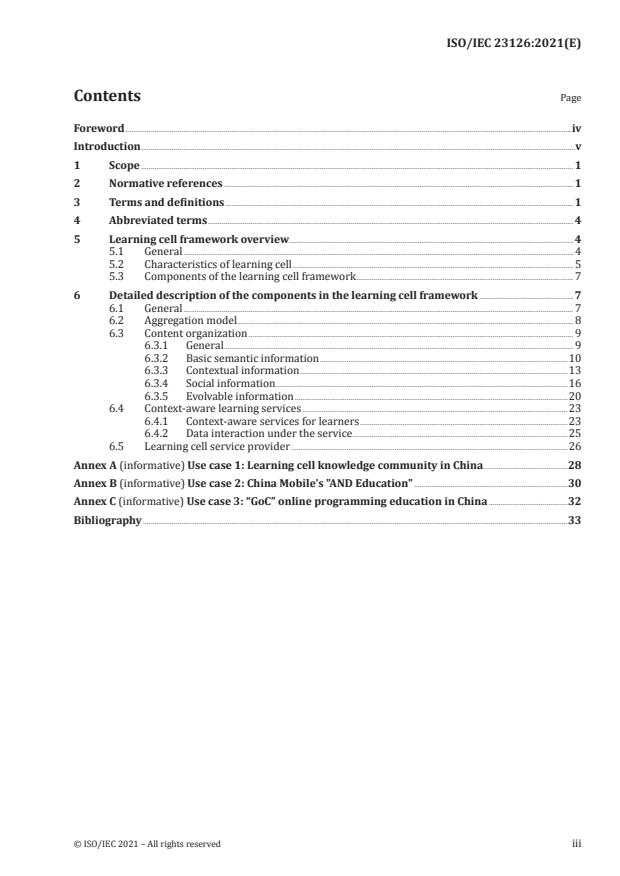

ISO/IEC 23126:2021 - Information technology for learning, education and training -- Ubiquitous learning resource organization and description framework

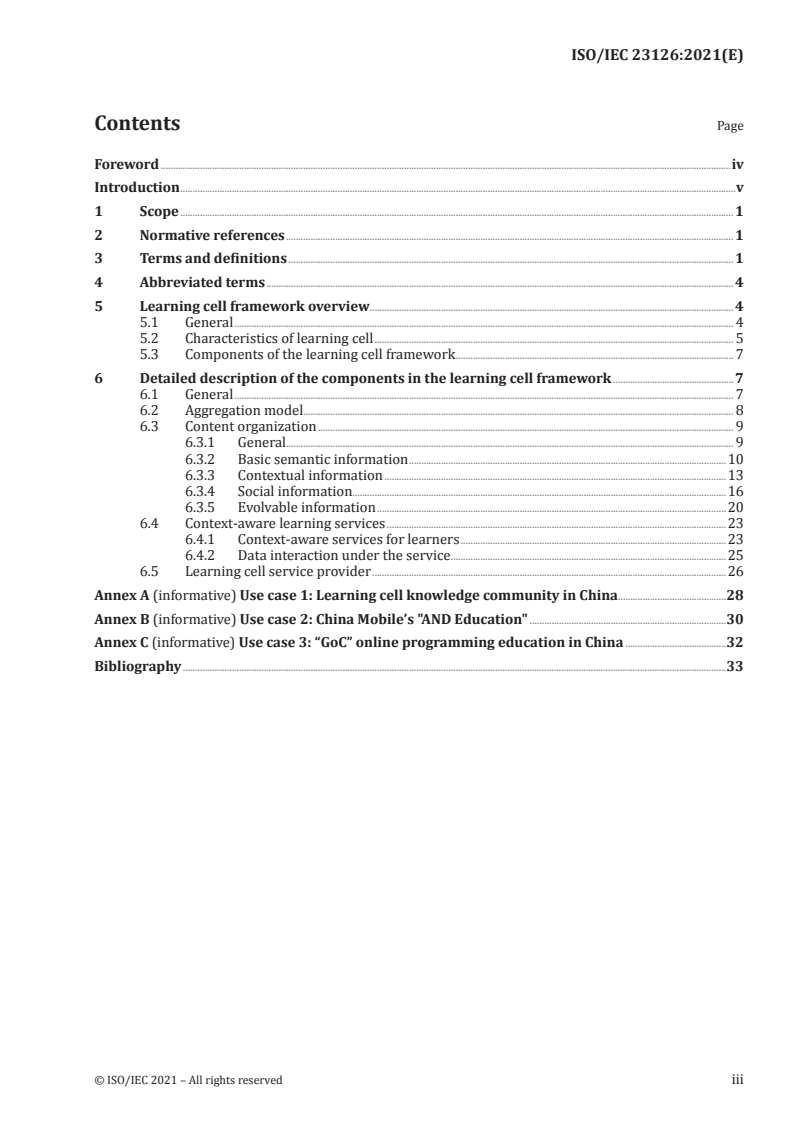

ISO/IEC 23126:2021 - Information technology for learning, education and training — Ubiquitous learning resource organization and description framework/19/2021
Overview
ISO/IEC 23126:2021 defines a framework for organizing and describing learning resources in ubiquitous learning environments. Also called the learning cell framework, the standard addresses how resources can be dynamically aggregated, how social interactions are recorded to support social learning, and how resources evolve through learner contributions. Core components include an aggregation model, content organization, context-aware learning services, and the learning cell service provider.
Keywords: ISO/IEC 23126:2021, ubiquitous learning, learning cell, learning resource organization, context-aware learning services, dynamic aggregation, social learning.
Key Topics
- Learning cell: A dynamic structure that models learning resources with four characteristics - contextual, social, evolvable, and dynamically aggregated.
- Learning cell entity & container: Presentations of learning cells in specific contexts and the storage/management space for extracted resources and ingredients.
- Aggregation model: Rules for semantically grouping learning ingredients into learning cells, clusters and knowledge clouds to satisfy diverse learning objectives.
- Content organization: Semantic, contextual, social and evolvable information schemas for describing learning ingredients (content, activities, tools, metadata).
- Context-aware learning services: Services that adapt resource delivery based on environment, device, learner state and contextual metadata.
- Social and evolvable information: Recording interactions, contributions and versioning so resources evolve as learners contribute knowledge.
- Identifiers & environment metadata: Stable identifiers and environment descriptors (time, location, network constraints) to support ubiquitous delivery.
- Note: The standard specifies the framework and component descriptions; it does not provide exhaustive technical definitions or implementation-level details.
Applications
ISO/IEC 23126:2021 is intended for organizations and professionals building adaptive, social and distributed learning systems:
- EdTech vendors and LMS/platform developers implementing context-aware and mobile/IoT-enabled learning services.
- Instructional designers and learning architects creating modular, reusable learning ingredients and personalized learning paths.
- Content aggregators and knowledge managers organizing resources into knowledge clusters and knowledge clouds.
- Educational institutions and enterprises deploying social-learning communities and personal learning spaces where learner contributions evolve content.
Practical uses include personalized mobile learning, dynamic content aggregation for blended learning, social learning analytics, and evolving curricula based on learner input. The standard’s annexes include real-world use cases illustrating implementation scenarios.
Related Standards
- References in the document link to ISO/IEC 19788 (learning metadata), ISO 30401 (knowledge management), and ISO/IEC 2382 (IT terminology).
- ISO/IEC 23126 contains no normative references but is complementary to metadata and learning-technology standards for implementation planning.
For teams designing ubiquitous learning solutions, ISO/IEC 23126:2021 provides a conceptual blueprint to organize adaptive, social and evolving learning resources.
Relations
- Effective Date
- 28-Jan-2023
Buy Documents
ISO/IEC 23126:2021 - Information technology for learning, education and training -- Ubiquitous learning resource organization and description framework
ISO/IEC 23126:2021 - Information technology for learning, education and training — Ubiquitous learning resource organization and description framework/19/2021
Get Certified
Connect with accredited certification bodies for this standard

BSI Group
BSI (British Standards Institution) is the business standards company that helps organizations make excellence a habit.

NYCE
Mexican standards and certification body.
Sponsored listings
Frequently Asked Questions
ISO/IEC 23126:2021 is a standard published by the International Organization for Standardization (ISO). Its full title is "Information technology for learning, education and training — Ubiquitous learning resource organization and description framework". This standard covers: This document specifies a framework to describe and organize learning resources in ubiquitous learning. It provides features to enable dynamic aggregation of resources in different learning contexts, in which the social interactions are recorded to facilitate social learning. The features that reflect the evolutionary history of resources based on learners’ contributions are also defined. The framework includes an aggregation model, content organization, context-aware learning services, and learning cell service provider.
This document specifies a framework to describe and organize learning resources in ubiquitous learning. It provides features to enable dynamic aggregation of resources in different learning contexts, in which the social interactions are recorded to facilitate social learning. The features that reflect the evolutionary history of resources based on learners’ contributions are also defined. The framework includes an aggregation model, content organization, context-aware learning services, and learning cell service provider.
ISO/IEC 23126:2021 is classified under the following ICS (International Classification for Standards) categories: 35.240.90 - IT applications in education. The ICS classification helps identify the subject area and facilitates finding related standards.
ISO/IEC 23126:2021 has the following relationships with other standards: It is inter standard links to ISO 17174:2024. Understanding these relationships helps ensure you are using the most current and applicable version of the standard.
ISO/IEC 23126:2021 is available in PDF format for immediate download after purchase. The document can be added to your cart and obtained through the secure checkout process. Digital delivery ensures instant access to the complete standard document.
Standards Content (Sample)
INTERNATIONAL ISO/IEC
STANDARD 23126
First edition
2021-04
Information technology for learning,
education and training — Ubiquitous
learning resource organization and
description framework
Technologies pour l'éducation, la formation et l'apprentissage —
Description de l'organisation et ressources d'apprentissage
omniprésent
Reference number
©
ISO/IEC 2021
© ISO/IEC 2021
All rights reserved. Unless otherwise specified, or required in the context of its implementation, no part of this publication may
be reproduced or utilized otherwise in any form or by any means, electronic or mechanical, including photocopying, or posting
on the internet or an intranet, without prior written permission. Permission can be requested from either ISO at the address
below or ISO’s member body in the country of the requester.
ISO copyright office
CP 401 • Ch. de Blandonnet 8
CH-1214 Vernier, Geneva
Phone: +41 22 749 01 11
Email: copyright@iso.org
Website: www.iso.org
Published in Switzerland
ii © ISO/IEC 2021 – All rights reserved
Contents Page
Foreword .iv
Introduction .v
1 Scope . 1
2 Normative references . 1
3 Terms and definitions . 1
4 Abbreviated terms . 4
5 Learning cell framework overview. 4
5.1 General . 4
5.2 Characteristics of learning cell . 5
5.3 Components of the learning cell framework . 7
6 Detailed description of the components in the learning cell framework .7
6.1 General . 7
6.2 Aggregation model . 8
6.3 Content organization . 9
6.3.1 General. 9
6.3.2 Basic semantic information .10
6.3.3 Contextual information .13
6.3.4 Social information . .16
6.3.5 Evolvable information .20
6.4 Context-aware learning services .23
6.4.1 Context-aware services for learners .23
6.4.2 Data interaction under the service .25
6.5 Learning cell service provider .26
Annex A (informative) Use case 1: Learning cell knowledge community in China .28
Annex B (informative) Use case 2: China Mobile’s "AND Education" .30
Annex C (informative) Use case 3: “GoC” online programming education in China .32
Bibliography .33
© ISO/IEC 2021 – All rights reserved iii
Foreword
ISO (the International Organization for Standardization) and IEC (the International Electrotechnical
Commission) form the specialized system for worldwide standardization. National bodies that
are members of ISO or IEC participate in the development of International Standards through
technical committees established by the respective organization to deal with particular fields of
technical activity. ISO and IEC technical committees collaborate in fields of mutual interest. Other
international organizations, governmental and non-governmental, in liaison with ISO and IEC, also
take part in the work.
The procedures used to develop this document and those intended for its further maintenance are
described in the ISO/IEC Directives, Part 1. In particular, the different approval criteria needed for
the different types of document should be noted. This document was drafted in accordance with the
editorial rules of the ISO/IEC Directives, Part 2 (see www .iso .org/ directives) or www .iec .ch/ members
_experts/ refdocs).
Attention is drawn to the possibility that some of the elements of this document may be the subject
of patent rights. ISO and IEC shall not be held responsible for identifying any or all such patent
rights. Details of any patent rights identified during the development of the document will be in the
Introduction and/or on the ISO list of patent declarations received (see www .iso .org/ patents) or the IEC
list of patent declarations received (see patents.iec.ch).
Any trade name used in this document is information given for the convenience of users and does not
constitute an endorsement.
For an explanation of the voluntary nature of standards, the meaning of ISO specific terms and
expressions related to conformity assessment, as well as information about ISO's adherence to the
World Trade Organization (WTO) principles in the Technical Barriers to Trade (TBT), see www .iso .org/
iso/ foreword .html. In the IEC, see www .iec .ch/ understanding -standards.
This document was prepared by Joint Technical Committee ISO/IEC JTC 1, Information technology,
Subcommittee SC 36, Information technology for learning, education and training.
Any feedback or questions on this document should be directed to the user’s national standards body. A
complete listing of these bodies can be found at www .iso .org/ members .html and www .iec .ch/ national
-committees.
iv © ISO/IEC 2021 – All rights reserved
Introduction
Ubiquitous learning is becoming increasingly prevalent. Ubiquitous learning makes it possible for
students to learn anything, at anytime, anywhere, using any learning device. To support ubiquitous
learning for learners, a ubiquitous learning support model should be constructed to provide ubiquitous
services. The model consists of four parts: user interface; sensor layer; educational cloud system; and
learning resources and services (Figure 1). During the learning process, the user interface detects
learners’ learning status, logs, interactions and personal information in the real learning context
through the sensor layer. Subsequently, the educational cloud system conducts computing and analysis
before providing learners with adaptive learning resources and services (see Annexes A, B and C).
Figure 1 — Ubiquitous learning support model
Learning resources and services are central to learners’ learning processes. However, learners’
learning contexts can change as learners start and continue learning at different points across time and
location. Under these circumstances, learners need adaptive resources and services to achieve effective
learning. Traditional learning resources are designed and developed by experts for specific contexts.
In some cases, the content is mostly static and cannot dynamically change to meet the diverse needs of
learners who are accessing content in different environments. In addition, learners can encounter some
difficulties as they learn specific topics. Related experts, peers or resources supporting the learning of
the topic can be helpful for learners to expand their knowledge and knowledge-related connections.
As time passed, learners can also contribute to current knowledge and thus promote the updating or
evolution of knowledge while they achieve even higher-level knowledge. In order to make the learning
process effective, it is important to provide learners with continuously evolving resources:
a) Learning resources should have the ability to adapt to different learners’ needs under different
learning contexts.
b) Learning resources should support the interactions not only between learners and resources, but
also the interactions among learners and among resources.
c) Learning resources should evolve according to the contribution of learners or new knowledge so
that they can be continuously adapted for learners with diverse needs.
© ISO/IEC 2021 – All rights reserved v
d) In order to support personalized learning, dynamic and distributed resource aggregation service
should be provided to learners with different learning requirements.
In summary, the ubiquitous learning support model needs to support diverse contexts, rich social
interactions, continuous evolution and dynamic aggregation of knowledge. To that end, learning
resources are the most important part for realizing the adaption of the learning process. In order to
support that adaption, not only experts but also learners should be involved in the co-construction
of learning resources. During the resource construction, resources should align with the contextual,
social, evolvable and dynamic aggregated features. And in order to make the resources constructed by
different contributors align with those features, a standardized guideline is needed for co-construction.
However, existing standards for learning resources design and development focus on different aspects
of static learning resources in terms of topic, description, related subjects, contributor and so on, and
there is no description of the contextual, social, evolvable and dynamic aspects. In order to support these
aspects, this document offers a ubiquitous learning resource organization and description framework,
which is also referred to as a “learning cell framework”. This document provides a description of the
main framework for ubiquitous learning resources. It does not provide detailed definition.
vi © ISO/IEC 2021 – All rights reserved
INTERNATIONAL STANDARD ISO/IEC 23126:2021(E)
Information technology for learning, education and
training — Ubiquitous learning resource organization and
description framework
1 Scope
This document specifies a framework to describe and organize learning resources in ubiquitous
learning. It provides features to enable dynamic aggregation of resources in different learning contexts,
in which the social interactions are recorded to facilitate social learning. The features that reflect the
evolutionary history of resources based on learners’ contributions are also defined.
The framework includes an aggregation model, content organization, context-aware learning services,
and learning cell service provider.
2 Normative references
There are no normative references in this document.
3 Terms and definitions
For the purposes of this document, the following terms and definitions apply.
ISO and IEC maintain terminological databases for use in standardization at the following addresses:
— ISO Online browsing platform: available at https:// www .iso .org/ obp
— IEC Electropedia: available at http:// www .electropedia .org/
3.1
entity
any concrete or abstract thing that exists, did exist, or might exist, including associations among
these things
EXAMPLE A person, an object, an event, an idea, a process, etc.
Note 1 to entry: Entity is a supportive element of identifier.
[SOURCE: ISO/IEC 2382:2015, 2121433, modified — domain of removed, notes to entry
updated]
3.2
environment
context, surroundings or conditions in which a person learns, lives or operates
Note 1 to entry: Environment information includes time zones, geographical information, applicable norms and
standards for telecommunication, technical implementation (firewalls, useable or allowed ports, bandwidth, file
size restrictions, etc.), infrastructure support, current noise levels, and other environmental factors that may
impact on delivery modes required by the learner.
3.3
identifier
sequence of characters capable of uniquely identifying an entity (3.1)
[SOURCE: ISO/IEC 19788-1:2011, 3.19, modified — notes to entry removed]
© ISO/IEC 2021 – All rights reserved 1
3.4
knowledge
human or organizational asset enabling effective decisions and action in context
Note 1 to entry: Knowledge can be individual, collective or organizational.
Note 2 to entry: There are diverse views on the scope covered within knowledge, based on context and purpose. The
definition above is general as to the various perspectives. Examples of knowledge include insights and know-how.
Note 3 to entry: Knowledge is acquired through learning or experience.
[SOURCE: ISO 30401:2018, 3.25]
3.5
knowledge cloud
collection of learning cell (3.7) and knowledge cluster (3.6) aggregated semantically based on several
related or similar topics to satisfy particular requirements for learning
3.6
knowledge cluster
collection of two or more learning cells (3.7) aggregated semantically based on a specific topic
Note 1 to entry: Knowledge cluster is a supportive element of knowledge cloud.
Note 2 to entry: Knowledge cluster can be involved in learning communities to support learners’ learning.
3.7
learning cell
dynamic structure for ubiquitous learning resource (3.13), which defines the basic elements and their
relations, and provides a personalized presentation [learning cell entity (3.9)] to support the diverse
needs of learners based on a specific learning objective
Note 1 to entry: The structure is context adaptive, involves social factors to support social learning, realizes the
evolution based on learners’ interactions and contributions, and can dynamically aggregate content, based on
the contextual, social and evolvable information and present learners with personalized learning cell entity (3.9).
Note 2 to entry: Learning cell has four characteristics: contextual, social, evolvable and dynamic aggregated.
Note 3 to entry: Learning cell is a supportive element of knowledge cloud and knowledge cluster.
Note 4 to entry: Learning cell can be involved in learning communities to support learners’ learning.
3.8
learning cell container
space where learning resource (3.13) or learning ingredient (3.11) is extracted from different learning
systems and managed according to specific topic or topics
Note 1 to entry: In this space, the resources or ingredients collected from the learning systems can be reorganized
and retained in a well-structured manner.
3.9
learning cell entity
instance of a learning cell (3.7) that can be used in different learning contexts to support different
learning needs
Note 1 to entry: A learning cell entity is a presentation of a learning cell within a specific context.
3.10
learning community
area in which learners with the same interests can interact, access, and share information using
resources such as learning cell (3.7) and knowledge clusters (3.6) to achieve specific learning objectives
or outcomes
2 © ISO/IEC 2021 – All rights reserved
3.11
learning ingredient
component that can be used to form a learning cell (3.7), such as content, activity, tools and metadata
Note 1 to entry: A learning ingredient is a supportive element of learning cell.
3.12
learning objective
description of a goal of training or learning in terms of the knowledge, skills or performance expected
of a learner
Note 1 to entry: A learning objective may also be referred to as a learning outcome.
Note 2 to entry: A learning objective is often defined based on the requirements of a curriculum criterion or a set
of criteria.
[SOURCE: ISO/IEC 2382-36:2019, 3.5.2, modified — notes to entry added]
3.13
learning resource
resource (3.17) used for learning, education and training
[SOURCE: ISO/IEC 19788-1:2011, 3.20]
3.14
obligation status
indication of whether or not a value for the attribute is to be provided
[SOURCE: ISO/IEC 19788-1:2011, 3.20, modified — note to entry removed]
3.15
person
person class
any entity (3.1) which is a natural or legal person
3.16
personal learning space
place for a learner to manage his/her learning profile, assignments, interactive data, evaluation and
associated information generated during the learning process
Note 1 to entry: This personal space may be shared with learner’s permission to instructor(s), other learner(s),
and other systems to support further learning of the individual, other individuals, and the system itself. Learner
data and interactions are private in the personal space and learner consent is required to share this data.
3.17
resource
entity (3.1) that can be identified and referenced by an unambiguous and stable identifier (3.3) in a
recognized identification system
[SOURCE: ISO/IEC 19788-1:2011, 3.30]
3.18
resource class
set of resources (3.17) that can be identified by listing or description of boundaries and meaning and
whose properties and behaviour follow the same rule
Note 1 to entry: A resource class has the following attributes:
— Identifier.
— Name.
— Definition.
© ISO/IEC 2021 – All rights reserved 3
— SubclassOf [multiple inheritance].
— Note.
EXAMPLE Learning Resources (set of all learning resources), Persons (set of all Persons), Rights (set of all
rights objects), and Documents (set of all documents).
[SOURCE: ISO/IEC 19788-1:2011, 3.31]
3.19
sharable learning cell description interface
SLDI
interface to provide registration and open access for services and resources in different learning systems
3.20
social knowledge network
SKN
network constituted by person, knowledge and their relations based on specific knowledge that
supports learners’ knowledge and peer discovery during the ubiquitous learning process
Note 1 to entry: A social knowledge network represents all the nodes that have a relationship with specific
knowledge, and the nodes include person nodes and knowledge nodes.
3.21
ubiquitous learning
learning that is stimulated and supported through diverse channels and always readily accessible
[SOURCE: ISO/IEC TS 29140:2020, 3.15]
4 Abbreviated terms
LOM learning object metadata
MLR metadata for learning resources
ITLET information technology for learning, education and training
API application programming interface
5 Learning cell framework overview
5.1 General
The learning cell framework supports learners’ ubiquitous learning. An overview of the ubiquitous
learning model supported by the learning cell framework is provided in Figure 2, which illustrates the
process for learners to acquire ubiquitous learning services in different situations. In this model, the
situations (classroom, home, bus station and so on) where learners’ learning requirements rise are
defined. In different situations, learners can interact with learning cells embedded in different devices.
During this process, the learning cell service will detect learners’ personalized information and learning
status with various sensors. Detected information will be sent to the educational cloud computing
centre for analysis. The educational cloud computing centre conducts analysis and decides learners’
current states and needs. The needs include several kinds of personalized services, such as knowledge
network, social network, and other learning services (learning tools, learning activities, cognitive map
and so on). These services will be dynamically collected, aggregated with the form of the learning cell
and then present to learners with an adaptive presentation.
4 © ISO/IEC 2021 – All rights reserved
After these processes, learners can acquire adaptive learning support. With learners’ further
interactions, the learning cell can also be enriched. This document defines the core factors in a
ubiquitous learning resource, and these constitute the organization and description framework.
Figure 2 — Ubiquitous learning supported by the learning cell framework
The learning cell framework defines the characteristics of learning resources, in which different
situations are supported for contextualized learning. At the same time, social knowledge network is
used to support social learning and learning activities can be used to help the progression of the learners
and learning resources. At last, the learning resources can be dynamically aggregated from different
sources. Moreover, the framework also provides a detailed introduction of how these characteristics are
represented with specific properties. Subclauses 5.2 and 5.3 define the characteristics and components
of the learning cell framework.
5.2 Characteristics of learning cell
The learning cell has four essential characteristics: contextual, social, evolvable, and dynamic-
aggregated. These characteristics can help realize the previously mentioned resource requirements
Contextual: The learning cell provides a changeable and dynamic structure that can adjust the
elements and their organization in the structure so as to support learners’ learning under different
contexts. After that learners in different contexts can access resources that are aligned with their
contexts both in terms of structure and display. This means that the presentation of the resource will
match the learners’ contexts.
Social: The learning cell provides social elements in its structure. The social elements are presented to
learners with the form of social knowledge network, which contains person nodes, knowledge nodes,
and the relations among these nodes. The nodes and relations in the social knowledge network are
© ISO/IEC 2021 – All rights reserved 5
created by learners’ social interactions with different knowledge and related person nodes, such as
other learners. The interactions will be retained as the SKN and used for computing and analysis.
Evolvable: The learning cell defines elements to record the interaction history and aggregation history
of resources during the learning process. The interaction history is based on the contributions of
different learners and promotes the learning cell transformation from insufficient to sufficient, low-
quality to high-quality. The control of this process will be realized by algorithms. Also, when new
resources are created, they will be classified semantically by algorithm, and thus cluster to a higher-
level resource with higher quality.
Dynamic-aggregated: The learning cell defines the aggregate process how a learning cell entity can
be formed and presented to learners dynamically. Contextual information is the basic condition for
realizing the dynamic aggregation. A computing centre in the learning cell first conducts data analysis
based on the contextual information and decides the elements involved in the learning cell entity. Then
the sequences or structure of different elements will be computed, thus aggregating the elements
together in a well-ordered manner. Also, when the context changes, the learning cell will detect the
change and conduct re-aggregation dynamically. In this way, the resource is dynamically aggregated.
Figure 3 — Functions supported by learning cell framework
To realize these characteristics, this document defines how the system is supported by learning cell
framework functions (see Figure 3). It includes three core elements: devices, connected network, and
educational cloud computing centre. When ubiquitous learning begins, learners send their requirements
through adaptive devices. Then the requests and related data collected by the sensors embedded in the
environment are sent through the connected network to the educational cloud computing centre. After
receiving the requested information, the context-aware module conducts analysis, and then transfers
the analysed information to the recommendation and decision module. The recommendation and
decision module are responsible for indexing, searching and selecting ingredients from the learning
cell container, including learning objectives, content, activities, semantic information and cognitive
network. Then the extracted ingredients are aggregated through the aggregation module into learning
cell. Finally, the learning cell is displayed adaptively after format matching, such as matching type, size,
and resolution of the device. Users can interact with the learning cell and promote the evolution of the
learning cell.
6 © ISO/IEC 2021 – All rights reserved
5.3 Components of the learning cell framework
The components of the learning cell framework are shown in Figure 4. The aggregation model defines
the structure of a learning cell. The content organization provides detailed description for the elements
and features in a learning cell. Context-aware learning services can support learners’ situated learning
based on the model and the organization, and finally the learning cell service provider can help the
learning cell service be used by different systems or platforms:
— Aggregation model: The learning cell aggregation model defines the core elements and aggregation
process of learning cell framework. With this model, learning systems which in line with the learning
cell standard can conduct resource aggregation and provide learners with adaptive entities to
different learners in different contexts.
— Content organization: The content organization defines the detailed semantic information and
their organization which support the composition of the learning cell. The semantic information
includes basic semantic information, contextual information, social information and evolvable
information.
— Context-aware learning services: Context-aware learning services provide APIs for learners
to access resource aggregation services for ubiquitous learning. The services are based on the
learners’ contextual information and personal profile. With the information authorized, the system
can provide learners with adaptive learning services.
— Learning cell service provider: The learning cell service provider defines the process of how to
realize learning cell services in different systems. It stores the service information and guidelines
on how to register the services. Moreover, different systems can communicate with each other and
with the registered services.
Figure 4 — Components of learning cell framework
6 Detailed description of the components in the learning cell framework
6.1 General
The four components of the learning cell framework play different roles during the ubiquitous learning.
The aggregation model decides the structure of the ubiquitous learning resources. The content
organization provides the detailed information regarding organization and structure. The context-
aware learning services sense learners’ information under different situations and help decide what
© ISO/IEC 2021 – All rights reserved 7
kind of resource or service learners need. Finally, the learning cell service provider provides open
services among different learning systems or platforms.
6.2 Aggregation model
This component defines which elements constitute the learning cell and how to realize the aggregation
process with the provided elements. With these elements, the detailed content can be aggregated
dynamically if the context changes. The learning cell is a dynamic structure. It is organized based on
specific knowledge and is related to one learning objective. At the back of the structure, there are large
amounts of resources used to support the dynamic aggregation of the learning cell for learners based
on the structure, environment and context. The aggregated learning cell can be represented to learners
as a learning cell entity.
Elements of the learning cell aggregation model include: learning objective, semantic information,
content, activity and SKN, as shown in Figure 5. The learning objective, as an educational property, is
the most important element of learning. It defines which learning level the learners are supposed to
attain after the learning process. Semantic information will be used to differentiate learning cells. On
one hand, it defines what topic the current learning cell is. On the other hand, it defines the organization
of elements within this learning cell. Content and activity are the main parts of the learning cell.
These elements represent the real resources (or learning cell instances) that learners get during the
learning process. SKN describes the network of the current learning cell. It includes social relations
and knowledge relations. With these relations, learning will become connected and helpful to learners’
progress.
Figure 5 — Aggregation model
Regarding the aggregation process, there are three components: learning cell, knowledge cluster,
and knowledge cloud. There are three levels of aggregation: aggregation of a single learning cell,
aggregation from single learning cell to knowledge cluster, and aggregation from knowledge cluster to
knowledge cloud.
For the aggregation of a single learning cell, all these processes are based on the aggregation model.
It will search for related ingredients from the learning cell container and then output the learning cell
entity with specific learning objective and organization.
After certain learning cells are aggregated, multiple learning cells with the same topic can be aggregated
to a knowledge cluster. The learning cells in a knowledge cluster can be networked by different semantic
relations. The knowledge cluster can also directly or indirectly help establish relationships between
users and resources.
Similarly, knowledge clusters with similar themes or strong semantic relationships can be aggregated
to the knowledge cloud, which can provide richer learning content with relevant themes for learners
(see Figure 6).
8 © ISO/IEC 2021 – All rights reserved
Figure 6 — Aggregation process for learning cells
6.3 Content organization
6.3.1 General
In order to satisfy the specific learning objective accurately, the learning cell is expected to have a well-
organized structure. On one hand, some internal properties are required to describe the relationships
between entities within the learning cell. On the other hand, some associated properties can be used
to describe the relationships between different learning cells. To achieve this purpose, this framework
specifies the content organization of a learning cell that contains both the learning ingredients, contexts
and the descriptions of all of these relationships. All of these elements are supported by the learning
cell container defined in the learning cell framework (see 6.4.1.2).
The content organization of the learning cell is described in Figure 7 and contains three parts:
ingredients, resource contexts, and description of the learning cell information that reflect learning cell’s
characteristics (basic semantic information, contextual information, social information and evolvable
information). Ingredients include multimedia resources, learning activities, learning tools, templates,
evaluations and generative information provided by the learning cell container. Resource contexts
describe the list of the provided context or situation in which the learning occurs. The description of the
learning cell information defines information based on the learning cell’s characteristics and contains
four sub-parts: basic semantic information, contextual information, social information and evolvable
information.
The basic semantic information is based on the metadata defined in IEEE LOM, Dublin Core, and MLR,
and is the basic information which supports the dynamic aggregation. This document also makes
some adjustments according to the ubiquitous learning needs. The other three descriptions are
unique features of the learning cell and help realize the contextualization, socialization, and evolution
characteristics in ubiquitous learning. The contextual information describes the most preferred context
in which the learning cell can be implemented. The social information provides the rules and relations
that make the learning cell a social entity. With the information, a network can be constructed, thus
learners and learning cells can be located more easily. The evolvable information describes the dynamic
state of a learning cell. In ubiquitous learning, the learning cell can dynamically change and evolve with
© ISO/IEC 2021 – All rights reserved 9
learners’ learning process and emerging contents. Hence, it is necessary to record the version updates
and interactions for the learning cell. Subclauses 6.3.2 to 6.3.5 specify the four descriptions in detail.
Key
characteristic information
ingredients
resource contexts
Figure 7 — Content organization of the learning cell
6.3.2 Basic semantic information
This document supports semantic description for basic metadata existing in previous learning
resource standards, such as title, description, life cycle and so on. This framework defines all of
these properties using triples, like ,,
hasValue,PropertyValue>. With numerous triples, resources can connect to each other based on
the relations defined. When one resource is changed, the related resources can successively be
updated according to the relations in the triples. The basic semantic information will facilitate the
representation, categorized management, browsing, searching, sharing and exchange of learning
resources, and enhance completeness of the description.
In detail, basic semantic information in the learning cell framework mainly includes the following
data elements: basic information of resources (general), copyright information of resources (right),
pre-defined relation information (relation), annotation information (annotation, conforming to the
web annotation data model and the ISO/IEC 19788 series), historical edition information (lifecycle),
learning material organization information (organization, extend the classification and education
in LOM), learning content information (learning content), learning objective information (learning
objective), evaluation scheme information (evaluation), practice/test information (practice), learning
activity information (learning activity), version description information (content version), sensor and
so on (see Figure 8). Most of these data elements are used to describe the content of the resources,
while sensor is a data element which realizes the perception of information through tags or QR codes.
10 © ISO/IEC 2021 – All rights reserved
Key
data element
relations
Figure 8 — Basic semantic information
The data elements, information and their citations are shown in Table 1. These elements are basic
elements in composing the learning cell. Their citation sources and obligation status are described. The
information can be extended if needed.
Table 1 — Cited elements
Data elements Citation source Obligation status
Annotation 19788-5:2012::RC0001 Annotation optional
Classification 19788-5:2012::DES1000 mandatory
Content version 19788-8:2015::DES0500 optional
Contributor 19788-2:2011::DES0600 mandatory
Coverage 19788-2:2011::DES1400 optional
Creator 19788-2::DES0200 mandatory
Data Dublin Core mandatory
Evaluation Adjusted from Educational of LOM optional
Format 19788-2:2011::DES0900 mandatory
GeneralInfo Adjusted from LOM(General) mandatory
Learning activity 19788-5:2012::RC0005 Learning optional
activity
Learning content New optional
Learning objective Adjusted from Educational of LOM optional
LifeCycle LOM optional
Organization Dublin Core(Publisher),LOM optional
© ISO/IEC 2021 – All rights reserved 11
Table 1 (continued)
Data elements Citation source Obligation status
Practice/test Adjusted from Educational of LOM optional
Relation Adjusted from 19788-5::DES2700 optional
Pedagogical Relation
Rights 19788-2:2011::DES1500 mandatory
Sensor New mandatory
Source Dublin Core mandatory
Subject and keywords 19788-2::DES0300 optional
Other information … …
For each of these data elements, the learning cell can be represented in detail with some descriptive
data properties, such as identifier, name, description, language (used to describe what language the
element support) and other information. Apart from the proposed data properties, two new properties
are needed: ‘RecordPermission’ and ‘AccessibleToOthers’, to describe if the learner would like their data
to be recorded and open access to others. The detailed description is like the following:
DES-FORMAT:
— Identifier: from 19788-1;
— Name: from19788 -2: 2011: : DES0100 Title;
— Definition;
— Language;
— RecordPermission;
— AccessibleToOthers;
— OtherInformation.
Figure 8 shows the elements of the learning cell, which are described in detail in Figure 9. Each element
is drawn as a rectangle or circle, and each relation is drawn as an arrow. The arrows and the objects at
the arrows’ start and end constitute the triples which describe the learning resources.
Figure 9 — Description of each element
12 © ISO/IEC 2021 – All rights reserved
6.3.3 Contextual information
Contextual information is one of the core characteristics of ubiquitous learning and it represents
factors that indicate if a specific resource can be used in one context. This is quite important for the
effectiveness and adaptability of learning. The context-based adaptation considers different types of
contexts, such as devices, output format, content, and so on. On one hand, the output service is required
to be in accordance with the devices and the outer conditions to make sure the format of the resource
adapts to the learners. On the other hand, the content shall be adapted to learners with different
abilities or characteristics to realize content adaption (see Figure 10). As shown in Figure 10, learners
can start learning under different contexts with different devices. Under this condition, the learning
resources provided to the learners can be different and adaptive to the devices and contexts. Also, as
noted in Figure 10, Learner1 and Learner2 are different users with varied abilities who need to get
specific content adapted to their learning abilities and requirements. This can help make learning more
efficient. To realize these efficiencies, a method shall be proposed to define and describe the contexts of
learning resources, as well as a contextualized process.
Figure 10 — The demand for contextualized resources
To satisfy varied learning demands, categories of contexts, and the detailed properties under them, will
be defined. Also, resources in the learning cell container are tagged with provided context properties.
Only in this way, the ubiquitous learning system can recommend resources accurately. For example,
when a learner is learning Knowledge A at Location L, the ubiquitous learning system should provide
resources that are adaptable for Knowledge A and Location L. If the resource was not tagged before,
the ubiquitous learning system would not be able to decide whether this resource is appropriate for the
specific learner or not.
To ensure this, the contextual service framework is specified, which is used to describe the function
of contextual services for learners (see Figure 11). In this service framework, the details of contextual
information are defined: equipment context, time-space context, physical state context, instructional
state context and learning state context.
In the contextual service framework, there are several factors: learners, sensor, context-aware,
adaptive resources, adaptive resource instances, and resource and rule database. Learner1, Learner2,
Learner3, … represent different kinds of learners. The sensor represents the medium that can sense
learners’ requirements and convey the appropriate information. The context-aware module can match
© ISO/IEC 2021 – All rights reserved 13
each learner’s requirement with the resources in a database based on specific relations. The adaptive
resources module defines two kinds of adaption: format and content. The adaptive resource instances
module identifies the final resource shown to different users. The database is a place that stores all
the resource ingredients and rules. When learners’ requirements are identified, the demands can
be transferred to the ubiquitous learning server through sensors. After that, the server will conduct
context matching (format adaption and content adaption) with the defined context relations. Finally,
adaptive resource instances will be pushed to different learners.
Figure 11 — Contextual service framework
In the framework, five kinds of contextual information are defined. The equipment context describes
basic parameters of the equipment suited to this resource, such as the type of equipment (PC, laptop,
smartphone, tablets, PDA etc.), dimension, definition, memory, etc. The time-space context describes
the optimal
...
INTERNATIONAL ISO/IEC
STANDARD 23126
First edition
2021-04
Information technology for learning,
education and training — Ubiquitous
learning resource organization and
description framework
Technologies pour l'éducation, la formation et l'apprentissage —
Description de l'organisation et ressources d'apprentissage
omniprésent
Reference number
©
ISO/IEC 2021
© ISO/IEC 2021
All rights reserved. Unless otherwise specified, or required in the context of its implementation, no part of this publication may
be reproduced or utilized otherwise in any form or by any means, electronic or mechanical, including photocopying, or posting
on the internet or an intranet, without prior written permission. Permission can be requested from either ISO at the address
below or ISO’s member body in the country of the requester.
ISO copyright office
CP 401 • Ch. de Blandonnet 8
CH-1214 Vernier, Geneva
Phone: +41 22 749 01 11
Email: copyright@iso.org
Website: www.iso.org
Published in Switzerland
ii © ISO/IEC 2021 – All rights reserved
Contents Page
Foreword .iv
Introduction .v
1 Scope . 1
2 Normative references . 1
3 Terms and definitions . 1
4 Abbreviated terms . 4
5 Learning cell framework overview. 4
5.1 General . 4
5.2 Characteristics of learning cell . 5
5.3 Components of the learning cell framework . 7
6 Detailed description of the components in the learning cell framework .7
6.1 General . 7
6.2 Aggregation model . 8
6.3 Content organization . 9
6.3.1 General. 9
6.3.2 Basic semantic information .10
6.3.3 Contextual information .13
6.3.4 Social information . .16
6.3.5 Evolvable information .20
6.4 Context-aware learning services .23
6.4.1 Context-aware services for learners .23
6.4.2 Data interaction under the service .25
6.5 Learning cell service provider .26
Annex A (informative) Use case 1: Learning cell knowledge community in China .28
Annex B (informative) Use case 2: China Mobile’s "AND Education" .30
Annex C (informative) Use case 3: “GoC” online programming education in China .32
Bibliography .33
© ISO/IEC 2021 – All rights reserved iii
Foreword
ISO (the International Organization for Standardization) and IEC (the International Electrotechnical
Commission) form the specialized system for worldwide standardization. National bodies that
are members of ISO or IEC participate in the development of International Standards through
technical committees established by the respective organization to deal with particular fields of
technical activity. ISO and IEC technical committees collaborate in fields of mutual interest. Other
international organizations, governmental and non-governmental, in liaison with ISO and IEC, also
take part in the work.
The procedures used to develop this document and those intended for its further maintenance are
described in the ISO/IEC Directives, Part 1. In particular, the different approval criteria needed for
the different types of document should be noted. This document was drafted in accordance with the
editorial rules of the ISO/IEC Directives, Part 2 (see www .iso .org/ directives) or www .iec .ch/ members
_experts/ refdocs).
Attention is drawn to the possibility that some of the elements of this document may be the subject
of patent rights. ISO and IEC shall not be held responsible for identifying any or all such patent
rights. Details of any patent rights identified during the development of the document will be in the
Introduction and/or on the ISO list of patent declarations received (see www .iso .org/ patents) or the IEC
list of patent declarations received (see patents.iec.ch).
Any trade name used in this document is information given for the convenience of users and does not
constitute an endorsement.
For an explanation of the voluntary nature of standards, the meaning of ISO specific terms and
expressions related to conformity assessment, as well as information about ISO's adherence to the
World Trade Organization (WTO) principles in the Technical Barriers to Trade (TBT), see www .iso .org/
iso/ foreword .html. In the IEC, see www .iec .ch/ understanding -standards.
This document was prepared by Joint Technical Committee ISO/IEC JTC 1, Information technology,
Subcommittee SC 36, Information technology for learning, education and training.
Any feedback or questions on this document should be directed to the user’s national standards body. A
complete listing of these bodies can be found at www .iso .org/ members .html and www .iec .ch/ national
-committees.
iv © ISO/IEC 2021 – All rights reserved
Introduction
Ubiquitous learning is becoming increasingly prevalent. Ubiquitous learning makes it possible for
students to learn anything, at anytime, anywhere, using any learning device. To support ubiquitous
learning for learners, a ubiquitous learning support model should be constructed to provide ubiquitous
services. The model consists of four parts: user interface; sensor layer; educational cloud system; and
learning resources and services (Figure 1). During the learning process, the user interface detects
learners’ learning status, logs, interactions and personal information in the real learning context
through the sensor layer. Subsequently, the educational cloud system conducts computing and analysis
before providing learners with adaptive learning resources and services (see Annexes A, B and C).
Figure 1 — Ubiquitous learning support model
Learning resources and services are central to learners’ learning processes. However, learners’
learning contexts can change as learners start and continue learning at different points across time and
location. Under these circumstances, learners need adaptive resources and services to achieve effective
learning. Traditional learning resources are designed and developed by experts for specific contexts.
In some cases, the content is mostly static and cannot dynamically change to meet the diverse needs of
learners who are accessing content in different environments. In addition, learners can encounter some
difficulties as they learn specific topics. Related experts, peers or resources supporting the learning of
the topic can be helpful for learners to expand their knowledge and knowledge-related connections.
As time passed, learners can also contribute to current knowledge and thus promote the updating or
evolution of knowledge while they achieve even higher-level knowledge. In order to make the learning
process effective, it is important to provide learners with continuously evolving resources:
a) Learning resources should have the ability to adapt to different learners’ needs under different
learning contexts.
b) Learning resources should support the interactions not only between learners and resources, but
also the interactions among learners and among resources.
c) Learning resources should evolve according to the contribution of learners or new knowledge so
that they can be continuously adapted for learners with diverse needs.
© ISO/IEC 2021 – All rights reserved v
d) In order to support personalized learning, dynamic and distributed resource aggregation service
should be provided to learners with different learning requirements.
In summary, the ubiquitous learning support model needs to support diverse contexts, rich social
interactions, continuous evolution and dynamic aggregation of knowledge. To that end, learning
resources are the most important part for realizing the adaption of the learning process. In order to
support that adaption, not only experts but also learners should be involved in the co-construction
of learning resources. During the resource construction, resources should align with the contextual,
social, evolvable and dynamic aggregated features. And in order to make the resources constructed by
different contributors align with those features, a standardized guideline is needed for co-construction.
However, existing standards for learning resources design and development focus on different aspects
of static learning resources in terms of topic, description, related subjects, contributor and so on, and
there is no description of the contextual, social, evolvable and dynamic aspects. In order to support these
aspects, this document offers a ubiquitous learning resource organization and description framework,
which is also referred to as a “learning cell framework”. This document provides a description of the
main framework for ubiquitous learning resources. It does not provide detailed definition.
vi © ISO/IEC 2021 – All rights reserved
INTERNATIONAL STANDARD ISO/IEC 23126:2021(E)
Information technology for learning, education and
training — Ubiquitous learning resource organization and
description framework
1 Scope
This document specifies a framework to describe and organize learning resources in ubiquitous
learning. It provides features to enable dynamic aggregation of resources in different learning contexts,
in which the social interactions are recorded to facilitate social learning. The features that reflect the
evolutionary history of resources based on learners’ contributions are also defined.
The framework includes an aggregation model, content organization, context-aware learning services,
and learning cell service provider.
2 Normative references
There are no normative references in this document.
3 Terms and definitions
For the purposes of this document, the following terms and definitions apply.
ISO and IEC maintain terminological databases for use in standardization at the following addresses:
— ISO Online browsing platform: available at https:// www .iso .org/ obp
— IEC Electropedia: available at http:// www .electropedia .org/
3.1
entity
any concrete or abstract thing that exists, did exist, or might exist, including associations among
these things
EXAMPLE A person, an object, an event, an idea, a process, etc.
Note 1 to entry: Entity is a supportive element of identifier.
[SOURCE: ISO/IEC 2382:2015, 2121433, modified — domain of removed, notes to entry
updated]
3.2
environment
context, surroundings or conditions in which a person learns, lives or operates
Note 1 to entry: Environment information includes time zones, geographical information, applicable norms and
standards for telecommunication, technical implementation (firewalls, useable or allowed ports, bandwidth, file
size restrictions, etc.), infrastructure support, current noise levels, and other environmental factors that may
impact on delivery modes required by the learner.
3.3
identifier
sequence of characters capable of uniquely identifying an entity (3.1)
[SOURCE: ISO/IEC 19788-1:2011, 3.19, modified — notes to entry removed]
© ISO/IEC 2021 – All rights reserved 1
3.4
knowledge
human or organizational asset enabling effective decisions and action in context
Note 1 to entry: Knowledge can be individual, collective or organizational.
Note 2 to entry: There are diverse views on the scope covered within knowledge, based on context and purpose. The
definition above is general as to the various perspectives. Examples of knowledge include insights and know-how.
Note 3 to entry: Knowledge is acquired through learning or experience.
[SOURCE: ISO 30401:2018, 3.25]
3.5
knowledge cloud
collection of learning cell (3.7) and knowledge cluster (3.6) aggregated semantically based on several
related or similar topics to satisfy particular requirements for learning
3.6
knowledge cluster
collection of two or more learning cells (3.7) aggregated semantically based on a specific topic
Note 1 to entry: Knowledge cluster is a supportive element of knowledge cloud.
Note 2 to entry: Knowledge cluster can be involved in learning communities to support learners’ learning.
3.7
learning cell
dynamic structure for ubiquitous learning resource (3.13), which defines the basic elements and their
relations, and provides a personalized presentation [learning cell entity (3.9)] to support the diverse
needs of learners based on a specific learning objective
Note 1 to entry: The structure is context adaptive, involves social factors to support social learning, realizes the
evolution based on learners’ interactions and contributions, and can dynamically aggregate content, based on
the contextual, social and evolvable information and present learners with personalized learning cell entity (3.9).
Note 2 to entry: Learning cell has four characteristics: contextual, social, evolvable and dynamic aggregated.
Note 3 to entry: Learning cell is a supportive element of knowledge cloud and knowledge cluster.
Note 4 to entry: Learning cell can be involved in learning communities to support learners’ learning.
3.8
learning cell container
space where learning resource (3.13) or learning ingredient (3.11) is extracted from different learning
systems and managed according to specific topic or topics
Note 1 to entry: In this space, the resources or ingredients collected from the learning systems can be reorganized
and retained in a well-structured manner.
3.9
learning cell entity
instance of a learning cell (3.7) that can be used in different learning contexts to support different
learning needs
Note 1 to entry: A learning cell entity is a presentation of a learning cell within a specific context.
3.10
learning community
area in which learners with the same interests can interact, access, and share information using
resources such as learning cell (3.7) and knowledge clusters (3.6) to achieve specific learning objectives
or outcomes
2 © ISO/IEC 2021 – All rights reserved
3.11
learning ingredient
component that can be used to form a learning cell (3.7), such as content, activity, tools and metadata
Note 1 to entry: A learning ingredient is a supportive element of learning cell.
3.12
learning objective
description of a goal of training or learning in terms of the knowledge, skills or performance expected
of a learner
Note 1 to entry: A learning objective may also be referred to as a learning outcome.
Note 2 to entry: A learning objective is often defined based on the requirements of a curriculum criterion or a set
of criteria.
[SOURCE: ISO/IEC 2382-36:2019, 3.5.2, modified — notes to entry added]
3.13
learning resource
resource (3.17) used for learning, education and training
[SOURCE: ISO/IEC 19788-1:2011, 3.20]
3.14
obligation status
indication of whether or not a value for the attribute is to be provided
[SOURCE: ISO/IEC 19788-1:2011, 3.20, modified — note to entry removed]
3.15
person
person class
any entity (3.1) which is a natural or legal person
3.16
personal learning space
place for a learner to manage his/her learning profile, assignments, interactive data, evaluation and
associated information generated during the learning process
Note 1 to entry: This personal space may be shared with learner’s permission to instructor(s), other learner(s),
and other systems to support further learning of the individual, other individuals, and the system itself. Learner
data and interactions are private in the personal space and learner consent is required to share this data.
3.17
resource
entity (3.1) that can be identified and referenced by an unambiguous and stable identifier (3.3) in a
recognized identification system
[SOURCE: ISO/IEC 19788-1:2011, 3.30]
3.18
resource class
set of resources (3.17) that can be identified by listing or description of boundaries and meaning and
whose properties and behaviour follow the same rule
Note 1 to entry: A resource class has the following attributes:
— Identifier.
— Name.
— Definition.
© ISO/IEC 2021 – All rights reserved 3
— SubclassOf [multiple inheritance].
— Note.
EXAMPLE Learning Resources (set of all learning resources), Persons (set of all Persons), Rights (set of all
rights objects), and Documents (set of all documents).
[SOURCE: ISO/IEC 19788-1:2011, 3.31]
3.19
sharable learning cell description interface
SLDI
interface to provide registration and open access for services and resources in different learning systems
3.20
social knowledge network
SKN
network constituted by person, knowledge and their relations based on specific knowledge that
supports learners’ knowledge and peer discovery during the ubiquitous learning process
Note 1 to entry: A social knowledge network represents all the nodes that have a relationship with specific
knowledge, and the nodes include person nodes and knowledge nodes.
3.21
ubiquitous learning
learning that is stimulated and supported through diverse channels and always readily accessible
[SOURCE: ISO/IEC TS 29140:2020, 3.15]
4 Abbreviated terms
LOM learning object metadata
MLR metadata for learning resources
ITLET information technology for learning, education and training
API application programming interface
5 Learning cell framework overview
5.1 General
The learning cell framework supports learners’ ubiquitous learning. An overview of the ubiquitous
learning model supported by the learning cell framework is provided in Figure 2, which illustrates the
process for learners to acquire ubiquitous learning services in different situations. In this model, the
situations (classroom, home, bus station and so on) where learners’ learning requirements rise are
defined. In different situations, learners can interact with learning cells embedded in different devices.
During this process, the learning cell service will detect learners’ personalized information and learning
status with various sensors. Detected information will be sent to the educational cloud computing
centre for analysis. The educational cloud computing centre conducts analysis and decides learners’
current states and needs. The needs include several kinds of personalized services, such as knowledge
network, social network, and other learning services (learning tools, learning activities, cognitive map
and so on). These services will be dynamically collected, aggregated with the form of the learning cell
and then present to learners with an adaptive presentation.
4 © ISO/IEC 2021 – All rights reserved
After these processes, learners can acquire adaptive learning support. With learners’ further
interactions, the learning cell can also be enriched. This document defines the core factors in a
ubiquitous learning resource, and these constitute the organization and description framework.
Figure 2 — Ubiquitous learning supported by the learning cell framework
The learning cell framework defines the characteristics of learning resources, in which different
situations are supported for contextualized learning. At the same time, social knowledge network is
used to support social learning and learning activities can be used to help the progression of the learners
and learning resources. At last, the learning resources can be dynamically aggregated from different
sources. Moreover, the framework also provides a detailed introduction of how these characteristics are
represented with specific properties. Subclauses 5.2 and 5.3 define the characteristics and components
of the learning cell framework.
5.2 Characteristics of learning cell
The learning cell has four essential characteristics: contextual, social, evolvable, and dynamic-
aggregated. These characteristics can help realize the previously mentioned resource requirements
Contextual: The learning cell provides a changeable and dynamic structure that can adjust the
elements and their organization in the structure so as to support learners’ learning under different
contexts. After that learners in different contexts can access resources that are aligned with their
contexts both in terms of structure and display. This means that the presentation of the resource will
match the learners’ contexts.
Social: The learning cell provides social elements in its structure. The social elements are presented to
learners with the form of social knowledge network, which contains person nodes, knowledge nodes,
and the relations among these nodes. The nodes and relations in the social knowledge network are
© ISO/IEC 2021 – All rights reserved 5
created by learners’ social interactions with different knowledge and related person nodes, such as
other learners. The interactions will be retained as the SKN and used for computing and analysis.
Evolvable: The learning cell defines elements to record the interaction history and aggregation history
of resources during the learning process. The interaction history is based on the contributions of
different learners and promotes the learning cell transformation from insufficient to sufficient, low-
quality to high-quality. The control of this process will be realized by algorithms. Also, when new
resources are created, they will be classified semantically by algorithm, and thus cluster to a higher-
level resource with higher quality.
Dynamic-aggregated: The learning cell defines the aggregate process how a learning cell entity can
be formed and presented to learners dynamically. Contextual information is the basic condition for
realizing the dynamic aggregation. A computing centre in the learning cell first conducts data analysis
based on the contextual information and decides the elements involved in the learning cell entity. Then
the sequences or structure of different elements will be computed, thus aggregating the elements
together in a well-ordered manner. Also, when the context changes, the learning cell will detect the
change and conduct re-aggregation dynamically. In this way, the resource is dynamically aggregated.
Figure 3 — Functions supported by learning cell framework
To realize these characteristics, this document defines how the system is supported by learning cell
framework functions (see Figure 3). It includes three core elements: devices, connected network, and
educational cloud computing centre. When ubiquitous learning begins, learners send their requirements
through adaptive devices. Then the requests and related data collected by the sensors embedded in the
environment are sent through the connected network to the educational cloud computing centre. After
receiving the requested information, the context-aware module conducts analysis, and then transfers
the analysed information to the recommendation and decision module. The recommendation and
decision module are responsible for indexing, searching and selecting ingredients from the learning
cell container, including learning objectives, content, activities, semantic information and cognitive
network. Then the extracted ingredients are aggregated through the aggregation module into learning
cell. Finally, the learning cell is displayed adaptively after format matching, such as matching type, size,
and resolution of the device. Users can interact with the learning cell and promote the evolution of the
learning cell.
6 © ISO/IEC 2021 – All rights reserved
5.3 Components of the learning cell framework
The components of the learning cell framework are shown in Figure 4. The aggregation model defines
the structure of a learning cell. The content organization provides detailed description for the elements
and features in a learning cell. Context-aware learning services can support learners’ situated learning
based on the model and the organization, and finally the learning cell service provider can help the
learning cell service be used by different systems or platforms:
— Aggregation model: The learning cell aggregation model defines the core elements and aggregation
process of learning cell framework. With this model, learning systems which in line with the learning
cell standard can conduct resource aggregation and provide learners with adaptive entities to
different learners in different contexts.
— Content organization: The content organization defines the detailed semantic information and
their organization which support the composition of the learning cell. The semantic information
includes basic semantic information, contextual information, social information and evolvable
information.
— Context-aware learning services: Context-aware learning services provide APIs for learners
to access resource aggregation services for ubiquitous learning. The services are based on the
learners’ contextual information and personal profile. With the information authorized, the system
can provide learners with adaptive learning services.
— Learning cell service provider: The learning cell service provider defines the process of how to
realize learning cell services in different systems. It stores the service information and guidelines
on how to register the services. Moreover, different systems can communicate with each other and
with the registered services.
Figure 4 — Components of learning cell framework
6 Detailed description of the components in the learning cell framework
6.1 General
The four components of the learning cell framework play different roles during the ubiquitous learning.
The aggregation model decides the structure of the ubiquitous learning resources. The content
organization provides the detailed information regarding organization and structure. The context-
aware learning services sense learners’ information under different situations and help decide what
© ISO/IEC 2021 – All rights reserved 7
kind of resource or service learners need. Finally, the learning cell service provider provides open
services among different learning systems or platforms.
6.2 Aggregation model
This component defines which elements constitute the learning cell and how to realize the aggregation
process with the provided elements. With these elements, the detailed content can be aggregated
dynamically if the context changes. The learning cell is a dynamic structure. It is organized based on
specific knowledge and is related to one learning objective. At the back of the structure, there are large
amounts of resources used to support the dynamic aggregation of the learning cell for learners based
on the structure, environment and context. The aggregated learning cell can be represented to learners
as a learning cell entity.
Elements of the learning cell aggregation model include: learning objective, semantic information,
content, activity and SKN, as shown in Figure 5. The learning objective, as an educational property, is
the most important element of learning. It defines which learning level the learners are supposed to
attain after the learning process. Semantic information will be used to differentiate learning cells. On
one hand, it defines what topic the current learning cell is. On the other hand, it defines the organization
of elements within this learning cell. Content and activity are the main parts of the learning cell.
These elements represent the real resources (or learning cell instances) that learners get during the
learning process. SKN describes the network of the current learning cell. It includes social relations
and knowledge relations. With these relations, learning will become connected and helpful to learners’
progress.
Figure 5 — Aggregation model
Regarding the aggregation process, there are three components: learning cell, knowledge cluster,
and knowledge cloud. There are three levels of aggregation: aggregation of a single learning cell,
aggregation from single learning cell to knowledge cluster, and aggregation from knowledge cluster to
knowledge cloud.
For the aggregation of a single learning cell, all these processes are based on the aggregation model.
It will search for related ingredients from the learning cell container and then output the learning cell
entity with specific learning objective and organization.
After certain learning cells are aggregated, multiple learning cells with the same topic can be aggregated
to a knowledge cluster. The learning cells in a knowledge cluster can be networked by different semantic
relations. The knowledge cluster can also directly or indirectly help establish relationships between
users and resources.
Similarly, knowledge clusters with similar themes or strong semantic relationships can be aggregated
to the knowledge cloud, which can provide richer learning content with relevant themes for learners
(see Figure 6).
8 © ISO/IEC 2021 – All rights reserved
Figure 6 — Aggregation process for learning cells
6.3 Content organization
6.3.1 General
In order to satisfy the specific learning objective accurately, the learning cell is expected to have a well-
organized structure. On one hand, some internal properties are required to describe the relationships
between entities within the learning cell. On the other hand, some associated properties can be used
to describe the relationships between different learning cells. To achieve this purpose, this framework
specifies the content organization of a learning cell that contains both the learning ingredients, contexts
and the descriptions of all of these relationships. All of these elements are supported by the learning
cell container defined in the learning cell framework (see 6.4.1.2).
The content organization of the learning cell is described in Figure 7 and contains three parts:
ingredients, resource contexts, and description of the learning cell information that reflect learning cell’s
characteristics (basic semantic information, contextual information, social information and evolvable
information). Ingredients include multimedia resources, learning activities, learning tools, templates,
evaluations and generative information provided by the learning cell container. Resource contexts
describe the list of the provided context or situation in which the learning occurs. The description of the
learning cell information defines information based on the learning cell’s characteristics and contains
four sub-parts: basic semantic information, contextual information, social information and evolvable
information.
The basic semantic information is based on the metadata defined in IEEE LOM, Dublin Core, and MLR,
and is the basic information which supports the dynamic aggregation. This document also makes
some adjustments according to the ubiquitous learning needs. The other three descriptions are
unique features of the learning cell and help realize the contextualization, socialization, and evolution
characteristics in ubiquitous learning. The contextual information describes the most preferred context
in which the learning cell can be implemented. The social information provides the rules and relations
that make the learning cell a social entity. With the information, a network can be constructed, thus
learners and learning cells can be located more easily. The evolvable information describes the dynamic
state of a learning cell. In ubiquitous learning, the learning cell can dynamically change and evolve with
© ISO/IEC 2021 – All rights reserved 9
learners’ learning process and emerging contents. Hence, it is necessary to record the version updates
and interactions for the learning cell. Subclauses 6.3.2 to 6.3.5 specify the four descriptions in detail.
Key
characteristic information
ingredients
resource contexts
Figure 7 — Content organization of the learning cell
6.3.2 Basic semantic information
This document supports semantic description for basic metadata existing in previous learning
resource standards, such as title, description, life cycle and so on. This framework defines all of
these properties using triples, like ,,
hasValue,PropertyValue>. With numerous triples, resources can connect to each other based on
the relations defined. When one resource is changed, the related resources can successively be
updated according to the relations in the triples. The basic semantic information will facilitate the
representation, categorized management, browsing, searching, sharing and exchange of learning
resources, and enhance completeness of the description.
In detail, basic semantic information in the learning cell framework mainly includes the following
data elements: basic information of resources (general), copyright information of resources (right),
pre-defined relation information (relation), annotation information (annotation, conforming to the
web annotation data model and the ISO/IEC 19788 series), historical edition information (lifecycle),
learning material organization information (organization, extend the classification and education
in LOM), learning content information (learning content), learning objective information (learning
objective), evaluation scheme information (evaluation), practice/test information (practice), learning
activity information (learning activity), version description information (content version), sensor and
so on (see Figure 8). Most of these data elements are used to describe the content of the resources,
while sensor is a data element which realizes the perception of information through tags or QR codes.
10 © ISO/IEC 2021 – All rights reserved
Key
data element
relations
Figure 8 — Basic semantic information
The data elements, information and their citations are shown in Table 1. These elements are basic
elements in composing the learning cell. Their citation sources and obligation status are described. The
information can be extended if needed.
Table 1 — Cited elements
Data elements Citation source Obligation status
Annotation 19788-5:2012::RC0001 Annotation optional
Classification 19788-5:2012::DES1000 mandatory
Content version 19788-8:2015::DES0500 optional
Contributor 19788-2:2011::DES0600 mandatory
Coverage 19788-2:2011::DES1400 optional
Creator 19788-2::DES0200 mandatory
Data Dublin Core mandatory
Evaluation Adjusted from Educational of LOM optional
Format 19788-2:2011::DES0900 mandatory
GeneralInfo Adjusted from LOM(General) mandatory
Learning activity 19788-5:2012::RC0005 Learning optional
activity
Learning content New optional
Learning objective Adjusted from Educational of LOM optional
LifeCycle LOM optional
Organization Dublin Core(Publisher),LOM optional
© ISO/IEC 2021 – All rights reserved 11
Table 1 (continued)
Data elements Citation source Obligation status
Practice/test Adjusted from Educational of LOM optional
Relation Adjusted from 19788-5::DES2700 optional
Pedagogical Relation
Rights 19788-2:2011::DES1500 mandatory
Sensor New mandatory
Source Dublin Core mandatory
Subject and keywords 19788-2::DES0300 optional
Other information … …
For each of these data elements, the learning cell can be represented in detail with some descriptive
data properties, such as identifier, name, description, language (used to describe what language the
element support) and other information. Apart from the proposed data properties, two new properties
are needed: ‘RecordPermission’ and ‘AccessibleToOthers’, to describe if the learner would like their data
to be recorded and open access to others. The detailed description is like the following:
DES-FORMAT:
— Identifier: from 19788-1;
— Name: from19788 -2: 2011: : DES0100 Title;
— Definition;
— Language;
— RecordPermission;
— AccessibleToOthers;
— OtherInformation.
Figure 8 shows the elements of the learning cell, which are described in detail in Figure 9. Each element
is drawn as a rectangle or circle, and each relation is drawn as an arrow. The arrows and the objects at
the arrows’ start and end constitute the triples which describe the learning resources.
Figure 9 — Description of each element
12 © ISO/IEC 2021 – All rights reserved
6.3.3 Contextual information
Contextual information is one of the core characteristics of ubiquitous learning and it represents
factors that indicate if a specific resource can be used in one context. This is quite important for the
effectiveness and adaptability of learning. The context-based adaptation considers different types of
contexts, such as devices, output format, content, and so on. On one hand, the output service is required
to be in accordance with the devices and the outer conditions to make sure the format of the resource
adapts to the learners. On the other hand, the content shall be adapted to learners with different
abilities or characteristics to realize content adaption (see Figure 10). As shown in Figure 10, learners
can start learning under different contexts with different devices. Under this condition, the learning
resources provided to the learners can be different and adaptive to the devices and contexts. Also, as
noted in Figure 10, Learner1 and Learner2 are different users with varied abilities who need to get
specific content adapted to their learning abilities and requirements. This can help make learning more
efficient. To realize these efficiencies, a method shall be proposed to define and describe the contexts of
learning resources, as well as a contextualized process.
Figure 10 — The demand for contextualized resources
To satisfy varied learning demands, categories of contexts, and the detailed properties under them, will
be defined. Also, resources in the learning cell container are tagged with provided context properties.
Only in this way, the ubiquitous learning system can recommend resources accurately. For example,
when a learner is learning Knowledge A at Location L, the ubiquitous learning system should provide
resources that are adaptable for Knowledge A and Location L. If the resource was not tagged before,
the ubiquitous learning system would not be able to decide whether this resource is appropriate for the
specific learner or not.
To ensure this, the contextual service framework is specified, which is used to describe the function
of contextual services for learners (see Figure 11). In this service framework, the details of contextual
information are defined: equipment context, time-space context, physical state context, instructional
state context and learning state context.
In the contextual service framework, there are several factors: learners, sensor, context-aware,
adaptive resources, adaptive resource instances, and resource and rule database. Learner1, Learner2,
Learner3, … represent different kinds of learners. The sensor represents the medium that can sense
learners’ requirements and convey the appropriate information. The context-aware module can match
© ISO/IEC 2021 – All rights reserved 13
each learner’s requirement with the resources in a database based on specific relations. The adaptive
resources module defines two kinds of adaption: format and content. The adaptive resource instances
module identifies the final resource shown to different users. The database is a place that stores all
the resource ingredients and rules. When learners’ requirements are identified, the demands can
be transferred to the ubiquitous learning server through sensors. After that, the server will conduct
context matching (format adaption and content adaption) with the defined context relations. Finally,
adaptive resource instances will be pushed to different learners.
Figure 11 — Contextual service framework
In the framework, five kinds of contextual information are defined. The equipment context describes
basic parameters of the equipment suited to this resource, such as the type of equipment (PC, laptop,
smartphone, tablets, PDA etc.), dimension, definition, memory, etc. The time-space context describes
the optimal
...