

ISO 17607-2:2023
(Main)Steel structures — Execution of structural steelwork — Part 2: Steels
General Information
- Abstract
This document defines the general requirements for the constituent products of steels and steel products used in the execution of structural steelwork as structures or as fabricated components in conjunction with ISO 17607-1. Additional requirements to be addressed in the execution of structural steelwork, as structures or as fabricated components, can be found in other parts of the ISO 17607 series.
- Status
- Published
- Publication Date
- 07-Dec-2023
- Technical Committee
- ISO/TC 167 - Steel and aluminium structures
- Drafting Committee
- ISO/TC 167/WG 3 - Execution of steel structures
- Current Stage
- 6060 - International Standard published
- Start Date
- 08-Dec-2023
- Due Date
- 11-Feb-2023
- Completion Date
- 08-Dec-2023

Overview
ISO 17607-2:2023 - "Steel structures - Execution of structural steelwork - Part 2: Steels" defines the general requirements for steels and steel products used in the execution of structural steelwork. Intended to be used together with ISO 17607-1 (General requirements and vocabulary), this part covers material identification, inspection documents, traceability, product selection, and essential characteristics for steels used as structures or fabricated components.
Keywords: ISO 17607-2, structural steel, steel structures, execution of structural steelwork, structural steels, steel products, inspection documents.
Key topics and requirements
- Scope and linkage: Works in conjunction with ISO 17607-1 and other parts of the series (fabrication, erection, welding, bolting) to provide a complete execution framework.
- Execution specification: Requires that material properties, options and execution levels (see Annex A) are agreed and recorded before work starts; allows technically equivalent national standards to be referenced when documented.
- Identification, inspection and traceability: Inspection documents are specified in line with ISO 10474. Typical requirements:
- Lower-strength steels (≤ 275 MPa) - Type 2.2 inspection documents.
- Higher-strength steels (> 275 MPa) - Type 3.1 inspection documents (Type 3.2 acceptable where 3.1 is listed).
- Special cases (e.g., castings, high-strength cables, bearings) default to Type 3.1 unless notes permit Type 2.2.
- Structural steels and products: Steel grades, qualities and any product options must be specified. Product standards referenced include the ISO 630 series (hot‑rolled, fine‑grain, high‑yield, atmospheric corrosion resistant, seismic-improved steels) and standards for hollow sections (ISO 10799, ISO 12633).
- Declared properties: Information must be available for yield/tensile strength, elongation, impact/toughness (if required), thermal treatment, through‑thickness properties (ISO 7778) and limits on discontinuities in weld zones where specified.
- Welding considerations: Welding-related classification or carbon equivalent (CEV) information must be provided to assess weldability (grouping systems referenced in ISO/TR 20172–20174).
- Manufacturing tolerances and surface condition: Plate thickness tolerances and surface conditions follow applicable product standards unless the execution specification states otherwise.
Applications and users
ISO 17607-2 is practical for:
- Structural engineers and designers specifying material requirements.
- Fabricators and steelwork contractors ensuring conformity, traceability and inspection.
- Procurement teams and owners defining execution specifications in projects without a regional/national standard.
- QA/QC managers and inspectors preparing inspection documents and verifying material properties.
Practical uses include material selection for buildings, bridges and industrial structures; defining inspection and traceability regimes; and coordinating welding and fabrication requirements.
Related standards
- ISO 17607-1, -3, -4, -5, -6 (Execution series: general, fabrication, erection, welding, bolting)
- ISO 10474 (inspection documents)
- ISO 630 series (structural steels)
- ISO 7778 (through-thickness characteristics)
- ISO/TR 20172–20174 (welding material grouping)
- ISO 10799 / ISO 12633 (hollow sections)
For project implementation, reference Annex A (execution options and levels) and Annex B (national standards mapping).
Relations
- Effective Date
- 16-Oct-2025
- Effective Date
- 24-Dec-2022
Get Certified
Connect with accredited certification bodies for this standard

DIBt (Deutsches Institut für Bautechnik)
German Institute for Building Technology.
DIN CERTCO
DIN Group product certification.

Aboma Certification B.V.
Specialized in construction, metal, and transport sectors.
Sponsored listings
Frequently Asked Questions
ISO 17607-2:2023 is a standard published by the International Organization for Standardization (ISO). Its full title is "Steel structures — Execution of structural steelwork — Part 2: Steels". This standard covers: This document defines the general requirements for the constituent products of steels and steel products used in the execution of structural steelwork as structures or as fabricated components in conjunction with ISO 17607-1. Additional requirements to be addressed in the execution of structural steelwork, as structures or as fabricated components, can be found in other parts of the ISO 17607 series.
This document defines the general requirements for the constituent products of steels and steel products used in the execution of structural steelwork as structures or as fabricated components in conjunction with ISO 17607-1. Additional requirements to be addressed in the execution of structural steelwork, as structures or as fabricated components, can be found in other parts of the ISO 17607 series.
ISO 17607-2:2023 is classified under the following ICS (International Classification for Standards) categories: 91.080.13 - Steel structures. The ICS classification helps identify the subject area and facilitates finding related standards.
ISO 17607-2:2023 has the following relationships with other standards: It is inter standard links to ISO 10721-2:1999/Cor 1:1999, ISO 10721-2:1999. Understanding these relationships helps ensure you are using the most current and applicable version of the standard.
ISO 17607-2:2023 is available in PDF format for immediate download after purchase. The document can be added to your cart and obtained through the secure checkout process. Digital delivery ensures instant access to the complete standard document.
Standards Content (Sample)
INTERNATIONAL ISO
STANDARD 17607-2
First edition
2023-12
Steel structures — Execution of
structural steelwork —
Part 2:
Steels
Structures en acier – Exécution des charpentes et ossatures en
acier —
Partie 2: Aciers
Reference number
© ISO 2023
All rights reserved. Unless otherwise specified, or required in the context of its implementation, no part of this publication may
be reproduced or utilized otherwise in any form or by any means, electronic or mechanical, including photocopying, or posting on
the internet or an intranet, without prior written permission. Permission can be requested from either ISO at the address below
or ISO’s member body in the country of the requester.
ISO copyright office
CP 401 • Ch. de Blandonnet 8
CH-1214 Vernier, Geneva
Phone: +41 22 749 01 11
Email: copyright@iso.org
Website: www.iso.org
Published in Switzerland
ii
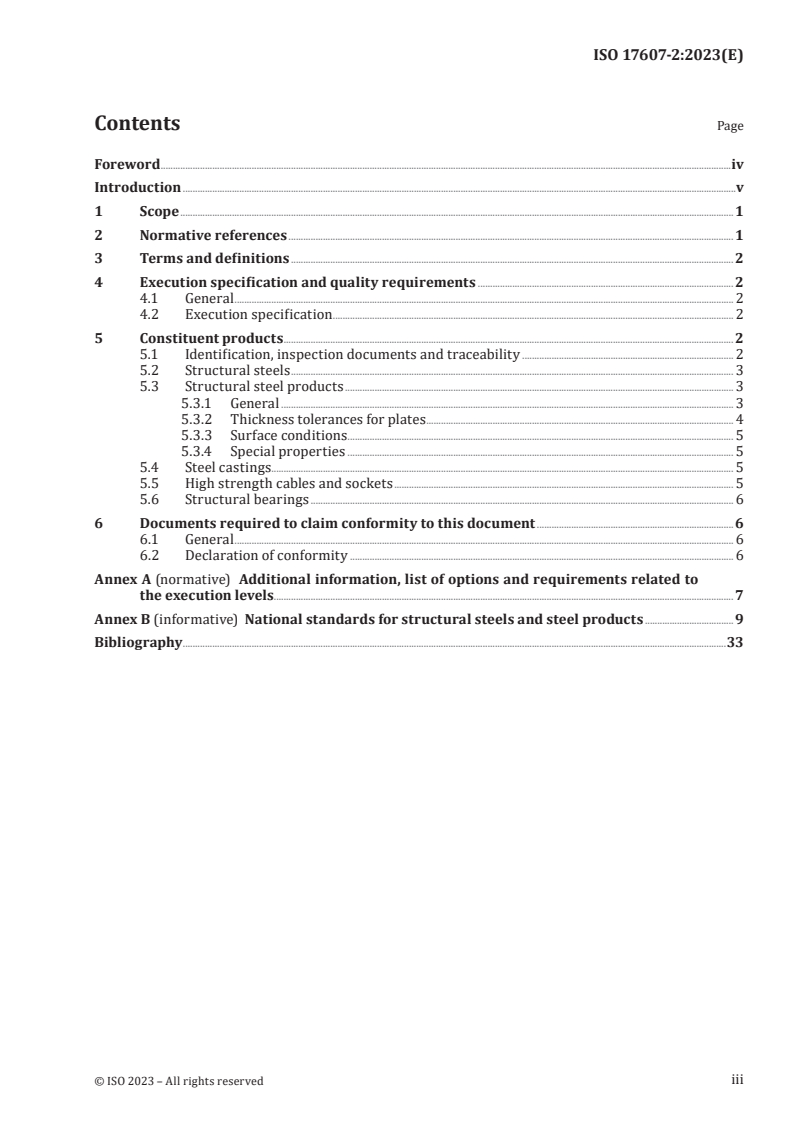
Contents Page
Foreword .iv
Introduction .v
1 Scope . 1
2 Normative references . 1
3 Terms and definitions . 2
4 Execution specification and quality requirements . 2
4.1 General . 2
4.2 Execution specification . 2
5 Constituent products . 2
5.1 Identification, inspection documents and traceability . 2
5.2 Structural steels . 3
5.3 Structural steel products . 3
5.3.1 General . 3
5.3.2 Thickness tolerances for plates . 4
5.3.3 Surface conditions . 5
5.3.4 Special properties . 5
5.4 Steel castings. 5
5.5 High strength cables and sockets . 5
5.6 Structural bearings . 6
6 Documents required to claim conformity to this document . 6
6.1 General . 6
6.2 Declaration of conformity . 6
Annex A (normative) Additional information, list of options and requirements related to
the execution levels. 7
Annex B (informative) National standards for structural steels and steel products .9
Bibliography .33
iii
Foreword
ISO (the International Organization for Standardization) is a worldwide federation of national standards
bodies (ISO member bodies). The work of preparing International Standards is normally carried out
through ISO technical committees. Each member body interested in a subject for which a technical
committee has been established has the right to be represented on that committee. International
organizations, governmental and non-governmental, in liaison with ISO, also take part in the work.
ISO collaborates closely with the International Electrotechnical Commission (IEC) on all matters of
electrotechnical standardization.
The procedures used to develop this document and those intended for its further maintenance are
described in the ISO/IEC Directives, Part 1. In particular, the different approval criteria needed for the
different types of ISO document should be noted. This document was drafted in accordance with the
editorial rules of the ISO/IEC Directives, Part 2 (see www.iso.org/directives).
ISO draws attention to the possibility that the implementation of this document may involve the use
of (a) patent(s). ISO takes no position concerning the evidence, validity or applicability of any claimed
patent rights in respect thereof. As of the date of publication of this document, ISO had not received
notice of (a) patent(s) which may be required to implement this document. However, implementers are
cautioned that this may not represent the latest information, which may be obtained from the patent
database available at www.iso.org/patents. ISO shall not be held responsible for identifying any or all
such patent rights.
Any trade name used in this document is information given for the convenience of users and does not
constitute an endorsement.
For an explanation of the voluntary nature of standards, the meaning of ISO specific terms and
expressions related to conformity assessment, as well as information about ISO's adherence to
the World Trade Organization (WTO) principles in the Technical Barriers to Trade (TBT), see
www.iso.org/iso/foreword.html.
This document was prepared by Technical Committee ISO/TC 167, Steel and aluminium structures.
This first edition cancels and replaces ISO 10721-2:1999, which has been technically revised.
A list of all parts in the ISO 17607 series can be found on the ISO website.
Any feedback or questions on this document should be directed to the user’s national standards body. A
complete listing of these bodies can be found at www.iso.org/members.html.
iv
Introduction
Specific requirements for the achievement of structures that are optimal with respect to safety, the
state of the economy, development and general values of a nation are given in the appropriate regional
or national standards, if they exist.
Many nations do not have their own standards for structural steelwork. Some reference other national
or regional standards. Some permit the project’s standard to be selected by the owner, designer or
constructor of the structure. Some do not require any standards to be followed.
The ISO 17607 series of standards on the execution of structural steelwork was developed to serve
as a means to provide a set of requirements and guidance for projects that are constructed without a
governing regional or national standard. The ISO 17607 series can also serve to reduce trade barriers.
Additional requirements to be addressed in the execution of structural steelwork, as structures or as
fabricated components, can be found in the other parts of the series:
— ISO 17607-1 (General requirements and terms and definitions);
— ISO 17607-3 (Fabrication);
— ISO 17607-4 (Erection);
— ISO 17607-5 (Welding);
— ISO 17607-6 (Bolting).
v
INTERNATIONAL STANDARD ISO 17607-2:2023(E)
Steel structures — Execution of structural steelwork —
Part 2:
Steels
1 Scope
This document defines the general requirements for the constituent products of steels and steel
products used in the execution of structural steelwork as structures or as fabricated components in
conjunction with ISO 17607-1.
Additional requirements to be addressed in the execution of structural steelwork, as structures or as
fabricated components, can be found in other parts of the ISO 17607 series.
2 Normative references
The following documents are referred to in the text in such a way that some or all of their content
constitutes requirements of this document. For dated references, only the edition cited applies. For
undated references, the latest edition of the referenced document (including any amendments) applies.
ISO 630-1, Structural steels — Part 1: General technical delivery conditions for hot-rolled products
ISO 630-2, Structural steels — Part 2: Technical delivery conditions for structural steels for general
purposes
ISO 630-3, Structural steels — Part 3: Technical delivery conditions for fine-grain structural steels
ISO 630-4, Structural steels — Part 4: Technical delivery conditions for high yield strength quenched and
tempered structural steel plates and wide flats
ISO 630-5, Structural steels — Part 5: Technical delivery conditions for structural steels with improved
atmospheric corrosion resistance
ISO 630-6, Structural steels — Part 6: Technical delivery conditions for seismic-improved structural steels
for building
ISO 4990, Steel castings — General technical delivery requirements
ISO 7778, Through-thickness characteristics for steel products
ISO 9477, High strength cast steels for general engineering and structural purposes
ISO 10474, Steel and steel products — Inspection documents
ISO 10799-1, Cold-formed welded structural hollow sections of non-alloy and fine grain steels — Part 1:
Technical delivery conditions
ISO 10799-2, Cold-formed welded structural hollow sections of non-alloy and fine grain steels — Part 2:
Dimensions and sectional properties
ISO 12633-1, Hot-finished structural hollow sections of non-alloy and fine grain steels — Part 1: Technical
delivery conditions
ISO 12633-2, Hot-finished structural hollow sections of non-alloy and fine grain steels — Part 2: Dimensions
and sectional properties
ISO 17607-1, Steel structures — Execution of structural steelwork— Part 1: General requirements and
vocabulary
ISO/TR 20172, Welding — Grouping systems for materials — European materials
ISO/TR 20173, Welding — Grouping systems for materials — American materials
ISO/TR 20174, Welding — Grouping systems for materials — Japanese materials
3 Terms and definitions
For the purposes of this document, the terms and definitions given in ISO 17607-1 apply.
ISO and IEC maintain terminology databases for use in standardization at the following addresses:
— ISO Online browsing platform: available at https:// www .iso .org/ obp
— IEC Electropedia: available at https:// www .electropedia .org/
4 Execution specification and quality requirements
4.1 General
See ISO 17607-1.
4.2 Execution specification
National standards and documents that provide technically equivalent conditions may be used, in
whole or in part, in place of referenced ISO standards or requirements of this document. In these cases,
the technically equivalent national standards and documents, and deviations from the requirements of
this document, shall be referenced in the execution specification.
The necessary information and technical requirements for structural steel and steel products shall be
agreed upon and completed before commencement.
The execution specification shall include the following items from Annex A as relevant:
a) additional information, see A.1;
b) options, see A.2;
c) requirements related to execution levels, see A.3.
There shall be procedures for making alterations to a previously agreed execution specification.
If constituent products of steels and steel products not covered by national standards or documents are
to be used, their relevant properties shall be specified.
For national standards and documents for structural steels and steel products, see Annex B
(informative).
5 Constituent products
5.1 Identification, inspection documents and traceability
For steels, the inspection documents according to ISO 10474 shall be as listed in Table 1.
Type 3.2 inspection documents are also suitable if Type 3.1 documents are listed in Table 1.
Table 1 — Inspection documents for constituent products
Constituent product Inspection documents
Structural steels
a, b, c
Structural steel grade ≤ 275MPa 2.2
b, c
Structural steel grade > 275MPa 3.1
d
Steel castings 3.1
High strength cables 3.1
Structural bearings 3.1
a
Inspection document 3.1 if specified minimum yield strength 275 MPa and specified impact energy
tested at a temperature less than 0 °C.
b
Elements included in the carbon equivalent value (CEV) shall be reported in the inspection
document.
c
Intentionally added elements, including Al, Nb, Ti, and B, shall be reported in the inspection
document.
d
Inspection document 2.2 may be provided if specified minimum yield strength ≤ 355 MPa and
specified impact energy tested at a temperature of 20 °C.
5.2 Structural steels
For execution levels 2 to 4, designated EXL2, EXL3 and EXL4, if different grades and qualities of steel
products are in circulation together, each item shall be designated with a mark that identifies its grade
and quality.
NOTE 1 Within the context of this clause, see the respective part in the ISO 630 series, the ISO 10799 series or
the ISO 12633 series for definitions of grades and qualities of steel.
5.3 Structural steel products
5.3.1 General
The steel grade and quality, with additional characteristics and any required options permitted by the
product standard, shall be specified in the execution specification.
Structural steels shall be in accordance with Table 2, or, if applicable, the requirements of the national
standard or documents.
Table 2 — Standards for structural steels
Structural steels Product standard
Hot-rolled products ISO 630-1
Structural steels for general purposes ISO 630-2
Fine grain structural steels ISO 630-3
High yield strength quenched and tempered structural steel plates ISO 630-4
Structural steels with improved atmospheric corrosion resistance ISO 630-5
Seismic-improved structural steels for building ISO 630-6
Structural hollow sections shall be in accordance with Table 3, or, if applicable, the requirements of the
national standard or documents.
Table 3 — Standards for structural hollow sections
Structural steels Product standard
ISO 10799-1
Cold-formed welded structural hollow sections of non-alloy and fine grain steels
ISO 10799-2
ISO 12633-1
Hot-finished structural hollow sections of non-alloy and fine grain steels
ISO 12633-2
See Annex B for selection of national standards and documents for structural steels and structural
hollow sections.
For steel materials or constituent products, information regarding the following characteristics shall
be available:
— strength (yield and tensile);
— elongation;
— reduction of area requirements, if required by the execution specification;
— tolerances on dimensions and shape;
— impact strength or toughness, if required by the execution specification;
— thermal heat treatment delivery condition;
— through thickness requirements (Z), in accordance with ISO 7778, if required by the execution
specification;
— limits on internal discontinuities or cracks in zones to be welded, if required by the execution
specification.
In addition, if the steel is to be welded, information shall be available regarding as follows:
— classification in accordance with the grouping system defined in ISO/TR 20172, ISO/TR 20173 or
ISO/TR 20174; or
— a maximum limit for the carbon equivalent of the steel; or
— its chemical composition in sufficient detail for its carbon equivalent to be calculated.
With respect to the properties listed above that are declared, the basis for the declarations shall be
provided, e.g. reference standards for test methods used to establish values for declared properties;
whether properties are specific to an identified lot, cast or heat; whether chemical properties are based
on ladle or product analysis.
Unless otherwise stated in the execution specification, the CEV shall be based on the CE formula:
IIW
Mn Cr++Mo VNiC+ u
CE =+C + +
IIW
65 15
NOTE 1 ISO/TR 17844 provides additional information on the CE formula.
IIW
5.3.2 Thickness tolerances for plates
Thickness tolerances for structural steel plates shall be in accordance with the applicable product
standard.
For product standards where more than one thickness tolerance class is given, the least restrictive
class shall be used unless specified in the execution specification.
5.3.3 Surface conditions
Surface conditions for structural steel shall be in accordance with the applicable product standard.
For product standards where more than one surface condition is given, the least restrictive condition
shall be used unless specified in the execution specification.
The inspection of the surface of product for defects revealed during surface preparation shall be
included in the inspection and test plans.
If surface imperfections or internal imperfections in steel products revealed during surface preparation
are repaired using methods that are in accordance with this document, the repaired product may be
used provided that it conforms with the nominal properties specified for the original product.
5.3.4 Special properties
Special properties for structural steels, including those affected by processing prior to delivery, shall be
specified in the execution specification, in accordance with the applicable product standard.
NOTE Cambering and bending are examples of processes that can affect steel properties.
5.4 Steel castings
Steel castings shall conform to the requirements ISO 4990 or ISO 9477. The technical delivery conditions
(e.g. grades, qualities and, if appropriate, finishes) shall be specified in the execution specification
together with any required options that are permitted in the product standards that are required.
Unless specified in the execution specification, the properties of delivered castings shall be evaluated
by testing.
Unless specified in the execution specification, the testing shall include:
a) 100 % visual testing (VT),
b) the following destructive tests on items taken at random during production:
— tensile and elongation tests (one unit per melt);
— impact tests (three units per melt);
— reduction of area test (one unit per melt, if appropriate):
— chemical analysis (one unit per melt);
— microscopic examination of cross-sections (one unit per melt).
c) the following non-destructive tests on items taken at random from each manufacturing lot:
— magnetic particle testing (MT) or penetrant testing (PT) on 10 % of each manufacturing lot to
detect surface-breaking discontinuities;
— ultrasonic testing (UT) or radiographic testing (RT) on 10 % of each manufacturing lot to detect
sub-surface discontinuities.
5.5 High strength cables and sockets
Wires for high strength cables shall be cold-drawn or cold-rolled steel wires. The tensile strength grade
and, if appropriate, coating class shall be specified.
Strands for high strength cables shall conform to the requirements of the execution specification. The
designation and class of the strand shall be specified.
The minimum breaking load and diameter of the steel wire rope and, if appropriate, requirements
related to corrosion protection shall be specified.
The filling material for the sockets shall be selected, taking into account service temperature and
actions such that continued creeping of the loaded strand through the socket is prevented.
5.6 Structural bearings
Requirements for structural bearings shall be specified in the execution specification.
6 Documents required to claim conformity to this document
6.1 General
Constructors may claim conformity with the requirements of this document either by:
— adoption of the ISO standards referenced in Clause 2;
or
— adoption of other standards to those listed in Clause 2 that provide technically equivalent conditions
(see examples in Annex B);
or
— adoption of other documents that provide technically equivalent conditions.
Unless otherwise listed in the execution specification, it is the responsibility of the constructor to
demonstrate that the standards or documents selected provide technically equivalent conditions to
those in the corresponding ISO standards referenced in Clause 2.
Prior to execution, adoption of other standards or documents shall be verified and approved by specifier
and shall be incorporated into the execution specifications.
NOTE The contents of Annex B do not establish that the standards or documents listed are technically
equivalent, which remains the responsibility of the constructor.
6.2 Declaration of conformity
A constructor claiming conformity with these requirements shall list the applicable supporting
standards or documents.
Annex A
(normative)
Additional information, list of options and requirements related to
the execution levels
A.1 List of required additional information
Table A.1 provides the additional information that is required in the text of this document as appropriate
to fully define the requirements for execution of the work to be in accordance with this document (i.e.
where the wording “shall be specified” is used).
Table A.1 — Additional information required
Clause Additional information required
4 – Execution specification and quality requirements
4.2 Properties of products not covered by listed standards
5 – Constituent products
5.3.1 Grade and quality, with additional characteristics and any required options permitted by the
product standard
5.3.4 Special properties for structural steels
5.4 Grades, qualities and, if appropriate, finishes for steel castings
5.5 Requirements related to the following items:
— the tensile strength grade and, if appropriate, coating class;
— the designation and class of the strand;
— corrosion protection;
5.6 Requirements for structural bearings
A.2 List of options
Table A.2 lists the items which may be specified in the execution specification to define requirements
for the execution of the work where options are given in this document.
Table A.2 — List of options to be specified
Clause Option(s) to be specified
4 – Execution specification and quality requirements
4.2 If a quality plan for execution of the steel, castings, cable or structural bearings is required
5 – Constituent products
5.3.1 If the following characteristics are applicable:
— reduction of area requirements;
— impact strength or toughness;
— through thickness requirements (Z);
— limits on internal discontinuities or cracks in zones to be welded;
— the CEV.
5.3.2 The thickness tolerance class, if not the least restrictive
5.3.3 The surface condition class, if not the least restrictive
If repairs of surface defects are permitted
5.4 Options for steel castings
If other evaluations than testing are required
If other acceptance criteria are required
6 – Documents required to claim conformity to these requirements
6.1 adoption of other standards or document
A.3 Requirements related to the execution levels
Table A.3 lists requirements specific to each of the execution levels referenced in this document.
Items identified in bold letters in Table A.3 relate to the general system of control of execution and
are amenable to a common choice of execution level across the whole of the structural steelwork (or a
phase of the structural steelwork). The other items generally demand the selection of the appropriate
execution level on a component-by-component or a connection detail-by-detail basis.
Table A.3 — Requirements for each execution level
Clauses EXL1 EXL2 EXL3 EXL4
4 – Execution specification and quality requirements
4.2 Quality documenta-
— Yes Yes Yes
tion
5 – Constituent products
5.2 Identification, in-
spection documents and
traceability
Inspection documents See Table 1 See Table 1 See Table 1 See Table 1
Traceability — see ISO/IEC 17067- see ISO/IEC 17067- see ISO/IEC 17067-
1 1 1
Marking — Yes Yes Yes
Key
a dash "—" means no specific requirement in the text.
Annex B
(informative)
National standards for structural steels and steel products
B.1 General
Tables B.1 to B.16 show the national standards corresponding to the ISO standard(s) referenced in this
document.
NOTE The contents of Tables B.1 to B.16 do not establish any technical equivalence between the standards
listed.
B.2 Australian/New Zealand standards (AS/NZS)
B.2.1 Structural steels
Table B.1 — AS/NZS standards for structural steels and steel products
Standard Grade Notes
Shapes, plates and bars
AS 1548 PT430N, PT430NR, PT430T
a
PT460N. PT460NR, PT460T
b
PT490N, PT490NR, PT490T
PT540T
AS 3597 500, 500PV
600, 600PV
c
700, 700PV
AS/NZS 3678 250
d
350, WR350
AS/NZS 3679.1 300, 300L0, 300L15, 300S0
e
350, 350L0, 350L15, 350S0
Sheet and strip
f
AS/NZS 1594 HA200
HA250, HU250
HA300, HA300/1, HU300, HU300/1
HA350, HW350
HA400
AS/NZS 1595 CA 220
CA 260
CW300
CA 350
CA 500
TTabablele B B.11 ((ccoonnttiinnueuedd))
Standard Grade Notes
Hollow structural sections
e
AS/NZS 1163 C250, C250L0
f
C350, C350L0
g
C450, C450L0
Castings and forgings
—
Key
N = Normalized after rolling
NR = Normalized rolling
T = Thermo mechanical control rolling
S = Seismic grade
S0 = impact tested at 0 °C
a
PT = Tensile strength specified pressure vessel steel
b
Impact tested grade variants are not shown
c
PV = Pressure Vessel
d
WR = Weather Resistant
e
L = Low temperature impact tested
L0 at 0 °C
L15 at -15 °C
f
C = Cold-formed
g
See also ISO/TR 20173
B.2.2 Dimensions and tolerances
Table B.2 — AS/NZS standards for dimensions and tolerances of structural steels
Standard Notes
AS/NZS 1365
B.3 Canadian standards (CSA)
B.3.1 Structural steels
Table B.3 — CSA standards for structural steels and steel products
Standard Grade Notes
Shapes, plates and bar
CSA G40.21 260W, 260WT
300W, 300WT
345WM, 345WMT
350A, 350AT, 350W, 350WT, 350R
a
380W, 380WT
400A, 400AT, 400W, 400WT
480A, 480AT, 480W, 480WT
550A, 550AT, 550W, 550WT
700Q, 700QT
Sheet
CSA G40.21 260W, 260WT
300W, 300WT
345WM, 345WMT
350A, 350AT, 350W, 350WT, 350R
a
380W, 380WT
400A. 400AT, 400W, 400WT
480A, 480AT, 480W, 480WT
550A, 550AT, 550W, 550WT
700Q, 700QT
Hollow structural sections
CSA G40.21 300W
350A, 350AT, 350W, 350WT
380W, 380WT
a
400A, 400AT, 400W, 400WT
480A, 480AT, 480W, 480WT
550A, 550AT, 550W, 550WT
Castings and forgings
—
Key
a
W = Weldable
T = Notch-Tough
R =Atmospheric Corrosion-Resistant
A =Atmospheric Corrosion-Resistant Weldable
Q = Quenched and Tempered Low-Alloy (weldable)
M = with composition restrictions.
B.3.2 Dimensions and tolerances
Table B.4 — CSA standards for dimensions and tolerances of structural steels
Standard Notes
CSA G40.20
B.4 Chinese standards (GB)
B.4.1 Structural steels
Table B.5 — GB standards for structural steels and steel products
Standard Grade Notes
Shapes, plates and bars
GB/T 700 Q195
Q235
Q275
GB/T 714 Q345q, Q345NH
Q370q, Q370NH
Q420q, Q420NH
Q460q, Q460NH
a
Q500q, Q500NH
Q550q, Q550NH
Q620q,Q620NH
Q690q, Q690NH
GB/T 1591 Q355N, Q355M
Q390N, Q390M
Q420N, Q420M
Q460N, Q460M
b
Q500M
Q550M
Q620M
Q690M
GB/T 4171 Q235NH
Q265GN
Q295NH, Q295GNH
HQ310GNH
a
Q355NH, Q355GNH
c
Q415NH
Q460NH
Q500NH
Q550NH
GB/T 4172 Q235NH
Q295NH
a
Q355NH
Q460NH
GB/T 5313 Z15
Z25
Z35
TTabablele B B.55 ((ccoonnttiinnueuedd))
Standard Grade Notes
GB/T 6725 Q195
Q215
Q235
Q345
Q390
Q420
Q460
Q500
Q550
Q620
Q690
Q750
GB/T 19879 Q235GJ
Q345GJ
Q390GJ
Q420GJ
d
Q460GJ
Q500GJ
Q550GJ
Q620GJ
Q690GJ
GB/T 20933 Q295bz
e
Q390bz
Q420bz
GB/T 20934 GLG345
GLG460
GLG550
GLG650
GLG750
GLG850
GLG1100
BLG205
BLG400
BLG725
BLG835
BLG1080
GB/T 34560.2 Q235
Q275
Q355
Q450
GB/T 34560.3 Q275N, Q275M
Q355N, Q355M
Q390N, Q390M
Q420N, Q420M
b
Q460N, Q460M
Q500M
Q550M
Q620M
Q690M
TTabablele B B.55 ((ccoonnttiinnueuedd))
Standard Grade Notes
GB/T 34560.4 Q460Q
Q500Q
Q550Q
Q620Q
Q690Q
Q800Q
f
Q890Q
Q960Q
Q1030Q
Q1100Q
Q1200Q
Q1300Q
GB/T 34560.5 Q235W, Q235NH
Q295NH, Q295GNH
a
Q355W, Q355WP, Q355NH, Q355GNH
c
Q415NH
g
Q460NH
Q500NH
Q550NH
GB/T 34560.6 Q235KZ
Q345KZ
h
Q390KZ
Q420KZ
Q460KZ
Sheet and strip
GB/T 2518
TTabablele B B.55 ((ccoonnttiinnueuedd))
Standard Grade Notes
Hollow structural sections
GB/T 8162 Q235
Q275
Q295
Q345
Q390
Q420
Q460
GB/T 13793 08
Q195
Q215A, Q215B
Q235A, Q235B, Q235C
Q275, Q275A, Q275B
Q345A, Q345B, Q345C
Q390A, Q390B, Q390C
Q420A, Q420B, Q420C
Q460C, Q460D
GB/T 30063 Q235B, Q235C
Q345B, Q345C
Q390B, Q390C
Q420B, Q420C
Q460C, Q460
Q235GJB, Q235GJC
Q345GJB, Q345GJC
Q390GJB, Q390GJC
Q420GJC
GB/T 34201 10,20
Q195
Q215
Q235
Q345A, Q345B, Q345C, Q345D, Q345E
Q390A. Q390B, Q390C, Q390D, Q390E
Q420A. Q420B, Q420C, Q420D, Q420E
Q460C. Q460D, Q460E
TTabablele B B.55 ((ccoonnttiinnueuedd))
Standard Grade Notes
Castings and forgings
GB/T 7659 ZG200-400H
ZG230-450H
ZG270-480H
ZG300-500H
ZG340-550H
GB/T 11352 ZG200-400
ZG230-450
ZG270-500
ZG310-570
ZG340-640
Key
NH = Weathering steel
M = TMCP (thermo mechanical control processed) steel
WP = High Phosphorus Atmospheric Corrosion-Resistant Steel
a
q = Bridge structure steel
b
N = normalized rolling steel
c
GNH = High performance weathering steel
d
GJ = High-performance building structure steel
e
bz = steel plate
f
Q = Quenched and tempered steel
g
W = atmospheric corrosion-resistant steel
h
KZ = Aseismic steel
B.4.2 Dimensions and tolerances
Table B.6 — GB standards for dimensions and tolerances of structural steels
Standard Notes
GB/T 702
GB/T 706
GB/T 709
GB/T 6728
GB/T 11263
GB/T 17395
GB/T 21835
B.5 European standards (EN)
B.5.1 Structural steels
Table B.7 — EN standards for structural steels and steel products
Standard Grade Notes
Shapes, plates and bars
EN 10025-2 S235JR, S235JO, S235J2
S275JR, S275J0, S275J2
a
S355JR, S355JO, S355J2, S355K2
S450J0
TTabablele B B.77 ((ccoonnttiinnueuedd))
Standard Grade Notes
EN 10025-3 S275N, S275NL
S355N, S355NL
b
S420N, S420NL
S460N, S460NL
EN 10025-4 S275M, S275ML
S355M, S355ML
c
S420M, S420ML
S460M, S460ML
a
EN 10025-5 S235J0W, S235J2W
d
S355J0WP, S355J2WP, S355J2W, S355K2W
EN 10025-6 S460Q, S460QL, S460QL1
S500Q, S500QL, S500QL1
e
S550Q, S550QL, S550QL1
S620Q, S620QL, S620QL1
S690Q, S690QL, S690QL1
EN 10149-2 S315MC
S355MC
S420MC
S460MC
f
S500MC
S550MC
S600MC
S650MC
S700MC
EN 10149-3 S260NC
S315NC
f
S355NC
S420NC
EN 10268 HC180Y, HC180B
HC220Y, HC220I, HC220B
HC260Y, HC260I, HC260B, HC260LA
HC300I, HC300B, HC300LA
g
HC340LA
HC380LA
HC420LA
HC460LA
HC500LA
EN 10346 S220GD
S250GD
S280GD
h
S320GD
S350GD
S550GD
Sheet and strip
TTabablele B B.77 ((ccoonnttiinnueuedd))
Standard Grade Notes
EN 10248-1 S240GP
S270GP
S320GP
S355GP
S390GP
S430GP
EN 10249-1 S235JR, S235JO, S235J2
S275JR, S275J0, S275J2
a
S355JR, S355JO, S355J2, S355K2
S450J0
Hollow structural sections
EN 10210-1 S235JRH
EN 10210-3 S275J0H, S275J2H
S275NH, S275NLH
a
S355J0H, S355J2H, S355K2H
b
S355NH, S355NLH
S420NH, S420NLH
S460NH, S460NLH
EN 10219-1 S235JRH
EN 10219-3 S275J0H,S275J2H
S275NH, S275NLH
S275MH, S275MLH
a
S355J0H, S355J2H, S355K2H
b
S355NH, S355NLH
i
S355MH, S355MLH,
S420MH, S420MLH
S460NH, S460NLH
S460MH. S460MLH,
Castings and forgings
—
Key
a
JR = Longitudinal Charpy V-notch impacts 27 J at +20 °C
J0 = Longitudinal Charpy V-notch impacts 27 J at 0 °C
J2 = Longitudinal Charpy V-notch impacts 27 J at −20 °C
K2 = Longitudinal Charpy V-notch impacts 40 J at −20 °C
+AR = Supply in as rolled conditions
+N = Supply in normalized/normalized rolled conditions
Z Grade = Improved properties perpendicular to the surface
b
N = Longitudinal Charpy V-notch impacts temperature not lower than −20 °C
NL = Longitudinal Charpy V-notch impacts temperature. not lower than −50 °C
Z Grade = Improved properties perpendicular to the surface
c
M = Longitudinal Charpy V-notch impacts temperature not lower than −20 °C
ML = Longitudinal Charpy V-notch impacts temperature not lower than −50 °C
Z Grade = Improved properties perpendicular to the surface
TTabablele B B.77 ((ccoonnttiinnueuedd))
Standard Grade Notes
d
W = Improved atmospheric corrosion resistance
P = Greater phosphorus content
+AR = Supply in as rolled conditions
+N = Supply in normalized/normalized rolled conditions
Z Grade = Improved properties perpendicular to the surface
e
Q = Longitudinal Charpy V-notch impacts temp. not lower than −20 °C
QL = Longitudinal Charpy V-notch impacts temp. not lower than −40 °C
QL1 = Longitudinal Charpy V-notch impacts temp. not lower than −60 °C
Z Grade = Improved properties perpendicular to the surface
f
M = Thermomechanically rolled
N = Normalized or normalized rolled
C = Suitable for cold forming
g
B = Bake-hardening steel
I – Isotropic steel
LA – Low alloy / micro-alloyed steel
Y = high strength interstitial free steel
h
GD identifies steel for construction
i
JR = Longitudinal Charpy V-notch impacts 27 J at +20 °C
J0 = Longitudinal Charpy V-notch impacts 27 J at 0 °C
J2 = Longitudinal Charpy V-notch impacts 27 J at –20 °C
K2 = Longitudinal Charpy V-notch impacts 40 J at –20 °C
N = Normalized or normalized rolled
NL = Longitudinal Charpy V-notch impacts temp. not lower than –50 °C
M = Thermomechanically rolled
ML = Longitudinal Charpy V-notch impacts temp. not lower than –50 °C
H = Hollow section
B.5.2 Dimensions and tolerances
Table B.8 — EN standards for dimensions and tolerances of structural steels
Standard Notes
EN 10017
EN 10024
EN 10029
EN 10034
EN 10051
EN 10055
EN 10056-2
EN 10058
EN 10059
EN 10060
EN 10210-2
EN 10219-2
EN 10279
B.6 Japanese standards (JIS)
B.6.1 Structural steels
Table B.9 — JIS standards for structural steels and steel products
Standard Grade Notes
Shapes, plates and bars
JIS G 3101 SS400
SS490
SS540
JIS G 3106 SM400A, SM400B, SM400C
SM490A, SM490B, SM490C
a
SM490YA, SM490YB
b
SM520B, SM520C
SM570
JIS G 3114 SMA400AW, SMA400BW, SMA400CW
b
SMA490AW, SMA490BW, SMA490CW
SMA570W
JIS G 3136 SN400A, SN400B, SN400C
SN490B, SN490C
JIS G 3138 SNR400A, SNR400B
JIS G 3140 SBHS400, SBHS400W
a
SBHS500, SBHS500W
JIS G 3350 SSC400 t ≤ 4,5
JIS G 3353 SWH400, SWH400L
Sheet and strip
JIS G 3302 SGH400 t ≤ 6,0
SGH490
Hollow structural sections
JIS G 3444 STK400
STK490, SNR490B
c
JIS G 3466 STKR400
c
STKR490
JIS G 3475 STKN400W, STKN400B
STKN490B
Castings and forgings
JIS G 5101 SC480
TTabablele B B.99 ((ccoonnttiinnueuedd))
Standard Grade Notes
JIS G 5102 SCW410
SCW480
JIS G 5201 SCW410CF
SCW480CF
SCW490CF
Key
a
SM570, SMA570W, SBHS400, SBHS400W, SBHS500, SBHS400W are permitted for bridges but not per-
mitted for buildings. All other steels are permitted for use in buildings.
b a
Steels permitted for bridges are, in addition to those mentioned in footnote , SM400A, SM400B, SM400C,
SM490A, SM490B, SM490C, SM490YA, SM490YB, SM520C, SMA400AW, SMA400BW, SMA400CW, SMA490AW,
SMA490BW and SMA490CW.
c
In addition to the steels listed above, structural steels that are not included in JIS but approved by the
Minister of Land, Infrastructure, Transport and Tourism are permitted for use in buildings. For example, the
Minister-approved steel “cold-formed formed rectangular hollow section columns” BCR295, BCP235 and BCP325,
which are regulated by the Standard of Japanese Society of Steel Construction, JSS II 10, are used more commonly
than the STKR400 or STKR490 for columns in building structures.
B.6.2 Dimensions and tolerances
Table B.10 — JIS standards for dimensions and tolerances of structural steels
Standard Notes
JIS G 3191
JIS G 3192
JIS G 3193
JIS G 3194
B.7 Russian standards (GOST)
B.7.1 Structural steels
Table B.11 — GOST standards for structural steels and steel products
Standard Grade Notes
Shapes, plates and bars
a
GOST 380 Ст0
d
Ст1кп, Ст1пс, Ст1сп
Ст2кп, Ст2пс, Ст2сп
Ст3кп, Ст3пс, Ст3сп
Ст3Гпс, Ст3Гсп
Ст4кп, Ст4пс, Ст4сп
Ст5пс, Ст5сп
Ст5Гпс
Ст6пс. Ст6сп
GOST 535 Ст0, Ст1кп, Ст1пс, Ст1сп
Ст2кп, Ст2пс, Ст2сп,
Ст3кп, Ст3пс, Ст3сп,
Ст3Гпс, Ст3Гсп,
Ст4кп, Ст4пс, Ст4сп,
Ст5пс, Ст5сп, Ст5Гпс,
TTabablele B B.1111 ((ccoonnttiinnueuedd))
Standard Grade Notes
Ст6пс, Ст6сп
Е 185 (Fe 310)
Е 235 (Fe 360)
Е 275 (Fe 430)
Е 355 (Fe 510)
Fe 490
Fe 590
Fe 690
a
GOST 1050 05кп
b
08кп, 08пс, 08
10кп, 10пс, 10
11кп
15кп, 15пс, 15
18кп
20кп, 20пс, 20
50, 50A
58 (55пп)
60, 60пп, 60 пп «селект»
c
GOST 6713 16Д
d
15ХСНД
10ХСНД
c
GOST 19281 07ГФБ, 07ГФБ-1
d
08ХМФчЮА
09ГСФЮ
09Г2, 09Г2-1
09Г2Д, 09Г2Д-1
09Г2С, 09Г2С-1, 09Г2СД, 09Г2СД-1
09Г2ФБ, 09Г2ФБ-1
10Г2Б, 10Г2БД
10Г2С-1, 10Г2С1, 10Г2С1Д
10Г2ФБЮ, 10Г2ФБЮ-1
10ХСНД
10ХНДП
12Г2С, 12Г2С-1
12Г2СД, 12Г2СД-1
12Г2Ф, 12Г2Ф-1, 12Г2ФД, 12Г2ФД-1
12ГСБЮ, 12ГСБЮ-1
13ХФЮ
14Г2, 14Г2-1
15Г2СФ, 15Г2СФ-1, 15Г2СФД, 15Г2СФД-1
TTabablele B B.1111 ((ccoonnttiinnueuedd))
Standard Grade Notes
15ГФ, 15ГФ-1, 15ГФД, 15ГФД-1
15ХСНД
17Г1С-У, 17Г1С-У-1
20ФЮ
or 265; 295; 315; 325; 345; 355; 375; 390; 440; 460; 500;
550; 600; 620; 650; 700 and S235; S275; S355 by ЕN 10025-2
e
GOST 27772 С235
С245
С255
С345, С345К
С355, С355-1, С355К, С355П
С375
С390, С390-1
С440
С550
С590
c
GOST R 55374 09Г2СД
d
10ХСНД
14ХГНДЦ
15ХСНД
Sheet and strip
a
GOST 14637 Ст0
d
Ст2кп, Ст2пс, Ст2сп
Ст3кп, Ст3пс, Ст3сп
Ст3Гпс, Ст3Гсп
Ст4сп
Ст5пс, Ст5сп
Ст5Гпс
GOST 17066 C295
C315
C345
C355
C390
09Г2, 09Г2Д, 09Г2С, 09Г2СД
10Г2Б, 10Г2БД, 10Г2С1, 10Г2С1Д
10ХСНД, 10ХНДП
12ГС
14Г2
15ГФ, 15ХСНД
16ГС
17ГС
Hollow structural sections
TTabablele B B.1111 ((ccoonnttiinnueuedd))
Standard Grade Notes
e
GOST 30245 С235
С245
С255
С345, С345К
С355, С355-1, С355К, С355П
С375
С390, С390-1
С440
С550
С590
c
GOST R 52664 09Г2С
d
09ГСФ
17Г1С
17Г1СУ
С 245
С345
С540
e
GOST R 54864 С235
С245
С255
С275
С285
С345
С375
С390
С440
e
GOST R 58064 С245
С255
С345, С345К
С355, С355-1, С355К, С355П
С375
С390, С390-1
С440
С550
С590
С690
Castings and forgings
c
GOST 977 structural unalloyed:
f
15Л
20Л
25Л
ЗОЛ
35Л
40Л
45Л
50Л
TTabablele B B.1111 ((ccoonnttiinnueuedd))
Standard Grade Notes
c
structural alloyed:
d
20ГЛ
f
35ГЛ
20ГСЛ
30ГСЛ
20Г1ФЛ
20ФЛ
30ХГСФЛ
45ФЛ
32Х06Л
40ХЛ
20ХМЛ, 20ХМФЛ
20ГНМФЛ
35ХМЛ
30ХНМЛ
35ХГСЛ
35НГМЛ
20ДХЛ
08ГДНФЛ
13ХНДФТЛ
12ДН2ФЛ, 12ДХН1МФЛ
23ХГС2МФЛ
12Х7ГЗСЛ
25Х2ГНМФЛ
27Х5ГСМЛ
ЗОХЗСЗГМЛ,
03Н12Х5МЗТЛ, 03Н12Х5МЗТЮЛ
c
structural alloy used in legal relations between the CMEA
d
member countries:
f
15ГЛ
30ГЛ
45ГЛ
70ГЛ
55СЛ
40Г1
5ФЛ
15ФЛ
ЗОХЛ
25ХГЛ
35ХГЛ
50ХГЛ
60ХГЛ
70Х2ГЛ
TTabablele B B.1111 ((ccoonnttiinnueuedd))
Standard Grade Notes
35ХГФЛ
40ХФЛ
30ХМЛ
40ХМЛ
40ХНЛ, 40ХН2Л
30ХГ1
5МФРЛ
75ХНМФЛ
40ГТЛ
20ГНМЮЛ
c
alloyed with special properties:
d
martensitic class
f
20Х13Л, 08Х14НДЛ
09Х16Н4БЛ
09Х17НЗСЛ
10Х12НДЛ
20Х5МЛ
20X8ВЛ
40Х9С2Л
20Х12ВНМФЛ
85Х4М5Ф2В6Л (Р6М5Л)
90Х4М4Ф2В6Л (Р6М4Ф2Л)
c
alloyed with special properties:
d
martensite-ferritic class
f
15Х13Л — corrosion resistant
c
alloyed with special properties:
d
ferritic grade
f
15Х25ТЛ
c
alloyed with special properties:
d
austenitic-martensitic class
f
08Х15Н4ДМЛ
08Х14Н7МЛ
14Х18Н4Г4Л
c
alloyed with special properties:
d
austenitic-ferritic class
f
12Х25Н5ТМФЛ
I6X18Н12С4ТЮЛ
10Х18НЗГЗД2Л
35Х23Н7СЛ
40Х24Н12СЛ
20Х20Н14С2Л
c
alloyed with special properties:
d
austenitic class
f
10Х18Н9Л
12Х18Н9ТЛ
10Х18Н11БЛ
07Х17Н16ТЛ
TTabablele B B.1111 ((ccoonnttiinnueuedd))
Standard Grade Notes
12Х18Н12МЗТЛ
55Х18Г14С2ТЛ
15Х23Н18Л
20Х25Н19С2Л
18Х25Н19СЛ
45Х17Г13НЗЮЛ
Key
a
The letters «Ст» denote «Steel».
The numbers — the conditional number of the brand depending on the chemical composition (one digit indicates
its average content in the alloy in tenths of a percent).
The letters «кп», «пс», «сп» — the degree of deoxidati
...