

ISO 19104:2016
(Main)Geographic information — Terminology
General Information
- Abstract
ISO 19104:2016 specifies requirements for the collection, management and publication of terminology in the field of geographic information. The scope of this document includes - selection of concepts, harmonization of concepts and development of concept systems, - structure and content of terminological entries, - term selection, - definition preparation, - cultural and linguistic adaptation, - layout and formatting requirements in rendered documents, and - establishment and management of terminology registers. ISO 19104:2016 is applicable to International Standards and Technical Specifications in the field of geographic information.
- Status
- Published
- Publication Date
- 22-Sep-2016
- Technical Committee
- ISO/TC 211 - Geographic information/Geomatics
- Drafting Committee
- ISO/TC 211 - Geographic information/Geomatics
- Current Stage
- 9093 - International Standard confirmed
- Start Date
- 06-Dec-2021
- Completion Date
- 29-Aug-2026
Buy Documents





ISO 19104:2016 - Geographic information -- Terminology
ISO 19104:2016 - Geographic information — Terminology/23/2016
Overview
ISO 19104:2016 - Geographic information - Terminology defines requirements for creating, managing and publishing terminology used in the geospatial domain. The standard governs how concepts are selected and harmonized, how terminological entries are structured and drafted, and how multilingual and cultural adaptations are handled. It also specifies layout and formatting rules for rendered documents and the establishment and management of terminology registers. ISO 19104:2016 is intended for use in International Standards and Technical Specifications in geographic information.
Key Topics and Technical Requirements
- Selection and harmonization of concepts: requirements for choosing concepts, developing concept systems and ensuring consistent meaning across usages.
- Terminological entry content and drafting: required fields and drafting rules for entries, including preferred/admitted/deprecated terms, equivalent terms, abbreviations, symbols, definitions, examples, notes and sources.
- Cultural and linguistic adaptation: guidance for adapting terminology across languages and cultural contexts to preserve equivalence of meaning.
- Layout and formatting: presentation rules for terminological entries in rendered documents to ensure clear, uniform display.
- Terminology registers and schema: structure and conformance classes for registers, stakeholders’ roles, information packages (core and supplementary), and machine-readable schemas for simple and hierarchical multilingual registers.
- Conformance classes and testing: conformance model (terminological entry and register classes) and an abstract test suite to verify compliance.
- Annexes and examples: normative and informative annexes covering test suites, multilingual environments, entry formats and example glossaries.
Practical Applications and Who Uses ISO 19104
ISO 19104 is practical for anyone who needs consistent geospatial vocabulary across documents, systems and languages:
- Standards developers and ISO technical committees producing consistent definitions for GIS standards.
- Terminologists and translators creating multilingual glossaries and ensuring semantic equivalence.
- GIS data managers and metadata specialists who require harmonized term definitions for interoperability.
- Software vendors and implementers integrating controlled vocabularies or terminology registers into GIS applications and APIs.
- Registry owners and managers establishing and maintaining authoritative terminology registers.
Benefits include improved interoperability, reduced ambiguity in technical communication, and more reliable cross-language translations for geospatial concepts.
Related Standards
- ISO 19135-1 (registration of geospatial concepts) - applied in ISO 19104 for register management.
- ISO 10241-2 - referenced for cultural and linguistic adaptation practices.
- ISO/TC 211 is the responsible committee for geographic information/geomatics.
Keywords: ISO 19104, geographic information terminology, GIS terminology standard, terminology register, multilingual glossary, terminological entry.
Relations
- Effective Date
- 25-Aug-2026
- Effective Date
- 09-Feb-2013
Buy Documents
ISO 19104:2016 - Geographic information -- Terminology
ISO 19104:2016 - Geographic information — Terminology/23/2016
Get Certified
Connect with accredited certification bodies for this standard

BSI Group
BSI (British Standards Institution) is the business standards company that helps organizations make excellence a habit.

NYCE
Mexican standards and certification body.
Sponsored listings
Frequently Asked Questions
ISO 19104:2016 is a standard published by the International Organization for Standardization (ISO). Its full title is "Geographic information — Terminology". This standard covers: ISO 19104:2016 specifies requirements for the collection, management and publication of terminology in the field of geographic information. The scope of this document includes - selection of concepts, harmonization of concepts and development of concept systems, - structure and content of terminological entries, - term selection, - definition preparation, - cultural and linguistic adaptation, - layout and formatting requirements in rendered documents, and - establishment and management of terminology registers. ISO 19104:2016 is applicable to International Standards and Technical Specifications in the field of geographic information.
ISO 19104:2016 specifies requirements for the collection, management and publication of terminology in the field of geographic information. The scope of this document includes - selection of concepts, harmonization of concepts and development of concept systems, - structure and content of terminological entries, - term selection, - definition preparation, - cultural and linguistic adaptation, - layout and formatting requirements in rendered documents, and - establishment and management of terminology registers. ISO 19104:2016 is applicable to International Standards and Technical Specifications in the field of geographic information.
ISO 19104:2016 is classified under the following ICS (International Classification for Standards) categories: 01.040.35 - Information technology (Vocabularies); 35.240.70 - IT applications in science. The ICS classification helps identify the subject area and facilitates finding related standards.
ISO 19104:2016 has the following relationships with other standards: It is inter standard links to EN ISO 19146:2018, ISO/TS 19104:2008. Understanding these relationships helps ensure you are using the most current and applicable version of the standard.
ISO 19104:2016 is available in PDF format for immediate download after purchase. The document can be added to your cart and obtained through the secure checkout process. Digital delivery ensures instant access to the complete standard document.
Standards Content (Sample)
SLOVENSKI STANDARD
01-januar-2017
Geografske informacije - Terminologija
Geographic information -- Terminology
Information géographique -- Terminologie
Ta slovenski standard je istoveten z: ISO 19104:2016
ICS:
01.040.35 Informacijska tehnologija. Information technology
(Slovarji) (Vocabularies)
07.040 Astronomija. Geodezija. Astronomy. Geodesy.
Geografija Geography
35.240.70 Uporabniške rešitve IT v IT applications in science
znanosti
2003-01.Slovenski inštitut za standardizacijo. Razmnoževanje celote ali delov tega standarda ni dovoljeno.
INTERNATIONAL ISO
STANDARD 19104
First edition
2016-10-01
Geographic information —
Terminology
Information géographique — Terminologie
Reference number
©
ISO 2016
© ISO 2016, Published in Switzerland
All rights reserved. Unless otherwise specified, no part of this publication may be reproduced or utilized otherwise in any form
or by any means, electronic or mechanical, including photocopying, or posting on the internet or an intranet, without prior
written permission. Permission can be requested from either ISO at the address below or ISO’s member body in the country of
the requester.
ISO copyright office
Ch. de Blandonnet 8 • CP 401
CH-1214 Vernier, Geneva, Switzerland
Tel. +41 22 749 01 11
Fax +41 22 749 09 47
copyright@iso.org
www.iso.org
ii © ISO 2016 – All rights reserved
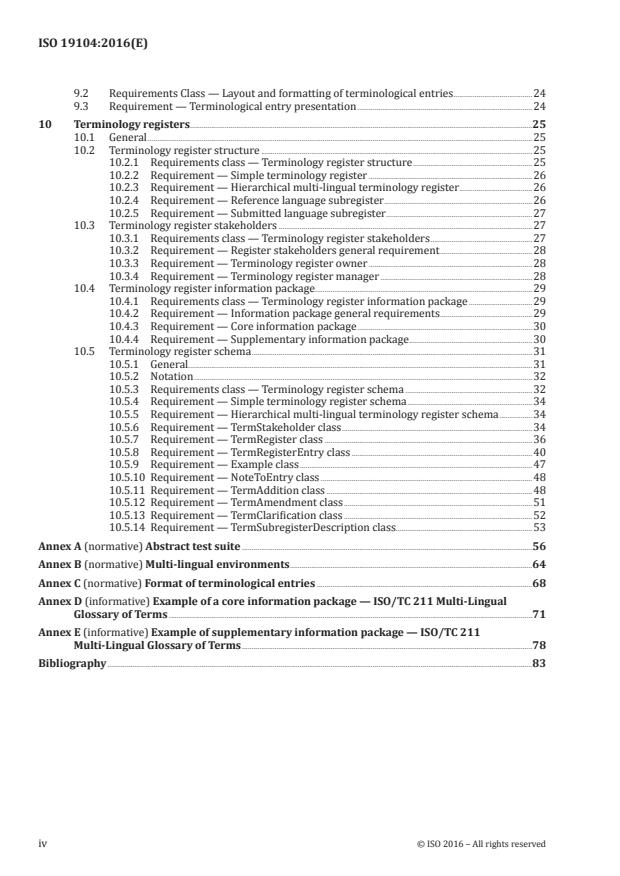
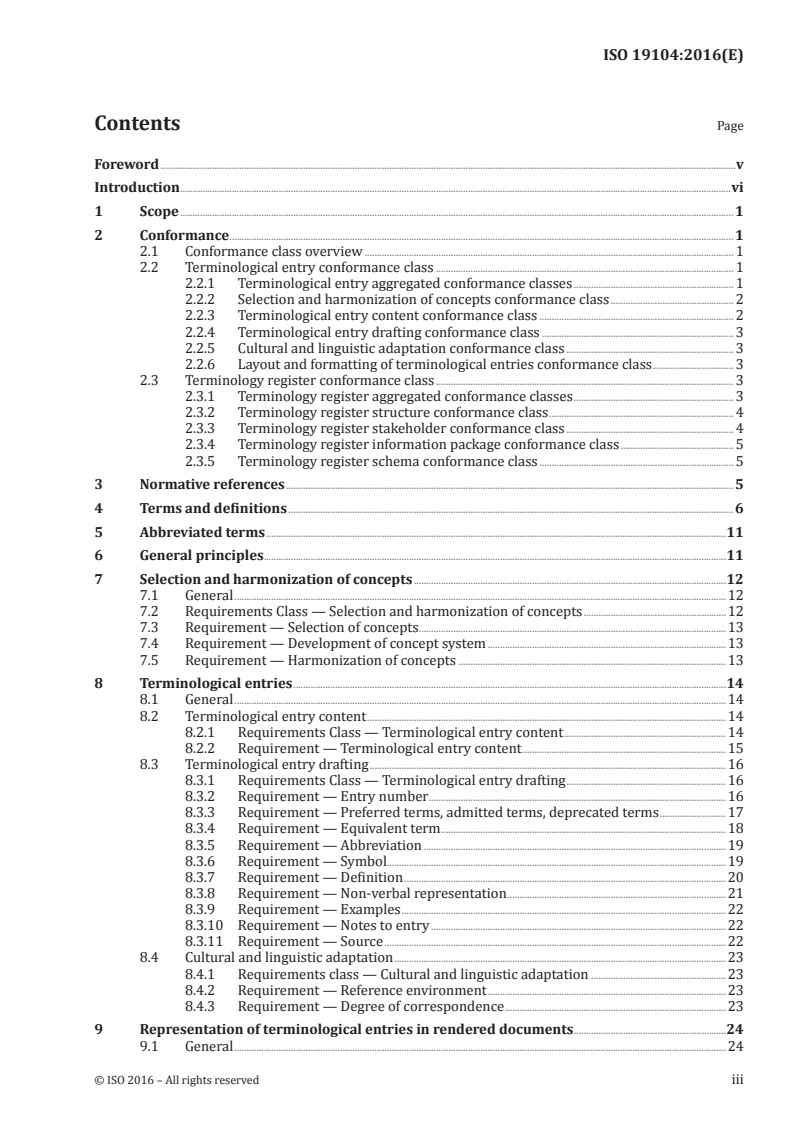
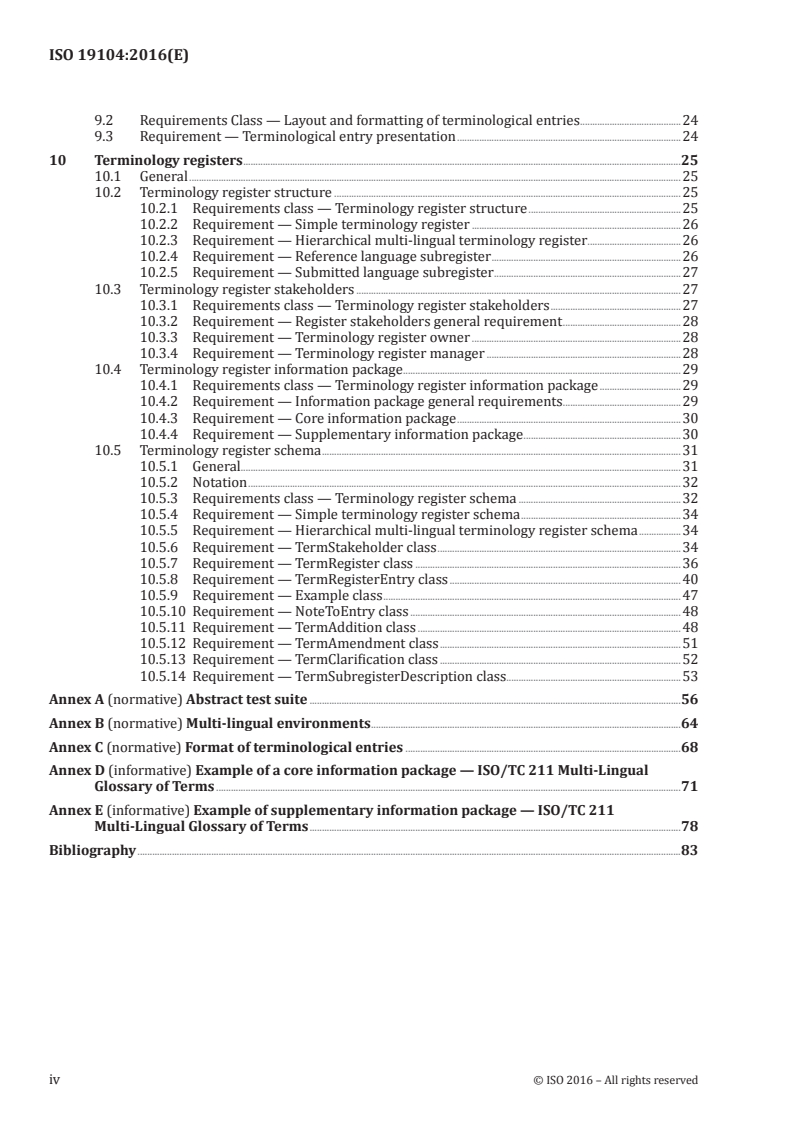
Contents Page
Foreword .v
Introduction .vi
1 Scope . 1
2 Conformance . 1
2.1 Conformance class overview . 1
2.2 Terminological entry conformance class . 1
2.2.1 Terminological entry aggregated conformance classes . 1
2.2.2 Selection and harmonization of concepts conformance class . 2
2.2.3 Terminological entry content conformance class . 2
2.2.4 Terminological entry drafting conformance class . 3
2.2.5 Cultural and linguistic adaptation conformance class . 3
2.2.6 Layout and formatting of terminological entries conformance class . 3
2.3 Terminology register conformance class . 3
2.3.1 Terminology register aggregated conformance classes . 3
2.3.2 Terminology register structure conformance class . 4
2.3.3 Terminology register stakeholder conformance class . 4
2.3.4 Terminology register information package conformance class . 5
2.3.5 Terminology register schema conformance class . 5
3 Normative references . 5
4 Terms and definitions . 6
5 Abbreviated terms .11
6 General principles .11
7 Selection and harmonization of concepts .12
7.1 General .12
7.2 Requirements Class — Selection and harmonization of concepts .12
7.3 Requirement — Selection of concepts .13
7.4 Requirement — Development of concept system .13
7.5 Requirement — Harmonization of concepts .13
8 Terminological entries .14
8.1 General .14
8.2 Terminological entry content .14
8.2.1 Requirements Class — Terminological entry content .14
8.2.2 Requirement — Terminological entry content .15
8.3 Terminological entry drafting .16
8.3.1 Requirements Class — Terminological entry drafting .16
8.3.2 Requirement — Entry number .16
8.3.3 Requirement — Preferred terms, admitted terms, deprecated terms .17
8.3.4 Requirement — Equivalent term .18
8.3.5 Requirement — Abbreviation .19
8.3.6 Requirement — Symbol . .19
8.3.7 Requirement — Definition .20
8.3.8 Requirement — Non-verbal representation .21
8.3.9 Requirement — Examples .22
8.3.10 Requirement — Notes to entry .22
8.3.11 Requirement — Source .22
8.4 Cultural and linguistic adaptation .23
8.4.1 Requirements class — Cultural and linguistic adaptation .23
8.4.2 Requirement — Reference environment .23
8.4.3 Requirement — Degree of correspondence .23
9 Representation of terminological entries in rendered documents .24
9.1 General .24
9.2 Requirements Class — Layout and formatting of terminological entries .24
9.3 Requirement — Terminological entry presentation .24
10 Terminology registers .25
10.1 General .25
10.2 Terminology register structure .25
10.2.1 Requirements class — Terminology register structure .25
10.2.2 Requirement — Simple terminology register .26
10.2.3 Requirement — Hierarchical multi-lingual terminology register .26
10.2.4 Requirement — Reference language subregister .26
10.2.5 Requirement — Submitted language subregister .27
10.3 Terminology register stakeholders .27
10.3.1 Requirements class — Terminology register stakeholders .27
10.3.2 Requirement — Register stakeholders general requirement .28
10.3.3 Requirement — Terminology register owner .28
10.3.4 Requirement — Terminology register manager .28
10.4 Terminology register information package .29
10.4.1 Requirements class — Terminology register information package .29
10.4.2 Requirement — Information package general requirements .29
10.4.3 Requirement — Core information package .30
10.4.4 Requirement — Supplementary information package .30
10.5 Terminology register schema .31
10.5.1 General.31
10.5.2 Notation .32
10.5.3 Requirements class — Terminology register schema .32
10.5.4 Requirement — Simple terminology register schema .34
10.5.5 Requirement — Hierarchical multi-lingual terminology register schema .34
10.5.6 Requirement — TermStakeholder class .34
10.5.7 Requirement — TermRegister class .36
10.5.8 Requirement — TermRegisterEntry class .40
10.5.9 Requirement — Example class .47
10.5.10 Requirement — NoteToEntry class .48
10.5.11 Requirement — TermAddition class .48
10.5.12 Requirement — TermAmendment class .51
10.5.13 Requirement — TermClarification class .52
10.5.14 Requirement — TermSubregisterDescription class.53
Annex A (normative) Abstract test suite .56
Annex B (normative) Multi-lingual environments .64
Annex C (normative) Format of terminological entries .68
Annex D (informative) Example of a core information package — ISO/TC 211 Multi-Lingual
Glossary of Terms .71
Annex E (informative) Example of supplementary information package — ISO/TC 211
Multi-Lingual Glossary of Terms .78
Bibliography .83
iv © ISO 2016 – All rights reserved
Foreword
ISO (the International Organization for Standardization) is a worldwide federation of national standards
bodies (ISO member bodies). The work of preparing International Standards is normally carried out
through ISO technical committees. Each member body interested in a subject for which a technical
committee has been established has the right to be represented on that committee. International
organizations, governmental and non-governmental, in liaison with ISO, also take part in the work.
ISO collaborates closely with the International Electrotechnical Commission (IEC) on all matters of
electrotechnical standardization.
The procedures used to develop this document and those intended for its further maintenance are
described in the ISO/IEC Directives, Part 1. In particular the different approval criteria needed for the
different types of ISO documents should be noted. This document was drafted in accordance with the
editorial rules of the ISO/IEC Directives, Part 2 (see www.iso.org/directives).
Attention is drawn to the possibility that some of the elements of this document may be the subject of
patent rights. ISO shall not be held responsible for identifying any or all such patent rights. Details of
any patent rights identified during the development of the document will be in the Introduction and/or
on the ISO list of patent declarations received (see www.iso.org/patents).
Any trade name used in this document is information given for the convenience of users and does not
constitute an endorsement.
For an explanation on the meaning of ISO specific terms and expressions related to conformity assessment,
as well as information about ISO’s adherence to the World Trade Organization (WTO) principles in the
Technical Barriers to Trade (TBT) see the following URL: www.iso.org/iso/foreword.html.
The committee responsible for this document is ISO/TC 211, Geographic information/Geomatics.
This first edition of ISO 19104 cancels and replaces ISO/TS 19104:2008, which has been technically
revised.
Introduction
A common language is an essential prerequisite to human communication. A simple knowledge of
vocabulary however, is insufficient to guarantee effective communication. A word can have several
meanings depending on the context in which it is used. Similarly, a concept can be referenced by several
terms, each communicating a different connotation or level of emphasis.
The issues associated with language extend far beyond day-to-day communication. Every field of
endeavour, from engineering to cookery, has its own vocabulary. To participate in discussions on a
subject, it is necessary to understand both the terms and the context in which they are used. Imprecise
usage (for example, by using two terms interchangeably when, in fact, they have distinctly different
connotations) may have unfortunate consequences.
The risks compound considerably when translating terminology from one language (for example,
English) to another (for example, Mandarin Chinese). The different cultures, language structures and
character sets can present difficulties in ensuring that terminological entries in both languages have
precisely the same meaning.
This document specifies requirements for the development of terminological entries in the field of
geographic information. Its scope includes the development of concepts, the content and drafting of
terminological entries, and the presentation of terminological records. It also includes guidelines for
the cultural and linguistic adaptation of terminological entries based on the provisions of ISO 10241-2.
This document applies the provisions of ISO 19135-1 to the registration of geospatial concepts. A schema
for the establishment of multi-lingual terminology registers is provided. The provisions of ISO 19135-1
regarding the management and maintenance of registers are also applied.
vi © ISO 2016 – All rights reserved
INTERNATIONAL STANDARD ISO 19104:2016(E)
Geographic information — Terminology
1 Scope
This document specifies requirements for the collection, management and publication of terminology
in the field of geographic information.
The scope of this document includes
— selection of concepts, harmonization of concepts and development of concept systems,
— structure and content of terminological entries,
— term selection,
— definition preparation,
— cultural and linguistic adaptation,
— layout and formatting requirements in rendered documents, and
— establishment and management of terminology registers.
This document is applicable to International Standards and Technical Specifications in the field of
geographic information.
2 Conformance
2.1 Conformance class overview
This document defines two aggregate conformance classes, namely
— terminological entry – for preparing and publishing terminological entries, and
— terminology register – for establishing and managing terminology registers.
Any terminological entry or terminology register claiming conformance with this document shall
comply with its respective aggregate conformance class and shall satisfy the associated abstract test
suite requirements described in Annex A.
2.2 Terminological entry conformance class
2.2.1 Terminological entry aggregated conformance classes
The terminological entry conformance class is an aggregate of five distinct conformance classes, namely
— selection and harmonization of concepts,
— terminological entry content,
— terminological entry drafting,
— cultural and linguistic adaptation, and
— layout and formatting of terminological entries.
The characteristics of the terminological entry conformance class are defined in Table 1.
Table 1 — Terminological entry conformance class
Conformance class identifier terminological entry
Standardization target terminological entry
Dependency 2.2.2 – Selection and harmonization of concepts conformance class
Dependency 2.2.3 – Terminological entry content conformance class
Dependency 2.2.4 – Terminological entry drafting conformance class
Dependency 2.2.5 – Cultural and linguistic adaptation conformance class
Dependency 2.2.6 – Layout and formatting of terminological entries conformance class
Requirements All requirements in Tables 2, 3, 4, 5 and 6.
Tests All tests in Tables 2, 3, 4, 5 and 6.
2.2.2 Selection and harmonization of concepts conformance class
Table 2 defines the characteristics of the conformance class for the selection and harmonization of
concepts.
Table 2 — Selection and harmonization of concepts conformance class
Conformance class identifier concept selection
Standardization target terminological entry
Dependency ISO 704:2009
Dependency ISO 860:2007
Dependency ISO 10241-1:2011
Requirements All requirements in Clause 7
Tests All tests in A.1
2.2.3 Terminological entry content conformance class
Table 3 defines the characteristics of the conformance class for terminological entry content.
Table 3 — Terminological entry content conformance class
Conformance class identifier terminological entry content
Standardization target terminological entry
Dependency ISO 704:2009
Dependency ISO 10241-1:2011
Requirements All requirements in 8.2
Tests All tests in A.2
2 © ISO 2016 – All rights reserved
2.2.4 Terminological entry drafting conformance class
Table 4 defines the characteristics of the conformance class for terminological entry drafting.
Table 4 — Terminological entry drafting conformance class
Conformance class identifier terminological entry drafting
Standardization target terminological entry
Dependency ISO 704:2009
Dependency ISO 10241-1:2011
Requirements All requirements in 8.3
Tests All tests in A.3
2.2.5 Cultural and linguistic adaptation conformance class
Table 5 defines the characteristics of the conformance class for cultural and linguistic adaptation.
Table 5 — Cultural and linguistic adaptation conformance class
Conformance class identifier cultural and linguistic adaptation
Standardization target terminological entry
Dependency ISO/IEC Guide 21-1
Dependency ISO 10241-2:2012
Requirements All requirements in 8.4
Tests All tests in A.4
2.2.6 Layout and formatting of terminological entries conformance class
Table 6 defines the characteristics of the conformance class for the layout and formatting of
terminological entries.
Table 6 — Layout and formatting of terminological entries conformance class
Conformance class identifier layout and formatting
Standardization target terminological entry
Dependency ISO 10241-1:2011
Requirements All requirements in 9
Tests All tests in A.5
2.3 Terminology register conformance class
2.3.1 Terminology register aggregated conformance classes
The terminology register conformance class is an aggregate of four distinct conformance classes, being:
— terminology register structure,
— terminology register stakeholder,
— terminology register information package,
— terminology register schema.
The characteristics of the terminology register conformance class are defined in Table 7.
Table 7 — Terminology register conformance class
Conformance class identifier terminology register
Standardization target terminology register
Dependency 2.3.2 – Terminology register structure conformance class
Dependency 2.3.3 – Terminology register stakeholder conformance class
Dependency 2.3.4 – Terminology register information package conformance class
Dependency 2.3.5 – Terminology register schema conformance class
Requirements All requirements in Tables 8, 9, 10 and 11
Tests All tests in Tables 8, 9, 10 and 11
2.3.2 Terminology register structure conformance class
Table 8 defines the characteristics of the conformance class for terminology register structure.
Table 8 — Terminology register structure conformance class
Conformance class identifier terminology register structure
Standardization target terminology register
Dependency ISO 19135-1:2015
Requirements All requirements in 10.2
Tests All tests in A.6
2.3.3 Terminology register stakeholder conformance class
Table 9 defines the characteristics of the conformance class for terminology register stakeholders.
Table 9 — Terminology register stakeholder conformance class
Conformance class identifier terminology register stakeholder
Standardization target terminology register
Dependency ISO 19135-1:2015
Requirements All requirements in 10.3
Tests All tests in A.7
4 © ISO 2016 – All rights reserved
2.3.4 Terminology register information package conformance class
Table 10 defines the characteristics of the conformance class for terminology register information
packages.
Table 10 — Terminology register information package conformance class
Conformance class identifier terminology register information package
Standardization target terminology register
Dependency ISO 19135-1:2015
Requirements All requirements in 10.4
Tests All tests in A.8
2.3.5 Terminology register schema conformance class
Table 11 defines the characteristics of the conformance class for terminology register schema.
Table 11 — Terminology register schema conformance class
Conformance class identifier terminology register schema
Standardization target terminology register
Dependency ISO 19103:2015
Dependency ISO 19115-1:2014
Dependency ISO 19135-1:2015
Requirements All requirements in 10.5
Tests All tests in A.9
3 Normative references
The following documents are referred to in the text in such a way that some or all of their content
constitutes requirements of this document. For dated references, only the edition cited applies. For
undated references, the latest edition of the referenced document (including any amendments) applies.
ISO 639-2, Codes for the representation of names of languages — Part 2: Alpha-3 code
ISO 690, Information and documentation — Guidelines for bibliographic references and citations to
information resources
ISO 704:2009, Terminology work — Principles and methods
ISO 860:2007, Terminology work — Harmonization of concepts and terms
ISO 3166-1, Codes for the representation of names of countries and their subdivisions — Part 1: Country codes
ISO 10241-1:2011, Terminological entries in standards — Part 1: General requirements and examples of
presentation
ISO 10241-2:2012, Terminological entries in standards — Part 2: Adoption of standardized
terminological entries
ISO 12615, Bibliographic references and source identifiers for terminology work
ISO 19103:2015, Geographic information — Conceptual schema language
ISO 19115-1:2014, Geographic information — Metadata — Part 1: Fundamentals
ISO 19135-1:2015, Geographic information — Procedures for item registration — Part 1: Fundamentals
4 Terms and definitions
For the purposes of this document, the following terms and definitions apply.
ISO and IEC maintain terminological databases for use in standardization at the following addresses:
— IEC Electropedia: available at http://www.electropedia.org/
— ISO Online browsing platform: available at http://www.iso.org/obp
NOTE The core list of terms and definitions from the ISO/TC 211 geographic information International
Standards and Technical Specifications is available at .
4.1
abbreviation
designation (4.10) formed by omitting words or letters from a longer form and designating the same
concept (4.3)
[SOURCE: ISO 1087-1:2000, 3.4.9]
4.2
admitted term
term (4.34) rated according to the scale of the term acceptability rating as a synonym for a preferred
term (4.21)
Note 1 to entry: An admitted term is an acceptable alternative to a preferred term.
[SOURCE: ISO 1087-1:2000, 3.4.16, modified — the Note 1 to entry has been added.]
4.3
concept
unit of knowledge created by a unique combination of characteristics
Note 1 to entry: Concepts are not necessarily bound to particular languages. They are, however, influenced by
the social or cultural background which often leads to different categorizations.
[SOURCE: ISO 1087-1:2000, 3.2.1]
4.4
concept field
unstructured set of thematically related concepts (4.3)
[SOURCE: ISO 1087-1:2000, 3.2.10]
4.5
concept harmonization
activity leading to the establishment of a correspondence between two or more closely related or
overlapping concepts (4.3) having professional, technical, scientific, social, economic, linguistic, cultural
or other differences, in order to eliminate or reduce minor differences between them
Note 1 to entry: The purpose of concept harmonization is to improve communication.
[SOURCE: ISO 860:2007, 3.1]
6 © ISO 2016 – All rights reserved
4.6
concept system
set of concepts (4.3) structured according to the relations among them
[SOURCE: ISO 1087-1:2000, 3.2.11]
4.7
data category
result of the specification of a specific type of terminological data (4.36)
[SOURCE: ISO 10241-1:2011, 3.1.4]
4.8
definition
representation of a concept (4.3) by a descriptive statement which serves to differentiate it from related
concepts
[SOURCE: ISO 1087-1:2000, 3.3.1]
4.9
deprecated term
term (4.34) rated according to the scale of the term acceptability rating as undesired
[SOURCE: ISO 1087-1:2000, 3.4.17]
4.10
designation
designator
representation of a concept (4.3) by a sign which denotes it
Note 1 to entry: In terminology work, three types of designations are distinguished: symbols, appellations and
terms (4.34).
[SOURCE: ISO 1087-1:2000, 3.4.1]
4.11
domain
distinct area of human knowledge to which a terminological entry (4.37) is
assigned
Note 1 to entry: Within a database or other terminology collection, a set of domains will generally be defined.
More than one domain can be associated with a given concept (4.3).
[SOURCE: ISO 19146:2010, 4.9, modified — In the definition, the words terminological record have been
changed to terminological entry.]
4.12
hierarchical register
structured set of registers (4.26) for a domain of register items, composed of a principal register (4.22)
and a set of subregisters (4.32)
EXAMPLE ISO/IEC 6523 (all parts) is associated with a hierarchical register. The principal register contains
organization identifier schemes and each subregister contains a set of organization identifiers that comply with a
single organization identifier scheme.
Note 1 to entry: Each subregister is a register in its own right.
[SOURCE: ISO 19135-1:2015, 4.1.4, modified — Note has been added.]
4.13
homograph
designation (4.10) having the same written form as another designation representing a different
concept (4.3)
EXAMPLE 1 The homographic term “die” as a noun represents different concepts in the domains of manufacturing,
integrated circuits and table-top games.
EXAMPLE 2
The homographic graphical symbol (e.g. in an airport or train station) may mean “up” (e.g. an esca-
lator) or “straight ahead” depending on the location’s surroundings.
[SOURCE: ISO 10241-1:2011, 3.4.1.4]
4.14
homonymy
relation between designations (4.10) and concepts (4.3) in a given language in which one designation
represents two or more unrelated concepts
Note 1 to entry: An example of homonymy is:
bark
1 “sound made by a dog”,
2 “outside covering of the stem of woody plants”,
3 “sailing vessel”.
Note 2 to entry: The designations in the relation of homonymy are called homonyms.
[SOURCE: ISO 1087-1:2000, 3.4.25]
4.15
homophone
one of two or more words that are pronounced the same but differ in meaning, origin, and sometimes
spelling
EXAMPLE night and knight.
4.16
item class
set of items with common properties
Note 1 to entry: Class is used in this context to refer to a set of instances, not the concept abstracted from that set
of instances.
[SOURCE: ISO 19135-1:2015, 4.1.7]
4.17
language
system of signs for communications usually consisting of vocabulary and rules
Note 1 to entry: In this document, language refers to natural language or special languages but not to
programming languages or artificial languages unless specifically identified.
[SOURCE: ISO 5127:2001, 1.1.2.01, modified — Note has been added.]
4.18
language identifier
information in a terminological entry (4.37) which indicates the name of a language (4.17)
[SOURCE: ISO 1087-1:2000, 3.8.8]
8 © ISO 2016 – All rights reserved
4.19
non-verbal representation
representation of a concept (4.3) by means other than a descriptive statement, while revealing
characteristics of this concept
Note 1 to entry: A non-verbal representation can be a chemical or mathematical formula, a pictographic
representation or a figure, table or other kind of visual or non-visual representation revealing characteristics of
the concept concerned.
[SOURCE: ISO 10241-1:2011, 3.4.2.3, modified — The reference to the examples has been removed.]
4.20
obsolete term
term (4.34) which is no longer in common use
[SOURCE: ISO 1087-1:2000, 3.4.18]
4.21
preferred term
term (4.34) rated according to the scale of the term acceptability rating as the primary term for a given
concept (4.3)
[SOURCE: ISO 1087-1:2000, 3.4.15]
4.22
principal register
register (4.26) that contains a description of each of the subregisters (4.32) in a hierarchical register (4.12)
[SOURCE: ISO 19135-1:2015, 4.1.8]
4.23
reference environment
geographical and cultural environment in which a concept (4.3) is conceived and perceived
4.24
reference language
language (4.17) specified for the development and description of concepts (4.3)
EXAMPLE The reference language for the ISO/TC 211 Multi-Lingual Glossary of terms is English.
Note 1 to entry: See submitted language (4.29).
4.25
reference language subregister
subregister (4.32) in a hierarchical multi-lingual terminology register (4.39) that contains only
terminological entries (4.37) in the reference language (4.24)
4.26
register
set of files containing identifiers assigned to items with descriptions of the associated items
[SOURCE: ISO 19135-1:2015, 4.1.9]
4.27
simple register
register (4.26) containing items of a single item class (4.16)
EXAMPLE A register containing terminological entries (4.37) in a single specified language.
4.28
subject field
field of special knowledge
[SOURCE: ISO 1087-1:2000, 3.1.2]
4.29
submitted language
language (4.17) that is not the reference language (4.24)
Note 1 to entry: Terminological entries presented in a submitted language are translated from equivalent
terminological entries (4.37) in the reference language.
4.30
submitted language subregister
subregister (4.32) in a hierarchical multi-lingual terminology register (4.39) that contains only
terminological entries (4.37) in a single submitted language (4.29)
4.31
subordinate concept
narrower concept
concept (4.3) which is either a specific concept or a partitive concept
[SOURCE: ISO 1087-1:2000, 3.2.14]
4.32
subregister
part of a hierarchical register (4.12) that contains items from a partition of a domain of information
[SOURCE: ISO 19135-1:2015, 4.1.16]
4.33
technical standard
standard containing the definitions of item classes (4.16) requiring registration
[SOURCE: ISO 19135-1:2015, 4.1.18]
4.34
term
verbal designation (4.10) of a general concept (4.3) in a specific subject field (4.28)
Note 1 to entry: A term may contain symbols and can have variants, e.g. different forms of spelling.
[SOURCE: ISO 1087-1:2000, 3.4.3]
4.35
term equivalent
term (4.34) in another language (4.17) which designates the same concept (4.3)
Note 1 to entry: A term equivalent should be accompanied by a definition (4.7) of the designated concept
expressed in the same language as the term equivalent.
4.36
terminological data
data related to concepts (4.3) or their designations (4.10)
[SOURCE: ISO 1087-1:2000, 3.8.1, modified — The accompanying note to the entry for terminological
data has been omitted.]
10 © ISO 2016 – All rights reserved
4.37
terminological entry
part of a terminological data collection (ISO 10241-1:2011, 3.1.2) which contains the terminological data
(4.36) related to one concept (4.3)
Note 1 to entry: A terminological entry prepared in accordance with the principles and methods given in ISO 704
follows the same structural principles whether it is monolingual or multi-lingual.
[SOURCE: ISO 1087-1:2000, 3.8.2, modified — Note 1 to entry has been added.]
4.38
terminological entry identifier
unique, unambiguous, and linguistically neutral identifier assigned to a terminological entry (4.37)
4.39
terminology register
register (4.26) of terminological entries (4.37)
Note 1 to entry: A terminology register may be structured according to language (4.17) and/or domain (4.11).
4.40
terminology repository
data store or document in which terms (4.34) and their associated definitions (4.8) are stored or
recorded
5 Abbreviated terms
CD committee draft
DIS draft International Standard
FDIS final draft International Standard
GIS geographic information system
IT information technology
IUT implementation under test
ODP open distributed processing
PT project team
TC technical committee
TMG Terminology Maintenance Group
UML Unified Modeling Language
WD working draft
6 General principles
The development of a terminological entry requires the simultaneous satisfaction of three
requirements, namely
— the identification of the concept,
— the nomination of a designation (usually a term) for that concept, and
— the construction of a definition, associated with the designation, that unambiguously describes the
concept.
The consistent resolution of the three will be guided by the basic principle that
— for each concept there is a single term (and vice-versa), and
— for each concept there is a single definition (and vice-versa).
Therefore, when developing a standard terminology within the field of geographic information
— every effort shall be made to avoid use of a single term for multiple concepts and multiple terms for
a single concept,
— every effort shall be made to avoid contradictions occurring in terminological entries in closely
related standards,
— only the concepts relevant to the subject or scope of the standard shall be defined, and
— the form of a definition shall be such that it can replace the term in context (i.e. principle of
substitution).
7 Selection and harmonization of concepts
7.1 General
The development of terminology requires a detailed understanding of the concepts that characterize
the domain or subject area.
Concepts do not exist as isolated units of knowledge but always in relation to each other. Concepts that
are structured according to the relations among them are said to form a concept system. A concept
system provides a structural representation of the concepts of a subject field. Its modelling requires
that the concepts of the subject field be examined and compared. The comparison process helps avoid
gaps and overlaps being introduced into the conceptual model.
When organizing concepts into a concept system, it is necessary to be cognisant of the subject field that
gave rise to the concept, and to consider the expectations and objectives of the target users. The subject
field shall act as the framework within which the concept field is established (see ISO 704:2009, 5.5.1).
Concepts and terms develop differently in individual languages and language communities, depending on
professional, technical, scientific, social, economic, linguistic, cultural or other factors (see ISO 860:2007,
0.1). Any asymmetry between languages may result in some unexpected anomalies. For example, the
concept “library” in English corresponds to two concepts in Japanese: “toshokan” and “toshoshitsu”.
Similarl
...
INTERNATIONAL ISO
STANDARD 19104
First edition
2016-10-01
Geographic information —
Terminology
Information géographique — Terminologie
Reference number
©
ISO 2016
© ISO 2016, Published in Switzerland
All rights reserved. Unless otherwise specified, no part of this publication may be reproduced or utilized otherwise in any form
or by any means, electronic or mechanical, including photocopying, or posting on the internet or an intranet, without prior
written permission. Permission can be requested from either ISO at the address below or ISO’s member body in the country of
the requester.
ISO copyright office
Ch. de Blandonnet 8 • CP 401
CH-1214 Vernier, Geneva, Switzerland
Tel. +41 22 749 01 11
Fax +41 22 749 09 47
copyright@iso.org
www.iso.org
ii © ISO 2016 – All rights reserved
Contents Page
Foreword .v
Introduction .vi
1 Scope . 1
2 Conformance . 1
2.1 Conformance class overview . 1
2.2 Terminological entry conformance class . 1
2.2.1 Terminological entry aggregated conformance classes . 1
2.2.2 Selection and harmonization of concepts conformance class . 2
2.2.3 Terminological entry content conformance class . 2
2.2.4 Terminological entry drafting conformance class . 3
2.2.5 Cultural and linguistic adaptation conformance class . 3
2.2.6 Layout and formatting of terminological entries conformance class . 3
2.3 Terminology register conformance class . 3
2.3.1 Terminology register aggregated conformance classes . 3
2.3.2 Terminology register structure conformance class . 4
2.3.3 Terminology register stakeholder conformance class . 4
2.3.4 Terminology register information package conformance class . 5
2.3.5 Terminology register schema conformance class . 5
3 Normative references . 5
4 Terms and definitions . 6
5 Abbreviated terms .11
6 General principles .11
7 Selection and harmonization of concepts .12
7.1 General .12
7.2 Requirements Class — Selection and harmonization of concepts .12
7.3 Requirement — Selection of concepts .13
7.4 Requirement — Development of concept system .13
7.5 Requirement — Harmonization of concepts .13
8 Terminological entries .14
8.1 General .14
8.2 Terminological entry content .14
8.2.1 Requirements Class — Terminological entry content .14
8.2.2 Requirement — Terminological entry content .15
8.3 Terminological entry drafting .16
8.3.1 Requirements Class — Terminological entry drafting .16
8.3.2 Requirement — Entry number .16
8.3.3 Requirement — Preferred terms, admitted terms, deprecated terms .17
8.3.4 Requirement — Equivalent term .18
8.3.5 Requirement — Abbreviation .19
8.3.6 Requirement — Symbol . .19
8.3.7 Requirement — Definition .20
8.3.8 Requirement — Non-verbal representation .21
8.3.9 Requirement — Examples .22
8.3.10 Requirement — Notes to entry .22
8.3.11 Requirement — Source .22
8.4 Cultural and linguistic adaptation .23
8.4.1 Requirements class — Cultural and linguistic adaptation .23
8.4.2 Requirement — Reference environment .23
8.4.3 Requirement — Degree of correspondence .23
9 Representation of terminological entries in rendered documents .24
9.1 General .24
9.2 Requirements Class — Layout and formatting of terminological entries .24
9.3 Requirement — Terminological entry presentation .24
10 Terminology registers .25
10.1 General .25
10.2 Terminology register structure .25
10.2.1 Requirements class — Terminology register structure .25
10.2.2 Requirement — Simple terminology register .26
10.2.3 Requirement — Hierarchical multi-lingual terminology register .26
10.2.4 Requirement — Reference language subregister .26
10.2.5 Requirement — Submitted language subregister .27
10.3 Terminology register stakeholders .27
10.3.1 Requirements class — Terminology register stakeholders .27
10.3.2 Requirement — Register stakeholders general requirement .28
10.3.3 Requirement — Terminology register owner .28
10.3.4 Requirement — Terminology register manager .28
10.4 Terminology register information package .29
10.4.1 Requirements class — Terminology register information package .29
10.4.2 Requirement — Information package general requirements .29
10.4.3 Requirement — Core information package .30
10.4.4 Requirement — Supplementary information package .30
10.5 Terminology register schema .31
10.5.1 General.31
10.5.2 Notation .32
10.5.3 Requirements class — Terminology register schema .32
10.5.4 Requirement — Simple terminology register schema .34
10.5.5 Requirement — Hierarchical multi-lingual terminology register schema .34
10.5.6 Requirement — TermStakeholder class .34
10.5.7 Requirement — TermRegister class .36
10.5.8 Requirement — TermRegisterEntry class .40
10.5.9 Requirement — Example class .47
10.5.10 Requirement — NoteToEntry class .48
10.5.11 Requirement — TermAddition class .48
10.5.12 Requirement — TermAmendment class .51
10.5.13 Requirement — TermClarification class .52
10.5.14 Requirement — TermSubregisterDescription class.53
Annex A (normative) Abstract test suite .56
Annex B (normative) Multi-lingual environments .64
Annex C (normative) Format of terminological entries .68
Annex D (informative) Example of a core information package — ISO/TC 211 Multi-Lingual
Glossary of Terms .71
Annex E (informative) Example of supplementary information package — ISO/TC 211
Multi-Lingual Glossary of Terms .78
Bibliography .83
iv © ISO 2016 – All rights reserved
Foreword
ISO (the International Organization for Standardization) is a worldwide federation of national standards
bodies (ISO member bodies). The work of preparing International Standards is normally carried out
through ISO technical committees. Each member body interested in a subject for which a technical
committee has been established has the right to be represented on that committee. International
organizations, governmental and non-governmental, in liaison with ISO, also take part in the work.
ISO collaborates closely with the International Electrotechnical Commission (IEC) on all matters of
electrotechnical standardization.
The procedures used to develop this document and those intended for its further maintenance are
described in the ISO/IEC Directives, Part 1. In particular the different approval criteria needed for the
different types of ISO documents should be noted. This document was drafted in accordance with the
editorial rules of the ISO/IEC Directives, Part 2 (see www.iso.org/directives).
Attention is drawn to the possibility that some of the elements of this document may be the subject of
patent rights. ISO shall not be held responsible for identifying any or all such patent rights. Details of
any patent rights identified during the development of the document will be in the Introduction and/or
on the ISO list of patent declarations received (see www.iso.org/patents).
Any trade name used in this document is information given for the convenience of users and does not
constitute an endorsement.
For an explanation on the meaning of ISO specific terms and expressions related to conformity assessment,
as well as information about ISO’s adherence to the World Trade Organization (WTO) principles in the
Technical Barriers to Trade (TBT) see the following URL: www.iso.org/iso/foreword.html.
The committee responsible for this document is ISO/TC 211, Geographic information/Geomatics.
This first edition of ISO 19104 cancels and replaces ISO/TS 19104:2008, which has been technically
revised.
Introduction
A common language is an essential prerequisite to human communication. A simple knowledge of
vocabulary however, is insufficient to guarantee effective communication. A word can have several
meanings depending on the context in which it is used. Similarly, a concept can be referenced by several
terms, each communicating a different connotation or level of emphasis.
The issues associated with language extend far beyond day-to-day communication. Every field of
endeavour, from engineering to cookery, has its own vocabulary. To participate in discussions on a
subject, it is necessary to understand both the terms and the context in which they are used. Imprecise
usage (for example, by using two terms interchangeably when, in fact, they have distinctly different
connotations) may have unfortunate consequences.
The risks compound considerably when translating terminology from one language (for example,
English) to another (for example, Mandarin Chinese). The different cultures, language structures and
character sets can present difficulties in ensuring that terminological entries in both languages have
precisely the same meaning.
This document specifies requirements for the development of terminological entries in the field of
geographic information. Its scope includes the development of concepts, the content and drafting of
terminological entries, and the presentation of terminological records. It also includes guidelines for
the cultural and linguistic adaptation of terminological entries based on the provisions of ISO 10241-2.
This document applies the provisions of ISO 19135-1 to the registration of geospatial concepts. A schema
for the establishment of multi-lingual terminology registers is provided. The provisions of ISO 19135-1
regarding the management and maintenance of registers are also applied.
vi © ISO 2016 – All rights reserved
INTERNATIONAL STANDARD ISO 19104:2016(E)
Geographic information — Terminology
1 Scope
This document specifies requirements for the collection, management and publication of terminology
in the field of geographic information.
The scope of this document includes
— selection of concepts, harmonization of concepts and development of concept systems,
— structure and content of terminological entries,
— term selection,
— definition preparation,
— cultural and linguistic adaptation,
— layout and formatting requirements in rendered documents, and
— establishment and management of terminology registers.
This document is applicable to International Standards and Technical Specifications in the field of
geographic information.
2 Conformance
2.1 Conformance class overview
This document defines two aggregate conformance classes, namely
— terminological entry – for preparing and publishing terminological entries, and
— terminology register – for establishing and managing terminology registers.
Any terminological entry or terminology register claiming conformance with this document shall
comply with its respective aggregate conformance class and shall satisfy the associated abstract test
suite requirements described in Annex A.
2.2 Terminological entry conformance class
2.2.1 Terminological entry aggregated conformance classes
The terminological entry conformance class is an aggregate of five distinct conformance classes, namely
— selection and harmonization of concepts,
— terminological entry content,
— terminological entry drafting,
— cultural and linguistic adaptation, and
— layout and formatting of terminological entries.
The characteristics of the terminological entry conformance class are defined in Table 1.
Table 1 — Terminological entry conformance class
Conformance class identifier terminological entry
Standardization target terminological entry
Dependency 2.2.2 – Selection and harmonization of concepts conformance class
Dependency 2.2.3 – Terminological entry content conformance class
Dependency 2.2.4 – Terminological entry drafting conformance class
Dependency 2.2.5 – Cultural and linguistic adaptation conformance class
Dependency 2.2.6 – Layout and formatting of terminological entries conformance class
Requirements All requirements in Tables 2, 3, 4, 5 and 6.
Tests All tests in Tables 2, 3, 4, 5 and 6.
2.2.2 Selection and harmonization of concepts conformance class
Table 2 defines the characteristics of the conformance class for the selection and harmonization of
concepts.
Table 2 — Selection and harmonization of concepts conformance class
Conformance class identifier concept selection
Standardization target terminological entry
Dependency ISO 704:2009
Dependency ISO 860:2007
Dependency ISO 10241-1:2011
Requirements All requirements in Clause 7
Tests All tests in A.1
2.2.3 Terminological entry content conformance class
Table 3 defines the characteristics of the conformance class for terminological entry content.
Table 3 — Terminological entry content conformance class
Conformance class identifier terminological entry content
Standardization target terminological entry
Dependency ISO 704:2009
Dependency ISO 10241-1:2011
Requirements All requirements in 8.2
Tests All tests in A.2
2 © ISO 2016 – All rights reserved
2.2.4 Terminological entry drafting conformance class
Table 4 defines the characteristics of the conformance class for terminological entry drafting.
Table 4 — Terminological entry drafting conformance class
Conformance class identifier terminological entry drafting
Standardization target terminological entry
Dependency ISO 704:2009
Dependency ISO 10241-1:2011
Requirements All requirements in 8.3
Tests All tests in A.3
2.2.5 Cultural and linguistic adaptation conformance class
Table 5 defines the characteristics of the conformance class for cultural and linguistic adaptation.
Table 5 — Cultural and linguistic adaptation conformance class
Conformance class identifier cultural and linguistic adaptation
Standardization target terminological entry
Dependency ISO/IEC Guide 21-1
Dependency ISO 10241-2:2012
Requirements All requirements in 8.4
Tests All tests in A.4
2.2.6 Layout and formatting of terminological entries conformance class
Table 6 defines the characteristics of the conformance class for the layout and formatting of
terminological entries.
Table 6 — Layout and formatting of terminological entries conformance class
Conformance class identifier layout and formatting
Standardization target terminological entry
Dependency ISO 10241-1:2011
Requirements All requirements in 9
Tests All tests in A.5
2.3 Terminology register conformance class
2.3.1 Terminology register aggregated conformance classes
The terminology register conformance class is an aggregate of four distinct conformance classes, being:
— terminology register structure,
— terminology register stakeholder,
— terminology register information package,
— terminology register schema.
The characteristics of the terminology register conformance class are defined in Table 7.
Table 7 — Terminology register conformance class
Conformance class identifier terminology register
Standardization target terminology register
Dependency 2.3.2 – Terminology register structure conformance class
Dependency 2.3.3 – Terminology register stakeholder conformance class
Dependency 2.3.4 – Terminology register information package conformance class
Dependency 2.3.5 – Terminology register schema conformance class
Requirements All requirements in Tables 8, 9, 10 and 11
Tests All tests in Tables 8, 9, 10 and 11
2.3.2 Terminology register structure conformance class
Table 8 defines the characteristics of the conformance class for terminology register structure.
Table 8 — Terminology register structure conformance class
Conformance class identifier terminology register structure
Standardization target terminology register
Dependency ISO 19135-1:2015
Requirements All requirements in 10.2
Tests All tests in A.6
2.3.3 Terminology register stakeholder conformance class
Table 9 defines the characteristics of the conformance class for terminology register stakeholders.
Table 9 — Terminology register stakeholder conformance class
Conformance class identifier terminology register stakeholder
Standardization target terminology register
Dependency ISO 19135-1:2015
Requirements All requirements in 10.3
Tests All tests in A.7
4 © ISO 2016 – All rights reserved
2.3.4 Terminology register information package conformance class
Table 10 defines the characteristics of the conformance class for terminology register information
packages.
Table 10 — Terminology register information package conformance class
Conformance class identifier terminology register information package
Standardization target terminology register
Dependency ISO 19135-1:2015
Requirements All requirements in 10.4
Tests All tests in A.8
2.3.5 Terminology register schema conformance class
Table 11 defines the characteristics of the conformance class for terminology register schema.
Table 11 — Terminology register schema conformance class
Conformance class identifier terminology register schema
Standardization target terminology register
Dependency ISO 19103:2015
Dependency ISO 19115-1:2014
Dependency ISO 19135-1:2015
Requirements All requirements in 10.5
Tests All tests in A.9
3 Normative references
The following documents are referred to in the text in such a way that some or all of their content
constitutes requirements of this document. For dated references, only the edition cited applies. For
undated references, the latest edition of the referenced document (including any amendments) applies.
ISO 639-2, Codes for the representation of names of languages — Part 2: Alpha-3 code
ISO 690, Information and documentation — Guidelines for bibliographic references and citations to
information resources
ISO 704:2009, Terminology work — Principles and methods
ISO 860:2007, Terminology work — Harmonization of concepts and terms
ISO 3166-1, Codes for the representation of names of countries and their subdivisions — Part 1: Country codes
ISO 10241-1:2011, Terminological entries in standards — Part 1: General requirements and examples of
presentation
ISO 10241-2:2012, Terminological entries in standards — Part 2: Adoption of standardized
terminological entries
ISO 12615, Bibliographic references and source identifiers for terminology work
ISO 19103:2015, Geographic information — Conceptual schema language
ISO 19115-1:2014, Geographic information — Metadata — Part 1: Fundamentals
ISO 19135-1:2015, Geographic information — Procedures for item registration — Part 1: Fundamentals
4 Terms and definitions
For the purposes of this document, the following terms and definitions apply.
ISO and IEC maintain terminological databases for use in standardization at the following addresses:
— IEC Electropedia: available at http://www.electropedia.org/
— ISO Online browsing platform: available at http://www.iso.org/obp
NOTE The core list of terms and definitions from the ISO/TC 211 geographic information International
Standards and Technical Specifications is available at .
4.1
abbreviation
designation (4.10) formed by omitting words or letters from a longer form and designating the same
concept (4.3)
[SOURCE: ISO 1087-1:2000, 3.4.9]
4.2
admitted term
term (4.34) rated according to the scale of the term acceptability rating as a synonym for a preferred
term (4.21)
Note 1 to entry: An admitted term is an acceptable alternative to a preferred term.
[SOURCE: ISO 1087-1:2000, 3.4.16, modified — the Note 1 to entry has been added.]
4.3
concept
unit of knowledge created by a unique combination of characteristics
Note 1 to entry: Concepts are not necessarily bound to particular languages. They are, however, influenced by
the social or cultural background which often leads to different categorizations.
[SOURCE: ISO 1087-1:2000, 3.2.1]
4.4
concept field
unstructured set of thematically related concepts (4.3)
[SOURCE: ISO 1087-1:2000, 3.2.10]
4.5
concept harmonization
activity leading to the establishment of a correspondence between two or more closely related or
overlapping concepts (4.3) having professional, technical, scientific, social, economic, linguistic, cultural
or other differences, in order to eliminate or reduce minor differences between them
Note 1 to entry: The purpose of concept harmonization is to improve communication.
[SOURCE: ISO 860:2007, 3.1]
6 © ISO 2016 – All rights reserved
4.6
concept system
set of concepts (4.3) structured according to the relations among them
[SOURCE: ISO 1087-1:2000, 3.2.11]
4.7
data category
result of the specification of a specific type of terminological data (4.36)
[SOURCE: ISO 10241-1:2011, 3.1.4]
4.8
definition
representation of a concept (4.3) by a descriptive statement which serves to differentiate it from related
concepts
[SOURCE: ISO 1087-1:2000, 3.3.1]
4.9
deprecated term
term (4.34) rated according to the scale of the term acceptability rating as undesired
[SOURCE: ISO 1087-1:2000, 3.4.17]
4.10
designation
designator
representation of a concept (4.3) by a sign which denotes it
Note 1 to entry: In terminology work, three types of designations are distinguished: symbols, appellations and
terms (4.34).
[SOURCE: ISO 1087-1:2000, 3.4.1]
4.11
domain
distinct area of human knowledge to which a terminological entry (4.37) is
assigned
Note 1 to entry: Within a database or other terminology collection, a set of domains will generally be defined.
More than one domain can be associated with a given concept (4.3).
[SOURCE: ISO 19146:2010, 4.9, modified — In the definition, the words terminological record have been
changed to terminological entry.]
4.12
hierarchical register
structured set of registers (4.26) for a domain of register items, composed of a principal register (4.22)
and a set of subregisters (4.32)
EXAMPLE ISO/IEC 6523 (all parts) is associated with a hierarchical register. The principal register contains
organization identifier schemes and each subregister contains a set of organization identifiers that comply with a
single organization identifier scheme.
Note 1 to entry: Each subregister is a register in its own right.
[SOURCE: ISO 19135-1:2015, 4.1.4, modified — Note has been added.]
4.13
homograph
designation (4.10) having the same written form as another designation representing a different
concept (4.3)
EXAMPLE 1 The homographic term “die” as a noun represents different concepts in the domains of manufacturing,
integrated circuits and table-top games.
EXAMPLE 2
The homographic graphical symbol (e.g. in an airport or train station) may mean “up” (e.g. an esca-
lator) or “straight ahead” depending on the location’s surroundings.
[SOURCE: ISO 10241-1:2011, 3.4.1.4]
4.14
homonymy
relation between designations (4.10) and concepts (4.3) in a given language in which one designation
represents two or more unrelated concepts
Note 1 to entry: An example of homonymy is:
bark
1 “sound made by a dog”,
2 “outside covering of the stem of woody plants”,
3 “sailing vessel”.
Note 2 to entry: The designations in the relation of homonymy are called homonyms.
[SOURCE: ISO 1087-1:2000, 3.4.25]
4.15
homophone
one of two or more words that are pronounced the same but differ in meaning, origin, and sometimes
spelling
EXAMPLE night and knight.
4.16
item class
set of items with common properties
Note 1 to entry: Class is used in this context to refer to a set of instances, not the concept abstracted from that set
of instances.
[SOURCE: ISO 19135-1:2015, 4.1.7]
4.17
language
system of signs for communications usually consisting of vocabulary and rules
Note 1 to entry: In this document, language refers to natural language or special languages but not to
programming languages or artificial languages unless specifically identified.
[SOURCE: ISO 5127:2001, 1.1.2.01, modified — Note has been added.]
4.18
language identifier
information in a terminological entry (4.37) which indicates the name of a language (4.17)
[SOURCE: ISO 1087-1:2000, 3.8.8]
8 © ISO 2016 – All rights reserved
4.19
non-verbal representation
representation of a concept (4.3) by means other than a descriptive statement, while revealing
characteristics of this concept
Note 1 to entry: A non-verbal representation can be a chemical or mathematical formula, a pictographic
representation or a figure, table or other kind of visual or non-visual representation revealing characteristics of
the concept concerned.
[SOURCE: ISO 10241-1:2011, 3.4.2.3, modified — The reference to the examples has been removed.]
4.20
obsolete term
term (4.34) which is no longer in common use
[SOURCE: ISO 1087-1:2000, 3.4.18]
4.21
preferred term
term (4.34) rated according to the scale of the term acceptability rating as the primary term for a given
concept (4.3)
[SOURCE: ISO 1087-1:2000, 3.4.15]
4.22
principal register
register (4.26) that contains a description of each of the subregisters (4.32) in a hierarchical register (4.12)
[SOURCE: ISO 19135-1:2015, 4.1.8]
4.23
reference environment
geographical and cultural environment in which a concept (4.3) is conceived and perceived
4.24
reference language
language (4.17) specified for the development and description of concepts (4.3)
EXAMPLE The reference language for the ISO/TC 211 Multi-Lingual Glossary of terms is English.
Note 1 to entry: See submitted language (4.29).
4.25
reference language subregister
subregister (4.32) in a hierarchical multi-lingual terminology register (4.39) that contains only
terminological entries (4.37) in the reference language (4.24)
4.26
register
set of files containing identifiers assigned to items with descriptions of the associated items
[SOURCE: ISO 19135-1:2015, 4.1.9]
4.27
simple register
register (4.26) containing items of a single item class (4.16)
EXAMPLE A register containing terminological entries (4.37) in a single specified language.
4.28
subject field
field of special knowledge
[SOURCE: ISO 1087-1:2000, 3.1.2]
4.29
submitted language
language (4.17) that is not the reference language (4.24)
Note 1 to entry: Terminological entries presented in a submitted language are translated from equivalent
terminological entries (4.37) in the reference language.
4.30
submitted language subregister
subregister (4.32) in a hierarchical multi-lingual terminology register (4.39) that contains only
terminological entries (4.37) in a single submitted language (4.29)
4.31
subordinate concept
narrower concept
concept (4.3) which is either a specific concept or a partitive concept
[SOURCE: ISO 1087-1:2000, 3.2.14]
4.32
subregister
part of a hierarchical register (4.12) that contains items from a partition of a domain of information
[SOURCE: ISO 19135-1:2015, 4.1.16]
4.33
technical standard
standard containing the definitions of item classes (4.16) requiring registration
[SOURCE: ISO 19135-1:2015, 4.1.18]
4.34
term
verbal designation (4.10) of a general concept (4.3) in a specific subject field (4.28)
Note 1 to entry: A term may contain symbols and can have variants, e.g. different forms of spelling.
[SOURCE: ISO 1087-1:2000, 3.4.3]
4.35
term equivalent
term (4.34) in another language (4.17) which designates the same concept (4.3)
Note 1 to entry: A term equivalent should be accompanied by a definition (4.7) of the designated concept
expressed in the same language as the term equivalent.
4.36
terminological data
data related to concepts (4.3) or their designations (4.10)
[SOURCE: ISO 1087-1:2000, 3.8.1, modified — The accompanying note to the entry for terminological
data has been omitted.]
10 © ISO 2016 – All rights reserved
4.37
terminological entry
part of a terminological data collection (ISO 10241-1:2011, 3.1.2) which contains the terminological data
(4.36) related to one concept (4.3)
Note 1 to entry: A terminological entry prepared in accordance with the principles and methods given in ISO 704
follows the same structural principles whether it is monolingual or multi-lingual.
[SOURCE: ISO 1087-1:2000, 3.8.2, modified — Note 1 to entry has been added.]
4.38
terminological entry identifier
unique, unambiguous, and linguistically neutral identifier assigned to a terminological entry (4.37)
4.39
terminology register
register (4.26) of terminological entries (4.37)
Note 1 to entry: A terminology register may be structured according to language (4.17) and/or domain (4.11).
4.40
terminology repository
data store or document in which terms (4.34) and their associated definitions (4.8) are stored or
recorded
5 Abbreviated terms
CD committee draft
DIS draft International Standard
FDIS final draft International Standard
GIS geographic information system
IT information technology
IUT implementation under test
ODP open distributed processing
PT project team
TC technical committee
TMG Terminology Maintenance Group
UML Unified Modeling Language
WD working draft
6 General principles
The development of a terminological entry requires the simultaneous satisfaction of three
requirements, namely
— the identification of the concept,
— the nomination of a designation (usually a term) for that concept, and
— the construction of a definition, associated with the designation, that unambiguously describes the
concept.
The consistent resolution of the three will be guided by the basic principle that
— for each concept there is a single term (and vice-versa), and
— for each concept there is a single definition (and vice-versa).
Therefore, when developing a standard terminology within the field of geographic information
— every effort shall be made to avoid use of a single term for multiple concepts and multiple terms for
a single concept,
— every effort shall be made to avoid contradictions occurring in terminological entries in closely
related standards,
— only the concepts relevant to the subject or scope of the standard shall be defined, and
— the form of a definition shall be such that it can replace the term in context (i.e. principle of
substitution).
7 Selection and harmonization of concepts
7.1 General
The development of terminology requires a detailed understanding of the concepts that characterize
the domain or subject area.
Concepts do not exist as isolated units of knowledge but always in relation to each other. Concepts that
are structured according to the relations among them are said to form a concept system. A concept
system provides a structural representation of the concepts of a subject field. Its modelling requires
that the concepts of the subject field be examined and compared. The comparison process helps avoid
gaps and overlaps being introduced into the conceptual model.
When organizing concepts into a concept system, it is necessary to be cognisant of the subject field that
gave rise to the concept, and to consider the expectations and objectives of the target users. The subject
field shall act as the framework within which the concept field is established (see ISO 704:2009, 5.5.1).
Concepts and terms develop differently in individual languages and language communities, depending on
professional, technical, scientific, social, economic, linguistic, cultural or other factors (see ISO 860:2007,
0.1). Any asymmetry between languages may result in some unexpected anomalies. For example, the
concept “library” in English corresponds to two concepts in Japanese: “toshokan” and “toshoshitsu”.
Similarly, the English terms “period” and “periodic time” best translate to “période” in French.
Concept harmonization, within and between domains (and also across multiple languages), may
therefore be necessary. Harmonization starts at the concept level and continues at the term level. It is
an integral part of standardization.
The principles and methods for identifying concepts and developing concept systems are specified in
ISO 704.
7.2 Requirements Class — Selection and harmonization of concepts
The requirements for selecting and harmonizing concepts for a geographic information standard or
technical specification comprise a single requirements class (see Table 12), identified as
standards.iso.org/iso/19104/req/con> and abbreviated as 19104con.
12 © ISO 2016 – All rights reserved
Table 12 — Requirements class for selection and harmonization of concepts
Requirements class
19104con =
Target type Terminological entry
Dependency ISO 704:2009
Dependency ISO 860:2007
Dependency ISO 10241-
...
INTERNATIONAL ISO
STANDARD 19104
First edition
2016-10-01
Geographic information —
Terminology
Information géographique — Terminologie
Reference number
©
ISO 2016
© ISO 2016, Published in Switzerland
All rights reserved. Unless otherwise specified, no part of this publication may be reproduced or utilized otherwise in any form
or by any means, electronic or mechanical, including photocopying, or posting on the internet or an intranet, without prior
written permission. Permission can be requested from either ISO at the address below or ISO’s member body in the country of
the requester.
ISO copyright office
Ch. de Blandonnet 8 • CP 401
CH-1214 Vernier, Geneva, Switzerland
Tel. +41 22 749 01 11
Fax +41 22 749 09 47
copyright@iso.org
www.iso.org
ii © ISO 2016 – All rights reserved
Contents Page
Foreword .v
Introduction .vi
1 Scope . 1
2 Conformance . 1
2.1 Conformance class overview . 1
2.2 Terminological entry conformance class . 1
2.2.1 Terminological entry aggregated conformance classes . 1
2.2.2 Selection and harmonization of concepts conformance class . 2
2.2.3 Terminological entry content conformance class . 2
2.2.4 Terminological entry drafting conformance class . 3
2.2.5 Cultural and linguistic adaptation conformance class . 3
2.2.6 Layout and formatting of terminological entries conformance class . 3
2.3 Terminology register conformance class . 3
2.3.1 Terminology register aggregated conformance classes . 3
2.3.2 Terminology register structure conformance class . 4
2.3.3 Terminology register stakeholder conformance class . 4
2.3.4 Terminology register information package conformance class . 5
2.3.5 Terminology register schema conformance class . 5
3 Normative references . 5
4 Terms and definitions . 6
5 Abbreviated terms .11
6 General principles .11
7 Selection and harmonization of concepts .12
7.1 General .12
7.2 Requirements Class — Selection and harmonization of concepts .12
7.3 Requirement — Selection of concepts .13
7.4 Requirement — Development of concept system .13
7.5 Requirement — Harmonization of concepts .13
8 Terminological entries .14
8.1 General .14
8.2 Terminological entry content .14
8.2.1 Requirements Class — Terminological entry content .14
8.2.2 Requirement — Terminological entry content .15
8.3 Terminological entry drafting .16
8.3.1 Requirements Class — Terminological entry drafting .16
8.3.2 Requirement — Entry number .16
8.3.3 Requirement — Preferred terms, admitted terms, deprecated terms .17
8.3.4 Requirement — Equivalent term .18
8.3.5 Requirement — Abbreviation .19
8.3.6 Requirement — Symbol . .19
8.3.7 Requirement — Definition .20
8.3.8 Requirement — Non-verbal representation .21
8.3.9 Requirement — Examples .22
8.3.10 Requirement — Notes to entry .22
8.3.11 Requirement — Source .22
8.4 Cultural and linguistic adaptation .23
8.4.1 Requirements class — Cultural and linguistic adaptation .23
8.4.2 Requirement — Reference environment .23
8.4.3 Requirement — Degree of correspondence .23
9 Representation of terminological entries in rendered documents .24
9.1 General .24
9.2 Requirements Class — Layout and formatting of terminological entries .24
9.3 Requirement — Terminological entry presentation .24
10 Terminology registers .25
10.1 General .25
10.2 Terminology register structure .25
10.2.1 Requirements class — Terminology register structure .25
10.2.2 Requirement — Simple terminology register .26
10.2.3 Requirement — Hierarchical multi-lingual terminology register .26
10.2.4 Requirement — Reference language subregister .26
10.2.5 Requirement — Submitted language subregister .27
10.3 Terminology register stakeholders .27
10.3.1 Requirements class — Terminology register stakeholders .27
10.3.2 Requirement — Register stakeholders general requirement .28
10.3.3 Requirement — Terminology register owner .28
10.3.4 Requirement — Terminology register manager .28
10.4 Terminology register information package .29
10.4.1 Requirements class — Terminology register information package .29
10.4.2 Requirement — Information package general requirements .29
10.4.3 Requirement — Core information package .30
10.4.4 Requirement — Supplementary information package .30
10.5 Terminology register schema .31
10.5.1 General.31
10.5.2 Notation .32
10.5.3 Requirements class — Terminology register schema .32
10.5.4 Requirement — Simple terminology register schema .34
10.5.5 Requirement — Hierarchical multi-lingual terminology register schema .34
10.5.6 Requirement — TermStakeholder class .34
10.5.7 Requirement — TermRegister class .36
10.5.8 Requirement — TermRegisterEntry class .40
10.5.9 Requirement — Example class .47
10.5.10 Requirement — NoteToEntry class .48
10.5.11 Requirement — TermAddition class .48
10.5.12 Requirement — TermAmendment class .51
10.5.13 Requirement — TermClarification class .52
10.5.14 Requirement — TermSubregisterDescription class.53
Annex A (normative) Abstract test suite .56
Annex B (normative) Multi-lingual environments .64
Annex C (normative) Format of terminological entries .68
Annex D (informative) Example of a core information package — ISO/TC 211 Multi-Lingual
Glossary of Terms .71
Annex E (informative) Example of supplementary information package — ISO/TC 211
Multi-Lingual Glossary of Terms .78
Bibliography .83
iv © ISO 2016 – All rights reserved
Foreword
ISO (the International Organization for Standardization) is a worldwide federation of national standards
bodies (ISO member bodies). The work of preparing International Standards is normally carried out
through ISO technical committees. Each member body interested in a subject for which a technical
committee has been established has the right to be represented on that committee. International
organizations, governmental and non-governmental, in liaison with ISO, also take part in the work.
ISO collaborates closely with the International Electrotechnical Commission (IEC) on all matters of
electrotechnical standardization.
The procedures used to develop this document and those intended for its further maintenance are
described in the ISO/IEC Directives, Part 1. In particular the different approval criteria needed for the
different types of ISO documents should be noted. This document was drafted in accordance with the
editorial rules of the ISO/IEC Directives, Part 2 (see www.iso.org/directives).
Attention is drawn to the possibility that some of the elements of this document may be the subject of
patent rights. ISO shall not be held responsible for identifying any or all such patent rights. Details of
any patent rights identified during the development of the document will be in the Introduction and/or
on the ISO list of patent declarations received (see www.iso.org/patents).
Any trade name used in this document is information given for the convenience of users and does not
constitute an endorsement.
For an explanation on the meaning of ISO specific terms and expressions related to conformity assessment,
as well as information about ISO’s adherence to the World Trade Organization (WTO) principles in the
Technical Barriers to Trade (TBT) see the following URL: www.iso.org/iso/foreword.html.
The committee responsible for this document is ISO/TC 211, Geographic information/Geomatics.
This first edition of ISO 19104 cancels and replaces ISO/TS 19104:2008, which has been technically
revised.
Introduction
A common language is an essential prerequisite to human communication. A simple knowledge of
vocabulary however, is insufficient to guarantee effective communication. A word can have several
meanings depending on the context in which it is used. Similarly, a concept can be referenced by several
terms, each communicating a different connotation or level of emphasis.
The issues associated with language extend far beyond day-to-day communication. Every field of
endeavour, from engineering to cookery, has its own vocabulary. To participate in discussions on a
subject, it is necessary to understand both the terms and the context in which they are used. Imprecise
usage (for example, by using two terms interchangeably when, in fact, they have distinctly different
connotations) may have unfortunate consequences.
The risks compound considerably when translating terminology from one language (for example,
English) to another (for example, Mandarin Chinese). The different cultures, language structures and
character sets can present difficulties in ensuring that terminological entries in both languages have
precisely the same meaning.
This document specifies requirements for the development of terminological entries in the field of
geographic information. Its scope includes the development of concepts, the content and drafting of
terminological entries, and the presentation of terminological records. It also includes guidelines for
the cultural and linguistic adaptation of terminological entries based on the provisions of ISO 10241-2.
This document applies the provisions of ISO 19135-1 to the registration of geospatial concepts. A schema
for the establishment of multi-lingual terminology registers is provided. The provisions of ISO 19135-1
regarding the management and maintenance of registers are also applied.
vi © ISO 2016 – All rights reserved
INTERNATIONAL STANDARD ISO 19104:2016(E)
Geographic information — Terminology
1 Scope
This document specifies requirements for the collection, management and publication of terminology
in the field of geographic information.
The scope of this document includes
— selection of concepts, harmonization of concepts and development of concept systems,
— structure and content of terminological entries,
— term selection,
— definition preparation,
— cultural and linguistic adaptation,
— layout and formatting requirements in rendered documents, and
— establishment and management of terminology registers.
This document is applicable to International Standards and Technical Specifications in the field of
geographic information.
2 Conformance
2.1 Conformance class overview
This document defines two aggregate conformance classes, namely
— terminological entry – for preparing and publishing terminological entries, and
— terminology register – for establishing and managing terminology registers.
Any terminological entry or terminology register claiming conformance with this document shall
comply with its respective aggregate conformance class and shall satisfy the associated abstract test
suite requirements described in Annex A.
2.2 Terminological entry conformance class
2.2.1 Terminological entry aggregated conformance classes
The terminological entry conformance class is an aggregate of five distinct conformance classes, namely
— selection and harmonization of concepts,
— terminological entry content,
— terminological entry drafting,
— cultural and linguistic adaptation, and
— layout and formatting of terminological entries.
The characteristics of the terminological entry conformance class are defined in Table 1.
Table 1 — Terminological entry conformance class
Conformance class identifier terminological entry
Standardization target terminological entry
Dependency 2.2.2 – Selection and harmonization of concepts conformance class
Dependency 2.2.3 – Terminological entry content conformance class
Dependency 2.2.4 – Terminological entry drafting conformance class
Dependency 2.2.5 – Cultural and linguistic adaptation conformance class
Dependency 2.2.6 – Layout and formatting of terminological entries conformance class
Requirements All requirements in Tables 2, 3, 4, 5 and 6.
Tests All tests in Tables 2, 3, 4, 5 and 6.
2.2.2 Selection and harmonization of concepts conformance class
Table 2 defines the characteristics of the conformance class for the selection and harmonization of
concepts.
Table 2 — Selection and harmonization of concepts conformance class
Conformance class identifier concept selection
Standardization target terminological entry
Dependency ISO 704:2009
Dependency ISO 860:2007
Dependency ISO 10241-1:2011
Requirements All requirements in Clause 7
Tests All tests in A.1
2.2.3 Terminological entry content conformance class
Table 3 defines the characteristics of the conformance class for terminological entry content.
Table 3 — Terminological entry content conformance class
Conformance class identifier terminological entry content
Standardization target terminological entry
Dependency ISO 704:2009
Dependency ISO 10241-1:2011
Requirements All requirements in 8.2
Tests All tests in A.2
2 © ISO 2016 – All rights reserved
2.2.4 Terminological entry drafting conformance class
Table 4 defines the characteristics of the conformance class for terminological entry drafting.
Table 4 — Terminological entry drafting conformance class
Conformance class identifier terminological entry drafting
Standardization target terminological entry
Dependency ISO 704:2009
Dependency ISO 10241-1:2011
Requirements All requirements in 8.3
Tests All tests in A.3
2.2.5 Cultural and linguistic adaptation conformance class
Table 5 defines the characteristics of the conformance class for cultural and linguistic adaptation.
Table 5 — Cultural and linguistic adaptation conformance class
Conformance class identifier cultural and linguistic adaptation
Standardization target terminological entry
Dependency ISO/IEC Guide 21-1
Dependency ISO 10241-2:2012
Requirements All requirements in 8.4
Tests All tests in A.4
2.2.6 Layout and formatting of terminological entries conformance class
Table 6 defines the characteristics of the conformance class for the layout and formatting of
terminological entries.
Table 6 — Layout and formatting of terminological entries conformance class
Conformance class identifier layout and formatting
Standardization target terminological entry
Dependency ISO 10241-1:2011
Requirements All requirements in 9
Tests All tests in A.5
2.3 Terminology register conformance class
2.3.1 Terminology register aggregated conformance classes
The terminology register conformance class is an aggregate of four distinct conformance classes, being:
— terminology register structure,
— terminology register stakeholder,
— terminology register information package,
— terminology register schema.
The characteristics of the terminology register conformance class are defined in Table 7.
Table 7 — Terminology register conformance class
Conformance class identifier terminology register
Standardization target terminology register
Dependency 2.3.2 – Terminology register structure conformance class
Dependency 2.3.3 – Terminology register stakeholder conformance class
Dependency 2.3.4 – Terminology register information package conformance class
Dependency 2.3.5 – Terminology register schema conformance class
Requirements All requirements in Tables 8, 9, 10 and 11
Tests All tests in Tables 8, 9, 10 and 11
2.3.2 Terminology register structure conformance class
Table 8 defines the characteristics of the conformance class for terminology register structure.
Table 8 — Terminology register structure conformance class
Conformance class identifier terminology register structure
Standardization target terminology register
Dependency ISO 19135-1:2015
Requirements All requirements in 10.2
Tests All tests in A.6
2.3.3 Terminology register stakeholder conformance class
Table 9 defines the characteristics of the conformance class for terminology register stakeholders.
Table 9 — Terminology register stakeholder conformance class
Conformance class identifier terminology register stakeholder
Standardization target terminology register
Dependency ISO 19135-1:2015
Requirements All requirements in 10.3
Tests All tests in A.7
4 © ISO 2016 – All rights reserved
2.3.4 Terminology register information package conformance class
Table 10 defines the characteristics of the conformance class for terminology register information
packages.
Table 10 — Terminology register information package conformance class
Conformance class identifier terminology register information package
Standardization target terminology register
Dependency ISO 19135-1:2015
Requirements All requirements in 10.4
Tests All tests in A.8
2.3.5 Terminology register schema conformance class
Table 11 defines the characteristics of the conformance class for terminology register schema.
Table 11 — Terminology register schema conformance class
Conformance class identifier terminology register schema
Standardization target terminology register
Dependency ISO 19103:2015
Dependency ISO 19115-1:2014
Dependency ISO 19135-1:2015
Requirements All requirements in 10.5
Tests All tests in A.9
3 Normative references
The following documents are referred to in the text in such a way that some or all of their content
constitutes requirements of this document. For dated references, only the edition cited applies. For
undated references, the latest edition of the referenced document (including any amendments) applies.
ISO 639-2, Codes for the representation of names of languages — Part 2: Alpha-3 code
ISO 690, Information and documentation — Guidelines for bibliographic references and citations to
information resources
ISO 704:2009, Terminology work — Principles and methods
ISO 860:2007, Terminology work — Harmonization of concepts and terms
ISO 3166-1, Codes for the representation of names of countries and their subdivisions — Part 1: Country codes
ISO 10241-1:2011, Terminological entries in standards — Part 1: General requirements and examples of
presentation
ISO 10241-2:2012, Terminological entries in standards — Part 2: Adoption of standardized
terminological entries
ISO 12615, Bibliographic references and source identifiers for terminology work
ISO 19103:2015, Geographic information — Conceptual schema language
ISO 19115-1:2014, Geographic information — Metadata — Part 1: Fundamentals
ISO 19135-1:2015, Geographic information — Procedures for item registration — Part 1: Fundamentals
4 Terms and definitions
For the purposes of this document, the following terms and definitions apply.
ISO and IEC maintain terminological databases for use in standardization at the following addresses:
— IEC Electropedia: available at http://www.electropedia.org/
— ISO Online browsing platform: available at http://www.iso.org/obp
NOTE The core list of terms and definitions from the ISO/TC 211 geographic information International
Standards and Technical Specifications is available at .
4.1
abbreviation
designation (4.10) formed by omitting words or letters from a longer form and designating the same
concept (4.3)
[SOURCE: ISO 1087-1:2000, 3.4.9]
4.2
admitted term
term (4.34) rated according to the scale of the term acceptability rating as a synonym for a preferred
term (4.21)
Note 1 to entry: An admitted term is an acceptable alternative to a preferred term.
[SOURCE: ISO 1087-1:2000, 3.4.16, modified — the Note 1 to entry has been added.]
4.3
concept
unit of knowledge created by a unique combination of characteristics
Note 1 to entry: Concepts are not necessarily bound to particular languages. They are, however, influenced by
the social or cultural background which often leads to different categorizations.
[SOURCE: ISO 1087-1:2000, 3.2.1]
4.4
concept field
unstructured set of thematically related concepts (4.3)
[SOURCE: ISO 1087-1:2000, 3.2.10]
4.5
concept harmonization
activity leading to the establishment of a correspondence between two or more closely related or
overlapping concepts (4.3) having professional, technical, scientific, social, economic, linguistic, cultural
or other differences, in order to eliminate or reduce minor differences between them
Note 1 to entry: The purpose of concept harmonization is to improve communication.
[SOURCE: ISO 860:2007, 3.1]
6 © ISO 2016 – All rights reserved
4.6
concept system
set of concepts (4.3) structured according to the relations among them
[SOURCE: ISO 1087-1:2000, 3.2.11]
4.7
data category
result of the specification of a specific type of terminological data (4.36)
[SOURCE: ISO 10241-1:2011, 3.1.4]
4.8
definition
representation of a concept (4.3) by a descriptive statement which serves to differentiate it from related
concepts
[SOURCE: ISO 1087-1:2000, 3.3.1]
4.9
deprecated term
term (4.34) rated according to the scale of the term acceptability rating as undesired
[SOURCE: ISO 1087-1:2000, 3.4.17]
4.10
designation
designator
representation of a concept (4.3) by a sign which denotes it
Note 1 to entry: In terminology work, three types of designations are distinguished: symbols, appellations and
terms (4.34).
[SOURCE: ISO 1087-1:2000, 3.4.1]
4.11
domain
distinct area of human knowledge to which a terminological entry (4.37) is
assigned
Note 1 to entry: Within a database or other terminology collection, a set of domains will generally be defined.
More than one domain can be associated with a given concept (4.3).
[SOURCE: ISO 19146:2010, 4.9, modified — In the definition, the words terminological record have been
changed to terminological entry.]
4.12
hierarchical register
structured set of registers (4.26) for a domain of register items, composed of a principal register (4.22)
and a set of subregisters (4.32)
EXAMPLE ISO/IEC 6523 (all parts) is associated with a hierarchical register. The principal register contains
organization identifier schemes and each subregister contains a set of organization identifiers that comply with a
single organization identifier scheme.
Note 1 to entry: Each subregister is a register in its own right.
[SOURCE: ISO 19135-1:2015, 4.1.4, modified — Note has been added.]
4.13
homograph
designation (4.10) having the same written form as another designation representing a different
concept (4.3)
EXAMPLE 1 The homographic term “die” as a noun represents different concepts in the domains of manufacturing,
integrated circuits and table-top games.
EXAMPLE 2
The homographic graphical symbol (e.g. in an airport or train station) may mean “up” (e.g. an esca-
lator) or “straight ahead” depending on the location’s surroundings.
[SOURCE: ISO 10241-1:2011, 3.4.1.4]
4.14
homonymy
relation between designations (4.10) and concepts (4.3) in a given language in which one designation
represents two or more unrelated concepts
Note 1 to entry: An example of homonymy is:
bark
1 “sound made by a dog”,
2 “outside covering of the stem of woody plants”,
3 “sailing vessel”.
Note 2 to entry: The designations in the relation of homonymy are called homonyms.
[SOURCE: ISO 1087-1:2000, 3.4.25]
4.15
homophone
one of two or more words that are pronounced the same but differ in meaning, origin, and sometimes
spelling
EXAMPLE night and knight.
4.16
item class
set of items with common properties
Note 1 to entry: Class is used in this context to refer to a set of instances, not the concept abstracted from that set
of instances.
[SOURCE: ISO 19135-1:2015, 4.1.7]
4.17
language
system of signs for communications usually consisting of vocabulary and rules
Note 1 to entry: In this document, language refers to natural language or special languages but not to
programming languages or artificial languages unless specifically identified.
[SOURCE: ISO 5127:2001, 1.1.2.01, modified — Note has been added.]
4.18
language identifier
information in a terminological entry (4.37) which indicates the name of a language (4.17)
[SOURCE: ISO 1087-1:2000, 3.8.8]
8 © ISO 2016 – All rights reserved
4.19
non-verbal representation
representation of a concept (4.3) by means other than a descriptive statement, while revealing
characteristics of this concept
Note 1 to entry: A non-verbal representation can be a chemical or mathematical formula, a pictographic
representation or a figure, table or other kind of visual or non-visual representation revealing characteristics of
the concept concerned.
[SOURCE: ISO 10241-1:2011, 3.4.2.3, modified — The reference to the examples has been removed.]
4.20
obsolete term
term (4.34) which is no longer in common use
[SOURCE: ISO 1087-1:2000, 3.4.18]
4.21
preferred term
term (4.34) rated according to the scale of the term acceptability rating as the primary term for a given
concept (4.3)
[SOURCE: ISO 1087-1:2000, 3.4.15]
4.22
principal register
register (4.26) that contains a description of each of the subregisters (4.32) in a hierarchical register (4.12)
[SOURCE: ISO 19135-1:2015, 4.1.8]
4.23
reference environment
geographical and cultural environment in which a concept (4.3) is conceived and perceived
4.24
reference language
language (4.17) specified for the development and description of concepts (4.3)
EXAMPLE The reference language for the ISO/TC 211 Multi-Lingual Glossary of terms is English.
Note 1 to entry: See submitted language (4.29).
4.25
reference language subregister
subregister (4.32) in a hierarchical multi-lingual terminology register (4.39) that contains only
terminological entries (4.37) in the reference language (4.24)
4.26
register
set of files containing identifiers assigned to items with descriptions of the associated items
[SOURCE: ISO 19135-1:2015, 4.1.9]
4.27
simple register
register (4.26) containing items of a single item class (4.16)
EXAMPLE A register containing terminological entries (4.37) in a single specified language.
4.28
subject field
field of special knowledge
[SOURCE: ISO 1087-1:2000, 3.1.2]
4.29
submitted language
language (4.17) that is not the reference language (4.24)
Note 1 to entry: Terminological entries presented in a submitted language are translated from equivalent
terminological entries (4.37) in the reference language.
4.30
submitted language subregister
subregister (4.32) in a hierarchical multi-lingual terminology register (4.39) that contains only
terminological entries (4.37) in a single submitted language (4.29)
4.31
subordinate concept
narrower concept
concept (4.3) which is either a specific concept or a partitive concept
[SOURCE: ISO 1087-1:2000, 3.2.14]
4.32
subregister
part of a hierarchical register (4.12) that contains items from a partition of a domain of information
[SOURCE: ISO 19135-1:2015, 4.1.16]
4.33
technical standard
standard containing the definitions of item classes (4.16) requiring registration
[SOURCE: ISO 19135-1:2015, 4.1.18]
4.34
term
verbal designation (4.10) of a general concept (4.3) in a specific subject field (4.28)
Note 1 to entry: A term may contain symbols and can have variants, e.g. different forms of spelling.
[SOURCE: ISO 1087-1:2000, 3.4.3]
4.35
term equivalent
term (4.34) in another language (4.17) which designates the same concept (4.3)
Note 1 to entry: A term equivalent should be accompanied by a definition (4.7) of the designated concept
expressed in the same language as the term equivalent.
4.36
terminological data
data related to concepts (4.3) or their designations (4.10)
[SOURCE: ISO 1087-1:2000, 3.8.1, modified — The accompanying note to the entry for terminological
data has been omitted.]
10 © ISO 2016 – All rights reserved
4.37
terminological entry
part of a terminological data collection (ISO 10241-1:2011, 3.1.2) which contains the terminological data
(4.36) related to one concept (4.3)
Note 1 to entry: A terminological entry prepared in accordance with the principles and methods given in ISO 704
follows the same structural principles whether it is monolingual or multi-lingual.
[SOURCE: ISO 1087-1:2000, 3.8.2, modified — Note 1 to entry has been added.]
4.38
terminological entry identifier
unique, unambiguous, and linguistically neutral identifier assigned to a terminological entry (4.37)
4.39
terminology register
register (4.26) of terminological entries (4.37)
Note 1 to entry: A terminology register may be structured according to language (4.17) and/or domain (4.11).
4.40
terminology repository
data store or document in which terms (4.34) and their associated definitions (4.8) are stored or
recorded
5 Abbreviated terms
CD committee draft
DIS draft International Standard
FDIS final draft International Standard
GIS geographic information system
IT information technology
IUT implementation under test
ODP open distributed processing
PT project team
TC technical committee
TMG Terminology Maintenance Group
UML Unified Modeling Language
WD working draft
6 General principles
The development of a terminological entry requires the simultaneous satisfaction of three
requirements, namely
— the identification of the concept,
— the nomination of a designation (usually a term) for that concept, and
— the construction of a definition, associated with the designation, that unambiguously describes the
concept.
The consistent resolution of the three will be guided by the basic principle that
— for each concept there is a single term (and vice-versa), and
— for each concept there is a single definition (and vice-versa).
Therefore, when developing a standard terminology within the field of geographic information
— every effort shall be made to avoid use of a single term for multiple concepts and multiple terms for
a single concept,
— every effort shall be made to avoid contradictions occurring in terminological entries in closely
related standards,
— only the concepts relevant to the subject or scope of the standard shall be defined, and
— the form of a definition shall be such that it can replace the term in context (i.e. principle of
substitution).
7 Selection and harmonization of concepts
7.1 General
The development of terminology requires a detailed understanding of the concepts that characterize
the domain or subject area.
Concepts do not exist as isolated units of knowledge but always in relation to each other. Concepts that
are structured according to the relations among them are said to form a concept system. A concept
system provides a structural representation of the concepts of a subject field. Its modelling requires
that the concepts of the subject field be examined and compared. The comparison process helps avoid
gaps and overlaps being introduced into the conceptual model.
When organizing concepts into a concept system, it is necessary to be cognisant of the subject field that
gave rise to the concept, and to consider the expectations and objectives of the target users. The subject
field shall act as the framework within which the concept field is established (see ISO 704:2009, 5.5.1).
Concepts and terms develop differently in individual languages and language communities, depending on
professional, technical, scientific, social, economic, linguistic, cultural or other factors (see ISO 860:2007,
0.1). Any asymmetry between languages may result in some unexpected anomalies. For example, the
concept “library” in English corresponds to two concepts in Japanese: “toshokan” and “toshoshitsu”.
Similarly, the English terms “period” and “periodic time” best translate to “période” in French.
Concept harmonization, within and between domains (and also across multiple languages), may
therefore be necessary. Harmonization starts at the concept level and continues at the term level. It is
an integral part of standardization.
The principles and methods for identifying concepts and developing concept systems are specified in
ISO 704.
7.2 Requirements Class — Selection and harmonization of concepts
The requirements for selecting and harmonizing concepts for a geographic information standard or
technical specification comprise a single requirements class (see Table 12), identified as
standards.iso.org/iso/19104/req/con> and abbreviated as 19104con.
12 © ISO 2016 – All rights reserved
Table 12 — Requirements class for selection and harmonization of concepts
Requirements class
19104con =
Target type Terminological entry
Dependency ISO 704:2009
Dependency ISO 860:2007
Dependency ISO 10241-
...