

ISO 13053-1:2011
(Main)Quantitative methods in process improvement — Six Sigma — Part 1: DMAIC methodology
General Information
- Abstract
ISO 13053-1:2011 describes a methodology for the business improvement methodology known as Six Sigma. The methodology typically comprises five phases: define, measure, analyse, improve and control (DMAIC). ISO 13053-1:2011 recommends the preferred or best practice for each of the phases of the DMAIC methodology used during the execution of a Six Sigma project. It also recommends how Six Sigma projects should be managed and describes the roles, expertise and training of the personnel involved in such projects. It is applicable to organizations using manufacturing processes as well as service and transactional processes.
- Status
- Published
- Publication Date
- 16-Aug-2011
- Current Stage
- 9093 - International Standard confirmed
- Start Date
- 04-Jan-2022
- Completion Date
- 29-Aug-2026
Buy Documents

ISO 13053-1:2011 - Quantitative methods in process improvement — Six Sigma — Part 1: DMAIC methodology Released:8/17/2011


ISO 13053-1:2011 - Méthodes quantitatives dans l'amélioration de processus — Six Sigma — Partie 1: Méthodologie DMAIC Released:8/17/2011
Overview
ISO 13053-1:2011 - Quantitative methods in process improvement - Six Sigma - Part 1: DMAIC methodology defines an internationally recognized, project-based approach for improving existing processes using the Five-phase DMAIC cycle: Define, Measure, Analyse, Improve, Control. Published by ISO in 2011, this standard recommends best practices for planning, executing and managing Six Sigma projects across manufacturing, service and transactional environments. It focuses on process improvement (not Design for Six Sigma or re‑engineering) and describes the organizational infrastructure, roles, training and monitoring needed to deliver measurable business value.
Key topics and technical requirements
- DMAIC phases - Guidance and expectations for activities in Define, Measure, Analyse, Improve and Control phases.
- Project management & monitoring - Gate reviews, project prioritization/selection, weekly mentoring, KPI tracking and project governance.
- Six Sigma measures - Recommended metrics such as DPMO (defects per million opportunities), sigma score, RTY (rolled throughput yield), RR (return rate), COPQ (cost of poor quality) and OTD (on-time delivery).
- Roles and competencies - Definitions and responsibilities for Champion, Deployment Manager, Sponsor, Master Black Belt, Black Belt, Green Belt, Yellow Belt, plus minimum competencies.
- Training requirements - Recommended training syllabi and minimum hours/competence expectations for each belt level and leadership roles.
- Tools & techniques (integration) - Reference to typical Six Sigma tools (MSA, SPC, DOE, FMEA, SIPOC, QFD) with detailed tool guidance provided in Part 2.
- Organizational infrastructure - Guidance on scaling Six Sigma across small, medium, large and multi‑site organizations.
- Relationship with quality management - Alignment considerations with ISO 9001 and risk/defect prevention practices.
Applications
ISO 13053-1 is practical for organizations seeking a structured, data-driven approach to reduce defects, lower cost of poor quality, improve delivery performance and increase customer satisfaction. Typical applications:
- Manufacturing process yield improvement
- Service and transactional process error reduction
- Supplier performance improvement and contract requirements
- Programmatic deployment of Six Sigma across sites and business units
Who should use this standard
- Quality and continuous improvement managers
- Six Sigma deployment leaders, Champions and Black/Green Belts
- Operations managers and process engineers
- Management systems integrators aligning Six Sigma with ISO 9001
Related standards
- ISO 13053-2 - Part 2: Tools and techniques (detailed statistical and process tools)
- ISO 9001 - Quality management system alignment and integration
Keywords: ISO 13053-1, Six Sigma, DMAIC methodology, process improvement, DPMO, sigma score, RTY, COPQ, Six Sigma training, ISO standard.
Buy Documents
ISO 13053-1:2011 - Quantitative methods in process improvement — Six Sigma — Part 1: DMAIC methodology Released:8/17/2011
ISO 13053-1:2011 - Méthodes quantitatives dans l'amélioration de processus — Six Sigma — Partie 1: Méthodologie DMAIC Released:8/17/2011
Get Certified
Connect with accredited certification bodies for this standard

BSI Group
BSI (British Standards Institution) is the business standards company that helps organizations make excellence a habit.

Bureau Veritas
Bureau Veritas is a world leader in laboratory testing, inspection and certification services.

DNV
DNV is an independent assurance and risk management provider.
Sponsored listings
Frequently Asked Questions
ISO 13053-1:2011 is a standard published by the International Organization for Standardization (ISO). Its full title is "Quantitative methods in process improvement — Six Sigma — Part 1: DMAIC methodology". This standard covers: ISO 13053-1:2011 describes a methodology for the business improvement methodology known as Six Sigma. The methodology typically comprises five phases: define, measure, analyse, improve and control (DMAIC). ISO 13053-1:2011 recommends the preferred or best practice for each of the phases of the DMAIC methodology used during the execution of a Six Sigma project. It also recommends how Six Sigma projects should be managed and describes the roles, expertise and training of the personnel involved in such projects. It is applicable to organizations using manufacturing processes as well as service and transactional processes.
ISO 13053-1:2011 describes a methodology for the business improvement methodology known as Six Sigma. The methodology typically comprises five phases: define, measure, analyse, improve and control (DMAIC). ISO 13053-1:2011 recommends the preferred or best practice for each of the phases of the DMAIC methodology used during the execution of a Six Sigma project. It also recommends how Six Sigma projects should be managed and describes the roles, expertise and training of the personnel involved in such projects. It is applicable to organizations using manufacturing processes as well as service and transactional processes.
ISO 13053-1:2011 is classified under the following ICS (International Classification for Standards) categories: 03.120.30 - Application of statistical methods. The ICS classification helps identify the subject area and facilitates finding related standards.
ISO 13053-1:2011 is available in PDF format for immediate download after purchase. The document can be added to your cart and obtained through the secure checkout process. Digital delivery ensures instant access to the complete standard document.
Standards Content (Sample)
INTERNATIONAL ISO
STANDARD 13053-1
First edition
2011-09-01
Quantitative methods in process
improvement — Six Sigma —
Part 1:
DMAIC methodology
Méthodes quantitatives dans l'amélioration de processus — Six
Sigma —
Partie 1: Méthodologie DMAIC
Reference number
©
ISO 2011
© ISO 2011
All rights reserved. Unless otherwise specified, no part of this publication may be reproduced or utilized in any form or by any means,
electronic or mechanical, including photocopying and microfilm, without permission in writing from either ISO at the address below or
ISO's member body in the country of the requester.
ISO copyright office
Case postale 56 CH-1211 Geneva 20
Tel. + 41 22 749 01 11
Fax + 41 22 749 09 47
E-mail copyright@iso.org
Web www.iso.org
Published in Switzerland
ii © ISO 2011 – All rights reserved
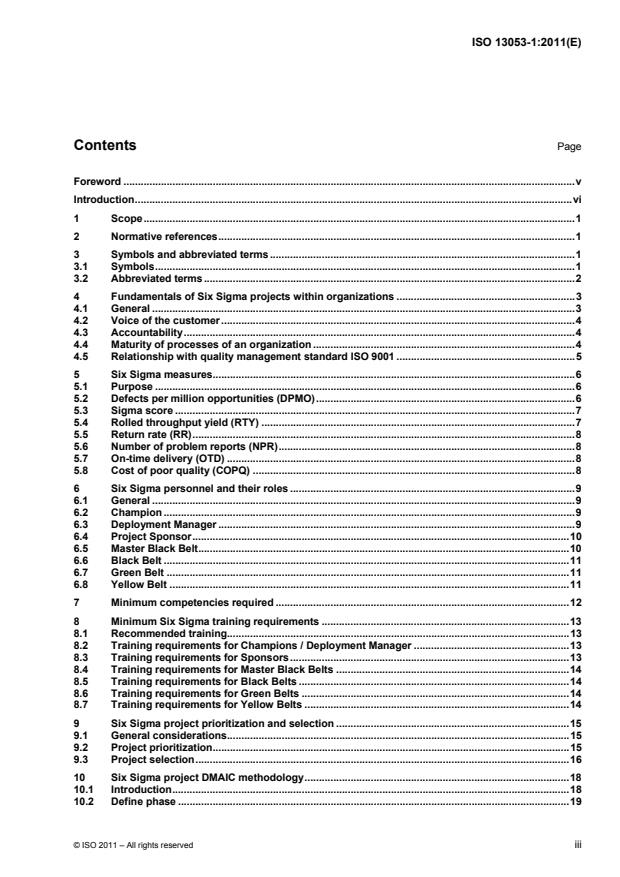
Contents Page
Foreword . v
Introduction . vi
1 Scope . 1
2 Normative references . 1
3 Symbols and abbreviated terms . 1
3.1 Symbols . 1
3.2 Abbreviated terms . 2
4 Fundamentals of Six Sigma projects within organizations . 3
4.1 General . 3
4.2 Voice of the customer . 4
4.3 Accountability . 4
4.4 Maturity of processes of an organization . 4
4.5 Relationship with quality management standard ISO 9001 . 5
5 Six Sigma measures . 6
5.1 Purpose . 6
5.2 Defects per million opportunities (DPMO) . 6
5.3 Sigma score . 7
5.4 Rolled throughput yield (RTY) . 7
5.5 Return rate (RR) . 8
5.6 Number of problem reports (NPR) . 8
5.7 On-time delivery (OTD) . 8
5.8 Cost of poor quality (COPQ) . 8
6 Six Sigma personnel and their roles . 9
6.1 General . 9
6.2 Champion . 9
6.3 Deployment Manager . 9
6.4 Project Sponsor . 10
6.5 Master Black Belt . 10
6.6 Black Belt . 11
6.7 Green Belt . 11
6.8 Yellow Belt . 11
7 Minimum competencies required . 12
8 Minimum Six Sigma training requirements . 13
8.1 Recommended training . 13
8.2 Training requirements for Champions / Deployment Manager . 13
8.3 Training requirements for Sponsors . 13
8.4 Training requirements for Master Black Belts . 14
8.5 Training requirements for Black Belts . 14
8.6 Training requirements for Green Belts . 14
8.7 Training requirements for Yellow Belts . 14
9 Six Sigma project prioritization and selection . 15
9.1 General considerations . 15
9.2 Project prioritization . 15
9.3 Project selection . 16
10 Six Sigma project DMAIC methodology . 18
10.1 Introduction . 18
10.2 Define phase . 19
10.3 Measure phase .19
10.4 Analyse phase .20
10.5 Improve phase .20
10.6 Control phase .21
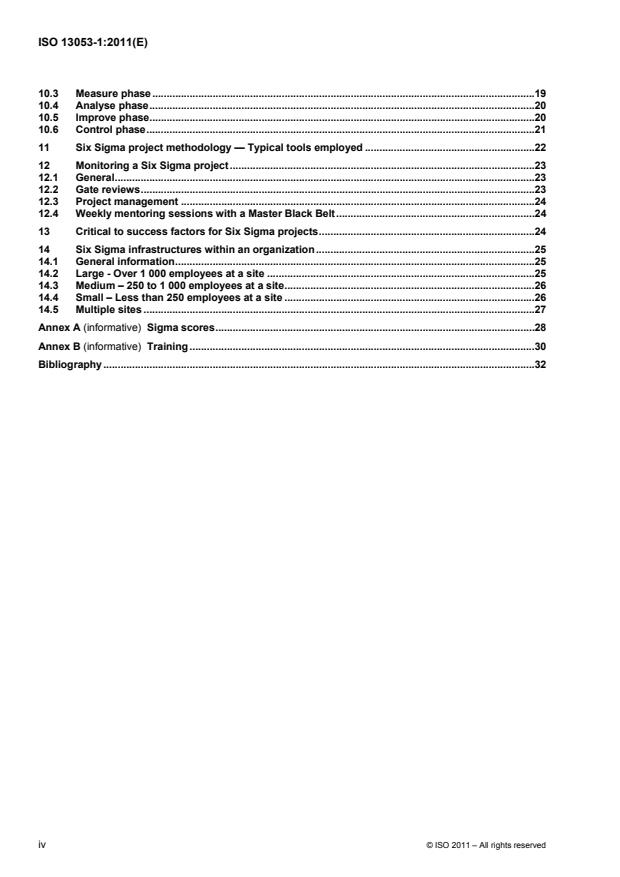
11 Six Sigma project methodology — Typical tools employed .22
12 Monitoring a Six Sigma project .23
12.1 General .23
12.2 Gate reviews .23
12.3 Project management .24
12.4 Weekly mentoring sessions with a Master Black Belt .24
13 Critical to success factors for Six Sigma projects .24
14 Six Sigma infrastructures within an organization .25
14.1 General information .25
14.2 Large - Over 1 000 employees at a site .25
14.3 Medium – 250 to 1 000 employees at a site .26
14.4 Small – Less than 250 employees at a site .26
14.5 Multiple sites .27
Annex A (informative) Sigma scores .28
Annex B (informative) Training .30
Bibliography .32
iv © ISO 2011 – All rights reserved
Foreword
ISO (the International Organization for Standardization) is a worldwide federation of national standards bodies
(ISO member bodies). The work of preparing International Standards is normally carried out through ISO
technical committees. Each member body interested in a subject for which a technical committee has been
established has the right to be represented on that committee. International organizations, governmental and
non-governmental, in liaison with ISO, also take part in the work. ISO collaborates closely with the
International Electrotechnical Commission (IEC) on all matters of electrotechnical standardization.
International Standards are drafted in accordance with the rules given in the ISO/IEC Directives, Part 2.
The main task of technical committees is to prepare International Standards. Draft International Standards
adopted by the technical committees are circulated to the member bodies for voting. Publication as an
International Standard requires approval by at least 75 % of the member bodies casting a vote.
Attention is drawn to the possibility that some of the elements of this document may be the subject of patent
rights. ISO shall not be held responsible for identifying any or all such patent rights.
ISO 13053-1 was prepared by Technical Committee ISO/TC 69, Applications of statistical methods,
Subcommittee SC 7, Application of statistical and related techniques for the implementation of Six Sigma.
ISO 13053 consists of the following parts, under the general title Quantitative methods in process
improvement — Six Sigma:
Part 1: DMAIC methodology
Part 2: Tools and techniques
Introduction
1)
The purpose of Six Sigma is to bring about improved business and quality performance and to deliver
improved profit by addressing serious business issues that may have existed for a long time. The driving force
behind the approach is for organizations to be competitive and to eliminate errors and waste. A number of Six
Sigma projects are about the reduction of losses. Some organizations require their staff to engage with Six
Sigma and demand that their suppliers do as well. The approach is project based and focuses on strategic
business aims.
There is little that is new within Six Sigma from the point of view of the tools and techniques utilized. The
method uses statistical tools, among others, and therefore deals with uncertain events in order to provide
decisions that are based on uncertainty. Consequently, it is considered to be good practice that a Six Sigma
general program is synchronized with risk management plans and defect prevention activities.
A difference, from what may have gone before with quality initiatives, is every project, before it can begin,
must have a sound business case. Six Sigma speaks the language of business (value measurement
throughout the project), and its philosophy is to improve customer satisfaction by the elimination and
prevention of defects and, as a result, to increase business profitability.
Another difference is the infrastructure. The creation of roles, and the responsibilities that go with them, gives
the method an infrastructure that is robust. The demand that all projects require a proper business case, the
common manner by which all projects become vetted, the clearly defined methodology (DMAIC) that all
projects follow, provides further elements of the infrastructure.
The scope of this part of ISO 13053 limits the document to only cover the improvement of existing processes.
It does not go into the realm of Design for Six Sigma (DFSS) or the re-engineering of a process where the
DMAIC methodology is not fully suitable, nor does it cover the issue of certification. There will also be
situations where any further work on an existing process is not possible, either technically, or in a financially
justifiable sense. Other standards dealing with these circumstances are yet to be developed, but when they
have been published, ISO 13053 together with those future documents will form a cohesive set of standards
ranging from improving existing processes to the development of new ones to deliver Six Sigma levels of
performance, and beyond.
1) Six Sigma is a trade mark of Motorola, Inc.
vi © ISO 2011 – All rights reserved
INTERNATIONAL STANDARD ISO 13053-1:2011(E)
Quantitative methods in process improvement — Six Sigma —
Part 1:
DMAIC methodology
1 Scope
This part of ISO 13053 describes a methodology for the business improvement methodology known as Six
Sigma. The methodology typically comprises five phases: define, measure, analyse, improve and control
(DMAIC).
This part of ISO 13053 recommends the preferred or best practice for each of the phases of the DMAIC
methodology used during the execution of a Six Sigma project. It also recommends how Six Sigma projects
should be managed and describes the roles, expertise and training of the personnel involved in such projects.
It is applicable to organizations using manufacturing processes as well as service and transactional processes.
2 Normative references
The following referenced documents are indispensable for the application of this document. For dated
references, only the edition cited applies. For undated references, the latest edition of the referenced
document (including any amendments) applies.
ISO 13053-2, Quantitative methods in process improvement — Six Sigma — Part 2: Tools and techniques
3 Symbols and abbreviated terms
3.1 Symbols
c number of defects (nonconformities)
location of the process; population mean value
“off-set” location of the process; “off-set” population mean value
n number of critical to quality characteristics
CTQC
n number of units surveyed
units
p proportion of nonconforming items
R sample range value
R moving range value usually calculated between successive observations
moving
population standard deviation
u number of defects (nonconformities) per item
X value
X sample arithmetic mean value
Y calculated number of defects per million opportunities
DPMO
z standardized normal distribution deviate
Z Sigma score or value
value
3.2 Abbreviated terms
5S acronym meaning sort, set, shine, standardize and sustain as used in the “visual factory”/“visual
workplace” approach
5-Why method for finding the potential root cause of a problem
8D eight disciplines problem-solving method
ANOVA analysis of variance
C&E cause and effect
COPQ cost of poor quality
COQ cost of quality
CTC critical to cost
CTQ critical to quality
CTQC critical to quality characteristic
DMAIC define, measure, analyse, improve, control
DOE design of experiments
DPMO defects per million opportunities
EVOP evolutionary operation
FMEA failure mode and effects analysis
FTA fault tree analysis
KPI key performance indicator
KPIV key process input variable
KPOV key process output variable
MCA multiple correspondence analysis
MSA measurement system analysis
NPR number of problem reports
2 © ISO 2011 – All rights reserved
OTD on-time delivery
ppm parts per million
QFD quality function deployment
RACI responsible, accountable, consulted, informed
RR return rate
RTY rolled throughput yield
SIPOC flowchart showing (S)upplier, (I)nputs, (P)rocess, (O)utputs, (C)ustomer relationships
SOP standard operating procedure
SPC statistical process control
TPM total productive maintenance
4 Fundamentals of Six Sigma projects within organizations
4.1 General
The main purpose of a Six Sigma project is to solve a given problem in order to contribute to an organization's
business goals. Six Sigma projects should be undertaken only when the solution to a problem is not known.
The specific activities of a Six Sigma project can be summarized as
a) gather data,
b) extract information from the data through analysis,
c) design a solution, and
d) ensure the desired results are obtained.
A practical approach should always be favoured when applying the above activities as shown in Table 1 below.
Table 1 — Fundamentals of Six Sigma
Question Six Sigma phase Description
What is the issue? Define Define a strategic issue to work on
Measure the current performance of the process to be
Where is the process now? Measure
improved
Analyse the process to establish the main root cause of poor
What is causing this? Analyse
performance
Improve the process through testing and studying potential
What can be done about it? Improve
solutions to establish a robust improved process
Control the improved process by establishing a standardized
How can it be kept there? Control process capable of being operated and continually improved to
maintain performance over time
4.2 Voice of the customer
The “voice of the customer” should provide a permanent feedback loop for the duration of a Six Sigma project.
In the context of a Six Sigma project, this might be the Project Sponsor, an internal customer, or an external
customer. It is important that every Six Sigma project start with the customers' needs and expectations.
Subsequently, the ongoing activities of the project should be checked, at each phase, to confirm that they
have not departed from the original customer expectations.
4.3 Accountability
The Six Sigma improvement methodology should be targeted on financial efficiency but should also take into
consideration safety and customer satisfaction.
In all cases, an accounting model should be established, as a first step, so that the financial performance of a
process is properly evaluated. Subsequently, both the financial department and operations department can
look at one set of data and should be able to forecast similar outcomes.
The performance of the project under investigation should be assessed in terms of effectiveness and
adaptability for the customer or the efficiency for the business. This should be reviewed regularly with the
sponsor of the project.
4.4 Maturity of processes of an organization
Continual improvement comprises a set of actions which improve the performance of an organization. The
concept of maturity has been introduced in order to evaluate different levels of performance of an organization
and to give a road map for continual improvement projects. Usually, five levels are used:
Initial (Level 1) – no description of any process in the organization;
Managed (Level 2) – reactive only on customer demand, the process to respond to the customer has
been formalized;
Defined (Level 3) – the processes of the whole organization are defined;
Quantitatively Managed (Level 4) – all the processes of Level 3 are quantitatively managed with
indicators; and
Optimized (Level 5) – the processes can be optimized with the use of indicators.
In a Six Sigma organization, the levels of maturity will change gradually. The different stages of progress will
provide a general road map of the continual improvement programme and the level of maturity. The levels are
shown in Figure 1.
4 © ISO 2011 – All rights reserved
Con�nual
Improvement
Progress Approach
Level 5:
Optimized
Level 4:
D
Quantitatively
y y
Managed
M A I C
Level 3: Defined
Level 2: Managed
Level 1: Initial
Figure 1 — Continual improvement and maturity level
4.5 Relationship with quality management standard ISO 9001
The quality principles outlined in the quality management system standards ISO 9000 and ISO 9001 call for a
factual approach to decision making, a process approach to achieving quality and the practice of continual
improvement.
Six Sigma methods are powerful tools for top performance in each of these areas.
Quality comes out of an enterprise's system. Quality methods such as Six Sigma operate more effectively
when they are integrated into an enterprise's operating system and processes, from market research to quality
planning to process control and through to life cycle management.
An enterprise introducing Six Sigma should examine its operating systems to understand where existing
processes need to be modified. The introduction of a range of methods, based on the use of data and
problem-solving methods (such as DMAIC), could help improve the enterprise's operating systems. This can
also help the enterprise improve the existing system continually, which is also a requirement of ISO 9001.
Companies which follow this route tend to achieve greater productivity, customer satisfaction and a
sustainable competitive position in their market place.
Members of an enterprise benefit from the training, learning and application of Six Sigma methods. They
become more competent and knowledgeable in statistical thinking, understanding process variability and the
resulting application within a quality management system.
Another very important benefit of integration of the Six Sigma methods in the quality management system is
the opportunity to collect and store core knowledge on each project and process. This knowledge (on
customer satisfaction, design for manufacture, process capability and in-service data on reliability) will be
passed on to subsequent project teams, thereby embedding in the enterprise core knowledge which business
sustainability needs to survive in the long term and avoiding the loss of knowledge when key people leave or
retire.
Customers and stakeholders are the ultimate beneficiaries of Six Sigma integration into a quality management
system giving a superior product, lower costs and better consistency from the delivered products.
5 Six Sigma measures
5.1 Purpose
The purpose of measures in a Six Sigma project is to be able to quantify the performance of a process. This
enables comparisons, analysis and insights into the causes of performance to be gained. Various business
measures can be applied to quantify a problem targeted for resolution by one or several Six Sigma projects.
Several measures can be used to quantify the problem during the execution of a Six Sigma project. The
following subclauses identify the chief measures that can be used. The choice of measure will depend on the
project. Three of these measures often used to stimulate activities for improvement are: “product return rate”,
“number of problem reports”, and “on-time delivery”. Continuous measures of these characteristics will tell us
more about “by how much” the characteristics need to be improved. A further measure groups most of these
as an overall measure – the cost of poor quality.
5.2 Defects per million opportunities (DPMO)
DPMO should be calculated using the following formula:
c
Y1 000 000
DPMO
nn
units CTQC
The potential number of CTQC defects (nonconformities) is counted from the n surveyed. It measures the
units
achieved quality performance and it is expressed as a rate per million of all such CTQC defects. The value
can then be later used to estimate a “sigma score” (or Z ). See Table 2.
value
Table 2 — Sigma scores
Calculated value of DPMO Sigma score (Z )
value
(Y )
DPMO
308 538,0 2
66 807,0 3
6 210,0 4
233,0 5
3,4 6
NOTE 1 A full table of sigma scores can be found in Annex A.
NOTE 2 Calculations are based on a 1,5 sigma shift of the mean.
The benchmark used to rank the quality or performance is the sigma score. World class performance has
become synonymous with a sigma score of 6, i.e. a performance level of 3,4 DPMO. Thus, a continuous
process with a sigma score of 6 has a specification limit that is actually 4,5 standard deviations from the mean
value.
As an illustration of how the above calculation can be applied, consider a product that has 1 000 CTQCs
associated with it. If all of the characteristics had a performance of 3,4 DPMO, then the probability that the unit
1 000
will be “defect-free” is 1 (0,000 003 4) , or 0,996 606. If a batch of 150 units were produced, the
probability that there will be no defects in the batch is 0,996 606 , or 0,60. In other words, even though each
CTQC has a sigma score of 6, the probability that there is at least one defect amongst a batch of 150 such
products will be 0,40. Thus, for such products, the level of DPMO performance for the CTQCs needs to be
much higher than a sigma score of 6. A sigma score of 6 is very much the initial threshold level.
6 © ISO 2011 – All rights reserved
5.3 Sigma score
The sigma score is derived from the normal distribution, but with a 1,5 standard deviation “off-set”, chosen
historically from custom and practice. See Figure 2. This offset of 1,5 ( 6 4,5) is called the shift (value).
NOTE The shift of 1,5 sigma captures the estimate of the variation of the process mean between short- and long-
term periods.
Y
Off-set
1,5 σ 4,5 σ
0,000 003 4
μ μ '
Figure 2 — Derivation of the sigma scores
A sigma score of 6 is actually 4,5 standard deviations from the mean value. Therefore, to determine the
proportion of the distribution remaining in the tail of the distribution, z is 4,5, using a standardized normal
distribution. Table 2 was constructed in this manner. Further values can be read from Table A.1, which has
been prepared in the same way.
Naturally, caution is required here since the normal distribution may not always be an appropriate model to
use.
5.4 Rolled throughput yield (RTY)
RTY is the probability that a single unit can pass through a series of process steps free of defects.
In the case of multi-stage processes RTY is calculated by multiplying the “first time through yield” for each
process step. The “first time through yield” does not include any rework, repair, additional adjustment, delay
for down time, etc. It is also called “non-adjusted rate” or “go-through rate”. See the example in Figure 3.
Scrap 10 Scrap 5
Rework 10 Rework 6 Rework 20
500 units 490 units 474 units 449 units
Op. 10 Op. 20 Op. 30
Y =(500-10)/500=0,980 Y =(490-10-6)/490=0,967 Y =(474-20-5)/474=0,947
FT FT FT
Y =0,980 x 0,967 x 0,947 = 0,897
RTY
Figure 3 — Rolled throughput yield example
The RTY calculation is a more appropriate measure of the process' performance rather than the more “naïve”
calculation after Op. 30 of 485 divided by 500, i.e. 0,970, that overstates the process' real performance of
0,897.
NOTE RTY assumes that the process steps are independent.
5.5 Return rate (RR)
RR is defined as the number of returns – or request for returns – of a given product in a specified period, such
as a month, divided by a measure of shipments. Shipments can be determined over the same specified period
as the number of returns or can be a “normalized” measure of shipments such as a smoothed average over a
year.
5.6 Number of problem reports (NPR)
NPR is defined as the number of customer-originated problem reports during a specified period such as a
month, where the reports relate to the quality of a product. A product can either be a piece of hardware, a
software release, a system installed at a customer site, or a service provided to a customer.
Reports are sometimes broken into three categories according to their severity: critical, major and minor. In
such cases, NPR is split into three different measures, one for each level of severity.
5.7 On-time delivery (OTD)
OTD measures the timeliness of deliveries to customers. It is defined as the percentage of orders that are
delivered at the customers' sites according to the scheduling requirements of the customers per specified
period of time.
5.8 Cost of poor quality (COPQ)
The traditional cost of quality (COQ) captures costs across the entire company using the categories of
prevention, appraisal, internal failure, and external failure. An often large part of COQ relates to the cost of
poor quality or COPQ that is incurred by producing and fixing defects either as internal failure or as external
failure. This cost covers all efforts to ship the defective product or its replacement, diagnose the root cause for
the defects, repair the defective product or scrap it, retest it, repackage the new product, etc. It does not
include any loss to the customer nor the cost incurred from lack of customer satisfaction with the product.
8 © ISO 2011 – All rights reserved
6 Six Sigma personnel and their roles
6.1 General
An organization seeking to implement Six Sigma should consider the following roles and whether they are
applicable to its implementation. Some roles may need to be assigned full time occupation depending upon
the size of the organization and the complexity of the projects (see Clause 14, Tables 8, 9 and 10). A
schematic representation of what the interrelationships can be is shown in Figure 4.
Six Sigma Steering Commi�ee
Six Sigma Deployment
Six Sigma Champion
Manager
Project Sponsor Project Sponsor
Master Black Belt Master Black Belt Master Black Belt
Black Belt Black Belt Black Belt
Green Belt Green Belt Green Belt
Yellow Belt Yellow Belt Yellow Belt
Figure 4 — Example of Six Sigma roles and their interrelationships
6.2 Champion
This individual is likely to be a senior member of the organization, e.g. director or a vice president of quality,
and one who carries a large degree of influence within the organization. The person will
a) determine the strategy for the deployment of Six Sigma throughout the organization, and
b) be responsible for setting and promoting business objectives with regards to the Six Sigma initiative.
6.3 Deployment Manager
To oversee and to manage the deployment of Six Sigma, every organization will require a Deployment
Manager. Depending upon the size of the organization, this might be a full time occupation. The roles of the
Deployment Manager will be the following:
a) to promote the Six Sigma initiative;
b) to determine, along with senior management, the nature of the expansion of Six Sigma within the
company, the size of the populations of Master Black Belts, Black Belts, Green Belts, etc., and the
duration of the secondments for these personnel;
c) to liaise with and report to senior management about the progress of any Six Sigma initiative;
d) to involve new Project Sponsors and recruit new Master Black Belts and Black Belt candidates for the
purpose of Six Sigma;
e) to negotiate with the different areas of the company for the secondment, and later the redeployment, of
the candidate Black Belts;
f) to manage any facility that is provided for the pursuit of Six Sigma, e.g. a Six Sigma centre, for the use of
the Master Black Belts and the Black Belts;
g) to seek potential projects; and
h) to participate in “major” gate reviews, as necessary.
6.4 Project Sponsor
The Project Sponsor is vitally important to the successful outcome of a Six Sigma project. This person may be
the process owner within which a Six Sigma project is to be undertaken. The Project Sponsor's duties will be
linked to the (1) success of the project, (2) importance and effective use of gate reviews, (3) institutionalization
of any problem solution, (4) the removal of old ways of doing business after a new solution is in-place, and (5)
the satisfaction of any training needs.
The principal roles of the Project Sponsor are the following:
a) to champion the Six Sigma methodology with peers and with others higher in the organization;
b) to support the nominated Six Sigma project;
c) to provide resources requested by the Black Belt and required for the Six Sigma project;
d) to remove any “road blocks” encountered by the Black Belt in discharging the project;
e) to participate in all gate reviews directly and to sign-off on the phase when the work has been done
properly;
f) to ensure the full implementation of all recommendations of the Six Sigma project;
g) to ensure that improvements identified within the nominated projects are realized and maintained; and
h) to ensure that completed projects are evaluated for potential application across other businesses or
elsewhere within the same business.
6.5 Master Black Belt
The role of the Master Black Belt is to support the Black Belts in the application of the DMAIC methodology
and the selection and use of the tools and techniques required. In particular, the Master Black Belt will
a) coach and mentor the Black Belts in the application of the DMAIC methodology and the selection and use
of the tools and techniques required,
b) provide support so that improvements identified within the nominated projects are realized and
maintained,
10 © ISO 2011 – All rights reserved
c) provide “internal” consultancy in advanced statistics,
d) assist in the identification of suitable improvement projects,
e) assist in the determination of the scope of the selected improvement project,
f) assist in periodic reviews of the improvement projects,
g) provide training in the tools and techniques associated with Six Sigma to Black and Green Belts as
required,
h) determine if any training activities are appropriate and effective, and
i) lead improvement projects as required.
NOTE Depending on its size, a company might use consultancy services to provide the Master Black Belt function
when a Master Black Belt cannot be grown within the company since Master Black Belts usually require experience drawn
from many companies and a wide business knowledge (they are often former senior managers within a company).
6.6 Black Belt
The Black Belt is expected to deliver the agreed benefits of a Six Sigma project to the organization. In so
doing, the Black Belt will
a) work with others to identify and quantify opportunities for improvement,
b) organize multidisciplinary teams (process organization), where necessary, and manage improvement
projects,
c) lead improvement projects or facilitate Green Belt Projects using the DMAIC methodology,
d) train, coach and mentor Green Belts on DMAIC methodology and associated process improvement
techniques, and
e) participate in all gate reviews directly through prepared presentations of the work accomplished to-date
with an emphasis on the accomplishments in the phase being reviewed.
6.7 Green Belt
The Green Belt is expected to deliver the agreed benefits of a Six Sigma project to the organization. These
improvement activities will often be within the Green Belt's usual field of employment and operation. In so
doing, the Green Belt will
a) work with the local “line management” to identify and quantify opportunities for improvement within the
local environment,
b) be required to work under the direction of a Black Belt as a member of a larger Six Sigma project led by
the Black Belt,
c) be required to lead a smaller Six Sigma project under the direction of a Black Belt, and
d) possibly coach process operators (Yellow Belts) on process improvement methods and activities.
6.8 Yellow Belt
A Yellow Belt is usually a process operator, either in a manufacturing sense or an office (transactional) sense.
The Yellow Belt is expected to participate in Six Sigma project teams when a Six Sigma project is concerned
with a process within which the Yellow Belt operates.
In so doing, the Yellow Belt will
a) work with the local Green Belt to identify and quantify opportunities for improvement within the local
environment,
b) be required to work under the direction of a Black Belt or a Green Belt as a member of a larger Six Sigma
project led by the Black Belt, and
c) be required to participate in a smaller Six Sigma project under the direction of a Green Belt.
7 Minimum competencies required
The recommended minimum competencies required of the Six Sigma personnel identified in Clause 6 are
shown in Table 3. The table indicates the minimum level of competency for each skill/role combination. A
numerical value has been assigned to each skill ranging from 0, where no competency is considered
necessary for a particular role, to 3, where the particular skill is considered highly necessary for a particular
role.
Table 3 — Minimum competency requirements to fulfil a given role
Skill Master Black Belt Black Belt Green Belt Yellow Belt
Business perception 3 2 1 1
Computer literacy 3 3 1 1
Customer focus 3 3 3 3
Interpersonal skills 3 3 2 1
Motivational skills 3 3 2 1
Numeracy 3 2 1 1
Practical problem
3 2 3 1
solving skills
Presentation skills 3 3 2 0
Process improvement
3 2 1 0
experience
Process management
3 3 2 0
skills
Project management
3 3 2 0
skills
Results driven 3 3 2 2
Six Sigma tools
3 2 1 1
knowledge
Statistical skills 3 2 1 0
Statistical software use 3 3 1 0
Training skills 3 3 1 0
Coaching skills 3 2 2 0
Level 0 - Not needed; Level 1 - Basic competence; Level 2 - Proficient user; Level 3 - Highest level of ability.
NOTE A value of 0 in the table indicates that, to fulfil the given role, a certain skill may not be needed. It does not mean that the
individual in the role has no knowledge of that particular skill.
12 © ISO 2011 – All rights reserved
8 Minimum Six Sigma training requirements
8.1 Recommended training
Training can be provided in a number of ways, either as formal classroom style courses or through other
training media such as e-Learning or similar distance learning courses. The recommended training
requirements, expressed in days, are shown in Table 4 for each of the Six Sigma personnel described in
Clause 6.
Table 4 — Recommended minimum course durations
a
Category Sponsor Master Black Black Belt Green Belt Yellow Belt
Champion /
b
Deployment Belt
Manager
c
3 1 10 20 5 1
Instruction
(days)
Tutorials (days) - - 2 5 1 0
Number of - - 2 2 1 0
qualifying Six
Sigma projects
a
To become a Champion, it is not enough to just complete the Champion Training.
b
A Master Black Belt will have previously completed Black Belt training and performed this role for at least two years and will
consequently have completed a number of Six Sigma projects.
c
The instruction given is assumed to be delivered in a classroom. Some companies substitute some of this time with distance
“e-learning”.
The Master Black Belt training is usually split into two weeks separated by a short interval of time, e.g. two weeks.
The Black Belt training is usually divided into five four-day durations, or some other suitable division e.g. four five-day durations, each
separated by about three to four weeks.
8.2 Training requirements for Champions / Deployment Manager
The purpose of this training is to familiarize the Champion and the Deployment Manager with the DMAIC
methodology and to understand and appreciate the tools that support it. In this way, they will be well prepared
to receive reports from Six Sigma teams about progress and findings of projects.
This training should have the same content as that for Green Belts but with more emphasis on project
selection, project scoping and implementation of recommendations. (The typical content of a Green Belt
training programme can be seen in Table B.2.)
8.3 Training requirements for Sponsors
The purpose of this training is to familiarize the Sponsor with the DMAIC methodology and to understand and
appreciate the tools that support it. In this way, the Sponsor will be prepared to receive reports from Six Sigma
teams about progress and findings of projects and to be able to fully participate in “gate reviews”, as well as to
be able to “institutionalize” the Six Sigma approach to business improvement.
The content for Sponsor training might vary according to the business application but will concentrate on the
assessment of the deliverables and how to evaluate them at the completion of each Six Sigma phase.
8.4 Training requirements for Master Black Belts
A candidate Master Black Belt should have already been accredited as a Black Belt and will therefore have
already received the necessary training for a Black Belt. If this is not the case, the Master Black Belt should
take further training that is recommended to extend the Master Black Belt's knowledge of statistical methods,
other related mathematical techniques and management organizational techniques. The precise training
agenda shall be tailored to the specific individuals and to the area(s) of application (manufacturing or
transacti
...
NORME ISO
INTERNATIONALE 13053-1
Première édition
2011-09-01
Méthodes quantitatives dans
l'amélioration de processus — Six
Sigma —
Partie 1:
Méthodologie DMAIC
Quantitative methods in process improvement — Six Sigma —
Part 1: DMAIC methodology
Numéro de référence
©
ISO 2011
DOCUMENT PROTÉGÉ PAR COPYRIGHT
© ISO 2011
Droits de reproduction réservés. Sauf prescription différente, aucune partie de cette publication ne peut être reproduite ni utilisée sous
quelque forme que ce soit et par aucun procédé, électronique ou mécanique, y compris la photocopie et les microfilms, sans l'accord écrit
de l'ISO à l'adresse ci-après ou du comité membre de l'ISO dans le pays du demandeur.
ISO copyright office
Case postale 56 CH-1211 Geneva 20
Tel. + 41 22 749 01 11
Fax + 41 22 749 09 47
E-mail copyright@iso.org
Web www.iso.org
Publié en Suisse
ii © ISO 2011 – Tous droits réservés
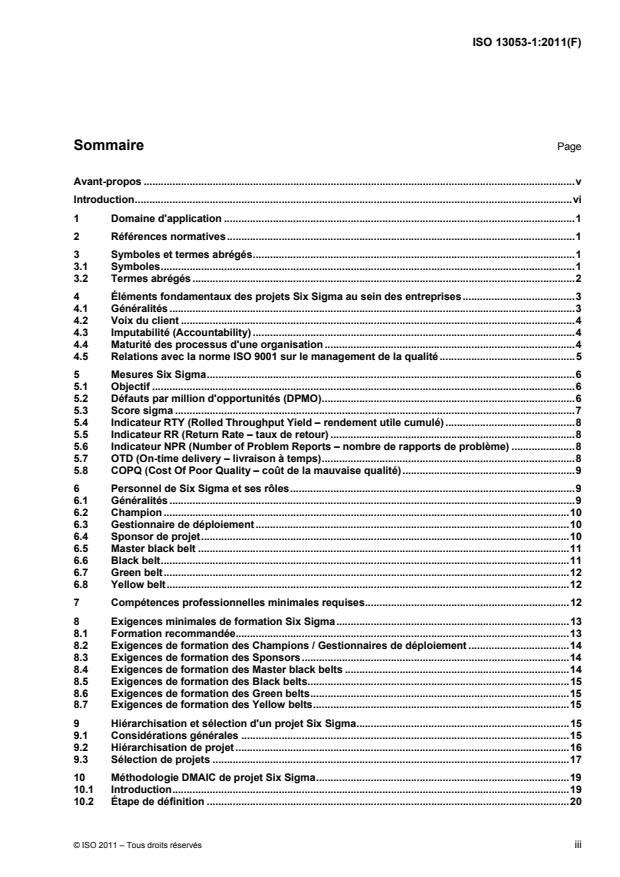
Sommaire Page
Avant-propos . v
Introduction . vi
1 Domaine d'application . 1
2 Références normatives . 1
3 Symboles et termes abrégés . 1
3.1 Symboles . 1
3.2 Termes abrégés . 2
4 Éléments fondamentaux des projets Six Sigma au sein des entreprises . 3
4.1 Généralités . 3
4.2 Voix du client . 4
4.3 Imputabilité (Accountability) . 4
4.4 Maturité des processus d'une organisation . 4
4.5 Relations avec la norme ISO 9001 sur le management de la qualité . 5
5 Mesures Six Sigma . 6
5.1 Objectif . 6
5.2 Défauts par million d'opportunités (DPMO) . 6
5.3 Score sigma . 7
5.4 Indicateur RTY (Rolled Throughput Yield – rendement utile cumulé) . 8
5.5 Indicateur RR (Return Rate – taux de retour) . 8
5.6 Indicateur NPR (Number of Problem Reports – nombre de rapports de problème) . 8
5.7 OTD (On-time delivery – livraison à temps) . 8
5.8 COPQ (Cost Of Poor Quality – coût de la mauvaise qualité) . 9
6 Personnel de Six Sigma et ses rôles . 9
6.1 Généralités . 9
6.2 Champion . 10
6.3 Gestionnaire de déploiement . 10
6.4 Sponsor de projet . 10
6.5 Master black belt . 11
6.6 Black belt . 11
6.7 Green belt . 12
6.8 Yellow belt . 12
7 Compétences professionnelles minimales requises . 12
8 Exigences minimales de formation Six Sigma . 13
8.1 Formation recommandée. 13
8.2 Exigences de formation des Champions / Gestionnaires de déploiement . 14
8.3 Exigences de formation des Sponsors . 14
8.4 Exigences de formation des Master black belts . 14
8.5 Exigences de formation des Black belts . 15
8.6 Exigences de formation des Green belts . 15
8.7 Exigences de formation des Yellow belts . 15
9 Hiérarchisation et sélection d'un projet Six Sigma . 15
9.1 Considérations générales . 15
9.2 Hiérarchisation de projet . 16
9.3 Sélection de projets . 17
10 Méthodologie DMAIC de projet Six Sigma . 19
10.1 Introduction . 19
10.2 Étape de définition . 20
10.3 Étape de mesure .20
10.4 Étape d'analyse .21
10.5 Étape d'amélioration .22
10.6 Étape de contrôle .22
11 Méthodologie de projet Six Sigma — Outils classiques utilisés .23
12 Suivi d'un projet Six Sigma .25
12.1 Généralités .25
12.2 Revues de fin de phase .25
12.3 Gestion de projet .25
12.4 Sessions hebdomadaires de tutorat avec un Master black belt .25
13 Facteurs essentiels pour la réussite des projets Six Sigma .25
14 Infrastructures Six Sigma au sein d'une entreprise .26
14.1 Généralités .26
14.2 Grand – plus de 1 000 employés sur un site .26
14.3 Moyen – 250 à 1 000 employés sur un site .27
14.4 Petit – moins de 250 employés sur un site .28
14.5 Plusieurs sites .28
Annexe A (informative) Scores sigma .29
Annexe B (informative) Formation .31
Bibliographie .33
iv © ISO 2011 – Tous droits réservés
Avant-propos
L'ISO (Organisation internationale de normalisation) est une fédération mondiale d'organismes nationaux de
normalisation (comités membres de l'ISO). L'élaboration des Normes internationales est en général confiée
aux comités techniques de l'ISO. Chaque comité membre intéressé par une étude a le droit de faire partie du
comité technique créé à cet effet. Les organisations internationales, gouvernementales et non
gouvernementales, en liaison avec l'ISO participent également aux travaux. L'ISO collabore étroitement avec
la Commission électrotechnique internationale (CEI) en ce qui concerne la normalisation électrotechnique.
Les Normes internationales sont rédigées conformément aux règles données dans les Directives ISO/CEI,
Partie 2.
La tâche principale des comités techniques est d'élaborer les Normes internationales. Les projets de Normes
internationales adoptés par les comités techniques sont soumis aux comités membres pour vote. Leur
publication comme Normes internationales requiert l'approbation de 75 % au moins des comités membres
votants.
L'attention est appelée sur le fait que certains des éléments du présent document peuvent faire l'objet de
droits de propriété intellectuelle ou de droits analogues. L'ISO ne saurait être tenue pour responsable de ne
pas avoir identifié de tels droits de propriété et averti de leur existence.
L'ISO 13053-1 a été élaborée par le comité technique ISO/TC 69, Application des méthodes statistiques,
sous-comité SC 7, Application de techniques statistiques, ou de techniques associées, pour la mise en œuvre
de Six Sigma.
L'ISO 13053 comprend les parties suivantes, présentées sous le titre général Méthodes quantitatives dans
l'amélioration de processus — Six Sigma:
Partie 1: Méthodologie DMAIC
Partie 2: Outils et techniques
Introduction
1)
Six Sigma a pour objet d'augmenter les performances de l'entreprise, la qualité de l'offre et d'améliorer la
rentabilité en traitant des difficultés récurrentes liées aux activités opérationnelles. L'élément moteur de cette
approche consiste à rendre les entreprises compétitives et à éliminer les erreurs et les gaspillages. Un certain
nombre de projets Six Sigma concerne la réduction des pertes. Certaines entreprises demandent à leur
personnel d'être partie prenante à Six Sigma, et à leurs fournisseurs d'en faire autant. L'approche se fonde
sur la conduite de projets et oriente ces projets vers des objectifs stratégiques.
Six Sigma présente peu de nouveautés en matière d'outils et de techniques utilisés. La méthode s'appuie,
entre autres, sur des outils statistiques, et donc sur des événements incertains afin de prendre des décisions
reposant sur la maîtrise de l'incertitude. Par conséquent, il est considéré comme étant de bonne pratique de
synchroniser un programme général Six Sigma avec des plans de gestion des risques et des activités de
prévention des défauts.
La vraie différence avec ce qui pouvait se pratiquer auparavant en matière de programmes de qualité est que
chaque projet doit faire l'objet d'une étude détaillée sur le retour d'investissement, et ce avant de l'initier. Six
Sigma parle la langue de l'entreprise et du développement des affaires (mesure de la valeur tout au long du
projet). Sa philosophie vise à améliorer la satisfaction du client en éliminant les défaillances et, ainsi, à
augmenter la rentabilité des entreprises.
Une autre différence concerne l'infrastructure. La création de rôles, et des responsabilités inhérentes, assure
la robustesse de l'infrastructure. La demande selon laquelle tous les projets doivent faire l'objet d'une analyse
correcte de rentabilité, la manière continue d'approuver tous les projets, la méthodologie clairement définie
(DMAIC) suivie par les projets sont autant d'éléments complémentaires de l'infrastructure.
Le domaine d'application de la présente partie de l'ISO 13053 limite le document à n'aborder que
l'amélioration des processus existants. Il n'aborde pas Design for Six Sigma (DFSS) ni la refonte d'un
processus dans lequel la méthodologie DMAIC n'est pas complètement pertinente, pas plus qu'il ne traite la
question de la certification. De plus, il y a également des cas où il n'est plus possible de poursuivre les
travaux sur un processus existant, tant du point de vue technique que financier. D'autres normes allant dans
ce sens restent à développer, mais lorsqu'elles auront été publiées, la présente partie de l'ISO 13053 et les
documents à venir formeront un ensemble cohérent de normes, allant de l'amélioration des processus
existants à l'élaboration de nouveaux processus, afin d'assurer la performance Six Sigma, et bien plus
encore.
1) Six Sigma est une marque commerciale de Motorola, Inc.
vi © ISO 2011 – Tous droits réservés
NORME INTERNATIONALE ISO 13053-1:2011(F)
Méthodes quantitatives dans l'amélioration de processus —
Six Sigma —
Partie 1:
Méthodologie DMAIC
1 Domaine d'application
La présente partie de l'ISO 13053 présente une méthodologie d'amélioration des processus d'activités
appelée Six Sigma. En règle générale, la méthodologie comporte cinq étapes: définir, mesurer, analyser,
améliorer et contrôler (DMAIC, pour «Define, Measure, Analyse, Improve and Control»).
La présente partie de l'ISO 13053 recommande les pratiques préférées ou les meilleures pratiques pour
chacune des étapes de la méthodologie DMAIC utilisée au cours de l'exécution d'un projet Six Sigma. Elle
donne également des recommandations sur la manière dont il convient de gérer les projets Six Sigma et
définit les rôles, compétences et formations du personnel y participant. Elle s'applique aux entreprises utilisant
des processus de fabrication, ainsi que des processus de service et de transaction.
2 Références normatives
Les documents de référence suivants sont indispensables pour l'application du présent document. Pour les
références datées, seule l'édition citée s'applique. Pour les références non datées, la dernière édition du
document de référence s'applique (y compris les éventuels amendements).
ISO 13053-2, Méthodes quantitatives dans l'amélioration de processus — Six Sigma — Partie 2: Outils et
techniques
3 Symboles et termes abrégés
3.1 Symboles
c nombre de défauts (non-conformités)
emplacement du processus; valeur moyenne de la population
emplacement «décalé» (offset) du processus; valeur moyenne de la population «décalée»
(offset)
n nombre de caractéristiques critiques pour la qualité (CTQ)
CTQC
n nombre d'unités étudiées
unités
p proportion des éléments non conformes
R valeur de l'étendue de l'échantillon
R valeur de plage mobile calculée entre des observations successives
moving
écart-type de la population
u nombre de défauts (non-conformités) par élément
X valeur
valeur moyenne arithmétique de l'échantillon
X
Y nombre calculé de défauts par million d'opportunités
DPMO
z
écart normalisé de la distribution normale
Z score ou valeur de Six Sigma
valeur
3.2 Termes abrégés
5S acronyme de «Sort, Set, Shine, Standardize and Sustain» (trier, définir, briller, normaliser et
maintenir), utilisé dans l'approche de «l'usine visuelle»/du «poste de travail visuel»
5 Pourquoi méthode de recherche de l'origine potentielle d'un problème
8D méthode permettant de résoudre un problème en huit étapes
AMDE analyse des modes de défaillance et de leurs effets («failure mode and effects analysis»)
(FMEA)
ANOVA analyse de la variance
C&E cause et effet
COPQ coût de la mauvaise qualité («cost of poor quality»)
COQ coût de la qualité («cost of quality»)
CTC critique pour les coûts («critical to cost»)
CTQ critique pour la qualité («critical to quality»)
CTQC caractéristique critique pour la qualité («critical to quality characteristic»)
DMAIC acronyme de «Define, Measure, Analyse, Improve, Control» (définir, mesurer, analyser,
améliorer, contrôler)
DOE plans d'expériences («design of experiments»)
DPMO défauts par million d'opportunités
EVOP essai d'évolution («evolutionary operation»)
FTA analyse de l'arbre de défaillances («fault tree analysis»)
KPI indicateur clé de performance («key performance indicator»)
KPIV variable d'entrée principale du processus («key process input variable»)
2 © ISO 2011 – Tous droits réservés
KPOV variable de sortie principale du processus («key process output variable»)
MCA analyse à plusieurs correspondances («multiple correspondence analysis»)
MSA analyse du système de mesure («measurement system analysis»)
NPR nombre de rapports de problème («number of problem reports»)
OTD livraison à temps («on-time delivery»)
ppm parties par million
QFD déploiement de la fonction qualité («quality function deployment»)
RACI acronyme de «Responsible, Accountable, Consulted, Informed» (responsable, autorité,
consulté, informé)
RR taux de retour («return rate»)
RTY indicateur RTY («Rolled Throughput Yield»: rendement utile cumulé)
SIPOC diagramme présentant les relations entre fournisseur, entrées, processus, sorties, client
(«Supplier, Inputs, Process, Outputs, Customer»)
SOP mode opératoire normalisé («standard operating procedure»)
SPC contrôle statistique du procédé («statistical process control»)
TPM maintenance productive totale («total productive maintenance»)
4 Éléments fondamentaux des projets Six Sigma au sein des entreprises
4.1 Généralités
L'objectif principal d'un projet Six Sigma est de résoudre un problème donné afin de participer aux objectifs
opérationnels d'une entreprise. Il convient que les projets Six Sigma ne soient entrepris que lorsque la
solution à un problème est inconnue.
Les activités spécifiques d'un projet Six Sigma peuvent être résumées de la manière suivante:
a) rassembler des données;
b) extraire des informations de l'analyse des données;
c) concevoir une solution;
d) s'assurer que les résultats souhaités soient obtenus.
Il convient de toujours favoriser l'approche pratique lors de l'application des activités ci-dessus, comme le
montre le Tableau 1 ci-dessous.
Tableau 1 — Fondamentaux de Six Sigma
Question Étape Six Sigma Description
Quel est le problème? Définir Définir un problème stratégique sur lequel travailler
Où se situe le processus en
Mesurer Mesurer la performance en cours du processus à améliorer
ce moment?
Analyser le processus pour établir la principale cause de la
Quelle en est la cause? Analyser
mauvaise performance
Améliorer le processus par des essais et l'étude des
Que peut-on y faire? Améliorer
éventuelles solutions vers un processus amélioré fiable
Contrôler le processus amélioré en établissant un processus
Comment maintenir les
Contrôler normalisé pouvant être réalisé et continuellement amélioré de
choses en l'état?
sorte à maintenir la performance dans le temps
4.2 Voix du client
Il convient que la «voix du client» offre une boucle de rétroaction permanente pendant la durée d'un projet Six
Sigma. Dans le contexte d'un projet Six Sigma, ce peut être le promoteur du projet, un client interne ou un
client externe. Il est important que chaque projet Six Sigma commence par définir les besoins et attentes du
client. Par la suite, il convient de vérifier les activités en cours liées au projet à chaque étape afin de confirmer
qu'elles répondent toujours aux attentes formulées par le client.
4.3 Imputabilité (Accountability)
Il convient que la méthodologie d'amélioration Six Sigma s'attache à l'efficacité économique, mais qu'elle
prenne aussi en considération la sécurité et la satisfaction du client.
Dans tous les cas, il convient de commencer par établir un modèle analytique de manière à pouvoir évaluer
correctement les performances financières d'un processus. Par la suite, le département financier et le
département des opérations peuvent examiner un ensemble de données et il convient qu'ils soient en mesure
de prévoir des résultats analogues.
Il convient que la performance du projet étudié soit évaluée en termes d'efficacité et d'adaptabilité pour le
client ou en termes d'efficacité économique. Il convient que ces points soient régulièrement examinés par le
sponsor du projet.
4.4 Maturité des processus d'une organisation
L'amélioration continue implique un ensemble d'actions permettant d'améliorer les performances d'une
entreprise. Le concept de maturité a été introduit afin d'évaluer les différents niveaux de performance d'une
entreprise et de mettre en place une feuille de route des projets d'amélioration continue. En règle générale,
cinq niveaux sont utilisés:
initial (Niveau 1) - aucune description d'un processus dans l'entreprise;
géré (Niveau 2) - réactif uniquement à la demande du client, le processus de réponse au client a été
formalisé;
défini (Niveau 3) - les processus de l'ensemble de l'entreprise sont définis;
géré de manière quantitative (Niveau 4) - tous les processus du niveau 3 sont gérés de manière
quantitative grâce à des indicateurs;
4 © ISO 2011 – Tous droits réservés
optimisé (Niveau 5) - les processus peuvent être optimisés à l'aide d'indicateurs.
Dans une entreprise Six Sigma, les niveaux de maturité changent progressivement. Les différents stades de
progression offrent une feuille de route générale du programme d'amélioration continue et du niveau de
maturité. Les niveaux sont indiqués à la Figure 1.
Amélioration
continue
Approche progressive
Niveau 5 :
Optimisé
Niveau 4 :
D
Géré de manière
y y
quantitative
M A I C
Niveau 3 : Défini
Niveau 2 : Géré
Niveau 1 : Initial
Figure 1 — Amélioration continue et niveau de maturité
4.5 Relations avec la norme ISO 9001 sur le management de la qualité
Les principes de qualité mis en évidence par les normes ISO 9000 et ISO 9001 sur le système de
management de la qualité invitent à une approche factuelle de la prise de décision, à une approche processus
permettant d'obtenir la qualité et à une amélioration continue.
Les méthodes Six Sigma sont de puissants outils pour une performance optimale dans chacun de ces
domaines.
La qualité est issue du système d'une entreprise. Les méthodes de qualité comme Six Sigma sont plus
efficaces lorsqu'elles sont intégrées dans le système opérationnel et dans les processus d'une entreprise, de
l'étude de marché à la planification de la qualité et au contrôle des processus, tout au long de la gestion du
cycle de vie.
Il convient qu'une entreprise qui se lance dans la mise en place d'un projet Six Sigma examine avant tout les
systèmes opérationnels afin de bien déterminer dans quelle mesure elle doit modifier les processus existants.
L'introduction d'un ensemble de méthodes, fondées sur l'utilisation de données et de méthodes de résolution
de problème (DMAIC, par exemple) permettrait de faciliter l'amélioration des systèmes opérationnels de
l'entreprise. Cela permet également à l'entreprise d'améliorer en permanence le système opérationnel
existant, comme l'exige l'ISO 9001. Les entreprises qui suivent cette voie tendent à obtenir une meilleure
productivité, à mieux satisfaire les clients et à maintenir une position compétitive sur leur marché.
Tous les membres d'une entreprise bénéficient de la formation, de l'apprentissage et de l'application des
méthodes Six Sigma. Ils deviennent plus compétents et maîtrisent les raisonnements statistiques,
comprennent la variabilité du processus et l'application résultante au sein d'un système de management de la
qualité.
L'intégration des méthodes Six Sigma dans le système de management de la qualité offre également la
possibilité de collecter et de stocker les connaissances de base sur chaque projet et processus. Ces éléments
seront inclus dans les données des futurs projets relatives à la satisfaction du client, à la conception de
fabrication, à la capacité du processus à la fiabilité. Par conséquent, il s'agit d'intégrer dans l'entreprise des
connaissances de base viables sur le long terme et d'éviter qu'elles ne disparaissent lorsque les personnes
qui les détiennent quittent l'entreprise ou partent à la retraite.
Les clients et les parties prenantes sont les ultimes bénéficiaires de l'intégration Six Sigma dans un système
de management de la qualité apportant une qualité supérieure, de plus faibles coûts et une cohérence
renforcée aux produits livrés.
5 Mesures Six Sigma
5.1 Objectif
L'objet des mesures dans un projet Six Sigma est d'être en mesure de quantifier la performance d'un
processus. Elles permettent des comparaisons, analyses et déductions sur les causes du manque de
performance. Différentes mesures d'activité d'affaires peuvent être appliquées pour quantifier un problème
pour lequel un ou plusieurs projets Six Sigma vont apporter une solution. Plusieurs mesures peuvent être
utilisées pour quantifier le problème lors de l'exécution d'un projet Six Sigma. Les paragraphes suivants
identifient les mesures phares qui peuvent être utilisées. Le choix d'une mesure dépend du projet. Trois de
ces mesures souvent utilisées pour simuler des activités d'amélioration sont le taux de retour de produits, le
nombre de problèmes rapportés et le respect des délais de livraison. Cependant, les mesures en continu de
ces caractéristiques nous en apprennent plus sur l'ampleur de l'amélioration nécessaire de ces
caractéristiques. Une autre mesure regroupe la plupart d'entre elles sous la forme d'une mesure globale: le
coût de la mauvaise qualité.
5.2 Défauts par million d'opportunités (DPMO)
Il convient d'obtenir la valeur calculée de DPMO à l'aide de la formule suivante:
c
Y1 000 000
DPMO
nn
unités CTQC
Le nombre potentiel de défauts CTQC (non-conformités) est déterminé à partir de n étudiées. Il mesure
unités
les performances de qualité obtenues et est exprimé en taux par million de ce type de défauts CTQC. La
valeur peut ensuite permettre d'estimer un «score sigma» (ou Z ). Voir le Tableau 2.
valeur
Tableau 2 — Scores sigma
Score sigma (Z )
Valeur calculée de DPMO (Y )
DPMO valeur
308 538,0 2
66 807,0 3
6 210,0 4
233,0 5
3,4 6
NOTE 1 Un tableau complet des scores sigma est disponible dans l'Annexe A.
NOTE 2 Les calculs reposent sur une déviation de la moyenne de 1,5 sigma.
6 © ISO 2011 – Tous droits réservés
La référence utilisée pour classer la qualité ou les performances est le score sigma. Les performances de
niveau international représentent un score sigma de 6; c'est-à-dire un niveau de performances de 3,4 DPMO.
Par conséquent, la limite de spécification d'un processus continu avec un score sigma égal à 6 donne en
réalité des écarts-types de 4,5 par rapport à la valeur moyenne.
Pour illustrer l'application du calcul ci-dessus, considérons un produit auquel sont associés 1 000 CTQC. Si
toutes les caractéristiques présentent une performance de 3,4 DPMO, la probabilité d'absence de défaut dans
1 000
l'unité est alors égale à 1 (0,000 003 4) , soit 0,996 606. Si un lot de 150 unités est produit, la probabilité
de n'avoir aucun défaut dans le lot est égale à 0,996 606 , soit 0,60. En d'autres termes, même si chaque
CTQC donne un score sigma de 6, la probabilité d'avoir au moins un défaut sur un lot de 150 produits est
de 0,40. Par conséquent, pour lesdits produits, le niveau de performances DPMO des CTQC doit être bien
supérieur à un score sigma de 6. Un score sigma de 6 est donc le niveau de seuil initial.
5.3 Score sigma
Le score sigma est déduit de la distribution normale, mais avec un «décalage» d'écart-type de 1,5, choisi
historiquement par l'usage et la pratique. Voir la Figure 2. Ce décalage de 1,5 ( 6 4,5) s'appelle l'écart (ou
la valeur d'écart).
NOTE L'écart de 1,5 sigma comprend l'estimation de la variation de la moyenne du processus entre les périodes à
court et long terme.
Y
Écart
1,5 σ 4,5 σ
0,000 003 4
μ μ '
Figure 2 — Écart des scores sigma
Un score sigma de 6 représente en réalité un écart-type de 4,5 par rapport à la valeur moyenne. Par
conséquent, pour déterminer la proportion de la distribution restante, z est égal à 4,5, à l'aide d'une
distribution normale normalisée. Le Tableau 2 a été élaboré de cette manière. D'autres valeurs peuvent être
lues dans le Tableau A.1, qui a été élaboré de la même manière.
Naturellement, des précautions doivent être prises dans le cas présent, la distribution normale n'étant pas
toujours le modèle approprié à utiliser.
5.4 Indicateur RTY (Rolled Throughput Yield – rendement utile cumulé)
L'indicateur RTY est la probabilité selon laquelle une seule unité peut passer une série d'étapes du processus
sans présenter de défaut.
Dans le cas des processus en plusieurs étapes, le rendement utile cumulé (RTY) est calculé en multipliant le
«premier rendement utile» pour chaque étape du processus. Le «premier rendement utile» ne comporte
aucune remise en fabrication, aucune réparation, aucun réglage supplémentaire, aucune durée d'interruption,
etc. Il est également appelé «taux non ajusté» ou «taux de passage». Voir l'exemple à la Figure 3.
Élimination 10 Élimination 5
Remise en fabrication 10 Remise en fabrication 6 Remise en fabrication 20
500 unités 490 unités 474 unités 449 unités
PC 10 PC 20 PC 30
Y =(500-10)/500=0,980 Y =(490-10-6)/490=0,967 Y =(474-20-5)/474=0,947
FT FT FT
Y =0,980 x 0,967 x 0,947 = 0,897
RTY
Figure 3 — Exemple de rendement utile cumulé
Le rendement utile cumulé (RTY) est une mesure plus appropriée des performances du processus que le
calcul plus «naïf» après le point de commande 30 de 485 divisé par 500 (soit 0,970) qui exagère les
performances réelles (0,897) du processus.
NOTE Le rendement utile cumulé (RTY) suppose l'indépendance des étapes du processus.
5.5 Indicateur RR (Return Rate – taux de retour)
L'indicateur RR est le nombre de retours (ou de demandes de retour) d'un produit donné au cours d'une
période donnée (un mois, par exemple) divisé par le nombre d'expéditions. Les expéditions peuvent être
déterminées sur la même période spécifiée que le nombre de retours. Il peut également s'agir d'une mesure
normalisée des expéditions (une moyenne lissée sur un an, par exemple).
5.6 Indicateur NPR (Number of Problem Reports – nombre de rapports de problème)
L'indicateur NPR est défini comme étant le nombre de rapports de problèmes signalés par des clients au
cours d'une période donnée (un mois, par exemple) concernant la qualité d'un produit. Un produit peut être
une pièce matérielle, un logiciel, un système installé sur le site du client ou un service apporté à un client.
Les rapports sont parfois classés en trois catégories, selon leur gravité: critique, majeur et mineur. Dans de
tels cas, le nombre de rapports de problème est divisé en trois mesures différentes, une pour chaque niveau
de gravité.
5.7 OTD (On-time delivery – livraison à temps)
L'indicateur OTD mesure le respect des délais de livraison aux clients. Il est défini comme le pourcentage des
commandes livrées aux clients conformément à leurs exigences sur une période de temps donnée.
8 © ISO 2011 – Tous droits réservés
5.8 COPQ (Cost Of Poor Quality – coût de la mauvaise qualité)
L'indicateur COQ (Cost Of Quality – coût de la qualité) permet de déterminer les coûts sur l'ensemble de
l'entreprise en utilisant des catégories de prévention, d'évaluation, de défaillance interne et de défaillance
externe. Souvent, une grande partie de l'indicateur COQ fait référence à l'indicateur COPQ (Cost Of Poor
Quality ou coût de la mauvaise qualité) induit par l'occurrence et la résolution de défauts liés à des
défaillances internes ou externes. Ce coût intègre tous les efforts de livraison du produit défectueux ou de
remplacement, le diagnostic de l'origine des défauts, la réparation ou la destruction du produit défectueux, les
nouveaux essais du produit, le nouvel emballage du produit, etc. Il n'intègre pas la perte subie par le client ni
le coût lié à l'insatisfaction du client vis-à-vis du produit.
6 Personnel de Six Sigma et ses rôles
6.1 Généralités
Il convient qu'une entreprise qui cherche à mettre en place Six Sigma tienne compte des rôles suivants et de
leur application dans le cadre de la mise en œuvre. Certains rôles peuvent être attribués à temps complet,
selon la taille de l'entreprise et la complexité des projets (voir l'Article 14, Tableaux 8, 9 et 10). La Figure 4
donne une représentation schématique des rapports mutuels.
Comité directeur de Six
Sigma
Gestionnaire de
Champion Six Sigma
déploiement Six Sigma
Sponsor de projet Sponsor de projet
Master Black Belt Master Black Belt Master Black Belt
Black Belt Black Belt Black Belt
Green Belt Green Belt Green Belt
Yellow Belt Yellow Belt Yellow Belt
Figure 4 — Exemple de rôles Six Sigma et de leurs rapports mutuels
6.2 Champion
Il peut s'agir d'un cadre supérieur de l'entreprise (un directeur ou un vice-président, par exemple) et d'une
personne de très grande influence dans l'entreprise. La personne
a) détermine la stratégie de déploiement de Six Sigma dans toute l'entreprise, et
b) est responsable de la mise en place et de la promotion des objectifs commerciaux liés aux projets de
l'initiative Six Sigma.
6.3 Gestionnaire de déploiement
Une entreprise a besoin d'un gestionnaire de déploiement pour superviser et gérer le déploiement de Six
Sigma. Selon la taille de l'entreprise, il peut s'agir d'un emploi à temps complet. Le rôle du gestionnaire de
déploiement consiste à:
a) promouvoir l'initiative Six Sigma;
b) déterminer, en collaboration avec les cadres dirigeants, la nature de l'expansion de Six Sigma au sein de
l'entreprise, le nombre de Master black belts, de Black belts, de Green belts, etc., et la durée des
affectations temporaires de ce personnel;
c) travailler en liaison avec les cadres dirigeants et les informer de l'évolution du programme Six Sigma;
d) faire appel à de nouveaux sponsors de projet et recruter des candidats Master black belt et Black belt
dévolus au projet Six Sigma;
e) négocier l'affectation temporaire des candidats Black belt avec les différents services de l'entreprise, puis
leur redéploiement ultérieur;
f) gérer tous les outils nécessaires au bon déroulement de Six Sigma (un centre Six Sigma, par exemple)
mis à la disposition des Master black belts et des Black belts;
g) rechercher des projets potentiels; et
h) participer aux principales revues de fin de phase, le cas échéant.
6.4 Sponsor de projet
Le Sponsor est un acteur fondamental de la réussite d'un projet Six Sigma. Il peut s'agir du responsable du
processus dans le cadre duquel un projet Six Sigma doit être réalisé. Les devoirs du sponsor du projet sont
(1) le succès du projet, (2) l'importance et l'utilisation efficace des revues de fin de phase, (3)
l'institutionnalisation des solutions de problème, (4) l'éradication des anciennes façons de procéder après
qu'une nouvelle solution a été mise en place et (5) la satisfaction des besoins de formation.
Le rôle du Sponsor de projet consiste à:
a) parrainer la méthodologie Six Sigma auprès de ses pairs et d'autres hauts responsables de l'entreprise;
b) soutenir le projet Six Sigma proposé;
c) fournir les ressources demandées par le Black belt et indispensables au projet Six Sigma;
d) supprimer toutes les «entraves» auxquelles est confronté le Black belt lors de l'exécution du projet;
e) participer directement à toutes les revues de fin de phase et contresigner l'étape lorsque le travail a été
réalisé correctement;
10 © ISO 2011 – Tous droits réservés
f) s'assurer de la totale mise en œuvre de toutes les recommandations liées au projet Six Sigma;
g) s'assurer de la réalisation et du maintien des améliorations identifiées dans les projets proposés;
h) veiller à ce que les projets terminés soient évalués pour une éventuelle application dans d'autres
entreprises ou ailleurs au sein de la même entreprise.
6.5 Master black belt
Le rôle du Master black belt consiste à soutenir les Black belts dans l'application de la méthodologie DMAIC
et la sélection et l'utilisation des outils et techniques requis. Notamment, le Master black belt
a) supervise les Black belts dans l'application de la méthodologie DMAIC et la sélection et l'usage des outils
et techniques requis,
b) apporte son soutien quant à la réalisation et au maintien des améliorations identifiées dans les projets
proposés,
c) apporte un conseil «interne» dans les statistiques complexes,
d) aide à l'identification de projets d'amélioration pertinents,
e) aide à la détermination de la portée du projet d'amélioration sélectionné,
f) aide à l'examen périodique des projets d'amélioration,
g) forme si nécessaire les Black belts et Green belts aux outils et techniques associés à Six Sigma,
h) détermine si des activités de formation sont appropriées et efficaces,
i) dirige les projets d'amélioration si nécessaire.
NOTE Selon sa taille, une entreprise peut faire appel à un consultant externe pour assurer la fonction de Master
black belt quand un Master black belt ne peut être trouvé dans l'entreprise. En effet, ce rôle implique généralement une
expérience acquise dans de nombreuses entreprises et une large connaissance du milieu (souvent d'anciens cadres
supérieurs d'entreprise).
6.6 Black belt
Le Black belt a pour mission de procurer à l'entreprise les avantages convenus d'un projet Six Sigma. Pour ce
faire, le Black belt
a) collabore avec les autres pour identifier et quantifier les occasions d'amélioration,
b) organise des équipes pluridisciplinaires (organisation du processus), le cas échéant, et gère les projets
d'amélioration,
c) dirige les projets d'amélioration ou facilite les projets Green belt au moyen de la méthodologie DMAIC,
d) forme, supervise et guide les Green belts sur la méthodologie DMAIC et les techniques d'amélioration de
processus associées,
e) participe à toutes les revues de fin de phase directement à travers des présentations préparées du travail
accompli avec une attention particulière sur les réalisations de la phase contrôlée.
6.7 Green belt
Le Green belt a pour mission de procurer à l'entreprise les avantages convenus d'un projet Six Sigma. Ces
activités d'amélioration entrent souvent dans le domaine de compétence habituel lié à l'emploi et au
fonctionnement du Green belt. Pour ce faire, le Green belt:
a) travaille avec les cadres locaux afin d'identifier et de quantifier les opportunités d'amélioration dans
l'environnement local;
b) travaille sous la direction d'un Black belt dans le cadre d'un projet Six Sigma plus large;
c) mène un projet Six Sigma moins important sous la direction d'un Black belt; et
d) dirige, le cas échéant, les opérateurs de processus (Yellow belts) sur les méthodes et activités
d'amélioration du processus.
6.8 Yellow belt
Un Yellow belt est en général un opérateur de processus, que ce soit dans un processus de fabrication ou
dans un processus administratif (transactionnel). Le Yellow belt a pour mission de participer aux équipes d'un
projet Six Sigma lorsque ledit projet porte sur un processus entrant dans son domaine de compétence. Pour
ce faire, le Yellow belt:
a) travaille avec le Green belt afin d'identifier et de quantifier les opportunités d'amélioration dans
l'environnement local;
b) travaille sous la direction d'un Black belt ou d'un Green belt dans le cadre d'un projet Six Sigma plus large
conduit par le Black belt;
c) participe à un projet Six Sigma moins important sous la direction d'un Green belt.
7 Compétences professionnelles minimales requises
Les compétences professionnelles minimales requises du personnel Six Sigma identifié dans l'Article 6 sont
présentées dans le Tableau 3. Ce tableau indique le niveau de compétence professionnelle minimal pour
chaque combinaison compétence technique/rôle. Une valeur numérique comprise entre 0 (aucune
compétence particulière n'est demandée pour un rôle donné) et 3 (la compétence technique particulière est
considérée comme étant absolument indispensable pour un rôle donné) a été attribuée à chaque compétence
technique.
12 © ISO 2011 – Tous droits réservés
Tableau 3 — Exigences minimales de compétence professionnelle pour remplir un rôle donné
Master black
Compétence technique Black belt Green belt Yellow belt
belt
Perception de l'activité 3 2 1 1
Maîtrise des outils informatiques 3 3 1 1
Écoute client 3 3 3 3
Compétences relationnelles 3 3 2 1
Aptitudes à motiver 3 3 2 1
Niveau en calcul 3 2
...