

ISO 22241-4:2023
(Main)Diesel engines — NOx reduction agent AUS 32 — Part 4: Refilling interface
General Information
- Abstract
This document specifies the refilling interface for the NOx reduction agent AUS 32 in conformance with ISO 22241-1, which is needed to operate converters with a selective catalytic reduction (SCR) exhaust treatment system. This document specifies the minimum functional and geometric requirements of an open refilling system, in order to ensure compatibility between the on-board refilling system and the off-board refilling system. Compatibility conditions for a sealed refilling system are provided in Annex A. This document applies to commercial vehicles and buses as defined in ISO 3833 and having a gross vehicle mass of more than 3,5 t, designed to use stationary off-board refilling systems. This document also applies to the nozzle of stationary off-board refilling systems. NOTE Throughout this document, the term “NOx reduction agent AUS 32” is abbreviated to “AUS 32”.
- Status
- Published
- Publication Date
- 15-Oct-2023
- Technical Committee
- ISO/TC 22/SC 34 - Propulsion, powertrain and powertrain fluids
- Drafting Committee
- ISO/TC 22/SC 34 - Propulsion, powertrain and powertrain fluids
- Current Stage
- 6060 - International Standard published
- Start Date
- 16-Oct-2023
- Due Date
- 13-Dec-2023
- Completion Date
- 16-Oct-2023
Overview
ISO 22241-4:2023 - "Diesel engines - NOx reduction agent AUS 32 - Part 4: Refilling interface" specifies the refilling interface needed to dispense AUS 32 (aqueous urea solution) into on-board tanks for vehicles equipped with selective catalytic reduction (SCR) systems. The standard sets minimum functional and geometric requirements for open refilling systems (and compatibility conditions for sealed systems in Annex A) to ensure reliable, safe and compatible interaction between on-board and stationary off-board refilling equipment. It applies to commercial vehicles and buses (ISO 3833) with a gross vehicle mass > 3.5 t, and to the nozzles of stationary refilling systems.
Key technical topics and requirements
- Scope & compatibility: Ensures on-board filler necks, inlet adapters and off-board nozzles are compatible for AUS 32 refilling.
- Flow rate: Specified maximum flow range 20–40 L/min for typical refilling (excludes canister and production-line filling).
- Automatic shut-off: Nozzles must include an automatic shut-off to protect against overfill (e.g., compliant with EN 13012).
- Spillage limits: Spillage thresholds depend on filler neck angle:
- < 30 ml per refilling at 50°–90° from horizontal
- < 50 ml per refilling at 30°–50°
- Filler neck geometry: Minimum dimensions (e.g., inlet diameter ≥ 39.5 mm, support ≥ 37 mm, stop height ≤ 48 mm) and recommended filler neck angle to minimize spillage.
- Inlet adapter & magnet ring: Inlet adapters must prevent misfueling and accept a magnet ring. Standard magnet option: NdFeB ring - outer Ø 34 mm, inner Ø 24 mm, height 10 mm; remanence 1.2–1.3 T; coercivity 800–900 kA/m; north pole outwards. Alternative magnet solutions can be validated by the test method (magnet resistance force Fres ≥ 0.5 N).
- Misfilling prevention: Misfilling of AUS 32 into diesel fuel tank limited (≤ 80 ml per filling trial) and design prevents fuel entering AUS 32 tank.
- Materials & cleanliness: Materials in contact with AUS 32 must be compatible (see ISO 22241-3) and surfaces must be free of contaminants.
- Temperature & freezing: Operational temperature ranges specified (e.g., −30 °C to +80 °C for on-board components) and designs must account for AUS 32 freezing behavior (freeze point ≈ −11.5 °C, ~7% volume expansion).
Applications - who uses this standard
- Vehicle manufacturers and OEMs designing on-board AUS 32 filler systems and tanks
- Component and inlet-adapter suppliers, nozzle and service-station equipment manufacturers
- Fleet operators, maintenance providers and service-station engineers implementing stationary off-board refilling
- Regulatory bodies and procurement teams specifying SCR refilling safety and interoperability requirements
Practical benefits
- Prevents misfueling and contamination of diesel fuel and AUS 32
- Standardizes refilling interfaces to ensure interoperability between vehicles and filling equipment
- Improves safety, reduces spillage and supports reliable SCR NOx reduction operation
Related standards
- ISO 22241-1 - AUS 32 quality requirements
- ISO 22241-3 - Handling, transportation and storage of AUS 32
- ISO 2575 - Symbols for vehicle controls/indicators
- EN 13012 is referenced for nozzle automatic shut-off examples
Keywords: ISO 22241-4, AUS 32, refilling interface, filler neck, inlet adapter, filler nozzle, SCR, NOx reduction, misfilling prevention, commercial vehicles.
Relations
- Effective Date
- 06-Jun-2022
Get Certified
Connect with accredited certification bodies for this standard

TÜV Rheinland
TÜV Rheinland is a leading international provider of technical services.

TÜV SÜD
TÜV SÜD is a trusted partner of choice for safety, security and sustainability solutions.

DEKRA Certification Inc.
DEKRA US certification services.
Sponsored listings
Frequently Asked Questions
ISO 22241-4:2023 is a standard published by the International Organization for Standardization (ISO). Its full title is "Diesel engines — NOx reduction agent AUS 32 — Part 4: Refilling interface". This standard covers: This document specifies the refilling interface for the NOx reduction agent AUS 32 in conformance with ISO 22241-1, which is needed to operate converters with a selective catalytic reduction (SCR) exhaust treatment system. This document specifies the minimum functional and geometric requirements of an open refilling system, in order to ensure compatibility between the on-board refilling system and the off-board refilling system. Compatibility conditions for a sealed refilling system are provided in Annex A. This document applies to commercial vehicles and buses as defined in ISO 3833 and having a gross vehicle mass of more than 3,5 t, designed to use stationary off-board refilling systems. This document also applies to the nozzle of stationary off-board refilling systems. NOTE Throughout this document, the term “NOx reduction agent AUS 32” is abbreviated to “AUS 32”.
This document specifies the refilling interface for the NOx reduction agent AUS 32 in conformance with ISO 22241-1, which is needed to operate converters with a selective catalytic reduction (SCR) exhaust treatment system. This document specifies the minimum functional and geometric requirements of an open refilling system, in order to ensure compatibility between the on-board refilling system and the off-board refilling system. Compatibility conditions for a sealed refilling system are provided in Annex A. This document applies to commercial vehicles and buses as defined in ISO 3833 and having a gross vehicle mass of more than 3,5 t, designed to use stationary off-board refilling systems. This document also applies to the nozzle of stationary off-board refilling systems. NOTE Throughout this document, the term “NOx reduction agent AUS 32” is abbreviated to “AUS 32”.
ISO 22241-4:2023 is classified under the following ICS (International Classification for Standards) categories: 43.060.40 - Fuel systems. The ICS classification helps identify the subject area and facilitates finding related standards.
ISO 22241-4:2023 has the following relationships with other standards: It is inter standard links to ISO 22241-4:2019. Understanding these relationships helps ensure you are using the most current and applicable version of the standard.
ISO 22241-4:2023 is available in PDF format for immediate download after purchase. The document can be added to your cart and obtained through the secure checkout process. Digital delivery ensures instant access to the complete standard document.
Standards Content (Sample)
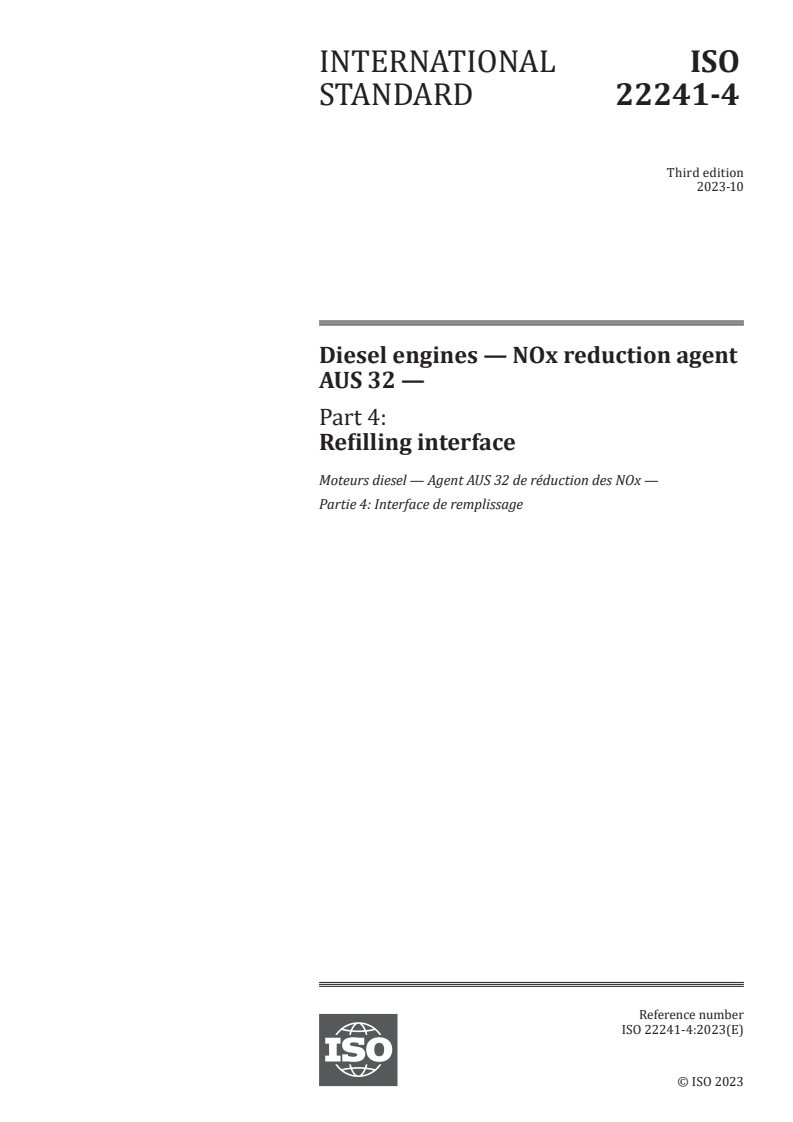
INTERNATIONAL ISO
STANDARD 22241-4
Third edition
2023-10
Diesel engines — NOx reduction agent
AUS 32 —
Part 4:
Refilling interface
Moteurs diesel — Agent AUS 32 de réduction des NOx —
Partie 4: Interface de remplissage
Reference number
© ISO 2023
All rights reserved. Unless otherwise specified, or required in the context of its implementation, no part of this publication may
be reproduced or utilized otherwise in any form or by any means, electronic or mechanical, including photocopying, or posting on
the internet or an intranet, without prior written permission. Permission can be requested from either ISO at the address below
or ISO’s member body in the country of the requester.
ISO copyright office
CP 401 • Ch. de Blandonnet 8
CH-1214 Vernier, Geneva
Phone: +41 22 749 01 11
Email: copyright@iso.org
Website: www.iso.org
Published in Switzerland
ii
Contents Page
Foreword .iv
1 Scope . 1
2 Normative references . 1
3 Terms and definitions . 1
4 Requirements . 3
4.1 Functional requirements . . 3
4.2 Filler neck . 4
4.3 Inlet adapter. 5
4.3.1 Inlet adapter with neodymium-iron-boron (NdFeB) magnet ring . 6
4.3.2 Inlet adapter with alternative equivalent magnet field . 6
4.4 Filler cap . 11
4.5 Filler nozzle . 11
4.6 Minimum free space for refilling .12
Annex A (normative) Compatibility conditions for sealed refilling systems .15
Bibliography .18
iii
Foreword
ISO (the International Organization for Standardization) is a worldwide federation of national standards
bodies (ISO member bodies). The work of preparing International Standards is normally carried out
through ISO technical committees. Each member body interested in a subject for which a technical
committee has been established has the right to be represented on that committee. International
organizations, governmental and non-governmental, in liaison with ISO, also take part in the work.
ISO collaborates closely with the International Electrotechnical Commission (IEC) on all matters of
electrotechnical standardization.
The procedures used to develop this document and those intended for its further maintenance are
described in the ISO/IEC Directives, Part 1. In particular, the different approval criteria needed for the
different types of ISO document should be noted. This document was drafted in accordance with the
editorial rules of the ISO/IEC Directives, Part 2 (see www.iso.org/directives).
ISO draws attention to the possibility that the implementation of this document may involve the use
of (a) patent(s). ISO takes no position concerning the evidence, validity or applicability of any claimed
patent rights in respect thereof. As of the date of publication of this document, ISO had not received
notice of (a) patent(s) which may be required to implement this document. However, implementers are
cautioned that this may not represent the latest information, which may be obtained from the patent
database available at www.iso.org/patents. ISO shall not be held responsible for identifying any or all
such patent rights.
Any trade name used in this document is information given for the convenience of users and does not
constitute an endorsement.
For an explanation of the voluntary nature of standards, the meaning of ISO specific terms and
expressions related to conformity assessment, as well as information about ISO's adherence to
the World Trade Organization (WTO) principles in the Technical Barriers to Trade (TBT), see
www.iso.org/iso/foreword.html.
This document was prepared by Technical Committee ISO/TC 22, Road vehicles, Subcommittee SC 34,
Propulsion, powertrain and powertrain fluids.
This third edition of ISO 22241-4 cancels and replaces the second edition (ISO 22241-4:2019), which has
been technically revised.
The main changes are as follows:
— an alternative magnetic function design has been added;
— Table 1 has been editorially and technically revised.
A list of all parts in the ISO 22241 series can be found on the ISO website.
Any feedback or questions on this document should be directed to the user’s national standards body. A
complete listing of these bodies can be found at www.iso.org/members.html.
iv
INTERNATIONAL STANDARD ISO 22241-4:2023(E)
Diesel engines — NOx reduction agent AUS 32 —
Part 4:
Refilling interface
1 Scope
This document specifies the refilling interface for the NOx reduction agent AUS 32 in conformance with
ISO 22241-1, which is needed to operate converters with a selective catalytic reduction (SCR) exhaust
treatment system.
This document specifies the minimum functional and geometric requirements of an open refilling
system, in order to ensure compatibility between the on-board refilling system and the off-board
refilling system. Compatibility conditions for a sealed refilling system are provided in Annex A.
This document applies to commercial vehicles and buses as defined in ISO 3833 and having a gross
vehicle mass of more than 3,5 t, designed to use stationary off-board refilling systems. This document
also applies to the nozzle of stationary off-board refilling systems.
NOTE Throughout this document, the term “NOx reduction agent AUS 32” is abbreviated to “AUS 32”.
2 Normative references
The following documents are referred to in the text in such a way that some or all of their content
constitutes requirements of this document. For dated references, only the edition cited applies. For
undated references, the latest edition of the referenced document (including any amendments) applies.
ISO 2575, Road vehicles — Symbols for controls, indicators and tell-tales
ISO 22241-1, Diesel engines — NOx reduction agent AUS 32 — Part 1: Quality requirements
ISO 22241-3, Diesel engines — NOx reduction agent AUS 32 — Part 3: Handling, transportation, and storage
3 Terms and definitions
For the purposes of this document, the terms and definitions given in ISO 22241-1 and the following
apply.
ISO and IEC maintain terminology databases for use in standardization at the following addresses:
— ISO Online browsing platform: available at https:// www .iso .org/ obp
— IEC Electropedia: available at https:// www .electropedia .org/
3.1
refilling system
off-board system and on-board system, including their refilling interface, for dispensing AUS 32 into the
on-board tank of the vehicle (3.12)
3.2
off-board refilling system
stationary equipment for dispensing AUS 32 into the on-board tank of the vehicle (3.12), consisting
typically of tank, pump, hose and filler nozzle (3.3)
3.3
filler nozzle
interfacing part of the off-board refilling system (3.2), which allows the operator to control the flow
of AUS 32 during the filling, consisting of a nozzle spout with a defined interface geometry and an
automatic shut-off system
3.4
on-board refilling system
equipment of the vehicle (3.12) necessary for refilling AUS 32 and consisting typically of an inlet adapter
(3.6), filler neck (3.5), filler cap (3.7) and tank
3.5
filler neck
interfacing part of the on-board refilling system (3.4) where the opening is formed by the inlet adapter
(3.6) to allow the tank to be refilled
3.6
inlet adapter
permanently fixed part of the filler neck (3.5), having a defined interface geometry and incorporating a
magnet ring for preventing misfilling of AUS 32 into the fuel tank
3.7
filler cap
part which is fitted to the filler neck (3.5) to prevent spillage (3.11) as well as to minimize contamination
of AUS 32 and which is temporarily opened or removed for refilling
3.8
open refilling system
universal refilling system (3.1) for which gas tightness between the filler nozzle (3.3) and the filler neck
(3.5) is not required
Note 1 to entry: The open refilling system permits, for example, refilling using a small volume container.
3.9
sealed refilling system
specific refilling system (3.1) where the connection between the filler nozzle (3.3) and the filler neck
(3.5) is gas-tight
3.10
canister
container of size one to ten litres capacity, with spout, used to refill the on-board tank of the vehicle
(3.12)
3.11
spillage
quantity of fluid that escapes from the filler nozzle (3.3) to the atmosphere after the nozzle has shut off
3.12
vehicle
commercial vehicle or bus as defined in ISO 3833 and having a gross vehicle mass of more than 3,5 t,
designed to use a stationary off-board refilling system (3.2)
3.13
magnet resistance force
F
res
force measured using the alternative equivalent magnet field test (4.3.2)
Note 1 to entry: The “res” subscript is the abbreviation for resistance.
4 Requirements
4.1 Functional requirements
The on-board refilling system and the off-board refilling system shall comply with the basic functional
requirements specified in Table 1. For sealed refilling system the additional requirements in Annex A
shall apply.
Table 1 — Basic functional requirements
No. Characteristic Requirement Remark
1 Maximum flow rate 20 l/min ≤ x ≤ 40 l/min Flow rates do not apply to:
range
— canister filling;
— production line filling.
2 Automatic shut-off Feature to protect against overfill is re- For example, a nozzle in conformance
of filler nozzle quired. with EN 13012
3 Maximum filling The automatic shut-off system of the nozzle High volume expansion of AUS 32
level in AUS 32 on- shall be used to protect against filling above during freezing (approximately 7 %)
board tank maximum level.
The on-board tank shall be designed to
allow for expansion of AUS 32.
4 Spillage < 30 ml per refilling with filler neck angles To minimize the effects of spilled
from the horizontal between 50° and 90° AUS 32 on the equipment
< 50 ml per refilling with filler neck angles
from the horizontal between 30° and 50°
5 Ventilation during Feature required on AUS 32 on-board tank. —
refilling
6 Operational tem- −30 °C to +80 °C For specific regions, the temperature
perature range range specified may not be sufficient
for on-board components
or be excessive. In such cases, a wider
−20 °C to +40 °C
or more narrow temperature range,
representative of that specific region,
for off-board components
may be considered.
7 Misfilling of AUS 32 ≤ 80 ml per filling trial The filler nozzle with magnet switch
into the diesel fuel as specified in 4.5, or equivalent de-
tank vice, will prevent misfilling.
8 Misfilling of fuel Feature required to prevent dispensing The inlet adapter diameter specified
into the AUS 32 on- of diesel fuel or petrol in AUS 32 on-board in 4.3 does not allow a diesel fuel or
board tank tank. petrol nozzle to enter.
9 Materials Materials in contact with AUS 32 shall be Suitable materials in accordance with
compatible with AUS 32 to avoid contami- ISO 22241-3 should be selected.
nation of AUS 32 as well as corrosion of the
devices used.
10 Freezing of AUS 32 Provide protection at the service station in AUS 32 freezes at −11,5 °C and has
accordance with operational temperature a volume increase of approximately
range. 7 %.
Vehicle parts shall be designed to cope with
freezing and thawing in accordance with
operational temperature range.
a
With a magnet resistance force F lower than 0,5 N it is not assured that the misfilling prevention of the nozzle will be
res
activated properly in case of crystallized AUS 32, wear and tear of the nozzle spout and dusty environment.
b
Recommendations only.
TTabablele 1 1 ((ccoonnttiinnueuedd))
No. Characteristic Requirement Remark
11 Cleanliness All surfaces of on-board and off-board —
equipment in direct contact with AUS 32
shall be free of foreign matter (e.g. fuel, oil,
greas
...