

ISO 21725-1:2021
(Main)Simplified design of prestressed concrete bridges — Part 1: I-girder bridges
General Information
- Abstract
This document provides information to perform the design of the prestressed concrete I-girder bridge for road that complies with the limitations established in 6.1. The rules of design set forth in this document are simplifications of more elaborate requirements. Designs and details for new road bridges address structural integrity by considering the following: — the use of continuity and redundancy to provide one or more alternate paths; — structural members and bearing seat widths that are resistant to damage or instability; and — external protection systems to minimize the effects of reasonably conceived severe loads.
- Status
- Published
- Publication Date
- 31-Oct-2021
- Technical Committee
- ISO/TC 71/SC 5 - Simplified design standard for concrete structures
- Drafting Committee
- ISO/TC 71/SC 5/WG 7 - Small pre-stressed concrete bridges
- Current Stage
- 6060 - International Standard published
- Start Date
- 01-Nov-2021
- Due Date
- 09-Oct-2021
- Completion Date
- 01-Nov-2021
Buy Documents



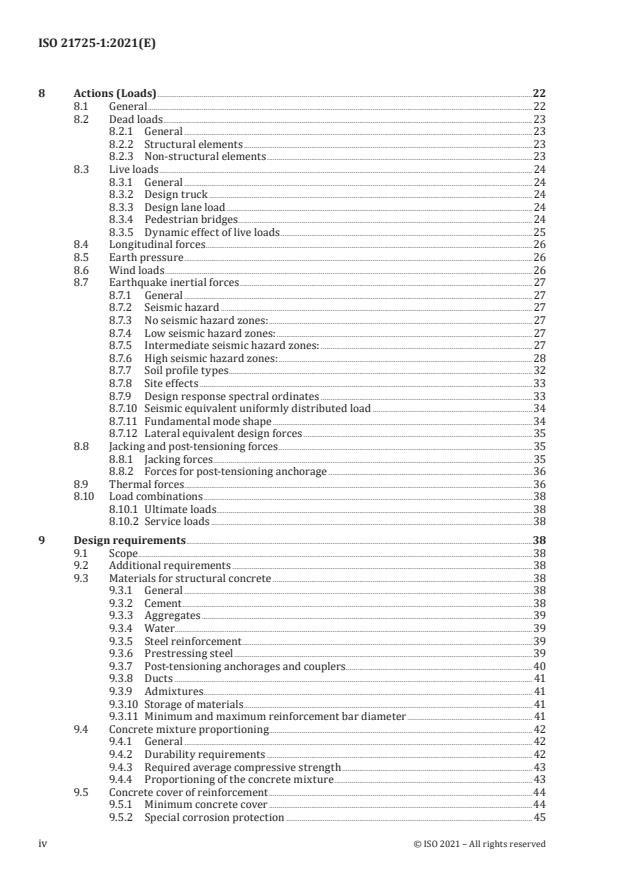
ISO 21725-1:2021 - Simplified design of prestressed concrete bridges
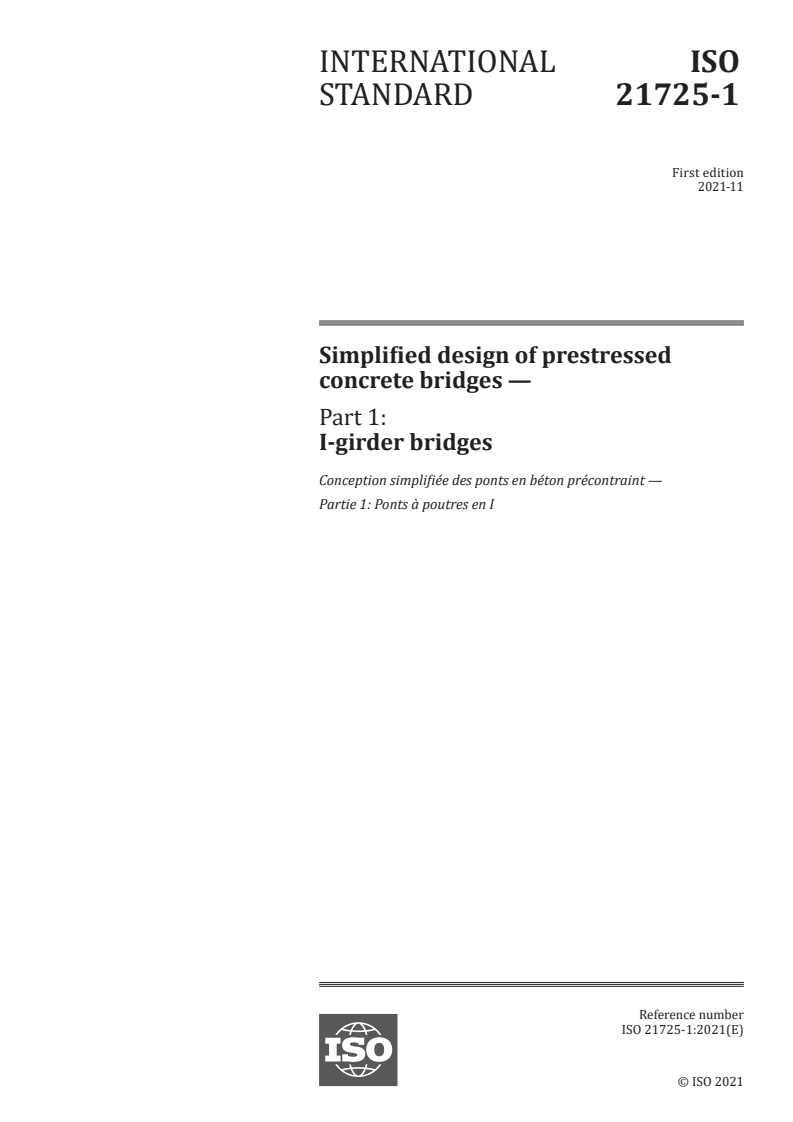

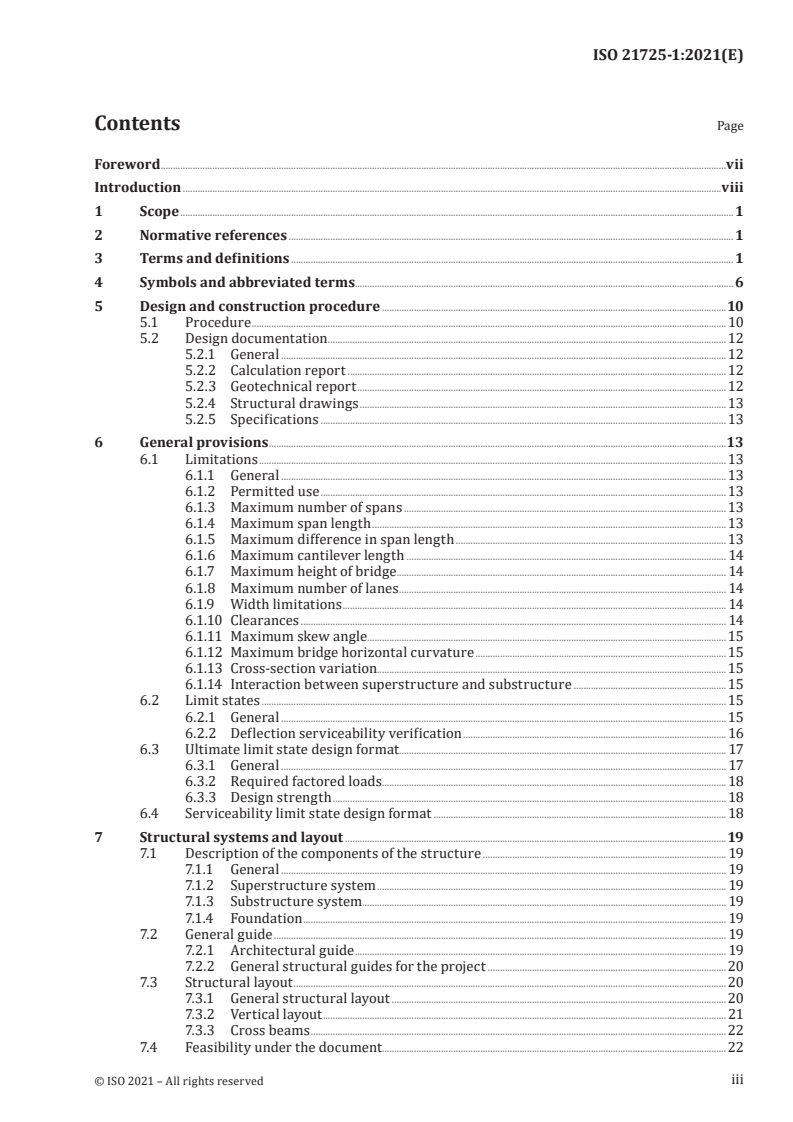
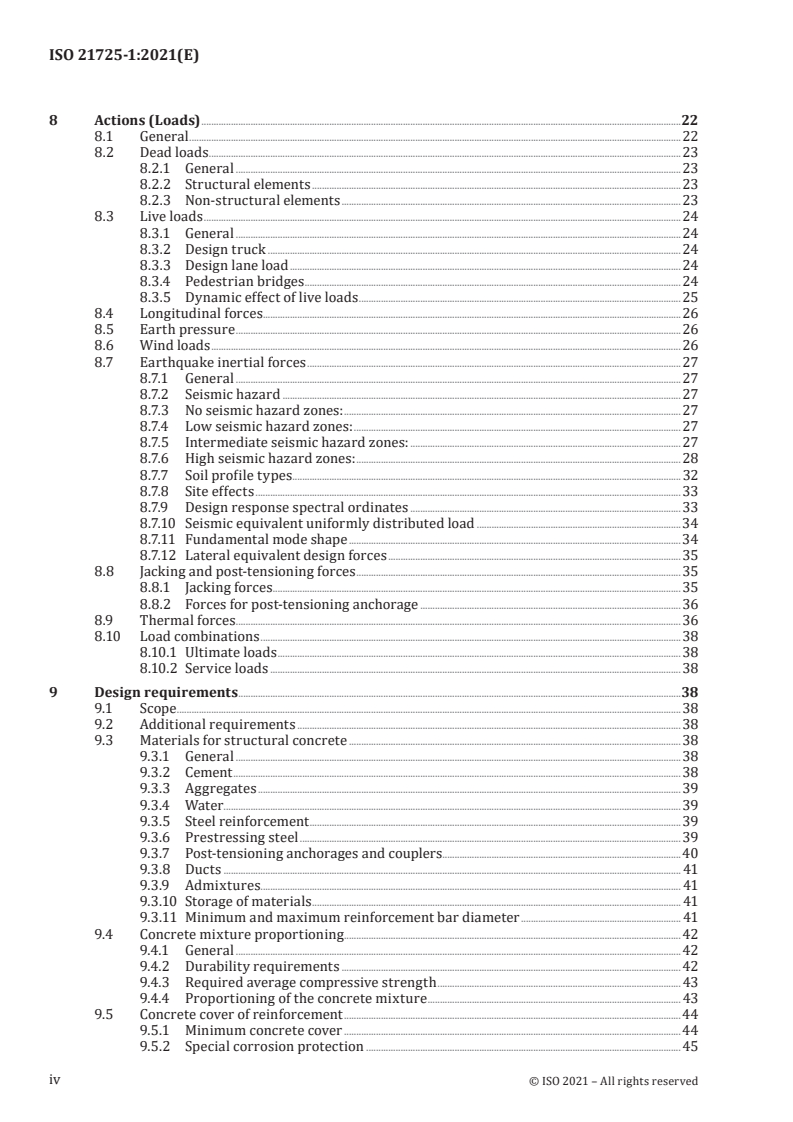
ISO 21725-1:2021 - Simplified design of prestressed concrete bridges — Part 1: I-girder bridges/1/2021
Overview
ISO 21725-1:2021 - "Simplified design of prestressed concrete bridges - Part 1: I-girder bridges" provides streamlined rules and guidance for the design of road bridges using prestressed concrete I-girder superstructures. The standard defines a simplified design approach (subject to the limitations in clause 6.1) that reduces complexity compared with more elaborate codes while ensuring structural integrity through continuity, redundancy and protective detailing. It covers design documentation, load models, limit states, materials and construction-related requirements specific to prestressed I-girder bridge systems.
Key Topics
- Scope and limitations: permitted use cases, maximum spans, lanes, widths, skew, curvature and other geometric constraints (see clause 6.1 for details).
- Design procedure and documentation: recommended design workflow, calculation reports, geotechnical reports, structural drawings and specifications.
- Limit states format: ultimate limit state (ULS) and serviceability limit state (SLS) verifications, including deflection and durability considerations.
- Actions (loads): dead loads, live loads (design truck/lane loads), dynamic effects, longitudinal forces, earth pressure, wind and seismic loads, thermal forces, jacking and post‑tensioning actions, and specified load combinations.
- Structural systems and layout: superstructure and substructure descriptions, vertical and cross-beam layout, continuity, redundancy and feasibility checks.
- Materials and components: guidance on concrete, aggregates, water, reinforcement, prestressing steel, post‑tensioning anchorages, ducts and admixtures.
- Seismic provisions: seismic hazard classification, soil profiles, site effects and simplified lateral design approaches suitable for I-girder bridges.
- Construction and detailing: bearing seat widths, protection systems and detailing to resist damage and provide alternate load paths.
Applications and Users
This standard is practical for:
- Bridge designers and structural engineers specifying prestressed concrete I-girder solutions for road bridges.
- Consultants and design offices seeking a simplified, consistent design methodology that complements national codes.
- Contractors and fabricators using standardized detailing and material requirements for precast or cast‑in‑place prestressed girders.
- Transport authorities and infrastructure owners who need a streamlined verification approach for routine road bridges within the standard’s stated limitations.
Use cases include rapid design of single- and multi-span road bridges where economy and repeatable detailing are priorities, or as a harmonized baseline when adapting designs across jurisdictions.
Related Standards
ISO 21725-1 is intended to complement national and international bridge design standards and codes of practice (for example, Eurocodes or AASHTO LRFD) and should be used in conjunction with applicable national regulations, geotechnical guidance and material standards.
Buy Documents
ISO 21725-1:2021 - Simplified design of prestressed concrete bridges
ISO 21725-1:2021 - Simplified design of prestressed concrete bridges — Part 1: I-girder bridges/1/2021
Get Certified
Connect with accredited certification bodies for this standard

DIBt (Deutsches Institut für Bautechnik)
German Institute for Building Technology.
DIN CERTCO
DIN Group product certification.
Zavod za gradbeništvo Slovenije (ZAG) - Inšpekcija
ZAG inspection body for construction products, structures, and materials.
Sponsored listings
Frequently Asked Questions
ISO 21725-1:2021 is a standard published by the International Organization for Standardization (ISO). Its full title is "Simplified design of prestressed concrete bridges — Part 1: I-girder bridges". This standard covers: This document provides information to perform the design of the prestressed concrete I-girder bridge for road that complies with the limitations established in 6.1. The rules of design set forth in this document are simplifications of more elaborate requirements. Designs and details for new road bridges address structural integrity by considering the following: — the use of continuity and redundancy to provide one or more alternate paths; — structural members and bearing seat widths that are resistant to damage or instability; and — external protection systems to minimize the effects of reasonably conceived severe loads.
This document provides information to perform the design of the prestressed concrete I-girder bridge for road that complies with the limitations established in 6.1. The rules of design set forth in this document are simplifications of more elaborate requirements. Designs and details for new road bridges address structural integrity by considering the following: — the use of continuity and redundancy to provide one or more alternate paths; — structural members and bearing seat widths that are resistant to damage or instability; and — external protection systems to minimize the effects of reasonably conceived severe loads.
ISO 21725-1:2021 is classified under the following ICS (International Classification for Standards) categories: 91.080.40 - Concrete structures; 93.040 - Bridge construction. The ICS classification helps identify the subject area and facilitates finding related standards.
ISO 21725-1:2021 is available in PDF format for immediate download after purchase. The document can be added to your cart and obtained through the secure checkout process. Digital delivery ensures instant access to the complete standard document.
Standards Content (Sample)
INTERNATIONAL ISO
STANDARD 21725-1
First edition
2021-11
Simplified design of prestressed
concrete bridges —
Part 1:
I-girder bridges
Conception simplifiée des ponts en béton précontraint —
Partie 1: Ponts à poutres en I
Reference number
© ISO 2021
All rights reserved. Unless otherwise specified, or required in the context of its implementation, no part of this publication may
be reproduced or utilized otherwise in any form or by any means, electronic or mechanical, including photocopying, or posting on
the internet or an intranet, without prior written permission. Permission can be requested from either ISO at the address below
or ISO’s member body in the country of the requester.
ISO copyright office
CP 401 • Ch. de Blandonnet 8
CH-1214 Vernier, Geneva
Phone: +41 22 749 01 11
Email: copyright@iso.org
Website: www.iso.org
Published in Switzerland
ii
Contents Page
Foreword .vii
Introduction .viii
1 Scope .1
2 Normative references .1
3 Terms and definitions .1
4 Symbols and abbreviated terms.6
5 Design and construction procedure .10
5.1 Procedure . 10
5.2 Design documentation . 12
5.2.1 General .12
5.2.2 Calculation report .12
5.2.3 Geotechnical report . 12
5.2.4 Structural drawings .13
5.2.5 Specifications . 13
6 General provisions .13
6.1 Limitations . 13
6.1.1 General .13
6.1.2 Permitted use . 13
6.1.3 Maximum number of spans . 13
6.1.4 Maximum span length .13
6.1.5 Maximum difference in span length . 13
6.1.6 Maximum cantilever length . 14
6.1.7 Maximum height of bridge . 14
6.1.8 Maximum number of lanes . 14
6.1.9 Width limitations . 14
6.1.10 Clearances . 14
6.1.11 Maximum skew angle . 15
6.1.12 Maximum bridge horizontal curvature . 15
6.1.13 Cross-section variation.15
6.1.14 Interaction between superstructure and substructure .15
6.2 Limit states . 15
6.2.1 General .15
6.2.2 Deflection serviceability verification . 16
6.3 Ultimate limit state design format . . 17
6.3.1 General . 17
6.3.2 Required factored loads. 18
6.3.3 Design strength . 18
6.4 Serviceability limit state design format . 18
7 Structural systems and layout .19
7.1 Description of the components of the structure . 19
7.1.1 General . 19
7.1.2 Superstructure system . 19
7.1.3 Substructure system. 19
7.1.4 Foundation . 19
7.2 General guide . 19
7.2.1 Architectural guide . 19
7.2.2 General structural guides for the project . 20
7.3 Structural layout . 20
7.3.1 General structural layout . 20
7.3.2 Vertical layout . 21
7.3.3 Cross beams . 22
7.4 Feasibility under the document . . 22
iii
8 Actions (Loads) .22
8.1 General .22
8.2 Dead loads . .23
8.2.1 General .23
8.2.2 Structural elements .23
8.2.3 Non-structural elements . 23
8.3 Live loads . 24
8.3.1 General . 24
8.3.2 Design truck . 24
8.3.3 Design lane load . 24
8.3.4 Pedestrian bridges . 24
8.3.5 Dynamic effect of live loads . 25
8.4 Longitudinal forces.26
8.5 Earth pressure .26
8.6 Wind loads . 26
8.7 Earthquake inertial forces . 27
8.7.1 General . 27
8.7.2 Seismic hazard . 27
8.7.3 No seismic hazard zones: . 27
8.7.4 Low seismic hazard zones: . 27
8.7.5 Intermediate seismic hazard zones: . 27
8.7.6 High seismic hazard zones: .28
8.7.7 Soil profile types. 32
8.7.8 Site effects . 33
8.7.9 Design response spectral ordinates . 33
8.7.10 Seismic equivalent uniformly distributed load .34
8.7.11 Fundamental mode shape .34
8.7.12 Lateral equivalent design forces . 35
8.8 Jacking and post-tensioning forces . 35
8.8.1 Jacking forces . 35
8.8.2 Forces for post-tensioning anchorage .36
8.9 Thermal forces . 36
8.10 Load combinations .38
8.10.1 Ultimate loads .38
8.10.2 Service loads .38
9 Design requirements .38
9.1 Scope . .38
9.2 Additional requirements .38
9.3 Materials for structural concrete .38
9.3.1 General .38
9.3.2 Cement .38
9.3.3 Aggregates .39
9.3.4 Water . . 39
9.3.5 Steel reinforcement .39
9.3.6 Prestressing steel . 39
9.3.7 Post-tensioning anchorages and couplers .40
9.3.8 Ducts . 41
9.3.9 Admixtures. 41
9.3.10 Storage of materials . 41
9.3.11 Minimum and maximum reinforcement bar diameter . 41
9.4 Concrete mixture proportioning . 42
9.4.1 General . 42
9.4.2 Durability requirements . 42
9.4.3 Required average compressive strength . 43
9.4.4 Proportioning of the concrete mixture . 43
9.5 Concrete cover of reinforcement .44
9.5.1 Minimum concrete cover .44
9.5.2 Special corrosion protection . 45
iv
9.6 Minimum reinforcement bend diameter . 45
9.7 Standard hook dimensions .46
9.8 Bar spacing and maximum aggregate size . 47
9.8.1 General . 47
9.8.2 Maximum nominal coarse aggregate size . 47
9.8.3 Minimum clear spacing between parallel bars in a layer .48
9.8.4 Minimum clear spacing between parallel layers of reinforcement .48
9.8.5 Minimum clear spacing between longitudinal bars in columns .48
9.8.6 Clear spacing between parallel lap splices .49
9.8.7 Maximum flexural reinforcement spacing in solid slabs.49
9.8.8 Maximum shrinkage and temperature reinforcement spacing in solid slabs .49
9.8.9 Maximum reinforcement spacing in structural concrete walls .50
9.8.10 Minimum spacing of prestressing tendons and ducts . 51
9.8.11 Maximum spacing of prestressing tendons in slabs . 52
9.8.12 Couplers in post-tensioning tendons . 52
9.9 Development length, lap splicing and anchorage of reinforcement . 52
9.9.1 Development length . 52
9.9.2 Lap splice dimensions .54
9.9.3 Minimum standard hook anchorage distance .54
9.10 Limits for longitudinal reinforcement . 55
9.10.1 General .55
9.10.2 Solid slabs and footings . 55
9.10.3 Girders, beams and joists.56
9.10.4 Columns .58
9.10.5 Structural concrete walls . 59
9.11 Minimum amounts of transverse reinforcement . 59
9.11.1 General . 59
9.11.2 Slabs . 59
9.11.3 Girders, beams and joists. 59
9.11.4 Columns .60
9.11.5 Structural concrete walls . 62
10 Stress limitations .63
10.1 Stress limitations for prestressing tendons .63
10.2 Stress limitations for concrete .64
10.2.1 For temporary stresses before losses-fully prestressed components .66
10.2.2 For stresses at serviceability limit state after losses-fully prestressed
components . 67
11 Loss of prestress .68
11.1 Total loss of prestress.68
11.2 Instantaneous losses . 69
11.2.1 Anchorage set . 69
11.2.2 Friction . 69
11.2.3 Elastic shortening . 70
11.3 Approximate estimate of time-dependent losses . 70
12 Details of tendon .73
12.1 Tendon confinement .73
12.1.1 General .73
12.1.2 Effects of curved tendons .74
12.2 External tendon supports . 75
12.3 Post-tensioned anchorage zones . 75
12.3.1 General . 75
12.3.2 General zone and local zone . 75
12.3.3 Design of general zone. 76
12.3.4 Design of local zone. 78
12.4 Pretensioned anchorage zones . 79
12.4.1 Bursting resistance .79
12.4.2 Confinement reinforcement . 79
v
13 Superstructure .79
13.1 Strength of members subjected to flexural moments . 79
13.1.1 General .79
13.1.2 Factored flexural moment at section and distribution factor method for
moment .80
13.1.3 Minimum design flexural moment strength .80
13.1.4 Nominal moment strength of PSC I-girder with deck .80
13.1.5 T-beam effect .83
13.2 Strength of members subjected to shear stresses .85
13.2.1 General .85
13.2.2 Factored shear and distribution factor method for shear .85
13.2.3 Design shear strength .85
13.2.4 Cohesion and friction factors .86
13.2.5 Interface shear strength and minimum area of interface shear
reinforcement .87
13.3 Decks .87
13.4 Solid slabs supported on girders, beams, or joists .87
13.5 Girders, beams, joists .87
13.6 Railings .87
14 Substructure .87
14.1 Girders that are part of a frame .87
14.2 Strength of members subjected to axial loads with or without flexure .87
14.3 Torsion .88
14.4 Bearing strength .88
14.5 Columns and piers .88
14.6 Concrete walls . .88
15 Foundations .88
15.1 Foundation type and capacity .88
15.2 Subsurface exploration and testing programs .88
15.3 Dimensioning of the foundation elements .88
15.4 Footings .88
15.5 Foundation mats .88
15.6 Footings on piles .88
15.7 Foundation beams .88
15.8 Retaining walls . .88
16 Lateral load resisting system .88
16.1 General .88
16.2 Specified lateral forces .89
16.3 Lateral force resisting structural system .89
16.4 Minimum amount of structural concrete walls .89
16.5 Special reinforcement details for seismic zones.89
17 Bearings .89
17.1 General .89
17.2 Multiple roller bearings .89
17.3 Elastomeric bearings .89
17.4 Anchorage .89
17.5 Design forces for supporting structure .89
Annex A (informative) Equivalent formulae for material factors .90
Annex B (informative) Beam deflection .92
Bibliography .93
vi
Foreword
ISO (the International Organization for Standardization) is a worldwide federation of national standards
bodies (ISO member bodies). The work of preparing International Standards is normally carried out
through ISO technical committees. Each member body interested in a subject for which a technical
committee has been established has the right to be represented on that committee. International
organizations, governmental and non-governmental, in liaison with ISO, also take part in the work.
ISO collaborates closely with the International Electrotechnical Commission (IEC) on all matters of
electrotechnical standardization.
The procedures used to develop this document and those intended for its further maintenance are
described in the ISO/IEC Directives, Part 1. In particular, the different approval criteria needed for the
different types of ISO documents should be noted. This document was drafted in accordance with the
editorial rules of the ISO/IEC Directives, Part 2 (see www.iso.org/directives).
Attention is drawn to the possibility that some of the elements of this document may be the subject of
patent rights. ISO shall not be held responsible for identifying any or all such patent rights. Details of
any patent rights identified during the development of the document will be in the Introduction and/or
on the ISO list of patent declarations received (see www.iso.org/patents).
Any trade name used in this document is information given for the convenience of users and does not
constitute an endorsement.
For an explanation of the voluntary nature of standards, the meaning of ISO specific terms and
expressions related to conformity assessment, as well as information about ISO's adherence to
the World Trade Organization (WTO) principles in the Technical Barriers to Trade (TBT), see
www.iso.org/iso/foreword.html.
This document was prepared by Technical Committee ISO/TC 71, Concrete, reinforced concrete and pre-
stressed concrete, Subcommittee SC 5, Simplified design standard for concrete structures.
Any feedback or questions on this document should be directed to the user’s national standards body. A
complete listing of these bodies can be found at www.iso.org/members.html.
vii
Introduction
The aim of this document is to provide rules for the design and construction of relatively short span
prestressed concrete I-girder bridges. This document is developed for countries that do not have
existing national standards on this subject and to offer to local regulatory authorities an alternative
for the design of relatively small bridges that abound in urban overpasses and over creeks and rivers
everywhere. This document may not be used in place of a national standard unless specifically
considered and accepted by the national standards body or other appropriate regulatory organization.
The design rules are based on simplified worldwide-accepted strength design models. This document is
self-contained; therefore, loads, simplified analysis procedures and design specifications are included,
as well as minimum acceptable construction practice guidelines.
The minimum dimensional guidelines contained in this document are intended to account for
undesirable side effects that require more sophisticated analysis and design procedures. Material and
construction guidelines are aimed at site-mixed concrete as well as ready-mixed concrete, and steel of
the minimum available strength grades.
The earthquake resistance guidelines are included to account for the numerous regions of the world
which lie in earthquake prone areas. The earthquake resistance for zones with high seismic hazard is
based on the employment of structural concrete walls (shear walls) that limit the lateral deformations
of the structure and provide for its lateral strength, in place of piers or frames that can be used in zones
with intermediate, low or no significant earthquake hazard.
This document contains provisions that can be modified by the national standards body due to local
design and construction requirements and practices. The specifications that can be modified are
included using ["boxed values"]. The national standards body is expected to review the "boxed values"
and may substitute alternative definitive values for these elements for use in the national application of
this document.
viii
...
INTERNATIONAL ISO
STANDARD 21725-1
First edition
2021-11
Simplified design of prestressed
concrete bridges —
Part 1:
I-girder bridges
Conception simplifiée des ponts en béton précontraint —
Partie 1: Ponts à poutres en I
Reference number
© ISO 2021
All rights reserved. Unless otherwise specified, or required in the context of its implementation, no part of this publication may
be reproduced or utilized otherwise in any form or by any means, electronic or mechanical, including photocopying, or posting on
the internet or an intranet, without prior written permission. Permission can be requested from either ISO at the address below
or ISO’s member body in the country of the requester.
ISO copyright office
CP 401 • Ch. de Blandonnet 8
CH-1214 Vernier, Geneva
Phone: +41 22 749 01 11
Email: copyright@iso.org
Website: www.iso.org
Published in Switzerland
ii
Contents Page
Foreword .vii
Introduction .viii
1 Scope .1
2 Normative references .1
3 Terms and definitions .1
4 Symbols and abbreviated terms.6
5 Design and construction procedure .10
5.1 Procedure . 10
5.2 Design documentation . 12
5.2.1 General .12
5.2.2 Calculation report .12
5.2.3 Geotechnical report . 12
5.2.4 Structural drawings .13
5.2.5 Specifications . 13
6 General provisions .13
6.1 Limitations . 13
6.1.1 General .13
6.1.2 Permitted use . 13
6.1.3 Maximum number of spans . 13
6.1.4 Maximum span length .13
6.1.5 Maximum difference in span length . 13
6.1.6 Maximum cantilever length . 14
6.1.7 Maximum height of bridge . 14
6.1.8 Maximum number of lanes . 14
6.1.9 Width limitations . 14
6.1.10 Clearances . 14
6.1.11 Maximum skew angle . 15
6.1.12 Maximum bridge horizontal curvature . 15
6.1.13 Cross-section variation.15
6.1.14 Interaction between superstructure and substructure .15
6.2 Limit states . 15
6.2.1 General .15
6.2.2 Deflection serviceability verification . 16
6.3 Ultimate limit state design format . . 17
6.3.1 General . 17
6.3.2 Required factored loads. 18
6.3.3 Design strength . 18
6.4 Serviceability limit state design format . 18
7 Structural systems and layout .19
7.1 Description of the components of the structure . 19
7.1.1 General . 19
7.1.2 Superstructure system . 19
7.1.3 Substructure system. 19
7.1.4 Foundation . 19
7.2 General guide . 19
7.2.1 Architectural guide . 19
7.2.2 General structural guides for the project . 20
7.3 Structural layout . 20
7.3.1 General structural layout . 20
7.3.2 Vertical layout . 21
7.3.3 Cross beams . 22
7.4 Feasibility under the document . . 22
iii
8 Actions (Loads) .22
8.1 General .22
8.2 Dead loads . .23
8.2.1 General .23
8.2.2 Structural elements .23
8.2.3 Non-structural elements . 23
8.3 Live loads . 24
8.3.1 General . 24
8.3.2 Design truck . 24
8.3.3 Design lane load . 24
8.3.4 Pedestrian bridges . 24
8.3.5 Dynamic effect of live loads . 25
8.4 Longitudinal forces.26
8.5 Earth pressure .26
8.6 Wind loads . 26
8.7 Earthquake inertial forces . 27
8.7.1 General . 27
8.7.2 Seismic hazard . 27
8.7.3 No seismic hazard zones: . 27
8.7.4 Low seismic hazard zones: . 27
8.7.5 Intermediate seismic hazard zones: . 27
8.7.6 High seismic hazard zones: .28
8.7.7 Soil profile types. 32
8.7.8 Site effects . 33
8.7.9 Design response spectral ordinates . 33
8.7.10 Seismic equivalent uniformly distributed load .34
8.7.11 Fundamental mode shape .34
8.7.12 Lateral equivalent design forces . 35
8.8 Jacking and post-tensioning forces . 35
8.8.1 Jacking forces . 35
8.8.2 Forces for post-tensioning anchorage .36
8.9 Thermal forces . 36
8.10 Load combinations .38
8.10.1 Ultimate loads .38
8.10.2 Service loads .38
9 Design requirements .38
9.1 Scope . .38
9.2 Additional requirements .38
9.3 Materials for structural concrete .38
9.3.1 General .38
9.3.2 Cement .38
9.3.3 Aggregates .39
9.3.4 Water . . 39
9.3.5 Steel reinforcement .39
9.3.6 Prestressing steel . 39
9.3.7 Post-tensioning anchorages and couplers .40
9.3.8 Ducts . 41
9.3.9 Admixtures. 41
9.3.10 Storage of materials . 41
9.3.11 Minimum and maximum reinforcement bar diameter . 41
9.4 Concrete mixture proportioning . 42
9.4.1 General . 42
9.4.2 Durability requirements . 42
9.4.3 Required average compressive strength . 43
9.4.4 Proportioning of the concrete mixture . 43
9.5 Concrete cover of reinforcement .44
9.5.1 Minimum concrete cover .44
9.5.2 Special corrosion protection . 45
iv
9.6 Minimum reinforcement bend diameter . 45
9.7 Standard hook dimensions .46
9.8 Bar spacing and maximum aggregate size . 47
9.8.1 General . 47
9.8.2 Maximum nominal coarse aggregate size . 47
9.8.3 Minimum clear spacing between parallel bars in a layer .48
9.8.4 Minimum clear spacing between parallel layers of reinforcement .48
9.8.5 Minimum clear spacing between longitudinal bars in columns .48
9.8.6 Clear spacing between parallel lap splices .49
9.8.7 Maximum flexural reinforcement spacing in solid slabs.49
9.8.8 Maximum shrinkage and temperature reinforcement spacing in solid slabs .49
9.8.9 Maximum reinforcement spacing in structural concrete walls .50
9.8.10 Minimum spacing of prestressing tendons and ducts . 51
9.8.11 Maximum spacing of prestressing tendons in slabs . 52
9.8.12 Couplers in post-tensioning tendons . 52
9.9 Development length, lap splicing and anchorage of reinforcement . 52
9.9.1 Development length . 52
9.9.2 Lap splice dimensions .54
9.9.3 Minimum standard hook anchorage distance .54
9.10 Limits for longitudinal reinforcement . 55
9.10.1 General .55
9.10.2 Solid slabs and footings . 55
9.10.3 Girders, beams and joists.56
9.10.4 Columns .58
9.10.5 Structural concrete walls . 59
9.11 Minimum amounts of transverse reinforcement . 59
9.11.1 General . 59
9.11.2 Slabs . 59
9.11.3 Girders, beams and joists. 59
9.11.4 Columns .60
9.11.5 Structural concrete walls . 62
10 Stress limitations .63
10.1 Stress limitations for prestressing tendons .63
10.2 Stress limitations for concrete .64
10.2.1 For temporary stresses before losses-fully prestressed components .66
10.2.2 For stresses at serviceability limit state after losses-fully prestressed
components . 67
11 Loss of prestress .68
11.1 Total loss of prestress.68
11.2 Instantaneous losses . 69
11.2.1 Anchorage set . 69
11.2.2 Friction . 69
11.2.3 Elastic shortening . 70
11.3 Approximate estimate of time-dependent losses . 70
12 Details of tendon .73
12.1 Tendon confinement .73
12.1.1 General .73
12.1.2 Effects of curved tendons .74
12.2 External tendon supports . 75
12.3 Post-tensioned anchorage zones . 75
12.3.1 General . 75
12.3.2 General zone and local zone . 75
12.3.3 Design of general zone. 76
12.3.4 Design of local zone. 78
12.4 Pretensioned anchorage zones . 79
12.4.1 Bursting resistance .79
12.4.2 Confinement reinforcement . 79
v
13 Superstructure .79
13.1 Strength of members subjected to flexural moments . 79
13.1.1 General .79
13.1.2 Factored flexural moment at section and distribution factor method for
moment .80
13.1.3 Minimum design flexural moment strength .80
13.1.4 Nominal moment strength of PSC I-girder with deck .80
13.1.5 T-beam effect .83
13.2 Strength of members subjected to shear stresses .85
13.2.1 General .85
13.2.2 Factored shear and distribution factor method for shear .85
13.2.3 Design shear strength .85
13.2.4 Cohesion and friction factors .86
13.2.5 Interface shear strength and minimum area of interface shear
reinforcement .87
13.3 Decks .87
13.4 Solid slabs supported on girders, beams, or joists .87
13.5 Girders, beams, joists .87
13.6 Railings .87
14 Substructure .87
14.1 Girders that are part of a frame .87
14.2 Strength of members subjected to axial loads with or without flexure .87
14.3 Torsion .88
14.4 Bearing strength .88
14.5 Columns and piers .88
14.6 Concrete walls . .88
15 Foundations .88
15.1 Foundation type and capacity .88
15.2 Subsurface exploration and testing programs .88
15.3 Dimensioning of the foundation elements .88
15.4 Footings .88
15.5 Foundation mats .88
15.6 Footings on piles .88
15.7 Foundation beams .88
15.8 Retaining walls . .88
16 Lateral load resisting system .88
16.1 General .88
16.2 Specified lateral forces .89
16.3 Lateral force resisting structural system .89
16.4 Minimum amount of structural concrete walls .89
16.5 Special reinforcement details for seismic zones.89
17 Bearings .89
17.1 General .89
17.2 Multiple roller bearings .89
17.3 Elastomeric bearings .89
17.4 Anchorage .89
17.5 Design forces for supporting structure .89
Annex A (informative) Equivalent formulae for material factors .90
Annex B (informative) Beam deflection .92
Bibliography .93
vi
Foreword
ISO (the International Organization for Standardization) is a worldwide federation of national standards
bodies (ISO member bodies). The work of preparing International Standards is normally carried out
through ISO technical committees. Each member body interested in a subject for which a technical
committee has been established has the right to be represented on that committee. International
organizations, governmental and non-governmental, in liaison with ISO, also take part in the work.
ISO collaborates closely with the International Electrotechnical Commission (IEC) on all matters of
electrotechnical standardization.
The procedures used to develop this document and those intended for its further maintenance are
described in the ISO/IEC Directives, Part 1. In particular, the different approval criteria needed for the
different types of ISO documents should be noted. This document was drafted in accordance with the
editorial rules of the ISO/IEC Directives, Part 2 (see www.iso.org/directives).
Attention is drawn to the possibility that some of the elements of this document may be the subject of
patent rights. ISO shall not be held responsible for identifying any or all such patent rights. Details of
any patent rights identified during the development of the document will be in the Introduction and/or
on the ISO list of patent declarations received (see www.iso.org/patents).
Any trade name used in this document is information given for the convenience of users and does not
constitute an endorsement.
For an explanation of the voluntary nature of standards, the meaning of ISO specific terms and
expressions related to conformity assessment, as well as information about ISO's adherence to
the World Trade Organization (WTO) principles in the Technical Barriers to Trade (TBT), see
www.iso.org/iso/foreword.html.
This document was prepared by Technical Committee ISO/TC 71, Concrete, reinforced concrete and pre-
stressed concrete, Subcommittee SC 5, Simplified design standard for concrete structures.
Any feedback or questions on this document should be directed to the user’s national standards body. A
complete listing of these bodies can be found at www.iso.org/members.html.
vii
Introduction
The aim of this document is to provide rules for the design and construction of relatively short span
prestressed concrete I-girder bridges. This document is developed for countries that do not have
existing national standards on this subject and to offer to local regulatory authorities an alternative
for the design of relatively small bridges that abound in urban overpasses and over creeks and rivers
everywhere. This document may not be used in place of a national standard unless specifically
considered and accepted by the national standards body or other appropriate regulatory organization.
The design rules are based on simplified worldwide-accepted strength design models. This document is
self-contained; therefore, loads, simplified analysis procedures and design specifications are included,
as well as minimum acceptable construction practice guidelines.
The minimum dimensional guidelines contained in this document are intended to account for
undesirable side effects that require more sophisticated analysis and design procedures. Material and
construction guidelines are aimed at site-mixed concrete as well as ready-mixed concrete, and steel of
the minimum available strength grades.
The earthquake resistance guidelines are included to account for the numerous regions of the world
which lie in earthquake prone areas. The earthquake resistance for zones with high seismic hazard is
based on the employment of structural concrete walls (shear walls) that limit the lateral deformations
of the structure and provide for its lateral strength, in place of piers or frames that can be used in zones
with intermediate, low or no significant earthquake hazard.
This document contains provisions that can be modified by the national standards body due to local
design and construction requirements and practices. The specifications that can be modified are
included using ["boxed values"]. The national standards body is expected to review the "boxed values"
and may substitute alternative definitive values for these elements for use in the national application of
this document.
viii
...