


ISO 5921:1982
(Main)Chlorofluorohydrocarbons for industrial use — Analysis by gas chromatography — General principles
Chlorofluorohydrocarbons for industrial use — Analysis by gas chromatography — General principles
Establishes a standard layout for methods for the determination of volatile components and gives general information on these methods. Takes into account the general layout of methods of chemical analysis given in ISO 78/2 and the recommendations given in ISO 2718.
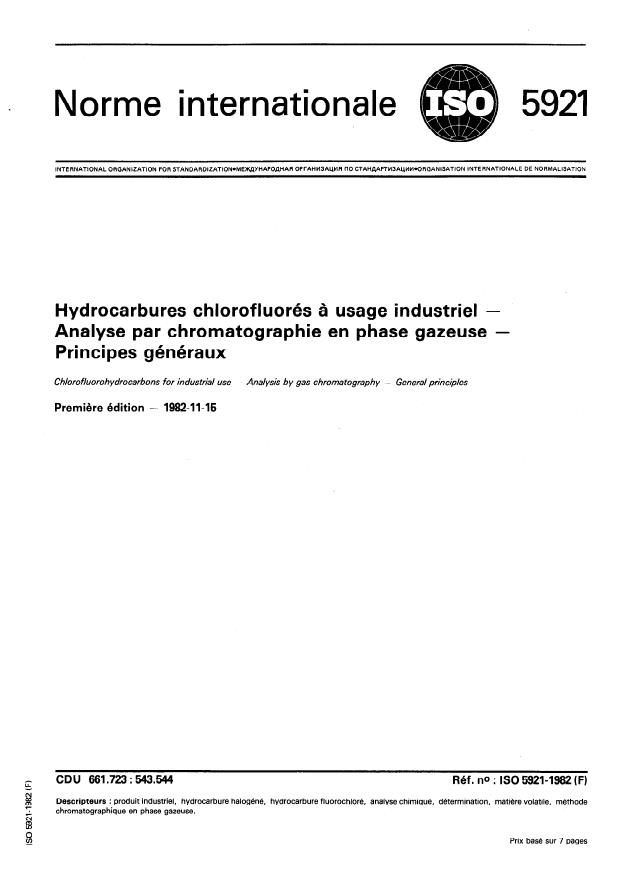
Hydrocarbures chlorofluorés à usage industriel — Analyse par chromatographie en phase gazeuse — Principes généraux
General Information
- Status
- Withdrawn
- Publication Date
- 31-Oct-1982
- Withdrawal Date
- 31-Oct-1982
- Technical Committee
- ISO/TC 47 - Chemistry
- Drafting Committee
- ISO/TC 47 - Chemistry
- Current Stage
- 9599 - Withdrawal of International Standard
- Start Date
- 27-May-2002
- Completion Date
- 14-Feb-2026
Relations
- Effective Date
- 06-Jun-2022
Buy Documents
ISO 5921:1982 - Chlorofluorohydrocarbons for industrial use -- Analysis by gas chromatography -- General principles
ISO 5921:1982 - Hydrocarbures chlorofluorés a usage industriel -- Analyse par chromatographie en phase gazeuse -- Principes généraux
ISO 5921:1982 - Hydrocarbures chlorofluorés a usage industriel -- Analyse par chromatographie en phase gazeuse -- Principes généraux
Get Certified
Connect with accredited certification bodies for this standard

ECOCERT
Organic and sustainability certification.

Eurofins Food Testing Global
Global leader in food, environment, and pharmaceutical product testing.

Intertek Bangladesh
Intertek certification and testing services in Bangladesh.
Sponsored listings
Frequently Asked Questions
ISO 5921:1982 is a standard published by the International Organization for Standardization (ISO). Its full title is "Chlorofluorohydrocarbons for industrial use — Analysis by gas chromatography — General principles". This standard covers: Establishes a standard layout for methods for the determination of volatile components and gives general information on these methods. Takes into account the general layout of methods of chemical analysis given in ISO 78/2 and the recommendations given in ISO 2718.
Establishes a standard layout for methods for the determination of volatile components and gives general information on these methods. Takes into account the general layout of methods of chemical analysis given in ISO 78/2 and the recommendations given in ISO 2718.
ISO 5921:1982 is classified under the following ICS (International Classification for Standards) categories: 71.080.20 - Halogenated hydrocarbons. The ICS classification helps identify the subject area and facilitates finding related standards.
ISO 5921:1982 has the following relationships with other standards: It is inter standard links to ISO 527-5:1997. Understanding these relationships helps ensure you are using the most current and applicable version of the standard.
ISO 5921:1982 is available in PDF format for immediate download after purchase. The document can be added to your cart and obtained through the secure checkout process. Digital delivery ensures instant access to the complete standard document.
Standards Content (Sample)
International Standard
INTERNATIONAL ORGANIZATION FOR STANDARDIZATION.ME~YHAPO~HAfl OPrAHM3AI#lR l-l0 CTAHP(APTM3AL(MbWORGANISATION INTERNATIONALE DE NORMALISATION
Chlorofluorohydrocarbons for industrial use - Analysis
by gas chromatography - General principles
Hydrocarbures chlorofluor&s 2 wage industriel - Analyse par Chromatographie en Phase gazeuse - Principes gtGn&aux
First edition - 1982-11-15
UDC 661.723 : 543.544
Ref. No. ISO 59214982 (EI
Descriptors :
industrial products, halohydrocarbons, fluorochlorinated hydrocarbons, chemicat analysis,
determination, volatile matters, gas
chromatographic analysis.
Price based on 7 pages
Foreword
ISO (the International Organization for Standardization) is a worldwide federation of
national Standards institutes (ISO member bedies). The work of developing Inter-
national Standards is carried out through ISO technical committees. Every member
body interested in a subject for which a technical committee has been set up has the
right to be represented on that committee. International organizations, governmental
and non-governmental, in liaison with ISO, also take patt in the work.
Draft International Standards adopted by the technical committees are circulated to
the member bodies for approval before their acceptance as International Standards by
the ISO Council.
International Standard ISO 5921 was developed by Technical Committee ISO/TC 47,
Chemistry, and was circulated to the member bodies in April 1981.
lt has been approved by the member bodies sf the following countries :
Austria
Hungary Portugal
Belgium
India South Africa, Rep. of
China
Italy Switzerland
Czechoslovakia Korea, Rep. of Thailand *
Egypt, Arab Rep. of Netherlands United Kingdom
France Philippines USSR
Germany, F. R.
Poland
No member body expressed disapproval of the document.
0 International Organkation for Standardisation, 1982
Printed in Switzerland
INTERNATIONAL STANDARD ISO 5921-1982 (E)
Chlorofluorohydrocarbons for industrial use - Analysis
by gas chromatography - General principles
Scope and field of application
This International Standard establishes the Standard layout for, and gives general information relating to, methods for the determina-
tion of volatile components in chlorofluorohydrocarbons by gas chromatography.
lt takes into account the general layout of methods of Chemical analysis given in ISO 78/2 and the recommendations given in
ISO 2718.
Reference
ISO 7812, Layouts for Standards - Part 2 : Standard for Chemical analysis.
ISO 2718, Standard Ia yout for a method of Chemical analysis b y gas chromatograph y.
ISO 3427, Gaseous halogenated h ydrocarbons fliquefied gasesl - Taking of a Sample.
ISO 59214982 (El
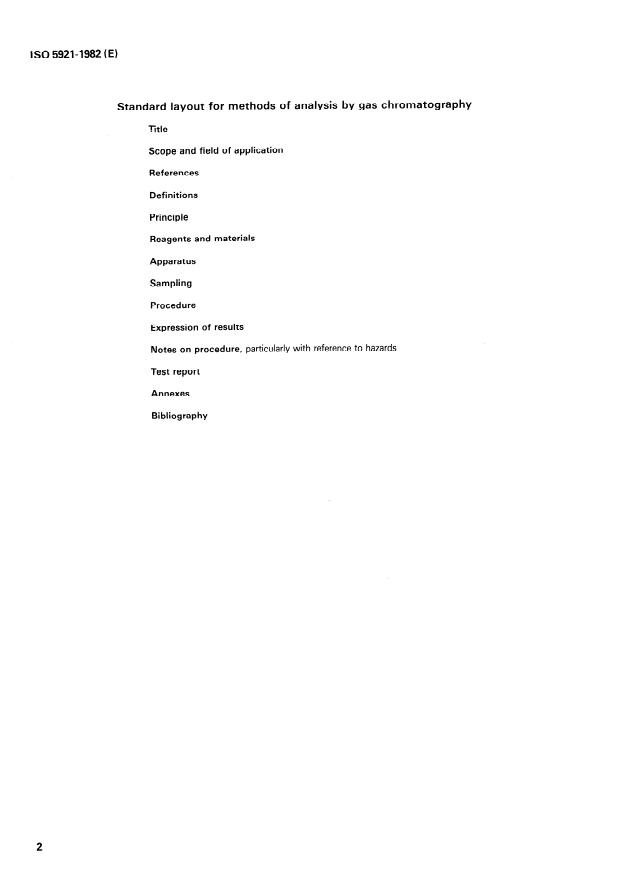
Standard layout for methods of analysis by gas chromatography
Title
Scope and field sf application
References
Definitions
Principle
Reagents and materials
Apparatus
Sampling
Procedure
Expression sf results
Notes on procedure, particularly with reference to hazards
Test report
Annexes
Bibliography
ISO 59214982 IE)
Notes on the application of the Standard layout to a general method of analysis of
chlorofluorohydrocarbons by gas chromatography
NOTE - Clauses contained in the Standard layout, but which are irrelevant to the general method, have been omitted. lt may nevertheless be
necessary, in writing specific methods, to include different combinations of clauses.
1 Scope and field of application The temperature, gas flow rate and pressure and electrical
characteristics of the chromatograph and its auxiliary devices
This clause shall identify the component(s) to be determined should have a Performance specification to allow
and the rangels) of concentration for which the method is
a) the peak retention time to be repeatable to + 2 % or
suitable.
better;
b) the peak heights or areas to be repeatable to 11 2 % or
2 Principle
better.
This clause shall give a concise summary of the method used.
4.2 njection devices
3 Reagents and materials
4.2.1 Liquids
During the analysis, unless otherwise stated, only reagents of
A mit osyringe (typical capacity 1 to 10 ~1) is suitable. The test
recognized analytical grade should be used.
Portion should be injected into an injection port heated to a
temperature at least 20 OC above the boiling Point of the main
3.1 Carrier gases and auxiliary gases
component.
3.1.1 Helium, minimum purity 99,9 % by volume, for use
with katharometer (thermal conductivity) detectors, or, as an
4-2.2
alternative.
Gaseous test portions should be injected through a stainless
steel gas Sample valve with a choice of loops of O,l, 1 or 5 ml
3.1.2 Hydrogen, minimum purity 99.9 % by volume.
capacity, which should be capable of being heated to a
temperature of at least 75 OC.
WARNING - Highly flammable; explosive when mixed
with air at concentrations ranging from approximately 4
temperatures of up to 150 OC may
NOTE - For certa in determinations,
to 75 % (VW).
be necessary.
3.1.3 Nitrogen, minimum purity 99,9 % by volume, for use
4.3 Column
with katharometer (thermal conductivity) detectors or flame
ionization detectors.
The column may be constructed of any suitable material, for
example glass, stainless steel or topper, that does not react
3.2 Auxiliary gases for flame ionization detectors
with the Sample. The following details shall be specified :
3.2.1 Hydrogen, minimum purity 99,5 % by volume.
length : according to the method specif ied (typically 1
a)
to 5 m);
3.2.2 Air, minimum purity 995 % by volume.
b) tu be diameter : internal and external diameters about
4mm an d 6 mm respectively;
3.3 Calibration reagents, minimum purity 99,5 % by
volume.
c) shape : to suit the oven geometry. If the column is
coiled, the coil diameter should be at least 10 times the
3.4 lnternal Standards, minimum purity 99,5 % by volume. outer diameter of the tube.
4.4 Column details
4 Apparatus
The following details shall be specified.
4.1 Gas chromatograph
4.4.1 Packing material, suitable for the Separation required
Any suitable instrument may be used. The mode of (for example a stationary Phase on a support, adsorbents, or
temperature control (isothermal or temperature programming) porous polymer beads, for example “Porapak”) :
and the type of detector required (thermal conductivity or flame
support : type, particle size and pretreatment;
ionization) should be specified. a)
ISO 5921-1982 (E)
b) stationary Phase : packing and method sf coating 5.2 ChIorofIuorohydrocarbons gaseous at
tYP%
the support. ambient temperature and pressure
The labora
tory Sample should be used wh enever possible, the
4.4.2 Filling and conditioning the cslumn : speciai pro-
sam iple bei ng taken fro m the I iquid Phase.
cedures to ensure compact and uniform filling.
For taking the Sample, use a Sample cylindre of type A Isee
4.4.3 Column effic iency, expressed as the length equivalent
IS0 3427).
lmpound.
to a theoretical plate for a specified CO
The liquefied gas should be vaporized by passage through a
fine control valve and then, in Order to ensure complete
4.4.4 Caarier gas dlow rate, determined directly by means of
volatilization, passed through either an empty 50 ml bubble in-
a flow meter. This measurement is usually made at column
dicator (sec the note) or, for samples with higher boiling Points,
outlet and at ambient temperature.
through a heated topper helix connected to the Sample valve
(sec the figure).
4.5 Detector
The temperature of the fine control valve should be ;Iower than
that of the Sample cylinder in Order to avoid premature evapora-
The following details shall be specified.
tion. This may be achieved by flushing the liquid Phase through
the va
...
Norme internationale
INTERNATIONAL ORGANIZATION FOR STANDARDIZATION.ME~YHAPOçIHAR OPTAHM3Al@lR fl0 CTAH~APTbl3AL@Wl.ORGANISATION INTERNATIONALE DE NORMALISATION
Hydrocarbures chlorofluorés à usage industriel -
Analyse par chromatographie en phase gazeuse -
Principes généraux
Chloro fluoroh ydrocarbons for industrial use - Analysis b y gas chromatograph y - General principles
Première édition - 1982-11-15
Réf. no : ISO 59214982 (F)
CDU 661.723 : 543.544
Descripteurs : produit industriel, hydrocarbure halogéné, hydrocarbure fluorochloré, analyse chimique, détermination, matière volatile, méthode
chromatographique en phase gazeuse.
Prix basé sur 7 pages
Avant-propos
L’ISO (Organisation internationale de normalisation) est une fédération mondiale
d’organismes nationaux de normalisation (comités membres de I’ISO). L’élaboration
des Normes internationales est confiée aux comités techniques de I’ISO. Chaque
comité membre intéressé par une étude a le droit de faire partie du comité technique
correspondant. Les organisations internationales, gouvernementales et non gouverne-
mentales, en liaison avec I’ISO, participent également aux travaux.
Les projets de Normes internationales adoptés par les comités techniques sont soumis
aux comités membres pour approbation, avant leur acceptation comme Normes inter-
nationales par le Conseil de I’ISO.
La Norme internationale ISO 5921 a été élaborée par le comité technique ISO/TC 47,
Chimie, et a été soumise aux comités membres en avril 1981.
Les comités membres des pays suivants l’ont approuvée :
Afrique du Sud, Rép. d’ France Portugal
Allemagne, R. F.
Hongrie Royaume-Uni
Autriche Inde Suisse
Belgique
Italie Tchécoslovaquie
Chine Pays- Bas Thaïlande
Corée, Rép. de Philippines URSS
Égypte, Rép. arabe d’ Pologne
Aucun comité membre ne l’a désapprouvée.
Organisation internationale de normalisation, 1982
Imprimé en Suisse
NORME INTERNATIONALE ISO 5921-1982 (F)
Hydrocarbures chlorofluorés à usage industriel -
Analyse par chromatographie en phase gazeuse -
Principes généraux
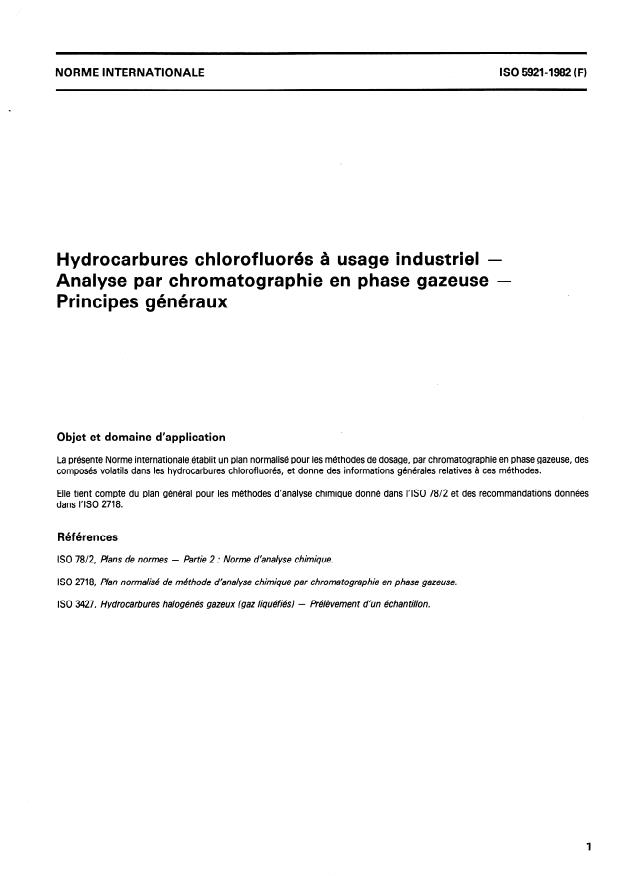
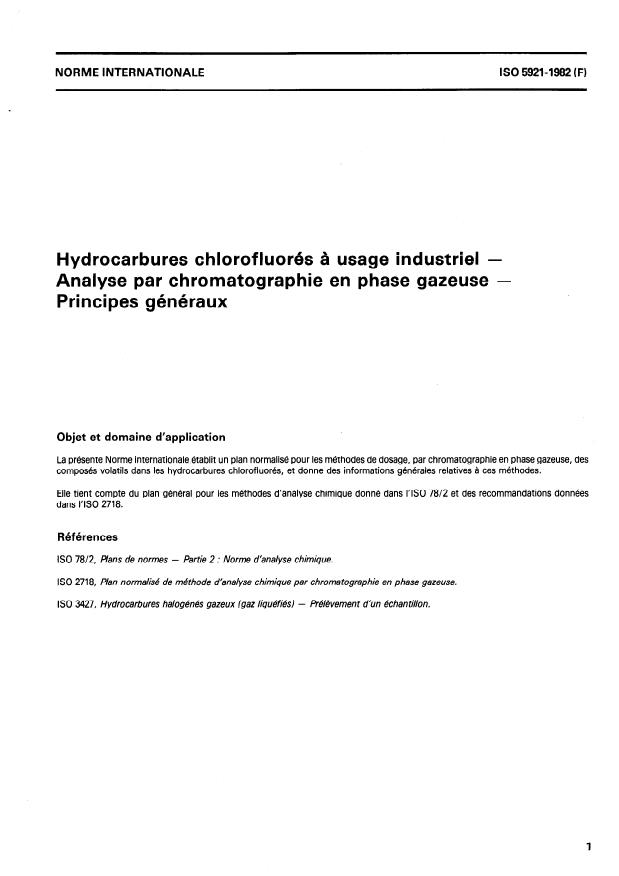
Objet et domaine d’application
La présente Norme internationale,établit un plan normalisé pour les méthodes de dosage, par chromatographie en phase gazeuse, des
composés volatils dans les hydrocarbures chlorofluorés, et donne des informations générales relatives à ces méthodes.
Elle tient compte du plan général pour les méthodes d’analyse chimique donné dans I’ISO 78/2 et des recommandations données
dans I’ISO 2718.
Références
ISO 7812, plans de normes - Partie 2 : Norme d’analyse chimique.
ISO 2718, Plan normalisé de méthode d’analyse chimique par chromatographie en phase gazeuse.
ISO 3427, Hydrocarbures halogénés gazeux (gaz liqut?fit?s) - Prélèvement d’un tkhantillon.
ISO 59214982 (FI
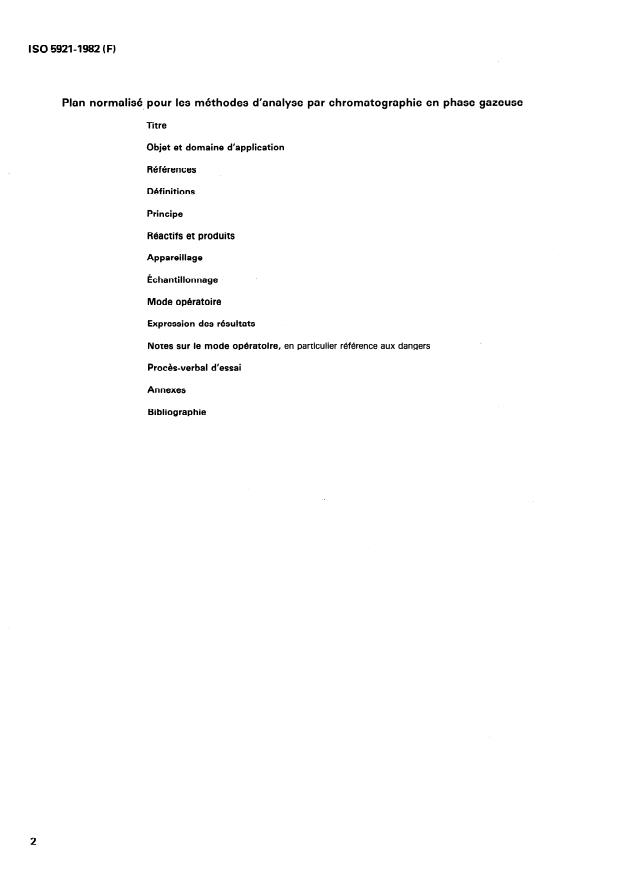
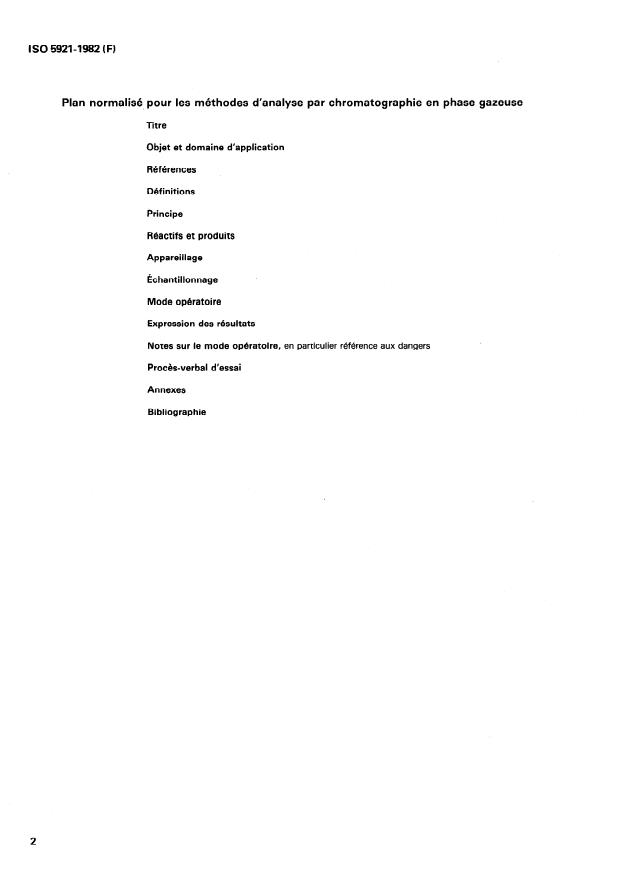
Plan normalisé pour les méthodes d’analyse par chromatographie en phase gazeuse
Titre
Objet et domaine d’application
Références
Définitions
Principe
Réactifs et produits
Appareillage
Échantillonnage .
Mode opératoire
Expression des résultats
Notes sur le mode opératoire, en particulier référence aux dangers
Procès-verbal d’essai
Annexes
Bibliographie
ISO 5921-1982 (FI
Commentaires relatifs à la mise en application du plan normalisé à une méthode générale
d’analyse, par chromatographie en phase gazeuse, des hydrocarbures chlorofluorés
à la méthode générale, ont été omis. II peut toutefois être
NOTE - Les chapitres contenus dans le plan normalisé, mais qui ne sont pas pertinents
nécessaire, en rédigeant une méthode spécifique, d’inclure différentes combinaisons de chapitres.
1 Objet et domaine d’application La température, le débit et la pression du gaz et les caractéristi-
ques électriques du chromatographe et de ses accessoires doi-
Ce chapitre doit indiquer la (ou les) substance(s) à doser et le
vent, par leur performance, permettre d’obtenir
(ou les) intervalle(s) de concentration pour laquelle la méthode
convient. a) un temps de rétention du pic répétable à + 2 % ou
mieux;
2 Principe
b) des aires ou hauteurs de pic répétables à -t 2 % ou
mieux.
Ce chapitre doit donner de maniére concise un résumé de la
méthode utilisée.
4.2 Dispositif d’injection
3 Réactifs et produits
4.2.1 Liquides
Au cours de l’analyse, sauf indications différentes, uniquement
Une microseringue (capacité généralement 1 à 10 PI) est appro-
des réactifs de qualité analytique reconnue doivent être utilisés.
priée. La prise d’essai doit être injectée dans un dispositif
d’injection, chauffé à au moins 20 OC au-dessus de la tempéra-
3.1 Gaz vecteur et gaz auxiliaires
ture d’ébullition du constituant principal.
3.1.1 Hblium, de pureté minimale 99,9 % en volume, pour
utilisation avec des détecteurs de type catharométre (a conduc-
4.2.2 Gaz
tion thermique) ou, en alternative,
Les prises d’essai gazeuses doivent être injectées par une vanne
d’échantillonnage à gaz en acier inoxydable, munie d’une bou-
3.1.2 Hydrogène, de pureté minimale 99,9 % en volume.
cle d’échantillonnage de capacité 0,5, 1 ou 5 ml, chauffée à une
température d’au moins 75 OC.
AVERTISSEMENT - Tr6s inflammable; peut exploser en
melange avec l’air dans l’intervalle de concentration de 4
NOTE - Pour certaines déterminations, des températures jusqu’à
à 75 Y0 (VI VI environ.
150 OC peuvent être nécessaires.
3.1.3 Azote, de pureté minimale 99,9 % en volume, pour uti-
4.3 Colonne
lisation avec des détecteurs de type catharométre (a conduc-
tion thermique) ou à ionisation de flamme.
La colonne peut être en n’importe quel matériau approprié, par
exemple verre, acier inoxydable ou cuivre, ne réagissant pas
3.2 Gaz auxiliaires pour détecteurs à ionisation
avec l’échantillon. Les détails suivants doivent être indiqués :
de flamme
a) longueur : selon la méthode spécifiée (généralement 1 à
3.2.1 Hydrogène, de pureté minimale 99,5 % en volume.
5 ml;
3.2.2 Air, de pureté minimale 99,5 % en volume. b) diamétres du tube : diametres intérieur et extérieur res-
pectivement 4 mm et 6 mm environ;
3.3 Réactifs pour étalonnage, de pureté minimale 99,5 %
c) forme : adaptée à la géométrie du four. Si la colonne
en volume.
est en serpentin, le diamétre de la spirale doit être au moins
égal à 10 fois le diamétre extérieur du tube.
3.4 Étalons internes, de pureté minimale 99,5 % en
volume.
4.4 Détails de la colonne
4 Appareillage Les détails suivants doivent être indiqués.
4.1 Chromatographe 4.4.1 Matériau de remplissage, approprié à la séparation
demandée (par exemple une phase stationnaire sur un support,
Tout appareil approprié peut être utilisé. Les conditions de tem- des adsorbants, ou des billes en polymère poreux telles que
pérature (isotherme ou programmée) et le type de détecteur
(( Porapak))) :
adéquat (a conductivité thermique ou à ionisation de flamme)
doivent être spécifiés. a) support : nature, granulométrie et traitement préalable;
ISO 59214982 (F)
5.2 Hydrocarbures chlorofluorés gazeux à la
b) phase stationnaire : nature, remplissage et méthode
température ambiante et à la pression normale
d’imprégnation du Huppert.
L’échantillon pour laboratoire doit être utilisé chaque fois que
4.4.2 Remplissage et conditionnement de la colonne :
c’est possible, l’échantillon étant prélevé à partir de la phase
Procédés spéciaux pour assurer un remplissage compact et uni-
liquide.
Pour le prélèvement de l’échantillon, utiliser un cylindre du
4.4.3 Efficacité de la colonne, exprimée en tant que hau- type A (voir ISO 3427).
teur équivalente à un plateau théorique pour un constituant
déterminé. Le gaz liquéfié doit être vaporisé par passage dans une vanne
fine de contrôle et ensuite, pour assurer une volatilisation com-
plète, soit dans un barboteur vide de 50 ml (voir la note), soit,
4.4.4 Débit du gaz vecteur, déterminé directement à l’aide
pour les échantillons à température d’ébullition plus élevée,
d’un débitmètre. II est généralement mesuré à la sortie de la
dans un serpentin en cuivre chauffé connecté à la vanne
colonne et à la température ambiante.
d’échantillonnage (voir la figure).
4.5 Détecteur
La température de la vanne fine de contrôle devra être infé-
rieure à celle du cylindre à échantillonnage pour éviter une éva-
Les détails suivants doivent être indiqués.
poration prématurée. Cela peut être obtenu en laissant s’écou-
ler la phase liquide à travers la vanne durant un temps très court
avant de connecter le cylindre à échanti
...
Norme internationale
INTERNATIONAL ORGANIZATION FOR STANDARDIZATION.ME~YHAPOçIHAR OPTAHM3Al@lR fl0 CTAH~APTbl3AL@Wl.ORGANISATION INTERNATIONALE DE NORMALISATION
Hydrocarbures chlorofluorés à usage industriel -
Analyse par chromatographie en phase gazeuse -
Principes généraux
Chloro fluoroh ydrocarbons for industrial use - Analysis b y gas chromatograph y - General principles
Première édition - 1982-11-15
Réf. no : ISO 59214982 (F)
CDU 661.723 : 543.544
Descripteurs : produit industriel, hydrocarbure halogéné, hydrocarbure fluorochloré, analyse chimique, détermination, matière volatile, méthode
chromatographique en phase gazeuse.
Prix basé sur 7 pages
Avant-propos
L’ISO (Organisation internationale de normalisation) est une fédération mondiale
d’organismes nationaux de normalisation (comités membres de I’ISO). L’élaboration
des Normes internationales est confiée aux comités techniques de I’ISO. Chaque
comité membre intéressé par une étude a le droit de faire partie du comité technique
correspondant. Les organisations internationales, gouvernementales et non gouverne-
mentales, en liaison avec I’ISO, participent également aux travaux.
Les projets de Normes internationales adoptés par les comités techniques sont soumis
aux comités membres pour approbation, avant leur acceptation comme Normes inter-
nationales par le Conseil de I’ISO.
La Norme internationale ISO 5921 a été élaborée par le comité technique ISO/TC 47,
Chimie, et a été soumise aux comités membres en avril 1981.
Les comités membres des pays suivants l’ont approuvée :
Afrique du Sud, Rép. d’ France Portugal
Allemagne, R. F.
Hongrie Royaume-Uni
Autriche Inde Suisse
Belgique
Italie Tchécoslovaquie
Chine Pays- Bas Thaïlande
Corée, Rép. de Philippines URSS
Égypte, Rép. arabe d’ Pologne
Aucun comité membre ne l’a désapprouvée.
Organisation internationale de normalisation, 1982
Imprimé en Suisse
NORME INTERNATIONALE ISO 5921-1982 (F)
Hydrocarbures chlorofluorés à usage industriel -
Analyse par chromatographie en phase gazeuse -
Principes généraux
Objet et domaine d’application
La présente Norme internationale,établit un plan normalisé pour les méthodes de dosage, par chromatographie en phase gazeuse, des
composés volatils dans les hydrocarbures chlorofluorés, et donne des informations générales relatives à ces méthodes.
Elle tient compte du plan général pour les méthodes d’analyse chimique donné dans I’ISO 78/2 et des recommandations données
dans I’ISO 2718.
Références
ISO 7812, plans de normes - Partie 2 : Norme d’analyse chimique.
ISO 2718, Plan normalisé de méthode d’analyse chimique par chromatographie en phase gazeuse.
ISO 3427, Hydrocarbures halogénés gazeux (gaz liqut?fit?s) - Prélèvement d’un tkhantillon.
ISO 59214982 (FI
Plan normalisé pour les méthodes d’analyse par chromatographie en phase gazeuse
Titre
Objet et domaine d’application
Références
Définitions
Principe
Réactifs et produits
Appareillage
Échantillonnage .
Mode opératoire
Expression des résultats
Notes sur le mode opératoire, en particulier référence aux dangers
Procès-verbal d’essai
Annexes
Bibliographie
ISO 5921-1982 (FI
Commentaires relatifs à la mise en application du plan normalisé à une méthode générale
d’analyse, par chromatographie en phase gazeuse, des hydrocarbures chlorofluorés
à la méthode générale, ont été omis. II peut toutefois être
NOTE - Les chapitres contenus dans le plan normalisé, mais qui ne sont pas pertinents
nécessaire, en rédigeant une méthode spécifique, d’inclure différentes combinaisons de chapitres.
1 Objet et domaine d’application La température, le débit et la pression du gaz et les caractéristi-
ques électriques du chromatographe et de ses accessoires doi-
Ce chapitre doit indiquer la (ou les) substance(s) à doser et le
vent, par leur performance, permettre d’obtenir
(ou les) intervalle(s) de concentration pour laquelle la méthode
convient. a) un temps de rétention du pic répétable à + 2 % ou
mieux;
2 Principe
b) des aires ou hauteurs de pic répétables à -t 2 % ou
mieux.
Ce chapitre doit donner de maniére concise un résumé de la
méthode utilisée.
4.2 Dispositif d’injection
3 Réactifs et produits
4.2.1 Liquides
Au cours de l’analyse, sauf indications différentes, uniquement
Une microseringue (capacité généralement 1 à 10 PI) est appro-
des réactifs de qualité analytique reconnue doivent être utilisés.
priée. La prise d’essai doit être injectée dans un dispositif
d’injection, chauffé à au moins 20 OC au-dessus de la tempéra-
3.1 Gaz vecteur et gaz auxiliaires
ture d’ébullition du constituant principal.
3.1.1 Hblium, de pureté minimale 99,9 % en volume, pour
utilisation avec des détecteurs de type catharométre (a conduc-
4.2.2 Gaz
tion thermique) ou, en alternative,
Les prises d’essai gazeuses doivent être injectées par une vanne
d’échantillonnage à gaz en acier inoxydable, munie d’une bou-
3.1.2 Hydrogène, de pureté minimale 99,9 % en volume.
cle d’échantillonnage de capacité 0,5, 1 ou 5 ml, chauffée à une
température d’au moins 75 OC.
AVERTISSEMENT - Tr6s inflammable; peut exploser en
melange avec l’air dans l’intervalle de concentration de 4
NOTE - Pour certaines déterminations, des températures jusqu’à
à 75 Y0 (VI VI environ.
150 OC peuvent être nécessaires.
3.1.3 Azote, de pureté minimale 99,9 % en volume, pour uti-
4.3 Colonne
lisation avec des détecteurs de type catharométre (a conduc-
tion thermique) ou à ionisation de flamme.
La colonne peut être en n’importe quel matériau approprié, par
exemple verre, acier inoxydable ou cuivre, ne réagissant pas
3.2 Gaz auxiliaires pour détecteurs à ionisation
avec l’échantillon. Les détails suivants doivent être indiqués :
de flamme
a) longueur : selon la méthode spécifiée (généralement 1 à
3.2.1 Hydrogène, de pureté minimale 99,5 % en volume.
5 ml;
3.2.2 Air, de pureté minimale 99,5 % en volume. b) diamétres du tube : diametres intérieur et extérieur res-
pectivement 4 mm et 6 mm environ;
3.3 Réactifs pour étalonnage, de pureté minimale 99,5 %
c) forme : adaptée à la géométrie du four. Si la colonne
en volume.
est en serpentin, le diamétre de la spirale doit être au moins
égal à 10 fois le diamétre extérieur du tube.
3.4 Étalons internes, de pureté minimale 99,5 % en
volume.
4.4 Détails de la colonne
4 Appareillage Les détails suivants doivent être indiqués.
4.1 Chromatographe 4.4.1 Matériau de remplissage, approprié à la séparation
demandée (par exemple une phase stationnaire sur un support,
Tout appareil approprié peut être utilisé. Les conditions de tem- des adsorbants, ou des billes en polymère poreux telles que
pérature (isotherme ou programmée) et le type de détecteur
(( Porapak))) :
adéquat (a conductivité thermique ou à ionisation de flamme)
doivent être spécifiés. a) support : nature, granulométrie et traitement préalable;
ISO 59214982 (F)
5.2 Hydrocarbures chlorofluorés gazeux à la
b) phase stationnaire : nature, remplissage et méthode
température ambiante et à la pression normale
d’imprégnation du Huppert.
L’échantillon pour laboratoire doit être utilisé chaque fois que
4.4.2 Remplissage et conditionnement de la colonne :
c’est possible, l’échantillon étant prélevé à partir de la phase
Procédés spéciaux pour assurer un remplissage compact et uni-
liquide.
Pour le prélèvement de l’échantillon, utiliser un cylindre du
4.4.3 Efficacité de la colonne, exprimée en tant que hau- type A (voir ISO 3427).
teur équivalente à un plateau théorique pour un constituant
déterminé. Le gaz liquéfié doit être vaporisé par passage dans une vanne
fine de contrôle et ensuite, pour assurer une volatilisation com-
plète, soit dans un barboteur vide de 50 ml (voir la note), soit,
4.4.4 Débit du gaz vecteur, déterminé directement à l’aide
pour les échantillons à température d’ébullition plus élevée,
d’un débitmètre. II est généralement mesuré à la sortie de la
dans un serpentin en cuivre chauffé connecté à la vanne
colonne et à la température ambiante.
d’échantillonnage (voir la figure).
4.5 Détecteur
La température de la vanne fine de contrôle devra être infé-
rieure à celle du cylindre à échantillonnage pour éviter une éva-
Les détails suivants doivent être indiqués.
poration prématurée. Cela peut être obtenu en laissant s’écou-
ler la phase liquide à travers la vanne durant un temps très court
avant de connecter le cylindre à échanti
...
Questions, Comments and Discussion
Ask us and Technical Secretary will try to provide an answer. You can facilitate discussion about the standard in here.
Loading comments...