

ISO 22680:2020
(Main)Metallic and other inorganic coatings — Measurement of the linear thermal expansion coefficient of thermal barrier coatings
General Information
- Abstract
This document specifies a method for measuring the reproducible linear thermal expansion coefficient of ceramic top coats (TCs) for thermal barrier coatings (TBCs) up to 1 300 °C.
- Status
- Published
- Publication Date
- 26-May-2020
- Technical Committee
- ISO/TC 107 - Metallic and other inorganic coatings
- Drafting Committee
- ISO/TC 107/WG 1 - Thermal spraying
- Current Stage
- 9093 - International Standard confirmed
- Start Date
- 24-Sep-2025
- Completion Date
- 29-Aug-2026
Buy Documents
ISO 22680:2020 - Metallic and other inorganic coatings -- Measurement of the linear thermal expansion coefficient of thermal barrier coatings
ISO 22680:2020 - Metallic and other inorganic coatings — Measurement of the linear thermal expansion coefficient of thermal barrier coatings/27/2020
Overview
ISO 22680:2020 specifies a standardized method to measure the linear thermal expansion coefficient of ceramic top coats (TCs) used in thermal barrier coatings (TBCs) - up to 1 300 °C. It addresses reproducible measurement of TC dilatation behavior (not the metallic bond coat or substrate) and fills a gap left by standards that target monolithic ceramics. The procedure covers specimen preparation, apparatus requirements, measurement cycles and reporting essentials.
Key topics and technical requirements
- Scope and principle
- Measures mean linear thermal expansion coefficient α(T) of ceramic top coats of TBCs.
- Requires repeated heating cycles because TCs commonly show unstable expansion during initial cycles; testing continues until a reproducible value is reached.
- Specimen preparation
- TC is separated from the TBC (chemical stripping or mechanical machining) into a free-standing plate.
- Minimum specimen size: length ≥ 10 mm, width ≥ 5 mm, thickness ≥ 0.5 mm; thickness chosen to avoid warping.
- Apparatus and setup
- Typical components: furnace, push rod, load control, differential transformer, recorder and thermocouple (tip close to specimen per ISO 17562).
- Supporting jig must allow free dilatation, prevent tilting, be chemically compatible with specimen; high-purity alumina recommended.
- Calibration required using a reference specimen per ISO 17139.
- Measurement procedure
- Heating rate: 1 °C/min to 5 °C/min.
- Push-rod contact force: 0.1 N to 1 N.
- Temperature increment for computing α(T): approximately 50 °C.
- Repetition continues until the criterion Z(T) ≤ 5% is met - i.e., the relative difference between successive measurements is within 5%.
- Reporting
- Must include specimen details, apparatus and materials, force/heating/atmosphere, number of measurements, expansion curve and α(T) values, and any deviations.
Applications and users
ISO 22680:2020 is relevant to:
- Coating manufacturers (plasma-sprayed, EB-PVD, etc.) validating TC thermomechanical properties.
- Turbine OEMs and aero/industrial gas-turbine component designers evaluating TBC performance.
- Materials and thermal-mechanical testing laboratories performing quality control and R&D.
- Researchers studying high-temperature behavior of ceramic coatings for engine and power-generation applications.
Keywords: ISO 22680:2020, thermal barrier coatings, linear thermal expansion coefficient, TBC, ceramic top coat, thermal expansion measurement, high-temperature testing.
Related standards
- ISO 17139 - thermophysical properties of ceramic composites (reference specimen & apparatus calibration)
- ISO 17562 - push-rod technique for monolithic ceramics (thermocouple placement guidance)
- ISO 14188 - TBC thermal cycle and shock test methods
This standard ensures consistent, reproducible measurement of TC thermal expansion, supporting reliable material selection, coating development and component life prediction at elevated temperatures.
Relations
- Effective Date
- 06-Jun-2022
Buy Documents
ISO 22680:2020 - Metallic and other inorganic coatings -- Measurement of the linear thermal expansion coefficient of thermal barrier coatings
ISO 22680:2020 - Metallic and other inorganic coatings — Measurement of the linear thermal expansion coefficient of thermal barrier coatings/27/2020
Get Certified
Connect with accredited certification bodies for this standard

DVS-ZERT GmbH
German welding certification society.
CARES (UK Certification Authority for Reinforcing Steels)
UK certification for reinforcing steels and construction.
EWF/IIW (European/International Welding Federation)
International welding personnel certification.
Sponsored listings
Frequently Asked Questions
ISO 22680:2020 is a standard published by the International Organization for Standardization (ISO). Its full title is "Metallic and other inorganic coatings — Measurement of the linear thermal expansion coefficient of thermal barrier coatings". This standard covers: This document specifies a method for measuring the reproducible linear thermal expansion coefficient of ceramic top coats (TCs) for thermal barrier coatings (TBCs) up to 1 300 °C.
This document specifies a method for measuring the reproducible linear thermal expansion coefficient of ceramic top coats (TCs) for thermal barrier coatings (TBCs) up to 1 300 °C.
ISO 22680:2020 is classified under the following ICS (International Classification for Standards) categories: 25.220.40 - Metallic coatings. The ICS classification helps identify the subject area and facilitates finding related standards.
ISO 22680:2020 has the following relationships with other standards: It is inter standard links to ISO 23936-1:2022. Understanding these relationships helps ensure you are using the most current and applicable version of the standard.
ISO 22680:2020 is available in PDF format for immediate download after purchase. The document can be added to your cart and obtained through the secure checkout process. Digital delivery ensures instant access to the complete standard document.
Standards Content (Sample)
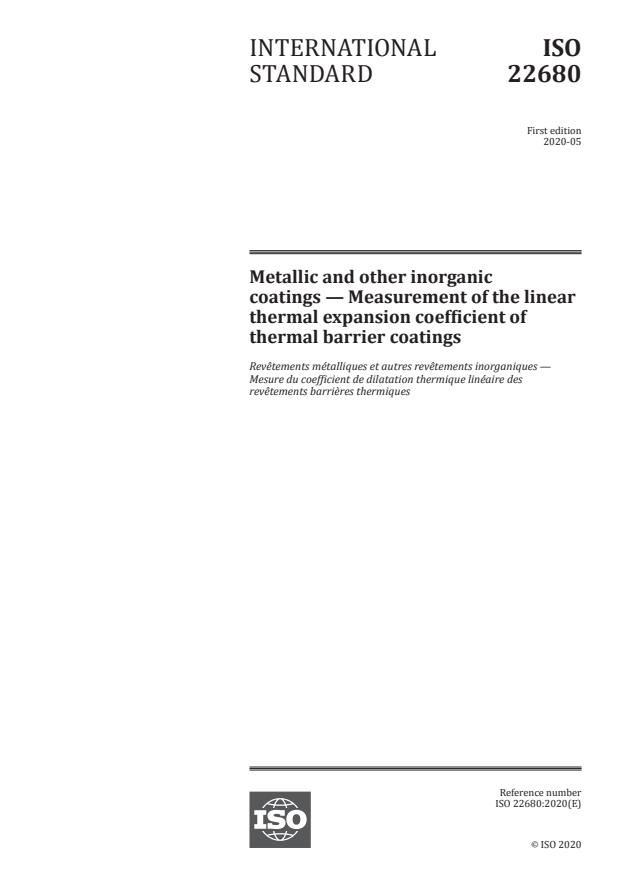
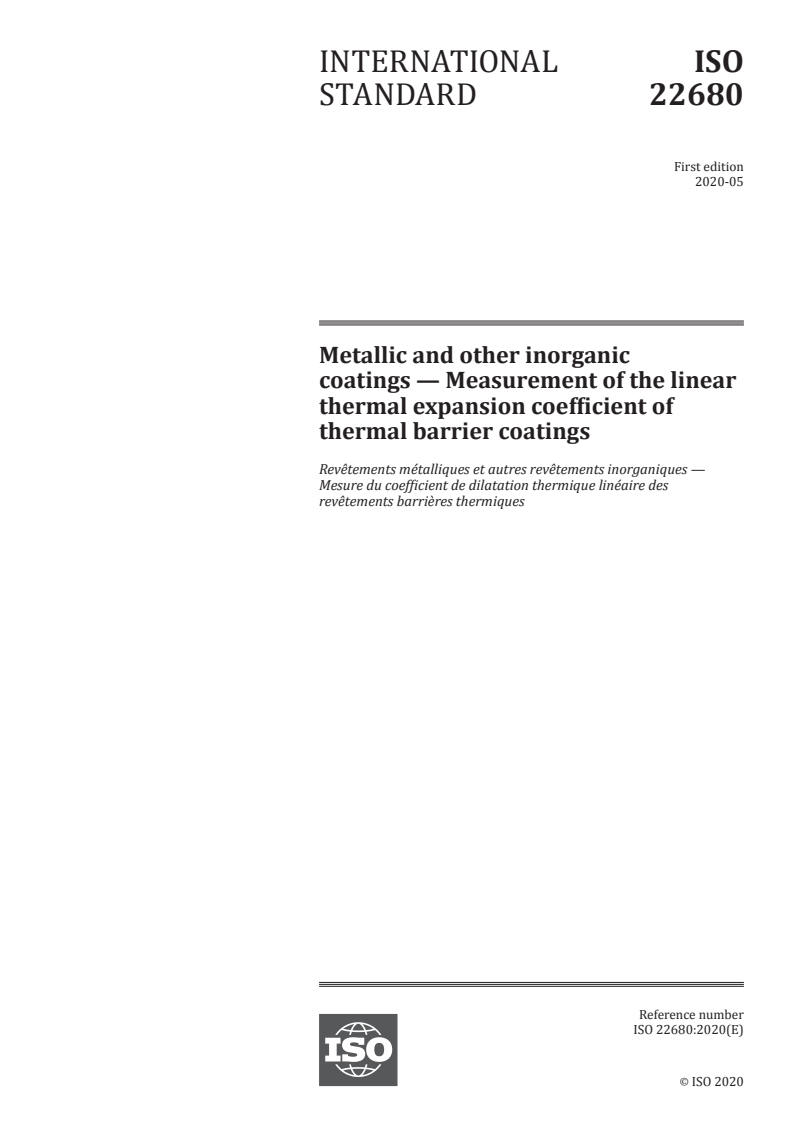
INTERNATIONAL ISO
STANDARD 22680
First edition
2020-05
Metallic and other inorganic
coatings — Measurement of the linear
thermal expansion coefficient of
thermal barrier coatings
Revêtements métalliques et autres revêtements inorganiques —
Mesure du coefficient de dilatation thermique linéaire des
revêtements barrières thermiques
Reference number
©
ISO 2020
© ISO 2020
All rights reserved. Unless otherwise specified, or required in the context of its implementation, no part of this publication may
be reproduced or utilized otherwise in any form or by any means, electronic or mechanical, including photocopying, or posting
on the internet or an intranet, without prior written permission. Permission can be requested from either ISO at the address
below or ISO’s member body in the country of the requester.
ISO copyright office
CP 401 • Ch. de Blandonnet 8
CH-1214 Vernier, Geneva
Phone: +41 22 749 01 11
Fax: +41 22 749 09 47
Email: copyright@iso.org
Website: www.iso.org
Published in Switzerland
ii © ISO 2020 – All rights reserved
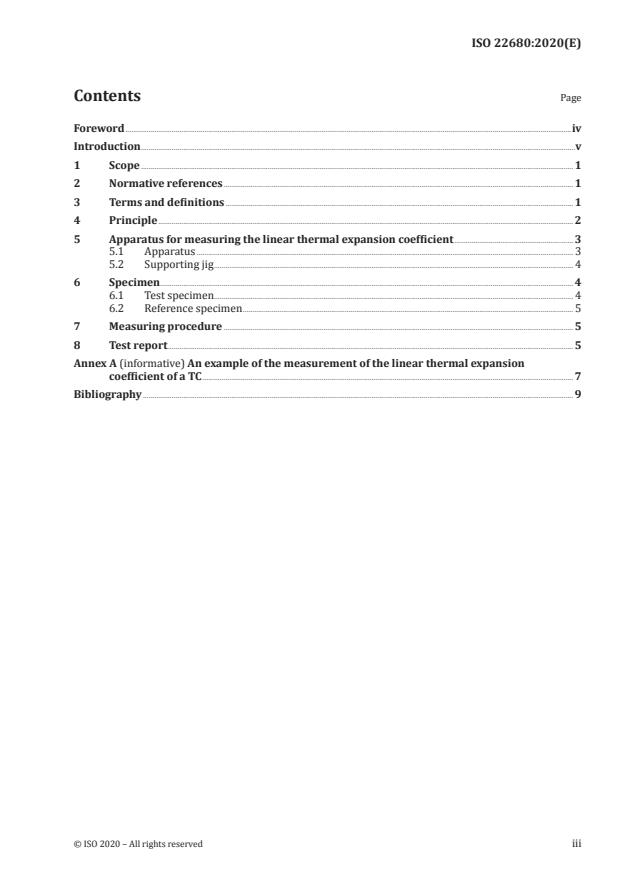
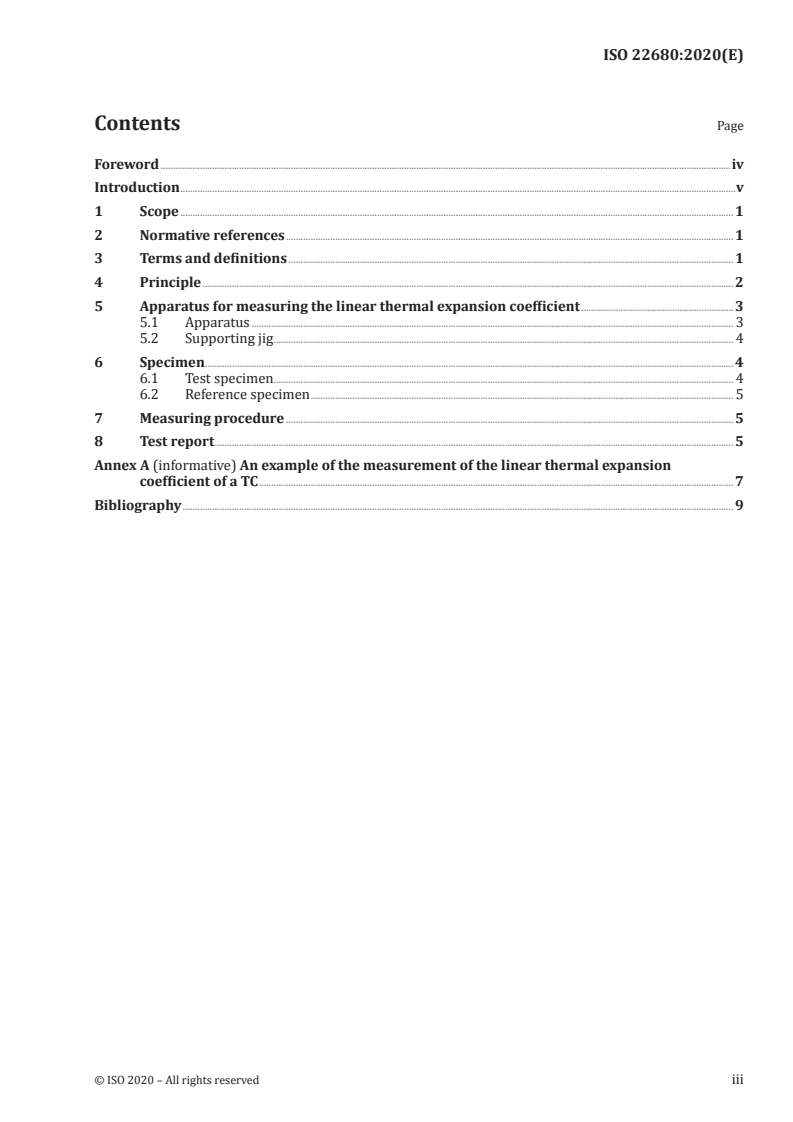
Contents Page
Foreword .iv
Introduction .v
1 Scope . 1
2 Normative references . 1
3 Terms and definitions . 1
4 Principle . 2
5 Apparatus for measuring the linear thermal expansion coefficient .3
5.1 Apparatus . 3
5.2 Supporting jig . 4
6 Specimen . 4
6.1 Test specimen . 4
6.2 Reference specimen . 5
7 Measuring procedure . 5
8 Test report . 5
Annex A (informative) An example of the measurement of the linear thermal expansion
coefficient of a TC . 7
Bibliography . 9
Foreword
ISO (the International Organization for Standardization) is a worldwide federation of national standards
bodies (ISO member bodies). The work of preparing International Standards is normally carried out
through ISO technical committees. Each member body interested in a subject for which a technical
committee has been established has the right to be represented on that committee. International
organizations, governmental and non-governmental, in liaison with ISO, also take part in the work.
ISO collaborates closely with the International Electrotechnical Commission (IEC) on all matters of
electrotechnical standardization.
The procedures used to develop this document and those intended for its further maintenance are
described in the ISO/IEC Directives, Part 1. In particular, the different approval criteria needed for the
different types of ISO documents should be noted. This document was drafted in accordance with the
editorial rules of the ISO/IEC Directives, Part 2 (see www .iso .org/ directives).
Attention is drawn to the possibility that some of the elements of this document may be the subject of
patent rights. ISO shall not be held responsible for identifying any or all such patent rights. Details of
any patent rights identified during the development of the document will be in the Introduction and/or
on the ISO list of patent declarations received (see www .iso .org/ patents).
Any trade name used in this document is information given for the convenience of users and does not
constitute an endorsement.
For an explanation of the voluntary nature of standards, the meaning of ISO specific terms and
expressions related to conformity assessment, as well as information about ISO’s adherence to the
World Trade Organization (WTO) principles in the Technical Barriers to Trade (TBT) see www .iso .org/
iso/ foreword .html.
This document was prepared by Technical Committee ISO/TC 107, Metallic and other inorganic coatings.
Any feedback or questions on this document should be directed to the user’s national standards body. A
complete listing of these bodies can be found at www .iso .org/ members .html.
iv © ISO 2020 – All rights reserved
Introduction
Thermal barrier coatings are highly advanced material systems, generally applied to surfaces of hot-
section components made of nickel or cobalt-based superalloys, such as combustors, blades and vanes
of power-generation gas turbines in thermal power plants and aero-engines operated at elevated
temperatures.
The function of these coatings is to protect metallic components for extended periods at elevated
temperatures by employing thermally insulating materials that can sustain an appreciable temperature
difference between load bearing alloys and coating surfaces. These coatings permit the high-
temperature operation by shielding these components, thereby extending their lives.
Although the linear thermal expansion coefficient is an important property of thermal barrier coatings,
the existing International Standard (e.g. ISO 17562) describes only a method for measuring this
parameter for monolithic ceramics.
This document specifies a method for measuring the linear thermal expansion coefficient of the ceramic
top coat for thermal barrier coating.
INTERNATIONAL STANDARD ISO 22680:2020(E)
Metallic and other inorganic coatings — Measurement of
the linear thermal expansion coefficient of thermal barrier
coatings
1 Scope
This document specifies a method for measuring the reproducible linear thermal expansion coefficient
of ceramic top coats (TCs) for thermal barrier coatings (TBCs) up to 1 300 °C.
2 Normative references
The following documents are referred to in the text in such a way that some or all of their content
constitutes requirements of this document. For dated references, only the edition cited applies. For
undated references, the latest edition of the referenced document (including any amendments) applies.
ISO 3611, Geometrical product specifications (GPS) — Dimensional measuring equipment: Micrometers for
external measurements — Design and metrological characteristics
ISO 17139, Fine ceramics (advanced ceramics, advanced technical ceramics) — Thermophysical properties
of ceramic composites — Determination of thermal expansion
ISO 17562, Fine ceramics (advanced cer
...
INTERNATIONAL ISO
STANDARD 22680
First edition
2020-05
Metallic and other inorganic
coatings — Measurement of the linear
thermal expansion coefficient of
thermal barrier coatings
Revêtements métalliques et autres revêtements inorganiques —
Mesure du coefficient de dilatation thermique linéaire des
revêtements barrières thermiques
Reference number
©
ISO 2020
© ISO 2020
All rights reserved. Unless otherwise specified, or required in the context of its implementation, no part of this publication may
be reproduced or utilized otherwise in any form or by any means, electronic or mechanical, including photocopying, or posting
on the internet or an intranet, without prior written permission. Permission can be requested from either ISO at the address
below or ISO’s member body in the country of the requester.
ISO copyright office
CP 401 • Ch. de Blandonnet 8
CH-1214 Vernier, Geneva
Phone: +41 22 749 01 11
Fax: +41 22 749 09 47
Email: copyright@iso.org
Website: www.iso.org
Published in Switzerland
ii © ISO 2020 – All rights reserved
Contents Page
Foreword .iv
Introduction .v
1 Scope . 1
2 Normative references . 1
3 Terms and definitions . 1
4 Principle . 2
5 Apparatus for measuring the linear thermal expansion coefficient .3
5.1 Apparatus . 3
5.2 Supporting jig . 4
6 Specimen . 4
6.1 Test specimen . 4
6.2 Reference specimen . 5
7 Measuring procedure . 5
8 Test report . 5
Annex A (informative) An example of the measurement of the linear thermal expansion
coefficient of a TC . 7
Bibliography . 9
Foreword
ISO (the International Organization for Standardization) is a worldwide federation of national standards
bodies (ISO member bodies). The work of preparing International Standards is normally carried out
through ISO technical committees. Each member body interested in a subject for which a technical
committee has been established has the right to be represented on that committee. International
organizations, governmental and non-governmental, in liaison with ISO, also take part in the work.
ISO collaborates closely with the International Electrotechnical Commission (IEC) on all matters of
electrotechnical standardization.
The procedures used to develop this document and those intended for its further maintenance are
described in the ISO/IEC Directives, Part 1. In particular, the different approval criteria needed for the
different types of ISO documents should be noted. This document was drafted in accordance with the
editorial rules of the ISO/IEC Directives, Part 2 (see www .iso .org/ directives).
Attention is drawn to the possibility that some of the elements of this document may be the subject of
patent rights. ISO shall not be held responsible for identifying any or all such patent rights. Details of
any patent rights identified during the development of the document will be in the Introduction and/or
on the ISO list of patent declarations received (see www .iso .org/ patents).
Any trade name used in this document is information given for the convenience of users and does not
constitute an endorsement.
For an explanation of the voluntary nature of standards, the meaning of ISO specific terms and
expressions related to conformity assessment, as well as information about ISO’s adherence to the
World Trade Organization (WTO) principles in the Technical Barriers to Trade (TBT) see www .iso .org/
iso/ foreword .html.
This document was prepared by Technical Committee ISO/TC 107, Metallic and other inorganic coatings.
Any feedback or questions on this document should be directed to the user’s national standards body. A
complete listing of these bodies can be found at www .iso .org/ members .html.
iv © ISO 2020 – All rights reserved
Introduction
Thermal barrier coatings are highly advanced material systems, generally applied to surfaces of hot-
section components made of nickel or cobalt-based superalloys, such as combustors, blades and vanes
of power-generation gas turbines in thermal power plants and aero-engines operated at elevated
temperatures.
The function of these coatings is to protect metallic components for extended periods at elevated
temperatures by employing thermally insulating materials that can sustain an appreciable temperature
difference between load bearing alloys and coating surfaces. These coatings permit the high-
temperature operation by shielding these components, thereby extending their lives.
Although the linear thermal expansion coefficient is an important property of thermal barrier coatings,
the existing International Standard (e.g. ISO 17562) describes only a method for measuring this
parameter for monolithic ceramics.
This document specifies a method for measuring the linear thermal expansion coefficient of the ceramic
top coat for thermal barrier coating.
INTERNATIONAL STANDARD ISO 22680:2020(E)
Metallic and other inorganic coatings — Measurement of
the linear thermal expansion coefficient of thermal barrier
coatings
1 Scope
This document specifies a method for measuring the reproducible linear thermal expansion coefficient
of ceramic top coats (TCs) for thermal barrier coatings (TBCs) up to 1 300 °C.
2 Normative references
The following documents are referred to in the text in such a way that some or all of their content
constitutes requirements of this document. For dated references, only the edition cited applies. For
undated references, the latest edition of the referenced document (including any amendments) applies.
ISO 3611, Geometrical product specifications (GPS) — Dimensional measuring equipment: Micrometers for
external measurements — Design and metrological characteristics
ISO 17139, Fine ceramics (advanced ceramics, advanced technical ceramics) — Thermophysical properties
of ceramic composites — Determination of thermal expansion
ISO 17562, Fine ceramics (advanced cer
...