

ISO 24409-3:2014
(Main)Ships and marine technology — Design, location and use of shipboard safety signs, safety-related signs, safety notices and safety markings — Part 3: Code of practice
General Information
- Abstract
ISO 24409-3:2014 is intended to provide for the consistent use of shipboard safety and fire control plan signs, guidance on their location and size, and for the use of appropriate graphical symbols and supplementary text to furnish additional directional information. ISO 24409-3:2014 does not apply to low-location lighting systems (or components of such systems) which are covered in ISO 15370.
- Status
- Published
- Publication Date
- 15-Jan-2014
- Technical Committee
- ISO/TC 8/SC 1 - Maritime safety
- Drafting Committee
- ISO/TC 8/SC 1/WG 3 - Fire protection
- Current Stage
- 9093 - International Standard confirmed
- Start Date
- 09-Sep-2024
- Completion Date
- 29-Aug-2026
Overview
ISO 24409-3:2014 - Ships and marine technology - Part 3: Code of practice - is the international code of practice for the consistent design, location and use of shipboard safety signs, safety-related signs, safety notices and safety markings. It provides practical guidance on the layout and implementation of escape route signing, fire control plan signs, life‑saving and fire‑fighting equipment signing, and related installation, illumination and maintenance considerations. The standard complements SOLAS requirements and other ISO shipboard guidance to improve wayfinding, orientation and emergency evacuation readiness on ships and offshore installations.
Key topics and technical requirements
- Escape route signing system: Principles for providing continuous, unambiguous signage from any location to assembly or embarkation stations, including planning to avoid confusion and identify dead ends.
- Sign location and mounting: Guidance on mounting height, positioning relative to doors, stair landings and architectural features to ensure conspicuousness in normal and emergency lighting.
- Graphical symbols and supplementary text: Use of standardized pictograms (e.g., assembly and exit symbols) with directional arrows and optional text to increase comprehension.
- Fire control plan signing: Requirements for signs and mimic diagrams that support ship officers in fire response and routeing to fire‑fighting equipment.
- Signing for equipment: Identification and location marking for fire‑fighting equipment, life‑saving appliances and embarkation stations.
- Illumination and photometric performance: Recommendations for phosphorescent sign properties and lighting levels to ensure visibility under emergency conditions.
- Sign size and viewing distance: Criteria to select sign dimensions appropriate to viewing distances and ship spaces.
- Documentation, inspection and maintenance: Requirements for documenting the signing system, crew familiarization (videos, leaflets, mimic signs), and periodic inspection and upkeep.
- Scope exclusions: Low‑location lighting systems are excluded (covered by ISO 15370).
Practical applications and users
ISO 24409-3 is used to design, verify and implement maritime safety signage across passenger ships, cargo vessels and offshore installations. Typical users include:
- Ship designers and naval architects integrating means-of-escape plans
- Shipowners, operators and safety officers developing evacuation and familiarization programs
- Shipyards and sign manufacturers producing compliant safety signs and installations
- Classification societies and regulatory authorities assessing conformance with SOLAS and IMO provisions
- Crew trainers and safety auditors conducting drills and inspections
Related standards
- ISO 24409-1 (Design principles)
- ISO 24409-2 (Catalogue of signs)
- ISO 15370 (Low‑location lighting)
- ISO 17631 (Shipboard plans for fire protection and means of escape)
- SOLAS and the IMO Fire Safety Systems (FSS) Code
Keywords: ISO 24409-3:2014, shipboard safety signs, escape route signage, fire control plan signing, maritime safety signage, phosphorescent signs, means of escape.
Get Certified
Connect with accredited certification bodies for this standard

DNV
DNV is an independent assurance and risk management provider.

Lloyd's Register
Lloyd's Register is a global professional services organisation specialising in engineering and technology.

FSC International
Forest Stewardship Council certification.
Sponsored listings
Frequently Asked Questions
ISO 24409-3:2014 is a standard published by the International Organization for Standardization (ISO). Its full title is "Ships and marine technology — Design, location and use of shipboard safety signs, safety-related signs, safety notices and safety markings — Part 3: Code of practice". This standard covers: ISO 24409-3:2014 is intended to provide for the consistent use of shipboard safety and fire control plan signs, guidance on their location and size, and for the use of appropriate graphical symbols and supplementary text to furnish additional directional information. ISO 24409-3:2014 does not apply to low-location lighting systems (or components of such systems) which are covered in ISO 15370.
ISO 24409-3:2014 is intended to provide for the consistent use of shipboard safety and fire control plan signs, guidance on their location and size, and for the use of appropriate graphical symbols and supplementary text to furnish additional directional information. ISO 24409-3:2014 does not apply to low-location lighting systems (or components of such systems) which are covered in ISO 15370.
ISO 24409-3:2014 is classified under the following ICS (International Classification for Standards) categories: 47.020.01 - General standards related to shipbuilding and marine structures. The ICS classification helps identify the subject area and facilitates finding related standards.
ISO 24409-3:2014 is available in PDF format for immediate download after purchase. The document can be added to your cart and obtained through the secure checkout process. Digital delivery ensures instant access to the complete standard document.
Standards Content (Sample)
INTERNATIONAL ISO
STANDARD 24409-3
First edition
2014-01-15
Ships and marine technology —
Design, location and use of shipboard
safety signs, safety-related signs,
safety notices and safety markings —
Part 3:
Code of practice
Navires et technologie maritime — Conception, emplacement et
utilisation des signaux de sécurité, signaux relatifs à la sécurité, notes
de sécurité et marquages de sécurité à bord des navires —
Partie 3: Code de bonne pratique
Reference number
©
ISO 2014
© ISO 2014
All rights reserved. Unless otherwise specified, no part of this publication may be reproduced or utilized otherwise in any form
or by any means, electronic or mechanical, including photocopying, or posting on the internet or an intranet, without prior
written permission. Permission can be requested from either ISO at the address below or ISO’s member body in the country of
the requester.
ISO copyright office
Case postale 56 • CH-1211 Geneva 20
Tel. + 41 22 749 01 11
Fax + 41 22 749 09 47
E-mail copyright@iso.org
Web www.iso.org
Published in Switzerland
ii © ISO 2014 – All rights reserved
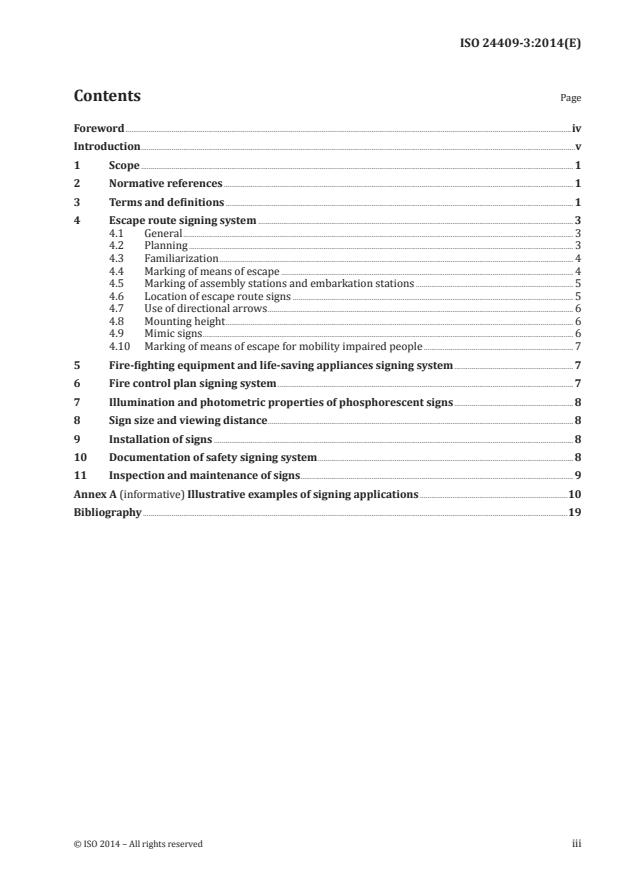
Contents Page
Foreword .iv
Introduction .v
1 Scope . 1
2 Normative references . 1
3 Terms and definitions . 1
4 Escape route signing system . 3
4.1 General . 3
4.2 Planning . 3
4.3 Familiarization . 4
4.4 Marking of means of escape . 4
4.5 Marking of assembly stations and embarkation stations . 5
4.6 Location of escape route signs . 5
4.7 Use of directional arrows . 6
4.8 Mounting height . 6
4.9 Mimic signs . 6
4.10 Marking of means of escape for mobility impaired people . 7
5 Fire-fighting equipment and life-saving appliances signing system .7
6 Fire control plan signing system . 7
7 Illumination and photometric properties of phosphorescent signs .8
8 Sign size and viewing distance . 8
9 Installation of signs . 8
10 Documentation of safety signing system . 8
11 Inspection and maintenance of signs . 9
Annex A (informative) Illustrative examples of signing applications .10
Bibliography .19
Foreword
ISO (the International Organization for Standardization) is a worldwide federation of national standards
bodies (ISO member bodies). The work of preparing International Standards is normally carried out
through ISO technical committees. Each member body interested in a subject for which a technical
committee has been established has the right to be represented on that committee. International
organizations, governmental and non-governmental, in liaison with ISO, also take part in the work.
ISO collaborates closely with the International Electrotechnical Commission (IEC) on all matters of
electrotechnical standardization.
The procedures used to develop this document and those intended for its further maintenance are
described in the ISO/IEC Directives, Part 1. In particular the different approval criteria needed for the
different types of ISO documents should be noted. This document was drafted in accordance with the
editorial rules of the ISO/IEC Directives, Part 2 (see www.iso.org/directives).
Attention is drawn to the possibility that some of the elements of this document may be the subject of
patent rights. ISO shall not be held responsible for identifying any or all such patent rights. Details of
any patent rights identified during the development of the document will be in the Introduction and/or
on the ISO list of patent declarations received (see www.iso.org/patents).
Any trade name used in this document is information given for the convenience of users and does not
constitute an endorsement.
For an explanation on the meaning of ISO specific terms and expressions related to conformity
assessment, as well as information about ISO’s adherence to the WTO principles in the Technical Barriers
to Trade (TBT) see the following URL: Foreword - Supplementary information
The committee responsible for this document is ISO/TC 8, Ships and marine technology, Subcommittee
SC 1, Lifesaving and fire protection.
ISO 24409 consists of the following parts, under the general title Ships and marine technology — Design,
location and use of shipboard safety signs, safety-related signs, safety notices and safety markings:
— Part 1: Design principles
— Part 2: Catalogue
— Part 3: Code of practice
iv © ISO 2014 – All rights reserved
Introduction
The growth of international travel by ship and the variety of work on offshore installations have created
a need to provide people travelling and working on-board ships and other marine installations with
signs and associated systems that communicate consistent and effective safety information. This part of
ISO 24409 specifies a system of signs on ships and other marine installations that is generally consistent
with standardized systems of signs with which many will have gained familiarity in other applications.
As such, this part of ISO 24409 clarifies and supplements existing requirements set out in SOLAS
regulations II-2/13.3.2.5.1, II-2/13.1.3, II-2/13.7.1.1, II-2/13.7.2, III/8, III/9, III/11.5, III/20.10, and
ISO 17631.
This part of ISO 24409 is intended to improve the safety of passengers and crew on board ships and
marine installations by providing guidance on the signing of escape routes, including the use of arrows
to provide directional information, and in so doing to assist in orientation and in the description of
the planned escape process to passengers and crew. In addition, it provides guidance in signing of the
location and instructions for the use of fire-fighting equipment and life-saving equipment.
This part of ISO 24409 does not specify if and when escape route signs will be required. However, it
has been assumed in the drafting of this part of ISO 24409 that its execution will be entrusted to a
competent person familiar with the relevant regulatory requirements. This part of ISO 24409 is
also intended for use by regulatory authorities to assist in judging compliance with appropriate IMO
regulations and resolutions. It should be noted that the signing of escape routes comprises only a part of
the management of means of escape. Many other considerations have to be taken into account, including
the requirements of people with special needs, in order to establish a safe evacuation procedure.
This part of ISO 24409 reflects best practice; the illustrations reflect a system designed to provide the
optimum amount of information to clearly identify the location and direction of the means of escape from
any location within a ship, or offshore installation, to the assembly stations and appropriate survival
craft embarkation stations. However, as shown in examples, by the use of supplementary text, escape
route signing can also have a role to play in the management of a ship in non-emergency situations.
INTERNATIONAL STANDARD ISO 24409-3:2014(E)
Ships and marine technology — Design, location and use of
shipboard safety signs, safety-related signs, safety notices
and safety markings —
Part 3:
Code of practice
1 Scope
This part of ISO 24409 is intended to provide for the consistent use of shipboard safety and fire control
plan signs, guidance on their location and size, and for the use of appropriate graphical symbols and
supplementary text to furnish additional directional information. This part of ISO 24409 does not apply
to low-location lighting systems (or components of such systems) which are covered in ISO 15370.
2 Normative references
The following documents, in whole or in part, are normatively referenced in this document and are
indispensable for its application. For dated references, only the edition cited applies. For undated
references, the latest edition of the referenced document (including any amendments) applies.
ISO 15370, Ships and marine technology — Low-location lighting (LLL) on passenger ships — Arrangement
ISO 17398, Safety colours and safety signs — Classification, performance and durability of safety signs
ISO 17631, Ships and marine technology — Shipboard plans for fire protection, life-saving appliances and
means of escape
ISO 24409-1, Ships and marine technology — Design, location and use of shipboard safety signs, safety-
related signs, safety notices and safety markings — Part 1: Design principles
ISO 24409-2, Ships and marine technology — Design, location and use of shipboard safety signs, safety-
related signs, safety notices and safety markings — Part 2: Catalogue
International Convention for the Safety of Life at Sea, 1974 (SOLAS 1974), as amended
International Maritime Organization, International Code for Fire Safety Systems (FSS Code)
3 Terms and definitions
For the purposes of this document, the terms and definitions given in ISO 24409-1 and ISO 24409-2 and
the following apply.
3.1
assembly station
muster station
designated internal or external space where persons are gathered in the event of an emergency
3.2
assembly station symbol
sign MES001 given in ISO 24409-2 used to identify assembly stations and which may be combined
with supplementary arrow to give directional information and/or supplementary text to increase
comprehension, as appropriate
3.3
assembly station plan
evacuation and abandon ship plan
plan, approved by the competent authority, which shows the location and the arrangement of passenger
and crew assembly stations, the passenger cabins assigned to them, if any, the escape routes to get from
them to the assigned survival craft, as applicable to the ship or offshore installation
Note 1 to entry: The above information may be included in the means of escape plan.
3.4
competent authority
administration whose flag the ship is entitled to fly, or an organization authorized by an administration
to perform functions on its behalf
3.5
embarkation station
designated area where survival craft are boarded
3.6
escape route
route forming part of the means of escape from any place on-board a ship to a designated assembly
station or embarkation station
3.7
escape route sign
exit, assembly station, or embarkation station sign with appropriate directional arrow used to guide
people along escape routes to a designated assembly station or embarkation station
3.8
escape route signing system
comprehensive layout of escape route signs
3.9
exit
doorway or other suitable opening lying on the perimeter of a space and part of the means of escape
from such space
3.10
exit sign
signs MES002 and MES003 given in ISO 24409-2 used to identify exits and which may be combined
with supplementary arrow and/or text, as appropriate, to give directional information or to increase
comprehension on the use of the means of escape
3.11
fire control plan
plan, approved by the competent authority, to be done for the guidance of the ship’s officers, showing
clearly for each deck the structural fire divisions provided for the ship, or installation, and the
arrangements relevant to the fire detection and fire alarms systems, the fire extinguishing appliances,
systems and equipment, the means of escape, and the arrangements provided for the fire protection of
the ventilation systems
3.12
life-saving appliances plan
plan, approved by the competent authority, which lists and shows the location and the arrangement of
the life-saving appliances provided for the ship
3.13
means of escape
doorways, corridors, stairways forming an escape route the dimensions of which are calculated in
accordance with the prescriptions of the FSS Code and SOLAS ’74
2 © ISO 2014 – All rights reserved
3.14
means of escape plan
plan, approved by the competent authority, which provides prescriptions for the on-board arrangements
in accordance with the requirements set out by the FSS Code and SOLAS ’74
Note 1 to entry: The elements of a means of escape plan are defined in ISO 17631, including an example in
ISO 17631, Annex B.
3.15
survival craft
craft capable of sustaining the lives of persons in distress from the time of abandoning the ship
4 Escape route signing system
4.1 General
4.1.1 The objective of the escape route signing system is to ensure that from any space within a ship or
other marine installation, a sign or series of signs is provided and placed so that a person is directed along
an escape route toward an assembly station or embarkation station, as applicable.
4.1.2 The signing system should be designed based on the means of escape plan, assembly station plan,
and life-saving appliances plan, as applicable. The operational needs of the ship in its management should
also be considered.
4.2 Planning
4.2.1 The signing system should provide simple identification of the means of escape provisions to
allow people to escape with minimum assistance. It should avoid possible points of confusion and, in
particular, give no cause for hesitation or need for decision-making amongst alternatives. People escaping
should be provided with clear, unambiguous directions from any place in the ship throughout the escape
route to the assembly stations and/or embarkation stations.
4.2.2 The following areas should be taken into account in planning and designing escape route signing
systems:
a) siting and nature of all designated means of escape, in particular, noting stairway enclosures, escape
ladders, and hatches;
b) relative conspicuousness of escape routes;
c) position of all doors and other exits sited along escape routes;
d) escape from public spaces or open decks;
e) provision of other systems (if any), such as low-location lighting or audible devices, to assist in
wayfinding in the event of an emergency evacuation;
f) type and positioning of ambient lights and lighting levels within the ship under both normal
conditions (such as entertainment areas which may have low lighting levels as part of normal
operation) and emergency lighting conditions;
g) location and lighting of any other signs, architectural features, decor, or barriers that could conceal
or divert attention from an escape route sign;
EXAMPLE A duty free store, for instance, may have many signs which compete for the viewer’s attention.
h) dead ends that may exist along escape routes are to be identified to avoid persons taking the wrong
route in an emergency situation;
i) type, height, and architectural design of ceilings.
4.3 Familiarization
4.3.1 General
Information regarding signs and the signing system should be made available (for example, by
information video, mimic signs, leaflets, public address system, etc.) to familiarize the crew and the
passengers, in accordance with relevant regulations and requirements.
4.3.2 Orientation within the ship
4.3.2.1 Numbering of decks should be consistent with and should reflect the numbering in the ship’s
safety plans. The deck numbers should be prominently displayed at stair landings and lift lobbies. Decks
may also be named, but the deck number should always be displayed with the name. See Figure A.3.
It is recommended that all decks be sequentially numbered, e.g. starting with “1” at the tank top or
lowest deck and then upwards; or with “1” at the bulkhead deck and upwards, and from it downwards.
In this latter case, the decks below the bulkhead deck may be identified by negative numbers (e.g. −1, −2,
−3, etc.) or by letters (e.g. A, B, C, etc.), again from top to bottom.
4.3.2.2 All embarkation stations for the survival craft, and the relevant survival craft, should be
sequentially numbered from fore to aft. Odd numbers should be used for the starboard side and even
numbers for the port side.
4.3.2.3 All assembly stations should be sequentially lettered, starting with “A”, from fore to aft. In case
they are located on the same deck but on both sides of the ship, then they should be sequentially lettered
from starboard side to port side. Should an assembly station span more than one deck, then the notation
may be by assembly station letter and deck number, e.g. A3, A4, and A5 for the assembly station A spanning
on decks 3, 4, and 5. Should assembly stations be located on more than one deck, then they should be
lettered from bottom to top.
4.4 Marking of means of escape
4.4.1 Exit doors and hatches from machinery spaces, service space
...