

ISO 10845-3:2021
(Main)Construction procurement — Part 3: Standard conditions of tender
General Information
- Abstract
This document sets out standard conditions of tender which bind the employer and tenderer to behave in a particular manner, establish what a tenderer is required to do in order to submit a compliant tender, make known the evaluation criteria to tenderers, and establish the manner in which the employer conducts the process of offer and acceptance and provide the necessary feedback to tenderers on the outcomes of the process. This document is intended for use in procurements relating to goods, services and construction works and disposals other than by auction.
- Status
- Published
- Publication Date
- 13-Jul-2021
- Technical Committee
- ISO/TC 59/SC 18 - Construction procurement
- Drafting Committee
- ISO/TC 59/SC 18/WG 1 - Maintenance of ISO 10845 series
- Current Stage
- 9020 - International Standard under periodical review
- Start Date
- 15-Jul-2026
- Completion Date
- 15-Jul-2026



Overview
ISO 10845-3:2021 - Construction procurement: Part 3 - Standard conditions of tender defines standard conditions that bind the employer and tenderer during a procurement process. The standard details what a tenderer must do to submit a compliant tender, discloses evaluation criteria, and sets the procedures for offer, acceptance and feedback. It applies to procurements for goods, services and construction works and to disposals other than by auction.
Keywords: ISO 10845-3, construction procurement, standard conditions of tender, tender evaluation, procurement procedures.
Key topics
The standard addresses practical and procedural requirements that support transparent, consistent tendering. Major topics include:
- General requirements: interpretation, communication, employer’s right to accept/reject offers, and permitted procurement procedures (including competitive negotiation and two-stage systems).
- Tenderer’s obligations: eligibility, cost of tendering, confidentiality, insurance, pricing, alternative offers, and submission formalities (signatures, sealing, tender securities).
- Employer’s undertakings: issuing addenda, returning late offers, opening procedures, non-disclosure, grounds for rejection, and tests for responsiveness.
- Evaluation of offers: four evaluation methods (financial only; financial + quality; financial + preferences; financial + quality + preferences), scoring approaches and handling arithmetical errors and clarifications.
- Administrative processes: two-envelope systems, tender validity and withdrawal, issuing notices to successful/unsuccessful tenderers, contract preparation and return of tender securities.
- Annexes and guidance: commentary, tender data templates, evaluation reporting, example tender securities and impact of scoring formulas.
Applications and who should use it
ISO 10845-3 is designed for organizations and professionals involved in public or private construction procurement who need consistent, defensible tendering processes:
- Employers, owner organizations and public procuring entities
- Procurement officers and contract managers
- Contractors, suppliers and tendering consultants
- Legal advisers and compliance teams
- Quantity surveyors and project managers
Practical benefits:
- Promotes transparent, fair procurement and reduces disputes
- Standardizes tender documentation and evaluation to support compliance and auditability
- Guides selection of evaluation methods and scoring to align with procurement goals (cost, quality, social preferences)
Related standards
- Other parts of the ISO 10845 series (construction procurement) for complementary guidance on procurement planning and contract documentation.
- General procurement and contract standards adopted by national authorities or international bodies may be used alongside ISO 10845-3 for comprehensive procurement frameworks.
For implementing ISO 10845-3, combine its standard conditions of tender with your organization’s procurement policy and local legal requirements to ensure enforceable, transparent tendering.
Relations
- Effective Date
- 14-Oct-2020
Get Certified
Connect with accredited certification bodies for this standard

DIBt (Deutsches Institut für Bautechnik)
German Institute for Building Technology.
DIN CERTCO
DIN Group product certification.

Aboma Certification B.V.
Specialized in construction, metal, and transport sectors.
Sponsored listings
Frequently Asked Questions
ISO 10845-3:2021 is a standard published by the International Organization for Standardization (ISO). Its full title is "Construction procurement — Part 3: Standard conditions of tender". This standard covers: This document sets out standard conditions of tender which bind the employer and tenderer to behave in a particular manner, establish what a tenderer is required to do in order to submit a compliant tender, make known the evaluation criteria to tenderers, and establish the manner in which the employer conducts the process of offer and acceptance and provide the necessary feedback to tenderers on the outcomes of the process. This document is intended for use in procurements relating to goods, services and construction works and disposals other than by auction.
This document sets out standard conditions of tender which bind the employer and tenderer to behave in a particular manner, establish what a tenderer is required to do in order to submit a compliant tender, make known the evaluation criteria to tenderers, and establish the manner in which the employer conducts the process of offer and acceptance and provide the necessary feedback to tenderers on the outcomes of the process. This document is intended for use in procurements relating to goods, services and construction works and disposals other than by auction.
ISO 10845-3:2021 is classified under the following ICS (International Classification for Standards) categories: 91.010.20 - Contractual aspects. The ICS classification helps identify the subject area and facilitates finding related standards.
ISO 10845-3:2021 has the following relationships with other standards: It is inter standard links to ISO 10845-3:2011. Understanding these relationships helps ensure you are using the most current and applicable version of the standard.
ISO 10845-3:2021 is available in PDF format for immediate download after purchase. The document can be added to your cart and obtained through the secure checkout process. Digital delivery ensures instant access to the complete standard document.
Standards Content (Sample)
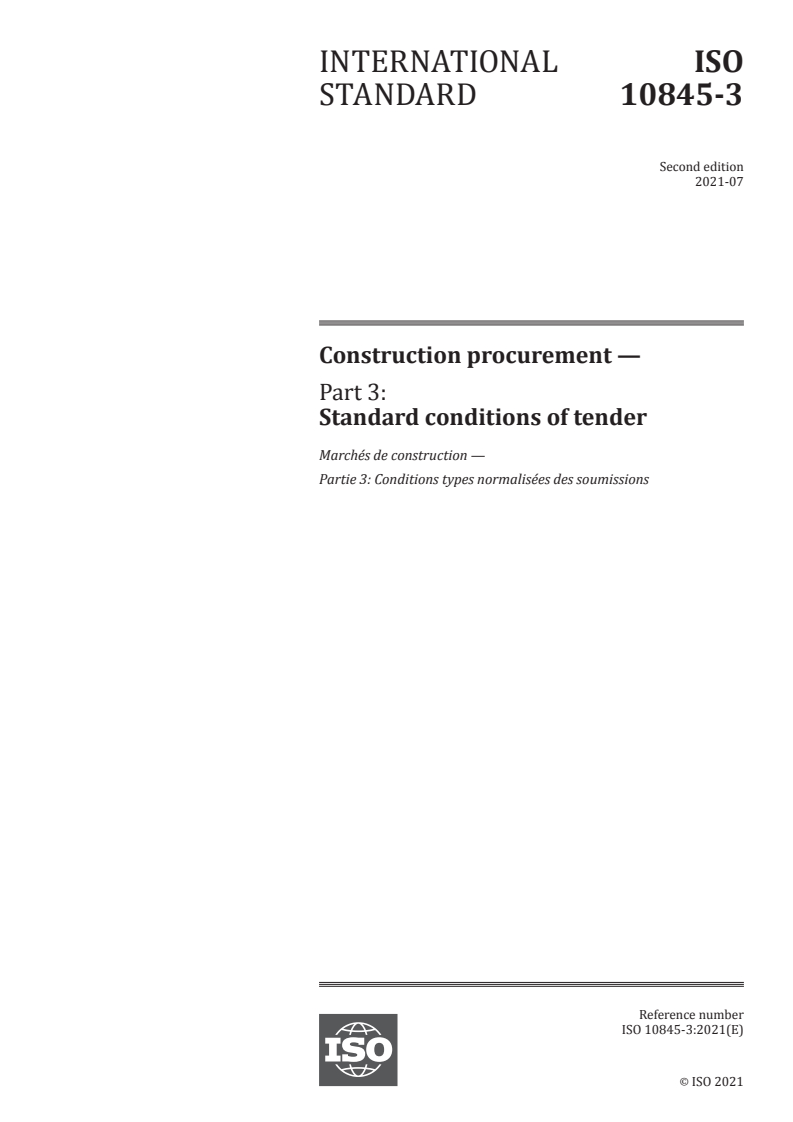
INTERNATIONAL ISO
STANDARD 10845-3
Second edition
2021-07
Construction procurement —
Part 3:
Standard conditions of tender
Marchés de construction —
Partie 3: Conditions types normalisées des soumissions
Reference number
©
ISO 2021
© ISO 2021
All rights reserved. Unless otherwise specified, or required in the context of its implementation, no part of this publication may
be reproduced or utilized otherwise in any form or by any means, electronic or mechanical, including photocopying, or posting
on the internet or an intranet, without prior written permission. Permission can be requested from either ISO at the address
below or ISO’s member body in the country of the requester.
ISO copyright office
CP 401 • Ch. de Blandonnet 8
CH-1214 Vernier, Geneva
Phone: +41 22 749 01 11
Email: copyright@iso.org
Website: www.iso.org
Published in Switzerland
ii © ISO 2021 – All rights reserved
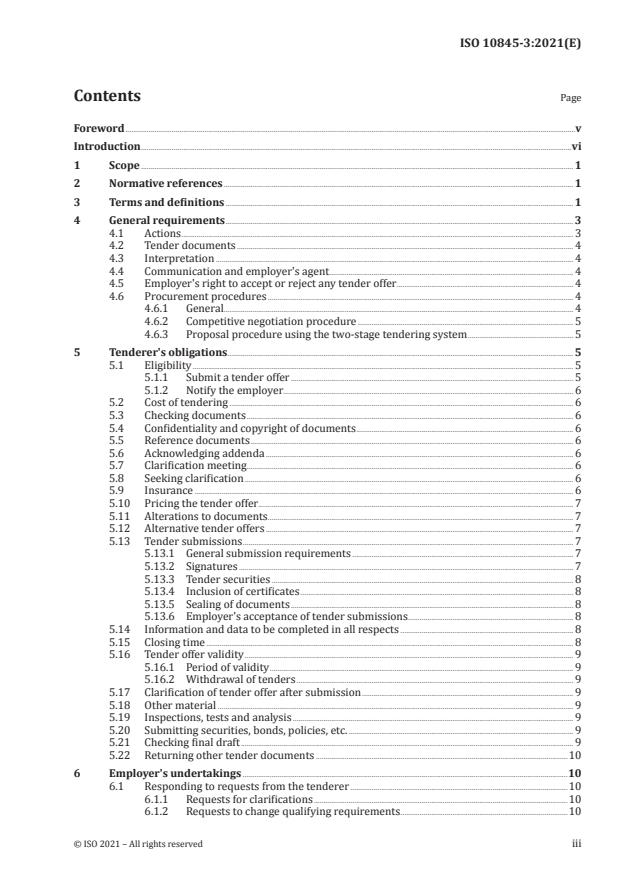
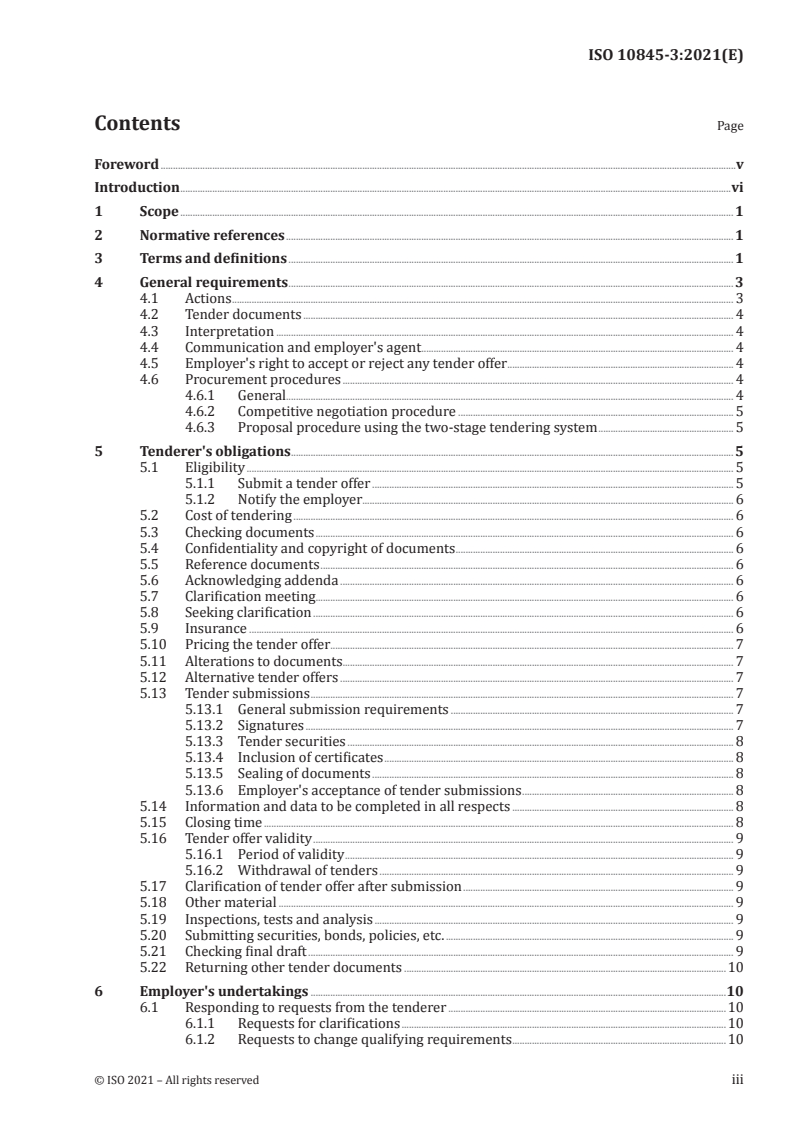
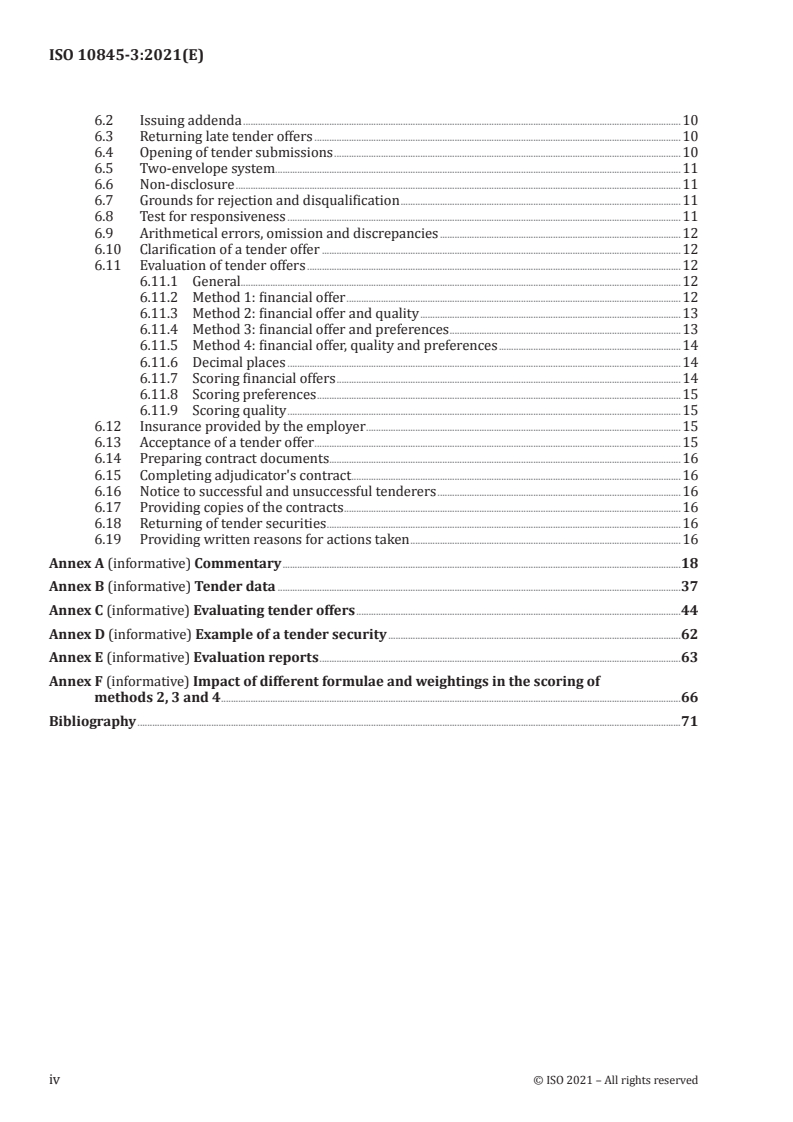
Contents Page
Foreword .v
Introduction .vi
1 Scope . 1
2 Normative references . 1
3 Terms and definitions . 1
4 General requirements . 3
4.1 Actions . 3
4.2 Tender documents . 4
4.3 Interpretation . 4
4.4 Communication and employer's agent . 4
4.5 Employer's right to accept or reject any tender offer . 4
4.6 Procurement procedures . 4
4.6.1 General. 4
4.6.2 Competitive negotiation procedure . 5
4.6.3 Proposal procedure using the two-stage tendering system . 5
5 Tenderer's obligations . 5
5.1 Eligibility . 5
5.1.1 Submit a tender offer . 5
5.1.2 Notify the employer. 6
5.2 Cost of tendering . 6
5.3 Checking documents . 6
5.4 Confidentiality and copyright of documents . 6
5.5 Reference documents . 6
5.6 Acknowledging addenda . 6
5.7 Clarification meeting. 6
5.8 Seeking clarification . 6
5.9 Insurance . 6
5.10 Pricing the tender offer. 7
5.11 Alterations to documents . 7
5.12 Alternative tender offers . 7
5.13 Tender submissions . 7
5.13.1 General submission requirements . 7
5.13.2 Signatures . 7
5.13.3 Tender securities . 8
5.13.4 Inclusion of certificates . 8
5.13.5 Sealing of documents . 8
5.13.6 Employer's acceptance of tender submissions . 8
5.14 Information and data to be completed in all respects . 8
5.15 Closing time . 8
5.16 Tender offer validity . 9
5.16.1 Period of validity . 9
5.16.2 Withdrawal of tenders . 9
5.17 Clarification of tender offer after submission . 9
5.18 Other material . 9
5.19 Inspections, tests and analysis . 9
5.20 Submitting securities, bonds, policies, etc. . 9
5.21 Checking final draft . 9
5.22 Returning other tender documents .10
6 Employer's undertakings .10
6.1 Responding to requests from the tenderer .10
6.1.1 Requests for clarifications .10
6.1.2 Requests to change qualifying requirements .10
6.2 Issuing addenda .10
6.3 Returning late tender offers .10
6.4 Opening of tender submissions .10
6.5 Two-envelope system .11
6.6 Non-disclosure .11
6.7 Grounds for rejection and disqualification .11
6.8 Test for responsiveness .11
6.9 Arithmetical errors, omission and discrepancies .12
6.10 Clarification of a tender offer .12
6.11 Evaluation of tender offers .12
6.11.1 General.12
6.11.2 Method 1: financial offer .12
6.11.3 Method 2: financial offer and quality .13
6.11.4 Method 3: financial offer and preferences .13
6.11.5 Method 4: financial offer, quality and preferences .14
6.11.6 Decimal places .14
6.11.7 Scoring financial offers .14
6.11.8 Scoring preferences .15
6.11.9 Scoring quality .15
6.12 Insurance provided by the employer .15
6.13 Acceptance of a tender offer .15
6.14 Preparing contract documents .16
6.15 Completing adjudicator's contract .16
6.16 Notice to successful and unsuccessful tenderers .16
6.17 Providing copies of the contracts .16
6.18 Returning of tender securities .16
6.19 Providing written reasons for actions taken .16
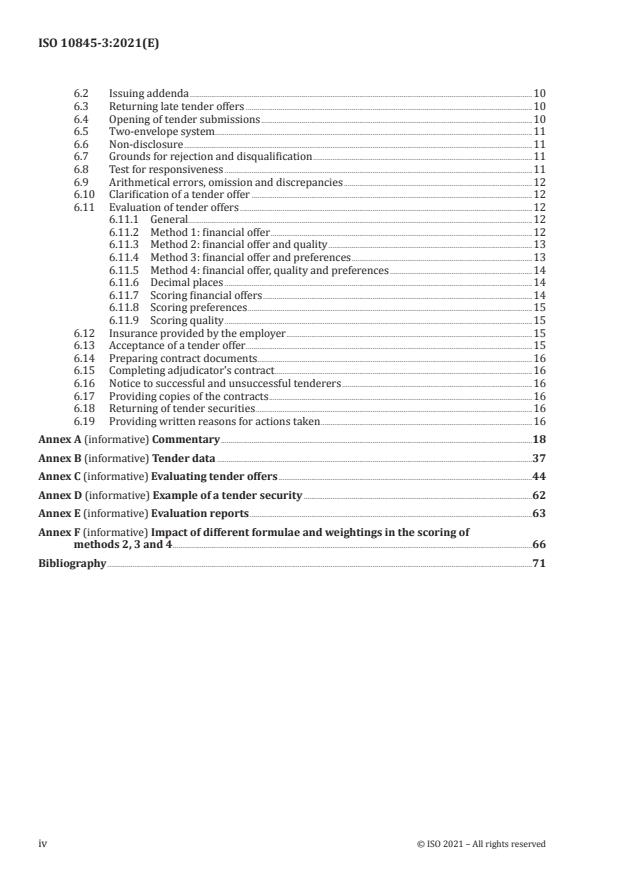
Annex A (informative) Commentary .18
Annex B (informative) Tender data .37
Annex C (informative) Evaluating tender offers .44
Annex D (informative) Example of a tender security .62
Annex E (informative) Evaluation reports .63
Annex F (informative) Impact of different formulae and weightings in the scoring of
methods 2, 3 and 4 .66
Bibliography .71
iv © ISO 2021 – All rights reserved
Foreword
ISO (the International Organization for Standardization) is a worldwide federation of national standards
bodies (ISO member bodies). The work of preparing International Standards is normally carried out
through ISO technical committees. Each member body interested in a subject for which a technical
committee has been established has the right to be represented on that committee. International
organizations, governmental and non-governmental, in liaison with ISO, also take part in the work.
ISO collaborates closely with the International Electrotechnical Commission (IEC) on all matters of
electrotechnical standardization.
The procedures used to develop this document and those intended for its further maintenance are
described in the ISO/IEC Directives, Part 1. In particular, the different approval criteria needed for the
different types of ISO documents should be noted. This document was drafted in accordance with the
editorial rules of the ISO/IEC Directives, Part 2 (see www .iso .org/ directives).
Attention is drawn to the possibility that some of the elements of this document may be the subject of
patent rights. ISO shall not be held responsible for identifying any or all such patent rights. Details of
any patent rights identified during the development of the document will be in the Introduction and/or
on the ISO list of patent declarations received (see www .iso .org/ patents).
Any trade name used in this document is information given for the convenience of users and does not
constitute an endorsement.
For an explanation of the voluntary nature of standards, the meaning of ISO specific terms and
expressions related to conformity assessment, as well as information about ISO's adherence to the
World Trade Organization (WTO) principles in the Technical Barriers to Trade (TBT), see www .iso .org/
iso/ foreword .html.
This document was prepared by Technical Committee ISO/TC 59, Buildings and civil engineering works,
Subcommittee SC 18, Construction procurement.
This second edition cancels and replaces the first edition (ISO 10845-3:2011), which has been
technically revised.
The main changes compared to the previous edition are as follows:
— definitions and parts of the text have been updated and aligned with other parts of the ISO 10845
series;
— the methods for evaluating tenders have been modified and the implications of choices made in
applying such methods explained;
— an informative annex on the formulation of evaluation reports has been added.
A list of all parts in the ISO 10845 series can be found on the ISO website.
Any feedback or questions on this document should be directed to the user’s national standards body. A
complete listing of these bodies can be found at www .iso .org/ members .html.
Introduction
Procurement is the process which creates, manages and fulfils contracts. There are accordingly three
phases to the procurement process associated with the delivery and maintenance of construction
works, namely:
— a planning phase during which decisions are made as to what, where and when goods and services
are required, how the market is to be engaged and what is the number, type, nature and timing of
the required contracts;
— an acquisition phase during which contracts are entered into following the execution of a selection
method; and
— a contract management (or contract administration) phase during which compliance with
requirements, changes in requirements and risk events which manifest during the execution of
contracts are managed.
Conditions of tender are required to establish procedures from the time that tenders are invited to the
time that a contract is awarded. Such conditions document the procedures, the manner in which those
engaged in the procurement process are to behave, the obligations of the tenderer and the undertakings
of the employer.
Annex A provides background information on this document, guidance on its use and suggestions
on good practice. Annex B provides guidance on how to develop the tender data for a procurement
document using this document. Annexes C and E offer guidance on the evaluation of tenders and the
structuring of evaluation reports, respectively. Annex D provides an example of a tender security.
Annex F provides insights into the use of different formulae and weightings in the scoring of tender
offers during the evaluation process,
ISO 10845-2 establishes the manner in which procurement documents should be formatted and
compiled. The standard conditions contained in this document can by reference be incorporated in
procurement documents formatted and compiled in accordance with the provisions of ISO 10845-2.
ISO 10845-4 establishes requirements relating to pre-qualification of tenderers who are invited to
submit a tender offer in terms of certain selection methods described in ISO 10845-1.
This document is part of the ISO 10845 series which covers various aspects of procurement within the
construction industry. Each part of the ISO 10845 series relates to a different aspect of procurement.
The objective of the ISO 10845 series is to provide a generic and standard set of processes, procedures
and methods for a procurement system that is fair, equitable, transparent, competitive and cost-
effective and which can be used to promote objectives additional to those associated with the immediate
objective of the procurement itself.
vi © ISO 2021 – All rights reserved
INTERNATIONAL STANDARD ISO 10845-3:2021(E)
Construction procurement —
Part 3:
Standard conditions of tender
1 Scope
This document sets out standard conditions of tender which
a) bind the employer and tenderer to behave in a particular manner,
b) establish what a tenderer is required to do in order to submit a compliant tender,
c) make known the evaluation criteria to tenderers, and
d) establish the manner in which the employer conducts the process of offer and acceptance and
provide the necessary feedback to tenderers on the outcomes of the process.
This document is intended for use in procurements relating to goods, services and construction works
and disposals other than by auction.
2 Normative references
There are no normative references in this document.
3 Terms and definitions
For the purposes of this document, the following terms and definitions apply.
ISO and IEC maintain terminology databases for use in standardization at the following addresses:
— ISO Online browsing platform: available at https:// www .iso .org/ obp
— IEC Electropedia: available at https:// www .electropedia .org/
3.1
bill of quantities
document for tendering, usually prepared in a standard form, comprising both a descriptive list of
quantities of works and descriptions of the materials, workmanship and other matters required for
construction works
[SOURCE: ISO 6707-2:2017, 3.5.11, modified — The preferred terms specific to the US have been
removed.]
3.2
bond
sum of money or securities submitted to the employer (3.8) or placed in the hands of a third party to
guarantee completion of the work and recovery of the sums which the contractor is recognized as
owing under the terms of the contract
[SOURCE: ISO 6707-2:2017, 3.5.40, modified — "client" has been replaced by "employer"; "of the work"
has been added after "completion".]
3.3
comparative offer
tenderer's (3.18) financial offer after all tendered parameters that can affect the value of the financial
offer have been taken into consideration to enable comparisons to be made on a comparable basis
3.4
conflict of interest
situation where business, financial, family, political or personal interests could interfere with the
judgment of persons in carrying out their duties for the organisation
[SOURCE: ISO 37001:2016, 3.29]
3.5
contract data
document that identifies the applicable conditions of a contract and states the associated contract-
specific data
[SOURCE: ISO 10845-1:2020, 3.8]
3.6
corrupt practice
offering, giving, receiving or soliciting of anything of value to influence the action of the employer (3.8)
or his staff or agents in the tender process
[SOURCE: ISO 10845-1:2020, 3.10, modified — "the procurement process or the administration of the
contract" has been replaced by "the tender process".]
3.7
eligibility criteria
criteria framed around the ability of a tenderer (3.18) to provide the required goods, services and
construction works or disposals, or any combination thereof, which need to be satisfied in order for a
submission to be evaluated
3.8
employer
person or organization (3.12) intending to or entering into a contract with the contractor to supply
goods, carry out construction works and/or provide services
[SOURCE: ISO 10845-1:2020, 3.15]
3.9
form of offer and acceptance
document that formalizes the legal process of offer and acceptance
3.10
fraudulent practice
misrepresentation of the facts in order to influence the tender process, or the award of a contract
arising from a tender offer (3.17) to the detriment of the employer (3.8), including collusive practices
intended to establish prices at artificial levels
[SOURCE: ISO 10845-1:2020, 3.18, modified — "or the administration of the contract including
compensation procedures" at the end has been removed.]
3.11
joint venture
two or more organizations (3.12) grouped together to carry out work and share the risks, where each is
jointly and severally liable for the actions and work of the other
[SOURCE: ISO 6707-2:2017, 3.8.3]
2 © ISO 2021 – All rights reserved
3.12
organization
company, firm, enterprise, association or other legal entity, whether incorporated or not, or public body
[SOURCE: ISO 10845-1:2020, 3.21]
3.13
quality
totality of features and characteristics of a product or service that bears on the ability of the product or
service to satisfy stated or implied needs
[SOURCE: ISO 10845-1:2020, 3.27]
3.14
returnable document
document that a tenderer (3.18) is required to complete and submit to the employer (3.8) as part of his
tender submission
3.15
scope of work
document that specifies and describes the goods, services, or construction works which are to be
provided, and any other requirements and constraints relating to the manner in which the contract
work is to be performed
[SOURCE: ISO 10845-1:2020, 3.29, modified — Notes 1 and 2 to entry have been removed.]
3.16
tender data
document that establishes the tenderer's (3.18) obligations in submitting a tender and the employer's
(3.8) undertakings in administering the tender process and evaluating tender offers (3.17)
[SOURCE: ISO 10845-1:2020, 3.37]
3.17
tender offer
written offer to supply goods, carry out construction works and/or provide services under given
conditions, usually at a stated price, and which is capable of acceptance and conversion into a binding
contract
[SOURCE: ISO 10845-1:2020, 3.38]
3.18
tenderer
person or organization (3.12) that submits a tender offer (3.17)
[SOURCE: ISO 10845-1:2020, 3.39, modified — Note 1 to entry has been removed.]
4 General requirements
4.1 Actions
The employer and each tenderer submitting a tender offer shall comply with the standard conditions of
tender. In their dealings with each other, they shall discharge their duties and obligations, as set out in
Clauses 5 and 6, in a timely manner and with integrity, behave equitably, honestly and transparently,
and not engage in anti-competitive practices.
The employer and the tenderer, and all the agents and employees involved in the tender process, shall
avoid conflicts of interest and, where a conflict of interest is perceived or known, declare any such
conflict of interest, indicating the nature of such conflict. Tenderers shall declare any potential conflict
of interest in their tender submissions. Employees, agents and advisors of the employer shall declare
any conflict of interest to whoever is responsible for overseeing the procurement process at the start of
any deliberations relating to the procurement process or as soon as they become aware of such conflict,
and abstain from any decisions where such conflict exists or recuse themselves from the procurement
process, as appropriate.
The employer shall not seek and a tenderer shall not submit a tender without having a firm intention
and the capacity to proceed with the contract.
NOTE 1 A conflict of interest can arise due to a conflict of roles which can provide an incentive for improper
acts in some circumstances or positions. A conflict of interest can create an appearance of impropriety that can
undermine confidence in the ability of that person to act properly in said circumstance or position, even if no
improper acts result.
NOTE 2 Conflicts of interest with respect to those engaged in the procurement process include direct, indirect
or family interests in the tender or outcome of the procurement process and any personal bias, inclination,
obligation, allegiance or loyalty which can in any way affect any decisions taken.
4.2 Tender documents
The documents issued by the employer for the purpose of a tender offer are listed in the tender data.
4.3 Interpretation
The tender data and additional requirements contained in the tender schedules that are included in the
returnable documents are deemed to be part of the standard conditions of tender in this document.
The standard conditions of tender contained in this document, the tender data and tender schedules
which are only required for tender evaluation purposes, shall not form part of any contract arising from
the invitation to tender.
4.4 Communication and employer's agent
Each communication between the employer and a tenderer shall be to or from the employer's agent
only, and in a form that can be read, copied and recorded, and in the language stated in the tender data.
The employer shall not take any responsibility for non-receipt of communications from or by a tenderer.
The name and contact details of the employer's agent are stated in the tender data.
4.5 Employer's right to accept or reject any tender offer
The employer may accept or reject any variation, deviation, tender offer, or alternative tender offer, and
may cancel the tender process and reject all tender offers at any time before the formation of a contract.
The employer shall not accept or incur any liability to a tenderer for such cancellation and rejection, but
shall give written reasons for such action upon written request to do so.
The employer may not, subsequent to the cancellation or abandonment of a tender process or the
rejection of all responsive tender offers, re-issue a tender covering substantially the same scope of
work within a period of six months unless only one tender was received and such tender was returned
unopened to the tenderer.
4.6 Procurement procedures
4.6.1 General
Unless otherwise stated in the tender data, a contract shall, subject to 6.13, be concluded with the
tenderer who, in terms of 6.11, is the highest ranked or the tenderer scoring the highest number of
tender evaluation points, as relevant, based on the tender submissions that are received at the closing
time for tenders.
4 © ISO 2021 – All rights reserved
4.6.2 Competitive negotiation procedure
Where the tender data require that the competitive negotiation procedure be followed, tenderers
shall submit tender offers in response to the proposed contract in the first round of submissions.
Notwithstanding the requirements of 6.4, the employer shall only announce the names of the tenderers
who make a submission. The requirements of 6.8, relating to the material deviations or qualifications
which affect the competitive position of tenderers, shall not apply.
All responsive tenderers, or not less than three responsive tenderers that are highest ranked in terms
of the evaluation method and evaluation criteria stated in the tender data, shall be invited in each
round to enter into competitive negotiations, based on the principle of equal treatment and keeping
confidential the proposed solutions and associated information. Notwithstanding the provisions of
6.17, the employer may request that tenders be clarified, specified and fine-tuned in order to improve
a tenderer's competitive position, provided that such clarification, specification, fine-tuning or
additional information does not alter any fundamental aspects of the offers or impose substantial new
requirements which restrict or distort competition or have a discriminatory effect.
At the conclusion of each round of negotiations, tenderers shall be invited by the employer to make
a fresh tender offer, based on the same evaluation criteria, with or without adjusted weightings.
Tenderers shall be advised when they are to submit their best and final offer.
The contract shall be awarded in accordance with the provisions of 6.11 and 6.13 after tenderers have
been requested to submit their best and final offer.
4.6.3 Proposal procedure using the two-stage tendering system
4.6.3.1 Option 1
In the first stage, tenderers shall submit technical proposals and, if required, cost parameters around
which a contract may be negotiated.
The employer shall evaluate each responsive submission in terms of the method of evaluation stated in
the tender data.
In the second stage, the employer shall negotiate a contract with the tenderer scoring the highest
number of evaluation points and award the contract in terms of the standard conditions of tender.
4.6.3.2 Option 2
In the first stage, tenderers shall submit only technical proposals. In the second stage, the employer
shall invite all responsive tenderers to submit tender offers, following the issuing of procurement
documents.
The employer shall evaluate tenders received during the second stage in terms of the method of
evaluation stated in the tender data, and award the contract in terms of the standard conditions of
tender in this document.
5 Tenderer's obligations
5.1 Eligibility
5.1.1 Submit a tender offer
Submit a tender offer only if the tenderer satisfies the eligibility criteria stated in the tender data and
if the tenderer, or any of the tenderer's principals, is not under any restriction to do business with the
employer.
Complete the eligibility declaration included in the tender documents (if any) and provide the required
evidence of satisfying stated eligibility criteria.
5.1.2 Notify the employer
Notify the employer of any proposed material change in the capabilities or formation of the tendering
entity (or both) or any other criteria which formed part of the qualifying requirements used by the
employer as the basis in a prior process to invite the tenderer to submit a tender offer, and obtain the
employer's written approval to do so before the closing time for tenders.
5.2 Cost of tendering
Accept that, unless otherwise stated in the tender data, the employer does not compensate the tenderer
for any costs incurred in the preparation and submission of a tender offer, including the costs of any
testing necessary to demonstrate that aspects of the tender offer comply with requirements.
5.3 Checking documents
Check the tender documents on receipt for completeness and notify the employer of any discrepancy or
omission.
5.4 Confidentiality and copyright of documents
Treat as confidential all matters arising in connection with the tender. Use and copy the documents
issued by the employer only for the purpose of preparing and submitting a tender offer in response to
the invitation.
5.5 Reference documents
Obtain, as necessary for submitting a tender offer, copies of the latest versions of standards,
specifications, conditions of contract and other publications, which are incorporated into the tender
documents by reference.
5.6 Acknowledging addenda
Acknowledge receipt of addenda to the tender documents, which the employer may issue, and, if
necessary, apply for an extension to the closing time stated in the tender data, in order to take the
addenda into account.
5.7 Clarification meeting
Attend, where required, a clarification meeting, the details of which are stated in the tender data, at
which tenderers may familiarize themselves with aspects of the proposed work, services or supply, and
raise questions.
5.8 Seeking clarification
Unless otherwise notified in the tender data, request clarification of the tender documents, if necessary,
by notifying the employer at least five working days before the closing time stated in the tender data.
5.9 Insurance
Be aware that the extent of insurance to be provided by the employer (if any) may not be for the full
cover required in terms of the conditions of contract identified in the contract data.
6 © ISO 2021 – All rights reserved
5.10 Pricing the tender offer
Include in the rates, prices, and the tendered total of the prices (if any), all duties, taxes which the law
requires to be paid [except value added tax (VAT)], and other levies payable by the successful tenderer,
that are applicable 14 days before the closing time stated in the tender data.
Show the VAT payable by the employer separately as an addition to the tendered total of the prices.
Provide rates and prices that are fixed for the duration of the contract and not subject to adjustment
except as provided for in the conditions of contract identified in the contract data.
State the rates and prices in monetary value of the contract unless otherwise instructed in the tender
data.
NOTE The contract data can provide for part payment in other currencies.
5.11 Alterations to documents
Do not make any alterations or additions to the tender documents, except to comply with instructions
issued by the employer or to correct errors made by the tenderer and ensure that all signatories to the
tender offer initial all such alterations.
Do not make erasures using masking fluid.
5.12 Alternative tender offers
Unless otherwise stated in the tender data, submit alternative tender offers only if a main tender offer,
strictly in accordance with all the requirements of the tender documents, is also submitted, as well as
a schedule that compares the requirements of the tender documents with the alternative requirements
that are proposed.
Accept that an alternative tender offer may be based only on the criteria stated in the tender data or
criteria otherwise acceptable to the employer.
5.13 Tender submissions
5.13.1 General submission requirements
Submit one tender offer only, either as a single entity or as a member in a joint venture, to provide the
whole of the works, services or supply identified in the draft contract, unless otherwise stated in the
tender data.
Return all returnable documents to the employer after completing them in their entirety, either
electronically (if they were issued in electronic format) or by writing legibly in non-erasable ink.
Submit
a) the parts of the tender offer communicated on paper as an original plus the number of copies stated
in the tender data, with a translation of any documentation in a language other than the language
of communication established in 3.4, and
b) the parts communicated electronically in the same format as they were issued by the employer.
5.13.2 Signatures
Sign the original and all copies of the tender offer where required in terms of the tender data.
State in the case of a joint venture which of the signatories is the lead partner whom the employer shall
hold liable for the purpose of the tender offer.
NOTE The employer holds all authorized signatories liable on behalf of the tenderer.
5.13.3 Tender securities
Submit, if instructed in terms of the tender data, a tender security from a bank or insurer that is in a
strong enough commercial position to carry such security in the name of the tenderer, or in the names
of each of the members of a joint venture, in the amount, for the period and in the form specified in the
tender data.
5.13.4 Inclusion of certificates
Include in the tender submission, or provide the employer with, any certificates as stated in the tender
data.
5.13.5 Sealing of documents
Seal the original and each copy of the tender offer as separate packages, marking the packages as
“ORIGINAL” and “COPY”. Unless otherwise specified in the tender data, seal the “ORIGINAL” and “COPY”
packages in a single package and state on the outside of such package the employer's address and
identification details specified in the tender data, as well as the tenderer's name and contact address.
Where a two-envelope system is required in terms of the tender data, place and seal the returnable
documents listed in the tender data in an envelope marked “FINANCIAL PROPOSAL” and place the
remaining returnable documents in an envelope marked “NON-FINANCIAL PROPOSAL”. State on the
outside of each envelope the employer's address and identification details stated in the tender data,
as well as the tenderer's name and contact address. Seal the original tender offer and copy packages
together in an outer package that states, on the outside, only the employer's address and identification
details as specified in the tender data.
5.13.6 Employer's acceptance of tender submissions
Accept that the employer does not assume any responsibility for the misplacement or premature
opening of the tender offer if the outer package is not sealed and marked as stated.
Accept that the employer shall not accept tender offers submitted by telegraph, telex, facsimile or
e-mail, unless otherwise stated in the tender data.
5.14 Information and data to be completed in all respects
Accept that tender offers which do not provide all the data or information requested, completely and in
the form required, may be regarded by the employer as being non-responsive.
5.15 Closing time
Ensure that the employer receives the tender offer at the address specified in the tender data not later
than the closing time stated in the tender data. Proof of posting or couriering shall not be accepted as
proof of delivery.
Accept that, if the employer extends the closing time stated in the tender data for any reason, the
requirements of the standard conditions of tender in this document apply equally to the extended
deadline.
8 © ISO 2021 – All rights reserved
5.16 Tender offer validity
5.16.1 Period of validity
Hold the tender offer(s) valid for acceptance by the employer at any time during the validity period
stated in the tender data after the closing time stated in the tender data.
If requested by the employer, consider extending the validity period stated in the tender data for an
agreed additional period, with or without any conditions attached to such e
...
INTERNATIONAL ISO
STANDARD 10845-3
Second edition
2021-07
Construction procurement —
Part 3:
Standard conditions of tender
Marchés de construction —
Partie 3: Conditions types normalisées des soumissions
Reference number
©
ISO 2021
© ISO 2021
All rights reserved. Unless otherwise specified, or required in the context of its implementation, no part of this publication may
be reproduced or utilized otherwise in any form or by any means, electronic or mechanical, including photocopying, or posting
on the internet or an intranet, without prior written permission. Permission can be requested from either ISO at the address
below or ISO’s member body in the country of the requester.
ISO copyright office
CP 401 • Ch. de Blandonnet 8
CH-1214 Vernier, Geneva
Phone: +41 22 749 01 11
Email: copyright@iso.org
Website: www.iso.org
Published in Switzerland
ii © ISO 2021 – All rights reserved
Contents Page
Foreword .v
Introduction .vi
1 Scope . 1
2 Normative references . 1
3 Terms and definitions . 1
4 General requirements . 3
4.1 Actions . 3
4.2 Tender documents . 4
4.3 Interpretation . 4
4.4 Communication and employer's agent . 4
4.5 Employer's right to accept or reject any tender offer . 4
4.6 Procurement procedures . 4
4.6.1 General. 4
4.6.2 Competitive negotiation procedure . 5
4.6.3 Proposal procedure using the two-stage tendering system . 5
5 Tenderer's obligations . 5
5.1 Eligibility . 5
5.1.1 Submit a tender offer . 5
5.1.2 Notify the employer. 6
5.2 Cost of tendering . 6
5.3 Checking documents . 6
5.4 Confidentiality and copyright of documents . 6
5.5 Reference documents . 6
5.6 Acknowledging addenda . 6
5.7 Clarification meeting. 6
5.8 Seeking clarification . 6
5.9 Insurance . 6
5.10 Pricing the tender offer. 7
5.11 Alterations to documents . 7
5.12 Alternative tender offers . 7
5.13 Tender submissions . 7
5.13.1 General submission requirements . 7
5.13.2 Signatures . 7
5.13.3 Tender securities . 8
5.13.4 Inclusion of certificates . 8
5.13.5 Sealing of documents . 8
5.13.6 Employer's acceptance of tender submissions . 8
5.14 Information and data to be completed in all respects . 8
5.15 Closing time . 8
5.16 Tender offer validity . 9
5.16.1 Period of validity . 9
5.16.2 Withdrawal of tenders . 9
5.17 Clarification of tender offer after submission . 9
5.18 Other material . 9
5.19 Inspections, tests and analysis . 9
5.20 Submitting securities, bonds, policies, etc. . 9
5.21 Checking final draft . 9
5.22 Returning other tender documents .10
6 Employer's undertakings .10
6.1 Responding to requests from the tenderer .10
6.1.1 Requests for clarifications .10
6.1.2 Requests to change qualifying requirements .10
6.2 Issuing addenda .10
6.3 Returning late tender offers .10
6.4 Opening of tender submissions .10
6.5 Two-envelope system .11
6.6 Non-disclosure .11
6.7 Grounds for rejection and disqualification .11
6.8 Test for responsiveness .11
6.9 Arithmetical errors, omission and discrepancies .12
6.10 Clarification of a tender offer .12
6.11 Evaluation of tender offers .12
6.11.1 General.12
6.11.2 Method 1: financial offer .12
6.11.3 Method 2: financial offer and quality .13
6.11.4 Method 3: financial offer and preferences .13
6.11.5 Method 4: financial offer, quality and preferences .14
6.11.6 Decimal places .14
6.11.7 Scoring financial offers .14
6.11.8 Scoring preferences .15
6.11.9 Scoring quality .15
6.12 Insurance provided by the employer .15
6.13 Acceptance of a tender offer .15
6.14 Preparing contract documents .16
6.15 Completing adjudicator's contract .16
6.16 Notice to successful and unsuccessful tenderers .16
6.17 Providing copies of the contracts .16
6.18 Returning of tender securities .16
6.19 Providing written reasons for actions taken .16
Annex A (informative) Commentary .18
Annex B (informative) Tender data .37
Annex C (informative) Evaluating tender offers .44
Annex D (informative) Example of a tender security .62
Annex E (informative) Evaluation reports .63
Annex F (informative) Impact of different formulae and weightings in the scoring of
methods 2, 3 and 4 .66
Bibliography .71
iv © ISO 2021 – All rights reserved
Foreword
ISO (the International Organization for Standardization) is a worldwide federation of national standards
bodies (ISO member bodies). The work of preparing International Standards is normally carried out
through ISO technical committees. Each member body interested in a subject for which a technical
committee has been established has the right to be represented on that committee. International
organizations, governmental and non-governmental, in liaison with ISO, also take part in the work.
ISO collaborates closely with the International Electrotechnical Commission (IEC) on all matters of
electrotechnical standardization.
The procedures used to develop this document and those intended for its further maintenance are
described in the ISO/IEC Directives, Part 1. In particular, the different approval criteria needed for the
different types of ISO documents should be noted. This document was drafted in accordance with the
editorial rules of the ISO/IEC Directives, Part 2 (see www .iso .org/ directives).
Attention is drawn to the possibility that some of the elements of this document may be the subject of
patent rights. ISO shall not be held responsible for identifying any or all such patent rights. Details of
any patent rights identified during the development of the document will be in the Introduction and/or
on the ISO list of patent declarations received (see www .iso .org/ patents).
Any trade name used in this document is information given for the convenience of users and does not
constitute an endorsement.
For an explanation of the voluntary nature of standards, the meaning of ISO specific terms and
expressions related to conformity assessment, as well as information about ISO's adherence to the
World Trade Organization (WTO) principles in the Technical Barriers to Trade (TBT), see www .iso .org/
iso/ foreword .html.
This document was prepared by Technical Committee ISO/TC 59, Buildings and civil engineering works,
Subcommittee SC 18, Construction procurement.
This second edition cancels and replaces the first edition (ISO 10845-3:2011), which has been
technically revised.
The main changes compared to the previous edition are as follows:
— definitions and parts of the text have been updated and aligned with other parts of the ISO 10845
series;
— the methods for evaluating tenders have been modified and the implications of choices made in
applying such methods explained;
— an informative annex on the formulation of evaluation reports has been added.
A list of all parts in the ISO 10845 series can be found on the ISO website.
Any feedback or questions on this document should be directed to the user’s national standards body. A
complete listing of these bodies can be found at www .iso .org/ members .html.
Introduction
Procurement is the process which creates, manages and fulfils contracts. There are accordingly three
phases to the procurement process associated with the delivery and maintenance of construction
works, namely:
— a planning phase during which decisions are made as to what, where and when goods and services
are required, how the market is to be engaged and what is the number, type, nature and timing of
the required contracts;
— an acquisition phase during which contracts are entered into following the execution of a selection
method; and
— a contract management (or contract administration) phase during which compliance with
requirements, changes in requirements and risk events which manifest during the execution of
contracts are managed.
Conditions of tender are required to establish procedures from the time that tenders are invited to the
time that a contract is awarded. Such conditions document the procedures, the manner in which those
engaged in the procurement process are to behave, the obligations of the tenderer and the undertakings
of the employer.
Annex A provides background information on this document, guidance on its use and suggestions
on good practice. Annex B provides guidance on how to develop the tender data for a procurement
document using this document. Annexes C and E offer guidance on the evaluation of tenders and the
structuring of evaluation reports, respectively. Annex D provides an example of a tender security.
Annex F provides insights into the use of different formulae and weightings in the scoring of tender
offers during the evaluation process,
ISO 10845-2 establishes the manner in which procurement documents should be formatted and
compiled. The standard conditions contained in this document can by reference be incorporated in
procurement documents formatted and compiled in accordance with the provisions of ISO 10845-2.
ISO 10845-4 establishes requirements relating to pre-qualification of tenderers who are invited to
submit a tender offer in terms of certain selection methods described in ISO 10845-1.
This document is part of the ISO 10845 series which covers various aspects of procurement within the
construction industry. Each part of the ISO 10845 series relates to a different aspect of procurement.
The objective of the ISO 10845 series is to provide a generic and standard set of processes, procedures
and methods for a procurement system that is fair, equitable, transparent, competitive and cost-
effective and which can be used to promote objectives additional to those associated with the immediate
objective of the procurement itself.
vi © ISO 2021 – All rights reserved
INTERNATIONAL STANDARD ISO 10845-3:2021(E)
Construction procurement —
Part 3:
Standard conditions of tender
1 Scope
This document sets out standard conditions of tender which
a) bind the employer and tenderer to behave in a particular manner,
b) establish what a tenderer is required to do in order to submit a compliant tender,
c) make known the evaluation criteria to tenderers, and
d) establish the manner in which the employer conducts the process of offer and acceptance and
provide the necessary feedback to tenderers on the outcomes of the process.
This document is intended for use in procurements relating to goods, services and construction works
and disposals other than by auction.
2 Normative references
There are no normative references in this document.
3 Terms and definitions
For the purposes of this document, the following terms and definitions apply.
ISO and IEC maintain terminology databases for use in standardization at the following addresses:
— ISO Online browsing platform: available at https:// www .iso .org/ obp
— IEC Electropedia: available at https:// www .electropedia .org/
3.1
bill of quantities
document for tendering, usually prepared in a standard form, comprising both a descriptive list of
quantities of works and descriptions of the materials, workmanship and other matters required for
construction works
[SOURCE: ISO 6707-2:2017, 3.5.11, modified — The preferred terms specific to the US have been
removed.]
3.2
bond
sum of money or securities submitted to the employer (3.8) or placed in the hands of a third party to
guarantee completion of the work and recovery of the sums which the contractor is recognized as
owing under the terms of the contract
[SOURCE: ISO 6707-2:2017, 3.5.40, modified — "client" has been replaced by "employer"; "of the work"
has been added after "completion".]
3.3
comparative offer
tenderer's (3.18) financial offer after all tendered parameters that can affect the value of the financial
offer have been taken into consideration to enable comparisons to be made on a comparable basis
3.4
conflict of interest
situation where business, financial, family, political or personal interests could interfere with the
judgment of persons in carrying out their duties for the organisation
[SOURCE: ISO 37001:2016, 3.29]
3.5
contract data
document that identifies the applicable conditions of a contract and states the associated contract-
specific data
[SOURCE: ISO 10845-1:2020, 3.8]
3.6
corrupt practice
offering, giving, receiving or soliciting of anything of value to influence the action of the employer (3.8)
or his staff or agents in the tender process
[SOURCE: ISO 10845-1:2020, 3.10, modified — "the procurement process or the administration of the
contract" has been replaced by "the tender process".]
3.7
eligibility criteria
criteria framed around the ability of a tenderer (3.18) to provide the required goods, services and
construction works or disposals, or any combination thereof, which need to be satisfied in order for a
submission to be evaluated
3.8
employer
person or organization (3.12) intending to or entering into a contract with the contractor to supply
goods, carry out construction works and/or provide services
[SOURCE: ISO 10845-1:2020, 3.15]
3.9
form of offer and acceptance
document that formalizes the legal process of offer and acceptance
3.10
fraudulent practice
misrepresentation of the facts in order to influence the tender process, or the award of a contract
arising from a tender offer (3.17) to the detriment of the employer (3.8), including collusive practices
intended to establish prices at artificial levels
[SOURCE: ISO 10845-1:2020, 3.18, modified — "or the administration of the contract including
compensation procedures" at the end has been removed.]
3.11
joint venture
two or more organizations (3.12) grouped together to carry out work and share the risks, where each is
jointly and severally liable for the actions and work of the other
[SOURCE: ISO 6707-2:2017, 3.8.3]
2 © ISO 2021 – All rights reserved
3.12
organization
company, firm, enterprise, association or other legal entity, whether incorporated or not, or public body
[SOURCE: ISO 10845-1:2020, 3.21]
3.13
quality
totality of features and characteristics of a product or service that bears on the ability of the product or
service to satisfy stated or implied needs
[SOURCE: ISO 10845-1:2020, 3.27]
3.14
returnable document
document that a tenderer (3.18) is required to complete and submit to the employer (3.8) as part of his
tender submission
3.15
scope of work
document that specifies and describes the goods, services, or construction works which are to be
provided, and any other requirements and constraints relating to the manner in which the contract
work is to be performed
[SOURCE: ISO 10845-1:2020, 3.29, modified — Notes 1 and 2 to entry have been removed.]
3.16
tender data
document that establishes the tenderer's (3.18) obligations in submitting a tender and the employer's
(3.8) undertakings in administering the tender process and evaluating tender offers (3.17)
[SOURCE: ISO 10845-1:2020, 3.37]
3.17
tender offer
written offer to supply goods, carry out construction works and/or provide services under given
conditions, usually at a stated price, and which is capable of acceptance and conversion into a binding
contract
[SOURCE: ISO 10845-1:2020, 3.38]
3.18
tenderer
person or organization (3.12) that submits a tender offer (3.17)
[SOURCE: ISO 10845-1:2020, 3.39, modified — Note 1 to entry has been removed.]
4 General requirements
4.1 Actions
The employer and each tenderer submitting a tender offer shall comply with the standard conditions of
tender. In their dealings with each other, they shall discharge their duties and obligations, as set out in
Clauses 5 and 6, in a timely manner and with integrity, behave equitably, honestly and transparently,
and not engage in anti-competitive practices.
The employer and the tenderer, and all the agents and employees involved in the tender process, shall
avoid conflicts of interest and, where a conflict of interest is perceived or known, declare any such
conflict of interest, indicating the nature of such conflict. Tenderers shall declare any potential conflict
of interest in their tender submissions. Employees, agents and advisors of the employer shall declare
any conflict of interest to whoever is responsible for overseeing the procurement process at the start of
any deliberations relating to the procurement process or as soon as they become aware of such conflict,
and abstain from any decisions where such conflict exists or recuse themselves from the procurement
process, as appropriate.
The employer shall not seek and a tenderer shall not submit a tender without having a firm intention
and the capacity to proceed with the contract.
NOTE 1 A conflict of interest can arise due to a conflict of roles which can provide an incentive for improper
acts in some circumstances or positions. A conflict of interest can create an appearance of impropriety that can
undermine confidence in the ability of that person to act properly in said circumstance or position, even if no
improper acts result.
NOTE 2 Conflicts of interest with respect to those engaged in the procurement process include direct, indirect
or family interests in the tender or outcome of the procurement process and any personal bias, inclination,
obligation, allegiance or loyalty which can in any way affect any decisions taken.
4.2 Tender documents
The documents issued by the employer for the purpose of a tender offer are listed in the tender data.
4.3 Interpretation
The tender data and additional requirements contained in the tender schedules that are included in the
returnable documents are deemed to be part of the standard conditions of tender in this document.
The standard conditions of tender contained in this document, the tender data and tender schedules
which are only required for tender evaluation purposes, shall not form part of any contract arising from
the invitation to tender.
4.4 Communication and employer's agent
Each communication between the employer and a tenderer shall be to or from the employer's agent
only, and in a form that can be read, copied and recorded, and in the language stated in the tender data.
The employer shall not take any responsibility for non-receipt of communications from or by a tenderer.
The name and contact details of the employer's agent are stated in the tender data.
4.5 Employer's right to accept or reject any tender offer
The employer may accept or reject any variation, deviation, tender offer, or alternative tender offer, and
may cancel the tender process and reject all tender offers at any time before the formation of a contract.
The employer shall not accept or incur any liability to a tenderer for such cancellation and rejection, but
shall give written reasons for such action upon written request to do so.
The employer may not, subsequent to the cancellation or abandonment of a tender process or the
rejection of all responsive tender offers, re-issue a tender covering substantially the same scope of
work within a period of six months unless only one tender was received and such tender was returned
unopened to the tenderer.
4.6 Procurement procedures
4.6.1 General
Unless otherwise stated in the tender data, a contract shall, subject to 6.13, be concluded with the
tenderer who, in terms of 6.11, is the highest ranked or the tenderer scoring the highest number of
tender evaluation points, as relevant, based on the tender submissions that are received at the closing
time for tenders.
4 © ISO 2021 – All rights reserved
4.6.2 Competitive negotiation procedure
Where the tender data require that the competitive negotiation procedure be followed, tenderers
shall submit tender offers in response to the proposed contract in the first round of submissions.
Notwithstanding the requirements of 6.4, the employer shall only announce the names of the tenderers
who make a submission. The requirements of 6.8, relating to the material deviations or qualifications
which affect the competitive position of tenderers, shall not apply.
All responsive tenderers, or not less than three responsive tenderers that are highest ranked in terms
of the evaluation method and evaluation criteria stated in the tender data, shall be invited in each
round to enter into competitive negotiations, based on the principle of equal treatment and keeping
confidential the proposed solutions and associated information. Notwithstanding the provisions of
6.17, the employer may request that tenders be clarified, specified and fine-tuned in order to improve
a tenderer's competitive position, provided that such clarification, specification, fine-tuning or
additional information does not alter any fundamental aspects of the offers or impose substantial new
requirements which restrict or distort competition or have a discriminatory effect.
At the conclusion of each round of negotiations, tenderers shall be invited by the employer to make
a fresh tender offer, based on the same evaluation criteria, with or without adjusted weightings.
Tenderers shall be advised when they are to submit their best and final offer.
The contract shall be awarded in accordance with the provisions of 6.11 and 6.13 after tenderers have
been requested to submit their best and final offer.
4.6.3 Proposal procedure using the two-stage tendering system
4.6.3.1 Option 1
In the first stage, tenderers shall submit technical proposals and, if required, cost parameters around
which a contract may be negotiated.
The employer shall evaluate each responsive submission in terms of the method of evaluation stated in
the tender data.
In the second stage, the employer shall negotiate a contract with the tenderer scoring the highest
number of evaluation points and award the contract in terms of the standard conditions of tender.
4.6.3.2 Option 2
In the first stage, tenderers shall submit only technical proposals. In the second stage, the employer
shall invite all responsive tenderers to submit tender offers, following the issuing of procurement
documents.
The employer shall evaluate tenders received during the second stage in terms of the method of
evaluation stated in the tender data, and award the contract in terms of the standard conditions of
tender in this document.
5 Tenderer's obligations
5.1 Eligibility
5.1.1 Submit a tender offer
Submit a tender offer only if the tenderer satisfies the eligibility criteria stated in the tender data and
if the tenderer, or any of the tenderer's principals, is not under any restriction to do business with the
employer.
Complete the eligibility declaration included in the tender documents (if any) and provide the required
evidence of satisfying stated eligibility criteria.
5.1.2 Notify the employer
Notify the employer of any proposed material change in the capabilities or formation of the tendering
entity (or both) or any other criteria which formed part of the qualifying requirements used by the
employer as the basis in a prior process to invite the tenderer to submit a tender offer, and obtain the
employer's written approval to do so before the closing time for tenders.
5.2 Cost of tendering
Accept that, unless otherwise stated in the tender data, the employer does not compensate the tenderer
for any costs incurred in the preparation and submission of a tender offer, including the costs of any
testing necessary to demonstrate that aspects of the tender offer comply with requirements.
5.3 Checking documents
Check the tender documents on receipt for completeness and notify the employer of any discrepancy or
omission.
5.4 Confidentiality and copyright of documents
Treat as confidential all matters arising in connection with the tender. Use and copy the documents
issued by the employer only for the purpose of preparing and submitting a tender offer in response to
the invitation.
5.5 Reference documents
Obtain, as necessary for submitting a tender offer, copies of the latest versions of standards,
specifications, conditions of contract and other publications, which are incorporated into the tender
documents by reference.
5.6 Acknowledging addenda
Acknowledge receipt of addenda to the tender documents, which the employer may issue, and, if
necessary, apply for an extension to the closing time stated in the tender data, in order to take the
addenda into account.
5.7 Clarification meeting
Attend, where required, a clarification meeting, the details of which are stated in the tender data, at
which tenderers may familiarize themselves with aspects of the proposed work, services or supply, and
raise questions.
5.8 Seeking clarification
Unless otherwise notified in the tender data, request clarification of the tender documents, if necessary,
by notifying the employer at least five working days before the closing time stated in the tender data.
5.9 Insurance
Be aware that the extent of insurance to be provided by the employer (if any) may not be for the full
cover required in terms of the conditions of contract identified in the contract data.
6 © ISO 2021 – All rights reserved
5.10 Pricing the tender offer
Include in the rates, prices, and the tendered total of the prices (if any), all duties, taxes which the law
requires to be paid [except value added tax (VAT)], and other levies payable by the successful tenderer,
that are applicable 14 days before the closing time stated in the tender data.
Show the VAT payable by the employer separately as an addition to the tendered total of the prices.
Provide rates and prices that are fixed for the duration of the contract and not subject to adjustment
except as provided for in the conditions of contract identified in the contract data.
State the rates and prices in monetary value of the contract unless otherwise instructed in the tender
data.
NOTE The contract data can provide for part payment in other currencies.
5.11 Alterations to documents
Do not make any alterations or additions to the tender documents, except to comply with instructions
issued by the employer or to correct errors made by the tenderer and ensure that all signatories to the
tender offer initial all such alterations.
Do not make erasures using masking fluid.
5.12 Alternative tender offers
Unless otherwise stated in the tender data, submit alternative tender offers only if a main tender offer,
strictly in accordance with all the requirements of the tender documents, is also submitted, as well as
a schedule that compares the requirements of the tender documents with the alternative requirements
that are proposed.
Accept that an alternative tender offer may be based only on the criteria stated in the tender data or
criteria otherwise acceptable to the employer.
5.13 Tender submissions
5.13.1 General submission requirements
Submit one tender offer only, either as a single entity or as a member in a joint venture, to provide the
whole of the works, services or supply identified in the draft contract, unless otherwise stated in the
tender data.
Return all returnable documents to the employer after completing them in their entirety, either
electronically (if they were issued in electronic format) or by writing legibly in non-erasable ink.
Submit
a) the parts of the tender offer communicated on paper as an original plus the number of copies stated
in the tender data, with a translation of any documentation in a language other than the language
of communication established in 3.4, and
b) the parts communicated electronically in the same format as they were issued by the employer.
5.13.2 Signatures
Sign the original and all copies of the tender offer where required in terms of the tender data.
State in the case of a joint venture which of the signatories is the lead partner whom the employer shall
hold liable for the purpose of the tender offer.
NOTE The employer holds all authorized signatories liable on behalf of the tenderer.
5.13.3 Tender securities
Submit, if instructed in terms of the tender data, a tender security from a bank or insurer that is in a
strong enough commercial position to carry such security in the name of the tenderer, or in the names
of each of the members of a joint venture, in the amount, for the period and in the form specified in the
tender data.
5.13.4 Inclusion of certificates
Include in the tender submission, or provide the employer with, any certificates as stated in the tender
data.
5.13.5 Sealing of documents
Seal the original and each copy of the tender offer as separate packages, marking the packages as
“ORIGINAL” and “COPY”. Unless otherwise specified in the tender data, seal the “ORIGINAL” and “COPY”
packages in a single package and state on the outside of such package the employer's address and
identification details specified in the tender data, as well as the tenderer's name and contact address.
Where a two-envelope system is required in terms of the tender data, place and seal the returnable
documents listed in the tender data in an envelope marked “FINANCIAL PROPOSAL” and place the
remaining returnable documents in an envelope marked “NON-FINANCIAL PROPOSAL”. State on the
outside of each envelope the employer's address and identification details stated in the tender data,
as well as the tenderer's name and contact address. Seal the original tender offer and copy packages
together in an outer package that states, on the outside, only the employer's address and identification
details as specified in the tender data.
5.13.6 Employer's acceptance of tender submissions
Accept that the employer does not assume any responsibility for the misplacement or premature
opening of the tender offer if the outer package is not sealed and marked as stated.
Accept that the employer shall not accept tender offers submitted by telegraph, telex, facsimile or
e-mail, unless otherwise stated in the tender data.
5.14 Information and data to be completed in all respects
Accept that tender offers which do not provide all the data or information requested, completely and in
the form required, may be regarded by the employer as being non-responsive.
5.15 Closing time
Ensure that the employer receives the tender offer at the address specified in the tender data not later
than the closing time stated in the tender data. Proof of posting or couriering shall not be accepted as
proof of delivery.
Accept that, if the employer extends the closing time stated in the tender data for any reason, the
requirements of the standard conditions of tender in this document apply equally to the extended
deadline.
8 © ISO 2021 – All rights reserved
5.16 Tender offer validity
5.16.1 Period of validity
Hold the tender offer(s) valid for acceptance by the employer at any time during the validity period
stated in the tender data after the closing time stated in the tender data.
If requested by the employer, consider extending the validity period stated in the tender data for an
agreed additional period, with or without any conditions attached to such e
...