

ISO 6082:2025
(Main)Construction project governance — Guidance on delivery management
General Information
- Abstract
This document provides guidance on: a) the role of the client in the effective and efficient delivery of construction projects; b) delivery management practices which enable the client’s business case to be transformed into project outcomes in a manner which consistently realizes value for money. This document is applicable to private sector, public sector or community organizations.
- Status
- Published
- Publication Date
- 06-Mar-2025
- Technical Committee
- ISO/TC 59/SC 18 - Construction procurement
- Drafting Committee
- ISO/TC 59/SC 18 - Construction procurement
- Current Stage
- 6060 - International Standard published
- Start Date
- 07-Mar-2025
- Due Date
- 06-Mar-2025
- Completion Date
- 07-Mar-2025

Overview
ISO 6082:2025 - Construction project governance: Guidance on delivery management provides guidance on the client’s role and delivery management practices that transform a business case into project outcomes while consistently realizing value for money. Applicable to private, public and community organizations, the standard focuses on governance, procurement and control practices across the lifecycle of construction works projects.
Key topics and requirements
ISO 6082:2025 addresses practical governance and delivery topics that clients and delivery teams must consider. Major topics include:
- Delivery management concepts: fundamentals of construction projects, the delivery process and procurement cycle.
- Context and risk: regional, organizational and project context, and risk management considerations.
- Client inputs: organisational values, vision, policies, strategic planning, business case and feasibility.
- Roles and responsibilities: steering committees, client delivery management teams, client delivery managers, finance, project delivery teams and stakeholders.
- Client delivery practices grouped into four pillars:
- Plan: site considerations, cost prediction, whole-life costing, procurement and implementation planning.
- Specify: scope of work, quality requirements, sustainability contributions and data/specification requirements.
- Procure: procurement systems, policy use, standardization and contract management.
- Oversee delivery: control frameworks, budget control, reporting, data capture/disclosure, risk/change management, commissioning and exit strategies.
- Control and systems: core systems for delivery, control frameworks and guidance on specifying requirements (informative annexes).
Practical applications
ISO 6082:2025 is designed for practical use in construction project governance and delivery management to:
- Improve alignment between client strategy and project outcomes.
- Strengthen procurement strategy and contract management to achieve value for money.
- Support decision-making through better cost forecasting (including whole-life cost) and evidence-based controls.
- Standardize delivery practices across programmes and portfolios to reduce risk and improve transparency.
- Enhance reporting, data capture and disclosure for governance and stakeholder assurance.
Who should use this standard
- Client organisations (public, private, community) and their executive steering committees
- Client delivery managers and project delivery teams
- Procurement and contract managers in construction procurement
- Finance departments overseeing project budgets and whole-life costing
- Consultants, architects, engineers and contractors who engage with client governance frameworks
Related standards
- ISO 21502 - Project, programme and portfolio management (referenced for general project management concepts)
- ISO 10845-1 - Construction procurement (referenced for procurement context and practices)
Keywords: construction project governance, delivery management, client delivery, procurement, value for money, project governance, construction procurement, whole-life costs.
Get Certified
Connect with accredited certification bodies for this standard

DIBt (Deutsches Institut für Bautechnik)
German Institute for Building Technology.
DIN CERTCO
DIN Group product certification.

Aboma Certification B.V.
Specialized in construction, metal, and transport sectors.
Sponsored listings
Frequently Asked Questions
ISO 6082:2025 is a standard published by the International Organization for Standardization (ISO). Its full title is "Construction project governance — Guidance on delivery management". This standard covers: This document provides guidance on: a) the role of the client in the effective and efficient delivery of construction projects; b) delivery management practices which enable the client’s business case to be transformed into project outcomes in a manner which consistently realizes value for money. This document is applicable to private sector, public sector or community organizations.
This document provides guidance on: a) the role of the client in the effective and efficient delivery of construction projects; b) delivery management practices which enable the client’s business case to be transformed into project outcomes in a manner which consistently realizes value for money. This document is applicable to private sector, public sector or community organizations.
ISO 6082:2025 is classified under the following ICS (International Classification for Standards) categories: 91.010.20 - Contractual aspects. The ICS classification helps identify the subject area and facilitates finding related standards.
ISO 6082:2025 is available in PDF format for immediate download after purchase. The document can be added to your cart and obtained through the secure checkout process. Digital delivery ensures instant access to the complete standard document.
Standards Content (Sample)
International
Standard
ISO 6082
First edition
Construction project governance —
2025-03
Guidance on delivery management
Reference number
© ISO 2025
All rights reserved. Unless otherwise specified, or required in the context of its implementation, no part of this publication may
be reproduced or utilized otherwise in any form or by any means, electronic or mechanical, including photocopying, or posting on
the internet or an intranet, without prior written permission. Permission can be requested from either ISO at the address below
or ISO’s member body in the country of the requester.
ISO copyright office
CP 401 • Ch. de Blandonnet 8
CH-1214 Vernier, Geneva
Phone: +41 22 749 01 11
Email: copyright@iso.org
Website: www.iso.org
Published in Switzerland
ii
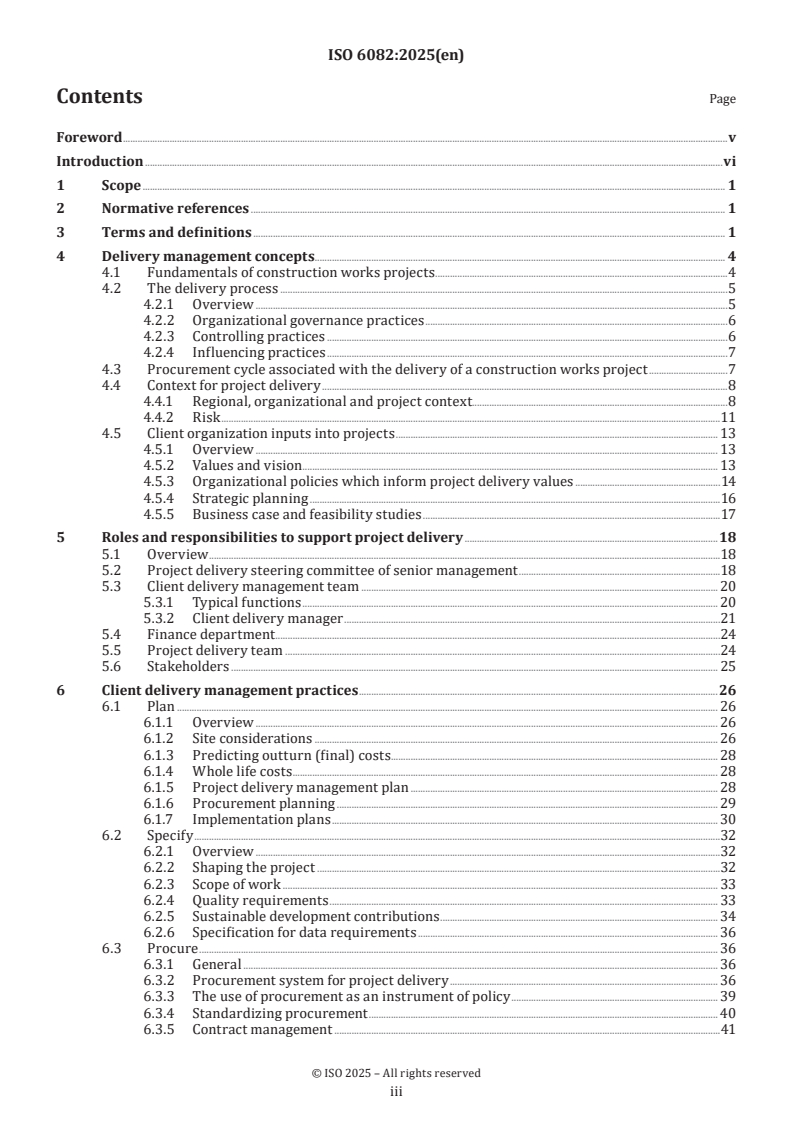
Contents Page
Foreword .v
Introduction .vi
1 Scope . 1
2 Normative references . 1
3 Terms and definitions . 1
4 Delivery management concepts . . 4
4.1 Fundamentals of construction works projects.4
4.2 The delivery process .5
4.2.1 Overview .5
4.2.2 Organizational governance practices .6
4.2.3 Controlling practices .6
4.2.4 Influencing practices .7
4.3 Procurement cycle associated with the delivery of a construction works project .7
4.4 Context for project delivery .8
4.4.1 Regional, organizational and project context.8
4.4.2 Risk .11
4.5 Client organization inputs into projects . 13
4.5.1 Overview . 13
4.5.2 Values and vision . 13
4.5.3 Organizational policies which inform project delivery values .14
4.5.4 Strategic planning .16
4.5.5 Business case and feasibility studies .17
5 Roles and responsibilities to support project delivery .18
5.1 Overview .18
5.2 Project delivery steering committee of senior management .18
5.3 Client delivery management team . 20
5.3.1 Typical functions . 20
5.3.2 Client delivery manager .21
5.4 Finance department .24
5.5 Project delivery team .24
5.6 Stakeholders . 25
6 Client delivery management practices .26
6.1 Plan . 26
6.1.1 Overview . 26
6.1.2 Site considerations . 26
6.1.3 Predicting outturn (final) costs. 28
6.1.4 Whole life costs . 28
6.1.5 Project delivery management plan . 28
6.1.6 Procurement planning . 29
6.1.7 Implementation plans . 30
6.2 Specify .32
6.2.1 Overview .32
6.2.2 Shaping the project .32
6.2.3 Scope of work . 33
6.2.4 Quality requirements . 33
6.2.5 Sustainable development contributions . 34
6.2.6 Specification for data requirements . 36
6.3 Procure . 36
6.3.1 General . 36
6.3.2 Procurement system for project delivery . 36
6.3.3 The use of procurement as an instrument of policy . 39
6.3.4 Standardizing procurement . 40
6.3.5 Contract management .41
iii
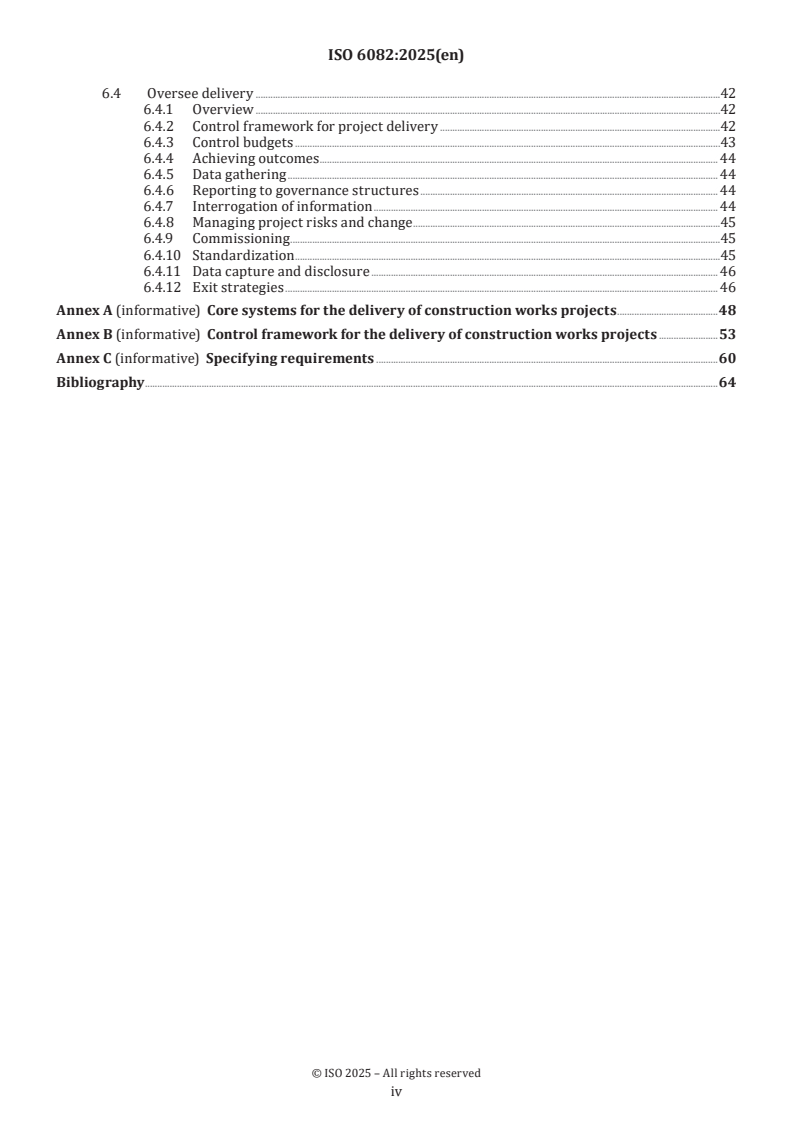
6.4 Oversee delivery .42
6.4.1 Overview .42
6.4.2 Control framework for project delivery .42
6.4.3 Control budgets .43
6.4.4 Achieving outcomes . 44
6.4.5 Data gathering . 44
6.4.6 Reporting to governance structures . 44
6.4.7 Interrogation of information . 44
6.4.8 Managing project risks and change .45
6.4.9 Commissioning .45
6.4.10 Standardization .45
6.4.11 Data capture and disclosure . 46
6.4.12 Exit strategies . 46
Annex A (informative) Core systems for the delivery of construction works projects .48
Annex B (informative) Control framework for the delivery of construction works projects .53
Annex C (informative) Specifying requirements .60
Bibliography .64
iv
Foreword
ISO (the International Organization for Standardization) is a worldwide federation of national standards
bodies (ISO member bodies). The work of preparing International Standards is normally carried out through
ISO technical committees. Each member body interested in a subject for which a technical committee
has been established has the right to be represented on that committee. International organizations,
governmental and non-governmental, in liaison with ISO, also take part in the work. ISO collaborates closely
with the International Electrotechnical Commission (IEC) on all matters of electrotechnical standardization.
The procedures used to develop this document and those intended for its further maintenance are described
in the ISO/IEC Directives, Part 1. In particular, the different approval criteria needed for the different types
of ISO document should be noted. This document was drafted in accordance with the editorial rules of the
ISO/IEC Directives, Part 2 (see www.iso.org/directives).
ISO draws attention to the possibility that the implementation of this document may involve the use of (a)
patent(s). ISO takes no position concerning the evidence, validity or applicability of any claimed patent
rights in respect thereof. As of the date of publication of this document, ISO had not received notice of (a)
patent(s) which may be required to implement this document. However, implementers are cautioned that
this may not represent the latest information, which may be obtained from the patent database available at
www.iso.org/patents. ISO shall not be held responsible for identifying any or all such patent rights.
Any trade name used in this document is information given for the convenience of users and does not
constitute an endorsement.
For an explanation of the voluntary nature of standards, the meaning of ISO specific terms and expressions
related to conformity assessment, as well as information about ISO's adherence to the World Trade
Organization (WTO) principles in the Technical Barriers to Trade (TBT), see www.iso.org/iso/foreword.html.
This document was prepared by Technical Committee ISO/TC 59, Buildings and civil engineering works,
Subcommittee SC 18, Construction procurement.
Any feedback or questions on this document should be directed to the user’s national standards body. A
complete listing of these bodies can be found at www.iso.org/members.html.
v
Introduction
The way clients approach procurement has a major influence on how the industry behaves, performs
and, ultimately, delivers value in projects. For each individual project or group of projects, the client’s
procurement strategy is what orchestrates the collaboration between design professionals, contractors
and subcontractors, ensuring that client requirements are met efficiently and effectively (as outlined in
ISO 10845-1). Procurement processes not only bring together these various contributors but also establish
the terms of engagement, defining the roles, responsibilities, and risks that bind the parties, with the aim of
achieving value for money and maximizing project outcomes.
ISO 21502 offers guidance on concepts and practices for project management that are important for and
have an impact on a project’s successful delivery. It is intended to apply to any public or private organization,
as well as any type of project within any industry, regardless of the purpose, delivery approaches, life cycle
model used, complexity, size, cost or duration. However, industry-specific adaptations of ISO 21502 are
necessary for construction works projects.
The adaptions which are necessary to accommodate the specificities of the construction industry include:
— the need to simultaneously address the geography, site conditions, communities, physical environments,
existing construction works, as well as a wide range of stakeholder requirements, client’s value
proposition and project constraints;
— an ever-changing, complex environment, often with a high degree of known and unknown risks;
— the scale and complexity of projects require high-impact evidence-based decision making with material
implications for cost and outcomes;
— the frequent one-of-a-kind product which is delivered on a particular site rather than mass-produced
items delivered in a factory environment;
— the frequent integration of built environment professions and engineering disciplines in the design and
delivery processes;
— the delivery of a project in phases, which provides an opportunity to review and refine the project design
and implementation strategy, as well as to validate the investment intention;
— the industry being almost entirely based on a competitive market environment for project cost, schedule
and performance delivery;
— the nature of the contracting construction businesses which are paid for work in progress and become a
conduit for payment to those businesses who do the actual work;
— projects being delivered through multiple contracts where:
— the individual pieces in a single project have no value without every other piece being successfully
completed;
— requirements (specifications), availability of resources (supply-side issues) and the context (how
and why projects take place) can change between project inception and completion, particularly
where there is an appreciable time between these milestones;
— the involvement of different combinations of funders, professionals, site conditions, materials and
technologies and general contractors, specialist contractors, skills and workforces on each project;
— the development or utilization of land;
— the magnitude of individual transactions which can form a major portion of the annual turnover or the
assets of organizations and stakeholders involved in the process;
— construction works, with a few exceptions, being acquired to support social and economic activities and,
as such, forming inputs into broader projects, beyond the construction sector.
vi
Furthermore, the buyer-supplier relationship differs from non-construction works projects in that the
buying or client function requires significant built environment professional capability throughout the
process of conceptualization to implementation and maintenance, i.e. through the full life cycle of the project.
Construction works projects are delivered through a supply chain. Contracts bind the participants in the
supply chain. The delivery of construction works projects embraces:
— a “buying” or client delivery management function focusing on client delivery management practices
(plan, specify, procure and oversee delivery);
— a “supply” or delivery function focussing on the management and integration of the resources required
to deliver the project.
The project management function associated with projects coordinates activities to direct, integrate and
control the accomplishment of agreed objectives in support of the supply function. The delivery management
function, on the other hand, focuses on knowledgeable leadership, consistent governance and systematic
administration of procurement, contracts and project finances.
Client procurement and delivery management practices (the client buying functions) are central to the
performance of the supply chain which delivers construction works projects. Such practices have a direct
impact on the realization of the client’s value proposition for the project, i.e. the promise of measurable
benefits. Delivery management is required to transform the value proposition associated with a business
case into project outcomes. Accordingly, delivery management focuses on the client’s practices in
delivering the client’s value aspirations for a construction works project whereas project management
focuses on practices to accomplish agreed objectives. The ISO 10845 series focuses on the characteristics
of procurement processes, methods and procedures and the detail relating thereto, concentrating on the
evaluation and award phase of procurement. There are several options relating to how construction works
are funded and how design and interface management responsibilities are allocated. There are also options
relating to the different types of contracts that may be entered into during the delivery cycle of a project,
how contractors and suppliers are to be remunerated, how secondary objectives are to be promoted through
a contract and how the market is to be approached to solicit tender offers. Such choices impact upon project
outcomes. ISO 22058 provides guidance on the development of procurement strategy and the procurement
tactics which are necessary to effectively implement a procurement strategy.
This document focuses on delivery management and is of particular relevance to clients that engage regularly
in the delivery of construction projects. It provides guidance on the client organization’s function to plan,
specify, procure and oversee the delivery of construction works projects, enabling the business case to be
converted into project outcomes. A client can be a project owner or an entity within a supply chain which
contracts for goods and services or any combination thereof. This document applies primarily to clients who
have a continuous flow, or pipeline, of projects. Nevertheless, much of the guidance can be adapted for use by
occasional clients who have construction works projects delivered through trusted delivery teams.
Annex A describes the core systems associated with the delivery of construction works projects, namely
a planning and budgeting system, an asset management system, a delivery management system and a
procurement system. It also indicates the forward and backward linkages between such systems. Annex B
provides a control framework which enables project delivery risks to be appropriately and proactively
managed and renders the project delivery system capable of being audited. Annex C provides guidance on
the specifying of requirements.
vii
International Standard ISO 6082:2025(en)
Construction project governance — Guidance on delivery
management
1 Scope
This document provides guidance on:
a) the role of the client in the effective and efficient delivery of construction projects;
b) delivery management practices which enable the client’s business case to be transformed into project
outcomes in a manner which consistently realizes value for money.
This document is applicable to private sector, public sector or community organizations.
2 Normative references
There are no normative references in this document.
3 Terms and definitions
For the purposes of this document, the following terms and definitions apply.
ISO and IEC maintain terminology databases for use in standardization at the following addresses:
— ISO Online browsing platform: available at https:// www .iso .org/ obp
— IEC Electropedia: available at https:// www .electropedia .org/
3.1
asset management plan
documented information that specifies the activities, resources, costs and timescales required for an
individual asset, or a grouping of assets, to achieve the organization’s (3.10) asset management objectives
Note 1 to entry: The grouping of assets may be by asset type, asset class, asset system or asset portfolio.
Note 2 to entry: An asset management plan is derived from the strategic asset management plan.
Note 3 to entry: An asset management plan may be contained in, or may be a subsidiary plan of, the strategic asset
management plan.
[SOURCE: ISO 55000:2024, 3.2.5, modified — The abbreviated term "AMP" has been removed.]
3.2
brief
document that states the requirements for a project
[SOURCE: ISO 6707-2:2017, 3.2.18, modified — The US preferred term has been removed.]
3.3
business case
documented justification to support decision making about the commitment to a project
Note 1 to entry: A business case summarizes the scope, benefits, costs and risks (3.20) of a proposed solution to a
business need.
[SOURCE: ISO 21500:2021, 3.2, modified — "programme or portfolio" at the end of the definition has been
removed; note 1 to entry has been added.]
3.4
client
person or organization (3.10) initiating and financing a project and approving the brief (3.2)
[SOURCE: ISO 6707-2:2017, 3.8.2]
3.5
client delivery management team
individuals or entities who, through coordinated actions, are responsible for performing the delivery
management (3.8) functions associated with project delivery (3.15)
3.6
construction works
everything that is constructed or results from construction operations
[SOURCE: ISO 6707-1:2020, 3.1.1.1, modified — The US preferred term and notes to entry have been
removed.]
3.7
contractor
person or organization (3.10) that undertakes construction work in accordance with a contract
[SOURCE: ISO 6707-2:2017, 3.8.6, modified — The US preferred term has been removed.]
3.8
delivery management
critical leadership role played by a knowledgeable client (3.4) to plan, specify, procure and oversee the
delivery of construction works (3.6) projects including knowledgeable leadership, consistent governance and
systematic administration of procurement (3.12), contracts and project finances
3.9
feasibility study
evaluation of a proposed project, the practicability of its achievement, potential risks (3.20) and the design,
financial, economic, social and environmental implications
[SOURCE: ISO 6707-2:2017, 3.3.16, modified — "potential risks" has been added.]
3.10
organization
person or group of people that has its own function with responsibilities, authorities and relationships to
achieve its objectives
[SOURCE: ISO 55000:2024, 3.3.1, modified — Notes 1 and 2 to entry have been removed.]
3.11
performance
ability to fulfil required functions under intended use conditions, behaviour when in use or impact on
economic conditions, the environment, society or quality of life
3.12
procurement
process which creates, manages and fulfils contracts relating to the provision of goods, services and
construction works (3.6) or disposals, or any combination thereof
[SOURCE: ISO 6707-2:2017, 3.5.18]
3.13
procurement document
documentation used to initiate or conclude (or both) a contract
[SOURCE: ISO 10845-1:2020, 3.25]
3.14
production information
information which provides the detailing, performance (3.11) definition, specification, sizing and positioning
of all systems and components enabling either construction or the production of further information for
construction
3.15
project delivery
combination of all planning, technical, administrative and managerial actions and activities associated with
the construction, supply, refurbishment, rehabilitation, alteration, maintenance or disposal of construction
works (3.6)
3.16
project delivery team
individuals or entities who, through coordinated activities, are collectively responsible for producing project
deliverables
3.17
project delivery management plan
plan which, as a minimum, summarizes the asset management plan (3.1), provides a credible forecast
of current and net demand for construction works (3.6) or requirements for functionality and prioritizes
projects against a forecasted budget over a number of years
3.18
project management
coordinated activities to direct and control the accomplishment of agreed objectives
[SOURCE: ISO 21502:2020, 3.24]
3.19
project value
outcome of client (3.4) decision making to achieve an optimal balance of the project benefits, risks (3.20)
and costs
3.20
risk
effect of uncertainty on objectives
Note 1 to entry: An effect is a deviation from the expected. It can be positive, negative or both, and can address, create
or result in opportunities and threats.
Note 2 to entry: Objectives can have different aspects and categories and can be applied at different levels.
Note 3 to entry: Risk is usually expressed in terms of risk sources, potential events, their consequences and their
likelihood.
[SOURCE: ISO 31000:2018, 3.1]
3.21
scope of work
document that specifies and describes the goods, services, or construction works (3.6) which are to be
provided, and any other requirements and constraints relating to the manner in which the contract work is
to be performed
Note 1 to entry: The term “scope of work” is a generic term that may be used to describe that which is commonly
referred to in forms of contract and publications as
a) supply contract: scope, goods information or specifications
b) service contract: scope, services information, specifications, scope of services, terms of reference or technical
specification
c) construction contracts: works information, production information (3.14), specifications, project specifications,
performance (3.11) requirements, specification of work or scope.
Note 2 to entry: The term “scope of work” is also sufficiently broad to include design and procurement (3.12)
requirements in design and construct, develop and construct and management contracting strategies relating to
construction contracts (see ISO 10845-2 and ISO 22058).
[SOURCE: ISO 10845-1:2020, 3.29, modified — In note 2 to entry, the reference to ISO 22058 had been added.]
3.22
stakeholder
person, group or organization (3.10) that has interests in, or can affect, be affected by, or perceive itself to be
affected by, any aspect of the project
[SOURCE: ISO 21500:2021, 3.18, modified — "programme or portfolio" at the end of the definition has been
removed.]
3.23
sustainable development
development that meets the environmental, social and economic needs of the present without compromising
the ability of future generations to meet their own needs
[SOURCE: ISO Guide 82:2019, 3.2, modified — Note 1 to entry has been removed.]
3.24
value for money
optimal use of resources to achieve intended project outcomes
Note 1 to entry: Optimal use of resources results in the most desirable possible outcomes given expressed or implied
restrictions or constraints.
[SOURCE: ISO 10845-1:2020, 3.40, modified — "project" has been added.]
3.25
value proposition
promise of measurable benefits
Note 1 to entry: The client’s (3.4) business case (3.3), vision, values and project priorities collectively make up the
client’s value proposition for a project
4 Delivery management concepts
4.1 Fundamentals of construction works projects
Construction works result from the management and integration of five primary resources, namely finance,
people, materials, plant and equipment. Such works are delivered through a supply chain which is procured,
mobilized and directed to provide the necessary professional services, labour and equipment, materials,
products, components, assemblies and plant required to provide the works.
Contracts bind the participants in the supply chain (professionals, general contractors, suppliers of
materials or equipment, suppliers, manufacturers, fabricators, service providers, subcontractors, etc.) and
define the obligations, liabilities and risks that link the parties together. Direct contracts can be entered into
with consultants, service providers, suppliers and contractors who, in turn, may subcontract some of their
responsibilities under their contracts to subcontractors. The client’s packaging strategy is a component of a
procurement strategy that focuses on the organization of work into contracts or orders issued in terms of a
framework agreement. This modifies the number of contractual relationships which the client must put in
place, oversee and administer (see ISO 22058).
Subcontracting is a well-established practice in the construction industry. It is an effective means of
involving small, medium and micro enterprises in the supply chain for the delivery of construction works.
The contractor provides the overall planning for the project, coordinates the multiple interfaces between
the sub-contractors and, unless otherwise stated in the contract with the client, remains responsible for
providing the works as if the work had not been subcontracted. Subcontractors in turn manage their own
work on site and off site.
4.2 The delivery process
4.2.1 Overview
Construction works projects are necessary to support organizational strategic objectives according to an
organization’s purpose and values. The client’s business case, vision, values and project priorities collectively
make up the client’s value proposition for a project. A client should to provide effective leadership of the
project throughout the delivery cycle, commencing at a strategic level and ending at the close out of a project.
A client must also:
— obtain the necessary resources which primarily relate to finance, people, materials, plant and equipment,
to deliver the project;
— contract and mobilize a supply chain (linked set of resources and processes) to provide the necessary
professional services, labour and equipment and to manufacture or supply materials, products,
components, assemblies and plant;
— make executive decisions to enable project delivery outcomes which realize benefits for not only the
organization but also for internal or external stakeholders.
Figure 1 illustrates the process whereby a client’s value proposition is transformed into project delivery
outcomes (see ISO 22058). Project outcomes result in construction works projects with the required
functionality, performance, and quality in all its forms, ready for use, with a concomitant impact on the
three aspects of sustainability (economic, environmental and social; see ISO 21931-1 and ISO 21931-2).
Project value, on the other hand, is the outcome of client decision making to achieve an optimal balance of
the project benefits, risks and costs.
Figure 1 — Translating the client value proposition into project outcomes
4.2.2 Organizational governance practices
Each organization has its own functions with responsibilities, authorities and relationships to achieve its
objectives and a governing body which has ultimate accountability for the whole organization. Organizations
are guided by governance frameworks (strategies, policies, decision-making structures and accountabilities
through which the organization’s governance arrangements operate), which ensure that the organization
remains true to its purpose (see ISO 37000).
Project delivery is necessary to support the strategic and business objectives of client organizations
according to their purpose and values and must be delivered within the client’s organizational governance
framework. Client organizational governing bodies should hold management to account to ensure that
construction works projects embrace the culture, norms and practices of the organization and align with
its purpose. They should make decisions informed by credible information and reliable data, anticipated
operational costs, stakeholders, ethical and societal expectations, compliance obligations, open and honest
reporting and natural environment limitations and impacts (see ISO 37000).
4.2.3 Controlling practices
The purpose of controlling a project is to monitor and measure performance against an agreed plan,
including authorized changes, taking account of the following when doing so (see ISO 21502):
— the business need is frequently satisfied though multiple contracts which should be procured and
managed in such a way that the anticipated benefits are progressively realized;
— there are several interfaces and interdependencies between contracts where delays in or failure to put
in place one contract or timeously complete a contract or a part thereof has a knock-on effect which not
only delays project completion but can significantly increase project costs;
— demand is most often determined and managed through service life plans which are based on an
assessment of current performance against desired levels of service or functionality and asset
management plans which provide a credible forecast of current demand and net demand for services or
requirements for functionality over a period of time;
— demand should be proactively managed through the planning, evaluation and award and contract
management phases to prevent scope creep, i.e. changes, continuous or uncontrolled growth in a project’s
scope, at any point after the project commences;
— a range of different combinations of goods and services with differing characteristics such as initial cost,
reliability, life-cycle costs, and operating costs can satisfy user requirements;
— risks are high due to uncertainties at the time when the contract is concluded;
— a supply chain frequently must be contracted, mobilized, and overseen to provide the necessary
professional services, materials, products, components and assemblies, equipment and labour to fulfil
the requirements of contracts;
— the final or outturn contract price equates to:
— the sum of the initial contract price for work, which is known;
— the cost of changes in scope of contract (variations) to enhance quality performance or to address
shortcomings which can impair performance;
— the amount of contract price adjustment for inflation provided for in the contract;
— the cost of risk events that materialize in the execution of a contract for which the supplier or
contractor is not responsible (see ISO 10845-1:2020, Annex E).
4.2.4 Influencing practices
During the process of converting a value proposition into project outcomes, the client should perform the
following delivery management practices to realize project value:
— plan - decide on what should be done, how it is to be resourced and achieved and in what time frames,
and set a budget;
— specify - define the organization’s functional and other requirements for the project clearly and precisely;
— procure - obtain project resources (internal and external) to perform project activities with care and effort;
— oversee delivery - observe and define the execution of the project to realize the organization’s value
proposition associated with the project justification.
Delivery management includes a “buyer function”, which requires significant built environment professional
capability throughout the full life cycle of the project (see ISO 10845-1:2020, Annex B).
NOTE Delivery management activities include planning at a programme and project level.
4.3 Procurement cycle associated with the delivery of a construction works project
A typical procurement cycle for the delivery of a construction works project is indicated in Figure 2 (see
ISO 22058:2022, Annex A). It comprises three phases, namely;
— a planning phase during which decisions are made as to what, where and when goods and services are
required, how the market is to be approached and what is the number, type, nature and timing of the
required contracts;
— an evaluation and award phase during which contracts are entered into following the development of
procurement tactics enabling a procurement strategy to be effectively implemented and the application
of the method by which tender offers are solicited from the market;
— a contract administration phase during which compliance with requirements, changes in requirements
and risk events which manifest during the execution of contracts are managed, the works are
commissioned and contracts are closed out.
Construction works projects are identified during strategic planning processes or through the identification
of critical needs identified within an asset management system (see Annex A). Thereafter projects should be
motivated by considering the benefit of the project or the consequences of not undertaking the project, or both.
Procurement strategy is required to engage with the market commencing with a make-or-buy decision and,
if the decision is to make, whether design and interface management responsibilities are to be retained or
transferred (see ISO 22058). During the planning and specifying stage, a strategic brief is developed, which
defines project objectives, needs, acceptance criteria and client priorities and aspirations, and which sets
out the basis for the development of a concept report. A concept report is then developed which sets out
a viable solution to the strategic brief (see Annex B). A decision is then made to implement the project. A
gateway review or financial feasibility studies may be required to inform this decision.
During the evaluation and award phase, procurement tactics are developed to effectively implement the
adopted procurement strategy (see ISO 22058) and procurement documents are developed (see ISO 10845-1,
ISO 10845-2, ISO 10845-3 and ISO 10845-4) prior to approaching the market for the services of a contractor.
Tender offers are then solicited and evaluated, and a contract is awarded to the successful tenderer (see
ISO 10845-1).
The delivery of construction works should be overseen during the contract administration phase where
contracts are administered in accordance with the administrative procedures included in the conditions
of contract and compliance with the requirements of the contract is confirmed. The commissioning of the
works, the handing over of the works to the end user or operator and the close out of the contract should also
be overseen.
Figure 2 — The procurement cycle for construction works (ISO 22058)
NOTE Figure 2
...