

ISO 1690:1976
(Main)Sodium and potassium silicates for industrial use — Determination of silica content — Gravimetric method by insolubilization
General Information
- Abstract
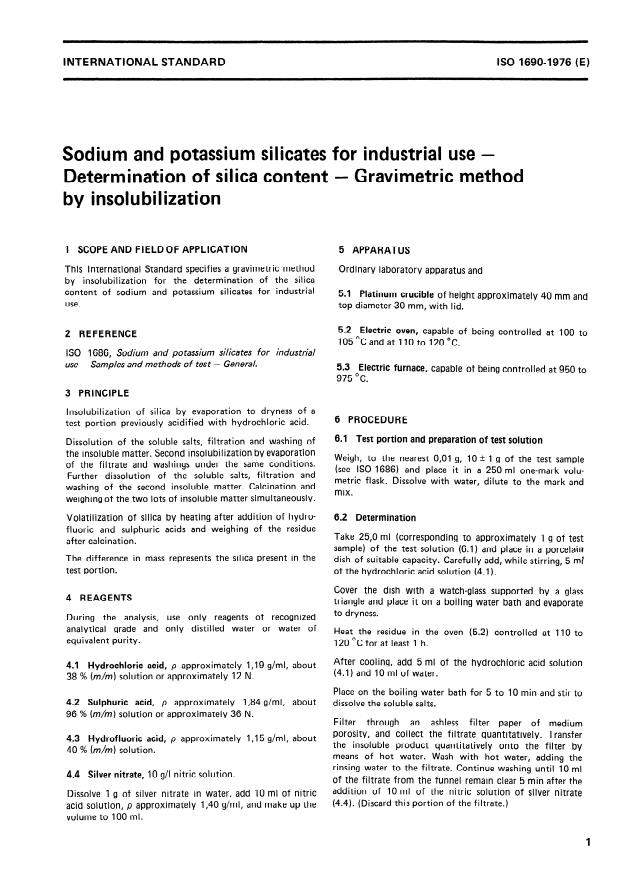
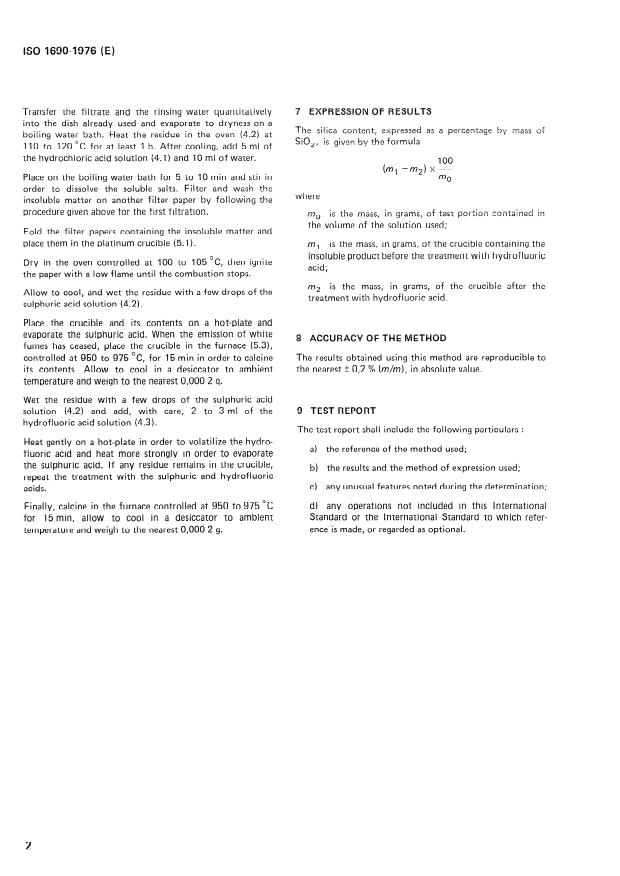
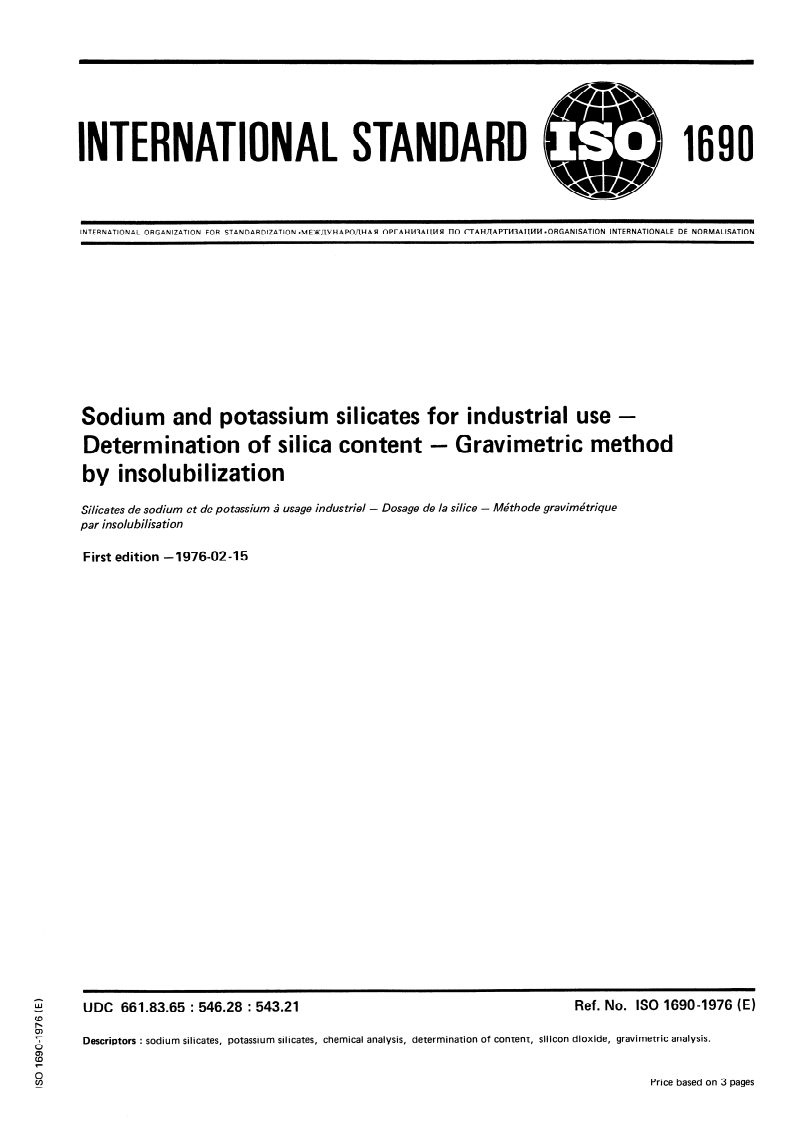
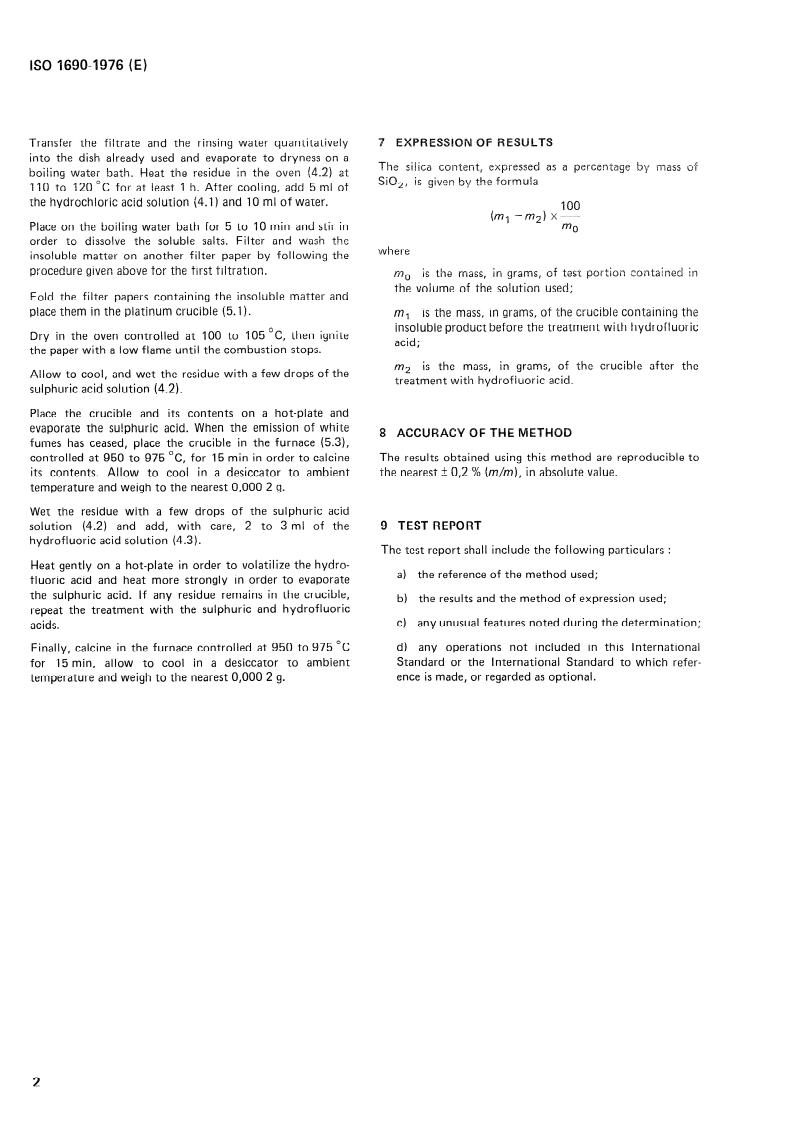
The procedure is based on evaporation to dryness of a test portion previously acidified with hydrochloric acid. Dissolution of the soluble salts, filtration and washing of the insoluble matter. Second evaporation of the filtrate and washings under the same conditions, further dissolution of the soluble salts, filtration and washing. Calcination and weighing of the two lots of insoluble matter simultaneously. Volatilization of silica by heating with hydrofluoric and sulphuric acids and weighing of the residue after calcination. The*difference in mass represents the silica present in the test portion.
- Status
- Published
- Publication Date
- 31-Jan-1976
- Technical Committee
- ISO/TC 47 - Chemistry
- Drafting Committee
- ISO/TC 47 - Chemistry
- Current Stage
- 9093 - International Standard confirmed
- Start Date
- 20-Oct-2023
- Completion Date
- 29-Aug-2026
Buy Documents
ISO 1690:1976 - Sodium and potassium silicates for industrial use -- Determination of silica content -- Gravimetric method by insolubilization
ISO 1690:1976 - Sodium and potassium silicates for industrial use — Determination of silica content — Gravimetric method by insolubilization/1/1976
ISO 1690:1976 - Silicates de sodium et de potassium a usage industriel -- Dosage de la silice -- Méthode gravimétrique par insolubilisation
ISO 1690:1976 - Silicates de sodium et de potassium a usage industriel -- Dosage de la silice -- Méthode gravimétrique par insolubilisation
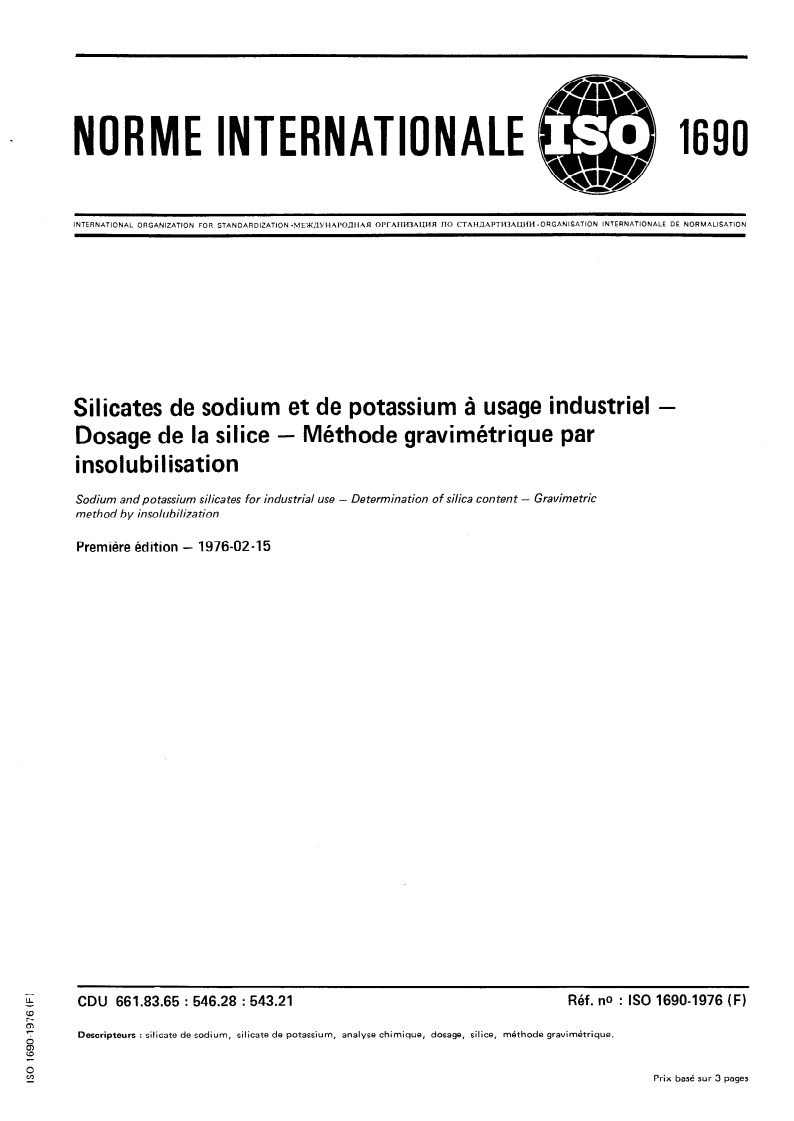
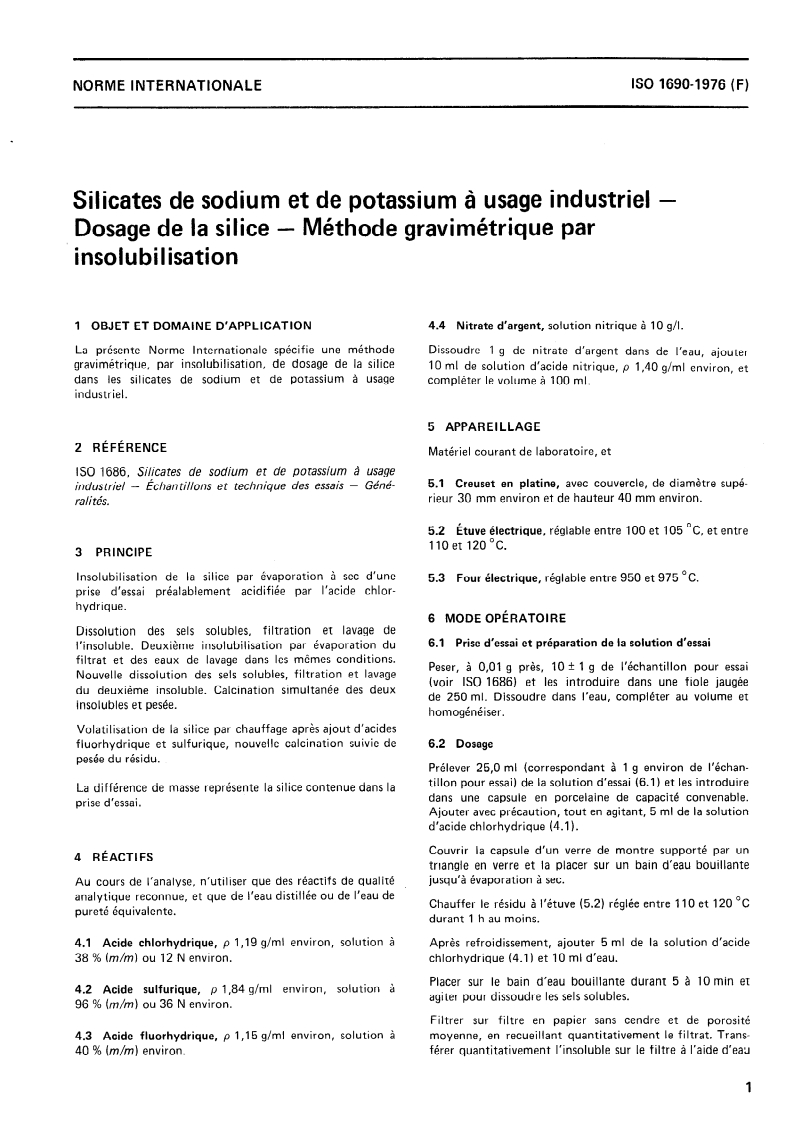
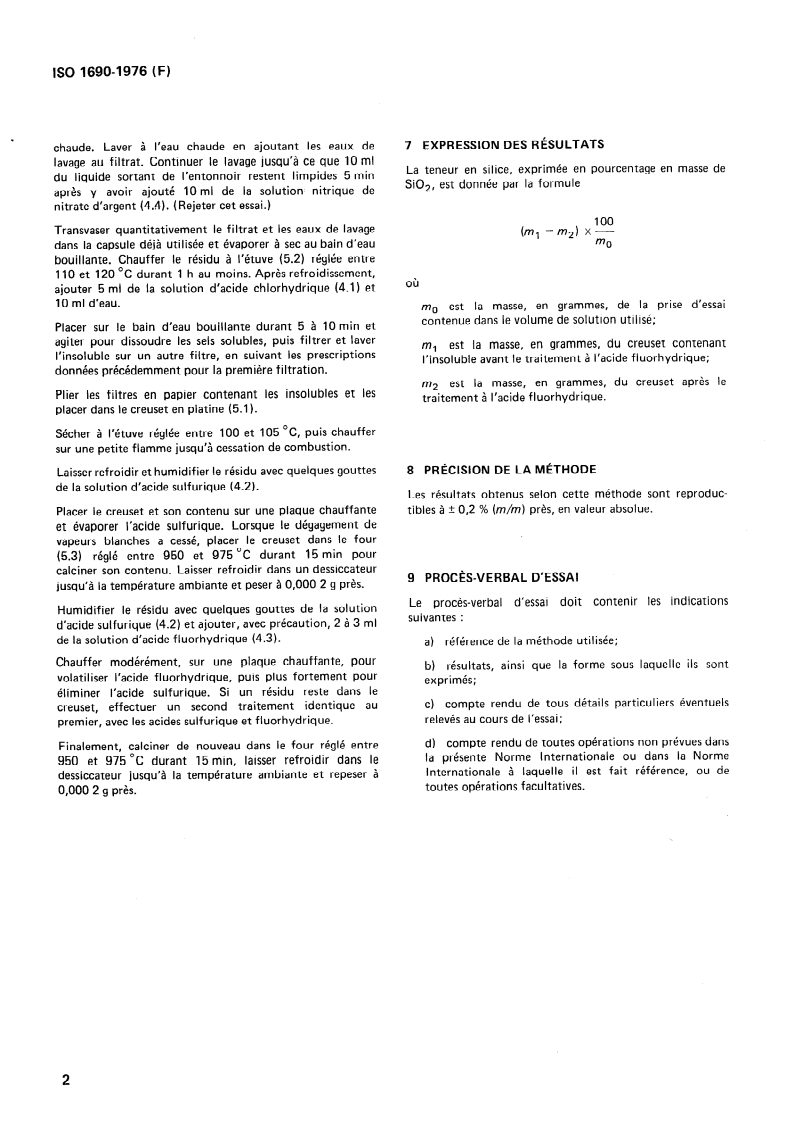
ISO 1690:1976 - Silicates de sodium et de potassium à usage industriel — Dosage de la silice — Méthode gravimétrique par insolubilisation/1/1976
ISO 1690:1976 - Silicates de sodium et de potassium à usage industriel — Dosage de la silice — Méthode gravimétrique par insolubilisation/1/1976
Overview
ISO 1690:1976 specifies a standardized gravimetric method for the determination of silica content in sodium and potassium silicates used in industrial applications. This international standard, developed by the International Organization for Standardization (ISO), defines a precise laboratory procedure involving acidification, evaporation, filtration, and calcination steps. The method measures silica by isolating the insoluble fraction and quantifying the difference in mass after treatment with hydrofluoric and sulfuric acids.
This gravimetric approach ensures accurate and reproducible silica analysis, essential for quality control and regulatory compliance in industries utilizing sodium and potassium silicates.
Key Topics
- Scope: Determination of silica content specifically in industrial-grade sodium and potassium silicates.
- Principle: Acidification of the test sample followed by evaporation to dryness, dissolution and washing of soluble salts, filtration of insoluble matter, and weight measurement after calcination and acid treatment.
- Apparatus:
- Platinum crucibles
- Electric ovens and furnaces with controlled temperature settings
- Porcelain capsules and filtration equipment
- Reagents:
- Hydrochloric acid (HCl)
- Sulfuric acid (H2SO4)
- Hydrofluoric acid (HF)
- Nitric acid and silver nitrate for filtration clarity checks
- Procedure Steps:
- Preparation of the test portion and acidification
- Evaporation, filtration, and washing of insoluble silica fractions
- Repetition of evaporation and filtration to ensure completeness
- Calcination, acid treatment to volatilize silica, and final weighing
- Result Expression: Silica content expressed as mass percentage (% m/m SiO₂), calculated based on the difference in mass before and after acid treatment.
- Precision: Method offers high reproducibility with ±0.2% absolute accuracy in silica content measurement.
- Documentation: Requirements for detailed test reports including methods, results, unusual observations, and any deviations.
Applications
ISO 1690:1976 is critical for industries where sodium and potassium silicates play a vital role, such as:
- Glass manufacturing: Ensuring the correct silica content affects glass quality and properties.
- Detergents and cleaners: Accurate silica determination impacts formulation stability and performance.
- Adhesives and coatings: Silica content controls product durability and adhesion properties.
- Water treatment chemicals: Quality control in the production of silicate-based agents.
- Ceramics and refractory materials: Maintaining specific silica concentrations enhances material integrity.
Implementing this gravimetric standard assists laboratories and quality control units in maintaining consistent product specifications, optimizing industrial processes, and complying with international quality requirements.
Related Standards
ISO 1690:1976 is part of a comprehensive set of ISO standards concerning sodium and potassium silicates, including:
- ISO 1686: Sampling and general testing techniques for sodium and potassium silicates.
- ISO 1687: Determination of density of silicate solutions.
- ISO 1688: Gravimetric method for determining dry matter content.
- ISO 1689: Gravimetric method for calculating Na2O or K2O ratios.
- ISO 1691: Carbonate content determination.
- ISO 1692: Total alkalinity measurement by titrimetric method.
- ISO 2122: Dissolution methods and insoluble matter determination.
- ISO 2123 and 2124: Viscosity and titrimetric silica analysis methods.
- ISO 3200 and 3201: Sulfate and iron determination methods.
These interconnected standards provide a full framework to evaluate, analyze, and control the quality of industrial silicate products.
Adopting ISO 1690:1976 ensures accurate silica content measurement through a reproducible gravimetric process, supporting high-quality production and material consistency across diverse industries working with sodium and potassium silicates.
Relations
- Effective Date
- 25-Aug-2026
Buy Documents
ISO 1690:1976 - Sodium and potassium silicates for industrial use -- Determination of silica content -- Gravimetric method by insolubilization
ISO 1690:1976 - Sodium and potassium silicates for industrial use — Determination of silica content — Gravimetric method by insolubilization/1/1976
ISO 1690:1976 - Silicates de sodium et de potassium a usage industriel -- Dosage de la silice -- Méthode gravimétrique par insolubilisation
ISO 1690:1976 - Silicates de sodium et de potassium a usage industriel -- Dosage de la silice -- Méthode gravimétrique par insolubilisation
ISO 1690:1976 - Silicates de sodium et de potassium à usage industriel — Dosage de la silice — Méthode gravimétrique par insolubilisation/1/1976
ISO 1690:1976 - Silicates de sodium et de potassium à usage industriel — Dosage de la silice — Méthode gravimétrique par insolubilisation/1/1976
Get Certified
Connect with accredited certification bodies for this standard

ECOCERT
Organic and sustainability certification.

Eurofins Food Testing Global
Global leader in food, environment, and pharmaceutical product testing.

Intertek Bangladesh
Intertek certification and testing services in Bangladesh.
Sponsored listings
Frequently Asked Questions
ISO 1690:1976 is a standard published by the International Organization for Standardization (ISO). Its full title is "Sodium and potassium silicates for industrial use — Determination of silica content — Gravimetric method by insolubilization". This standard covers: The procedure is based on evaporation to dryness of a test portion previously acidified with hydrochloric acid. Dissolution of the soluble salts, filtration and washing of the insoluble matter. Second evaporation of the filtrate and washings under the same conditions, further dissolution of the soluble salts, filtration and washing. Calcination and weighing of the two lots of insoluble matter simultaneously. Volatilization of silica by heating with hydrofluoric and sulphuric acids and weighing of the residue after calcination. The*difference in mass represents the silica present in the test portion.
The procedure is based on evaporation to dryness of a test portion previously acidified with hydrochloric acid. Dissolution of the soluble salts, filtration and washing of the insoluble matter. Second evaporation of the filtrate and washings under the same conditions, further dissolution of the soluble salts, filtration and washing. Calcination and weighing of the two lots of insoluble matter simultaneously. Volatilization of silica by heating with hydrofluoric and sulphuric acids and weighing of the residue after calcination. The*difference in mass represents the silica present in the test portion.
ISO 1690:1976 is classified under the following ICS (International Classification for Standards) categories: 71.060.50 - Salts. The ICS classification helps identify the subject area and facilitates finding related standards.
ISO 1690:1976 has the following relationships with other standards: It is inter standard links to EN 1209:2003. Understanding these relationships helps ensure you are using the most current and applicable version of the standard.
ISO 1690:1976 is available in PDF format for immediate download after purchase. The document can be added to your cart and obtained through the secure checkout process. Digital delivery ensures instant access to the complete standard document.
Standards Content (Sample)
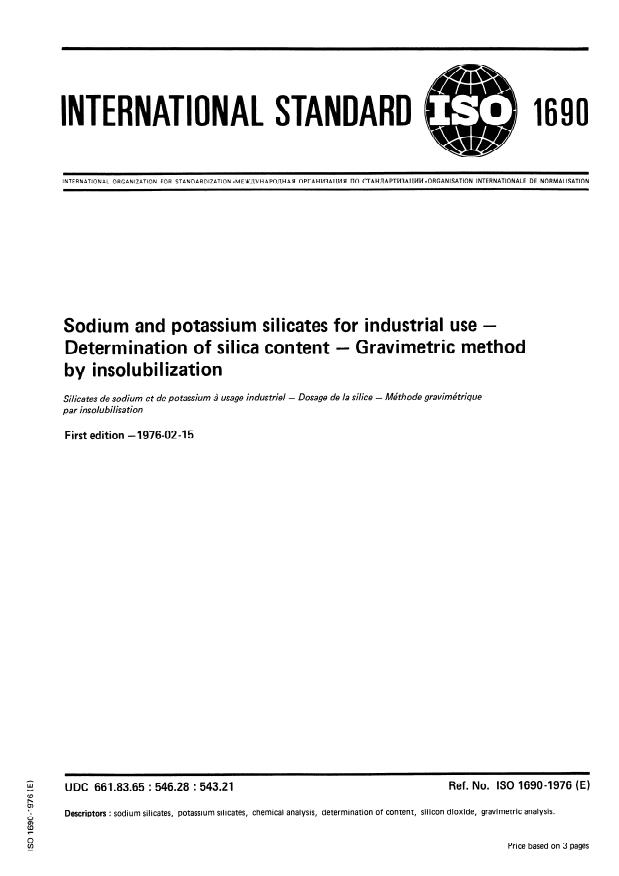
INTERNATIONAL STANDARD
INTERNATIONAL ORGANIZATION FOR STANDARDIZATION .MEXAYHAPOfiHAJl OPI-AHM3ALIMII I-IO Cl-AH~APTM3ALWi~ORGANISATION INTERNATIONALE DE NORMALISATION
Sodium and potassium silicates for industrial use -
Determination of silica content - Gravimetric method
by insolubilization
Silicates de sodium et de potassium 2 usage industriel - Dosage de la silice - Mthode gravimktrique
par insolubilisa tion
First edition -1976-02-15
Ref. No. ISO 1690-1976 (E)
UDC 661.83.65 : 546.28 : 543.21
Chemical analysis, determination of content, Silicon dioxide, gravimetric analysis.
Descriptors : sodium silicates, potassium siiicates,
Price based on 3 pages
FOREWORD
ISO (the International Organization for Standardization) is a worlwide federation
of national Standards institutes (ISO Member Bodies). The work of developing
International Standards is carried out through ISO Technical Committees. Every
Member Body interested in a subject for which a Technical Committee has been set
up has the right to be represented on that Committee. International organizations,
governmental and non-governmental, in Iiaison with ISO, also take part in the work.
Draft International Standards adopted by the Technical Committees are circulated
to the Member Bodies for approval before their acceptance as International
Standards by the ISO Council.
Prior to 1972, the results of the work of the Technical Committees were published
as ISO Recommendations; these documents are now in the process of being
transformed into International Standards. As part of this process, Technical
Committee ISO/TC 47 has reviewed ISO Recommendation R 1690 and found it
technically suitable for transformation. International Standard ISO 1690
therefore replaces ISO Recommendation R 1690-1970 to which it is technically
ident ical .
ISO Recommendation R 1690 was approved by the Member Bodies of the
following countries :
Austral ia Hungary Portugal
Austria lndia Romania
Belgium Iran South Africa, Rep, of
Brazil Israel Spain
Switzerland
Colombia Italy
Czechoslovakia Japan Thailand
Netherlands Turkey
Egypt, Arab Rep. of
New Zealand United Kingdom
France
Peru U.S.S.R.
Germany
Greece Poland Yugoslavia
No Member Body expressed disapproval of the Recommendation.
No Member Body disapproved the transformation of lSO/R 19760 into an
International Standard.
0 International Organkation for Standardkation, 1976 l
Printed in Switzerland
-----
ISO 16904976 (E)
INTERNATIONAL STANDARD
Sodium and potassium silicates for industrial use -
Determination of silica content - Gravimetric method
by insolubilization
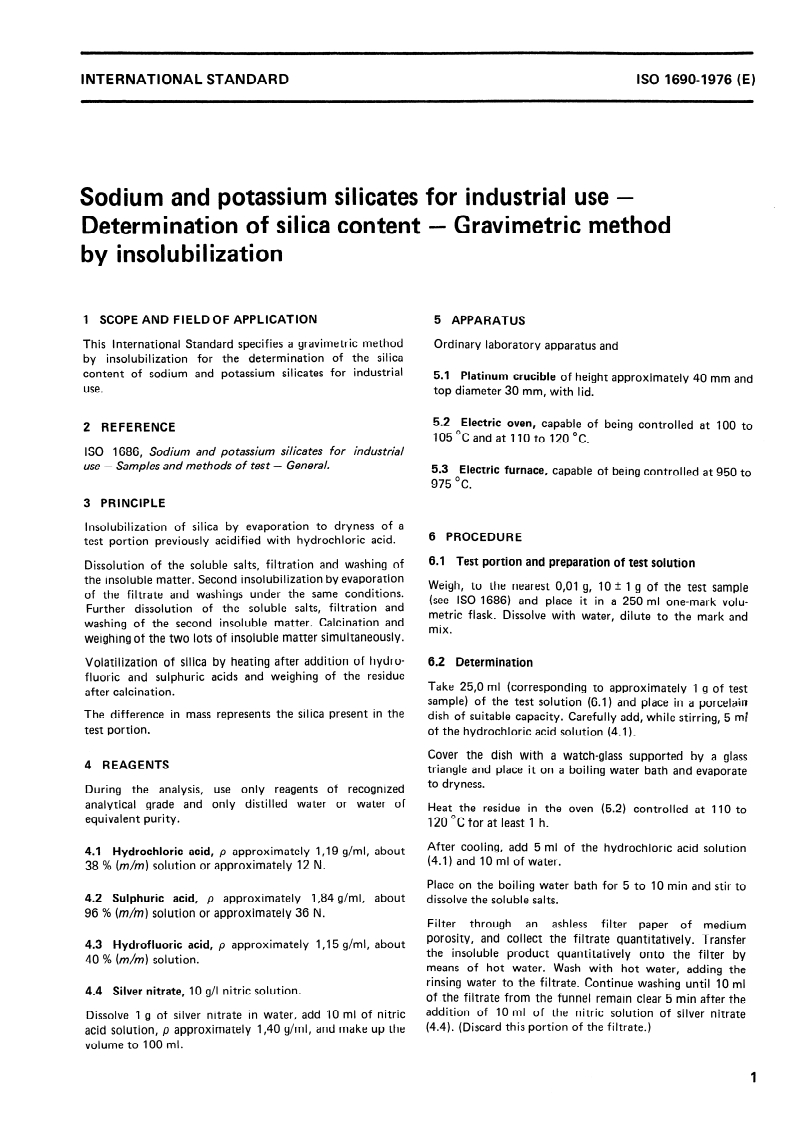
5 APPARATUS
1 SCOPE AND FIELD OF APPLICATION
Ordinary laboratory apparatus and
This International Standard specifies a gravimetric method
by insolubilization for the determination of the silica
content of sodium and potassium silicates for industrial
5.1 Platinum crucible of height approximately 40 mm and
use.
top diameter 30 mm, with lid.
5.2 Electric oven, capable of being controlled at 100 to
2 REFERENCE
105 “C and at 1 IO to 120 ‘C.
ISO 1686, Sodium and potassium silicates for industrial
use - Samples and methods of test - General.
5.3 Electric furnace, capable of being controlled at 950 to
975 “c.
3 PRINCIPLE
Insolubilization of silica by evaporation to dryness of a
6 PROCEDURE
test Portion previously acidified with hydrochloric acid.
6.1 Test Portion and preparation of test Solution
Dissolution of the soluble salts, filtration and washing of
the insoluble matter. Second insolubilization by evaporation
Weigh, to the nearest 0,Ol g, 10 tr 1 g of the test Sample
of the filtrate and washings under the same conditions.
(see ISO 1686) and place it in a 250 ml one-mark volu-
Further dissolution of the soluble salts, filtration and
metric flask. Dissolve with water, dilute to the mark and
washing of the second insoluble matter. Calcination and
mix.
weighing of the two lots of insoluble matter simultaneously.
6.2 Determination
Volatilization of silica by heating after addition of hydro-
fluoric and sulphuric acids and weighing of the residue
Take 25,0 ml (corresponding to approximately 1 g of test
after calcination.
Sample) of the test Solution (6.1) and place in a porcelain
The differente in mass represents the silica present in the dish of suitable capacity. Carefully add, while stirring, 5 mf
test Portion. of the hydrochloric acid Solution (4.1).
Cover the dish with a watch-glass supported by a glass
4 REAGENTS
triangle and place it on a boiling water bath and evaporate
to dryness.
During the analysis, use only reagents of recognized
analytical grade and only distilled water or water of
Heat the residue in the oven (5.2) controlled at 1 IO to
equivalent purity.
120 “C for at least 1 h.
After cooling, add 5 ml of the hydrochloric acid Solution
4.1 Hydrochlorit acid, p approximately 1,19 g/ml, about
(4.1) and 10 ml of water.
38 % (m/m) Solution or approxim
...
INTERNATIONAL STANDARD
INTERNATIONAL ORGANIZATION FOR STANDARDIZATION .MEXAYHAPOfiHAJl OPI-AHM3ALIMII I-IO Cl-AH~APTM3ALWi~ORGANISATION INTERNATIONALE DE NORMALISATION
Sodium and potassium silicates for industrial use -
Determination of silica content - Gravimetric method
by insolubilization
Silicates de sodium et de potassium 2 usage industriel - Dosage de la silice - Mthode gravimktrique
par insolubilisa tion
First edition -1976-02-15
Ref. No. ISO 1690-1976 (E)
UDC 661.83.65 : 546.28 : 543.21
Chemical analysis, determination of content, Silicon dioxide, gravimetric analysis.
Descriptors : sodium silicates, potassium siiicates,
Price based on 3 pages
FOREWORD
ISO (the International Organization for Standardization) is a worlwide federation
of national Standards institutes (ISO Member Bodies). The work of developing
International Standards is carried out through ISO Technical Committees. Every
Member Body interested in a subject for which a Technical Committee has been set
up has the right to be represented on that Committee. International organizations,
governmental and non-governmental, in Iiaison with ISO, also take part in the work.
Draft International Standards adopted by the Technical Committees are circulated
to the Member Bodies for approval before their acceptance as International
Standards by the ISO Council.
Prior to 1972, the results of the work of the Technical Committees were published
as ISO Recommendations; these documents are now in the process of being
transformed into International Standards. As part of this process, Technical
Committee ISO/TC 47 has reviewed ISO Recommendation R 1690 and found it
technically suitable for transformation. International Standard ISO 1690
therefore replaces ISO Recommendation R 1690-1970 to which it is technically
ident ical .
ISO Recommendation R 1690 was approved by the Member Bodies of the
following countries :
Austral ia Hungary Portugal
Austria lndia Romania
Belgium Iran South Africa, Rep, of
Brazil Israel Spain
Switzerland
Colombia Italy
Czechoslovakia Japan Thailand
Netherlands Turkey
Egypt, Arab Rep. of
New Zealand United Kingdom
France
Peru U.S.S.R.
Germany
Greece Poland Yugoslavia
No Member Body expressed disapproval of the Recommendation.
No Member Body disapproved the transformation of lSO/R 19760 into an
International Standard.
0 International Organkation for Standardkation, 1976 l
Printed in Switzerland
-----
ISO 16904976 (E)
INTERNATIONAL STANDARD
Sodium and potassium silicates for industrial use -
Determination of silica content - Gravimetric method
by insolubilization
5 APPARATUS
1 SCOPE AND FIELD OF APPLICATION
Ordinary laboratory apparatus and
This International Standard specifies a gravimetric method
by insolubilization for the determination of the silica
content of sodium and potassium silicates for industrial
5.1 Platinum crucible of height approximately 40 mm and
use.
top diameter 30 mm, with lid.
5.2 Electric oven, capable of being controlled at 100 to
2 REFERENCE
105 “C and at 1 IO to 120 ‘C.
ISO 1686, Sodium and potassium silicates for industrial
use - Samples and methods of test - General.
5.3 Electric furnace, capable of being controlled at 950 to
975 “c.
3 PRINCIPLE
Insolubilization of silica by evaporation to dryness of a
6 PROCEDURE
test Portion previously acidified with hydrochloric acid.
6.1 Test Portion and preparation of test Solution
Dissolution of the soluble salts, filtration and washing of
the insoluble matter. Second insolubilization by evaporation
Weigh, to the nearest 0,Ol g, 10 tr 1 g of the test Sample
of the filtrate and washings under the same conditions.
(see ISO 1686) and place it in a 250 ml one-mark volu-
Further dissolution of the soluble salts, filtration and
metric flask. Dissolve with water, dilute to the mark and
washing of the second insoluble matter. Calcination and
mix.
weighing of the two lots of insoluble matter simultaneously.
6.2 Determination
Volatilization of silica by heating after addition of hydro-
fluoric and sulphuric acids and weighing of the residue
Take 25,0 ml (corresponding to approximately 1 g of test
after calcination.
Sample) of the test Solution (6.1) and place in a porcelain
The differente in mass represents the silica present in the dish of suitable capacity. Carefully add, while stirring, 5 mf
test Portion. of the hydrochloric acid Solution (4.1).
Cover the dish with a watch-glass supported by a glass
4 REAGENTS
triangle and place it on a boiling water bath and evaporate
to dryness.
During the analysis, use only reagents of recognized
analytical grade and only distilled water or water of
Heat the residue in the oven (5.2) controlled at 1 IO to
equivalent purity.
120 “C for at least 1 h.
After cooling, add 5 ml of the hydrochloric acid Solution
4.1 Hydrochlorit acid, p approximately 1,19 g/ml, about
(4.1) and 10 ml of water.
38 % (m/m) Solution or approxim
...
NORME INTERNATIONALE.
INTERNATIONAL ORGANIZATION FOR STANDARDlZATlON l MDfof(yHAPOAHAR OPPAHM3ALWiR I-TO CTAH~APTM3ALWiM.ORGANISATION INTERNATIONALE DE NORMALISATION
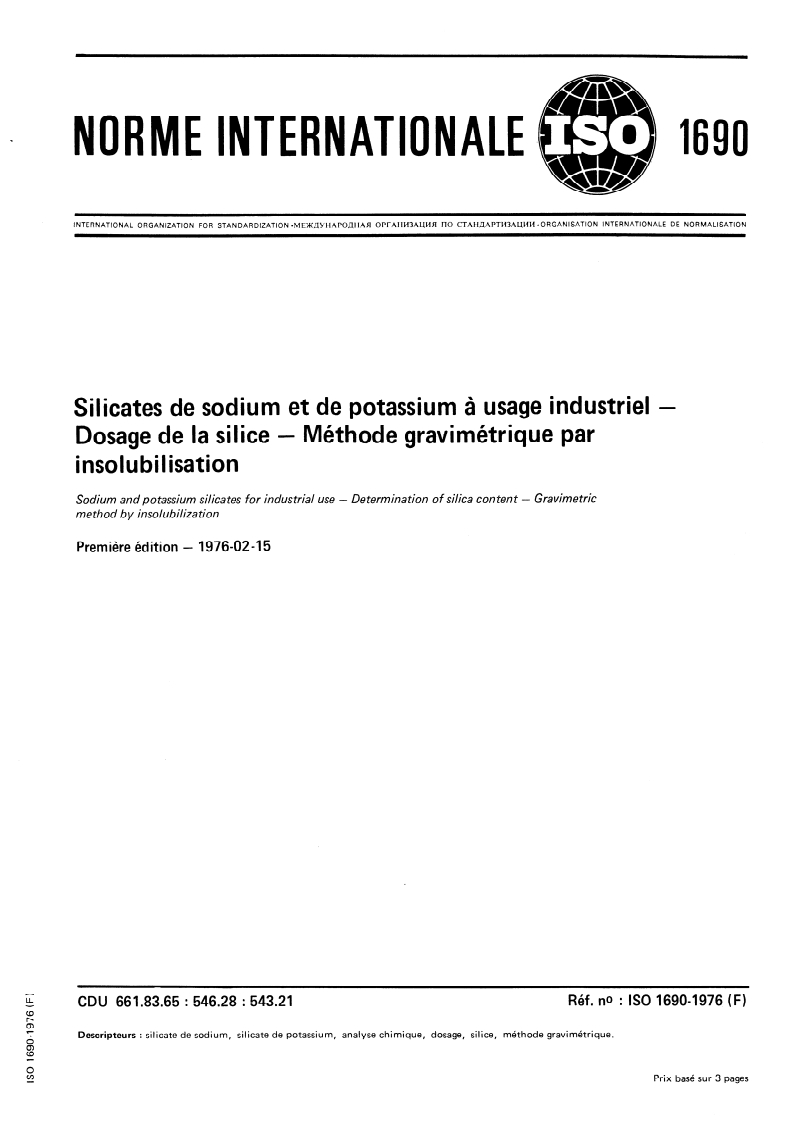
Silicates de sodium et de potassium à usage industriel -
Dosage de la silice - Méthode gravimétrique par
insolubilisation
Sodium and potassium silicates for indus triai use - Determination of silica content - Gravimetric
me thod b y insolubiliza tion
Première édition - 1976-02-l 5
CDU 661.83.65 : 546.28 : 543.21 Réf. no : ISO 1690-1976 (F)
Descripteurs : silicate de sodium, silicate de potassium, analyse chimique, dosage, silice, méthode gravimétrique
Prix basé sur 3 pages
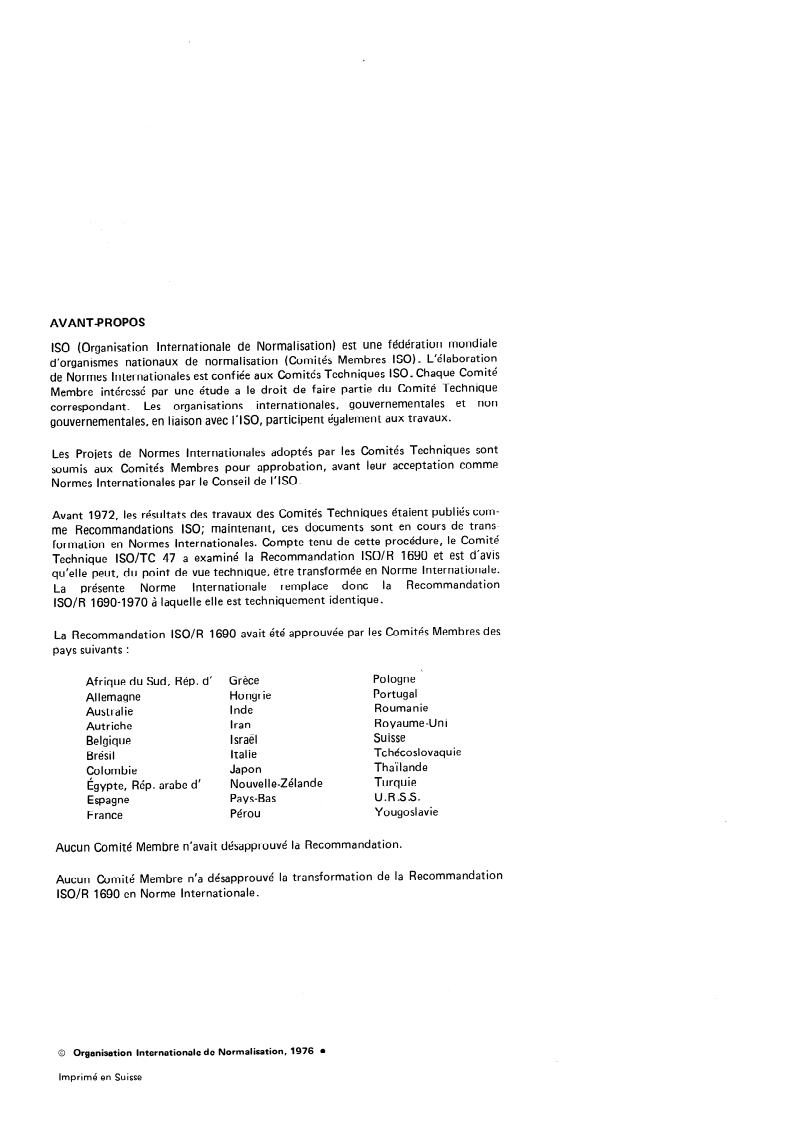
AVANT-PROPOS
ISO (Organisation Internationale de Normalisation) est une fédération mondiale
d’organismes nationaux de normalisation (Comités Membres ISO) _ L’élaboration
de Normes Internationales est confiée aux Comités Techniques ISO. Chaque Comité
Membre intéressé par une étude a le droit de faire partie du Comité Technique
correspondant. Les organisations internationales, gouvernementales et non
gouvernementales, en liaison avec I’ISO, participent également aux travaux.
Les Projets de Normes Internationales adoptés par les Comités Techniques sont
soumis aux Comités Membres pour approbation, avant leur acceptation comme
Normes Internationales par le Conseil de I’ISO.
Avant 1972, les résultats des travaux des Comités Techniques étaient publiés com-
me Recommandations ISO; maintenant, ces documents sont en cours de trans-
formation en Normes Internationales. Compte tenu de cette procédure, le Comité
-
Technique ISO/TC 47 a examiné la Recommandation ISO/R 1690 et est d’avis
qu’elle peut, du point de vue technique, être transformée en Norme Internationale.
La présente Norme Internationale remplace donc la Recommandation
ISO/R 1690-1970 à laquelle elle est techniquement identique.
La Recommandation ISO/R 1690 avait été approuvée par les Comités Membres des
pays suivants :
Pologne ’
Afrique du Sud, Rép. d’ Grèce
Hongrie Portugal
Allemagne
Roumanie
Australie Inde
Royaume-Uni
Autriche Iran
Belgique Israël Suisse
Tchécoslovaquie
Brési I Italie
Thaïlande
Colombie Japon
Nouvelle-Zélande Turquie
Égypte, Rép. arabe d’
Espagne Pays-Bas U.R.S.S.
France Pérou Yougoslavie
Aucun Comité Membre n’avait désapprouvé la Recommandation.
Aucun Comité Membre n’a désapprouvé la transformation de la Recommandation
ISO/R 1690 en Norme Internationale.
0 Organisation Internationale de Normalisation, 1976 l
Imprimé en Suisse
ISO 1690-1976 (F)
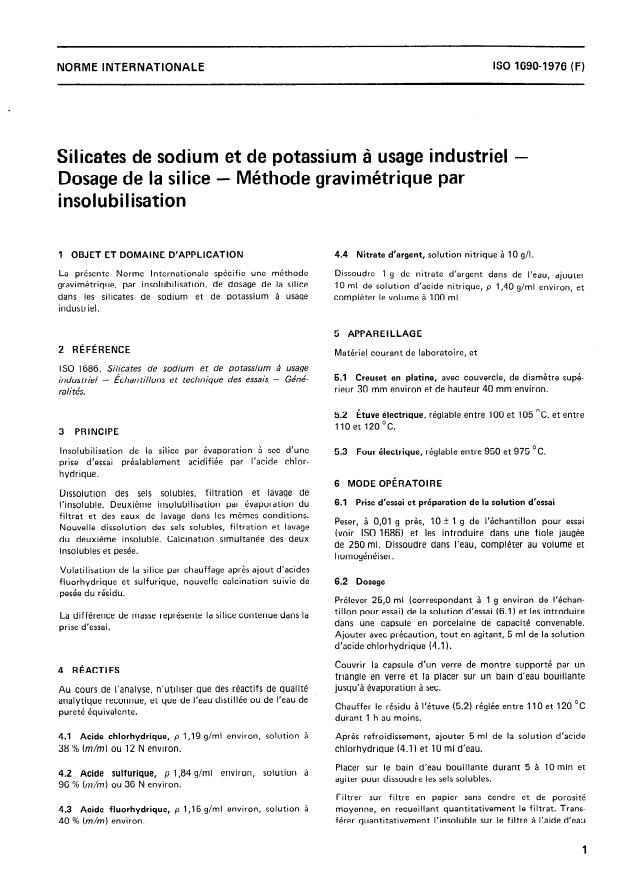
NORME INTERNATIONALE
Silicates de sodium et de potassium à usage industriel -
Dosage de la silice - Méthode gravimétrique par
insolubilisation
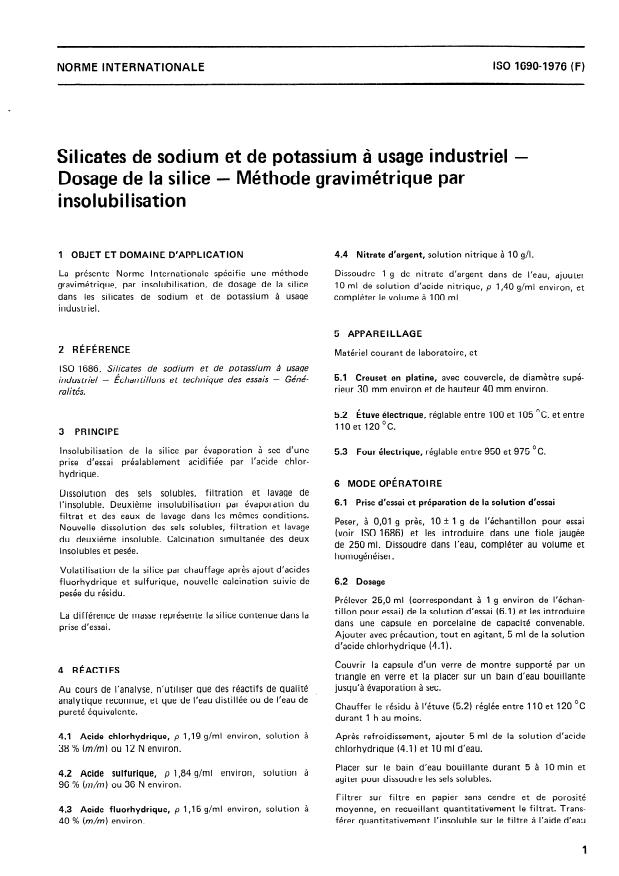
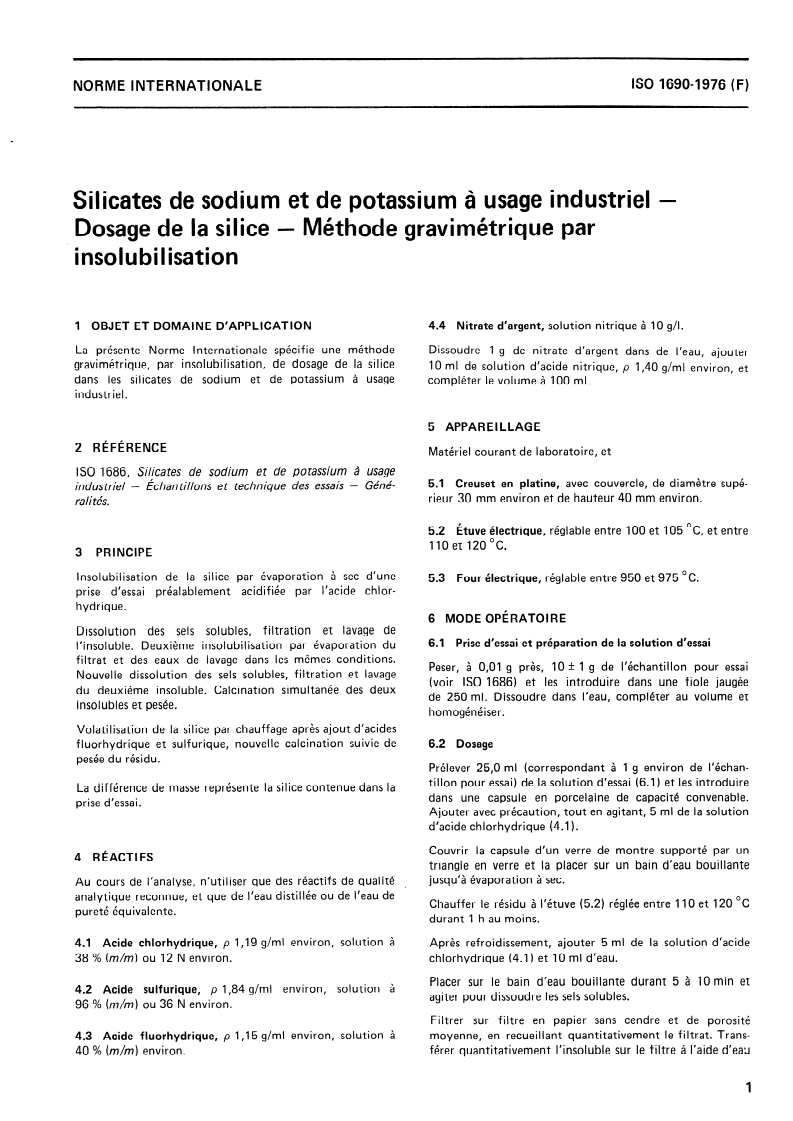
1 OBJET ET DOMAINE D’APPLICATION 4.4 Nitrate d’argent, solution nitrique à 10 g/l.
La présente Norme Internationale spécifie une méthode Dissoudre 1 g de nitrate d’argent dans de l’eau, ajouter
gravimétrique, par insolubilisation, de dosage de la silice
10 ml de solution d’acide nitrique, p 1,4O g/ml environ, et
dans les silicates de sodium et de potassium à usage
compléter le volume à 100 ml.
industriel.
5 APPAREILLAGE
2 RÉFÉRENCE
Matériel courant de laboratoire, et
I SO 1686, Silicates de sodium et de potassium à usage
5.1 Creuset en platine, avec couvercle, de diamètre supé-
indus trie1 - Échantillons et technique des essais - Géné-
rieur 30 mm environ et de hauteur 40 mm environ.
rali tés.
5.2 Étuve électrique, réglable entre 100 et 105 OC, et entre
110et 120°C.
3 PRINCIPE
Insolubilisation de la silice par évaporation à sec d’une
5.3 Four électrique, réglable entre 950 et 975 “C.
prise d’essai préalablement acidifiée par l’acide chlor-
hydrique.
6 MODE OPÉRATOIRE
Dissolution des sels solubles, filtration et lavage de
6.1 Prise d’essai et préparation de la solution d’essai
l’insoluble. Deuxième insolubilisation par évaporation du
filtrat et des eaux de lavage dans les mêmes conditions.
Peser, à 0,Ol g près, 10 + - 1 g de l’échantillon pour essai
Nouvelle dissolution des sels solubles, filtration et lavage
(voir ISO 1686) et les introduire dans une fiole jaugée
du deuxième insoluble. Calcination simultanée des deux
de 250 ml. Dissoudre dans l’eau, compléter au volume et
insolubles et pesée.
homogénéiser.
Volatilisation de la silice par chauffage après ajout d’acides
fluorhydrique et sulfurique, nouvelle calcination suivie de 6.2 Dosage
pesée du résidu.
Prélever 25,0 ml (correspondant à 1 g environ de I’échan-
tillon pour essai) de la solution d’essai (6.1) et les introduire
La différence de masse représente la silice contenue dans la
dans une capsule en porcelaine de capacité convenable.
prise d’essai.
Ajouter avec précaution, tout en agitant, 5 ml de la solution
d’acide chlorhydrique (4.1).
Couvrir la capsule d’un verre de montre supporté par un
4 RÉACTIFS
triangle en verre et la placer sur un bain d’eau bouillante
jusqu’à évaporation à sec.
Au cours de l’analyse, n’utiliser que des réactifs de qualité
analytique reconnue, et que de l’eau distillée ou de l’eau de
Chauffer le résidu à l’étuve (5.2) réglée entre 110 et 120 “C
pureté équivalente.
durant 1 h au moins.
4.1 Acide chlorhy
...
NORME INTERNATIONALE.
INTERNATIONAL ORGANIZATION FOR STANDARDlZATlON l MDfof(yHAPOAHAR OPPAHM3ALWiR I-TO CTAH~APTM3ALWiM.ORGANISATION INTERNATIONALE DE NORMALISATION
Silicates de sodium et de potassium à usage industriel -
Dosage de la silice - Méthode gravimétrique par
insolubilisation
Sodium and potassium silicates for indus triai use - Determination of silica content - Gravimetric
me thod b y insolubiliza tion
Première édition - 1976-02-l 5
CDU 661.83.65 : 546.28 : 543.21 Réf. no : ISO 1690-1976 (F)
Descripteurs : silicate de sodium, silicate de potassium, analyse chimique, dosage, silice, méthode gravimétrique
Prix basé sur 3 pages
AVANT-PROPOS
ISO (Organisation Internationale de Normalisation) est une fédération mondiale
d’organismes nationaux de normalisation (Comités Membres ISO) _ L’élaboration
de Normes Internationales est confiée aux Comités Techniques ISO. Chaque Comité
Membre intéressé par une étude a le droit de faire partie du Comité Technique
correspondant. Les organisations internationales, gouvernementales et non
gouvernementales, en liaison avec I’ISO, participent également aux travaux.
Les Projets de Normes Internationales adoptés par les Comités Techniques sont
soumis aux Comités Membres pour approbation, avant leur acceptation comme
Normes Internationales par le Conseil de I’ISO.
Avant 1972, les résultats des travaux des Comités Techniques étaient publiés com-
me Recommandations ISO; maintenant, ces documents sont en cours de trans-
formation en Normes Internationales. Compte tenu de cette procédure, le Comité
-
Technique ISO/TC 47 a examiné la Recommandation ISO/R 1690 et est d’avis
qu’elle peut, du point de vue technique, être transformée en Norme Internationale.
La présente Norme Internationale remplace donc la Recommandation
ISO/R 1690-1970 à laquelle elle est techniquement identique.
La Recommandation ISO/R 1690 avait été approuvée par les Comités Membres des
pays suivants :
Pologne ’
Afrique du Sud, Rép. d’ Grèce
Hongrie Portugal
Allemagne
Roumanie
Australie Inde
Royaume-Uni
Autriche Iran
Belgique Israël Suisse
Tchécoslovaquie
Brési I Italie
Thaïlande
Colombie Japon
Nouvelle-Zélande Turquie
Égypte, Rép. arabe d’
Espagne Pays-Bas U.R.S.S.
France Pérou Yougoslavie
Aucun Comité Membre n’avait désapprouvé la Recommandation.
Aucun Comité Membre n’a désapprouvé la transformation de la Recommandation
ISO/R 1690 en Norme Internationale.
0 Organisation Internationale de Normalisation, 1976 l
Imprimé en Suisse
ISO 1690-1976 (F)
NORME INTERNATIONALE
Silicates de sodium et de potassium à usage industriel -
Dosage de la silice - Méthode gravimétrique par
insolubilisation
1 OBJET ET DOMAINE D’APPLICATION 4.4 Nitrate d’argent, solution nitrique à 10 g/l.
La présente Norme Internationale spécifie une méthode Dissoudre 1 g de nitrate d’argent dans de l’eau, ajouter
gravimétrique, par insolubilisation, de dosage de la silice
10 ml de solution d’acide nitrique, p 1,4O g/ml environ, et
dans les silicates de sodium et de potassium à usage
compléter le volume à 100 ml.
industriel.
5 APPAREILLAGE
2 RÉFÉRENCE
Matériel courant de laboratoire, et
I SO 1686, Silicates de sodium et de potassium à usage
5.1 Creuset en platine, avec couvercle, de diamètre supé-
indus trie1 - Échantillons et technique des essais - Géné-
rieur 30 mm environ et de hauteur 40 mm environ.
rali tés.
5.2 Étuve électrique, réglable entre 100 et 105 OC, et entre
110et 120°C.
3 PRINCIPE
Insolubilisation de la silice par évaporation à sec d’une
5.3 Four électrique, réglable entre 950 et 975 “C.
prise d’essai préalablement acidifiée par l’acide chlor-
hydrique.
6 MODE OPÉRATOIRE
Dissolution des sels solubles, filtration et lavage de
6.1 Prise d’essai et préparation de la solution d’essai
l’insoluble. Deuxième insolubilisation par évaporation du
filtrat et des eaux de lavage dans les mêmes conditions.
Peser, à 0,Ol g près, 10 + - 1 g de l’échantillon pour essai
Nouvelle dissolution des sels solubles, filtration et lavage
(voir ISO 1686) et les introduire dans une fiole jaugée
du deuxième insoluble. Calcination simultanée des deux
de 250 ml. Dissoudre dans l’eau, compléter au volume et
insolubles et pesée.
homogénéiser.
Volatilisation de la silice par chauffage après ajout d’acides
fluorhydrique et sulfurique, nouvelle calcination suivie de 6.2 Dosage
pesée du résidu.
Prélever 25,0 ml (correspondant à 1 g environ de I’échan-
tillon pour essai) de la solution d’essai (6.1) et les introduire
La différence de masse représente la silice contenue dans la
dans une capsule en porcelaine de capacité convenable.
prise d’essai.
Ajouter avec précaution, tout en agitant, 5 ml de la solution
d’acide chlorhydrique (4.1).
Couvrir la capsule d’un verre de montre supporté par un
4 RÉACTIFS
triangle en verre et la placer sur un bain d’eau bouillante
jusqu’à évaporation à sec.
Au cours de l’analyse, n’utiliser que des réactifs de qualité
analytique reconnue, et que de l’eau distillée ou de l’eau de
Chauffer le résidu à l’étuve (5.2) réglée entre 110 et 120 “C
pureté équivalente.
durant 1 h au moins.
4.1 Acide chlorhy
...
NORME INTERNATIONALE.
INTERNATIONAL ORGANIZATION FOR STANDARDlZATlON l MDfof(yHAPOAHAR OPPAHM3ALWiR I-TO CTAH~APTM3ALWiM.ORGANISATION INTERNATIONALE DE NORMALISATION
Silicates de sodium et de potassium à usage industriel -
Dosage de la silice - Méthode gravimétrique par
insolubilisation
Sodium and potassium silicates for indus triai use - Determination of silica content - Gravimetric
me thod b y insolubiliza tion
Première édition - 1976-02-l 5
CDU 661.83.65 : 546.28 : 543.21 Réf. no : ISO 1690-1976 (F)
Descripteurs : silicate de sodium, silicate de potassium, analyse chimique, dosage, silice, méthode gravimétrique
Prix basé sur 3 pages
AVANT-PROPOS
ISO (Organisation Internationale de Normalisation) est une fédération mondiale
d’organismes nationaux de normalisation (Comités Membres ISO) _ L’élaboration
de Normes Internationales est confiée aux Comités Techniques ISO. Chaque Comité
Membre intéressé par une étude a le droit de faire partie du Comité Technique
correspondant. Les organisations internationales, gouvernementales et non
gouvernementales, en liaison avec I’ISO, participent également aux travaux.
Les Projets de Normes Internationales adoptés par les Comités Techniques sont
soumis aux Comités Membres pour approbation, avant leur acceptation comme
Normes Internationales par le Conseil de I’ISO.
Avant 1972, les résultats des travaux des Comités Techniques étaient publiés com-
me Recommandations ISO; maintenant, ces documents sont en cours de trans-
formation en Normes Internationales. Compte tenu de cette procédure, le Comité
-
Technique ISO/TC 47 a examiné la Recommandation ISO/R 1690 et est d’avis
qu’elle peut, du point de vue technique, être transformée en Norme Internationale.
La présente Norme Internationale remplace donc la Recommandation
ISO/R 1690-1970 à laquelle elle est techniquement identique.
La Recommandation ISO/R 1690 avait été approuvée par les Comités Membres des
pays suivants :
Pologne ’
Afrique du Sud, Rép. d’ Grèce
Hongrie Portugal
Allemagne
Roumanie
Australie Inde
Royaume-Uni
Autriche Iran
Belgique Israël Suisse
Tchécoslovaquie
Brési I Italie
Thaïlande
Colombie Japon
Nouvelle-Zélande Turquie
Égypte, Rép. arabe d’
Espagne Pays-Bas U.R.S.S.
France Pérou Yougoslavie
Aucun Comité Membre n’avait désapprouvé la Recommandation.
Aucun Comité Membre n’a désapprouvé la transformation de la Recommandation
ISO/R 1690 en Norme Internationale.
0 Organisation Internationale de Normalisation, 1976 l
Imprimé en Suisse
ISO 1690-1976 (F)
NORME INTERNATIONALE
Silicates de sodium et de potassium à usage industriel -
Dosage de la silice - Méthode gravimétrique par
insolubilisation
1 OBJET ET DOMAINE D’APPLICATION 4.4 Nitrate d’argent, solution nitrique à 10 g/l.
La présente Norme Internationale spécifie une méthode Dissoudre 1 g de nitrate d’argent dans de l’eau, ajouter
gravimétrique, par insolubilisation, de dosage de la silice
10 ml de solution d’acide nitrique, p 1,4O g/ml environ, et
dans les silicates de sodium et de potassium à usage
compléter le volume à 100 ml.
industriel.
5 APPAREILLAGE
2 RÉFÉRENCE
Matériel courant de laboratoire, et
I SO 1686, Silicates de sodium et de potassium à usage
5.1 Creuset en platine, avec couvercle, de diamètre supé-
indus trie1 - Échantillons et technique des essais - Géné-
rieur 30 mm environ et de hauteur 40 mm environ.
rali tés.
5.2 Étuve électrique, réglable entre 100 et 105 OC, et entre
110et 120°C.
3 PRINCIPE
Insolubilisation de la silice par évaporation à sec d’une
5.3 Four électrique, réglable entre 950 et 975 “C.
prise d’essai préalablement acidifiée par l’acide chlor-
hydrique.
6 MODE OPÉRATOIRE
Dissolution des sels solubles, filtration et lavage de
6.1 Prise d’essai et préparation de la solution d’essai
l’insoluble. Deuxième insolubilisation par évaporation du
filtrat et des eaux de lavage dans les mêmes conditions.
Peser, à 0,Ol g près, 10 + - 1 g de l’échantillon pour essai
Nouvelle dissolution des sels solubles, filtration et lavage
(voir ISO 1686) et les introduire dans une fiole jaugée
du deuxième insoluble. Calcination simultanée des deux
de 250 ml. Dissoudre dans l’eau, compléter au volume et
insolubles et pesée.
homogénéiser.
Volatilisation de la silice par chauffage après ajout d’acides
fluorhydrique et sulfurique, nouvelle calcination suivie de 6.2 Dosage
pesée du résidu.
Prélever 25,0 ml (correspondant à 1 g environ de I’échan-
tillon pour essai) de la solution d’essai (6.1) et les introduire
La différence de masse représente la silice contenue dans la
dans une capsule en porcelaine de capacité convenable.
prise d’essai.
Ajouter avec précaution, tout en agitant, 5 ml de la solution
d’acide chlorhydrique (4.1).
Couvrir la capsule d’un verre de montre supporté par un
4 RÉACTIFS
triangle en verre et la placer sur un bain d’eau bouillante
jusqu’à évaporation à sec.
Au cours de l’analyse, n’utiliser que des réactifs de qualité
analytique reconnue, et que de l’eau distillée ou de l’eau de
Chauffer le résidu à l’étuve (5.2) réglée entre 110 et 120 “C
pureté équivalente.
durant 1 h au moins.
4.1 Acide chlorhy
...
NORME INTERNATIONALE.
INTERNATIONAL ORGANIZATION FOR STANDARDlZATlON l MDfof(yHAPOAHAR OPPAHM3ALWiR I-TO CTAH~APTM3ALWiM.ORGANISATION INTERNATIONALE DE NORMALISATION
Silicates de sodium et de potassium à usage industriel -
Dosage de la silice - Méthode gravimétrique par
insolubilisation
Sodium and potassium silicates for indus triai use - Determination of silica content - Gravimetric
me thod b y insolubiliza tion
Première édition - 1976-02-l 5
CDU 661.83.65 : 546.28 : 543.21 Réf. no : ISO 1690-1976 (F)
Descripteurs : silicate de sodium, silicate de potassium, analyse chimique, dosage, silice, méthode gravimétrique
Prix basé sur 3 pages
AVANT-PROPOS
ISO (Organisation Internationale de Normalisation) est une fédération mondiale
d’organismes nationaux de normalisation (Comités Membres ISO) _ L’élaboration
de Normes Internationales est confiée aux Comités Techniques ISO. Chaque Comité
Membre intéressé par une étude a le droit de faire partie du Comité Technique
correspondant. Les organisations internationales, gouvernementales et non
gouvernementales, en liaison avec I’ISO, participent également aux travaux.
Les Projets de Normes Internationales adoptés par les Comités Techniques sont
soumis aux Comités Membres pour approbation, avant leur acceptation comme
Normes Internationales par le Conseil de I’ISO.
Avant 1972, les résultats des travaux des Comités Techniques étaient publiés com-
me Recommandations ISO; maintenant, ces documents sont en cours de trans-
formation en Normes Internationales. Compte tenu de cette procédure, le Comité
-
Technique ISO/TC 47 a examiné la Recommandation ISO/R 1690 et est d’avis
qu’elle peut, du point de vue technique, être transformée en Norme Internationale.
La présente Norme Internationale remplace donc la Recommandation
ISO/R 1690-1970 à laquelle elle est techniquement identique.
La Recommandation ISO/R 1690 avait été approuvée par les Comités Membres des
pays suivants :
Pologne ’
Afrique du Sud, Rép. d’ Grèce
Hongrie Portugal
Allemagne
Roumanie
Australie Inde
Royaume-Uni
Autriche Iran
Belgique Israël Suisse
Tchécoslovaquie
Brési I Italie
Thaïlande
Colombie Japon
Nouvelle-Zélande Turquie
Égypte, Rép. arabe d’
Espagne Pays-Bas U.R.S.S.
France Pérou Yougoslavie
Aucun Comité Membre n’avait désapprouvé la Recommandation.
Aucun Comité Membre n’a désapprouvé la transformation de la Recommandation
ISO/R 1690 en Norme Internationale.
0 Organisation Internationale de Normalisation, 1976 l
Imprimé en Suisse
ISO 1690-1976 (F)
NORME INTERNATIONALE
Silicates de sodium et de potassium à usage industriel -
Dosage de la silice - Méthode gravimétrique par
insolubilisation
1 OBJET ET DOMAINE D’APPLICATION 4.4 Nitrate d’argent, solution nitrique à 10 g/l.
La présente Norme Internationale spécifie une méthode Dissoudre 1 g de nitrate d’argent dans de l’eau, ajouter
gravimétrique, par insolubilisation, de dosage de la silice
10 ml de solution d’acide nitrique, p 1,4O g/ml environ, et
dans les silicates de sodium et de potassium à usage
compléter le volume à 100 ml.
industriel.
5 APPAREILLAGE
2 RÉFÉRENCE
Matériel courant de laboratoire, et
I SO 1686, Silicates de sodium et de potassium à usage
5.1 Creuset en platine, avec couvercle, de diamètre supé-
indus trie1 - Échantillons et technique des essais - Géné-
rieur 30 mm environ et de hauteur 40 mm environ.
rali tés.
5.2 Étuve électrique, réglable entre 100 et 105 OC, et entre
110et 120°C.
3 PRINCIPE
Insolubilisation de la silice par évaporation à sec d’une
5.3 Four électrique, réglable entre 950 et 975 “C.
prise d’essai préalablement acidifiée par l’acide chlor-
hydrique.
6 MODE OPÉRATOIRE
Dissolution des sels solubles, filtration et lavage de
6.1 Prise d’essai et préparation de la solution d’essai
l’insoluble. Deuxième insolubilisation par évaporation du
filtrat et des eaux de lavage dans les mêmes conditions.
Peser, à 0,Ol g près, 10 + - 1 g de l’échantillon pour essai
Nouvelle dissolution des sels solubles, filtration et lavage
(voir ISO 1686) et les introduire dans une fiole jaugée
du deuxième insoluble. Calcination simultanée des deux
de 250 ml. Dissoudre dans l’eau, compléter au volume et
insolubles et pesée.
homogénéiser.
Volatilisation de la silice par chauffage après ajout d’acides
fluorhydrique et sulfurique, nouvelle calcination suivie de 6.2 Dosage
pesée du résidu.
Prélever 25,0 ml (correspondant à 1 g environ de I’échan-
tillon pour essai) de la solution d’essai (6.1) et les introduire
La différence de masse représente la silice contenue dans la
dans une capsule en porcelaine de capacité convenable.
prise d’essai.
Ajouter avec précaution, tout en agitant, 5 ml de la solution
d’acide chlorhydrique (4.1).
Couvrir la capsule d’un verre de montre supporté par un
4 RÉACTIFS
triangle en verre et la placer sur un bain d’eau bouillante
jusqu’à évaporation à sec.
Au cours de l’analyse, n’utiliser que des réactifs de qualité
analytique reconnue, et que de l’eau distillée ou de l’eau de
Chauffer le résidu à l’étuve (5.2) réglée entre 110 et 120 “C
pureté équivalente.
durant 1 h au moins.
4.1 Acide chlorhy
...