


ISO/IEC Guide 2:1996
(Main)Standardization and related activities — General vocabulary
Standardization and related activities — General vocabulary
Provides general terms and definitions concerning standardization and related activities. It is intended to contribute towards mutual understanding amongst the members of ISO and IEC and the various governmental and non-governmental bodies involved in standardization at international and national levels.
Normalisation et activités connexes — Vocabulaire général
General Information
- Status
- Withdrawn
- Publication Date
- 28-Aug-1996
- Withdrawal Date
- 28-Aug-1996
- Technical Committee
- ISO/TMBG - Technical Management Board - groups
- Drafting Committee
- ISO/TMBG - Technical Management Board - groups
- Current Stage
- 9599 - Withdrawal of International Standard
- Start Date
- 03-Nov-2004
- Completion Date
- 14-Feb-2026
Relations
- Effective Date
- 15-Apr-2008
- Effective Date
- 15-Apr-2008
Frequently Asked Questions
ISO/IEC Guide 2:1996 is a guide published by the International Organization for Standardization (ISO). Its full title is "Standardization and related activities — General vocabulary". This standard covers: Provides general terms and definitions concerning standardization and related activities. It is intended to contribute towards mutual understanding amongst the members of ISO and IEC and the various governmental and non-governmental bodies involved in standardization at international and national levels.
Provides general terms and definitions concerning standardization and related activities. It is intended to contribute towards mutual understanding amongst the members of ISO and IEC and the various governmental and non-governmental bodies involved in standardization at international and national levels.
ISO/IEC Guide 2:1996 is classified under the following ICS (International Classification for Standards) categories: 01.040.01 - Generalities. Terminology. Standardization. Documentation (Vocabularies); 01.120 - Standardization. General rules. The ICS classification helps identify the subject area and facilitates finding related standards.
ISO/IEC Guide 2:1996 has the following relationships with other standards: It is inter standard links to ISO/IEC Guide 2:2004, ISO/IEC Guide 2:1991. Understanding these relationships helps ensure you are using the most current and applicable version of the standard.
ISO/IEC Guide 2:1996 is available in PDF format for immediate download after purchase. The document can be added to your cart and obtained through the secure checkout process. Digital delivery ensures instant access to the complete standard document.
Standards Content (Sample)
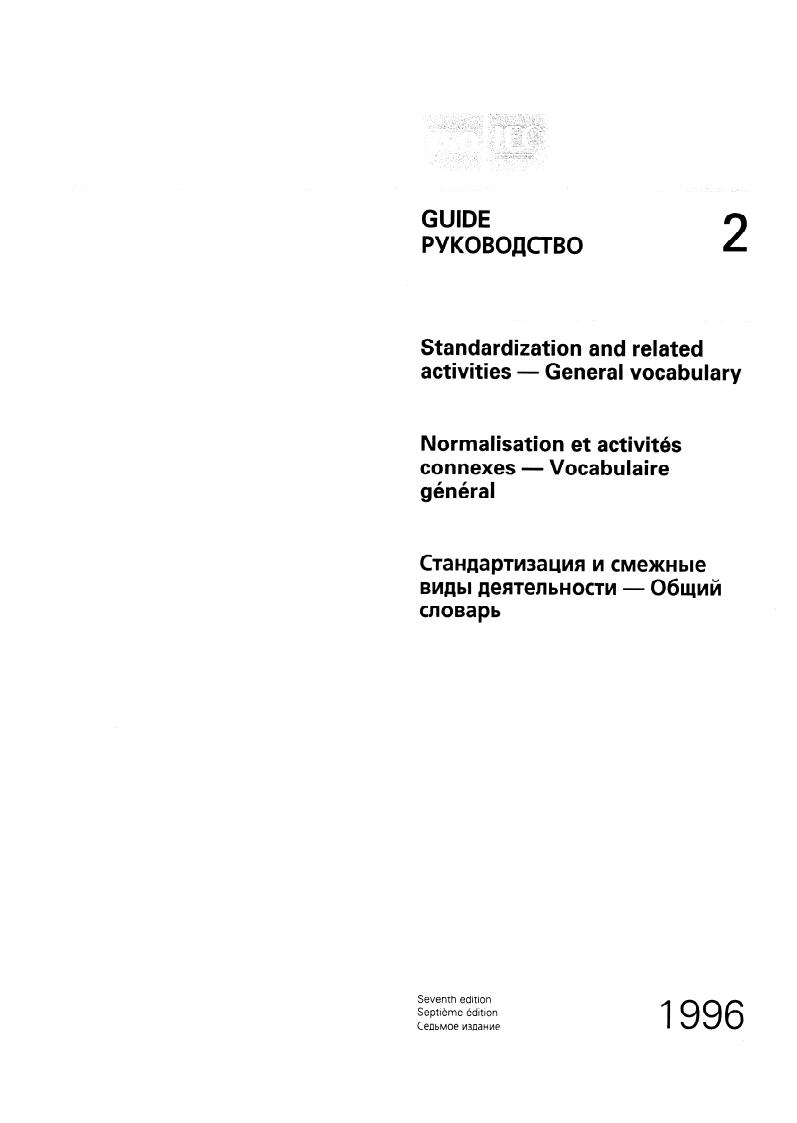
GUIDE
PYKOBOflCTBO
Standardization and related
activities - General vocabulary
Normalisation et activith
connexes - Vocabulaire
ghhal
CTaH~apTUl3El~lMl Ul CMWKHble
BUlAbl ~WlTWlbHOCTM - 0614u1fi
CJlOBapb
Seventh edition
Septkme kdition
Ceflbhnoe M3flat-we
Page
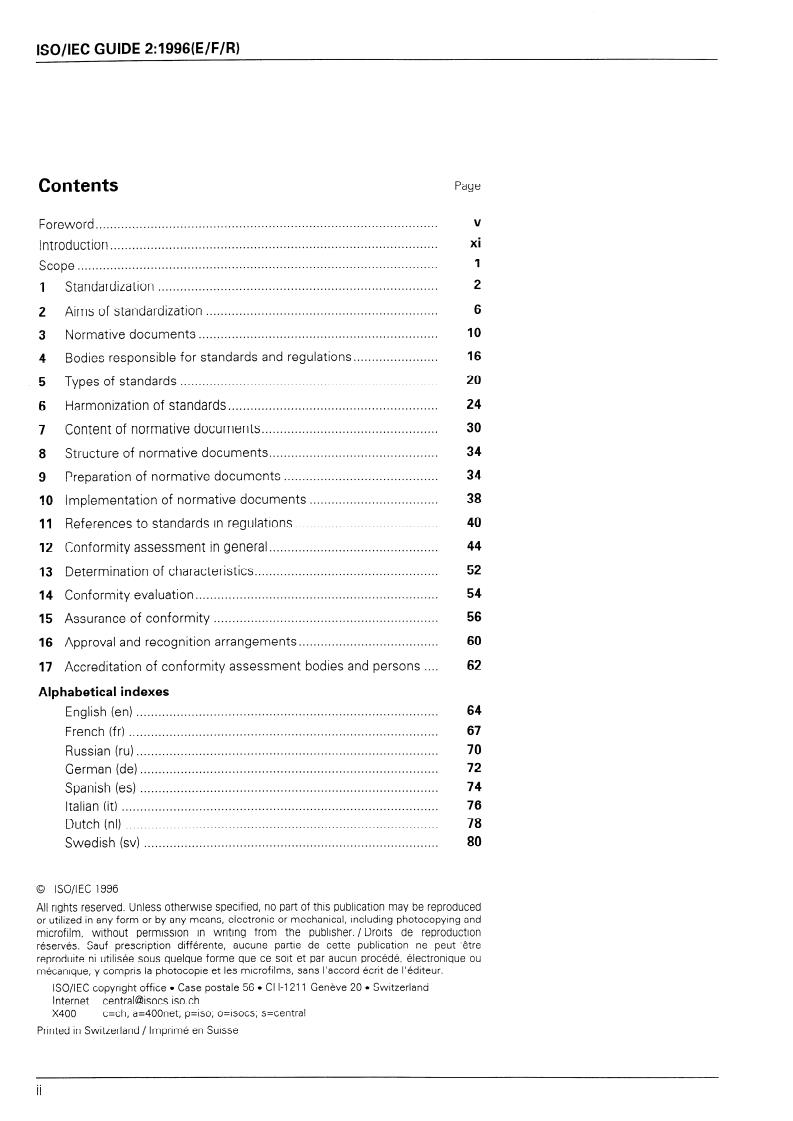
Contents
v
.............................................................................................
Foreword
xi
Introduction .
..................................................................................................
Scope
Standardization . .
............................................................... 6
2 Aims of standardization
Normative documents .
..................... 16
4 Bodies responsible for standards and regulations.
................................................... ................... 20
5 Types of standards
Harmonization of standards .
................................................ 30
7 Content of normative documents
.............................................. 34
8 Structure of normative documents
Preparation of normative documents .
................................... 38
IO Implementation of normative documents
.....................................
11 References to standards in regulations.
12 Conformity assessment in general. .
.................................................. 52
13 Determination of characteristics
Conformity evaluation. .
15 Assurance of conformity .
...................................... 60
16 Approval and recognition arrangements
....
17 Accreditation of conformity assessment bodies and persons
Alphabetical indexes
................................................ 64
English (en) .
French (fr) . .
Russian (ru) .
................................................................................. 72
German (de)
Spanish (es) . .
Italian (it) . .
Dutch (nl) . .
Swedish (sv) . . 80
0 ISO/IEC 1996
All rights reserved. Unless otherwise specified, no part of this publication may be reproduced
or utilized in any form or by any means, electronic or mechanical, including photocopyrng and
microfilm, without permission in writing from the publisher. / Drotts de reproduction
reserves. Sauf prescription differente, aucune pat-tie de cette publication ne peut ‘etre
reproduite ni utilisee sous quelque forme que ce soit et par aucun procede, electronique ou
mecanrque, y compris la photocopie et les microfilms, sans I’accord ecrit de I’editeur.
lSO/l EC copyright office l Case postale 56 l CH-1211 Geneve 20 0 Switzerland
Internet centraI@isocs.iso.ch
x400 c=ch; a=400net; p=iso; o=isocs; s=central
Printed in Switzerland / lmprime en Sursse
II
@ lSO/IEC
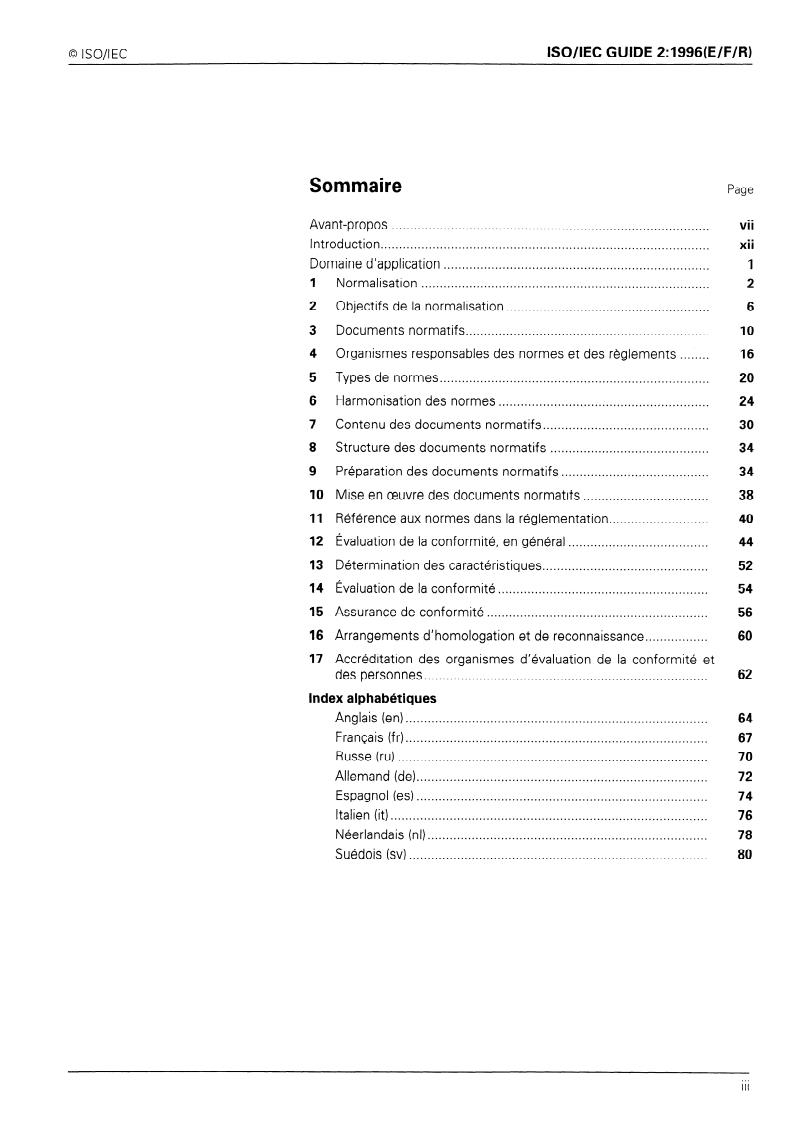
Sommaire Page
Avant-propos . . vii
Introduction . . . xii
Domaine d’application . .
1 Normalisation . . 2
2 Objectifs de la normalisation . . 6
Documents normatifs . . . 10
4 Organismes responsables des normes et des reglements . 16
5 Types de normes .
6 Harmonisation des normes . . 24
7 Contenu des documents normatifs . 30
Structure des documents normatifs . 34
9 Preparation des documents normatifs . 34
10 Mise en ceuvre des documents normatifs . 38
11 Reference aux normes dans la reglementation . 40
12 lkaluation de la conformite, en general .
13 Determination des caracteristiques . . 52
14 ivaluation de la conformite . 54
15 Assurance de conformite . . 56
16 Arrangements d’homologation et de reconnaissance. . 60
17 Accreditation des organismes d’evaluation de la conformite et
des personnes .
Index alphabetiques
Anglais (en) . . . . . . . . . . . . . . . . . . . . . . . . . . . . . . . . . . . . . . . . . . . . . . . . . . . . . . . . . . . . . . . . . . . . . . . . . . . . . . . . . . 64
Francais (fr) . . . . . . . . . . . . . . . . . . . . . . . . . . . . . . . . . . . . . . . . . . . . . . . . . . . . . . . . . . . . . . . . . . . . . . . . . . . . . . . . . . 67
Russe (ru) . .
Allemand (de) . . . . . . . . . . . . . . . . . . . . . . . . . . . . . . . . . . . . . . . . . . . . . . . . . . . . . . . . . . . . . . . . . . . . . . . . . . . . . . . 72
Espagnol (es) . .
Italien (it) . . 76
Neerlandais (nl) .
Suedois (sv) . . 80
. . 0
III
0 lSO/IEC
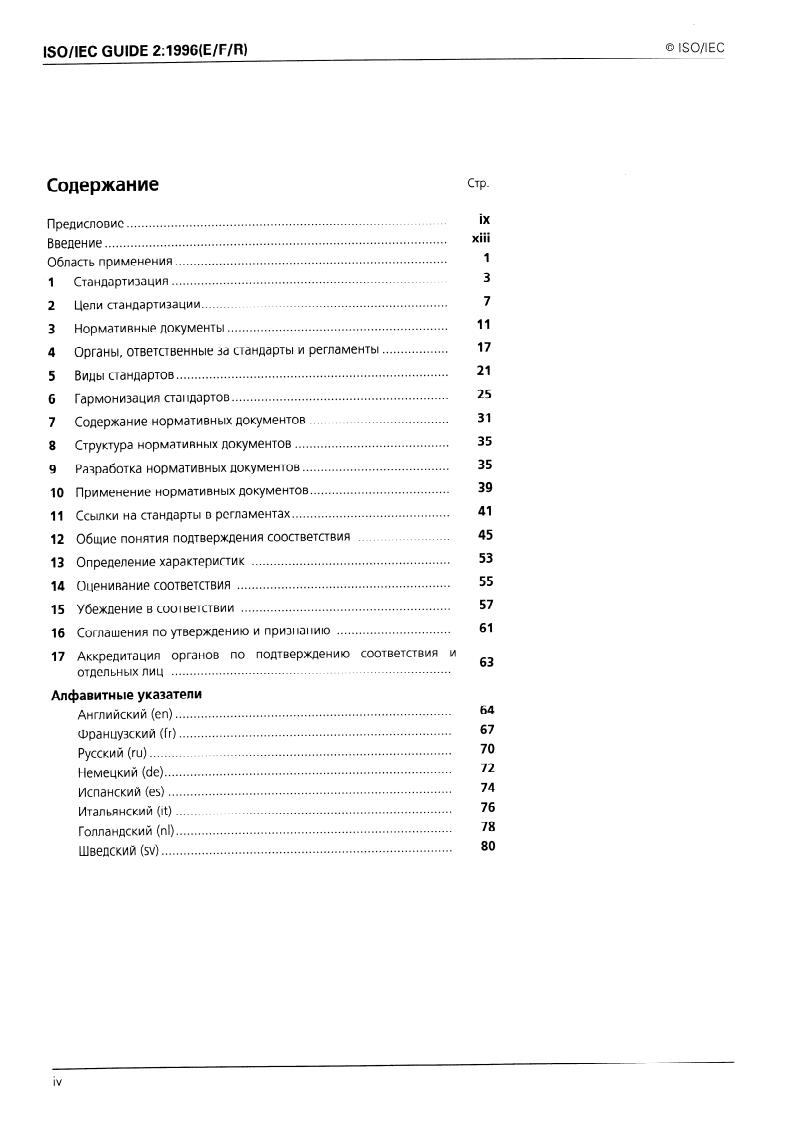
CTP.
Conepxawe
ix
.......................................................................................
Ilpeflwnostie
. . .
XIII
.............................................................................................
BBefleHlAe
..........................................................................
06flaCTb llpUMeHeHvlF1
...........................................................................
1 CTaHflapTlA3alJm
...................................................................
l_lenl/r cTaHflapTvI3aLw
............................................................
3 t-iOpMaTvlBHble CJOKyMeHTbl
..................
OpraH bl, OTBeTCTBeHH ble 323 CTaHaapTbl Pl pernaMeHTbl
........................................................................
5 h/&l CTaHnapTOB.
rapMOHI43aLJWI CTaHflapTOB .
......................................
7 COflepmaHlAe HOpMaTmBHblX aOKyMeHTOB
.......................................... 35
8 CTpyKTypa HOpMaTI/IBHblX /JOKyMeHTOB
........................................
hpa6oTKa HOpMaTPlBHblX DOKYMeHTOB
......................................
nplAMeHeHl4e HOpMaTklBHblX flOKyMeHTOB
...........................................
11 CCbU-lKVI Ha CTaHAapTbl B pernaMeHTaX
......................... 45
12 06uvre ilOHF1TWl llOf/TBep)KaeHMfI COOCTBeTCTBWI
......................................................
OnpefleneHvle XapaKTepMCTUK
..........................................................
14 OueHlABaHkle COOTBeTCTBV1fi
Y6emfleHvle B COOTBeTCTBMti .
...............................
16 CornauJeHm no yrBepm~eHm0 v1 npm3HaHmto
l-IO llOnTBep>KneHlAK) COOTBeTCTBWI l/l
17 AKKpeflUTaIJtiR OpraHOB
OTflenbHblX J-ltiu .
h@BVlTHble yKa3aTeflM
...........................................................................
&IrmkK1/1fi (en)
@paHiJ)/3CKtih (ff-) .
.................................................................................. 70
PyCCKlAti (ru)
..............................................................................
t-ieMeuKurti (de)
.............................................................................
IAcnatictwG (es)
MTanbFlHCKlAh (it) .
........................................................................... 78
ronnaHflcKMti (nl)
............................................................................... 80
MBeuCKPlti (SV)
iv
0 lSO/IEC
Foreword
IS0 (the International Organization for Standardization) and IEC (the Inter-
national Electrotechnical Commission) form the specialized system for
worldwide standardization. National bodies that are members of IS0 or IEC
participate in the development of International Standards through technical
committees established by the respective organization to deal with particu-
lar fields of technical activity. IS0 and IEC technical committees collab-
orate in fields of mutual interest. Other international organizations,
governmental and non-governmental, in liaison with IS0 and IEC, also take
part in the work.
The first edition of this Guide was published by IS0 in 1976. It was pre-
pared by the United Nations Economic Commission for Europe (UN/ECE) in
consultation with ISO, primarily to facilitate the work of the UN/ECE aimed
at removal of barriers to international trade arising from lack of harmoniz-
ation of standards or inadequate international application of standards.
The second, thirdand fourth editions of IS0 Guide 2 added new terms and
definitions in more or less isolated groups, within no overall planned
framework. Work on a systematically structured revision was authorized
by IS0 Council in 1981 as the principal task of a working group within the
IS0 Committee on standardization principles (ISO/STACO), including IEC
and UN/ECE spokesmen and in cooperation with the IS0 Committee on
conformity assessment (ISO/CASCO) and the International Laboratory
Accreditation Conference (I LAC).
The main reason for this activity was a request from UN/ECE for complete
and urgent revision of IS0 Guide 2 to take into account a number’ of
specific problems raised by the UN/ECE Government Officials Responsible
for Standardization Policies as well as the proposed terminology being
prepared in the UN/ECE Working Party on Building.
Moreover, IS0 was publishing an increasing number of Guides on stan-
dardization policies and procedures, several of them in conjunction with
I EC. To guard against terminological inconsistencies, a clear understanding
of basic concepts needed to be established, and unambiguous general
terms and definitions provided.
The resulting fifth edition of Guide 2 was issued, for the first time as a joint
lSO/l EC publication, in 1986.
The sixth edition (1991) incorporated amendments in response to specific
questions raised by IS0 and IEC members, requests from the General
Agreement on Tariffs and Trade (GATT) and the UN/ECE, and proposals
from lSO/CASCO.
This seventh edition (1996) preserves the structure of its recent prede-
cessors by grouping related concepts under generic clause headings. Thus,
clauses 1 to 11 concern standardization, proceeding from the more general
to more specific aspects. Similarly, the terms and definitions given in the
newly revised clauses 12 to 17 cover the broad spectrum of conformity
assessment. These latter clauses have been modified on the recommen-
dations of lSO/CASCO to reflect recent developments in conformity
V
0 lSO/IEC
assessment activities, and were approved by the national bodies of IS0
and IEC in 1994. They are not intended to provide a comprehensive classi-
fication but include, in particular, concepts related to the following typical
sequence:
a) determination of product, process or service characteristics
(clause 13);
b) comparison of characteristics with specified requirements, i.e. con-
formity evaluation (clause 14);
assurance of conformity, e.g. by supplier’s declaration or by certifi-
d
cation (clause 15).
vi
@ lSO/lEC ISO/IEC GUIDE 2:1996(E/F/R)
Avant-propos
L’ISO (Organisation internationale de normalisation) et la CEI (Commission
electrotechnique internationale) forment ensemble le systeme specialise
de la normalisation mondiale. Les organismes nationaux membres de I’ISO
ou de la CEI participent au developpement de Normes internationales par
I’intermediaire des comites techniques c&s par I’organisation concernee
afin de s’occuper des domaines particuliers de I’activite technique. Les
comites techniques de I’ISO et de la CEI collaborent dans des domaines
d’interet commun. D’autres organisations internationales, gouvernementa-
les ou non gouvernementales, en liaison avec I’ISO et la CEI participent
egalement aux travaux.
La premi&e tidition du present Guide a ete publiee par I’ISO en 1976. Elle
a ete preparee par la Commission economique des Nations Unies pour
I’Europe (UN/ECE), en collaboration avec I’ISO, principalement pour faciliter
les travaux de l’UN/ECE visant a la suppression des obstacles au
commerce international dus a l’absence de normes harmonisees ou a une
application inadequate des normes au niveau international.
Les deuxieme, troisi6me et quatheme 6ditions du Guide IS0 2 ont inclus
de nouveaux termes et definitions en groupes plus ou moins isoles, sans
plan d’ensemble. Le Conseil de I’ISO a done accepte en 1981 une mise en
revision systematique et structuree comme mission principale d’un groupe
de travail au sein du Comite de I’ISO pour les principes de la normalisation
(lSO/STACO) et comprenant des representants de la CEI et de I’UN/ECE,
egalement en cooperation avec le Comite de I’ISO pour I’evaluation de la
conformite (lSO/CASCO) et la Conference internationale sur I’agrement
des laboratoires d’essais (ILAC).
Cette activite faisait notamment suite a une demande de l’UN/ECE portant
sur une revision urgente du Guide IS0 2 afin de tenir compte a la fois d’un
certain nombre de questions particulieres soulevees par les responsables
gouvernementaux de l’UN/ECE en mat&e de politique de normalisation et
des propositions de terminologie en preparation au sein du groupe de
travail UN/ECE charge du batiment.
En outre, I’ISO publiait un nombre croissant de Guides sur les politiques et
les procedures de normalisation dont plusieurs en collaboration avec la
CEI. Afin d’eviter des incoherences terminologiques, il etait done neces-
saire d’assurer une comprehension precise des concepts fondamentaux et
de retenir des termes generaux et leurs definitions denues d’ambigu’l’te.
La cinqui&me 6dition du Guide 2 resultant de ces travaux a ete publiee,
pour la premiere fois comme publication commune ISO/CEl, en 1986.
La sixi&me &dition (1991) a incorpore des amendements qui ont ete elabo-
res faisant suite a des questions particulieres soulevees par les membres
de I’ISO et de la CEI, a des demandes de I’Accord general sur les tarifs
douaniers et le commerce (GATT) et de l’UN/ECE ainsi qu’a des propo-
sitions de I’ISO/CASCO.
La presente septi&me Edition (1996) conserve la structure des editions les
plus recentes en regroupant les concepts connexes en sections generi-
vii
0 lSO/IEC
ques. Ainsi, les articles 1 a 11, qui concernent la normalisation, commen-
cent par les aspects les plus generaux pour aboutir aux plus specifiques.
D’une man&e semblable, les termes et definitions figurant dans les
articles 12 a 17, qui viennent d’etre revises, couvrent le domaine de I’eva-
luation de la conformite. Ces derniers articles ont ete modifies sur la base
de recommandations de I’ISOKASCO, afin de refleter les developpements
intervenus recemment dans les activites d’evaluation de la conformite; ces
articles ont ete approuves par les organismes nationaux de I’ISO et de la
CEI en 1994. L’objet n’est pas de fournir une classification exhaustive,
mais d’inclure, en particulier, les concepts se rapportant 8 la skquence
type suivante:
determination des caracteristiques d’un produit, processus ou service
a)
(article 13);
b) comparaison des caracteristiques avec des exigences specifiques,
c’est-a-dire bvaluation de la conformit (article 14);
assurance de la conformit& par exemple par la dbclaration du fournis-
cl
seur ou par la certification (article 15).
. . .
VIII
0 lSO/IEC
llpeflncnowie
l4CO (MexIyHapop,HaR opraHmaum no cTat+napTmauMM) VI M3K (Mexny-
HapoflHaR 3JleKTpOTeXHWieCKaFl KOMVICCVIFI) Ct)Op~~~pyto~ cneuManM3MpoBaH-
CllCTeMy BCeMVlpHOti cTaH~apTln3aL(vlvl. t-iauMOHaflbHble OpraHbl,
HYD
fwnfvo~~ec~ weHaMM MC0 M MX, npw#MatoT yracwe B paspa60TKe
MeJKflyHapOQHblX CTaHuapTOB I-lpVl nOCpeJJCTBe TeXHMYeCKlAX KOMVITeTOB, CO3-
AaHHblX 3aldHTepeCOBaHHOi OpraHlA3a~Plel? C UeJlbtO pa3peLLlaTb TeXHMYeCKMe
npo6neMbi B pa3nWHblX o6nacTHx flefiTeJlbHOCTM. TeXHWieCKMe KOMldTeTbl
VlCO VI M3K COTpyJJHWatOT B o6nacTRx B3aVlMHOrO MHTepeca. npowe MemAy-
HapOnH ble npaBlnTeJlbCTBeHHble M HenpaBvlTeJlbCTBeHHble opraHH3auw4,
MMetouMe c~fl3111 c MC0 M M3K, Tame npidHuMaK)T yqac-rme B pa6oTax.
nep5Oe M3,&wMe HaCTofiuer0 pyKOBOflCTBa 6bmo ony6nvwosatiO VICO B
1976 r. OHO 6brno mroTometio 3KoHomrecKoii Kormcc~ei OOH jqnfi
EBponbl (3KE OOH) B CoTpyflHwecTBe c VICO, npemfle Bcero B uenfix
o6nerreHvw pa6oTbi 3KE OOH no ycTpaHet-wo 6apbepoB B MemflyHaponHoi
ToproBne, B03HMKaBwx B pe3ynbTaTe ~TC~-I-CTBIAR rapMoHM3auvw cTaHflapToB
&UN/l HeafieKBaTHOrO nplAMeHeHWl CTaHflapTOB Ha MemflyHapOflHOM ypOBHe.
TpeTbe M WTsepToe M3,&lHMfl PyKOBOQCTBa 1/1co 2 HOBble
Bo sropoe,
TepMMHbl M OnpefleIleHLdfi BBOflMWlCb 6onee WlM MeHee Vl30JlVlpOBaHHblMVl
rpynnaMi4 BHe KaKMx-To 061.414~ nnaHMpyeMblx paMoK. Pa6oTa no nonroToBKe
nepeCMOTpeHHOr0 PyKOBOflCTBa CO CVlCTeMaTPl3i4pOBaHHOii CTpyKTypOil B
KaYecTBe OCHOBHO~ 3aflaw padorei rpynnbl B paMKax KOMlnTeTa KO no
npMHuMnaM cTaHnapTti3aqw (VlCO/CTAKO), BmoYa~ npeflcTasweneti M3K
IA 3KE OOH M B CoTpy~HwecTBe c KOMMTeTOM KO no OueHKe COoTBeTcTBV1R
(VlCO/KACKO) VI Me>KflyHapoflHoh Kot-@epeHuMei no ampeamaum naeo-
paTopid (WlAK) 6bina CaHKuMoHMpoBaHa CoBeToM VlCO B 1981 r.
OCHOBHOI~ npwwHoii flnfl npoBeneHMH 3~0Lji pa6oTbl nocnymvrn 3anpoc 3KE
OOH, B KOTOPOM roBopMnocb o tieO6XO~iwOCTM nonHoro VI cKopei;ruJero
nepecMoTpa PyKOBOflCTBa MC0 2 flnfi yreTa pf4fla KOHKpeTHblX npodneM,
nOflHRTblX Ha COBeLL/aHMflX i-!paBVlTeJlbCTBeHHblX flOJl)KHOCTHblX JllAu, OTBeT-
CTBeHHblX 3a nOJ-IMTVlKy B o6nacTu CTaHnapTL13aL/MV1, a TaKJKe TepMiAHOnOrMu,
paspa6aweaennoti B parmax padorei rpynnbi 3KE OOH no upomenbcmy.
K TOMY me nocTofiHHo Bo3pacTano wcno ny6nMKyeMbix VlCO (mHorna
COBMeCTHO c M3K) PyKOBOflCTB no BOnpOCaM nOnL/IT~K~ B o6nacTvl
CTaHflapTti3auw v1 COOTBeTCTBylOLl.Jl/rM npOL/eflypaM. Bo m6exame tie-
COBMeCTMMOCTM TepMVlHOJlOrWl tieO6xOflMMO 6bino yCTaHOBlATb UCHoe
nOHMMaHMe OCHOBHblX nOHRTHil Ll aaTb O~HO3Ha~Hble o6uure TepMlAHbl M
0npeneneHw
I7flToe M3flatfMe PyKOBOflCTBa 2, KOTOpOe npeflcTaBnfw0 co6oti pe3ynbTaT 3TVlX
pa6oT, BnepBble BblLLlJlO B CBeT B 1986 r. KaK COBMeCTHOe vr3nativre IKO VI
M3K.
MeCToe M3,L@HMe (1991) BK~tOYWlO M3MeHeHldF1, pa3pa60TKa KOTOpblX
OCy~eCTBWlaCb B OTBeT Ha KOHKpeTHble BOnpOCbl, nOCTaBJleHHble W-leHdML/I
VlCO VI M3K, tia 3anpocbi co cTopoHbi reHepanbHOr0 cornaueHm no
Tapi@aM M Toprosne (i-An) VI 3KOtiOMweCKOi KOML/~CCWI OOH flm EBpOnbl
(3KE OOH), a Tawe Ha npeanomeHw LdCO/KACKO.
ix
tiacTofiu_lee cenbMoe wAatiMe(1996)coxpaHReT c-rpy~~ypy npemHHx l/r3laHG
B TOM CMblCJle, YTO CBR3aHHble flpyr C flP)IrOM I-IOHRTVIR rp)‘i-ll-l~pOBaHbl I-lOfl
0611.114~14 3armaBwww pa3lenoB.TawM o6pa3oM pa3flenbl 1 flo 11 OTHOCFITCFI
K CTaHflaPTlA3aL(MlA, cneAyH nopfiflorc OT 6onee 06~~4~ K 6onee cneuw
C@ALleCKVIM acneKTaM. nO~O6HbiM o6pa3ohn, TepMVlHbi w onpefleneHw,
RaHHble B WpeCMOTPeHHbIX pa3flenaX 12 A0 17, BKJ-IKIWtOT Ll.JVIPOKlAil ClleKTp
nOHFITVlti, OTHOCF~~L(VIXC~~ K OL(eHVlBaHWO COOTBeTCTBMF1. 3TVl pa3flWIbl 6bu-w
L43MeHeHbl B COOTBeTCTBWA C peKOMeHWWmMVI l/lCO/KAC#O C IJeJIbtO
OTpa3lATb pa3BllTVle B l-lOCJ-E?~Hee BpeMF1 flf?RTenbHOCTeti l-l0 OLJeHI4BaHVltO
COOTBeTCTBW VI 6bu-w olo6peHbl HaL/lAOHaJlbHblMti OpraHaMVI MC0 v1 M3K B
1994 r. OHM He npeflHa3Haqetibi flasaTb WiepnbiBatO~yto KnaccN@IKatJ~tO,
HO BKJllOClatOT, B WCTHOCTM, ilOHflTl45I, CBfI3aHHble C TW-WiHOl;r
l-lOCJleflOB+
TW-lbHOCTbtO:
0npefleneHidfi XapaKTepvIcTiw npoflylcww, npouecca vu-w ycnyw (pa3-
a>
flen 13);
6) CpaBHeHlnR XapaKTepHCTVlK CO Cl-lelJ@lWCKVlMVl Tpe6OBWWvWl, T.e.
O~eHVlBaHVlR COOTBeTCTBWl (pa3fleJl 14);
y6exflet-m B COOTBeTCTBW, Hanp. nocpencTBoM fieKnapauw4 nocTaf3-
B)
UvrKa w-w cepT~c@4Kaww(pa3~en 15).
X
@ PSO/IEC
Introduction
Whilst IS0 and IEC jointly provide the international framework for stan-
dardization, covering a wide range of mainly technical matters, the general
concept of standardization extends beyond their terms of reference. For
IS0 and IEC purposes, the definition of standardization (1 .I) should
accordingly be read in conjunction with the definitions of standard (3.2)
and consensus (1.7).
The general terminological principles guiding the revisions of Guide 2 since
1986 have been those established by Technical Committee ISOnC 37,
Terminology (principles and coordination).
Terms expressing more specific concepts may generally be constructed by
a combination of terms representing more general concepts. The latter
terms thus form “building blocks”, and the selection of terms and the con-
struction of definitions within this Guide has been based on this approach
in cases where equivalent English, French and Russian combined terms
contain the same “building blocks”.
In this way, additional terms can be readily constructed within the frame-
work of the Guide. For example, the term safety standard can be defined
as a standard (3.2) concerned with freedom from unacceptable risk of
harm (definition of safety in 2.5).
Words placed between parentheses “( . . . )” within some terms may be
omitted if it is unlikely that this will cause confusion.
The definitions included in this Guide are directly equivalent in the English,
French and Russian languages. They have been drawn up as concisely as
practicable. Where they first occur in other definitions, terms which have
themselves been defined in this Guide are printed in bold type.
The notes appended to certain definitions offer clarification, explanation or
examples to facilitate understanding of the concepts described. In certain
cases, the notes may differ in different languages for linguistic reasons, or
additional notes may be given.
In science and technology, the English word “standard” is used with two
different meanings: as a normative document as defined in 3.2 (in French
“norme”, in Russian “CTatinapT”) and also as a measurement standard (in
French “btalon”, in Russian “3TanoH”). This Guide is concerned solely
with the first meaning. The second is the province of the International
vocabulary of basic and general terms in metrology (V/M).
xi
@ lSO/IEC
Introduction
Alors que I’ISO et la CEI constituent conjointement le cadre international
de la normalisation couvrant toute une gamme de sujets principalement
techniques, le concept general de normalisation s’etend au-dela de leur
mandat. Pour les besoins de I’ISO et de la CEI, il convient done de lire la
definition de la normalisation (1 .I) conjointement avec les definitions de la
norme (3.2) et du consensus (I .7).
Les principes terminologiques generaux qui ont preside aux revisions du
Guide 2 depuis 1986 ont ete ceux definis au sein du Comite technique
lSO/TC 37, Terminologie (principes et coordination).
Les termes exprimant des concepts plus specifiques peuvent generale-
ment etre form& par la combinaison d’expressions representant des
concepts plus generaux. Ces derniers constituent done des ((elements de
construction)) et le choix des termes ainsi que l’elaboration des definitions
dans le present Guide se fondent sur cette methode lorsque les termes
combines equivalents en anglais, francais et russe cornportent les memes
((elements de construction )).
Des termes supplementaires peuvent ainsi etre aisement construits dans
le cadre de ce Guide. Par exemple, I’expression norme de shurit6 peut
etre definie comme &ant une norme (3.2) visant a I’absence de tout
risque de dommage inacceptable (definition de la skurit6 en 2.5).
Les mots places entre parentheses ((( . . . 1)) peuvent etre omis lorsqu’il n’y
a pas de confusion possible.
Les definitions contenues dans le present Guide sont directement equiva-
lentes en anglais, en francais et en russe. Elles ont ete etablies de facon
aussi concise que possible. Lorsque des termes deja definis dans le pre-
sent Guide interviennent dans d’autres definitions, ils sont imprimes en
caracteres gras lors de leur premiere occurrence.
Les notes relatives a certaines definitions apportent des clarifications,
commentaires ou exemples, pour faciliter la comprehension des concepts
decrits. Dans certains cas, pour des raisons linguistiques, les notes pour-
ront etre differentes ou le texte pourra appeler des notes supplementaires.
Dans le domaine des sciences et de la technique, le terme anglais
((standard)) peut avoir deux sens differents: le premier concerne un
document normatif au sens defini en 3.2 (en francais ((norme)), en russe
(
(&talon)), en russe (wanotw). Dans le present Guide, le mot est employe
exclusivement dans sa premiere acception. La deuxieme acception s’em-
ploie dans le cadre du Vocabulaire international des termes fondamentaux
et g&Graux de m&rologie (VIM).
XII
0 lSO/lEC
BBe#eHMe
B TO BpeMFi KaK B paMKax MC0 II M3K o6ecnewsaem Memflytiapofltiafl
CTaHRapTVl3auWl, OXBaTblBatOUJafi WlpOKVlli Kpyf- UlaBHblM o6pasoM TeXHM-
LleCKMX BOnpOCOB, o6uee I-IOHfITMe CTaHflapTM3aQwd BblXO~VlT 3a paMKVl
cc@epbl fleflTenbHocTi4 ~TL/IX opratii43auvu8. J$w ueneii MC0 VI M~K onpeflene-
HMe CTaH~apTM3ak@lkl (1.1) CneflyeT paCCMaTpL4BaTb COBMeCTHO C OlYpefle-
neweM CTaHflapra (3.2) M KoHceHcyca (1.7).
06uvre f-IpiAH~WIbl TepMUHOnOrw, KOTOpble nemaT B OCHOBe nepecMOTpoB
PyKOBOflCTBa 2, OCyllJeCTBneHHblX C 1985 r. - 3To npi4Huwtbi, 0npefleneHHble
TeXHMYeCKMM KOMMTeTOM VlCO/TK 37, Tepwmm-m (npMHfJW7bl M KOOp-
AMHaL/m).
TepMVlHbl 6onee KOHKpeTHblX l-lOHflT!dl MOl-yT 6blTb I-lOCTpOeHbl C I-lOMO~btO
TepMMHOB 6onee 061.4~~ IlOHRTdl. TepMMHbl nocnefltiux ~~BJI~%OTCEI KaK 6bl
,,CTpOMTenbHblMVl 6noKaMd’. B paMKaX flaHHO!-0 PyKOBOflCTBa OT60p TepMvl-
HUB id noc-rpoet-we onpeflenewi t-ta 0cHoBe 3Toro nonxofla f303MomHbl
TOnbKO B TeX CnyqafiX, KOf-fla 3KBMBaneHTHble aHU-WlilCKVle, apaHlJy3CKVle l/l
pyCCKl/re TepMVlHbl CnOBOCOYeTaHWl COnepmaT OflHM M Te JKe ,,CTpOMTenbHbIe
6notd’.
TaKMM cnoco6oM B paMKaX PyKOBOACTBa nerK0 nOCTpO1IITb flOnOnt#Tenbt-ible
TepMMHbl. tianpurMep, TepML/IH CTaHaaPT Ha 6e30naCHocTb MO>KtiO Onpefle-
JlL’lTb KaK CTaHJJapT (3.2), Hai-IpaBneHHbli Ha yCTpaHeHvIe HeflOflyCTMMOrO
pvlcKa, CBFi3aHHOrO C 803MO>KHOCTbtO HaHeCeHMF1 yuep6a (OI-IpefleneHMe
TepMMHa 6e30nacHocTb B n. 2.5).
B KOTOpblX 3aKJllOcleHbl CnOBa B HeKOTOpblX TepMVlt;aX,
Kpyrnble CKO~KM ( . . . ),
03HaratOT, YTO JJaHHble CnOBa MOt-yT 6blTb OllyLIJeHbl, eCnVI eCTb yBepeHHOCTb,
YTO 3T0 He I-lpmBefleT K HellpaBMnbHOMy l-lOHL’lMaHIltO.
BKntoqeHHble B flaHHoe P~KOBO~CTBO 0npefleneHwi Ha aHrnWcKoM, @paH-
uy3CKOM t’l pyCCKOM fi3bIKaX llOnHOCTbt0 3KBtdBaneHTHbl. Ol-lpe/IJeneHWl l-lpVl-
BefleHbl B HaM6onee KpaTKOM, f-IO B03MO)KHOCTU, BV1fle. B TeX CnyqaflX, KOrfla
yme OllpefleneHHble B flaHHOM PyKOBOfiCTBe TepMVlHbl BCTperatOTCFl B I-lepBbli
pa3 B upywx onpeneneHuux, OHM HaneYaTaHbl mi4pHblM UJ~N$IT~M.
B npvmeratwwx, KOTOpblMVl ctia6metibl HeKOTOpble Ol-lpefleneHIlfi, aalOTCF1
yTO’-iHeHWl, llOflCHeHvw VlnvI I-ipr/lMepbl 1J-W o6nerreHvw I-lOHvlMaHWl l-lOHFiTVli%
B HeKOTOpblX CnyraRX l--lp~Me‘laHWl B pa3nWHblX Fl3blKaX MOl-yT OTnWiaTbCF1
flpyr OT flpyra no npmwHaM ni4HrBwTvrrecKoro xapaKTepa w-w me ~0i-y~
nOTpe6OBaTbCR flOnOnHL/1TenbHble t-IpvrMe~aHwi.
B HayKe VI TeXHMKe aHrnvGcKoe CnoBo ,,standard” ticnonb3yeTcn B pl~yx
pa3nwHblx 3HaYeHldRX: KaK HOpMaTMBHblil flOKyMeHT B COOTBeTCTBWl C
OllpefleneHUeM 3.2 (BO C$IpaHlJy3CKOM R3blKe ,,nOtYTle”, B pyCCKOM fI3blKe
,,CTaHaaPT”) l/l B 3Ha’ieHVlVI, I-lepeuaBaeMOM pyCCKMM TepMlnHOM ,,3TaIlOH” l/l
@IpaHlJy3CKVlM ,,&atOn”. B AaHHOM PyKOBOflCTBe paCCMaTpVlBaeTCFl TOnbKO
nepBoe 3HaqeHMe. BTopoe 3HaYeHHe nplnBefleH0 i3 MeX,gyHapOflHOM cnosape
OCHOBHblX M 064~~ TepMflHOB B o6nacTM Merponor-MM (VIM).
XIII
This page intentionally left blank
0 lSO/IEC
Standardization and Normalisation et cTaH~apTul3a~ulFl ul
activith connexes - CMWKHbIe BMJJbl
related activities -
General vocabulary Vocabulaire gh&al JJWlTeJIbHOCTM -
06qu1ti CJlOBapb
Domaine d’application
Scope 06nacTb flfWlMC?HeHWl
Le present Guide fournit des termes
This Guide provides general terms t-iacTofluee PYKOBOACTBO flaeT o6ume
and definitions concerning standard- generaux et leurs definitions concer- TepMvlHbl M onpeaenerir4fl B o6nacTM
ization and related activities. It is slant la normalisation et les activites CTaHflapTlA3aL/Wl L’l CMWKHbIX BllAOB
connexes. II est prevu pour contri-
intended to contribute fundamen- aefiTenbt-rocTvr. IlpeflnonaraeTcfl, YTO
tally towards mutual understanding buer, de man&e fondamentale, a la OH0 BHeCeT BeCOMblil BKJ-lafl B
comprehension mutuelle entre les
amongst the members of IS0 and flUlO B3aMMOllOHL4MaHl4F1 MWKfly WE-
IEC and the various governmental membres de I’ISO, de la CEI et des HaML’l L/Ice M M3K L/1 pa3JllNHbIMVl
and non-governmental agencies diverses institutions gouvernemen- I-lpaBVlTWlbCTBeHHblMlA l/l Henpasu-
involved in standardization at inter- tales et non gouvernementales TWlbCTBeHHblMt4 WeHTCTBaMV1, 323Hl+
national
national, regional and engagees dans la normalisation aux M&Oll@lMMCFI cTatiflapTr43aur4efi Ha
levels. It is intended also to provide niveaux international, regional et MWKQyHapOflHOM, pN4OHaflbHOM M
a suitable source for teaching and national. II est prevu egalement pour HauVlOHZUlbHOM YPOBHFIX. OH0 TaKme
constituer un instrument de forma-
for reference, briefly covering basic npefltia3tiaraercfi CJl)DlWlTb L/ICTOY-
theoretical and practical principles tion ou de reference couvrant brie- HVIKOM yre6tioro MnM cnpaBo+ioro
of standardization, certification and vement les principes de base, MaTepvlana, KOTOPbIil B KpaTKOti
theoriques et pratiques, de la @opMe r43naraeT -reopeTMrecKMe M
laboratory accreditation.
normalisation, de la certification et npaKTr4recKMe npr4tiuvrnbi cTatiflaprM-
it is not the aim of this Guide to
de I’accreditation des laboratoires
3auMkr, cepTul@MKaur4M M aKKpeflkrra-
definitions of terms
duplicate
d’essais. ~L/IVI na6opaTopW
adequately defined for general
L’objet du present Guide n’est pas B ~eni4 flaHHOr0 PyKOBOflCTBEl tie
purposes in other authoritative
international vocabularies. de redonner les definitions de BXO~\MT ny6nMpOBatiMe OnpeflenetiMti
termes deja definis de facon satis-
-repMMt-roB, yxe r4Metour4x onpeflene-
NOTES
faisante dans leur sens general par Ht’lFl B ~PYrlAX aBTOPl4TeTHbIX MWKflY-
1 From this point of view, particular
d’autres vocabulaires internationaux HapOflHblX CJlOBaPF1X.
attention is drawn to the International
faisant autorite.
vocabulary of basic and general terms llPl4MEYAHWl
in metrology (V/M) jointly prepared by NOTES
1 C ~TOI? TOC~KPI 3peHMfl oco6oe BriMMa-
ISO, IEC, BIPM, IFCC, IUPAC, IUPAP
1 Une attention particuliere doit etre we o6paueHo Ha Mex,4yHaPOflHbll;l
and OIML, and published in 1993 (sec-
portee, a cet egard, au Vocabulaire C.OBapb OCHOBHblX M 064~~ TePMMHOB B
ond edition).
o6nacTM MeTpOflOWM (VIM), l-‘lO~rOTOB-
international des termes fondamen taux
2 2 In In addition addition to to the the terms terms given given in in the the et g&-kraux de m&rologie (VIM) pre- JleHHblti COBMeCTHO 1/1CO, M3K, M6MB,
official official languages languages of of IS0 IS0 and and I I EC EC M03M, MCllYQ MCl-lYX, M(DKX M
pare conjointement par I’ISO, la CEI, le
(English, (English, French French and and Russian), Russian), equiv- equiv- Ol-Iy6flMKOBaHHblti B 19% r. (BTOPOe
BIPM, la FICC, I’OIML, I’UICPA et
alent alent terms terms provided provided by by the the relevant relevant I’UIPPA et qui a ete publie en 1993 vl3flaHvle).
member member bodies bodies are are given given in in the the follow- follow-
(deuxieme edition).
2 B flOt-lOJIHeHvIe K TePMV1HaM Ha O@-
ing ing languages: languages:
UPlaJlbHblX R3blKaX 1/1co (aHUWlr;lCKOM,
2 En plus des termes donnes dans les
- - German German (de); (de);
C@paHlJY3CKOM Ll PYCCKOM) 3KBl4Ba-
langues officielles de I’ISO et de la CEI
- - Spanish Spanish (es); (es);
JleHTHble TePMVIHbl, l-lo/JROTOBJleHHble CO-
(anglais, francais et russe), les termes
- - Italian Italian (it); (it);
equivalents fournis par les comites OTBeTCTBYtOuVIMVI KOMMTeTaMlWUleHaMPl,
- - Dutch Dutch (nl); (nl);
f--lpPlBefleHbl Ha CJleflylO~PlX R3blKaX:
membres responsables sont donnes
- - Swedish Swedish (sv). (sv).
- HeMeuKOM e ;
dans les langues suivantes : (d >
- allemand (de); - MCflaHCKOM (es);
- MTaJlbflHCKOM (it);
- espagnol (es);
- ronnai-tflcKoM (nl);
- italien (it);
- UIBeflCKOM (SV).
- neerlandais (nl);
- suedois (sv).
@ lSO/IEC
1 Normalisation
1 Standardization
1.1 1.1
normalisation
standardization
activity of establishing, with regard to actual or poten- activite propre a etablir, face a des problemes reels ou
potentiels, des dispositions destinees a un usage
tial problems, provisions for common and repeated
use, aimed at the achievement of the optimum de- commun et rep&e, visant a I’obtention du degre op-
timal d’ordre dans un contexte donne
gree of order in a given context
NOTES
NOTES
1 In particular, the activity consists of the processes of 1 Cette activite concerne, en particulier, la formulation, la
diffusion et la mise en application de normes.
formulating, issuing and implementing standards.
2 La normalisation offre d’importants avantages, notam-
2 Important benefits of standardization are improvement
of the suitability of products, processes and services for ment par une meilleure adaptation des produits, des pro-
cessus et des services aux fins qui leur sont assignees, par
their intended purposes, prevention of barriers to trade and
facilitation of technological cooperation. la prevention des obstacles au commerce et en facilitant la
cooperation technologique.
1.2
sujet de normalisation
subject of standardization
topic to be standardized mat&e a normaliser
NOTES NOTES
1 The expression “product, process or service” has been 1 L’expression ((produit, processus ou service)) a ate
adoptee tout au long de ce guide pour que les sujets de
adopted throughout this Guide to encompass the subject of
standardization in a broad sense, and should be understood normalisation soient consider-es dans un sens large; elle
doit etre interpretee comme pouvant recouvrir sans dis-
equally to cover, for example, any material, component,
equipment, system, interface, protocol, procedure, tinction tout materiau, composant, equipement, systeme,
function, method or activity. interface, protocole, procedure, fonction, methode ou
activite.
2 Standardization may be limited to particular aspects of
any subject. For example, in the case of shoes, criteria 2 Le champ de la normalisation peut etre Iimite a certains
aspects particuliers d’un sujet quelconque. Dans le cas des
could be standardized separately for sizes and durability.
chaussures par exemple, la pointure et les criteres de
durabilite peuvent etre normalises separement.
1.3 1.3
domaine de normalisation
field of standardization
domain of standardization (deprecated) groupe de sujets de normalisation reliks entre eux
group of related subjects of standardization
NOTE - On peut ainsi considerer I’ingenierie, les
transports, I’agriculture ou les grandeurs et unites, par
NOTE - Engineering, transport, agriculture, and quantities
exemple, comme des domaines de normalisation.
and units, for example, could be regarded as fields of stan-
dardization.
1.4
state of the art 6tat de la technique
developed stage of technical capability at a given time &tat de I’arb
as regards products, processes and services, based &at d’avancement d’une capacitk technique & un mo-
on the relevant consolidated findings of science, ment donne, en ce qui concerne un produit, un pro-
technology and experience cessus ou un service, fond6 sur des dkouvertes
scientifiques, techniques et expbrimentales pertinen-
tes
0 lSO/IEC
1 cTaH~apTM3a~MR
1.1 1.1
CTaHflapTlnsaum de Normung; Normungsarbeit
flWTWl bHOCTb, HanpaBneHHaR Ha ~OCTM>I
MXlbHOil CTefleHM )A-lOpFIflOWHWI B Oflpe~W-lE?HHO~ 06- it normazione
JlaCTkl i-lOCpe/JCTBOM YCTaHOBJleHMR nOJlOJKeHHiil AJlfl nl normalisatie
Bceo6uero Vl MHOrOKPEITHOrO LICI-IOJlb30BaHWi B OTHOLW- sv standardisering
HMM PeaflbHO CyLl.&CTBytO~l4X WlM llOTeH~l&UlbHblX 3aflSi
1 B YaCTHOCTVl, 3Ta JJeRTeJlbHOCTb npORBJlReTCFl B npoueccax
pa3pa6oTw, ony6nIMOm-m Ln npPlMeHeHWl CTaHJJapTos.
2 BamHetiwMMM pe3yJ’lbTaTaMVl JJefITeJlbHOCTVl l-l0 CTaHflapTM-
3a~VWl RBJlF1lOTCFI f-iOBblLlleHlAe CTeneHVl COOTBeTCTBVlFt npOflyK-
~MLI, npOueCCOB M yCJlyr l4X Ct)yHKl#lOHaJlbHOMy Ha3HaC(eHMlO,
ycTpatieHW 6apbepOB B TOprOBfle M COfletiCTBMe HayrHO-
TeXHiNeCKOMy COTpyJJHWeCTBy.
1.2 1.2
o6beKT cTaHnapTlrn3auuw de Normungsgegenstand
o6beKT, KOTOPbltl flOfl>KeH 6blTb CTaHf@pTVl30BaH es
objet0 de normalization
it oggetto di normazione
flPVlMEYAHVl/r
nl
onderwerp van normalisatie
sv %mne f6r standardisering
1 B flaHHOM PyKOBOnCTBe /JJ-lFl OTpa)KeHWl nOHRTl4Fl 06beKT
CTaHflapTl43a~MM B LLWlpOKOM CMbiCJle npVlHRT0 BblpaIKeHVle
,, nponyKum, npouecc mk4 ycnyra”, KoTopoe cnenye-r not+
MaTb KaK OTHOCRLlJeeCFl B paBHOti CTeneHVl K nto6oMy MaTe-
pLIany, KOMnOHeHTy, 06Opy~OBati~t0, CMCTeMe, MX COBMeCTM-
MOCTVl, npoToKony, npoqeflype, @~HKIJVWI, MeTofly w-w
flefITeIl bHOCTLl.
2 cTaH~apTM3al@lcl MOmeT OrpaHMWlBaTbCR onpefle-
JleHHblMLl aCneKTaMvr nto6oro 06beK-m. t-tanpMMep, npuMeHw
TeJlbHO K 06yBM pa3Mepbl M KplATepWl npO~HOCTlil MOl-yl- 6blTb
CTaHflapTM30BaHbl OTfleJlbHO.
13 1.3
OklacTb cTaH~apTM3a~MM de Normungsgebiet
COBOKynHOCTb B3EWlMOCBF13aHHblX 06beKTos CTaHflap- es campo de normalization
TM3alJlllM it campo di normazione
nl gebied van normalisatie
I-lPVlMEVAHklE - 06nacTbto cTaHaapTmaL(vw, HanpMMep,
sv standardiseringsomrade
MO>KHO CYVlTaTb MaLLIMHOCTpOeHPle, TpaHCnOpT, CeJlbCKOe
X03RtlCTB0, BeJlLl‘iVlHbl Ll e/JVlHH~bl.
1.4
1.4
YpOBeHb pa3BMTUiSl TeXHMKUl de Stand der Technik
flOCTVlrHyTblti K naHHOM)/ MOMeHTY BpeMeHM YpOBeHb es estado de la tecnica; estado del arte
TeXHWieCKVlX B03MO>KHOCTei;r tlpMMeHMTWibH0 K I-lpOflyK- it stato dell’arte
L(MVI, npoueccaM M ycnyraM, mmto~Wcfi pe3ynbTaToM nl stand van de techniek
o6o6~etiHbix flOCTVl>KeHlAil HayKU, TeXHVlKM M npaKTl/l- sv (teknikens) utvecklingsstadium (hellre in:
qecKor0 on biTa vetenskapens och teknikens stsndpunkt)
0 lSO/lEC
1.5 1.5
r&gle technique reconnue
acknowledged rule of technology
&gle de I’art))
technical provision acknowledged by a majority of
disposition technique reconnue par une majorit
representative experts as reflecting the state of the
art d’experts representatifs comme refl&ant Mat de la
technique
NOTE - A normative document on a technical subject, if
prepared with the cooperation of concerned interests by
NOTE - Si un document normatif sur un sujet technique
consultation and consensus procedures, is presumed to est p&par6 avec la coop&ation des parties int&ess6es par
constitute an acknowledged rule of technology at the time le biais de consultations et de proc6dures de realisation
of its approval. d’un consensus, il est cens6 constituer une r&gle techni-
que reconnue au moment de son approbation.
1.6 1.6
level of standardization niveau de normalisation
geographical, political or economic extent of involve- portee gbographique, politique ou 6conomique de la
normalisation
ment in standardization
1.6.1 1.6.1
normalisation internationale
international standardization
standardization in which involvement is open to rel- normalisation dans laquelle peuvent s’engager les
organismes concern& de tous les pays
evant bodies from all countries
1.6.2
1.6.2
regional standardization normalisation rhgionale
standardization in which involvement is open to rel-
normalisation dans laquelle peuvent s’engager les
evant bodies from countries from only one geographi- organismes concern& d’un seul et meme secteur
cal, political or economic area of the world
ghographique, politique ou 6conomique du monde
1.6.3 1.6.3
national standardization normalisation nationale
standardization that takes place at the level of one normalisation qui se situe au niveau d’un pays d&er-
specific country min6
NOTE -
Dans un pays ou une division territoriale d’un
Within a country or a territorial division of a
NOTE -
pays, la normalisation peut egalement se faire sur une base
country, standardization may also take place on a branch or
sectorielle (par exemple ministkres), au niveau local, au
sectoral basis (e.g. ministries), at local levels, at association
niveau des associations et des entreprises dans I’industrie
and company levels in industry and in individual factories,
et les usines, ateliers et bureaux individuels.
workshops and offices.
ISO/lEC GUIDE 2:1996(E/F/R)
Q lSO/IEC
1.5
1.5
npUl3HaHHOe TexHwectcoe npaEIuln0 de anerkannte Regel der Technik
es regla reconocida de tecnologia; reglas
TexHw-iecKoe nono>#etiMe, npm3HaBaeMoe 60nbLUWtCT-
BOM KOMl-leTeHTHblX cileL/~aflL4CTOB B KaYeCTBe OTpamato- del arte
u(erO YpOBeHb pa3BMTMFI TeXHMKLa it regola riconosciuta di tecnologia
nl erkende technische regel
I-lPklMEYAHklE - HOPMaTMBHblih AOKYMeHT, OTHOCRLL/l&R
sv erkiind teknisk praxis
K KaKoknM60 TeXHWieCKOti o6nacTu, CClMTaeTCR llpM3HaHHblM
TeXHMWCKMM l-lpaBVlnOM B MOMeHT yTBe/NoKeHMfl 3TOr0 AO-
KyMeHTa, eCflVl OH pa3pa60Tat-i B COTpyflHWieCTBe C 3alilHTepe-
COBaHHblML’l CTOpOHaMl4 I-lyTeM KOHCyJlbTa~lAti I.4 Ha OCHOBe
KOHCeHCyCa.
1.6 1.6
ypOBeHb cTaHflapTuna~uwi de Normungsebene
@opMa yrac-rm B flefiTenbHocTVr no cTaHflapTM3a~bw c es nive
...
Questions, Comments and Discussion
Ask us and Technical Secretary will try to provide an answer. You can facilitate discussion about the standard in here.
Loading comments...