


ISO 7662:1988
(Main)Rubber and plastics hoses — Determination of abrasion of lining
Rubber and plastics hoses — Determination of abrasion of lining
Specifies a method for determining the abrasion of a hose lining when a certain amount of specified grit is passed through the hose. The method is applicable to rubber and plastics hoses with an internal bore of 20 to 50 mm used for grit blasting, shot blasting and similar operation. The method may be used for comparison of the abrasion resistance of different types of hose.
Tuyaux en caoutchouc et en plastique — Détermination de l'abrasion du tube du tuyau
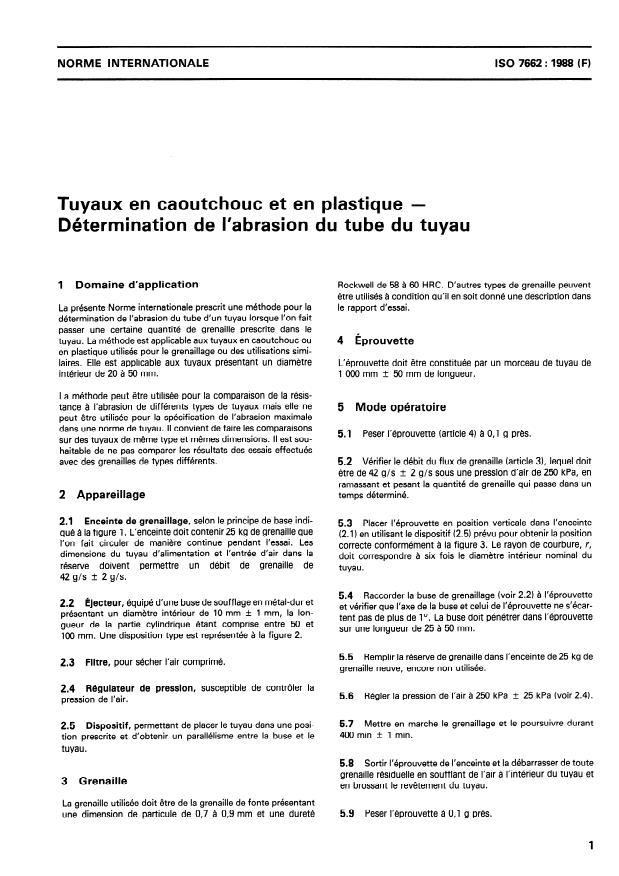
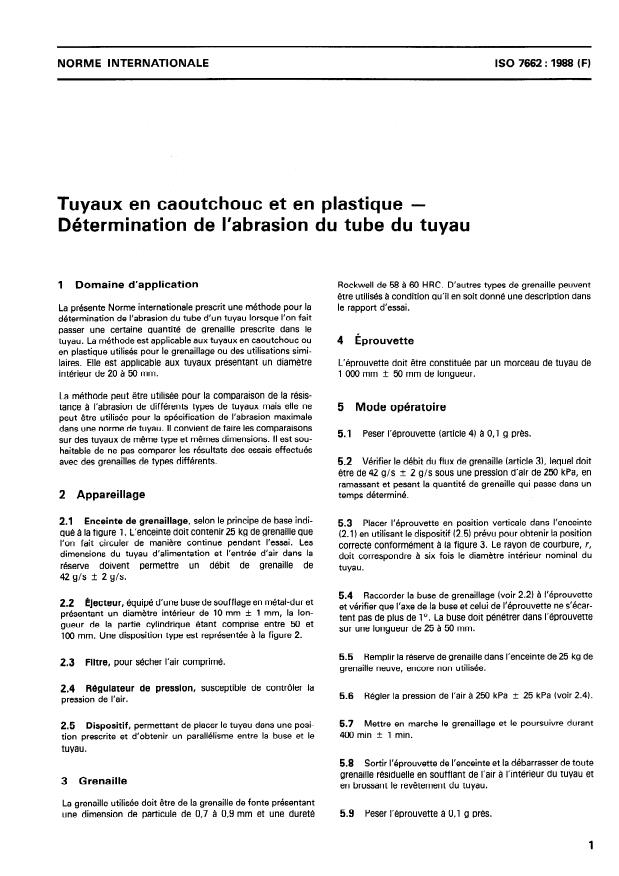
La présente Norme internationale prescrit une méthode pour la détermination de l'abrasion du tube d'un tuyau lorsque l'on fait passer une certaine quantité de grenaille prescrite dans le tuyau. La méthode est applicable aux tuyaux en caoutchouc ou en plastique utilisés pour le grenaillage ou des utilisations similaires. Elle est applicable aux tuyaux présentant un diamètre intérieur de 20 à 50 mm. La méthode peut être utilisée pour la comparaison de la résistance à l'abrasion de différents types de tuyaux mais elle ne peut être utilisée pour la spécification de l'abrasion maximale dans une norme de tuyau. Il convient de faire les comparaisons sur des tuyaux de même type et mêmes dimensions. Il est souhaitable de ne pas comparer les résultats des essais effectués avec des grenailles de types différents.
General Information
- Status
- Withdrawn
- Publication Date
- 20-Apr-1988
- Technical Committee
- ISO/TC 45/SC 1 - Rubber and plastics hoses and hose assemblies
- Drafting Committee
- ISO/TC 45/SC 1/WG 4 - Hose test methods
- Current Stage
- 9599 - Withdrawal of International Standard
- Start Date
- 16-Jan-2025
- Completion Date
- 14-Feb-2026
Overview
ISO 7662:1988 is an international standard developed by the International Organization for Standardization (ISO) that specifies a precise method for determining the abrasion resistance of the lining in rubber and plastic hoses. This standard is critical for evaluating how hose linings perform under abrasive conditions such as grit blasting, shot blasting, and similar industrial operations. It applies to hoses with an internal bore diameter ranging from 20 to 50 mm. By providing a consistent test method, ISO 7662 allows manufacturers and users to compare the abrasion resistance of different hose materials and constructions accurately.
Key Topics
- Test Method: The standard defines a procedure where a specific quantity of metallic grit (0.7 to 0.9 mm particle size, Hardness Rockwell 58-60 HRC) is passed through the hose lining under controlled conditions to simulate abrasive wear.
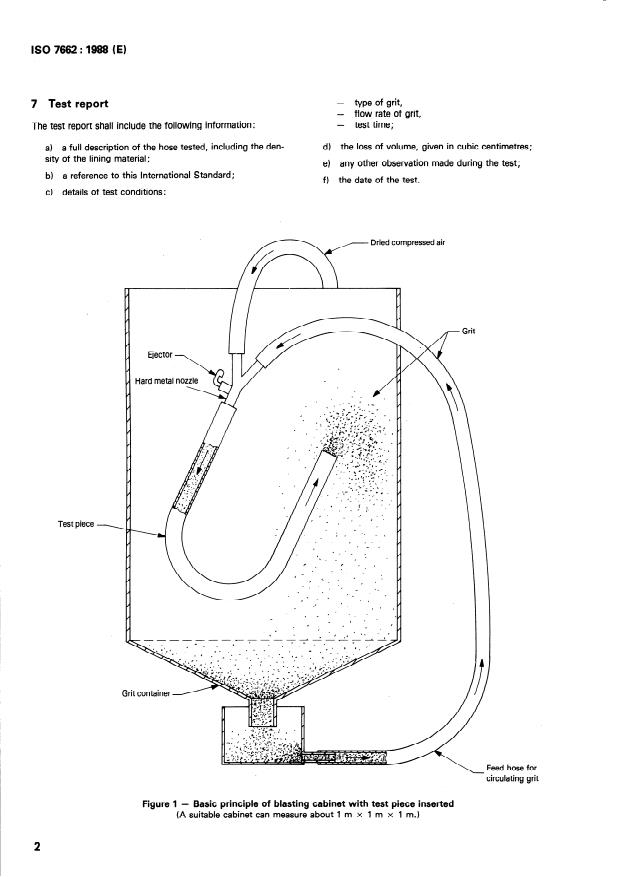
- Test Setup: Utilizes an abrasive blasting enclosure containing 25 kg of grit circulated continuously during the test, and an ejector fitted with a metal-hard blasting nozzle that directs grit through the lining.
- Sample Preparation: Test specimens are hose sections 1000 mm long, weighed before and after testing with 0.1 g accuracy.
- Operating Conditions:
- Air pressure regulated at 250 kPa ± 25 kPa
- Grit flow rate of 42 g/s ± 2 g/s
- Test duration of 400 minutes ± 1 minute
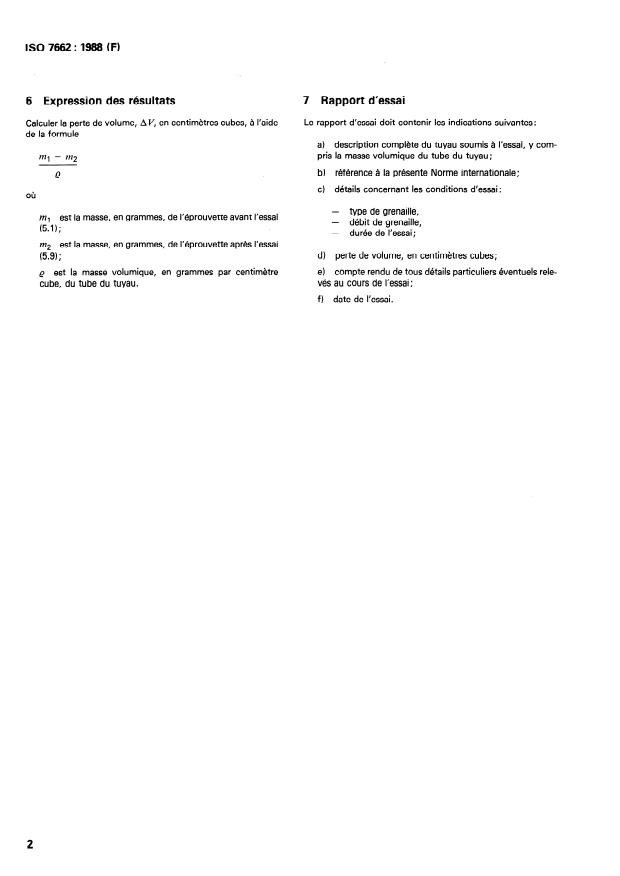
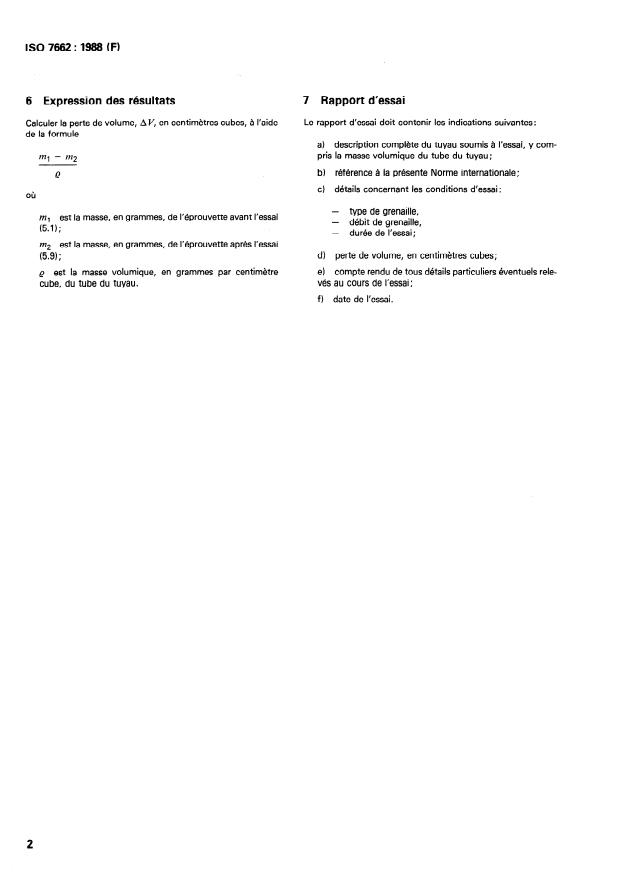
- Result Calculation: Abrasion loss is quantified as the volume loss of the hose lining, derived from the weight difference before and after the test considering the material density.
- Reporting: Comprehensive test reports must include hose description, grit type, flow rate, test duration, and recorded volume loss of the lining.
Applications
ISO 7662:1988 serves a vital role in industries where hoses undergo severe abrasive wear during use. Typical applications include:
- Industrial Abrasive Conveyance: Hoses that transport abrasive media like grit and shot for surface preparation.
- Manufacturing and Construction: Assessing hose durability in sandblasting and grit blasting operations to optimize hose material selection and design.
- Quality Control and Product Development: Comparing abrasion resistance of new hose lining materials or compounds to ensure product longevity in harsh environments.
- Procurement Specifications: Providing objective test data to support the selection of hoses based on abrasion resistance performance.
- Maintenance and Safety: Preventing premature hose failure that can cause operational downtime or safety hazards caused by worn-out hose linings.
Related Standards
To complement ISO 7662, other related ISO and industry standards may be consulted for a complete understanding of hose performance and safety:
- ISO 8330 - Rubber and plastics hoses and hose assemblies - Vocabulary: Defines terms related to hoses and their components, essential for clear communication.
- ISO 4649 - Rubber- or plastics-covered abrasive belts - Determination of abrasion resistance: Focuses on abrasion testing of flexible rubber/plastic surfaces.
- ISO 18752 - Rubber and plastics hoses and hose assemblies - Hydraulic hoses: Specifies requirements and tests relevant for hydraulic hose durability.
- ASTM D3953 - Standard Test Method for Abrasion Resistance of Rubber: Another commonly used abrasion testing procedure in the rubber industry.
- EN 2386 - Rubber and plastic hoses - General specifications: Provides a framework for hose properties and testing methods.
Implementing ISO 7662:1988 enhances the reliability and durability of hoses in abrasive environments by ensuring that hose linings meet rigorous abrasion resistance criteria. This contributes not only to product quality assurance but also to operational safety and cost-efficiency in abrasive handling applications.
Buy Documents
ISO 7662:1988 - Rubber and plastics hoses — Determination of abrasion of lining Released:4/21/1988
ISO 7662:1988 - Tuyaux en caoutchouc et en plastique — Détermination de l'abrasion du tube du tuyau Released:4/21/1988
ISO 7662:1988 - Tuyaux en caoutchouc et en plastique — Détermination de l'abrasion du tube du tuyau Released:4/21/1988
Get Certified
Connect with accredited certification bodies for this standard

Institut za varilstvo d.o.o. (Welding Institute)
Slovenia's leading welding institute since 1952. ISO 3834, EN 1090, pressure equipment certification, NDT personnel, welder qualification. Only IIW Au
Sponsored listings
Frequently Asked Questions
ISO 7662:1988 is a standard published by the International Organization for Standardization (ISO). Its full title is "Rubber and plastics hoses — Determination of abrasion of lining". This standard covers: Specifies a method for determining the abrasion of a hose lining when a certain amount of specified grit is passed through the hose. The method is applicable to rubber and plastics hoses with an internal bore of 20 to 50 mm used for grit blasting, shot blasting and similar operation. The method may be used for comparison of the abrasion resistance of different types of hose.
Specifies a method for determining the abrasion of a hose lining when a certain amount of specified grit is passed through the hose. The method is applicable to rubber and plastics hoses with an internal bore of 20 to 50 mm used for grit blasting, shot blasting and similar operation. The method may be used for comparison of the abrasion resistance of different types of hose.
ISO 7662:1988 is classified under the following ICS (International Classification for Standards) categories: 23.040.70 - Hoses and hose assemblies. The ICS classification helps identify the subject area and facilitates finding related standards.
ISO 7662:1988 is available in PDF format for immediate download after purchase. The document can be added to your cart and obtained through the secure checkout process. Digital delivery ensures instant access to the complete standard document.
Standards Content (Sample)
IS0
INTERNATIONAL STANDARD
First edition
1988-04-15
INTERNATIONAL ORGANIZATION FOR STANDARDIZATION
ORGANISATION INTERNATIONALE DE NORMALISATION
MEXAYHAPOAHAR OPrAHkl3A~MR I-IO CTAH~APTM3A~MM
Rubber and plastics hoses - Determination of
abrasion of lining
Tuyaux en caoutchouc et en plastique - D&termination de l’abrasion du tube du tu yau
Reference number
IS0 7662: 1988 (E)
IS0 7662: 1988 (El
Foreword
IS0 (the International Organization for Standardization) is a worldwide federation of
national standards bodies (IS0 member bodies). The work of preparing International
Standards is normally carried out through IS0 technical committees. Each member
body interested in a subject for which a technical committee has been established has
the right to be represented on that committee. International organizations, govern-
mental and non-governmental, in liaison with ISO, also take part in the work. IS0
collaborates closely with the International Electrotechnical Commission (IEC) on all
matters of electrotechnical standardization.
Draft International Standards adopted by the technical committees are circulated to
the member bodies for approval before their acceptance as International Standards by
the IS0 Council. They are approved in accordance with IS0 procedures requiring at
least 75 % approval by the member bodies voting.
International Standard IS0 7662 was prepared by Technical Committee ISO/TC 45,
Rubber and rubber products.
0 International Organization for Standardization, 1988
Printed in Switzerland
IS0 7662 : 4988 (E)
INTERNATIONAL STANDARD
Determination of
Rubber and plastics hoses -
abrasion of lining
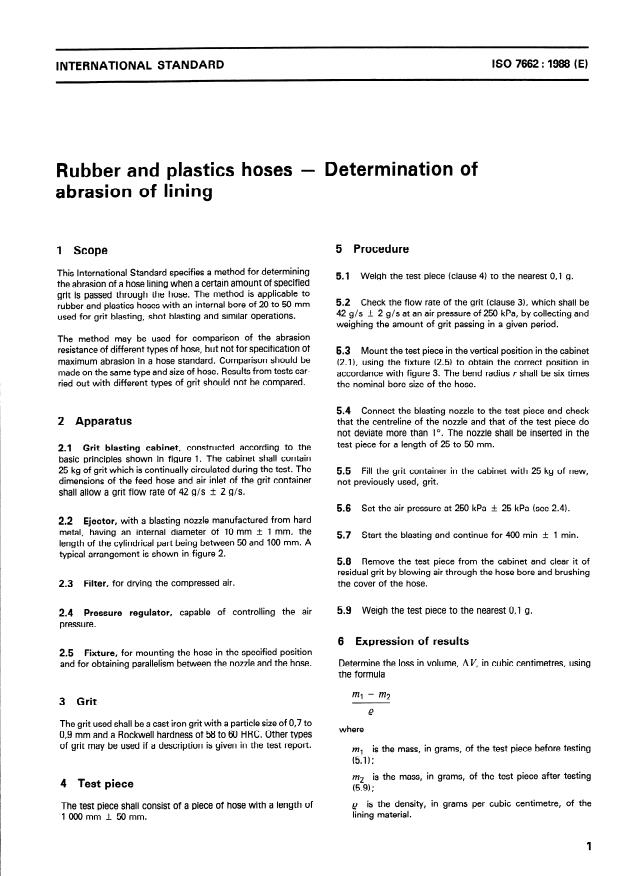
5 Procedure
1 Scope
This International Standard specifies a method for determining
5.1 Weigh the test piece (clause 4) to the nearest 0,l g.
the abrasion of a hose lining when a certain amount of specified
grit is passed through the hose. The method is applicable to
5.2 Check the flow rate of the grit (clause 31, which shall be
rubber and plastics hoses with an internal bore of 20 to 50 mm
42 g/s + 2 g/s at an air pressure of 250 kPa, by collecting and
used for grit blasting, shot blasting and similar operations.
weighing the amount of grit passing in a given period.
The method may be used for comparison of the abrasion
resistance of different types of hose, but not for specification of
5.3 Mount the test piece in the vertical position in the cabinet
maximum abrasion in a hose standard. Comparison should be (2.1), using the fixture (2.5) to obtain the correct position in
made on the same type and size of hose. Results from tests car-
accordance with figure 3. The bend radius r shall be six times
ried out with different types of grit should not be compared.
the nominal bore size of the hose.
5:4 Connect the blasting nozzle to the test piece and check
2 Apparatus
that the centreline of the nozzle and that of the test piece do
not deviate more than 1 O. The nozzle shall be inserted in the
test piece for a length of 25 to 50 mm.
2.1 Grit blasting cabinet,
...
ISO
NORME INTERNATIONALE
Première édition
1988-04-15
INTERNATIONAL ORGANIZATION FOR STANDARDIZATION
ORGANISATION INTERNATIONALE DE NORMALISATION
. MEXflYHAPOAHAR OPI-AHM3A~MFl Il0 CTAHAAPTM3A~MM
Tuyaux en caoutchouc et en plastique -
Détermination de I’abrasion du tube du tuyau
Rubber and plastics hoses - Determination of abrasion of lining
Numéro de référence
ISO 7662 : 1988 (F)
ISO 7662: 1988 (FI
Avant-propos
L’ISO (Organisation internationale de normalisation) est une fédération mondiale
d’organismes nationaux de normalisation (comités membres de I’ISO). L’élaboration
des Normes internationales est en général confiée aux comités techniques de I’ISO.
Chaque comité membre intéressé par une étude a le droit de faire partie du comité
technique créé à cet effet. Les organisations internationales, gouvernementales et non
gouvernementales, en liaison avec I’ISO participent également aux travaux. L’ISO col-
labore étroitement avec la Commission électrotechnique internationale (CEI) en ce qui
concerne la normalisation électrotechnique.
Les projets de Normes internationales adoptés par les comités techniques sont soumis
aux comités membres pour approbation, avant leur acceptation comme Normes inter-
nationales par le Conseil de I’ISO. Les Normes internationales sont approuvées confor-
mément aux procédures de I’ISO qui requièrent l’approbation de 75 % au moins des
comités membres votants.
La Norme internationale ISO 7662 a été élaborée par le comité technique ISO/TC 45,
Efas tomères et produits à base d’élastomères.
0 Organisation internationale de normalisation, 1988
Imprimé en Suisse
NORME INTERNATIONALE ISO 7662: 1988 (FI
Tuyaux en caoutchouc et en plastique -
Détermination de I’abrasion du tube du tuyau
1 Domaine d’application Rockwell de 58 à 60 HRC. D’autres types de grenaille peuvent
être utilisés à condition qu’il en soit donné une description dans
La présente Norme internationale prescrit une méthode pour la le rapport d’essai.
détermination de I’abrasion du tube d’un tuyau lorsque l’on fait
passer une certaine quantité de grenaille prescrite dans le
tuyau. La méthode est applicable aux tuyaux en caoutchouc ou 4 Éprouvette
en plastique utilisés pour le grenaillage ou des utilisations simi-
laires. Elle est applicable aux tuyaux présentant un diamètre L’éprouvette doit être constituée par un morceau de tuyau de
intérieur de 20 à 50 mm.
1 000 mm + 50 mm de longueur.
La méthode peut être utilisée pour la comparaison de la résis-
tance à I’abrasion de différents types de tuyaux mais elle ne
5 Mode opératoire
peut être utilisée pour la spécification de I’abrasion maximale
dans une norme de tuyau. II convient de faire les comparaisons
5.1 Peser l’éprouvette (article 4) à 0,l g près.
sur des tuyaux de même type et mêmes dimensions. II est sou-
haitable de ne pas comparer les résultats des essais effectués
avec des grenailles de types différents. 5.2 Vérifier le débit du flux de grenaille (article 31, lequel doit
être de 42 g/s + 2 g/s sous une pression d’air de 250 kPa, en
ramassant et pesant la quantité de grenaille qui passe dans un
2 Appareillage temps déterminé.
2.1 Enceinte de grenaillage, selon le principe de base indi-
5.3 Placer l’éprouvette en position verticale dans l’enceinte
qué à la figure 1. L’enceinte doit contenir 25 kg de grenaille que
(2.1) en utilisant le dispositif (2.5) prévu pour obtenir la position
...
ISO
NORME INTERNATIONALE
Première édition
1988-04-15
INTERNATIONAL ORGANIZATION FOR STANDARDIZATION
ORGANISATION INTERNATIONALE DE NORMALISATION
. MEXflYHAPOAHAR OPI-AHM3A~MFl Il0 CTAHAAPTM3A~MM
Tuyaux en caoutchouc et en plastique -
Détermination de I’abrasion du tube du tuyau
Rubber and plastics hoses - Determination of abrasion of lining
Numéro de référence
ISO 7662 : 1988 (F)
ISO 7662: 1988 (FI
Avant-propos
L’ISO (Organisation internationale de normalisation) est une fédération mondiale
d’organismes nationaux de normalisation (comités membres de I’ISO). L’élaboration
des Normes internationales est en général confiée aux comités techniques de I’ISO.
Chaque comité membre intéressé par une étude a le droit de faire partie du comité
technique créé à cet effet. Les organisations internationales, gouvernementales et non
gouvernementales, en liaison avec I’ISO participent également aux travaux. L’ISO col-
labore étroitement avec la Commission électrotechnique internationale (CEI) en ce qui
concerne la normalisation électrotechnique.
Les projets de Normes internationales adoptés par les comités techniques sont soumis
aux comités membres pour approbation, avant leur acceptation comme Normes inter-
nationales par le Conseil de I’ISO. Les Normes internationales sont approuvées confor-
mément aux procédures de I’ISO qui requièrent l’approbation de 75 % au moins des
comités membres votants.
La Norme internationale ISO 7662 a été élaborée par le comité technique ISO/TC 45,
Efas tomères et produits à base d’élastomères.
0 Organisation internationale de normalisation, 1988
Imprimé en Suisse
NORME INTERNATIONALE ISO 7662: 1988 (FI
Tuyaux en caoutchouc et en plastique -
Détermination de I’abrasion du tube du tuyau
1 Domaine d’application Rockwell de 58 à 60 HRC. D’autres types de grenaille peuvent
être utilisés à condition qu’il en soit donné une description dans
La présente Norme internationale prescrit une méthode pour la le rapport d’essai.
détermination de I’abrasion du tube d’un tuyau lorsque l’on fait
passer une certaine quantité de grenaille prescrite dans le
tuyau. La méthode est applicable aux tuyaux en caoutchouc ou 4 Éprouvette
en plastique utilisés pour le grenaillage ou des utilisations simi-
laires. Elle est applicable aux tuyaux présentant un diamètre L’éprouvette doit être constituée par un morceau de tuyau de
intérieur de 20 à 50 mm.
1 000 mm + 50 mm de longueur.
La méthode peut être utilisée pour la comparaison de la résis-
tance à I’abrasion de différents types de tuyaux mais elle ne
5 Mode opératoire
peut être utilisée pour la spécification de I’abrasion maximale
dans une norme de tuyau. II convient de faire les comparaisons
5.1 Peser l’éprouvette (article 4) à 0,l g près.
sur des tuyaux de même type et mêmes dimensions. II est sou-
haitable de ne pas comparer les résultats des essais effectués
avec des grenailles de types différents. 5.2 Vérifier le débit du flux de grenaille (article 31, lequel doit
être de 42 g/s + 2 g/s sous une pression d’air de 250 kPa, en
ramassant et pesant la quantité de grenaille qui passe dans un
2 Appareillage temps déterminé.
2.1 Enceinte de grenaillage, selon le principe de base indi-
5.3 Placer l’éprouvette en position verticale dans l’enceinte
qué à la figure 1. L’enceinte doit contenir 25 kg de grenaille que
(2.1) en utilisant le dispositif (2.5) prévu pour obtenir la position
...
Questions, Comments and Discussion
Ask us and Technical Secretary will try to provide an answer. You can facilitate discussion about the standard in here.
Loading comments...