

ISO 13767:2020
(Main)Ships and marine technology — Ship's mooring and towing fittings — Shipside roller fairleads
General Information
- Abstract
This document specifies the types, nominal sizes, dimensions and materials, as well as construction, manufacturing and marking requirements, for shipside roller fairleads installed to lead the mooring rope of a ship.
- Status
- Published
- Publication Date
- 27-Aug-2020
- Technical Committee
- ISO/TC 8/SC 4 - Outfitting and deck machinery
- Drafting Committee
- ISO/TC 8/SC 4/WG 4 - Ship's mooring and towing fittings
- Current Stage
- 9093 - International Standard confirmed
- Start Date
- 17-Aug-2026
- Completion Date
- 29-Aug-2026
Buy Documents
ISO 13767:2020 - Ships and marine technology -- Ship's mooring and towing fittings -- Shipside roller fairleads
ISO 13767:2020 - Ships and marine technology — Ship's mooring and towing fittings — Shipside roller fairleads/28/2020
Overview - ISO 13767:2020 (Shipside roller fairleads)
ISO 13767:2020 specifies requirements for shipside roller fairleads, the mooring and towing fittings used to lead mooring ropes from inboard to outboard. The standard covers classification by type, nominal sizes, dimensional requirements, materials, manufacturing and inspection rules, marking, and the basis for strength assessment (including finite element analysis). It replaces ISO 13767:2012 and aligns with related IMO guidance on mooring and towing equipment.
Key topics and technical requirements
- Types and sizes
- Two construction types: 2-roller and 3-roller.
- Nominal roller diameters (Dn): 150, 200, 250, 300, 350, 400, 450, 500 mm.
- Dimensions and tables
- Detailed dimensional tables and assembly drawings define mounting openings, throat geometry and welding details.
- Materials
- Seats and structural plates: weldable steel with a yield point of ≥ 235 N/mm².
- Manufacturing and inspection
- All surfaces, including welds, must be free of visible flaws.
- Surfaces in contact with ropes must be smooth and free from abrasive irregularities.
- External surfaces must have an anti‑corrosion protective finish.
- Marking and SWL
- Safe Working Load (SWL) must be recorded on the ship’s towing and mooring plan (per IMO MSC/Circ.1175).
- The fairlead must be marked with its SWL (in tonnes, symbol “t”) by weld bead or equivalent, placed so it is not obscured in operation.
- SWL values in the standard are provided for rope deflections of 90° and 160° (noted as θ = 90° and θ = 20° in the document).
- Actual onboard SWL requires consideration of under‑deck reinforcement and may be adjusted by agreement between user and manufacturer.
- Strength assessment / FEM
- Loading cases include horizontal and vertical loads (considered individually).
- Stress criterion: combined stress under SWL limited to 85% of material yield.
- FEM modeling guidance: 2D shell elements, mesh size ~3× plate thickness, and specified boundary conditions.
Applications - who uses this standard
- Shipbuilders and shipyards (fitting specification and installation)
- Mooring‑fittings manufacturers and OEMs (design, fabrication, marking)
- Naval architects and marine engineers (structural design, FE analysis)
- Classification societies and surveyors (type approval, inspection)
- Ship operators and shipmasters (mooring plans, operational SWL awareness)
Related standards and guidance
- ISO 13755 - Ships’ mooring and towing fittings - Steel rollers
- IMO Circular MSC/Circ.1175 - Guidance on shipboard towing and mooring equipment
- IACS UR A2 and OCIMF Mooring Equipment Guidelines (MEG4) - referenced for practice and design context
ISO 13767:2020 is a practical standard for safe, consistent selection, manufacture and marking of shipside roller fairleads, supporting reliable mooring operations and compliance with international mooring equipment guidance.
Relations
- Effective Date
- 06-Jun-2022
- Effective Date
- 30-Sep-2017
Buy Documents
ISO 13767:2020 - Ships and marine technology -- Ship's mooring and towing fittings -- Shipside roller fairleads
ISO 13767:2020 - Ships and marine technology — Ship's mooring and towing fittings — Shipside roller fairleads/28/2020
Get Certified
Connect with accredited certification bodies for this standard

DNV
DNV is an independent assurance and risk management provider.

Lloyd's Register
Lloyd's Register is a global professional services organisation specialising in engineering and technology.

FSC International
Forest Stewardship Council certification.
Sponsored listings
Frequently Asked Questions
ISO 13767:2020 is a standard published by the International Organization for Standardization (ISO). Its full title is "Ships and marine technology — Ship's mooring and towing fittings — Shipside roller fairleads". This standard covers: This document specifies the types, nominal sizes, dimensions and materials, as well as construction, manufacturing and marking requirements, for shipside roller fairleads installed to lead the mooring rope of a ship.
This document specifies the types, nominal sizes, dimensions and materials, as well as construction, manufacturing and marking requirements, for shipside roller fairleads installed to lead the mooring rope of a ship.
ISO 13767:2020 is classified under the following ICS (International Classification for Standards) categories: 47.020.50 - Deck equipment and installations. The ICS classification helps identify the subject area and facilitates finding related standards.
ISO 13767:2020 has the following relationships with other standards: It is inter standard links to ISO 9073-18:2023, ISO 13767:2012. Understanding these relationships helps ensure you are using the most current and applicable version of the standard.
ISO 13767:2020 is available in PDF format for immediate download after purchase. The document can be added to your cart and obtained through the secure checkout process. Digital delivery ensures instant access to the complete standard document.
Standards Content (Sample)
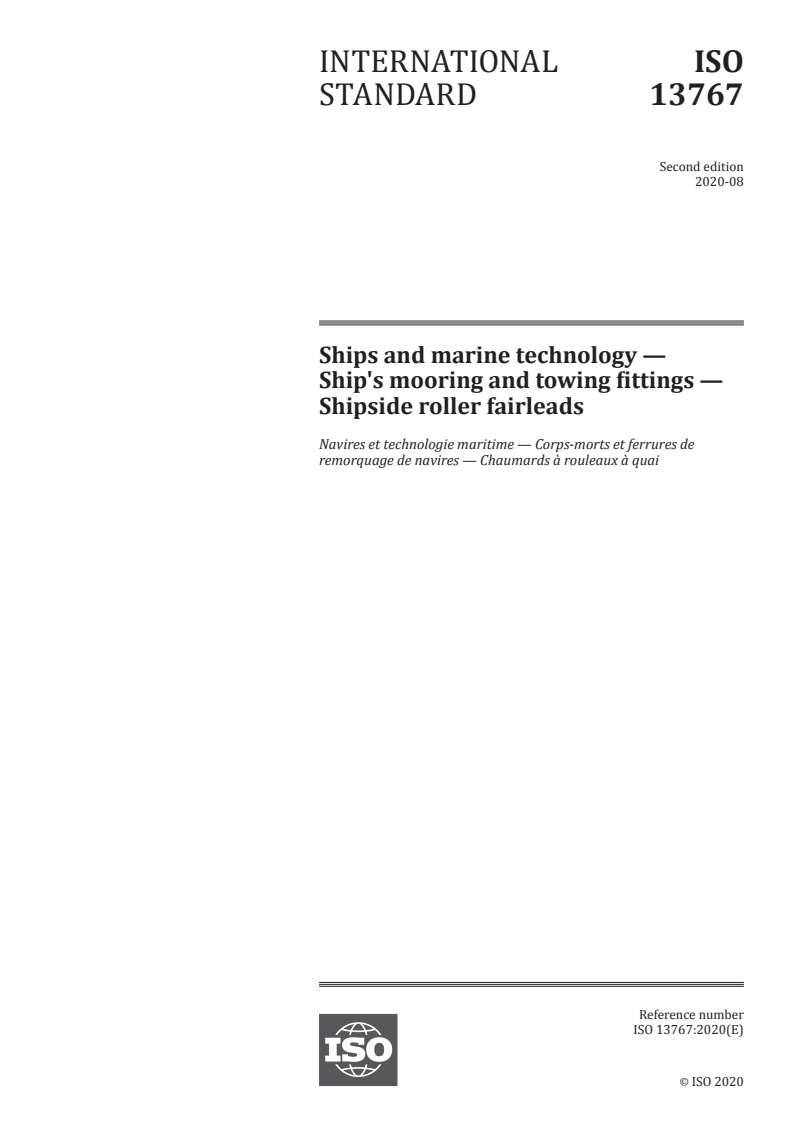
INTERNATIONAL ISO
STANDARD 13767
Second edition
2020-08
Ships and marine technology —
Ship's mooring and towing fittings —
Shipside roller fairleads
Navires et technologie maritime — Corps-morts et ferrures de
remorquage de navires — Chaumards à rouleaux à quai
Reference number
©
ISO 2020
© ISO 2020
All rights reserved. Unless otherwise specified, or required in the context of its implementation, no part of this publication may
be reproduced or utilized otherwise in any form or by any means, electronic or mechanical, including photocopying, or posting
on the internet or an intranet, without prior written permission. Permission can be requested from either ISO at the address
below or ISO’s member body in the country of the requester.
ISO copyright office
CP 401 • Ch. de Blandonnet 8
CH-1214 Vernier, Geneva
Phone: +41 22 749 01 11
Email: copyright@iso.org
Website: www.iso.org
Published in Switzerland
ii © ISO 2020 – All rights reserved
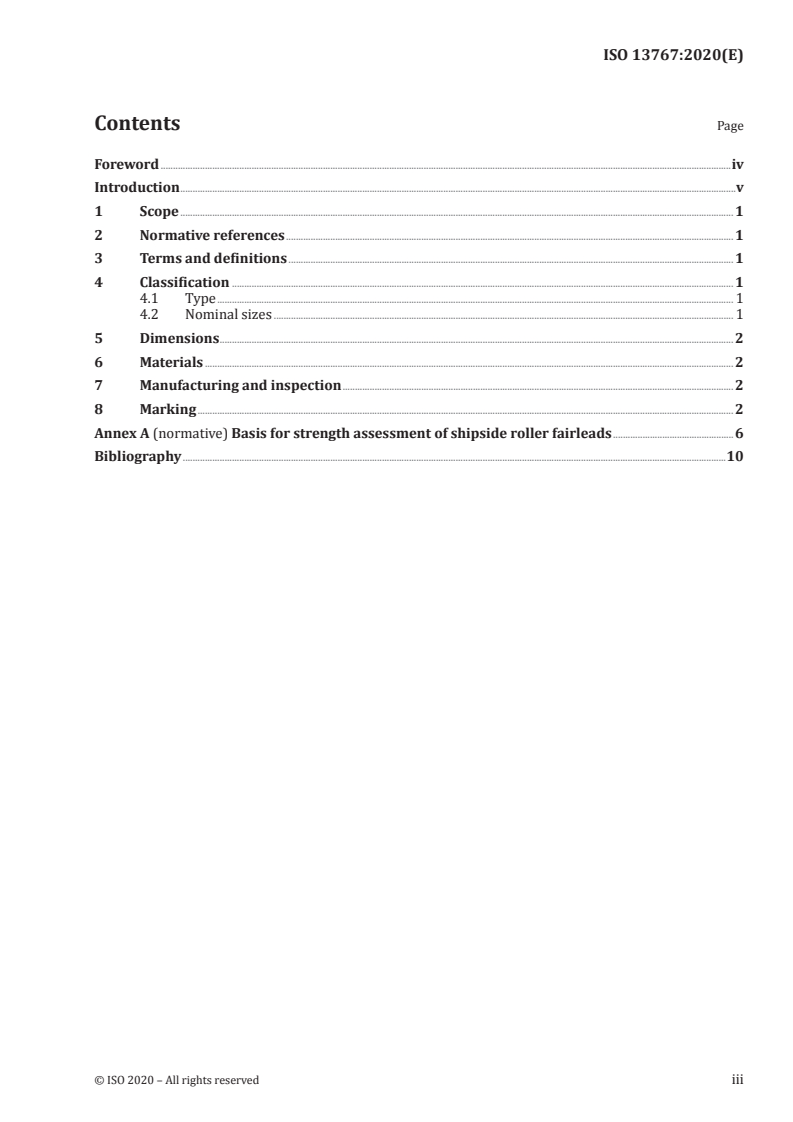
Contents Page
Foreword .iv
Introduction .v
1 Scope . 1
2 Normative references . 1
3 Terms and definitions . 1
4 Classification . 1
4.1 Type . 1
4.2 Nominal sizes . 1
5 Dimensions . 2
6 Materials . 2
7 Manufacturing and inspection . 2
8 Marking . 2
Annex A (normative) Basis for strength assessment of shipside roller fairleads .6
Bibliography .10
Foreword
ISO (the International Organization for Standardization) is a worldwide federation of national standards
bodies (ISO member bodies). The work of preparing International Standards is normally carried out
through ISO technical committees. Each member body interested in a subject for which a technical
committee has been established has the right to be represented on that committee. International
organizations, governmental and non-governmental, in liaison with ISO, also take part in the work.
ISO collaborates closely with the International Electrotechnical Commission (IEC) on all matters of
electrotechnical standardization.
The procedures used to develop this document and those intended for its further maintenance are
described in the ISO/IEC Directives, Part 1. In particular, the different approval criteria needed for the
different types of ISO documents should be noted. This document was drafted in accordance with the
editorial rules of the ISO/IEC Directives, Part 2 (see www .iso .org/ directives).
Attention is drawn to the possibility that some of the elements of this document may be the subject of
patent rights. ISO shall not be held responsible for identifying any or all such patent rights. Details of
any patent rights identified during the development of the document will be in the Introduction and/or
on the ISO list of patent declarations received (see www .iso .org/ patents).
Any trade name used in this document is information given for the convenience of users and does not
constitute an endorsement.
For an explanation of the voluntary nature of standards, the meaning of ISO specific terms and
expressions related to conformity assessment, as well as information about ISO's adherence to
the World Trade Organization (WTO) principles in the Technical Barriers to Trade (TBT), see
www .iso .org/ iso/ foreword .html.
This document was prepared Technical Committee ISO/TC 8, Ships and marine technology, Subcommittee
SC 4, Outfitting and deck machinery.
This second edition cancels and replaces the first edition (ISO 13767:2012), which has been technically
revised.
The main changes compared to the previous edition are as follows:
— the definition of SWL (3.1) has been reworded;
— the column headings in Table 1 have been amended;
— the mark numbers in Figure 2 have been amended;
— technical information on FEM has been added in A.3.2.
Any feedback or questions on this document should be directed to the user’s national standards body. A
complete listing of these bodies can be found at www .iso .org/ members .html.
iv © ISO 2020 – All rights reserved
Introduction
The shipside roller fairlead is a type of ship’s mooring fitting installed on board to lead the mooring
rope from the ship’s inboard to outboard.
INTERNATIONAL STANDARD ISO 13767:2020(E)
Ships and marine technology — Ship's mooring and towing
fittings — Shipside roller fairleads
1 Scope
This document specifies the types, nominal sizes, dimensions and materials, as well as construction,
manufacturing and marking requirements, for shipside roller fairleads installed to lead the mooring
rope of a ship.
2 Normative references
The following documents are referred to in the text in such a way that some or all of their content
constitutes requirements of this document. For dated references, only the edition cited applies. For
undated references, the latest edition of the referenced document (including any amendments) applies.
ISO 13755, Ships and marine technology — Ship’s mooring and towing fittings — Steel rollers
IMO Circular MSC/Circ.1175, Guidance on shipboard towing and mooring equipment
3 Terms and definitions
For the purposes of this document, the following terms and definitions apply.
ISO and IEC maintain terminological databases for use in standardization at the following addresses:
— ISO Online browsing platform: available at https:// www .iso .org/ obp
— IEC Electropedia: available at http:// www .electropedia .org/
3.1
safe working load
SWL
safe load limit (maximum permissible load) of the
...
INTERNATIONAL ISO
STANDARD 13767
Second edition
2020-08
Ships and marine technology —
Ship's mooring and towing fittings —
Shipside roller fairleads
Navires et technologie maritime — Corps-morts et ferrures de
remorquage de navires — Chaumards à rouleaux à quai
Reference number
©
ISO 2020
© ISO 2020
All rights reserved. Unless otherwise specified, or required in the context of its implementation, no part of this publication may
be reproduced or utilized otherwise in any form or by any means, electronic or mechanical, including photocopying, or posting
on the internet or an intranet, without prior written permission. Permission can be requested from either ISO at the address
below or ISO’s member body in the country of the requester.
ISO copyright office
CP 401 • Ch. de Blandonnet 8
CH-1214 Vernier, Geneva
Phone: +41 22 749 01 11
Email: copyright@iso.org
Website: www.iso.org
Published in Switzerland
ii © ISO 2020 – All rights reserved
Contents Page
Foreword .iv
Introduction .v
1 Scope . 1
2 Normative references . 1
3 Terms and definitions . 1
4 Classification . 1
4.1 Type . 1
4.2 Nominal sizes . 1
5 Dimensions . 2
6 Materials . 2
7 Manufacturing and inspection . 2
8 Marking . 2
Annex A (normative) Basis for strength assessment of shipside roller fairleads .6
Bibliography .10
Foreword
ISO (the International Organization for Standardization) is a worldwide federation of national standards
bodies (ISO member bodies). The work of preparing International Standards is normally carried out
through ISO technical committees. Each member body interested in a subject for which a technical
committee has been established has the right to be represented on that committee. International
organizations, governmental and non-governmental, in liaison with ISO, also take part in the work.
ISO collaborates closely with the International Electrotechnical Commission (IEC) on all matters of
electrotechnical standardization.
The procedures used to develop this document and those intended for its further maintenance are
described in the ISO/IEC Directives, Part 1. In particular, the different approval criteria needed for the
different types of ISO documents should be noted. This document was drafted in accordance with the
editorial rules of the ISO/IEC Directives, Part 2 (see www .iso .org/ directives).
Attention is drawn to the possibility that some of the elements of this document may be the subject of
patent rights. ISO shall not be held responsible for identifying any or all such patent rights. Details of
any patent rights identified during the development of the document will be in the Introduction and/or
on the ISO list of patent declarations received (see www .iso .org/ patents).
Any trade name used in this document is information given for the convenience of users and does not
constitute an endorsement.
For an explanation of the voluntary nature of standards, the meaning of ISO specific terms and
expressions related to conformity assessment, as well as information about ISO's adherence to
the World Trade Organization (WTO) principles in the Technical Barriers to Trade (TBT), see
www .iso .org/ iso/ foreword .html.
This document was prepared Technical Committee ISO/TC 8, Ships and marine technology, Subcommittee
SC 4, Outfitting and deck machinery.
This second edition cancels and replaces the first edition (ISO 13767:2012), which has been technically
revised.
The main changes compared to the previous edition are as follows:
— the definition of SWL (3.1) has been reworded;
— the column headings in Table 1 have been amended;
— the mark numbers in Figure 2 have been amended;
— technical information on FEM has been added in A.3.2.
Any feedback or questions on this document should be directed to the user’s national standards body. A
complete listing of these bodies can be found at www .iso .org/ members .html.
iv © ISO 2020 – All rights reserved
Introduction
The shipside roller fairlead is a type of ship’s mooring fitting installed on board to lead the mooring
rope from the ship’s inboard to outboard.
INTERNATIONAL STANDARD ISO 13767:2020(E)
Ships and marine technology — Ship's mooring and towing
fittings — Shipside roller fairleads
1 Scope
This document specifies the types, nominal sizes, dimensions and materials, as well as construction,
manufacturing and marking requirements, for shipside roller fairleads installed to lead the mooring
rope of a ship.
2 Normative references
The following documents are referred to in the text in such a way that some or all of their content
constitutes requirements of this document. For dated references, only the edition cited applies. For
undated references, the latest edition of the referenced document (including any amendments) applies.
ISO 13755, Ships and marine technology — Ship’s mooring and towing fittings — Steel rollers
IMO Circular MSC/Circ.1175, Guidance on shipboard towing and mooring equipment
3 Terms and definitions
For the purposes of this document, the following terms and definitions apply.
ISO and IEC maintain terminological databases for use in standardization at the following addresses:
— ISO Online browsing platform: available at https:// www .iso .org/ obp
— IEC Electropedia: available at http:// www .electropedia .org/
3.1
safe working load
SWL
safe load limit (maximum permissible load) of the
...