

ISO 1769:1975
(Main)Laboratory glassware — Pipettes — Colour coding
General Information
- Abstract
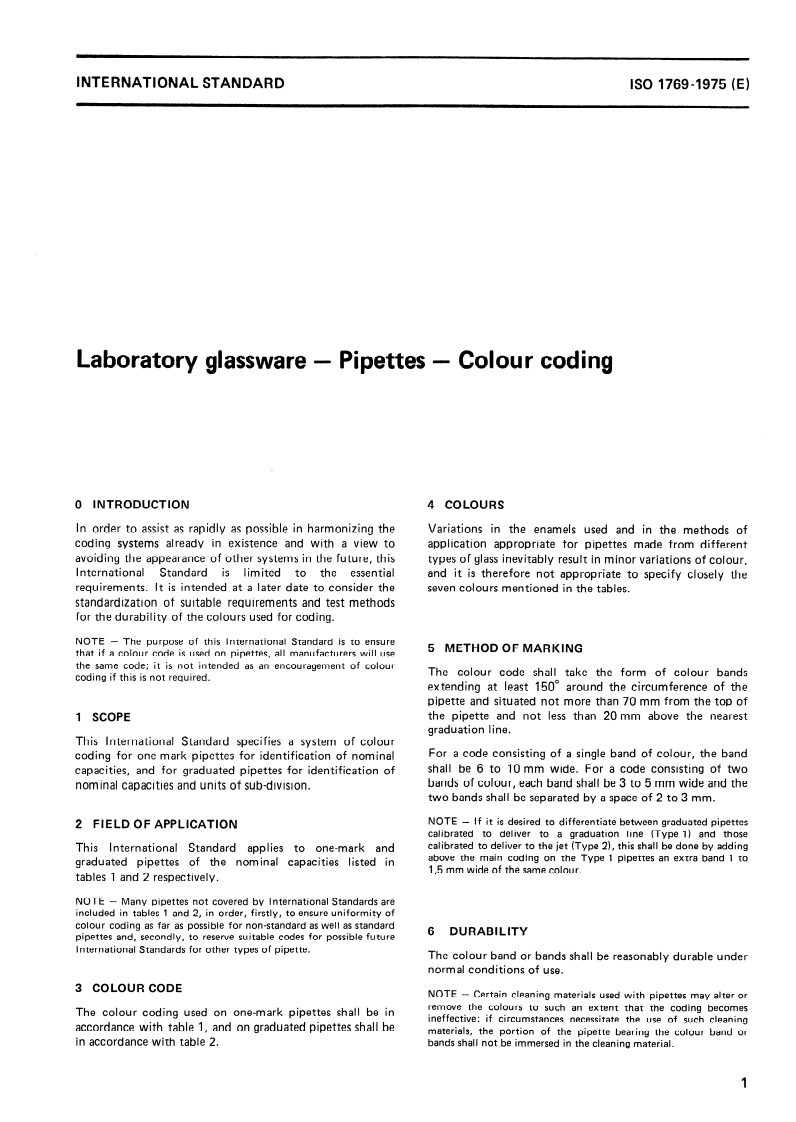
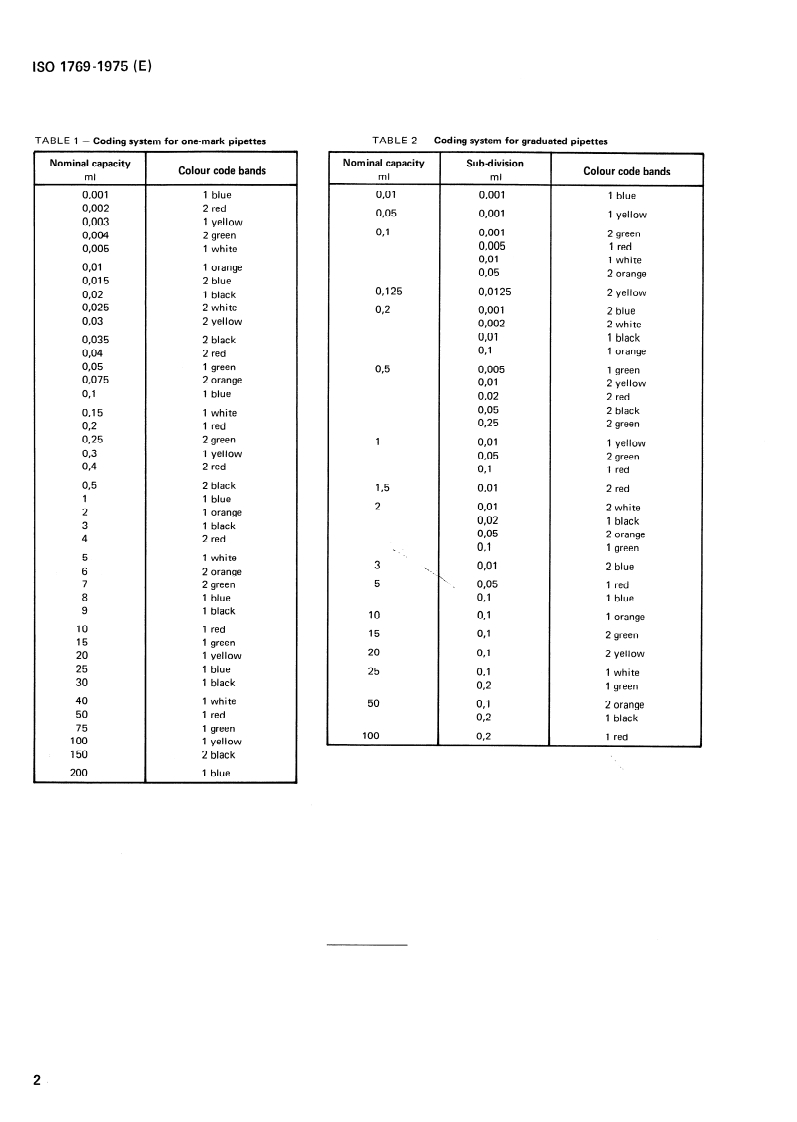
A system of color coding is specified for one-mark pipettes for identification of nominal capacities, and for graduated pipettes for identification of nominal capacities and unit of subdivision. The color code bands for the different capacities are tabled and the method of marking is specified. Suitable requirements and test methods for the durability of the colours are intended to be considered at a later date.
- Status
- Published
- Publication Date
- 31-Aug-1975
- Technical Committee
- ISO/TC 48 - Laboratory equipment
- Drafting Committee
- ISO/TC 48 - Laboratory equipment
- Current Stage
- 9060 - Close of review
- Completion Date
- 02-Sep-2031
Buy Documents






ISO 1769:1975 - Laboratory glassware -- Pipettes -- Colour coding
ISO 1769:1975 - Laboratory glassware — Pipettes — Colour coding/1/1975



ISO 1769:1975 - Verrerie de laboratoire -- Pipettes -- Code de couleurs



ISO 1769:1975 - Verrerie de laboratoire -- Pipettes -- Code de couleurs
ISO 1769:1975 - Verrerie de laboratoire — Pipettes — Code de couleurs/1/1975
ISO 1769:1975 - Verrerie de laboratoire — Pipettes — Code de couleurs/1/1975
Overview
ISO 1769:1975 is an International Standard developed by the International Organization for Standardization (ISO) that specifies a color coding system for laboratory glassware, specifically pipettes. This standard provides uniform guidelines for color marking on one-mark and graduated pipettes to identify their nominal capacities and units of subdivision. The primary goal is to harmonize existing color coding variations, ensuring consistent identification across manufacturers and applications worldwide.
The use of standardized color codes helps laboratory professionals quickly and accurately identify pipette capacities, reducing errors and improving efficiency in various analytical, pharmaceutical, and research settings.
Key Topics
Scope and Application
ISO 1769:1975 applies to both one-mark pipettes and graduated pipettes. Color coding identifies nominal capacities for one-mark pipettes and both nominal capacities and units of subdivision for graduated pipettes. The standard covers a broad range of nominal capacities to ensure compatibility with many pipette types, including some non-standard sizes.Color Coding System
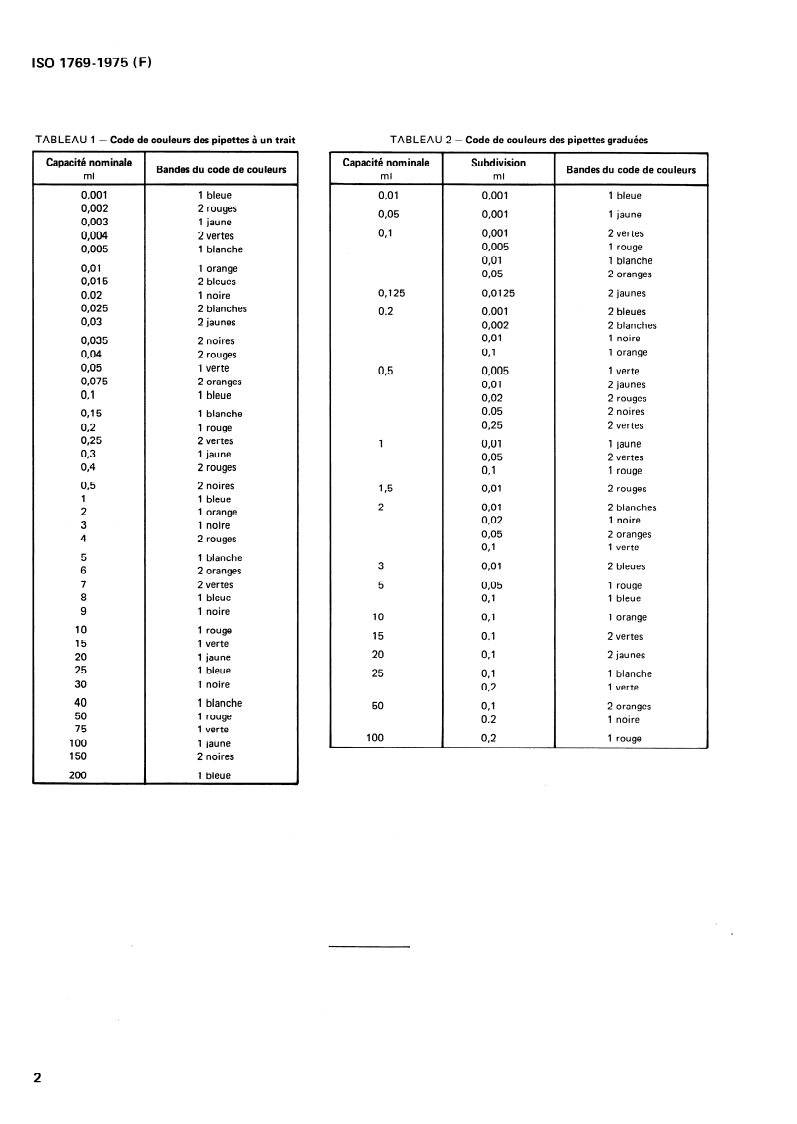
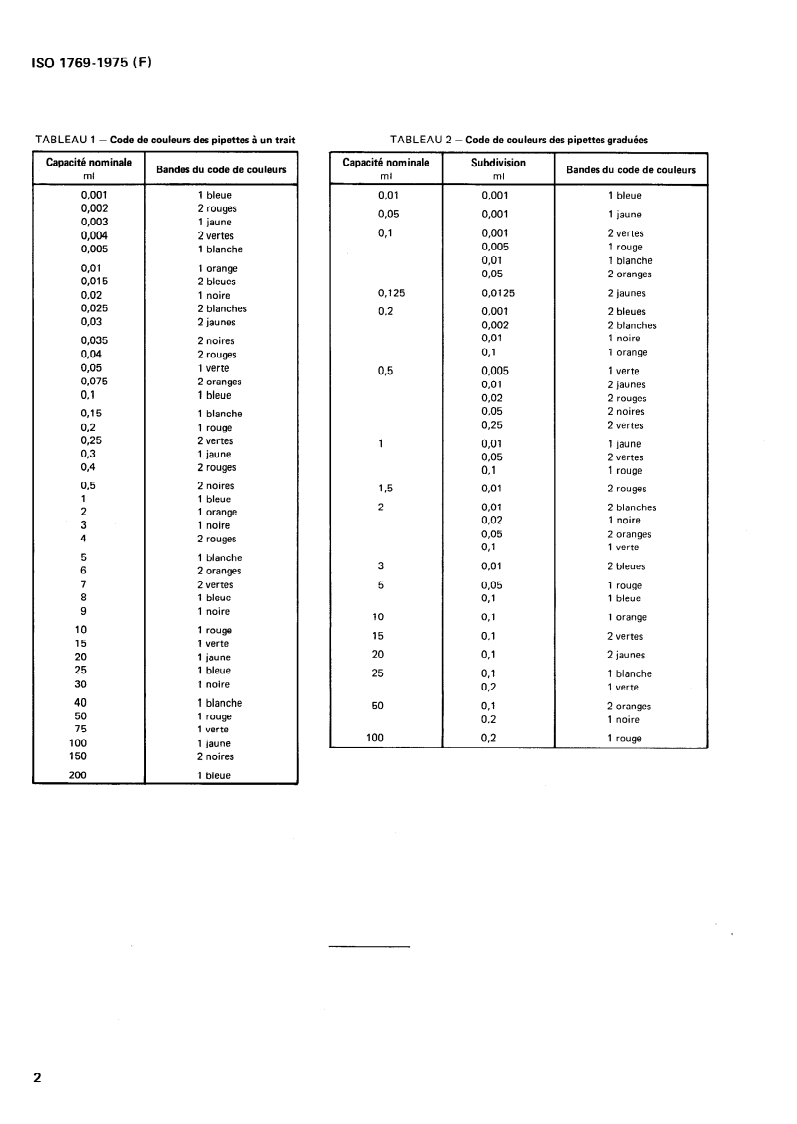
The standard details specific color bands used in pipette marking:- One-mark pipettes use single or multiple colored bands according to capacity.
- Graduated pipettes feature color bands representing nominal capacity and subdivision units.
- Color bands must encircle at least 150° of the pipette circumference and be positioned within defined distances from the top to maintain visibility and consistency.
- Dimensions for bands and spacing are standardized to 3–10 mm widths, depending on the number of bands.
Durability of Colors
Although ISO 1769 specifies the colors and their application method, durability requirements and testing methods for color fastness are planned for future updates. The current standard advises that the color bands must be reasonably durable under typical laboratory usage but warns that certain cleaning chemicals may degrade the color bands.Method of Marking
The standard mandates clear specifications for placement and sizing of color bands:- Bands must not be less than 20 mm above the nearest graduation to avoid obscuring measurement markings.
- Differentiation between pipette types (e.g., Type 1 and Type 2 delivery) can be indicated by an additional narrow band above the main color code.
Applications
ISO 1769:1975’s color coding system is highly valuable in laboratory environments where precise liquid measurement is critical, such as:
Clinical and Medical Laboratories
Ensures rapid identification of pipette volumes, speeding up sample preparation and analysis while minimizing risk of volume errors.Pharmaceutical Production
Supports quality control by standardizing pipette capacity identification, critical for accurate formulation and dosing.Research and Development
Simplifies the workflow in chemical, biological, and environmental research labs by visually distinguishing pipette sizes at a glance.Educational Institutions
Offers uniform coding for teaching laboratories globally, promoting best practices in liquid handling and measurement accuracy.
Related Standards
ISO 1769:1975 complements several other ISO standards associated with laboratory glassware and measurement:
- ISO 4787 – Laboratory glassware - Volumetric glassware - Methods for use and testing of capacity and linear markings
- ISO 3103 – Laboratory glassware - Flasks
- ISO 835 – Laboratory glassware - Beakers
- ISO 385 – Laboratory glassware - Graduated measuring cylinders
These standards collectively ensure consistent quality, calibration, and usability of laboratory glassware across various types and applications.
Keywords: ISO 1769:1975, pipette color coding, laboratory glassware standards, one-mark pipettes, graduated pipettes, nominal capacity identification, pipette marking, laboratory measurement accuracy, pipette capacity color bands, ISO pipette standards.
Relations
- Effective Date
- 25-Aug-2026
- Effective Date
- 25-Aug-2026
Buy Documents
ISO 1769:1975 - Laboratory glassware -- Pipettes -- Colour coding
ISO 1769:1975 - Laboratory glassware — Pipettes — Colour coding/1/1975
ISO 1769:1975 - Verrerie de laboratoire -- Pipettes -- Code de couleurs
ISO 1769:1975 - Verrerie de laboratoire -- Pipettes -- Code de couleurs
ISO 1769:1975 - Verrerie de laboratoire — Pipettes — Code de couleurs/1/1975
ISO 1769:1975 - Verrerie de laboratoire — Pipettes — Code de couleurs/1/1975
Get Certified
Connect with accredited certification bodies for this standard

BSMI (Bureau of Standards, Metrology and Inspection)
Taiwan's standards and inspection authority.
Sponsored listings
Frequently Asked Questions
ISO 1769:1975 is a standard published by the International Organization for Standardization (ISO). Its full title is "Laboratory glassware — Pipettes — Colour coding". This standard covers: A system of color coding is specified for one-mark pipettes for identification of nominal capacities, and for graduated pipettes for identification of nominal capacities and unit of subdivision. The color code bands for the different capacities are tabled and the method of marking is specified. Suitable requirements and test methods for the durability of the colours are intended to be considered at a later date.
A system of color coding is specified for one-mark pipettes for identification of nominal capacities, and for graduated pipettes for identification of nominal capacities and unit of subdivision. The color code bands for the different capacities are tabled and the method of marking is specified. Suitable requirements and test methods for the durability of the colours are intended to be considered at a later date.
ISO 1769:1975 is classified under the following ICS (International Classification for Standards) categories: 01.070 - Colour coding; 17.060 - Measurement of volume, mass, density, viscosity. The ICS classification helps identify the subject area and facilitates finding related standards.
ISO 1769:1975 has the following relationships with other standards: It is inter standard links to EN ISO 648:2008, EN ISO 835:2007. Understanding these relationships helps ensure you are using the most current and applicable version of the standard.
ISO 1769:1975 is available in PDF format for immediate download after purchase. The document can be added to your cart and obtained through the secure checkout process. Digital delivery ensures instant access to the complete standard document.
Standards Content (Sample)
2003-01.Slovenski inštitut za standardizacijo. Razmnoževanje celote ali delov tega standarda ni dovoljeno.Laboratorijska steklovina - Pipete - Barvno kodiranjeVerrerie de laboratoire -- Pipettes -- Code de couleursLaboratory glassware -- Pipettes -- Colour coding71.040.20Laboratorijska posoda in aparatiLaboratory ware and related apparatus01.070Barvno kodiranjeColour codingICS:Ta slovenski standard je istoveten z:ISO 1769:1975SIST ISO 1769:1995en01-avgust-1995SIST ISO 1769:1995SLOVENSKI
STANDARD
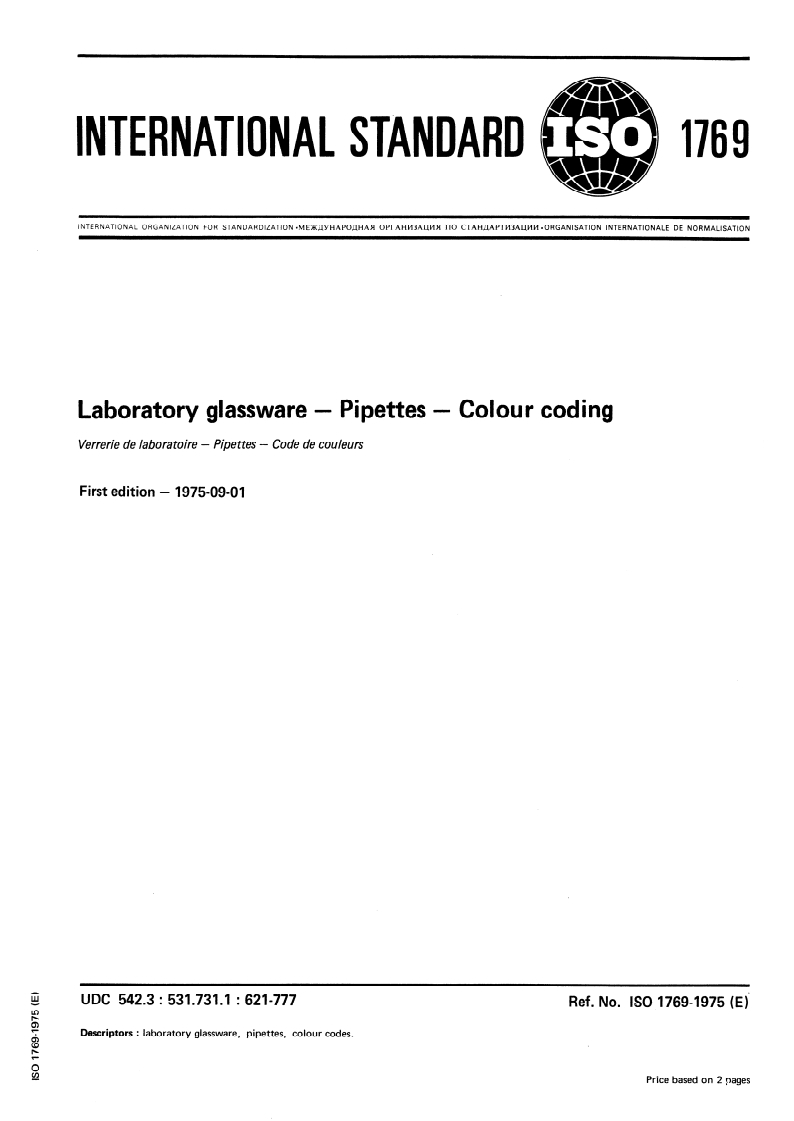
GI - . I E INTERNATIONAL STANDARD INTERNATIONAL ORGANIZATION FOR STANDARDIZATION l ME’HCLrlYHAPOAHAFI OPI-AHM3ALWiR no CTAHAAPTM3ALWWi.ORGANISATION INTERNATIONALE DE NORMALISATION Laboratory glassware - Pipettes - Colour coding Verrerie de laboratoire - Pipettes - Code de couleurs First edition - 1975-09-01 UDC 542.3 : 531.731.1 : 621-777 Ref. No. ISO 1769-1975 (E) Descriptors : laboratory glassware, pipettes, colour Codes. Price based on 2 pages SIST ISO 1769:1995
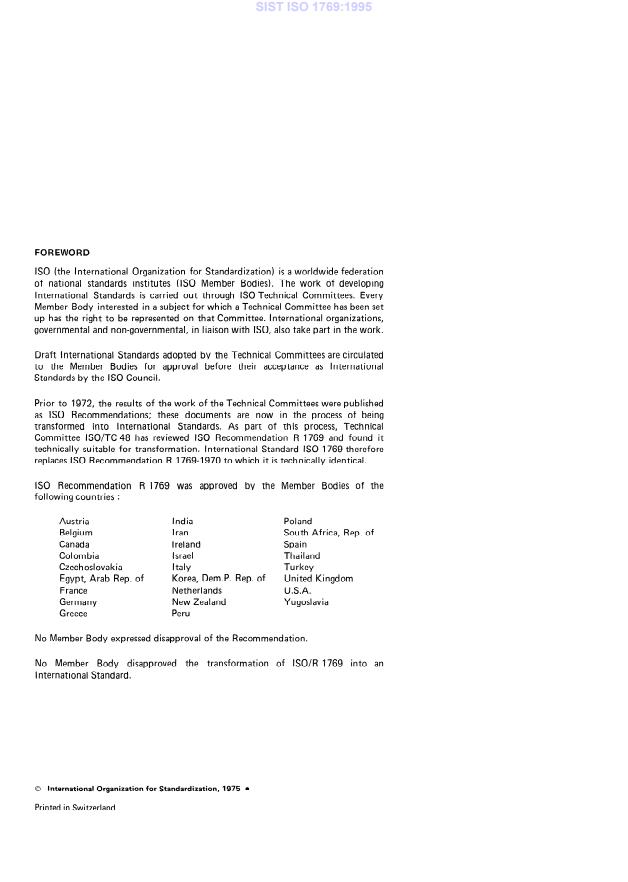
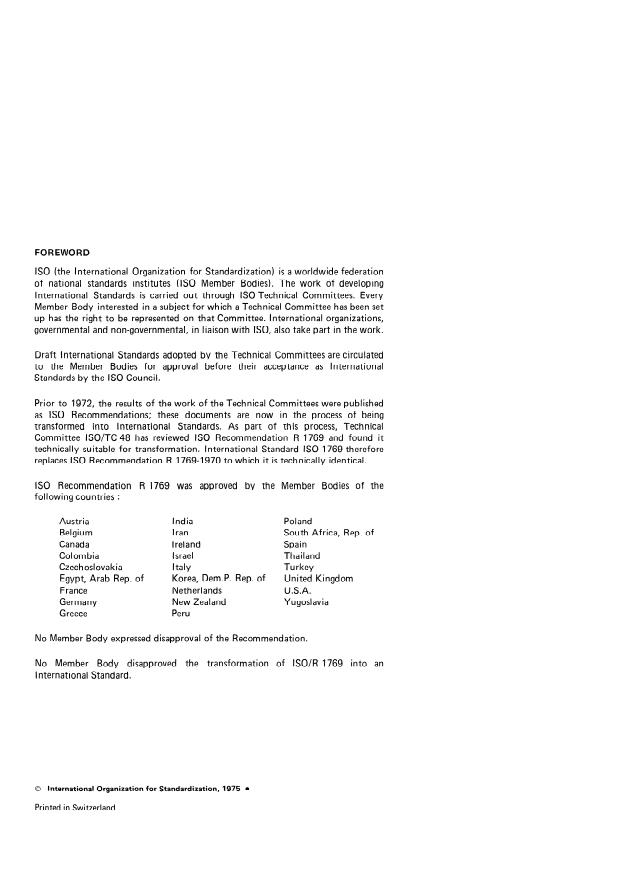
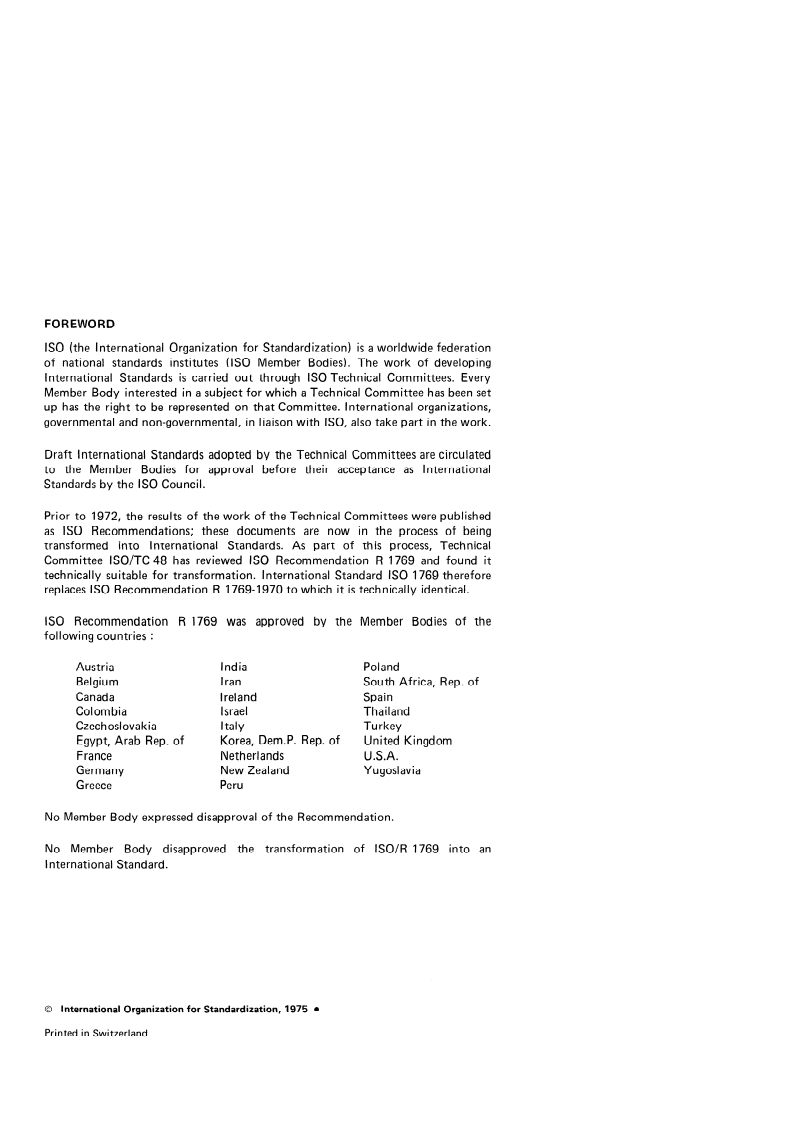
ISO (the International Organization for Standardization) is a worldwide federation of national Standards institutes (ISO Member Bodies). The work of developing International Standards is carried out through ISO Technical Committees. Every Member Body interested in a subject for which a Technical Committee has been set up has the right to be represented on that Committee. International organizations, governmental and non-governmental, in liaison with ISO, also take part in the work. Draft International Standards adopted by the Technical Committees are circulated to the Member Bodies for approval before their acceptance as International Standards by the ISO Council. Prior to 1972, the results of the work of the Technical Committees were published as ISO Recommendations; these documents are now in the process of being transformed into International Standards. As part of this process, Technical Committee ISO/TC 48 has reviewed ISO Recommendation R 1769 and found it technically suitable for transformation. International Standard ISO 1769 therefore replaces ISO Recommendation R 1769-1970 to which it is technically identical. ISO Recommendati following countries : on R 1769 was approved by the Member Bodies of the Austria India Belgium Iran Canada Ireland Colombia Israel Czechoslovakia I taly Egypt, Arab Rep. of Korea, Dem.P. Rep. of France Netherlands Germany New Zealand Greece Peru Poland South Africa, Rep. of Spain Thailand Turkey United Kingdom U.S.A. Yugoslavia No Member Body expressed disapproval of the Recommendation. No Member Body disapproved the transformation of ISO/R 1769 into an International Standard. 0 International Organkation for Standardkation, 1975 l Printed in Switzerland SIST ISO 1769:1995
INTERNATIONAL STANDARD ISO 17694975 (E) Laboratory glassware - Pipettes - Colour coding 0 INTRODUCTION In Order to assist as rapidly as possible in harmonizing the coding Systems already in existente and with a view to avoiding the appearance of other Systems in the future, this International Standard is limited to the essential requirements. lt is intended at a later date to consider the standardization of suitable requirements and test methods for the durability of the colours used for coding. NOTE - The purpose of this International Standard is to ensure that if a colour code is used on pipettes, all manufacturers will use the same Code; it is not intended as an encouragement of colour coding if this is not required. 1 SCOPE This International Standard specifies a System of
...
INTERNATIONAL STANDARD
INTERNATIONAL ORGANIZATION FOR STANDARDIZATION l ME’HCLrlYHAPOAHAFI OPI-AHM3ALWiR no CTAHAAPTM3ALWWi.ORGANISATION INTERNATIONALE DE NORMALISATION
Laboratory glassware - Pipettes - Colour coding
Verrerie de laboratoire - Pipettes - Code de couleurs
First edition
- 1975-09-01
GI
UDC 542.3 : 531.731.1 : 621-777
-
Ref. No. ISO 1769-1975 (E)
.
I Descriptors : laboratory glassware, pipettes, colour Codes.
E
Price based on 2 pages
ISO (the International Organization for Standardization) is a worldwide federation
of national Standards institutes (ISO Member Bodies). The work of developing
International Standards is carried out through ISO Technical Committees. Every
Member Body interested in a subject for which a Technical Committee has been set
up has the right to be represented on that Committee. International organizations,
governmental and non-governmental, in liaison with ISO, also take part in the work.
Draft International Standards adopted by the Technical Committees are circulated
to the Member Bodies for approval before their acceptance as International
Standards by the ISO Council.
Prior to 1972, the results of the work of the Technical Committees were published
as ISO Recommendations; these documents are now in the process of being
transformed into International Standards. As part of this process, Technical
Committee ISO/TC 48 has reviewed ISO Recommendation R 1769 and found it
technically suitable for transformation. International Standard ISO 1769 therefore
replaces ISO Recommendation R 1769-1970 to which it is technically identical.
ISO Recommendati on R 1769 was approved by the Member Bodies of the
following countries :
Austria India Poland
Belgium Iran South Africa, Rep. of
Canada Ireland Spain
Colombia Israel Thailand
Czechoslovakia I taly Turkey
Korea, Dem.P. Rep. of
Egypt, Arab Rep. of United Kingdom
France Netherlands U.S.A.
Germany New Zealand Yugoslavia
Greece Peru
No Member Body expressed disapproval of the Recommendation.
No Member Body disapproved the transformation of ISO/R 1769 into an
International Standard.
0 International Organkation for Standardkation, 1975 l
Printed in Switzerland
INTERNATIONAL STANDARD
ISO 17694975 (E)
Laboratory glassware - Pipettes - Colour coding
0 INTRODUCTION 4 COLOURS
In Order to assist as rapidly as possible in harmonizing the Variations in the enamels used and in the methods of
coding Systems already in existente and with a view to application appropriate for pipettes made from different
avoiding the appearance of other Systems in the future, this types of glass inevitably result in minor variations of colour,
International Standard is limited to the essential and it is therefore not appropriate to specify closely the
requirements. lt is intended at a later date to consider the seven colours mentioned in the tables.
standardization of suitable requirements and test methods
for the durability of the colours used for coding.
NOTE - The purpose of this International Standard is to ensure
5 METHOD OF MARKING
that if a colour code is used on pipettes, all manufacturers will use
the same Code; it is not intended as an encouragement of colour
The colour code shall take the form of colour bands
coding if this is not required.
extending a
...
INTERNATIONAL STANDARD
INTERNATIONAL ORGANIZATION FOR STANDARDIZATION l ME’HCLrlYHAPOAHAFI OPI-AHM3ALWiR no CTAHAAPTM3ALWWi.ORGANISATION INTERNATIONALE DE NORMALISATION
Laboratory glassware - Pipettes - Colour coding
Verrerie de laboratoire - Pipettes - Code de couleurs
First edition
- 1975-09-01
GI
UDC 542.3 : 531.731.1 : 621-777
-
Ref. No. ISO 1769-1975 (E)
.
I Descriptors : laboratory glassware, pipettes, colour Codes.
E
Price based on 2 pages
ISO (the International Organization for Standardization) is a worldwide federation
of national Standards institutes (ISO Member Bodies). The work of developing
International Standards is carried out through ISO Technical Committees. Every
Member Body interested in a subject for which a Technical Committee has been set
up has the right to be represented on that Committee. International organizations,
governmental and non-governmental, in liaison with ISO, also take part in the work.
Draft International Standards adopted by the Technical Committees are circulated
to the Member Bodies for approval before their acceptance as International
Standards by the ISO Council.
Prior to 1972, the results of the work of the Technical Committees were published
as ISO Recommendations; these documents are now in the process of being
transformed into International Standards. As part of this process, Technical
Committee ISO/TC 48 has reviewed ISO Recommendation R 1769 and found it
technically suitable for transformation. International Standard ISO 1769 therefore
replaces ISO Recommendation R 1769-1970 to which it is technically identical.
ISO Recommendati on R 1769 was approved by the Member Bodies of the
following countries :
Austria India Poland
Belgium Iran South Africa, Rep. of
Canada Ireland Spain
Colombia Israel Thailand
Czechoslovakia I taly Turkey
Korea, Dem.P. Rep. of
Egypt, Arab Rep. of United Kingdom
France Netherlands U.S.A.
Germany New Zealand Yugoslavia
Greece Peru
No Member Body expressed disapproval of the Recommendation.
No Member Body disapproved the transformation of ISO/R 1769 into an
International Standard.
0 International Organkation for Standardkation, 1975 l
Printed in Switzerland
INTERNATIONAL STANDARD
ISO 17694975 (E)
Laboratory glassware - Pipettes - Colour coding
0 INTRODUCTION 4 COLOURS
In Order to assist as rapidly as possible in harmonizing the Variations in the enamels used and in the methods of
coding Systems already in existente and with a view to application appropriate for pipettes made from different
avoiding the appearance of other Systems in the future, this types of glass inevitably result in minor variations of colour,
International Standard is limited to the essential and it is therefore not appropriate to specify closely the
requirements. lt is intended at a later date to consider the seven colours mentioned in the tables.
standardization of suitable requirements and test methods
for the durability of the colours used for coding.
NOTE - The purpose of this International Standard is to ensure
5 METHOD OF MARKING
that if a colour code is used on pipettes, all manufacturers will use
the same Code; it is not intended as an encouragement of colour
The colour code shall take the form of colour bands
coding if this is not required.
extending a
...
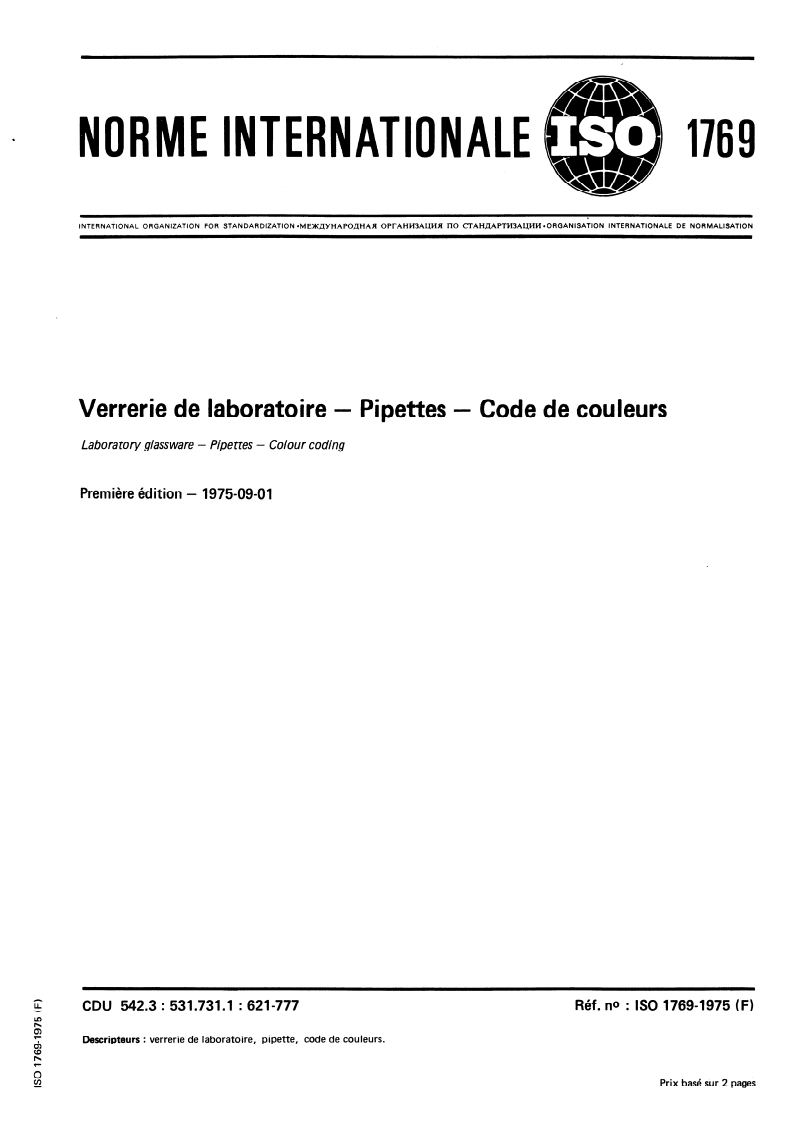
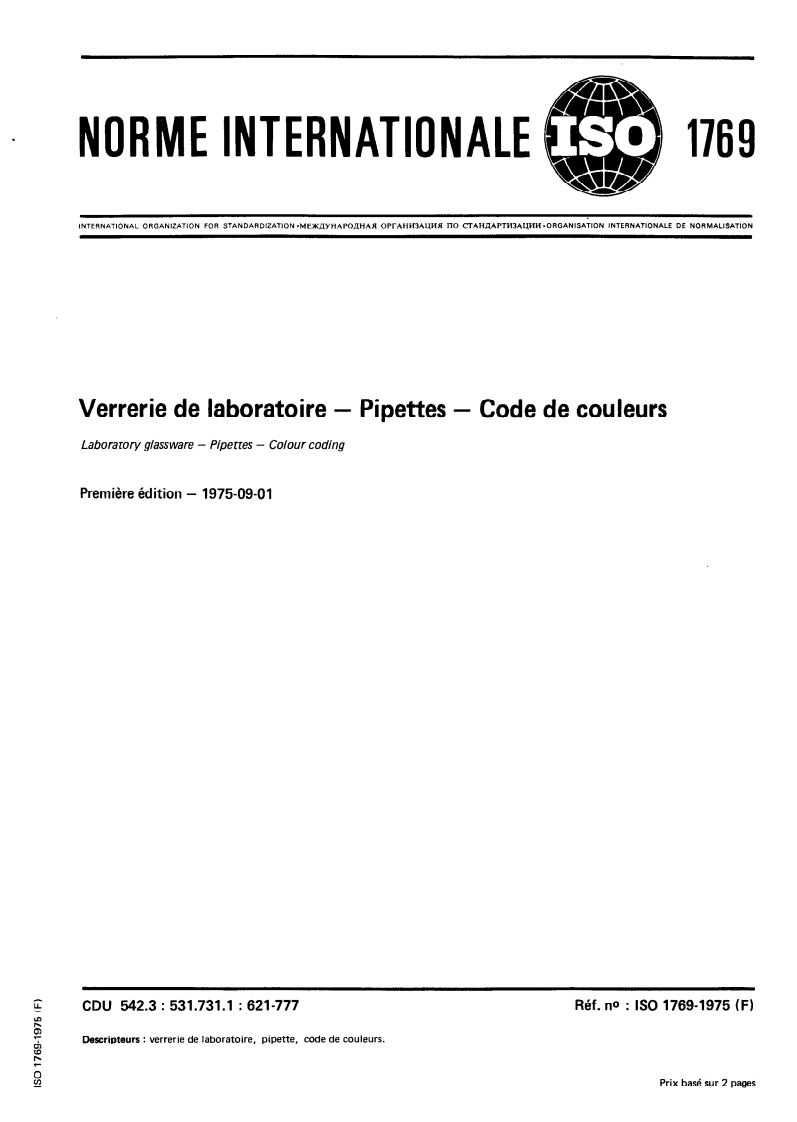
NORME INTERNATIONALE
INTERNATIONAL ORGANIZATION FOR STANDARDIZATION l MElKAYHAPOAHAII OPI-AHM3ALU-W l-I0 CI-AHAAPTM3A~WW~ORGANISATION INTERNATIONALE DE NORMALISATION
Verrerie de laboratoire - Pipettes - Code de couleurs
Laboratoty gfassware - Pipettes - Colour coding
Première édition - 1975-09-01
Réf. no : ISO 17694975 (F)
CDU 542.3 : 531.731.1 : 621-777
Descripteurs : verrerie de laboratoire, pipette, code de couleurs.
Prix basé sur 2 pages
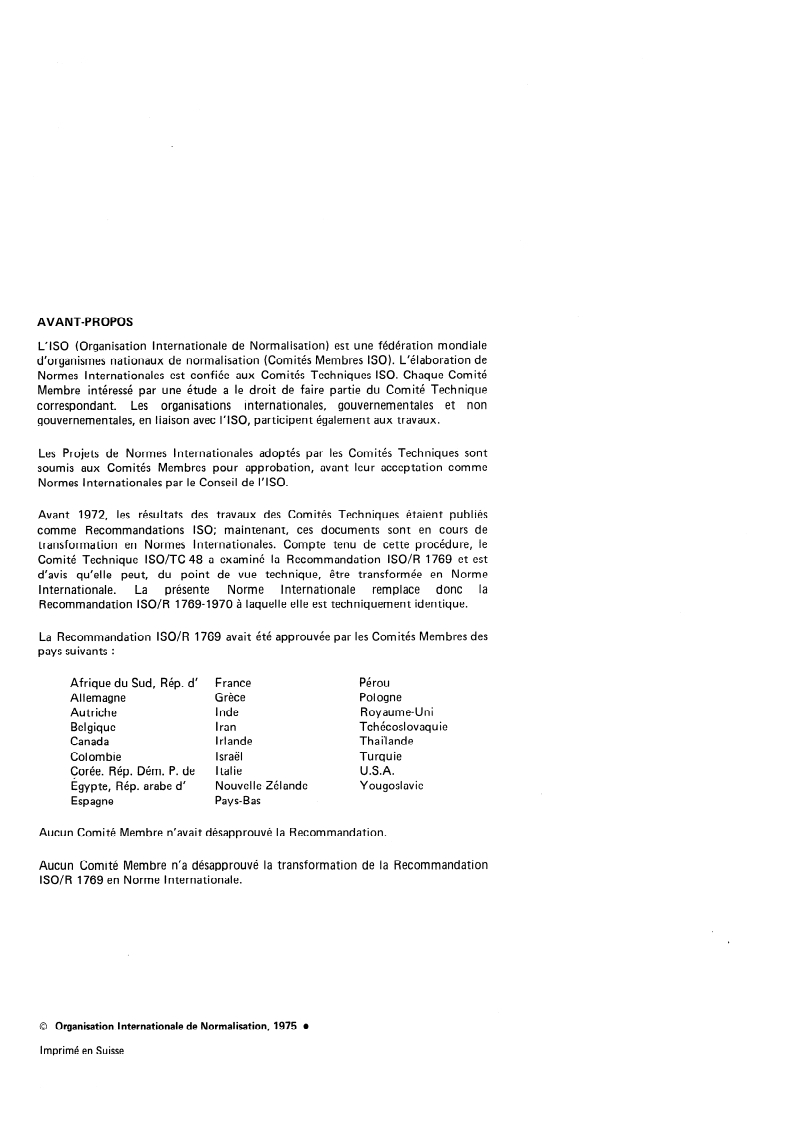
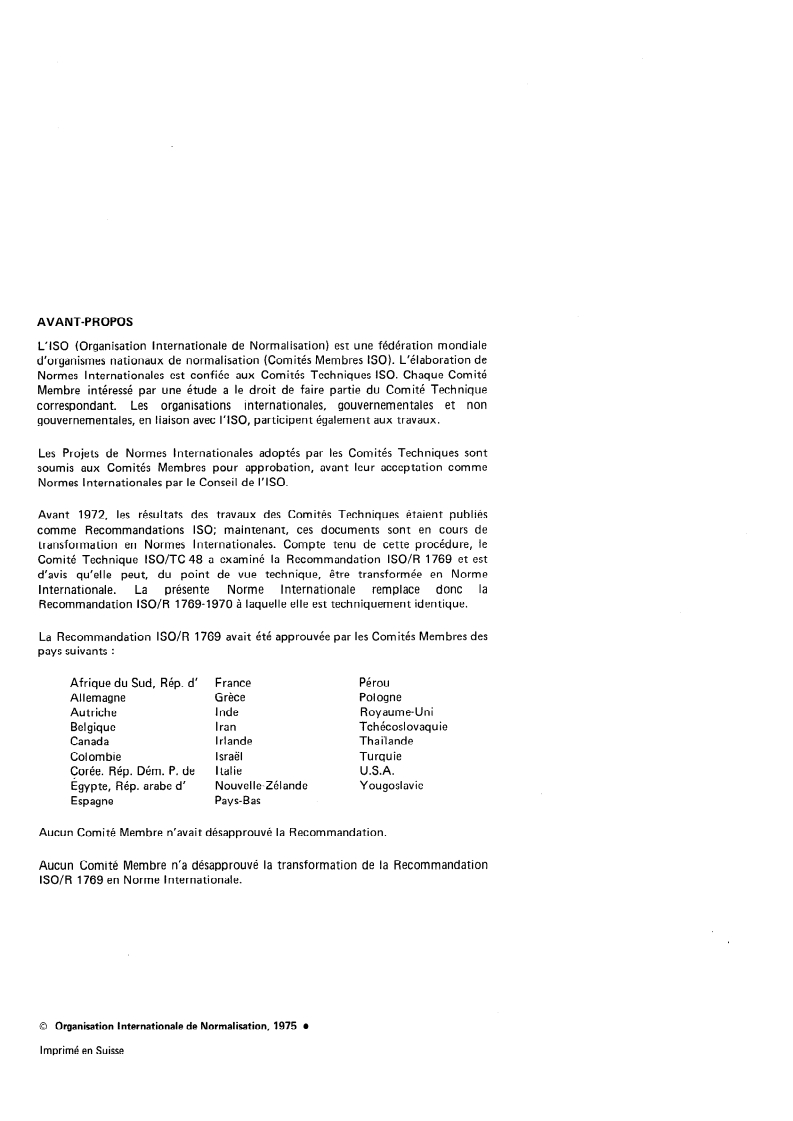
AVANT-PROPOS
L’ISO (Organisation Internationale de Normalisation) est une fédération mondiale
d’organismes nationaux de normalisation (Comités Membres ISO). L’élaboration de
Normes Internationales est confiée aux Comités Techniques ISO. Chaque Comité
Membre intéressé par une étude a le droit de faire partie du Comité Technique
correspondant. Les organisations internationales, gouvernementales et non
gouvernementales, en liaison avec I’ISO, participent également aux travaux.
Les Projets de Normes Internationales adoptés par les Comités Techniques sont
soumis aux Comités Membres pour approbation, avant leur acceptation comme
Normes Internationales par le Conseil de I’ISO.
Avant 1972, les résultats des travaux des Comités Techniques étaient publiés
comme Recommandations ISO; maintenant, ces documents sont en cours de
transformation en Normes Internationales. Compte tenu de cette procédure, le
Comité Technique ISO/TC 48 a examiné la Recommandation ISO/R 1769 et est
d’avis qu’elle peut, du point de vue technique, être transformée en Norme
Internationale. La présente Norme Internationale remplace donc la
Recommandation ISO/R 1769-1970 à laquelle elle est techniquement identique.
La Recommandation ISO/R 1769 avait été approuvée par les Comités Membres des
pays suivants :
Afrique du Sud, Rép. d’ France Pérou
Allemagne Grèce Pologne
Autriche Inde Royaume-Uni
Belgique Iran Tchécoslovaquie
Canada Irlande Thaïlande
Turquie
Colombie Israël
Italie U.S.A.
Corée. Rép. Dém. P. de
Yougoslavie
Égypte, Rép. arabe d’ Nouvelle-Zélande
Espagne Pays-Bas
Aucun Comité Membre n’avait désapprouvé la Recommandation.
Aucun Comité Membre n’a désapprouvé la transformation de la Recommandation
lSO/R 1769 en Norme Internationale.
0 Organisation Internationale de Normalisation, 1975 l
Imprimé en Suisse
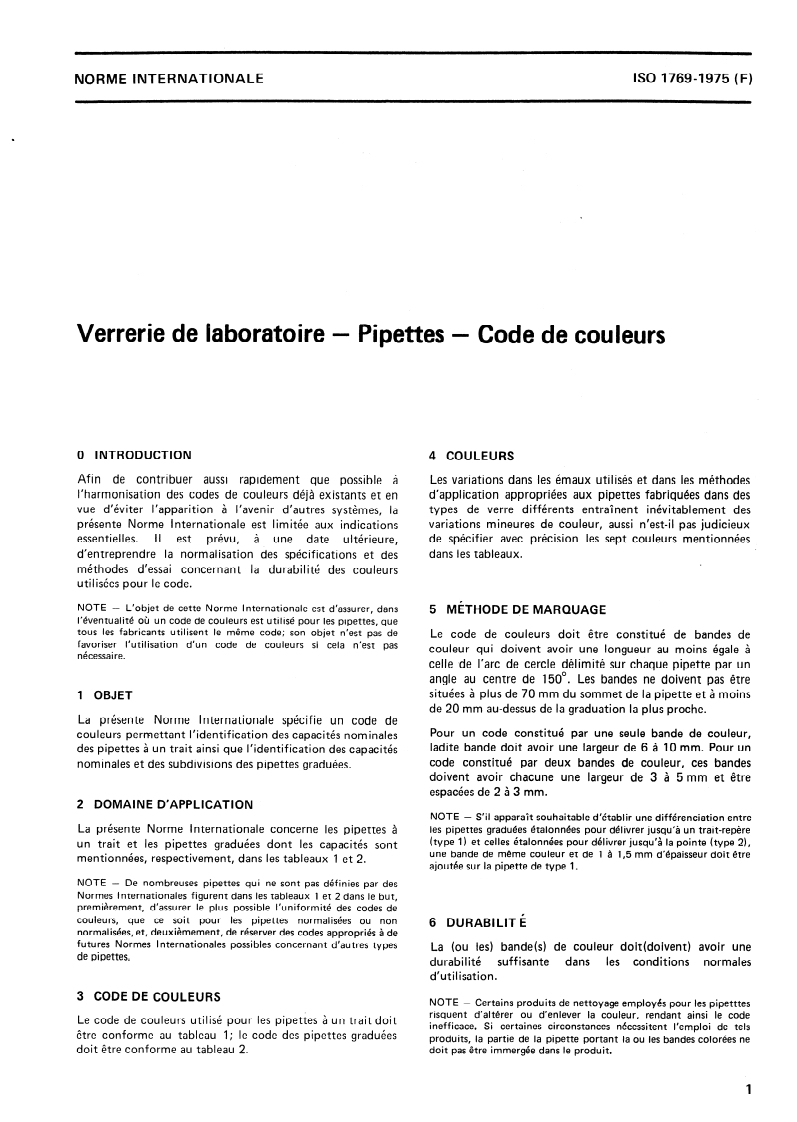
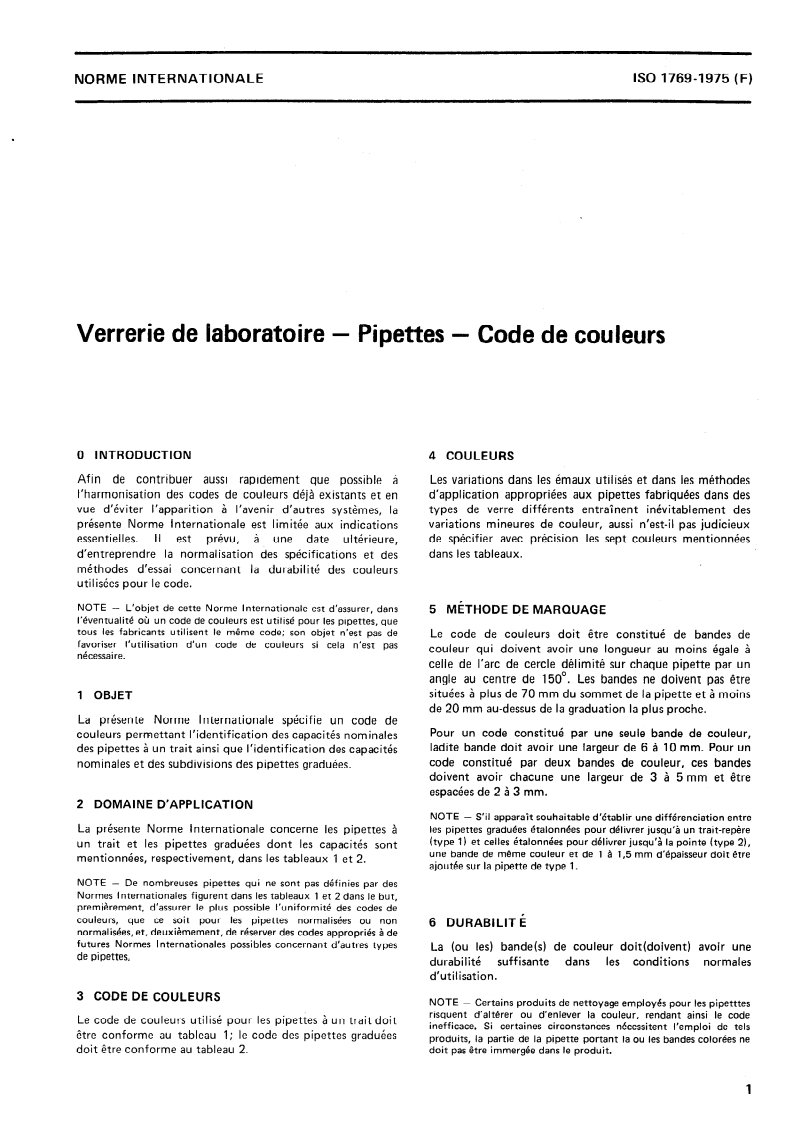
ISO 17694975 (F)
NORME INTERNATIONALE
Verrerie de laboratoire - Pipettes - Code de couleurs
0 INTRODUCTION 4 COULEURS
Afin de contribuer aussi rapidement que possible à Les variations dans les émaux utilisés et dans les méthodes
d’application appropriées aux pipettes fabriquées dans des
l’harmonisation des codes de couleurs déjà existants et en
types de verre différents entraînent inévitablement des
vue d’éviter l’apparition à l’avenir d’autres systèmes, la
variations mineures de couleur, aussi n’est-il pas judicieux
présente Norme Internationale est limitée aux indications
de spécifier avec précision les sept couleurs mentionnées
essentielles. II est prévu, à une date ultérieure,
dans les tableaux.
d’entreprendre la normalisation des spécifications et des
méthodes d’essai concernant la durabilité des couleurs
utilisées pour le code.
NOTE - L’objet de cette Norme Internationale est d’assurer, dans
5 MÉTHODE DE MARQUAGE
l’éventualité où un code de couleurs est utilisé pour les pipettes, que
tous les fabricants utilisent le même code; son objet n’est pas de
Le code de couleurs doit être constitué de bandes de
favoriser l’utilisation d’un code de couleurs si cela n’est pas
couleur qui doivent avoir une longueur au moins égale à
nécessaire.
celle de l’arc de cercle délimité sur chaque pipe
...
NORME INTERNATIONALE
INTERNATIONAL ORGANIZATION FOR STANDARDIZATION l MElKAYHAPOAHAII OPI-AHM3ALU-W l-I0 CI-AHAAPTM3A~WW~ORGANISATION INTERNATIONALE DE NORMALISATION
Verrerie de laboratoire - Pipettes - Code de couleurs
Laboratoty gfassware - Pipettes - Colour coding
Première édition - 1975-09-01
Réf. no : ISO 17694975 (F)
CDU 542.3 : 531.731.1 : 621-777
Descripteurs : verrerie de laboratoire, pipette, code de couleurs.
Prix basé sur 2 pages
AVANT-PROPOS
L’ISO (Organisation Internationale de Normalisation) est une fédération mondiale
d’organismes nationaux de normalisation (Comités Membres ISO). L’élaboration de
Normes Internationales est confiée aux Comités Techniques ISO. Chaque Comité
Membre intéressé par une étude a le droit de faire partie du Comité Technique
correspondant. Les organisations internationales, gouvernementales et non
gouvernementales, en liaison avec I’ISO, participent également aux travaux.
Les Projets de Normes Internationales adoptés par les Comités Techniques sont
soumis aux Comités Membres pour approbation, avant leur acceptation comme
Normes Internationales par le Conseil de I’ISO.
Avant 1972, les résultats des travaux des Comités Techniques étaient publiés
comme Recommandations ISO; maintenant, ces documents sont en cours de
transformation en Normes Internationales. Compte tenu de cette procédure, le
Comité Technique ISO/TC 48 a examiné la Recommandation ISO/R 1769 et est
d’avis qu’elle peut, du point de vue technique, être transformée en Norme
Internationale. La présente Norme Internationale remplace donc la
Recommandation ISO/R 1769-1970 à laquelle elle est techniquement identique.
La Recommandation ISO/R 1769 avait été approuvée par les Comités Membres des
pays suivants :
Afrique du Sud, Rép. d’ France Pérou
Allemagne Grèce Pologne
Autriche Inde Royaume-Uni
Belgique Iran Tchécoslovaquie
Canada Irlande Thaïlande
Turquie
Colombie Israël
Italie U.S.A.
Corée. Rép. Dém. P. de
Yougoslavie
Égypte, Rép. arabe d’ Nouvelle-Zélande
Espagne Pays-Bas
Aucun Comité Membre n’avait désapprouvé la Recommandation.
Aucun Comité Membre n’a désapprouvé la transformation de la Recommandation
lSO/R 1769 en Norme Internationale.
0 Organisation Internationale de Normalisation, 1975 l
Imprimé en Suisse
ISO 17694975 (F)
NORME INTERNATIONALE
Verrerie de laboratoire - Pipettes - Code de couleurs
0 INTRODUCTION 4 COULEURS
Afin de contribuer aussi rapidement que possible à Les variations dans les émaux utilisés et dans les méthodes
d’application appropriées aux pipettes fabriquées dans des
l’harmonisation des codes de couleurs déjà existants et en
types de verre différents entraînent inévitablement des
vue d’éviter l’apparition à l’avenir d’autres systèmes, la
variations mineures de couleur, aussi n’est-il pas judicieux
présente Norme Internationale est limitée aux indications
de spécifier avec précision les sept couleurs mentionnées
essentielles. II est prévu, à une date ultérieure,
dans les tableaux.
d’entreprendre la normalisation des spécifications et des
méthodes d’essai concernant la durabilité des couleurs
utilisées pour le code.
NOTE - L’objet de cette Norme Internationale est d’assurer, dans
5 MÉTHODE DE MARQUAGE
l’éventualité où un code de couleurs est utilisé pour les pipettes, que
tous les fabricants utilisent le même code; son objet n’est pas de
Le code de couleurs doit être constitué de bandes de
favoriser l’utilisation d’un code de couleurs si cela n’est pas
couleur qui doivent avoir une longueur au moins égale à
nécessaire.
celle de l’arc de cercle délimité sur chaque pipe
...
NORME INTERNATIONALE
INTERNATIONAL ORGANIZATION FOR STANDARDIZATION l MElKAYHAPOAHAII OPI-AHM3ALU-W l-I0 CI-AHAAPTM3A~WW~ORGANISATION INTERNATIONALE DE NORMALISATION
Verrerie de laboratoire - Pipettes - Code de couleurs
Laboratoty gfassware - Pipettes - Colour coding
Première édition - 1975-09-01
Réf. no : ISO 17694975 (F)
CDU 542.3 : 531.731.1 : 621-777
Descripteurs : verrerie de laboratoire, pipette, code de couleurs.
Prix basé sur 2 pages
AVANT-PROPOS
L’ISO (Organisation Internationale de Normalisation) est une fédération mondiale
d’organismes nationaux de normalisation (Comités Membres ISO). L’élaboration de
Normes Internationales est confiée aux Comités Techniques ISO. Chaque Comité
Membre intéressé par une étude a le droit de faire partie du Comité Technique
correspondant. Les organisations internationales, gouvernementales et non
gouvernementales, en liaison avec I’ISO, participent également aux travaux.
Les Projets de Normes Internationales adoptés par les Comités Techniques sont
soumis aux Comités Membres pour approbation, avant leur acceptation comme
Normes Internationales par le Conseil de I’ISO.
Avant 1972, les résultats des travaux des Comités Techniques étaient publiés
comme Recommandations ISO; maintenant, ces documents sont en cours de
transformation en Normes Internationales. Compte tenu de cette procédure, le
Comité Technique ISO/TC 48 a examiné la Recommandation ISO/R 1769 et est
d’avis qu’elle peut, du point de vue technique, être transformée en Norme
Internationale. La présente Norme Internationale remplace donc la
Recommandation ISO/R 1769-1970 à laquelle elle est techniquement identique.
La Recommandation ISO/R 1769 avait été approuvée par les Comités Membres des
pays suivants :
Afrique du Sud, Rép. d’ France Pérou
Allemagne Grèce Pologne
Autriche Inde Royaume-Uni
Belgique Iran Tchécoslovaquie
Canada Irlande Thaïlande
Turquie
Colombie Israël
Italie U.S.A.
Corée. Rép. Dém. P. de
Yougoslavie
Égypte, Rép. arabe d’ Nouvelle-Zélande
Espagne Pays-Bas
Aucun Comité Membre n’avait désapprouvé la Recommandation.
Aucun Comité Membre n’a désapprouvé la transformation de la Recommandation
lSO/R 1769 en Norme Internationale.
0 Organisation Internationale de Normalisation, 1975 l
Imprimé en Suisse
ISO 17694975 (F)
NORME INTERNATIONALE
Verrerie de laboratoire - Pipettes - Code de couleurs
0 INTRODUCTION 4 COULEURS
Afin de contribuer aussi rapidement que possible à Les variations dans les émaux utilisés et dans les méthodes
d’application appropriées aux pipettes fabriquées dans des
l’harmonisation des codes de couleurs déjà existants et en
types de verre différents entraînent inévitablement des
vue d’éviter l’apparition à l’avenir d’autres systèmes, la
variations mineures de couleur, aussi n’est-il pas judicieux
présente Norme Internationale est limitée aux indications
de spécifier avec précision les sept couleurs mentionnées
essentielles. II est prévu, à une date ultérieure,
dans les tableaux.
d’entreprendre la normalisation des spécifications et des
méthodes d’essai concernant la durabilité des couleurs
utilisées pour le code.
NOTE - L’objet de cette Norme Internationale est d’assurer, dans
5 MÉTHODE DE MARQUAGE
l’éventualité où un code de couleurs est utilisé pour les pipettes, que
tous les fabricants utilisent le même code; son objet n’est pas de
Le code de couleurs doit être constitué de bandes de
favoriser l’utilisation d’un code de couleurs si cela n’est pas
couleur qui doivent avoir une longueur au moins égale à
nécessaire.
celle de l’arc de cercle délimité sur chaque pipe
...
NORME INTERNATIONALE
INTERNATIONAL ORGANIZATION FOR STANDARDIZATION l MElKAYHAPOAHAII OPI-AHM3ALU-W l-I0 CI-AHAAPTM3A~WW~ORGANISATION INTERNATIONALE DE NORMALISATION
Verrerie de laboratoire - Pipettes - Code de couleurs
Laboratoty gfassware - Pipettes - Colour coding
Première édition - 1975-09-01
Réf. no : ISO 17694975 (F)
CDU 542.3 : 531.731.1 : 621-777
Descripteurs : verrerie de laboratoire, pipette, code de couleurs.
Prix basé sur 2 pages
AVANT-PROPOS
L’ISO (Organisation Internationale de Normalisation) est une fédération mondiale
d’organismes nationaux de normalisation (Comités Membres ISO). L’élaboration de
Normes Internationales est confiée aux Comités Techniques ISO. Chaque Comité
Membre intéressé par une étude a le droit de faire partie du Comité Technique
correspondant. Les organisations internationales, gouvernementales et non
gouvernementales, en liaison avec I’ISO, participent également aux travaux.
Les Projets de Normes Internationales adoptés par les Comités Techniques sont
soumis aux Comités Membres pour approbation, avant leur acceptation comme
Normes Internationales par le Conseil de I’ISO.
Avant 1972, les résultats des travaux des Comités Techniques étaient publiés
comme Recommandations ISO; maintenant, ces documents sont en cours de
transformation en Normes Internationales. Compte tenu de cette procédure, le
Comité Technique ISO/TC 48 a examiné la Recommandation ISO/R 1769 et est
d’avis qu’elle peut, du point de vue technique, être transformée en Norme
Internationale. La présente Norme Internationale remplace donc la
Recommandation ISO/R 1769-1970 à laquelle elle est techniquement identique.
La Recommandation ISO/R 1769 avait été approuvée par les Comités Membres des
pays suivants :
Afrique du Sud, Rép. d’ France Pérou
Allemagne Grèce Pologne
Autriche Inde Royaume-Uni
Belgique Iran Tchécoslovaquie
Canada Irlande Thaïlande
Turquie
Colombie Israël
Italie U.S.A.
Corée. Rép. Dém. P. de
Yougoslavie
Égypte, Rép. arabe d’ Nouvelle-Zélande
Espagne Pays-Bas
Aucun Comité Membre n’avait désapprouvé la Recommandation.
Aucun Comité Membre n’a désapprouvé la transformation de la Recommandation
lSO/R 1769 en Norme Internationale.
0 Organisation Internationale de Normalisation, 1975 l
Imprimé en Suisse
ISO 17694975 (F)
NORME INTERNATIONALE
Verrerie de laboratoire - Pipettes - Code de couleurs
0 INTRODUCTION 4 COULEURS
Afin de contribuer aussi rapidement que possible à Les variations dans les émaux utilisés et dans les méthodes
d’application appropriées aux pipettes fabriquées dans des
l’harmonisation des codes de couleurs déjà existants et en
types de verre différents entraînent inévitablement des
vue d’éviter l’apparition à l’avenir d’autres systèmes, la
variations mineures de couleur, aussi n’est-il pas judicieux
présente Norme Internationale est limitée aux indications
de spécifier avec précision les sept couleurs mentionnées
essentielles. II est prévu, à une date ultérieure,
dans les tableaux.
d’entreprendre la normalisation des spécifications et des
méthodes d’essai concernant la durabilité des couleurs
utilisées pour le code.
NOTE - L’objet de cette Norme Internationale est d’assurer, dans
5 MÉTHODE DE MARQUAGE
l’éventualité où un code de couleurs est utilisé pour les pipettes, que
tous les fabricants utilisent le même code; son objet n’est pas de
Le code de couleurs doit être constitué de bandes de
favoriser l’utilisation d’un code de couleurs si cela n’est pas
couleur qui doivent avoir une longueur au moins égale à
nécessaire.
celle de l’arc de cercle délimité sur chaque pipe
...