

ISO 4470:1981
(Main)Sawn timber — Determination of the average moisture content of a lot
General Information
- Abstract
Two methods are specified: a) Measuring the electrical resistance or conductance of the test pieces using an electrical moisture meter and b) determining the loss in mass after drying test pieces until absolutely dry.
- Status
- Published
- Publication Date
- 30-Nov-1981
- Technical Committee
- ISO/TC 218 - Timber
- Drafting Committee
- ISO/TC 218/WG 3 - Sawn and processed timber
- Current Stage
- 9093 - International Standard confirmed
- Start Date
- 17-Jan-2024
- Completion Date
- 29-Aug-2026
Buy Documents

ISO 4470:1981 - Sawn timber — Determination of the average moisture content of a lot Released:12/1/1981
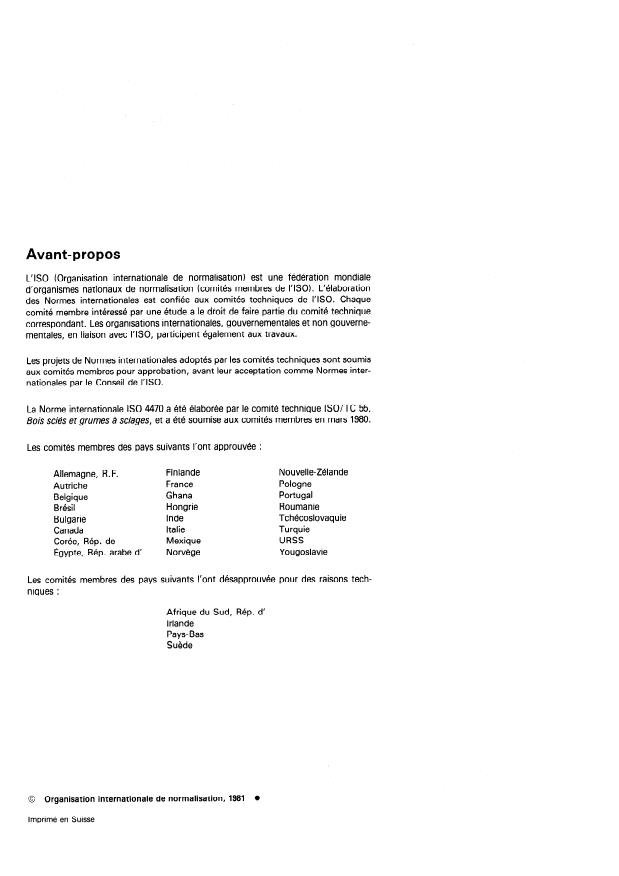
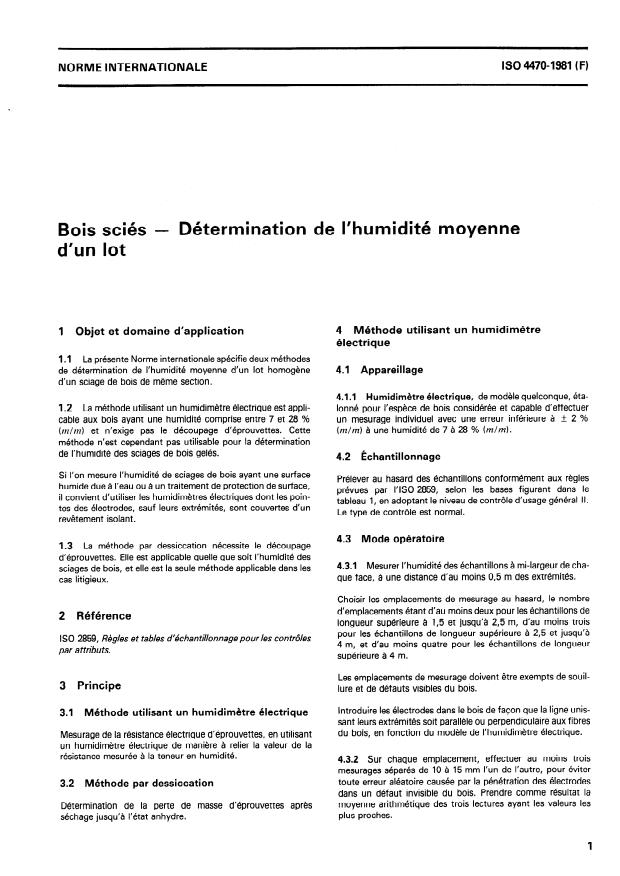

ISO 4470:1981 - Bois sciés — Détermination de l'humidité moyenne d'un lot Released:12/1/1981
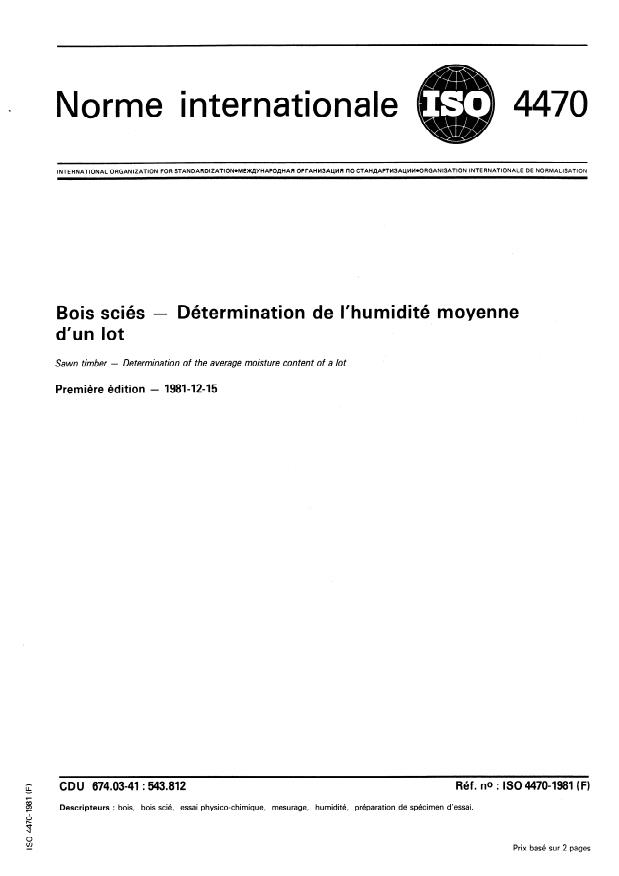
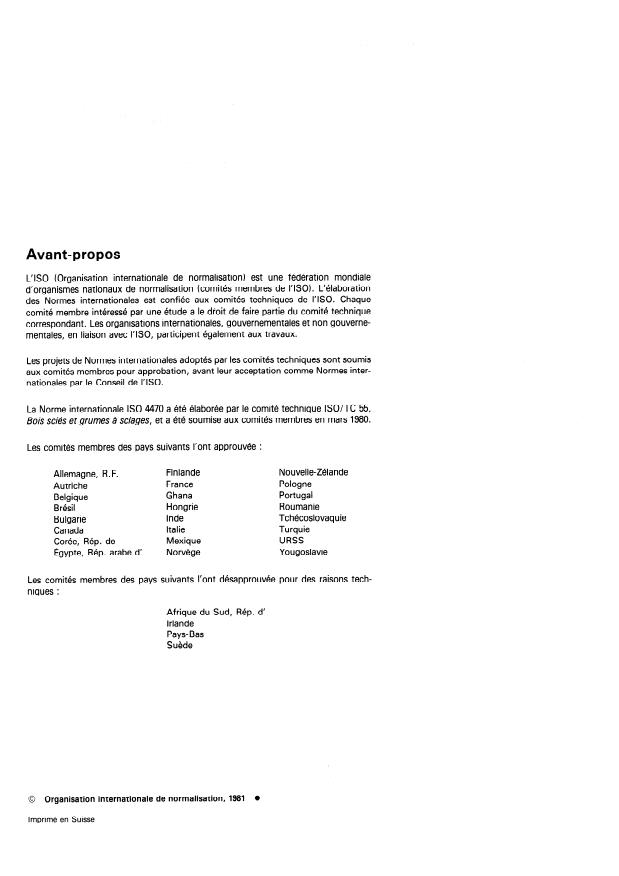
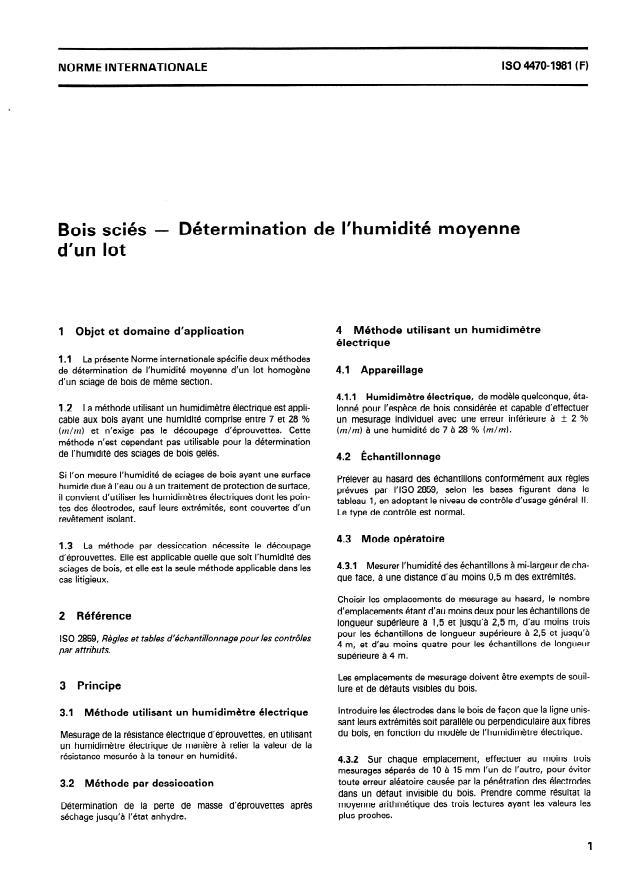

ISO 4470:1981 - Bois sciés — Détermination de l'humidité moyenne d'un lot Released:12/1/1981
Overview
ISO 4470:1981 is an international standard developed by the International Organization for Standardization (ISO) that specifies methods for determining the average moisture content of a lot of sawn timber. The moisture content of timber is a critical parameter affecting its quality, durability, and suitability for various applications. This standard outlines two practical and reliable methods of measurement: (a) using an electrical moisture meter and (b) the drying method involving mass loss determination. Both methods are designed to ensure consistent and accurate assessment of moisture content in homogeneous lots of sawn timber.
Key Topics
Scope and Applicability
- Suitable for homogeneous lots of sawn timber with the same cross-section.
- Electrical moisture meter method is applicable for timber moisture contents between 7% and 28%, excluding frozen timber.
- Drying method is applicable regardless of moisture content and is the preferred method in disputes due to its high accuracy.
Method 1: Electrical Moisture Meter
- Uses measurement of electrical resistance or conductance of test pieces.
- Requires a moisture meter calibrated for the wood species.
- Non-destructive, no need to cut test pieces.
- Sampling according to ISO 2859 with random selection.
- Measurement points on the timber faces must be free of dirt and defects.
- Multiple readings per test piece ensure measurement reliability.
- Results are expressed as average moisture content in percentage by mass.
Method 2: Drying Method
- Involves cutting test pieces and measuring weight loss upon drying.
- Requires precise weighing equipment and oven-drying at 103 ± 2°C until constant mass is achieved.
- Test pieces are weighed before and after drying and moisture content calculated based on mass difference.
- Suitable for all timber moisture contents and is the only method advised for legal or technical disputes.
- Sampling also follows ISO 2859 with a special inspection level.
Sampling and Test Preparation
- Samples are taken randomly according to specified inspection levels.
- Test pieces must be cut as full cross-section sections approximately 20 mm long.
- Pieces must be free of bark and visible defects to ensure accurate results.
Calculation and Reporting
- Moisture content expressed as a percentage by mass (nearest 1% for electrical method, nearest 0.1% for drying).
- Test reports must include method used, equipment details, test date, and individual and average results.
- Clear reference to ISO 4470:1981 is mandatory in documentation.
Applications
Quality Control in Timber Industry
- Ensures timber batches meet moisture content specifications critical for processing and end-use.
- Guards against quality issues like warping, shrinkage, and decay caused by improper moisture levels.
Construction and Wood Manufacturing
- Moisture content determination helps in deciding suitability of sawn timber for structural use.
- Prevents problems in wood furniture, flooring, and panel industries due to moisture variation.
Trade and Compliance
- Provides a standardized basis for moisture content measurement during commercial transactions.
- Used for dispute resolution related to timber moisture disputes under technical or contractual obligations.
Research and Development
- Offers standardized procedures for scientific studies related to wood physico-chemical properties.
Related Standards
ISO 2859 – Sampling procedures and tables for inspection by attributes: This standard guides the random sampling process required both for electrical and drying moisture tests.
ISO 2780 – Wood preservatives - Determination of moisture content of treated wood: Addresses moisture testing specifically for treated wood with chemical preservatives.
ISO 5834 – Timber - Moisture content determination for different wood products and methods: Covers additional moisture measurement methods beyond ISO 4470.
Keywords: ISO 4470, sawn timber, moisture content, electrical moisture meter, drying method, timber quality control, wood moisture measurement, sampling procedures, ISO standards, timber testing methods
Relations
- Effective Date
- 09-Feb-2026
- Effective Date
- 09-Feb-2026
- Effective Date
- 09-Feb-2026
Buy Documents
ISO 4470:1981 - Sawn timber — Determination of the average moisture content of a lot Released:12/1/1981
ISO 4470:1981 - Bois sciés — Détermination de l'humidité moyenne d'un lot Released:12/1/1981
ISO 4470:1981 - Bois sciés — Détermination de l'humidité moyenne d'un lot Released:12/1/1981
Get Certified
Connect with accredited certification bodies for this standard

Gozdarski inštitut Slovenije
Slovenian Forestry Institute. Forest management certification support, timber testing.
Sponsored listings
Frequently Asked Questions
ISO 4470:1981 is a standard published by the International Organization for Standardization (ISO). Its full title is "Sawn timber — Determination of the average moisture content of a lot". This standard covers: Two methods are specified: a) Measuring the electrical resistance or conductance of the test pieces using an electrical moisture meter and b) determining the loss in mass after drying test pieces until absolutely dry.
Two methods are specified: a) Measuring the electrical resistance or conductance of the test pieces using an electrical moisture meter and b) determining the loss in mass after drying test pieces until absolutely dry.
ISO 4470:1981 is classified under the following ICS (International Classification for Standards) categories: 79.040 - Wood, sawlogs and sawn timber. The ICS classification helps identify the subject area and facilitates finding related standards.
ISO 4470:1981 has the following relationships with other standards: It is inter standard links to EN 3-7:2004+A1:2007, EN 16856:2020, CEN/TR 15642:2011. Understanding these relationships helps ensure you are using the most current and applicable version of the standard.
ISO 4470:1981 is available in PDF format for immediate download after purchase. The document can be added to your cart and obtained through the secure checkout process. Digital delivery ensures instant access to the complete standard document.
Standards Content (Sample)
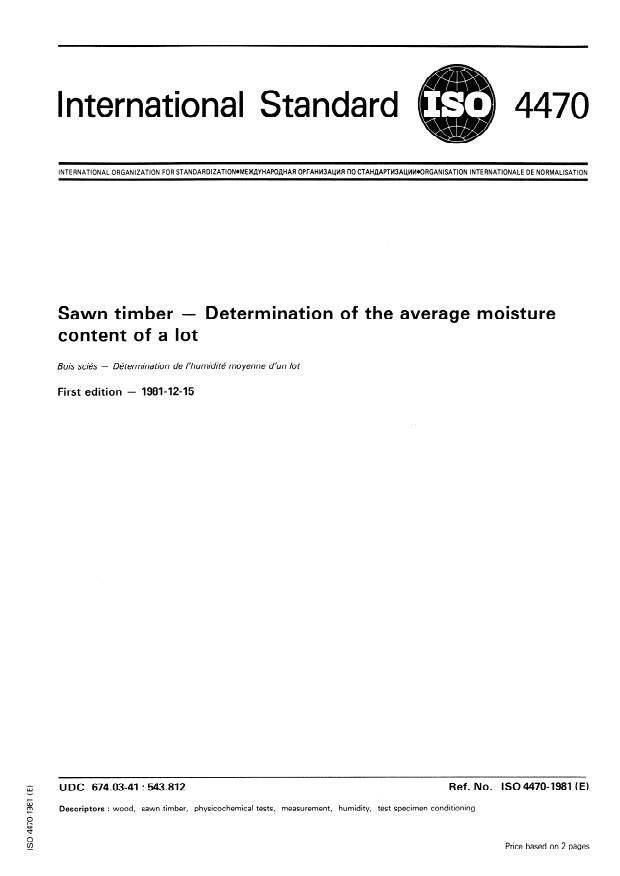
International Standard
INTERNATIONAL ORGANIZATION FOR STANDARDIZATION.MEXKCIYHAPOL1HAFI OPrAHM3AUMR fl0 CTAH~APTbl3AL(MM.ORGANISATION INTERNATIONALE DE NORMALISATION
Sawn timber - Determination of the average moisture
content of a lot
Bois sc/& - Determination de l’humiditb mo yenne d’un lot
First edition - 1981-12-15
Ref. No. ISO4470-1981 (E)
GI UDC 674.03-41 : 643.812
-
Descriptors : wood, sawn timber, physicochemical tests, measurement, humidity, test specimen conditioning.
Price based on 2 pages
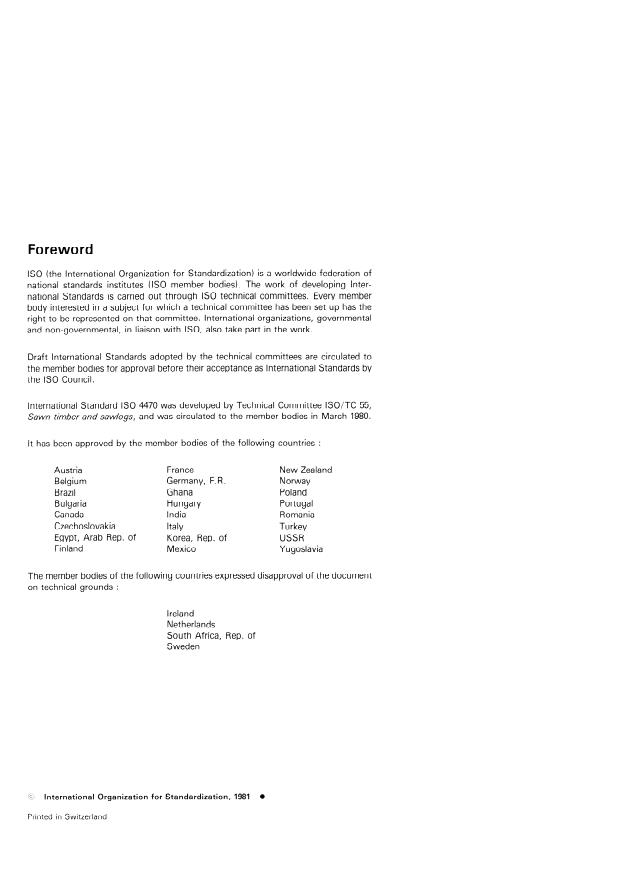
Fsreword
ISO (the International Organization for Standardization) is a worldwide federation of
national Standards institutes (ISO member bedies). The work of developing Inter-
national Standards is carried out through ISO technical committees. Every member
body interested in a subject for which a technical committee has been set up has the
right to be represented on that committee. International organizations, governmental
and non-governmental, in liaison with ISO, also take part in the work.
Draft International Standards adopted by the technical committees are circulated to
the member bodies for approval before their acceptance as International Standards by
the ISO Council.
International Standard ISO 4470 was developed by Technical Committee ISO/TC 55,
Sawn timber and sawlogs, and was circulated to the member bodies in March 1980.
It has been approved by the member bodies of the following countries :
Austria France New Zealand
Belgium Germany, F. R. Norway
Brazil Ghana Roland
Bulgaria Hungary Portugal
Canada India Romania
Czechoslovakia
Italy Turkey
Egypt, Arab Rep. of
Korea, Rep. of USSR
Finland
Mexico Yugoslavia
The member bodies of the following countries expressed disapproval of the document
on technical grounds :
Ireland
Netherlands
South Africa, Rep. of
Sweden
International Organization for Standardization, 1981
Printed in Switzerland
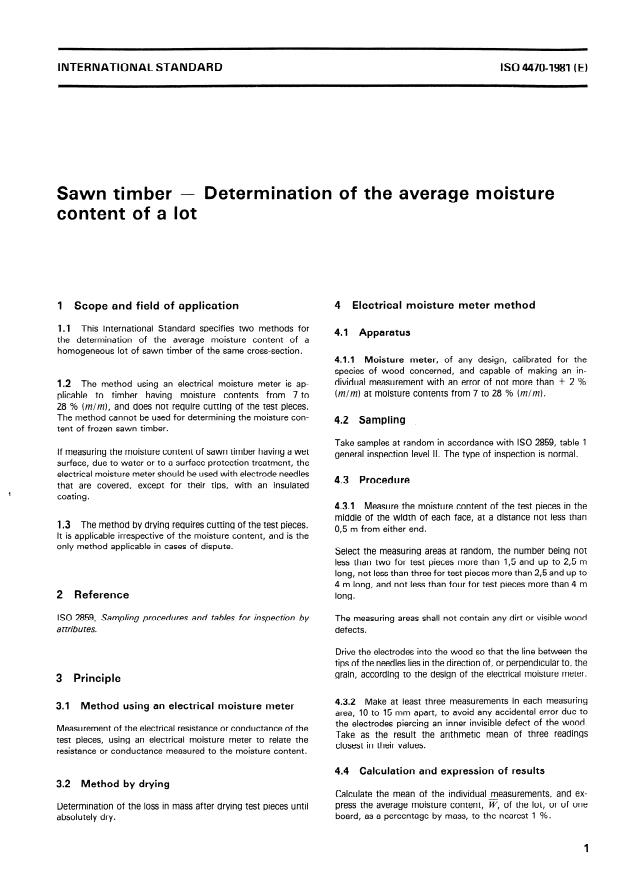
INTERNATIONAL STANDARD ISO 4470-1981 (E)
- Determination of the average moisture
Sawn timber
content of a lot
4 Electrical moisture meter method
1 Scope and field of application
1.1 This International Standard specifies two methods for
4.1 Apparatus
the determination of the average moisture content of a
homogeneous lot of sawn timber of the same Cross-section.
4.1.1 Moisture meter, of any design, calibrated for the
species of wood concerned, and capable of making an in-
dividual measurement with an error of not more than AI 2 %
1.2 The method using an electrical moisture meter is ap-
(mlm) at moisture contents from 7 to 28 % (mlm).
plicable to timber having moisture contents from 7 to
28 % (mlm), and does not require cutting of the test pieces.
The method cannot be used for determining the moisture con-
4.2 Sampling
tent of frozen sawn timber.
Take samples at random in accordance with ISO 2859, table 1
If measuring the moisture content of sawn timber having a wet
general inspection level II. The type of inspection is normal.
surface, due to water or to a surface protection treatment, the
electrical moisture meter should be used with electrode needles
4.3 Procedure
that are covered, except for their tips, with an insulated
coating.
4.3.1 Measure the moisture content of the test pieces in the
middle of the width of each face, at a distance not less than
1.3 The method by drying requires cutting of the test pieces.
0,5 m from either end.
It is applicable irrespective of the moisture content, and is the
only method applicable in cases of dispute.
Select the measuring areas at random, the number being not
less than two for test pieces more than 1,5 and up to 2,5 m
long, not less than three for test pieces more than 2,5 and up to
4 m long, and not less than four for test pieces more than 4 m
2 Reference long .
ISO 2859, Sampling procedures and tables for inspection by
The measuring areas shall not contain any dirt or visible wood
a ttributes.
defects.
Drive the electrodes into the wood so that the line between the
tips of the needles lies in the direction of, or perpendicular to, the
grain, a
...
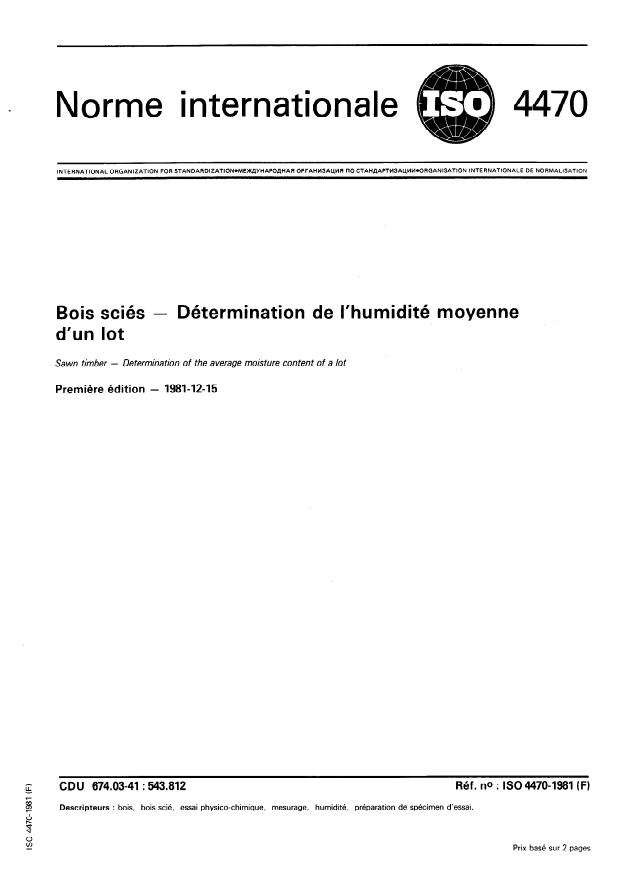
Norme internationale
INTERNATIONAL ORGANIZATION FOR STANDARDIZATION.MEWlYHAPORHAR OPI-AHM3AUMR fl0 CTAH~APTM3AUMM*ORGANISATlON INTERNATIONALE DE NORMALISATION
Bois sciés - Détermination de l’humidité moyenne
d’un lot
Sawn timber - Determination of the average moisture content of a lot
Première édition - 1981-12-15
Réf. no : ISO 4470-1981 (F)
CDU 674.03-41 : 543.812
Descripteurs : bois, bois scié, essai physico-chimique, mesurage, humidité, préparation’ de spécimen d’essai.
Prix basé sur 2 pages
Avant-propos
L’ISO (Organisation internationale de normalisation) est une fédération mondiale
d’organismes nationaux de normalisation (comités membres de I’ISO). L’élaboration
des Normes internationales est confiée aux comités techniques de I’ISO. Chaque
comité membre intéressé par une étude a le droit de faire partie du comité technique
correspondant. Les organisations internationales, gouvernementales et non gouverne-
mentales, en liaison avec I’ISO, participent également aux travaux.
Les projets de Normes internationales adoptés par les comités techniques sont soumis
aux comités membres pour approbation, avant leur acceptation comme Normes inter-
nationales par le Conseil de I’ISO.
La Norme internationale ISO 4470 a été élaborée par le comité technique ISO/TC 55,
Bois sciés et grumes à sciages, et a été soumise aux comités membres en mars 1980.
Les comités membres des pays suivants l’ont approuvée :
Nouvelle-Zélande
Finlande
Allemagne, R.F.
France Pologne
Au triche
Ghana Portugal
Belgique
Hongrie Roumanie
Brésil
Inde Tchécoslovaquie
Bulgarie
Italie Turquie
Canada
Mexique URSS
Corée, Rép. de
Yougoslavie
Égypte, Rép. arabe d’ Norvège
Les comités membres des pays suivants l’ont désapprouvée pour des raisons tech-
niques :
Afrique du Sud, Rép. d’
Irlande
Pays- Bas
Suéde
@ Organisation internationale de normalisation, 1981 0
Imprimé en Suisse
ISO 44704981 (F)
NORME INTERNATIONALE
Bois sciés - Détermination de l’humidité moyenne
d’un lot
4 Méthode utilisant un humidimètre
1 Objet et domaine d’application
électrique
1.1 La présente Norme internationale spécifie deux méthodes
de détermination de l’humidité moyenne d’un lot homogène 4.1 Appareillage
d’un sciage de bois de même section.
4.1 .l Humidimètre électrique, de modèle quelconque, éta-
1.2 La méthode utilisant un humidimètre électrique est appli-
lonné pour l’espèce de bois considérée et capable d’effectuer
cable aux bois ayant une humidité comprise entre 7 et 28 % un mesurage individuel avec une erreur inférieure à $r 2 %
(mlm) et n’exige pas le découpage d’éprouvettes. Cette (mlm) à une humidité de 7 à 28 % (mlm).
méthode n’est cependant pas utilisable pour la détermination
de l’humidité des sciages de bois gelés.
4.2 Échantillonnage
Si l’on mesure l’humidité de sciages de bois ayant une surface
Prélever au hasard des échantillons conformément aux règles
humide due à l’eau ou à un traitement de protection de surface,
prévues par I’ISO 2859, selon les bases figurant dans le
il convient d’utiliser les humidimètres électriques dont les poin-
tableau 1, en adoptant le niveau de contrôle d’usage général II.
tes des électrodes, sauf leurs extrémités, sont couvertes d’un
Le type de contrôle est normal.
revêtement isolant.
4.3 Mode opératoire
1.3 La méthode par dessiccation nécessite le découpage
d’éprouvettes. Elle est applicable quelle que soit l’humidité des
4.3.1 Mesurer l’humidité des échantillons à mi-largeur de cha-
sciages de bois, et elle est la seule méthode applicable dans les
que face, à une distance d’au moins 0,5 m des extrémités.
cas litigieux.
Choisir les emplacements de mesurage au hasard, le nombre
d’emplacements étant d’au moins deux pour les échantillons de
2 Référence
longueur supérieure à 1,5 et jusqu’à 2,5 m, d’au moins trois
pour les échantillons de longueur supérieure à 2,5 et jusqu’à
I SO 2859, Règles et tables d’échantillonnage pour les contrôles
4 m, et d’au moins quatre pour les échantillons de longueur
par attributs.
supérieure à 4 m.
Les emplacements de mesurage doivent être exempts de souil-
3 Principe
lure et de défauts visibles du bois.
Introduire les électrodes dans le bois de facon que la ligne unis-
3.1 Méthode utilisant un humidimètre électrique
sant leurs extrémités soit parallèle ou perpendiculaire aux fibres
du bois, en fonction du modèle de I’humidimètre électrique.
Mesurage de l
...
Norme internationale
INTERNATIONAL ORGANIZATION FOR STANDARDIZATION.MEWlYHAPORHAR OPI-AHM3AUMR fl0 CTAH~APTM3AUMM*ORGANISATlON INTERNATIONALE DE NORMALISATION
Bois sciés - Détermination de l’humidité moyenne
d’un lot
Sawn timber - Determination of the average moisture content of a lot
Première édition - 1981-12-15
Réf. no : ISO 4470-1981 (F)
CDU 674.03-41 : 543.812
Descripteurs : bois, bois scié, essai physico-chimique, mesurage, humidité, préparation’ de spécimen d’essai.
Prix basé sur 2 pages
Avant-propos
L’ISO (Organisation internationale de normalisation) est une fédération mondiale
d’organismes nationaux de normalisation (comités membres de I’ISO). L’élaboration
des Normes internationales est confiée aux comités techniques de I’ISO. Chaque
comité membre intéressé par une étude a le droit de faire partie du comité technique
correspondant. Les organisations internationales, gouvernementales et non gouverne-
mentales, en liaison avec I’ISO, participent également aux travaux.
Les projets de Normes internationales adoptés par les comités techniques sont soumis
aux comités membres pour approbation, avant leur acceptation comme Normes inter-
nationales par le Conseil de I’ISO.
La Norme internationale ISO 4470 a été élaborée par le comité technique ISO/TC 55,
Bois sciés et grumes à sciages, et a été soumise aux comités membres en mars 1980.
Les comités membres des pays suivants l’ont approuvée :
Nouvelle-Zélande
Finlande
Allemagne, R.F.
France Pologne
Au triche
Ghana Portugal
Belgique
Hongrie Roumanie
Brésil
Inde Tchécoslovaquie
Bulgarie
Italie Turquie
Canada
Mexique URSS
Corée, Rép. de
Yougoslavie
Égypte, Rép. arabe d’ Norvège
Les comités membres des pays suivants l’ont désapprouvée pour des raisons tech-
niques :
Afrique du Sud, Rép. d’
Irlande
Pays- Bas
Suéde
@ Organisation internationale de normalisation, 1981 0
Imprimé en Suisse
ISO 44704981 (F)
NORME INTERNATIONALE
Bois sciés - Détermination de l’humidité moyenne
d’un lot
4 Méthode utilisant un humidimètre
1 Objet et domaine d’application
électrique
1.1 La présente Norme internationale spécifie deux méthodes
de détermination de l’humidité moyenne d’un lot homogène 4.1 Appareillage
d’un sciage de bois de même section.
4.1 .l Humidimètre électrique, de modèle quelconque, éta-
1.2 La méthode utilisant un humidimètre électrique est appli-
lonné pour l’espèce de bois considérée et capable d’effectuer
cable aux bois ayant une humidité comprise entre 7 et 28 % un mesurage individuel avec une erreur inférieure à $r 2 %
(mlm) et n’exige pas le découpage d’éprouvettes. Cette (mlm) à une humidité de 7 à 28 % (mlm).
méthode n’est cependant pas utilisable pour la détermination
de l’humidité des sciages de bois gelés.
4.2 Échantillonnage
Si l’on mesure l’humidité de sciages de bois ayant une surface
Prélever au hasard des échantillons conformément aux règles
humide due à l’eau ou à un traitement de protection de surface,
prévues par I’ISO 2859, selon les bases figurant dans le
il convient d’utiliser les humidimètres électriques dont les poin-
tableau 1, en adoptant le niveau de contrôle d’usage général II.
tes des électrodes, sauf leurs extrémités, sont couvertes d’un
Le type de contrôle est normal.
revêtement isolant.
4.3 Mode opératoire
1.3 La méthode par dessiccation nécessite le découpage
d’éprouvettes. Elle est applicable quelle que soit l’humidité des
4.3.1 Mesurer l’humidité des échantillons à mi-largeur de cha-
sciages de bois, et elle est la seule méthode applicable dans les
que face, à une distance d’au moins 0,5 m des extrémités.
cas litigieux.
Choisir les emplacements de mesurage au hasard, le nombre
d’emplacements étant d’au moins deux pour les échantillons de
2 Référence
longueur supérieure à 1,5 et jusqu’à 2,5 m, d’au moins trois
pour les échantillons de longueur supérieure à 2,5 et jusqu’à
I SO 2859, Règles et tables d’échantillonnage pour les contrôles
4 m, et d’au moins quatre pour les échantillons de longueur
par attributs.
supérieure à 4 m.
Les emplacements de mesurage doivent être exempts de souil-
3 Principe
lure et de défauts visibles du bois.
Introduire les électrodes dans le bois de facon que la ligne unis-
3.1 Méthode utilisant un humidimètre électrique
sant leurs extrémités soit parallèle ou perpendiculaire aux fibres
du bois, en fonction du modèle de I’humidimètre électrique.
Mesurage de l
...