

ISO 10292:1994
(Main)Glass in building — Calculation of steady-state U values (thermal transmittance) of multiple glazing
General Information
- Abstract
Applies to glass, coated glass and materials opaque in the far infrared wavelengths. Gives the fundamental rules for calculating the thermal transmittance in the glazing central area (edge effects are not included). The rules are intended to enable the heat loss through glazing in a building to be estimated from the U values and, together with heat losses through the opaque elements of the building, are used to determine the capacity of the heating or cooling plant. In addition, U values for other purposes (e.g. condensation on glazing surfaces, seasonal heat loss through glazing) can be calculated using the same procedure.
- Status
- Withdrawn
- Publication Date
- 29-Jun-1994
- Technical Committee
- ISO/TC 160/SC 2 - Use considerations
- Current Stage
- 9599 - Withdrawal of International Standard
- Start Date
- 15-Jul-2026
- Completion Date
- 29-Aug-2026
Buy Documents
ISO 10292:1994 - Glass in building — Calculation of steady-state U values (thermal transmittance) of multiple glazing Released:6/30/1994
ISO 10292:1994 - Verre dans la construction — Calcul du coefficient de transmission thermique U, en régime stationnaire des vitrages multiples Released:6/30/1994
ISO 10292:1994 - Verre dans la construction — Calcul du coefficient de transmission thermique U, en régime stationnaire des vitrages multiples Released:6/30/1994
Overview
ISO 10292:1994 - "Glass in building - Calculation of steady-state U values (thermal transmittance) of multiple glazing" provides a standardized method to calculate the steady‑state U value (thermal transmittance) for the central area of sealed multiple glazing units. The standard applies to clear and coated glass, and to materials opaque in the far‑infrared. It excludes combined edge effects (spacer/frame thermal bridges) and is intended for estimating heat loss through glazing for heating/cooling sizing, condensation risk assessment and seasonal energy accounting. U values are expressed in Watts per square metre kelvin [W/(m2·K)].
Key topics and technical requirements
- Scope and definition: U value defined as steady‑state heat transfer rate per temperature difference for glazing central area (edge effects not included).
- Calculation basis: Combines surface heat transfer coefficients, gas‑space conductance (conduction + convection), and radiation conductance. Uses fundamental dimensionless numbers (Grashof, Prandtl, Nusselt) to assess convection in gas layers.
- Radiation and emissivity:
- Uses corrected emissivity for coated surfaces; Annex A prescribes spectral reflectance measurement and conversion tables.
- For ordinary glass, corrected emissivity = 0.837; radiation conductance reference = 4.4 W/(m2·K).
- Gas properties: Annex A lists thermal conductivity, density, viscosity and specific heat for common fills (air, argon, krypton, SF6) and prescribes how to treat gas mixtures.
- Reference values and defaults:
- External heat transfer coefficient he = 23 W/(m2·K) (for comparison)
- Internal heat transfer coefficient hi = 8 W/(m2·K)
- Glass thermal resistivity r = 1 mm·K/W
- Mean glazing temperature Tm = 283 K, ΔT = 15 K
- Practical rules: Guidance for vertical, horizontal and inclined spaces; special handling when convection is suppressed or enhanced; iterative solution for multi‑space glazing; U values quoted to one decimal.
Applications
- Sizing heating and cooling plant by estimating glazing heat losses
- Window and façade thermal performance calculations for building energy modelling
- Predicting condensation risk on glazing surfaces
- Comparing glazing options (coatings, gas fills, multi‑layer designs) for energy efficiency
- Producing standardized U‑value data for product datasheets and certification
Who uses this standard
- Façade engineers, window and glazing manufacturers
- Architects and building envelope consultants
- HVAC and energy‑modelling professionals
- Building code assessors and certification bodies
- Test laboratories measuring glazing thermal performance
Related standards
ISO 10292 was prepared by ISO/TC 160 (Glass in building). Users often apply it alongside other building thermal and window performance standards and national regulations for U‑values and energy compliance.
Keywords: ISO 10292, U value, thermal transmittance, multiple glazing, glass in building, glazing U values, emissivity, gas fill, heat transfer coefficients, window thermal performance.
Relations
- Effective Date
- 09-Feb-2026
- Effective Date
- 09-Feb-2026
- Effective Date
- 09-Feb-2026
- Effective Date
- 09-Feb-2026
- Effective Date
- 09-Feb-2026
- Effective Date
- 09-Feb-2026
- Effective Date
- 09-Feb-2026
- Effective Date
- 09-Feb-2026
- Effective Date
- 09-Feb-2026
- Effective Date
- 09-Feb-2026
- Effective Date
- 15-Jun-2024
Buy Documents
ISO 10292:1994 - Glass in building — Calculation of steady-state U values (thermal transmittance) of multiple glazing Released:6/30/1994
ISO 10292:1994 - Verre dans la construction — Calcul du coefficient de transmission thermique U, en régime stationnaire des vitrages multiples Released:6/30/1994
ISO 10292:1994 - Verre dans la construction — Calcul du coefficient de transmission thermique U, en régime stationnaire des vitrages multiples Released:6/30/1994
Frequently Asked Questions
ISO 10292:1994 is a standard published by the International Organization for Standardization (ISO). Its full title is "Glass in building — Calculation of steady-state U values (thermal transmittance) of multiple glazing". This standard covers: Applies to glass, coated glass and materials opaque in the far infrared wavelengths. Gives the fundamental rules for calculating the thermal transmittance in the glazing central area (edge effects are not included). The rules are intended to enable the heat loss through glazing in a building to be estimated from the U values and, together with heat losses through the opaque elements of the building, are used to determine the capacity of the heating or cooling plant. In addition, U values for other purposes (e.g. condensation on glazing surfaces, seasonal heat loss through glazing) can be calculated using the same procedure.
Applies to glass, coated glass and materials opaque in the far infrared wavelengths. Gives the fundamental rules for calculating the thermal transmittance in the glazing central area (edge effects are not included). The rules are intended to enable the heat loss through glazing in a building to be estimated from the U values and, together with heat losses through the opaque elements of the building, are used to determine the capacity of the heating or cooling plant. In addition, U values for other purposes (e.g. condensation on glazing surfaces, seasonal heat loss through glazing) can be calculated using the same procedure.
ISO 10292:1994 is classified under the following ICS (International Classification for Standards) categories: 81.040.20 - Glass in building. The ICS classification helps identify the subject area and facilitates finding related standards.
ISO 10292:1994 has the following relationships with other standards: It is inter standard links to EN ISO 52022-3:2017, EN ISO 10077-2:2017, EN ISO 12631:2012, EN ISO 10077-1:2017, EN ISO 12631:2017, EN ISO 13792:2012, EN ISO 52018-1:2017, EN ISO 52016-1:2017, EN ISO 13791:2012, EN ISO 52022-1:2017, ISO 10292:2026. Understanding these relationships helps ensure you are using the most current and applicable version of the standard.
ISO 10292:1994 is available in PDF format for immediate download after purchase. The document can be added to your cart and obtained through the secure checkout process. Digital delivery ensures instant access to the complete standard document.
Standards Content (Sample)
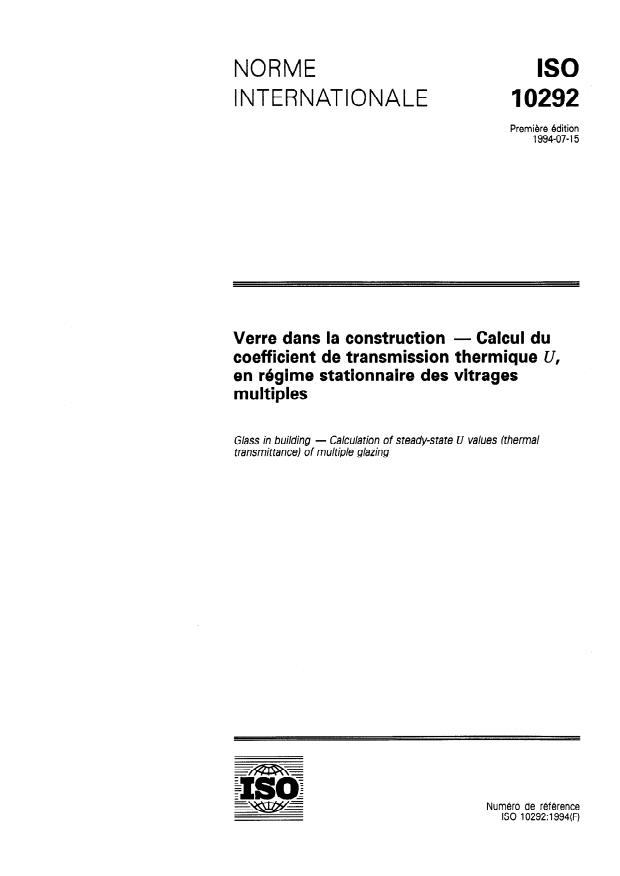
INTERNATIONAL
ISO
STANDARD
First edition
1994-07-15
Glass in building - Calculation of
steady-state U values (thermal
transmittance) of multiple glazing
Verre dans Ia construction - Calcul du coefficient de transmission
thermique U, en regime stationnaire des vitrages multiples
Reference number
ISO 10292: 1994(E)
Foreword
ISO (the International Organization for Standardization) is a worldwide
federation of national Standards bodies (ISO member bodies). The work
of preparing International Standards is normally carried out through ISO
technical committees. Esch member body interested in a subject for
which a technical committee has been established has the right to be
represented on that committee. International organizations, governmental
and non-governmental, in liaison with ISO, also take part in the work. ISO
collaborates closely with the International Electrotechnical Commission
(IEC) on all matters of electrotechnical standardization.
Draft International Standards adopted by the technical committees are
circulated to the member bodies for voting. Publication as an International
Standard requires approval by at least 75 % of the member bodies casting
a vote.
International Standard ISO 10292 was prepared by Technical Committee
ISOnC 160, Glass in building, Subcommittee SC 2, Use considerations.
Annex A forms an integral part of this International Standard. Annex B is
for information only.
0 ISO 1994
All rights reserved. Unless otherwise specified, no part of this publication may be reproduced
or utilized in any form or by any means, electronie or mechanical, including photocopying and
microfilm, without Permission in writing from the publisher.
International Organization for Standardization
Case Postale 56 l CH-1 211 Geneve 20 l Switzerland
Printed in Switzerland
ii
INTERNATIONAL STANDARD 0 ISO
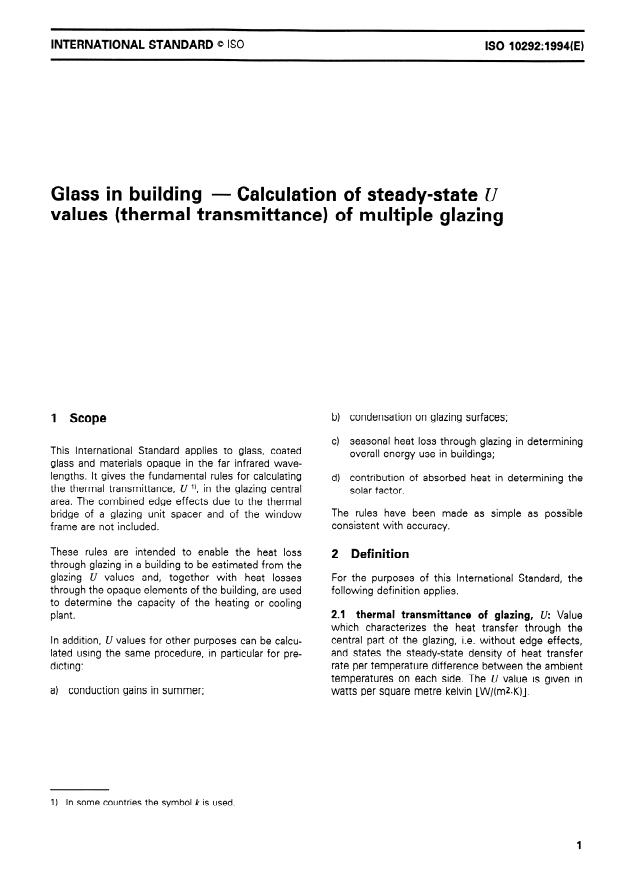
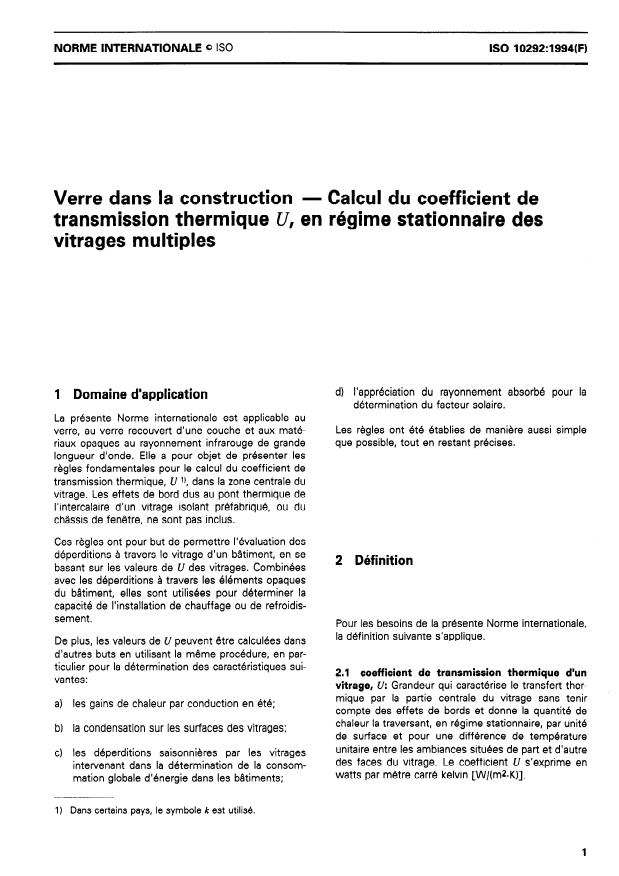
Glass in building - Calculation of steady-state U
values (thermal transmittance) of multiple glazing
b) condensation on glazing surfaces;
1 Scope
c) seasonal heat loss through glazing in determining
This International Standard applies to glass, coated
Overall energy use in buildings;
glass and materials opaque in the far infrared wave-
lengths. lt gives the fundamental rules for calculating
d) contribution of absorbed heat in determining the
the thermal transmittance, U ‘1, in the glazing central
solar factor.
area. The combined edge effects due to the thermal
The rules have been made as simple as possible
bridge of a glazing unit spacer and of the window
consistent with accuracy.
frame are not included.
These rules are intended to enable the heat loss
2 Definition
through glazing in a building to be estimated from the
glazing U values and, together with heat losses For the purposes of this International Standard, the
following definition applies.
through the opaque elements of the building, are used
to determine the capacity of the heating or cooling
2.1 thermal transmittance of glazing, U: Value
plant.
which characterizes the heat transfer through the
central part of the glazing, i.e. without edge effects,
In addition, U values for other purposes tan be calcu-
and states the steady-state density of heat transfer
lated using the Same procedure, in particular for pre-
rate per temperature differente between the ambient
dicting:
temperatures on each side. The U value is given in
Watts per Square metre kelvin [W/(m2*K)].
a) conduction gains in Summer;
1) In some countries the Symbol k is used.
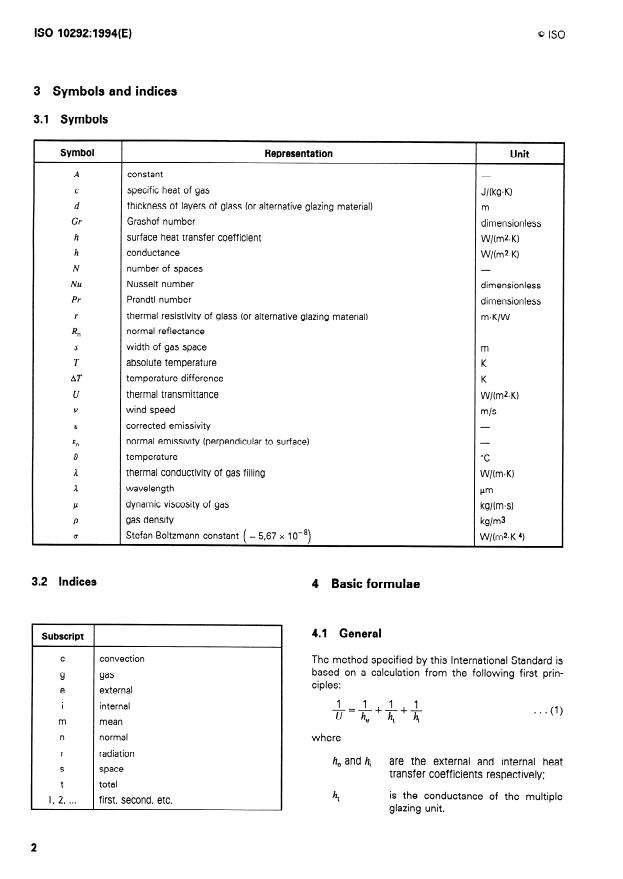
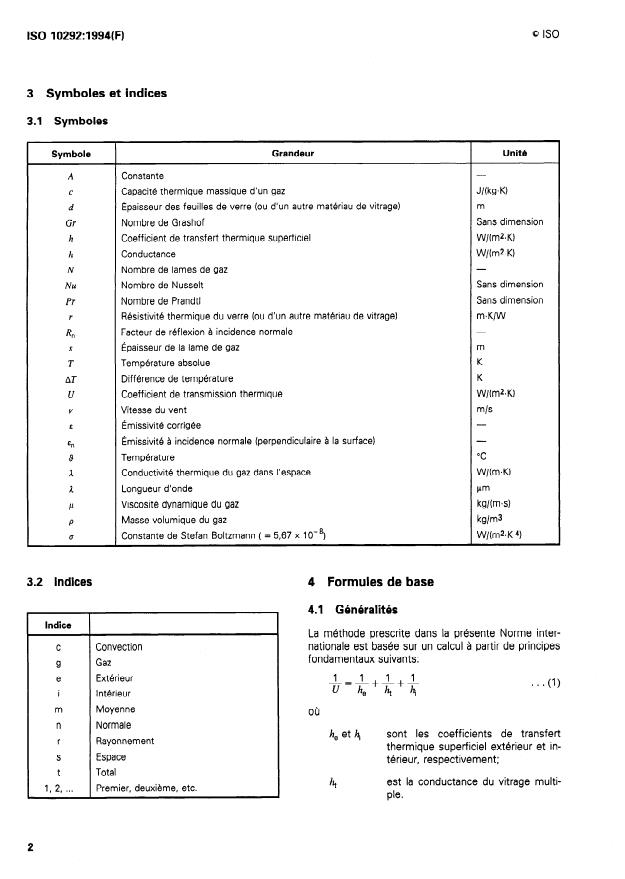
3 Symbols and indices
31 . Symbols
Symbol Representation Unit
A constant
c specific heat of gas J/kgW
m
d thickness of layers of glass (or alternative glazing material)
dimensionless
GI- Grashof number
h surface heat transfer coefficient W/(m*K)
conductance W/(m*K)
h
N number of spaces
Nu Nusselt number dimensionless
Pr Prandtl number dimensionless
r thermal resistivity of glass (or alternative glazing material) mK/W
normal reflectance
Rn
S width of gas space m
T absolute temperature K
AT temperature differente K
u thermal transmittance W/(m*.K)
V wind Speed
mls
E corrected emissivity
normal emissivity (perpendicular to surface)
4-l
9 temperature “C
A. thermal conductivity of gas filling
W/h-Kl
A. wavelength
Pm
dynamic viscosity of gas
kg/h-s)
c1
gas density
kW3
P
0 Stefan-Boltzmann constant (= 5,67 x lO-*) W/(m*.K 4)
3.2 Indices
4 Basic formulae
4.1 General
Subscript
C convection The method specified by this International Standard is
based on a calculation from the following first prin-
g WS
ciples:
e external
1 1 1 1
i internal -=-
. . .
(1)
U h, +F+h;
m mean
n normal where
r radiation
he and hi are the external and internal heat
S space
transfer coefficients respectively;
t total
is the conductance of the multiple
ht
1, 2, . . . first, second, etc.
glazing unit.
Gr is the Grashof number,
. . .
(2)
Pr is the Prandtl number,
n is an exponent,
h is the gas space conductance;
S
9,81 s3ATp2
=
Gr . . .
(7)
N is the number of spaces;
TmP2
M is the number of materials;
. . .
(8)
d is the total thickness of each material;
m
where
is the thermal resistivity of each material
rm
AT is the temperature differente
(the thermal resistivity of glass is
on either side of the glazing, in
1 mmK/W).
kelvins (K),
h, = h, + h, . . .
(3)
is the gas density, in kilograms
P
per cubic metre (kg/m3),
h is the radiation conductance; is the gas dynamic viscosity, in
P
r
kilograms per metre second
h is the gas conductance (conduction and
Cw(m-ql
convection).
c is the gas specific heat, in
joules per kilogram kelvin
4.2 Radiation conductance, h,
[J/kg*K)l,
The radiation conductance, h,, is given by
is the gas mean temperature,
Tm
in kelvins (K).
. . .
(4)
For vertical spaces, the Nusselt number is calculated
from formula (6) using A = 0,035 and n = 0,38 under
where
the following condition (see also ref. Cl]).
is the Stefan-Boltzmann constant;
a
If NU < 1, the value unity is used in formula (5), cor-
responding to GrmPr less than 6 800. If Nu > 1, the
g1 and c2 are the corrected emissivities at the
greater value is used in formula (5) corresponding to
mean absolute temperature Tm of the
a regime with convection.
gas space.
4.3 Gas condwctance, hg
5 Basic material properties
The gas conductance, hg, is given by
5.1 Emissivity
h,=Nu+ . . .
(5)
The corrected emissivities E of the surfaces bounding
the enclosed spaces are required to calculate the
is the width of the space, in metres (m);
s
radiation conductance, h,, in formula (4).
A. is the gas thermal conductivity, in Watts
For glass surfaces, the corrected emissivity to be
per metre kelvin [W/(mgK)];
used is 0,837.
Nu is the Nusselt number, given by
For coated surfaces, the normal emissivity, E,, is ob-
tained from infrared spectrometer measurements
Nu = A (GraPrjn
(sec A.l in annex A).
The CO rrected emissivity is obtained from A.2, in
A is a constant, annex A .
63 ISO
The mean temperature of the space, Tm1 is fixed at then
283 K, for purposes of comparison.
F = F,R, -k F2R2 + . . . . . .
(9)
NOTE 1 Two different definitions of emissivity should be
thermal
where F represents the relevant i.e.
proper-V,
theoretically used to describe radiation exchange:
conductivity, density, dynamic viscosity or specif ic
heat.
- between glass surfaces facing each other in multiple
glazing, or
53 . lnfrared-absorbing gases
- between a glass surface and the inside of a room.
Some gases absorb infrared radiation in the 5 km to
However, in practice numerical differentes are found to be
50 Fm range-
negligibly small. Thus corrected emissivity tan be used to
describe both types of heat exchange with sufficient ap-
Where the gas concerned is used in combination with
proximation.
a low emissivity coating (E < 0,2), this effect is ig-
nored because of the low density of the net infrared
radiant flux.
For other cases the U value shall be measured if a
possible benefit to the U value from the absorption
5.2 Gas properties
of the gas might be realized.
The following prop
...
NORME
Iso
INTERNATIONALE
Première 6dition
1994-07-l 5
Verre dans la construction - Calcul du
coefficient de transmission thermique U,
en régime stationnaire des vitrages
multiples
Glass in building - Calculation of steady-state U values (thermal
transmittance) of multiple glazing
Num&o de référence
60 10292: 1994(F)
Avant-propos
L’ISO (Organisation internationale de normalisation) est une fédération
mondiale d’organismes nationaux de normalisation (comités membres de
I’ISO). L’elaboration des Normes internationales est en général confiee aux
comites techniques de I’ISO. Chaque comité membre interessé par une
étude a le droit de faire partie du comité technique crée a cet effet. Les
organisations internationales, gouvernementales et non gouvernemen-
tales, en liaison avec I’ISO participent également aux travaux. L’ISO colla-
bore etroitement avec la Commission électrotechnique internationale (CEI)
en ce qui concerne la normalisation électrotechnique.
Les projets de Normes internationales adoptes par les comités techniques
sont soumis aux comites membres pour vote. Leur publication comme
Normes internationales requiert l’approbation de 75 % au moins des co-
mites membres votants.
La Norme internationale ISO 10292 a été élaborée par le comite technique
lSO/TC 160, Verre dans la construction, sous-comité SC 2, Utilisation.
L’annexe A fait partie intégrante de la presente Norme internationale.
L’annexe B est donnée uniquement a titre d’information.
0 ISO 1994
Droits de reproduction réservés. Sauf prescription différente, aucune partie de cette publi-
cation ne peut être reproduite ni utilisée sous quelque forme que ce soit et par aucun pro-
céde, électronique ou mécanique, y compris la photocopie et les microfilms, sans l’accord
ecrit de l’editeur.
Organisation internationale de normalisation
Case Postale 56.CH-1211 Genéve 20 l Suis se
Imprimé en Suisse
ii
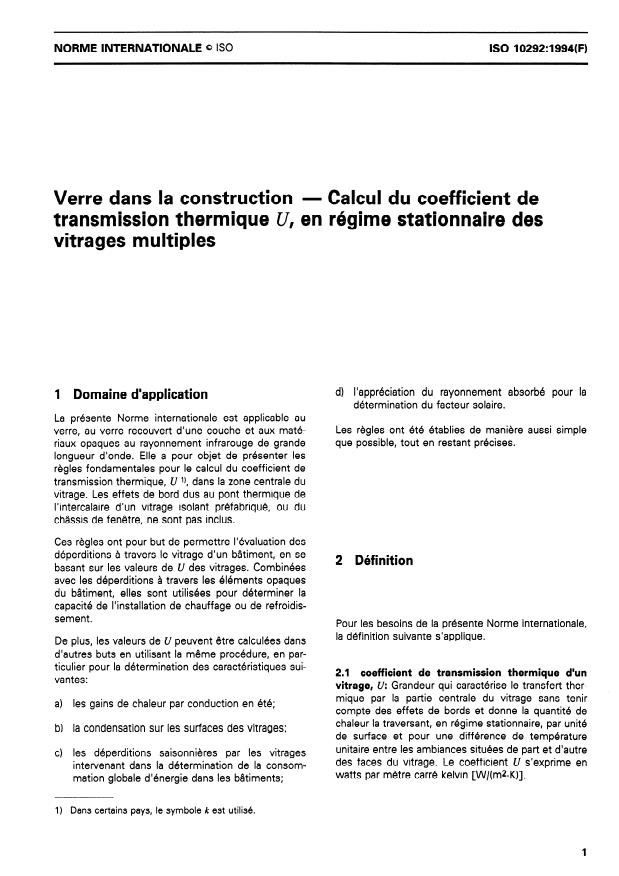
NORME INTERNATIONALE 0 ISO ISO 10292:1994(F)
Verre dans la construction - Calcul du coefficient de
transmission thermique U, en régime stationnaire des
vitrages multiples
d) l’appréciation du rayonnement absorbe pour la
1 Domaine d’application
determination du facteur solaire.
La présente Norme internationale est applicable au
verre, au verre recouvert d’une couche et aux mate- Les régles ont ete etablies de manière aussi simple
riaux opaques au rayonnement infrarouge de grande que possible, tout en restant précises.
longueur d’onde. Elle a pour objet de présenter les
règles fondamentales pour le calcul du coefficient de
1) dans la zone centrale du
transmission thermique, U ,
vitrage. Les effets de bord dus au pont thermique de
l’intercalaire d’un vitrage isolant préfabriqué, ou du
châssis de fenêtre, ne sont pas inclus.
Ces régles ont pour but de permettre l’evaluation des
déperditions à travers le vitrage d’un bâtiment, en se
2 Définition
basant sur les valeurs de U des vitrages. Combinees
avec les déperditions à travers les elements opaques
du bâtiment, elles sont utilisees pour déterminer la
capacité de l’installation de chauffage ou de refroidis-
sement.
Pour les besoins de la présente Norme internationale,
la définition suivante s’applique.
De plus, les valeurs de U peuvent être calculées dans
d’autres buts en utilisant la même procédure, en par-
ticulier pour la détermination des caractéristiques sui-
2.1 coefficient de transmission thermique d’un
vantes:
vitrage, U: Grandeur qui caractérise le transfert ther-
mique par la partie centrale du vitrage sans tenir
a) les gains de chaleur par conduction en été;
compte des effets de bords et donne la quantité de
chaleur la traversant, en régime stationnaire, par unite
b) la condensation sur les surfaces des vitrages;
de surface et pour une difference de température
unitaire entre les ambiances situées de part et d’autre
c) les déperditions saisonnieres par les vitrages
des faces du vitrage. Le coefficient U s’exprime en
intervenant dans la determination de la consom-
watts par mètre carre kelvin [W/(m20K)].
mation globale d’énergie dans les bâtiments;
1) Dans certains pays, le symbole k est utilisé.
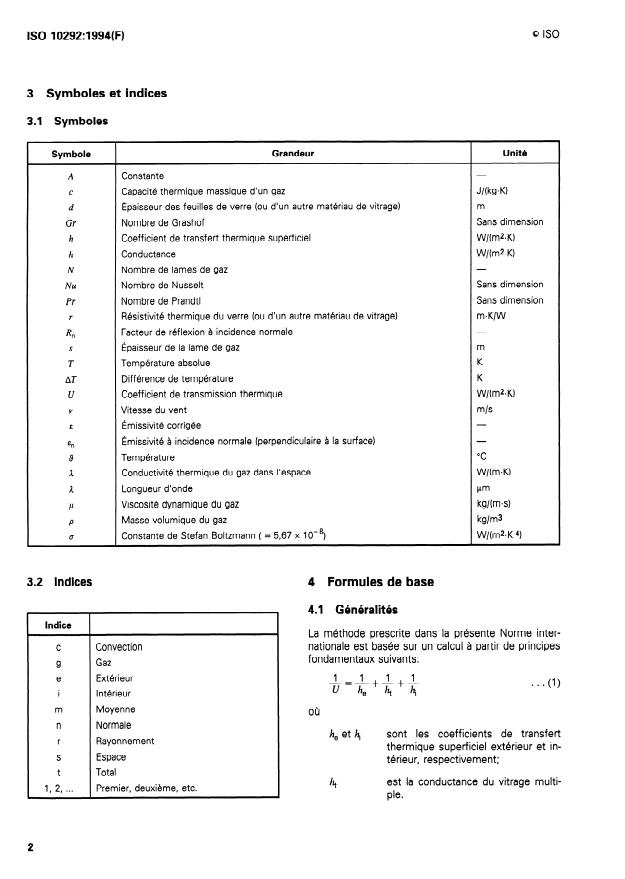
3 Symboles et indices
3.1 Symboles
Unit&
Grandeur
Symbole
A Constante
C Capacité thermique massique d’un gaz J/(kgW
m
d Epaisseur des feuilles de verre (ou d’un autre matériau de vitrage)
Sans dimension
Nombre de Grashof
Gr
W/(m*K)
h Coefficient de transfert thermique superficiel
W/(m*- K)
Conductance
h
Nombre de lames de gaz
N
Nombre de Nusselt Sans dimension
NU
Nombre de Prandtl Sans dimension
Pr
mK/W
r Résistivité thermique du verre (ou d’un autre matériau de vitrage)
Facteur de reflexion à incidence normale
m
S Epaisseur de la lame de gaz
K
T Température absolue
K
AT Différence de température
W/(m*-K)
u Coefficient de transmission thermique
V Vitesse du vent
m/s
E Émissivité corrigée
Émissivité à incidence normale (perpendiculaire à la surface)
%
“C
Température
A Conductivité thermique du gaz dans l’espace W/(mW
Longueur d’onde Pm
Â.
Viscosité dynamique du gaz kgl(m-s)
cc
Masse volumique du gaz
wm3
P
W/(m*-K 4)
Constante de Stefan Boltzmann ( = 5,67 x 10-*)
a
3.2 Indices 4 Formules de base
4.1 Généralités
Indice
La méthode prescrite dans la présente Norme inter-
C Convection nationale est basée sur un calcul à partir de principes
fondamentaux suivants:
Gaz
g
e Extérieur 1 1 1 1
-=
. . .
(1)
I;B+I;t+7;
u
i Intérieur
m Moyenne
où
n Normale
h, et 4 sont les coefficients de transfert
r Rayonnement
thermique superficiel ext&ieur et in-
S Espace
térieur, respectivement;
t Total
est la conductance du vitrage multi-
1, 2, . . . Premier, deuxiéme, etc.
.
ple
0 ISO
Nu = A(GrmPr)” . . .
(6)
où
A est une constante,
h est la conductance thermique de la lame
S
Gr est le nombre de Grashof,
de gaz;
Pr
est le nombre de Prandtl,
N est le nombre de lames de gaz;
n est un exposant,
est le nombre de matériaux;
M
Gr 9,81 s3ATp2
d est l’épaisseur totale de chaque matériau; =
. . .
m
(7)
TP m
est la resistivite thermique de chaque ma-
rm
tériau (la resistivité thermique du verre est PC
=-
Pr . . .
(8)
égale à 1 maK/W). a#
où
. . .
h, = hg + h,
(3)
AT est la difference de tempéra-
où
ture des surfaces des verres de
part et d’autre de la lame de
h est la conductance thermique radiative de
r
gaz, en kelvins (K),
est la masse volumique du gaz,
thermique du
h est la conductance P
gaz
en kilogrammes par metre
(conduction + convection).
cube (kg/m3),
4.2 Conductance radiative, h,
est la viscosité dynamique du
cc
gaz, en kilogrammes par métre
La conductance radiative est donnee par la formule
seconde [kg/(ms)],
suivante:
est la capacité thermique mas-
. . .
(4) sique du gaz, en joules par ki-
logramme kelvin [J/(kg*K)],
où
T est la température moyenne
m
absolue du gaz, en kelvins (K).
a est la constante de Stefan
Boltzmann;
Pour les lames verticales, le nombre de Nusselt est
calcule à partir de la formule (6) avec A = 0,035 et
g1 et c2 sont les émissivités corrigées à la
n = 0,38, en tenant compte de la condition suivante
température moyenne absolue Tm de
(voir aussi réf. Cl]).
la lame de gaz.
Si NU < 1, on utilise une valeur de NU = 1 dans la
4.3 Conductance du gaz, hg
formule (5), ce qui correspond à une valeur de GraPr
inférieure à 6 800. Si NU > 1, la valeur reelle de NU est
La conductance du gaz est donnée par la formule
utilisée dans la formule (5), correspondant à un régime
suivante:
avec convection.
h,=Nu+ . . .
(5)
5 Propriétés fondamentales des
où
matériaux
S est l’épaisseur de la lame de gaz, en mè-
tres (m);
5.1 Émissivité
Â, est la conductivité thermique du gaz, en
Les émissivites corrigées, E, des surfaces limitant les
watts par metre kelvin [W/(mmK)];
espaces fermes sont necessaires pour le calcul de la
Nu est le nombre du Nusselt, donne par conductance radiative, hr, dans la formule (4).
Pour les surfaces en verre, 0 n utilise 0,837 comme Des valeurs pour les propriétés d’une serie de gaz
valeur de I’émissivité corrigée. utilises en vitrages isolants préfabriqués sont données
au tableau A.3 de l’annexe A.
Pour des surfaces recouvertes de couches, la valeur
de I’émissivité a incidence normale, E,, est obtenue Pour les mélanges de gaz, les propriétés sont obte-
par mesure à l’aide d’un spectrométre infrarouge (voir nues par pondération proportionnelle aux rapports des
A.1 dans l’annexe A). volumes.
L’émissivité corrigée est obtenue à partir du Si on a
tableau A.2 de l’annexe A. La température moyenne
- un gaz 1 avec un rapport de volume R,,
de la lame de gaz, Tm, est fixee à 283 K, dans un but
de comparaison.
- un gaz 2 avec un rapport de volume R2, etc.,
Théoriquement il convient d’utiliser deux défini-
NOTE 1
alors
tions différentes de I’émissivité pour décrire les échanges
radiatifs entre
F = F,R, + F2R2 + . . .
. . .
(9)
- des surfaces vitrées se faisant face, dans les vitrages
où F représente la propriété concernée, c’est-à-dire,
multiples, ou
la conductivite thermique, la masse volumique, la vis-
cosité ou la capacité thermique massique.
- entre une surface vitrée et l’ambiance intérieure d’un
local.
Les différences entre les deux types d’échange se révèlent
cependant négligeables en pratique. En conséquence,
5.3 Absorption infrarouge
I’émissivité corrigée peut être utilisée dans les deux cas
avec une approximation suffisante.
Certains gaz absorbent le rayonnement infrarouge
dans le domaine de longueurs d’onde de 5 prn à
50 prn.
5.2 Propriétés des gaz
Lorsqu’un t
...
NORME
Iso
INTERNATIONALE
Première 6dition
1994-07-l 5
Verre dans la construction - Calcul du
coefficient de transmission thermique U,
en régime stationnaire des vitrages
multiples
Glass in building - Calculation of steady-state U values (thermal
transmittance) of multiple glazing
Num&o de référence
60 10292: 1994(F)
Avant-propos
L’ISO (Organisation internationale de normalisation) est une fédération
mondiale d’organismes nationaux de normalisation (comités membres de
I’ISO). L’elaboration des Normes internationales est en général confiee aux
comites techniques de I’ISO. Chaque comité membre interessé par une
étude a le droit de faire partie du comité technique crée a cet effet. Les
organisations internationales, gouvernementales et non gouvernemen-
tales, en liaison avec I’ISO participent également aux travaux. L’ISO colla-
bore etroitement avec la Commission électrotechnique internationale (CEI)
en ce qui concerne la normalisation électrotechnique.
Les projets de Normes internationales adoptes par les comités techniques
sont soumis aux comites membres pour vote. Leur publication comme
Normes internationales requiert l’approbation de 75 % au moins des co-
mites membres votants.
La Norme internationale ISO 10292 a été élaborée par le comite technique
lSO/TC 160, Verre dans la construction, sous-comité SC 2, Utilisation.
L’annexe A fait partie intégrante de la presente Norme internationale.
L’annexe B est donnée uniquement a titre d’information.
0 ISO 1994
Droits de reproduction réservés. Sauf prescription différente, aucune partie de cette publi-
cation ne peut être reproduite ni utilisée sous quelque forme que ce soit et par aucun pro-
céde, électronique ou mécanique, y compris la photocopie et les microfilms, sans l’accord
ecrit de l’editeur.
Organisation internationale de normalisation
Case Postale 56.CH-1211 Genéve 20 l Suis se
Imprimé en Suisse
ii
NORME INTERNATIONALE 0 ISO ISO 10292:1994(F)
Verre dans la construction - Calcul du coefficient de
transmission thermique U, en régime stationnaire des
vitrages multiples
d) l’appréciation du rayonnement absorbe pour la
1 Domaine d’application
determination du facteur solaire.
La présente Norme internationale est applicable au
verre, au verre recouvert d’une couche et aux mate- Les régles ont ete etablies de manière aussi simple
riaux opaques au rayonnement infrarouge de grande que possible, tout en restant précises.
longueur d’onde. Elle a pour objet de présenter les
règles fondamentales pour le calcul du coefficient de
1) dans la zone centrale du
transmission thermique, U ,
vitrage. Les effets de bord dus au pont thermique de
l’intercalaire d’un vitrage isolant préfabriqué, ou du
châssis de fenêtre, ne sont pas inclus.
Ces régles ont pour but de permettre l’evaluation des
déperditions à travers le vitrage d’un bâtiment, en se
2 Définition
basant sur les valeurs de U des vitrages. Combinees
avec les déperditions à travers les elements opaques
du bâtiment, elles sont utilisees pour déterminer la
capacité de l’installation de chauffage ou de refroidis-
sement.
Pour les besoins de la présente Norme internationale,
la définition suivante s’applique.
De plus, les valeurs de U peuvent être calculées dans
d’autres buts en utilisant la même procédure, en par-
ticulier pour la détermination des caractéristiques sui-
2.1 coefficient de transmission thermique d’un
vantes:
vitrage, U: Grandeur qui caractérise le transfert ther-
mique par la partie centrale du vitrage sans tenir
a) les gains de chaleur par conduction en été;
compte des effets de bords et donne la quantité de
chaleur la traversant, en régime stationnaire, par unite
b) la condensation sur les surfaces des vitrages;
de surface et pour une difference de température
unitaire entre les ambiances situées de part et d’autre
c) les déperditions saisonnieres par les vitrages
des faces du vitrage. Le coefficient U s’exprime en
intervenant dans la determination de la consom-
watts par mètre carre kelvin [W/(m20K)].
mation globale d’énergie dans les bâtiments;
1) Dans certains pays, le symbole k est utilisé.
3 Symboles et indices
3.1 Symboles
Unit&
Grandeur
Symbole
A Constante
C Capacité thermique massique d’un gaz J/(kgW
m
d Epaisseur des feuilles de verre (ou d’un autre matériau de vitrage)
Sans dimension
Nombre de Grashof
Gr
W/(m*K)
h Coefficient de transfert thermique superficiel
W/(m*- K)
Conductance
h
Nombre de lames de gaz
N
Nombre de Nusselt Sans dimension
NU
Nombre de Prandtl Sans dimension
Pr
mK/W
r Résistivité thermique du verre (ou d’un autre matériau de vitrage)
Facteur de reflexion à incidence normale
m
S Epaisseur de la lame de gaz
K
T Température absolue
K
AT Différence de température
W/(m*-K)
u Coefficient de transmission thermique
V Vitesse du vent
m/s
E Émissivité corrigée
Émissivité à incidence normale (perpendiculaire à la surface)
%
“C
Température
A Conductivité thermique du gaz dans l’espace W/(mW
Longueur d’onde Pm
Â.
Viscosité dynamique du gaz kgl(m-s)
cc
Masse volumique du gaz
wm3
P
W/(m*-K 4)
Constante de Stefan Boltzmann ( = 5,67 x 10-*)
a
3.2 Indices 4 Formules de base
4.1 Généralités
Indice
La méthode prescrite dans la présente Norme inter-
C Convection nationale est basée sur un calcul à partir de principes
fondamentaux suivants:
Gaz
g
e Extérieur 1 1 1 1
-=
. . .
(1)
I;B+I;t+7;
u
i Intérieur
m Moyenne
où
n Normale
h, et 4 sont les coefficients de transfert
r Rayonnement
thermique superficiel ext&ieur et in-
S Espace
térieur, respectivement;
t Total
est la conductance du vitrage multi-
1, 2, . . . Premier, deuxiéme, etc.
.
ple
0 ISO
Nu = A(GrmPr)” . . .
(6)
où
A est une constante,
h est la conductance thermique de la lame
S
Gr est le nombre de Grashof,
de gaz;
Pr
est le nombre de Prandtl,
N est le nombre de lames de gaz;
n est un exposant,
est le nombre de matériaux;
M
Gr 9,81 s3ATp2
d est l’épaisseur totale de chaque matériau; =
. . .
m
(7)
TP m
est la resistivite thermique de chaque ma-
rm
tériau (la resistivité thermique du verre est PC
=-
Pr . . .
(8)
égale à 1 maK/W). a#
où
. . .
h, = hg + h,
(3)
AT est la difference de tempéra-
où
ture des surfaces des verres de
part et d’autre de la lame de
h est la conductance thermique radiative de
r
gaz, en kelvins (K),
est la masse volumique du gaz,
thermique du
h est la conductance P
gaz
en kilogrammes par metre
(conduction + convection).
cube (kg/m3),
4.2 Conductance radiative, h,
est la viscosité dynamique du
cc
gaz, en kilogrammes par métre
La conductance radiative est donnee par la formule
seconde [kg/(ms)],
suivante:
est la capacité thermique mas-
. . .
(4) sique du gaz, en joules par ki-
logramme kelvin [J/(kg*K)],
où
T est la température moyenne
m
absolue du gaz, en kelvins (K).
a est la constante de Stefan
Boltzmann;
Pour les lames verticales, le nombre de Nusselt est
calcule à partir de la formule (6) avec A = 0,035 et
g1 et c2 sont les émissivités corrigées à la
n = 0,38, en tenant compte de la condition suivante
température moyenne absolue Tm de
(voir aussi réf. Cl]).
la lame de gaz.
Si NU < 1, on utilise une valeur de NU = 1 dans la
4.3 Conductance du gaz, hg
formule (5), ce qui correspond à une valeur de GraPr
inférieure à 6 800. Si NU > 1, la valeur reelle de NU est
La conductance du gaz est donnée par la formule
utilisée dans la formule (5), correspondant à un régime
suivante:
avec convection.
h,=Nu+ . . .
(5)
5 Propriétés fondamentales des
où
matériaux
S est l’épaisseur de la lame de gaz, en mè-
tres (m);
5.1 Émissivité
Â, est la conductivité thermique du gaz, en
Les émissivites corrigées, E, des surfaces limitant les
watts par metre kelvin [W/(mmK)];
espaces fermes sont necessaires pour le calcul de la
Nu est le nombre du Nusselt, donne par conductance radiative, hr, dans la formule (4).
Pour les surfaces en verre, 0 n utilise 0,837 comme Des valeurs pour les propriétés d’une serie de gaz
valeur de I’émissivité corrigée. utilises en vitrages isolants préfabriqués sont données
au tableau A.3 de l’annexe A.
Pour des surfaces recouvertes de couches, la valeur
de I’émissivité a incidence normale, E,, est obtenue Pour les mélanges de gaz, les propriétés sont obte-
par mesure à l’aide d’un spectrométre infrarouge (voir nues par pondération proportionnelle aux rapports des
A.1 dans l’annexe A). volumes.
L’émissivité corrigée est obtenue à partir du Si on a
tableau A.2 de l’annexe A. La température moyenne
- un gaz 1 avec un rapport de volume R,,
de la lame de gaz, Tm, est fixee à 283 K, dans un but
de comparaison.
- un gaz 2 avec un rapport de volume R2, etc.,
Théoriquement il convient d’utiliser deux défini-
NOTE 1
alors
tions différentes de I’émissivité pour décrire les échanges
radiatifs entre
F = F,R, + F2R2 + . . .
. . .
(9)
- des surfaces vitrées se faisant face, dans les vitrages
où F représente la propriété concernée, c’est-à-dire,
multiples, ou
la conductivite thermique, la masse volumique, la vis-
cosité ou la capacité thermique massique.
- entre une surface vitrée et l’ambiance intérieure d’un
local.
Les différences entre les deux types d’échange se révèlent
cependant négligeables en pratique. En conséquence,
5.3 Absorption infrarouge
I’émissivité corrigée peut être utilisée dans les deux cas
avec une approximation suffisante.
Certains gaz absorbent le rayonnement infrarouge
dans le domaine de longueurs d’onde de 5 prn à
50 prn.
5.2 Propriétés des gaz
Lorsqu’un t
...