

ISO/TS 18827:2017
(Main)Nanotechnologies — Electron spin resonance (ESR) as a method for measuring reactive oxygen species (ROS) generated by metal oxide nanomaterials
General Information
- Abstract
ISO/TS 18827:2017 provides a procedure for the detection of ROS (OH, O2-, 1O2) generated by metal oxide nanomaterials in aqueous solution with a reactive oxygen species-specific spin trapping agent using ESR, but excludes ESR procedures that do not use a spin trapping agent.
- Status
- Published
- Publication Date
- 22-May-2017
- Technical Committee
- ISO/TC 229 - Nanotechnologies
- Drafting Committee
- ISO/TC 229 - Nanotechnologies
- Current Stage
- 9093 - International Standard confirmed
- Start Date
- 18-Dec-2023
- Completion Date
- 29-Aug-2026
Buy Documents

ISO/TS 18827:2017 - Nanotechnologies -- Electron spin resonance (ESR) as a method for measuring reactive oxygen species (ROS) generated by metal oxide nanomaterials

ISO/TS 18827:2017 - Nanotechnologies — Electron spin resonance (ESR) as a method for measuring reactive oxygen species (ROS) generated by metal oxide nanomaterials/23/2017
Overview
ISO/TS 18827:2017 - Nanotechnologies - Electron spin resonance (ESR) as a method for measuring reactive oxygen species (ROS) generated by metal oxide nanomaterials - specifies a standardized, spin-trapping ESR procedure to detect and quantify ROS produced by metal oxide nanomaterials in aqueous, cell-free conditions. The technical specification targets detection of the biologically relevant ROS: hydroxyl radical (•OH), superoxide anion (O2•–) and singlet oxygen (1O2) using species-specific spin traps and excludes ESR methods that do not use spin trapping agents.
Key topics and requirements
- Purpose: Provide a reproducible ESR-based method to assess ROS generation potential of metal oxide nanomaterials as part of nanotoxicity evaluation and physico‑chemical characterisation.
- Target ROS and spin traps:
- DMPO for hydroxyl radical (DMPO/•OH adduct)
- BMPO for superoxide (BMPO/OOH adduct)
- TPC for singlet oxygen (TPC/1O2 adduct)
- Positive controls and validation: describes use of established radical-generating systems (e.g., Fenton reaction, hypoxanthine–xanthine oxidase, rose bengal photosensitization) and zero-baseline controls to demonstrate assay suitability.
- Procedure elements: preparation of nanomaterial suspensions, reagents and spin trap stock solutions, reaction conditions, sample injection and ESR measurement of spin adduct spectra, and calculation/standardization steps.
- Interferences and limitations: addresses sampling, timing, potential assay interferences, and the importance of controlling physico-chemical parameters (pH, light, aggregation) that influence ROS formation.
- Output: ESR spectra (spin adduct fingerprints) enabling detection and semi-quantitative assessment of ROS generation.
Applications and who should use it
- Researchers and laboratories characterising metal oxide nanomaterials (e.g., TiO2, ZnO) for oxidative potential.
- Nanotoxicologists and risk assessors evaluating ROS-mediated cytotoxicity and mechanistic hazard data.
- Product developers in biomedical devices, cosmetics, coatings, pigments, and environmental nanomaterials seeking early-stage screening of oxidative reactivity.
- Quality control and regulatory testing labs requiring standardized ESR spin‑trapping methods to support safety dossiers and comparability studies.
Practical value: ISO/TS 18827:2017 provides a reproducible, cell‑free screen to predict oxidative stress potential, support hazard identification, and inform further in vitro or in vivo testing strategies.
Related standards
- ISO/TS 80004‑1:2015 (nanotechnology vocabulary) - terminology referenced in the specification.
- ISO/TS 10993‑5:2009 and ISO/TS 10993‑12:2012 - referenced for test sample and control definitions used in biological testing contexts.
Keywords: ISO/TS 18827:2017, ESR, spin trapping, ROS, nanotechnologies, metal oxide nanomaterials, DMPO, BMPO, TPC, nanotoxicity, reactive oxygen species.
Buy Documents
ISO/TS 18827:2017 - Nanotechnologies -- Electron spin resonance (ESR) as a method for measuring reactive oxygen species (ROS) generated by metal oxide nanomaterials
ISO/TS 18827:2017 - Nanotechnologies — Electron spin resonance (ESR) as a method for measuring reactive oxygen species (ROS) generated by metal oxide nanomaterials/23/2017
Frequently Asked Questions
ISO/TS 18827:2017 is a technical specification published by the International Organization for Standardization (ISO). Its full title is "Nanotechnologies — Electron spin resonance (ESR) as a method for measuring reactive oxygen species (ROS) generated by metal oxide nanomaterials". This standard covers: ISO/TS 18827:2017 provides a procedure for the detection of ROS (OH, O2-, 1O2) generated by metal oxide nanomaterials in aqueous solution with a reactive oxygen species-specific spin trapping agent using ESR, but excludes ESR procedures that do not use a spin trapping agent.
ISO/TS 18827:2017 provides a procedure for the detection of ROS (OH, O2-, 1O2) generated by metal oxide nanomaterials in aqueous solution with a reactive oxygen species-specific spin trapping agent using ESR, but excludes ESR procedures that do not use a spin trapping agent.
ISO/TS 18827:2017 is classified under the following ICS (International Classification for Standards) categories: 07.030 - Physics. Chemistry; 07.120 - Nanotechnologies. The ICS classification helps identify the subject area and facilitates finding related standards.
ISO/TS 18827:2017 is available in PDF format for immediate download after purchase. The document can be added to your cart and obtained through the secure checkout process. Digital delivery ensures instant access to the complete standard document.
Standards Content (Sample)
TECHNICAL ISO/TS
SPECIFICATION 18827
First edition
2017-06
Nanotechnologies — Electron spin
resonance (ESR) as a method for
measuring reactive oxygen species
(ROS) generated by metal oxide
nanomaterials
Nanotechnologies — Résonance paramagnétique électronique (RPE)
pour la mesure des espèces réactives de l’oxygène (ROS) générées par
des nanomatériaux sous forme d’oxyde métallique
Reference number
©
ISO 2017
© ISO 2017, Published in Switzerland
All rights reserved. Unless otherwise specified, no part of this publication may be reproduced or utilized otherwise in any form
or by any means, electronic or mechanical, including photocopying, or posting on the internet or an intranet, without prior
written permission. Permission can be requested from either ISO at the address below or ISO’s member body in the country of
the requester.
ISO copyright office
Ch. de Blandonnet 8 • CP 401
CH-1214 Vernier, Geneva, Switzerland
Tel. +41 22 749 01 11
Fax +41 22 749 09 47
copyright@iso.org
www.iso.org
ii © ISO 2017 – All rights reserved
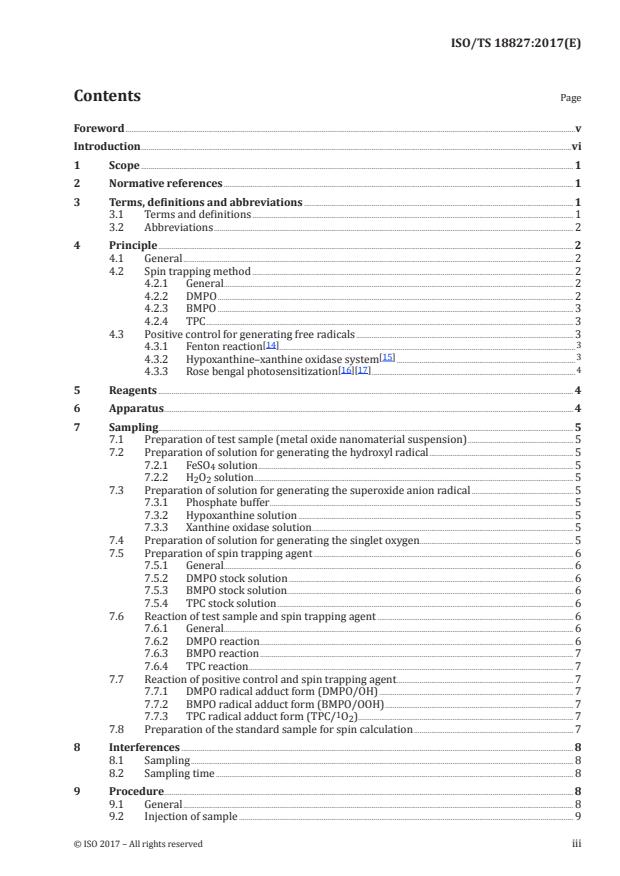
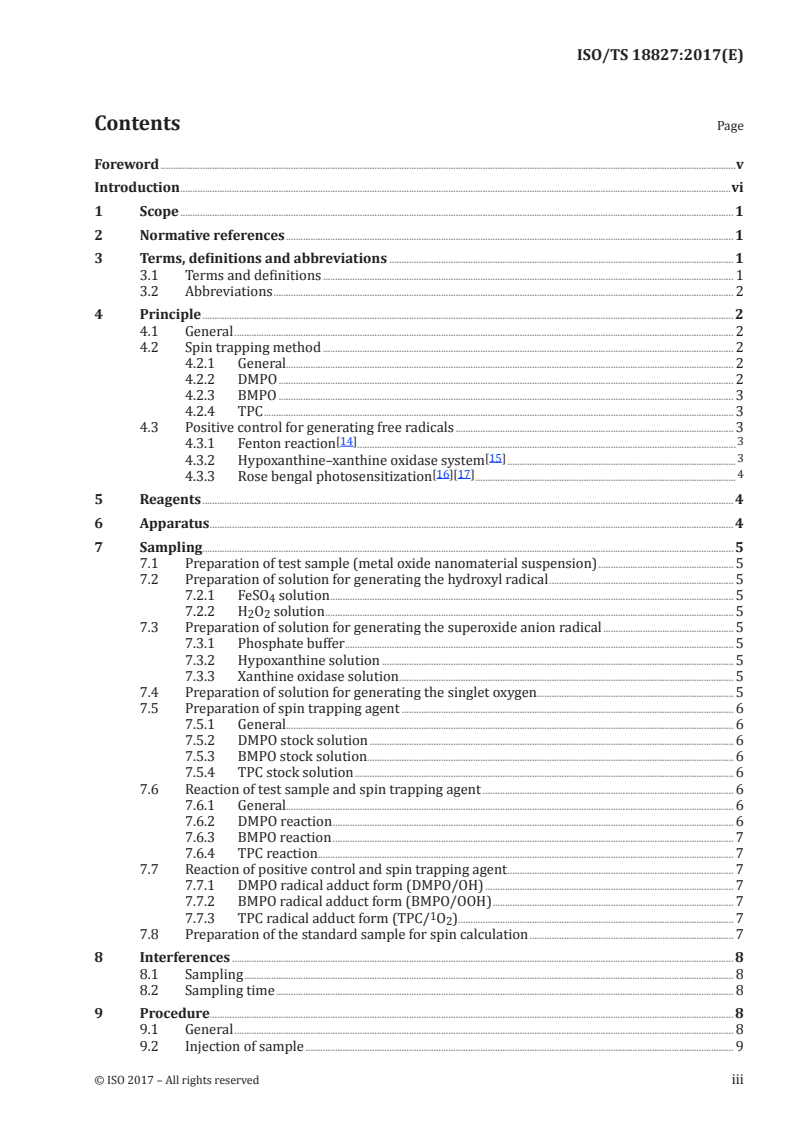
Contents Page
Foreword .v
Introduction .vi
1 Scope . 1
2 Normative references . 1
3 Terms, definitions and abbreviations . 1
3.1 Terms and definitions . 1
3.2 Abbreviations . 2
4 Principle . 2
4.1 General . 2
4.2 Spin trapping method . 2
4.2.1 General. 2
4.2.2 DMPO . 2
4.2.3 BMPO . 3
4.2.4 TPC . 3
4.3 Positive control for generating free radicals . 3
[14] 3
4.3.1 Fenton reaction . .
[15] 3
4.3.2 Hypoxanthine–xanthine oxidase system .
[16][17] 4
4.3.3 Rose bengal photosensitization .
5 Reagents . 4
6 Apparatus . 4
7 Sampling . 5
7.1 Preparation of test sample (metal oxide nanomaterial suspension) . 5
7.2 Preparation of solution for generating the hydroxyl radical . 5
7.2.1 FeSO solution . 5
7.2.2 H O solution . 5
2 2
7.3 Preparation of solution for generating the superoxide anion radical . 5
7.3.1 Phosphate buffer . 5
7.3.2 Hypoxanthine solution . 5
7.3.3 Xanthine oxidase solution . 5
7.4 Preparation of solution for generating the singlet oxygen. 5
7.5 Preparation of spin trapping agent . 6
7.5.1 General. 6
7.5.2 DMPO stock solution . 6
7.5.3 BMPO stock solution. 6
7.5.4 TPC stock solution . 6
7.6 Reaction of test sample and spin trapping agent . 6
7.6.1 General. 6
7.6.2 DMPO reaction . 6
7.6.3 BMPO reaction . 7
7.6.4 TPC reaction . 7
7.7 Reaction of positive control and spin trapping agent . 7
7.7.1 DMPO radical adduct form (DMPO/OH) . 7
7.7.2 BMPO radical adduct form (BMPO/OOH) . 7
7.7.3 TPC radical adduct form (TPC/ O ) . 7
7.8 Preparation of the standard sample for spin calculation . 7
8 Interferences . 8
8.1 Sampling . 8
8.2 Sampling time . 8
9 Procedure. 8
9.1 General . 8
9.2 Injection of sample . 9
9.3 ESR measurement .10
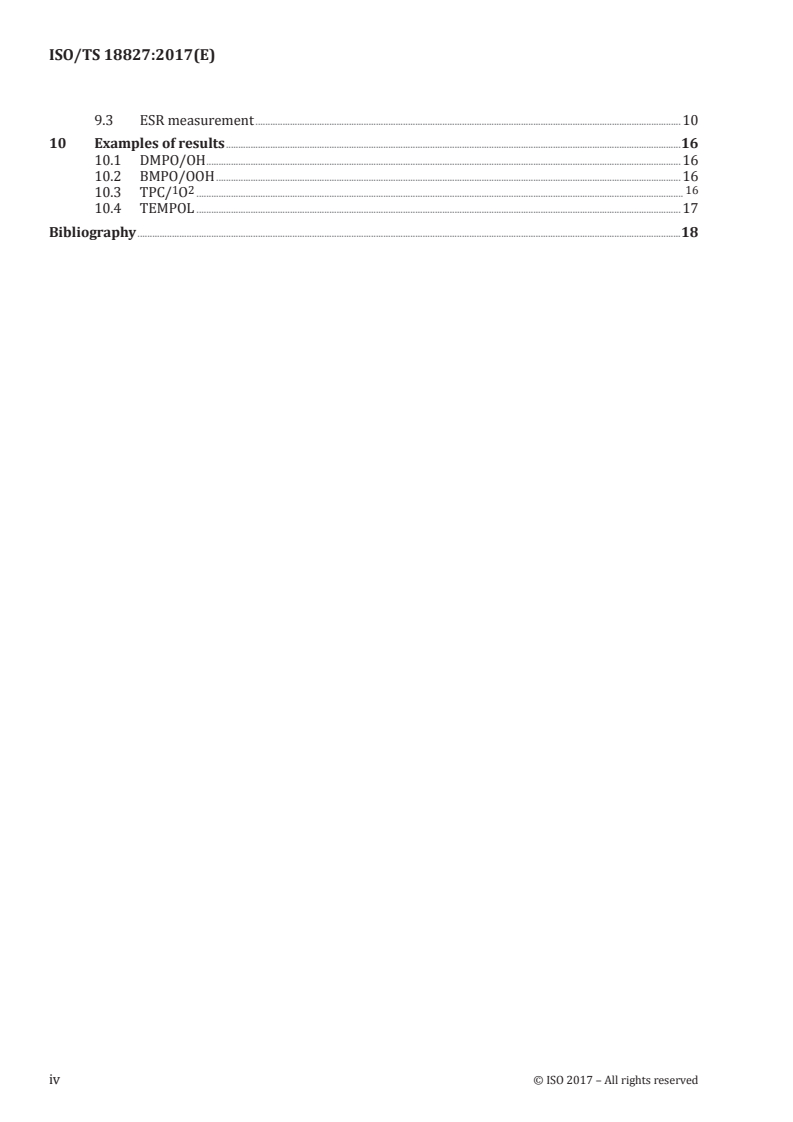
10 Examples of results .16
10.1 DMPO/OH .16
10.2 BMPO/OOH .16
1 2 16
10.3 TPC/ O .
10.4 TEMPOL .17
Bibliography .18
iv © ISO 2017 – All rights reserved
Foreword
ISO (the International Organization for Standardization) is a worldwide federation of national standards
bodies (ISO member bodies). The work of preparing International Standards is normally carried out
through ISO technical committees. Each member body interested in a subject for which a technical
committee has been established has the right to be represented on that committee. International
organizations, governmental and non-governmental, in liaison with ISO, also take part in the work.
ISO collaborates closely with the International Electrotechnical Commission (IEC) on all matters of
electrotechnical standardization.
The procedures used to develop this document and those intended for its further maintenance are
described in the ISO/IEC Directives, Part 1. In particular the different approval criteria needed for the
different types of ISO documents should be noted. This document was drafted in accordance with the
editorial rules of the ISO/IEC Directives, Part 2 (see www .iso .org/ directives).
Attention is drawn to the possibility that some of the elements of this document may be the subject of
patent rights. ISO shall not be held responsible for identifying any or all such patent rights. Details of
any patent rights identified during the development of the document will be in the Introduction and/or
on the ISO list of patent declarations received (see www .iso .org/ patents).
Any trade name used in this document is information given for the convenience of users and does not
constitute an endorsement.
For an explanation on the voluntary nature of standards, the meaning of ISO specific terms and
expressions related to conformity assessment, as well as information about ISO’s adherence to the
World Trade Organization (WTO) principles in the Technical Barriers to Trade (TBT) see the following
URL: w w w . i s o .org/ iso/ foreword .html.
This document was prepared by Technical Committee ISO/TC 229, Nanotechnologies.
Introduction
Recently, the use of metal or metal oxide-based nanomaterials has dramatically increased in biomedical
and industrial applications. However, the scientific basis for the cytotoxicity and genotoxicity of most
manufactured nanomaterials are not fully understood. An important mechanism of nanotoxicity is
the generation of reactive oxygen species (ROS). The study on the hazardous effects of metal oxide
nanomaterials is still in its initial stage. The ability to generate ROS is one main source of toxicity of
metal oxide nanomaterials. Overproduction of ROS can induce oxidative stress, resulting in cells failing
to maintain normal physiological redox-regulated functions. This in turn may lead to DNA damage,
unregulated cell signalling, change in cell motility, cytotoxicity, apoptosis and cancer initiation. There
are critical determinants that can affect the generation of ROS. The critical determinants include size,
shape, particle surface, surface positive charges, surface-containing groups, particle dissolution, metal
ion release from nanometals and nanometal oxides, UV light activation, aggregation, mode of interaction
[1]
with cells, inflammation and pH of the medium . Thus, to detect and quantify ROS formation on the
surface of metal oxide nanomaterials, this document suggests the electron-spin-resonance (ESR) method.
Amongst ROS, the most biologically relevant and widely studied are hydroxyl radical (OH), superoxide
- 1
anion radical (O ), singlet oxygen ( O ) and hydrogen peroxide (H O ).
2 2 2 2
However, direct detection of some free radicals (e.g. superoxide anion and hydroxyl radical) is very
[2]
difficult or impossible in solution at room temperature. ESR spin trapping is a valuable tool in the
[3]
study of transient free radicals . Spin trapping is a technique, developed in the late 1960s, where
a nitrone or nitroso compound (a spin trap) reacts with a target free radical to form a stable and
distinguishable free radical (spin adducts) to be detected by ESR spectroscopy.
Spin adducts can be observed directly by ESR spectroscopy. The ESR spectra of these spin adducts are
unique and provide a fingerprint for the presence of ROS.
This document specifies methods of detection by ESR of 5,5-dimethyl-1-pyrroline-N-oxide (DMPO)
hydroxyl adduct, 5-tert-butoxycarbonyl-5-methyl-1-pyrroline-N-oxide (BMPO) superoxide adduct and
2,2,5,5-tetramethyl-3-pyrroline-3-carboxamide (TPC) singlet oxygen adduct formation from metal
oxide nanomaterials. This document provides a method to assess ROS generation on the metal oxide
nanomaterials in a cell free condition. This method may provide valuable information for the prediction
of ROS-mediated cytotoxicity without cytotoxicity assay at physico-chemical evaluation phase.
vi © ISO 2017 – All rights reserved
TECHNICAL SPECIFICATION ISO/TS 18827:2017(E)
Nanotechnologies — Electron spin resonance (ESR) as
a method for measuring reactive oxygen species (ROS)
generated by metal oxide nanomaterials
1 Scope
- 1
This document provides a procedure for the detection of ROS (OH, O , O ) generated by metal oxide
2 2
nanomaterials in aqueous solution with a reactive oxygen species-specific spin trapping agent using
ESR, but excludes ESR procedures that do not use a spin trapping agent.
2 Normative references
There are no normative references in this document.
3 Terms, definitions and abbreviations
For the purposes of this document, the following terms and definitions apply.
ISO and IEC maintain terminological databases for use in standardization at the following addresses:
— IEC Electropedia: available at http:// www .electropedia .org/
— ISO Online browsing platform: available at http:// www .iso .org/ obp
3.1 Terms and definitions
3.1.1
nanomaterial
material with any external dimension in the nanoscale or having internal structure or surface structure
in the nanoscale
Note 1 to entry: This generic term is inclusive of nano-object and nanostructured material.
Note 2 to entry: See also ISO/TS 80004-1:2015, 2.8 to 2.10.
[SOURCE: ISO/TS 80004-1:2015, 2.4]
3.1.2
test sample
material, device, device portion, component, extract or portion thereof that is subjected to biological or
chemical testing or evaluation
[SOURCE: ISO/TS 10993-5:2009, 3.5]
3.1.3
zero baseline control
equivalent of the positive control where no radicals are detected
Note 1 to entry: For example, zero baseline control for the positive control of fenton reaction will be H O and
2 2
DMPO in the absence of iron; for hypoxanthine–xanthine oxidase (HX-XO) system, it will be hypoxanthine and
BMPO in the absence of HX-XO; for rose bengal photosensitization, it will be rose bengal and TPC in the absence
of light.
3.1.4
positive control
well-characterized material or substance that, when evaluated by a specific test method, demonstrates
the suitability of the test system to yield a reproducible, appropriately positive or reactive response in
the test system
[SOURCE: ISO/TS 10993-12:2012, 3.12]
3.2 Abbreviations
ROS reactive oxygen species
ESR electron spin resonance
DMPO 5,5-dimethyl-1-pyrroline-N-oxide
BMPO 5-tert-butoxycarbonyl-5-methyl-1-pyrroline-N-oxide
TPC 2,2,5,5-tetramethyl-3-pyrroline-3-carboxamide
DTPA diethylenetriaminepentaacetic acid
OH hydroxyl radical
OH- hydroxide ion
O superoxide anion radical
0 singlet oxygen
TEMPOL 4-hydroxyl-2,2,6,6-tetramethylpiperidine-1-oxyl
4 Principle
4.1 General
In most atoms and molecules, electrons are paired. The paired electrons do not give an ESR signal while
atoms and molecules with unpaired electrons give an ESR signal. When an atom or molecule with an
unpaired electron is placed in a magnetic field, the spin of the unpaired electron can align either in the
same direction or in the opposite direction as the field. These two alignments of electron spin have
different energies. The application of a magnetic field to an unpaired electron lifts the degeneracy of
its spin states. ESR spectroscopy measures the absorption of microwave radiation associated with the
[4]
transition between these non-degenerate spin states .
4.2 Spin trapping method
4.2.1 General
Spin trapping is used in ESR spectroscopy for detection and identification of short-lived free radicals.
Ideally, the adduct formed between a spin trapping agent and a free radical has an ESR spectrum
characteristic and specific to that free radical. Advanced ESR studies employing spin-trap agents were
adopted to distinguish the different types of ROS.
4.2.2 DMPO
DMPO has significant advantages over other nitrone spin traps. It is particularly useful for identifying
oxygen-centred radicals, e.g. superoxide anion and hydroxyl radicals. The spin adduct formed between
2 © ISO 2017 – All rights reserved
DMPO and the hydroxyl radical has an ESR signal consisting of a quartet with intensity ratio of 1:2:2:1
[5]
and hyperfine splitting of a = a = 1,49 mT to 1,5 mT, which is consistent with the DMPO-OH adduct .
N H
4.2.3 BMPO
BMPO is suitable for the specific in vivo or in vitro detection of short-lived superoxide anions and hydroxyl
[6]
radicals by forming distinguishable adducts measurable with ESR spectroscopy . Other nitrone spin
traps, such as DMPO, do not distinguish superoxide and hydroxyl radical easily because of spontaneous
decay of DMPO-superoxide adduct (t1/2 = 0,9 min to 1,3 min) into the DMPO-hydroxyl adduct. BMPO-
superoxide adduct does not decay into a hydroxyl adduct and has a much longer half-life (t1/2 = 8,5 min to
[7] [8][9]
15,7 min) . The BMPO-superoxide adduct were fitted with a = 1,34, a = 1,18 mT .
N H
4.2.4 TPC
[10]
TPC has proper sensitivity and dynamic range for detecting the formation of singlet oxygen . TPC-
[11] 1
singlet oxygen adduct spectrum shows a triplet with 1:1:1 signal intensity . The TPC/ O adduct has
[12]
a hyperfine splitting of a = 0,172 mT .
N
NOTE 1 The hyperfine coupling constants of magnetic nuclei (a = the hyperfine splitting of the spectrum, ai
1 13 14
where i = type of nucleus, e.g. H, C, N) and the pattern of an ESR spectrum contains the information about
the structure and geometry of such radicals.
[13]
NOTE 2 The width of spectral line is characteristic of resonance frequency-energy absorption conditions .
4.3 Positive control for generating free radicals
Fenton reaction, hypoxanthine–xanthine oxidase (HX-XO) system and rose bengal photosensitization
are well-characterized systems that can generate hydroxyl radical, superoxide anions and singlet
oxygen, respectively. These systems demonstrates the suitability of the spin trapping agents to yield a
reproducible and ESR signal patterns of the spin adducts such as intensity ratio and hyperfine splitting.
[14]
4.3.1 Fenton reaction
Transition metal ions can activate H O to form hydroxyl radicals which are strong oxidants. This
2 2
system is called the fenton reaction. Iron (II) (ferrous ion) is oxidized by hydrogen peroxide to produce
iron (III) (ferric ion), a hydroxyl radical and a hydroxyl anion (Reaction 1). The hydroxyl radical
produced in the fenton reaction might be then trapped by DMPO to yield the spin adduct, DMPO/OH
(Reaction 2).
2+ 3+ ∙ + -
Fe + H O → Fe + OH OH Reaction 1
2 2
OH + DMPO → DMPO/OH Reaction 2
[15]
4.3.2 Hypoxanthine–xanthine oxidase system
Hypoxanthine–xanthine oxidase (HX-XO) system is a well-characterized system that can generate
superoxide anions (Reaction 3 and Reaction 4). The superoxide anion can then be trapped by BMPO to
form the spin adduct, BMPO/OOH (Reaction 5).
Xanthineoxidase
Reaction 3
Hypoxanthine + H O + O → Xanthine + H O
2 2 2 2
Xanthineoxidase
Reaction 4
-
Xanthine + H O + O → Uric acid + O
2 2 2
-
O + BMPO → BMPO/OOH Reaction 5
[16][17]
4.3.3 Rose bengal photosensitization
Rose bengal is known as a photosensitizer for generation of singlet oxygen. When photoexcited, rose
bengal transfers its energy to oxygen producing singlet oxygen (Reaction 6 and Reaction 7). The singlet
oxygen can then be trapped by TPC to form the adduct, TPC/ O (Reaction 8).
2.
Lightm(λ=ax around 550 nm)
Reaction 6
rose bengal → rose bengal*
rose bengal* + O → rose bengal + O Reaction 7
2 2
1 1
O + TPC → TPC/ O Reaction 8
2 2
5 Reagents
Use only reagents of recognized analytical grade and only distilled water or water of equivalent purity.
5.1 Spin-trap agent, for example DMPO, BMPO and TPC.
5.2 Reagents for positive control, for example FeSO , H O , phosphate buffer (pH 7,4),
4 2 2
diethylenetriaminepentaacetic acid (DTPA) or chelating ion exchange resin, hypoxanthine, xanthine
oxidase, rose bengal.
5.3 Deionised water (18,2 MΩ at 25 °C).
5.4 Standard sample for spin calculation, for example TEMPOL.
6 Apparatus
The usual laboratory apparatus are required and, in particular, the following:
6.1 Laboratory balance.
6.2 1,5 mℓ centrifuge tube.
6.3 Pipettes, with 10 µℓ to 1 000 µℓ volume.
6.4 Pipette tips, for 10 µℓ to 1 000 µℓ volume.
6.5 Vortex mixer.
6.6 Centrifuge, for 1,5 mℓ centrifuge tube.
6.7 Sample cell (flat sample cell or fine capillary-like sample tube), for samples of aqueous
solutions; consisting of quartz (pure silicon dioxide, SiO ).
6.8 Light source, λ max = around 550 nm.
6.9 ESR spectrometer.
4 © ISO 2017 – All rights reserved
7 Sampling
7.1 Preparation of test sample (metal oxide nanomaterial suspension)
The metal oxide nanomaterial is freshly prepared in deionised water and agitated on a vortex mixer
or pipetting immediately. Approximately 500 µℓ is required for each sample. Mix well by vortexing
[18]
or pipetting. Do not sonicate because radicals can be generated by sonication . Refer to 8.1 and the
[19]
OECD document .
Types and levels of ROS generated from nanomaterials can vary in accordance with the type of
nanomaterials. Sample concentration of nanomaterials should be experimentally determined.
Compare the ROS levels generated from same concentration of nanomaterial according to the ROS
type. Refer to 9.3.9.
7.2 Preparation of solution for generating the hydroxyl radical
7.2.1 FeSO solution
Dissolve the FeSO in deionised water to make a concentration of 0,01 mM. Exactly 50 µℓ is required for
each sample. Only freshly prepared solutions of FeSO should be used.
7.2.2 H O solution
2 2
Dilute the H O in deionised water to make a concentration of 0,1 mM. Exactly 50 µℓ is required for
2 2
each sample. Freshly prepared solutions of H O should be used.
2 2
7.3 Preparation of solution for generating the superoxide anion radical
7.3.1 Phosphate buffer
Prepare a solution of phosphate buffer (100 mM, pH7,4) removed transition metal ions in deionised water.
Exactly 70 µℓ is required for each sample. To remove transition metal ions, refer to NOTE 1 or NOTE 2.
NOTE 1 DTPA is used to eliminate possible artefactual oxidation by trace amounts of contaminating metal
[20]
ions .
NOTE 2 Chelating ion exchange resins are specific exchangers or chelating. Prepare a solution of phosphate
[21][22]
buffer by treating with chelating ion exchange resin .
7.3.2 Hypoxanthine solution
Dissolve the hypoxanthine in 100 mM phosphate buffer to make a concentration of 0,125 μM. Exactly
100 µℓ is required for each sample.
7.3.3 Xanthine oxidase solution
Dissolve the Xanthine oxidase in 100 mM phosphate buffer to make a concentration of 0,125 unit/mℓ.
Exactly 10 µℓ is required for each sample. Freshly prepared solutions of xanthine oxidase should be
used. Store at 2 °C to 8 °C.
7.4 Preparation of solution for generating the singlet oxygen
Dissolve the rose bengal in deionised water to make a concentration of 100 μM. Exactly 50 µℓ is required
for each sample. Protect from light.
7.5 Preparation of spin trapping agent
7.5.1 General
Spin trapping agents contain paramagnetic impurities that ca
...
TECHNICAL ISO/TS
SPECIFICATION 18827
First edition
2017-06
Nanotechnologies — Electron spin
resonance (ESR) as a method for
measuring reactive oxygen species
(ROS) generated by metal oxide
nanomaterials
Nanotechnologies — Résonance paramagnétique électronique (RPE)
pour la mesure des espèces réactives de l’oxygène (ROS) générées par
des nanomatériaux sous forme d’oxyde métallique
Reference number
©
ISO 2017
© ISO 2017, Published in Switzerland
All rights reserved. Unless otherwise specified, no part of this publication may be reproduced or utilized otherwise in any form
or by any means, electronic or mechanical, including photocopying, or posting on the internet or an intranet, without prior
written permission. Permission can be requested from either ISO at the address below or ISO’s member body in the country of
the requester.
ISO copyright office
Ch. de Blandonnet 8 • CP 401
CH-1214 Vernier, Geneva, Switzerland
Tel. +41 22 749 01 11
Fax +41 22 749 09 47
copyright@iso.org
www.iso.org
ii © ISO 2017 – All rights reserved
Contents Page
Foreword .v
Introduction .vi
1 Scope . 1
2 Normative references . 1
3 Terms, definitions and abbreviations . 1
3.1 Terms and definitions . 1
3.2 Abbreviations . 2
4 Principle . 2
4.1 General . 2
4.2 Spin trapping method . 2
4.2.1 General. 2
4.2.2 DMPO . 2
4.2.3 BMPO . 3
4.2.4 TPC . 3
4.3 Positive control for generating free radicals . 3
[14] 3
4.3.1 Fenton reaction . .
[15] 3
4.3.2 Hypoxanthine–xanthine oxidase system .
[16][17] 4
4.3.3 Rose bengal photosensitization .
5 Reagents . 4
6 Apparatus . 4
7 Sampling . 5
7.1 Preparation of test sample (metal oxide nanomaterial suspension) . 5
7.2 Preparation of solution for generating the hydroxyl radical . 5
7.2.1 FeSO solution . 5
7.2.2 H O solution . 5
2 2
7.3 Preparation of solution for generating the superoxide anion radical . 5
7.3.1 Phosphate buffer . 5
7.3.2 Hypoxanthine solution . 5
7.3.3 Xanthine oxidase solution . 5
7.4 Preparation of solution for generating the singlet oxygen. 5
7.5 Preparation of spin trapping agent . 6
7.5.1 General. 6
7.5.2 DMPO stock solution . 6
7.5.3 BMPO stock solution. 6
7.5.4 TPC stock solution . 6
7.6 Reaction of test sample and spin trapping agent . 6
7.6.1 General. 6
7.6.2 DMPO reaction . 6
7.6.3 BMPO reaction . 7
7.6.4 TPC reaction . 7
7.7 Reaction of positive control and spin trapping agent . 7
7.7.1 DMPO radical adduct form (DMPO/OH) . 7
7.7.2 BMPO radical adduct form (BMPO/OOH) . 7
7.7.3 TPC radical adduct form (TPC/ O ) . 7
7.8 Preparation of the standard sample for spin calculation . 7
8 Interferences . 8
8.1 Sampling . 8
8.2 Sampling time . 8
9 Procedure. 8
9.1 General . 8
9.2 Injection of sample . 9
9.3 ESR measurement .10
10 Examples of results .16
10.1 DMPO/OH .16
10.2 BMPO/OOH .16
1 2 16
10.3 TPC/ O .
10.4 TEMPOL .17
Bibliography .18
iv © ISO 2017 – All rights reserved
Foreword
ISO (the International Organization for Standardization) is a worldwide federation of national standards
bodies (ISO member bodies). The work of preparing International Standards is normally carried out
through ISO technical committees. Each member body interested in a subject for which a technical
committee has been established has the right to be represented on that committee. International
organizations, governmental and non-governmental, in liaison with ISO, also take part in the work.
ISO collaborates closely with the International Electrotechnical Commission (IEC) on all matters of
electrotechnical standardization.
The procedures used to develop this document and those intended for its further maintenance are
described in the ISO/IEC Directives, Part 1. In particular the different approval criteria needed for the
different types of ISO documents should be noted. This document was drafted in accordance with the
editorial rules of the ISO/IEC Directives, Part 2 (see www .iso .org/ directives).
Attention is drawn to the possibility that some of the elements of this document may be the subject of
patent rights. ISO shall not be held responsible for identifying any or all such patent rights. Details of
any patent rights identified during the development of the document will be in the Introduction and/or
on the ISO list of patent declarations received (see www .iso .org/ patents).
Any trade name used in this document is information given for the convenience of users and does not
constitute an endorsement.
For an explanation on the voluntary nature of standards, the meaning of ISO specific terms and
expressions related to conformity assessment, as well as information about ISO’s adherence to the
World Trade Organization (WTO) principles in the Technical Barriers to Trade (TBT) see the following
URL: w w w . i s o .org/ iso/ foreword .html.
This document was prepared by Technical Committee ISO/TC 229, Nanotechnologies.
Introduction
Recently, the use of metal or metal oxide-based nanomaterials has dramatically increased in biomedical
and industrial applications. However, the scientific basis for the cytotoxicity and genotoxicity of most
manufactured nanomaterials are not fully understood. An important mechanism of nanotoxicity is
the generation of reactive oxygen species (ROS). The study on the hazardous effects of metal oxide
nanomaterials is still in its initial stage. The ability to generate ROS is one main source of toxicity of
metal oxide nanomaterials. Overproduction of ROS can induce oxidative stress, resulting in cells failing
to maintain normal physiological redox-regulated functions. This in turn may lead to DNA damage,
unregulated cell signalling, change in cell motility, cytotoxicity, apoptosis and cancer initiation. There
are critical determinants that can affect the generation of ROS. The critical determinants include size,
shape, particle surface, surface positive charges, surface-containing groups, particle dissolution, metal
ion release from nanometals and nanometal oxides, UV light activation, aggregation, mode of interaction
[1]
with cells, inflammation and pH of the medium . Thus, to detect and quantify ROS formation on the
surface of metal oxide nanomaterials, this document suggests the electron-spin-resonance (ESR) method.
Amongst ROS, the most biologically relevant and widely studied are hydroxyl radical (OH), superoxide
- 1
anion radical (O ), singlet oxygen ( O ) and hydrogen peroxide (H O ).
2 2 2 2
However, direct detection of some free radicals (e.g. superoxide anion and hydroxyl radical) is very
[2]
difficult or impossible in solution at room temperature. ESR spin trapping is a valuable tool in the
[3]
study of transient free radicals . Spin trapping is a technique, developed in the late 1960s, where
a nitrone or nitroso compound (a spin trap) reacts with a target free radical to form a stable and
distinguishable free radical (spin adducts) to be detected by ESR spectroscopy.
Spin adducts can be observed directly by ESR spectroscopy. The ESR spectra of these spin adducts are
unique and provide a fingerprint for the presence of ROS.
This document specifies methods of detection by ESR of 5,5-dimethyl-1-pyrroline-N-oxide (DMPO)
hydroxyl adduct, 5-tert-butoxycarbonyl-5-methyl-1-pyrroline-N-oxide (BMPO) superoxide adduct and
2,2,5,5-tetramethyl-3-pyrroline-3-carboxamide (TPC) singlet oxygen adduct formation from metal
oxide nanomaterials. This document provides a method to assess ROS generation on the metal oxide
nanomaterials in a cell free condition. This method may provide valuable information for the prediction
of ROS-mediated cytotoxicity without cytotoxicity assay at physico-chemical evaluation phase.
vi © ISO 2017 – All rights reserved
TECHNICAL SPECIFICATION ISO/TS 18827:2017(E)
Nanotechnologies — Electron spin resonance (ESR) as
a method for measuring reactive oxygen species (ROS)
generated by metal oxide nanomaterials
1 Scope
- 1
This document provides a procedure for the detection of ROS (OH, O , O ) generated by metal oxide
2 2
nanomaterials in aqueous solution with a reactive oxygen species-specific spin trapping agent using
ESR, but excludes ESR procedures that do not use a spin trapping agent.
2 Normative references
There are no normative references in this document.
3 Terms, definitions and abbreviations
For the purposes of this document, the following terms and definitions apply.
ISO and IEC maintain terminological databases for use in standardization at the following addresses:
— IEC Electropedia: available at http:// www .electropedia .org/
— ISO Online browsing platform: available at http:// www .iso .org/ obp
3.1 Terms and definitions
3.1.1
nanomaterial
material with any external dimension in the nanoscale or having internal structure or surface structure
in the nanoscale
Note 1 to entry: This generic term is inclusive of nano-object and nanostructured material.
Note 2 to entry: See also ISO/TS 80004-1:2015, 2.8 to 2.10.
[SOURCE: ISO/TS 80004-1:2015, 2.4]
3.1.2
test sample
material, device, device portion, component, extract or portion thereof that is subjected to biological or
chemical testing or evaluation
[SOURCE: ISO/TS 10993-5:2009, 3.5]
3.1.3
zero baseline control
equivalent of the positive control where no radicals are detected
Note 1 to entry: For example, zero baseline control for the positive control of fenton reaction will be H O and
2 2
DMPO in the absence of iron; for hypoxanthine–xanthine oxidase (HX-XO) system, it will be hypoxanthine and
BMPO in the absence of HX-XO; for rose bengal photosensitization, it will be rose bengal and TPC in the absence
of light.
3.1.4
positive control
well-characterized material or substance that, when evaluated by a specific test method, demonstrates
the suitability of the test system to yield a reproducible, appropriately positive or reactive response in
the test system
[SOURCE: ISO/TS 10993-12:2012, 3.12]
3.2 Abbreviations
ROS reactive oxygen species
ESR electron spin resonance
DMPO 5,5-dimethyl-1-pyrroline-N-oxide
BMPO 5-tert-butoxycarbonyl-5-methyl-1-pyrroline-N-oxide
TPC 2,2,5,5-tetramethyl-3-pyrroline-3-carboxamide
DTPA diethylenetriaminepentaacetic acid
OH hydroxyl radical
OH- hydroxide ion
O superoxide anion radical
0 singlet oxygen
TEMPOL 4-hydroxyl-2,2,6,6-tetramethylpiperidine-1-oxyl
4 Principle
4.1 General
In most atoms and molecules, electrons are paired. The paired electrons do not give an ESR signal while
atoms and molecules with unpaired electrons give an ESR signal. When an atom or molecule with an
unpaired electron is placed in a magnetic field, the spin of the unpaired electron can align either in the
same direction or in the opposite direction as the field. These two alignments of electron spin have
different energies. The application of a magnetic field to an unpaired electron lifts the degeneracy of
its spin states. ESR spectroscopy measures the absorption of microwave radiation associated with the
[4]
transition between these non-degenerate spin states .
4.2 Spin trapping method
4.2.1 General
Spin trapping is used in ESR spectroscopy for detection and identification of short-lived free radicals.
Ideally, the adduct formed between a spin trapping agent and a free radical has an ESR spectrum
characteristic and specific to that free radical. Advanced ESR studies employing spin-trap agents were
adopted to distinguish the different types of ROS.
4.2.2 DMPO
DMPO has significant advantages over other nitrone spin traps. It is particularly useful for identifying
oxygen-centred radicals, e.g. superoxide anion and hydroxyl radicals. The spin adduct formed between
2 © ISO 2017 – All rights reserved
DMPO and the hydroxyl radical has an ESR signal consisting of a quartet with intensity ratio of 1:2:2:1
[5]
and hyperfine splitting of a = a = 1,49 mT to 1,5 mT, which is consistent with the DMPO-OH adduct .
N H
4.2.3 BMPO
BMPO is suitable for the specific in vivo or in vitro detection of short-lived superoxide anions and hydroxyl
[6]
radicals by forming distinguishable adducts measurable with ESR spectroscopy . Other nitrone spin
traps, such as DMPO, do not distinguish superoxide and hydroxyl radical easily because of spontaneous
decay of DMPO-superoxide adduct (t1/2 = 0,9 min to 1,3 min) into the DMPO-hydroxyl adduct. BMPO-
superoxide adduct does not decay into a hydroxyl adduct and has a much longer half-life (t1/2 = 8,5 min to
[7] [8][9]
15,7 min) . The BMPO-superoxide adduct were fitted with a = 1,34, a = 1,18 mT .
N H
4.2.4 TPC
[10]
TPC has proper sensitivity and dynamic range for detecting the formation of singlet oxygen . TPC-
[11] 1
singlet oxygen adduct spectrum shows a triplet with 1:1:1 signal intensity . The TPC/ O adduct has
[12]
a hyperfine splitting of a = 0,172 mT .
N
NOTE 1 The hyperfine coupling constants of magnetic nuclei (a = the hyperfine splitting of the spectrum, ai
1 13 14
where i = type of nucleus, e.g. H, C, N) and the pattern of an ESR spectrum contains the information about
the structure and geometry of such radicals.
[13]
NOTE 2 The width of spectral line is characteristic of resonance frequency-energy absorption conditions .
4.3 Positive control for generating free radicals
Fenton reaction, hypoxanthine–xanthine oxidase (HX-XO) system and rose bengal photosensitization
are well-characterized systems that can generate hydroxyl radical, superoxide anions and singlet
oxygen, respectively. These systems demonstrates the suitability of the spin trapping agents to yield a
reproducible and ESR signal patterns of the spin adducts such as intensity ratio and hyperfine splitting.
[14]
4.3.1 Fenton reaction
Transition metal ions can activate H O to form hydroxyl radicals which are strong oxidants. This
2 2
system is called the fenton reaction. Iron (II) (ferrous ion) is oxidized by hydrogen peroxide to produce
iron (III) (ferric ion), a hydroxyl radical and a hydroxyl anion (Reaction 1). The hydroxyl radical
produced in the fenton reaction might be then trapped by DMPO to yield the spin adduct, DMPO/OH
(Reaction 2).
2+ 3+ ∙ + -
Fe + H O → Fe + OH OH Reaction 1
2 2
OH + DMPO → DMPO/OH Reaction 2
[15]
4.3.2 Hypoxanthine–xanthine oxidase system
Hypoxanthine–xanthine oxidase (HX-XO) system is a well-characterized system that can generate
superoxide anions (Reaction 3 and Reaction 4). The superoxide anion can then be trapped by BMPO to
form the spin adduct, BMPO/OOH (Reaction 5).
Xanthineoxidase
Reaction 3
Hypoxanthine + H O + O → Xanthine + H O
2 2 2 2
Xanthineoxidase
Reaction 4
-
Xanthine + H O + O → Uric acid + O
2 2 2
-
O + BMPO → BMPO/OOH Reaction 5
[16][17]
4.3.3 Rose bengal photosensitization
Rose bengal is known as a photosensitizer for generation of singlet oxygen. When photoexcited, rose
bengal transfers its energy to oxygen producing singlet oxygen (Reaction 6 and Reaction 7). The singlet
oxygen can then be trapped by TPC to form the adduct, TPC/ O (Reaction 8).
2.
Lightm(λ=ax around 550 nm)
Reaction 6
rose bengal → rose bengal*
rose bengal* + O → rose bengal + O Reaction 7
2 2
1 1
O + TPC → TPC/ O Reaction 8
2 2
5 Reagents
Use only reagents of recognized analytical grade and only distilled water or water of equivalent purity.
5.1 Spin-trap agent, for example DMPO, BMPO and TPC.
5.2 Reagents for positive control, for example FeSO , H O , phosphate buffer (pH 7,4),
4 2 2
diethylenetriaminepentaacetic acid (DTPA) or chelating ion exchange resin, hypoxanthine, xanthine
oxidase, rose bengal.
5.3 Deionised water (18,2 MΩ at 25 °C).
5.4 Standard sample for spin calculation, for example TEMPOL.
6 Apparatus
The usual laboratory apparatus are required and, in particular, the following:
6.1 Laboratory balance.
6.2 1,5 mℓ centrifuge tube.
6.3 Pipettes, with 10 µℓ to 1 000 µℓ volume.
6.4 Pipette tips, for 10 µℓ to 1 000 µℓ volume.
6.5 Vortex mixer.
6.6 Centrifuge, for 1,5 mℓ centrifuge tube.
6.7 Sample cell (flat sample cell or fine capillary-like sample tube), for samples of aqueous
solutions; consisting of quartz (pure silicon dioxide, SiO ).
6.8 Light source, λ max = around 550 nm.
6.9 ESR spectrometer.
4 © ISO 2017 – All rights reserved
7 Sampling
7.1 Preparation of test sample (metal oxide nanomaterial suspension)
The metal oxide nanomaterial is freshly prepared in deionised water and agitated on a vortex mixer
or pipetting immediately. Approximately 500 µℓ is required for each sample. Mix well by vortexing
[18]
or pipetting. Do not sonicate because radicals can be generated by sonication . Refer to 8.1 and the
[19]
OECD document .
Types and levels of ROS generated from nanomaterials can vary in accordance with the type of
nanomaterials. Sample concentration of nanomaterials should be experimentally determined.
Compare the ROS levels generated from same concentration of nanomaterial according to the ROS
type. Refer to 9.3.9.
7.2 Preparation of solution for generating the hydroxyl radical
7.2.1 FeSO solution
Dissolve the FeSO in deionised water to make a concentration of 0,01 mM. Exactly 50 µℓ is required for
each sample. Only freshly prepared solutions of FeSO should be used.
7.2.2 H O solution
2 2
Dilute the H O in deionised water to make a concentration of 0,1 mM. Exactly 50 µℓ is required for
2 2
each sample. Freshly prepared solutions of H O should be used.
2 2
7.3 Preparation of solution for generating the superoxide anion radical
7.3.1 Phosphate buffer
Prepare a solution of phosphate buffer (100 mM, pH7,4) removed transition metal ions in deionised water.
Exactly 70 µℓ is required for each sample. To remove transition metal ions, refer to NOTE 1 or NOTE 2.
NOTE 1 DTPA is used to eliminate possible artefactual oxidation by trace amounts of contaminating metal
[20]
ions .
NOTE 2 Chelating ion exchange resins are specific exchangers or chelating. Prepare a solution of phosphate
[21][22]
buffer by treating with chelating ion exchange resin .
7.3.2 Hypoxanthine solution
Dissolve the hypoxanthine in 100 mM phosphate buffer to make a concentration of 0,125 μM. Exactly
100 µℓ is required for each sample.
7.3.3 Xanthine oxidase solution
Dissolve the Xanthine oxidase in 100 mM phosphate buffer to make a concentration of 0,125 unit/mℓ.
Exactly 10 µℓ is required for each sample. Freshly prepared solutions of xanthine oxidase should be
used. Store at 2 °C to 8 °C.
7.4 Preparation of solution for generating the singlet oxygen
Dissolve the rose bengal in deionised water to make a concentration of 100 μM. Exactly 50 µℓ is required
for each sample. Protect from light.
7.5 Preparation of spin trapping agent
7.5.1 General
Spin trapping agents contain paramagnetic impurities that ca
...