


ISO/IEC 10373-6:2016
(Main)Identification cards — Test methods — Part 6: Proximity cards
Identification cards — Test methods — Part 6: Proximity cards
ISO/IEC 10373-6:2016 defines test methods for characteristics of identification cards according to the definition given in ISO/IEC 7810. Each test method is cross‑referenced to one or more base standards, which can be ISO/IEC 7810 or one or more of the supplementary standards that define the information storage technologies employed in identification card applications. NOTE 1 Criteria for acceptability do not form part of ISO/IEC 10373-6 :2016, but will be found in the International Standards mentioned above. NOTE 2 Test methods defined in ISO/IEC 10373-6 :2016 are intended to be performed separately. A given proximity card or object, or proximity coupling device, is not required to pass through all the tests sequentially. ISO/IEC 10373-6:2016 defines test methods which are specific to proximity cards and objects, and proximity coupling devices and proximity extended devices, defined in ISO/IEC 14443‑1, ISO/IEC 14443‑2, ISO/IEC 14443‑3, and ISO/IEC 14443‑4. ISO/IEC 10373‑1 defines test methods which are common to one or more integrated circuit card technologies and other parts deal with other technology‑specific tests.
Cartes d'identification — Méthodes d'essai — Partie 6: Cartes de proximité
General Information
- Status
- Withdrawn
- Publication Date
- 17-Jul-2016
- Withdrawal Date
- 17-Jul-2016
- Technical Committee
- ISO/IEC JTC 1/SC 17 - Cards and security devices for personal identification
- Drafting Committee
- ISO/IEC JTC 1/SC 17/WG 8 - Integrated circuit cards without contacts
- Current Stage
- 9599 - Withdrawal of International Standard
- Start Date
- 22-Jul-2020
- Completion Date
- 14-Feb-2026
Relations
- Effective Date
- 21-Nov-2015
- Effective Date
- 21-Nov-2015
- Effective Date
- 08-May-2020
- Effective Date
- 22-Apr-2017
- Effective Date
- 22-Mar-2014
- Effective Date
- 22-Mar-2014
- Effective Date
- 22-Mar-2014
- Effective Date
- 22-Mar-2014
- Effective Date
- 22-Mar-2014

Get Certified
Connect with accredited certification bodies for this standard

BSI Group
BSI (British Standards Institution) is the business standards company that helps organizations make excellence a habit.

NYCE
Mexican standards and certification body.
Sponsored listings
Frequently Asked Questions
ISO/IEC 10373-6:2016 is a standard published by the International Organization for Standardization (ISO). Its full title is "Identification cards — Test methods — Part 6: Proximity cards". This standard covers: ISO/IEC 10373-6:2016 defines test methods for characteristics of identification cards according to the definition given in ISO/IEC 7810. Each test method is cross‑referenced to one or more base standards, which can be ISO/IEC 7810 or one or more of the supplementary standards that define the information storage technologies employed in identification card applications. NOTE 1 Criteria for acceptability do not form part of ISO/IEC 10373-6 :2016, but will be found in the International Standards mentioned above. NOTE 2 Test methods defined in ISO/IEC 10373-6 :2016 are intended to be performed separately. A given proximity card or object, or proximity coupling device, is not required to pass through all the tests sequentially. ISO/IEC 10373-6:2016 defines test methods which are specific to proximity cards and objects, and proximity coupling devices and proximity extended devices, defined in ISO/IEC 14443‑1, ISO/IEC 14443‑2, ISO/IEC 14443‑3, and ISO/IEC 14443‑4. ISO/IEC 10373‑1 defines test methods which are common to one or more integrated circuit card technologies and other parts deal with other technology‑specific tests.
ISO/IEC 10373-6:2016 defines test methods for characteristics of identification cards according to the definition given in ISO/IEC 7810. Each test method is cross‑referenced to one or more base standards, which can be ISO/IEC 7810 or one or more of the supplementary standards that define the information storage technologies employed in identification card applications. NOTE 1 Criteria for acceptability do not form part of ISO/IEC 10373-6 :2016, but will be found in the International Standards mentioned above. NOTE 2 Test methods defined in ISO/IEC 10373-6 :2016 are intended to be performed separately. A given proximity card or object, or proximity coupling device, is not required to pass through all the tests sequentially. ISO/IEC 10373-6:2016 defines test methods which are specific to proximity cards and objects, and proximity coupling devices and proximity extended devices, defined in ISO/IEC 14443‑1, ISO/IEC 14443‑2, ISO/IEC 14443‑3, and ISO/IEC 14443‑4. ISO/IEC 10373‑1 defines test methods which are common to one or more integrated circuit card technologies and other parts deal with other technology‑specific tests.
ISO/IEC 10373-6:2016 is classified under the following ICS (International Classification for Standards) categories: 35.240.15 - Identification cards. Chip cards. Biometrics. The ICS classification helps identify the subject area and facilitates finding related standards.
ISO/IEC 10373-6:2016 has the following relationships with other standards: It is inter standard links to ISO/IEC 10373-6:2011/FDAmd 5, ISO/IEC 10373-6:2011/FDAmd 6, ISO/IEC 10373-6:2016/Amd 3:2018, ISO/IEC 10373-6:2020, ISO/IEC 10373-6:2011/Amd 4:2012, ISO/IEC 10373-6:2011/Amd 1:2012, ISO/IEC 10373-6:2011/Amd 2:2012, ISO/IEC 10373-6:2011/Amd 3:2012, ISO/IEC 10373-6:2011. Understanding these relationships helps ensure you are using the most current and applicable version of the standard.
ISO/IEC 10373-6:2016 is available in PDF format for immediate download after purchase. The document can be added to your cart and obtained through the secure checkout process. Digital delivery ensures instant access to the complete standard document.
Standards Content (Sample)
INTERNATIONAL ISO/IEC
STANDARD 10373-6
Third edition
2016-07-15
Identification cards — Test
methods —
Part 6:
Proximity cards
Cartes d’identification — Méthodes d’essai —
Partie 6: Cartes de proximité
Reference number
©
ISO/IEC 2016
© ISO/IEC 2016, Published in Switzerland
All rights reserved. Unless otherwise specified, no part of this publication may be reproduced or utilized otherwise in any form
or by any means, electronic or mechanical, including photocopying, or posting on the internet or an intranet, without prior
written permission. Permission can be requested from either ISO at the address below or ISO’s member body in the country of
the requester.
ISO copyright office
Ch. de Blandonnet 8 • CP 401
CH-1214 Vernier, Geneva, Switzerland
Tel. +41 22 749 01 11
Fax +41 22 749 09 47
copyright@iso.org
www.iso.org
ii © ISO/IEC 2016 – All rights reserved
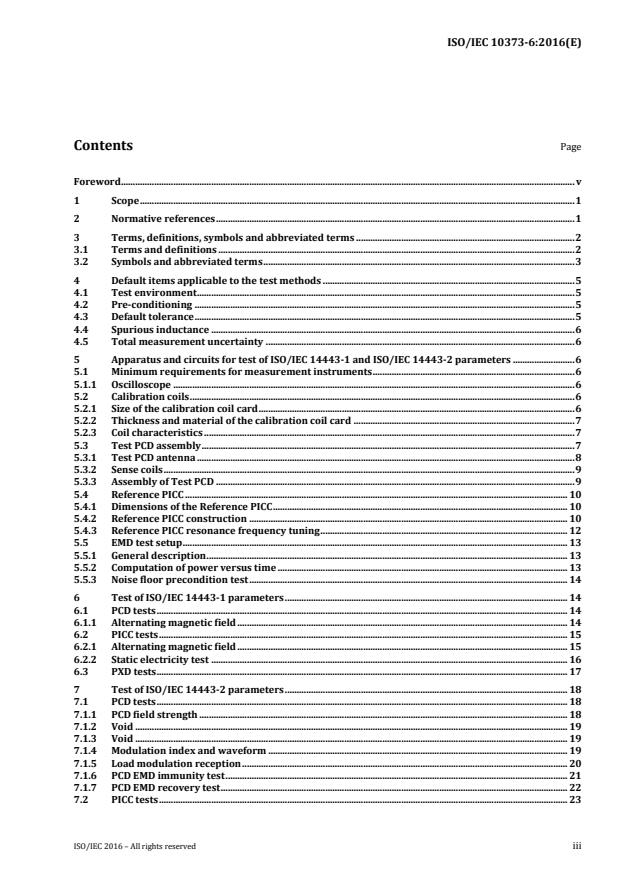
Contents Page
Foreword. v
1 Scope . 1
2 Normative references . 1
3 Terms, definitions, symbols and abbreviated terms . 2
3.1 Terms and definitions . 2
3.2 Symbols and abbreviated terms . 3
4 Default items applicable to the test methods . 5
4.1 Test environment . 5
4.2 Pre-conditioning . 5
4.3 Default tolerance . 5
4.4 Spurious inductance . 6
4.5 Total measurement uncertainty . 6
5 Apparatus and circuits for test of ISO/IEC 14443-1 and ISO/IEC 14443-2 parameters . 6
5.1 Minimum requirements for measurement instruments . 6
5.1.1 Oscilloscope . 6
5.2 Calibration coils . 6
5.2.1 Size of the calibration coil card . 6
5.2.2 Thickness and material of the calibration coil card . 7
5.2.3 Coil characteristics . 7
5.3 Test PCD assembly . 7
5.3.1 Test PCD antenna . 8
5.3.2 Sense coils . 9
5.3.3 Assembly of Test PCD . 9
5.4 Reference PICC . 10
5.4.1 Dimensions of the Reference PICC . 10
5.4.2 Reference PICC construction . 10
5.4.3 Reference PICC resonance frequency tuning . 12
5.5 EMD test setup . 13
5.5.1 General description . 13
5.5.2 Computation of power versus time . 13
5.5.3 Noise floor precondition test . 14
6 Test of ISO/IEC 14443-1 parameters . 14
6.1 PCD tests . 14
6.1.1 Alternating magnetic field . 14
6.2 PICC tests . 15
6.2.1 Alternating magnetic field . 15
6.2.2 Static electricity test . 16
6.3 PXD tests . 17
7 Test of ISO/IEC 14443-2 parameters . 18
7.1 PCD tests . 18
7.1.1 PCD field strength . 18
7.1.2 Void . 19
7.1.3 Void . 19
7.1.4 Modulation index and waveform . 19
7.1.5 Load modulation reception . 20
7.1.6 PCD EMD immunity test . 21
7.1.7 PCD EMD recovery test . 22
7.2 PICC tests . 23
ISO/IEC 2016 – All rights reserved iii
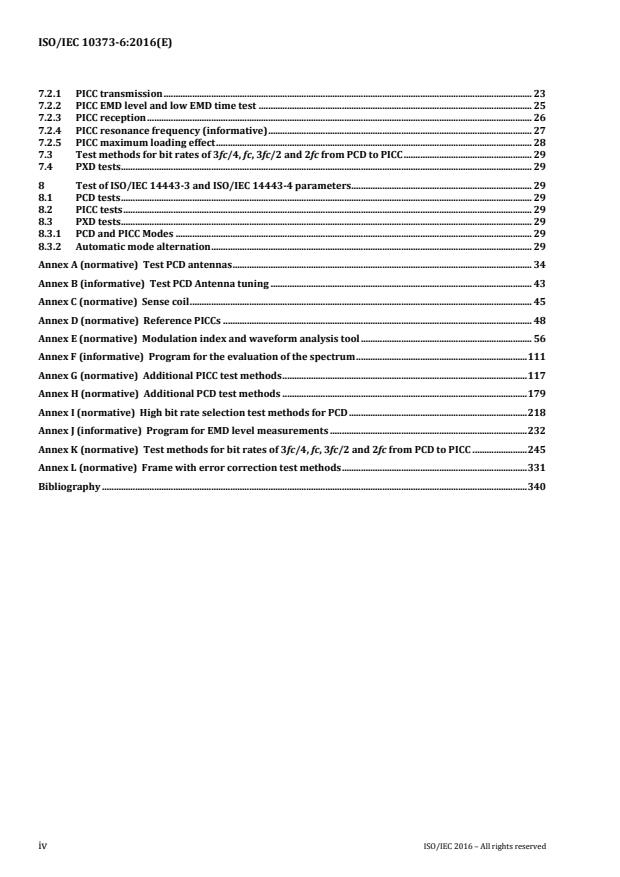
7.2.1 PICC transmission . 23
7.2.2 PICC EMD level and low EMD time test . 25
7.2.3 PICC reception . 26
7.2.4 PICC resonance frequency (informative) . 27
7.2.5 PICC maximum loading effect . 28
7.3 Test methods for bit rates of 3fc/4, fc, 3fc/2 and 2fc from PCD to PICC . 29
7.4 PXD tests . 29
8 Test of ISO/IEC 14443-3 and ISO/IEC 14443-4 parameters . 29
8.1 PCD tests . 29
8.2 PICC tests . 29
8.3 PXD tests . 29
8.3.1 PCD and PICC Modes . 29
8.3.2 Automatic mode alternation . 29
Annex A (normative) Test PCD antennas . 34
Annex B (informative) Test PCD Antenna tuning . 43
Annex C (normative) Sense coil . 45
Annex D (normative) Reference PICCs . 48
Annex E (normative) Modulation index and waveform analysis tool . 56
Annex F (informative) Program for the evaluation of the spectrum . 111
Annex G (normative) Additional PICC test methods . 117
Annex H (normative) Additional PCD test methods . 179
Annex I (normative) High bit rate selection test methods for PCD . 218
Annex J (informative) Program for EMD level measurements . 232
Annex K (normative) Test methods for bit rates of 3fc/4, fc, 3fc/2 and 2fc from PCD to PICC . 245
Annex L (normative) Frame with error correction test methods . 331
Bibliography . 340
iv ISO/IEC 2016 – All rights reserved
Foreword
ISO (the International Organization for Standardization) and IEC (the International Electrotechnical
Commission) form the specialized system for worldwide standardization. National bodies that are
members of ISO or IEC participate in the development of International Standards through technical
committees established by the respective organization to deal with particular fields of technical activity.
ISO and IEC technical committees collaborate in fields of mutual interest. Other international
organizations, governmental and non-governmental, in liaison with ISO and IEC, also take part in the
work. In the field of information technology, ISO and IEC have established a joint technical committee,
ISO/IEC JTC 1.
The procedures used to develop this document and those intended for its further maintenance are
described in the ISO/IEC Directives, Part 1. In particular the different approval criteria needed for the
different types of document should be noted. This document was drafted in accordance with the
editorial rules of the ISO/IEC Directives, Part 2 (see www.iso.org/directives).
Attention is drawn to the possibility that some of the elements of this document may be the subject of
patent rights. ISO and IEC shall not be held responsible for identifying any or all such patent
rights. Details of any patent rights identified during the development of the document will be in the
Introduction and/or on the ISO list of patent declarations received (see www.iso.org/patents).
Any trade name used in this document is information given for the convenience of users and does not
constitute an endorsement.
For an explanation on the meaning of ISO specific terms and expressions related to conformity
assessment, as well as information about ISO's adherence to the WTO principles in the Technical
Barriers to Trade (TBT) see the following URL: Foreword - Supplementary information
The committee responsible for this document is ISO/IEC JTC 1, Information technology, Subcommittee
SC 17, Cards and personal identification.
This third edition cancels and replaces the second edition (ISO/IEC 10373-6:2011), which has been
technically revised.
It also incorporates the Amendments ISO/IEC 10373-6:2011/Amd 1:2012, ISO/IEC 10373-6:2011/Amd
2:2012, ISO/IEC 10373-6:2011/Amd 3:2012, ISO/IEC 10373-6:2011/Amd 4:2012, and the Technical
Corrigendum ISO/IEC 10373-6:2011/Cor 1:2013.
ISO/IEC 10373 consists of the following parts, under the general title Identification cards — Test
methods:
— Part 1: General characteristics
— Part 2: Cards with magnetic stripes
— Part 3: Integrated circuit cards with contacts and related interface devices
— Part 5: Optical memory cards
— Part 6: Proximity cards
ISO/IEC 2016 – All rights reserved v
— Part 7: Vicinity cards
— Part 8: USB-ICC
— Part 9: Optical memory cards — Holographic recording method
vi ISO/IEC 2016 – All rights reserved
INTERNATIONAL STANDARD ISO/IEC 10373-6:2016(E)
Identification cards — Test methods — Part 6: Proximity cards
1 Scope
ISO/IEC 10373 defines test methods for characteristics of identification cards according to the definition
given in ISO/IEC 7810. Each test method is cross-referenced to one or more base standards, which can be
ISO/IEC 7810 or one or more of the supplementary standards that define the information storage
technologies employed in identification card applications.
NOTE 1 Criteria for acceptability do not form part of ISO/IEC 10373, but will be found in the International
Standards mentioned above.
NOTE 2 Test methods defined in this part of ISO/IEC 10373 are intended to be performed separately. A given
proximity card or object, or proximity coupling device, is not required to pass through all the tests sequentially.
This part of ISO/IEC 10373 defines test methods which are specific to proximity cards and objects, and
proximity coupling devices and proximity extended devices, defined in ISO/IEC 14443-1,
ISO/IEC 14443-2, ISO/IEC 14443-3, and ISO/IEC 14443-4.
ISO/IEC 10373-1 defines test methods which are common to one or more integrated circuit card
technologies and other parts deal with other technology-specific tests.
2 Normative references
The following documents, in whole or in part, are normatively referenced in this document and are
indispensable for its application. For dated references, only the edition cited applies. For undated
references, the latest edition of the referenced document (including any amendments) applies.
ISO/IEC 7810, Identification cards — Physical characteristics
ISO/IEC 14443-1:2016, Identification cards — Contactless integrated circuit cards — Proximity cards —
Part 1: Physical characteristics
ISO/IEC 14443-2:2016, Identification cards — Contactless integrated circuit cards — Proximity cards —
Part 2: Radio frequency power and signal interface
ISO/IEC 14443-3:2016, Identification cards — Contactless integrated circuit cards — Proximity cards —
Part 3: Initialization and anticollision
ISO/IEC 14443-4:2016, Identification cards — Contactless integrated circuit cards — Proximity cards —
Part 4: Transmission protocol
IEC 61000-4-2:2008, Electromagnetic compatibility (EMC) — Part 4-2: Testing and measurement
techniques — Electrostatic discharge immunity test
© ISO/IEC 2016 – All rights reserved 1
3 Terms, definitions, symbols and abbreviated terms
3.1 Terms and definitions
For the purposes of this document, the terms and definitions given in ISO/IEC 14443-1, ISO/IEC 14443-2,
ISO/IEC 14443-3, and ISO/IEC 14443-4, and the following apply.
NOTE Elements in bold square brackets [ ] are optional definitions.
3.1.1
base standard
standard which the test method is used to verify conformance to
3.1.2
CascadeLevels
number of cascade levels of the PICC
3.1.3
Command Set
set describing the PICC commands during initialization and anticollision
Note 1 to entry: See ISO/IEC 14443-3:2016, 6.4 for PICC Type A and ISO/IEC 14443-3:2016, 7.5 for PICC Type B.
3.1.4
loading effect
change in PCD antenna current caused by the presence of PICC(s) in the field due to the mutual coupling
modifying the PCD antenna resonance and quality factor
3.1.5
mute
no response within a specified timeout, e.g. expiration of FWT
3.1.6
PICC states
different PICC states during initialization and anticollision
Note 1 to entry: See ISO/IEC 14443-3:2016, 6.3 for PICC Type A and ISO/IEC 14443-3:2016, 7.4 for PICC Type B.
3.1.7
scenario
defined typical protocol and application specific communication to be used with the test methods defined
in this part of ISO/IEC 10373
3.1.8
Test Initial State
TIS
element from PICC states that is the PICC state before performing a specific PICC command from
Command Set
3.1.9
test method
method for testing characteristics of identification cards for the purpose of confirming their compliance
with International Standards
2 © ISO/IEC 2016 – All rights reserved
3.1.10
Test Target State
TTS
element from PICC states that is the PICC state after performing a specific PICC command from Command
Set
3.2 Symbols and abbreviated terms
(xxxxx)b Data bit representations
'XY' Hexadecimal notation, equal to XY in base 16
ATA(cid) Answer to ATTRIB, i.e. (mbli+cid CRC_B), with mbli an arbitrary hex
value (see ISO/IEC 14443-3:2016, 7.11)
ATTRIB(cid, fsdi) Default ATTRIB command with PUPI from ATQB, CID = cid and
Maximum Frame Size Code value = fsdi, i.e. ('1D' PUPI cid fsdi '01 00'
CRC_B)
DUT Device under test
ESD Electrostatic Discharge
I(c) (inf [,CID = cid] ISO/IEC 14443-4 I-block with chaining bit c∈{1,0}, block number
n
[,NAD = nad] [,~CRC]) n∈{1,0} and information field inf. By default no CID and no NAD will be
transmitted. If CID = cid∈{0.15} is specified, it will be transmitted as
second parameter. If NAD = nad∈{0.'FF'} is specified, it will be
transmitted as third parameter (or second parameter if no CID is
transmitted). If the literal '~CRC' is not specified, a valid CRC
corresponding to the type of the PICC will be transmitted by default (i.e.
CRC_A or CRC_B)
IUT Implementation Under Test (ISO/IEC 9646); within the scope of this
part of ISO/IEC 10373, IUT represents the PCD under the test
LT Lower Tester (ISO/IEC 9646), the PICC-emulation part of the PCD-test-
apparatus
m Modulation index
Mute No response within a specified timeout
N/A Not applicable
PPS(cid, dri, dsi) Default PPS request with CID = cid, DRI = dri and DSI = dsi,
i.e. ('D' + cid '11' dsi × 4 + dri CRC_A)
R(ACK [,CID = cid] [,~CRC]) ISO/IEC 14443-4 R(ACK) block with block number n. The definition of
n
the optional CID and ~CRC symbols is as described in the I(c) block
n
above
R(NAK [,CID = cid][,~CRC]) ISO/IEC 14443-4 R(NAK) block with block number n. The definition of
n
the optional CID and ~CRC symbols is as described in the I(c) block
n
above
RATS(cid, fsdi) Default RATS command with CID = cid and FSDI value = fsdi
i.e. ('E0' fsdi × 16 + cid CRC_A)
READY(I) READY state in cascade level I, I ∈ {1, 2, 3}; e.g. READY(2) is a PICC
cascade level 2
© ISO/IEC 2016 – All rights reserved 3
READY*(I) READY* state in cascade level I, I ∈ {1, 2, 3}; e.g. READY*(2) is a PICC
cascade level 2
REQB(N) REQB command with N as defined in ISO/IEC 14443-3:2016, 7.7
S(WTX)(WTXM ISO/IEC 14443-4 S(WTX) block with parameter WTXM. The definition
[,CID = cid][,~CRC]) of the optional CID and ~CRC symbols is as described in the I(c) block
n
above
S(DESELECT [,CID = cid] ISO/IEC 14443-4 S(DESELECT) block. The definition of the optional CID
[,~CRC]) and ~CRC symbols is as described in the I(c) block above
n
SAK(cascade) the SELECT(I) answer with the cascade bit (bit 3) set to (1)b
SAK(complete) the SELECT(I) answer with the cascade bit (bit 3) set to (0)b
SEL(c) Select code of level c (i.e. SEL(1) = '93', SEL(2) = '95', SEL(3) = '97')
SELECT(I) SELECT command of cascade level I, i.e.
SELECT(1) = ( '93 70' UIDTX BCC CRC_A)
SELECT(2) = ( '95 70' UIDTX BCC CRC_A)
SELECT(3) = ( '97 70' UIDTX BCC CRC_A)
SLOTMARKER(n) Slot-MARKER command with slot number n, i.e. (16 × (n − 1) + 5 CRC_B)
TB-PDU Transmission Block Protocol Data Unit, which consists of either I-block,
R-block or S-block
TEST_COMMAND1(1) Default test command consisting of one unchained I-block
NOTE This command depends on the negotiated maximum frame size
value of the PICC.
TEST_COMMAND1(n), n > 1 Default test command consisting of n chained I-blocks (PCD chaining)
NOTE This command depends on the negotiated maximum frame size
value of the PICC.
TEST_COMMAND1(n) INF field of k'th I-block chain of TEST_COMMAND1(n)
k
NOTE This command depends on the negotiated maximum frame size
value of the PICC.
TEST_COMMAND2(n), n > 1 Default test command which expects a response consisting of n chained
I-blocks
NOTE This command depends on the negotiated maximum frame size
value of the PCD.
TEST_COMMAND3 Default test command consisting of one I-block which needs more than
FWT time for execution
TEST_RESPONSE1(n) INF field of the response to TEST_COMMAND1(n)
NOTE This response is assumed to be always unchained.
TEST_RESPONSE2(n) Response to TEST_COMMAND2(n)
NOTE This response depends on the negotiated maximum frame size
value of the PCD.
4 © ISO/IEC 2016 – All rights reserved
TEST_RESPONSE2(n) INF field of k'th I-block chain of TEST_RESPONSE2(n)
k
NOTE This response depends on the negotiated maximum frame size
value of the PCD.
TEST_RESPONSE3 Response I-block to TEST_COMMAND3
NOTE This response is always assumed to be unchained.
TM-PDU Test Management Protocol Data Unit (ISO/IEC 9646-1, PDU)
t Start of PICC transmission
START
UIDTX Transmitted UID 32-bit data at cascade level I (see Table 1)
I
UT Upper Tester (ISO/IEC 9646), the master part of the PCD-test-apparatus
UT_APDU Upper Tester Application Protocol Data Unit: a packet of data to be sent
by the PCD to the LT through the RF interface
V DC voltage measured at connector CON3 of the Reference PICC
load
WUPB(N) WUPB command with N as defined in ISO/IEC 14443-3:2016, 7.7
~X Bit sequence consisting of the inverted bits of bit sequence X or any
other bit sequence different from X
X[[a.b]] Bit subsequence of bit sequence X consisting of the bits between
position a and b included. If a > b then the sequence is empty
X[[n]] Bit at position n of bit sequence X. First bit is at position 1
X[n] Byte at position n of bit sequence X. First byte is at position 1
(i.e. X[n] = X[[(n − 1) × 8 + 1.n × 8]])
Table 1 — Mapping from UID to UIDTX
Cascade level Single UID PICC Double UID PICC Triple UID PICC
UIDTX1 UID0 UID1 UID2 UID3 '88' UID0 UID1 UID2 '88' UID0 UID1 UID2
UIDTX2 — UID3 UID4 UID5 UID6 '88' UID3 UID4 UID5
UIDTX — — UID6 UID7 UID8 UID9
4 Default items applicable to the test methods
4.1 Test environment
Unless otherwise specified, testing shall take place in an environment of temperature 23 °C ± 3 °C
(73 °F ± 5 °F) and of relative humidity 40 % to 60 %.
4.2 Pre-conditioning
No environmental pre-conditioning of PICCs or PCDs is required by the test methods in this part of
ISO/IEC 10373.
4.3 Default tolerance
Unless otherwise specified, a default tolerance of ±5 % shall be applied to the quantity values given to
specify the characteristics of the test equipment (e.g. linear dimensions) and the test method procedures
(e.g. test equipment adjustments).
© ISO/IEC 2016 – All rights reserved 5
4.4 Spurious inductance
Resistors and capacitors should have negligible inductance.
4.5 Total measurement uncertainty
The total measurement uncertainty for each quantity determined by these test methods shall be stated in
the test report.
Basic information is given in ISO/IEC Guide 98-3.
5 Apparatus and circuits for test of ISO/IEC 14443-1 and ISO/IEC 14443-2
parameters
This Clause defines the test apparatus and test circuits for verifying the operation of a PICC or a PCD
according to ISO/IEC 14443-1 and ISO/IEC 14443-2. The test apparatus includes the following:
— measurement instruments (see 5.1);
— calibration coil (see 5.2);
— Test PCD assembly (see 5.3);
— Reference PICC (see 5.4);
— EMD test setup (see 5.5).
These are described in the following clauses.
5.1 Minimum requirements for measurement instruments
5.1.1 Oscilloscope
The digital sampling oscilloscope shall be capable of sampling at a rate of at least 500 million samples per
second with a resolution of at least 8 bits at optimum scaling and shall have an overall minimum
bandwidth of 250 MHz. The oscilloscope should have the capability to output the sampled data as a text
file to facilitate mathematical and other operations such as windowing on the sampled data using
software programs (see Annex E and Annex F).
NOTE The overall bandwidth is the combination of oscilloscope and probing system bandwidth.
5.2 Calibration coils
This subclause defines the size, thickness and characteristics of the calibration coils 1 and 2.
Calibration coil 1 shall be used only in Test PCD assembly 1 and calibration coil 2 shall be used only in
Test PCD assembly 2.
5.2.1 Size of the calibration coil card
The calibration coil card shall consist of an area which has the height and width of an ID-1 type defined in
ISO/IEC 7810 containing a single turn coil concentric with the card outline (see Figure 1).
6 © ISO/IEC 2016 – All rights reserved
Figure 1 — Calibration coils 1 and 2
5.2.2 Thickness and material of the calibration coil card
The thickness of the calibration coil card shall be less than that of an ID-1 card. It shall be constructed of a
suitable insulating material.
5.2.3 Coil characteristics
The coil on the calibration coil card shall have one turn. Relative dimensional tolerance shall be ±2 %.
The outer size of the calibration coil 1 shall be 72 mm × 42 mm with corner radius 5 mm.
NOTE 1 The area over which the field is integrated is approximately 3 000 mm .
NOTE 2 At 13,56 MHz the approximate inductance is 250 nH and the approximate resistance is 0,4 Ω.
The open circuit calibration factor for the calibration coil 1 is 0,318 V (rms) per A/m (rms) [Equivalent to
900 mV (peak-to-peak) per A/m (rms)].
The outer size of the calibration coil 2 shall be 46 mm × 24 mm with corner radius 2 mm.
NOTE 3 The area over which the field is integrated is approximately 1 100 mm .
NOTE 4 At 13,56 MHz the approximate inductance is 140 nH and the approximate resistance is 0,3 Ω.
The open circuit calibration factor for the calibration coil 2 is 0,118 V (rms) per A/m (rms) [Equivalent to
333 mV (peak-to-peak) per A/m (rms)].
The coil shall be made as a printed coil on printed circuit board (PCB) plated with 35 µm copper. Track
width shall be 500 µm with a relative tolerance of ±20 %. The size of the connection pads shall be
1,5 mm × 1,5 mm.
A high impedance oscilloscope probe with an input admittance equivalent to a parallel capacitance
C < 14 pF and a parallel resistance R > 9 kΩ at 13,56 MHz shall be used to measure the (open circuit)
p p
voltage induced in the coil.
The high impedance oscilloscope probe ground connection should be as short as possible, less than
20 mm or coaxial connection.
5.3 Test PCD assembly
Two Test PCD assemblies are defined:
— Test PCD assembly 1 for PICCs of "Class 1", "Class 2" and "Class 3" and for PICCs which do not claim
compliance with a class;
© ISO/IEC 2016 – All rights reserved 7
— Test PCD assembly 2 for PICCs of "Class 4", "Class 5" and "Class 6".
Each Test PCD assembly shall consist of a circular Test PCD antenna and two parallel sense coils, sense
coil a and sense coil b, as shown in principle by Figure 2. The sense coils shall be connected such that the
signal from one coil is in opposite phase to the other. The 10 Ω potentiometer P1 serves to fine adjust the
balance point when the sense coils are not loaded by a PICC or any magnetically coupled circuit. The
capacitive load of the probe including its parasitic capacitance shall be less than 14 pF.
The capacitance of the connections and of the oscilloscope probe should be kept to a minimum for
reproducibility.
In order to avoid any unintended misalignment in case of an unsymmetrical set-up the tuning range of the
potentiometer P1 is only 10 Ω. If the set-up cannot be compensated by the 10 Ω potentiometer P1, the
overall symmetry of the set-up should be checked.
The high impedance oscilloscope probe ground connection should be as short as possible, less than
20 mm or coaxial connection.
Figure 2 — Test set-up (principle)
5.3.1 Test PCD antenna
In Test PCD assembly 1 the Test PCD antenna 1 shall have a diameter of 150 mm.
In Test PCD assembly 2 the Test PCD antenna 2 shall have a diameter of 100 mm.
Each Test PCD antenna construction shall conform to the corresponding drawings in Annex A.
The matching of each Test PCD antenna should be accomplished by using an impedance analyzer or a
network analyzer or an LCR meter. If either an impedance analyzer or a network analyzer or an LCR
meter is not available, then the matching may be accomplished with the procedure given in Annex B.
8 © ISO/IEC 2016 – All rights reserved
5.3.2 Sense coils
In Test PCD assembly 1 the size of the sense coils 1 shall be 100 mm × 70 mm with corner radius 10 mm.
In Test PCD assembly 2 the size of the sense coils 2 shall be 60 mm × 47 mm with corner radius 10 mm.
Each sense coil construction shall conform to the corresponding drawings in Annex C.
5.3.3 Assembly of Test PCD
The sense coils 1 and Test PCD antenna 1 shall be assembled parallel and with the sense and antenna
coils coaxial and such that the distance between the active conductors is 37,5 mm as shown in Figure 3,
Test PCD assembly 1.
The sense coils 2 and Test PCD antenna 2 shall be assembled parallel and with the sense and antenna
coils coaxial and such that the distance between the active conductors is 23 mm as shown in Figure 3,
Test PCD assembly 2.
The dimensional tolerance shall be better than ± 0,5 mm. The distance between the coil in the DUT and
the calibration coil shall be equal with respect to the coil of the Test PCD antenna.
NOTE These distances are chosen to offer a strong and homogenous magnetic field in the DUT position.
Figure 3 — Test PCD assembly 1 and Test PCD assembly 2
© ISO/IEC 2016 – All rights reserved 9
5.4 Reference PICC
A Reference PICC is defined to test the ability of a PCD to
— generate a field strength of at least H and not exceeding H ,
min max
— transfer power to a PICC,
— transmit a modulated signal to a PICC,
— receive a load modulation signal from the PICC,
in its operating volume.
5.4.1 Dimensions of the Reference PICC
The Reference PICC shall consist of an area containing the coils which has the height and width defined in
ISO/IEC 7810 for ID-1 type. An area external to this, containing the circuitry which emulates the required
PICC functions, shall be appended in such a way as to allow insertion into the test set-ups and so as to
cause no interference to the tests. The dimensions shall be as shown in Figure 4.
Figure 4 — Reference PICC dimensions
5.4.2 Reference PICC construction
The Reference PICCs coils layouts are defined in Annex D. If connectors are used between the coils and
the circuitry, those connectors shall have minimal, if any, effect on the RF measurements.
The Reference PICC shall have a circuit diagram as defined in Figure 5 and component values as defined
in Table 2.
10 © ISO/IEC 2016 – All rights reserved
Figure 5 — Reference PICC circuit diagram
NOTE Position 'd' of jumper J1 is RFU.
Table 2 — Reference PICC components list
Component Value Component Value
b
L1 See Annex D C1 7 pF – 50 pF
b
L2 See Annex D C2 3 pF – 10 pF
R1 1,8 kΩ C3 27 pF
a
R2 0 kΩ – 2 kΩ C4 1 nF
c
R3 220 Ω D1, D2, D3, D4 BAR43S or equivalent
c
R4 51 kΩ Dz BZX84, 15 V or equivalent
R5 51 Ω Q1a, Q1b BCV61A or equivalent
R6 500 kΩ Q2 BSS83 or equivalent
ACM3225 -102-2P or
R7 110 kΩ CMF1, CMF2, CMF3, CMF4
equivalent
R8 51 Ω CON1, CON2, CON3, CON4 RF connector
R9 1,5 kΩ
a
A multi-turn potentiometer (turns ≥10) should be used.
b
Q - factor shall be higher than 100 at 13,56 MHz.
c
Care should be taken on parameters Cj (Junction capacitance), Cp (Package capacitance), Ls (Series inductance) and Rs
(Series resistance) of equivalent diodes. Note that these values may not be available in the datasheet.
At CON1 the load modulation signal shall be applied. The load modulation can be determined in Test PCD
assembly. When not used, the load modulation signal generator shall be disconnected or set to 0 V.
With the voltage at CON2 the Reference PICC load can be adjusted until the required DC voltage shows at
CON3.
© ISO/IEC 2016 – All rights reserved 11
The Reference PICC DC voltage shall be measured at CON3 using a high impedance voltmeter and the
connection wires should be twisted or coaxial.
The PCD waveform parameters are picked up at CON4 using a high impedance oscilloscope probe. The
high impedance oscilloscope probe ground connection should be as short as possible, less than 20 mm or
coaxial connection.
Position 'a' of J2 shall be used for testing bit rates of fc/128, fc/64, fc/32 and fc/16.
Position 'b' of J2 shall be used for testing bit rates of fc/8, fc/4 and fc/2.
5.4.3 Reference PICC resonance frequency tuning
The Reference PICC resonance frequency shall be calibrated with the following procedure.
a) Set jumper J1 to position 'a'.
b) Connect the calibration coil directly to a signal generator and the Reference PICC connector CON3 to
a high impedance voltmeter. Connect all the other connectors to the same equipment as used for the
tests.
c) Locate the Reference PICC at a distance d = 10 mm above the calibration coil with the axes of the two
coils (calibration coil and Reference PICC main coil) being congruent (see Figure 6).
d) Drive the calibration coil with a sine wave set to the desired resonance frequency.
e) Adjust the Reference PICC capacitors C1 and C2 to get maximum DC voltage at CON3.
f) Adjust the signal generator drive level to obtain a DC voltage at CON3 of V as defined in Table 3.
load
g) Repeat steps e) and f) until the maximum voltage after step e) is V .
load
h) Calibrate the Test PCD assembly to produce the H operating condition on the calibration coil.
min
i) Place the Reference PICC into the DUT position on the Test PCD assembly. Switch the jumper J1 to
position 'b' and adjust R2 to obtain a DC voltage of V measured at connector CON3. The operating
load
field condition shall be verified by monitoring the voltage on the calibration coil and adjusted if
necessary.
j) Repeat steps b) to g) with the obtained value of R2.
NOTE Instead of a signal generator, a vector network analyzer may be used if sufficient power is provided to
produce V at CON3 while reaching the maximum resistive part of the measured complex impedance of the
load
calibration coil.
12 © ISO/IEC 2016 – All rights reserved
Figure 6 — Reference PICC frequency tuning set-up (principle)
5.5 EMD test setup
5.5.1 General description
The EMD test setup contains the following:
— a signal generator with low phase noise, which is used to synthesize both an EMD test pattern and
PCD test commands sent to the PICC under test;
— the Test PCD assembly;
— a signal amplitude analyzing device:
either a signal acquiring device (e.g. oscilloscope) and appropriate computation software;
or a spectrum analyzer (see additional constraints in 5.5.2).
The signal amplitude analyzing device shall be able to carry out power versus time measurements with
fixed frequency, fixed bandwidth, high dynamic range, low measurement uncertainty and high time
resolution.
NOTE The PICC EMD tests may be performed using the RF output signal of a commercial PCD. The PCD EMD
test may use a PICC emulator to generate the EMD test pattern.
5.5.2 Computation of power versus time
The beginning of the captured signal shall be windowed by a Bartlett window of exactly two subcarrier
cycles. Fourier transformation of these windowed samples produces one power value. By shifting the
Bartlett window by steps of 1/fc from the beginning to the end of the captured signal, the desired power
versus time result is finally computed.
NOTE The resulting 3 dB bandwidth of the above described window is 531 kHz and its noise equivalent
bandwidth amounts to 843 kHz.
The computation of the power versus time shall be performed at fc + fs and fc − fs, using a scaling such
that a pure sinusoidal signal results in its peak magnitude. An example of computation is provided in
Annex J.
© ISO/IEC 2016 – All rights reserved 13
In case of using a spectrum analyzer, the analyzer shall have at least an equivalent analysis bandwidth. It
shall pass the noise floor precondition test, as defined in 5.5.3, and there shall be some additional margin
of 10/fc on t requirement and no spikes above the EMD limit.
E, PICC
5.5.3 Noise floor precondition test
5.5.3.1 Purpose
In order to ensure a high dynamic range and sufficient sensitivity, a noise floor measurement shall be
performed and passed successfully by the EMD test setup. The aim of this precondition test is to verify
that the test apparatus used for EMD level measurement satisfies a minimum noise requirement.
The noise floor test is passed if the noise standard deviation is at least three times smaller than the EMD
limit V , when measured as described in 5.5.3.2.
E, PICC
The noise standard deviation is determined by calculating the root-mean-square value of the results of
the Fourier transformation, as described in 5.5.2.
NOTE This noise floor can be obtained either with a 14-bit digitizer at a sampling rate of 100 million samples
per second or with an 8-bit digital oscilloscope at sampling rate of 1 000 million samples per second.
5.5.3.2 Procedure
Perform the following steps to assess the noise floor at least at H and H .
min max
a) Tune the Reference PICC to 13,56 MHz.
b) Adjust the RF power delivered by the signal generator to the Test PCD antenna to the required field
strength as measured by the calibration coil.
c) Place the Reference PICC into the DUT position on the Test PCD assembly, set jumper J1 to position
'b' and adjust R2 to obtain a voltage of V at CON3. Alternatively, jumper J1 may be set to position 'c'
load
and the applied voltage on CON2 is adjusted to obtain a voltage of V at CON3. In both cases the
load
operating field condition shall be verified by monitoring the voltage in the calibration coil and
adjusted if necessary.
d) Record the signal of the sense coils for a time period of at least 250 μs.
e) Compute the noise standard deviations at fc + fs and fc − fs using suitable computer software, as e.g.
the one given in Annex J. Check if these noise standard deviations are three times smaller than V .
E, PICC
5.5.3.3 Test report
The test report shall state the noise standard deviations at fc + fs and fc – fs and shall state whether the
requirements have been fulfilled.
6 Test of ISO/IEC 14443-1 parameters
6.1 PCD tests
6.1.1 Alternating magnetic field
6.1.1.1 Purpose
This test determines that the PCD generates a field not higher than the average value specified in
ISO/IEC 14443-1, in any possible PICC position.
14 © ISO/IEC 2016 – All rights reserved
6.1.1.2 Procedure
a) Tune the Reference PICC 1 to 19 MHz as described in 5.4.3 step
...
Questions, Comments and Discussion
Ask us and Technical Secretary will try to provide an answer. You can facilitate discussion about the standard in here.
Loading comments...