

ISO/IEC 18630:2023
(Main)Information technology — Digitally recorded media for information interchange and storage — Quality discrimination method for optical disks and operating method of storage systems for long-term data preservation
General Information
- Abstract
This document specifies a quality discrimination method for optical disks and the operating method of storage systems for long-term digital data preservation using optical disks and optical disk drives (hereinafter referred to as "drives"). It is applicable to recordable (write-once) optical disks which can prevent physical overwriting and deletion by erroneous or intentional operation in contexts where greater importance is given to evidence. It is also applicable to read-only (ROM) optical disks. This document specifies: — combinations of recordable optical disks and drives used for long-term data preservation; — quality discrimination criteria for recordable optical disks and the operation method of long-term storage systems; — a quality test for read-only optical disks and the operation method of long-term storage systems; — quality discrimination criteria for BD recordable disks when adopting defect management.
- Status
- Published
- Publication Date
- 08-Nov-2023
- Current Stage
- 6060 - International Standard published
- Start Date
- 09-Nov-2023
- Due Date
- 29-Sep-2024
- Completion Date
- 09-Nov-2023
Buy Documents
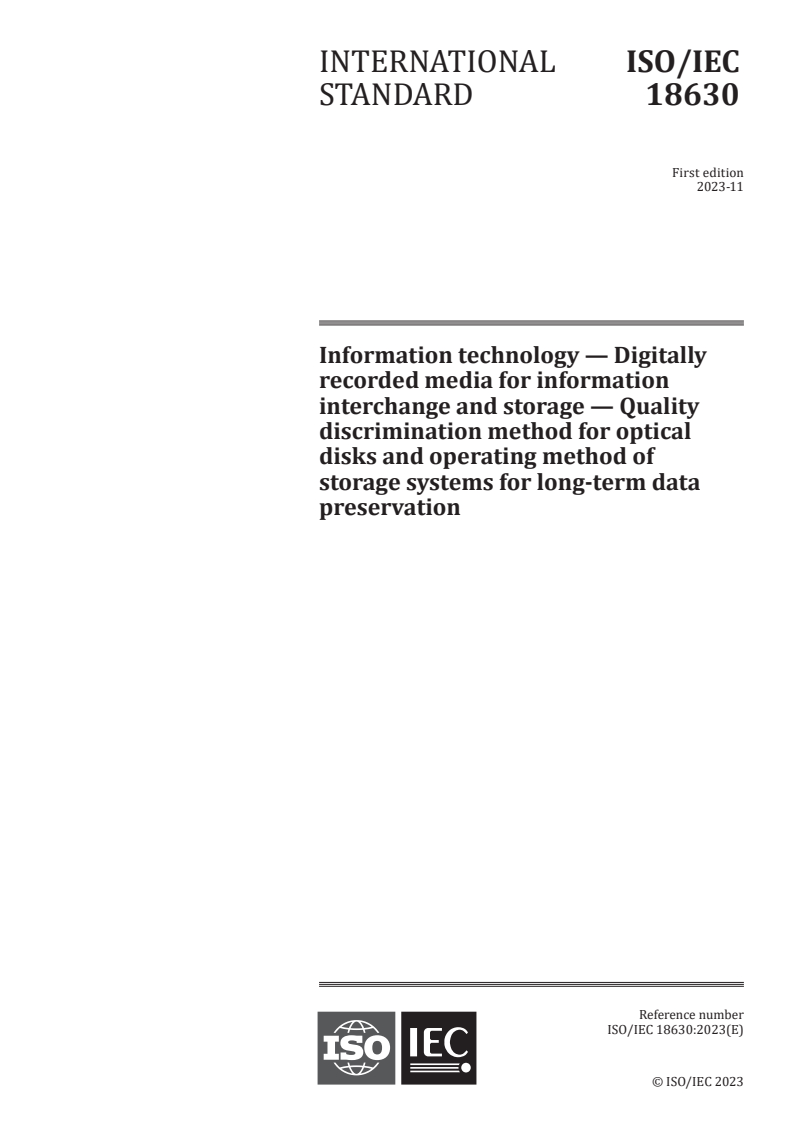
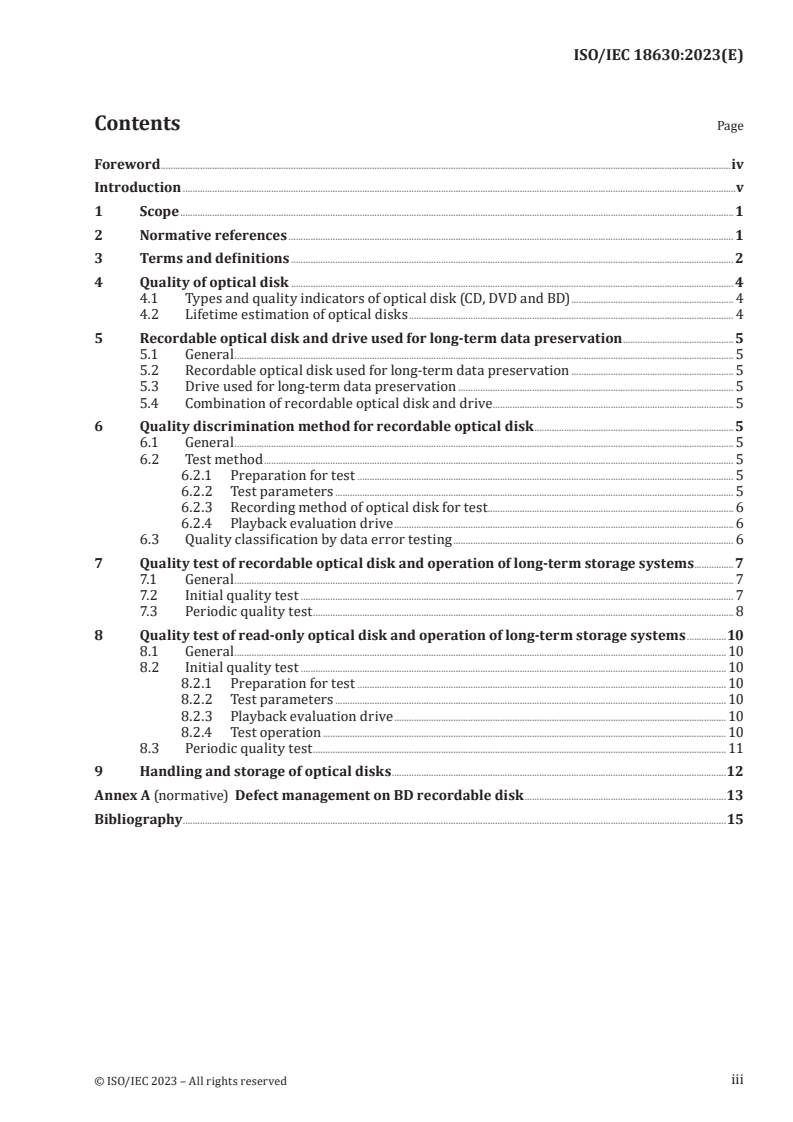
ISO/IEC 18630:2023 - Information technology — Digitally recorded media for information interchange and storage — Quality discrimination method for optical disks and operating method of storage systems for long-term data preservation Released:9. 11. 2023
Overview
ISO/IEC 18630:2023 - Information technology - Digitally recorded media for information interchange and storage - Quality discrimination method for optical disks and operating method of storage systems for long-term data preservation - provides procedures and criteria to evaluate and operate optical-disk based archival systems. The standard covers both recordable (write-once) optical disks (used when preventing overwriting/deletion is critical) and read‑only (ROM) media, and defines how to combine disks and drives to achieve reliable long‑term digital preservation.
Key topics and requirements
- Quality discrimination for recordable disks: Defines how to assess initial recording quality and form combinations of recordable disks and drives suitable for long‑term preservation.
- Quality tests:
- Initial quality test - verification before storage to confirm recording quality and estimated lifetime.
- Periodic quality test - scheduled re‑tests during preservation to monitor ongoing recoverability.
- Technical quality indicators: Uses standardized error metrics and measurements (for example Max C1, Max PI SUM 8, Max RSER, Max BE) measured at decoder inputs and over defined blocks/intervals to judge media quality.
- Test methods and parameters: Specifies preparation, recording methods for test media, playback evaluation drive requirements, and test parameter definitions without prescribing proprietary tooling.
- BD defect management: Includes criteria and an annex addressing defect management when adopted for BD recordable disks.
- Operational guidance: Recommendations for combining specific disks and drives, handling, storage conditions, and integrating quality discrimination into storage-system operations.
Practical applications and users
Who benefits:
- Archivists, libraries, museums - for long‑term preservation of cultural and legal records.
- Government and legal bodies - evidence‑grade storage where write‑once media prevents tampering.
- Enterprises and data centers - cold/immigration archival strategies, offline repositories.
- Manufacturers and test labs - to certify media and drives, and to supply media-drive combinations validated for archival use. Practical value:
- Improves confidence in data recovery by establishing initial acceptance criteria and ongoing monitoring.
- Enables procurement and validation of vendor-supplied media/drive combinations for archival deployments.
- Supports lifecycle planning (testing, migration triggers, handling/storage best practices).
Related standards (normative references)
- ISO/IEC 16963 - lifetime estimation test methods for optical disks
- ISO/IEC 10149, 12862, 16448, 16449, 17344, 23912, 25434 - CD/DVD/format specifications
- ISO/IEC 30190, 30191 - BD recordable disk specifications These references are cited within ISO/IEC 18630:2023 and should be consulted when implementing the standard.
Buy Documents
ISO/IEC 18630:2023 - Information technology — Digitally recorded media for information interchange and storage — Quality discrimination method for optical disks and operating method of storage systems for long-term data preservation Released:9. 11. 2023
Get Certified
Connect with accredited certification bodies for this standard

BSI Group
BSI (British Standards Institution) is the business standards company that helps organizations make excellence a habit.

NYCE
Mexican standards and certification body.
Sponsored listings
Frequently Asked Questions
ISO/IEC 18630:2023 is a standard published by the International Organization for Standardization (ISO). Its full title is "Information technology — Digitally recorded media for information interchange and storage — Quality discrimination method for optical disks and operating method of storage systems for long-term data preservation". This standard covers: This document specifies a quality discrimination method for optical disks and the operating method of storage systems for long-term digital data preservation using optical disks and optical disk drives (hereinafter referred to as "drives"). It is applicable to recordable (write-once) optical disks which can prevent physical overwriting and deletion by erroneous or intentional operation in contexts where greater importance is given to evidence. It is also applicable to read-only (ROM) optical disks. This document specifies: — combinations of recordable optical disks and drives used for long-term data preservation; — quality discrimination criteria for recordable optical disks and the operation method of long-term storage systems; — a quality test for read-only optical disks and the operation method of long-term storage systems; — quality discrimination criteria for BD recordable disks when adopting defect management.
This document specifies a quality discrimination method for optical disks and the operating method of storage systems for long-term digital data preservation using optical disks and optical disk drives (hereinafter referred to as "drives"). It is applicable to recordable (write-once) optical disks which can prevent physical overwriting and deletion by erroneous or intentional operation in contexts where greater importance is given to evidence. It is also applicable to read-only (ROM) optical disks. This document specifies: — combinations of recordable optical disks and drives used for long-term data preservation; — quality discrimination criteria for recordable optical disks and the operation method of long-term storage systems; — a quality test for read-only optical disks and the operation method of long-term storage systems; — quality discrimination criteria for BD recordable disks when adopting defect management.
ISO/IEC 18630:2023 is classified under the following ICS (International Classification for Standards) categories: 35.220.30 - Optical storage devices. The ICS classification helps identify the subject area and facilitates finding related standards.
ISO/IEC 18630:2023 is available in PDF format for immediate download after purchase. The document can be added to your cart and obtained through the secure checkout process. Digital delivery ensures instant access to the complete standard document.
Standards Content (Sample)
INTERNATIONAL ISO/IEC
STANDARD 18630
First edition
2023-11
Information technology — Digitally
recorded media for information
interchange and storage — Quality
discrimination method for optical
disks and operating method of
storage systems for long-term data
preservation
Reference number
© ISO/IEC 2023
© ISO/IEC 2023
All rights reserved. Unless otherwise specified, or required in the context of its implementation, no part of this publication may
be reproduced or utilized otherwise in any form or by any means, electronic or mechanical, including photocopying, or posting on
the internet or an intranet, without prior written permission. Permission can be requested from either ISO at the address below
or ISO’s member body in the country of the requester.
ISO copyright office
CP 401 • Ch. de Blandonnet 8
CH-1214 Vernier, Geneva
Phone: +41 22 749 01 11
Email: copyright@iso.org
Website: www.iso.org
Published in Switzerland
ii
© ISO/IEC 2023 – All rights reserved
Contents Page
Foreword .iv
Introduction .v
1 Scope . 1
2 Normative references . 1
3 Terms and definitions . 2
4 Quality of optical disk . 4
4.1 Types and quality indicators of optical disk (CD, DVD and BD) . 4
4.2 Lifetime estimation of optical disks . 4
5 Recordable optical disk and drive used for long-term data preservation .5
5.1 General . 5
5.2 Recordable optical disk used for long-term data preservation . 5
5.3 Drive used for long-term data preservation . 5
5.4 Combination of recordable optical disk and drive. 5
6 Quality discrimination method for recordable optical disk . 5
6.1 General . 5
6.2 Test method . 5
6.2.1 Preparation for test . 5
6.2.2 Test parameters . 5
6.2.3 Recording method of optical disk for test . 6
6.2.4 Playback evaluation drive . 6
6.3 Quality classification by data error testing . 6
7 Quality test of recordable optical disk and operation of long-term storage systems .7
7.1 General . 7
7.2 Initial quality test . 7
7.3 Periodic quality test . 8
8 Quality test of read-only optical disk and operation of long-term storage systems .10
8.1 General . 10
8.2 Initial quality test . 10
8.2.1 Preparation for test . 10
8.2.2 Test parameters . 10
8.2.3 Playback evaluation drive . 10
8.2.4 Test operation . 10
8.3 Periodic quality test . 11
9 Handling and storage of optical disks .12
Annex A (normative) Defect management on BD recordable disk .13
Bibliography .15
iii
© ISO/IEC 2023 – All rights reserved
Foreword
ISO (the International Organization for Standardization) and IEC (the International Electrotechnical
Commission) form the specialized system for worldwide standardization. National bodies that are
members of ISO or IEC participate in the development of International Standards through technical
committees established by the respective organization to deal with particular fields of technical
activity. ISO and IEC technical committees collaborate in fields of mutual interest. Other international
organizations, governmental and non-governmental, in liaison with ISO and IEC, also take part in the
work.
The procedures used to develop this document and those intended for its further maintenance
are described in the ISO/IEC Directives, Part 1. In particular, the different approval criteria
needed for the different types of document should be noted. This document was drafted in
accordance with the editorial rules of the ISO/IEC Directives, Part 2 (see www.iso.org/directives or
www.iec.ch/members_experts/refdocs).
ISO and IEC draw attention to the possibility that the implementation of this document may involve the
use of (a) patent(s). ISO and IEC take no position concerning the evidence, validity or applicability of
any claimed patent rights in respect thereof. As of the date of publication of this document, ISO and IEC
had not received notice of (a) patent(s) which may be required to implement this document. However,
implementers are cautioned that this may not represent the latest information, which may be obtained
from the patent database available at www.iso.org/patents and https://patents.iec.ch. ISO and IEC shall
not be held responsible for identifying any or all such patent rights.
Any trade name used in this document is information given for the convenience of users and does not
constitute an endorsement.
For an explanation of the voluntary nature of standards, the meaning of ISO specific terms and
expressions related to conformity assessment, as well as information about ISO's adherence to
the World Trade Organization (WTO) principles in the Technical Barriers to Trade (TBT) see
www.iso.org/iso/foreword.html. In the IEC, see www.iec.ch/understanding-standards.
This document was prepared by Joint Technical Committee ISO/IEC JTC 1, Information technology,
Subcommittee SC 23, Digitally Recorded Media for Information Interchange and Storage.
Any feedback or questions on this document should be directed to the user’s national standards
body. A complete listing of these bodies can be found at www.iso.org/members.html and
www.iec.ch/national-committees.
iv
© ISO/IEC 2023 – All rights reserved
Introduction
In the digital information society, there is no secure means for storing and accumulating rapidly growing
digital information safely and on a permanent basis. There is therefore a concern that the world will
face a critical situation and significant problem in the near future. Within this context, optical disks
are increasingly being considered as a solution for archiving storage media with high capacity because
of their unique features (such as low cost, high compatibility and low energy consumption) and more
specifically, their data storage capability without power consumption.
On the other hand, the data storage performance of an optical disk often depends on the initial
recording quality and storage environment conditions. Therefore, when an optical disk is used for long-
term data storage, it is desirable to check its estimated lifetime and initial recording quality by using a
combination of a good quality optical disk and a good quality recording drive.
For this reason, this document specifies quality discrimination criteria using the initial quality of
recordable optical disks as an index. It also specifies a quality judgement method for storage systems
for long-term data preservation, including the consistency of the recordable optical disks and recording
drives to ensure the quality of recorded digital data. In this document, recordable (write-once) optical
disks are adopted as long-term storage media to ensure the security of the stored digital data when
giving greater importance to evidence, because physical overwriting and deletion by erroneous or
intentional operation can be prevented.
This document is also applicable to read-only optical disks such as CD-ROM, DVD-ROM and BD-ROM,
specifying the quality judgement method for long-term data preservation.
This document enables users to build data storage systems that use recordable and/or read-only optical
disks for long-term data preservation. Optical disks with sufficient quality can be confirmed based on
the results of the initial quality test. Through the periodic quality test described in this document, the
possibility of data restoration from the optical disk can be continuously monitored. Using this document,
manufacturers will be able to supply recordable and read-only optical disks incorporated with suitable
recording and playback drives for building data storage systems for long-term data preservation.
In the future, it will be possible to build data storage systems using optical disks for storing and
accumulating important digital information safely and on a permanent basis, for consumer use and
professional use. The safe and secure progress of the digital information society towards greater
sophistication can be expected.
v
© ISO/IEC 2023 – All rights reserved
INTERNATIONAL STANDARD ISO/IEC 18630:2023(E)
Information technology — Digitally recorded media
for information interchange and storage — Quality
discrimination method for optical disks and operating
method of storage systems for long-term data preservation
1 Scope
This document specifies a quality discrimination method for optical disks and the operating method
of storage systems for long-term digital data preservation using optical disks and optical disk drives
(hereinafter referred to as "drives").
It is applicable to recordable (write-once) optical disks which can prevent physical overwriting and
deletion by erroneous or intentional operation in contexts where greater importance is given to
evidence. It is also applicable to read-only (ROM) optical disks.
This document specifies:
— combinations of recordable optical disks and drives used for long-term data preservation;
— quality discrimination criteria for recordable optical disks and the operation method of long-term
storage systems;
— a quality test for read-only optical disks and the operation method of long-term storage systems;
— quality discrimination criteria for BD recordable disks when adopting defect management.
2 Normative references
The following documents are referred to in the text in such a way that some or all of their content
constitutes requirements of this document. For dated references, only the edition cited applies. For
undated references, the latest edition of the referenced document (including any amendments) applies.
ISO/IEC 10149, Information technology — Data interchange on read-only 120 mm optical data disks (CD-
ROM)
ISO/IEC 12862, Information technology — 120 mm (8,54 Gbytes per side) and 80 mm (2,66 Gbytes per side)
DVD recordable disk for dual layer (DVD-R for DL)
ISO/IEC 16448, Information technology — 120 mm DVD — Read-only disk
ISO/IEC 16449, Information technology — 80 mm DVD — Read-only disk
ISO/IEC 16963, Information technology — Digitally recorded media for information interchange and
storage — Test method for the estimation of lifetime of optical disks for long-term data storage
ISO/IEC 17344, Information technology — Data interchange on 120 mm and 80 mm optical disk using +R
format — Capacity: 4,7 Gbytes and 1,46 Gbytes per side (recording speed up to 16X)
ISO/IEC 23912, Information technology — 80 mm (1,46 Gbytes per side) and 120 mm (4,70 Gbytes per side)
DVD Recordable Disk (DVD-R)
ISO/IEC 25434, Information technology — Data interchange on 120 mm and 80 mm optical disk using +R
DL format — Capacity: 8,55 Gbytes and 2,66 Gbytes per side (recording speed up to 16X)
© ISO/IEC 2023 – All rights reserved
ISO/IEC 30190, Information technology — Digitally recorded media for information interchange and
storage — 120 mm Single Layer (25,0 Gbytes per disk) and Dual Layer (50,0 Gbytes per disk) BD Recordable
disk
ISO/IEC 30191, Information technology — Digitally recorded media for information interchange and
storage — 120 mm Triple Layer (100,0 Gbytes single sided disk and 200,0 Gbytes double sided disk) and
Quadruple Layer (128,0 Gbytes single sided disk) BD Recordable disk
ECMA-394, Recordable Compact Disk Systems CD-R Multi-Speed
3 Terms and definitions
For the purposes of this document, the following terms and definitions apply.
ISO and IEC maintain terminology databases for use in standardization at the following addresses:
— ISO Online browsing platform: available at https:// www .iso .org/ obp
— IEC Electropedia: available at https:// www .electropedia .org/
3.1
maximum C1 error
Max C1
maximum number of C1 errors per second averaged over any 10 s in one of the relevant areas on a CD,
measured at the input of error correction decoder under the standard data transfer rate
Note 1 to entry: See ISO/IEC 10149, ISO/IEC 16963, and ECMA 394.
3.2
maximum PI SUM 8
Max PI SUM 8
maximum parity of inner code (PI) error count at any consecutive 8 error correction code (3.7) blocks in
one of the relevant areas on a DVD, measured at the first pass of the decoder before correction
Note 1 to entry: See ISO/IEC 12862, ISO/IEC 16448, ISO/IEC 16449, ISO/IEC 17344, ISO/IEC 23912, and
ISO/IEC 25434.
3.3
maximum random symbol error rate
Max RSER
maximum value of random symbol error rate in one of the relevant areas on a BD excluding burst errors
of 40 bytes or more, measured at the input of error-correction decoder
Note 1 to entry: See ISO/IEC 30190, and ISO/IEC 30191.
Note 2 to entry: Maximum random symbol error rate shall be measured by averaging over any N consecutive long
distance code (3.8) blocks to reduce the impact of burst errors, with the condition that all blocks are recorded in
a continuously written sequence, in a discontinuously written sequence excluding disk defects. In this document,
the number of N shall be 10 000, and when defect management (3.17) is applied, the number of N shall be 10 000
at maximum.
3.4
maximum burst error
Max BE
maximum sum of the lengths of burst errors with length greater than or equal to 40 bytes in one
recording-unit block in one of the relevant areas on a BD
Note 1 to entry: See ISO/IEC 30190 and ISO/IEC 30191.
Note 2 to entry: The number of burst errors is not covered in this document.
© ISO/IEC 2023 – All rights reserved
3.5
error rate
rate of data errors on the recorded disk measured before error correction is applied
3.6
uncorrectable error
error in the read-out data that cannot be corrected by the error-correction decoders
[SOURCE: ISO/IEC 29121:2021, 3.18]
3.7
error correction code
ECC
mathematical computation yielding check bytes used for the detection and correction of errors in data
3.8
long distance code
LDC
error correction code (3.7) that increases the correction ability by increasing the code length and
assigning more inspection symbols
Note 1 to entry: Long distance code is used in BD disks.
Note 2 to entry: See ISO/IEC 30190, and ISO/IEC 30191.
3.9
initial quality test
verification test of the data quality recorded on an optical disk before storing
3.10
periodic quality test
periodic test of the data quality recorded on an optical disk during preservation period
3.11
constant linear velocity
CLV
rotation control method of optical disk that keeps the linear velocity constant
3.12
data migration
process to copy data from one storage device or medium to another
3.13
lifetime
time that information is retrievable in a system (3.15)
[SOURCE: ISO/IEC 29121:2021, 3.9]
3.14
preservation period
period during which an optical disk has been stored since data was recorded
3.15
system
combination of hardware, software, storage medium and documentation, used to record, retrieve and
reproduce information
[SOURCE: ISO/IEC 16963:2017, 3.20]
© ISO/IEC 2023 – All rights reserved
3.16
defect management
DM
method for handling the defective areas on the BD recordable disk
[SOURCE: ISO/IEC 17345:2006, 4.10, modified — disk type ("BD recordable") has been added.]
3.17
defective cluster
cluster in a user-data area that has been registered in a defect list as unreliable or uncorrectable
Note 1 to entry: See ISO/IEC 30190, and ISO/IEC 30191.
[SOURCE: ISO/IEC 30190:2021, 3.6, modified — Note 1 to entry has been added.]
4 Quality of optical disk
4.1 Types and quality indicators of optical disk (CD, DVD and BD)
The types and quality indicators of typical CD, DVD and BD disks are shown in Table 1.
Table 1 — Types and quality indicators of typical optical disks
Number of Typical quality
Type of optical disk Recording layer Capacity
a
layers indicator
CD-ROM Read-only
b
CD 1 640 MB / 700 MB C1 error
CD-R Write-once
DVD-ROM Read-only
1 4,7 Gbytes
c
DVD DVD-R PI SUM 8
Write-once
2 8,5 Gbytes
+R
1 25 Gbytes
BD-ROM Read-only 2 50 Gbytes / 66 Gbytes
3 100 Gbytes
1 25 Gbytes d
RSER and
BD
e
burst error
2 50 Gbytes
BD recordable disk Write-once 3 100 Gbytes
4 128 Gbytes
3, both sides 200 Gbytes
NOTE JIS Z 6017 is used as a method for long-term storage of digitized documents using writable CD, DVD and BD disks, and
ISO/IEC 29121 is used for data migration methods.
a
The test parameters specified in 6.2.2 are used for the quality discrimination method for each type of optical disk.
b
C1 error is the number of errors as defined in ISO/IEC 10149.
c
PI SUM 8 is the PI error count as defined in ISO/IEC 16448.
d
RSER is the random symbol error rate as defined in ISO/IEC 30190.
e
Burst error is the sum of the lengths of burst errors as defined in ISO/IEC 30190.
4.2 Lifetime estimation of optical disks
The lifetime of an optical disk shall be estimated in accordance with the test method specified in
ISO/IEC 16963, with the following conditions.
— Controlled storage-condition (temperature, T = 25 °C and relative humidity, R = 50 %) as the
H
ambient storage-condition for the lifetime estimation.
© ISO/IEC 2023 – All rights reserved
— 95 % lower confidence bound of B Life [= (B Life) ] for the maximum-likelihood method with the
5 5 L
least squares method, or the point estimates of the 5th percentile with variation (= B Life) for the
5V
acceleration-factor method, as the lifetime estimation.
5 Recordable optical disk and drive used for long-term data preservation
5.1 General
This clause speci
...