


ISO 10844:2011
(Main)Acoustics — Specification of test tracks for measuring noise emitted by road vehicles and their tyres
Acoustics — Specification of test tracks for measuring noise emitted by road vehicles and their tyres
ISO 10844:2011 specifies the essential characteristics of a test surface intended to be used for measuring vehicle and tyre/road noise emissions. The surface design given in ISO 10844:2011: a) produces consistent levels of tyre/road sound emission under a wide range of operating conditions including those appropriate to vehicle sound testing; b) minimizes inter-site variation; c)provides minor absorption of the vehicle sound sources; d) is consistent with road-building practice.
Acoustique — Spécification des surfaces d'essai pour le mesurage du bruit émis par les véhicules routiers et leurs pneumatiques
L'ISO 10844:2011 spécifie les caractéristiques essentielles d'une surface d'essai destinée à être utilisée pour mesurer les émissions de bruit de véhicules et du contact pneumatique/chaussée. La conception de la surface reprise dans l'ISO 10844:2011: a) produit des émissions acoustiques de contact pneumatique/chaussée constantes dans une vaste gamme de conditions d'utilisation, y compris celles qui sont appropriées à l'essai des émissions acoustiques de véhicules; b) minimise les variations entre les sites; c) entraîne une absorption très faible des émissions acoustiques du véhicule; d) est compatible avec les pratiques de la construction routière.
General Information
- Status
- Withdrawn
- Publication Date
- 30-Jan-2011
- Withdrawal Date
- 30-Jan-2011
- Technical Committee
- ISO/TC 43/SC 1 - Noise
- Drafting Committee
- ISO/TC 43/SC 1/WG 42 - Joint ISO/TC 43/SC 1 - ISO/TC 22 WG: Measurement of noise emission (external) from road vehicles
- Parallel Committee
- ISO/TC 22 - Road vehicles
- Current Stage
- 9599 - Withdrawal of International Standard
- Start Date
- 12-May-2014
- Completion Date
- 14-Feb-2026
Relations
- Effective Date
- 29-Jun-2013
- Effective Date
- 15-Apr-2008
Buy Documents



ISO 10844:2011 - Acoustics -- Specification of test tracks for measuring noise emitted by road vehicles and their tyres


ISO 10844:2011 - Acoustique -- Spécification des surfaces d'essai pour le mesurage du bruit émis par les véhicules routiers et leurs pneumatiques


Get Certified
Connect with accredited certification bodies for this standard

TÜV Rheinland
TÜV Rheinland is a leading international provider of technical services.

TÜV SÜD
TÜV SÜD is a trusted partner of choice for safety, security and sustainability solutions.

BSI Group
BSI (British Standards Institution) is the business standards company that helps organizations make excellence a habit.
Sponsored listings
Frequently Asked Questions
ISO 10844:2011 is a standard published by the International Organization for Standardization (ISO). Its full title is "Acoustics — Specification of test tracks for measuring noise emitted by road vehicles and their tyres". This standard covers: ISO 10844:2011 specifies the essential characteristics of a test surface intended to be used for measuring vehicle and tyre/road noise emissions. The surface design given in ISO 10844:2011: a) produces consistent levels of tyre/road sound emission under a wide range of operating conditions including those appropriate to vehicle sound testing; b) minimizes inter-site variation; c)provides minor absorption of the vehicle sound sources; d) is consistent with road-building practice.
ISO 10844:2011 specifies the essential characteristics of a test surface intended to be used for measuring vehicle and tyre/road noise emissions. The surface design given in ISO 10844:2011: a) produces consistent levels of tyre/road sound emission under a wide range of operating conditions including those appropriate to vehicle sound testing; b) minimizes inter-site variation; c)provides minor absorption of the vehicle sound sources; d) is consistent with road-building practice.
ISO 10844:2011 is classified under the following ICS (International Classification for Standards) categories: 17.140.30 - Noise emitted by means of transport; 43.020 - Road vehicles in general. The ICS classification helps identify the subject area and facilitates finding related standards.
ISO 10844:2011 has the following relationships with other standards: It is inter standard links to ISO 10844:2014, ISO 10844:1994. Understanding these relationships helps ensure you are using the most current and applicable version of the standard.
ISO 10844:2011 is available in PDF format for immediate download after purchase. The document can be added to your cart and obtained through the secure checkout process. Digital delivery ensures instant access to the complete standard document.
Standards Content (Sample)
INTERNATIONAL ISO
STANDARD 10844
Second edition
2011-02-01
Acoustics — Specification of test tracks
for measuring noise emitted by road
vehicles and their tyres
Acoustique — Spécification des surfaces d'essai pour le mesurage du
bruit émis par les véhicules routiers et leurs pneumatiques
Reference number
©
ISO 2011
PDF disclaimer
This PDF file may contain embedded typefaces. In accordance with Adobe's licensing policy, this file may be printed or viewed but
shall not be edited unless the typefaces which are embedded are licensed to and installed on the computer performing the editing. In
downloading this file, parties accept therein the responsibility of not infringing Adobe's licensing policy. The ISO Central Secretariat
accepts no liability in this area.
Adobe is a trademark of Adobe Systems Incorporated.
Details of the software products used to create this PDF file can be found in the General Info relative to the file; the PDF-creation
parameters were optimized for printing. Every care has been taken to ensure that the file is suitable for use by ISO member bodies. In
the unlikely event that a problem relating to it is found, please inform the Central Secretariat at the address given below.
© ISO 2011
All rights reserved. Unless otherwise specified, no part of this publication may be reproduced or utilized in any form or by any means,
electronic or mechanical, including photocopying and microfilm, without permission in writing from either ISO at the address below or
ISO's member body in the country of the requester.
ISO copyright office
Case postale 56 • CH-1211 Geneva 20
Tel. + 41 22 749 01 11
Fax + 41 22 749 09 47
E-mail copyright@iso.org
Web www.iso.org
Published in Switzerland
ii © ISO 2011 – All rights reserved
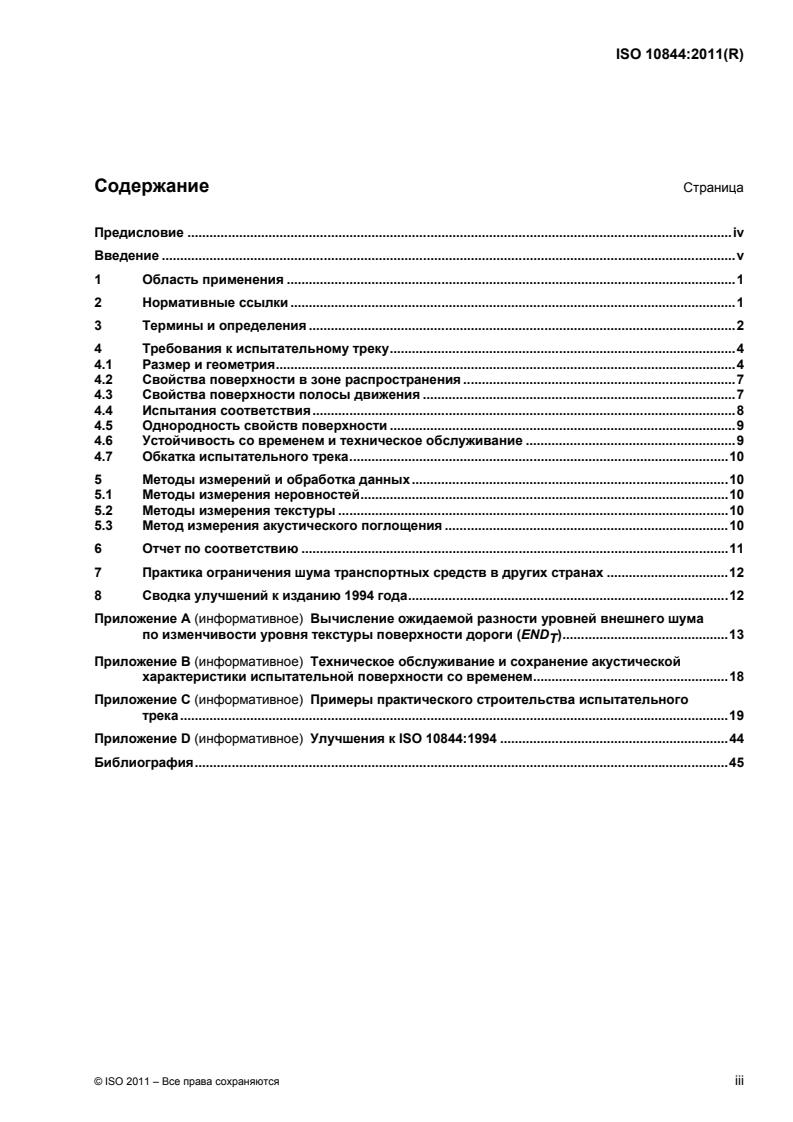
Contents Page
Foreword .iv
Introduction.v
1 Scope.1
2 Normative references.1
3 Terms and definitions .2
4 Requirements of the test track.3
4.1 Size and geometry.3
4.2 Surface properties of the propagation area.6
4.3 Surface properties of the drive lane.7
4.4 Conformity tests.7
4.5 Homogeneity of surface properties.9
4.6 Stability with time and maintenance .9
4.7 Break-in of the test track .9
5 Measurement methods and data processing .9
5.1 Irregularity measurement methods .9
5.2 Texture measurements methods .9
5.3 Acoustic absorption measurement method .10
6 Conformity report.10
7 Practices from different countries.12
8 Summary of improvements on the 1994 edition .12
Annex A (informative) Calculation of the Expected pass-by Noise level Difference from Texture
level variation of road surface (END ) .13
T
Annex B (informative) Maintenance and stability of acoustic performance of test surface over
time .18
Annex C (informative) Examples of test track construction practices.19
Annex D (informative) Improvements on ISO 10844:1994 .44
Bibliography.45
Foreword
ISO (the International Organization for Standardization) is a worldwide federation of national standards bodies
(ISO member bodies). The work of preparing International Standards is normally carried out through ISO
technical committees. Each member body interested in a subject for which a technical committee has been
established has the right to be represented on that committee. International organizations, governmental and
non-governmental, in liaison with ISO, also take part in the work. ISO collaborates closely with the
International Electrotechnical Commission (IEC) on all matters of electrotechnical standardization.
International Standards are drafted in accordance with the rules given in the ISO/IEC Directives, Part 2.
The main task of technical committees is to prepare International Standards. Draft International Standards
adopted by the technical committees are circulated to the member bodies for voting. Publication as an
International Standard requires approval by at least 75 % of the member bodies casting a vote.
Attention is drawn to the possibility that some of the elements of this document may be the subject of patent
rights. ISO shall not be held responsible for identifying any or all such patent rights.
ISO 10844 was prepared by Technical Committee ISO/TC 43, Acoustics, Subcommittee SC 1, Noise, in
cooperation with ISO/TC 22, Road vehicles.
This second edition cancels and replaces the first edition (ISO 10844:1994), of which it constitutes a technical
revision.
iv © ISO 2011 – All rights reserved
Introduction
In general, the road surface parameters affecting the noise emission of vehicles are the texture and sound
absorption characteristics. In addition, the mechanical impedance and the skid resistance properties of the
surface layer may also influence measured noise levels.
In order to minimize the variation in rolling sound emission and vehicle sound emission measurements made
at different testing locations it is, therefore, necessary to specify the relevant surface properties and
recommend carefully the properties of the materials, design, construction of the test surface.
The principal objective of this International Standard is to provide a revised specification of the surface which
improves the reproducibility of measurement.
This International Standard is designed in a way that test tracks conforming to this International Standard are
compatible with ISO 10844:1994, but in addition the variability of properties is reduced.
It is important that the test provides a high degree of reproducibility between different test sites and that the
surface design should not only minimize the inter-site variation of tyre/road noise, but should also ensure that
the propagation of noise is unaffected by the surface used. This latter consideration precludes the use of road
surfaces which have open textures and which have the property of absorbing noise from the power unit and
other related sources.
This International Standard is a revised version of ISO 10844:1994, including more restrictive specifications of
the surface and recommendations for the test track construction process and maintenance. The basic
properties of the surface remain unchanged.
The users of this International Standard are encouraged to measure END and to communicate the data to
T
the ISO/TC 43/SC 1/WG 42 for analysis before the next periodical review.
Furthermore, this International Standard recommends a non destructive test method for periodical checking of
the surface characteristics.
ISO 10844 is quoted in several International Standards (e.g. ISO 362, ISO 13325).
INTERNATIONAL STANDARD ISO 10844:2011(E)
Acoustics — Specification of test tracks for measuring noise
emitted by road vehicles and their tyres
1 Scope
This International Standard specifies the essential characteristics of a test surface intended to be used for
measuring vehicle and tyre/road noise emissions.
The surface design given in this International Standard:
⎯ produces consistent levels of tyre/road sound emission under a wide range of operating conditions
including those appropriate to vehicle sound testing;
⎯ minimizes inter-site variation;
⎯ provides minor absorption of the vehicle sound sources;
⎯ is consistent with road-building practice.
NOTE For the purposes of this International Standard, the terms noise and sound are used interchangeably.
2 Normative references
The following referenced documents are indispensable for the application of this document. For dated
references, only the edition cited applies. For undated references, the latest edition of the referenced
document (including any amendments) applies.
ISO 362-1, Measurement of noise emitted by accelerating road vehicles — Engineering method — Part 1: M
and N categories
ISO 13472-2, Acoustics — Measurement of sound absorption properties of road surfaces in situ — Part 2:
Spot method for reflective surfaces
ISO 13473-1, Characterization of pavement texture by use of surface profiles — Part 1: Determination of
Mean Profile Depth
ISO 13473-3, Characterization of pavement texture by use of surface profiles — Part 3: Specification and
classification of profilometers
ISO/TS 13473-4, Characterization of pavement texture by use of surface profiles — Part 4: Spectral analysis
of surface profiles
EN 13036-7, Road and airfield surface characteristics — Test methods — Part 7: Irregularity measurement of
pavement courses: the straightedge test
3 Terms and definitions
For the purposes of this document, the following terms and definitions apply.
3.1
sound absorption coefficient
α
fraction of the sound power incident on the test object that is absorbed within the test object for a plane wave
at normal incidence
NOTE Expressed as a percentage it is called sound absorption.
3.2
surface profile
3.2.1
texture profile
two-dimensional sample of pavement texture generated if a sensor, such as the tip of a needle or a laser spot,
continuously touches or shines on the pavement surface while it is moved along a line on the surface
NOTE It is described by two coordinates: one along the surface plane, called “distance” (the abscissa), and the other
in a direction normal to the surface plane, called “amplitude” (the ordinate).
3.2.2
irregularity
maximum distance of a surface from the measurement edge of the straightedge between two contact points of
the straightedge when placed perpendicular to the surface
NOTE 1 Pavement characteristics at longer wavelengths than 0,5 m are considered to be above that of texture and are
referred to here as irregularity.
NOTE 2 Refer to Figure C.1.
3.2.2.1
longitudinal irregularity
irregularity in the longitudinal axis of the track
3.2.2.2
transversal irregularity
irregularity in the direction perpendicular to the axis of the track
3.2.3
straightedge
device used for measuring the deviation from a plane
3.2.4
megatexture
deviation of a pavement surface from a true planar surface with the characteristic dimensions along the
surface of 50 mm to 500 mm, corresponding to texture wavelengths with one-third-octave bands including the
range 63 mm to 500 mm of centre wavelengths
NOTE Peak-to-peak amplitudes normally vary in the range 0,1 mm to 50 mm. This type of texture is the texture which
has wavelengths in the same order of size as a tyre/road interface and is often created by potholes or “waviness”. It is
usually an unwanted characteristic resulting from defects in the surface. Surface roughness with longer wavelengths than
megatexture is referred to as irregularity.
3.2.5
macrotexture
deviation of a pavement surface from a true planar surface with the characteristic dimensions along the
surface of 0,5 mm to 50 mm, corresponding to texture wavelengths with one-third-octave bands including the
range 0,63 mm to 50 mm of centre wavelengths
2 © ISO 2011 – All rights reserved
NOTE Peak-to-peak amplitudes may normally vary in the range 0,1 mm to 20 mm. This type of texture is the texture
which has wavelengths of the same order of size as tyre tread elements in the tyre/road interface. Surfaces are normally
designed with a sufficient macrotexture to obtain suitable water drainage in the tyre/road interface. The macrotexture is
obtained by suitable proportioning of the aggregate and mortar of the mix or by surface finishing techniques.
3.2.6
microtexture
deviation of a pavement surface from a true planar surface with the characteristic dimension along the surface
below 0,5 mm, corresponding to texture wavelengths with one-third-octave bands with centre wavelengths
less than or equal to 0,50 mm
3.3
gradient and cross fall
3.3.1
gradient
ratio of the height difference and the length measured along the longitudinal axis of the drive lane, expressed
as a percentage
3.3.2
cross fall
height difference expressed as a percentage of the length measured along the transversal axis of the drive
lane
3.4
propagation area
part of the test track on each side of the drive lane (see Figure 1)
3.5
drive lane
part of the test track where the vehicle runs
3.6
stiffness
ratio of a normal force and resulting displacement
3.7
dense asphalt concrete
asphalt in which the aggregate particles are essentially continuously graded to form an interlocking structure
NOTE Definition from EN 13108-1.
3.8
mean profile depth
average value of the height difference between the profile and a horizontal line through the highest peak (the
peak level) over a 100 mm long baseline
NOTE Adapted from ISO 13473-1:1997, 3.5.4.
4 Requirements of the test track
4.1 Size and geometry
4.1.1 Size
The test track shall consist of two areas, a drive lane and a propagation area. The dimensions shall comply
with Figure 1 and Table 1.
Key
l construction run-up section
s
l drive lane extension beyond propagation area
a
CC' drive lane centre line
PP' microphone line
A propagation area
dotted area drive lane
Figure 1 — Size of the test track
A drive lane with a length of l and width of at least 3,0 m that is centered around line PP'. The value of l is
a a
defined in Table 1.
Table 1 — Minimum drive lane extension length
For long vehicles with rear engine, having a distance
For testing tyres, passenger cars,
Length of more than10 m between reference point and the
motorcycles, light duty vehicles, trucks
front axle (reference point as defined in ISO 362-1)
a
l
10 m 20 m
a
a
20 m is necessary only for the exit side (BB') as defined in ISO 362-1of the test track according to the purpose of this requirement
NOTE For the stabilization of the laying process, a minimum length of l = 60 m is recommended on at least one side.
s
The propagation area shall extend at least 10 m from the centre of the drive lane and at least 10 m at both
sides of the line PP'.
Within a radius of 50 m around the centre of the track the space shall be free of large reflecting objects such
as fences, rocks, bridges or buildings.
NOTE Buildings outside the 50 m radius can have significant influence if their reflection focuses on the test track.
4 © ISO 2011 – All rights reserved
4.1.2 Geometry
a) Drive lane
The drive lane shall fulfil the following requirements:
⎯ For acceptance of the test track only, transverse irregularities equal to or less than 0,003 m and
longitudinal irregularities equal to or less than 0,002 m measured with the straightedge according to
EN 13036-7;
⎯ For periodical checking of the test track only, transverse irregularities equal to or less than 0,005 m and
longitudinal irregularities equal to or less than 0,005 m measured with the straightedge according to
EN 13036-7;
⎯ For acceptance only, deviation from the horizontal plane in transverse direction of 1,0 % maximum (see
Figure 2) and in a longitudinal direction of 0,5 % maximum.
It is recommended that the irregularities requirements be fulfilled starting from the microphone line to cover
the drive lane plus 10 m from the end of the section l on both sides.
a
b) Propagation area
⎯ The propagation area shall have irregularities equal to or less than 0,02 m measured with the
straightedge according to EN 13036-7;
⎯ The propagation area may have one or both sides lower than the drive lane. Cross fall in transverse
direction, measured using an appropriate instrument, shall be equal or less than 2,0 % (see Figure 2);
NOTE The slope should be designed in such a way that the draining of water is possible.
Figure 2 (continued)
Key
1 % max: Allowed drive lane cross fall
2 % max: allowed propagation area cross fall
Figure 2 — Propagation area slope in transverse direction
+0,02
⎯ Steps or discontinuities between the propagation area and the drive lane shall be m (see Figure 3).
Figure 3 — Propagation area – Steps or discontinuities
4.2 Surface properties of the propagation area
The average of the values of the sound absorption in each one-third-octave-band between 315 Hz and
1 600 Hz central frequency shall be less than or equal to 10 %. The sound absorption coefficient shall be
measured according to 5.3.
Location and number of measurement points are given in 4.4.
6 © ISO 2011 – All rights reserved
4.3 Surface properties of the drive lane
The surface of the drive lane shall:
a) be dense asphalt concrete,
b) exhibit a sound absorption equal to or less than 8 % in any one-third-octave band between 315 Hz and
1 600 Hz when measured according to 5.3,
c) have a maximum chipping size of 8 mm (tolerance allowed between 6,3 mm to 10 mm),
d) have a thickness of the wearing course greater or equal than 30 mm,
e) have a Mean Profile Depth measured according to ISO 13473-1 of 0,5 mm ± 0,2 mm,
f) have a target sieving curve for the aggregate as described in Figure 4.
Figure 4 — Sieving curve area
NOTE Until more results for validation are available, END is not part of the normative part of this International
T
Standard. The present state of the art with respect to this method is described in Annex A but is restricted to cases where
no elastic material (rubber, polyurethane, etc) is applied in the top layer or sub-layers except for modification of bitumen by
less than 1 % by mass of the total mix. Polymer-modified bitumen allows higher termperature operation and reduced
surface wear.
4.4 Conformity tests
a) The surface properties for each requirement shall be determined at the following occasions before the
acceptance of the track (refer to Table 2);
b) During the periodical checking of the track (refer to Table 2);
c) All measurements shall be made along the total length of the drive lane in each wheel track according to
the following scheme (see an example in Figure 5);
d) For sound absorption, texture, geometrical compliance, the first point shall be chosen randomly on each
side in the vicinity of the line PP' and the subsequent measurements shall be performed at 5 m intervals
not on the same axis of the centre line to cover the whole track;
Figure 5 — Measurement positions on test track, example for l = 40 m
e) After construction take a total of four cores, preferably at 10 m intervals outside the wheel tracks on the
driving lane run up section, and measure the sieving curve from these samples.
For checking the surface properties of the propagation area, take at least two measurements randomly
chosen on each side.
In addition, sound absorption of the propagation area shall be measured at both sides of the drive lane
between the microphone location and the centre of drive lane in the vicinity of the line PP'.
Table 2 — Periodicity for checking the requirements during acceptance and periodical checking
Requirements For acceptance For periodical checking
for the
Drive lane Propagation area Drive lane Propagation area
track
×
Gradient N.A. N.A. N.A.
(0,5 %)
Slope
× ×
Cross fall N.A. N.A.
(1 %) (2 %)
×
×
Longitudinal irregularity (u5 mm) N.A.
(u2 mm) ×
a
2 years
(u20 mm)
×
randomly
×
Transverse irregularity (u5 mm) N.A.
(u3 mm)
a
2 years
×
×
MPD
Texture MPD N.A. N.A.
0,5 mm ± 0,2 mm
0,5 mm ± 0,2 mm
a
2 years
×
× ×
Absorption (8 % max) N.A.
(8 % max) (10 %max)
a
4 years
Grading curve × N.A. N.A. N.A.
× to be checked
N.A. not applicable
a
Periodicity.
8 © ISO 2011 – All rights reserved
4.5 Homogeneity of surface properties
In order to ensure that the properties of the drive lane and the properties of the propagation area are
homogeneous, the average of all positions and 80 % of the samples shall meet the requirements with respect
to:
⎯ acoustic absorption;
⎯ surface texture;
⎯ geometrical compliance.
4.6 Stability with time and maintenance
The test track is a test instrument and shall be protected from damage and be taken care of. The test track
should be used only for noise measurements.
Loose debris or dust which could significantly reduce the texture depth shall be removed from the surface.
Sealing of cracks is acceptable as long as acoustical performances (as per 4.2 and 4.3) of the test track are
not affected.
See Annex B for recommendations.
4.7 Break-in of the test track
The texture and absorption characteristics shall be checked not earlier than 4 weeks after construction or
1 000 passes after construction.
If the surface is exclusively used for testing heavy vehicles (M2 above 3,5 t, M3, N2 and N3) this break-in
period is not necessary.
5 Measurement methods and data processing
5.1 Irregularity measurement methods
The irregularity of the drive lane shall be determined according to EN 13036-7 using a straightedge consisting
of a beam of 3,0 m length and wedge with 1 mm steps on the oblique side.
5.2 Texture measurements methods
5.2.1 Profile measurement
The profile is measured according to ISO 13473-1 for MPD and ISO 13473-3 for END . The measurement
T
instrumentation shall meet the requirements of class DE defined in ISO 13473-3.
Additional details to ISO 13473-1 — MPD shall be measured in the wheel tracks of the driving lane and the
following two options may be used:
⎯ Continuous measurement: MPD is measured continuously over the entire driving lane. The measured
profile shall be divided into eight sections, each 5 m long, for which MPD shall be evaluated separately as
average over the section. A total of two measurement runs shall be made in each wheel track,
⎯ Segmented measurement: MPD is measured at a minimum of four locations in each of the two wheel
tracks (eight if the test track is used for two-wheeled vehicles). These locations shall be evenly distributed
over the driving lane length. At each such location, a minimum length of 2,0 m of profiles shall be
measured, each one at least 0,8 m long and positioned in a way which give statistically independent MPD
values.
The MPD requirement in 4.3 shall be met at each of the eight locations or sections.
When calculating END , the wavelength spectrum from 100 mm to 5 mm one-third-octave-band of the profile
T
shall be obtained according to the specifications of ISO/TS 13473-4. A tapered cosine window is preferred
(refer to ISO 13472-4).
5.2.2 Texture profile data pre-processing
Removal of spike data is necessary. For details refer to ISO/TS 13473-6.
5.3 Acoustic absorption measurement method
The acoustic absorption shall be measured in the frequency range from 280 Hz to 1 800 Hz with an in-situ
device meeting the specifications of ISO 13472-2. The results shall be expressed in the one-third octave band
coefficients according to the procedure described in ISO 13472-2.
6 Conformity report
The test report for each pavement test surface shall contain all information required for construction approval
or periodical inspection, whatever is applicable.
Example:
a) General information
⎯ Owner
⎯ Contractor's name
⎯ Date of construction of the test track
⎯ Location of the test track
⎯ Certifying authority (if applicable)
⎯ Certification status
⎯ Main use of the test track (e.g. truck tyre coast by, testing, passenger car drive by)
⎯ Notable features (e.g. under track, heating)
b) Size and geometry
1) Size
i) Dimensions of the driving lane
⎯ Total length (m)
⎯ Width (m)
⎯ l (m)
a
⎯ l (m)
s
10 © ISO 2011 – All rights reserved
ii) Dimensions of the propagation area
⎯ Length (m)
⎯ Width (m)
iii) Free space
⎯ Radius (m)
⎯ Notable feature
2) Geometry
i) Drive lane
⎯ Transverse and longitudinal irregularities (m)
⎯ Deviation from the horizontal plane in transverse direction (%)
ii) Propagation area
⎯ Irregularities (m)
⎯ Slope in transverse direction (%)
⎯ Steps or discontinuities (m)
c) Surface properties
1) Material
i) Drive lane
⎯ Sound absorption
⎯ Maximum chipping size
⎯ Thickness of wearing course
⎯ Texture
⎯ Sieving curve
⎯ Elastic material
ii) Propagation area
⎯ Sound absorption
2) Homogeneity statement of surface properties
⎯
d) Proving the requirements
⎯ Scheme of the measuring point
⎯ Measuring material description
⎯ Description of the measuring methods
e) Homogeneity of surface properties
7 Practices from different countries
Annex C gives information on current practices from different countries.
8 Summary of improvements on the 1994 edition
Annex D lists improvements made compared to ISO 10844:1994.
12 © ISO 2011 – All rights reserved
Annex A
(informative)
Calculation of the Expected pass-by Noise level Difference from Texture
level variation of road surface (END )
T
A.1 General information — Principle
The END is a single number rating providing an estimation of the variation of the dB(A) global noise level due
T
to texture changes with respect to a reference surface. The reference surface is characterized by a third-
octave texture profile spectrum L as a function of the texture wavelength, λ, and a third-octave noise
tx,ref, λ
spectrum L as a function of the frequency, f.
mi
The END is evaluated from the third-octave texture profile spectrum, L , of the track to be tested. It is
T tx, λ
composed of two terms intended to handle two tyre/road noise generation mechanisms: the texture induced
vibration and radiation of the tyre belt and the air-pumping phenomenon.
The first term, 10 lg(A/B), is evaluated from texture level differences at wavelengths λ = v/f, where v is the
rolling speed considered. For greater convenience, the texture levels at wavelengths v/f are evaluated by
linear interpolation from the texture levels at standard λ values (see A.3). The second term C is evaluated
from the texture level difference at λ = 5 mm.
A.2 Surface properties of the drive lane — Texture measured using END
T
The texture is measured using END method as defined in A.2. The reference texture profile is given in
T
Table A.1. The value to achieve shall be ±1,5 dB.
NOTE A direct comparison of texture spectra is inadequate because of the fact that different spectral ranges affect
rolling noise level in different ways. The END procedure takes into account the effect of a wavelength band on the related
T
acoustic frequency band and weights these effects on the basis of their contribution to the overall A-weighted sound
pressure level.
Table A.1 — Reference texture profile spectrum
One-third- octave-band
100 80 63 50 40 32 25 20 5
Wavelength [in mm]
Level texture L [in dB]
tx
32,0 34,0 34,5 35,2 36,2 37,3 37,9 38,8 39,8
with reference to1 µm
The profile is measured according to ISO 13473-2.
In order to calculate the END value for a given test track with measured one-third-octave-band spectrum
T
levels L , one can follow the procedure as outlined below. The levels L have to be available for every
tx,λ tx, λ
one-third-octave band between 20 mm and 100 mm and for λ = 5 mm These levels shall be measured
according to ISO 13473 and be expressed as levels re. 1 µm in decibels.
A.3 Calculation of the differences ΔL between L and the reference ISO 10844
tx,λ tx,λ
Test Track spectrum L
tx,ref, λ
ΔL = L − L (A.1)
tx,λ tx, λ tx,ref, λ
Values for the L are given in Table A.2.
tx,ref, λ
Table A.2 — One-third-octave-band levels for the relevant texture wavelengths λ and the
corresponding acoustic frequencies f at 80 km/h
L in dB
λ in mm f in Hz
tx,ref,λ
100 32,0 222
80 34,0 278
63 34,5 353
50 35,2 444
40 36,2 556
31,5 37,3 705
25 37,9 889
20 38,8 1 111
The third column of Table A.2 shows the corresponding (acoustic) frequency, f, for a speed of 80 km/h. By
means of linear interpolation, one calculates the values ΔL for the acoustic frequencies 250 Hz, 315 Hz,
tx,i
400 Hz, 500 Hz, 630 Hz, 800 Hz, and 1 000 Hz. Subscript i = 1 corresponds to f = 250 Hz, i = 2 to f = 315 Hz
and so on.
A.4 Calculation of the term A as follows
(L + b ΔL )/10
mi i tx,i
A = Σ 10 for i = 1 … 13 (A.2)
where
L are reference noise levels, as given in Table A.3;
mi
b are fixed factors, as given in Table A.4.
i
A.5 Calculation of the term B as follows
L /10
mi
B = Σ 10 for i = 1 … 13 (A.3)
where L are again given in Table A.3.
mi
14 © ISO 2011 – All rights reserved
Table A.3 — Values for the reference noise levels
f in Hz
L in dB
Index i
mi
(one-third octave)
1 250 51,9
2 315 52,1
3 400 55,1
4 500 59,7
5 630 61,6
6 800 64,9
7 1 000 64,6
8 1 250 62,8
9 1 600 62,2
10 2 000 61,3
11 2 500 59,9
12 3 150 56,6
13 4 000 54,2
Table A.4 — Factors b
i
b
Index i f in Hz
i
1 250 0,9
2 315 0,85
3 400 0,8
4 500 0,75
5 630 0,7
6 800 0,65
7 1 000 0,4
8 1 250 0
9 1 600 0
10 2 000 0
11 2 500 0
12 3 150 0
13 4 000 0
A.6 Calculation of the term C as follows
C = 0,25 ΔL (A.4)
tx,5 mm
where ΔL = L − L
tx,5 mm tx,5 mm tx,ref,5 mm
With L the measured texture level of the surface under consideration for the texture wavelength 5 mm
tx,5 mm
and L the corresponding level of the reference surface, equalling 39,8 dB.
tx,ref,5 mm
A.7 Calculation of END
T
END = 10 lg(A/B) dB – C (A.5)
T
A.8 Worked example
Suppose one measured a one-third-octave-band spectrum on a new test track as given in Table A.5.
Table A.5 — Example of measured one-third-octave-band spectrum
L in dB
λ in mm
tx,λ
100 46
80 45
63 43
50 41
40 40
31,5 39
25 38
20 44
5 48
⎯ Calculate the differences ΔL between the L and the reference ISO 10844 Test Track spectrum
tx,λ tx,λ
L .
tx,ref,λ
The values ΔL are calculated and given in Table A.6.
tx, λ
Table A.6 — Calculated values for ΔL
tx,λ
ΔL in dB
λ in mm f in Hz
tx,λ
100 14,0 222
80 11,0 278
63 8,5 353
50 5,8 444
40 3,8 556
31,5 1,7 705
25 0,1 889
20 5,2 1111
The linearly interpolated ΔL for the reference acoustic frequencies 250 Hz, 315 Hz, … etc. are given in
tx,i
Table A.7.
⎯ Calculate the term A
Using the values from Table A.7 for ΔL , the values for the b from Table A.4 and the values given in Table
tx,i i
A.3 for the L , Equation (A.2) can be evaluated as:
mi
A = 2,26 × 10
16 © ISO 2011 – All rights reserved
Table A.7 — Interpolated values for ΔL
tx,i
ΔL in dB
Index i f in Hz
tx,i
1 250 12,5
2 315 9,7
3 400 7,2
4 500 4,8
5 630 2,8
6 800 0,9
7 1000 2,7
⎯ Calculate the term B
Using the values from Table A.3 for the L , Equation (A.3) can be evaluated as:
mi
B = 1,56 × 10
⎯ Calculate the term C as follows
C = 0,25 × (L − L ) dB = 0,25 × (48 − 39,8) = 2,1 dB
tx,5 mm tx,ref,5 mm
where L = 48 dB was a measured value from the example (Table A.5) and L = 39,8 dB was
tx,5 mm tx,rwf,5 mm
given.
⎯ Calculate END :
T
END can now be evaluated with Equation (A.5):
T
7 7
END = 10 lg(A/B) dB – C = 10 lg (2,26 × 10 /1,56 × 10 ) dB – 2,1 dB
T
= –0,4 dB
Hence, based on the texture data, the example surface is expected to be 1,6 dB noisier than the reference
test track.
Annex B
(informative)
Maintenance and stability of acoustic performance of test surface over
time
B.1 General
This annex gives information on maintaining the test track and on stability with time of the test track.
B.2 Maintenance
In the process of cleaning, be careful not to use devices that may alter the texture such as rotating steel
brushes, high pressure water spray etc. The dust should be sucked off or brushed off.
Salt may alter the surface temporarily or even permanently in such a way as to increase noise and therefore
application of salt is prohibited.
B.3 Influence of age
The surface will achieve its required characteristics approximately 4 weeks after construction, or after
sufficient crossings are made in order to remove the bitumen cover from the mineral surface.
From practical experience, it is known that the tyre/road noise levels measured on the test surface increase
slightly during the first 6 months to 12 months after construction.
The influence of age on the noise from trucks is generally less than that from cars.
The surface wears out depending on the frequency of use mainly in the wheel tracks (ravelling and rutting)
and as a consequence, the acoustic properties may be affected.
The stiffness of the base and sub grade can influence the durability of the track.
When the track surface is hot, additional damage can occur.
Avoid conducting acceleration tests when the surface temperature is over 50 °C, unless the track is
specifically designed for operation above this temperature.
For use at higher surface temperatures, this edition of this International Standard allows the use of polymer-
modified bitumen.
B.4 Repaving the test area
When necessary to repave the test track drive lane, it is unnecessary to repave more than the test strip of 3 m
width, where vehicles are driving, provided the test area outside the strip meets the requirements for sound
absorption.
The whole width of the drive lane should always be renewed according to the width of the finisher or the
milling machine. Additional longitudinal joints should be avoided.
18 © ISO 2011 – All rights reserved
Annex C
(informative)
Examples of test track construction practices
C.1 Aim of Annex C
The aim of this annex is to give information on current practices from different countries. It is not the aim to
describe a standardized process to build a test track. It does not guarantee that applying one of these
processes will automatically lead to fulfilment of the specification at the first attempt. Any other construction
practice may be applied as far as it satisfies the requirements of this International Standard.
C.3 is an example from Germany;
C.4 is an example from Japan;
C.5 is an example from USA;
C.6 is an example from The Netherlands.
C.2 General
The requirements in this International Standard are more severe than those for building common roads. The
experience shows the necessity to have a good know-how of road building practice and skill to be able to
construct the test track according to the present standard requirements.
IMPORTANT — The base and the sub-base shall ensure stability and evenness according to best road
construction practice.
IMPORTANT — In the practices illustrated by the following examples, coring is used because
ISO 10844:1994 required void content or absorption. Today, void content is replaced by non-intrusive
methods.
C.3 Example from Germany
C.3.1 Sub layers
a) New construction of a test track
In the case of a completely new road construction, base and sub-base layers shall ensure good stability and
evenness, according to best road construction practice. The unevenness of the base and binder layer should
be less than 2 mm under a 3 m straightedge in any direction.
Dimensions in millimetres
Figure C.1 — To check the unevenness using the straightedge method
NOTE 1 For checking the 2 mm requirement, the distance between the straightedge and the surface can be measured
using a staggered gauge with steps of 0,1 mm as described in EN 13036-7. If laser profilometer is used, care shall be
taken to obtain equivalent result, i.e. not considering very localized variation.
NOTE 2 The recommended value of E 2 (Young modulus) of the asphalt wearing and the top layer course for
v
passenger cars track and for trucks track (see Figure A.2) is:
1) 2
⎯ For the subgrade : E 2 W 150 MN/m ;
v
2) 2 2
⎯ For the natural soil : 60 MN/m uE 2 u 80 MN/m .
v
1) To determine the modulus values of the subgrade and natural soil the California Bearing Ratio method (ASTM D1883-
[12]
99 or EN 13286-47 can be used.
20 © ISO 2011 – All rights reserved
Key
1 Asphalt concrete top layer (wearing course) E 2 XX
v
2 Asphalt binder (second layer) E 2 XX
v
3 Asphalt sub-base (first layer / tout venant)
4 Subgrade (mix granulat base course)
5 Natural soil or soil stabilised by lime E 2 XX
v
Figure C.2 — Schematic of the layers - Recommended value for E
²
v
NOTE 3 Depending of the Young’s Modulus of the natural soil (E 2) asphalt sub-base, sub-grade will be defined
v
according to the local road practice considering its influence on the test surface characteristics as defined in this
International Standard.
To ensure that these characteristics are fulfilled, the evenness of the interface between asphalt binder and
sub-base must be less than 4 mm with a straightedge.
b) Renewal of the asphalt concrete top layer (wearing course)
When the asphalt concrete top layer (wearing course) has to be replaced by a new test surface, the milling of
the old asphalt concrete top layer (wearing course) should only be done by means of a precise levelling cutter,
guided by levelled wires on each side or similar laser or ultrasonic sensors (see Figure C.3). This is to ensure
that possible unevenness of the old asphalt concrete top layer (wearing course) is not copied into the new top
layer.
The minimum working width should be 2 m, and the maximum distance between cut lines should not exceed
6 mm.
Figure C.3 — Renewal of the asphalt concrete top layer (wearing course)
Both longitudinal and transversal joints should be sealed with a cold joint based on Polymer modified Bitumen
(PmB) since it can be processed cold. Self-adhesive joint tapes are not suitable and must be avoided. Firm
adhesion between the new top layer and the milled plane must be ensured by an adhesion promoter (see
2 2
Figure C.4), for example: bitumen emulsion (200 g/m to 300 g/m ).
Figure C.4 — Finely milled surface ready for the application of new asphalt concrete top layer (wearing
course)
22 © ISO 2011 – All rights reserved
C.3.2 Mix design of the asphalt concrete top layer (wearing course)
C.3.2.1 Ingredients
a) Mineral materials
Mineral materials of the highest quality are essential and shall comply with the highest requirements of the
country.
Selection criteria are: strength, abrasion resistance, polishing resistance, crushing resistance, frost resistance,
as well as grain shape.
Magmatic rocks such as “basalt”, “gabbro”, “diabase”, “granite” and “porphyry” (or similar) are generally
recommended due to their high level of microtexture and their high shear resistance of compacted layers.
Limestone is too soft; moraine has not enough microtexture so they are not suitable.
The Polished Stone Value (PSV) should be at least 50 according to EN 1097-8.
Grain shape is an important feature; it should approximate a cubic form, with a length/thickness ratio less than
3:1, (EN 13043; see also EN 933-5 - category C ).
100/0
Chipping size D > 2 mm should be 100 % crushed rock and the chippings should be washed. The test surface
shall be dense asphalt concrete and maximum chipping size shall be 8 mm nominal (tolerances in the range
6,3 mm to 10 mm as per EN 13108-1).
The sand fraction (0,063 mm < D < 2 mm) should have a flow value of at least 30 according to EN 933-6.
Delivery conditions are important and should comply with EN 933-6, as well as EN 13043.
The filler according to B 11-121 is by definition a mineral powder with a chipping size less than D < 0,063 mm.
Limestone powder (calcium carbonate) or (slaked) spent lime (calcium hydroxide) are recommended, due to
their alkaline nature, which favours adhesion with bitumen.
Other grain sizes can be used depending on local supply, but shall not exceed 0,09 mm.
The filler fraction fines of the crushed rock (u0,09 mm) shall be totally removed and replaced by the limestone
powder added filler with a maximum grain size of 0,09 mm;
b) Binder
The binder shall be bitumen. Depending on the climatic condition of the area, bitumen as binder may be
straight penetration type bitumen or a modified bitumen.
c) Mix formulation
Grading curve is the most important parameter for noise and should be a requirement of the surface.
For the suitability tests, the crushed-rock granulate are washed, and sieved (ISO 56
...
NORME ISO
INTERNATIONALE 10844
Deuxième édition
2011-02-01
Acoustique — Spécification des surfaces
d'essai pour le mesurage du bruit émis
par les véhicules routiers et leurs
pneumatiques
Acoustics — Specification of test tracks for measuring noise emitted by
road vehicles and their tyres
Numéro de référence
©
ISO 2011
DOCUMENT PROTÉGÉ PAR COPYRIGHT
© ISO 2011
Droits de reproduction réservés. Sauf prescription différente, aucune partie de cette publication ne peut être reproduite ni utilisée sous
quelque forme que ce soit et par aucun procédé, électronique ou mécanique, y compris la photocopie et les microfilms, sans l'accord écrit
de l'ISO à l'adresse ci-après ou du comité membre de l'ISO dans le pays du demandeur.
ISO copyright office
Case postale 56 CH-1211 Geneva 20
Tel. + 41 22 749 01 11
Fax + 41 22 749 09 47
E-mail copyright@iso.org
Web www.iso.org
Publié en Suisse
ii © ISO 2011 – Tous droits réservés
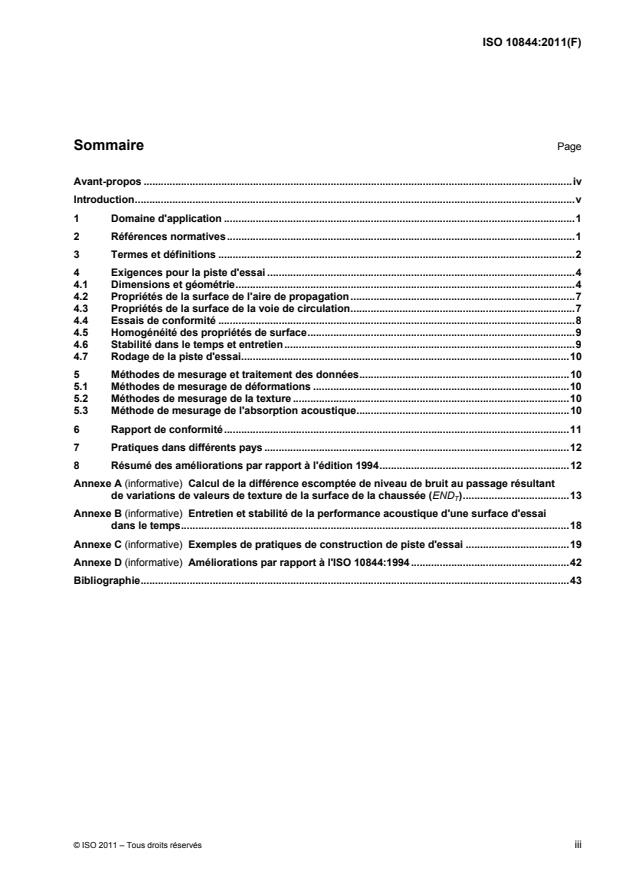
Sommaire Page
Avant-propos . iv
Introduction . v
1 Domaine d'application . 1
2 Références normatives . 1
3 Termes et définitions . 2
4 Exigences pour la piste d'essai . 4
4.1 Dimensions et géométrie . 4
4.2 Propriétés de la surface de l'aire de propagation . 7
4.3 Propriétés de la surface de la voie de circulation . 7
4.4 Essais de conformité . 8
4.5 Homogénéité des propriétés de surface . 9
4.6 Stabilité dans le temps et entretien . 9
4.7 Rodage de la piste d'essai . 10
5 Méthodes de mesurage et traitement des données . 10
5.1 Méthodes de mesurage de déformations . 10
5.2 Méthodes de mesurage de la texture . 10
5.3 Méthode de mesurage de l'absorption acoustique . 10
6 Rapport de conformité . 11
7 Pratiques dans différents pays . 12
8 Résumé des améliorations par rapport à l'édition 1994 . 12
Annexe A (informative) Calcul de la différence escomptée de niveau de bruit au passage résultant
de variations de valeurs de texture de la surface de la chaussée (END ) . 13
T
Annexe B (informative) Entretien et stabilité de la performance acoustique d'une surface d'essai
dans le temps . 18
Annexe C (informative) Exemples de pratiques de construction de piste d'essai . 19
Annexe D (informative) Améliorations par rapport à l'ISO 10844:1994 . 42
Bibliographie . 43
Avant-propos
L'ISO (Organisation internationale de normalisation) est une fédération mondiale d'organismes nationaux de
normalisation (comités membres de l'ISO). L'élaboration des Normes internationales est en général confiée
aux comités techniques de l'ISO. Chaque comité membre intéressé par une étude a le droit de faire partie du
comité technique créé à cet effet. Les organisations internationales, gouvernementales et non
gouvernementales, en liaison avec l'ISO participent également aux travaux. L'ISO collabore étroitement avec
la Commission électrotechnique internationale (CEI) en ce qui concerne la normalisation électrotechnique.
Les Normes internationales sont rédigées conformément aux règles données dans les Directives ISO/CEI,
Partie 2.
La tâche principale des comités techniques est d'élaborer les Normes internationales. Les projets de Normes
internationales adoptés par les comités techniques sont soumis aux comités membres pour vote. Leur
publication comme Normes internationales requiert l'approbation de 75 % au moins des comités membres
votants.
L'attention est appelée sur le fait que certains des éléments du présent document peuvent faire l'objet de
droits de propriété intellectuelle ou de droits analogues. L'ISO ne saurait être tenue pour responsable de ne
pas avoir identifié de tels droits de propriété et averti de leur existence.
L'ISO 10844 a été élaborée par le Comité technique ISO/TC 43, Acoustique, Sous-comité SC 1, Bruit, en
coopération avec l'ISO/TC 22, Véhicules routiers.
Cette deuxième édition annule et remplace la première édition (ISO 10844:1994), dont elle constitue une
révision technique.
iv © ISO 2011 – Tous droits réservés
Introduction
En général, les paramètres de surface routière qui influencent le bruit émis par les véhicules sont les
caractéristiques de texture et d'absorption acoustique. Par ailleurs, l'impédance mécanique et les propriétés
d'adhérence de la couche superficielle peuvent également influencer les niveaux de bruit mesurés.
Afin de minimiser les variations des mesures des émissions acoustiques de roulement et des émissions
acoustiques de véhicule effectuées à des emplacements différents, il est nécessaire de spécifier les
propriétés des surface d'essais pertinentes et de formuler soigneusement les recommandations pour les
propriétés des matériaux, la conception et la construction de la surface d'essai.
L'objectif principal de la présente Norme internationale est de fournir une spécification révisée de la surface
qui améliore la reproductibilité du mesurage.
La présente Norme internationale est conçue de telle manière que les pistes d'essai en conformité avec la
présente Norme internationale soient compatibles avec l'ISO 10844:1994, mais la variabilité des propriétés
est par ailleurs réduite.
Il est important que l'essai assure un haut degré de reproductibilité entre différents sites d'essai et que la
conception de la surface non seulement minimise la variation du bruit de contact pneumatique/chaussée entre
les sites, mais garantisse également que la propagation du bruit ne soit pas influencée par la surface utilisée.
Cette dernière considération exclut l'utilisation de surfaces routières à textures ouvertes et qui ont pour
propriété d'absorber le bruit provenant du groupe motopropulseur et autres sources liées.
La présente Norme internationale est une version révisée de l'ISO 10844:1994, comprenant des
spécifications plus restrictives pour la surface et des recommandations pour le procédé de construction et
l'entretien de la surface d'essai. Les propriétés de base de la surface restent inchangées.
Les utilisateurs de la présente Norme internationale sont invités à mesurer END et à communiquer les
T
données à l'ISO/TC 43/SC 1/WG 42 pour analyse avant le prochain examen périodique.
Par ailleurs, la présente Norme internationale recommande une méthode d'essai non destructif pour la
vérification périodique des caractéristiques de surface.
L'ISO 10844 est citée dans quelques Normes internationales (par exemple l'ISO 362 et l'ISO 13325).
NORME INTERNATIONALE ISO 10844:2011(F)
Acoustique — Spécification des surfaces d'essai pour le
mesurage du bruit émis par les véhicules routiers et leurs
pneumatiques
1 Domaine d'application
La présente Norme internationale spécifie les caractéristiques essentielles d'une surface d'essai destinée à
être utilisée pour mesurer les émissions de bruit de véhicules et du contact pneumatique/chaussée.
La conception de la surface reprise dans la présente Norme internationale
produit des émissions acoustiques de contact pneumatique/chaussée constantes dans une vaste gamme
de conditions d'utilisation, y compris celles qui sont appropriées à l'essai des émissions acoustiques de
véhicules;
minimise les variations entre les sites;
entraîne une absorption très faible des émissions acoustiques du véhicule;
est compatible avec les pratiques de la construction routière.
NOTE Pour les besoins de la présente Norme internationale, les termes bruit et émissions acoustiques sont
interchangeables.
2 Références normatives
Les documents de référence suivants sont indispensables pour l'application du présent document. Pour les
références datées, seule l'édition citée s'applique. Pour les références non datées, la dernière édition du
document de référence s'applique (y compris les éventuels amendements).
ISO 362-1, Mesurage du bruit émis par les véhicules routiers en accélération — Méthode d'expertise —
Partie 1: Catégories M et N
ISO 13472-2, Acoustique — Mesurage in situ des propriétés d'absorption acoustique des revêtements de
chaussées — Partie 2: Méthode ponctuelle pour les surfaces réfléchissantes
ISO 13473-1, Caractérisation de la texture d'un revêtement de chaussée à partir de relevés de profils de la
surface — Partie 1: Détermination de la profondeur moyenne du profil
ISO 13473-3, Caractérisation de la texture d'un revêtement de chaussée à partir de relevés de profils de la
surface — Partie 3: Spécification et classification des appareils de mesure de profil
ISO/TS 13473-4, Caractérisation de la texture d'un revêtement de chaussée à partir de relevés de profils de la
surface — Partie 4: Analyse spectrale des profils de la surface
EN 13036-7, Caractéristiques de surface des routes et aérodromes — Méthodes d'essai — Partie 7:
Mesurage des déformations localisées des couches de roulement des chaussées: Essai à la règle
3 Termes et définitions
Pour les besoins du présent document, les termes et définitions suivants s'appliquent.
3.1
coefficient d'absorption acoustique
fraction de la puissance acoustique incidente sur l'objet mis à l'essai qui est absorbée à l'intérieur de l'objet
mis à l'essai pour une onde plane à incidence normale.
NOTE Lorsqu'il est exprimé en pourcentage, on le désigne par le terme absorption acoustique.
3.2
profil de la surface
3.2.1
relevé de profil
échantillon bidimensionnel de texture du revêtement créé si un capteur, tel que la pointe d'une aiguille ou un
rayon laser, est en contact continu ou éclaire de manière continue la surface de revêtement pendant
l'exploration de cette surface en suivant une ligne
NOTE Il est décrit à l'aide de deux coordonnées: une parallèlement à la surface plane, appelée «distance»
(abscisse), et l'autre perpendiculairement à cette même surface, appelée «amplitude» (ordonnée).
3.2.2
déformation
distance maximale d'une surface par rapport au bord de mesurage d'une règle positionnée
perpendiculairement à cette surface, entre deux points de contact de la règle
NOTE 1 Des caractéristiques de chaussée de longueurs d'onde supérieures à 0,5 m sont considérées comme étant
supérieures à celles de la texture et sont désignées ici sous le terme déformation.
NOTE 2 Se reporter à la Figure C.1.
3.2.2.1
déformation longitudinale
déformation dans l'axe longitudinal de la piste
3.2.2.2
déformation transversale
déformation dans la direction perpendiculaire à l'axe de la piste
3.2.3
règle
outil pour mesurer l'écart par rapport à une surface plane
3.2.4
mégatexture
écart entre la surface du revêtement et une surface plane vraie dont les dimensions caractéristiques sont
comprises entre 50 mm et 500 mm le long de la surface, correspondant à des longueurs d'onde de la texture
en bandes d'un tiers d'octave qui incluent les longueurs d'onde centrales de 63 mm à 500 mm
NOTE Les amplitudes de pic à pic se situent généralement entre 0,1 mm et 50 mm. Cette catégorie de texture donne
des longueurs d'ondes du même ordre de grandeur que l'aire de contact pneumatiques/chaussées et est souvent le
résultat de fondrières et d'«ondulations». II s'agit généralement d'une caractéristique ou d'une conséquence d'une
altération involontaire des surfaces. Dans le cas de rugosité de surface avec des longueurs d'ondes plus longues que la
mégatexture, on parle de déformation.
2 © ISO 2011 – Tous droits réservés
3.2.5
macrotexture
écart entre la surface du revêtement et une surface plane vraie dont les dimensions caractéristiques sont
comprises entre 0,5 mm et 50 mm le long de la surface, correspondant à des longueurs d'onde de la texture
en bandes d'un tiers d'octave qui incluent les longueurs d'onde centrales de 0,63 mm à 50 mm
NOTE Les amplitudes de pic à pic se situent normalement entre 0,1 mm et 20 mm. Cette catégorie de texture donne
des longueurs d'onde du même ordre de grandeur que des pavés de gomme de la bande de roulement des pneumatiques
qui interviennent dans le contact pneumatiques/chaussées. Les surfaces sont généralement conçues avec une
macrotexture suffisante pour obtenir un bon drainage de l'eau à l'interface pneumatique/chaussée. On obtient la
macrotexture en faisant un dosage approprié du granulat et du mortier dans le mélange ou grâce à des techniques de
finition de surface.
3.2.6
microtexture
écart entre la surface du revêtement et une surface plane vraie dont la dimension caractéristique le long de la
surface est inférieure à 0,5 mm, correspondant à des longueurs d'onde de la texture en bandes d'un tiers
d'octave qui incluent des longueurs d'onde centrales inférieures ou égales à 0,50 mm
3.3
pentes longitudinale et transversale
3.3.1
pente longitudinale
rapport entre la différence de hauteur et la longueur mesurée le long de l'axe longitudinal de la voie de
circulation, exprimée en pourcentage
3.3.2
pente transversale
différence de hauteur exprimée en pourcentage de la longueur mesurée le long de l'axe transversal de la voie
de circulation
3.4
aire de propagation
partie de la piste d'essai située de chaque côté de la voie de circulation (voir Figure 1)
3.5
voie de circulation
partie de la piste d'essai où circule le véhicule
3.6
rigidité
rapport entre une force perpendiculaire et le déplacement qui en résulte
3.7
béton bitumineux dense
asphalte dont les particules de granulat sont essentiellement classées de manière continue pour former une
structure imbriquée
NOTE Définition reprise de l'EN 13108-1.
3.8
profondeur moyenne du profil
valeur moyenne de la différence de hauteur entre le profil et une ligne horizontale passant par la saillie la plus
haute (le niveau de saillie) sur une ligne de base de 100 mm
NOTE Adapté de l'ISO 13473-1:1997, 3.5.4.
4 Exigences pour la piste d'essai
4.1 Dimensions et géométrie
4.1.1 Dimensions
La piste d'essai doit comprendre deux aires, une voie de circulation et une aire de propagation. Les
dimensions doivent être conformes à la Figure 1 et dans le Tableau 1.
Légende
l section construite de lancement
s
l prolongation de la voie de circulation au-delà de
a
l'aire de propagation
CC' axe médian de la voie de circulation
PP' axe de microphone
A aire de propagation
voie de circulation
aire en pointillés
Figure 1 — Dimensions de la piste d'essai
Une voie de circulation d'une longueur l et d'une largeur d'au moins 3,0 m centrée autour de l'axe PP'. La
a
est définie dans le Tableau 1.
valeur l
a
Tableau 1 — Longueur de prolongation minimum de la voie de circulation
Pour des véhicules longs à moteur arrière avec une
Pour les essais de pneumatiques, voitures
distance de plus de 10 m entre le point de référence
Longueur particulières, motocycles, véhicules
et l'essieu avant (point de référence selon la définition
utilitaires légers, camions
de l'ISO 362-1)
a
l
10 m 20 m
a
a
20 m ne sont nécessaires que pour le côté de sortie (BB') de la piste d'essai définie dans l'ISO 362-1, pour les besoins de cette
exigence
4 © ISO 2011 – Tous droits réservés
NOTE Afin de stabiliser le procédé de mise en œuvre, une longueur minimale de l 60 m est recommandée au
s
moins d'un côté.
L'aire de propagation doit se poursuivre sur 10 m au moins à partir du centre de la voie de circulation et sur
10 m au moins de chaque côté de l'axe PP'.
Dans un rayon de 50 m autour du centre de la piste l'espace doit être libre de tous grands objets
réfléchissants tels que clôtures, rochers, ponts ou bâtiments.
NOTE Des bâtiments situés en dehors du rayon de 50 m peuvent avoir une influence significative si leur reflet vise la
piste d'essai.
4.1.2 Géométrie
a) Voie de circulation
La voie de circulation doit remplir les exigences suivantes:
Aux fins d'acceptation de la piste d'essai uniquement, des déformations transversales inférieures ou
égales à 0,003 m et des déformations longitudinales inférieures ou égales à 0,002 m mesurées avec la
règle selon l'EN 13036-7;
Aux fins de vérifications périodiques de la piste d'essai uniquement, des déformations transversales
inférieures ou égales à 0,005 m et des déformations longitudinales inférieures ou égales à 0,005 m
mesurées avec la règle selon l'EN 13036-7;
Aux fins d'acceptation uniquement, un écart du plan horizontal de 1,0 % maximum en direction
transversale (voir Figure 2) et de 0,5 % maximum en direction longitudinale.
Il est recommandé que les exigences relatives aux déformations soient satisfaites à partir de l'axe de
microphone et couvrent la voie de circulation plus 10 m des deux côtés à partir du bout de la section l .
a
b) Aire de propagation
L'aire de propagation doit avoir des déformations inférieures ou égales à 0,02 m mesurées avec la règle
selon l'EN 13036-7;
L'aire de propagation peut être plus basse d'un côté ou des deux côtés de la voie de circulation. La pente
transversale, mesurée avec un instrument approprié, doit être inférieure ou égale à 2,0 % (voir Figure 2);
NOTE La conception de la pente doit permettre le drainage de l'eau.
Figure 2 (suite)
Légende
1 % max: pente transversale admise pour la voie de circulation
2 % max: pente transversale admise pour l'aire de propagation
Figure 2 — Pente de l'aire de propagation en direction transversale
0,02
Des marches ou discontinuités entre l'aire de propagation et la voie de circulation doivent être de
m (voir Figure 3).
Figure 3 — Aire de propagation — Marches ou discontinuités
6 © ISO 2011 – Tous droits réservés
4.2 Propriétés de la surface de l'aire de propagation
La moyenne des valeurs de l'absorption acoustique dans chaque bande d'un tiers d'octave entre 315 Hz et
1 600 Hz de fréquence centrale doit être inférieure ou égale à 10%. Le coefficient d'absorption acoustique doit
être mesuré selon 5.3.
Les emplacements des points de mesure et leur nombre figurent en 4.4.
4.3 Propriétés de la surface de la voie de circulation
La surface de la voie de circulation doit:
a) être en béton bitumineux dense,
b) présenter une absorption acoustique inférieure ou égale à 8% dans chaque bande d'un tiers d'octave
entre 315 Hz et 1 600 Hz lorsque la mesure est effectuée conformément à 5.3.
c) avoir une dimension de gravillons maximum de 8 mm (tolérance autorisée de 6,3 mm à 10 mm),
d) avoir une épaisseur de couche de roulement supérieure ou égale à 30 mm,
e) avoir une profondeur moyenne du profil mesurée selon l'ISO 13473-1 de 0,5 mm ± 0,2 mm,
f) Avoir un objectif de courbe granulométrique du granulat selon la Figure 4.
Figure 4 — Aire de la courbe granulométrique
NOTE En attendant que plus de résultats pour sa validation soient disponibles, la END ne fait pas partie de la partie
T
normative de la présente Norme internationale. L'état de l'art actuel pour cette méthode figure dans l'Annexe A, mais il est
limité aux cas où aucun matériau élastique (caoutchouc, polyuréthane, etc.), n'est appliqué dans la couche supérieure ou
les sous-couches, sauf pour modifier le bitume de moins de 1 % de la masse du mélange total. Le bitume modifié aux
polymères permet une utilisation à des températures plus élevées et une moindre usure de la surface.
4.4 Essais de conformité
a) Les propriétés de surface pour chaque exigence doivent être déterminées aux occasions suivantes avant
l'acceptation de la piste (voir Tableau 2);
b) Pendant la vérification périodique de la piste (voir Tableau 2);
c) Tous les mesurages doivent être effectués sur toute la longueur de la voie de circulation pour chaque
trace de roue selon le schéma suivant (voir un exemple à la Figure 5);
d) Pour l'absorption acoustique, la texture et la conformité géométrique, le premier point doit être choisi au
hasard de chaque côté à proximité de l'axe PP' et les mesurages suivants doivent être réalisés à des
intervalles de 5 m et non pas sur le même axe médian pour couvrir toute la piste;
e) Après la construction, prélever quatre carottes au total, de préférence à des intervalles de 10 m en
dehors des traces de roue dans la section de lancement de la voie de circulation et mesurer la courbe
granulométrique pour ces échantillons.
Pour vérifier les propriétés de surface de l'aire de propagation, effectuer au moins deux mesurages au hasard
de chaque côté.
Par ailleurs, l'absorption acoustique de l'aire de propagation doit être mesurée des deux côtés de la voie de
circulation entre la position de microphone et le centre de la voie de circulation à proximité de l'axe PP'.
Figure 5 — Emplacements pour le mesurage sur la piste d'essai, exemple pour l 40 m
8 © ISO 2011 – Tous droits réservés
Tableau 2 — Périodicité de la vérification des exigences pendant l'acceptation et vérifications
périodiques
Exigences Pour acceptation Pour les vérifications périodiques
pour la
Voie de Aire de Voie de Aire de
piste circulation propagation circulation propagation
Pente
N.A. N.A. N.A.
longitudinale
(0,5 %)
Pente
Pente transversale N.A. N.A.
(1 %) (2 %)
Déformation longitudinale (≤5 mm) N.A.
(≤2 mm)
a
2 ans
(≤ 20 mm)
Au hasard
Déformation transversale (≤5 mm) N.A.
(≤3 mm)
a
2 ans
PMP
Texture PMP N.A. N.A.
0,5 mm ± 0,2 mm
0,5 mm ± 0,2 mm
a
2 ans
Absorption (8 % max) N.A.
(8 % max) (10 %max)
a
4 ans
Courbe granulométrique N.A. N.A. N.A.
à vérifier
N.A. non applicable
a
Périodicité.
4.5 Homogénéité des propriétés de surface
Pour assurer l'homogénéité des propriétés de la voie de circulation et des propriétés de l'aire de propagation,
la moyenne de tous les emplacements et 80% des échantillons doivent satisfaire aux exigences pour:
l'absorption acoustique;
la texture de la surface;
la conformité géométrique.
4.6 Stabilité dans le temps et entretien
La piste d'essai est un instrument d'essai et elle doit être protégée de dégâts et entretenue. La piste d'essai
ne devrait servir qu'aux mesurages de bruit.
Des débris errants ou des poussières susceptibles de diminuer significativement la profondeur de texture
doivent être éliminés de la surface.
La réparation de fissures est acceptable tant que les performances acoustiques (selon 4.2 et 4.3) de la piste
d'essai ne sont pas influencées.
Voir les recommandations en Annexe B.
4.7 Rodage de la piste d'essai
La texture et les caractéristiques d'absorption doivent être vérifiées au plus tôt 4 semaines après la
construction ou après 1 000 passages suivant la construction.
Si la surface sert exclusivement à l'essai de véhicules lourds (M2 supérieurs à 3,5 t, M3, N2 et N3) cette
période de rodage n'est pas nécessaire.
5 Méthodes de mesurage et traitement des données
5.1 Méthodes de mesurage de déformations
La déformation de la voie de circulation doit être déterminée selon l'EN 13036-7 en utilisant une règle
comportant une poutre de 3,0 m de longueur et une cale en forme de coin avec des marquages par
incréments de 1 mm sur la face inclinée.
5.2 Méthodes de mesurage de la texture
5.2.1 Mesurage du profil
Le mesurage du profil se fait selon l'ISO 13473-1 pour la PMP et selon l'ISO 13473-3 pour la END . Les
T
instruments de mesurage doivent satisfaire aux exigences de la classe DE définie dans l'ISO 13473-3.
Données complémentaires à celles de l'ISO 13473-1 — la PMP doit être mesurée dans les traces des roues
de la voie de circulation et les deux options suivantes peuvent être retenues:
Mesurage continu: la PMP est mesurée en continu sur toute la voie de circulation. Le profil mesuré doit
être divisé en huit sections, de 5 m chacune, pour lesquelles la PMP est calculée séparément comme
une moyenne de la section. Deux passages de mesurage doivent être effectués en tout pour chaque
trace de roue,
Mesurage segmenté: la PMP est mesurée en un minimum de quatre emplacements pour chacune des
deux traces de roue (huit si la piste d'essai est utilisée pour des véhicules à deux roues). Ces
emplacements doivent être répartis de manière égale sur la longueur de la voie de circulation. En chaque
emplacement, une longueur minimale de 2,0 m de profil doit être mesurée, chacune faisant au moins
0,8 m de long et située de manière à donner des valeurs de PMP statistiquement indépendantes.
L'exigence pour la PMP en 4.3 doit être satisfaite en chacun des huit emplacements ou sections.
Pour calculer la valeur END , le spectre de longueur d'onde de 100 mm à 5 mm de bande d'un tiers d'octave
T
du profil doit être obtenu en appliquant les spécifications de l'ISO/TS 13473-4. La démarche privilégiée est
celle du fenêtrage de Tukey (voir l'ISO 13472-4, «tapered cosine window»).
5.2.2 Traitement préalable des données du relevé de profil
Il est nécessaire d'éliminer les pics de données. Voir les détails dans l'ISO/TS 13473-4.
5.3 Méthode de mesurage de l'absorption acoustique
L'absorption acoustique doit être mesurée dans la gamme de fréquences de 280 Hz à 1 800 Hz à l'aide d'un
dispositif in-situ répondant aux spécifications de l'ISO 13472-2. Les résultats doivent être exprimés en
coefficients de bande d'un tiers d'octave selon la procédure décrite dans l'ISO 13472-2.
10 © ISO 2011 – Tous droits réservés
6 Rapport de conformité
Le rapport d'essai pour chaque revêtement de surface d'essai doit contenir toute l'information requise pour
l'approbation de la construction ou la vérification périodique, selon le cas.
Exemple:
a) Information générale
Propriétaire
Nom de l'entrepreneur
Date de construction de la piste d'essai
Emplacement de la piste d'essai
Autorité de certification (s'il y a lieu)
Statut de la certification
Utilisation principale de la piste d'essai (p.ex. pneumatique camion en roue libre, essai, passage
propulsé de véhicule particulier)
Particularités marquantes (par exemple sous piste, chauffage)
b) Dimensions et géométrie
1) Dimensions
i) Dimensions de la voie de circulation
Longueur totale (m)
Largeur (m)
l (m)
a
l (m)
s
ii) Dimensions de l'aire de propagation
Longueur (m)
Largeur (m)
iii) Espace libre
Rayon (m)
Particularité marquante
2) Géométrie
i) Voie de circulation
Déformations transversales et longitudinales (m)
Écart du plan horizontal en direction transversale (%)
ii) Aire de propagation
Déformations (m)
Pente en direction transversale (%)
Marches ou discontinuités (m)
c) Propriétés de la surface
1) Matériau
i) Voie de circulation
Absorption acoustique
Dimension maximum des gravillons
Épaisseur de la couche de roulement
Texture
Courbe granulométrique
Matériau élastique
ii) Aire de propagation
Absorption acoustique
2) Déclaration d'homogénéité des propriétés de la surface
d) Prouver les exigences
Schéma du point de mesure
Description du matériel de mesurage
Description des méthodes de mesurage
e) Homogénéité des propriétés de surface
7 Pratiques dans différents pays
L'Annexe C donne des informations sur les pratiques actuelles dans différent pays.
8 Résumé des améliorations par rapport à l'édition 1994
L'Annexe D énumère les améliorations effectuées par rapport à l'ISO 10844:1994.
12 © ISO 2011 – Tous droits réservés
Annexe A
(informative)
Calcul de la différence escomptée de niveau de bruit au passage
résultant de variations de valeurs de texture de la surface de la chaussée
(END )
T
A.1 Informations générales — Principe
END est un classement par chiffre simple qui fournit une estimation de la variation du niveau global de bruit
T
dB(A) résultant de changements de texture par rapport à une surface de référence. La surface de référence
se caractérise par un spectre de relevé de profil de texture en tiers d'octave L qui est une fonction de la
tx,ref,
longueur d'onde de texture, , et d'un spectre de bruit de tiers d'octave L en fonction de la fréquence, f.
mi
END est calculée à partir du spectre de relevé de profil de texture en tiers d'octave, L , de la piste à
T
tx,
analyser. Elle comprend deux éléments destinés à couvrir deux mécanismes de génération de bruit de
contact pneumatique/chaussée. La vibration et le rayonnement de la ceinture du pneumatique induits par la
texture et le phénomène de pompage de l'air.
Le premier élément, 10 lg(A/B), est calculé à partir de différences de valeurs de texture à des longueurs
d'ondes v/f, où v est la vitesse de roulement examinée. Pour plus de simplicité, les valeurs de texture aux
longueurs d'onde v/f sont calculées par interpolation linéaire à partir des valeurs de texture à des valeurs
normales (voir A.3). Le second élément C est calculé à partir de la différence de valeur de texture à 5 mm.
A.2 Propriétés de la surface de la voie de circulation — Texture mesurée en utilisant
END
T
On mesure la texture en utilisant la méthode END définie en A.2. Le relevé de profil de référence est donné
T
dans le Tableau A.1. La valeur à atteindre doit être ±1,5 dB.
NOTE Une comparaison directe entre spectres de texture n'est pas adéquate parce que différentes gammes de
spectres ont des influences différentes sur le niveau de bruit de roulement. La procédure de END prend en compte l'effet
T
d'une bande de longueur d'onde sur la bande de fréquence acoustique correspondante et pondère ces effets en fonction
de leur contribution au niveau général de pression acoustique pondéré A.
Tableau A.1 — Spectre de relevés de profil de référence
Longueur d'onde de
bande d'un tiers 100 80 63 50 40 32 25 20 5
d'octave [en mm]
Valeur de texture L [en
tx
32,0 34,0 34,5 35,2 36,2 37,3 37,9 38,8 39,8
dB] par rapport à 1 µm
Le profil est mesuré selon l'ISO 13473-2.
Le calcul de la valeur END pour une piste d'essai donnée avec des valeurs mesurées de spectre d'un tiers
T
d'octave L , peut se faire en suivant la procédure décrite ci-dessous. Les valeurs L doivent être
tx, tx,
disponibles pour chaque bande d'un tiers d'octave entre 20 mm et 100 mm et pour 5 mm. Ces valeurs
doivent être mesurées selon l'ISO 13473 et exprimées en tant que valeurs par rapport à 1 µm en décibels.
A.3 Calcul des différences L entre L et le spectre de référence de piste d'essai
tx, tx,
ISO 10844 L
tx,ref,
L L L (A.1)
tx, tx, tx,ref,
Les valeurs pour L sont données dans le Tableau A.2.
tx,ref,
Tableau A.2 — Valeurs de bande d'un tiers d'octave pour les longueurs d'onde correspondantes et
fréquences acoustiques f correspondantes à 80 km/h
L en dB f en Hz
en mm
tx,ref,
100 32,0 222
80 34,0 278
63 34,5 353
50 35,2 444
40 36,2 556
31,5 37,3 705
25 37,9 889
20 38,8 1 111
La troisième colonne dans le Tableau A.2 indique la fréquence (acoustique), f, correspondante pour une
vitesse de 80 km/h. On calcule les valeurs L par interpolation linéaire pour les fréquences acoustiques
tx,i
250 Hz, 315 Hz, 400 Hz, 500 Hz, 630 Hz, 800 Hz, et 1 000 Hz. L'indice i 1 correspond à f 250 Hz, i 2 à
f 315 Hz etc.
A.4 Calcul du terme A selon l'équation
(L b L )/10
mi i tx,i
A 10 pour i 1 … 13 (A.2)
où
L sont des niveaux de bruits de référence, tels que donnés dans le Tableau A.3;
mi
b sont des facteurs fixes, tels que donnés dans le Tableau A.4.
i
A.5 Calcul du terme B selon l'équation
L /10
mi
B Σ 10 pour i 1 … 13 (A.3)
où L sont à nouveau données dans le Tableau A.3.
mi
14 © ISO 2011 – Tous droits réservés
Tableau A.3 — Valeurs pour les niveaux de bruit de référence
f en Hz
L en dB
Indice i
mi
(tiers d'octave)
1 250 51,9
2 315 52,1
3 400 55,1
4 500 59,7
5 630 61,6
6 800 64,9
7 1 000 64,6
8 1 250 62,8
9 1 600 62,2
10 2 000 61,3
11 2 500 59,9
12 3 150 56,6
13 4 000 54,2
Tableau A.4 — Facteurs b
i
Indice i f en Hz b
i
1 250 0,9
2 315 0,85
3 400 0,8
4 500 0,75
5 630 0,7
6 800 0,65
7 1 000 0,4
8 1 250 0
9 1 600 0
10 2 000 0
11 2 500 0
12 3 150 0
13 4 000 0
A.6 Calcul du terme C selon l'équation
C 0,25 L (A.4)
tx,5 mm
où L L L
tx,5 mm tx,5 mm tx,ref,5 mm
Avec L comme valeur de texture mesurée pour la surface en cours d'examen pour une longueur d'onde
tx,5 mm
de texture de 5 mm et L comme valeur correspondante pour la surface de référence, le résultat est
tx,ref,5 mm
39,8 dB.
A.7 Calcul de END
T
END 10 lg(A/B) dB – C (A.5)
T
A.8 Exemple pratique
On suppose qu'on mesure un spectre de bande de tiers d'octave sur une nouvelle piste d'essai selon les
données dans le Tableau A.5.
Tableau A.5 — Exemple de spectre de bande de tiers d'octave mesuré
L en dB
en mm
tx,
100 46
80 45
63 43
50 41
40 40
31,5 39
25 38
20 44
5 48
Calculer les différences L entre L et le spectre de référence de piste d'essai ISO 10844 L
tx, tx, tx,ref,
Les valeurs L sont calculées et données dans le Tableau A.6.
tx,
Tableau A.6 — Valeurs calculées pour L
tx,
L en dB
en mm f en Hz
tx,
100 14,0 222
80 11,0 278
63 8,5 353
50 5,8 444
40 3,8 556
31,5 1,7 705
25 0,1 889
20 5,2 1 111
Les valeurs L obtenues par interpolation linéaire pour les fréquences acoustiques de référence 250 Hz,
tx,i
315 Hz, … etc., sont données dans le Tableau A.7.
Calculer le terme A
En utilisant les valeurs dans le Tableau A.7 pour L , les valeurs de b dans le Tableau A.4 et les valeurs
tx,i i
données dans le Tableau A.3 pour L , l'équation (A.2) peut être formulée comme suit:
mi
A 2,26 10
16 © ISO 2011 – Tous droits réservés
Tableau A.7 — Valeurs interpolées pour L
tx,i
L en dB
Indice i f en Hz
tx,i
1 250 12,5
2 315 9,7
3 400 7,2
4 500 4,8
5 630 2,8
6 800 0,9
7 1 000 2,7
Calculer le terme B
En utilisant les valeurs dans le Tableau A.3 pour L , l'équation (A.3) peut être formulée comme suit:
mi
B 1,56 10
Calculer le terme C comme suit
C 0,25 (L L ) dB 0,25 (48 39,8) 2,1 dB
tx,5 mm tx,ref,5 mm
où L 48 dB est une valeur mesurée de l'exemple (Tableau A.5) et L 39,8 dB est donné.
tx,5 mm tx,rwf,5 mm
Calculer END :
T
END peut maintenant être calculé grâce à l'équation (A.5):
T
7 7
END 10 lg(A/B) dB – C 10 lg (2,26 10 /1,56 10 ) dB – 2,1 dB
T
–0,4 dB
Ainsi, en s'appuyant sur les données de la texture, la surface de l'exemple serait plus bruyante de 1,6 dB que
la piste d'essai de référence.
Annexe B
(informative)
Entretien et stabilité de la performance acoustique
d'une surface d'essai dans le temps
B.1 Généralités
La présente annexe donne des informations sur l'entretien de la piste d'essai et sur sa stabilité dans le temps.
B.2 Entretien
Pendant le nettoyage, il convient de veiller à ne pas utiliser des équipements susceptibles d'altérer la texture,
tels que des brosses rotatives en acier, des jets d'eau à haute pression, etc. La poussière devrait être aspirée
ou éliminée par brossage.
Le sel peut altérer la surface temporairement, voire même de manière permanente, en augmentant le bruit et
l'application de sel est interdite.
B.3 Influence du vieillissement
La surface atteint ses caractéristiques requises 4 semaines environ après sa construction, ou après un
nombre suffisant de passages pour éliminer la couverture de bitume de la surface minérale.
On sait, par expérience, que les niveaux de bruit du contact pneumatique/chaussée, mesurés sur la surface
d'essai, augmentent légèrement dans les 6 à 12 mois qui suivent la construction.
L'influence du vieillissement sur le bruit créé par les camions est généralement moindre que pour le bruit créé
par les voitures.
En fonction de la fréquence d'utilisation, la surface s'use principalement dans les traces de roue
(désenrobage, orniérage) et il peut en résulter une altération des propriétés acoustiques.
La rigidité de la base et du remblai peut influencer la durabilité de la piste.
Des dégâts supplémentaires peuvent se produire quand la surface de la piste est chaude.
Il convient d'éviter de réaliser des essais d'accélération lorsque la température de surface dépasse 50°C, sauf
si la piste est spécifiquement conçue pour servir au-delà de cette température.
Pour une utilisation à des températures de surface supérieures, cette édition de la présente Norme
internationale autorise l'utilisation de bitume modifié aux polymères.
B.4 Réfection de la zone d'essai
Lorsqu'il est nécessaire de réparer la voie de circulation de la piste d'essai, il est inutile de remplacer plus que
la bande d'essai de 3 m de large sur laquelle les véhicules se déplacent, à condition que la zone d'essai à
l'extérieur de la bande remplisse les exigences pour l'absorption acoustique.
La voie de circulation devrait toujours être réparée sur toute sa largeur selon la largeur du finisseur ou de la
raboteuse. Des joints longitudinaux supplémentaires devraient être évités.
18 © ISO 2011 – Tous droits réservés
Annexe C
(informative)
Exemples de pratiques de construction de piste d'essai
C.1 Objectif de l'Annexe C
L'objectif de la présente Annexe est de donner des informations sur les pratiques actuelles dans différent
pays. Son objectif n'est pas de décrire un procédé normalisé de construction de piste d'essai. Elle ne garantit
pas que l'application d'un de ces procédés mène automatiquement à la satisfaction des spécifications dès la
première tentative. Toute autre méthode de construction peut être appliquée dans la mesure où elle satisfait
aux exigences de la présente Norme internationale.
C.3 est un exemple de l'Allemagne;
C.4 est un exemple du Japon;
C.5 est un exemple des USA;
C.6 est un exemple des Pays-Bas.
C.2 Généralités
Les exigences de la présente Norme internationale sont plus contraignantes que celles qui s'appliquent à la
construction de routes normales. L'expérience enseigne qu'il est nécessaire d'avoir un bon savoir faire de la
pratique de la construction routière et les compétences nécessaires pour construire une piste d'essai selon
les exigences de la présente norme.
IMPORTANT — La base et la sous-base doivent assurer une bonne stabilité et un bon uni,
conformément aux meilleures pratiques de construction routière.
IMPORTANT — Dans les pratiques illustrées par les exemples qui suivent, le carottage est pratiqué
car l'ISO 10844:1994 l'exigeait pour la teneur en vides ou l'absorption. De nos jours, la teneur en vides
est remplacée par des méthodes non intrusives.
C.3 Exemple de l'Allemagne
C.3.1 Sous-couches
a) Nouvelle construction d'une piste d'essai
Dans le cas de la construction d'une route entièrement nouvelle, les couches de base et de sous-base doivent
garantir une bonne stabilité et un bon uni, selon les meilleures pratiques de la construction routière. Le défaut
d'uni de surface de la couche de base et du liant devrait être inférieur à 2 mm sous une règle de 3 m dans
toute direction.
Dimensions en millimètres
Figure C.1 — Vérification du défaut d'uni de surface en utilisant la méthode de la règle
NOTE 1 Pour vérifier l'exigence de 2 mm, la distance entre la règle et la surface peut être mesurée en utilisant une
jauge avec des marquages par incréments de 0,1 mm, selon la description de l'EN 13036-7. Dans le cas de l'utilisation
d'un profilomètre laser, il convient de veiller à obtenir un résultat équivalent, c'est-à-dire de ne pas tenir compte de
variations très localisées.
NOTE 2 Valeur recommandée pour E 2 (module de Young) de la couche d'usure d'asphalte et la couche supérieure
v
pour les pistes pour véhicules particuliers et pour les pistes pour camions (voir Figure A.2):
1) 2
Pour le remblai : E 2 ≥ 150 MN/m ;
v
1) 2 2
Pour le sol naturel : 60 MN/m ≤E 2 ≤ 80 MN/m
v
[12]
1) La méthode «California Bearing Ratio» (ASTM D1883-99 ou EN 13286-47) peut être utilisée pour déterminer les
valeurs du module du remblai et du sol naturel.
20 © ISO 2011 – Tous droits réservés
Légende
1 Couche supérieure de roulement en béton bitumineux (couche d'usure) E 2 XX
v
2 Liant d'asphalte (deuxième couche) E 2 XX
v
3 Sous-base d'asphalte (première couche / tout venant)
4 Remblai (couche de mélange de granulat de base)
5 Sol naturel ou sol stabilisé à la chaux E 2 XX
v
Figure C.2 — Schéma des couches – Valeur recommandée pour E
²
v
NOTE 3 Selon le module de Young de la sous-base de l'asphalte en sol naturel (E 2), un remblai sera défini selon la
v
pratique locale de construction routière en tenant compte de son influence sur les caractéristiques de la surface d'es
...
МЕЖДУНАРОДНЫЙ ISO
СТАНДАРТ 10844
Второе издание
2011-02-01
Акустика. Требования к
испытательным трекам для измерения
шума, производимого дорожным
транспортом и его шинами
Acoustics. Specification of test tracks for measurement noise, emitted
by road vehicles and their tyres
Ответственность за подготовку русской версии несёт GOST R
(Российская Федерация) в соответствии со статьёй 18.1 Устава ISO
Ссылочный номер
©
ISO 2011
Отказ от ответственности при работе в PDF
Настоящий файл PDF может содержать интегрированные шрифты. В соответствии с условиями лицензирования, принятыми
фирмой Adobe, этот файл можно распечатать или смотреть на экране, но его нельзя изменить, пока не будет получена
лицензия на установку интегрированных шрифтов в компьютере, на котором ведется редактирование. В случае загрузки
настоящего файла заинтересованные стороны принимают на себя ответственность за соблюдение лицензионных условий
фирмы Adobe. Центральный секретариат ISO не несет никакой ответственности в этом отношении.
Adobe - торговый знак Adobe Systems Incorporated.
Подробности, относящиеся к программным продуктам, использованным для создания настоящего файла PDF, можно найти в
рубрике General Info файла; параметры создания PDFоптимизированы для печати. Были приняты во внимание все меры
предосторожности с тем, чтобы обеспечить пригодность настоящего файла для использования комитетами – членами ISO. В
редких случаях возникновения проблемы, связанной со сказанным выше, просим информировать Центральный секретариат по
адресу, приведенному ниже.
.
ДОКУМЕНТ ЗАЩИЩЕН АВТОРСКИМ ПРАВОМ
© ISO 2011
Все права сохраняются. Если не задано иначе, никакую часть настоящей публикации нельзя копировать или использовать в
какой-либо форме или каким-либо электронным или механическим способом, включая фотокопии и микрофильмы, без
предварительного письменного согласия офиса ISO по адресу, указанному ниже, или членов ISO в стране регистрации
пребывания.
ISO copyright office
Case postale 56 • CH-1211 Geneva 20
Tel. + 41 22 749 01 11
Fax + 41 22 749 09 47
E-mail copyright@iso.org
Web www.iso.org
Опубликовано в Швейцарии
ii © ISO 2011 – Все права сохраняются
Содержание Страница
Предисловие .iv
Введение .v
1 Область применения .1
2 Нормативные ссылки .1
3 Термины и определения .2
4 Требования к испытательному треку.4
4.1 Размер и геометрия.4
4.2 Свойства поверхности в зоне распространения .7
4.3 Свойства поверхности полосы движения .7
4.4 Испытания соответствия.8
4.5 Однородность свойств поверхности .9
4.6 Устойчивость со временем и техническое обслуживание .9
4.7 Обкатка испытательного трека.10
5 Методы измерений и обработка данных.10
5.1 Методы измерения неровностей.10
5.2 Методы измерения текстуры .10
5.3 Метод измерения акустического поглощения .10
6 Отчет по соответствию .11
7 Практика ограничения шума транспортных средств в других странах .12
8 Сводка улучшений к изданию 1994 года.12
Приложение A (информативное) Вычисление ожидаемой разности уровней внешнего шума
по изменчивости уровня текстуры поверхности дороги (END ).13
T
Приложение B (информативное) Техническое обслуживание и сохранение акустической
характеристики испытательной поверхности со временем.18
Приложение C (информативное) Примеры практического строительства испытательного
трека.19
Приложение D (информативное) Улучшения к ISO 10844:1994 .44
Библиография.45
Предисловие
Международная организация по стандартизации (ISO) является всемирной федерацией национальных
организаций по стандартизации (комитетов-членов ISO). Разработка международных стандартов
обычно осуществляется техническими комитетами ISO. Каждый комитет-член, заинтересованный в
деятельности, для которой был создан технический комитет, имеет право быть представленным в этом
комитете. Международные правительственные и неправительственные организации, имеющие связи с
ISO, также принимают участие в работах. Что касается стандартизации в области электротехники, то
ISO работает в тесном сотрудничестве с Международной электротехнической комиссией (IEC).
Проекты международных стандартов разрабатываются в соответствии с правилами Директив ISO/IEC,
Часть 2.
Основной задачей технических комитетов является подготовка международных стандартов. Проекты
международных стандартов, принятые техническими комитетами, рассылаются комитетам-членам на
голосование. Их опубликование в качестве международных стандартов требует одобрения не менее
75 % комитетов-членов, принимающих участие в голосовании.
Следует иметь в виду, что некоторые элементы настоящего международного стандарта могут быть
объектом патентных прав. Международная организация по стандартизации не может нести
ответственность за идентификацию какого-либо одного или всех патентных прав.
ISO 10844 подготовил Технический комитет ISO/TC 43, Акустика, Подкомитет SC 1, Шум, в
сотрудничестве с ISO/TC 22 Дорожные транспортные средства.
Настоящее второе издание отменяет и замещает первое (ISO 10844:1994), которое технически
пересмотрено.
iv © ISO 2011 – Все права сохраняются
Введение
В общих чертах к параметрам дорожной поверхности, которые оказывают влияние на шумовое
излучение транспортных средств, относятся характеристики ее текстуры и звукового поглощения.
Кроме того, свойства поверхностного слоя в отношении механического импеданса и сопротивления
скольжению могут также влиять на измеренные уровни шума.
Чтобы свести к минимуму разброс в излучениях шума качения колес по поверхности дороги и
измерениях звукового излучения одного и того же транспортного средства, которые сделаны в разных
местах проведения испытаний, необходимо точно определить уместные свойства поверхности и
внимательно рекомендовать свойства материалов, дизайн и укладку испытательной поверхности.
Основной задачей настоящего международного стандарта является предоставление
скорректированного подробного описания поверхности, которая улучшает вопроизводимость
измерения.
Настоящий международный стандарт задуман в том плане, что соответствующие ему испытательные
треки являются совместимыми с требованиями ISO 10844:1994, но с дополнительным снижением
изменчивости свойств.
На испытательных треках важно обеспечить высокую степень воспроизводимости результатов
проверки шумности покрышек в сравнении с разными местами проведения испытаний. За счет дизайна
поверхности трека следует не только минимизировать разброс шумовых характеристик шин при
взаимодействии с дорожным покрытием в разных местах движения, но также гарантировать, что
используемая поверхность не влияет на распространение шума. Последнее суждение не позволяет
использовать дорожные поверхности, которые имеют явно выраженные текстуры и обладают
свойством поглощения шума двигателя и других связанных источников.
Настоящий международный стандарт является пересмотренной версией ISO 10844:1994, включая
более жесткие технические требования к поверхности, а также рекомендации для процесса
строительства и технического обслуживания испытательного трека. Основные свойства поверхности
остаются без изменения.
Пользователям настоящего международного стандарта рекомендуется измерять значение END и
T
сообщать данные в рабочую группу ISO/TC 43/SC 1/WG 42 для анализа перед очередным
пересмотром настоящего стандарта.
Более того, настоящий международный стандарт рекомендует метод неразрушающего испытания для
периодических проверок характеристик поверхности.
ISO 10844 цитируется в нескольких международных стандартах (например, ISO 362, ISO 13325).
МЕЖДУНАРОДНЫЙ СТАНДАРТ ISO 10844:2011(R)
Акустика. Требования к испытательным трекам для
измерения шума, производимого дорожным транспортом и
его шинами
1 Область применения
Настоящий международный стандарт точно определяет важные характеристики испытательной
поверхности, которую надо использовать для измерения излучений шума, производимого
транспортными средствами и их шинами при движении на дороге.
Дизайн поверхности, данной в настоящем международном стандарте:
⎯ дает согласованные уровни звуковых излучений при взаимодействии шин с дорожным покрытием
в широком диапазоне эксплуатационных условий, включая подходящие для проведения
испытаний шумности транспортных средств;
⎯ минимизирует диапазон разброса уровней шума качения на различных однотипных покрытиях
дорог в разных местах;
⎯ обеспечивает незначительное поглощение шума от источников звука транспортного средства;
⎯ согласуется с практикой строительства дорог.
ПРИМЕЧАНИЕ В настоящем международном стандарте термины шума и звука используются как
равнозначные.
2 Нормативные ссылки
Следующие ссылочные документы являются обязательными для применения настоящего документа.
Для устаревших ссылок применяется только цитируемое издание. Для недатированных ссылок
применяется самое последнее издание ссылочного документа (включая изменения).
ISO 362-1, Измерение шума, излучаемого дорожными транспортными средствами при разгоне.
Технический метод. Часть 1. Категории M и N
ISO 13472-2, Акустика. Местное измерение свойств дорожных покрытий в отношении поглощения
звука. Часть 2: Дифференциальный метод для отражательной поверхности
ISO 13473-1, Определение характеристик структуры дорожного покрытия путем использования
профилей поверхностей. Часть 1. Определение средней глубины профиля
ISO 13473-3, Определение характеристик структуры дорожного покрытия путем использования
профилей поверхностей. Часть 3. Описание и классификация измерителей профиля
ISO/TS 13473-4, Определение характеристик структуры дорожного покрытия путем использования
профилей поверхностей. Часть 4. Спектральный анализ профилей поверхностей
EN 13036-7, Характеристики дорожного и аэродромного покрытия. Методы испытаний. Часть 7.
Измерение неровности направлений дорожных покрытий: испытание с использованием поверочной
линейки
3 Термины и определения
В настоящем документе применяются следующие термины и определения.
3.1
коэффициент поглощения звука
sound absorption coefficient
α
часть звуковой энергии, падающей на тест-объект, которая поглощается в его пределах для плоской
волны при нормальном падении
ПРИМЕЧАНИЕ Выражается в процентах и называется поглощением звука.
3.2
профиль поверхности
surface profile
3.2.1
профиль текстуры
texture profile
двухмерная модель структуры дорожного покрытия, полученная с помощью датчика, например,
кончика иглы или лазерного пятна, который непрерывно касается или освещает поверхность
дорожного покрытия, поступательно перемещаясь вдоль линии на этой поверхности
ПРИМЕЧАНИЕ Профиль текстуры характеризуется двумя координатами: одна координата вдоль плоскости
поверхности, называемая ”дистанция” (абсцисса), другая – в направлении перпендикулярно к плоскости
поверхности, называемая ”амплитуда” (ордината).
3.2.2
неровность
irregularity
максимальная дистанция поверхности от измерительной кромки поверочной линейки между двумя
контактными точками этой линейки, когда она положена перпендикулярно к этой поверхности
ПРИМЕЧАНИЕ 1 Характеристики дорожного покрытия на длинах волн больше 0,5 м считаются выше
характеристики текстуры и называются здесь как неровность.
ПРИМЕЧАНИЕ 2 Обратитесь к Рисунку C.1.
3.2.2.1
продольная неровность
longitudinal irregularity
неровность в продольной оси трека
3.2.2.2
поперечная неровность
transversal irregularity
неровность в направлении перпендикулярно оси трека
3.2.3
поверочная линейка
straightedge
устройство, используемое для измерения отклонения от плоскости
3.2.4
мегатекстура
megatexture
отклонение поверхности дорожного покрытия от истинной планарной поверхности с
характеристическими размерами вдоль этой поверхности от 50 мм до 500 мм, соответствующее
длинам волн текстуры с третьоктавными полосами, включающими диапазон средних длин волн от 63 мм
до 500 мм
2 © ISO 2011 – Все права сохраняются
ПРИМЕЧАНИЕ Двойные амплитуды могут нормально изменяться в диапазоне от 0,1 мм до 50 мм. Этот тип
текстуры является текстурой поверхности, которая имеет значения длины волны такого же порядка размера, как
интерфейс динамического взаимодействия шин и дорожного покрытия. Она часто создается выбоинами или
“волнистостью”. Это, как правило, нежелательная характеристика, являющаяся результатом дефектов в
поверхности. Шероховатость поверхности с более длинными волнами, чем мегатекстура, называется неровностью.
3.2.5
макротекстура
macrotexture
отклонение поверхности дорожного покрытия от истинной планарной поверхности с
характеристическими размерами вдоль этой поверхности от 0,5 мм до 50 мм, соответствующее
длинам волн текстуры с третьоктавными полосами, включающими диапазон средних длин волн от
0,63 мм до 50 мм
ПРИМЕЧАНИЕ Двойные амплитуды могут нормально изменяться в диапазоне от 0,1 мм до 20 мм. Этот тип
текстуры является текстурой, которая имеет значения длины волны такого же порядка размера, как элементы
протектора покрышки в интерфейсе динамического взаимодействия шин с дорожным покрытием. Поверхности
нормально проектируются с достаточной макротекстурой, чтобы получить подходящее дренирование воды в
интерфейсе динамического взаимодействия шин и дорожного покрытия. Макротекстура получается с помощью
подходящей пропорциональности заполнителя смеси или технологий окончательной обработки поверхности.
3.2.6
микроструктура
microtexture
отклонение поверхности дорожного покрытия от истинной планарной поверхности с
характеристическим размером ниже 0,5 мм вдоль этой поверхности, соответствующее длинам волн
текстуры с третьоктавными полосами со средними длинами волн до 0,50 мм включительно
3.3
градиент и уклон в поперечном направлении
gradient and cross fall
3.3.1
градиент
gradient
отношение разности высот и длины, измеренной вдоль продольной оси полосы движения, выраженное
в процентах
3.3.2
уклон в поперечном направлении
cross fall
разность высот, выраженная в процентах длины, измеренной вдоль поперечной оси полосы движения
3.4
зона распространения
propagation area
часть испытательного трека с каждой стороны полосы движения (см. Рисунок 1)
3.5
полоса движения
drive lane
часть испытательного трека, где движется транспортное средство
3.6
жесткость
stiffness
отношение нормальной силы и результирующего смещения
3.7
плотный асфальтовый бетон
dense asphalt concrete
асфальт, в котором частицы заполнителя, по существу, непрерывно смешиваются для формирования
взаимосвязанной структуры
ПРИМЕЧАНИЕ Определение из EN 13108-1.
3.8
средняя глубина профиля
mean profile depth (MPD)
среднее значение разности высот между профилем и горизонтальной линией через самый высокий пик
(уровень пика) над базисной линией длиной 100 мм
ПРИМЕЧАНИЕ Адаптировано из ISO 13473-1:1997, 3.5.4.
4 Требования к испытательному треку
4.1 Размер и геометрия
4.1.1 Размер
Испытательный трек должен состоять из двух частей: полосы движения и зоны распространения.
Размеры должны соответствовать Рисунку 1 и Таблице 1.
Обозначение
l участок строительства для разгона
s
l удлинение полосы движения за пределами зоны распространения
a
CC' средняя линия полосы движения
PP' линия микрофонов
A зона распространения
штрихованная площадь полоса движения
Рисунок 1 — Размер испытательного трека
Полоса движения с участками длиной l и шириной, по меньшей мере, 3,0 м центрируется
a
относительно линии PP'. Значение l определяется в Таблице 1.
a
4 © ISO 2011 – Все права сохраняются
Таблица 1 — Минимальная длина участка полосы движения за пределами зоны
распространения шума
Для длинных транспортных средств, имеющих
Для испытания шин, легковых
заднее расположение двигателя и расстояние
Длина автомобилей, мотоциклов, легких
больше 10 м между опорной точкой и передней
транспортных средств, грузовиков
осью (определение опорной точки см. в ISO 362-1)
a
l
10 м 20 м
a
a
20 м необходимо только со стороны въезда (BB') на испытательный трек, как определено в ISO 362-1 в соответствии с
целью настоящего требования
ПРИМЕЧАНИЕ Для стабилизации процесса укладки трека рекомендуется минимальная длина участка разгона
l = 60 м, по меньшей мере, на одной стороне трека.
s
Зона распространения шума должна расширяться, по меньшей мере, на 10 м от средней линии полосы
движения и, по меньшей мере, на 10 м по обе стороны от линии PP'.
Пространство в пределах окружности радиусом 50 м, описанной из центра трека, должно быть
свободным от крупных отражающих объектов, например, заборов, скал, мостов или зданий.
ПРИМЕЧАНИЕ Здания за пределом радиуса 50 м могут оказывать значимое влияние, если их фокусы
отражения на испытательном треке.
4.1.2 Геометрия
a) Полоса движения
Полоса движения должна выполнять следующие требования:
⎯ Для приемки только испытательного трека необходимо, чтобы поперечные неровности были
равны или меньше 0,003 м, а продольные неровности - равны или меньше 0,002 м при измерении
мерной линейкой в соответствии с EN 13036-7;
⎯ Для периодической проверки только испытательного трека необходимо, чтобы поперечные и
продольные неровности были равны или меньше 0,005 м при измерении мерной линейкой в
соответствии с EN 13036-7;
⎯ Только для приемки необходимо, чтобы отклонение от горизонтальной плоскости в поперечном
направлении было максимум 1,0 % (см. Рисунок 2) и в продольном направлении максимум 0,5 %.
Рекомендуется удовлетворять требования к неровностям, начиная от линии расположения
микрофонов, чтобы охватить полосу движения плюс 10 м от конца участка l по обе стороны.
a
b) Зона распространения
⎯ Зона распространения должна иметь неровности, равные или меньше 0,02 м при измерении
мерной линейкой согласно EN 13036-7;
⎯ Зона распространения может иметь одну или обе стороны ниже уровня полосы движения. Уклон в
поперечном направлении, измеренный подходящим прибором, должен быть равен или меньше
2,0 % (см. Рисунок 2);
ПРИМЕЧАНИЕ Склон следует проектировать с учетом возможности стока воды.
Обозначение
макс. 1%: допустимый уклон полосы движения в поперечном направлении
макс. 2%: допустимый уклон зоны распространения в поперечном направлении
Рисунок 2 — Склон зоны распространения в поперечном направлении
⎯ Ступеньки или нарушения непрерывности между зоной распространения и полосой движения
+0,02
должны быть м (см. Рисунок 3).
Рисунок 3 — Зона распространения. Ступеньки и нарушения непрерывности
6 © ISO 2011 – Все права сохраняются
4.2 Свойства поверхности в зоне распространения
Средние значения поглощения шума в каждой третьоктавной полосе между средней частотой 315 Гц и
1 600 Гц должно быть меньше или равно 10 %. Коэффициент поглощения шума должен быть измерен
в соответствии с 5.3.
Местоположение и количество точек измерения дается в 4.4.
4.3 Свойства поверхности полосы движения
Поверхность полосы движения должна:
a) быть плотным асфальтовым бетоном,
b) показывать поглощение звука, равное или меньше 8 % в любой третьоктавной полосе между
315 Гц и 1600 Гц при измерении согласно 5.3,
c) иметь максимальный размер выкрашивания 8 мм (допуск разрешается между 6,3 мм - 10 мм),
d) иметь толщину слоя износа дорожного покрытия больше или равную 30 мм,
e) иметь среднюю глубину профиля, измеренную согласно ISO 13473-1, величиной 0,5 мм ± 0,2 мм,
f) иметь кривую целевого просеивания для заполнителя согласно характеристике на Рисунке 4.
Рисунок 4 — Площадь кривой просеивания
ПРИМЕЧАНИЕ До тех пор, пока не будет в распоряжении больше результатов проверки достоверности,
величина END не является частью нормативной части настоящего международного стандарта. Современное
T
положение дел в том, что касается этого метода, характеризуется в Приложении A, но ограничивается случаями,
когда упругие материалы (резина, полиуретан и т.д.) не применяются в верхнем слое или подслоях, за
исключением модификации битума менее чем на 1 % по массе от всей смеси. Модифицированный битум с
добавкой полимера обеспечивает эксплуатацию при более высокой температуре и уменьшенный износ
поверхности.
4.4 Испытания соответствия
a) Свойства поверхности для каждого требования должны быть установлены в следующих случаях
перед приемкой трека (обратитесь к Таблице 2);
b) Во время проведения периодической проверки трека (обратитесь к Таблице 2);
c) Все измерения должны быть сделаны вдоль полной длины полосы движения в каждой колее
шасси в соответствии со следующей схемой (см. пример на Рисунке 5);
d) Для измерения поглощения шума, определения текстуры, геометрического соответствия, первая
точка выбирается наугад на каждой стороне вблизи линии PP', а последующие измерения должны
быть выполнены через интервалы 5 м, не на той же самой оси средней линии, чтобы охватить
весь трек;
Рисунок 5 — Позиции измерений на испытательном треке, пример для l = 40 м
e) После завершения строительства возьмите всего четыре керна предпочтительно через интервалы
10 м снаружи колей шасси на участке разгона полосы движения и измерьте кривую просеивания
по этим образцам.
Чтобы проверить свойства поверхности в зоне распространения, сделайте, по меньшей мере, два
произвольных измерения на каждой стороне.
Кроме того, поглощение шума в зоне распространения должно быть измерено с обеих сторон полосы
движения между расположением микрофонов и центром полосы движения вблизи линии PP'.
8 © ISO 2011 – Все права сохраняются
Таблица 2— Периодичность проверки требований во время приемки и периодических проверок
Для приемки Для периодической проверки
Требования для трека
Полоса Зона Полоса Зона
движения распространения движения распространения
×
Градиент N.A. N.A. N.A.
(0,5 %)
Уклон
Уклон в
× ×
поперечном N.A. N.A.
(1 %) (2 %)
направлении
×
×
Продольная неровность (u 5 мм) N.A.
(u 2 мм) ×
a
2 года
(u 20 мм)
×
наугад
×
Поперечная неровность (u 5 мм) N.A.
(u 3 мм)
a
2 года
×
×
MPD
Текстура поверхности MPD N.A. N.A.
0,5 мм ± 0,2 мм
0,5 мм ± 0,2 мм
a
2 года
×
× ×
Поглощение (макс. 8 %) N.A.
(макс. 8 % ) (макс. 10 %)
a
4 года
Кривая гранулометрического
× N.A. N.A. N.A.
состава
× подлежит проверке
N.A. не применяется
a
периодически.
4.5 Однородность свойств поверхности
Для гарантии, что свойства полосы движения и свойства поверхности в зоне распространения
являются однородными, среднее всех позиций и 80 % образцов должны отвечать требованиям в
отношении следующего:
⎯ акустическое поглощение;
⎯ текстура поверхности;
⎯ геометрическое соответствие.
4.6 Устойчивость со временем и техническое обслуживание
Испытательный трек, являясь инструментом проведения испытаний, должен быть защищен от
повреждения и о нем следует заботиться. Испытательный трек следует использовать только для
измерений шума.
Несвязанные осколки или пыль, которые могли бы значимо снижать глубину текстуры, должны быть
удалены с поверхности.
Заделка трещин является приемлемой до тех пор, пока эти работы не влияют на акустические
характеристики испытательного трека (согласно 4.2 и 4.3).
См. рекомендации в Приложении B.
4.7 Обкатка испытательного трека
Текстура поверхности и характеристики поглощения должны быть проверены либо не позднее, чем
спустя 4 недели после строительства, или после 1 000 проездов после строительства.
Если поверхность используется исключительно для испытаний тяжелых транспортных средств (M2
свыше 3,5 т, M3, N2 и N3), то нет необходимости в этом периоде обкатки.
5 Методы измерений и обработка данных
5.1 Методы измерения неровностей
Неровности полосы движения должны быть установлены в соответствии с EN 13036-7, используя
мерную линейку, состоящую из балки длиной 3,0 м и ступенчатым через 1 мм клином на скошенной
стороне.
5.2 Методы измерения текстуры
5.2.1 Измерение профиля
Профиль измеряется согласно ISO 13473-1 для средней глубины профиля (MPD) и ISO 13473-3 для
величины END . Измерительный инструментарий должен отвечать требованиям класса DE,
T
определенного в ISO 13473-3.
Дополнительные подробности к ISO 13473-1 — MPD должна быть измерена в колеях шасси полосы
движения и можно использовать два следующих варианта:
⎯ Непрерывное измерение: MPD измеряется непрерывно по всей полосе движения. Измеряемый
профиль должен быть разделен на 8 сечений, каждое длиной 5 м, для которых оценка MPD
должна осуществляться отдельно как среднее по всему сечению. Всего должно быть сделано два
прогона измерений в каждой колее шасси,
⎯ Сегментированное измерение: MPD измеряется по двум колеям минимум в 4 местах каждой колеи
шасси (восемь, если испытательный трек используется для транспортных средств с двумя шасси).
Эти места должны быть равномерно распределены по длине полосы движения. В каждом таком
месте должны быть измерены профили минимальной длиной 2,0 м, каждый профиль на длине, по
меньшей мере, 0,8 м и расположенный таким образом, который дает статистически независимые
значения MPD.
Требование MPD в 4.3 должно быть удовлетворено на каждом из восьми мест или сечений.
При вычислении END спектр длин волн профиля в третьоктавной полосе от 100 мм до 5 мм должен
T
быть получен в соответствии с техническими условиями ISO/TS 13473-4. Клиновидное косинус – окно
является предпочтительным (ссылка на ISO 13472-4).
5.2.2 Предварительная обработка данных профиля текстуры
Необходимо удалить данные выбросов. Подробности смотрите в ISO/TS 13473-6.
5.3 Метод измерения акустического поглощения
Акустическое поглощение должно быть измерено в частотном диапазоне от 280 Гц до 1 800 Гц с
устройством на своем месте, которое удовлетворяет технические условия ISO 13472-2. Результаты
должны быть выражены в коэффициентах третьоктавных полос согласно процедуре, изложенной в
ISO 13472-2.
10 © ISO 2011 – Все права сохраняются
6 Отчет по соответствию
Протокол испытания для каждой дорожной испытательной поверхности должен содержать
информацию, необходимую для утверждения строительства или периодической инспекции в
зависимости от ситуации применения.
Пример:
a) Общая информация
⎯ Собственник
⎯ Название подрядчика
⎯ Дата строительства испытательного трека
⎯ Местоположение испытательного трека
⎯ Официальный орган по сертификации (в приемлемом случае)
⎯ Статус сертификации
⎯ Главное использование испытательного трека (испытание грузовых шин на накате, движение
автомобиля по треку)
⎯ Примечательные свойства (например, под треком, нагревание)
b) Размер и геометрия
1) Размер
i) Размеры полосы движения
⎯ Общая длина (м)
⎯ Ширина (м)
⎯ l (м)
a
⎯ l (м)
s
ii) Размеры зоны распространения
⎯ Длина (м)
⎯ Ширина (м)
iii) Свободное пространство
⎯ Радиус (м)
⎯ Примечательное свойство
2) Геометрия
i) Полоса движения
⎯ Поперечные и продольные неровности (м)
⎯ Отклонение от горизонтальной плоскости в поперечном направлении (%)
ii) Зона распространения
⎯ Неровности поверхности (м)
⎯ Склон в поперечном направлении (%)
⎯ Ступеньки или нарушения непрерывности (м)
c) Свойства поверхности
1) Материал
i) Полоса движения
⎯ Поглощение шума
⎯ Максимальный размер скалывания
⎯ Толщина слоя износа дорожного покрытия
⎯ Текстура поверхности
⎯ Кривая просеивания
⎯ Упругий материал
ii) Зона распространения
⎯ Поглощение шума
2) Заявление об однородности свойств поверхности
d) Обоснование требований
⎯ Схема места измерения
⎯ Описание материала измерения
⎯ Описание методов измерения
e) Однородность свойств поверхности
7 Практика ограничения шума транспортных средств в других странах
Приложение C дает информацию о текущих практических мерах ограничения шума транспортных
средств в разных странах.
8 Сводка улучшений в издание 1994 года
В Приложении D перечисляются внесенные усовершенствования по сравнению с ISO 10844:1994.
12 © ISO 2011 – Все права сохраняются
Приложение A
(информативное)
Вычисление ожидаемой разности уровней внешнего шума по
изменчивости уровня текстуры поверхности дороги (END )
T
A.1 Общая информация. Принцип
Величина END является простым численным номиналом, дающим оценку изменчивости уровня
T
общего шума в дБ(A) вследствие изменений текстуры по опорной поверхности. Опорная поверхность
характеризуется третьоктавным спектром профиля текстуры L в функции длины волны текстуры
tx,ref, λ
λ и третьоктавным спектром шума L в функции частоты f.
mi
Номинал END оценивается по третьоктавному спектру профиля текстуры L трека, который надо
T tx, λ
испытывать. Он составлен из двух членов, предназначенным представлять два механизма генерации
шума при динамическом взаимодействии шин с дорожным покрытием – это вибрация, наведенная
текстурой, а также шум, производимый покрышками шин, и феномен воздушного насоса.
Первый член, 10 lg(A/B), оценивается из разностей уровней текстуры на длинах волн λ = v/f, где v есть
рассматриваемая скорость качения шин по дорожному покрытию. Для большей убедительности уровни
текстуры на длинах волн v/f оцениваются путем линейной интерполяции из уровней текстуры на
стандартных значениях λ (см. A.3). Второй член C оценивается из разности уровней текстуры на длине
волны λ = 5 мм.
A.2 Свойства поверхности полосы движения. Текстура, измеренная с
использованием номинала END
T
Текстура измеряется, используя метод END , как определено в A.2. Профиль опорной текстуры дается
T
в Таблице A.1. Достижимое значение должно быть ±1,5 дБ.
ПРИМЕЧАНИЕ Прямое сравнение спектров текстуры является неадекватным вследствие факта, что разные
спектральные диапазоны влияют на уровень шума качения разным образом. Метод END принимает во внимание
T
влияние полосы длин волн на связанный диапазон звуковых частот и взвешивает эти влияния на основе их вклада
в общий A-взвешенный уровень звукового давления.
Таблица A.1 — Опорный спектр профиля текстуры
Третьоктавная полоса
100 80 63 50 40 32 25 20 5
длин волн [в мм]
Уровневая текстура L [в
tx
32,0 34,0 34,5 35,2 36,2 37,3 37,9 38,8 39,8
дБ] относительно 1 мкм
Профиль измеряется в соответствии с ISO 13473-2.
Чтобы вычислить значение END для заданного испытательного трека с измеренными уровнями
T
спектра третьоктавной полосы частот L , можно следовать методике, изложенной ниже в общих
tx,λ
чертах. Уровни L необходимо иметь для каждой третьоктавной полосы длин волн от 20 мм до
tx, λ
100 мм и для λ = 5 мм. Эти уровни должны быть измерены в соответствии с ISO 13473 и выражены как
уровни относительно 1 мкм в децибелах.
A.3 Вычисление разностей ΔL между L и опорным спектром L
tx,λ tx,λ tx,ref, λ
испытательного трека в ISO 10844
ΔL = L − L (A.1)
tx,λ tx, λ tx,ref, λ
Значения для L даются в Таблице A.2.
tx,ref, λ
Таблица A.2 — Уровни третьоктавной полосы длин волн λ уместной текстуры и
соответствующие акустические частоты f на скорости 80 км/ч
L в дБ
λ в мм f в Гц
tx,ref,λ
100 32,0 222
80 34,0 278
63 34,5 353
50 35,2 444
40 36,2 556
31,5 37,3 705
25 37,9 889
20 38,8 1 111
Третий столбец Таблицы A.2 показывает соответствующую (акустическую) частоту f для скорости
транспортного средства 80 км/ч. Путем линейной интерполяции вычисляем значения ΔL для
tx,i
акустических частот 250 Гц, 315 Гц, 400 Гц, 500 Гц, 630 Гц, 800 Гц и 1 000 Гц. Нижний индекс i = 1
соответствует f = 250 Гц, i = 2 соответствует f = 315 Гц и т.д.
A.4 Вычисление члена A
(L + b ΔL )/10
mi i tx,i
A = Σ 10 for i = 1 … 13 (A.2)
где
L уровни шума, приведенные к опорной плоскости, как дано в Таблице A.3;
mi
b постоянные множители, как дано в Таблице A.4.
i
A.5 Вычисление члена B
L /10
mi
B = Σ 10 for i = 1 … 13 (A.3)
где L есть снова значения, данные в Таблице A.3.
mi
14 © ISO 2011 – Все права сохраняются
Таблица A.3 — Значения для опорных уровней шума
f в Гц
L в дБ
Индекс i
mi
(одна треть октавы)
1 250 51,9
2 315 52,1
3 400 55,1
4 500 59,7
5 630 61,6
6 800 64,9
7 1 000 64,6
8 1 250 62,8
9 1 600 62,2
10 2 000 61,3
11 2 500 59,9
12 3 150 56,6
13 4 000 54,2
Таблица A.4 — Множители b
i
b
Индекс i f в Гц
i
1 250 0,9
2 315 0,85
3 400 0,8
4 500 0,75
5 630 0,7
6 800 0,65
7 1 000 0,4
8 1 250 0
9 1 600 0
10 2 000 0
11 2 500 0
12 3 150 0
13 4 000 0
A.6 Вычисление члена C
C = 0,25 ΔL (A.4)
tx,5 mm
где ΔL = L − L
tx,5 mm tx,5 mm tx,ref,5 mm
L - измеренный уровень текстуры рассматриваемой поверхности для длины волны текстуры
tx,5 mm
5 мм и L - соответствующий уровень опорной поверхности, равный 39,8 дБ.
tx,ref,5 mm
A.7 Вычисление END
T
END = 10 lg(A/B) dB – C (A.5)
T
A.8 Пример с решением
Предположим, что измерен спектр третьоктавной полосы длин волн на новом испытательном треке,
как задано в Таблице A.5.
Таблица A.5 — Пример измеренного спектра тректьоктавной полосы длин волн
L в дБ
λ в мм tx,λ
100 46
80 45
63 43
50 41
40 40
31,5 39
25 38
20 44
5 48
⎯ Вычислите разности ΔL между L и опорным спектром L для испытательного трека в
tx,λ tx,λ tx,ref,λ
ISO 10844
Значения ΔL вычислены и даны в Таблице A.6.
tx, λ
Таблица A.6 — Вычисленные значения для ΔL
tx,λ
λ в мм ΔL в дБ f в Гц
tx,λ
100 14,0 222
80 11,0 278
63 8,5 353
50 5,8 444
40 3,8 556
31,5 1,7 705
25 0,1 889
20 5,2 1111
Линейно интерполированные значения ΔL для опорных акустических частот 250 Гц, 315 Гц, …и т.д.
tx,i
даются в Таблице A.7.
⎯ Вычислите член A
Используя значения из Таблицы 7 для ΔL , значения для b из Таблицы A.4 и значения, заданные в
tx,I i
Таблице A.3 для L , уравнение (A.2) может оцениваться как:
mi
A = 2,26 × 10
16 © ISO 2011 – Все права сохраняются
Таблица A.7 — Интерполированные значения для ΔL
tx,i
ΔL в дБ
Индекс i f в Гц
tx,i
1 250 12,5
2 315 9,7
3 400 7,2
4 500 4,8
5 630 2,8
6 800 0,9
7 1000 2,7
⎯ Вычислите член B
Используя значения из Таблицы A.3 для L , уравнение (A.3) может оцениваться как:
mi
B = 1,56 × 10
⎯ Вычислите член C
C = 0,25 × (L − L ) dB = 0,25 × (48 − 39,8) = 2,1 dB
tx,5 mm tx,ref,5 mm
где L = 48 дБ есть измеренное значение из примера (Таблица A.5) и L = 39,8 дБ было
tx,5 mm tx,rwf,5 mm
задано.
:
⎯ Вычислите END
T
END может быть теперь оцениваться с уравнением (A.5):
T
7 7
END = 10 lg(A/B) dB – C = 10 lg (2,26 × 10 /1,56 × 10 ) dB – 2,1 dB
T
= –0,4 dB
Следовательно, на основе данных текстуры ожидается, что поверхность, рассматриваемая в примере,
должна производить шум на 1,6 дБ выше, чем опорный испытательный трек.
Приложение B
(информативное)
Техническое обслуживание и сохранение акустической
характеристики испытательной поверхности со временем
B.1 Общие положения
Настоящее приложение дает информацию по техническому обслуживанию испытательного трека и
поддержанию его стабильности со временем.
B.2 Техническое обслуживание
Будьте внимательными во время чистки, чтобы не использовать устройства, которые могут
видоизменять текстуру, например, стальные щетки, струя воды под высоким давлением и т.д. Пыль
следует засасывать или сметать.
Соль может видоизменять поверхность временно и даже постоянно в сторону увеличения шума,
поэтому применение соли запрещается.
B.3 Влияние старения
Поверхность достигает своих требуемых характеристик спустя приблизительно 4 недели после
строительства или после достаточного числа пересечений, чтобы удалить битумное покрытие с
поверхности минералов.
Из практического опыта известно, что уровни шума от динамического взаимодействия шин с дорожным
покрытием, измеренные на испытательной поверхности, увеличиваются слегка в течение первого
периода от 6 до 12 месяцев после строительства.
Влияние старения на шум от грузовиков, как правило, меньше, чем от автомобилей.
Поверхность изнашивается в зависимости от частоты использования главным образом в колеях шасси
(расслоение асфальтового покрытия и образование борозды) и как следствие, износ может влиять на
акустические свойства.
Жесткость основания и земляное полотно могут влиять на долговечность трека.
Когда поверхность трека горячая, то может случиться дополнительное повреждение.
Не проводите испытания на воздействие ускорения при температуре поверхности 50°C, если трек
специально не предназначен для эксплуатации выше этой температуры.
Чтобы использовать трек при более высоких температурах поверхности, настоящее издание
международного стандарта допускает использование полимерно-битумного покрытия.
B.4 Повторное дорожное покрытие испытательного участка
При необходимости повторного дорожного покрытия полосы движения испытательного трека следует
охватить полосу шириной не больше 3 м, по которой движется транспорт, при условии, что
испытательный участок за пределами этой полосы удовлетворяет требования к поглощению шума.
Всю ширину полосы движения следует всегда обновлять в соответствии с шириной соответствующей
дорожной машины для измельчения и отделки. Следует избегать дополнительных продольных
соединений.
18 © ISO 2011 – Все права сохраняются
Приложение C
(информативное)
Примеры практического строительства испытательного трека
C.1 Цель приложения C
Целью настоящего приложения является сообщение информации о текущей практике в разных
странах. Здесь не ставится задача описания стандартизованного процесса строительства
испытательного трека. Данное приложение не гарантирует, что применение одного из этих процессов
автоматически ведет к выполнению технических требований с первой попытки. Любая другая практика
строительства может быть применена, если она отвечает требованиям настоящего международного
стандарта.
C.3 дает пример из Германии;
C.4 дает пример из Японии;
C.5 дает пример из США;
C.6 дает пример из Нидерландов.
C.2 Общие положения
Требования в настоящем международном стандарте являются более суровыми по сравнению с
техническими условиями для строительства общих дорог. Как показывает опыт, необходимо хорошее
знание и умение в практике дорожного строительства, а также мастерство, позволяющее строить
испытательный трек согласно настоящим стандартным требованиям.
ВАЖНО — Основание и подоснова должны обеспечивать стабильность и ровность в
соответствии с наилучшей практикой дорожного строительства.
ВАЖНО — В следующих примерах практического применения взятие кернов используется на
том основании, что согласно ISO 10844:1994 требуется информация о содержании пустот или
поглощении. В настоящее время содержание пустот заменяется методами без проникновения в
дорожное полотно.
C.3 Пример из Германии
C.3.1 Подслои
a) Новое строительство испытательного трека
В случае полностью нового дорожного строительства основание и слои подосновы должны
обеспечивать хорошую стабильность и ровность согласно наилучшей практике строительства дорог.
Неровность основания и связанного слоя следует допускать на уровне меньше 2 мм под трехметровой
мерной линейкой в любом направлении.
Размеры в миллиметрах
Рисунок C.1 — Проверка неровности с помощью мерной линейки
ПРИМЕЧАНИЕ 1 Чтобы проверить требование неровности величиной 2 мм, расстояние между кромкой мерной
линейки и поверхностью может быть измерено, используя зигзагообразный калибр с шагом 0,1 мм согласно
описанию в EN 13036-7. Если используется лазерный профилометр, то надо быть внимательным, чтобы получить
эквивалентный результат, т.е. не принимая во внимание очень локализованный разброс показаний.
ПРИМЕЧАНИЕ 2 Рекомендованное значение E 2 (модули Юнга) износа асфальта и направление верхнего слоя
v
трека для легковых автомобилей и трека для грузовиков (см. Рисунок A.2) следующие:
1) 2
⎯ Для земляного полотна : E 2 W 150 МН/м ;
v
2) 2 2
⎯ Для естественной почвы : 60 МН/м u E 2 u 80 МН/м .
v
1) Чтобы установить значения модулей для земляного полотна и естественной почвы, можно использовать
[12]
метод Калифорнийского показателя плотности грунта (ASTM D1883-99 или EN 13286-47 .
20 © ISO 2011 – Все права сохраняются
Обозначение
1 Асфальтобетонный верхний слой (направление износа) E 2 XX
v
2 Асфальтовое связующее вещество (второй слой) E 2 XX
v
3 Подложка асфальта (первый слой / бетон)
4 Земляное полотно (основное покрытие из смеси гранул)
5 Естественная почва и почва, стабилизированная известью E 2 XX
v
Рисунок C.2 — Схематическое представление слоев – Рекомендованное значение для E
²
v
ПРИМЕЧАНИЕ 3 В зависимости от модулей Юнга для естественной почвы (E 2), асфальтовая подоснова и
v
земляное полотно будут определяться в соответствии с местной дорожной практикой, рассматривая их влияние
на характеристики испытательной поверхности, определенные в настоящем международном стандарте.
Для гарантии,
...
Questions, Comments and Discussion
Ask us and Technical Secretary will try to provide an answer. You can facilitate discussion about the standard in here.
Loading comments...