

ISO 1691:1976
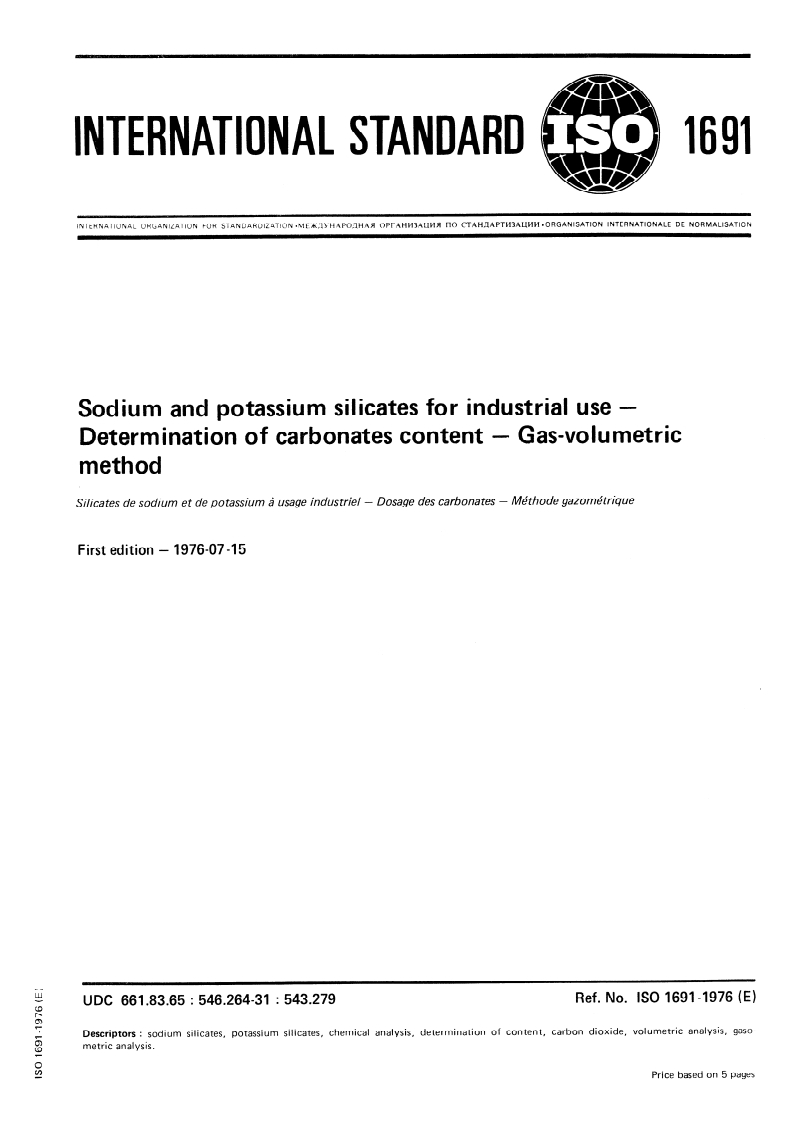
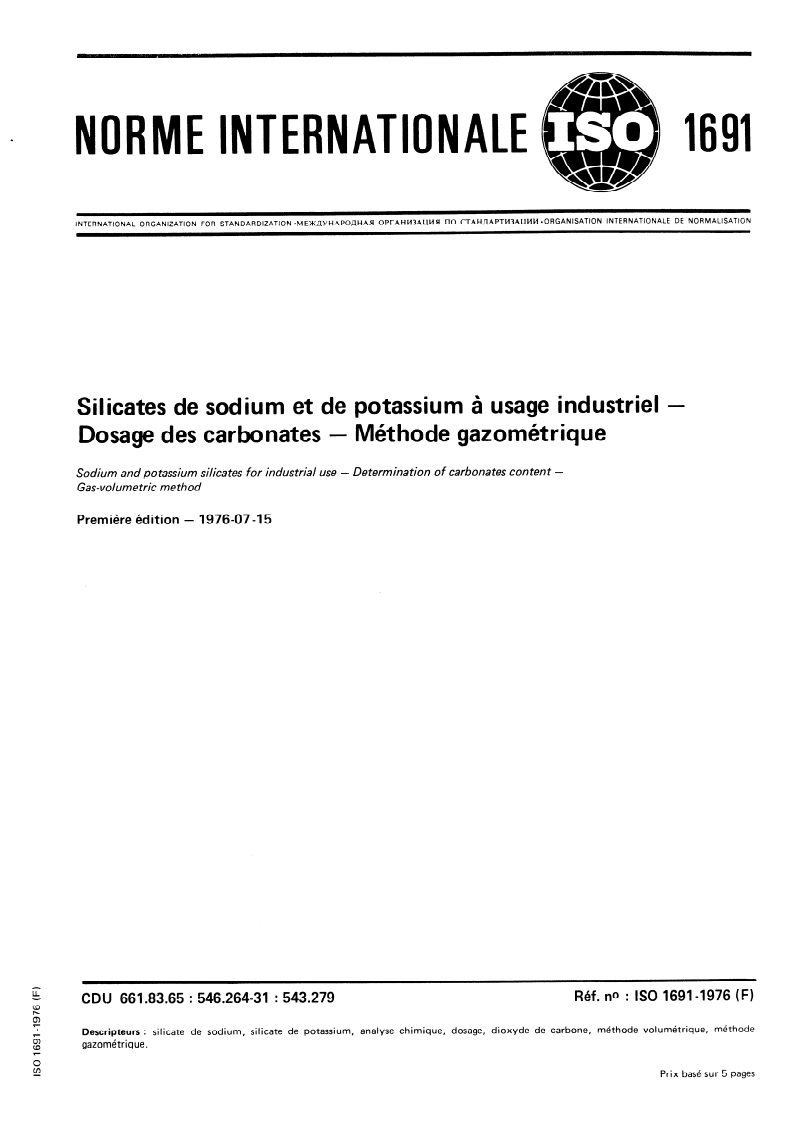
(Main)Sodium and potassium silicates for industrial use — Determination of carbonates content — Gas-volumetric method
General Information
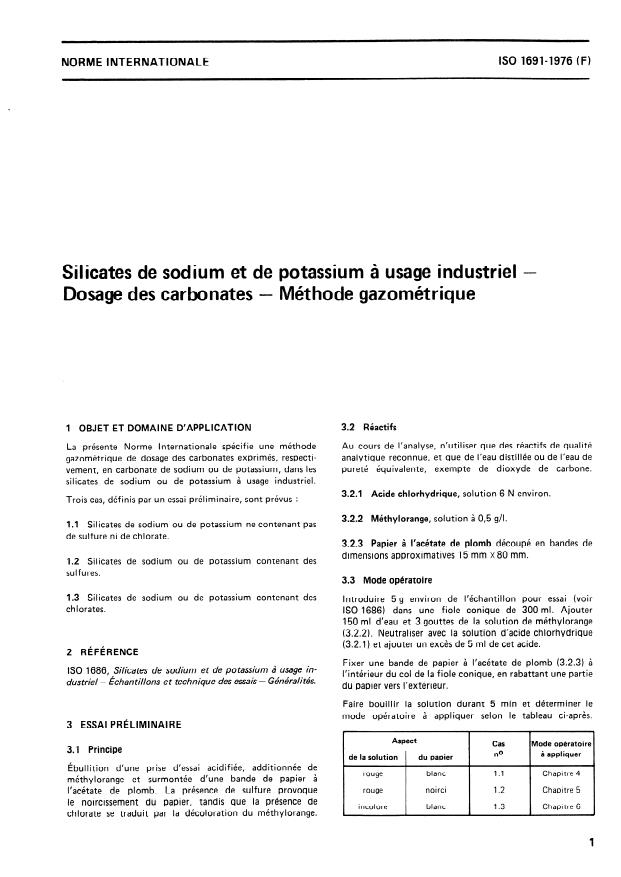
- Abstract
Three cases, defined by a preliminary test, are envisaged: silicates containing neither sulphides nor chlorates; silicates containing sulphides; silicates containing chlorates. The method based on boiling of an acidified test portion containing methyl orange and with a lead paper strip in the vapour. The presence of sulphides produces blackening of the paper and the presence of chlorates decolorizes the methyl orange. Volumetric*measurement of carbon dioxide evolved from silicates containing neither sulphides nor chlorates by reaction with a hydrochloric acid solution. The principle for the oxidation of sulphides and the reduction of chlorates are specified.
- Status
- Published
- Publication Date
- 30-Jun-1976
- Technical Committee
- ISO/TC 47 - Chemistry
- Drafting Committee
- ISO/TC 47 - Chemistry
- Current Stage
- 9093 - International Standard confirmed
- Start Date
- 20-Oct-2023
- Completion Date
- 29-Aug-2026
Buy Documents
ISO 1691:1976 - Sodium and potassium silicates for industrial use -- Determination of carbonates content -- Gas-volumetric method
ISO 1691:1976 - Sodium and potassium silicates for industrial use — Determination of carbonates content — Gas-volumetric method/1/1976
ISO 1691:1976 - Silicates de sodium et de potassium a usage industriel -- Dosage des carbonates -- Méthode gazométrique
ISO 1691:1976 - Silicates de sodium et de potassium a usage industriel -- Dosage des carbonates -- Méthode gazométrique
ISO 1691:1976 - Silicates de sodium et de potassium à usage industriel — Dosage des carbonates — Méthode gazométrique/1/1976
ISO 1691:1976 - Silicates de sodium et de potassium à usage industriel — Dosage des carbonates — Méthode gazométrique/1/1976
Overview
ISO 1691:1976 specifies an international standard method for the determination of carbonate content in sodium and potassium silicates used in industrial applications. The method is a gas-volumetric technique that measures carbon dioxide evolved when silicate samples react with hydrochloric acid. This standard addresses three specific sample cases based on the presence or absence of interfering substances such as sulphides and chlorates, ensuring accurate carbonate quantification. It provides a reliable analytical procedure useful for quality control, product specification, and research in industries utilizing sodium and potassium silicates.
Key Topics
Scope and Sample Classification
ISO 1691:1976 covers three cases distinguished by a preliminary test: silicates without sulphides or chlorates, those containing sulphides, and those containing chlorates. Proper identification of sample type is vital for applying the correct analytical procedure.Gas-Volumetric Methodology
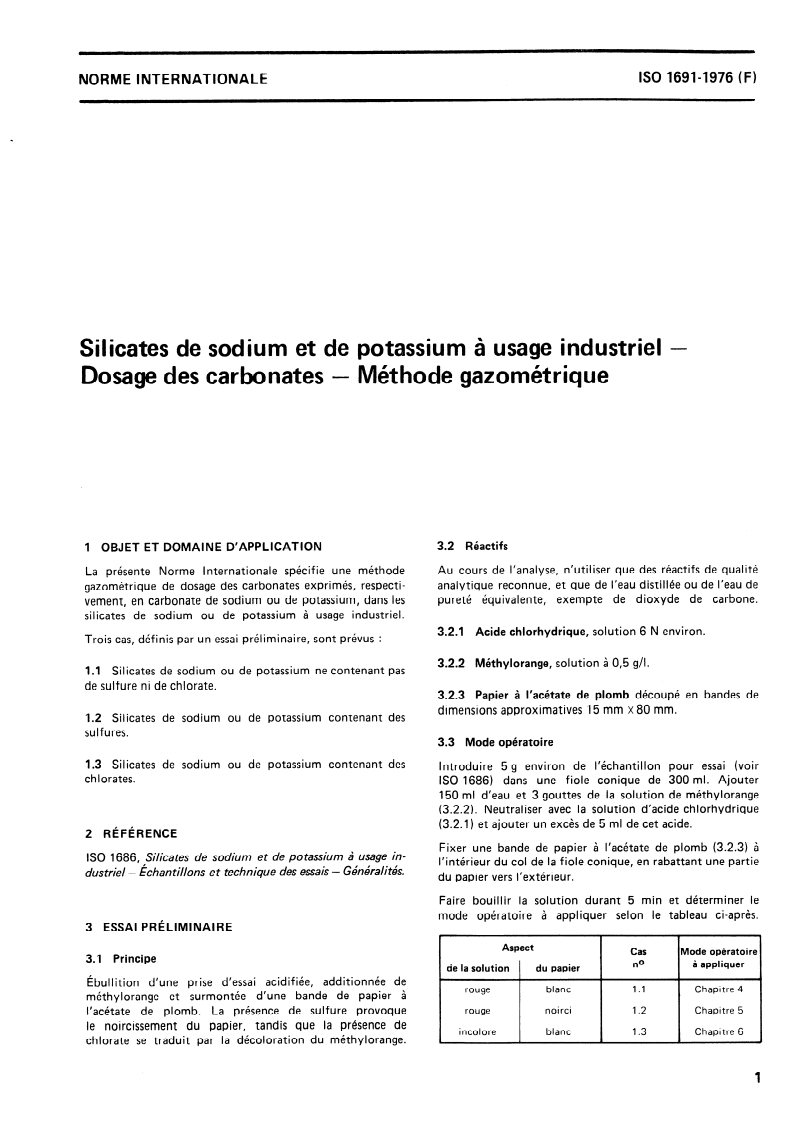
The core principle involves acidifying the silicate sample with hydrochloric acid, then boiling with methyl orange indicator and a lead acetate paper strip. This setup detects sulphides (blackening of paper) or chlorates (methyl orange decolorization). For samples without sulphides or chlorates, CO₂ volume resulting from carbonate decomposition is measured volumetrically.Reagents and Apparatus
Key reagents include hydrochloric acid (approximately 6 N), methyl orange solution, lead acetate paper, sodium hydroxide, hydrogen peroxide (for sulphide oxidation), and ferrous sulfate solution (for chlorate reduction). The analytical apparatus consists of a conical flask, gas burette, absorbers, and thermostatic water bath to capture and quantify CO₂ volume accurately.Procedural Variations Based on Sample Type
- Silicates without sulphides/chlorates: Direct volumetric measurement of evolved CO₂.
- Silicates containing sulphides: Pre-oxidation with hydrogen peroxide to avoid interference from hydrogen sulfide gas.
- Silicates containing chlorates: Reduction with ferrous sulfate to convert chlorates to chlorides, preventing chlorine interference.
Calculation and Expression of Results
Results are expressed as a percentage by mass of sodium carbonate (Na₂CO₃) or potassium carbonate (K₂CO₃) depending on the silicate type. The method demonstrates high repeatability with an accuracy of ±0.04% (m/m).
Applications
Quality Control in Chemical Manufacturing
Ensures accurate carbonate content in sodium and potassium silicates, critical for consistent product performance in glass production, detergents, adhesives, and water treatment chemicals.Industrial Process Monitoring
Helps optimize manufacturing conditions by providing reliable carbonate measurement, preventing quality deviations caused by variable carbonate levels.Research and Development
Facilitates formulation improvements and comparative studies involving silicate raw materials through precise carbonate quantification.Regulatory Compliance
Supports adherence to product and industry standards requiring certified chemical composition testing.
Related Standards
ISO 1691 complements and is supported by a series of related ISO standards focused on sodium and potassium silicates, including:
- ISO 1686: Sampling and general test techniques for sodium and potassium silicates
- ISO 1687: Density determination methods for solutions
- ISO 1688: Gravimetric determination of dry matter content
- ISO 1689: Calculation of Na₂O or K₂O ratios in silicates
- ISO 1690: Gravimetric method for silica content determination
- ISO 1692: Total alkalinity determination by titration
- ISO 2122: Dissolution methods and insoluble content determination
- ISO 2123: Determination of dynamic viscosity
- ISO 2124: Silica content by titrimetric method
- ISO 3200: Sulfate content determination by gravimetry
- ISO 3201: Iron content determination via photometry
These standards collectively ensure comprehensive analytical capability for chemical properties essential to the industrial use of sodium and potassium silicates.
Keywords: ISO 1691, carbonate determination, sodium silicate analysis, potassium silicate, gas-volumetric method, industrial silicates, sulphide interference, chlorate interference, chemical analysis, quality control, carbonate content, hydrochloric acid reaction, methyl orange indicator.
Buy Documents
ISO 1691:1976 - Sodium and potassium silicates for industrial use -- Determination of carbonates content -- Gas-volumetric method
ISO 1691:1976 - Sodium and potassium silicates for industrial use — Determination of carbonates content — Gas-volumetric method/1/1976
ISO 1691:1976 - Silicates de sodium et de potassium a usage industriel -- Dosage des carbonates -- Méthode gazométrique
ISO 1691:1976 - Silicates de sodium et de potassium a usage industriel -- Dosage des carbonates -- Méthode gazométrique
ISO 1691:1976 - Silicates de sodium et de potassium à usage industriel — Dosage des carbonates — Méthode gazométrique/1/1976
ISO 1691:1976 - Silicates de sodium et de potassium à usage industriel — Dosage des carbonates — Méthode gazométrique/1/1976
Get Certified
Connect with accredited certification bodies for this standard

ECOCERT
Organic and sustainability certification.

Eurofins Food Testing Global
Global leader in food, environment, and pharmaceutical product testing.

Intertek Bangladesh
Intertek certification and testing services in Bangladesh.
Sponsored listings
Frequently Asked Questions
ISO 1691:1976 is a standard published by the International Organization for Standardization (ISO). Its full title is "Sodium and potassium silicates for industrial use — Determination of carbonates content — Gas-volumetric method". This standard covers: Three cases, defined by a preliminary test, are envisaged: silicates containing neither sulphides nor chlorates; silicates containing sulphides; silicates containing chlorates. The method based on boiling of an acidified test portion containing methyl orange and with a lead paper strip in the vapour. The presence of sulphides produces blackening of the paper and the presence of chlorates decolorizes the methyl orange. Volumetric*measurement of carbon dioxide evolved from silicates containing neither sulphides nor chlorates by reaction with a hydrochloric acid solution. The principle for the oxidation of sulphides and the reduction of chlorates are specified.
Three cases, defined by a preliminary test, are envisaged: silicates containing neither sulphides nor chlorates; silicates containing sulphides; silicates containing chlorates. The method based on boiling of an acidified test portion containing methyl orange and with a lead paper strip in the vapour. The presence of sulphides produces blackening of the paper and the presence of chlorates decolorizes the methyl orange. Volumetric*measurement of carbon dioxide evolved from silicates containing neither sulphides nor chlorates by reaction with a hydrochloric acid solution. The principle for the oxidation of sulphides and the reduction of chlorates are specified.
ISO 1691:1976 is classified under the following ICS (International Classification for Standards) categories: 71.060.50 - Salts. The ICS classification helps identify the subject area and facilitates finding related standards.
ISO 1691:1976 is available in PDF format for immediate download after purchase. The document can be added to your cart and obtained through the secure checkout process. Digital delivery ensures instant access to the complete standard document.
Standards Content (Sample)
INTERNATIONAL STANDARD
INTERNATIONAL ORGANIZATION FOR STANDARDIZ4TION l ME;rli:lL’H4PO+~HAFI OPI-AHM3AUM5i I-IO CTAHLIAPTM3AUMM .ORGANISATION INTERNATIONALE DE NORMALISATION
Sodium and potassium silicates for industrial use -
Determination of carbonates content - Gas-volumetric
method
Silica tes de sodium et de potassium 2 usage industriel - Dosage des carbonates - Mtithode gazometrique
First edition - 1976-07-15
Ref. No. ISO 1691-1976 (E)
UDC 661.83.65 : 546.264-31 : 543.279
Chemical analysis, determination of content, carbon dioxide, volumetric analysis, gaso-
Descriptors : sodium silicates, potassium silicates,
metric analysis.
Price based on 5 pages
FQREWORD
ISO (the International Organization for Standardization) is a worldwide federation
of national Standards institutes (ISO Member Bodies). The work of developing
International Standards is carried out through ISO Technicai Committees. Every
Member Body interested in a subject for which a Technical Committee has been set
up has the right to be represented on that Committee. International organizations,
governmental and non-governmental, in liaison with ISO, also take part in the work.
Draft International Standards adopted by the Technical Committees are circulated
to the Member Bodies for approval before their acceptance as International
Standards by the ISO Council.
Prior to 1972, the results of the work of the Technical Committees were published
as ISO Recommendations; these documents are now in the process of being
transformed into International Standards. As part of this process, Technical
Committee lSO/TC47 has reviewed ISO Recommendation R 1691 and found it
technically suitable for transformation. International Standard ISO 1691 therefore
replaces ISO Recommendation R 1691-1970.
ISO Recommendation R 1691 was approved by the Member Bodies of the
following countries :
Australia Hungary Portugal
Austria India Romania
Belgium Iran South Africa, Rep. of
Brazil Israel Spain
Colombia Italy Switzerland
Czechoslovakia Japan Thailand
Egypt, Arab Rep. of Netherlands Turkey
France New Zealand United Kingdom
Germany Peru U.S.S. R.
G reece
Poland Yugoslavia
No Member Body ttxpi-essed disapproval of the Recommendation.
No Member Body disapproved the transformation of ISO/R 1691 into an
n~tif-mal
fnter Standard.
\ International Organization for Standardkation, 1976 l
Pr ,h:c3Ci in C L\n~;!:re;iai.c;
ISO 16914976 (E)
INTERNATIONAL STANDARD
Sodium and potassium silicates for industrial use -
Determination of carbonates content - Gas-volumetric
method
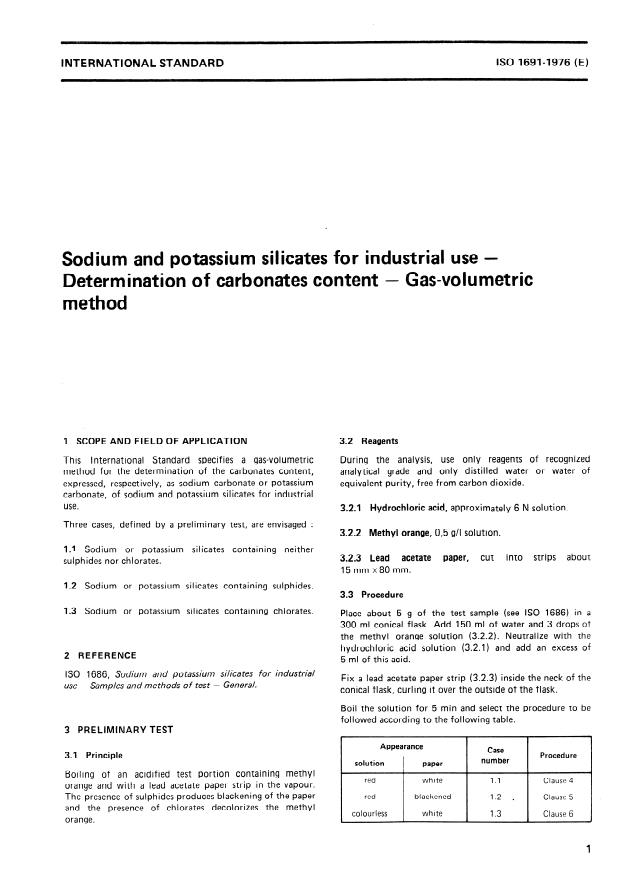
l SCOPE AND FIELD OF APPLICATION 3.2 Reagents
During the analysis, Lose only reagents of recognized
This l nternational Standard specifies a gas-volumetric
method for the determination of the carbonates content, analytical grade and only distilled water or water of
equivalent purity, free from carbon dioxide.
expressed, respectively, as sodium carbonate or potassium
carbonate, of sodium and potassium silicates for industrial
use.
3.2.1 Hydrochlorit acid, approximately 6 N Solution.
Three cases, defined by a preliminary test, are envisaged :
3.2.2 Methyl orange, 0,5 g/l Solution.
1.1 Sodium or potassium silicates containing neither
3.2.3 Lead acetate Paper, tut into Strips about
sulphides nor chlorates.
15mmx8Omm.
1.2 Sodium or potassium silicates containing sulphides.
3.3 Procedure
1.3 Sodium or potassium silicates containing chlorates.
Place about 5 g of the test Sample (see ISO 1686) in a
300 ml conical flask. Add 150 ml of water and 3 drops of
the methyl orange Solution (3.2.2). Neutralize with the
hydrochloric acid Solution (3.2.1) and add an excess of
2 REFERENCE
5 ml of this acid.
ISO 1686, Sodium and potassium silicates for industrial
Fix a lead acetate Paper Strip (3.2.3) inside the neck of the
use - Samples and methods of test - General.
conical flask, curling it over the outside of the flask.
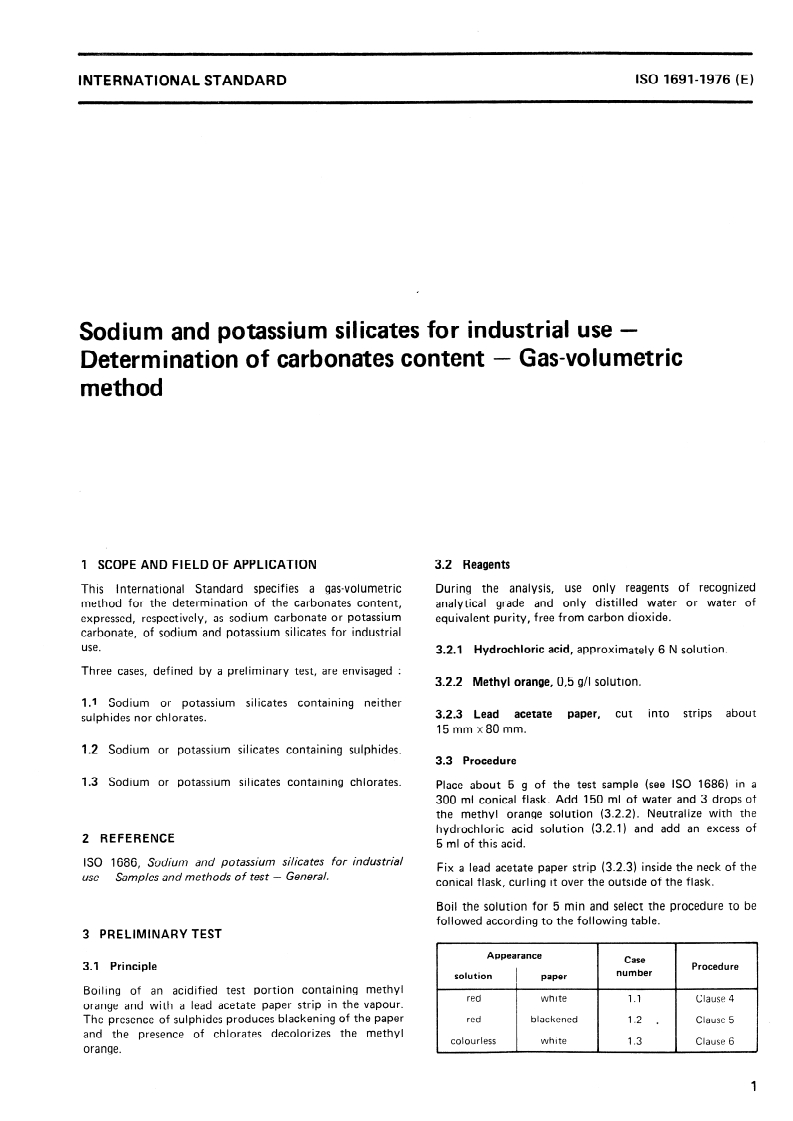
Boil the Solution for 5 min and select the procedure to be
followed according to the following table.
3 PRELOMINARY TEST
Appeatance
3.1 Principle
/ paper 1 n,mb,r 1 Procedure /
solution
Boiling of an acidified test Portion containing methyl
red white 1.1 Clause 4
orange and with a lead acetate Paper Strip in the vapour.
The presence of sulphides produces blackening of the Paper r-ed blackened 1.2 . Clause 5
and the presence of chlorates decolorizes the methyl
colourless white 1.3 Clause 6
orange.
ISO 1691-1976 (E)
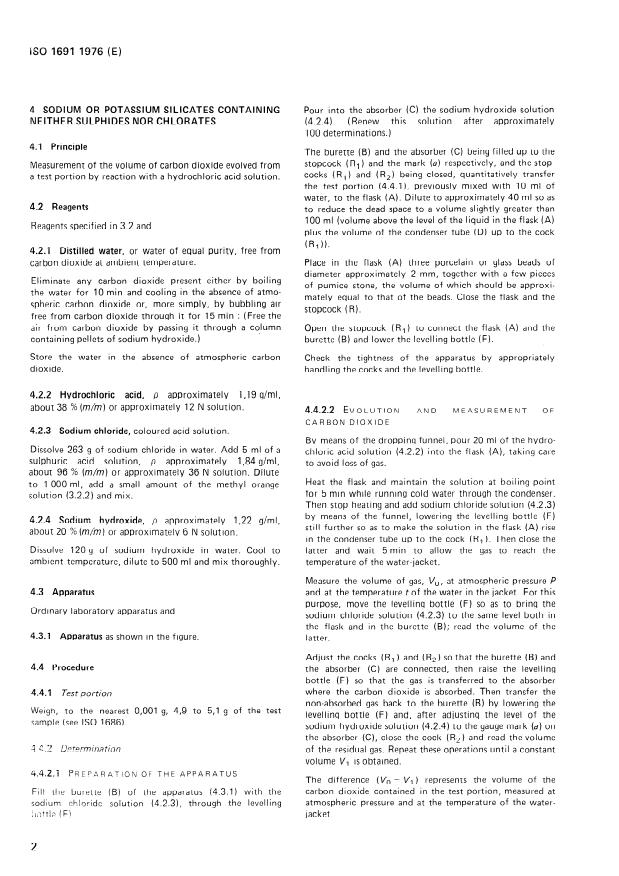
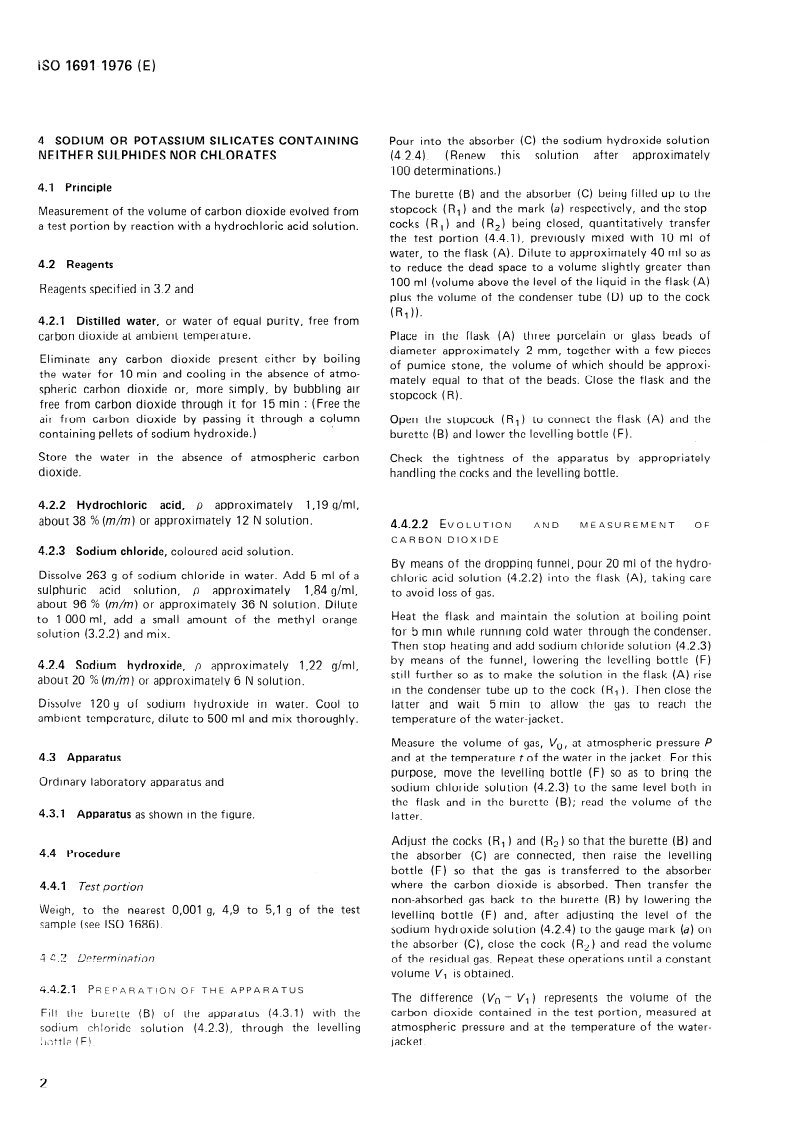
4 SODIUM OR POTASSIUM SILICATES CONTAINING Pour into the absorber (C) the sodium hydroxide Solution
NEITHER SULPHIDES NOR CHLORATES (4.2.4). (Renew this Solution after approximately
100 determinations.)
4.1 Principle
The burette (B) and the absorber (C) being filled up to the
stopcock (R, ) and the mark (a) respectively, and the stop-
Measurement of the vo lume of carbo n diox ide evolved from
cocks (R,) and (RZ) being closed, quantitatively transfer
a Pest Portion reacti on wi th a hyd roch Io Iric acid Solution.
bY
the test Portion (4.4.1), previously mixed with 10 ml of
water, to the flask (A). Dilute to approximately 40 ml so as
4.2 Reagents
to reduce the dead space to a volume slightly greater than
100 ml (volume above the level of the liquid in the flask (A)
Reagents specified in 3.2 and
plus the volume of the condenser tube (D) up to the cock
(R, 1).
4.2.1 Distilled watet-, or water of equal purity, free from
temperature.
carbon dioxide at ambient Place in the flask (A) three porcelain or glass beads of
diameter approximately 2 mm, together with a few pieces
Eliminate any carbon dioxide present either by boiling
of pumice stone, the volume of which should be approxi-
the water for 10 min and cooling in the absence of atmo-
mately equal to that of the beads. Close the flask and the
spheric carbon dioxide or, more simply, by bubbling air
stopcock (R).
free from carbon dioxide through it for 15 min : (Free the
air from carbon dioxide by passing it through a column Open the s topcock (R,) to connect the flask (A) and the
containing pellets of sodium hydroxide.) burette (B) and Iower the levelling bottle (F).
Store the water in the absence of atmospheric carbon
Check the tightness sf the apparatus by appropriately
dioxide.
handling the cocks and the levelling bottle.
4.2.2 Hydrochlorit acid, p approximately iJ9 g/ml,
about 38 % (uI/~) or approximately 12 N Solution.
MEASUREMENT
4.4.2.2 EVOLUTION AND OF
CARBON DIOXIDE
4.2.3 Sodium chloride, coloured acid Solution.
By means of the dropping funnel, pour 20 ml sf the hydro-
Dissolve 263 g of sodium chloride in water. Add 5 ml of a
chloric acid solution (4.2.2) into the flask (A), taking care
sulphuric
acid Solution, p approximately 1,84 g/ml,
to avoid loss of gas.
about 96 % (m/m) or approximately 36 N Solution. Dilute
Heat the flask and maintain the Solution at boiling Point
to 1 000 ml, add a small amount of the methyl orange
for 5 min while running cold water through the condenser.
solution (3.2.2) and mix.
Then stop heating and add sodium chloride Solution (4.2.3)
by means of the funnel, lowering the levelling bettle (F)
4.2.4 Sodium hydroxide, p approximately 1,22 g/mI,
still further so as to make the solution in the flask (A) rise
about 20 % (IW’~) or approximately 6 N solution.
in the condenser tube up to the cock (R, ). Then close the
Dissol
ve 120 g of sodium hy droxide in water. Cool to latter and wait 5 min to allow the gas to resch the
ambie nt temperature, dilute to
500 ml and mix thorough temperature of the water-jacket.
IY-
Measure the volume of gas, Vo, at atmospheric pressure P
4.3 Apparatus
and at the temperature t of the water in the jacket. For this
purpose, move the levelling bottle (F) so as to bring the
Ordinary laboratory apparatus and
sodium chloride Solution (4.2.3) to the same level both in
the flask and in the bure
...
INTERNATIONAL STANDARD
INTERNATIONAL ORGANIZATION FOR STANDARDIZ4TION l ME;rli:lL’H4PO+~HAFI OPI-AHM3AUM5i I-IO CTAHLIAPTM3AUMM .ORGANISATION INTERNATIONALE DE NORMALISATION
Sodium and potassium silicates for industrial use -
Determination of carbonates content - Gas-volumetric
method
Silica tes de sodium et de potassium 2 usage industriel - Dosage des carbonates - Mtithode gazometrique
First edition - 1976-07-15
Ref. No. ISO 1691-1976 (E)
UDC 661.83.65 : 546.264-31 : 543.279
Chemical analysis, determination of content, carbon dioxide, volumetric analysis, gaso-
Descriptors : sodium silicates, potassium silicates,
metric analysis.
Price based on 5 pages
FQREWORD
ISO (the International Organization for Standardization) is a worldwide federation
of national Standards institutes (ISO Member Bodies). The work of developing
International Standards is carried out through ISO Technicai Committees. Every
Member Body interested in a subject for which a Technical Committee has been set
up has the right to be represented on that Committee. International organizations,
governmental and non-governmental, in liaison with ISO, also take part in the work.
Draft International Standards adopted by the Technical Committees are circulated
to the Member Bodies for approval before their acceptance as International
Standards by the ISO Council.
Prior to 1972, the results of the work of the Technical Committees were published
as ISO Recommendations; these documents are now in the process of being
transformed into International Standards. As part of this process, Technical
Committee lSO/TC47 has reviewed ISO Recommendation R 1691 and found it
technically suitable for transformation. International Standard ISO 1691 therefore
replaces ISO Recommendation R 1691-1970.
ISO Recommendation R 1691 was approved by the Member Bodies of the
following countries :
Australia Hungary Portugal
Austria India Romania
Belgium Iran South Africa, Rep. of
Brazil Israel Spain
Colombia Italy Switzerland
Czechoslovakia Japan Thailand
Egypt, Arab Rep. of Netherlands Turkey
France New Zealand United Kingdom
Germany Peru U.S.S. R.
G reece
Poland Yugoslavia
No Member Body ttxpi-essed disapproval of the Recommendation.
No Member Body disapproved the transformation of ISO/R 1691 into an
n~tif-mal
fnter Standard.
\ International Organization for Standardkation, 1976 l
Pr ,h:c3Ci in C L\n~;!:re;iai.c;
ISO 16914976 (E)
INTERNATIONAL STANDARD
Sodium and potassium silicates for industrial use -
Determination of carbonates content - Gas-volumetric
method
l SCOPE AND FIELD OF APPLICATION 3.2 Reagents
During the analysis, Lose only reagents of recognized
This l nternational Standard specifies a gas-volumetric
method for the determination of the carbonates content, analytical grade and only distilled water or water of
equivalent purity, free from carbon dioxide.
expressed, respectively, as sodium carbonate or potassium
carbonate, of sodium and potassium silicates for industrial
use.
3.2.1 Hydrochlorit acid, approximately 6 N Solution.
Three cases, defined by a preliminary test, are envisaged :
3.2.2 Methyl orange, 0,5 g/l Solution.
1.1 Sodium or potassium silicates containing neither
3.2.3 Lead acetate Paper, tut into Strips about
sulphides nor chlorates.
15mmx8Omm.
1.2 Sodium or potassium silicates containing sulphides.
3.3 Procedure
1.3 Sodium or potassium silicates containing chlorates.
Place about 5 g of the test Sample (see ISO 1686) in a
300 ml conical flask. Add 150 ml of water and 3 drops of
the methyl orange Solution (3.2.2). Neutralize with the
hydrochloric acid Solution (3.2.1) and add an excess of
2 REFERENCE
5 ml of this acid.
ISO 1686, Sodium and potassium silicates for industrial
Fix a lead acetate Paper Strip (3.2.3) inside the neck of the
use - Samples and methods of test - General.
conical flask, curling it over the outside of the flask.
Boil the Solution for 5 min and select the procedure to be
followed according to the following table.
3 PRELOMINARY TEST
Appeatance
3.1 Principle
/ paper 1 n,mb,r 1 Procedure /
solution
Boiling of an acidified test Portion containing methyl
red white 1.1 Clause 4
orange and with a lead acetate Paper Strip in the vapour.
The presence of sulphides produces blackening of the Paper r-ed blackened 1.2 . Clause 5
and the presence of chlorates decolorizes the methyl
colourless white 1.3 Clause 6
orange.
ISO 1691-1976 (E)
4 SODIUM OR POTASSIUM SILICATES CONTAINING Pour into the absorber (C) the sodium hydroxide Solution
NEITHER SULPHIDES NOR CHLORATES (4.2.4). (Renew this Solution after approximately
100 determinations.)
4.1 Principle
The burette (B) and the absorber (C) being filled up to the
stopcock (R, ) and the mark (a) respectively, and the stop-
Measurement of the vo lume of carbo n diox ide evolved from
cocks (R,) and (RZ) being closed, quantitatively transfer
a Pest Portion reacti on wi th a hyd roch Io Iric acid Solution.
bY
the test Portion (4.4.1), previously mixed with 10 ml of
water, to the flask (A). Dilute to approximately 40 ml so as
4.2 Reagents
to reduce the dead space to a volume slightly greater than
100 ml (volume above the level of the liquid in the flask (A)
Reagents specified in 3.2 and
plus the volume of the condenser tube (D) up to the cock
(R, 1).
4.2.1 Distilled watet-, or water of equal purity, free from
temperature.
carbon dioxide at ambient Place in the flask (A) three porcelain or glass beads of
diameter approximately 2 mm, together with a few pieces
Eliminate any carbon dioxide present either by boiling
of pumice stone, the volume of which should be approxi-
the water for 10 min and cooling in the absence of atmo-
mately equal to that of the beads. Close the flask and the
spheric carbon dioxide or, more simply, by bubbling air
stopcock (R).
free from carbon dioxide through it for 15 min : (Free the
air from carbon dioxide by passing it through a column Open the s topcock (R,) to connect the flask (A) and the
containing pellets of sodium hydroxide.) burette (B) and Iower the levelling bottle (F).
Store the water in the absence of atmospheric carbon
Check the tightness sf the apparatus by appropriately
dioxide.
handling the cocks and the levelling bottle.
4.2.2 Hydrochlorit acid, p approximately iJ9 g/ml,
about 38 % (uI/~) or approximately 12 N Solution.
MEASUREMENT
4.4.2.2 EVOLUTION AND OF
CARBON DIOXIDE
4.2.3 Sodium chloride, coloured acid Solution.
By means of the dropping funnel, pour 20 ml sf the hydro-
Dissolve 263 g of sodium chloride in water. Add 5 ml of a
chloric acid solution (4.2.2) into the flask (A), taking care
sulphuric
acid Solution, p approximately 1,84 g/ml,
to avoid loss of gas.
about 96 % (m/m) or approximately 36 N Solution. Dilute
Heat the flask and maintain the Solution at boiling Point
to 1 000 ml, add a small amount of the methyl orange
for 5 min while running cold water through the condenser.
solution (3.2.2) and mix.
Then stop heating and add sodium chloride Solution (4.2.3)
by means of the funnel, lowering the levelling bettle (F)
4.2.4 Sodium hydroxide, p approximately 1,22 g/mI,
still further so as to make the solution in the flask (A) rise
about 20 % (IW’~) or approximately 6 N solution.
in the condenser tube up to the cock (R, ). Then close the
Dissol
ve 120 g of sodium hy droxide in water. Cool to latter and wait 5 min to allow the gas to resch the
ambie nt temperature, dilute to
500 ml and mix thorough temperature of the water-jacket.
IY-
Measure the volume of gas, Vo, at atmospheric pressure P
4.3 Apparatus
and at the temperature t of the water in the jacket. For this
purpose, move the levelling bottle (F) so as to bring the
Ordinary laboratory apparatus and
sodium chloride Solution (4.2.3) to the same level both in
the flask and in the bure
...
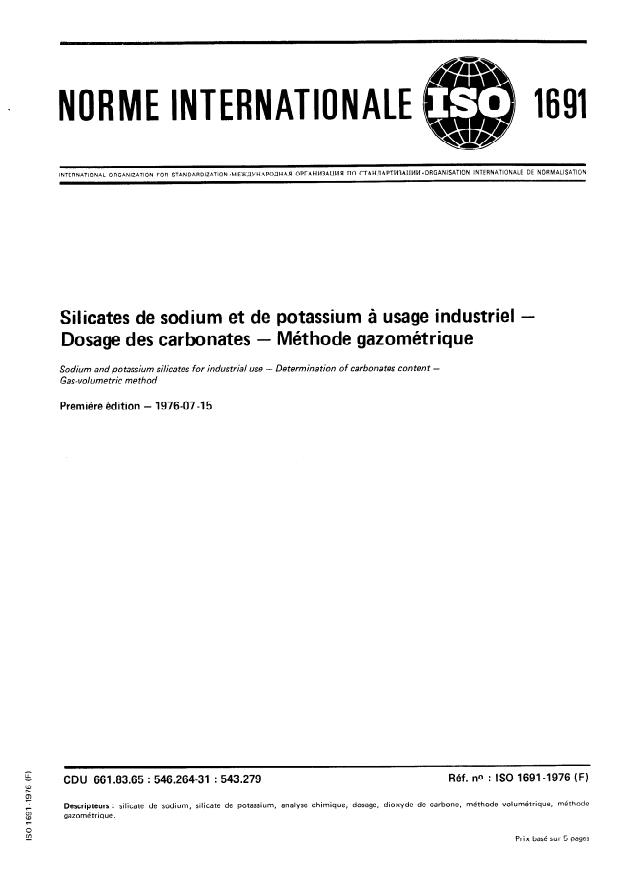
NORME INTERNATIONALE
INTERNATIONAL ORGANIZATION FOR STANDARDIZATION l MEXflJ’HAPOAHAB OPI-AHi43ALWi5l Il0 CTAHJlAPTM3ALUdM =ORGANISATION INTERNATIONALE DE NORMALISATION
Silicates de sodium et de potassium à usage industriel -
Dosage des carbonates - Méthode gazométrique
Sodium and potassium silicates for industrial use - De termina tion of carbonates content -
Gas-volume trie me thod
Première édition - 1976-07-15
ii-
-
CDU 661.83.65 : 546.264-31 : 543.279 I%!f. no : ISO 1691-1976 (F)
K
m
Descripteurs : silicate de sodium, silicate de potassium, analyse chimique, dosage, dioxyde de carbone, méthode volumétrique, méthode
gazométrique.
h
Prix basé sur 5 pages
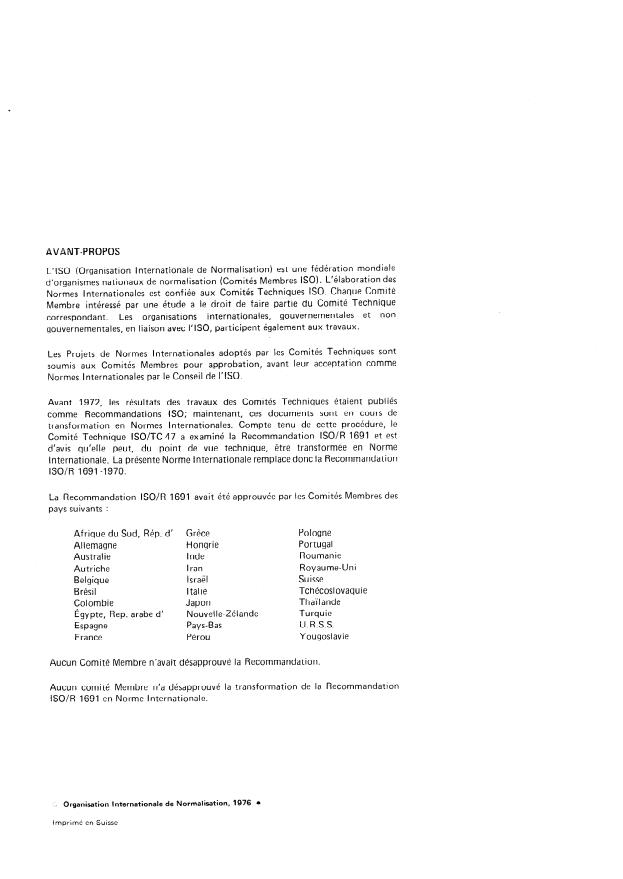
AVANT-PRBPB%
L’ISO (Organisation Internationale de Normalisation) est une fédération mondiale
d’organismes nationaux de normalisation (Comités Membres ISO). L’élaboration des
Normes Internationales est confiée aux Comités Techniques KO. Chaque Comité
Membre intéressé par une étude a le droit de faire partie du Comité Technique
correspondant. Les organisations internationales, gouvernementales et non
gouvernementales, en liaison avec I’ISO, participent également aux travaux.
Les Projets de Normes Internationales adoptés par les Comités Techniques sont
soumis aux Comités Membres pour approbation, avant leur acceptation comme
Normes Internationales par le Conseil de I’ISO.
Avant 1972, les résultats des travaux des Comités Techniques étaient publiés
comme Recommandations ISO; maintenant, ces documents sont en cours de
transformation en Normes Internationales. Compte tenu de cette procédure, le
Comité Technique ISO/TC 47 a examiné la Recommandation ISO/R 1691 et est
d’avis qu’elle peut, du point de vue technique, être transformée en Norme
Internationale. La présente Norme Internationale remplace donc la Recommandation
ISO/R 1691-1970.
La Recommandation ISO/R 1691 avait été approuvée par les Comités Membres des
pays suivants :
Afrique du Sud, Rép. d’ Grèce Pologne
Allemagne Hongrie Portugal
Australie Inde Roumanie
Autriche Iran Royaume-Uni
Belgique
Israël Suisse
Brésil Tchécoslovaquie
Italie
Colombie Japon Thaïlande
Égypte, Rep. arabe d’
Nouvelle-Zélande Turquie
Espagne Pays-Bas U. R.S.S.
France
Pérou Yougoslavie
Aucun Comité Membre n’avait désapprouvé la Recommandation.
Aucun comité Membre n’a désapprouvé la transformation de la Recommandation
ISO/R 1691 en Norme Internationale.
,’ Organisation Internationale de Normalisation, 1976 0
Imprimé en Suisse
ISO 1691-1976 (F)
NORME INTERNATIONALE
Silicates de sodium et de potassium à usage industriel -
Dosage des carbonates - Méthode gazométrique
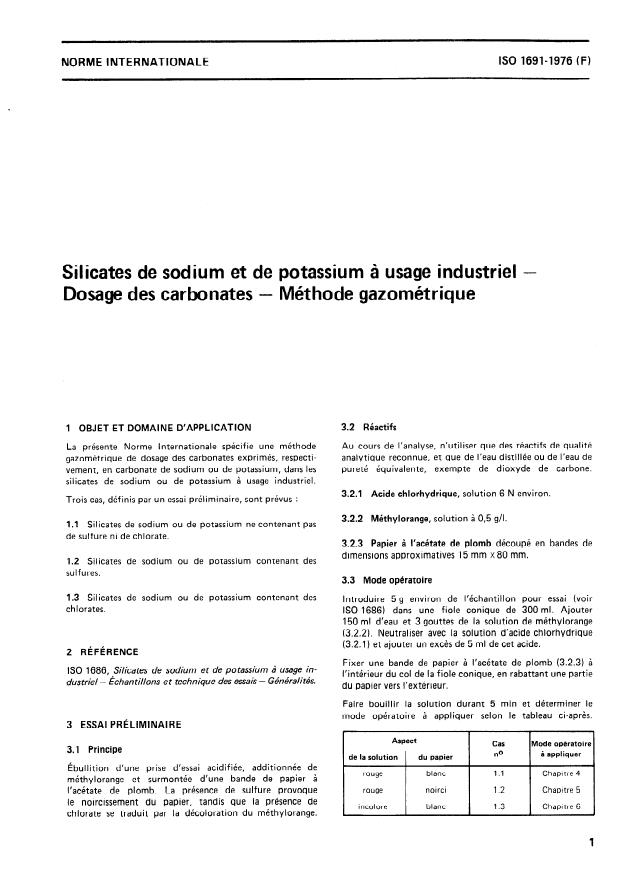
3.2 Réactifs
1 OBJET ET DOMAINE D’APPLICATION
Au cours de l’analyse, n’utiliser que des réactifs de qualité
La présente Norme Internationale spécifie une méthode
gazométrique de dosage des carbonates exprimés, respecti- analytique reconnue, et que de l’eau distillée ou de l’eau de
pureté équivalente, exempte de dioxyde de carbone.
vement, en carbonate de sodium ou de potassium, dans les
silicates de sodium ou de potassium à usage industriel.
32.1 Acide chlorhydrique, solution 6 N environ.
Trois cas, définis par un essai préliminaire, sont prévus :
3.2.2 Méthylorange, solution à 0,5 g/l
1.1 Silicates de sodium ou de potassium ne contenant pas
de sulfure ni de chlorate.
3.2.3 Papier à l’acétate de plomb découpé en bandes de
dimensions approximatives 15 mm x 80 mm.
1.2 Silicates de sodium ou de potassium contenant des
sulfures.
3.3 Mode opératoire
1.3 Silicates de sodium ou de potassium contenant des
Introduire 5 g environ de l’échantillon pour essai (voir
chlorates.
ISO 1686) dans une fiole conique de 300 ml. Ajouter
150 ml d’eau et 3 gouttes de la solution de méthylorange
(3.2.2). Neutraliser avec la solution d’acide chlorhydrique
(3.2.1) et ajouter un excès de 5 ml de cet acide.
2 RÉFÉRENCE
Fixer une bande de papier à l’acétate de plomb (3.2.3) à
ISO 1686, Silicates de sodium et de potassium à usage in-
l’intérieur du col de la fiole conique, en rabattant une partie
dustriel - Échantillons et technique des essais - Généralités.
du papier vers l’extérieur.
Faire bouillir la solution durant 5 min et déterminer le
mode opératoire à appliquer selon le tableau ci-après.
3 ESSAI PRÉLIMINAIRE
Aspect
1 CJ
3.1 Principe
de la solution
du papier
/ I
Ébullition d’une prise d’essai acidifiée, additionnée de
rouge 1.1 Chapitre 4
méthylorange et surmontée d’une bande de papier à
La présence de sulfure provoque rouge 1.2 Chapitre 5
l’acétate de plomb.
le noircissement du papier, tandis que la présence de
incolore 1.3 Chapitre 6
chlorate se traduit par la décoloration du méthylorange.
ISO 1691-1976 (F)
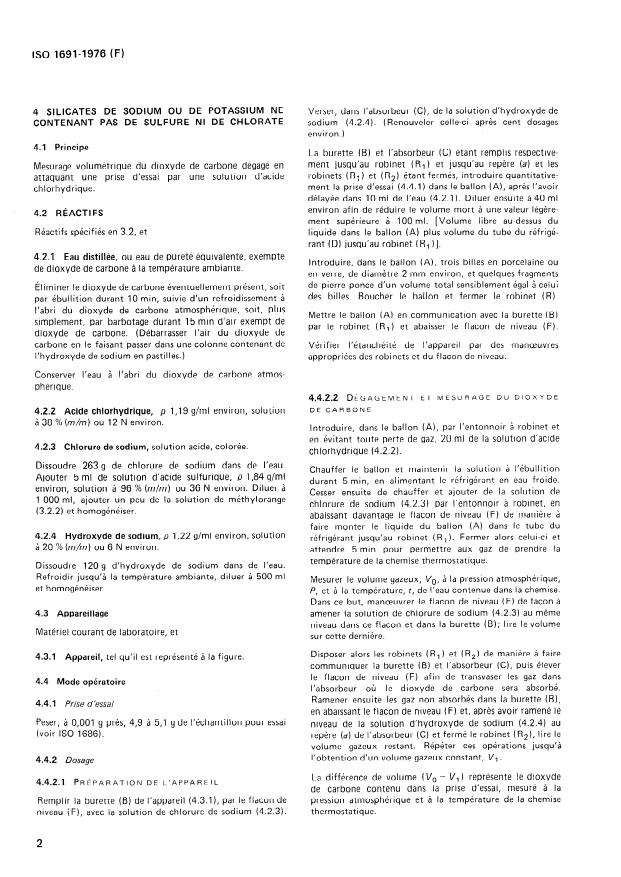
Verser, dans I’absorbeur (C), de la solution d’hydroxyde de
4 SILICATES DE SODIUM OU DE POTASSIUM NE
CONTENANT PAS DE SULFURE NI DE CHLORATE sodium (4.2.4). (Renouveler celle-ci après cent dosages
environ.)
4.1 Principe
La burette (B) et I’absorbeur (C) étant remplis respective-
ment jusqu’au robinet (R, ) et jusqu’au repère (a) et les
Mesurage volumétrique du dioxyde de carbone dégagé en
robinets (R: ) et ( R2) étant fermés, introduire quantitative-
attaquant une prise d’essai par une solution d’acide
ment la prise d’essai (4.4.1) dans le ballon (A), après l’avoir
chlorhydrique.
délayée dans 10 ml de l’eau (4.2.1). Diluer ensuite à 40 ml
environ afin de réduire le volume mort à une valeur Iégère-
4.2 RÉACTIFS
ment supérieure à 100 ml. [Volume libre au-dessus du
Réactifs spécifiés en 3.2, et
liquide dans le ballon (A) plus volume du tube du réfrigé-
rant (D) jusqu’au robinet (R, )].
4.2.1 Eau distillée, ou eau de pureté équivalente, exempte
Introduire, dans le ballon (A), trois billes en porcelaine ou
de dioxyde de carbone à la température ambiante.
en verre, de diamètre 2 mm environ, et quelques fragments
de pierre ponce d’un volume total sensiblement égal à celui
Éliminer le dioxyde de carbone éventuellement présent, soit
des billes. Boucher le ballon et fermer le robinet (R).
par ébullition durant 10 min, suivie d’un refroidissement à
l’abri du dioxyde de carbone atmosphérique, soit, plus
Mettre le ballon (A) en communication avec la burette (B)
simplement, par barbotage durant 15 min d’air exempt de
par le robinet (R,) et abaisser le flacon de niveau (F).
dioxyde de carbone. (Débarrasser l’air du dioxyde de
carbone en le faisant passer dans une colonne contenant de
Vérifier l’étanchéité de l’appareil par des mancwvres
l’hydroxyde de sodium en pastilles.)
appropriées des robinets et du flacon de niveau.
Conserver l’eau à l’abri du dioxyde de carbone atmos-
phérique.
4.4.2.2 DÉGAGEMENT ET MESURAGE DU DIOXYDE
DE CARBONE
4.2.2 Acide chlorhydrique, p 1,19 g/ml environ, solution
à 38 % (m/m) ou 12 N environ.
Introduire, dans le ballon (A), par l’entonnoir à robinet et
en évitant toute perte de gaz, 20 ml de la solution d’acide
4.2.3 Chlorure de sodium, solution acide, colorée.
chlorhydrique (4.2.2).
Dissoudre 263 g de chlorure de sodium dans de l’eau.
Chauffer le ballon et maintenir la solution à l’ébullition
Ajouter 5 ml de solution d’acide sulfurique, p 1,84 g/ml
durant 5 min, en alimentant le réfrigérant en eau froide.
environ, solution à 96 % (mlm) ou 36 N environ. Diluer à
Cesser ensuite de chauffer et ajouter de la solution de
II 000 ml, ajouter un peu de la solution de méthylorange
chlorure de sodium (4.2.3) par l’entonnoir à robinet, en
(3.2.2) et homogénéiser.
abaissant davantage le flacon de niveau (F) de manière à
faire monter le liquide du ballon (A) dans le tube du
4.2.4 Hydroxyde de sodium, p 1,22 g/ml environ, solution
réfrigérant jusqu’au robinet (R,). Fermer alors celui-ci et
à 20 % (m/m) ou 6 N environ.
attendre 5 min pour permettre aux gaz de prendre la
température de la chemise thermostatique.
Dissoudre 120 g d’hydroxyde de sodium dans de l’eau.
Refroidir jusqu’à la température ambiante, diluer à 500 ml
Mesurer le volume gazeux, Vo, à la pression atmosphérique,
.
et homogénéiser.
P, et à la température, t, de l’eau contenue dans la chemise.
Dans ce but, manœuvrer le flacon de niveau (F) de facon à
4.3 Appareillage
amener la s
...
NORME INTERNATIONALE
INTERNATIONAL ORGANIZATION FOR STANDARDIZATION l MEXflJ’HAPOAHAB OPI-AHi43ALWi5l Il0 CTAHJlAPTM3ALUdM =ORGANISATION INTERNATIONALE DE NORMALISATION
Silicates de sodium et de potassium à usage industriel -
Dosage des carbonates - Méthode gazométrique
Sodium and potassium silicates for industrial use - De termina tion of carbonates content -
Gas-volume trie me thod
Première édition - 1976-07-15
ii-
-
CDU 661.83.65 : 546.264-31 : 543.279 I%!f. no : ISO 1691-1976 (F)
K
m
Descripteurs : silicate de sodium, silicate de potassium, analyse chimique, dosage, dioxyde de carbone, méthode volumétrique, méthode
gazométrique.
h
Prix basé sur 5 pages
AVANT-PRBPB%
L’ISO (Organisation Internationale de Normalisation) est une fédération mondiale
d’organismes nationaux de normalisation (Comités Membres ISO). L’élaboration des
Normes Internationales est confiée aux Comités Techniques KO. Chaque Comité
Membre intéressé par une étude a le droit de faire partie du Comité Technique
correspondant. Les organisations internationales, gouvernementales et non
gouvernementales, en liaison avec I’ISO, participent également aux travaux.
Les Projets de Normes Internationales adoptés par les Comités Techniques sont
soumis aux Comités Membres pour approbation, avant leur acceptation comme
Normes Internationales par le Conseil de I’ISO.
Avant 1972, les résultats des travaux des Comités Techniques étaient publiés
comme Recommandations ISO; maintenant, ces documents sont en cours de
transformation en Normes Internationales. Compte tenu de cette procédure, le
Comité Technique ISO/TC 47 a examiné la Recommandation ISO/R 1691 et est
d’avis qu’elle peut, du point de vue technique, être transformée en Norme
Internationale. La présente Norme Internationale remplace donc la Recommandation
ISO/R 1691-1970.
La Recommandation ISO/R 1691 avait été approuvée par les Comités Membres des
pays suivants :
Afrique du Sud, Rép. d’ Grèce Pologne
Allemagne Hongrie Portugal
Australie Inde Roumanie
Autriche Iran Royaume-Uni
Belgique
Israël Suisse
Brésil Tchécoslovaquie
Italie
Colombie Japon Thaïlande
Égypte, Rep. arabe d’
Nouvelle-Zélande Turquie
Espagne Pays-Bas U. R.S.S.
France
Pérou Yougoslavie
Aucun Comité Membre n’avait désapprouvé la Recommandation.
Aucun comité Membre n’a désapprouvé la transformation de la Recommandation
ISO/R 1691 en Norme Internationale.
,’ Organisation Internationale de Normalisation, 1976 0
Imprimé en Suisse
ISO 1691-1976 (F)
NORME INTERNATIONALE
Silicates de sodium et de potassium à usage industriel -
Dosage des carbonates - Méthode gazométrique
3.2 Réactifs
1 OBJET ET DOMAINE D’APPLICATION
Au cours de l’analyse, n’utiliser que des réactifs de qualité
La présente Norme Internationale spécifie une méthode
gazométrique de dosage des carbonates exprimés, respecti- analytique reconnue, et que de l’eau distillée ou de l’eau de
pureté équivalente, exempte de dioxyde de carbone.
vement, en carbonate de sodium ou de potassium, dans les
silicates de sodium ou de potassium à usage industriel.
32.1 Acide chlorhydrique, solution 6 N environ.
Trois cas, définis par un essai préliminaire, sont prévus :
3.2.2 Méthylorange, solution à 0,5 g/l
1.1 Silicates de sodium ou de potassium ne contenant pas
de sulfure ni de chlorate.
3.2.3 Papier à l’acétate de plomb découpé en bandes de
dimensions approximatives 15 mm x 80 mm.
1.2 Silicates de sodium ou de potassium contenant des
sulfures.
3.3 Mode opératoire
1.3 Silicates de sodium ou de potassium contenant des
Introduire 5 g environ de l’échantillon pour essai (voir
chlorates.
ISO 1686) dans une fiole conique de 300 ml. Ajouter
150 ml d’eau et 3 gouttes de la solution de méthylorange
(3.2.2). Neutraliser avec la solution d’acide chlorhydrique
(3.2.1) et ajouter un excès de 5 ml de cet acide.
2 RÉFÉRENCE
Fixer une bande de papier à l’acétate de plomb (3.2.3) à
ISO 1686, Silicates de sodium et de potassium à usage in-
l’intérieur du col de la fiole conique, en rabattant une partie
dustriel - Échantillons et technique des essais - Généralités.
du papier vers l’extérieur.
Faire bouillir la solution durant 5 min et déterminer le
mode opératoire à appliquer selon le tableau ci-après.
3 ESSAI PRÉLIMINAIRE
Aspect
1 CJ
3.1 Principe
de la solution
du papier
/ I
Ébullition d’une prise d’essai acidifiée, additionnée de
rouge 1.1 Chapitre 4
méthylorange et surmontée d’une bande de papier à
La présence de sulfure provoque rouge 1.2 Chapitre 5
l’acétate de plomb.
le noircissement du papier, tandis que la présence de
incolore 1.3 Chapitre 6
chlorate se traduit par la décoloration du méthylorange.
ISO 1691-1976 (F)
Verser, dans I’absorbeur (C), de la solution d’hydroxyde de
4 SILICATES DE SODIUM OU DE POTASSIUM NE
CONTENANT PAS DE SULFURE NI DE CHLORATE sodium (4.2.4). (Renouveler celle-ci après cent dosages
environ.)
4.1 Principe
La burette (B) et I’absorbeur (C) étant remplis respective-
ment jusqu’au robinet (R, ) et jusqu’au repère (a) et les
Mesurage volumétrique du dioxyde de carbone dégagé en
robinets (R: ) et ( R2) étant fermés, introduire quantitative-
attaquant une prise d’essai par une solution d’acide
ment la prise d’essai (4.4.1) dans le ballon (A), après l’avoir
chlorhydrique.
délayée dans 10 ml de l’eau (4.2.1). Diluer ensuite à 40 ml
environ afin de réduire le volume mort à une valeur Iégère-
4.2 RÉACTIFS
ment supérieure à 100 ml. [Volume libre au-dessus du
Réactifs spécifiés en 3.2, et
liquide dans le ballon (A) plus volume du tube du réfrigé-
rant (D) jusqu’au robinet (R, )].
4.2.1 Eau distillée, ou eau de pureté équivalente, exempte
Introduire, dans le ballon (A), trois billes en porcelaine ou
de dioxyde de carbone à la température ambiante.
en verre, de diamètre 2 mm environ, et quelques fragments
de pierre ponce d’un volume total sensiblement égal à celui
Éliminer le dioxyde de carbone éventuellement présent, soit
des billes. Boucher le ballon et fermer le robinet (R).
par ébullition durant 10 min, suivie d’un refroidissement à
l’abri du dioxyde de carbone atmosphérique, soit, plus
Mettre le ballon (A) en communication avec la burette (B)
simplement, par barbotage durant 15 min d’air exempt de
par le robinet (R,) et abaisser le flacon de niveau (F).
dioxyde de carbone. (Débarrasser l’air du dioxyde de
carbone en le faisant passer dans une colonne contenant de
Vérifier l’étanchéité de l’appareil par des mancwvres
l’hydroxyde de sodium en pastilles.)
appropriées des robinets et du flacon de niveau.
Conserver l’eau à l’abri du dioxyde de carbone atmos-
phérique.
4.4.2.2 DÉGAGEMENT ET MESURAGE DU DIOXYDE
DE CARBONE
4.2.2 Acide chlorhydrique, p 1,19 g/ml environ, solution
à 38 % (m/m) ou 12 N environ.
Introduire, dans le ballon (A), par l’entonnoir à robinet et
en évitant toute perte de gaz, 20 ml de la solution d’acide
4.2.3 Chlorure de sodium, solution acide, colorée.
chlorhydrique (4.2.2).
Dissoudre 263 g de chlorure de sodium dans de l’eau.
Chauffer le ballon et maintenir la solution à l’ébullition
Ajouter 5 ml de solution d’acide sulfurique, p 1,84 g/ml
durant 5 min, en alimentant le réfrigérant en eau froide.
environ, solution à 96 % (mlm) ou 36 N environ. Diluer à
Cesser ensuite de chauffer et ajouter de la solution de
II 000 ml, ajouter un peu de la solution de méthylorange
chlorure de sodium (4.2.3) par l’entonnoir à robinet, en
(3.2.2) et homogénéiser.
abaissant davantage le flacon de niveau (F) de manière à
faire monter le liquide du ballon (A) dans le tube du
4.2.4 Hydroxyde de sodium, p 1,22 g/ml environ, solution
réfrigérant jusqu’au robinet (R,). Fermer alors celui-ci et
à 20 % (m/m) ou 6 N environ.
attendre 5 min pour permettre aux gaz de prendre la
température de la chemise thermostatique.
Dissoudre 120 g d’hydroxyde de sodium dans de l’eau.
Refroidir jusqu’à la température ambiante, diluer à 500 ml
Mesurer le volume gazeux, Vo, à la pression atmosphérique,
.
et homogénéiser.
P, et à la température, t, de l’eau contenue dans la chemise.
Dans ce but, manœuvrer le flacon de niveau (F) de facon à
4.3 Appareillage
amener la s
...
NORME INTERNATIONALE
INTERNATIONAL ORGANIZATION FOR STANDARDIZATION l MEXflJ’HAPOAHAB OPI-AHi43ALWi5l Il0 CTAHJlAPTM3ALUdM =ORGANISATION INTERNATIONALE DE NORMALISATION
Silicates de sodium et de potassium à usage industriel -
Dosage des carbonates - Méthode gazométrique
Sodium and potassium silicates for industrial use - De termina tion of carbonates content -
Gas-volume trie me thod
Première édition - 1976-07-15
ii-
-
CDU 661.83.65 : 546.264-31 : 543.279 I%!f. no : ISO 1691-1976 (F)
K
m
Descripteurs : silicate de sodium, silicate de potassium, analyse chimique, dosage, dioxyde de carbone, méthode volumétrique, méthode
gazométrique.
h
Prix basé sur 5 pages
AVANT-PRBPB%
L’ISO (Organisation Internationale de Normalisation) est une fédération mondiale
d’organismes nationaux de normalisation (Comités Membres ISO). L’élaboration des
Normes Internationales est confiée aux Comités Techniques KO. Chaque Comité
Membre intéressé par une étude a le droit de faire partie du Comité Technique
correspondant. Les organisations internationales, gouvernementales et non
gouvernementales, en liaison avec I’ISO, participent également aux travaux.
Les Projets de Normes Internationales adoptés par les Comités Techniques sont
soumis aux Comités Membres pour approbation, avant leur acceptation comme
Normes Internationales par le Conseil de I’ISO.
Avant 1972, les résultats des travaux des Comités Techniques étaient publiés
comme Recommandations ISO; maintenant, ces documents sont en cours de
transformation en Normes Internationales. Compte tenu de cette procédure, le
Comité Technique ISO/TC 47 a examiné la Recommandation ISO/R 1691 et est
d’avis qu’elle peut, du point de vue technique, être transformée en Norme
Internationale. La présente Norme Internationale remplace donc la Recommandation
ISO/R 1691-1970.
La Recommandation ISO/R 1691 avait été approuvée par les Comités Membres des
pays suivants :
Afrique du Sud, Rép. d’ Grèce Pologne
Allemagne Hongrie Portugal
Australie Inde Roumanie
Autriche Iran Royaume-Uni
Belgique
Israël Suisse
Brésil Tchécoslovaquie
Italie
Colombie Japon Thaïlande
Égypte, Rep. arabe d’
Nouvelle-Zélande Turquie
Espagne Pays-Bas U. R.S.S.
France
Pérou Yougoslavie
Aucun Comité Membre n’avait désapprouvé la Recommandation.
Aucun comité Membre n’a désapprouvé la transformation de la Recommandation
ISO/R 1691 en Norme Internationale.
,’ Organisation Internationale de Normalisation, 1976 0
Imprimé en Suisse
ISO 1691-1976 (F)
NORME INTERNATIONALE
Silicates de sodium et de potassium à usage industriel -
Dosage des carbonates - Méthode gazométrique
3.2 Réactifs
1 OBJET ET DOMAINE D’APPLICATION
Au cours de l’analyse, n’utiliser que des réactifs de qualité
La présente Norme Internationale spécifie une méthode
gazométrique de dosage des carbonates exprimés, respecti- analytique reconnue, et que de l’eau distillée ou de l’eau de
pureté équivalente, exempte de dioxyde de carbone.
vement, en carbonate de sodium ou de potassium, dans les
silicates de sodium ou de potassium à usage industriel.
32.1 Acide chlorhydrique, solution 6 N environ.
Trois cas, définis par un essai préliminaire, sont prévus :
3.2.2 Méthylorange, solution à 0,5 g/l
1.1 Silicates de sodium ou de potassium ne contenant pas
de sulfure ni de chlorate.
3.2.3 Papier à l’acétate de plomb découpé en bandes de
dimensions approximatives 15 mm x 80 mm.
1.2 Silicates de sodium ou de potassium contenant des
sulfures.
3.3 Mode opératoire
1.3 Silicates de sodium ou de potassium contenant des
Introduire 5 g environ de l’échantillon pour essai (voir
chlorates.
ISO 1686) dans une fiole conique de 300 ml. Ajouter
150 ml d’eau et 3 gouttes de la solution de méthylorange
(3.2.2). Neutraliser avec la solution d’acide chlorhydrique
(3.2.1) et ajouter un excès de 5 ml de cet acide.
2 RÉFÉRENCE
Fixer une bande de papier à l’acétate de plomb (3.2.3) à
ISO 1686, Silicates de sodium et de potassium à usage in-
l’intérieur du col de la fiole conique, en rabattant une partie
dustriel - Échantillons et technique des essais - Généralités.
du papier vers l’extérieur.
Faire bouillir la solution durant 5 min et déterminer le
mode opératoire à appliquer selon le tableau ci-après.
3 ESSAI PRÉLIMINAIRE
Aspect
1 CJ
3.1 Principe
de la solution
du papier
/ I
Ébullition d’une prise d’essai acidifiée, additionnée de
rouge 1.1 Chapitre 4
méthylorange et surmontée d’une bande de papier à
La présence de sulfure provoque rouge 1.2 Chapitre 5
l’acétate de plomb.
le noircissement du papier, tandis que la présence de
incolore 1.3 Chapitre 6
chlorate se traduit par la décoloration du méthylorange.
ISO 1691-1976 (F)
Verser, dans I’absorbeur (C), de la solution d’hydroxyde de
4 SILICATES DE SODIUM OU DE POTASSIUM NE
CONTENANT PAS DE SULFURE NI DE CHLORATE sodium (4.2.4). (Renouveler celle-ci après cent dosages
environ.)
4.1 Principe
La burette (B) et I’absorbeur (C) étant remplis respective-
ment jusqu’au robinet (R, ) et jusqu’au repère (a) et les
Mesurage volumétrique du dioxyde de carbone dégagé en
robinets (R: ) et ( R2) étant fermés, introduire quantitative-
attaquant une prise d’essai par une solution d’acide
ment la prise d’essai (4.4.1) dans le ballon (A), après l’avoir
chlorhydrique.
délayée dans 10 ml de l’eau (4.2.1). Diluer ensuite à 40 ml
environ afin de réduire le volume mort à une valeur Iégère-
4.2 RÉACTIFS
ment supérieure à 100 ml. [Volume libre au-dessus du
Réactifs spécifiés en 3.2, et
liquide dans le ballon (A) plus volume du tube du réfrigé-
rant (D) jusqu’au robinet (R, )].
4.2.1 Eau distillée, ou eau de pureté équivalente, exempte
Introduire, dans le ballon (A), trois billes en porcelaine ou
de dioxyde de carbone à la température ambiante.
en verre, de diamètre 2 mm environ, et quelques fragments
de pierre ponce d’un volume total sensiblement égal à celui
Éliminer le dioxyde de carbone éventuellement présent, soit
des billes. Boucher le ballon et fermer le robinet (R).
par ébullition durant 10 min, suivie d’un refroidissement à
l’abri du dioxyde de carbone atmosphérique, soit, plus
Mettre le ballon (A) en communication avec la burette (B)
simplement, par barbotage durant 15 min d’air exempt de
par le robinet (R,) et abaisser le flacon de niveau (F).
dioxyde de carbone. (Débarrasser l’air du dioxyde de
carbone en le faisant passer dans une colonne contenant de
Vérifier l’étanchéité de l’appareil par des mancwvres
l’hydroxyde de sodium en pastilles.)
appropriées des robinets et du flacon de niveau.
Conserver l’eau à l’abri du dioxyde de carbone atmos-
phérique.
4.4.2.2 DÉGAGEMENT ET MESURAGE DU DIOXYDE
DE CARBONE
4.2.2 Acide chlorhydrique, p 1,19 g/ml environ, solution
à 38 % (m/m) ou 12 N environ.
Introduire, dans le ballon (A), par l’entonnoir à robinet et
en évitant toute perte de gaz, 20 ml de la solution d’acide
4.2.3 Chlorure de sodium, solution acide, colorée.
chlorhydrique (4.2.2).
Dissoudre 263 g de chlorure de sodium dans de l’eau.
Chauffer le ballon et maintenir la solution à l’ébullition
Ajouter 5 ml de solution d’acide sulfurique, p 1,84 g/ml
durant 5 min, en alimentant le réfrigérant en eau froide.
environ, solution à 96 % (mlm) ou 36 N environ. Diluer à
Cesser ensuite de chauffer et ajouter de la solution de
II 000 ml, ajouter un peu de la solution de méthylorange
chlorure de sodium (4.2.3) par l’entonnoir à robinet, en
(3.2.2) et homogénéiser.
abaissant davantage le flacon de niveau (F) de manière à
faire monter le liquide du ballon (A) dans le tube du
4.2.4 Hydroxyde de sodium, p 1,22 g/ml environ, solution
réfrigérant jusqu’au robinet (R,). Fermer alors celui-ci et
à 20 % (m/m) ou 6 N environ.
attendre 5 min pour permettre aux gaz de prendre la
température de la chemise thermostatique.
Dissoudre 120 g d’hydroxyde de sodium dans de l’eau.
Refroidir jusqu’à la température ambiante, diluer à 500 ml
Mesurer le volume gazeux, Vo, à la pression atmosphérique,
.
et homogénéiser.
P, et à la température, t, de l’eau contenue dans la chemise.
Dans ce but, manœuvrer le flacon de niveau (F) de facon à
4.3 Appareillage
amener la s
...
NORME INTERNATIONALE
INTERNATIONAL ORGANIZATION FOR STANDARDIZATION l MEXflJ’HAPOAHAB OPI-AHi43ALWi5l Il0 CTAHJlAPTM3ALUdM =ORGANISATION INTERNATIONALE DE NORMALISATION
Silicates de sodium et de potassium à usage industriel -
Dosage des carbonates - Méthode gazométrique
Sodium and potassium silicates for industrial use - De termina tion of carbonates content -
Gas-volume trie me thod
Première édition - 1976-07-15
ii-
-
CDU 661.83.65 : 546.264-31 : 543.279 I%!f. no : ISO 1691-1976 (F)
K
m
Descripteurs : silicate de sodium, silicate de potassium, analyse chimique, dosage, dioxyde de carbone, méthode volumétrique, méthode
gazométrique.
h
Prix basé sur 5 pages
AVANT-PRBPB%
L’ISO (Organisation Internationale de Normalisation) est une fédération mondiale
d’organismes nationaux de normalisation (Comités Membres ISO). L’élaboration des
Normes Internationales est confiée aux Comités Techniques KO. Chaque Comité
Membre intéressé par une étude a le droit de faire partie du Comité Technique
correspondant. Les organisations internationales, gouvernementales et non
gouvernementales, en liaison avec I’ISO, participent également aux travaux.
Les Projets de Normes Internationales adoptés par les Comités Techniques sont
soumis aux Comités Membres pour approbation, avant leur acceptation comme
Normes Internationales par le Conseil de I’ISO.
Avant 1972, les résultats des travaux des Comités Techniques étaient publiés
comme Recommandations ISO; maintenant, ces documents sont en cours de
transformation en Normes Internationales. Compte tenu de cette procédure, le
Comité Technique ISO/TC 47 a examiné la Recommandation ISO/R 1691 et est
d’avis qu’elle peut, du point de vue technique, être transformée en Norme
Internationale. La présente Norme Internationale remplace donc la Recommandation
ISO/R 1691-1970.
La Recommandation ISO/R 1691 avait été approuvée par les Comités Membres des
pays suivants :
Afrique du Sud, Rép. d’ Grèce Pologne
Allemagne Hongrie Portugal
Australie Inde Roumanie
Autriche Iran Royaume-Uni
Belgique
Israël Suisse
Brésil Tchécoslovaquie
Italie
Colombie Japon Thaïlande
Égypte, Rep. arabe d’
Nouvelle-Zélande Turquie
Espagne Pays-Bas U. R.S.S.
France
Pérou Yougoslavie
Aucun Comité Membre n’avait désapprouvé la Recommandation.
Aucun comité Membre n’a désapprouvé la transformation de la Recommandation
ISO/R 1691 en Norme Internationale.
,’ Organisation Internationale de Normalisation, 1976 0
Imprimé en Suisse
ISO 1691-1976 (F)
NORME INTERNATIONALE
Silicates de sodium et de potassium à usage industriel -
Dosage des carbonates - Méthode gazométrique
3.2 Réactifs
1 OBJET ET DOMAINE D’APPLICATION
Au cours de l’analyse, n’utiliser que des réactifs de qualité
La présente Norme Internationale spécifie une méthode
gazométrique de dosage des carbonates exprimés, respecti- analytique reconnue, et que de l’eau distillée ou de l’eau de
pureté équivalente, exempte de dioxyde de carbone.
vement, en carbonate de sodium ou de potassium, dans les
silicates de sodium ou de potassium à usage industriel.
32.1 Acide chlorhydrique, solution 6 N environ.
Trois cas, définis par un essai préliminaire, sont prévus :
3.2.2 Méthylorange, solution à 0,5 g/l
1.1 Silicates de sodium ou de potassium ne contenant pas
de sulfure ni de chlorate.
3.2.3 Papier à l’acétate de plomb découpé en bandes de
dimensions approximatives 15 mm x 80 mm.
1.2 Silicates de sodium ou de potassium contenant des
sulfures.
3.3 Mode opératoire
1.3 Silicates de sodium ou de potassium contenant des
Introduire 5 g environ de l’échantillon pour essai (voir
chlorates.
ISO 1686) dans une fiole conique de 300 ml. Ajouter
150 ml d’eau et 3 gouttes de la solution de méthylorange
(3.2.2). Neutraliser avec la solution d’acide chlorhydrique
(3.2.1) et ajouter un excès de 5 ml de cet acide.
2 RÉFÉRENCE
Fixer une bande de papier à l’acétate de plomb (3.2.3) à
ISO 1686, Silicates de sodium et de potassium à usage in-
l’intérieur du col de la fiole conique, en rabattant une partie
dustriel - Échantillons et technique des essais - Généralités.
du papier vers l’extérieur.
Faire bouillir la solution durant 5 min et déterminer le
mode opératoire à appliquer selon le tableau ci-après.
3 ESSAI PRÉLIMINAIRE
Aspect
1 CJ
3.1 Principe
de la solution
du papier
/ I
Ébullition d’une prise d’essai acidifiée, additionnée de
rouge 1.1 Chapitre 4
méthylorange et surmontée d’une bande de papier à
La présence de sulfure provoque rouge 1.2 Chapitre 5
l’acétate de plomb.
le noircissement du papier, tandis que la présence de
incolore 1.3 Chapitre 6
chlorate se traduit par la décoloration du méthylorange.
ISO 1691-1976 (F)
Verser, dans I’absorbeur (C), de la solution d’hydroxyde de
4 SILICATES DE SODIUM OU DE POTASSIUM NE
CONTENANT PAS DE SULFURE NI DE CHLORATE sodium (4.2.4). (Renouveler celle-ci après cent dosages
environ.)
4.1 Principe
La burette (B) et I’absorbeur (C) étant remplis respective-
ment jusqu’au robinet (R, ) et jusqu’au repère (a) et les
Mesurage volumétrique du dioxyde de carbone dégagé en
robinets (R: ) et ( R2) étant fermés, introduire quantitative-
attaquant une prise d’essai par une solution d’acide
ment la prise d’essai (4.4.1) dans le ballon (A), après l’avoir
chlorhydrique.
délayée dans 10 ml de l’eau (4.2.1). Diluer ensuite à 40 ml
environ afin de réduire le volume mort à une valeur Iégère-
4.2 RÉACTIFS
ment supérieure à 100 ml. [Volume libre au-dessus du
Réactifs spécifiés en 3.2, et
liquide dans le ballon (A) plus volume du tube du réfrigé-
rant (D) jusqu’au robinet (R, )].
4.2.1 Eau distillée, ou eau de pureté équivalente, exempte
Introduire, dans le ballon (A), trois billes en porcelaine ou
de dioxyde de carbone à la température ambiante.
en verre, de diamètre 2 mm environ, et quelques fragments
de pierre ponce d’un volume total sensiblement égal à celui
Éliminer le dioxyde de carbone éventuellement présent, soit
des billes. Boucher le ballon et fermer le robinet (R).
par ébullition durant 10 min, suivie d’un refroidissement à
l’abri du dioxyde de carbone atmosphérique, soit, plus
Mettre le ballon (A) en communication avec la burette (B)
simplement, par barbotage durant 15 min d’air exempt de
par le robinet (R,) et abaisser le flacon de niveau (F).
dioxyde de carbone. (Débarrasser l’air du dioxyde de
carbone en le faisant passer dans une colonne contenant de
Vérifier l’étanchéité de l’appareil par des mancwvres
l’hydroxyde de sodium en pastilles.)
appropriées des robinets et du flacon de niveau.
Conserver l’eau à l’abri du dioxyde de carbone atmos-
phérique.
4.4.2.2 DÉGAGEMENT ET MESURAGE DU DIOXYDE
DE CARBONE
4.2.2 Acide chlorhydrique, p 1,19 g/ml environ, solution
à 38 % (m/m) ou 12 N environ.
Introduire, dans le ballon (A), par l’entonnoir à robinet et
en évitant toute perte de gaz, 20 ml de la solution d’acide
4.2.3 Chlorure de sodium, solution acide, colorée.
chlorhydrique (4.2.2).
Dissoudre 263 g de chlorure de sodium dans de l’eau.
Chauffer le ballon et maintenir la solution à l’ébullition
Ajouter 5 ml de solution d’acide sulfurique, p 1,84 g/ml
durant 5 min, en alimentant le réfrigérant en eau froide.
environ, solution à 96 % (mlm) ou 36 N environ. Diluer à
Cesser ensuite de chauffer et ajouter de la solution de
II 000 ml, ajouter un peu de la solution de méthylorange
chlorure de sodium (4.2.3) par l’entonnoir à robinet, en
(3.2.2) et homogénéiser.
abaissant davantage le flacon de niveau (F) de manière à
faire monter le liquide du ballon (A) dans le tube du
4.2.4 Hydroxyde de sodium, p 1,22 g/ml environ, solution
réfrigérant jusqu’au robinet (R,). Fermer alors celui-ci et
à 20 % (m/m) ou 6 N environ.
attendre 5 min pour permettre aux gaz de prendre la
température de la chemise thermostatique.
Dissoudre 120 g d’hydroxyde de sodium dans de l’eau.
Refroidir jusqu’à la température ambiante, diluer à 500 ml
Mesurer le volume gazeux, Vo, à la pression atmosphérique,
.
et homogénéiser.
P, et à la température, t, de l’eau contenue dans la chemise.
Dans ce but, manœuvrer le flacon de niveau (F) de facon à
4.3 Appareillage
amener la s
...