

ISO/IEC 13170:2009
(Main)Information technology — 120 mm (8,54 Gbytes per side) and 80 mm (2,66 Gbytes per side) DVD re-recordable disk for dual layer (DVD-RW for DL)
General Information
- Abstract
ISO/IEC 13170:2010 specifies the mechanical, physical and optical characteristics of a 120 mm and an 80 mm dual layer DVD re-recordable disk to enable the interchange of such disks. It specifies the quality of the embossed, unrecorded and the recorded signals, the format of the data, the format of the information zone, the format of the unrecorded zone, and the recording method, thereby allowing for information interchange by means of such disks. This disk is identified as a DVD re-recordable disk for dual layer (DVD-RW for DL). ISO/IEC 13170:2010 specifies: 120 mm and 80 mm nominal diameter disks that may be either single or double sided; the conditions for conformance; the environments in which the disk is to be operated and stored; the mechanical and physical characteristics of the disk, so as to provide mechanical interchange between data processing systems; the format of the embossed information on an unrecorded disk, including the physical disposition of the tracks and sectors, the error correcting codes and the coding method used; the format of the data and the recorded information on the disk, including the physical disposition of the tracks and sectors, the error correcting codes and the coding method used; the characteristics of the signals from embossed and unrecorded areas on the disk, enabling data processing systems to read the embossed information and to write to the disks; the characteristics of the signals recorded on the disk, enabling data processing systems to read the data from the disk. ISO/IEC 13170:2010 provides for interchange of disks between disk drives. Together with an International Standard for volume and file structure, it provides for full data interchange between data processing systems.
- Status
- Published
- Publication Date
- 03-Nov-2009
- Current Stage
- 9093 - International Standard confirmed
- Start Date
- 21-Aug-2020
- Completion Date
- 29-Aug-2026



Overview
ISO/IEC 13170:2009 specifies the mechanical, physical and optical characteristics of 120 mm (8.54 Gbytes per side) and 80 mm (2.66 Gbytes per side) dual-layer re‑recordable DVDs - identified as DVD-RW for DL. The standard defines disk formats and recording methods to enable reliable interchange of disks between drives and data processing systems, supporting single- or double-sided media and full data interchange when used together with a companion standard for volume and file structure.
Key topics and technical requirements
- Disk types and capacities: Nominal 120 mm and 80 mm diameters, dual-layer re‑recordable, single- or double‑sided.
- Mechanical and dimensional characteristics: Overall dimensions, clamping zone, runout, mass, moment of inertia and tolerance requirements to ensure mechanical interchange.
- Optical parameters: Substrate thickness, refractive index, birefringence, reflectivity (recorded and unrecorded), and angular deviation limits.
- Track and data format: Physical disposition of tracks and sectors, channel bit length, embossed information format and error‑correcting codes.
- Signal characteristics and quality: Specifications for embossed, unrecorded and recorded signals - high-frequency amplitudes, jitter, signal asymmetry, cross-track signals and defect tolerance.
- Servo and addressing signals: Radial/tangential push‑pull, differential phase tracking, groove wobble, Land Pre‑Pit and addressing mechanisms used for layer and sector addressing.
- Recording and test methods: Defined write strategies for Layer 0 and Layer 1, measurement conditions, and reference measurement devices (Pick‑Up Head and normalized servo transfer functions).
- Environmental and safety: Conditions for testing, operating, storage and transportation; conformance and flammability/safety considerations for optical media.
Applications and who uses it
ISO/IEC 13170 is practical for:
- Optical media manufacturers ensuring disk production meets mechanical and optical interchangeability.
- Optical drive and pick‑up head designers implementing servo and read/write electronics compatible with DVD‑RW DL media.
- Test and QA laboratories performing signal quality, jitter and reflectivity testing to verify conformance.
- System integrators, data archivists and IT procurement specifying durable, interoperable media for long‑term storage and content distribution.
- Standards bodies and compliance officers referencing a formal specification for optical-media interoperability.
Related standards
- Companion standards that define volume and file structure are required to achieve full data interchange between systems when using ISO/IEC 13170 media.
Keywords: ISO/IEC 13170, DVD‑RW for DL, dual layer DVD re‑recordable, 120 mm DVD, 80 mm DVD, optical media standard, disk interchange, track geometry, signal quality.
Get Certified
Connect with accredited certification bodies for this standard

BSI Group
BSI (British Standards Institution) is the business standards company that helps organizations make excellence a habit.

NYCE
Mexican standards and certification body.
Sponsored listings
Frequently Asked Questions
ISO/IEC 13170:2009 is a standard published by the International Organization for Standardization (ISO). Its full title is "Information technology — 120 mm (8,54 Gbytes per side) and 80 mm (2,66 Gbytes per side) DVD re-recordable disk for dual layer (DVD-RW for DL)". This standard covers: ISO/IEC 13170:2010 specifies the mechanical, physical and optical characteristics of a 120 mm and an 80 mm dual layer DVD re-recordable disk to enable the interchange of such disks. It specifies the quality of the embossed, unrecorded and the recorded signals, the format of the data, the format of the information zone, the format of the unrecorded zone, and the recording method, thereby allowing for information interchange by means of such disks. This disk is identified as a DVD re-recordable disk for dual layer (DVD-RW for DL). ISO/IEC 13170:2010 specifies: 120 mm and 80 mm nominal diameter disks that may be either single or double sided; the conditions for conformance; the environments in which the disk is to be operated and stored; the mechanical and physical characteristics of the disk, so as to provide mechanical interchange between data processing systems; the format of the embossed information on an unrecorded disk, including the physical disposition of the tracks and sectors, the error correcting codes and the coding method used; the format of the data and the recorded information on the disk, including the physical disposition of the tracks and sectors, the error correcting codes and the coding method used; the characteristics of the signals from embossed and unrecorded areas on the disk, enabling data processing systems to read the embossed information and to write to the disks; the characteristics of the signals recorded on the disk, enabling data processing systems to read the data from the disk. ISO/IEC 13170:2010 provides for interchange of disks between disk drives. Together with an International Standard for volume and file structure, it provides for full data interchange between data processing systems.
ISO/IEC 13170:2010 specifies the mechanical, physical and optical characteristics of a 120 mm and an 80 mm dual layer DVD re-recordable disk to enable the interchange of such disks. It specifies the quality of the embossed, unrecorded and the recorded signals, the format of the data, the format of the information zone, the format of the unrecorded zone, and the recording method, thereby allowing for information interchange by means of such disks. This disk is identified as a DVD re-recordable disk for dual layer (DVD-RW for DL). ISO/IEC 13170:2010 specifies: 120 mm and 80 mm nominal diameter disks that may be either single or double sided; the conditions for conformance; the environments in which the disk is to be operated and stored; the mechanical and physical characteristics of the disk, so as to provide mechanical interchange between data processing systems; the format of the embossed information on an unrecorded disk, including the physical disposition of the tracks and sectors, the error correcting codes and the coding method used; the format of the data and the recorded information on the disk, including the physical disposition of the tracks and sectors, the error correcting codes and the coding method used; the characteristics of the signals from embossed and unrecorded areas on the disk, enabling data processing systems to read the embossed information and to write to the disks; the characteristics of the signals recorded on the disk, enabling data processing systems to read the data from the disk. ISO/IEC 13170:2010 provides for interchange of disks between disk drives. Together with an International Standard for volume and file structure, it provides for full data interchange between data processing systems.
ISO/IEC 13170:2009 is classified under the following ICS (International Classification for Standards) categories: 35.220.30 - Optical storage devices. The ICS classification helps identify the subject area and facilitates finding related standards.
ISO/IEC 13170:2009 is available in PDF format for immediate download after purchase. The document can be added to your cart and obtained through the secure checkout process. Digital delivery ensures instant access to the complete standard document.
Standards Content (Sample)
INTERNATIONAL ISO/IEC
STANDARD 13170
First edition
2009-11-01
Information technology — 120 mm
(8,54 Gbytes per side) and 80 mm
(2,66 Gbytes per side) DVD re-recordable
disk for dual layer (DVD-RW for DL)
Technologies de l'information — Disque DVD réenregistrable de
120 mm (8,54 Go par face) et 80 mm (2,66 Go par face) pour double
couche (DVD-RW pour DL)
Reference number
©
ISO/IEC 2009
PDF disclaimer
This PDF file may contain embedded typefaces. In accordance with Adobe's licensing policy, this file may be printed or viewed but
shall not be edited unless the typefaces which are embedded are licensed to and installed on the computer performing the editing. In
downloading this file, parties accept therein the responsibility of not infringing Adobe's licensing policy. The ISO Central Secretariat
accepts no liability in this area.
Adobe is a trademark of Adobe Systems Incorporated.
Details of the software products used to create this PDF file can be found in the General Info relative to the file; the PDF-creation
parameters were optimized for printing. Every care has been taken to ensure that the file is suitable for use by ISO member bodies. In
the unlikely event that a problem relating to it is found, please inform the Central Secretariat at the address given below.
© ISO/IEC 2009
All rights reserved. Unless otherwise specified, no part of this publication may be reproduced or utilized in any form or by any means,
electronic or mechanical, including photocopying and microfilm, without permission in writing from either ISO at the address below or
ISO's member body in the country of the requester.
ISO copyright office
Case postale 56 • CH-1211 Geneva 20
Tel. + 41 22 749 01 11
Fax + 41 22 749 09 47
E-mail copyright@iso.org
Web www.iso.org
Published in Switzerland
ii © ISO/IEC 2009 – All rights reserved
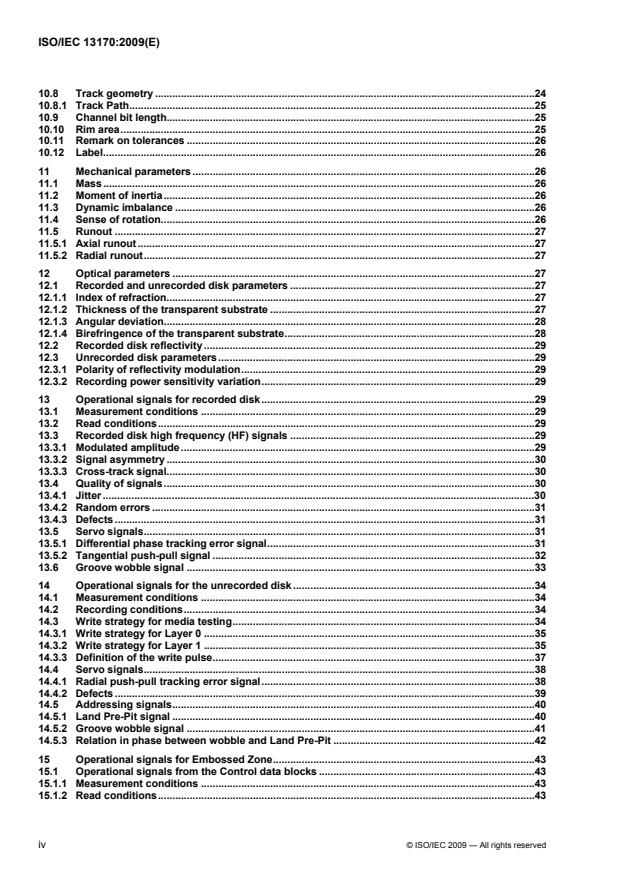
Contents Page
Foreword . vii
Introduction . viii
1 Scope . 1
2 Conformance . 1
2.1 Optical Disk . 1
2.2 Generating system . 2
2.3 Receiving system . 2
3 Normative references . 2
4 Terms and definitions . 2
5 Conventions and notations . 5
5.1 Representation of numbers . 5
5.2 Names . 6
6 Acronyms . 6
7 General description of a disk . 7
8 General requirement . 8
8.1 Environments . 8
8.1.1 Test environment . 8
8.1.2 Operating environment . 8
8.1.3 Storage environment . 9
8.1.4 Transportation . 9
8.2 Safety requirements . 9
8.3 Flammability . 10
9 Reference measurement devices . 10
9.1 Pick-Up Head (PUH) . 10
9.1.1 PUH for measuring recorded disks . 10
9.1.2 PUH for measuring unrecorded disks . 12
9.2 Measurement conditions . 13
9.2.1 Recorded and unrecorded disk . 13
9.2.2 Recorded disk . 13
9.2.3 Unrecorded disk . 13
9.3 Normalized servo transfer function . 14
9.4 Reference servo for axial tracking . 14
9.4.1 Recorded disk . 14
9.4.2 Unrecorded disk . 16
9.5 Reference servo for radial tracking . 17
9.5.1 Recorded disk . 17
9.5.2 Unrecorded disk . 18
10 Dimensional characteristics . 19
10.1 Overall dimensions . 21
10.2 First transition area . 21
10.3 Second transition area . 22
10.4 Clamping Zone . 22
10.5 Third transition area . 22
10.6 R-Information Zone . 23
10.6.1 Sub-divisions of the R-Information Zone . 23
10.7 Information Zone . 23
10.7.1 Sub-divisions of the Information zone . 23
© ISO/IEC 2009 — All rights reserved iii
10.8 Track geometry .24
10.8.1 Track Path .25
10.9 Channel bit length.25
10.10 Rim area .25
10.11 Remark on tolerances .26
10.12 Label .26
11 Mechanical parameters .26
11.1 Mass .26
11.2 Moment of inertia .26
11.3 Dynamic imbalance .26
11.4 Sense of rotation .26
11.5 Runout .27
11.5.1 Axial runout .27
11.5.2 Radial runout .27
12 Optical parameters .27
12.1 Recorded and unrecorded disk parameters .27
12.1.1 Index of refraction.27
12.1.2 Thickness of the transparent substrate .27
12.1.3 Angular deviation .28
12.1.4 Birefringence of the transparent substrate .28
12.2 Recorded disk reflectivity .29
12.3 Unrecorded disk parameters .29
12.3.1 Polarity of reflectivity modulation .29
12.3.2 Recording power sensitivity variation .29
13 Operational signals for recorded disk .29
13.1 Measurement conditions .29
13.2 Read conditions .29
13.3 Recorded disk high frequency (HF) signals .29
13.3.1 Modulated amplitude .29
13.3.2 Signal asymmetry .30
13.3.3 Cross-track signal.30
13.4 Quality of signals .30
13.4.1 Jitter .30
13.4.2 Random errors .31
13.4.3 Defects .31
13.5 Servo signals .31
13.5.1 Differential phase tracking error signal .31
13.5.2 Tangential push-pull signal .32
13.6 Groove wobble signal .33
14 Operational signals for the unrecorded disk .34
14.1 Measurement conditions .34
14.2 Recording conditions .34
14.3 Write strategy for media testing .34
14.3.1 Write strategy for Layer 0 .35
14.3.2 Write strategy for Layer 1 .35
14.3.3 Definition of the write pulse .37
14.4 Servo signals .38
14.4.1 Radial push-pull tracking error signal .38
14.4.2 Defects .39
14.5 Addressing signals .40
14.5.1 Land Pre-Pit signal .40
14.5.2 Groove wobble signal .41
14.5.3 Relation in phase between wobble and Land Pre-Pit .42
15 Operational signals for Embossed Zone .43
15.1 Operational signals from the Control data blocks .43
15.1.1 Measurement conditions .43
15.1.2 Read conditions .43
iv © ISO/IEC 2009 — All rights reserved
15.1.3 High frequency (HF) signals . 43
15.1.4 Quality of signals . 43
15.1.5 Servo signals . 43
15.1.6 Groove wobble signal . 44
15.2 Operational signals from the Servo Blocks . 44
15.2.1 Measurement conditions . 45
15.2.2 Read conditions . 45
15.2.3 Servo signals . 45
15.2.4 Addressing signals . 45
16 General . 46
17 Data Frames . 46
17.1 Identification Data (ID) . 47
17.2 ID Error Detection Code . 48
17.3 RSV . 48
17.4 Error Detection Code . 48
18 Scrambled Frames . 49
19 ECC Block configuration . 50
20 Recording Frames . 51
21 Modulation . 52
22 Physical Sectors . 53
23 Suppress control of the d.c. component . 54
24 Linking scheme . 55
24.1 Structure of linking . 55
24.2 2K-Link and 32K-Link . 56
24.3 Lossless-Link . 56
25 General description of the Information Zone . 58
25.1 Layout of the Information Zone . 58
25.2 Physical Sector numbering . 59
26 Lead-in Zone, Middle Zone and Lead-out Zone . 60
26.1 Lead-in Zone . 60
26.1.1 Initial Zone . 61
26.1.2 Buffer Zone 0 . 61
26.1.3 RW-Physical Format Information Zone . 61
26.1.4 Reference Code Zone . 65
26.1.5 Buffer Zone 1 . 65
26.1.6 Control Data Zone . 65
26.1.7 Extra Border Zone . 81
26.2 Middle Zone . 82
26.3 Lead-out Zone . 82
27 General description of the Unrecorded Zone . 83
27.1 Layout of the Unrecorded Zone . 83
27.2 ECC Block address . 84
27.3 ECC Block numbering . 84
28 Pre-pit Data format . 85
28.1 General description . 85
28.2 Pre-pit block structure . 87
28.3 Pre-pit data block configuration . 89
28.3.1 Relative address . 90
28.3.2 ECC Block address data configuration . 91
28.3.3 Parity A and Parity B . 91
28.3.4 Field ID0 . 92
28.3.5 Field ID1 . 93
28.3.6 Field ID2 . 95
© ISO/IEC 2009 — All rights reserved v
28.3.7 Field ID3 and Field ID4 .95
28.3.8 Field ID5 .98
29 Data structure of R-Information Zone and ODTA .98
29.1 Layout of Disk Testing Area and Recording Management Area .98
29.2 Structure of the Disk Testing Area .99
29.3 Data configuration of the Recording Management Area (RMA) . 101
29.3.1 Sector format of the Recording Management Area . 101
29.3.2 Logical data structure of RMA . 103
29.3.3 Recording Management Data (Format2 RMD and Format3 RMD) . 104
Annex A (normative) Measurement of the angular deviation α . 125
Annex B (normative) Measurement of birefringence . 127
Annex C (normative) Measurement of the differential phase tracking error . 130
Annex D (normative) Measurement of light reflectance . 134
Annex E (normative) Tapered cone for disk clamping . 136
Annex F (normative) Measurement of jitter . 137
Annex G (normative) 8-to-16 Modulation with RLL (2,10) requirements . 140
Annex H (normative) Optimum Power Control . 150
Annex I (normative) Measurement of the groove wobble amplitude . 154
Annex J (normative) Measurement methods for the operational signals for an unrecorded disk . 156
Annex K (normative) NBCA Code . 157
Annex L (normative) Format operation . 163
Annex M (normative) Measurement method of the Land Pre-Pit signal . 166
Annex N (normative) Construction of Information Zone . 167
Annex O (normative) Recording order . 169
Annex P (normative) Clearance in the number of sectors . 170
Annex Q (normative) Layer jump recording . 172
Annex R (informative) Measurement method of the Space layer thickness in a disk . 174
Annex S (informative) Transportation . 175
vi © ISO/IEC 2009 — All rights reserved
Foreword
ISO (the International Organization for Standardization) and IEC (the International Electrotechnical
Commission) form the specialized system for worldwide standardization. National bodies that are members of
ISO or IEC participate in the development of International Standards through technical committees
established by the respective organization to deal with particular fields of technical activity. ISO and IEC
technical committees collaborate in fields of mutual interest. Other international organizations, governmental
and non-governmental, in liaison with ISO and IEC, also take part in the work. In the field of information
technology, ISO and IEC have established a joint technical committee, ISO/IEC JTC 1.
International Standards are drafted in accordance with the rules given in the ISO/IEC Directives, Part 2.
The main task of the joint technical committee is to prepare International Standards. Draft International
Standards adopted by the joint technical committee are circulated to national bodies for voting. Publication as
an International Standard requires approval by at least 75 % of the national bodies casting a vote.
Attention is drawn to the possibility that some of the elements of this document may be the subject of patent
rights. ISO and IEC shall not be held responsible for identifying any or all such patent rights.
ISO/IEC 13170 was prepared by Ecma International (as ECMA-384) and was adopted, under a special “fast-
track procedure”, by Joint Technical Committee ISO/IEC JTC 1, Information technology, in parallel with its
approval by national bodies of ISO and IEC.
© ISO/IEC 2009 — All rights reserved vii
Introduction
Ecma Technical Committee TC31 was established in 1984 for the standardization of Optical Disks and Optical
Disk Cartridges (ODC). Since its establishment, the Committee has made major contributions to ISO/IEC
JTC 1/SC 23 toward the development of International Standards for optical disks. Numerous standards have
been developed by TC31 and published by Ecma, almost all of which have also been adopted by ISO/IEC
under the fast-track procedure as International Standards. The following Ecma Standards for DVD 120 mm
and 80 mm have been published by Ecma and adopted by ISO/IEC JTC 1. Those standards are based on
original specifications from The DVD Forum.
ISO/IEC 16448 Information technology — 120 mm DVD — Read-only disk
ISO/IEC 16449 Information technology — 80 mm DVD — Read-only disk
ISO/IEC 16824 Information technology — 120 mm DVD rewritable disk (DVD-RAM)
ISO/IEC 16825 Information technology — Case for 120 mm DVD-RAM disks
ISO/IEC 17342 Information technology — 80 mm (1,46 Gbytes per side) and 120 mm (4,70 Gbytes per
side) DVD re-recordable disk (DVD-RW)
ISO/IEC 17592 Information technology — 120 mm (4,7 Gbytes per side) and 80 mm (1,46 Gbytes per
side) DVD rewritable disk (DVD-RAM)
ISO/IEC 17594 Information technology — Cases for 120 mm and 80 mm DVD-RAM disks
ISO/IEC 20563 Information technology — 80 mm (1,23 Gbytes per side) and 120 mm (3,95 Gbytes per
side) DVD-recordable disk (DVD-R)
ISO/IEC 23912 Information technology — 80 mm (1,46 Gbytes per side) and 120 mm (4,70 Gbytes per
side) DVD Recordable Disk (DVD-R)
In April 2007, nine members proposed that TC31 develop a standard for 120 mm and 80 mm dual layer
DVD re-recordable optical disks using Phase Change recording technology. TC31 adopted this
project, which has resulted in this International Standard.
This International Standard specifies two Types of dual layer re-recordable optical disks: one (Type 1S)
making use of recording on only a single side of the disk and yielding a nominal capacity of 8,54 Gbytes for a
120 mm disk and 2,66 Gbytes for an 80 mm disk, the other (Type 2S) making use of recording on both sides
of the disk and yielding a nominal capacity of 17,08 Gbytes for a 120 mm disk and 5,32 Gbytes for an 80 mm
disk.
viii © ISO/IEC 2009 — All rights reserved
INTERNATIONAL STANDARD ISO/IEC 13170:2009(E)
Information technology — 120 mm (8,54 Gbytes per side) and
80 mm (2,66 Gbytes per side) DVD re-recordable disk for dual
layer (DVD-RW for DL)
1 Scope
This International Standard specifies the mechanical, physical and optical characteristics of a 120 mm and an
80 mm dual layer DVD re-recordable disk to enable the interchange of such disks. It specifies the quality of
the embossed, unrecorded and the recorded signals, the format of the data, the format of the information zone,
the format of the unrecorded zone, and the recording method, thereby allowing for information interchange by
means of such disks. This disk is identified as a DVD re-recordable disk for dual layer (DVD-RW for DL).
This International Standard specifies:
− 120 mm and 80 mm nominal diameter disks that may be either single or double sided;
− the conditions for conformance;
− the environments in which the disk is to be operated and stored;
− the mechanical and physical characteristics of the disk, so as to provide mechanical interchange between
data processing systems;
− the format of the embossed information on an unrecorded disk, including the physical disposition of the
tracks and sectors, the error correcting codes and the coding method used;
− the format of the data and the recorded information on the disk, including the physical disposition of the
tracks and sectors, the error correcting codes and the coding method used;
− the characteristics of the signals from embossed and unrecorded areas on the disk, enabling data
processing systems to read the embossed information and to write to the disks;
− the characteristics of the signals recorded on the disk, enabling data processing systems to read the data
from the disk.
This International Standard provides for interchange of disks between disk drives. Together with a standard
for volume and file structure, it provides for full data interchange between data processing systems.
2 Conformance
2.1 Optical Disk
A claim of conformance shall specify the type of the disk, i.e. its size and whether it is single-sided or double
sided. An optical disk shall be in conformance with this International Standard if it meets the mandatory
requirements specified for this type.
© ISO/IEC 2009 — All rights reserved 1
2.2 Generating system
A generating system shall be in conformance with this International Standard if the optical disk it generates is
in accordance with 2.1.
2.3 Receiving system
A receiving system shall be in conformance with this International Standard if it is able to handle an optical
disk according to 2.1.
3 Normative references
The following referenced documents are indispensable for the application of this document. For dated
references, only the edition cited applies. For undated references, the latest edition of the referenced
document (including any amendments) applies.
ISO 8859-1, -2, -3 and -4, Information technology — 8-bit single-byte coded graphic character sets — Part 1:
Latin alphabet No. 1
nd
ECMA-287, Safety of electronic equipment — 2 edition (December 2002)
4 Terms and definitions
For the purposes of this document, the following terms and definitions apply.
4.1
basic recording speed
recording speed at which a disk is under an obligation to be recorded
NOTE A Basic recording speed is mandatory for each Class.
4.2
block SYNC guard area
recorded area in the first ECC block of the contiguous area of which recording is started from the unrecorded
area by using 32K-Link
4.3
channel bit
elements by which, after modulation, the binary values ZERO and ONE are represented on the disk by marks
4.4
clamping zone
annular part of the disk within which a clamping force is applied by a clamping device
4.5
class
integer number, including 0, that indicates Basic recording speed supported by a disk
NOTE A group of recording speeds in a disk must contain at least one Basic recording speed which is mandatory for
recording device and disk.
4.6
data zone
zone between the Lead-in Zone and the Middle Zone on Layer 0 and zone between the Middle Zone and the
Lead-out Zone on Layer 1, in which user data is recorded
2 © ISO/IEC 2009 — All rights reserved
4.7
data recordable zone
zone that is available to record user data
4.8
Digital Sum Value
DSV
arithmetic sum obtained from a bit stream by allocating the decimal value 1 to bits set to ONE and the decimal
value –1 to bits set to Zero
4.9
disk reference plane
plane defined by the perfectly flat annular surface of an ideal spindle onto which the Clamping Zone of the
disk is clamped, and which is normal to the axis of rotation
4.10
Disk Testing Area
DTA
area used for Optimum Power Control
NOTE 1 There are two kinds of the Disk Testing Area on a disk. Inner Disk Testing Area (IDTA) is located in the R-
Information Zone and situated adjacent to the inside of the Recording Management Area. Outer Disk Testing Area (ODTA)
is fixed and situated adjacent to the outside of the fixed Middle Zone.
NOTE 2 The optional IDTA can be located on Layer 1 facing the special allocation in the Initial zone on Layer 0 as an
option for devices, when NBCA is not applied on a disk.
4.11
ECC Block address
absolute physical address used to define the recording position on the land of each area
NOTE 1 This address is pre-recorded as Land Pre-Pits and equal to the bit-inverted numbers from b23 to b4 of the
Physical sector number recorded in the groove. Serially decremented numbers are assigned to blocks from the inner
radius to the outer radius on Layer 0 and from the outer radius to the inner radius on Layer 1. The first ECC Block address
in the Data Recordable Zone on Layer 0 is (FFCFFF). The bit-inverted number is calculated so that the bit value of one
becomes that of zero and vice versa.
NOTE 2 The "ECC Block address" definition is specific to this Standard.
4.12
Error Correction Code
ECC
mathematical computation yielding check bytes used for the detection and correction of errors in data
4.13
Error Detection Code
EDC
code designed to detect certain kinds of errors in data
NOTE Error Detection Code consists of data and the error detection parity.
4.14
finalization
action for changing into the state where the Lead-in, the Lead-out and the Middle Zones are recorded
NOTE After Finalization, the information Zone from the Lead-in Zone to the Middle Zone on Layer 0 and from the
Middle Zone to the Lead-out Zone on Layer 1 shall be recorded without any unrecorded areas.
4.15
groove
wobbled guidance track
© ISO/IEC 2009 — All rights reserved 3
4.16
information zone
zone comprising the Lead-in Zone, the Data Zone, the Middle Zone and the Lead-out Zone
4.17
initial information zone
zone comprising the Lead-in Zone, the Data Recordable Zone, the fixed Middle Zone and the Lead-out Zone
4.18
land
area between the grooves
4.19
Land Pre-Pit
LPP
pits embossed on the land during the manufacture of the disk substrate, which contain address information
4.20
Layer jump address
address on Layer 0 that causes layer jump to Layer 1
NOTE The end sector number of the Data area on Layer 0 and the address that is located immediately
before the shifted Middle area are also Layer jump addresses.
4.21
lead-in zone
zone comprising Physical sectors adjacent to the inside of the Data Zone on Layer 0
4.22
lead-out zone
zone comprising Physical sectors adjacent to the inside of the Data Zone on Layer 1
NOTE When the recording of user data is finished on Layer 0, the Lead-out Zone is located adjacent to the inside of
the Middle Zone on Layer 1.
4.23
middle zone
zone comprising physical sectors adjacent to the outside of the Data Zone on Layer 0 and Layer 1
respectively
NOTE 1 The fixed Middle Zone is located outside of Data Recordable Zone of a disk.
NOTE 2 The shifted Middle Zone can be added at the inner radius than the fixed Middle Zone as an option for devices,
depending on the size of the Data Zone and located outside of the Data Zone.
4.24
Recording Management Area
RMA
area containing the Recording Management Data (RMD), situated adjacent to the inside of the Lead-in Zone
on Layer 0 and the Lead-out Zone on Layer 1 respectively
4.25
Recording Management Data
RMD
information about the recording on the disk, including information for recordings
NOTE Two kinds of RMD format are specified. Format2 RMD contains the information of Pionter to indicate the valid
Format3 RMD Set in the RMA segment. Format3 RMD contains the information related to Restricted Overwrite recording
mode including Layer jump recording mode.
4 © ISO/IEC 2009 — All rights reserved
4.26
restricted overwrite
recording mode in which recording the ECC block(s) onto any portion of recorded ECC block(s) or
concatenating the ECC block(s) to the most outer recorded ECC block(s) with the Linking scheme
4.27
r-information zone
zone comprising the Inner Disk Testing Area (IDTA) and the Recording Management Area (RMA)
4.28
rzone
ECC blocks that are continuous on a layer and assigned to user data on Layer 0 and/or Layer 1 during
recording
4.29
sector
smallest addressable part of a track in the information zone of a disk that can be accessed independently of
other addressable parts
4.30
substrate
transparent layer of the disk, provided for mechanical support of the recording or recorded layer, through
which the optical beam accesses the recordable / recorded layer
4.31
track
360° turn of a continuous spiral of recorded marks or groove
4.32
track pitch
distance between adjacent average physical track centrelines of the wobbled grooves for the unrecorded disk,
or between adjacent physical track centrelines of the successive recorded marks for the recorded disk,
measured in the radial direction
4.33
zone
annular area of the disk
5 Conventions and notations
5.1 Representation of numbers
A measured value is rounded off to the least significant digit of the corresponding specified value. For instance,
it implies that a specified value of 1,26 with a positive t
...