

ISO 18553:2025
(Main)Method for the assessment of the degree of pigment or carbon black dispersion in polyolefin pipes, fittings and compounds
General Information
- Abstract
This document describes a method with two procedures for the assessment of carbon black or pigment particle and agglomerate size, and the rating of dispersion in polyolefin pipes, fittings and compounds. The method is applicable to polyolefin pipes and fittings, as well as raw material in pellet form, with the choice of procedure to be determined by the referring specification. The method is applicable to carbon black or pigmented polyolefin pipes, fittings and compounds with a carbon black content of less than 3 % by weight, and pigment content of less than 5 % by weight.
- Status
- Published
- Publication Date
- 17-Mar-2025
- Technical Committee
- ISO/TC 138/SC 5 - General properties of pipes, fittings and valves of plastic materials and their accessories -- Test methods and basic specifications
- Drafting Committee
- ISO/TC 138/SC 5/WG 5 - Polyolefin pipes
- Current Stage
- 6060 - International Standard published
- Start Date
- 18-Mar-2025
- Due Date
- 27-Mar-2025
- Completion Date
- 18-Mar-2025
Buy Documents

ISO 18553:2025 - Method for the assessment of the degree of pigment or carbon black dispersion in polyolefin pipes, fittings and compounds Released:18. 03. 2025

ISO 18553:2025 - Méthode d'estimation de la dispersion du pigment et du noir de carbone dans les tubes, raccords et compositions a base de polyoléfines Released:18. 03. 2025
Overview
ISO 18553:2025 specifies a laboratory method for assessing the degree of pigment or carbon black dispersion in polyolefin pipes, fittings and compound raw materials. The standard defines two preparation procedures - a microtome procedure (primary) and an optional compression procedure - and provides objective particle/agglomerate size grading and a photographic reference system for appearance rating. It applies to polyolefin products and pellets containing up to 3% carbon black or 5% pigment by weight.
Key Topics and requirements
- Scope and applicability
- Applies to polyolefin pipes, fittings and pellet compounds; choice of procedure is determined by the referring specification.
- Limits: carbon black < 3% wt; pigments < 5% wt.
- Principle
- Produce thin test slices (microtome) or heat-and-compress specimens, then examine microscopically.
- Measure particle and agglomerate sizes and assign arithmetic gradings from multiple test pieces.
- Test-piece preparation
- Microtome slices are preferred for product and raw-material testing; compression method is allowed for some raw materials but may alter agglomerate morphology.
- Example slice thicknesses given: (20 ± 5) µm for black materials; (40 ± 10) µm for pigmented materials.
- Six test pieces are prepared and evaluated to derive an average grading.
- Microscopy and measurement
- Use an optical microscope (or digital imaging system) with calibrated graticule or stage micrometer.
- Lighting and magnification should allow identification of defined size ranges; measurements are compared to tabulated grading (Annex A).
- Photomicrographs (Annex B) are provided for appearance rating and comparison.
- Reporting
- Results expressed as particle/agglomerate size grading and optional appearance rating. Test report content and examples are specified.
Practical applications
- Quality control and production acceptance for manufacturers of polyolefin pipes and fittings.
- Raw-material qualification for compounders and black/pigment suppliers.
- Incoming inspection and supplier verification in supply chains where dispersion affects mechanical properties, UV protection and product appearance.
- R&D and failure analysis to correlate dispersion quality with performance (surface finish, strength, UV stability).
Who uses this standard
- Pipe and fitting manufacturers, compounders, testing laboratories, regulatory bodies, and purchasers specifying dispersion limits in procurement or product standards.
Related standards
- ISO 293 (compression moulding of thermoplastic test specimens)
- ISO 1133-1 (melt mass-flow rate / MFR test) - referenced as alternate sample generation method
Keywords: ISO 18553:2025, pigment dispersion, carbon black dispersion, polyolefin pipes, microtome procedure, compression procedure, particle size grading, photomicrographs.
Relations
- Referred By
EN 18035:2025 - Prestressing steels - Waxed and sheathed strands for construction applications - Effective Date
- 09-Feb-2026
- Effective Date
- 09-Feb-2026
- Effective Date
- 28-Oct-2023
- Effective Date
- 30-Sep-2023
Buy Documents
ISO 18553:2025 - Method for the assessment of the degree of pigment or carbon black dispersion in polyolefin pipes, fittings and compounds Released:18. 03. 2025
ISO 18553:2025 - Méthode d'estimation de la dispersion du pigment et du noir de carbone dans les tubes, raccords et compositions a base de polyoléfines Released:18. 03. 2025
Get Certified
Connect with accredited certification bodies for this standard

Institut za varilstvo d.o.o. (Welding Institute)
Slovenia's leading welding institute since 1952. ISO 3834, EN 1090, pressure equipment certification, NDT personnel, welder qualification. Only IIW Au
Sponsored listings
Frequently Asked Questions
ISO 18553:2025 is a standard published by the International Organization for Standardization (ISO). Its full title is "Method for the assessment of the degree of pigment or carbon black dispersion in polyolefin pipes, fittings and compounds". This standard covers: This document describes a method with two procedures for the assessment of carbon black or pigment particle and agglomerate size, and the rating of dispersion in polyolefin pipes, fittings and compounds. The method is applicable to polyolefin pipes and fittings, as well as raw material in pellet form, with the choice of procedure to be determined by the referring specification. The method is applicable to carbon black or pigmented polyolefin pipes, fittings and compounds with a carbon black content of less than 3 % by weight, and pigment content of less than 5 % by weight.
This document describes a method with two procedures for the assessment of carbon black or pigment particle and agglomerate size, and the rating of dispersion in polyolefin pipes, fittings and compounds. The method is applicable to polyolefin pipes and fittings, as well as raw material in pellet form, with the choice of procedure to be determined by the referring specification. The method is applicable to carbon black or pigmented polyolefin pipes, fittings and compounds with a carbon black content of less than 3 % by weight, and pigment content of less than 5 % by weight.
ISO 18553:2025 is classified under the following ICS (International Classification for Standards) categories: 23.040.20 - Plastics pipes; 23.040.45 - Plastics fittings. The ICS classification helps identify the subject area and facilitates finding related standards.
ISO 18553:2025 has the following relationships with other standards: It is inter standard links to EN 18035:2025, EN 1555-1:2025, ISO 18553:2002/Amd 1:2007, ISO 18553:2002. Understanding these relationships helps ensure you are using the most current and applicable version of the standard.
ISO 18553:2025 is available in PDF format for immediate download after purchase. The document can be added to your cart and obtained through the secure checkout process. Digital delivery ensures instant access to the complete standard document.
Standards Content (Sample)
International
Standard
ISO 18553
Second edition
Method for the assessment of the
2025-03
degree of pigment or carbon black
dispersion in polyolefin pipes,
fittings and compounds
Méthode d'estimation de la dispersion du pigment et du noir
de carbone dans les tubes, raccords et compositions à base de
polyoléfines
Reference number
© ISO 2025
All rights reserved. Unless otherwise specified, or required in the context of its implementation, no part of this publication may
be reproduced or utilized otherwise in any form or by any means, electronic or mechanical, including photocopying, or posting on
the internet or an intranet, without prior written permission. Permission can be requested from either ISO at the address below
or ISO’s member body in the country of the requester.
ISO copyright office
CP 401 • Ch. de Blandonnet 8
CH-1214 Vernier, Geneva
Phone: +41 22 749 01 11
Email: copyright@iso.org
Website: www.iso.org
Published in Switzerland
ii
Contents Page
Foreword .iv
Introduction .v
1 Scope . 1
2 Normative references . 1
3 Terms and definitions . 1
4 Principle . 1
5 Apparatus . 2
5.1 General .2
5.2 For the microtome procedure (see 6.1.2) .2
5.3 For the compression procedure (see 6.1.3) .2
6 Procedure . 2
6.1 Test piece preparation .2
6.2 Microscopic examination .5
6.2.1 Examination for assessment of the grade of dispersion .5
6.2.2 Examination for rating of appearance .5
7 Expression of results . 5
7.1 Grading of particle and agglomerate size .5
7.2 Rating of appearance .5
8 Test report . 5
Annex A (normative) Grading tables for particles and agglomerates and for rating of
appearance . 7
Annex B (normative) Photomicrographs (reference pictures) . 9
Annex C (informative) Grading of particles and agglomerates, and rating of appearance —
Examples . 14
Annex D (informative) Basic specification .16
Annex E (informative) Example of an agglomerate spread by compression procedure . 17
iii
Foreword
ISO (the International Organization for Standardization) is a worldwide federation of national standards
bodies (ISO member bodies). The work of preparing International Standards is normally carried out through
ISO technical committees. Each member body interested in a subject for which a technical committee
has been established has the right to be represented on that committee. International organizations,
governmental and non-governmental, in liaison with ISO, also take part in the work. ISO collaborates closely
with the International Electrotechnical Commission (IEC) on all matters of electrotechnical standardization.
The procedures used to develop this document and those intended for its further maintenance are described
in the ISO/IEC Directives, Part 1. In particular, the different approval criteria needed for the different types
of ISO document should be noted. This document was drafted in accordance with the editorial rules of the
ISO/IEC Directives, Part 2 (see www.iso.org/directives).
ISO draws attention to the possibility that the implementation of this document may involve the use of (a)
patent(s). ISO takes no position concerning the evidence, validity or applicability of any claimed patent
rights in respect thereof. As of the date of publication of this document, ISO had not received notice of (a)
patent(s) which may be required to implement this document. However, implementers are cautioned that
this may not represent the latest information, which may be obtained from the patent database available at
www.iso.org/patents. ISO shall not be held responsible for identifying any or all such patent rights.
Any trade name used in this document is information given for the convenience of users and does not
constitute an endorsement.
For an explanation of the voluntary nature of standards, the meaning of ISO specific terms and expressions
related to conformity assessment, as well as information about ISO's adherence to the World Trade
Organization (WTO) principles in the Technical Barriers to Trade (TBT), see www.iso.org/iso/foreword.html.
This document was prepared by Technical Committee ISO/TC 138, Plastics pipes, fittings and valves for the
transport of fluids, Subcommittee SC 5, General properties of pipes, fittings and valves of plastic materials and
their accessories -- Test methods and basic specifications.
This second edition cancels and replaces the first edition (ISO 18553:2002), which has been technically
revised. It also incorporates the Amendment ISO 18553:2002/Amd. 1:2007.
The main changes are as follows:
— the microtome method for preparing test pieces has been made the primary method, but the compression
method remains an option;
— for testing of materials, samples can now be taken from pellet, moulded sheet or melt index extrudate,
using test pieces cut by microtome;
— more prescriptive descriptions of preparing samples and test pieces from pipe and fittings have been given;
— the magnification to be used to assess the size of particles and agglomerates is no longer specified (a
magnification appropriate to allow identification of the different size ranges is to be used);
— for the rating of appearance, a more precise evaluation has been given.
Any feedback or questions on this document should be directed to the user’s national standards body. A
complete listing of these bodies can be found at www.iso.org/members.html.
iv
Introduction
Thermoplastic products manufactured for pipeline systems are normally pigmented. Typically, fine carbon
black particles or pigments are used. These are normally incorporated into the raw material prior to either
extrusion of pipe or injection moulding of pipe fittings. The purpose of colouring is to allow identification of
the pipeline in service and, in the case of carbon black, to act as protection of the polymer from degradation
by ultra-violet light if the product is stored outdoor or used for outdoor service. It is important that the
carbon black or pigment particles are correctly dispersed in the polymer, and hence the final product, to
ensure that the physical, mechanical and surface protection properties are maintained. Correct dispersion
can also be an indication that antioxidants and ultra-violet stabilizers are correctly dispersed, and that the
size of agglomerates or particles is not excessive.
This method provides procedures for assessing the degree of dispersion by physical measurement of the
size of the dispersed particles and arithmetic grading of the particle size distribution. It also provides
photographs for comparison with microscopic images of samples taken from raw-material compounds or
products in order to judge subjectively the acceptability of carbon black or pigment dispersion.
A recommended limit of particles/agglomerate size grading and an acceptable rating of appearance is given
in Annex D.
v
International Standard ISO 18553:2025(en)
Method for the assessment of the degree of pigment or carbon
black dispersion in polyolefin pipes, fittings and compounds
1 Scope
This document describes a method with two procedures for the assessment of carbon black or pigment
particle and agglomerate size, and the rating of dispersion in polyolefin pipes, fittings and compounds.
The method is applicable to polyolefin pipes and fittings, as well as raw material in pellet form, with the
choice of procedure to be determined by the referring specification.
The method is applicable to carbon black or pigmented polyolefin pipes, fittings and compounds with a
carbon black content of less than 3 % by weight, and pigment content of less than 5 % by weight.
2 Normative references
The following documents are referred to in the text in such a way that some or all of their content constitutes
requirements of this document. For dated references, only the edition cited applies. For undated references,
the latest edition of the referenced document (including any amendments) applies.
ISO 293, Plastics — Compression moulding of test specimens of thermoplastic materials
ISO 1133-1, Plastics — Determination of the melt mass-flow rate (MFR) and melt volume-flow rate (MVR) of
thermoplastics — Part 1: Standard method
3 Terms and definitions
No terms and definitions are listed in this document.
ISO and IEC maintain terminology databases for use in standardization at the following addresses:
— ISO Online browsing platform: available at https:// www .iso .org/ obp
— IEC Electropedia: available at https:// www .electropedia .org/
4 Principle
Small samples of raw-material pellet, melt index extrudate, compression moulded sheet, or material removed
from the pipe or fitting are taken for assessment. Microtome slices are cut from the samples for examination.
Alternatively, samples are heated and compressed between microscope slides for examination.
The test pieces produced are examined microscopically and the sizes of particles and agglomerates are
measured, recorded and graded by comparison with a tabulated grading system (see Table A.1).
A particle/agglomerate size grading is determined from an average of the gradings determined for six test pieces.
If required, a rating of the appearance of the dispersion is determined by comparison with photomicrographs
(see Annex B).
5 Apparatus
5.1 General
5.1.1 Microscope, capable of producing suitable magnification (see 6.2.1 and 6.2.2) with orthogonal
travel, a standard calibrated graticule capable of measuring the particle and agglomerate size, and lighting
adequate to avoid optical effects. Alternatively, microscopes with a digital camera system may be employed
with software to facilitate measurement, and calibrated with a stage micrometer.
5.1.2 Glass microscope slides, 1 mm thickness is suitable, with a thin cover slip.
5.2 For the microtome procedure (see 6.1.2)
5.2.1 Microtome, capable of producing a slice of the required thickness (see 6.1.2).
5.3 For the compression procedure (see 6.1.3)
5.3.1 Oven or hotplate or other type of heating device, capable of operating at a controlled temperature
between 150 °C and 210 °C.
5.3.2 Scalpel, for cutting out specimens.
5.3.3 Press, weights or spring clips, to maintain pressure.
6 Procedure
6.1 Test piece preparation
6.1.1 Two methods of preparation of test pieces are described for raw materials: a microtome procedure
and alternatively a compression procedure. The microtome procedure is the preferred procedure and in
case of a dispute it shall apply.
For the preparation of test pieces from products (pipes, fittings), the microtome procedure shall be used.
Cutting of the samples from which the test pieces are taken shall take place on a clean surface, to minimize
the possibility of extraneous contamination.
NOTE The compression procedure will not necessarily give the same result as using the microtome procedure
because of the movement of material during compression, and the potential spreading of agglomera
...
Norme
internationale
ISO 18553
Deuxième édition
Méthode d'estimation de la
2025-03
dispersion du pigment et du noir de
carbone dans les tubes, raccords et
compositions à base de polyoléfines
Method for the assessment of the degree of pigment or carbon
black dispersion in polyolefin pipes, fittings and compounds
Numéro de référence
DOCUMENT PROTÉGÉ PAR COPYRIGHT
© ISO 2025
Tous droits réservés. Sauf prescription différente ou nécessité dans le contexte de sa mise en œuvre, aucune partie de cette
publication ne peut être reproduite ni utilisée sous quelque forme que ce soit et par aucun procédé, électronique ou mécanique,
y compris la photocopie, ou la diffusion sur l’internet ou sur un intranet, sans autorisation écrite préalable. Une autorisation peut
être demandée à l’ISO à l’adresse ci-après ou au comité membre de l’ISO dans le pays du demandeur.
ISO copyright office
Case postale 401 • Ch. de Blandonnet 8
CH-1214 Vernier, Genève
Tél.: +41 22 749 01 11
E-mail: copyright@iso.org
Web: www.iso.org
Publié en Suisse
ii
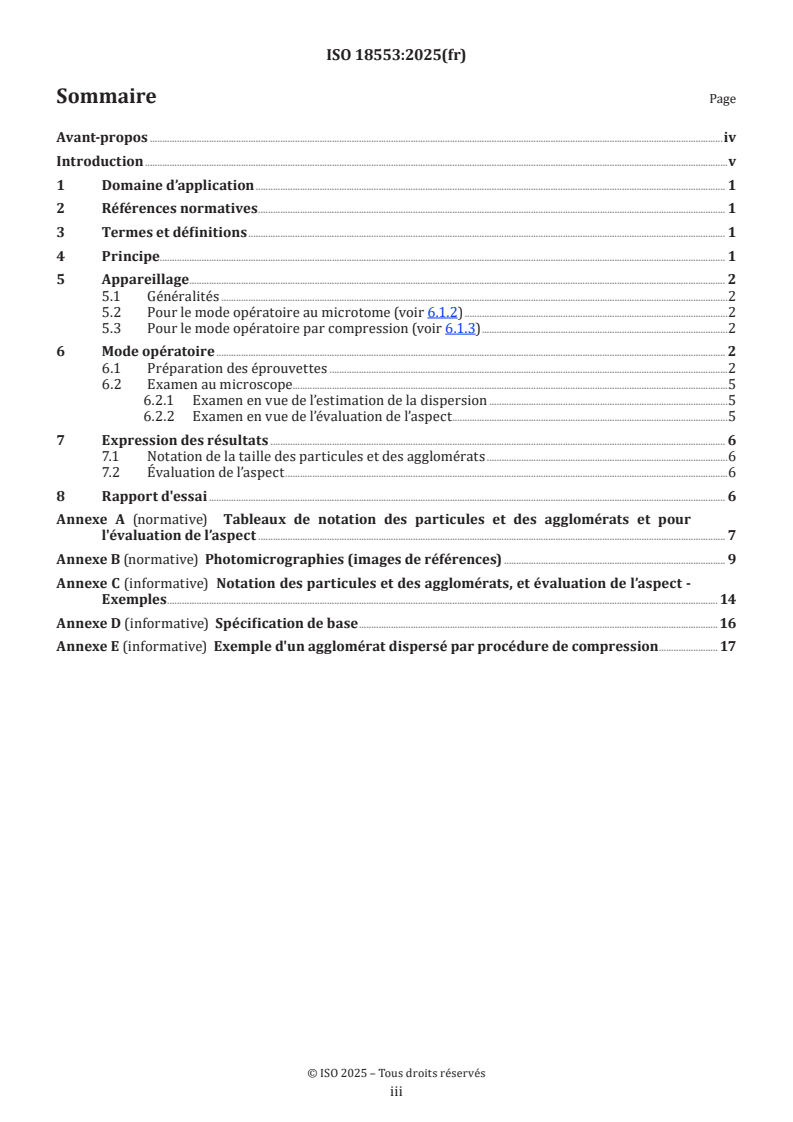
Sommaire Page
Avant-propos .iv
Introduction .v
1 Domaine d’application . 1
2 Références normatives . 1
3 Termes et définitions . 1
4 Principe. 1
5 Appareillage . 2
5.1 Généralités .2
5.2 Pour le mode opératoire au microtome (voir 6.1.2) .2
5.3 Pour le mode opératoire par compression (voir 6.1.3) .2
6 Mode opératoire . 2
6.1 Préparation des éprouvettes .2
6.2 Examen au microscope.5
6.2.1 Examen en vue de l’estimation de la dispersion .5
6.2.2 Examen en vue de l’évaluation de l’aspect .5
7 Expression des résultats . 6
7.1 Notation de la taille des particules et des agglomérats .6
7.2 Évaluation de l’aspect .6
8 Rapport d'essai . 6
Annexe A (normative) Tableaux de notation des particules et des agglomérats et pour
l'évaluation de l’aspect . 7
Annexe B (normative) Photomicrographies (images de références) . 9
Annexe C (informative) Notation des particules et des agglomérats, et évaluation de l’aspect -
Exemples . 14
Annexe D (informative) Spécification de base .16
Annexe E (informative) Exemple d'un agglomérat dispersé par procédure de compression . 17
iii
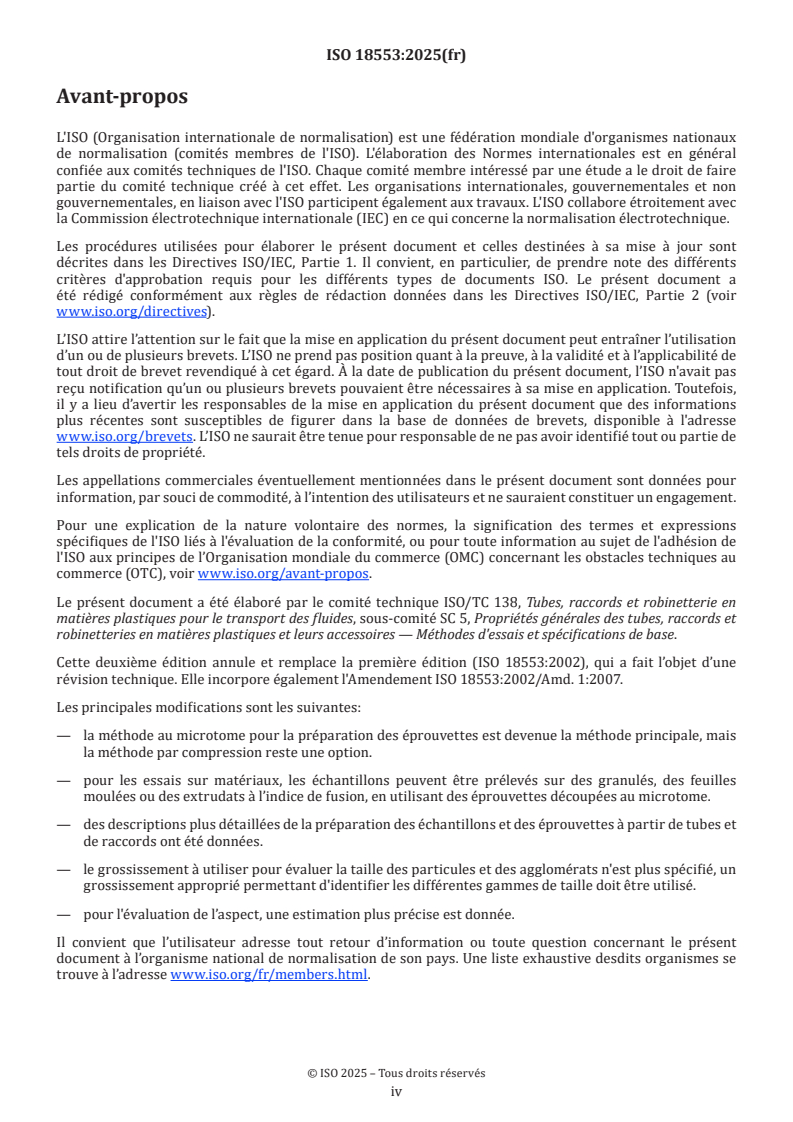
Avant-propos
L'ISO (Organisation internationale de normalisation) est une fédération mondiale d'organismes nationaux
de normalisation (comités membres de l'ISO). L'élaboration des Normes internationales est en général
confiée aux comités techniques de l'ISO. Chaque comité membre intéressé par une étude a le droit de faire
partie du comité technique créé à cet effet. Les organisations internationales, gouvernementales et non
gouvernementales, en liaison avec l'ISO participent également aux travaux. L'ISO collabore étroitement avec
la Commission électrotechnique internationale (IEC) en ce qui concerne la normalisation électrotechnique.
Les procédures utilisées pour élaborer le présent document et celles destinées à sa mise à jour sont
décrites dans les Directives ISO/IEC, Partie 1. Il convient, en particulier, de prendre note des différents
critères d'approbation requis pour les différents types de documents ISO. Le présent document a
été rédigé conformément aux règles de rédaction données dans les Directives ISO/IEC, Partie 2 (voir
www.iso.org/directives).
L’ISO attire l’attention sur le fait que la mise en application du présent document peut entraîner l’utilisation
d’un ou de plusieurs brevets. L’ISO ne prend pas position quant à la preuve, à la validité et à l’applicabilité de
tout droit de brevet revendiqué à cet égard. À la date de publication du présent document, l’ISO n'avait pas
reçu notification qu’un ou plusieurs brevets pouvaient être nécessaires à sa mise en application. Toutefois,
il y a lieu d’avertir les responsables de la mise en application du présent document que des informations
plus récentes sont susceptibles de figurer dans la base de données de brevets, disponible à l'adresse
www.iso.org/brevets. L’ISO ne saurait être tenue pour responsable de ne pas avoir identifié tout ou partie de
tels droits de propriété.
Les appellations commerciales éventuellement mentionnées dans le présent document sont données pour
information, par souci de commodité, à l’intention des utilisateurs et ne sauraient constituer un engagement.
Pour une explication de la nature volontaire des normes, la signification des termes et expressions
spécifiques de l'ISO liés à l'évaluation de la conformité, ou pour toute information au sujet de l'adhésion de
l'ISO aux principes de l’Organisation mondiale du commerce (OMC) concernant les obstacles techniques au
commerce (OTC), voir www.iso.org/avant-propos.
Le présent document a été élaboré par le comité technique ISO/TC 138, Tubes, raccords et robinetterie en
matières plastiques pour le transport des fluides, sous-comité SC 5, Propriétés générales des tubes, raccords et
robinetteries en matières plastiques et leurs accessoires — Méthodes d'essais et spécifications de base.
Cette deuxième édition annule et remplace la première édition (ISO 18553:2002), qui a fait l’objet d’une
révision technique. Elle incorpore également l'Amendement ISO 18553:2002/Amd. 1:2007.
Les principales modifications sont les suivantes:
— la méthode au microtome pour la préparation des éprouvettes est devenue la méthode principale, mais
la méthode par compression reste une option.
— pour les essais sur matériaux, les échantillons peuvent être prélevés sur des granulés, des feuilles
moulées ou des extrudats à l’indice de fusion, en utilisant des éprouvettes découpées au microtome.
— des descriptions plus détaillées de la préparation des échantillons et des éprouvettes à partir de tubes et
de raccords ont été données.
— le grossissement à utiliser pour évaluer la taille des particules et des agglomérats n'est plus spécifié, un
grossissement approprié permettant d'identifier les différentes gammes de taille doit être utilisé.
— pour l'évaluation de l’aspect, une estimation plus précise est donnée.
Il convient que l’utilisateur adresse tout retour d’information ou toute question concernant le présent
document à l’organisme national de normalisation de son pays. Une liste exhaustive desdits organismes se
trouve à l’adresse www.iso.org/fr/members.html.
iv
Introduction
Les produits thermoplastiques fabriqués pour les systèmes de canalisations sont normalement pigmentés. De
fines particules de noir de carbone ou des pigments sont habituellement utilisés. Ceux-ci sont généralement
incorporés à la matière première avant l'extrusion du tube ou le moulage par injection des raccords. Cette
coloration permet l'identification de la canalisation qui est en service et, dans le cas du noir de carbone, elle
protège le polymère des dégradations dues à la lumière ultraviolette lorsque les produits sont stockés ou
utilisés à l’extérieur. Il est important que les particules de noir de carbone ou du pigment soient correctement
dispersées dans le polymère, et par conséquent dans le produit final, de sorte que les propriétés physiques,
mécaniques et de protection de surface soient maintenues. Une bonne dispersion peut aussi indiquer que les
antioxydants et les stabilisants ultraviolets sont correctement dispersés, et que la taille des agglomérats ou
des particules n'est pas excessive.
Cette méthode présente des modes opératoires pour estimer la dispersion par la mesure physique de la taille
des particules dispersées et par la notation arithmétique de la distribution de la taille des particules. Elle
présente également des photographies destinées à la comparaison avec des images prises au microscope
d'échantillons prélevés dans la composition de matière première ou sur les produits, afin de juger
subjectivement si la dispersion du noir de carbone ou du pigment est acceptable.
Une limite recommandée de la notation relative à la dimension des particules/agglomérats et pour une
évaluation acceptable de l`aspect est donnée dans l’Annexe D.
v
Norme internationale ISO 18553:2025(fr)
Méthode d'estimation de la dispersion du pigment et du noir
de carbone dans les tubes, raccords et compositions à base de
polyoléfines
1 Domaine d’application
Le présent document décrit une méthode comportant deux modes opératoires pour l’estimation de la taille
des particules et des agglomérats de noir de carbone ou de pigment et l’évaluation de leur dispersion dans
les tubes, les raccords et les compositions à base de polyoléfines.
Cette méthode est applicable aux tubes et aux raccords à base de polyoléfines, ainsi qu'à la matière première
sous forme de granulés, le choix du mode opératoire étant défini par la spécification concernée.
Cette méthode est applicable aux tubes, raccords et compositions en polyoléfine à base de noir de carbone
ou pigmentés, dont la teneur en noir de carbone est inférieure à 3 % en fraction massique et la teneur en
pigments inférieure à 5 % en fraction massique.
2 Références normatives
Les documents suivants sont cités dans le texte de sorte qu’ils constituent, pour tout ou partie de leur
contenu, des exigences du présent document. Pour les références datées, seule l’édition citée s’applique. Pour
les références non datées, la dernière édition du document de référence s'applique (y compris les éventuels
amendements).
ISO 293, Plastiques — Moulage par compression des éprouvettes en matières thermoplastiques
ISO 1133-1, Plastiques — Détermination de l'indice de fluidité à chaud des thermoplastiques, en masse (MFR) et
en volume (MVR) — Partie 1: Méthode normale
3 Termes et définitions
Aucun terme n’est défini dans le présent document.
L’ISO et l’IEC tiennent à jour des bases de données terminologiques destinées à être utilisées en normalisation,
consultables aux adresses suivantes:
— ISO Online browsing platform: disponible à l’adresse https:// www .iso .org/ obp
— IEC Electropedia: disponible à l’adresse https:// www .electropedia .org/
4 Principe
De petits échantillons de granulés de matière première, d'extrudat à l’indice de fusion, de feuilles moulées par
compression ou de matériau retiré du tube ou du raccord sont prélevés à des fins d'évaluation. Des tranches
au microtome sont découpées dans les échantillons pour examen. Les échantillons peuvent également être
chauffés et comprimés entre des lames de microscope pour être examinés.
Les éprouvettes obtenues sont examinées au microscope; la taille des particules et des agglomérats est
mesurée, enregistrée et notée par comparaison avec un système de notation mis sous forme d'un tableau
(voir Tableau A.1).
La note relative à la taille des particules/agglomérats est obtenue à partir de la moyenne des notes obtenues
sur six échantillons.
Si nécessaire, une évaluation de l'aspect de la dispersion est déterminée par comparaison avec des
photomicrographies (voir Annexe B).
5 Appareillage
5.1 Généralités
5.1.1 Microscope, à même de donner un grossissement approprié, voir 6.2.1 et 6.2.2, équipé d'un chariot
à déplacement orthogonal, d'une mire micrométrique étalonnée standard pour mesurer la taille des
agglomérats et des particules, ainsi que d'un éclairage convenable, afin d'éviter les effets d'optique. Il est
également possible d'utiliser des microscopes dotés d'un système de caméra numérique et d'un logiciel
facilitant les mesurages, et de les calibrer à l'aide d'un micromètre à platine.
5.1.2 Lames de verre porte-objet pour microscope: une épaisseur de 1 mm convient, avec une fine
couche de couverture.
5.2 Pour le mode opératoire au microtome (voir 6.1.2)
5.2.1 Microtome, permettant d'obtenir des pellicules de l'épaisseur spécifiée (voir 6.1.2)
5.3 Pour le mode opératoire par compression (voir 6.1.3)
5.3.1 Four ou plaque chauffante ou autre dispositif chauffant thermorégulé, à même de donner des
températures comprises entre 150 °C et 210 °C.
5.3.2 Scalpel, pour le découpage des éprouvettes.
5.3.3 Presse, poids ou pinces à ressort, pour exercer la pression.
6 Mode opératoire
6.1 Préparation des éprouvettes
6.1.1 Deux méthodes de préparation des éprouvettes sont décrites pour les matières premières: un mode
opératoire au microtome et, alternativement, un mode opératoire par compression. Le mode opératoire au
microtome est le mode opératoire préféré et, en cas de litige, c'est celui qui s'applique.
Pour la préparation d'éprouvettes à partir de produits (tubes, raccords), le mode opératoire au microtome
doit être utilisée. La découpe des échantillons sur lesquels sont prélevées les éprouvettes doit se faire sur
une surface propre, afin de réduire au minimum la possibilité de contamination étrangère.
NOTE Le mode opératoire par compression ne donnera pas nécessairement le même résultat que la méthode au
microtome en raison du mouvement du matériel pendant la compression et de la dispersion potentielle d'agglomérats.
Un exemple illustrant une telle dispersion d'agglomérats est donné à l'Annexe E
6.1.2 Mode opératoire au microtome
6.1.2.1 Essai sur échantillons de
...