

ISO 18232:2006
(Main)Health Informatics — Messages and communication — Format of length limited globally unique string identifiers
General Information
- Abstract
ISO 18232:2006 specifies the encoding and length for globally unique identifiers for data objects used in healthcare exchanged as alphanumeric strings.
- Status
- Published
- Publication Date
- 05-Apr-2006
- Technical Committee
- ISO/TC 215 - Health informatics
- Drafting Committee
- ISO/TC 215/WG 2 - Systems and Device Interoperability
- Current Stage
- 9093 - International Standard confirmed
- Start Date
- 20-Nov-2023
- Completion Date
- 29-Aug-2026
Buy Documents
ISO 18232:2006 - Health Informatics — Messages and communication — Format of length limited globally unique string identifiers Released:4/6/2006
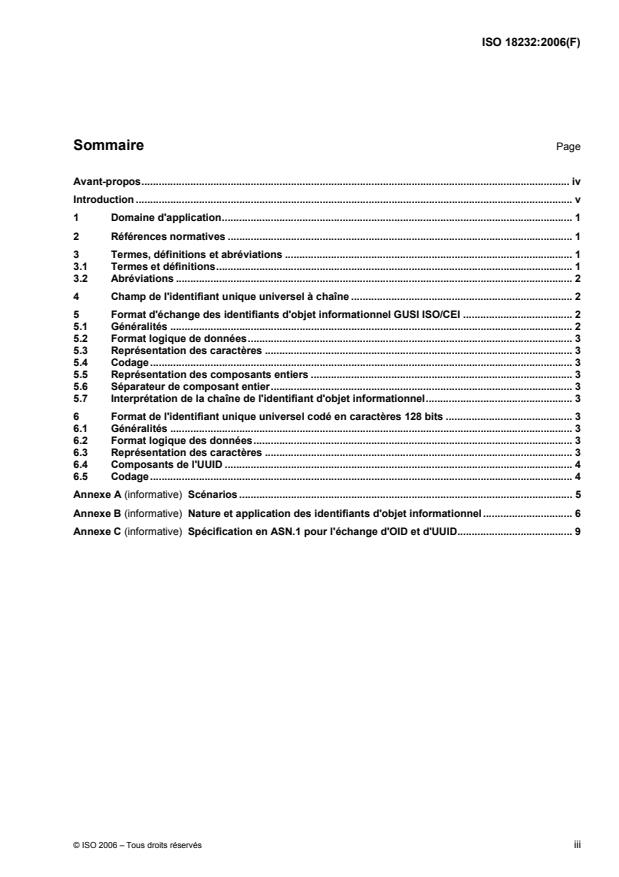
ISO 18232:2006 - Informatique de santé — Messages et communication — Format des identifiants uniques universels codés en caractere et limités en longueur Released:4/6/2006
Overview
ISO 18232:2006 defines a common, length-limited alphanumeric format for exchanging globally unique string identifiers (GUSI) for healthcare data objects. It standardizes how both ISO/IEC object identifiers (OIDs) and 128‑bit universal unique identifiers (UUIDs) are represented as character strings so that different healthcare systems can reliably reference, verify and merge data objects exchanged electronically.
Key topics and technical requirements
- Field constraints
- GUSI field length: maximum 64 octets.
- Field type: alphanumeric encoded per ISO/IEC 646 (basic ISO 7‑bit character set).
- OID (ISO/IEC data object identifier) format
- Logical format: sequence of integer components per ISO/IEC 8824‑1 and registration rules in ISO/IEC 9834.
- Character set: digits 0–9 and the dot “.” as separator.
- Component rule: no leading zero in an integer component unless the value is zero.
- Separator: single full stop (.) with no leading or trailing dot.
- Applications must not infer semantic meaning from OID components.
- 128‑bit UUID format
- Logical format: 128‑bit binary value represented in hexadecimal text.
- Character set: digits 0–9, letters a–f, and hyphen “-”.
- Canonical layout: five hyphen‑separated components of lengths 8-4-4-4-12 characters.
- Encoded as alphanumeric octets per ISO/IEC 646.
Practical applications
- Verification of referenced objects: Confirm that a retrieved image, waveform or report matches the identifier embedded in the reference/pointer.
- Record merging: Use globally unique identifiers as reliable keys when combining data from multiple institutions.
- Archival indexing and access control: Link GUSIs to storage paths for retrieval and rights management within archives and PACS.
- Interoperability across systems: Facilitate exchange between EHRs, imaging systems and GP systems that may differ in native identifier models.
Who should use this standard
- Healthcare IT architects and system integrators
- EHR, PACS, LIS and imaging software vendors
- Developers implementing DICOM, HL7 or other healthcare messaging
- Standards bodies and registries issuing OID roots
Related standards
- ISO/IEC 8824‑1 (ASN.1 object identifier rules)
- ISO/IEC 9834 (registration authorities)
- DICOM (PS 3.x references for medical imaging object/UID usage)
- UUID specifications referenced in the standard
ISO 18232:2006 helps ensure consistent, interoperable string representations of global identifiers in healthcare data exchange, improving data integrity, traceability and system integration.
Buy Documents
ISO 18232:2006 - Health Informatics — Messages and communication — Format of length limited globally unique string identifiers Released:4/6/2006
ISO 18232:2006 - Informatique de santé — Messages et communication — Format des identifiants uniques universels codés en caractere et limités en longueur Released:4/6/2006
Get Certified
Connect with accredited certification bodies for this standard

BSI Group
BSI (British Standards Institution) is the business standards company that helps organizations make excellence a habit.

NYCE
Mexican standards and certification body.
Sponsored listings
Frequently Asked Questions
ISO 18232:2006 is a standard published by the International Organization for Standardization (ISO). Its full title is "Health Informatics — Messages and communication — Format of length limited globally unique string identifiers". This standard covers: ISO 18232:2006 specifies the encoding and length for globally unique identifiers for data objects used in healthcare exchanged as alphanumeric strings.
ISO 18232:2006 specifies the encoding and length for globally unique identifiers for data objects used in healthcare exchanged as alphanumeric strings.
ISO 18232:2006 is classified under the following ICS (International Classification for Standards) categories: 35.240.80 - IT applications in health care technology. The ICS classification helps identify the subject area and facilitates finding related standards.
ISO 18232:2006 is available in PDF format for immediate download after purchase. The document can be added to your cart and obtained through the secure checkout process. Digital delivery ensures instant access to the complete standard document.
Standards Content (Sample)
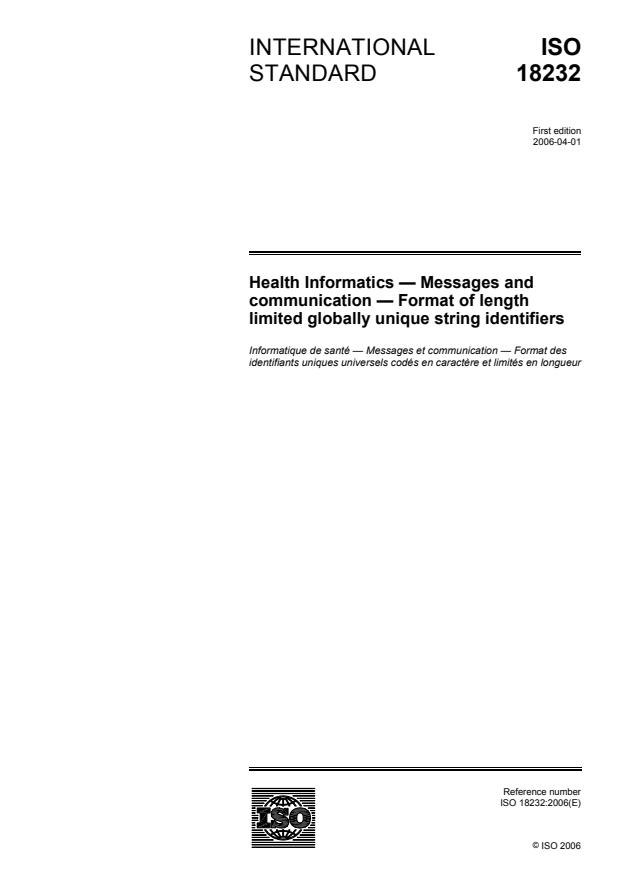
INTERNATIONAL ISO
STANDARD 18232
First edition
2006-04-01
Health Informatics — Messages and
communication — Format of length
limited globally unique string identifiers
Informatique de santé — Messages et communication — Format des
identifiants uniques universels codés en caractère et limités en longueur
Reference number
©
ISO 2006
PDF disclaimer
This PDF file may contain embedded typefaces. In accordance with Adobe's licensing policy, this file may be printed or viewed but
shall not be edited unless the typefaces which are embedded are licensed to and installed on the computer performing the editing. In
downloading this file, parties accept therein the responsibility of not infringing Adobe's licensing policy. The ISO Central Secretariat
accepts no liability in this area.
Adobe is a trademark of Adobe Systems Incorporated.
Details of the software products used to create this PDF file can be found in the General Info relative to the file; the PDF-creation
parameters were optimized for printing. Every care has been taken to ensure that the file is suitable for use by ISO member bodies. In
the unlikely event that a problem relating to it is found, please inform the Central Secretariat at the address given below.
© ISO 2006
All rights reserved. Unless otherwise specified, no part of this publication may be reproduced or utilized in any form or by any means,
electronic or mechanical, including photocopying and microfilm, without permission in writing from either ISO at the address below or
ISO's member body in the country of the requester.
ISO copyright office
Case postale 56 • CH-1211 Geneva 20
Tel. + 41 22 749 01 11
Fax + 41 22 749 09 47
E-mail copyright@iso.org
Web www.iso.org
Published in Switzerland
ii © ISO 2006 – All rights reserved
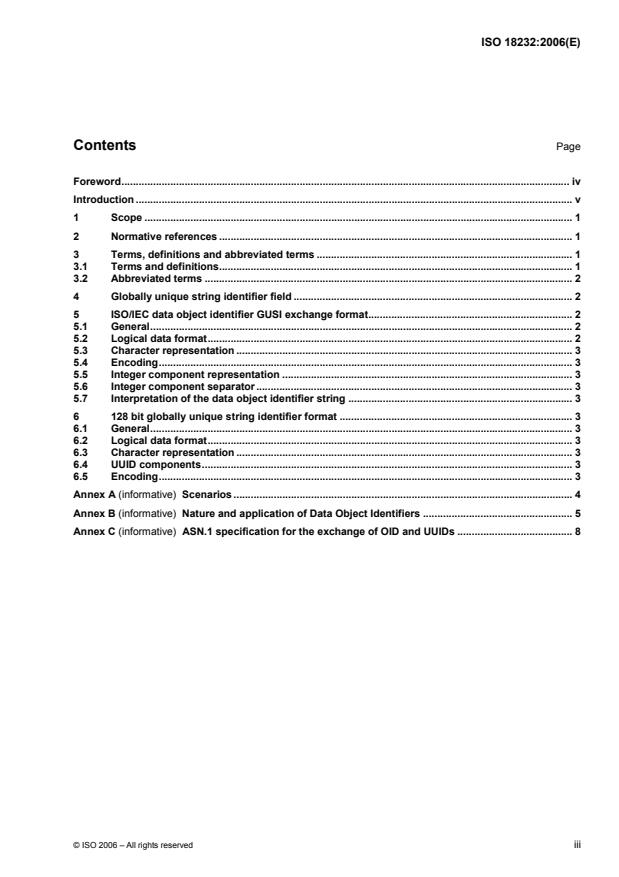
Contents Page
Foreword. iv
Introduction . v
1 Scope . 1
2 Normative references . 1
3 Terms, definitions and abbreviated terms . 1
3.1 Terms and definitions. 1
3.2 Abbreviated terms . 2
4 Globally unique string identifier field . 2
5 ISO/IEC data object identifier GUSI exchange format. 2
5.1 General. 2
5.2 Logical data format. 2
5.3 Character representation . 3
5.4 Encoding. 3
5.5 Integer component representation . 3
5.6 Integer component separator. 3
5.7 Interpretation of the data object identifier string . 3
6 128 bit globally unique string identifier format . 3
6.1 General. 3
6.2 Logical data format. 3
6.3 Character representation . 3
6.4 UUID components. 3
6.5 Encoding. 3
Annex A (informative) Scenarios .4
Annex B (informative) Nature and application of Data Object Identifiers . 5
Annex C (informative) ASN.1 specification for the exchange of OID and UUIDs . 8
Foreword
ISO (the International Organization for Standardization) is a worldwide federation of national standards bodies
(ISO member bodies). The work of preparing International Standards is normally carried out through ISO
technical committees. Each member body interested in a subject for which a technical committee has been
established has the right to be represented on that committee. International organizations, governmental and
non-governmental, in liaison with ISO, also take part in the work. ISO collaborates closely with the
International Electrotechnical Commission (IEC) on all matters of electrotechnical standardization.
International Standards are drafted in accordance with the rules given in the ISO/IEC Directives, Part 2.
The main task of technical committees is to prepare International Standards. Draft International Standards
adopted by the technical committees are circulated to the member bodies for voting. Publication as an
International Standard requires approval by at least 75 % of the member bodies casting a vote.
Attention is drawn to the possibility that some of the elements of this document may be the subject of patent
rights. ISO shall not be held responsible for identifying any or all such patent rights.
ISO 18232 was prepared by Technical Committee ISO/TC 215, Health informatics.
iv © ISO 2006 – All rights reserved
Introduction
Data objects used in medicine include reports and results of diagnostic procedures which are stored and
exchanged in electronic form, and objects such as templates. Applications must be able to find the location
and the identification of such objects. Object identifiers are often numeric in form. This International Standard
provides a means of exchanging globally unique identifiers expressed as character strings. It is not concerned
with the specification of the location from which a data object may be retrieved.
A healthcare service for a patient is delivered in identifiable parts which may be termed healthcare service
items. A healthcare service item can be performed for a patient by a healthcare professional, or a healthcare
professional may request a healthcare service item to be performed by another healthcare professional or by
a healthcare service department such as a medical imaging service department.
Healthcare service item results arise from numerical measurement or assessment by a healthcare
professional. Individual numerical results may be included within report text, perhaps in a table. Sets of
numerical results may be presented visually e.g. waveform (graph) or image (picture).
Results that consist of a large number of measured values such as a waveform or digital image are known as
data objects.
To allow safe use in medicine, all data objects must be identified by a globally unique identifier (GUI), such as
an ISO OID or binary MS GUI. The GUI allocated to a data object is attached to the data object (e.g. by
including it within a computer file header section). The reference to a data object includes the GUI of the data
object as well as the path to the data object. The application that retrieves the data object can verify that the
correct data have been retrieved by matching the GUI in the reference to the GUI attached to the data object.
See Annex A for relevant scenarios.
It may be noted that:
a) the issue of the location of a data object is separate from the issue of its identity; indeed several identical
copies of the object may exist;
b) a globally unique data object identifier is intended for machine use and may be quite large;
c) a short, user-friendly, locally unique identifier is often required in addition to the globally unique identifier
for human use. (This is outside the scope of this International Standard.)
Globally unique identifiers are already specified in various standards and the intention of this International
Standard is to provide a specification for a common format for the exchange of commonly used globally
unique identifiers expressed as alphanumeric strings.
A logical data format for globally unique identifiers constructed from a sequence of integers is defined by
ISO/IEC 8824-1. Identifiers based on ISO/IEC 8824-1 are widely used in medical imaging. 128 bit universal
unique identifiers (UUIDs) are widely used in the MS Windows environment. This International Standard
specifies the format of alphanumeric string fields for the exchange of globally unique string identifiers (GUSI)
INTERNATIONAL STANDARD ISO 18232:2006(E)
Health Informatics — Messages and communication — Format
of length limited globally unique string identifiers
1 Scope
This International Standard specifies the encoding and length for globally unique identifiers for data objects
used in healthcare exchanged as alphanumeric strings.
The technologies used for data storage, location and communication are outside the scope of this
International Standard.
2 Normative references
The following referenced documents are indispensable for the application of this document. For dated
references, only the edition cited applies. For undated references, the latest edition of the referenced
document (including any amendments) applies.
ISO/IEC 646, Information technology — ISO 7-bit coded character set for information interchange
ISO/IEC 8824-1:2002, Information technology — Abstract Syntax Notation One (ASN.1): Specification of basic
notation — Part 1
ISO/IEC 9834 (all parts), Information Technology — Open Systems Interconnection — Procedures for the
operation of OSI Registration Authorities
DICOM PS 3.3, Digital Imaging and Communications in Medicine — Part 3: Information Object Definitions
DICOM PS 3.4, Digital Imaging and Communications in Medicine — Part 4: Service Class Specifications
DICOM PS 3.5, Digital Imaging and Communications in Medicine — Part 5: Data Structures and Encoding
3 Terms, definitions and abbreviated terms
3.1 Terms and definitions
3.1.1
information object
well-defined piece of information, definition, or specification which requires a name in order to identify its use
in communication
NOTE Adapted from ISO/IEC 8824-1.
3.1.2
object identifier
OID
value (distinguishable from all other such values) that is associated with an information object
NOTE Adapted from ISO/IEC 8824-1.
3.1.3
data object identifier
sequence of integer components constructed as specified in ISO/IEC 8824-1, having a root sequence of
components issued by a national standards body and sequence of following integer components whose
uniqueness is guaranteed by the organization that defined it
NOTE Which is guaranteed to be globally unique by that national body registered as specified by ISO 9834.
3.1.4
unique identifier
identifier that is different from any other such identifier within a given namespace
3.1.5
globally unique identifier
identifier that is different from any other such identifier in any domain namespace
3.1.6
globally unique string identifier
alphanumeric string of maximum length 64 characters, which is different from any other alphanumeric string
that has been or will be exchanged according to the provisions of this International Standard
3.2 Abbreviated terms
GUI globally unique identifier
OID object identifier
UID unique identifier (DICOM)
GUSI globally unique string identifier
UUID universal unique identifier
4 Globally unique string identifier field
When communicated by means of electronic data exchange the field containing the GUSI shall conform to the
following:
a) length: 64 octets;
b) type: alphanumeric.
NOTE The object identifier field might be included as part of the data object metadata or might be part of a “wrapper”
containing the data object. However this issue is outside the scope of this International Standard.
5 ISO/IEC data object identifier GUSI exchange format
5.1 General
Applications that conform to this clause shall support the use of object identifiers (OIDs) as specified by
ISO/IEC 8824-1 and shall be constructed and encoded according to 5.2 to 5.7.
5.2 Logical data format
Data object identifiers shall be constructed from a sequence of integer components in accordance with the
provisions of ISO/IEC 8824-1 and ISO/IEC 9834-7.
2 © ISO 2006 – All rights reserved
5.3 Character representation
Data object identif
...
NORME ISO
INTERNATIONALE 18232
Première édition
2006-04-01
Informatique de santé — Messages et
communication — Format des identifiants
uniques universels codés en caractère et
limités en longueur
Health Informatics — Messages and communication — Format of
length limited globally unique string identifiers
Numéro de référence
©
ISO 2006
PDF – Exonération de responsabilité
Le présent fichier PDF peut contenir des polices de caractères intégrées. Conformément aux conditions de licence d'Adobe, ce fichier
peut être imprimé ou visualisé, mais ne doit pas être modifié à moins que l'ordinateur employé à cet effet ne bénéficie d'une licence
autorisant l'utilisation de ces polices et que celles-ci y soient installées. Lors du téléchargement de ce fichier, les parties concernées
acceptent de fait la responsabilité de ne pas enfreindre les conditions de licence d'Adobe. Le Secrétariat central de l'ISO décline toute
responsabilité en la matière.
Adobe est une marque déposée d'Adobe Systems Incorporated.
Les détails relatifs aux produits logiciels utilisés pour la création du présent fichier PDF sont disponibles dans la rubrique General Info
du fichier; les paramètres de création PDF ont été optimisés pour l'impression. Toutes les mesures ont été prises pour garantir
l'exploitation de ce fichier par les comités membres de l'ISO. Dans le cas peu probable où surviendrait un problème d'utilisation,
veuillez en informer le Secrétariat central à l'adresse donnée ci-dessous.
© ISO 2006
Droits de reproduction réservés. Sauf prescription différente, aucune partie de cette publication ne peut être reproduite ni utilisée sous
quelque forme que ce soit et par aucun procédé, électronique ou mécanique, y compris la photocopie et les microfilms, sans l'accord écrit
de l'ISO à l'adresse ci-après ou du comité membre de l'ISO dans le pays du demandeur.
ISO copyright office
Case postale 56 • CH-1211 Geneva 20
Tel. + 41 22 749 01 11
Fax. + 41 22 749 09 47
E-mail copyright@iso.org
Web www.iso.org
Publié en Suisse
ii © ISO 2006 – Tous droits réservés
Sommaire Page
Avant-propos. iv
Introduction . v
1 Domaine d'application. 1
2 Références normatives . 1
3 Termes, définitions et abréviations . 1
3.1 Termes et définitions. 1
3.2 Abréviations . 2
4 Champ de I'identifiant unique universel à chaîne . 2
5 Format d'échange des identifiants d'objet informationnel GUSI ISO/CEI . 2
5.1 Généralités . 2
5.2 Format logique de données. 3
5.3 Représentation des caractères . 3
5.4 Codage. 3
5.5 Représentation des composants entiers .3
5.6 Séparateur de composant entier. 3
5.7 Interprétation de la chaîne de l'identifiant d'objet informationnel. 3
6 Format de l'identifiant unique universel codé en caractères 128 bits . 3
6.1 Généralités . 3
6.2 Format logique des données. 3
6.3 Représentation des caractères . 3
6.4 Composants de l'UUID . 4
6.5 Codage. 4
Annexe A (informative) Scénarios . 5
Annexe B (informative) Nature et application des identifiants d'objet informationnel . 6
Annexe C (informative) Spécification en ASN.1 pour l'échange d'OID et d'UUID. 9
Avant-propos
L'ISO (Organisation internationale de normalisation) est une fédération mondiale d'organismes nationaux de
normalisation (comités membres de l'ISO). L'élaboration des Normes internationales est en général confiée
aux comités techniques de l'ISO. Chaque comité membre intéressé par une étude a le droit de faire partie du
comité technique créé à cet effet. Les organisations internationales, gouvernementales et non
gouvernementales, en liaison avec l'ISO participent également aux travaux. L'ISO collabore étroitement avec
la Commission électrotechnique internationale (CEI) en ce qui concerne la normalisation électrotechnique.
Les Normes internationales sont rédigées conformément aux règles données dans les Directives ISO/CEI,
Partie 2.
La tâche principale des comités techniques est d'élaborer les Normes internationales. Les projets de Normes
internationales adoptés par les comités techniques sont soumis aux comités membres pour vote. Leur
publication comme Normes internationales requiert l'approbation de 75 % au moins des comités membres
votants.
L'attention est appelée sur le fait que certains des éléments du présent document peuvent faire l'objet de
droits de propriété intellectuelle ou de droits analogues. L'ISO ne saurait être tenue pour responsable de ne
pas avoir identifié de tels droits de propriété et averti de leur existence.
L'ISO 18232 a été élaborée par le comité technique ISO/TC 215, Informatique de santé.
iv © ISO 2006 – Tous droits réservés
Introduction
Parmi les objets informationnels utilisés en médecine, on compte les rapports et les résultats des diagnostics
qui sont conservés et échangés sous forme électronique ainsi que des objets tels que les modèles. Les
applications doivent être en mesure de trouver l'emplacement de ces objets et de les identifier. Les
identifiants d'objet se présentent souvent sous forme numérique. La présente Norme internationale fournit un
moyen d'échanger des indicateurs uniques universels exprimés sous la forme de chaînes de caractères. Elle
ne traite pas de l'emplacement où peut être retrouvé un objet informationnel.
Le service de santé offert à un patient peut se subdiviser en parties identifiables appelées prestations de
santé. Ces prestations peuvent être assurées au patient par un professionnel de santé, par un professionnel
de santé appelé par le précédent ou par un département d'un service de santé tel que le département du
service d'imagerie médicale.
Les résultats de la prestation de service de santé découlent des mesures ou évaluations numériques
effectuées par un professionnel de santé. Ces résultats numériques peuvent être inclus dans un rapport sous
la forme d'un texte ou éventuellement d'un tableau. Les ensembles de résultats numériques peuvent être
présentés sous forme visuelle, par exemple une courbe ou une image.
Les résultats regroupant un grand nombre de valeurs mesurées sous forme de courbes ou d'images
numériques sont appelés objets informationnels.
Pour assurer la sécurité de leur utilisation en médecine, tous les objets informationnels doivent être identifiés
par un identifiant unique mondial (GUI) de type ISO (identifiant d'objet ISO – ISO OID) ou de type binaire
(identifiant unique universel de Microsoft – GUI MS). Le GUI affecté à un objet informationnel est attaché à cet
objet (par exemple par inclusion dans la zone de l'en-tête d'un fichier informatique). La référence à un objet
informationnel inclut le GUI de cet objet ainsi que le chemin correspondant. L'application qui recherche l'objet
informationnel peut vérifier qu'elle a trouvé les données correctes en appariant le GUI et la référence à ce GUI
attachée à l'objet informationnel. Voir en annexe A des scénarios appropriés.
Il peut être noté que
a) la question de l'emplacement de l'objet informationnel est distincte de la question de l'identité de celui-ci;
il peut en effet exister plusieurs copies identiques de l'objet,
b) un identifiant unique universel de l'objet informationnel est destiné à un usage machine et peut être
relativement long,
c) un identifiant unique local, court et facile à retenir par l'utilisateur est souvent nécessaire en plus de
l'identifiant unique universel pour que l'homme puisse l'utiliser. (Ce point sort du domaine d'application de
la présente Norme internationale).
Des identifiants uniques universels étant déjà spécifiés dans diverses normes, l'objectif de la présente Norme
internationale est de spécifier un format commun d'échange entre les identifiants uniques universels
couramment utilisés et ce, par le biais de chaînes alphanumériques.
L'ISO/CEI 8824-1 définit un format logique de données pour les identifiants uniques universels, bâti à partir
d'une séquence d'entiers. Les identifiants basés sur l'ISO/CEI 8824-1 sont largement utilisés en imagerie
médicale. Les identifiants uniques universels 128 bits (UUID) sont largement répandus dans l'environnement
Windows de Microsoft. La présente Norme internationale spécifie le format de champs de chaînes
alphanumériques pour l'échange des identifiants uniques universels en chaîne (GUSI)
NORME INTERNATIONALE ISO 18232:2006(F)
Informatique de santé — Messages et communication —
Format des identifiants uniques universels codés en caractère
et limités en longueur
1 Domaine d'application
La présente Norme internationale spécifie le codage et la longueur des identifiants uniques universels des
objets informationnels échangés sous forme de chaînes alphanumérique en informatique de santé.
Les technologies utilisées pour le stockage des données, leur localisation et la communication ne font pas
l'objet de la présente Norme internationale.
2 Références normatives
Les documents de référence suivants sont indispensables pour l'application du présent document. Pour les
références datées, seule l'édition citée s'applique. Pour les références non datées, la dernière édition du
document de référence s'applique (y compris les éventuels amendements).
ISO/CEI 646, Technologies de l'information — Jeu ISO de caractères codés à 7 éléments pour l'échange
d'information
ISO/CEI 8824-1:2002, Technologies de l'information — Notation de syntaxe abstraite numéro un (ASN.1):
Spécification de la notation de base — Partie 1
ISO/CEI 9834 (toutes les parties), Technologies de l'information — Interconnexion de systèmes ouverts (OSI)
— Procédures opérationnelles pour les organismes d'enregistrement de l'OSI
DICOM PS 3.3, Digital Imaging and Communications in Medicine — Part 3: Information Object Definitions
DICOM PS 3.4, Digital Imaging and Communications in Medicine — Part 4: Service Class Specifications
DICOM PS 3.5, Digital Imaging and Communications in Medicine — Part 5: Data Structures and Encoding
3 Termes, définitions et abréviations
3.1 Termes et définitions
3.1.1
objet informationnel
élément d'information, de définition ou de spécification devant être nommé pour permettre d'identifier son
utilisation en communication
NOTE Adapté de l'ISO/CEI 8824-1.
3.1.2
identifiant d'objet
OID
valeur (distinguable d'autres valeurs du même type ) associée à un objet informationnel
NOTE Adapté de l'ISO/CEI 8824-1.
3.1.3
identifiant d'objet informationnel
séquence d'entiers, construite de la manière spécifiée dans l'ISO/CEI 8824-1 et composée d'une suite de
composants racine attribués par un organisme national de normalisation et d'une séquence de composants
entiers suivants dont le caractère unique est garanti par l'organisation qui la définit
NOTE Cette séquence est garantie comme étant unique dans le monde par cet organisme national enregistré de la
manière spécifiée dans l'ISO 9834.
3.1.4
identifiant unique
identifiant qui est différent de tout autre identifiant analogue dans un espace de désignation donné
3.1.5
identifiant unique mondial
identifiant qui est différent de tout autre identifiant analogue quel que soit l'espace de désignation
3.1.6
identifiant unique universel codé en caractères
chaîne alphanumérique d'une longueur maximale de 64 caractères, différente de toute autre chaîne
alphanumérique qui a été ou sera échangée conformément aux dispositions de la présente Norme
internationale
3.2 Abréviations
GUI identifiant unique universel/mondial
OID identifiant d'objet
UID identifiant unique (DICOM)
GUSI identifiant unique universel à chaîne
UUID identifiant unique universel/mondial
4 Champ de I'identifiant unique universel à chaîne
Dans les communications par échange électronique de données, le champ contenant le GUSI doit être
conforme aux indications qui suivent.
a) longueur: 64 octets;
b) type: alphanumérique.
NOTE Le champ de l'identifiant d'objet peut être inclus dans les métadonnées concernant l'objet informationnel ou
peut faire partie d'une «enveloppe» qui contient l'objet informationnel. Cette question ne fait toutefois pas partie de la
présente Norme internationale.
5 Format d'échange des identifiants d'objet informationnel GUSI ISO/CEI
5.1 Généralités
Les applications conformes au présent article doivent permettre l'emploi des identifiants d'objet (OID)
spécifiés dans l'ISO/CEI 8824-1; elles doivent être construites et codées conformément aux indications de 5.2
à 5.7.
2 © ISO 2006 – Tous droits réservés
5.2 Format logique de données
Les identifiants d'objet informationnel doivent être construits à partir d'une séquence d'entiers conformément
aux dispositions de l'ISO/CEI 8824-1 et de l'ISO/CEI 9834-7.
5.3 Représentation des caractères
Les entiers des identifiants d'objet informationnel doivent être représentés par une chaîne de caractères
utilisant les caractères suivants:
"0", "1", "2", "3", "4", "5", "6", "7", "8", "9", "."
NOTE Voir un exemple en Annexe
...