

ISO/TS 18621-21:2023
(Main)Graphic technology — Image quality evaluation methods for printed matter — Part 21: Measurement of 1D distortions of macroscopic uniformity utilizing scanning spectrophotometers
General Information
- Abstract
This document defines a measurement method for the evaluation of distortions in the macroscopic uniformity of printed areas that are oriented in the horizontal and vertical direction, such as streaks and bands. It provides requirements for the layout of the test form, the use of a colour measurement device taking measurements in a 2D sampling grid, and the formula to compute the Macro-Uniformity-Score. This document does not cover any non-adjacent or non-horizontal nor vertical patterns. Due to the used spatial frequency, the Macro-Uniformity-Score does not measure high frequency (fine) patterns such as missing nozzles.
- Status
- Published
- Publication Date
- 26-Mar-2023
- Technical Committee
- ISO/TC 130 - Graphic technology
- Drafting Committee
- ISO/TC 130 - Graphic technology
- Current Stage
- 9060 - Close of review
- Start Date
- 05-Jun-2026
- Completion Date
- 04-Jun-2026
Buy Documents


ISO/TS 18621-21:2023 - Graphic technology — Image quality evaluation methods for printed matter — Part 21: Measurement of 1D distortions of macroscopic uniformity utilizing scanning spectrophotometers Released:27. 03. 2023
Overview - ISO/TS 18621-21:2023 (Graphic technology)
ISO/TS 18621-21:2023 defines a standardized, instrumented method to quantify 1D distortions in the macroscopic uniformity of printed areas (e.g., banding and streakiness) using scanning spectrophotometers. The method produces a single Macro‑Uniformity‑Score (0–100) based on averaged CIELAB measurements and adjacent CIEDE2000 colour differences along horizontal and vertical directions. The procedure is tailored for large, uniformly tinted areas and intentionally excludes non‑adjacent, diagonal or high‑frequency defects (for example, missing nozzles).
Key topics and technical requirements
- Test form and layout
- Uniformly tinted area on an A4 test page with a minimum dimension of 156 mm.
- Typical 2D sampling matrix assuming 6 mm pitch: ~31 × 26 patches (about 806 spots); perimeter patches may be omitted for processing.
- Measurement grid and device
- Use a scanning spectrophotometer or a handheld device mounted on an XY table to capture a well‑defined 2D sampling grid.
- Aperture diameter should be between 3 mm and 6 mm.
- Maximum sampling pitch: 6 mm in both directions.
- Measurement conditions
- Conform to ISO 13655; white backing per ISO 13655 Annex A.
- Prefer M1 measurement condition and store results in ISO 28178‑compliant format when applicable.
- Computation and scoring
- Average CIELAB values along rows and columns, compute adjacent CIEDE2000 differences, normalize and combine horizontal and vertical components.
- Macro‑Uniformity‑Score is computed using a formula (includes fitted factors 40 and 15) and rounded to zero decimals; higher is better (100 = perfect uniformity).
- Reporting
- Record test page dimensions, colour encoding, measurement condition/backing, any omitted perimeter patches, and final score.
Practical applications
- Objective evaluation of banding, streaks and large‑scale color non‑uniformity in digital, toner and inkjet printing systems.
- Quality control and acceptance testing in print production, OEM process validation, color laboratory benchmarking, and R&D for print engine development.
- Useful in process control when comparing printers, substrates or ink sets under defined test conditions.
Who should use this standard
- Print service providers, OEMs of printers and presses, color quality labs, prepress engineers, and researchers working on image quality metrics and print defect characterization.
Related standards
- ISO 13655 - Spectral measurement and colorimetric computation (measurement conformance).
- ISO/CIE 11664‑6 - CIEDE2000 colour‑difference definition.
- ISO 28178 - Data format for storing colorimetric measurements.
- ISO 12647‑7 - Reference point for proofing sampling (9‑point method comparison).
Keywords: ISO/TS 18621-21:2023, Macro-Uniformity-Score, macroscopic uniformity, scanning spectrophotometers, image quality evaluation, banding, streakiness, CIEDE2000, ISO 13655.
Relations
- Effective Date
- 06-Jun-2022
Buy Documents
ISO/TS 18621-21:2023 - Graphic technology — Image quality evaluation methods for printed matter — Part 21: Measurement of 1D distortions of macroscopic uniformity utilizing scanning spectrophotometers Released:27. 03. 2023
Frequently Asked Questions
ISO/TS 18621-21:2023 is a technical specification published by the International Organization for Standardization (ISO). Its full title is "Graphic technology — Image quality evaluation methods for printed matter — Part 21: Measurement of 1D distortions of macroscopic uniformity utilizing scanning spectrophotometers". This standard covers: This document defines a measurement method for the evaluation of distortions in the macroscopic uniformity of printed areas that are oriented in the horizontal and vertical direction, such as streaks and bands. It provides requirements for the layout of the test form, the use of a colour measurement device taking measurements in a 2D sampling grid, and the formula to compute the Macro-Uniformity-Score. This document does not cover any non-adjacent or non-horizontal nor vertical patterns. Due to the used spatial frequency, the Macro-Uniformity-Score does not measure high frequency (fine) patterns such as missing nozzles.
This document defines a measurement method for the evaluation of distortions in the macroscopic uniformity of printed areas that are oriented in the horizontal and vertical direction, such as streaks and bands. It provides requirements for the layout of the test form, the use of a colour measurement device taking measurements in a 2D sampling grid, and the formula to compute the Macro-Uniformity-Score. This document does not cover any non-adjacent or non-horizontal nor vertical patterns. Due to the used spatial frequency, the Macro-Uniformity-Score does not measure high frequency (fine) patterns such as missing nozzles.
ISO/TS 18621-21:2023 is classified under the following ICS (International Classification for Standards) categories: 37.100.10 - Reproduction equipment. The ICS classification helps identify the subject area and facilitates finding related standards.
ISO/TS 18621-21:2023 has the following relationships with other standards: It is inter standard links to ISO/TS 18621-21:2020. Understanding these relationships helps ensure you are using the most current and applicable version of the standard.
ISO/TS 18621-21:2023 is available in PDF format for immediate download after purchase. The document can be added to your cart and obtained through the secure checkout process. Digital delivery ensures instant access to the complete standard document.
Standards Content (Sample)
TECHNICAL ISO/TS
SPECIFICATION 18621-21
Second edition
2023-03
Graphic technology — Image quality
evaluation methods for printed
matter —
Part 21:
Measurement of 1D distortions of
macroscopic uniformity utilizing
scanning spectrophotometers
Technologie graphique — Méthodes d’évaluation de la qualité
d’image pour les imprimés —
Partie 21: Mesure des distorsions 1D d'uniformité macroscopique à
l'aide de spectrophotomètres à balayage
Reference number
© ISO 2023
All rights reserved. Unless otherwise specified, or required in the context of its implementation, no part of this publication may
be reproduced or utilized otherwise in any form or by any means, electronic or mechanical, including photocopying, or posting on
the internet or an intranet, without prior written permission. Permission can be requested from either ISO at the address below
or ISO’s member body in the country of the requester.
ISO copyright office
CP 401 • Ch. de Blandonnet 8
CH-1214 Vernier, Geneva
Phone: +41 22 749 01 11
Email: copyright@iso.org
Website: www.iso.org
Published in Switzerland
ii
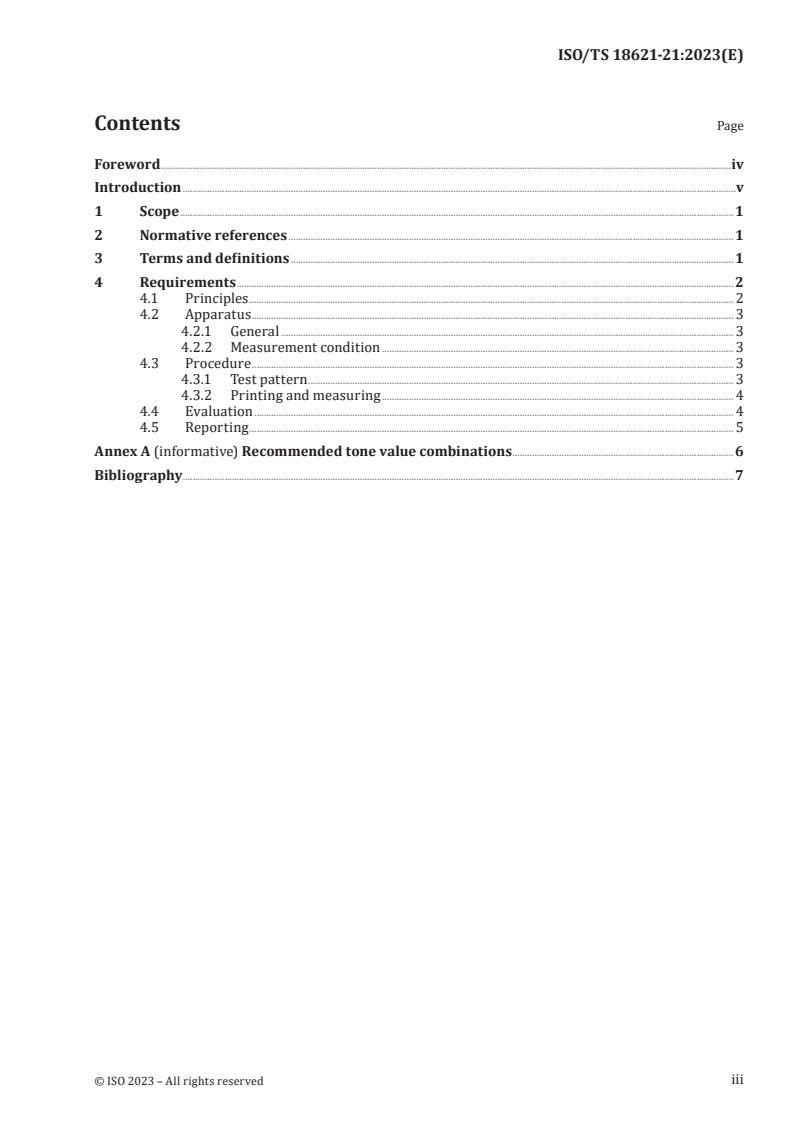
Contents Page
Foreword .iv
Introduction .v
1 Scope . 1
2 Normative references . 1
3 Terms and definitions . 1
4 Requirements . 2
4.1 Principles . 2
4.2 Apparatus . 3
4.2.1 General . 3
4.2.2 Measurement condition . 3
4.3 Procedure . 3
4.3.1 Test pattern . 3
4.3.2 Printing and measuring . 4
4.4 Evaluation . 4
4.5 Reporting . 5
Annex A (informative) Recommended tone value combinations . 6
Bibliography . 7
iii
Foreword
ISO (the International Organization for Standardization) is a worldwide federation of national standards
bodies (ISO member bodies). The work of preparing International Standards is normally carried out
through ISO technical committees. Each member body interested in a subject for which a technical
committee has been established has the right to be represented on that committee. International
organizations, governmental and non-governmental, in liaison with ISO, also take part in the work.
ISO collaborates closely with the International Electrotechnical Commission (IEC) on all matters of
electrotechnical standardization.
The procedures used to develop this document and those intended for its further maintenance are
described in the ISO/IEC Directives, Part 1. In particular, the different approval criteria needed for the
different types of ISO documents should be noted. This document was drafted in accordance with the
editorial rules of the ISO/IEC Directives, Part 2 (see www.iso.org/directives).
Attention is drawn to the possibility that some of the elements of this document may be the subject of
patent rights. ISO shall not be held responsible for identifying any or all such patent rights. Details of
any patent rights identified during the development of the document will be in the Introduction and/or
on the ISO list of patent declarations received (see www.iso.org/patents).
Any trade name used in this document is information given for the convenience of users and does not
constitute an endorsement.
For an explanation of the voluntary nature of standards, the meaning of ISO specific terms and
expressions related to conformity assessment, as well as information about ISO's adherence to
the World Trade Organization (WTO) principles in the Technical Barriers to Trade (TBT), see
www.iso.org/iso/foreword.html.
This document was prepared by Technical Committee ISO/TC 130, Graphic technology.
This second edition cancels and replaces the first edition (ISO/TS 18621-21:2020), which has been
technically revised.
The main changes are as follows:
— Formulae (1) to (6) have been corrected;
— the Bibliography has been updated.
A list of all parts in the ISO 18621 series can be found on the ISO website.
Any feedback or questions on this document should be directed to the user’s national standards body. A
complete listing of these bodies can be found at www.iso.org/members.html.
iv
Introduction
The subject of image quality is broad and complex, due to its multidimensionality and the apparent
characteristics of human vision. Many different methods can be available to provide a measure of a
particular visual attribute in some particular viewing context and aimed at a particular printing
technology. It is a challenge to have image quality evaluation methods that are independent of the
marking technology, i.e. correlate with human perception to provide visual significance to measured
differences across many printing technologies. The evaluation of perceived image quality is an active
field of research.
The uniformity that can be achieved, or in fact the lack thereof, is an important factor in the evaluation
of the overall print quality. Uniformity refers to the subjective impression of the homogeneity of the
colour in extended areas up to the document size. Colour uniformity refers to all types of unintended
but visible variations in colour, that may go in any direction in colour space and may have any spatial
pattern. Spatial patterns include 1D, 2D, periodic, aperiodic, localized, large-scale and small-scale
variations. They can be identified as streaks or streakiness, banding, gradients, mottle, moiré and
others.
When evaluating perceived uniformity, the intended viewing distance should be taken into account. For
practical application it is also common practice to distinguish 2 categories of uniformity that depend on
the spatial frequency (or actually the angular frequency as seen by the eye):
— Microscopic uniformity such as graininess that is related to the imaging process and generally
consists of a 2D random noise pattern. It is visually relevant for image objects as small as few square
mm in size in case of normal reading distance (40 cm).
— Macroscopic uniformity involves distortions in the homogeneity that extend beyond few mm in one
or both geometric dimensions. It is generally visible across the document page size with examples
called banding, cording stripes or streaks.
This document focuses on the macroscopic uniformity that exhibits 1D type patterns that extend more
or less across the printed area of a page. It uses well established colour measurement instruments as
the basic measurement device, especially systems that can be combined with automated XY-tables for
performing well-defined measurements in a complete 2D grid of measurement locations in an easy
way. These systems generally have a minimum pitch in both dimensions of 6 mm. This method takes
a much more rigorous approach than the 9-point sample method that is defined in ISO 12647-7 that is
applicable to proofing systems.
The measurement method derives a single valued Macro-Uniformity-Score on a scale that ranges
from 100 (“perfect uniformity”) to 0 (“extremely poor uniformity”). It is based on the evaluation of
the average colour differences that occur in horizontal and vertical rows separately and adds them up
to arrive at a single value. Then a formula is applied to compute the Macro-Uniformity-Score that is
shown to correlate well with the perception of representative streaks or stripes of toner-based printing
systems as well as inkjet based systems.
This document describes a methodology in such a way that other documents can apply it for specific
use cases. Such documents will typically need to apply additional constraints on test pages and process
control in order to ensure that the resulting Macro-Uniformity-Score can be compared between
different printing devices, substrates and ink sets.
v
TECHNICAL SPECIFICATION ISO/TS 18621-21:2023(E)
Graphic technology — Image quality evaluation methods
for printed matter —
Part 21:
Measurement of 1D distortions of macroscopic uniformity
util
...