

ISO 16014-4:2019
(Main)Plastics — Determination of average molecular weight and molecular weight distribution of polymers using size-exclusion chromatography — Part 4: High-temperature method
General Information
- Abstract
This document specifies a method for determining the average molecular weight and the molecular weight distribution of polymers by size-exclusion chromatography (SEC) using an organic eluent at temperatures between 60 °C and 220 °C (see Annex A). The average molecular weight and the molecular weight distribution are calculated from a calibration curve prepared using polymer standards. Therefore, this test method is classified as a relative method (see ISO 16014-1).
- Status
- Published
- Publication Date
- 14-May-2019
- Technical Committee
- ISO/TC 61/SC 5 - Physical-chemical properties
- Drafting Committee
- ISO/TC 61/SC 5/WG 11 - Analytical methods
- Current Stage
- 9093 - International Standard confirmed
- Start Date
- 06-Jun-2024
- Completion Date
- 29-Aug-2026
Buy Documents
ISO 16014-4:2019 - Plastics -- Determination of average molecular weight and molecular weight distribution of polymers using size-exclusion chromatography
ISO 16014-4:2019 - Plastics — Determination of average molecular weight and molecular weight distribution of polymers using size-exclusion chromatography — Part 4: High-temperature method/15/2019
Overview
ISO 16014-4:2019 - Plastics: Determination of average molecular weight and molecular weight distribution of polymers using size-exclusion chromatography (SEC) - Part 4: High-temperature method specifies a relative SEC method using organic eluents at elevated temperatures (60 °C to 220 °C). The standard defines how to determine average molecular weight and molecular weight distribution from a calibration curve prepared with polymer standards, and it is intended for polymers that require high-temperature dissolution and elution.
Keywords: ISO 16014-4:2019, size-exclusion chromatography, SEC, high-temperature method, molecular weight distribution, average molecular weight, polymers
Key topics and technical requirements
- Scope & principle: Relative SEC method; results calculated from a calibration curve using molecular weight standards (see ISO 16014-1 for general principles).
- Operating temperature: Column and detector operation between 60 °C and 220 °C; column temperature-control within ±0.5 K, injector within ±1 K.
- System performance:
- Pump flow-rate stability to ±0.3%.
- Column set requirements: theoretical plate number > 12 000/m, resolution factor R > 1.5, asymmetry factor 1.00 ± 0.15.
- Automatic injection required (manual injection impractical at high T).
- Reagents & additives: Organic eluents suitable for high temperatures (examples in Annex B); antioxidants such as 2,6‑di‑tert‑butyl‑4‑methylphenol to prevent degradation; recommended filtration to protect columns.
- Calibration & standards: Use narrow-distribution molecular weight standards covering the target range; alternative polymers may be used with universal calibration methods (see ISO 16014-2).
- Data handling: Chromatographic data acquisition, calibration-curve fitting and calculation of average molecular weights and distribution parameters as specified.
Applications and who uses it
- Industries: Polymer manufacturers, plastics processors, quality control laboratories, materials testing labs, and R&D facilities dealing with high‑melting or solvent‑sensitive polymers (e.g., high‑density polyethylene, engineering thermoplastics).
- Use cases:
- Accurate determination of molecular weight distribution for product specification and batch-to-batch control.
- Polymer research and development where thermal dissolution and high-temperature SEC are necessary.
- Failure analysis and characterization when conventional room-temperature SEC cannot dissolve samples.
Related standards
- ISO 16014-1 - General principles for SEC of polymers.
- ISO 16014-2 - Universal calibration method.
- ISO 472, ISO 5725-1, ISO 5725-2 - Terminology and measurement precision guidance referenced by ISO 16014-4:2019.
This standard is essential for laboratories performing high‑temperature SEC to ensure reliable, reproducible molecular weight and molecular weight distribution measurements for thermally demanding polymer systems.
Relations
- Effective Date
- 25-Aug-2026
- Effective Date
- 06-Jun-2022
- Effective Date
- 15-Dec-2017
Buy Documents
ISO 16014-4:2019 - Plastics -- Determination of average molecular weight and molecular weight distribution of polymers using size-exclusion chromatography
ISO 16014-4:2019 - Plastics — Determination of average molecular weight and molecular weight distribution of polymers using size-exclusion chromatography — Part 4: High-temperature method/15/2019
Get Certified
Connect with accredited certification bodies for this standard

DIN CERTCO
DIN Group product certification.

Smithers Quality Assessments
US management systems and product certification.
Sponsored listings
Frequently Asked Questions
ISO 16014-4:2019 is a standard published by the International Organization for Standardization (ISO). Its full title is "Plastics — Determination of average molecular weight and molecular weight distribution of polymers using size-exclusion chromatography — Part 4: High-temperature method". This standard covers: This document specifies a method for determining the average molecular weight and the molecular weight distribution of polymers by size-exclusion chromatography (SEC) using an organic eluent at temperatures between 60 °C and 220 °C (see Annex A). The average molecular weight and the molecular weight distribution are calculated from a calibration curve prepared using polymer standards. Therefore, this test method is classified as a relative method (see ISO 16014-1).
This document specifies a method for determining the average molecular weight and the molecular weight distribution of polymers by size-exclusion chromatography (SEC) using an organic eluent at temperatures between 60 °C and 220 °C (see Annex A). The average molecular weight and the molecular weight distribution are calculated from a calibration curve prepared using polymer standards. Therefore, this test method is classified as a relative method (see ISO 16014-1).
ISO 16014-4:2019 is classified under the following ICS (International Classification for Standards) categories: 83.080.01 - Plastics in general. The ICS classification helps identify the subject area and facilitates finding related standards.
ISO 16014-4:2019 has the following relationships with other standards: It is inter standard links to EN ISO 16014-5:2019, ISO 17829:2025, ISO 16014-4:2012. Understanding these relationships helps ensure you are using the most current and applicable version of the standard.
ISO 16014-4:2019 is available in PDF format for immediate download after purchase. The document can be added to your cart and obtained through the secure checkout process. Digital delivery ensures instant access to the complete standard document.
Standards Content (Sample)
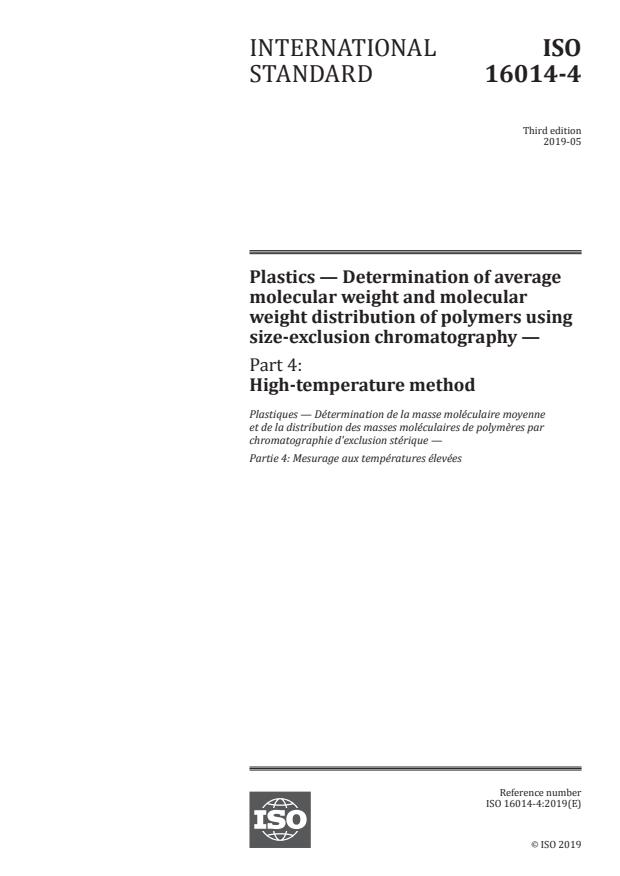
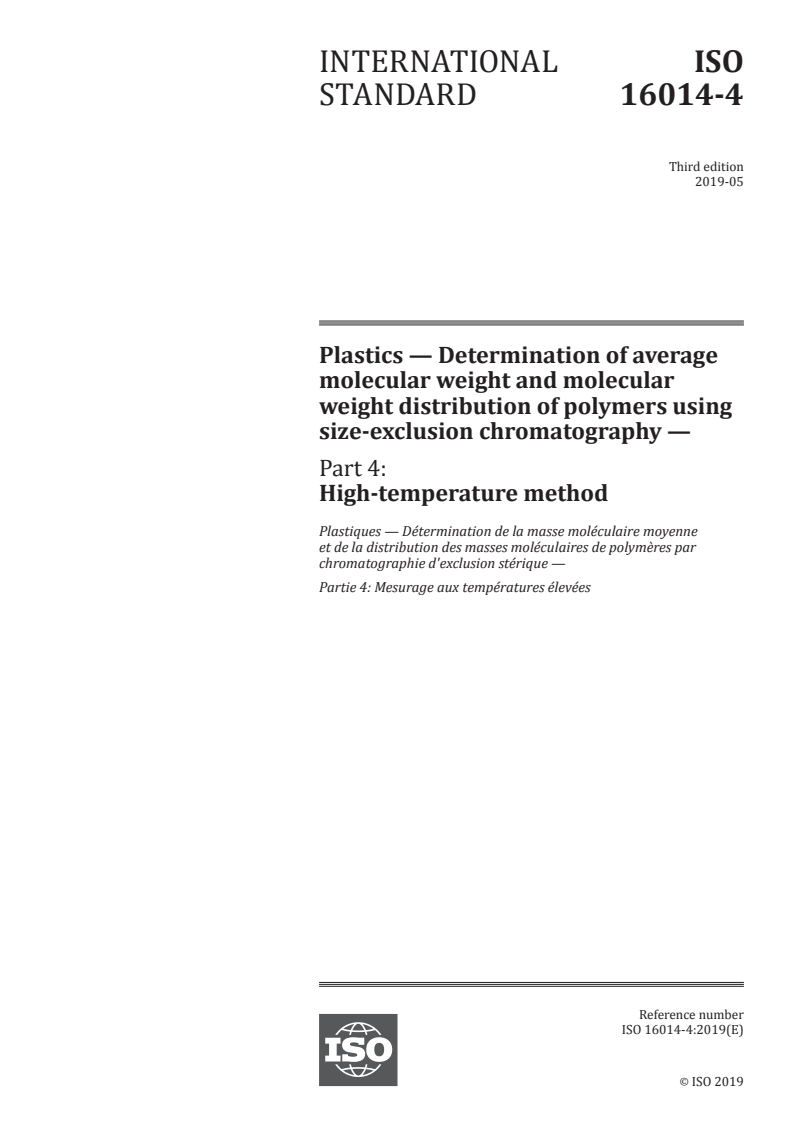
INTERNATIONAL ISO
STANDARD 16014-4
Third edition
2019-05
Plastics — Determination of average
molecular weight and molecular
weight distribution of polymers using
size-exclusion chromatography —
Part 4:
High-temperature method
Plastiques — Détermination de la masse moléculaire moyenne
et de la distribution des masses moléculaires de polymères par
chromatographie d'exclusion stérique —
Partie 4: Mesurage aux températures élevées
Reference number
©
ISO 2019
© ISO 2019
All rights reserved. Unless otherwise specified, or required in the context of its implementation, no part of this publication may
be reproduced or utilized otherwise in any form or by any means, electronic or mechanical, including photocopying, or posting
on the internet or an intranet, without prior written permission. Permission can be requested from either ISO at the address
below or ISO’s member body in the country of the requester.
ISO copyright office
CP 401 • Ch. de Blandonnet 8
CH-1214 Vernier, Geneva
Phone: +41 22 749 01 11
Fax: +41 22 749 09 47
Email: copyright@iso.org
Website: www.iso.org
Published in Switzerland
ii © ISO 2019 – All rights reserved
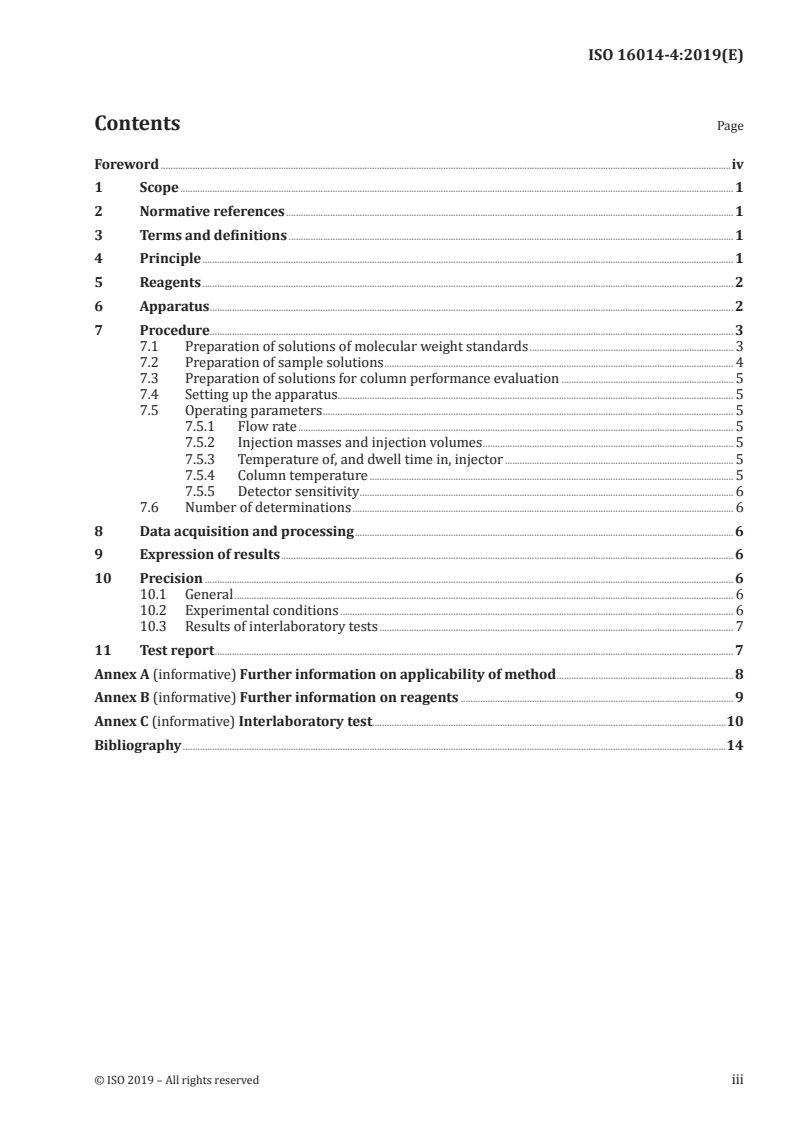
Contents Page
Foreword .iv
1 Scope . 1
2 Normative references . 1
3 Terms and definitions . 1
4 Principle . 1
5 Reagents . 2
6 Apparatus . 2
7 Procedure. 3
7.1 Preparation of solutions of molecular weight standards . 3
7.2 Preparation of sample solutions . 4
7.3 Preparation of solutions for column performance evaluation . 5
7.4 Setting up the apparatus. 5
7.5 Operating parameters . 5
7.5.1 Flow rate . 5
7.5.2 Injection masses and injection volumes . 5
7.5.3 Temperature of, and dwell time in, injector . 5
7.5.4 Column temperature . 5
7.5.5 Detector sensitivity . 6
7.6 Number of determinations . 6
8 Data acquisition and processing . 6
9 Expression of results . 6
10 Precision . 6
10.1 General . 6
10.2 Experimental conditions . 6
10.3 Results of interlaboratory tests . 7
11 Test report . 7
Annex A (informative) Further information on applicability of method . 8
Annex B (informative) Further information on reagents . 9
Annex C (informative) Interlaboratory test.10
Bibliography .14
Foreword
ISO (the International Organization for Standardization) is a worldwide federation of national standards
bodies (ISO member bodies). The work of preparing International Standards is normally carried out
through ISO technical committees. Each member body interested in a subject for which a technical
committee has been established has the right to be represented on that committee. International
organizations, governmental and non-governmental, in liaison with ISO, also take part in the work.
ISO collaborates closely with the International Electrotechnical Commission (IEC) on all matters of
electrotechnical standardization.
The procedures used to develop this document and those intended for its further maintenance are
described in the ISO/IEC Directives, Part 1. In particular, the different approval criteria needed for the
different types of ISO documents should be noted. This document was drafted in accordance with the
editorial rules of the ISO/IEC Directives, Part 2 (see www .iso .org/directives).
Attention is drawn to the possibility that some of the elements of this document may be the subject of
patent rights. ISO shall not be held responsible for identifying any or all such patent rights. Details of
any patent rights identified during the development of the document will be in the Introduction and/or
on the ISO list of patent declarations received (see www .iso .org/patents).
Any trade name used in this document is information given for the convenience of users and does not
constitute an endorsement.
For an explanation of the voluntary nature of standards, the meaning of ISO specific terms and
expressions related to conformity assessment, as well as information about ISO's adherence to the
World Trade Organization (WTO) principles in the Technical Barriers to Trade (TBT) see www .iso
.org/iso/foreword .html.
This document was prepared by Technical Committee ISO/TC 61, Plastics, Subcommittee SC 5, Physical-
chemical properties.
This third edition cancels and replaces the second edition (ISO 16014-4:2012), which has been
technically revised. The main changes compared to the previous edition are as follows:
— publication dates of references have been removed;
— molecular mass has been changed to molecular weight according to IUPAC rule;
— the operating temperature of the columns has been changed into 60 °C to 220 °C.
A list of all parts in the ISO 16014 series can be found on the ISO website.
Any feedback or questions on this document should be directed to the user’s national standards body. A
complete listing of these bodies can be found at www .iso .org/members .html.
iv © ISO 2019 – All rights reserved
INTERNATIONAL STANDARD ISO 16014-4:2019(E)
Plastics — Determination of average molecular weight
and molecular weight distribution of polymers using size-
exclusion chromatography —
Part 4:
High-temperature method
1 Scope
This document specifies a method for determining the average molecular weight and the molecular
weight distribution of polymers by size-exclusion chromatography (SEC) using an organic eluent at
temperatures between 60 °C and 220 °C (see Annex A). The average molecular weight and the molecular
weight distribution are calculated from a calibration curve prepared using polymer standards.
Therefore, this test method is classified as a relative method (see ISO 16014-1).
2 Normative references
The following documents are referred to in the text in such a way that some or all of their content
constitutes requirements of this document. For dated references, only the edition cited applies. For
undated references, the latest edition of the referenced document (including any amendments) applies.
ISO 472, Plastics — Vocabulary
ISO 5725-1, Accuracy (trueness and precision) of measurement methods and results — Part 1: General
principles and definitions
ISO 5725-2, Accuracy (trueness and precision) of measurement methods and results — Part 2: Basic method
for the determination of repeatability and reproducibility of a standard measurement method
ISO 16014-1, Plastics — Determination of average molecular weight and molecular weight distribution of
polymers using size-exclusion chromatography — Part 1: General principles
ISO 16014-2, Plastics — Determination of average molecular mass and molecular mass distribution of
polymers using size-exclusion chromatography — Part 2: Universal calibration method
3 Terms and definitions
For the purposes of this document, the terms and definitions given in ISO 472 and in ISO 16014-1 apply.
ISO and IEC maintain terminological databases for use in standardization at the following addresses:
— ISO Online browsing platform: available at https: //www .iso .org/obp
— IEC Electropedia: available at http: //www .electropedia .org/
4 Principle
According to ISO 16014-1.
5 Reagents
5.1 Eluent.
For a general discussion of eluents, see ISO 16014-1.
For examples of eluents used for SEC measurements at temperatures > 60 °C, see Annex B.
5.2 Reagent for column evaluation, according to ISO 16014-1.
There are several low molecular weight compounds that can be used, for example diphenylmethane when
1,2-dichlorobenzene is used as eluent or ethylbenzene when 1,2,4-trichlorobenzene is used as eluent.
5.3 Molecular weight standards, according to ISO 16014-1.
Some examples of commercially available molecular weight standards are given in Annex B.
5.4 Reagent for flow rate marker (internal standard), according to ISO 16014-1.
An example of a compound suitable for use as a flow rate marker is 2,6-di-tert-butyl-4-methylphenol
when 1,2-dichlorobenzene or 1,2,4-trichlorobenzene is used as eluent. When an IR detector is used as
concentration detector, a low molecular weight aliphatic, like heptane, can be used.
5.5 Additives.
Phenol-type antioxidants such as 2,6-di-tert-butyl-4-methylphenol should preferably be added to avoid
degradation of the polymer sample. For further examples of antioxidants, see Annex B.
6 Apparatus
6.1 General
A schematic diagram of an SEC system is shown in ISO 16014-1.
Either commercially available or assembled SEC systems may be used, provided they meet the
component requirements specified and have the capability to maintain a constant column temperature
between 60 °C and 220 °C. However, components connected upstream of the injector, such as the eluent
reservoir, the pumping system and tubing, does not need to be kept at the same temperature as the
columns.
6.2 Eluent reservoir, according to ISO 16014-1.
As mentioned in 6.1, it is not necessary to keep the eluent reservoir at the same temperature as the
columns.
6.3 Pumping system, according to ISO 16014-1.
In order to maintain the flow rate accurate to within ±0,3 %, the pumping system shall be kept at a
constant temperature. As mentioned in 6.1, it is not, however, necessary to keep the pumping system at
the same temperature as the columns.
6.4 Injector, according to ISO 16014-1.
In order to ensure that the polymer solution remains clear, without any precipitation, the injector
temperature-control equipment shall be capable of keeping the injector at the same temperature, to
within ±1 K, as the columns. As manual injection is impossible at such temperatures, an automatic
injection system shall be used.
2 © ISO 2019 – All rights reserved
6.5 Columns. according to ISO 16014-1.
Organic or inorganic packing materials may be used, and there are no limitations on particle size or
shape except that, when analysing high molecular weight and/or shear-sensitive polymers, the particle
size should be large enough for no rupture of the polymer chain to occur during elution of the polymers.
The set of columns used shall have a theoretical plate number > 12 000/m, and the resolution factor R
shall be > 1,5 close to the polymer peak. The asymmetry factor shall be within the range 1,00 ± 0,15. The
set of columns used should preferably cover the whole range of molecular weights being determined,
and the calibration curve shall be as linear as possible (the correlation factor shall be very close to 1).
Determination of the theoretical plate number, the resolution factor and the asymmetry factor of the
columns shall be carried out as described in ISO 16014-1.
The column temperature-control equipment shall be capable of keeping the columns within ±0,5 K of
the operating temperature, which shall be between 60 °C and 220 °C.
6.6 Detector, according to ISO 16014-1.
The detector temperature-control equipment shall be capable of keeping the detector within ±0,5 K of
the temperature set, in order to meet the requirements for flow rate and baseline stability (sensitivity).
It is recommended that the columns and detector be kept at the same temperature.
6.7 Tubing, according to ISO 16014-1.
The temperature of the tubing shall be kept constant and high enough to ensure that the column
performance requirements are met, but it is not necessary to keep the tubing at the same temperature
as the column.
6.8 Temperature-control unit.
Refer to 6.4 for the injector temperature-control equipment. Refer to 6.5 and 6.6 for the columns and
detector.
One of the important factors in SEC is that all components need to be kept at a constant temperature
and, with the method described in this document, some of them need to be kept at a high temperature.
6.9 Recorder and plotter, according to ISO 16014-1.
6.10 Data-processing system, according to ISO 16014-1.
6.11 Other components.
In addition to the components described above, a column guard filter, a pressure monitor, a pulse
damper or related components can be used, if necessary.
7 Procedure
7.1 Preparation of solutions of molecular weight standards
The molecular weight standards used to prepare the calibration curve should preferably be selected so
as to cover the range of molecular weights of the polymer being analysed and so that there are at least
two standards in e
...
INTERNATIONAL ISO
STANDARD 16014-4
Third edition
2019-05
Plastics — Determination of average
molecular weight and molecular
weight distribution of polymers using
size-exclusion chromatography —
Part 4:
High-temperature method
Plastiques — Détermination de la masse moléculaire moyenne
et de la distribution des masses moléculaires de polymères par
chromatographie d'exclusion stérique —
Partie 4: Mesurage aux températures élevées
Reference number
©
ISO 2019
© ISO 2019
All rights reserved. Unless otherwise specified, or required in the context of its implementation, no part of this publication may
be reproduced or utilized otherwise in any form or by any means, electronic or mechanical, including photocopying, or posting
on the internet or an intranet, without prior written permission. Permission can be requested from either ISO at the address
below or ISO’s member body in the country of the requester.
ISO copyright office
CP 401 • Ch. de Blandonnet 8
CH-1214 Vernier, Geneva
Phone: +41 22 749 01 11
Fax: +41 22 749 09 47
Email: copyright@iso.org
Website: www.iso.org
Published in Switzerland
ii © ISO 2019 – All rights reserved
Contents Page
Foreword .iv
1 Scope . 1
2 Normative references . 1
3 Terms and definitions . 1
4 Principle . 1
5 Reagents . 2
6 Apparatus . 2
7 Procedure. 3
7.1 Preparation of solutions of molecular weight standards . 3
7.2 Preparation of sample solutions . 4
7.3 Preparation of solutions for column performance evaluation . 5
7.4 Setting up the apparatus. 5
7.5 Operating parameters . 5
7.5.1 Flow rate . 5
7.5.2 Injection masses and injection volumes . 5
7.5.3 Temperature of, and dwell time in, injector . 5
7.5.4 Column temperature . 5
7.5.5 Detector sensitivity . 6
7.6 Number of determinations . 6
8 Data acquisition and processing . 6
9 Expression of results . 6
10 Precision . 6
10.1 General . 6
10.2 Experimental conditions . 6
10.3 Results of interlaboratory tests . 7
11 Test report . 7
Annex A (informative) Further information on applicability of method . 8
Annex B (informative) Further information on reagents . 9
Annex C (informative) Interlaboratory test.10
Bibliography .14
Foreword
ISO (the International Organization for Standardization) is a worldwide federation of national standards
bodies (ISO member bodies). The work of preparing International Standards is normally carried out
through ISO technical committees. Each member body interested in a subject for which a technical
committee has been established has the right to be represented on that committee. International
organizations, governmental and non-governmental, in liaison with ISO, also take part in the work.
ISO collaborates closely with the International Electrotechnical Commission (IEC) on all matters of
electrotechnical standardization.
The procedures used to develop this document and those intended for its further maintenance are
described in the ISO/IEC Directives, Part 1. In particular, the different approval criteria needed for the
different types of ISO documents should be noted. This document was drafted in accordance with the
editorial rules of the ISO/IEC Directives, Part 2 (see www .iso .org/directives).
Attention is drawn to the possibility that some of the elements of this document may be the subject of
patent rights. ISO shall not be held responsible for identifying any or all such patent rights. Details of
any patent rights identified during the development of the document will be in the Introduction and/or
on the ISO list of patent declarations received (see www .iso .org/patents).
Any trade name used in this document is information given for the convenience of users and does not
constitute an endorsement.
For an explanation of the voluntary nature of standards, the meaning of ISO specific terms and
expressions related to conformity assessment, as well as information about ISO's adherence to the
World Trade Organization (WTO) principles in the Technical Barriers to Trade (TBT) see www .iso
.org/iso/foreword .html.
This document was prepared by Technical Committee ISO/TC 61, Plastics, Subcommittee SC 5, Physical-
chemical properties.
This third edition cancels and replaces the second edition (ISO 16014-4:2012), which has been
technically revised. The main changes compared to the previous edition are as follows:
— publication dates of references have been removed;
— molecular mass has been changed to molecular weight according to IUPAC rule;
— the operating temperature of the columns has been changed into 60 °C to 220 °C.
A list of all parts in the ISO 16014 series can be found on the ISO website.
Any feedback or questions on this document should be directed to the user’s national standards body. A
complete listing of these bodies can be found at www .iso .org/members .html.
iv © ISO 2019 – All rights reserved
INTERNATIONAL STANDARD ISO 16014-4:2019(E)
Plastics — Determination of average molecular weight
and molecular weight distribution of polymers using size-
exclusion chromatography —
Part 4:
High-temperature method
1 Scope
This document specifies a method for determining the average molecular weight and the molecular
weight distribution of polymers by size-exclusion chromatography (SEC) using an organic eluent at
temperatures between 60 °C and 220 °C (see Annex A). The average molecular weight and the molecular
weight distribution are calculated from a calibration curve prepared using polymer standards.
Therefore, this test method is classified as a relative method (see ISO 16014-1).
2 Normative references
The following documents are referred to in the text in such a way that some or all of their content
constitutes requirements of this document. For dated references, only the edition cited applies. For
undated references, the latest edition of the referenced document (including any amendments) applies.
ISO 472, Plastics — Vocabulary
ISO 5725-1, Accuracy (trueness and precision) of measurement methods and results — Part 1: General
principles and definitions
ISO 5725-2, Accuracy (trueness and precision) of measurement methods and results — Part 2: Basic method
for the determination of repeatability and reproducibility of a standard measurement method
ISO 16014-1, Plastics — Determination of average molecular weight and molecular weight distribution of
polymers using size-exclusion chromatography — Part 1: General principles
ISO 16014-2, Plastics — Determination of average molecular mass and molecular mass distribution of
polymers using size-exclusion chromatography — Part 2: Universal calibration method
3 Terms and definitions
For the purposes of this document, the terms and definitions given in ISO 472 and in ISO 16014-1 apply.
ISO and IEC maintain terminological databases for use in standardization at the following addresses:
— ISO Online browsing platform: available at https: //www .iso .org/obp
— IEC Electropedia: available at http: //www .electropedia .org/
4 Principle
According to ISO 16014-1.
5 Reagents
5.1 Eluent.
For a general discussion of eluents, see ISO 16014-1.
For examples of eluents used for SEC measurements at temperatures > 60 °C, see Annex B.
5.2 Reagent for column evaluation, according to ISO 16014-1.
There are several low molecular weight compounds that can be used, for example diphenylmethane when
1,2-dichlorobenzene is used as eluent or ethylbenzene when 1,2,4-trichlorobenzene is used as eluent.
5.3 Molecular weight standards, according to ISO 16014-1.
Some examples of commercially available molecular weight standards are given in Annex B.
5.4 Reagent for flow rate marker (internal standard), according to ISO 16014-1.
An example of a compound suitable for use as a flow rate marker is 2,6-di-tert-butyl-4-methylphenol
when 1,2-dichlorobenzene or 1,2,4-trichlorobenzene is used as eluent. When an IR detector is used as
concentration detector, a low molecular weight aliphatic, like heptane, can be used.
5.5 Additives.
Phenol-type antioxidants such as 2,6-di-tert-butyl-4-methylphenol should preferably be added to avoid
degradation of the polymer sample. For further examples of antioxidants, see Annex B.
6 Apparatus
6.1 General
A schematic diagram of an SEC system is shown in ISO 16014-1.
Either commercially available or assembled SEC systems may be used, provided they meet the
component requirements specified and have the capability to maintain a constant column temperature
between 60 °C and 220 °C. However, components connected upstream of the injector, such as the eluent
reservoir, the pumping system and tubing, does not need to be kept at the same temperature as the
columns.
6.2 Eluent reservoir, according to ISO 16014-1.
As mentioned in 6.1, it is not necessary to keep the eluent reservoir at the same temperature as the
columns.
6.3 Pumping system, according to ISO 16014-1.
In order to maintain the flow rate accurate to within ±0,3 %, the pumping system shall be kept at a
constant temperature. As mentioned in 6.1, it is not, however, necessary to keep the pumping system at
the same temperature as the columns.
6.4 Injector, according to ISO 16014-1.
In order to ensure that the polymer solution remains clear, without any precipitation, the injector
temperature-control equipment shall be capable of keeping the injector at the same temperature, to
within ±1 K, as the columns. As manual injection is impossible at such temperatures, an automatic
injection system shall be used.
2 © ISO 2019 – All rights reserved
6.5 Columns. according to ISO 16014-1.
Organic or inorganic packing materials may be used, and there are no limitations on particle size or
shape except that, when analysing high molecular weight and/or shear-sensitive polymers, the particle
size should be large enough for no rupture of the polymer chain to occur during elution of the polymers.
The set of columns used shall have a theoretical plate number > 12 000/m, and the resolution factor R
shall be > 1,5 close to the polymer peak. The asymmetry factor shall be within the range 1,00 ± 0,15. The
set of columns used should preferably cover the whole range of molecular weights being determined,
and the calibration curve shall be as linear as possible (the correlation factor shall be very close to 1).
Determination of the theoretical plate number, the resolution factor and the asymmetry factor of the
columns shall be carried out as described in ISO 16014-1.
The column temperature-control equipment shall be capable of keeping the columns within ±0,5 K of
the operating temperature, which shall be between 60 °C and 220 °C.
6.6 Detector, according to ISO 16014-1.
The detector temperature-control equipment shall be capable of keeping the detector within ±0,5 K of
the temperature set, in order to meet the requirements for flow rate and baseline stability (sensitivity).
It is recommended that the columns and detector be kept at the same temperature.
6.7 Tubing, according to ISO 16014-1.
The temperature of the tubing shall be kept constant and high enough to ensure that the column
performance requirements are met, but it is not necessary to keep the tubing at the same temperature
as the column.
6.8 Temperature-control unit.
Refer to 6.4 for the injector temperature-control equipment. Refer to 6.5 and 6.6 for the columns and
detector.
One of the important factors in SEC is that all components need to be kept at a constant temperature
and, with the method described in this document, some of them need to be kept at a high temperature.
6.9 Recorder and plotter, according to ISO 16014-1.
6.10 Data-processing system, according to ISO 16014-1.
6.11 Other components.
In addition to the components described above, a column guard filter, a pressure monitor, a pulse
damper or related components can be used, if necessary.
7 Procedure
7.1 Preparation of solutions of molecular weight standards
The molecular weight standards used to prepare the calibration curve should preferably be selected so
as to cover the range of molecular weights of the polymer being analysed and so that there are at least
two standards in e
...