

ISO/TS 12512:2017
(Main)Glass reinforced thermosetting plastic (GRP) pipes — Determination of initial specific ring stiffness using segment test species cut from a pipe
General Information
- Abstract
ISO/TS 12512:2017 specifies a method for determining the initial specific ring stiffness of pipes having a nominal size of DN 2000 or larger, using segment test pieces cut from a glass-reinforced thermosetting plastics (GRP) pipe.
- Status
- Published
- Publication Date
- 18-Jul-2017
- Drafting Committee
- ISO/TC 138/SC 6/WG 1 - Methods of test
- Current Stage
- 9093 - International Standard confirmed
- Start Date
- 12-Jun-2024
- Completion Date
- 29-Aug-2026
Buy Documents

ISO/TS 12512:2017 - Glass reinforced thermosetting plastic (GRP) pipes — Determination of initial specific ring stiffness using segment test species cut from a pipe Released:19. 07. 2017

ISO/TS 12512:2017 - Glass reinforced thermosetting plastic (GRP) pipes — Determination of initial specific ring stiffness using segment test species cut from a pipe/19/2017
Overview
ISO/TS 12512:2017 defines a test method for measuring the initial specific ring stiffness of large-diameter glass reinforced thermosetting plastic (GRP) pipes (nominal size DN 2000 or larger) using segmental test pieces cut from the pipe. Issued as a Technical Specification, it documents a 79° segment test approach developed to overcome practical difficulties of testing full pipe rings for very large diameters and to support further research, equipment development and correlation work with the established ring test (ISO 7685).
Key topics and technical requirements
- Scope and intent: Applies to GRP pipes DN 2000+ and provides procedure alternatives to full-ring stiffness testing.
- Segment geometry: Uses 79° segment test pieces cut from a pipe ring; dimensions (width, wall thickness, mean diameter) must be measured and recorded.
- Two test methods:
- Method A (constant load) - apply a load producing a target deflection, maintain load for a specified time, measure final deflection.
- Method B (constant deflection) - impose the target deflection, hold for a specified time, measure final load.
- Target deflection basis: The segment deflection is chosen to correspond to the deflection of a full ring deflected to (3 ± 0.5) % in accordance with ISO 7685; conversion factors and finite-element-derived relationships (e.g., α for derived vertical deflection and ξ deflection coefficient) are used to relate segment behaviour to ring behaviour.
- Corrections and factors: The standard includes correction factors such as a load correction factor (β) to account for support positions and geometry when testing segments.
- Apparatus and accuracy: Specifies compressive-loading machines, load application surfaces, measuring instruments and accuracy requirements (loading accuracy ±1% of maximum indicated load).
- Specimen preparation and conditioning: Details on preparation, number of specimens, dimensional measurement and conditioning procedures are included.
- Calculations and reporting: Defines how to calculate specific ring stiffness (S0) and what to include in the test report.
Practical applications
- Quality control and characterization of very large-diameter GRP pipes where full-ring testing is impractical.
- Research and development to refine segment-to-ring correlation, develop test equipment, and evaluate stiffness behaviour.
- Supporting product classification, validation of manufacturing processes and comparative performance testing for infrastructure projects (sewer, water and drainage systems).
Who should use this standard
- Pipe manufacturers and production quality teams
- Independent testing laboratories and R&D groups
- Design engineers and specifiers working with large-diameter GRP piping
- Standards committees and researchers developing improved test correlations
Related standards
- ISO 7685 - Plastics piping systems - GRP pipes - Determination of initial specific ring stiffness (full-ring test). ISO/TS 12512 is intended as a complementary/alternative method and references ISO 7685 for deflection targets and classification context.
Keywords: GRP pipes, glass reinforced thermosetting plastic, initial specific ring stiffness, segment test, DN 2000, ring stiffness test, ISO/TS 12512, ISO 7685, segmental test pieces, Method A, Method B.
Buy Documents
ISO/TS 12512:2017 - Glass reinforced thermosetting plastic (GRP) pipes — Determination of initial specific ring stiffness using segment test species cut from a pipe Released:19. 07. 2017
ISO/TS 12512:2017 - Glass reinforced thermosetting plastic (GRP) pipes — Determination of initial specific ring stiffness using segment test species cut from a pipe/19/2017
Get Certified
Connect with accredited certification bodies for this standard

Institut za varilstvo d.o.o. (Welding Institute)
Slovenia's leading welding institute since 1952. ISO 3834, EN 1090, pressure equipment certification, NDT personnel, welder qualification. Only IIW Au
Sponsored listings
Frequently Asked Questions
ISO/TS 12512:2017 is a technical specification published by the International Organization for Standardization (ISO). Its full title is "Glass reinforced thermosetting plastic (GRP) pipes — Determination of initial specific ring stiffness using segment test species cut from a pipe". This standard covers: ISO/TS 12512:2017 specifies a method for determining the initial specific ring stiffness of pipes having a nominal size of DN 2000 or larger, using segment test pieces cut from a glass-reinforced thermosetting plastics (GRP) pipe.
ISO/TS 12512:2017 specifies a method for determining the initial specific ring stiffness of pipes having a nominal size of DN 2000 or larger, using segment test pieces cut from a glass-reinforced thermosetting plastics (GRP) pipe.
ISO/TS 12512:2017 is classified under the following ICS (International Classification for Standards) categories: 23.040.20 - Plastics pipes. The ICS classification helps identify the subject area and facilitates finding related standards.
ISO/TS 12512:2017 is available in PDF format for immediate download after purchase. The document can be added to your cart and obtained through the secure checkout process. Digital delivery ensures instant access to the complete standard document.
Standards Content (Sample)
TECHNICAL ISO/TS
SPECIFICATION 12512
First edition
2017-07
Glass reinforced thermosetting
plastic (GRP) pipes — Determination
of initial specific ring stiffness using
segment test species cut from a pipe
Tubes en plastique thermodurcissables renforcés de verre (PRV) —
Détermination de la rigidité annulaire spécifique initiale et de la
résistance à la déflexion annulaire initiale en utilisant des éprouvettes
segmentaires découpées dans un tube
Reference number
©
ISO 2017
© ISO 2017, Published in Switzerland
All rights reserved. Unless otherwise specified, no part of this publication may be reproduced or utilized otherwise in any form
or by any means, electronic or mechanical, including photocopying, or posting on the internet or an intranet, without prior
written permission. Permission can be requested from either ISO at the address below or ISO’s member body in the country of
the requester.
ISO copyright office
Ch. de Blandonnet 8 • CP 401
CH-1214 Vernier, Geneva, Switzerland
Tel. +41 22 749 01 11
Fax +41 22 749 09 47
copyright@iso.org
www.iso.org
ii © ISO 2017 – All rights reserved
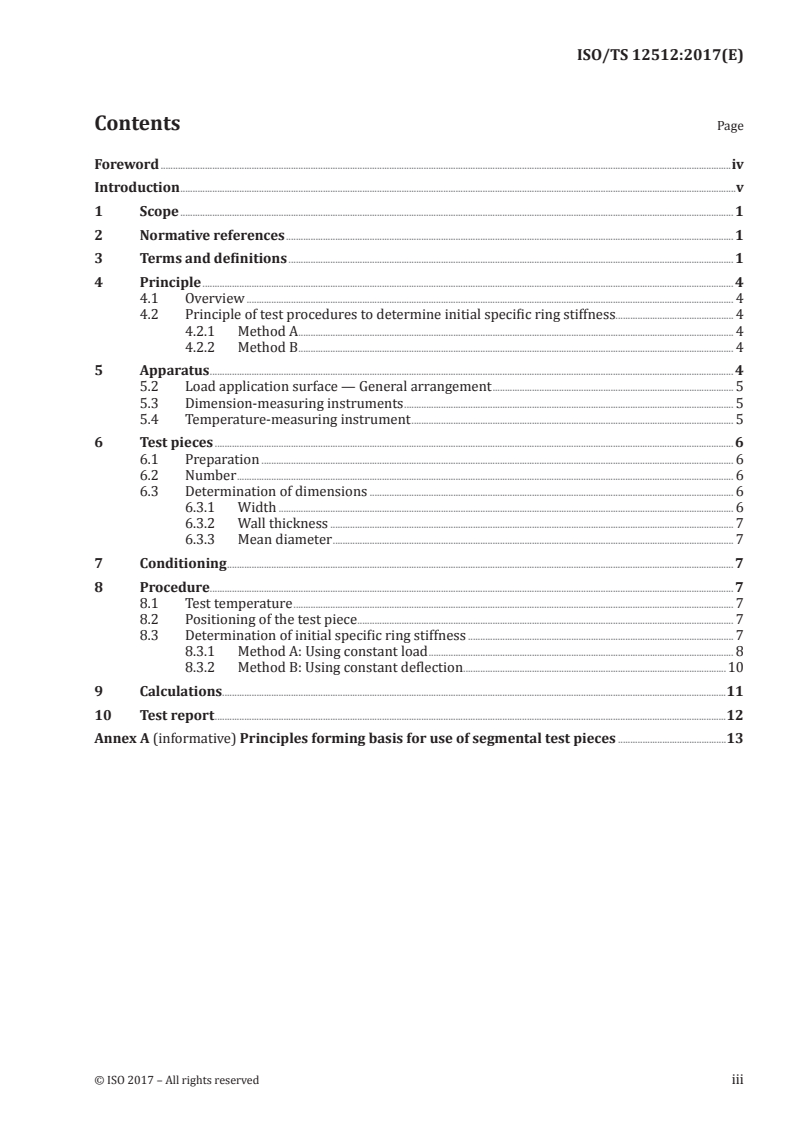
Contents Page
Foreword .iv
Introduction .v
1 Scope . 1
2 Normative references . 1
3 Terms and definitions . 1
4 Principle . 4
4.1 Overview . 4
4.2 Principle of test procedures to determine initial specific ring stiffness . 4
4.2.1 Method A . 4
4.2.2 Method B . 4
5 Apparatus . 4
5.2 Load application surface — General arrangement . 5
5.3 Dimension-measuring instruments . 5
5.4 Temperature-measuring instrument . 5
6 Test pieces . 6
6.1 Preparation . 6
6.2 Number . 6
6.3 Determination of dimensions . 6
6.3.1 Width . 6
6.3.2 Wall thickness . 7
6.3.3 Mean diameter . 7
7 Conditioning . 7
8 Procedure. 7
8.1 Test temperature . 7
8.2 Positioning of the test piece . 7
8.3 Determination of initial specific ring stiffness . 7
8.3.1 Method A: Using constant load . 8
8.3.2 Method B: Using constant deflection . .10
9 Calculations.11
10 Test report .12
Annex A (informative) Principles forming basis for use of segmental test pieces .13
Foreword
ISO (the International Organization for Standardization) is a worldwide federation of national standards
bodies (ISO member bodies). The work of preparing International Standards is normally carried out
through ISO technical committees. Each member body interested in a subject for which a technical
committee has been established has the right to be represented on that committee. International
organizations, governmental and non-governmental, in liaison with ISO, also take part in the work.
ISO collaborates closely with the International Electrotechnical Commission (IEC) on all matters of
electrotechnical standardization.
The procedures used to develop this document and those intended for its further maintenance are
described in the ISO/IEC Directives, Part 1. In particular the different approval criteria needed for the
different types of ISO documents should be noted. This document was drafted in accordance with the
editorial rules of the ISO/IEC Directives, Part 2 (see www .iso .org/ directives).
Attention is drawn to the possibility that some of the elements of this document may be the subject of
patent rights. ISO shall not be held responsible for identifying any or all such patent rights. Details of
any patent rights identified during the development of the document will be in the Introduction and/or
on the ISO list of patent declarations received (see www .iso .org/ patents).
Any trade name used in this document is information given for the convenience of users and does not
constitute an endorsement.
For an explanation on the voluntary nature of standards, the meaning of ISO specific terms and
expressions related to conformity assessment, as well as information about ISO’s adherence to the
World Trade Organization (WTO) principles in the Technical Barriers to Trade (TBT) see the following
URL: w w w . i s o .org/ iso/ foreword .html.
This document was prepared by ISO/TC 138, Plastics pipes, fittings and valves for the transport of fluids,
SC 6, Reinforced plastics pipes and fittings for all applications.
iv © ISO 2017 – All rights reserved
Introduction
This document develops an alternative to the testing of full pipe rings to measure initial specific
ring stiffness (ISO 7685). The goal was to use ring segments which ideally would have led to the use
of smaller and more easily handled test specimens and standard testing machines. Much work was
done on developing equipment for testing ring segments and on the analysis of loading conditions and
calculation procedures and conducting testing programs.
There was neither sufficient nor uniform correlation of segment testing results to standard ring testing
results to allow the use of segment testing as an alternative stiffness test procedure. There were
indications that correlation was perhaps diameter (DN), stiffness class (SN) and pressure class (PN),
as well as specimen width, dependent. As initial ring stiffness (SN) is a key classification parameter for
GRP pipes this resulted in the segment test being not accepted as a viable alternative stiffness testing
procedure.
This document presents the last draft of the segment test method. It was agreed to issue this last
draft as a Technical Specification so that the work done would not be lost and perhaps will allow
interested parties to continue to develop the analysis of loading conditions, equipment development
and calculation procedures. It may also prove useful as a research tool.
TECHNICAL SPECIFICATION ISO/TS 12512:2017(E)
Glass reinforced thermosetting plastic (GRP) pipes —
Determination of initial specific ring stiffness using
segment test species cut from a pipe
1 Scope
This document specifies a method for determining the initial specific ring stiffness of pipes having a
nominal size of DN 2000 or larger, using segment test pieces cut from a glass-reinforced thermosetting
plastics (GRP) pipe.
2 Normative references
The following referenced documents are indispensable for the application of this document. For dated
references, only the edition cited applies. For undated references, the latest edition of the referenced
document (including any amendments) applies.
ISO 7685, Plastics piping systems — Glass-reinforced thermosetting plastics (GRP) pipes — Determination
of initial specific ring stiffness
3 Terms and definitions
For the purposes of this document, the following terms and definitions apply.
ISO and IEC maintain terminological databases for use in standardization at the following addresses:
— IEC Electropedia: available at http:// www .electropedia .org/
— ISO Online browsing platform: available at http:// www .iso .org/ obp
3.1
compressive load
F
load applied to a pipe to cause a diametric deflection
Note 1 to entry: Compressive load is expressed in newtons (N).
3.2
load applied to 79 ° segmental test piece
F
load applied to 79 ° segmental test piece to cause deflection
Note 1 to entry: Load applied to 79 ° segmental test piece is expressed in newtons (N).
3.3
deflection coefficient applied to 79 ° segmental test piece
ξ
coefficient given by Formula (1):
−5
ξ =+1860 2500× yd ×10 (1)
{}()
sm
where
y is the vertical deflection of the pipe ring derived from the 79 ° pipe segment (see 3.7);
s
d is the mean diameter of the pipe ring (see 3.8).
m
Note 1 to entry: Deflection coefficient applied to 79 ° segmental test piece is a dimensionless number.
3.4
vertical deflection
y
vertical change in diameter of a pipe in a horizontal position in response to a vertical compressive
load (3.1)
Note 1 to entry: Vertical deflection is expressed in metres (m).
3.5
relative vertical deflection
y/d
m
ratio of the vertical deflection (3.4) of a pipe, y, to its mean diameter, d (3.8)
m
Note 1 to entry: Relative vertical deflection when multiplied by 100 is expressed in percent (%). Otherwise it is a
dimensionless number.
3.6
derived vertical deflection of pipe segment
y
d
vertical deflection of the pipe segment, using Formula (2), which is derived by finite element analysis of
a pipe ring and which results in the same loading conditions as if the pipe segment were part of a pipe
ring deflected by the vertical deflection y
yy=×α (2)
d 79
where α is the conversion factor for 79 ° segment test piece determined by finite element analysis (see
Table 1).
Note 1 to entry: Derived vertical deflection is expressed in metres (m).
3.7
vertical deflection of pipe ring y derived from 79 ° pipe segment test
s
ratio of the vertical deflection of a pipe ring, to the derived vertical deflection of a 79 ° pipe segment
taken from the same pipe, when the same deflection force is applied to each unit is given by the
following formula:
yy=3,469 (3)
sd
where
y is the vertical deflection of pipe ring;
s
y is the derived vertical deflection of 79° segment.
d
3.8
mean diameter
d
m
diameter of the circle corresponding with the middle of the pipe wall cross-section
It is given by either Formula (4) or (5):
dd=+e (4)
mi
2 © ISO 2017 – All rights reserved
dd=−e (5)
me
where
d is the average of the measured internal diameters (see 6.3.3);
i
d is the average of the measured external diameters (see 6.3.3);
e
e is the average of the measured wall thicknesses of the pipe (see 6.3.2).
Note 1 to entry: Mean diameter is expressed in metres (m) when the wall thickness and diameters are measured
in metres (m).
3.9
specific ring stiffness
S
physical characteristic of the pipe, which is a measure of the resistance to ring deflection under
external load
Note 1 to entry: Specific ring stiffness is determined by testing and is defined, in newtons per square metre
(N/m ), by Formula (6):
SE= Id (6)
m
where
E is the apparent modulus of elasticity as determined in the ring stiffness test, expressed in new-
tons per square metre (N/m );
d is the mean diameter (3.8) of the test piece, in metres;
m
Ι is the second moment of area in the longitudinal direction per metre length, expressed in metres
to the fourth power per metre, i.e.
Ie= /12 (7)
where e is the wall thickness of the test piece, in metres.
3.10
initial specific ring stiffness
S
initial value of S obtained by testing in accordance with this document.
Note 1 to entry: Initial specific ring stiffness is expressed in newtons per square metre (N/m ).
3.13
average width of 79 ° segmental test piece
b
average of three measurements taken at specified locations on the segment test piece (see 6.1 and 6.3.1)
Note 1 to entry: Average width is expressed in metres (m).
3.14
load correction factor
β
factor applied to the measured deflection load F applied to a 79° segment during test
β =−de /d (8)
()
m m
where
d is the mean diameter (see 3.8) of the test piece, in metres;
m
e is the wall thickness of the test piece, in metres
Note 1 to entry: This compensates for the supports being placed at segment the edges instead of centre of
segment edges
4 Principle
4.1 Overview
To overcome problems with the size of the testing equipment and test pieces, when using full rings of
large diameter pipes to determine the initial stiffness, the test procedures described in this document
have been developed using 79 ° segments taken from full rings of pipe. Using formulae given in the
document, the required deflection, to be applied to the segment, is determined which ensures that the
test piece will be subject to the same level of strain as a full ring test piece when testing in accordance
with ISO 7685.
4.2 Principle of test procedures to determine initial specific ring stiffness
A segment of pipe is loaded across its width to deflect it vertically. Two ways are given for doing this:
method A (constant load) and method B (constant deflection), either of which can be used.
4.2.1 Method A
A load is applied to a segment test piece to give a deflection equal to the segment’s deflection when
considered as part of a full ring which is deflected to (3 ± 0,5) % in accordance with ISO 7685. The load is
kept constant for a specified period of time and the final deflection is determined at the end of this period.
4.2.2 Method B
A load is applied to a segment test piece to give a deflection equal to the segment’s deflection when
considered as part of a full ring which is deflected to (3 ± 0,5) % in accordance with ISO 7685. The
deflection is kept constant for a specified period of time and at the end of this period the final load
being applied is determined.
It is assumed that the following test parameters specified in this Test Method will be either accepted or
restated in any International Standard referring to this Test Method:
a) the method to be used (A or B);
b) the width of the test pieces (see 6.1);
c) the number of test pieces (see 6.2);
d) if applicable, the details of conditioning of the test pieces (see Clause 7).
5 Apparatus
5.1 Compressive-loading machine, comprising a system capable of applying, without shock, a
compressive force, F, (suitable for the applicable test method described in Clause 4) at a controlled rate
through a load application surface conforming to 5.2 so that a horizontally orientated segmental test
piece conforming to Clause 6 can be deflected vertically. The accuracy of loading shall be within ± 1 % of
the maximum indicated load.
4 © ISO 2017 – All rights reserved
5.2 Load application surface — General arrangement
The surface shall be provided by a plate (see 5.2.1), or a beam bar (see 5.2.2), with their major axis
perpendicular to and centred on the direction of application of the load, F, by the compressive-loading
machine, as shown in Figures 1 and 2. The surfaces in contact with the test piece shall be flat, smooth,
clean and parallel. A plate or beam bar shall have a length at least equal to the width of the test piece
(see Clause 6) and a thickness such that visible deformation does not occur during the test.
5.2.1 Plate, shall have a width of at least 100 mm.
5.2.2 Beam bar, shall have rounded edges, a flat face (see Figure 1) without sharp edges and a width of
50 mm ± 5 mm. The beam bars shall be designed and supported such that no other surface of the beam
bar structure comes into contact with the test piece during the test.
5.3 Dimension-measuring instruments
Capable of determining:
— the necessary dimensions (length, width, diameter, wall thickness) to an accuracy of within
± 0,1 mm;
— the deflection of the test piece in the vertical direction to an accuracy of within ± 1,0 % of the
maximum value.
5.4 Temperature-measuring instrument
If applicable, capable of verifying conformity to the specified test temperature (see 8.1).
Key
(a) load application using plate 5 wheel, four per sledge
(b) load application using beam bar 6 rail
(c) cross section of beam bar 7 rail support
1 width of flat face, 50 mm ± 5 mm 8 metal plate forming top of beam
2 plate load application surface 9 beam bar load application surface
3 segmental test piece F vertical load applied to test piece
4 sledge to enable free movement of test piece
Figure 1 — Schematic diagram of the alternative load application arrangements
6 Test pieces
6.1 Preparation
Each segmental test piece shall be obtained from a complete ring cut from the pipe to be tested. The
width of the test piece shall be 125 ± 25 mm.
The cut ends shall be smooth and cut on a radial line perpendicular to the axis of the pipe.
Straight lines, to serve as reference lines, shall be drawn on the inside or the outside across the width
of the segmental test piece at three approximately equally spaced intervals around its circumference.
6.2 Number
Three segmental test pieces shall be cut from the complete ring.
6.3 Determination of dimensions
6.3.1 Width
Measure the width, b, of the test piece along each of the three reference lines (see 6.1) to an accuracy
of 0,2 mm.
6 © ISO 2017 – All rights reserved
----------------------
...
TECHNICAL ISO/TS
SPECIFICATION 12512
First edition
2017-07
Glass reinforced thermosetting
plastic (GRP) pipes — Determination
of initial specific ring stiffness using
segment test species cut from a pipe
Tubes en plastique thermodurcissables renforcés de verre (PRV) —
Détermination de la rigidité annulaire spécifique initiale et de la
résistance à la déflexion annulaire initiale en utilisant des éprouvettes
segmentaires découpées dans un tube
Reference number
©
ISO 2017
© ISO 2017, Published in Switzerland
All rights reserved. Unless otherwise specified, no part of this publication may be reproduced or utilized otherwise in any form
or by any means, electronic or mechanical, including photocopying, or posting on the internet or an intranet, without prior
written permission. Permission can be requested from either ISO at the address below or ISO’s member body in the country of
the requester.
ISO copyright office
Ch. de Blandonnet 8 • CP 401
CH-1214 Vernier, Geneva, Switzerland
Tel. +41 22 749 01 11
Fax +41 22 749 09 47
copyright@iso.org
www.iso.org
ii © ISO 2017 – All rights reserved
Contents Page
Foreword .iv
Introduction .v
1 Scope . 1
2 Normative references . 1
3 Terms and definitions . 1
4 Principle . 4
4.1 Overview . 4
4.2 Principle of test procedures to determine initial specific ring stiffness . 4
4.2.1 Method A . 4
4.2.2 Method B . 4
5 Apparatus . 4
5.2 Load application surface — General arrangement . 5
5.3 Dimension-measuring instruments . 5
5.4 Temperature-measuring instrument . 5
6 Test pieces . 6
6.1 Preparation . 6
6.2 Number . 6
6.3 Determination of dimensions . 6
6.3.1 Width . 6
6.3.2 Wall thickness . 7
6.3.3 Mean diameter . 7
7 Conditioning . 7
8 Procedure. 7
8.1 Test temperature . 7
8.2 Positioning of the test piece . 7
8.3 Determination of initial specific ring stiffness . 7
8.3.1 Method A: Using constant load . 8
8.3.2 Method B: Using constant deflection . .10
9 Calculations.11
10 Test report .12
Annex A (informative) Principles forming basis for use of segmental test pieces .13
Foreword
ISO (the International Organization for Standardization) is a worldwide federation of national standards
bodies (ISO member bodies). The work of preparing International Standards is normally carried out
through ISO technical committees. Each member body interested in a subject for which a technical
committee has been established has the right to be represented on that committee. International
organizations, governmental and non-governmental, in liaison with ISO, also take part in the work.
ISO collaborates closely with the International Electrotechnical Commission (IEC) on all matters of
electrotechnical standardization.
The procedures used to develop this document and those intended for its further maintenance are
described in the ISO/IEC Directives, Part 1. In particular the different approval criteria needed for the
different types of ISO documents should be noted. This document was drafted in accordance with the
editorial rules of the ISO/IEC Directives, Part 2 (see www .iso .org/ directives).
Attention is drawn to the possibility that some of the elements of this document may be the subject of
patent rights. ISO shall not be held responsible for identifying any or all such patent rights. Details of
any patent rights identified during the development of the document will be in the Introduction and/or
on the ISO list of patent declarations received (see www .iso .org/ patents).
Any trade name used in this document is information given for the convenience of users and does not
constitute an endorsement.
For an explanation on the voluntary nature of standards, the meaning of ISO specific terms and
expressions related to conformity assessment, as well as information about ISO’s adherence to the
World Trade Organization (WTO) principles in the Technical Barriers to Trade (TBT) see the following
URL: w w w . i s o .org/ iso/ foreword .html.
This document was prepared by ISO/TC 138, Plastics pipes, fittings and valves for the transport of fluids,
SC 6, Reinforced plastics pipes and fittings for all applications.
iv © ISO 2017 – All rights reserved
Introduction
This document develops an alternative to the testing of full pipe rings to measure initial specific
ring stiffness (ISO 7685). The goal was to use ring segments which ideally would have led to the use
of smaller and more easily handled test specimens and standard testing machines. Much work was
done on developing equipment for testing ring segments and on the analysis of loading conditions and
calculation procedures and conducting testing programs.
There was neither sufficient nor uniform correlation of segment testing results to standard ring testing
results to allow the use of segment testing as an alternative stiffness test procedure. There were
indications that correlation was perhaps diameter (DN), stiffness class (SN) and pressure class (PN),
as well as specimen width, dependent. As initial ring stiffness (SN) is a key classification parameter for
GRP pipes this resulted in the segment test being not accepted as a viable alternative stiffness testing
procedure.
This document presents the last draft of the segment test method. It was agreed to issue this last
draft as a Technical Specification so that the work done would not be lost and perhaps will allow
interested parties to continue to develop the analysis of loading conditions, equipment development
and calculation procedures. It may also prove useful as a research tool.
TECHNICAL SPECIFICATION ISO/TS 12512:2017(E)
Glass reinforced thermosetting plastic (GRP) pipes —
Determination of initial specific ring stiffness using
segment test species cut from a pipe
1 Scope
This document specifies a method for determining the initial specific ring stiffness of pipes having a
nominal size of DN 2000 or larger, using segment test pieces cut from a glass-reinforced thermosetting
plastics (GRP) pipe.
2 Normative references
The following referenced documents are indispensable for the application of this document. For dated
references, only the edition cited applies. For undated references, the latest edition of the referenced
document (including any amendments) applies.
ISO 7685, Plastics piping systems — Glass-reinforced thermosetting plastics (GRP) pipes — Determination
of initial specific ring stiffness
3 Terms and definitions
For the purposes of this document, the following terms and definitions apply.
ISO and IEC maintain terminological databases for use in standardization at the following addresses:
— IEC Electropedia: available at http:// www .electropedia .org/
— ISO Online browsing platform: available at http:// www .iso .org/ obp
3.1
compressive load
F
load applied to a pipe to cause a diametric deflection
Note 1 to entry: Compressive load is expressed in newtons (N).
3.2
load applied to 79 ° segmental test piece
F
load applied to 79 ° segmental test piece to cause deflection
Note 1 to entry: Load applied to 79 ° segmental test piece is expressed in newtons (N).
3.3
deflection coefficient applied to 79 ° segmental test piece
ξ
coefficient given by Formula (1):
−5
ξ =+1860 2500× yd ×10 (1)
{}()
sm
where
y is the vertical deflection of the pipe ring derived from the 79 ° pipe segment (see 3.7);
s
d is the mean diameter of the pipe ring (see 3.8).
m
Note 1 to entry: Deflection coefficient applied to 79 ° segmental test piece is a dimensionless number.
3.4
vertical deflection
y
vertical change in diameter of a pipe in a horizontal position in response to a vertical compressive
load (3.1)
Note 1 to entry: Vertical deflection is expressed in metres (m).
3.5
relative vertical deflection
y/d
m
ratio of the vertical deflection (3.4) of a pipe, y, to its mean diameter, d (3.8)
m
Note 1 to entry: Relative vertical deflection when multiplied by 100 is expressed in percent (%). Otherwise it is a
dimensionless number.
3.6
derived vertical deflection of pipe segment
y
d
vertical deflection of the pipe segment, using Formula (2), which is derived by finite element analysis of
a pipe ring and which results in the same loading conditions as if the pipe segment were part of a pipe
ring deflected by the vertical deflection y
yy=×α (2)
d 79
where α is the conversion factor for 79 ° segment test piece determined by finite element analysis (see
Table 1).
Note 1 to entry: Derived vertical deflection is expressed in metres (m).
3.7
vertical deflection of pipe ring y derived from 79 ° pipe segment test
s
ratio of the vertical deflection of a pipe ring, to the derived vertical deflection of a 79 ° pipe segment
taken from the same pipe, when the same deflection force is applied to each unit is given by the
following formula:
yy=3,469 (3)
sd
where
y is the vertical deflection of pipe ring;
s
y is the derived vertical deflection of 79° segment.
d
3.8
mean diameter
d
m
diameter of the circle corresponding with the middle of the pipe wall cross-section
It is given by either Formula (4) or (5):
dd=+e (4)
mi
2 © ISO 2017 – All rights reserved
dd=−e (5)
me
where
d is the average of the measured internal diameters (see 6.3.3);
i
d is the average of the measured external diameters (see 6.3.3);
e
e is the average of the measured wall thicknesses of the pipe (see 6.3.2).
Note 1 to entry: Mean diameter is expressed in metres (m) when the wall thickness and diameters are measured
in metres (m).
3.9
specific ring stiffness
S
physical characteristic of the pipe, which is a measure of the resistance to ring deflection under
external load
Note 1 to entry: Specific ring stiffness is determined by testing and is defined, in newtons per square metre
(N/m ), by Formula (6):
SE= Id (6)
m
where
E is the apparent modulus of elasticity as determined in the ring stiffness test, expressed in new-
tons per square metre (N/m );
d is the mean diameter (3.8) of the test piece, in metres;
m
Ι is the second moment of area in the longitudinal direction per metre length, expressed in metres
to the fourth power per metre, i.e.
Ie= /12 (7)
where e is the wall thickness of the test piece, in metres.
3.10
initial specific ring stiffness
S
initial value of S obtained by testing in accordance with this document.
Note 1 to entry: Initial specific ring stiffness is expressed in newtons per square metre (N/m ).
3.13
average width of 79 ° segmental test piece
b
average of three measurements taken at specified locations on the segment test piece (see 6.1 and 6.3.1)
Note 1 to entry: Average width is expressed in metres (m).
3.14
load correction factor
β
factor applied to the measured deflection load F applied to a 79° segment during test
β =−de /d (8)
()
m m
where
d is the mean diameter (see 3.8) of the test piece, in metres;
m
e is the wall thickness of the test piece, in metres
Note 1 to entry: This compensates for the supports being placed at segment the edges instead of centre of
segment edges
4 Principle
4.1 Overview
To overcome problems with the size of the testing equipment and test pieces, when using full rings of
large diameter pipes to determine the initial stiffness, the test procedures described in this document
have been developed using 79 ° segments taken from full rings of pipe. Using formulae given in the
document, the required deflection, to be applied to the segment, is determined which ensures that the
test piece will be subject to the same level of strain as a full ring test piece when testing in accordance
with ISO 7685.
4.2 Principle of test procedures to determine initial specific ring stiffness
A segment of pipe is loaded across its width to deflect it vertically. Two ways are given for doing this:
method A (constant load) and method B (constant deflection), either of which can be used.
4.2.1 Method A
A load is applied to a segment test piece to give a deflection equal to the segment’s deflection when
considered as part of a full ring which is deflected to (3 ± 0,5) % in accordance with ISO 7685. The load is
kept constant for a specified period of time and the final deflection is determined at the end of this period.
4.2.2 Method B
A load is applied to a segment test piece to give a deflection equal to the segment’s deflection when
considered as part of a full ring which is deflected to (3 ± 0,5) % in accordance with ISO 7685. The
deflection is kept constant for a specified period of time and at the end of this period the final load
being applied is determined.
It is assumed that the following test parameters specified in this Test Method will be either accepted or
restated in any International Standard referring to this Test Method:
a) the method to be used (A or B);
b) the width of the test pieces (see 6.1);
c) the number of test pieces (see 6.2);
d) if applicable, the details of conditioning of the test pieces (see Clause 7).
5 Apparatus
5.1 Compressive-loading machine, comprising a system capable of applying, without shock, a
compressive force, F, (suitable for the applicable test method described in Clause 4) at a controlled rate
through a load application surface conforming to 5.2 so that a horizontally orientated segmental test
piece conforming to Clause 6 can be deflected vertically. The accuracy of loading shall be within ± 1 % of
the maximum indicated load.
4 © ISO 2017 – All rights reserved
5.2 Load application surface — General arrangement
The surface shall be provided by a plate (see 5.2.1), or a beam bar (see 5.2.2), with their major axis
perpendicular to and centred on the direction of application of the load, F, by the compressive-loading
machine, as shown in Figures 1 and 2. The surfaces in contact with the test piece shall be flat, smooth,
clean and parallel. A plate or beam bar shall have a length at least equal to the width of the test piece
(see Clause 6) and a thickness such that visible deformation does not occur during the test.
5.2.1 Plate, shall have a width of at least 100 mm.
5.2.2 Beam bar, shall have rounded edges, a flat face (see Figure 1) without sharp edges and a width of
50 mm ± 5 mm. The beam bars shall be designed and supported such that no other surface of the beam
bar structure comes into contact with the test piece during the test.
5.3 Dimension-measuring instruments
Capable of determining:
— the necessary dimensions (length, width, diameter, wall thickness) to an accuracy of within
± 0,1 mm;
— the deflection of the test piece in the vertical direction to an accuracy of within ± 1,0 % of the
maximum value.
5.4 Temperature-measuring instrument
If applicable, capable of verifying conformity to the specified test temperature (see 8.1).
Key
(a) load application using plate 5 wheel, four per sledge
(b) load application using beam bar 6 rail
(c) cross section of beam bar 7 rail support
1 width of flat face, 50 mm ± 5 mm 8 metal plate forming top of beam
2 plate load application surface 9 beam bar load application surface
3 segmental test piece F vertical load applied to test piece
4 sledge to enable free movement of test piece
Figure 1 — Schematic diagram of the alternative load application arrangements
6 Test pieces
6.1 Preparation
Each segmental test piece shall be obtained from a complete ring cut from the pipe to be tested. The
width of the test piece shall be 125 ± 25 mm.
The cut ends shall be smooth and cut on a radial line perpendicular to the axis of the pipe.
Straight lines, to serve as reference lines, shall be drawn on the inside or the outside across the width
of the segmental test piece at three approximately equally spaced intervals around its circumference.
6.2 Number
Three segmental test pieces shall be cut from the complete ring.
6.3 Determination of dimensions
6.3.1 Width
Measure the width, b, of the test piece along each of the three reference lines (see 6.1) to an accuracy
of 0,2 mm.
6 © ISO 2017 – All rights reserved
----------------------
...