

ISO 15553:2006
(Main)Water quality — Isolation and identification of Cryptosporidium oocysts and Giardia cysts from water
General Information
- Abstract
ISO 15553:2006 specifies a method that is applicable for the detection and enumeration of Cryptosporidium oocysts and Giardia cysts in water. It is applicable for the examination of surface and ground waters, treated waters, mineral waters, swimming pool and recreational waters. This method does not allow identification to species level, the host species of origin or the determination of viability or infectivity of any Cryptosporidium oocyst or Giardia cyst which may be present. These procedures are for use by experienced analysts who have successfully completed competency tests prior to commencing analysis.
- Status
- Published
- Publication Date
- 12-Nov-2006
- Technical Committee
- ISO/TC 147/SC 4 - Microbiological methods
- Drafting Committee
- ISO/TC 147/SC 4 - Microbiological methods
- Current Stage
- 9060 - Close of review
- Completion Date
- 02-Sep-2031
Buy Documents


ISO 15553:2006 - Water quality -- Isolation and identification of Cryptosporidium oocysts and Giardia cysts from water
ISO 15553:2006 - Water quality — Isolation and identification of Cryptosporidium oocysts and Giardia cysts from water/13/2006
Overview
ISO 15553:2006 - Water quality: Isolation and identification of Cryptosporidium oocysts and Giardia cysts from water specifies a validated laboratory method for the detection and enumeration of Cryptosporidium oocysts and Giardia cysts in water. The method applies to surface and ground waters, treated and mineral waters, swimming pools and recreational waters. It defines sampling, concentration, purification and microscopic identification steps, but does not determine species, host origin, viability or infectivity.
Key topics and technical requirements
- Sample volumes & sampling: Procedure supports small (≈10 L) to large (up to 1 000 L) sample volumes; choice depends on water type, turbidity and required sensitivity. On-site filtration may be needed for large volumes.
- Concentration by filtration and elution: Uses cartridge or membrane filtration systems (examples: Pall Envirochek STD/HV, IDEXX Filta-Max®) and manufacturer-specified elution buffers and pumps.
- Further concentration & purification: Immunomagnetic separation (IMS) using paramagnetic beads coated with specific antibodies to isolate oocysts/cysts from particulate matter.
- Staining & detection: Fluorescent monoclonal antibodies (e.g. FITC conjugates) plus nuclear stains (DAPI) are used. Examination is by epifluorescence combined with differential interference contrast (DIC) microscopy (total magnification ~1 000×).
- Equipment & reagents: Typical lab apparatus includes peristaltic pumps, centrifuges, magnetic particle concentrators, well slides, calibrated micropipettes and appropriate reagents/buffers (reagent preparation is detailed in annexes).
- Quality control & competency: For reliable results, analysts must be experienced, pass competency tests, perform regular recovery/positive control checks (Annex D), and participate in external quality assurance schemes. Annexes provide performance data and alternative methods.
Practical applications and users
- Environmental and public health laboratories monitoring microbial contamination in drinking water, source waters and recreational facilities.
- Water suppliers and utilities conducting routine surveillance and incident investigations.
- Regulatory agencies and consultants performing compliance testing, risk assessment and outbreak response. Practical benefits include standardized procedures for comparable recoveries, documented QC, and guidance for selecting filtration and concentration techniques suited to sample type and turbidity.
Related information
- Prepared by ISO/TC 147 (Water quality), Subcommittee SC4 (Microbiological methods).
- Annexes cover reagent preparation, small-volume concentration, calibration of eyepiece graticules, recovery testing, performance data and alternative approaches.
Keywords: ISO 15553:2006, water quality standard, Cryptosporidium oocysts, Giardia cysts, immunomagnetic separation (IMS), filtration and elution, fluorescence microscopy, environmental testing, drinking water monitoring.
Relations
- Effective Date
- 06-Jun-2022
Buy Documents
ISO 15553:2006 - Water quality -- Isolation and identification of Cryptosporidium oocysts and Giardia cysts from water
ISO 15553:2006 - Water quality — Isolation and identification of Cryptosporidium oocysts and Giardia cysts from water/13/2006
Frequently Asked Questions
ISO 15553:2006 is a standard published by the International Organization for Standardization (ISO). Its full title is "Water quality — Isolation and identification of Cryptosporidium oocysts and Giardia cysts from water". This standard covers: ISO 15553:2006 specifies a method that is applicable for the detection and enumeration of Cryptosporidium oocysts and Giardia cysts in water. It is applicable for the examination of surface and ground waters, treated waters, mineral waters, swimming pool and recreational waters. This method does not allow identification to species level, the host species of origin or the determination of viability or infectivity of any Cryptosporidium oocyst or Giardia cyst which may be present. These procedures are for use by experienced analysts who have successfully completed competency tests prior to commencing analysis.
ISO 15553:2006 specifies a method that is applicable for the detection and enumeration of Cryptosporidium oocysts and Giardia cysts in water. It is applicable for the examination of surface and ground waters, treated waters, mineral waters, swimming pool and recreational waters. This method does not allow identification to species level, the host species of origin or the determination of viability or infectivity of any Cryptosporidium oocyst or Giardia cyst which may be present. These procedures are for use by experienced analysts who have successfully completed competency tests prior to commencing analysis.
ISO 15553:2006 is classified under the following ICS (International Classification for Standards) categories: 07.100.20 - Microbiology of water. The ICS classification helps identify the subject area and facilitates finding related standards.
ISO 15553:2006 has the following relationships with other standards: It is inter standard links to ISO 5167-5:2016. Understanding these relationships helps ensure you are using the most current and applicable version of the standard.
ISO 15553:2006 is available in PDF format for immediate download after purchase. The document can be added to your cart and obtained through the secure checkout process. Digital delivery ensures instant access to the complete standard document.
Standards Content (Sample)
2003-01.Slovenski inštitut za standardizacijo. Razmnoževanje celote ali delov tega standarda ni dovoljeno.Kakovost vode - Izolacija in identifikacija oocist Cryptosporidium in cist GiardiaQualité de l'eau - Isolement et identification des oocystes de Cryptosporidium et des kystes de GiardiaWater quality - Isolation and identification of Cryptosporidium oocysts and Giardia cysts from water07.100.20Mikrobiologija vodeMicrobiology of waterICS:Ta slovenski standard je istoveten z:ISO 15553:2006SIST ISO 15553:2010en01-september-2010SIST ISO 15553:2010SLOVENSKI
STANDARD
Reference numberISO 15553:2006(E)© ISO 2006
INTERNATIONAL STANDARD ISO15553First edition2006-11-15Water quality — Isolation and identification of Cryptosporidium oocysts and Giardia cysts from water Qualité de l'eau — Isolement et identification des oocystes de Cryptosporidium et des kystes de Giardia SIST ISO 15553:2010
©
ISO 2006 All rights reserved. Unless otherwise specified, no part of this publication may be reproduced or utilized in any form or by any means, electronic or mechanical, including photocopying and microfilm, without permission in writing from either ISO at the address below or ISO's member body in the country of the requester. ISO copyright office Case postale 56 • CH-1211 Geneva 20 Tel.
+ 41 22 749 01 11 Fax
+ 41 22 749 09 47 E-mail
copyright@iso.org Web
www.iso.org Published in Switzerland
ii © ISO 2006 – All rights reserved
Preparation of reagents.16 Annex B (informative)
Concentration of oocysts and cysts from small (10 l) volumes of water.19 Annex C (informative)
Calibration of eyepiece graticule.24 Annex D (informative)
Preparation of positive controls and recovery tests.25 Annex E (informative)
Examples of indicative performance data.28 Annex F (informative)
Alternative methods.30 Annex G (informative)
Further information about Cryptosporidium and Giardia.31 Annex H (informative)
Details of manufacturers.32 Bibliography.36
INTERNATIONAL STANDARD ISO 15553:2006(E) © ISO 2006 – All rights reserved 1Water quality — Isolation and identification of Cryptosporidium oocysts and Giardia cysts from water 1 Scope This International Standard specifies a method that is applicable for the detection and enumeration of Cryptosporidium oocysts and Giardia cysts in water. It is applicable for the examination of surface and ground waters, treated waters, mineral waters, swimming pool and recreational waters. This method does not allow identification to species level, the host species of origin or the determination of viability or infectivity of any Cryptosporidium oocyst or Giardia cyst which may be present. These procedures are for use by experienced analysts who have successfully completed competency tests prior to commencing analysis. In addition, such analysts should continue to demonstrate competency by examining seeded samples at regular intervals and taking part in external quality assurance schemes. NOTE Bodies resembling Cryptosporidium or Giardia in morphology can be present and these may be mistaken for oocysts or cysts. Results should be interpreted with care. Where there is doubt about the identity of oocysts or cysts or where an unusually high result is obtained, it is advisable to have the slides examined by experts from other laboratories to confirm or refute the findings. 2 Terms and definitions For the purposes of this document, the following terms and definitions apply. 2.1 Cryptosporidium protozoan parasite, concentrated and selected from water samples with the methods described, which reacts with specific anti-Cryptosporidium antibodies and exhibits the typical morphological characteristics described in 7.4 of this International Standard NOTE A more complete definition of the parasite and the different genotypes and species is given in Annex G. 2.2 Giardia protozoan parasite, concentrated and selected from water samples with the methods described, which reacts with specific anti-Giardia antibodies and exhibits the typical morphological characteristics described in 7.4 of this International Standard NOTE A more complete definition of the parasite and the different species is given in Annex G. 3 Principle 3.1 Concentration from water The isolation of Cryptosporidium and Giardia from water requires the use of a procedure which allows the volume of the sample to be reduced whilst retaining any oocysts and cysts. The concentration procedure used however, is dependent upon the water type which is to be analysed, the volume of sample and the amount of particulate material in the sample. This document describes the use of two concentration techniques for varying volumes of water using cartridge filtration and elution followed by low speed centrifugation (7.1). Additional methods for the recovery of oocysts and cysts from small volumes of water or very turbid waters are given in Annex B. Some examples of recovery data for these techniques are given in Annex E. SIST ISO 15553:2010
3.2 Purification and further concentration After concentration of particulate material from filter eluates, oocysts and cysts are isolated using immunomagnetic separation (IMS) (7.2). Oocysts and cysts are attached to para-magnetic beads coated with specific antibody, the beads are separated from the unwanted particulate material using a magnet and then the oocysts and cysts are dissociated from the beads using acid and neutralized using alkali before immunostaining. 3.3 Detection of Cryptosporidium and Giardia After IMS, organisms are labelled with monoclonal antibody (mAb) conjugated to a fluorochrome, usually fluoroscein isothiocyanate (FITC). In addition, any nuclear material is labelled with a nucleic acid stain to aid identification (7.3). Each sample is then examined for the presence of labelled Cryptosporidium oocysts and Giardia cysts using epifluorescence and differential interference contrast (DIC) microscopy (7.4). 4 Reagents 4.1 Reagents required for eluting Pall EnvirochekTM STD capsule filters 1) 4.1.1 Deionized water, 0,2 µm filtered at the point of use. 4.1.2 Laureth 12 detergent. 4.1.3 Tris buffer, pH 7,4 (A.1.1). 4.1.4 EDTA solution, 0,5 mol/l, pH 8,0 (A.1.2). 4.1.5 Antifoam A. 4.1.6 Elution buffer (A.1.3). 4.2 Reagents required for eluting Pall EnvirochekTM HV capsule filters 1) 4.2.1 Deionized water, 0,2 µm filtered at point of use. 4.2.2 Pre-treatment buffer (A.1.4). 4.2.3 Laureth 12 detergent
1) All products and reagents are examples of suitable products available commercially. This information is given for the convenience of users of this International Standard and does not constitute an endorsement by ISO of these products. SIST ISO 15553:2010
2) All apparatus are examples of suitable products available commercially. This information is given for the convenience of users of this International Standard and does not constitute an endorsement by ISO of these products. SIST ISO 15553:2010
Warming all the elution solutions to 37 °C improves the removal of particulate material. Elution is also helped by increasing the shaking speed to 900 cpm. 7.1.3 Idexx Filta-Max® Filtration The elution apparatus consists of an upper and lower wash tube (5.2.10), a wash station (5.2.8) and a vacuum set (5.2.9) designed to reduce the volume of the eluate to 50 ml through a membrane (5.2.11). The elution procedure is as follows: Place a membrane filter (rough surface uppermost) in the base of the lower wash tube and put the tube into the base. Make sure that the membrane is held securely and that the tap on the base is closed. Unscrew the housing top using the tools provided, remove the filter module from its housing and screw it into the plunger head of the wash station. Pour any residual water in the filter housing into the lower wash tube. Place the upper part of the wash tube into the jaws of the wash station and lower the filter module down through the tube. Using the key provided, remove the retaining screw from the filter module. The filter should begin to expand. Screw the stainless steel tube into the base of the upper wash tube. Pour approximately 600 ml of wash buffer into the lower wash tube and run a small volume of buffer through the membrane by opening the tap on the base of the lower wash tube. Attach the lower wash tube to the upper wash tube. Pump the plunger up and down four or five times to help the filter module expand. If the filter does not expand, leave it soaking in elution buffer for 5 min, occasionally pumping the plunger to help filter expansion. Pump the plunger up and down as far as it will travel 20 times only. Disconnect the lower wash tube, pressing the plunger 5 times to remove any residual elution buffer from the foam rings. Rinse the stainless steel tube with elution buffer and plug the end with the small rubber bung provided. Place the elution tube on a magnetic stirrer. Locate the magnetic stirring bar into the top of the elution tube and set the stirrer such that the liquid in the tube is mixed. Connect the vacuum pump and open the tap on the base of the wash tube. If the sample has little turbidity and the catch bottle is placed below the wash tube, liquid will flow by gravity through the membrane. For turbid liquids, apply a vacuum of no greater than 40 kPa (30 cm of mercury) to filter the washings through the membrane. Should the membrane become blocked, decant washings into a clean bottle, remove the membrane to a plastic bag (5.2.12) and place a fresh membrane into the lower wash tube with the smooth surface uppermost. SIST ISO 15553:2010
Count badly distorted and damaged objects with care, particularly when no typical oocysts or cysts are observed on a slide. NOTE 1 The majority of Cryptosporidium oocysts appear spherical or slightly ovoid with brighter even staining around the entire circumference. Some oocysts can deviate from this description. Those which have been in the environment for some time can be weakly stained or appear fuzzy. They may still have contents and sporozoite nuclei can be identified. Often oocysts are split as if a segment has been removed. Under these circumstances, the oocyst may have ruptured during drying on the slide and sporozoites and sporozoite nuclei may be evident adjacent to the oocyst. In addition, oocysts, especially those without contents, may appear to be distorted or partially folded. NOTE 2 The majority of Giardia cysts appear ovoid (8 µm to 12 µm × 7 µm to 10 µm), however, on occasion, cysts may appear spherical with dimensions of ap
...
INTERNATIONAL ISO
STANDARD 15553
First edition
2006-11-15
Water quality — Isolation and
identification of Cryptosporidium oocysts
and Giardia cysts from water
Qualité de l'eau — Isolement et identification des oocystes de
Cryptosporidium et des kystes de Giardia
Reference number
©
ISO 2006
PDF disclaimer
This PDF file may contain embedded typefaces. In accordance with Adobe's licensing policy, this file may be printed or viewed but
shall not be edited unless the typefaces which are embedded are licensed to and installed on the computer performing the editing. In
downloading this file, parties accept therein the responsibility of not infringing Adobe's licensing policy. The ISO Central Secretariat
accepts no liability in this area.
Adobe is a trademark of Adobe Systems Incorporated.
Details of the software products used to create this PDF file can be found in the General Info relative to the file; the PDF-creation
parameters were optimized for printing. Every care has been taken to ensure that the file is suitable for use by ISO member bodies. In
the unlikely event that a problem relating to it is found, please inform the Central Secretariat at the address given below.
© ISO 2006
All rights reserved. Unless otherwise specified, no part of this publication may be reproduced or utilized in any form or by any means,
electronic or mechanical, including photocopying and microfilm, without permission in writing from either ISO at the address below or
ISO's member body in the country of the requester.
ISO copyright office
Case postale 56 • CH-1211 Geneva 20
Tel. + 41 22 749 01 11
Fax + 41 22 749 09 47
E-mail copyright@iso.org
Web www.iso.org
Published in Switzerland
ii © ISO 2006 – All rights reserved
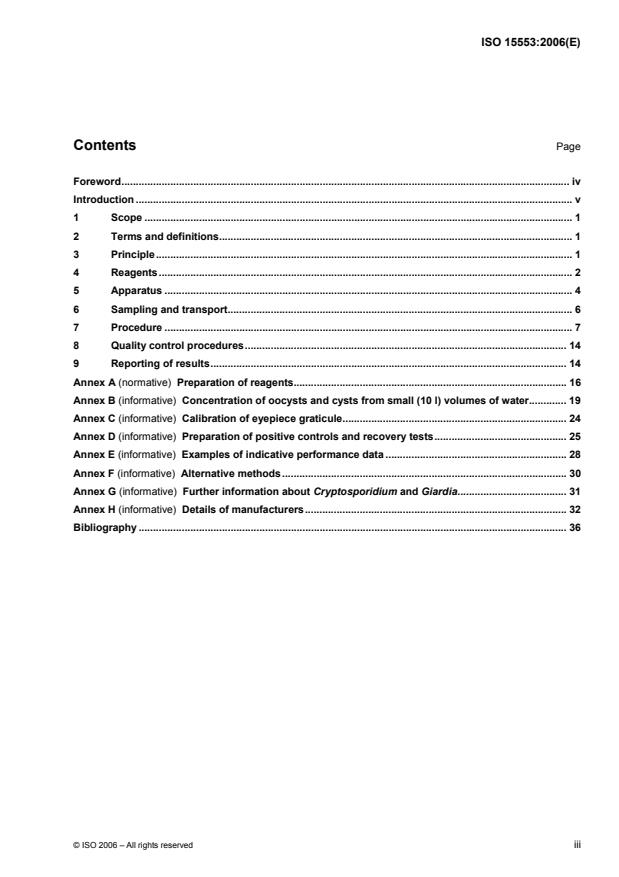
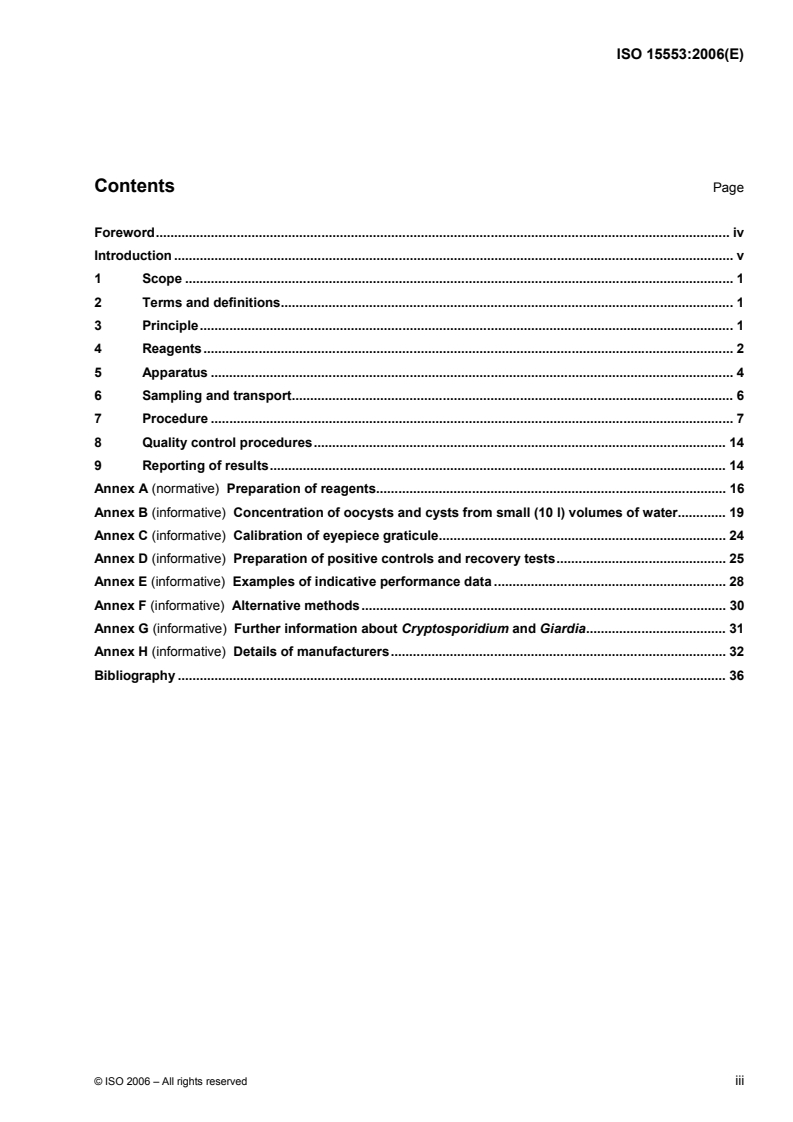
Contents Page
Foreword. iv
Introduction . v
1 Scope . 1
2 Terms and definitions. 1
3 Principle. 1
4 Reagents. 2
5 Apparatus . 4
6 Sampling and transport. 6
7 Procedure . 7
8 Quality control procedures. 14
9 Reporting of results. 14
Annex A (normative) Preparation of reagents. 16
Annex B (informative) Concentration of oocysts and cysts from small (10 l) volumes of water. 19
Annex C (informative) Calibration of eyepiece graticule. 24
Annex D (informative) Preparation of positive controls and recovery tests. 25
Annex E (informative) Examples of indicative performance data . 28
Annex F (informative) Alternative methods. 30
Annex G (informative) Further information about Cryptosporidium and Giardia. 31
Annex H (informative) Details of manufacturers. 32
Bibliography . 36
Foreword
ISO (the International Organization for Standardization) is a worldwide federation of national standards bodies
(ISO member bodies). The work of preparing International Standards is normally carried out through ISO
technical committees. Each member body interested in a subject for which a technical committee has been
established has the right to be represented on that committee. International organizations, governmental and
non-governmental, in liaison with ISO, also take part in the work. ISO collaborates closely with the
International Electrotechnical Commission (IEC) on all matters of electrotechnical standardization.
International Standards are drafted in accordance with the rules given in the ISO/IEC Directives, Part 2.
The main task of technical committees is to prepare International Standards. Draft International Standards
adopted by the technical committees are circulated to the member bodies for voting. Publication as an
International Standard requires approval by at least 75 % of the member bodies casting a vote.
Attention is drawn to the possibility that some of the elements of this document may be the subject of patent
rights. ISO shall not be held responsible for identifying any or all such patent rights.
ISO 15553 was prepared by Technical Committee ISO/TC 147, Water quality, Subcommittee SC 4,
Microbiological methods.
iv © ISO 2006 – All rights reserved
Introduction
Cryptosporidium and Giardia are protozoan parasites that can cause enteric illness in humans. Both
organisms are characterized by an ability to survive in the aquatic environment. Cryptosporidium in particular
is resistant to chlorine at the concentrations used in the treatment of drinking and swimming pool waters.
Consequently the absence of vegetative bacteria as indicators of faecal contamination does not necessarily
indicate the absence of Cryptosporidium oocysts or Giardia cysts. The methods described in this document
may be used to determine whether Cryptosporidium and/or Giardia are present in water supplies. The
techniques have been selected on the basis of method development and peer review publication of the data
thus obtained. They are further selected to give comparable recoveries of the methods or reagents used in the
isolation of the organisms.
INTERNATIONAL STANDARD ISO 15553:2006(E)
Water quality — Isolation and identification of Cryptosporidium
oocysts and Giardia cysts from water
1 Scope
This International Standard specifies a method that is applicable for the detection and enumeration of
Cryptosporidium oocysts and Giardia cysts in water. It is applicable for the examination of surface and ground
waters, treated waters, mineral waters, swimming pool and recreational waters.
This method does not allow identification to species level, the host species of origin or the determination of
viability or infectivity of any Cryptosporidium oocyst or Giardia cyst which may be present. These procedures
are for use by experienced analysts who have successfully completed competency tests prior to commencing
analysis. In addition, such analysts should continue to demonstrate competency by examining seeded
samples at regular intervals and taking part in external quality assurance schemes.
NOTE Bodies resembling Cryptosporidium or Giardia in morphology can be present and these may be mistaken for
oocysts or cysts. Results should be interpreted with care. Where there is doubt about the identity of oocysts or cysts or
where an unusually high result is obtained, it is advisable to have the slides examined by experts from other laboratories
to confirm or refute the findings.
2 Terms and definitions
For the purposes of this document, the following terms and definitions apply.
2.1
Cryptosporidium
protozoan parasite, concentrated and selected from water samples with the methods described, which reacts
with specific anti-Cryptosporidium antibodies and exhibits the typical morphological characteristics described
in 7.4 of this International Standard
NOTE A more complete definition of the parasite and the different genotypes and species is given in Annex G.
2.2
Giardia
protozoan parasite, concentrated and selected from water samples with the methods described, which reacts
with specific anti-Giardia antibodies and exhibits the typical morphological characteristics described in 7.4 of
this International Standard
NOTE A more complete definition of the parasite and the different species is given in Annex G.
3 Principle
3.1 Concentration from water
The isolation of Cryptosporidium and Giardia from water requires the use of a procedure which allows the
volume of the sample to be reduced whilst retaining any oocysts and cysts. The concentration procedure used
however, is dependent upon the water type which is to be analysed, the volume of sample and the amount of
particulate material in the sample. This document describes the use of two concentration techniques for
varying volumes of water using cartridge filtration and elution followed by low speed centrifugation (7.1).
Additional methods for the recovery of oocysts and cysts from small volumes of water or very turbid waters
are given in Annex B. Some examples of recovery data for these techniques are given in Annex E.
Table 1 — Membrane filters/filtration systems used for the concentration of parasites
from water samples
Membrane filter/filtration system Application
Concentration of 10-litre to 200-litre (or more) samples of
TM a
Pall Envirochek STD
water
TM
Pall Envirochek HV Concentration of 10-litre to 1 000-litre samples of water ®
IDEXX Filta-Max Concentration of 10-litre to 1 000-litre samples of water
a
It has been shown by some laboratories that this technique may be used successfully for larger volumes of
water although the manufacturers’ instructions may only include volumes up to 200 litres.
3.2 Purification and further concentration
After concentration of particulate material from filter eluates, oocysts and cysts are isolated using
immunomagnetic separation (IMS) (7.2). Oocysts and cysts are attached to para-magnetic beads coated with
specific antibody, the beads are separated from the unwanted particulate material using a magnet and then
the oocysts and cysts are dissociated from the beads using acid and neutralized using alkali before
immunostaining.
3.3 Detection of Cryptosporidium and Giardia
After IMS, organisms are labelled with monoclonal antibody (mAb) conjugated to a fluorochrome, usually
fluoroscein isothiocyanate (FITC). In addition, any nuclear material is labelled with a nucleic acid stain to aid
identification (7.3). Each sample is then examined for the presence of labelled Cryptosporidium oocysts and
Giardia cysts using epifluorescence and differential interference contrast (DIC) microscopy (7.4).
4 Reagents
TM 1)
4.1 Reagents required for eluting Pall Envirochek STD capsule filters
4.1.1 Deionized water, 0,2 µm filtered at the point of use.
4.1.2 Laureth 12 detergent.
4.1.3 Tris buffer, pH 7,4 (A.1.1).
4.1.4 EDTA solution, 0,5 mol/l, pH 8,0 (A.1.2).
4.1.5 Antifoam A.
4.1.6 Elution buffer (A.1.3).
TM 1)
4.2 Reagents required for eluting Pall Envirochek HV capsule filters
4.2.1 Deionized water, 0,2 µm filtered at point of use.
4.2.2 Pre-treatment buffer (A.1.4).
4.2.3 Laureth 12 detergent
1) All products and reagents are examples of suitable products available commercially. This information is given for the
convenience of users of this International Standard and does not constitute an endorsement by ISO of these products.
2 © ISO 2006 – All rights reserved
4.2.4 Tris buffer, pH 7,4 (A.1.1).
4.2.5 EDTA solution, 0,5 mol/l, pH 8,0 (A.1.2).
4.2.6 Antifoam A.
4.2.7 Elution buffer (A.1.3).
® 1)
4.3 Reagents required for eluting IDEXX Filta-Max filters
4.3.1 Phosphate buffered saline (PBS) (A.2.1).
4.3.2 Polyoxyethylene(20)sorbitan monolaurate (Tween 20).
Store at room temperature (20 ± 5) °C. Expiry date one year.
4.3.3 Elution buffer (A.2.2).
4.4 Concentration and detection reagents
4.4.1 Methanol, analytical grade.
4.4.2 Magnetic beads, for the detection of Cryptosporidium and Giardia.
Expiry date printed by the manufacturer.
NOTE See Annex H for a list of suitable suppliers.
4.4.3 Fluorescently labelled monoclonal antibodies (mAbs) against Cryptosporidium and Giardia.
Store at (5 ± 3) °C. Expiry date as stated by the manufacturer. When stains are prepared from concentrated
material using a diluent supplied by the manufacturer, the prepared solution is stored at (5 ± 3) °C for no
longer than 6 months.
NOTE See Annex H for a list of suitable suppliers.
4.4.4 Immunofluorescence mounting medium (A.3.1).
NOTE See Annex H for a list of suitable suppliers.
4.4.5 4′,6′-Diamidino-2-phenylindole dihydrochloride dihydrate (DAPI) freeze dried reagent.
Store according to the manufacturer's instructions.
Expiry date printed by the manufacturer on each vial.
4.4.6 DAPI stock solution (A.3.2).
4.4.7 DAPI working solution (A.3.3).
4.4.8 Phosphate buffered saline (PBS) (A.2.1).
4.4.9 Non-fluorescing immersion oil.
Store at room temperature (20 ± 5) °C.
4.4.10 Stock suspensions of Cryptosporidium parvum oocysts and Giardia lamblia cysts.
Store at (5 ± 3) °C, never allow the suspension to freeze and check quality regularly. Ideally, suspensions of
oocysts and cysts should be no more than 3 months old. Stock suspensions should be checked
microscopically to confirm that they are monodispersed and discarded if clumps or aggregates are detected.
In addition, if mAb and DAPI staining become weak and oocysts become deformed, they should also be
discarded.
4.4.11 Parasite storage medium (A.3.4).
5 Apparatus
Use usual laboratory equipment and, in particular, the following.
TM 2)
5.1 Scientific apparatus, required for concentration using Pall Envirochek STD or HV.
TM
5.1.1 Sampling capsule, Envirochek STD or HV (Pall).
5.1.2 Peristaltic pump, capable of a flow rate of 2 l/min.
5.1.3 Silicon tubing, for use with the peristaltic pump.
5.1.4 Seeding container, 10 l, if seeding filters is required.
TM
5.1.5 Wrist-action shaker, with arms for the agitation of the Envirochek STD or HV sample capsules.
5.1.6 Centrifuge, capable of a minimum of 1 100 g.
5.1.7 Centrifuge tubes, conical, plastic, screwtop, 250 ml capacity.
5.1.8 Centrifuge tubes, conical, plastic, screwtop, 50 ml capacity.
NOTE A flow meter and flow restrictor are required for taking water samples with the filter.
® 2)
5.2 Specific apparatus, required for concentration using IDEXX Filta-Max . ®
5.2.1 Sampling housing, Idexx Filta-Max . ®
5.2.2 Sampling module, Idexx Filta-Max . ®
5.2.3 Filter membranes, Idexx Filta-Max .
5.2.4 Laboratory pump, capable of supplying 500 kPa (5 bar) pressure.
5.2.5 Peristaltic pump, capable of flow rate of 4 l/min.
5.2.6 Silicon tubing, for use with peristaltic pump.
5.2.7 Seeding container, 10 l, if seeding filters is required. ®
5.2.8 Wash station, automatic or manual, and wash station clamp set, Idexx Filta-Max .
5.2.9 Vacuum set, includes plastic hand pump, waste bottle, tubing and magnetic stirring bar. Idexx ®
Filta-Max .
2) All apparatus are examples of suitable products available commercially. This information is given for the convenience
of users of this International Standard and does not constitute an endorsement by ISO of these products.
4 © ISO 2006 – All rights reserved
5.2.10 Tubing set, includes elution tube, and middle section, concentrator tube and base, with line tap and ®
steel rod Idexx Filta-Max .
5.2.11 Membrane, for tubing set.
5.2.12 Plastic bag, for washing membrane.
5.2.13 Centrifuge, capable of 1 100 g.
5.2.14 Centrifuge tubes, conical, plastic, 50 ml capacity.
5.2.15 Forceps.
NOTE A flow meter and flow restrictor are required for taking water samples with the filter.
2)
5.3 General apparatus .
5.3.1 Incubator, at (36 ± 2) °C.
5.3.2 Refrigerator, at (5 ± 3) °C.
5.3.3 Magnetic stirrer, and magnetic stirring bars.
5.3.4 Vortex mixer.
5.3.5 Wash bottles, polypropylene, 250 ml.
5.3.6 Calibrated micropipettes, adjustable: 1 µl to 10 µl with 1 µl to 10 µl tips; 20 µl to 200 µl with 10 µl to
200 µl tips; 200 µl to 1 000 µl with 100 µl to 1 000 µl tips.
5.3.7 pH meter.
5.3.8 Magnetic particle concentrators, with suitable tubes.
5.3.9 Well microscope slides, with special hydrophobic coating and coverslips.
5.3.10 Epifluorescence microscope, with a UV filter (350 nm excitation, 450 nm emission), FITC filter
TM
(480 nm excitation, 520 nm emission) filters, differential interference contrast (DIC) optics and an eye piece
graticule. Total magnification 1 000 ×.
5.3.11 Microscope stage micrometer, 1 mm, ruled in 100 units.
5.3.12 Eyepiece graticule, ruled in 100 units.
5.3.13 Humidity chamber, e.g. consisting of a tightly sealed plastic container containing damp paper towels
on which the slides are placed.
5.3.14 10 l containers, graduated in 1 l.
5.3.15 Neubauer haemocytometer slide.
6 Sampling and transport
The size of the sample is dependent on the type of water being sampled, the purpose of the analysis, the
sensitivity to be achieved and the speed with which the result is required. Small volume samples (10 l to 100 l)
can be collected in the field and transported and analysed quickly whereas large volume samples (1 000 l)
require on-site filtration. Filtration may take up to 24 h because of a restricted flow rate through the filter. Small
volume samples (10 l) will give an indication of water quality at the time of sampling whereas large volumes
(1 000 l) will give an indication of water quality over an extended period. Since the concentration of
Cryptosporidium and Giardia is usually very low, large test volumes (10 l to 1 000 l) are required. The volume
to be examined may be dictated by regulatory limits.
For large volume filtration, connect the device in-line with the water supply, making sure that the flow through
the filter is in the direction indicated on the housing by the manufacturer. A flow meter should be included with
the filter and this should be read before and after sampling. If the filter is to be transported to the laboratory, it
should be sealed, after sampling, with end caps provided by the manufacturer. Due care shall be taken to
ensure that the flow rates do not exceed those recommended by the manufacturers of the filtration devices.
Take small volume grab samples and transport them to the laboratory in the dark at ambient temperature.
Once at the laboratory, samples should be stored at (5 ± 3) °C unless they are to be analysed immediately.
Samples should be analysed preferably within 24 h of collection and no longer than 4 d.
If the samples are filtered in the field, transport the filters in the dark at ambient temperature. Once at the
laboratory, samples should be stored at (5 ± 3) °C unless they are to be analysed immediately. Samples
should be analysed preferably within 24 h of collection and no longer than 4 d. If filters are stored at (5 ± 3) °C,
they shall be allowed to warm to room temperature before elution starts.
No information is available to date on the behaviour of Cryptosporidium and Giardia during sample or filter
storage. It is therefore advisable to examine the samples as soon after sampling as possible.
A pre-treatment step using sodium polyphosphate before the elution buffer was introduced to improve the
removal of particulate material bound to the filter.
TM
NOTE 1 The Envirochek STD filter consists of a pleated polyether sulfone membrane sealed in a polycarbonate
shell. The filter is supported on a loose polypropylene support. It is supplied packaged with two end caps which can be
used to seal the filter. The filter can be connected to a water supply by connecting to a ribbed inlet and the direction of flow
through the filter is clearly marked. The flow through the filter should not exceed 2,3 l/min and the differential pressure
across the filter should not exceed 210 kPa (2,1 bar).
TM
NOTE 2 The Envirochek HV capsule is comprised of 1 µm pore size polyester track-etched membrane permanently
enclosed in a polycarbonate housing. The polyester membrane is directly laminated to a polypropylene support which
TM
offers a significant strength improvement over the standard Envirochek STD. The capsule housing burst strength
exceeds 1 000 kPa (10 bar) and the differential pressure across the filter membrane is rated to 410 kPa (4,1 bar). Each
TM
Envirochek HV capsule is 100 % integrity tested after assembly to ensure product performance. The effective filtration
TM 2
area of the Envirochek HV is 1 300 cm . The filter is supplied with two end caps which can be used to seal the filter for
transport to the laboratory. The filter can be supplied with a tamper evident label containing a unique identification number.
TM
The flow through the Envirochek HV should not exceed 3,4 l/min. ®
NOTE 3 The Filta-Max filter consists of a foam filter module comprising 60 open cell reticulated foam discs with an
external diameter of 55 mm and an internal diameter of 15 mm. The discs are sandwiched between two retaining plates
and compressed by tightening a retaining bolt to give a nominal porosity of 1 µm. The filter module fits into a filter housing
which has a screw top and seal. The filter housing has stainless steel barbed inlet and outlet ports. The sample enters
through the lid of the housing and exits through the base. Water flows into the housing, through the compressed foam
rings into the centre of the module and through the outlet port. Removal of the retaining bolt during the elution stage allows
the filter to expand during washing. Filter housings are supplied with two tools for the removal of the top and two rubber ®
bungs to seal water in the sample. After sampling, Filta-Max should be kept wet during storage and transportation. If
stored or transported in the filter housing, the inlet and outlet should be securely plugged with the rubber stoppers
provided. During transportation or storage, the filter module may be removed from the housing and aseptically placed in
an airtight container along with several milliliters of additional deionized water.
6 © ISO 2006 – All rights reserved
7 Procedure
7.1 Concentration
TM
7.1.1 Pall Envirochek STD Filtration
Support the filter vertically with the white bleed valve uppermost. Remove the two end caps and allow any
water in the sample to drain out through the filter. Replace the bottom end cap, fill the cartridge with elution
buffer (4.1.6) through the inlet fitting until it covers the filter by approximately 1 cm. Replace the upper end cap
and secure the cartridge horizontally into the wrist shaker (5.1.5) with the white bleed valve in the 12 o’clock
position. Shake at 600 cycles per minute (cpm) ± 25 cpm for 5 min ± 30 s.
Remove the upper end cap and pour the washings into a 250 ml conical centrifuge tube (5.1.7). Add a further
aliquot of elution buffer into the capsule, replace the upper end cap and shake for a further 5 min ± 30 s.
Ensure that the white bleed valve is in the 3 o’clock or 9 o’clock position.
After 5 min of shaking, remove the upper end cap and decant the washings into the 250 ml centrifuge tube
and centrifuge at 1 100 × g for 15 min without braking during the deceleration phase. Record the pellet volume
(volume of solids) immediately after centrifugation.
A second centrifugation step may be required in a 50 ml centrifuge tube in order to measure the volume.
Alternatively, 50 ml centrifuge tubes may be used to concentrate the particulate material eluted from the filter.
Using a pipette and a vacuum source of less than 20 kPa (0,2 bar), carefully aspirate off the supernatant
leaving 2 ml to 5 ml above the pellet. If no pellet is visible, extra care shall taken to avoid aspirating oocysts
and cysts during this step.
Add deionized water to the centrifuge tube to bring the total volume to 9 ml. Vortex the tube for 10 s to 15 s to
resuspend the pellet and either store the sample at (5 ± 3) °C for future IMS or proceed directly to 7.2.
If the pellet volume exceeds that recommended by the manufacturer of the IMS test kit, centrifuge the sample
a second time in a tube that permits the pellet volume to be measured accurately. Subdivide the sample into
aliquots for IMS such that each aliquot represents the maximum pellet volume recommended by the
manufacturer and make up each aliquot to 9 ml with deionized water.
TM
7.1.2 Pall Envirochek HV Filtration
Support the filter vertically with the white bleed valve uppermost. Remove the two end caps and allow any
water in the sample to drain out through the filter. Replace the bottom end cap, fill the cartridge with
pre-treatment buffer (4.2.2) through the inlet fitting until it covers the filter by approximately 1 cm. Replace the
upper end cap and secure the cartridge horizontally into the wrist shaker (5.1.5) with the white bleed valve in
the vertical position. Shake at 600 cycles per minute (cpm) ± 25 cpm for 5 min ± 30 s.
Secure the filter vertically with the white bleed valve uppermost, remove the end caps and allow the
pre-treatment buffer to drain out through the filter. Replace the bottom end cap and fill the cartridge as above
with deionized water (4.2.1). Replace the upper end cap and rinse the membrane by gently rotating the filter
for 30 s. Secure the filter vertically, remove the end caps and allow the deionized water to drain out through
the filter.
Replace the bottom end cap, fill the cartridge with elution buffer (4.2.7) through the inlet fitting until it covers
the filter by approximately 1 cm. Replace the upper end cap and secure the cartridge into the wrist shaker
(5.1.5) with the white bleed valve in the 12 o’clock position. Shake at 600 cpm ± 25 cpm for 5 min ± 30 s.
Remove the upper end cap and pour the washings into a 250 ml conical centrifuge tube (5.1.7). Add a further
aliquot of elution buffer into the capsule, replace the upper end cap and shake for a further 5 min ± 30 s.
Ensure that the white bleed valve is in the 4 o’clock position. After 5 min of shaking, turn the filter such that the
white valve is in the 8 o’clock position and shake for a further 5 min.
Remove the upper end cap and decant the washings into the 250 ml centrifuge tube and centrifuge at 1 100 g
for 15 min without braking during the deceleration phase. Record the pellet volume (volume of solids)
immediately after centrifugation.
A second centrifugation step may be required in a 50 ml centrifuge tube in order to measure the volume.
Alternatively, 50 ml centrifuge tubes may be used to concentrate the particulate material eluted from the filter.
Using a pipette and a vacuum source of less than 20 kPa (0,2 bar), carefully aspirate off the supernatant
leaving 2 ml to 5 ml above the pellet. If no pellet is visible, extra care shall be taken to avoid aspirating oocysts
and cysts during this step.
Add deionized water to the centrifuge tube to bring the total volume to 9 ml. Vortex the tube for 10 s to 15 s to
re-suspend the pellet and either store the sample at (5 ± 3) °C for IMS or proceed directly to 7.2.
If the pellet volume exceeds that recommended by the manufacturer of the IMS test kit, centrifuge the sample
a second time in a tube that permits the pellet volume to be measured accurately. Subdivide the sample into
aliquots for IMS such that each aliquot represents the maximum pellet volume recommended by the
manufacturer and make up each aliquot to 9 ml with deionized water.
NOTE Warming all the elution solutions to 37 °C improves the removal of particulate material. Elution is also helped
by increasing the shaking speed to 900 cpm. ®
7.1.3 Idexx Filta-Max Filtration
The elution apparatus consists of an upper and lower wash tube (5.2.10), a wash station (5.2.8) and a vacuum
set (5.2.9) designed to reduce the volume of the eluate to 50 ml through a membrane (5.2.11). The elution
procedure is as follows:
Place a membrane filter (rough surface uppermost) in the base of the lower wash tube and put the tube into
the base. Make sure that the membrane is held securely and that the tap on the base is closed.
Unscrew the housing top using the tools provided, remove the filter module from its housing and screw it into
the plunger head of the wash station. Pour any residual water in the filter housing into the lower wash tube.
Place the upper part of the wash tube into the jaws of the wash station and lower the filter module down
through the tube.
Using the key provided, remove the retaining screw from the filter module. The filter should begin to expand.
Screw the stainless steel tube into the base of the upper wash tube.
Pour approximately 600 ml of wash buffer into the lower wash tube and run a small volume of buffer through
the membrane by opening the tap on the base of the lower wash tube. Attach the lower wash tube to the
upper wash tube. Pump the plunger up and down four or five times to help the filter module expand. If the filter
does not expand, leave it soaking in elution buffer for 5 min, occasionally pumping the plunger to help filter
expansion.
Pump the plunger up and down as far as it will travel 20 times only. Disconnect the lower wash tube, pressing
the plunger 5 times to remove any residual elution buffer from the foam rings. Rinse the stainless steel tube
with elution buffer and plug the end with the small rubber bung provided. Place the elution tube on a magnetic
stirrer. Locate the magnetic stirring bar into the top of the elution tube and set the stirrer such that the liquid in
the tube is mixed. Connect the vacuum pump and open the tap on the base of the wash tube.
If the sample has little turbidity and the catch bottle is placed below the wash tube, liquid will flow by gravity
through the membrane. For turbid liquids, apply a vacuum of no greater than 40 kPa (30 cm of mercury) to
filter the washings through the membrane.
Should the membrane become blocked, decant washings into a clean bottle, remove the membrane to a
plastic bag (5.2.12) and place a fresh membrane into the lower wash tube with the smooth surface uppermost.
8 © ISO 2006 – All rights reserved
Pour the liquid back into the wash tube, rinsing the bottle, and continue the filtration process. Each membrane
shall be washed in a separate bag.
When the washings fall to approximately half way up the stirring bar (approximately 30 ml), close the tap and
disconnect the vacuum pump and water trap. Pour the liquid in the wash tube into a 50 ml centrifuge tube
(5.2.14).
Add a further 600 ml of elution buffer to the lower wash tube and attach it to the wash station. Repeat the
washing procedure using only 10 strokes of the plunger. Remove the lower wash tube, rinsing the stainless
steel tube, place it on the stirrer and attach the stirring bar. Concentrate the filter washing down to
approximately one inch above the stirring bar as described above. Add the contents of the first elution to the
wash tube and continue reducing the volume of eluate until it is again half way up the magnetic bar. Remove
the stirring bar and pour the filter washings (approximately 30 ml) into the centrifuge tube.
Unscrew the wash tube from the base and carefully remove the membrane filter with fine forceps. Add the
filter to the bag provided together with 5 ml of elution buffer. Seal the bag and wash the filter by rubbing
between fingers and thumb for (60 ± 10) s. Pipette off the washings and add to the 50 ml centrifuge tube.
Repeat the wash procedure and add the second washings to the centrifuge tube. Make up the volume in the
tube to 50 ml with elution buffer.
Centrifuge the 50 ml tube at 1 100 × g for 15 min without braking during the deceleration phase.
Record the pellet volume (volume of solids) immediately after centrifugation.
Using a Pasteur pipette and a vacuum source of less than 20 kPa (0,2 bar), carefully aspirate off the
supernatant leaving 2 ml to 5 ml above the pellet. If no pellet is visible, extra care shall taken to avoid
aspirating oocysts and cysts during this step.
Add deionized water to the centrifuge tube to bring the total volume to 9 ml. Vortex the tube for 10 s to 15 s to
re-suspend the pellet and either store the sample at (5 ± 3) °C for IMS or proceed directly to 7.2.
If the pellet volume exceeds that recommended by the manufacturer of the IMS test kit, centrifuge the sample
a second time in a tube that permits the pellet volume to be measured accurately. Subdivide the sample into
aliquots for IMS such that each aliquot represents the maximum pellet volume recommended by the
manufacturer and make up each aliquot to 9 ml with deionized water.
NOTE 1 The manufacturers provide a compact disc with the apparatus with full instructions on the assembly and
operation of the equipment.
NOTE 2 An automated wash station is now available (see Annex H).
Clean the wash tubes with hot water and detergent followed by thorough rinsing in warm water and filtered
deionized water.
NOTE 3 Where a number of samples from different sources are examined routinely, it is advantageous to have a
separate wash tube set and plunger dedicated to each site to minimize cross contamination.
7.2 Immunomagnetic separation (IMS)
This technique involves the attachment of oocysts and cysts to magnetic beads coated with antibodies to
either Cryptosporidium or Giardia. The oocyst or cyst-bead complex is separated from interfering particles in
the water concentrate by using a magnet. After separation, the oocysts and cysts are dissociated from the
beads by acid treatment. Oocysts and cysts are transferred in suspension to a microscope slide and the
magnetisable beads are discarded.
No detailed instructions can be given in this International Standard because commercial test kits are the only
validated methods available for IMS. The test kits shall be used according to the manufacturer's instructions.
NOTE 1 For details of the manufacturers of IMS test kits, see Annex H.
NOTE 2 Automated capture and concentration equipment is now available, see Annex H.
7.3 Sample staining
Label an appropriate well slide with the sample number and the sample volume analysed (the whole of the
sample should be analysed).
After addition of NaOH to the wells of the slide, distribute aliquots of the suspension containing the separated
oocysts and cysts (7.2) onto the wells.
NOTE 1 The volume of the NaOH and the sample added to each well will depend on the size of the wells.
Prepare two separate well slides with positive and negative controls. The positive control shall consist of a
suspension of Cryptosporidium and Giardia containing a known number of parasites (Annex D). The negative
control shall consist of filtered deionized water or PBS. Further positive and negative controls shall be
included with each batch of samples stained.
Place the well slides containing the samples in an incubator at (36 ± 2) °C or no higher than 42 °C and
evaporate to dryness.
Apply a drop of methanol (4.4.1) to each well containing the dried sample and allow to air dry at (20 ± 5) °C.
Overlay the sample well with FITC fluorescently labelled monoclonal antibodies (mAb) (4.4.3).
Place the slides in a humidity chamber (5.3.13), if required, and incubate at (36 ± 2) °C for the time specified
by the manufacturer of the conjugated antibodies.
NOTE 2 The exact volumes and times depend on the type of antibodies and well slides used.
After incubation, remove the slides from the humidity chamber and gently aspirate excess labelled mAb from
the side of each well. When performing this step, ensure that the pipette tip does not touch the well surface.
Apply 1 drop of 4′,6′-diamidino-2-phenylindole (DAPI) solution (4.4.7) to each well. Allow to stand at room
temperature (20 ± 5) °C for 2 min.
NOTE 3 This timing applies only to slides that have been methanol fixed and subsequently dried.
Remove excess DAPI solution by aspiration (as described above).
Apply a drop of filtered deionized water to each well and then aspirate the excess deionized water (as
described above).
NOTE 4 An additional washing step using 0,01 M PBS, pH 7,2 is sometimes used before washing with deionized water.
Allow slides to dry at room temperature (20 ± 5) °C or in an incubator at (36 ± 2) °C.
Store the slides in the dark at (5 ± 3) °C until ready for examination. The slides should be examined as soon
after processing as possible and shall be examined the next day.
NOTE 5 Slides have been kept for up to three months in the dark and retained their fluorescence. No detailed
investigations have been carried out, however, concerning the loss of fluorescence or DAPI staining upon storage. Keep
the slide dry and mount it before examination.
Before the examination, apply approximately 20 µl of slide mountant (4.4.4) to the edge of the well on the
sample slide, taking care not to touch the slide with the pipette tip.
Place a coverslip onto the slide, taking care not to create bubbles in the slide mountant (4.4.4). Seal the edges
of the coverslip with clear nail polish.
Alternatively, the mounting medium may be pipetted onto the centre of the coverslip and the slide carefully
inverted and placed on the coverslip. The slide can then be carefully turned over with the coverslip uppermost.
Take care to avoid trapping air bubbles between the slide and the coverslip.
10 © ISO 2006 – All rights reserved
7.4 Microscopy
7.4.1 General
Use an epifluorescence microscope fitted with DIC (5.3.10) for analysis of all sample preparations. Use
objectives and eyepieces to a total magnification of 200 × or 400 × and 1 000 ×. Refer to the manufacturer’s
instruction manual for details of microscope configuration.
Calibrate the eyepiece graticule (5.3.12) at regular intervals. (See Annex C for calibration of the eyepiece
graticule.)
Use a magnification of 800 × to 1 000 × for the confirmation of oocysts and cysts.
Within this procedure, oocyst and cyst detection relies upon the manual examination of sample preparations
using epifluorescence/DIC microscopy. Although this technique is widely employed, it is time consuming, can
cause operator fatigue and, as a result, is open to human error. Consequently, a reliable automated procedure
is of considerable benefit. Presently, several instruments that can automatically scan sample preparations are
available (e.g. laser scanning cytometry) or are in development. When properly validated, such equipment
may be employed.
7.4.2 Examination of fluorescent sample preparations using epifluorescence microscopy
7.4.2.1 General
The output of ultraviolet (UV) light from mercury vapour lamps may vary and will gradually decline as the bulb
is used. Check the intensity of the UV light regularly using a fluorescent control slide.
Using the epifluorescence microscope (5.3.10) and a 200 × or 400 × magnification, examine the stained
control slides to ensure that, on the positive control slide, oocysts and cysts have been correctly labelled by
the mAb and that the negative control slide is free from oocysts and cysts. Repeat this examination at 1 000 ×
magnification to confirm the staining, the size and appearance of the oocysts and cysts. Examine the contents
using the UV excitation filter to ensure that the nuclear material has been correctly labelled by DAPI.
If the positive control slide is negative, repeat the stain before any samples are processed. If the negative
control slide is positive, undertake an investigation to determine the source of the contamination. Prepare
fresh reagents and stain the control slides again before any samples are processed.
Providing that these checks are satisfactory, examine the samples by scanning each well systematically using
epifluorescent microscopy (FITC). Use a side-to-side or top-to-bottom scanning pattern.
When a horizontal row has been completed, identify a feature situated at the bottom centre of the field of view
(i.e. sample debris or the edge of the well slide coating). Move the microscope stage so that this feature
appears near the top of the field of view. If the scanning has been carried out using a top-to-bottom pattern
(vertical rows), then identify a feature situated at the right hand side, centre of the field of view. Move the
microscope stage so that this feature appears near the left hand side of the field of view.
⎯ With side-to-side scanning, move the stage horizontally so that the boundary of the well is completely in
view, then scan horizontally back across the well.
⎯ With top-to-bottom scanning, move the stage vertically so that the boundary of the well is completely in
view, then scan up or down the well as necessary.
Repeat until the whole well has been scanned. Scan using a magnification of 200 × or 400 × and note the
number of objects which are presumptive Cryptosporidium or Giardia. Where there are only one or two objects,
examine each object at 800 × to 1 000 × using water or oil immersion objectives to confirm that they are
oocysts or cysts. Where there are more presumptive oocysts or cysts, examine the whole slide at 800 × to
1 000 × and confirm each object. This process is easier than switching from a dry low power objective to a
high power objective to examine each suspect body.
All objects with typical characteristics of Cryptosporidium or Giardia (7.4.2.2.) should be further examined and
measured using DAPI (7.4.3) and DIC (7.4.4).
7.4.2.2 Identification of Cryptosporidium oocysts and Giardia cysts: FITC
When labelled with FITC-mAb and examined using epifluorescence microscopy (FITC, filter block), organisms
should exhibit the following characteristics.
Table 2 — Identification of Cryptosporidium oocysts and Giardia cysts
Cryptosporidium oocysts Giardia cysts
Apple green fluorescence Apple green fluorescence
(often with bright edges) (often with bright edges)
Spherical or slightly ovoid in shape Ovoid in shape
Some oocysts will exhibit creases, splits and suture lines Some cysts will exhibit creases and folds
Diameter of 4 µm to 6 µm
Dimensions of (8 µm to 12 µm) × (7 µm to 10 µm)
Count badly distorted and damaged objects with care, particularly when no typical oocysts or cysts are
observed on a slide.
NOTE 1 The majority of Cryptosporidium oocysts appear spherical or slightly ovoid with brighter even staining around
the entire circumference. Some ooc
...
INTERNATIONAL ISO
STANDARD 15553
First edition
2006-11-15
Water quality — Isolation and
identification of Cryptosporidium oocysts
and Giardia cysts from water
Qualité de l'eau — Isolement et identification des oocystes de
Cryptosporidium et des kystes de Giardia
Reference number
©
ISO 2006
PDF disclaimer
This PDF file may contain embedded typefaces. In accordance with Adobe's licensing policy, this file may be printed or viewed but
shall not be edited unless the typefaces which are embedded are licensed to and installed on the computer performing the editing. In
downloading this file, parties accept therein the responsibility of not infringing Adobe's licensing policy. The ISO Central Secretariat
accepts no liability in this area.
Adobe is a trademark of Adobe Systems Incorporated.
Details of the software products used to create this PDF file can be found in the General Info relative to the file; the PDF-creation
parameters were optimized for printing. Every care has been taken to ensure that the file is suitable for use by ISO member bodies. In
the unlikely event that a problem relating to it is found, please inform the Central Secretariat at the address given below.
© ISO 2006
All rights reserved. Unless otherwise specified, no part of this publication may be reproduced or utilized in any form or by any means,
electronic or mechanical, including photocopying and microfilm, without permission in writing from either ISO at the address below or
ISO's member body in the country of the requester.
ISO copyright office
Case postale 56 • CH-1211 Geneva 20
Tel. + 41 22 749 01 11
Fax + 41 22 749 09 47
E-mail copyright@iso.org
Web www.iso.org
Published in Switzerland
ii © ISO 2006 – All rights reserved
Contents Page
Foreword. iv
Introduction . v
1 Scope . 1
2 Terms and definitions. 1
3 Principle. 1
4 Reagents. 2
5 Apparatus . 4
6 Sampling and transport. 6
7 Procedure . 7
8 Quality control procedures. 14
9 Reporting of results. 14
Annex A (normative) Preparation of reagents. 16
Annex B (informative) Concentration of oocysts and cysts from small (10 l) volumes of water. 19
Annex C (informative) Calibration of eyepiece graticule. 24
Annex D (informative) Preparation of positive controls and recovery tests. 25
Annex E (informative) Examples of indicative performance data . 28
Annex F (informative) Alternative methods. 30
Annex G (informative) Further information about Cryptosporidium and Giardia. 31
Annex H (informative) Details of manufacturers. 32
Bibliography . 36
Foreword
ISO (the International Organization for Standardization) is a worldwide federation of national standards bodies
(ISO member bodies). The work of preparing International Standards is normally carried out through ISO
technical committees. Each member body interested in a subject for which a technical committee has been
established has the right to be represented on that committee. International organizations, governmental and
non-governmental, in liaison with ISO, also take part in the work. ISO collaborates closely with the
International Electrotechnical Commission (IEC) on all matters of electrotechnical standardization.
International Standards are drafted in accordance with the rules given in the ISO/IEC Directives, Part 2.
The main task of technical committees is to prepare International Standards. Draft International Standards
adopted by the technical committees are circulated to the member bodies for voting. Publication as an
International Standard requires approval by at least 75 % of the member bodies casting a vote.
Attention is drawn to the possibility that some of the elements of this document may be the subject of patent
rights. ISO shall not be held responsible for identifying any or all such patent rights.
ISO 15553 was prepared by Technical Committee ISO/TC 147, Water quality, Subcommittee SC 4,
Microbiological methods.
iv © ISO 2006 – All rights reserved
Introduction
Cryptosporidium and Giardia are protozoan parasites that can cause enteric illness in humans. Both
organisms are characterized by an ability to survive in the aquatic environment. Cryptosporidium in particular
is resistant to chlorine at the concentrations used in the treatment of drinking and swimming pool waters.
Consequently the absence of vegetative bacteria as indicators of faecal contamination does not necessarily
indicate the absence of Cryptosporidium oocysts or Giardia cysts. The methods described in this document
may be used to determine whether Cryptosporidium and/or Giardia are present in water supplies. The
techniques have been selected on the basis of method development and peer review publication of the data
thus obtained. They are further selected to give comparable recoveries of the methods or reagents used in the
isolation of the organisms.
INTERNATIONAL STANDARD ISO 15553:2006(E)
Water quality — Isolation and identification of Cryptosporidium
oocysts and Giardia cysts from water
1 Scope
This International Standard specifies a method that is applicable for the detection and enumeration of
Cryptosporidium oocysts and Giardia cysts in water. It is applicable for the examination of surface and ground
waters, treated waters, mineral waters, swimming pool and recreational waters.
This method does not allow identification to species level, the host species of origin or the determination of
viability or infectivity of any Cryptosporidium oocyst or Giardia cyst which may be present. These procedures
are for use by experienced analysts who have successfully completed competency tests prior to commencing
analysis. In addition, such analysts should continue to demonstrate competency by examining seeded
samples at regular intervals and taking part in external quality assurance schemes.
NOTE Bodies resembling Cryptosporidium or Giardia in morphology can be present and these may be mistaken for
oocysts or cysts. Results should be interpreted with care. Where there is doubt about the identity of oocysts or cysts or
where an unusually high result is obtained, it is advisable to have the slides examined by experts from other laboratories
to confirm or refute the findings.
2 Terms and definitions
For the purposes of this document, the following terms and definitions apply.
2.1
Cryptosporidium
protozoan parasite, concentrated and selected from water samples with the methods described, which reacts
with specific anti-Cryptosporidium antibodies and exhibits the typical morphological characteristics described
in 7.4 of this International Standard
NOTE A more complete definition of the parasite and the different genotypes and species is given in Annex G.
2.2
Giardia
protozoan parasite, concentrated and selected from water samples with the methods described, which reacts
with specific anti-Giardia antibodies and exhibits the typical morphological characteristics described in 7.4 of
this International Standard
NOTE A more complete definition of the parasite and the different species is given in Annex G.
3 Principle
3.1 Concentration from water
The isolation of Cryptosporidium and Giardia from water requires the use of a procedure which allows the
volume of the sample to be reduced whilst retaining any oocysts and cysts. The concentration procedure used
however, is dependent upon the water type which is to be analysed, the volume of sample and the amount of
particulate material in the sample. This document describes the use of two concentration techniques for
varying volumes of water using cartridge filtration and elution followed by low speed centrifugation (7.1).
Additional methods for the recovery of oocysts and cysts from small volumes of water or very turbid waters
are given in Annex B. Some examples of recovery data for these techniques are given in Annex E.
Table 1 — Membrane filters/filtration systems used for the concentration of parasites
from water samples
Membrane filter/filtration system Application
Concentration of 10-litre to 200-litre (or more) samples of
TM a
Pall Envirochek STD
water
TM
Pall Envirochek HV Concentration of 10-litre to 1 000-litre samples of water ®
IDEXX Filta-Max Concentration of 10-litre to 1 000-litre samples of water
a
It has been shown by some laboratories that this technique may be used successfully for larger volumes of
water although the manufacturers’ instructions may only include volumes up to 200 litres.
3.2 Purification and further concentration
After concentration of particulate material from filter eluates, oocysts and cysts are isolated using
immunomagnetic separation (IMS) (7.2). Oocysts and cysts are attached to para-magnetic beads coated with
specific antibody, the beads are separated from the unwanted particulate material using a magnet and then
the oocysts and cysts are dissociated from the beads using acid and neutralized using alkali before
immunostaining.
3.3 Detection of Cryptosporidium and Giardia
After IMS, organisms are labelled with monoclonal antibody (mAb) conjugated to a fluorochrome, usually
fluoroscein isothiocyanate (FITC). In addition, any nuclear material is labelled with a nucleic acid stain to aid
identification (7.3). Each sample is then examined for the presence of labelled Cryptosporidium oocysts and
Giardia cysts using epifluorescence and differential interference contrast (DIC) microscopy (7.4).
4 Reagents
TM 1)
4.1 Reagents required for eluting Pall Envirochek STD capsule filters
4.1.1 Deionized water, 0,2 µm filtered at the point of use.
4.1.2 Laureth 12 detergent.
4.1.3 Tris buffer, pH 7,4 (A.1.1).
4.1.4 EDTA solution, 0,5 mol/l, pH 8,0 (A.1.2).
4.1.5 Antifoam A.
4.1.6 Elution buffer (A.1.3).
TM 1)
4.2 Reagents required for eluting Pall Envirochek HV capsule filters
4.2.1 Deionized water, 0,2 µm filtered at point of use.
4.2.2 Pre-treatment buffer (A.1.4).
4.2.3 Laureth 12 detergent
1) All products and reagents are examples of suitable products available commercially. This information is given for the
convenience of users of this International Standard and does not constitute an endorsement by ISO of these products.
2 © ISO 2006 – All rights reserved
4.2.4 Tris buffer, pH 7,4 (A.1.1).
4.2.5 EDTA solution, 0,5 mol/l, pH 8,0 (A.1.2).
4.2.6 Antifoam A.
4.2.7 Elution buffer (A.1.3).
® 1)
4.3 Reagents required for eluting IDEXX Filta-Max filters
4.3.1 Phosphate buffered saline (PBS) (A.2.1).
4.3.2 Polyoxyethylene(20)sorbitan monolaurate (Tween 20).
Store at room temperature (20 ± 5) °C. Expiry date one year.
4.3.3 Elution buffer (A.2.2).
4.4 Concentration and detection reagents
4.4.1 Methanol, analytical grade.
4.4.2 Magnetic beads, for the detection of Cryptosporidium and Giardia.
Expiry date printed by the manufacturer.
NOTE See Annex H for a list of suitable suppliers.
4.4.3 Fluorescently labelled monoclonal antibodies (mAbs) against Cryptosporidium and Giardia.
Store at (5 ± 3) °C. Expiry date as stated by the manufacturer. When stains are prepared from concentrated
material using a diluent supplied by the manufacturer, the prepared solution is stored at (5 ± 3) °C for no
longer than 6 months.
NOTE See Annex H for a list of suitable suppliers.
4.4.4 Immunofluorescence mounting medium (A.3.1).
NOTE See Annex H for a list of suitable suppliers.
4.4.5 4′,6′-Diamidino-2-phenylindole dihydrochloride dihydrate (DAPI) freeze dried reagent.
Store according to the manufacturer's instructions.
Expiry date printed by the manufacturer on each vial.
4.4.6 DAPI stock solution (A.3.2).
4.4.7 DAPI working solution (A.3.3).
4.4.8 Phosphate buffered saline (PBS) (A.2.1).
4.4.9 Non-fluorescing immersion oil.
Store at room temperature (20 ± 5) °C.
4.4.10 Stock suspensions of Cryptosporidium parvum oocysts and Giardia lamblia cysts.
Store at (5 ± 3) °C, never allow the suspension to freeze and check quality regularly. Ideally, suspensions of
oocysts and cysts should be no more than 3 months old. Stock suspensions should be checked
microscopically to confirm that they are monodispersed and discarded if clumps or aggregates are detected.
In addition, if mAb and DAPI staining become weak and oocysts become deformed, they should also be
discarded.
4.4.11 Parasite storage medium (A.3.4).
5 Apparatus
Use usual laboratory equipment and, in particular, the following.
TM 2)
5.1 Scientific apparatus, required for concentration using Pall Envirochek STD or HV.
TM
5.1.1 Sampling capsule, Envirochek STD or HV (Pall).
5.1.2 Peristaltic pump, capable of a flow rate of 2 l/min.
5.1.3 Silicon tubing, for use with the peristaltic pump.
5.1.4 Seeding container, 10 l, if seeding filters is required.
TM
5.1.5 Wrist-action shaker, with arms for the agitation of the Envirochek STD or HV sample capsules.
5.1.6 Centrifuge, capable of a minimum of 1 100 g.
5.1.7 Centrifuge tubes, conical, plastic, screwtop, 250 ml capacity.
5.1.8 Centrifuge tubes, conical, plastic, screwtop, 50 ml capacity.
NOTE A flow meter and flow restrictor are required for taking water samples with the filter.
® 2)
5.2 Specific apparatus, required for concentration using IDEXX Filta-Max . ®
5.2.1 Sampling housing, Idexx Filta-Max . ®
5.2.2 Sampling module, Idexx Filta-Max . ®
5.2.3 Filter membranes, Idexx Filta-Max .
5.2.4 Laboratory pump, capable of supplying 500 kPa (5 bar) pressure.
5.2.5 Peristaltic pump, capable of flow rate of 4 l/min.
5.2.6 Silicon tubing, for use with peristaltic pump.
5.2.7 Seeding container, 10 l, if seeding filters is required. ®
5.2.8 Wash station, automatic or manual, and wash station clamp set, Idexx Filta-Max .
5.2.9 Vacuum set, includes plastic hand pump, waste bottle, tubing and magnetic stirring bar. Idexx ®
Filta-Max .
2) All apparatus are examples of suitable products available commercially. This information is given for the convenience
of users of this International Standard and does not constitute an endorsement by ISO of these products.
4 © ISO 2006 – All rights reserved
5.2.10 Tubing set, includes elution tube, and middle section, concentrator tube and base, with line tap and ®
steel rod Idexx Filta-Max .
5.2.11 Membrane, for tubing set.
5.2.12 Plastic bag, for washing membrane.
5.2.13 Centrifuge, capable of 1 100 g.
5.2.14 Centrifuge tubes, conical, plastic, 50 ml capacity.
5.2.15 Forceps.
NOTE A flow meter and flow restrictor are required for taking water samples with the filter.
2)
5.3 General apparatus .
5.3.1 Incubator, at (36 ± 2) °C.
5.3.2 Refrigerator, at (5 ± 3) °C.
5.3.3 Magnetic stirrer, and magnetic stirring bars.
5.3.4 Vortex mixer.
5.3.5 Wash bottles, polypropylene, 250 ml.
5.3.6 Calibrated micropipettes, adjustable: 1 µl to 10 µl with 1 µl to 10 µl tips; 20 µl to 200 µl with 10 µl to
200 µl tips; 200 µl to 1 000 µl with 100 µl to 1 000 µl tips.
5.3.7 pH meter.
5.3.8 Magnetic particle concentrators, with suitable tubes.
5.3.9 Well microscope slides, with special hydrophobic coating and coverslips.
5.3.10 Epifluorescence microscope, with a UV filter (350 nm excitation, 450 nm emission), FITC filter
TM
(480 nm excitation, 520 nm emission) filters, differential interference contrast (DIC) optics and an eye piece
graticule. Total magnification 1 000 ×.
5.3.11 Microscope stage micrometer, 1 mm, ruled in 100 units.
5.3.12 Eyepiece graticule, ruled in 100 units.
5.3.13 Humidity chamber, e.g. consisting of a tightly sealed plastic container containing damp paper towels
on which the slides are placed.
5.3.14 10 l containers, graduated in 1 l.
5.3.15 Neubauer haemocytometer slide.
6 Sampling and transport
The size of the sample is dependent on the type of water being sampled, the purpose of the analysis, the
sensitivity to be achieved and the speed with which the result is required. Small volume samples (10 l to 100 l)
can be collected in the field and transported and analysed quickly whereas large volume samples (1 000 l)
require on-site filtration. Filtration may take up to 24 h because of a restricted flow rate through the filter. Small
volume samples (10 l) will give an indication of water quality at the time of sampling whereas large volumes
(1 000 l) will give an indication of water quality over an extended period. Since the concentration of
Cryptosporidium and Giardia is usually very low, large test volumes (10 l to 1 000 l) are required. The volume
to be examined may be dictated by regulatory limits.
For large volume filtration, connect the device in-line with the water supply, making sure that the flow through
the filter is in the direction indicated on the housing by the manufacturer. A flow meter should be included with
the filter and this should be read before and after sampling. If the filter is to be transported to the laboratory, it
should be sealed, after sampling, with end caps provided by the manufacturer. Due care shall be taken to
ensure that the flow rates do not exceed those recommended by the manufacturers of the filtration devices.
Take small volume grab samples and transport them to the laboratory in the dark at ambient temperature.
Once at the laboratory, samples should be stored at (5 ± 3) °C unless they are to be analysed immediately.
Samples should be analysed preferably within 24 h of collection and no longer than 4 d.
If the samples are filtered in the field, transport the filters in the dark at ambient temperature. Once at the
laboratory, samples should be stored at (5 ± 3) °C unless they are to be analysed immediately. Samples
should be analysed preferably within 24 h of collection and no longer than 4 d. If filters are stored at (5 ± 3) °C,
they shall be allowed to warm to room temperature before elution starts.
No information is available to date on the behaviour of Cryptosporidium and Giardia during sample or filter
storage. It is therefore advisable to examine the samples as soon after sampling as possible.
A pre-treatment step using sodium polyphosphate before the elution buffer was introduced to improve the
removal of particulate material bound to the filter.
TM
NOTE 1 The Envirochek STD filter consists of a pleated polyether sulfone membrane sealed in a polycarbonate
shell. The filter is supported on a loose polypropylene support. It is supplied packaged with two end caps which can be
used to seal the filter. The filter can be connected to a water supply by connecting to a ribbed inlet and the direction of flow
through the filter is clearly marked. The flow through the filter should not exceed 2,3 l/min and the differential pressure
across the filter should not exceed 210 kPa (2,1 bar).
TM
NOTE 2 The Envirochek HV capsule is comprised of 1 µm pore size polyester track-etched membrane permanently
enclosed in a polycarbonate housing. The polyester membrane is directly laminated to a polypropylene support which
TM
offers a significant strength improvement over the standard Envirochek STD. The capsule housing burst strength
exceeds 1 000 kPa (10 bar) and the differential pressure across the filter membrane is rated to 410 kPa (4,1 bar). Each
TM
Envirochek HV capsule is 100 % integrity tested after assembly to ensure product performance. The effective filtration
TM 2
area of the Envirochek HV is 1 300 cm . The filter is supplied with two end caps which can be used to seal the filter for
transport to the laboratory. The filter can be supplied with a tamper evident label containing a unique identification number.
TM
The flow through the Envirochek HV should not exceed 3,4 l/min. ®
NOTE 3 The Filta-Max filter consists of a foam filter module comprising 60 open cell reticulated foam discs with an
external diameter of 55 mm and an internal diameter of 15 mm. The discs are sandwiched between two retaining plates
and compressed by tightening a retaining bolt to give a nominal porosity of 1 µm. The filter module fits into a filter housing
which has a screw top and seal. The filter housing has stainless steel barbed inlet and outlet ports. The sample enters
through the lid of the housing and exits through the base. Water flows into the housing, through the compressed foam
rings into the centre of the module and through the outlet port. Removal of the retaining bolt during the elution stage allows
the filter to expand during washing. Filter housings are supplied with two tools for the removal of the top and two rubber ®
bungs to seal water in the sample. After sampling, Filta-Max should be kept wet during storage and transportation. If
stored or transported in the filter housing, the inlet and outlet should be securely plugged with the rubber stoppers
provided. During transportation or storage, the filter module may be removed from the housing and aseptically placed in
an airtight container along with several milliliters of additional deionized water.
6 © ISO 2006 – All rights reserved
7 Procedure
7.1 Concentration
TM
7.1.1 Pall Envirochek STD Filtration
Support the filter vertically with the white bleed valve uppermost. Remove the two end caps and allow any
water in the sample to drain out through the filter. Replace the bottom end cap, fill the cartridge with elution
buffer (4.1.6) through the inlet fitting until it covers the filter by approximately 1 cm. Replace the upper end cap
and secure the cartridge horizontally into the wrist shaker (5.1.5) with the white bleed valve in the 12 o’clock
position. Shake at 600 cycles per minute (cpm) ± 25 cpm for 5 min ± 30 s.
Remove the upper end cap and pour the washings into a 250 ml conical centrifuge tube (5.1.7). Add a further
aliquot of elution buffer into the capsule, replace the upper end cap and shake for a further 5 min ± 30 s.
Ensure that the white bleed valve is in the 3 o’clock or 9 o’clock position.
After 5 min of shaking, remove the upper end cap and decant the washings into the 250 ml centrifuge tube
and centrifuge at 1 100 × g for 15 min without braking during the deceleration phase. Record the pellet volume
(volume of solids) immediately after centrifugation.
A second centrifugation step may be required in a 50 ml centrifuge tube in order to measure the volume.
Alternatively, 50 ml centrifuge tubes may be used to concentrate the particulate material eluted from the filter.
Using a pipette and a vacuum source of less than 20 kPa (0,2 bar), carefully aspirate off the supernatant
leaving 2 ml to 5 ml above the pellet. If no pellet is visible, extra care shall taken to avoid aspirating oocysts
and cysts during this step.
Add deionized water to the centrifuge tube to bring the total volume to 9 ml. Vortex the tube for 10 s to 15 s to
resuspend the pellet and either store the sample at (5 ± 3) °C for future IMS or proceed directly to 7.2.
If the pellet volume exceeds that recommended by the manufacturer of the IMS test kit, centrifuge the sample
a second time in a tube that permits the pellet volume to be measured accurately. Subdivide the sample into
aliquots for IMS such that each aliquot represents the maximum pellet volume recommended by the
manufacturer and make up each aliquot to 9 ml with deionized water.
TM
7.1.2 Pall Envirochek HV Filtration
Support the filter vertically with the white bleed valve uppermost. Remove the two end caps and allow any
water in the sample to drain out through the filter. Replace the bottom end cap, fill the cartridge with
pre-treatment buffer (4.2.2) through the inlet fitting until it covers the filter by approximately 1 cm. Replace the
upper end cap and secure the cartridge horizontally into the wrist shaker (5.1.5) with the white bleed valve in
the vertical position. Shake at 600 cycles per minute (cpm) ± 25 cpm for 5 min ± 30 s.
Secure the filter vertically with the white bleed valve uppermost, remove the end caps and allow the
pre-treatment buffer to drain out through the filter. Replace the bottom end cap and fill the cartridge as above
with deionized water (4.2.1). Replace the upper end cap and rinse the membrane by gently rotating the filter
for 30 s. Secure the filter vertically, remove the end caps and allow the deionized water to drain out through
the filter.
Replace the bottom end cap, fill the cartridge with elution buffer (4.2.7) through the inlet fitting until it covers
the filter by approximately 1 cm. Replace the upper end cap and secure the cartridge into the wrist shaker
(5.1.5) with the white bleed valve in the 12 o’clock position. Shake at 600 cpm ± 25 cpm for 5 min ± 30 s.
Remove the upper end cap and pour the washings into a 250 ml conical centrifuge tube (5.1.7). Add a further
aliquot of elution buffer into the capsule, replace the upper end cap and shake for a further 5 min ± 30 s.
Ensure that the white bleed valve is in the 4 o’clock position. After 5 min of shaking, turn the filter such that the
white valve is in the 8 o’clock position and shake for a further 5 min.
Remove the upper end cap and decant the washings into the 250 ml centrifuge tube and centrifuge at 1 100 g
for 15 min without braking during the deceleration phase. Record the pellet volume (volume of solids)
immediately after centrifugation.
A second centrifugation step may be required in a 50 ml centrifuge tube in order to measure the volume.
Alternatively, 50 ml centrifuge tubes may be used to concentrate the particulate material eluted from the filter.
Using a pipette and a vacuum source of less than 20 kPa (0,2 bar), carefully aspirate off the supernatant
leaving 2 ml to 5 ml above the pellet. If no pellet is visible, extra care shall be taken to avoid aspirating oocysts
and cysts during this step.
Add deionized water to the centrifuge tube to bring the total volume to 9 ml. Vortex the tube for 10 s to 15 s to
re-suspend the pellet and either store the sample at (5 ± 3) °C for IMS or proceed directly to 7.2.
If the pellet volume exceeds that recommended by the manufacturer of the IMS test kit, centrifuge the sample
a second time in a tube that permits the pellet volume to be measured accurately. Subdivide the sample into
aliquots for IMS such that each aliquot represents the maximum pellet volume recommended by the
manufacturer and make up each aliquot to 9 ml with deionized water.
NOTE Warming all the elution solutions to 37 °C improves the removal of particulate material. Elution is also helped
by increasing the shaking speed to 900 cpm. ®
7.1.3 Idexx Filta-Max Filtration
The elution apparatus consists of an upper and lower wash tube (5.2.10), a wash station (5.2.8) and a vacuum
set (5.2.9) designed to reduce the volume of the eluate to 50 ml through a membrane (5.2.11). The elution
procedure is as follows:
Place a membrane filter (rough surface uppermost) in the base of the lower wash tube and put the tube into
the base. Make sure that the membrane is held securely and that the tap on the base is closed.
Unscrew the housing top using the tools provided, remove the filter module from its housing and screw it into
the plunger head of the wash station. Pour any residual water in the filter housing into the lower wash tube.
Place the upper part of the wash tube into the jaws of the wash station and lower the filter module down
through the tube.
Using the key provided, remove the retaining screw from the filter module. The filter should begin to expand.
Screw the stainless steel tube into the base of the upper wash tube.
Pour approximately 600 ml of wash buffer into the lower wash tube and run a small volume of buffer through
the membrane by opening the tap on the base of the lower wash tube. Attach the lower wash tube to the
upper wash tube. Pump the plunger up and down four or five times to help the filter module expand. If the filter
does not expand, leave it soaking in elution buffer for 5 min, occasionally pumping the plunger to help filter
expansion.
Pump the plunger up and down as far as it will travel 20 times only. Disconnect the lower wash tube, pressing
the plunger 5 times to remove any residual elution buffer from the foam rings. Rinse the stainless steel tube
with elution buffer and plug the end with the small rubber bung provided. Place the elution tube on a magnetic
stirrer. Locate the magnetic stirring bar into the top of the elution tube and set the stirrer such that the liquid in
the tube is mixed. Connect the vacuum pump and open the tap on the base of the wash tube.
If the sample has little turbidity and the catch bottle is placed below the wash tube, liquid will flow by gravity
through the membrane. For turbid liquids, apply a vacuum of no greater than 40 kPa (30 cm of mercury) to
filter the washings through the membrane.
Should the membrane become blocked, decant washings into a clean bottle, remove the membrane to a
plastic bag (5.2.12) and place a fresh membrane into the lower wash tube with the smooth surface uppermost.
8 © ISO 2006 – All rights reserved
Pour the liquid back into the wash tube, rinsing the bottle, and continue the filtration process. Each membrane
shall be washed in a separate bag.
When the washings fall to approximately half way up the stirring bar (approximately 30 ml), close the tap and
disconnect the vacuum pump and water trap. Pour the liquid in the wash tube into a 50 ml centrifuge tube
(5.2.14).
Add a further 600 ml of elution buffer to the lower wash tube and attach it to the wash station. Repeat the
washing procedure using only 10 strokes of the plunger. Remove the lower wash tube, rinsing the stainless
steel tube, place it on the stirrer and attach the stirring bar. Concentrate the filter washing down to
approximately one inch above the stirring bar as described above. Add the contents of the first elution to the
wash tube and continue reducing the volume of eluate until it is again half way up the magnetic bar. Remove
the stirring bar and pour the filter washings (approximately 30 ml) into the centrifuge tube.
Unscrew the wash tube from the base and carefully remove the membrane filter with fine forceps. Add the
filter to the bag provided together with 5 ml of elution buffer. Seal the bag and wash the filter by rubbing
between fingers and thumb for (60 ± 10) s. Pipette off the washings and add to the 50 ml centrifuge tube.
Repeat the wash procedure and add the second washings to the centrifuge tube. Make up the volume in the
tube to 50 ml with elution buffer.
Centrifuge the 50 ml tube at 1 100 × g for 15 min without braking during the deceleration phase.
Record the pellet volume (volume of solids) immediately after centrifugation.
Using a Pasteur pipette and a vacuum source of less than 20 kPa (0,2 bar), carefully aspirate off the
supernatant leaving 2 ml to 5 ml above the pellet. If no pellet is visible, extra care shall taken to avoid
aspirating oocysts and cysts during this step.
Add deionized water to the centrifuge tube to bring the total volume to 9 ml. Vortex the tube for 10 s to 15 s to
re-suspend the pellet and either store the sample at (5 ± 3) °C for IMS or proceed directly to 7.2.
If the pellet volume exceeds that recommended by the manufacturer of the IMS test kit, centrifuge the sample
a second time in a tube that permits the pellet volume to be measured accurately. Subdivide the sample into
aliquots for IMS such that each aliquot represents the maximum pellet volume recommended by the
manufacturer and make up each aliquot to 9 ml with deionized water.
NOTE 1 The manufacturers provide a compact disc with the apparatus with full instructions on the assembly and
operation of the equipment.
NOTE 2 An automated wash station is now available (see Annex H).
Clean the wash tubes with hot water and detergent followed by thorough rinsing in warm water and filtered
deionized water.
NOTE 3 Where a number of samples from different sources are examined routinely, it is advantageous to have a
separate wash tube set and plunger dedicated to each site to minimize cross contamination.
7.2 Immunomagnetic separation (IMS)
This technique involves the attachment of oocysts and cysts to magnetic beads coated with antibodies to
either Cryptosporidium or Giardia. The oocyst or cyst-bead complex is separated from interfering particles in
the water concentrate by using a magnet. After separation, the oocysts and cysts are dissociated from the
beads by acid treatment. Oocysts and cysts are transferred in suspension to a microscope slide and the
magnetisable beads are discarded.
No detailed instructions can be given in this International Standard because commercial test kits are the only
validated methods available for IMS. The test kits shall be used according to the manufacturer's instructions.
NOTE 1 For details of the manufacturers of IMS test kits, see Annex H.
NOTE 2 Automated capture and concentration equipment is now available, see Annex H.
7.3 Sample staining
Label an appropriate well slide with the sample number and the sample volume analysed (the whole of the
sample should be analysed).
After addition of NaOH to the wells of the slide, distribute aliquots of the suspension containing the separated
oocysts and cysts (7.2) onto the wells.
NOTE 1 The volume of the NaOH and the sample added to each well will depend on the size of the wells.
Prepare two separate well slides with positive and negative controls. The positive control shall consist of a
suspension of Cryptosporidium and Giardia containing a known number of parasites (Annex D). The negative
control shall consist of filtered deionized water or PBS. Further positive and negative controls shall be
included with each batch of samples stained.
Place the well slides containing the samples in an incubator at (36 ± 2) °C or no higher than 42 °C and
evaporate to dryness.
Apply a drop of methanol (4.4.1) to each well containing the dried sample and allow to air dry at (20 ± 5) °C.
Overlay the sample well with FITC fluorescently labelled monoclonal antibodies (mAb) (4.4.3).
Place the slides in a humidity chamber (5.3.13), if required, and incubate at (36 ± 2) °C for the time specified
by the manufacturer of the conjugated antibodies.
NOTE 2 The exact volumes and times depend on the type of antibodies and well slides used.
After incubation, remove the slides from the humidity chamber and gently aspirate excess labelled mAb from
the side of each well. When performing this step, ensure that the pipette tip does not touch the well surface.
Apply 1 drop of 4′,6′-diamidino-2-phenylindole (DAPI) solution (4.4.7) to each well. Allow to stand at room
temperature (20 ± 5) °C for 2 min.
NOTE 3 This timing applies only to slides that have been methanol fixed and subsequently dried.
Remove excess DAPI solution by aspiration (as described above).
Apply a drop of filtered deionized water to each well and then aspirate the excess deionized water (as
described above).
NOTE 4 An additional washing step using 0,01 M PBS, pH 7,2 is sometimes used before washing with deionized water.
Allow slides to dry at room temperature (20 ± 5) °C or in an incubator at (36 ± 2) °C.
Store the slides in the dark at (5 ± 3) °C until ready for examination. The slides should be examined as soon
after processing as possible and shall be examined the next day.
NOTE 5 Slides have been kept for up to three months in the dark and retained their fluorescence. No detailed
investigations have been carried out, however, concerning the loss of fluorescence or DAPI staining upon storage. Keep
the slide dry and mount it before examination.
Before the examination, apply approximately 20 µl of slide mountant (4.4.4) to the edge of the well on the
sample slide, taking care not to touch the slide with the pipette tip.
Place a coverslip onto the slide, taking care not to create bubbles in the slide mountant (4.4.4). Seal the edges
of the coverslip with clear nail polish.
Alternatively, the mounting medium may be pipetted onto the centre of the coverslip and the slide carefully
inverted and placed on the coverslip. The slide can then be carefully turned over with the coverslip uppermost.
Take care to avoid trapping air bubbles between the slide and the coverslip.
10 © ISO 2006 – All rights reserved
7.4 Microscopy
7.4.1 General
Use an epifluorescence microscope fitted with DIC (5.3.10) for analysis of all sample preparations. Use
objectives and eyepieces to a total magnification of 200 × or 400 × and 1 000 ×. Refer to the manufacturer’s
instruction manual for details of microscope configuration.
Calibrate the eyepiece graticule (5.3.12) at regular intervals. (See Annex C for calibration of the eyepiece
graticule.)
Use a magnification of 800 × to 1 000 × for the confirmation of oocysts and cysts.
Within this procedure, oocyst and cyst detection relies upon the manual examination of sample preparations
using epifluorescence/DIC microscopy. Although this technique is widely employed, it is time consuming, can
cause operator fatigue and, as a result, is open to human error. Consequently, a reliable automated procedure
is of considerable benefit. Presently, several instruments that can automatically scan sample preparations are
available (e.g. laser scanning cytometry) or are in development. When properly validated, such equipment
may be employed.
7.4.2 Examination of fluorescent sample preparations using epifluorescence microscopy
7.4.2.1 General
The output of ultraviolet (UV) light from mercury vapour lamps may vary and will gradually decline as the bulb
is used. Check the intensity of the UV light regularly using a fluorescent control slide.
Using the epifluorescence microscope (5.3.10) and a 200 × or 400 × magnification, examine the stained
control slides to ensure that, on the positive control slide, oocysts and cysts have been correctly labelled by
the mAb and that the negative control slide is free from oocysts and cysts. Repeat this examination at 1 000 ×
magnification to confirm the staining, the size and appearance of the oocysts and cysts. Examine the contents
using the UV excitation filter to ensure that the nuclear material has been correctly labelled by DAPI.
If the positive control slide is negative, repeat the stain before any samples are processed. If the negative
control slide is positive, undertake an investigation to determine the source of the contamination. Prepare
fresh reagents and stain the control slides again before any samples are processed.
Providing that these checks are satisfactory, examine the samples by scanning each well systematically using
epifluorescent microscopy (FITC). Use a side-to-side or top-to-bottom scanning pattern.
When a horizontal row has been completed, identify a feature situated at the bottom centre of the field of view
(i.e. sample debris or the edge of the well slide coating). Move the microscope stage so that this feature
appears near the top of the field of view. If the scanning has been carried out using a top-to-bottom pattern
(vertical rows), then identify a feature situated at the right hand side, centre of the field of view. Move the
microscope stage so that this feature appears near the left hand side of the field of view.
⎯ With side-to-side scanning, move the stage horizontally so that the boundary of the well is completely in
view, then scan horizontally back across the well.
⎯ With top-to-bottom scanning, move the stage vertically so that the boundary of the well is completely in
view, then scan up or down the well as necessary.
Repeat until the whole well has been scanned. Scan using a magnification of 200 × or 400 × and note the
number of objects which are presumptive Cryptosporidium or Giardia. Where there are only one or two objects,
examine each object at 800 × to 1 000 × using water or oil immersion objectives to confirm that they are
oocysts or cysts. Where there are more presumptive oocysts or cysts, examine the whole slide at 800 × to
1 000 × and confirm each object. This process is easier than switching from a dry low power objective to a
high power objective to examine each suspect body.
All objects with typical characteristics of Cryptosporidium or Giardia (7.4.2.2.) should be further examined and
measured using DAPI (7.4.3) and DIC (7.4.4).
7.4.2.2 Identification of Cryptosporidium oocysts and Giardia cysts: FITC
When labelled with FITC-mAb and examined using epifluorescence microscopy (FITC, filter block), organisms
should exhibit the following characteristics.
Table 2 — Identification of Cryptosporidium oocysts and Giardia cysts
Cryptosporidium oocysts Giardia cysts
Apple green fluorescence Apple green fluorescence
(often with bright edges) (often with bright edges)
Spherical or slightly ovoid in shape Ovoid in shape
Some oocysts will exhibit creases, splits and suture lines Some cysts will exhibit creases and folds
Diameter of 4 µm to 6 µm
Dimensions of (8 µm to 12 µm) × (7 µm to 10 µm)
Count badly distorted and damaged objects with care, particularly when no typical oocysts or cysts are
observed on a slide.
NOTE 1 The majority of Cryptosporidium oocysts appear spherical or slightly ovoid with brighter even staining around
the entire circumference. Some ooc
...