

ISO 19027:2016
(Main)Design principles for communication support board using pictorial symbols
General Information
- Abstract
ISO 19027:2016 specifies basic configurations for communication support boards, which are necessary to facilitate communication. A variety of communication support boards can be designed for specific communication purposes. This International Standard specifies basic elements common to different types of formats/media, such as simple boards, book style or digital media. This International Standard does not regulate any specific design or any specific pictorial symbols for communication support boards. As for design principles of pictorial symbols, this International Standard introduces examples of design principles applicable when designing and developing pictorial symbols. NOTE Examples of basic pattern used to create pictorial symbols are shown in Annex A. Examples of communication support boards using pictorial symbols are shown in Annexes B and C.
- Status
- Published
- Publication Date
- 03-Jan-2016
- Current Stage
- 9060 - Close of review
- Completion Date
- 02-Dec-2031
Buy Documents

ISO 19027:2016 - Design principles for communication support board using pictorial symbols

ISO 19027:2016 - Design principles for communication support board using pictorial symbols/4/2016
Overview
ISO 19027:2016 - "Design principles for communication support board using pictorial symbols" specifies basic configurations and design guidance for communication support boards that use pictorial symbols to facilitate interaction when spoken or language-based communication is limited. The standard covers common elements across media (single-page boards, book-style formats, and digital media), presents practical layout and typographic guidance, and introduces principles for designing pictorial symbols. It does not mandate specific symbols or visual designs; rather it gives principles and examples (Annexes A–E) to promote clarity, consistency and cross-cultural usability.
Key topics and requirements
- Basic configuration
- Board size and material (paper, plastic; lamination recommended for paper)
- Supported formats/media: single page, book-style, digital
- Background guidance (white recommended; contrast considerations)
- Indication items (layout and metadata)
- Title placement (upper area; first screen for digital)
- Typeface guidance: sans-serif or minimal serifs; regular/bold weights (examples in Annex E)
- Language: use official local language(s); optional English; max four languages per board
- Publisher information and contact placement (lower or back; last screen for digital)
- Pictorial symbol design
- Consistency across symbols on a board and with widely used societal symbols (harmonize with established standards where applicable)
- High contrast, clear, crisp, bold silhouettes; photos must be high quality
- Layout rules: category grouping, appropriate symbol count per page, priority placement for safety/emergency symbols (uppermost section)
- Captions: positioned above or below symbols
- Blank space for notes
- Support for combinations (symbols + photos + illustrations) and digital animation features
- Design principles for pictorial symbols
- Simplicity, contrast, natural depiction of living things, motion expression (arrows/animation), selective detail for disambiguation (e.g., bicycle vs motorcycle)
- Line thickness (minimum recommendations, see Annex A) and framing/basic pattern guidance
Applications and users
ISO 19027:2016 is practical for:
- Designers and graphic teams creating communication boards and icon sets
- Assistive-technology and digital app developers (augmentative communication interfaces)
- Clinicians, speech-language therapists and educators who select or customize boards
- Publishers, public service providers and transport/health facilities seeking inclusive signage and communication aids
- Policy-makers and accessibility program managers implementing low-cost visual communication tools
By following ISO 19027, stakeholders can create usable, culturally-aware visual communication aids that improve inclusion and reduce language barriers.
Related standards
- ISO 17724 (graphical symbol definition)
- ISO 7001 (public information symbols) - referenced for harmonization
- Work overseen by ISO/TC 173, Assistive products for persons with disability, SC 7 (Accessible design)
Buy Documents
ISO 19027:2016 - Design principles for communication support board using pictorial symbols
ISO 19027:2016 - Design principles for communication support board using pictorial symbols/4/2016
Get Certified
Connect with accredited certification bodies for this standard

CIS Institut d.o.o.
Personal Protective Equipment (PPE) certification body. Notified Body NB-2890 for EU Regulation 2016/425 PPE.

Kiwa BDA Testing
Building and construction product certification.
Kmetijski inštitut Slovenije
Agricultural Institute of Slovenia. Soil testing, plant health, agricultural product analysis.
Sponsored listings
Frequently Asked Questions
ISO 19027:2016 is a standard published by the International Organization for Standardization (ISO). Its full title is "Design principles for communication support board using pictorial symbols". This standard covers: ISO 19027:2016 specifies basic configurations for communication support boards, which are necessary to facilitate communication. A variety of communication support boards can be designed for specific communication purposes. This International Standard specifies basic elements common to different types of formats/media, such as simple boards, book style or digital media. This International Standard does not regulate any specific design or any specific pictorial symbols for communication support boards. As for design principles of pictorial symbols, this International Standard introduces examples of design principles applicable when designing and developing pictorial symbols. NOTE Examples of basic pattern used to create pictorial symbols are shown in Annex A. Examples of communication support boards using pictorial symbols are shown in Annexes B and C.
ISO 19027:2016 specifies basic configurations for communication support boards, which are necessary to facilitate communication. A variety of communication support boards can be designed for specific communication purposes. This International Standard specifies basic elements common to different types of formats/media, such as simple boards, book style or digital media. This International Standard does not regulate any specific design or any specific pictorial symbols for communication support boards. As for design principles of pictorial symbols, this International Standard introduces examples of design principles applicable when designing and developing pictorial symbols. NOTE Examples of basic pattern used to create pictorial symbols are shown in Annex A. Examples of communication support boards using pictorial symbols are shown in Annexes B and C.
ISO 19027:2016 is classified under the following ICS (International Classification for Standards) categories: 13.180 - Ergonomics. The ICS classification helps identify the subject area and facilitates finding related standards.
ISO 19027:2016 is available in PDF format for immediate download after purchase. The document can be added to your cart and obtained through the secure checkout process. Digital delivery ensures instant access to the complete standard document.
Standards Content (Sample)
INTERNATIONAL ISO
STANDARD 19027
First edition
2016-01-15
Design principles for communication
support board using pictorial symbols
Principes de conception pour le conseil de support de communication
utilisant des symboles illustrés
Reference number
©
ISO 2016
© ISO 2016, Published in Switzerland
All rights reserved. Unless otherwise specified, no part of this publication may be reproduced or utilized otherwise in any form
or by any means, electronic or mechanical, including photocopying, or posting on the internet or an intranet, without prior
written permission. Permission can be requested from either ISO at the address below or ISO’s member body in the country of
the requester.
ISO copyright office
Ch. de Blandonnet 8 • CP 401
CH-1214 Vernier, Geneva, Switzerland
Tel. +41 22 749 01 11
Fax +41 22 749 09 47
copyright@iso.org
www.iso.org
ii © ISO 2016 – All rights reserved
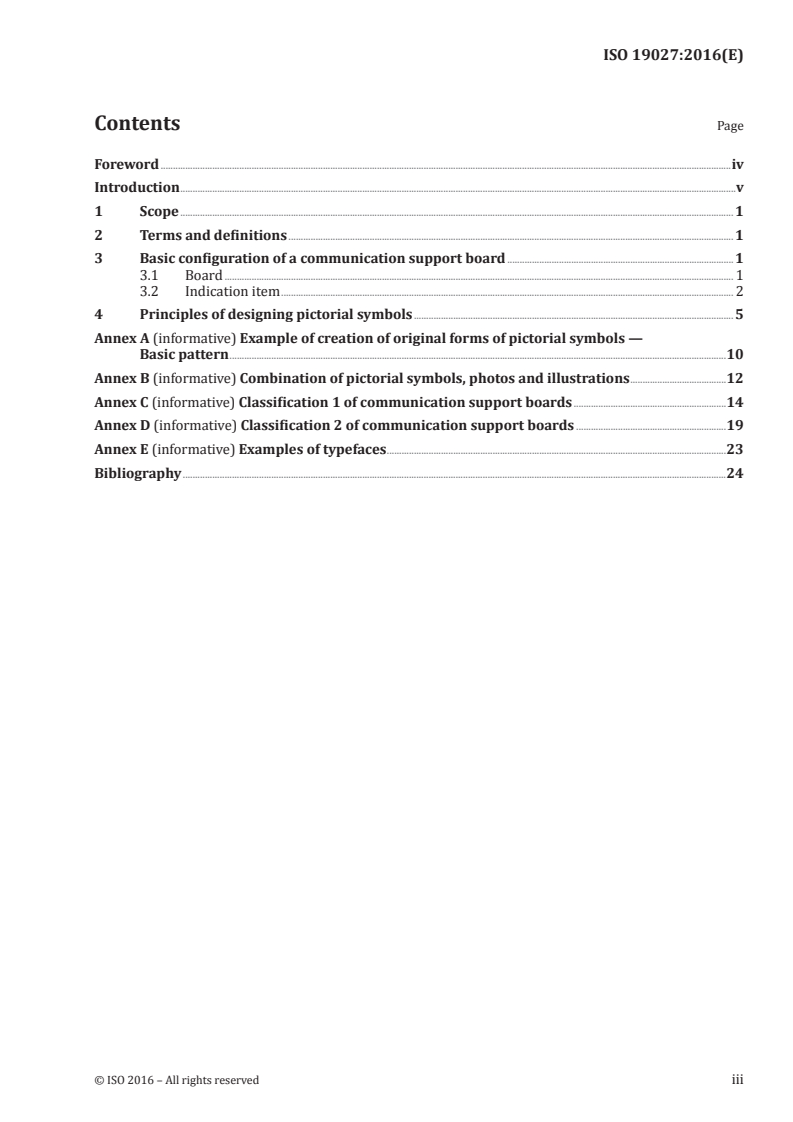
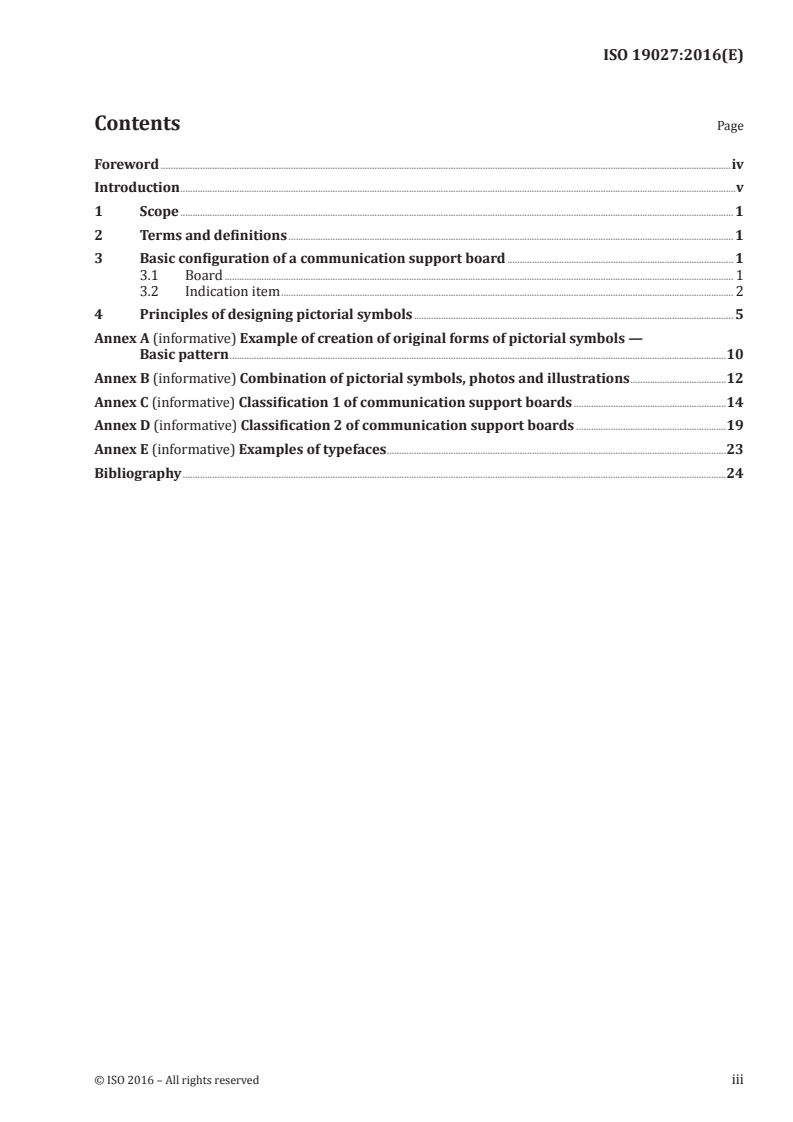
Contents Page
Foreword .iv
Introduction .v
1 Scope . 1
2 Terms and definitions . 1
3 Basic configuration of a communication support board . 1
3.1 Board . 1
3.2 Indication item . 2
4 Principles of designing pictorial symbols . 5
Annex A (informative) Example of creation of original forms of pictorial symbols —
Basic pattern .10
Annex B (informative) Combination of pictorial symbols, photos and illustrations .12
Annex C (informative) Classification 1 of communication support boards .14
Annex D (informative) Classification 2 of communication support boards .19
Annex E (informative) Examples of typefaces .23
Bibliography .24
Foreword
ISO (the International Organization for Standardization) is a worldwide federation of national standards
bodies (ISO member bodies). The work of preparing International Standards is normally carried out
through ISO technical committees. Each member body interested in a subject for which a technical
committee has been established has the right to be represented on that committee. International
organizations, governmental and non-governmental, in liaison with ISO, also take part in the work.
ISO collaborates closely with the International Electrotechnical Commission (IEC) on all matters of
electrotechnical standardization.
The procedures used to develop this document and those intended for its further maintenance are
described in the ISO/IEC Directives, Part 1. In particular the different approval criteria needed for the
different types of ISO documents should be noted. This document was drafted in accordance with the
editorial rules of the ISO/IEC Directives, Part 2 (see www.iso.org/directives).
Attention is drawn to the possibility that some of the elements of this document may be the subject of
patent rights. ISO shall not be held responsible for identifying any or all such patent rights. Details of
any patent rights identified during the development of the document will be in the Introduction and/or
on the ISO list of patent declarations received (see www.iso.org/patents).
Any trade name used in this document is information given for the convenience of users and does not
constitute an endorsement.
For an explanation on the meaning of ISO specific terms and expressions related to conformity
assessment, as well as information about ISO’s adherence to the WTO principles in the Technical
Barriers to Trade (TBT) see the following URL: Foreword - Supplementary information
The committee responsible for this document is ISO/TC 173, Assistive products for persons with disability,
Subcommittee SC 7, Accessible design.
iv © ISO 2016 – All rights reserved
Introduction
This International Standard provides design principles for usable communication support boards that
assist in transcending regional/cultural and linguistic barriers and is of substantial benefit for those
persons who is to rely on a visual strategy to express their communicative intent.
A communication support board is a tool designed for the use of visual symbols (such as pictorial
symbols) to facilitate communication and social interaction when expressive/receptive communication
is limited due to physical or linguistic barriers.
Pictorial symbols, as visual expressions internationally, remove communication barriers in daily
life when the characteristics of the pictorial symbols are easy to understand and able to be applied
regardless of regional/cultural differences.
There are several user groups of pictorial symbols ranging from those who have poor or no
communication abilities to those who require enhanced communication support.
It is important that the symbols used for the communication board correspond with the symbols visible in
the environment to facilitate communication for the individual using the communication board in society.
In addition, the usage of communication support boards encourages inclusiveness in society for the user.
INTERNATIONAL STANDARD ISO 19027:2016(E)
Design principles for communication support board using
pictorial symbols
1 Scope
This International Standard specifies basic configurations for communication support boards, which
are necessary to facilitate communication. A variety of communication support boards can be designed
for specific communication purposes.
This International Standard specifies basic elements common to different types of formats/media, such
as simple boards, book style or digital media. This International Standard does not regulate any specific
design or any specific pictorial symbols for communication support boards.
As for design principles of pictorial symbols, this International Standard introduces examples of design
principles applicable when designing and developing pictorial symbols.
NOTE Examples of basic pattern used to create pictorial symbols are shown in Annex A. Examples of
communication support boards using pictorial symbols are shown in Annexes B and C.
2 Terms and definitions
For the purposes of this document, the following terms and definitions apply.
2.1
graphical symbol
visually perceptible figure with a particular meaning used to transmit information independently of
language
[SOURCE: ISO 17724:2003]
2.2
pictorial symbol
visual figure which comprises representational and abstract symbols, sometimes used in multiple
combinations
2.3
communication support board
tool to support persons who have difficulties communicating
Note 1 to entry: It can be used in various situations and places, such as for private, public and educational usage.
Note 2 to entry: This includes difficulties communicating orally or when language is a barrier to express
communicative intent.
3 Basic configuration of a communication support board
3.1 Board
a) Size
Size should be suitable for the intended users and intended usage.
b) Material
A communication support board can be made of paper or plastic.
In case of paper, surface lamination is recommended to facilitate writing necessary matters and erasing
such when needed.
c) Formats/media
There are various types of formats/media that can be used:
1) a single page communication support board;
2) a book-style is more practical especially when several pages are required;
3) digital media.
When the communication support board is composed of several pages, it is recommended to be
classified by category, such as transport facilities, food and drink, sequences of daily life, etc.
NOTE Examples of communication support boards are given in Annex C.
d) Background colour
It is advisable to use white background. However, a coloured background of a board, exclusive of the
symbols, can be used for effect.
When multiple symbols are being displayed on a single board, then it is advisable to use white background
for the board, to contrast with the background of individual symbols which are mostly in black.
NOTE Examples of coloured backgrounds are given in Figure C.6.
3.2 Indication item
a) Title
A title should be located at the upper part of a communication support board so that the intended use
might be easily understood. It should be presented in the first screen in digital media. The title can
consist of pictorial symbols and/or text.
b) Typeface
A typeface for use on a communication support board should be carefully chosen, based on the
following guidelines:
1) sans serif typeface or typeface with very small serifs;
2) regular or bold weight.
NOTE Examples of typefaces are shown in Annex E.
c) Language
When text is needed, it should be written in the official language/languages of the country. In order to
facilitate the usage of a communication support board, text could be translated in English. In case of
using multi-languages, it should be limited to four languages on a single board.
In digital media, change of multiple languages should be realized by changing screen or configuration.
d) Pictorial symbols
1) The design of symbols on one board should be consistent.
2) Symbols should be in contrast to the background and responsive to safety colours.
3) Pictorial symbols should be clear, crisp and bold.
2 © ISO 2016 – All rights reserved
When using pictures or photos in any case, they should be of high quality.
e) Layout of pictorial symbols
1) Framing pictorial symbols within the same category in one box should be distinguished from
other information (e.g. text or symbols) and arranged sequentially.
2) In order to make each symbol clear and recognizable, the number of pictorial symbols should
be appropriate according to size of formats/media.
NOTE Examples are shown in Figure C.4.
3) Pictorial symbols, regarding safety and emergency, which have high priority, should be
arranged in the uppermost section of a communication support board.
4) Combination of pictorial symbols and graphical symbols can be used.
5) Combination of pictorial symbols, photos and illustrations can be used.
6) Animation features can be used in digital media.
7) Pictorial symbols to indicate common answers and phrases on individual boards, such as ‘Yes’,
‘No’ and ‘No idea’, should be placed to facilitate conversation.
NOTE Examples of combination of pictorial symbols, photos and illustrations are given in Ann
...
INTERNATIONAL ISO
STANDARD 19027
First edition
2016-01-15
Design principles for communication
support board using pictorial symbols
Principes de conception pour le conseil de support de communication
utilisant des symboles illustrés
Reference number
©
ISO 2016
© ISO 2016, Published in Switzerland
All rights reserved. Unless otherwise specified, no part of this publication may be reproduced or utilized otherwise in any form
or by any means, electronic or mechanical, including photocopying, or posting on the internet or an intranet, without prior
written permission. Permission can be requested from either ISO at the address below or ISO’s member body in the country of
the requester.
ISO copyright office
Ch. de Blandonnet 8 • CP 401
CH-1214 Vernier, Geneva, Switzerland
Tel. +41 22 749 01 11
Fax +41 22 749 09 47
copyright@iso.org
www.iso.org
ii © ISO 2016 – All rights reserved
Contents Page
Foreword .iv
Introduction .v
1 Scope . 1
2 Terms and definitions . 1
3 Basic configuration of a communication support board . 1
3.1 Board . 1
3.2 Indication item . 2
4 Principles of designing pictorial symbols . 5
Annex A (informative) Example of creation of original forms of pictorial symbols —
Basic pattern .10
Annex B (informative) Combination of pictorial symbols, photos and illustrations .12
Annex C (informative) Classification 1 of communication support boards .14
Annex D (informative) Classification 2 of communication support boards .19
Annex E (informative) Examples of typefaces .23
Bibliography .24
Foreword
ISO (the International Organization for Standardization) is a worldwide federation of national standards
bodies (ISO member bodies). The work of preparing International Standards is normally carried out
through ISO technical committees. Each member body interested in a subject for which a technical
committee has been established has the right to be represented on that committee. International
organizations, governmental and non-governmental, in liaison with ISO, also take part in the work.
ISO collaborates closely with the International Electrotechnical Commission (IEC) on all matters of
electrotechnical standardization.
The procedures used to develop this document and those intended for its further maintenance are
described in the ISO/IEC Directives, Part 1. In particular the different approval criteria needed for the
different types of ISO documents should be noted. This document was drafted in accordance with the
editorial rules of the ISO/IEC Directives, Part 2 (see www.iso.org/directives).
Attention is drawn to the possibility that some of the elements of this document may be the subject of
patent rights. ISO shall not be held responsible for identifying any or all such patent rights. Details of
any patent rights identified during the development of the document will be in the Introduction and/or
on the ISO list of patent declarations received (see www.iso.org/patents).
Any trade name used in this document is information given for the convenience of users and does not
constitute an endorsement.
For an explanation on the meaning of ISO specific terms and expressions related to conformity
assessment, as well as information about ISO’s adherence to the WTO principles in the Technical
Barriers to Trade (TBT) see the following URL: Foreword - Supplementary information
The committee responsible for this document is ISO/TC 173, Assistive products for persons with disability,
Subcommittee SC 7, Accessible design.
iv © ISO 2016 – All rights reserved
Introduction
This International Standard provides design principles for usable communication support boards that
assist in transcending regional/cultural and linguistic barriers and is of substantial benefit for those
persons who is to rely on a visual strategy to express their communicative intent.
A communication support board is a tool designed for the use of visual symbols (such as pictorial
symbols) to facilitate communication and social interaction when expressive/receptive communication
is limited due to physical or linguistic barriers.
Pictorial symbols, as visual expressions internationally, remove communication barriers in daily
life when the characteristics of the pictorial symbols are easy to understand and able to be applied
regardless of regional/cultural differences.
There are several user groups of pictorial symbols ranging from those who have poor or no
communication abilities to those who require enhanced communication support.
It is important that the symbols used for the communication board correspond with the symbols visible in
the environment to facilitate communication for the individual using the communication board in society.
In addition, the usage of communication support boards encourages inclusiveness in society for the user.
INTERNATIONAL STANDARD ISO 19027:2016(E)
Design principles for communication support board using
pictorial symbols
1 Scope
This International Standard specifies basic configurations for communication support boards, which
are necessary to facilitate communication. A variety of communication support boards can be designed
for specific communication purposes.
This International Standard specifies basic elements common to different types of formats/media, such
as simple boards, book style or digital media. This International Standard does not regulate any specific
design or any specific pictorial symbols for communication support boards.
As for design principles of pictorial symbols, this International Standard introduces examples of design
principles applicable when designing and developing pictorial symbols.
NOTE Examples of basic pattern used to create pictorial symbols are shown in Annex A. Examples of
communication support boards using pictorial symbols are shown in Annexes B and C.
2 Terms and definitions
For the purposes of this document, the following terms and definitions apply.
2.1
graphical symbol
visually perceptible figure with a particular meaning used to transmit information independently of
language
[SOURCE: ISO 17724:2003]
2.2
pictorial symbol
visual figure which comprises representational and abstract symbols, sometimes used in multiple
combinations
2.3
communication support board
tool to support persons who have difficulties communicating
Note 1 to entry: It can be used in various situations and places, such as for private, public and educational usage.
Note 2 to entry: This includes difficulties communicating orally or when language is a barrier to express
communicative intent.
3 Basic configuration of a communication support board
3.1 Board
a) Size
Size should be suitable for the intended users and intended usage.
b) Material
A communication support board can be made of paper or plastic.
In case of paper, surface lamination is recommended to facilitate writing necessary matters and erasing
such when needed.
c) Formats/media
There are various types of formats/media that can be used:
1) a single page communication support board;
2) a book-style is more practical especially when several pages are required;
3) digital media.
When the communication support board is composed of several pages, it is recommended to be
classified by category, such as transport facilities, food and drink, sequences of daily life, etc.
NOTE Examples of communication support boards are given in Annex C.
d) Background colour
It is advisable to use white background. However, a coloured background of a board, exclusive of the
symbols, can be used for effect.
When multiple symbols are being displayed on a single board, then it is advisable to use white background
for the board, to contrast with the background of individual symbols which are mostly in black.
NOTE Examples of coloured backgrounds are given in Figure C.6.
3.2 Indication item
a) Title
A title should be located at the upper part of a communication support board so that the intended use
might be easily understood. It should be presented in the first screen in digital media. The title can
consist of pictorial symbols and/or text.
b) Typeface
A typeface for use on a communication support board should be carefully chosen, based on the
following guidelines:
1) sans serif typeface or typeface with very small serifs;
2) regular or bold weight.
NOTE Examples of typefaces are shown in Annex E.
c) Language
When text is needed, it should be written in the official language/languages of the country. In order to
facilitate the usage of a communication support board, text could be translated in English. In case of
using multi-languages, it should be limited to four languages on a single board.
In digital media, change of multiple languages should be realized by changing screen or configuration.
d) Pictorial symbols
1) The design of symbols on one board should be consistent.
2) Symbols should be in contrast to the background and responsive to safety colours.
3) Pictorial symbols should be clear, crisp and bold.
2 © ISO 2016 – All rights reserved
When using pictures or photos in any case, they should be of high quality.
e) Layout of pictorial symbols
1) Framing pictorial symbols within the same category in one box should be distinguished from
other information (e.g. text or symbols) and arranged sequentially.
2) In order to make each symbol clear and recognizable, the number of pictorial symbols should
be appropriate according to size of formats/media.
NOTE Examples are shown in Figure C.4.
3) Pictorial symbols, regarding safety and emergency, which have high priority, should be
arranged in the uppermost section of a communication support board.
4) Combination of pictorial symbols and graphical symbols can be used.
5) Combination of pictorial symbols, photos and illustrations can be used.
6) Animation features can be used in digital media.
7) Pictorial symbols to indicate common answers and phrases on individual boards, such as ‘Yes’,
‘No’ and ‘No idea’, should be placed to facilitate conversation.
NOTE Examples of combination of pictorial symbols, photos and illustrations are given in Ann
...