

ISO 1004-1:2013
(Main)Information processing — Magnetic ink character recognition — Part 1: Print specifications for E13B
General Information
- Abstract
ISO 1004-1:2013 specifies the shape, dimensions, magnetic signal level, and tolerances for the E-13B characters which include 10 numerals and four special symbols printed in magnetic ink and used for the purpose of character recognition. It describes the various known types of printing defects and other printing considerations, together with the tolerances permitted.
- Status
- Published
- Publication Date
- 26-May-2013
- Technical Committee
- ISO/TC 68/SC 9 - Information exchange for financial services
- Drafting Committee
- ISO/TC 68/SC 9 - Information exchange for financial services
- Current Stage
- 9093 - International Standard confirmed
- Start Date
- 29-Jul-2025
- Completion Date
- 29-Aug-2026

Overview
ISO 1004-1:2013 - Information processing - Magnetic ink character recognition - Part 1: Print specifications for E13B defines the print requirements for the E‑13B magnetic ink font used primarily in banking and automatic document handling. The standard specifies the shape, dimensions, magnetic signal level, and tolerances for the 10 numerals and four special MICR symbols (Transit, Amount, On‑us, Dash). It also documents known printing defects, acceptable tolerances, and considerations for paper, ink distribution and permanence.
Key topics and technical requirements
- Character configuration: Exact forms for digits 0–9 and four special symbols with reference centre‑lines and design matrices.
- Dimensions & radii: All radii are 0.165 mm (except in zero); detailed dimensions are provided in figures (units in millimetres).
- Average edge & tolerances: Average edge tolerance for stroke edges ±0.038 mm; edge irregularities allowed to ±0.089 mm with limits on summation of irregular edge portions.
- Minimum stroke widths: Minimum horizontal bar width = 0.279 mm (does not apply to vertical bars).
- Character spacing & alignment: Inter‑character spacing 3.175 mm ±0.254 mm; full‑space spacing typically 6.35 mm ±0.508 mm; adjacent spacing must not be less than 2.921 mm or more than 4.064 mm in special cases. Vertical alignment tolerance (bottom edges) up to 0.762 mm.
- Skew: Maximum allowable character skew ±1.5° relative to the document aligning edge.
- Voids & extraneous ink: Limits and measurement methods for voids, attached extraneous ink, and magnetic vs non‑magnetic contamination.
- Signal level & PCS: Definitions and requirements for magnetic signal level and relative signal level; requirements for optical clear band and print contrast signal (PCS).
- Paper & permanence: Guidance on paper characteristics and permanence tests for MICR printing.
Practical applications and users
- Financial institutions (cheque processing, automated clearing systems)
- Printing houses producing MICR lines on cheques, deposit slips and financial documents
- MICR ink and toner manufacturers ensuring correct magnetic signal and distribution
- Quality assurance and compliance teams implementing document acceptance criteria
- Hardware and software vendors for MICR readers, sorters and check scanners
Using ISO 1004-1:2013 helps ensure reliable magnetic character recognition, reduces read errors, and supports interoperability across banks and document handlers.
Related standards
- ISO 1004-2 - Print specifications for CMC7 (complements Part 1)
- Other relevant standards and annexes in ISO 1004 cover sampling, paper characteristics and conversion tables included as informative annexes in the publication.
Keywords: ISO 1004-1:2013, E13B, MICR, magnetic ink character recognition, print specifications, MICR tolerances, magnetic signal level, cheque processing.
Relations
- Revises
ISO 1004:1995 - Information processing — Magnetic ink character recognition — Print specifications - Effective Date
- 16-Jan-2010
Get Certified
Connect with accredited certification bodies for this standard

BSI Group
BSI (British Standards Institution) is the business standards company that helps organizations make excellence a habit.

NYCE
Mexican standards and certification body.
Sponsored listings
Frequently Asked Questions
ISO 1004-1:2013 is a standard published by the International Organization for Standardization (ISO). Its full title is "Information processing — Magnetic ink character recognition — Part 1: Print specifications for E13B". This standard covers: ISO 1004-1:2013 specifies the shape, dimensions, magnetic signal level, and tolerances for the E-13B characters which include 10 numerals and four special symbols printed in magnetic ink and used for the purpose of character recognition. It describes the various known types of printing defects and other printing considerations, together with the tolerances permitted.
ISO 1004-1:2013 specifies the shape, dimensions, magnetic signal level, and tolerances for the E-13B characters which include 10 numerals and four special symbols printed in magnetic ink and used for the purpose of character recognition. It describes the various known types of printing defects and other printing considerations, together with the tolerances permitted.
ISO 1004-1:2013 is classified under the following ICS (International Classification for Standards) categories: 35.240.40 - IT applications in banking. The ICS classification helps identify the subject area and facilitates finding related standards.
ISO 1004-1:2013 has the following relationships with other standards: It is inter standard links to ISO 1004:1995. Understanding these relationships helps ensure you are using the most current and applicable version of the standard.
ISO 1004-1:2013 is available in PDF format for immediate download after purchase. The document can be added to your cart and obtained through the secure checkout process. Digital delivery ensures instant access to the complete standard document.
Standards Content (Sample)
INTERNATIONAL ISO
STANDARD 1004-1
First edition
2013-06-01
Information processing — Magnetic
ink character recognition —
Part 1:
Print specifications for E13B
Traitement de l’information — Reconnaissance des caractères à
encre magnétique —
Partie 1: Spécifications d’impression E13B
Reference number
©
ISO 2013
© ISO 2013
All rights reserved. Unless otherwise specified, no part of this publication may be reproduced or utilized otherwise in any form
or by any means, electronic or mechanical, including photocopying, or posting on the internet or an intranet, without prior
written permission. Permission can be requested from either ISO at the address below or ISO’s member body in the country of
the requester.
ISO copyright office
Case postale 56 • CH-1211 Geneva 20
Tel. + 41 22 749 01 11
Fax + 41 22 749 09 47
E-mail copyright@iso.org
Web www.iso.org
Published in Switzerland
ii © ISO 2013 – All rights reserved
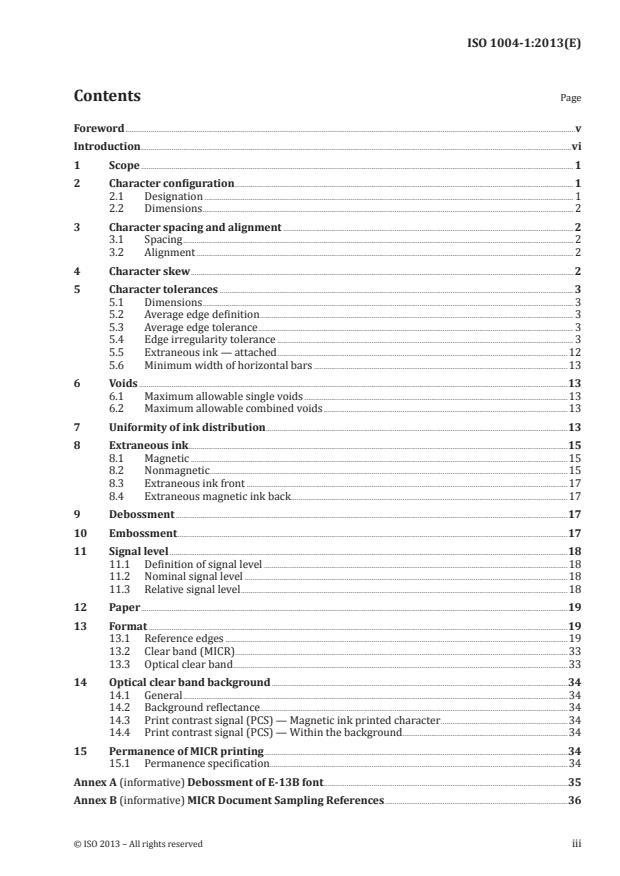
Contents Page
Foreword .v
Introduction .vi
1 Scope . 1
2 Character configuration . 1
2.1 Designation . 1
2.2 Dimensions . 2
3 Character spacing and alignment . 2
3.1 Spacing . 2
3.2 Alignment . 2
4 Character skew . 2
5 Character tolerances . 3
5.1 Dimensions . 3
5.2 Average edge definition . 3
5.3 Average edge tolerance . 3
5.4 Edge irregularity tolerance . 3
5.5 Extraneous ink — attached .12
5.6 Minimum width of horizontal bars .13
6 Voids .13
6.1 Maximum allowable single voids .13
6.2 Maximum allowable combined voids .13
7 Uniformity of ink distribution .13
8 Extraneous ink .15
8.1 Magnetic .15
8.2 Nonmagnetic .15
8.3 Extraneous ink front .17
8.4 Extraneous magnetic ink back.17
9 Debossment .17
10 Embossment .17
11 Signal level .18
11.1 Definition of signal level .18
11.2 Nominal signal level .18
11.3 Relative signal level .18
12 Paper .19
13 Format .19
13.1 Reference edges .19
13.2 Clear band (MICR) .33
13.3 Optical clear band .33
14 Optical clear band background .34
14.1 General .34
14.2 Background reflectance .34
14.3 Print contrast signal (PCS) — Magnetic ink printed character .34
14.4 Print contrast signal (PCS) — Within the background . .34
15 Permanence of MICR printing .34
15.1 Permanence specification.34
Annex A (informative) Debossment of E-13B font .35
Annex B (informative) MICR Document Sampling References .36
Annex C (informative) Paper Characteristics for MICR .37
Annex D (informative) Unit conversion tables .43
Bibliography .45
iv © ISO 2013 – All rights reserved
Foreword
ISO (the International Organization for Standardization) is a worldwide federation of national standards
bodies (ISO member bodies). The work of preparing International Standards is normally carried out
through ISO technical committees. Each member body interested in a subject for which a technical
committee has been established has the right to be represented on that committee. International
organizations, governmental and non-governmental, in liaison with ISO, also take part in the work.
ISO collaborates closely with the International Electrotechnical Commission (IEC) on all matters of
electrotechnical standardization.
The procedures used to develop this document and those intended for its further maintenance are
described in the ISO/IEC Directives, Part 1. In particular the different approval criteria needed for the
different types of ISO documents should be noted. This document was drafted in accordance with the
editorial rules of the ISO/IEC Directives, Part 2. www.iso.org/directives
Attention is drawn to the possibility that some of the elements of this document may be the subject of
patent rights. ISO shall not be held responsible for identifying any or all such patent rights. Details of
any patent rights identified during the development of the document will be in the Introduction and/or
on the ISO list of patent declarations received. www.iso.org/patents
Any trade name used in this document is information given for the convenience of users and does not
constitute an endorsement.
The committee responsible for this document is ISO/TC 68, Financial services, Subcommittee SC 7,
Core banking.
This first edition of ISO 1004-1, together with ISO 1004-2, cancels and replaces ISO 1004:1995, which
has been technically revised.
ISO 1004 consists of the following parts, under the general title Information processing — Magnetic ink
character recognition:
— Part 1: Print specifications for E13B
— Part 2: Print specifications for CMC7
Annexes A to D of this International Standard are for information only.
Introduction
The characters specified in this part of ISO 1004 were developed initially for use in banks to permit
automatic document handling for financial institution data processing, but they have application to
other automatic handling systems as well.
vi © ISO 2013 – All rights reserved
INTERNATIONAL STANDARD ISO 1004-1:2013(E)
Information processing — Magnetic ink character
recognition —
Part 1:
Print specifications for E13B
1 Scope
This part of ISO 1004 specifies the shape, dimensions, magnetic signal level, and tolerances for the E-13B
characters which include 10 numerals and four special symbols printed in magnetic ink and used for the
purpose of character recognition. It describes the various known types of printing defects and other
printing considerations, together with the tolerances permitted.
2 Character configuration
2.1 Designation
The series of standard magnetic ink characters shall consist of 10 numerals and four special symbols.
They shall be identified as follows:
Name Character appearance
One (1)
Two (2)
Three (3)
Four (4)
Five (5)
Six (6)
Seven (7)
Eight (8)
Nine (9)
Zero (0)
Symbol 1 (Transit)
Symbol 2 (Amount)
Symbol 3 (On-us)
Symbol 4 (Dash)
2.2 Dimensions
Detailed dimensions and the reference centre-lines of the printed characters for the 10 numerals and
four special symbols shall be as shown in Figure 1 to Figure 14.
Figure 15 illustrates the character design matrix. All radii are 0,165 mm except in the character zero. All
radii shall be blended with adjacent edges. Tolerance of each average edge = ± 0,038 mm. The minimum
horizontal bars width is 0,279 mm. This minimum dimension does not apply to vertical bars (see 5.5).
3 Character spacing and alignment
3.1 Spacing
3.1.1 Character spacing
The distance between the right average edges of adjacent characters shall be 3,175 mm ± 0,254 mm. See
Figure 16. Average edge is discussed in 5.2.
3.1.2 Tolerance accumulation
The accumulation of spacing tolerances in any common field shall be limited to the extent that the
accumulation does not infringe upon the boundaries defining this field.
3.1.3 Special cases
Normally a spacing of 6,35 mm ± 0,508 mm is accumulated when two characters within a field are
separated by one space.
Additional spacing tolerance of ± 1,5588 mm shall apply within a field or from field to field when printing
does not guarantee to meet adjacent character spacing but only when surrounding spaces are utilized as
a safety band. For those instances where a full space is not used, adjacent character spacing shall never
be less than 2,921 mm or more than 4,064 mm.
3.2 Alignment
3.2.1 Reference point
Alignment is the relative vertical location of a character with respect to adjacent characters within a
given field. The horizontal centre-line of each character is shown in Figure 1 through Figure 14. These
centre-lines serve to establish vertical alignment of all characters, since all characters are designed
about the same horizontal centre-line.
3.2.2 Tolerance
Alignment of a line of characters printed in any field shall be such that the bottom edges of adjacent
characters within each field do not vary vertically by more than 0,762 mm (see Figure 17). These
tolerances shall not accumulate so that the field exceeds the 6,35 mm encoding strip.
On the symbols that do not come down to the “base-line” (On-Us and Dash, Figure 13 and Figure 14), the
same 0,762 mm tolerance shall apply to the horizontal centre-line.
4 Character skew
The maximum allowable character skew shall be ± 1,5° measured with respect to the aligning (bottom)
edge of the document. See Figure 18.
2 © ISO 2013 – All rights reserved
5 Character tolerances
5.1 Dimensions
See Figures 1 to 14 for dimensions of the printed characters, and subclause 2.2.
5.2 Average edge definition
The typical edge of a printed character is not a straight line. The term “average edge” shall be used for
horizontal and vertical edges and is defined as an imaginary line, parallel to either the vertical centre-
line or the horizontal centre-line that divides the irregularities. The result is that the summation of the
white areas on one side of the line is equal to the summation of the black areas on the other side. The
average edge of the radii shall be tangent to the average edge of the stroke. See Figure 19.
5.3 Average edge tolerance
The average edge tolerance for all stroke edges shall be ± 0,038 mm applied to the dimensions (measured
from the vertical centre-line and horizontal centre-line) that locate the edges. A typical illustration of
this tolerance is shown at the top of Figure 20. The average edge of the radii shall be tangent to the
average edges of the character, and the tolerance of the radii shall also be ± 0,038 mm.
5.4 Edge irregularity tolerance
5.4.1 Average edge irregularities
Peaks and valleys located about the average edge shall be permitted to extend to ± 0,089 mm from the
average edge. An example is shown in Figure 20. However, when these occur, the summation of the edge
present in the 0,038 to 0,089 mm zone shall not exceed 25 % of the total edge.
5.4.2 Edge voids
An occasional void can be present at the edge of a character stroke and creates a valley that exceeds
the 0,089 mm limit mentioned in 5.4.1. See Figure 20.
No two voids as described shall occur within 0,889 mm of each other as measured from the points of
maximum excursion from the average edge.
Valleys that exceed the 0,089 mm zone are voids and are controlled by the void limits given in Clause 6
and shall be measured from the average edge of a character stroke. However, any portion of an edge void
that is within the 0,089 mm zone shall be included in the measurement of the percentage of the edge
present in the 0,038 to 0,089 mm zone.
Figures 1 to 14 show dimensions for printed characters, in accordance with the following requirements.
— All radii shall be 0,165 mm except in character zero.
— All radii shall be blended with adjacent edges.
— Tolerance (average edge) = ± 0,038 mm
— Minimum horizontal bars width shall be 0,279 mm. This does not apply to vertical bars (see 5.5).
— All dimensions on figures below are in millimetres.
Figure 1 — One
Figure 2 — Two
4 © ISO 2013 – All rights reserved
Figure 3 — Three
Figure 4 — Four
Figure 5 — Five
Figure 6 — Six
6 © ISO 2013 – All rights reserved
Figure 7 — Seven
Figure 8 — Eight
Figure 9 — Nine
Figure 10 — Zero
8 © ISO 2013 – All rights reserved
Figure 11 — Transit symbol (Symbol 1)
Figure 12 — Amount symbol (Symbol 2)
Figure 13 — On-Us symbol (Symbol 3)
Figure 14 — Dash symbol (Symbol 4)
10 © ISO 2013 – All rights reserved
Figure 15 — Character design matrix
Figure 16 — Distance between characters
Figure 17 — Allowable variation in vertical alignment of adjacent characters in millimetres
Figure 18 — Allowable character skew
Figure 19 — Average edge example
5.5 Extraneous ink — attached
An occasional excursion (such as feathering or stringing out) can be present at the edge and extend
beyond the 0,038 mm to 0,089 mm zone. Such occasional excursions shall not be considered as edge
irregularities and are defined as extraneous ink that is “attached” to the character. These occasional
12 © ISO 2013 – All rights reserved
excursions are allowed if each can be contained in a 0,076 mm × 0,076 mm square. Those excursions
that cannot be contained in a 0,076 mm × 0,076 mm square are acceptable, provided that they can be
contained in a 0,102 mm × 0,102 mm square and shall be limited to one per character and shall total not
more than five per field.
In measuring the size of such excursions, only that portion extending beyond the 0,089 mm limit shall
be considered since the portion of the excursion within the 0,038 mm to 0,089 mm zone is controlled by
character edge irregularity limits given in 5.4.
5.6 Minimum width of horizontal bars
The distance between the average edges of any horizontal bar shall be at least 0,279 mm. This
specification is an adjunct to the dimension specification locating each edge. This specification does not
apply to vertical bars, since vertical bars are controlled entirely by dimensions locating each edge.
6 Voids
6.1 Maximum allowable single voids
6.1.1 Voids
The maximum allowable single void (the absence of ink within the specified outline of the printed
character) anywhere in the character, including at an edge, shall be of a size that can be contained
entirely within the boundary of a 0,203 mm × 0,203 mm square, with the following exceptions.
If the portion of the character involving a single void occupies two or more 0,330 mm × 0,330 mm square
zones (see Figure 15), then the maximum allowable single void shall be completely surrounded by ink
and contained entirely within the boundary of a 0,254 mm × 0,254 mm square. In this case, voids at the
edges are not included and shall be limited to a 0,203 mm × 0,203 mm square. See Figure 21.
6.1.2 Needle voids
Single voids that are long and narrow are called “needle” type voids. They shall be allowable in any
length anywhere within the character provided that they are no wider than 0,051 mm average edge to
average edge.
6.2 Maximum allowable combined voids
The combined area of all voids, in any vertical 0,330 mm column of zones or horizontal 0,330 mm row of
zones, shall not exceed 20 % of the area of that column or row. See Figure 15 and Figure 22.
7 Uniformity of ink distribution
The magnetic ink deposited shall be uniformly distributed within the outlines of each character.
Conditions to be avoided include excessive squeeze-out, halo, and other uneven deposits. A ridge of ink
that outlines a character and appears dense in relation to the ink deposited within the character is
acceptable, provided that its width does not exceed 0,038 mm between its average edges. Such ridges
are predominant in letterpress printing and in some impact printing.
Each printed MICR character should also be magnetically uniform, as observed from its waveform as
measured with a signal level tester, waveform measurement system, or its equivalent.
NOTE Evaluation of real world ink samples often indicates that ink, which appears visually uniform, has
an actual thickness variation, and therefore a variation in its magnetic signal properties. Such variation can be
due to technical peculiarities of the printing process, and may be evident in an evaluation of the magnetic signal
waveform. The user is cautioned that magnetic non-uniformity does not always correlate positively with rejects
experienced in MICR document processing equipment. To resolve borderline situations, much depends on the
degree of non-uniformity. The user or quality control analyst should re-examine the questionable documents
optically, and then decide whether to accept or reject the document.
NOTE This drawing is for illustrative purposes only and is not meant to represent an actual edge.
Figure 20 — Tolerances for average edge and edge irregularity
14 © ISO 2013 – All rights reserved
8 Extraneous ink
8.1 Magnetic
Any magnetic ink which appears in the 15,875 mm MICR clear band other than the MICR characters
shall be considered extraneous ink. See 8.3.1, 8.4 and Figure 23 . The clear band is applicable to both
front and back of the document.
8.2 Nonmagnetic
Any ink appearing in the 7,620 mm optical clear band that interferes with optical reading of MICR
characters shall be considered non-magnetic extraneous ink. It includes splatter, smear, tracking,
feathering, stringing out, toning, back offset, and so forth. See 8.3.2 and Figure 23. This clear area is
defined in ISO 1831 and includes the printing band for the MICR characters. The optical clear band
applies only to the document front.
Figure 21 — Single voids
Figure 22 — Example of rows and columns for character 8
Area A The rules in 8.2, 8.3.2, 13.3, and 14 apply here.
Area B The rules in 8.1, 8.3.1, 8.4, and 13.2 apply here.
Figure 23 — MICR clear band and optical clear band — Extraneous ink restriction areas
Figure 24 — Example of a waveform of the On-Us symbol Χ
16 © ISO 2013 – All rights reserved
8.3 Extraneous ink front
8.3.1 Magnetic ink
Extraneous magnetic ink on the front of the document within the 15,875 mm MICR clear band shall be
acceptable if the spots can be contained in a 0,076 mm × 0,076 mm square.
Spots that cannot be contained in a 0,076 mm × 0,076 mm square shall be acceptable provided they can
be contained in a 0,102 mm × 0,102 mm square and are limited to one per character space and total not
more than five per field.
Spots that are found to be located within the outermost limits established by the character edge
irregularity tolerance shall be considered under the character edge irregularity specifications.
8.3.2 Non-magnetic ink
Spots within the 7,620 mm optical clear band that can be contained inside a circle 0,203 mm in diameter
shall be acceptable as long as no two spots are closer than 1,016 mm to each other or an E-13B character.
8.4 Extraneous magnetic ink back
Extraneous magnetic ink on the back of the document within the area of the MICR clear band shall be
acceptable if the spots are entirely contained in a 0,152 mm × 0,152 mm square.
9 Debossment
Penetration of the printed character into the surface of the paper is known as debossment. Debossment
of the printed character is undesirable. Where it is excessive, it can be the cause of rejects or misreads.
Signal levels may be reduced or distorted because the magnetic ink characters are displaced from the
MICR reader magnetic pick-up device by the debossment depth. Debossment on the face of the document
may or may not cause fractures of the paper fibres that are detectable on the reverse side.
For the purposes of this part of ISO 1004, 0,025 mm debossment shall be established as an objective.
Due to practical manufacturing constraints, this specification is frequently exceeded by letterpress
printing, press numbering, ribbon encoding, and post-encoding processes. Additional tolerances beyond
0,025 mm may be acceptable before rejects by MICR recognition equipment will occur. See Annex A.
Debossment of MICR characters can be compounded by the signal strength of the ink used, the uniformity
of the ink coverage, the evenness of debossment, or the combination of these.
EXAMPLE 1 Uneven debossment such as deeper penetration by a vertical narrow stroke of a character, as
compared to a broader portion of the same character coupled with insufficient signal from the ink can cause rejects.
EXAMPLE 2 Although uniform debossment of an entire character with adequate signal strength probably will
not cause rejects, given that these conditions can occur, a further explanation of tolerances acceptable under
certain circumstances is contained in Annex A.
10 Embossment
This part of ISO 1004 establishes an embossment limit of 0,0152 mm that shall not be exceeded unless
additional precautions have been taken to minimize character abrasion. For most dry ink images, an
embossment value of 0,0152 mm or less shall result in acceptable reader/sorter wear. See Clause 15 for
a discussion of permanence of MICR printing.
NOTE 1 Certain MICR dry ink printing technologies (xerography, ionography, or magnetography) may result
in raised or embossed printing. The range of embossment for dry ink printing technologies is normally from
0,0076 mm to 0,0152 mm.
NOTE 2 The steel-die engraving form of intaglio printing, which simultaneously prints and embosses, can
result in embossment on the order of 0,025 mm. Such highly embossed MICR characters and check borders are
known to cause excessive MICR read head wear in high speed reader/sorters. The paper stock used in intaglio
printing, e.g. travellers checks, often causes problems when the MICR amount field is impact encoded. Other forms
of intaglio printing are available which do not result in high levels of embossment.
NOTE 3 Excessive embossment of the printed MICR characters is undesirable since it can lead to increased
abrasive wear of the MICR characters, contamination of the reader/sorter and, in the case of highly embossed intaglio
printing, accelerated wear of the MICR read heads. Severely abraded characters can ultimately result in rejects
or misreads. However, the actual wear performance might depend upon the specifics of each dry ink formulation.
Furthermore, how well the dry ink has been fused and the properties of the paper play an important role in
determining the embossment level that is acceptable. Embossed values exceeding 0,0152 mm may be acceptable if
the image is endowed with low friction properties as a result of its formulation or treatment during printing.
11 Signal level
11.1 Definition of signal level
Signal level shall be defined as the amplitude of the voltage waveform which results when a d-c
magnetized and fully saturated MICR printed character is moved at a specified speed past a specifically
defined magnetic read head whose output is amplified with a defined transfer function. The usual unit
of measure for voltage is mv or volts. However, it is common practice to scale the output voltage such
that 100 units of measure shall be equal to the value of the average of peaks three and five of an ideal
reference On-Us symbol. For convenience, we call the units of signal measure when appropriately scaled,
Signal Units (SU). See Figure 24 for a waveform of a typical On-Us symbol. Its signal level is 125 SU,
which is the average of peak 3 (129 SU) and peak 5 (121 SU).
11.2 Nominal signal level
Nominal signal level shall be the signal obtained from a properly printed reference sample (On-Us
symbol), calibrated as 100 signal units (SU) using the wire card calibration (WCC) procedure, when
suitable test equipment is used. All other characters are then referenced to the On-Us symbol to obtain
an individual nominal signal level, in signal units (SU), using a designated peak or the average of two
designated peaks. See Table 1 for the nominal signal level values for each character and the peak number
as shown on its respective reference waveform.
11.3 Relative signal level
Relative signal level shall be the ratio, stated as a percentage, that the signal level in signal units (SU) of
a MICR character being measured bears to the nominal signal level for that same character. For example,
for a sample character “2”, if the signal level of its first peak (the designated peak)
...