

ISO 22827-2:2005
(Main)Acceptance tests for Nd:YAG laser beam welding machines — Machines with optical fibre delivery — Part 2: Moving mechanism
General Information
- Abstract
ISO 22827-2:2005 covers acceptance testing of equipment for 2D manipulation and also, to some extent, movements along the Z-axis. ISO 22827-2:2005 specifies two methods for the testing of the accuracy of the moving mechanism. The first method (type 1 test) provides a test method capable of classification of the moving mechanism rigorously according to the required accuracy. The second method (type 2 test) provides a simpler method for testing the moving mechanism by marking. The selection of the test method is optional. However, for large-size laser beam welding machines, such as a laser beam welding machine using 2D moving optics or an X-Y table, the type 2 test is applicable. ISO 22827-2:2005 is not applicable for welding cells with manual positioning of the welding head and/or the component, and for fixed-position welding without the moving mechanism.
- Status
- Published
- Publication Date
- 13-Oct-2005
- Technical Committee
- ISO/TC 44/SC 10 - Quality management in the field of welding
- Drafting Committee
- ISO/TC 44/SC 10 - Quality management in the field of welding
- Current Stage
- 9060 - Close of review
- Completion Date
- 02-Sep-2030
Buy Documents
ISO 22827-2:2005 - Acceptance tests for Nd:YAG laser beam welding machines — Machines with optical fibre delivery — Part 2: Moving mechanism Released:10/14/2005
ISO 22827-2:2005 - Essais de réception pour les machines de soudage par faisceau laser Nd:YAG — Machines avec transport de faisceau par fibre optique — Partie 2: Mécanisme de positionnement Released:10/14/2005
Overview
ISO 22827-2:2005 - Acceptance tests for Nd:YAG laser beam welding machines (machines with optical fibre delivery) - Part 2: Moving mechanism defines acceptance and verification tests for the moving/mechanized positioning systems of Nd:YAG laser welding machines. It covers 2D manipulation and limited Z-axis movement, specifies two optional test methods (Type 1 and Type 2) for assessing positioning accuracy, trajectory accuracy, and travel speed, and excludes manually positioned or fixed‑position welding systems.
Key topics and technical requirements
- Two test methods
- Type 1 test: Rigorous classification and measurement of positioning and dynamic trajectory accuracy; suitable where precise quantification is required.
- Type 2 test: Simpler marking/inspection method (pattern marking, tape/steel-wire checks) recommended for large-size machines (e.g., 2D moving optics, X–Y tables).
- Classification of moving mechanism into four accuracy classes: A (very high), B (high), C (ordinary), D (low).
- Positioning repeatability and accuracy (examples from standard):
- Unidirectional repeatability: A/B ±0.01 mm, C ±0.02 mm, D ±0.2 mm
- Bidirectional repeatability: A ±0.02 mm up to D ±0.4 mm
- Positioning accuracy per metre: A ±0.05 mm/m up to D ±0.4 mm/m
- Travelling speed accuracy requirements at maximum, minimum and preferred speeds (class-dependent tolerances, e.g., max speed ±2% for A/B).
- Trajectory accuracy tests (rectangles, circles, 45° bevels) with maximum error limits per class; Type 2 uses marking patterns (square + inscribed circle) and measures intersection deviation, meandering, and arc deviation.
- Test conditions and equipment: Measurements made at specified travel speeds, over full travel ranges (sampling every 1 m for long tables), using calibrated instruments (dial gauges, laser measurers, tape, steel wire).
Applications
- Acceptance testing at machine delivery and verification after repairs or modifications that affect motion performance.
- Factory acceptance tests (FAT) and site acceptance tests (SAT) for Nd:YAG laser welding lines using optical fibre delivery.
- Quality assurance for welding procedures that require specific positional and dynamic accuracy (automotive, aerospace, precision fabrication).
Who uses this standard
- Manufacturers and integrators of Nd:YAG laser welding machines
- QA/QC engineers performing FAT/SAT and maintenance verification
- Production engineers specifying welding-procedure requirements that depend on motion accuracy
- Test laboratories and procurement teams evaluating laser welding equipment
Related standards
- ISO 22827-1 (Laser assembly)
- ISO 230-2 (Test code for machine tools - positioning accuracy)
- ISO 15616-2:2003 and ISO/TS 17477:2003 (related laser machine acceptance and trajectory tests)
- ISO 9283 (robot performance - for 3D manipulators)
Keywords: ISO 22827-2:2005, Nd:YAG laser beam welding, moving mechanism, acceptance tests, optical fibre delivery, positioning accuracy, trajectory accuracy, Type 1 test, Type 2 test.
Relations
- Effective Date
- 25-Aug-2026
- Referred By
EN 16602-70-39:2018 - Space product assurance - Welding of metallic materials for flight hardware - Effective Date
- 25-Aug-2026
- Effective Date
- 12-Feb-2026
- Effective Date
- 06-Jun-2022
Buy Documents
ISO 22827-2:2005 - Acceptance tests for Nd:YAG laser beam welding machines — Machines with optical fibre delivery — Part 2: Moving mechanism Released:10/14/2005
ISO 22827-2:2005 - Essais de réception pour les machines de soudage par faisceau laser Nd:YAG — Machines avec transport de faisceau par fibre optique — Partie 2: Mécanisme de positionnement Released:10/14/2005
Get Certified
Connect with accredited certification bodies for this standard

DVS-ZERT GmbH
German welding certification society.
CARES (UK Certification Authority for Reinforcing Steels)
UK certification for reinforcing steels and construction.
EWF/IIW (European/International Welding Federation)
International welding personnel certification.
Sponsored listings
Frequently Asked Questions
ISO 22827-2:2005 is a standard published by the International Organization for Standardization (ISO). Its full title is "Acceptance tests for Nd:YAG laser beam welding machines — Machines with optical fibre delivery — Part 2: Moving mechanism". This standard covers: ISO 22827-2:2005 covers acceptance testing of equipment for 2D manipulation and also, to some extent, movements along the Z-axis. ISO 22827-2:2005 specifies two methods for the testing of the accuracy of the moving mechanism. The first method (type 1 test) provides a test method capable of classification of the moving mechanism rigorously according to the required accuracy. The second method (type 2 test) provides a simpler method for testing the moving mechanism by marking. The selection of the test method is optional. However, for large-size laser beam welding machines, such as a laser beam welding machine using 2D moving optics or an X-Y table, the type 2 test is applicable. ISO 22827-2:2005 is not applicable for welding cells with manual positioning of the welding head and/or the component, and for fixed-position welding without the moving mechanism.
ISO 22827-2:2005 covers acceptance testing of equipment for 2D manipulation and also, to some extent, movements along the Z-axis. ISO 22827-2:2005 specifies two methods for the testing of the accuracy of the moving mechanism. The first method (type 1 test) provides a test method capable of classification of the moving mechanism rigorously according to the required accuracy. The second method (type 2 test) provides a simpler method for testing the moving mechanism by marking. The selection of the test method is optional. However, for large-size laser beam welding machines, such as a laser beam welding machine using 2D moving optics or an X-Y table, the type 2 test is applicable. ISO 22827-2:2005 is not applicable for welding cells with manual positioning of the welding head and/or the component, and for fixed-position welding without the moving mechanism.
ISO 22827-2:2005 is classified under the following ICS (International Classification for Standards) categories: 25.160.30 - Welding equipment. The ICS classification helps identify the subject area and facilitates finding related standards.
ISO 22827-2:2005 has the following relationships with other standards: It is inter standard links to EN ISO 22827-1:2005, EN 16602-70-39:2018, EN ISO 22827-2:2005, ISO 4037-2:1997. Understanding these relationships helps ensure you are using the most current and applicable version of the standard.
ISO 22827-2:2005 is available in PDF format for immediate download after purchase. The document can be added to your cart and obtained through the secure checkout process. Digital delivery ensures instant access to the complete standard document.
Standards Content (Sample)
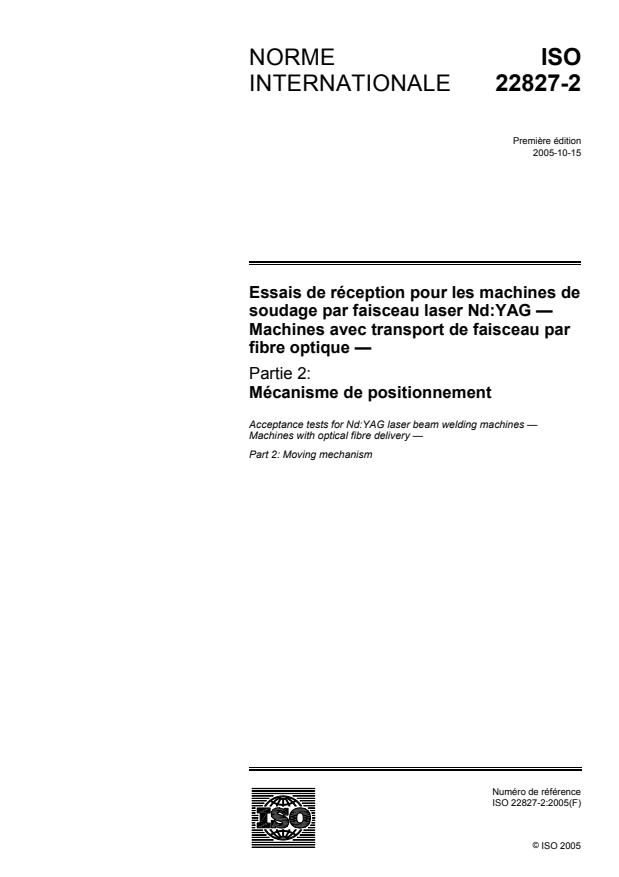
INTERNATIONAL ISO
STANDARD 22827-2
First edition
2005-10-15
Acceptance tests for Nd:YAG laser beam
welding machines — Machines with
optical fibre delivery —
Part 2:
Moving mechanism
Essais de réception pour les machines de soudage par faisceau laser
Nd:YAG — Machines avec transport de faisceau par fibre optique —
Partie 2: Mécanisme de positionnement
Reference number
©
ISO 2005
PDF disclaimer
This PDF file may contain embedded typefaces. In accordance with Adobe's licensing policy, this file may be printed or viewed but
shall not be edited unless the typefaces which are embedded are licensed to and installed on the computer performing the editing. In
downloading this file, parties accept therein the responsibility of not infringing Adobe's licensing policy. The ISO Central Secretariat
accepts no liability in this area.
Adobe is a trademark of Adobe Systems Incorporated.
Details of the software products used to create this PDF file can be found in the General Info relative to the file; the PDF-creation
parameters were optimized for printing. Every care has been taken to ensure that the file is suitable for use by ISO member bodies. In
the unlikely event that a problem relating to it is found, please inform the Central Secretariat at the address given below.
© ISO 2005
All rights reserved. Unless otherwise specified, no part of this publication may be reproduced or utilized in any form or by any means,
electronic or mechanical, including photocopying and microfilm, without permission in writing from either ISO at the address below or
ISO's member body in the country of the requester.
ISO copyright office
Case postale 56 • CH-1211 Geneva 20
Tel. + 41 22 749 01 11
Fax + 41 22 749 09 47
E-mail copyright@iso.org
Web www.iso.org
Published in Switzerland
ii © ISO 2005 – All rights reserved
Contents Page
Foreword. iv
Introduction . v
1 Scope . 1
2 Normative references . 1
3 Terms and definitions. 2
4 Environmental conditions. 2
5 Test of accuracy of the moving mechanism. 2
5.1 Type 1 test . 2
5.2 Type 2 test . 4
6 Test report . 7
Annex A (informative) Example of a test report form . 8
Bibliography . 9
Foreword
ISO (the International Organization for Standardization) is a worldwide federation of national standards bodies
(ISO member bodies). The work of preparing International Standards is normally carried out through ISO
technical committees. Each member body interested in a subject for which a technical committee has been
established has the right to be represented on that committee. International organizations, governmental and
non-governmental, in liaison with ISO, also take part in the work. ISO collaborates closely with the
International Electrotechnical Commission (IEC) on all matters of electrotechnical standardization.
International Standards are drafted in accordance with the rules given in the ISO/IEC Directives, Part 2.
The main task of technical committees is to prepare International Standards. Draft International Standards
adopted by the technical committees are circulated to the member bodies for voting. Publication as an
International Standard requires approval by at least 75 % of the member bodies casting a vote.
Attention is drawn to the possibility that some of the elements of this document may be the subject of patent
rights. ISO shall not be held responsible for identifying any or all such patent rights.
ISO 22827-2 was prepared by Technical Committee ISO/TC 44, Welding and allied processes, Subcommittee
SC 10, Unification of requirements in the field of metal welding.
ISO 22827 consists of the following parts, under the general title Acceptance tests for Nd:YAG laser beam
welding machines — Machines with optical fibre delivery:
⎯ Part 1: Laser assembly
⎯ Part 2: Moving mechanism
iv © ISO 2005 – All rights reserved
Introduction
Requests for official interpretations of any aspect of this part of ISO 22827 should be sent to the Secretariat of
ISO/TC 44/SC 10 via the member body in the user's country, a complete listing of which can be found at
www.iso.org.
INTERNATIONAL STANDARD ISO 22827-2:2005(E)
Acceptance tests for Nd:YAG laser beam welding machines —
Machines with optical fibre delivery —
Part 2:
Moving mechanism
1 Scope
This part of ISO 22827 covers acceptance testing of equipment for 2D manipulation and also, to some extent,
movements along the Z-axis.
NOTE Welding robots and similar 3D equipment for manipulation are covered by other standards, notably ISO 9283.
This part of ISO 22827 specifies two methods for the testing of the accuracy of the moving mechanism. The
first method (type 1 test) provides a test method capable of classification of the moving mechanism rigorously
according to the required accuracy. The second method (type 2 test) provides a simpler method for testing the
moving mechanism by marking. The selection of the test method is optional. However, for large-size laser
beam welding machines, such as a laser beam welding machine using 2D moving optics or an X-Y table, the
type 2 test is applicable.
This part of ISO 22827 is not applicable for welding cells with manual positioning of the welding head and/or
the component, and for fixed-position welding without the moving mechanism.
The requirements can also be applied as a part of verification testing as part of maintenance, as appropriate.
If modifications are made to a laser beam machine (rebuilding, repairs, modifications to the operating
conditions, etc.) that have an effect on the acceptance testing, a repeat test may be necessary to cover the
machine parameters affected by such modifications.
NOTE The beam generating system, the optical delivery system and the devices for shielding and assist gasses are
covered in ISO 22827-1.
This part of ISO 22827 can be applied to a part of the acceptance conditions for the delivery of the laser beam
welding machine.
2 Normative references
The following referenced documents are indispensable for the application of this document. For dated
references, only the edition cited applies. For undated references, the latest edition of the referenced
document (including any amendments) applies.
ISO 230-2, Test code for machine tools — Part 2: Determination of accuracy and repeatability of positioning
numerically controlled axes
ISO 15616-2:2003, Acceptance tests for CO -laser beam machines for high quality welding and cutting —
Part 2: Measurement of static and dynamic accuracy
ISO/TS 17477:2003, Acceptance tests for CO -laser beam machines for welding and cutting using 2D moving
optics type
3 Terms and definitions
For the purposes of this document, the following terms and definitions apply:
3.1
positioning accuracy
precision and repeatability of positioning of the part in motion (work piece, optics, etc.) along a translation or
rotation axis
NOTE The following characteristics can be distinguished in accordance with ISO 230-2:
⎯ mean reversal value of an axis: arithmetic mean of the reversal values at all target positions along or
around the axis;
⎯ unidirectional and bidirectional repeatability of positioning of an axis: maximum value of the repeatability
of positioning at any position along or around the axis and under the conditions specified in ISO 230-2;
⎯ bidirectional accuracy of positioning of an axis: maximum difference between the extreme values of the
positional deviations regardless of the position and the direction of motion [ISO 15616-2:2003].
3.2
trajectory accuracy
trajectory deviation between the required path and the realised or marked path.
4 Environmental conditions
Laser beam welding machines shall be installed in welding cells, also including equipment for manipulation of
the welding head and/or the component to be welded.
5 Test of accuracy of the moving mechanism
5.1 Type 1 test
5.1.1 Classification of the moving mechanism
The moving mechanism for the laser beam welding system is classified as follows:
A: Very high accuracy welding
B: High accuracy welding
C: Ordinary welding
D: Low accuracy welding
The designation of the classes is arbitrary to some degree. Selection of the required class has to be done
during production planning and the class specified in the welding-procedure specification.
Detailed testing of the moving table or rotating fixtures shall be carried out either without a load or with a load
(maximum load). When the moving system is provided with a beam-moving axis, this shall be tested.
The positioning accuracy shall be measured in accordance with 5.1.2.
The dynamic trajectory accuracy shall be measured in accordance with 5.1.3.
2 © ISO 2005 – All rights reserved
5.1.2 Inspection of positioning accuracy
The range of repeatability and positioning accuracy of the Nd:YAG laser beam welding machines shall be in
accordance with Table 1, according to the classification of the moving mechanism.
Testing shall be carried out at the maximum travelling speed specified in the manufacturer's specification for
welding operations. The measured value of accuracy shall be within the range shown in Table 1. At least three
measurements shall be taken and averaged.
When the table length is in 1 m or longer, the positioning accuracy shall be measured at every 1 m in span of
the movement. Inspection shall be carried out for the X-and Y-coordinates.
Table 1 — Range of repeatability and positioning accuracy
Acceptance criteria for class
Item
A B C D
Positioning repeatability
— unidirec
...
NORME ISO
INTERNATIONALE 22827-2
Première édition
2005-10-15
Essais de réception pour les machines de
soudage par faisceau laser Nd:YAG —
Machines avec transport de faisceau par
fibre optique —
Partie 2:
Mécanisme de positionnement
Acceptance tests for Nd:YAG laser beam welding machines —
Machines with optical fibre delivery —
Part 2: Moving mechanism
Numéro de référence
©
ISO 2005
PDF – Exonération de responsabilité
Le présent fichier PDF peut contenir des polices de caractères intégrées. Conformément aux conditions de licence d'Adobe, ce fichier
peut être imprimé ou visualisé, mais ne doit pas être modifié à moins que l'ordinateur employé à cet effet ne bénéficie d'une licence
autorisant l'utilisation de ces polices et que celles-ci y soient installées. Lors du téléchargement de ce fichier, les parties concernées
acceptent de fait la responsabilité de ne pas enfreindre les conditions de licence d'Adobe. Le Secrétariat central de l'ISO décline toute
responsabilité en la matière.
Adobe est une marque déposée d'Adobe Systems Incorporated.
Les détails relatifs aux produits logiciels utilisés pour la création du présent fichier PDF sont disponibles dans la rubrique General Info
du fichier; les paramètres de création PDF ont été optimisés pour l'impression. Toutes les mesures ont été prises pour garantir
l'exploitation de ce fichier par les comités membres de l'ISO. Dans le cas peu probable où surviendrait un problème d'utilisation,
veuillez en informer le Secrétariat central à l'adresse donnée ci-dessous.
© ISO 2005
Droits de reproduction réservés. Sauf prescription différente, aucune partie de cette publication ne peut être reproduite ni utilisée sous
quelque forme que ce soit et par aucun procédé, électronique ou mécanique, y compris la photocopie et les microfilms, sans l'accord écrit
de l'ISO à l'adresse ci-après ou du comité membre de l'ISO dans le pays du demandeur.
ISO copyright office
Case postale 56 • CH-1211 Geneva 20
Tel. + 41 22 749 01 11
Fax. + 41 22 749 09 47
E-mail copyright@iso.org
Web www.iso.org
Publié en Suisse
ii © ISO 2005 – Tous droits réservés
Sommaire Page
Avant-propos. iv
Introduction . v
1 Domaine d'application. 1
2 Références normatives . 1
3 Termes et définitions. 2
4 Conditions environnementales . 2
5 Essai de d'exactitude du mécanisme de positionnement . 2
5.1 Essai de type 1 . 2
5.2 Essai de type 2 . 5
6 Rapport d'essai . 8
Annexe A (informative) Exemple de formulaire de rapport d'essai . 9
Bibliographie . 10
Avant-propos
L'ISO (Organisation internationale de normalisation) est une fédération mondiale d'organismes nationaux de
normalisation (comités membres de l'ISO). L'élaboration des Normes internationales est en général confiée
aux comités techniques de l'ISO. Chaque comité membre intéressé par une étude a le droit de faire partie du
comité technique créé à cet effet. Les organisations internationales, gouvernementales et non
gouvernementales, en liaison avec l'ISO participent également aux travaux. L'ISO collabore étroitement avec
la Commission électrotechnique internationale (CEI) en ce qui concerne la normalisation électrotechnique.
Les Normes internationales sont rédigées conformément aux règles données dans les Directives ISO/CEI,
Partie 2.
La tâche principale des comités techniques est d'élaborer les Normes internationales. Les projets de Normes
internationales adoptés par les comités techniques sont soumis aux comités membres pour vote. Leur
publication comme Normes internationales requiert l'approbation de 75 % au moins des comités membres
votants.
L'attention est appelée sur le fait que certains des éléments du présent document peuvent faire l'objet de
droits de propriété intellectuelle ou de droits analogues. L'ISO ne saurait être tenue pour responsable de ne
pas avoir identifié de tels droits de propriété et averti de leur existence.
L'ISO 22827-2 a été élaborée par le comité technique ISO/TC 44, Soudage et techniques connexes,
sous-comité SC 10, Unification des prescriptions dans la technique du soudage des métaux.
L'ISO 22827 comprend les parties suivantes, présentées sous le titre général Essais de réception pour les
machines de soudage par faisceau laser Nd:YAG — Machines avec transport de faisceau par fibre optique:
⎯ Partie 1: Ensemble laser
⎯ Partie 2: Mécanisme de positionnement
iv © ISO 2005 – Tous droits réservés
Introduction
Il convient d'adresser les demandes d'interprétation officielle de tout aspect de la présente partie de
l'ISO 22827 au secrétariat de l'ISO/TC 44/SC 10, par l'intermédiaire du comité membre situé dans le pays de
l'utilisateur, dont une liste complète peut être obtenue à l'adresse www.iso.org.
NORME INTERNATIONALE ISO 22827-2:2005(F)
Essais de réception pour les machines de soudage par faisceau
laser Nd:YAG — Machines avec transport de faisceau par fibre
optique —
Partie 2:
Mécanisme de positionnement
1 Domaine d'application
La présente partie de l'ISO 22827 couvre les essais de réception des équipements pour les mouvements de
manipulation 2D et également, dans une certaine mesure, les mouvements suivant l'axe Z.
NOTE Les robots de soudage et les équipements similaires pour la manipulation sont couverts par d'autres normes,
notamment l'ISO 9283.
La présente partie de l'ISO 22827 spécifie deux méthodes pour les essais relatifs à l'exactitude du mécanisme
de positionnement. La première méthode (essai de type 1) fournit une méthode d'essai capable de classifier
le mécanisme de positionnement de façon rigoureuse conformément à l'exactitude exigée. La deuxième
méthode (essai de type 2) fournit une méthode plus simple pour l'essai par marquage du mécanisme de
positionnement. Le choix de la méthode d'essai est optionnel. Cependant, dans le cas des machines de
soudage par faisceau laser de grandes dimensions telles que les machines de soudage par faisceau laser
utilisant des optiques mobiles 2D et des tables X-Y, l'essai de type 2 est applicable.
La présente partie de l'ISO 22827 n'est pas applicable pour les cellules de soudage avec positionnement
manuel de la tête de soudage et/ou du composant et pour des positions de soudage fixes, sans mécanisme
de positionnement.
Les exigences peuvent également s'appliquer en tant que partie intégrante des essais de vérification lors de
la maintenance, si approprié.
Dans le cas où des modifications pratiquées sur une machine à faisceau laser (remise en état, réparation,
modifications des conditions d'utilisation, etc.) peuvent affecter les résultats des essais de réception, un
nouvel essai peut s'avérer nécessaire pour vérifier les paramètres de la machine affectés par de telles
modifications.
NOTE Le système de génération de faisceau, le système de transport du faisceau et les dispositifs relatifs aux gaz
de protection et d'assistance sont couverts par l'ISO 22827-1.
La présente partie de l'ISO 22827 peut être appliquée en tant que partie des conditions de réception lors de la
livraison de la machine de soudage par faisceau laser.
2 Références normatives
Les documents de référence suivants sont indispensables pour l'application du présent document. Pour les
références datées, seule l'édition citée s'applique. Pour les références non datées, la dernière édition du
document de référence s'applique (y compris les éventuels amendements).
ISO 230-2, Code d'essai des machines-outils — Partie 2: Détermination de l'exactitude et de la répétabilité de
positionnement des axes en commande numérique
ISO 15616-2:2003, Essais de réception des machines de soudage et de coupage de qualité par faisceau
laser CO — Partie 2: Mesure de la précision du système de mise en œuvre du faisceau en statique et en
dynamique
ISO/TS 17477:2003, Essais de réception des machines de soudage et de coupage par faisceau laser CO à
l'aide d'optiques mobiles 2D
3 Termes et définitions
Pour les besoins du présent document, les termes et définitions suivants s'appliquent.
3.1
exactitude de positionnement
exactitude et répétabilité du positionnement de la partie en mouvement (pièce, optique, etc.) par rapport à un
axe de translation ou de rotation
NOTE Les caractéristiques suivantes peuvent être distinguées conformément à l'ISO 230-2:
⎯ valeur moyenne de réversibilité d'un axe: moyenne arithmétique des valeurs de réversibilité de tous les
points visés le long ou autour d'un axe;
⎯ répétabilité de positionnement unidirectionnelle ou bidirectionnelle d'un axe: valeur maximale de
répétabilité de positionnement en toute position le long ou autour de l'axe, dans les conditions spécifiées
dans l'ISO 230-2;
⎯ exactitude bidirectionnelle de positionnement d'un axe: écart maximal entre les valeurs extrêmes des
écarts de positionnement indépendamment de la position et de la direction du mouvement
[ISO 15616-2:2003].
3.2
exactitude de trajectoire
écart de trajectoire entre le parcours exigé et le parcours réalisé ou marqué
4 Conditions environnementales
Les machines de soudage par faisceau laser doivent être installées dans des cellules de soudage qui
comprennent également des mécanismes de déplacement pour la tête de soudage et/ou le composant à
souder.
5 Essai de d'exactitude du mécanisme de positionnement
5.1 Essai de type 1
5.1.1 Classification du mécanisme de positionnement
Le mécanisme de positionnement pour le système de soudage par faisceau laser est classifié de la manière
suivante:
A: Soudage de très haute précision
B: Soudage de haute précision
C: Soudage courant
D: Soudage de faible précision
2 © ISO 2005 – Tous droits réservés
La désignation des classes est, d'une certaine manière, arbitraire. Le choix de la classe exigée doit être
effectué lors de la planification de la fabrication et la classe doit être spécifiée dans le descriptif de mode
opératoire de soudage.
Les différents essais de la table mobile ou des dispositifs de fixation tournants doivent être réalisés avec ou
sans chargement (charge maximale). Lorsque le système de positionnement est muni d'un axe mobile pour le
faisceau, cet élément doit être soumis à essai.
L'exactitude de positionnement doit être mesurée conformément à 5.1.2.
L'exactitude dynamique de trajectoire doit être mesurée conformément à 5.1.3.
5.1.2 Contrôles et essais relatifs à l'exactitude de positionnement
L'étendue de répétabilité et de l'exactitude de positionnement des machines de soudage par faisceau laser
Nd:YAG doivent être en conformité avec le Tableau 1, suivant la classe du mécanisme de positionnement.
Les essais doivent être réalisés avec la vitesse de déplacement maximale spécifiée dans les spécifications du
fabricant pour les opérations de soudage. La valeur mesurée de l'exactitude doit se situer dans la plage
indiquée dans le Tableau 1. Au moins trois mesures doivent être obtenues et moyennées.
Lorsque la longueur de la table est égale ou supérieure à 1 m, l'exactitude de positionnement doit être
mesurée à des points distants de 1 m le long de la course. Les contrôles et essais doivent être effectués
suivant les axes X et Y.
Tableau 1 — Étendue de répétabilité et de l'exactitude de positionnement
Critère d'acceptation pour la classe
Paramètre
A B C D
Répétabilité de positionnement
— unidirectionnelle ± 0,01 mm ± 0,01 mm ± 0,02 mm ± 0,2 mm
— bidirectionnelle ± 0,02 mm ± 0,04 mm ± 0,06 mm ± 0,4 mm
Exactitude de positionnement ± 0,05 mm/m ± 0,1 mm/m ± 0,2 mm/m ± 0,4 mm/m
L'exactitude de p
...