


ISO/IEC 14496-3:1999/Amd 1:2000
(Amendment)Information technology — Coding of audio-visual objects — Part 3: Audio — Amendment 1: Audio extensions
Information technology — Coding of audio-visual objects — Part 3: Audio — Amendment 1: Audio extensions
Technologies de l'information — Codage des objets audiovisuels — Partie 3: Codage audio — Amendement 1: Extensions audio
General Information
- Status
- Withdrawn
- Publication Date
- 04-Oct-2000
- Withdrawal Date
- 04-Oct-2000
- Current Stage
- 9599 - Withdrawal of International Standard
- Start Date
- 20-Dec-2001
- Completion Date
- 14-Feb-2026
Relations
- Amends
ISO/IEC 14496-3:1999 - Information technology — Coding of audio-visual objects — Part 3: Audio - Effective Date
- 06-Jun-2022
- Effective Date
- 06-Jun-2022
- Effective Date
- 15-Apr-2008
- Effective Date
- 15-Apr-2008
Get Certified
Connect with accredited certification bodies for this standard

BSI Group
BSI (British Standards Institution) is the business standards company that helps organizations make excellence a habit.

NYCE
Mexican standards and certification body.
Sponsored listings
Frequently Asked Questions
ISO/IEC 14496-3:1999/Amd 1:2000 is a standard published by the International Organization for Standardization (ISO). Its full title is "Information technology — Coding of audio-visual objects — Part 3: Audio — Amendment 1: Audio extensions". This standard covers: Information technology — Coding of audio-visual objects — Part 3: Audio — Amendment 1: Audio extensions
Information technology — Coding of audio-visual objects — Part 3: Audio — Amendment 1: Audio extensions
ISO/IEC 14496-3:1999/Amd 1:2000 is classified under the following ICS (International Classification for Standards) categories: 35.040 - Information coding; 35.040.40 - Coding of audio, video, multimedia and hypermedia information. The ICS classification helps identify the subject area and facilitates finding related standards.
ISO/IEC 14496-3:1999/Amd 1:2000 has the following relationships with other standards: It is inter standard links to ISO/IEC 14496-3:1999, ISO/IEC 14496-3:1999/Amd 1:2000/Cor 1:2001; is excused to ISO/IEC 14496-3:1999/Amd 1:2000/Cor 1:2001, ISO/IEC 14496-3:1999. Understanding these relationships helps ensure you are using the most current and applicable version of the standard.
ISO/IEC 14496-3:1999/Amd 1:2000 is available in PDF format for immediate download after purchase. The document can be added to your cart and obtained through the secure checkout process. Digital delivery ensures instant access to the complete standard document.
Standards Content (Sample)
INTERNATIONAL ISO/IEC
STANDARD 14496-3
First edition
1999-12-15
AMENDMENT 1
2000-09-15
Information technology — Coding of
audio-visual objects —
Part 3:
Audio
AMENDMENT 1: Audio extensions
Technologies de l'information — Codage des objets audiovisuels —
Partie 3: Codage audio
AMENDEMENT 1: Extensions audio
Reference number
ISO/IEC 14496-3:1999/Amd.1:2000(E)
©
ISO/IEC 2000
ISO/IEC 14496-3:1999/Amd.1:2000(E)
PDF disclaimer
This PDF file may contain embedded typefaces. In accordance with Adobe's licensing policy, this file may be printed or viewed but shall not
be edited unless the typefaces which are embedded are licensed to and installed on the computer performing the editing. In downloading this
file, parties accept therein the responsibility of not infringing Adobe's licensing policy. The ISO Central Secretariat accepts no liability in this
area.
Adobe is a trademark of Adobe Systems Incorporated.
Details of the software products used to create this PDF file can be found in the General Info relative to the file; the PDF-creation parameters
were optimized for printing. Every care has been taken to ensure that the file is suitable for use by ISO member bodies. In the unlikely event
that a problem relating to it is found, please inform the Central Secretariat at the address given below.
© ISO/IEC 2000
All rights reserved. Unless otherwise specified, no part of this publication may be reproduced or utilized in any form or by any means, electronic
or mechanical, including photocopying and microfilm, without permission in writing from either ISO at the address below or ISO's member body
in the country of the requester.
ISO copyright office
Case postale 56 � CH-1211 Geneva 20
Tel. + 41 22 749 01 11
Fax + 41 22 749 09 47
E-mail copyright@iso.ch
Web www.iso.ch
Printed in Switzerland
ii © ISO/IEC 2000 – All rights reserved
Ó 14496-3:1999/:
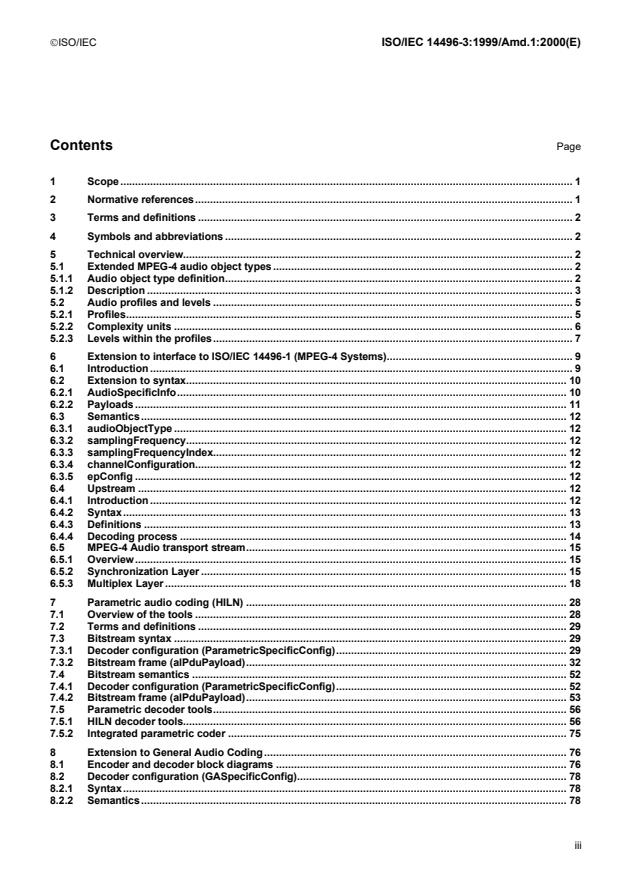
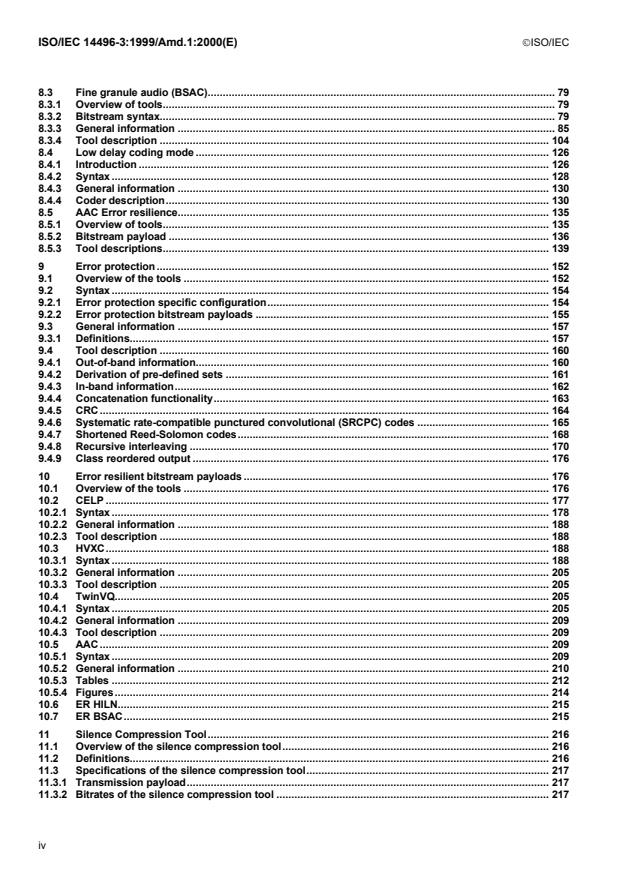
Contents
Page
1. . . . .1
2. . . .1
3 . . . . 2
4. . . .2
5. . . . .2
................................ ................................ ................................ ....2
................................ ................................ ................................ ....................2
................................ ................................ ................................ ................................ ..............3
................................ ................................ ................................ ........................5
................................ ................................ ................................ ................................ .....................5
................................ ................................ ................................ ................................ .....6
................................ ................................ ................................ ........................7
6. .9
................................ ................................ ................................ ................................ .............9
................................ ................................ ................................ ...............................
................................ ................................ ................................ ................................ ..
................................ ................................ ................................ ................................ ................
................................ ................................ ................................ ................................ ..............
................................ ................................ ................................ ................................ ...
................................ ................................ ................................ ...............................
................................ ................................ ................................ ......................
................................ ................................ ................................ ............................
................................ ................................ ................................ ................................ ................
................................ ................................ ................................ ................................ ...............
................................ ................................ ................................ ................................ ...........
................................ ................................ ................................ ................................ ....................
................................ ................................ ................................ ................................ .............
................................ ................................ ................................ .................................
................................ ................................ ................................ ...........
................................ ................................ ................................ ................................ ................
................................ ................................ ................................ ..........................
................................ ................................ ................................ ................................ ......
7. . . .
................................ ................................ ................................ ............................
................................ ................................ ................................ ...........................
................................ ................................ ................................ ................................ ...
................................ ................................ .............
................................ ................................ ................................ ...........
................................ ................................ ................................ .............................
................................ ................................ .............
................................ ................................ ................................ ...........
................................ ................................ ................................ ......................
................................ ................................ ................................ ................................
................................ ................................ ................................ .................
8. . . .
................................ ................................ .................................
................................ ................................ ..........................
................................ ................................ ................................ ................................ ....................
................................ ................................ ................................ ................................ ..............
iii
78 Semantics 8.2.2
78 Syntax 8.2.1
78 Decoder configuration (GASpecificConfig) 8.2
76 Encoder and decoder block diagrams 8.1
76 Extension to General Audio Coding
75 Integrated parametric coder 7.5.2
56 HILN decoder tools 7.5.1
56 Parametric decoder tools 7.5
53 Bitstream frame (alPduPayload) 7.4.2
52 (ParametricSpecificConfig) Decoder configuration 7.4.1
52 Bitstream semantics 7.4
32 Bitstream frame (alPduPayload) 7.3.2
29 Decoder configuration (ParametricSpecificConfig) 7.3.1
29 Bitstream syntax 7.3
29 Terms and definitions 7.2
28 Overview of the tools 7.1
28 Parametric audio coding (HILN)
18 Multiplex Layer 6.5.3
15 Synchronization Layer 6.5.2
15 Overview 6.5.1
15 MPEG-4 Audio transport stream 6.5
14 Decoding process 6.4.4
13 Definitions 6.4.3
13 Syntax 6.4.2
12 Introduction 6.4.1
12 Upstream 6.4
12 epConfig 6.3.5
12 channelConfiguration 6.3.4
12 samplingFrequencyIndex 6.3.3
12 samplingFrequency 6.3.2
12 audioObjectType 6.3.1
12 Semantics 6.3
11 Payloads 6.2.2
10 AudioSpecificInfo 6.2.1
10 Extension to syntax 6.2
Introduction 6.1
Extension to interface to ISO/IEC 14496-1 (MPEG-4 Systems)
Levels within the profiles 5.2.3
Complexity units 5.2.2
Profiles 5.2.1
Audio profiles and levels 5.2
Description 5.1.2
Audio object type definition 5.1.1
Extended MPEG-4 audio object types 5.1
Technical overview
Symbols and abbreviations
definitions Terms and
Normative references
Scope
(E) 2000 Amd.1 ISO/IEC ISO/IEC
14496-3:1999/:Ó
................................ ................................ ................................ ....................
................................ ................................ ................................ ................................ ...
................................ ................................ ................................ ................................ ....
................................ ................................ ................................ ..............................
................................ ................................ ................................ ................................ ..
................................ ................................ ................................ ......................
................................ ................................ ................................ ................................ .........
................................ ................................ ................................ ................................ ..................
................................ ................................ ................................ ............................
................................ ................................ ................................ ................................
................................ ................................ ................................ ............................
................................ ................................ ................................ .................................
................................ ................................ ................................ ...............................
................................ ................................ ................................ .................................
9. . . . .
................................ ................................ ................................ ..........................
................................ ................................ ................................ ................................ ..................
................................ ................................ ..............................
................................ ................................ ................................ ..
................................ ................................ ................................ ............................
................................ ................................ ................................ ................................ ............
................................ ................................ ................................ ................................ ..
................................ ................................ ................................ ......................
................................ ................................ ................................ ............
................................ ................................ ................................ .............................
................................ ................................ ................................ ................
................................ ................................ ................................ ................................ ......................
................................ ............
................................ ................................ ................................ ........
................................ ................................ ................................ ........................
................................ ................................ ................................ .......................
................................ ................................ ................................ ......
................................ ................................ ................................ ..........................
................................ ................................ ................................ ................................ ....................
................................ ................................ ................................ ................................ ..................
................................ ................................ ................................ ............................
................................ ................................ ................................ ................................ ..
................................ ................................ ................................ ................................ ....................
................................ ................................ ................................ ................................ ..................
................................ ................................ ................................ ............................
................................ ................................ ................................ ................................ ..
................................ ................................ ................................ ................................ .................
................................ ................................ ................................ ................................ ..................
................................ ................................ ................................ ............................
................................ ................................ ................................ ................................ ..
................................ ................................ ................................ ................................ ......................
................................ ................................ ................................ ................................ ..................
................................ ................................ ................................ ............................
................................ ................................ ................................ ................................ ..................
................................ ................................ ................................ ................................ .................
ER HILN . . . . .
................................ ................................ ................................ ................................ ..............
................................ ................................ ................................ ..................
................................ ................................ .........................
................................ ................................ ................................ ................................ ............
................................ ................................ .................
................................ ................................ ................................ .........................
................................ ................................ ...........................
iv
217 Bitrates of the silence compression tool 11.3.2
217 Transmission payload 11.3.1
217 ions of the silence compression tool Specificat 11.3
216 Definitions 11.2
216 Overview of the silence compression tool 11.1
216 Silence Compression Tool 11
215 BSAC ER 10.7
215 10.6
214 Figures 10.5.4
212 Tables 10.5.3
210 General information 10.5.2
209 Syntax 10.5.1
209 AAC 10.5
209 Tool description 10.4.3
209 General information 10.4.2
205 Syntax 10.4.1
205 TwinVQ 10.4
205 Tool description 10.3.3
205 General information 10.3.2
188 Syntax 10.3.1
188 HVXC 10.3
188 Tool description 10.2.3
188 General information 10.2.2
178 Syntax 10.2.1
177 CELP 10.2
176 Overview of the tools 10.1
176 Error resilient bitstream payloads 10
176 Class reordered output 9.4.9
170 Recursive interleaving 9.4.8
168 Shortened Reed-Solomon codes 9.4.7
165 Systematic rate-compatible punctured convolutional (SRCPC) codes 9.4.6
164 CRC 9.4.5
163 Concatenation functionality 9.4.4
162 In-band information 9.4.3
161 Derivation of pre-defined sets 9.4.2
160 Out-of-band information 9.4.1
160 Tool description 9.4
157 Definitions 9.3.1
157 General information 9.3
155 Error protection bitstream payloads 9.2.2
154 Error protection specific configuration 9.2.1
154 Syntax 9.2
152 Overview of the tools 9.1
152 Error protection
139 Tool descriptions 8.5.3
136 Bitstream payload 8.5.2
135 ools Overview of t 8.5.1
135 AAC Error resilience 8.5
130 Coder description 8.4.4
130 General information 8.4.3
128 Syntax 8.4.2
126 Introduction 8.4.1
126 Low delay coding mode 8.4
104 Tool description 8.3.4
85 General information 8.3.3
79 syntax Bitstream 8.3.2
79 Overview of tools 8.3.1
79 Fine granule audio (BSAC) 8.3
ISO/IEC (E) 2000 Amd.1 ISO/IEC
Ó 14496-3:1999/:
................................ ................................ ............
................................ ................................ ................................ ................................ ...................
................................ ................................ ................................ ................................ ..
................................ ................................ ................................ ............................
................................ ................................ ................................ .................................
................................ ................................ ................................ ................................ .........
................................ ................................ ................................ ................................ ............
................................ ................................ ................................ ................................ .........
................................ ................................ ................................ ................................ .......
................................ ................................ .......................
................................ ................................ ................................ ................................ ........
................................ ................................ ................................ ................................ ......
................................ ................................ ................................ ...................
................................ ................................ ................................ ................................
................................ ................................ ................................ ................................ .....
................................ ................................ ...............................
................................ ................................ ................................ ................................ ...............
................................ ................................ ................................ ................................ ............
................................ ................................ ................................ ................................ ...................
................................ ................................ ................
................................ ................................ ................................ ..........
................................ ................................ ................................ .....
................................ ................................ ................................ ..........................
................................ ................................ ................................ ..............
................................ ................................ ............................
................................ ................................ ................................ ................................
(informative) . . .
................................ ................................ ................................ .............
................................ ................................ ................................ ...............................
H. . . .
................................ ................................ ................................ ......................
................................ ................................ ................................ .........................
................................ ................................ ................................ ......
................................ ................................ ................................ .........
................................ ................................ ................................ ................
...............................
................................ ................................ ................................ ................................ ..........
................................ ................................ ...............
................................ ................................ ................................ ........
................................ ................................ ................................ ...................
................................ ................................ ................................ ................................ ..........
................................ ................................ ................................ .................................
................................ ................................ ................................ ..............
................................ ................................ ................................ ........
................................ ................................ ....................
................................ ................................ ................................ .....
................................ ................................ ...............................
................................ ................................ ................................ ....
................................ ................................ ................................ ................................ ..
................................ ................................ ................................ ...........................
................................ ................................ ................................ ................................
................................ ................................ ................................ ................................
................................ ................................ ................................ ..........................
................................ ................................ ................................ .............
................................ ................................ ................................ ................................
................................ ................................ .........
................................ ............................
................................ ................................ ................................ ................................ ............
v
270 Definitions C.4.1
269 Example of EP tool setting and error concealment for HVXC C.4
269 r the silence compression tool Error concealment fo C.3.2
264 Example for CELP C.3.1
264 Example of error concealment C.3
263 BSAC ER Example for C.2.5
262 le for HVXC Examp C.2.4
260 Example for CELP C.2.3
254 Example for Twin-VQ C.2.2
254 Example for AAC C.2.1
254 Example of out-of-band information C.2
253 Text format of out-of-band information C.1
253 Error protection tool (informative) Annex C
250 Payload transmitted over Elementary Stream B.8
249 Stereo-related data and PNS data B.7
248 Arithmetic Coding Procedure B.6.1
247 Arithmetic coding B.6
247 Scalefactors B.5
246 Grouping and interleaving B.4
246 Probability Table Determinations B.3
245 Bit Slicing of the quantized spectral coefficients B.2
245 Introduction B.1
245 Fine grain scalability tool: BSAC (Bit-Sliced Arithmetic Coding) (informative) Annex B
243 Integrated parametric coder A.3.2
242 Music/Speech classification tool A.3.1
241 Music/Speech Mixed Encoder tool A.3
241 HILN bitrate scalability A.2.3
238 HILN parameter encoder A.2.2
234 ILN parameter extraction A.2.1
234 HILN encoder tools A.2
234 Overview of the encoder tools A.1
234 Parametric audio encoder Annex A
232 process Decoding 12.5.1
232 process of variable rate mode Decoding 12.5
232 mode Bitrates of variable rate 12.4.2
231 Transmission payload 12.4.1
231 Specification of variable rate mode 12.4
230 Bitstream frame (alPduPayload) 12.3.2
229 Decoder configuration (ER HvxcSpecificConfig) 12.3.1
229 Syntax 12.3
229 Definitions 12.2
228 Overview 12.1
228 Extension of HVXC variable rate mode 12
228 Memory update 11.5.9
228 LP Synthesis filter 11.5.8
225 CNG excitation generation 11.5.7
225 RMS smoother 11.5.6
225 RMS decoder 11.5.5
224 LSP-LPC conversion LSP interpolation and 11.5.4
224 LSP smoother 11.5.3
224 LSP decoder 11.5.2
223 Definitions 11.5.1
223 CNG module 11.5
223 LSP transmission 11.4.3
222 Bitstream semantics 11.4.2
219 Bitstream syntax 11.4.1
218 Syntax 11.4
218 ompression tool Algorithmic delay of the silence c 11.3.3
(E) 2000 Amd.1 ISO/IEC ISO/IEC
14496-3:1999/:Ó
................................ ................................ ................................ ................................ ...
................................ ................................ ................................ ................................ .....
................................ ................................ ................................ ...............................
................................ ................................ ............................
................................ ................................ ................................ ................................ .........
................................ ................................ ................................ ................................ ............
................................ ................................ ................................ .......
................................ ................................ ................................ .........................
................................ ................................ ................................ ........
................................ ................................ ................................ .............
................................ ................................ ................................ ................................ .............
................................ ................................ ................................ ................................ .........
................................ ................................ ................................ ................................ ............
................................ ................................ ................................ ................................ ..........
................................ ................................ ................................ ..........................
................................ ................................ ................................ ................................ ...
................................ ................................ ................................ .........................
................................ ................................ .............................
................................ ................................ ................................ ............................
................................ ................................ ................................ .............................
................................ ................................ .......
................................ ................................ ................................ ............................
................................ ................................ ................................ ................................ ............
................................ ................................ ................................ ................................
................................ ................................ ................................ ..........................
................................ ................................ ................................ .....................
................................ ................................ ................................ ...............
................................ ................................ ................................ .......
................................ ................................ ................................ ........
vi
296 Patent statements (informative) Annex F
292 Transmitted parameters decision E.1.6
292 Background noise detection E.1.5
292 Signal stability detection E.1.4
291 Spectral comparison E.1.3
291 RMS computation E.1.2
291 Definitions E.1.1
291 Encoder Description E.1
291 Extension of HVXC variable rate mode (informative) Annex E
290 Local CNG decoder D.2.8
290 Parameter encoding D.2.7
289 Detection of the characteristics change D.2.6
289 Averaging of the RMS D.2.5
289 RMS calculation D.2.4
289 Averaging of the LSP D.2.3
289 LP analysis D.2.2
288 Definitions D.2.1
288 DTX module D.2
287 Hangover D.1.6
287 Frame voice activity decision D.1.5
286 Temporal voice activity decision D.1.4
286 Parameter calculation D.1.3
285 Down-sampling for the wideband D.1.2
285 Definitions D.1.1
285 VAD module D.1
285 Silence compression tool (informative) Annex D
282 Error concealment C.4.4
281 EP tool setting C.4.3
270 Channel coding C.4.2
ISO/IEC (E) 2000 Amd.1 ISO/IEC
Ó 14496-3:1999/:
Foreword
ISO (the International Organization for Standardization) and IEC (the International Electrotechnical Commission)
form the specialized system for worldwide standardization. National bodies that are members of ISO or IEC
participate in the development of International Standards through technical committees established by the
respective organization to deal with particular fields of technical activity. ISO and IEC technical committees
collaborate in fields of mutual interest. Other international organizations, governmental and non-governmental, in
3.
In the field of information technology, ISO and IEC have established a joint technical committee, ISO/IEC 1.
Draft International Standards adopted by the joint technical committee are circulated to national bodies for voting.
Attention is drawn to the possibility that some of the elements of this Amendment may be the subject of patent
Amendment 1 to International Standard ISO/IEC 14496-3:2000 was prepared by Joint Technical Committee
ISO/IEC JTC 1, Information technology, Subcommittee SC 29, Coding of audio, picture, multimedia and
hypermedia information.
Annexes A, B, C, D, E and F of this Amendment are for information only.
vii
rights. ISO and IEC shall not be held responsible for identifying any or all such patent rights.
casting a vote. % of the national bodies Publication as an International Standard requires approval by at least 75
JTC
International Standards are drafted in accordance with the rules given in the ISO/IEC Directives, Part
liaison with ISO and IEC, also take part in the work.
(E) 2000 Amd.1 ISO/IEC ISO/IEC
14496-3:1999/:Ó
Introduction
MPEG-4 version 2 is an amendment to MPEG-4 version 1. This document contains the description of bitstream
and decoder related to new tools defined within MPEG-4 version 2. As long as nothing else is
.
ISO/IEC 14496-3 (MPEG-4 Audio) is a new kind of audio standard that integrates many different types of audio
coding: natural sound with synthetic sound, low bitrate delivery with high-quality delivery, speech with music,
complex soundtracks with simple ones, and traditional content with interactive and virtual-reality content. By
standardizing individually sophisticated coding tools as well as a novel, flexible framework for audio
synchronization, mixing, and downloaded post-production, the developers of the MPEG-4 Audio standard have
MPEG-4, unlike previous audio standards created by ISO/IEC and other groups, does not target a single
application such as real-time telephony or high-quality audio compression. Rather, MPEG-4 Audio is a standard
that applies to application requiring the use of advanced sound compression, synthesis, manipulation, or
playback. The subparts that follow specify the state-of-the-art coding tools in several domains; however, MPEG-4
standard, exciting new possibilities for object-based audio coding, interactive presentation, dynamic soundtracks,
Since a single set of tools is used to cover the needs of a broad range of applications, is a natural
feature of systems that depend on the MPEG-4 Audio standard. A system that uses a particular coder—for
example, a real-time voice communication system making use of the MPEG-4 speech coding toolset—can easily
share data and development tools with other systems, even in different domains, that use the same tool—for
give a more detailed overview of the capabilities and
2.
With this extension, new tools are added to the MPEG-4 standard, while none of the existing tools of version 1 is
.
·
The error robustness tools provide improved performance on error-prone transmission channels. They can be
Improved error robustness for AAC is provided by a set of error resilience tools. These tools reduce the perceived
deterioration of the decoded audio signal that is caused by corrupted bits in the bitstream. The following tools are
·
·
·
viii
Huffman Codeword Reordering tool (HCR)
Reversible Variable Length Coding tool (RVLC)
Virtual CodeBook tool (VCB11)
parts of an AAC frame: several provided to improve the error robustness for
distinguished into codec specific error resilience tools and an common error protection tool.
Error Robustness
to provide the following new functionalities: In the area of Audio, new tools are added in MPEG-4 version 2
Version 2 is therefore fully backward compatible to version 1 replaced.
New concepts
version 4 Audio
MPEG- functionalities provided with following subclauses The
example, a voicemail indexing and retrieval system making use of MPEG-4 speech coding.
interoperability
and other sorts of new media, are enabled.
Audio is more than just the sum of its parts. As the tools described here are integrated with the rest of the MPEG-4
every
created new technology for a new, interactive world of digital audio.
Overview
mentioned, the description made in MPEG-4 version 1 is not changed but only extended
extensions
ISO/IEC (E) 2000 Amd.1 ISO/IEC
Ó 14496-3:1999/:
syntax. It allows advanced channel coding techniques, which can be adapted to the special needs of the different
The error protection tool (EP tool) provides unequal error protection (UEP) for MPEG-4 Audio in conjunction with
the error resilient bitstream payload. UEP is an efficient method to improve the error robustness of source
schemes. It is used by various speech and audio coding systems operating over error-prone channels such as
mobile telephone networks or Digital Audio Broadcasting (DAB). The bits of the coded signal representation are
·
of general audio signals at low bitrates. However
it has an algorithmic delay of up to 100ms and is thus not well suited for applications requiring low coding
-
ms for the bit reservoir. To enable coding of general audio signals with an algorithmic delay not exceeding 20 ms,
MPEG-4 version 2 specifies a Low-Delay Audio Coder which is derived from MPEG-2/4 Advanced Audio Coding
up to and uses a frame length of 512 or 480 samples, compared to the
1024 or 960 samples used in standard MPEG-2/4 AAC . Also the size of the window used in the analysis and
reduced by a factor of 2. No block switching is used to avoid the “due to
the block switching decision. To reduce pre-echo artefacts in case of transient signals, window shape switching is
a window is used, while a so-called
is used in case of transient signals. Use of the bit reservoir is minimized in the encoder in order to reach
·
Bitrate scalability, also known as embedded coding, is a very desirable functionality. The General Audio Coder of
version 1 supports large step scalability where a base layer bitstream can be combined with one or more
enhancement layer bitstreams to utilize a higher bitrate and thus obtain a better audio quality. In a typical
kbit/s base layer and two 16 used, permitting decoding at a
total bitrate of 24 (mono), (stereo), and 56 (stereo). Due to the side information carried in
each layer, small bitrate enhancement layers are not efficiently supported in version 1. To address this problem
and to provide efficient small step scalability for the General Audio Coder, the Bit-Sliced Arithmetic
coding of the quantized spectral data and the scalefactors. BSAC provides scalability in steps of 1 kbit/s per audio
i.e. 2 steps for a stereo signal. One base layer bitstream and many small enhancement layer
bitstreams are used. The base layer contains the general side information, specific side information for the first
audio data for the corresponding layer. To obtain fine step scalability, a bit-slicing scheme is applied to
quantized spectral data. First the quantized spectral values are grouped into frequency bands. Each of these
groups contains the quantized spectral values in their binary representation. Then the bits of a group are
in a group are processed, etc. These bit-slices are then encoded using an arithmetic coding scheme to
entropy coding with minimal redundancy. Various arithmetic coding models are provided to cover the different
statistics of the bit-slices. The scheme used to assign the bit-slices of the different frequency bands to the
enhancement layer is constructed in a special way. This ensures that, with an increasing number of enhancement
layers utilized by the decoder, quantized spectral data is refined by providing more of the less significant bits. But
·
The Parametric Audio Coding tools combine very low bitrate coding of general audio signals with the possibility of
modifying the playback speed or pitch during decoding without the need for an effects processing unit. In
v
ix
switching between different coding techniques. applications of object based coding allowing selection and/or
ersion 1, improved overall coding efficiency is expected for tools of combination with the speech and audio coding
Parametric Audio Coding
spectral data in higher frequency bands. also the bandwidth is increased by providing bit-slices of the
obtain
quantized values significance. Thus first all most significant bits (MSB) of the processed in slices according to their
the
enhancement streams contain only the specific side information and layer and the audio data of the first layer. The
kbit/s channel,
noiseless tool is used in combination with the AAC coding tools and replaces the . This tool is available in version
Coding (BSAC)
kbit/s kbit/s 40 kbit/s
kbit/s enhancement layers could be 24 configuration, a
Fine Grain Scalability
used at all. desired target delay. As one extreme case, no bit reservoir is
the
window low overlap sine provided instead. For non-transient parts of the signal
look-ahead'” delay synthesis filterbank is
48 kHz sampling rate . It operates at (AAC)
plus up to additional 210 kbit/s this results in an algorithmic coding delay of about 110 ms 24 kHz sampling rate and
the General Audio Coder operating at 24 As an example, for bi-directional communication. time delay, such as real
several
The MPEG-4 General Audio Coder provides very efficient coding
Low-Delay Audio Coding
sensitive bits. the different classes, giving better protection to more
applied to their error sensitivity. Then error protection is individually first grouped into different classes according to
coding
coding tools. This error resilient bitstream payload syntax is mandatory for all version 2 object types.
Improved error robustness capabilities for all coding tools are provided through the error resilient bitstream payload
(E) 2000 Amd.1 ISO/IEC ISO/IEC
14496-3:1999/:Ó
Parametric Audio Coding uses the Harmonic and Individual Lines plus Noise (HILN) technique to code general
of this technique is to decompose the input signal into audio objects which are described by appropriate source
are utilized
This approach allows to introduce a more advanced source model than just assuming a stationary signal for the
duration of a frame, which motivates the spectral decomposition used e.g. in the MPEG-4 General Audio Coder.
As known from speech coding, where specialized source models based on the speech generation process in
human vocal tract are applied, advanced source models can be advantageous in particular for very low bitrate
Due to the very low target bitrates, only the parameters for a small number of objects can be transmitted.
employed to select those objects that are most important for the
In HILN, the frequency and amplitude parameters are quantized according to the “just noticeable differences”
from psychoacoustics. The spectral envelope of the noise and the harmonic tone is described using LPC
modeling as known from speech coding. Correlation between the parameters of one frame and between
consecutive frames is exploited by parameter prediction. The quantized parameters are finally entropy coded and
A very interesting property of this parametric coding scheme arises from the fact that the signal is described in
terms of frequency and amplitude parameters. This signal representation permits speed and pitch change
with MPE
...
Questions, Comments and Discussion
Ask us and Technical Secretary will try to provide an answer. You can facilitate discussion about the standard in here.
Loading comments...