

ISO 18488:2015
(Main)Polyethylene (PE) materials for piping systems — Determination of Strain Hardening Modulus in relation to slow crack growth — Test method
General Information
- Abstract
ISO 18488:2015 specifies a method for the determination of the strain hardening modulus which is used as a measure for the resistance to slow crack growth of polyethylene. The strain hardening modulus is obtained from stress-strain curves on compression moulded samples. This International Standard describes how such measurement is performed and how the strain hardening modulus shall be determined from such a curve. Details of the required equipment, precision, and sample preparation for the generation of meaningful data are given. ISO 18488:2015 provides a method that is valid for all types of polyethylene, independent from the manufacturing technology, comonomer, catalyst type, that are used for pipes and fittings applications. NOTE This method could be developed for materials for other applications.
- Status
- Withdrawn
- Publication Date
- 19-Aug-2015
- Technical Committee
- ISO/TC 138/SC 5 - General properties of pipes, fittings and valves of plastic materials and their accessories -- Test methods and basic specifications
- Drafting Committee
- ISO/TC 138/SC 5/WG 20 - Slow crack growth (SCG)
- Current Stage
- 9599 - Withdrawal of International Standard
- Start Date
- 14-Oct-2025
- Completion Date
- 29-Aug-2026
Buy Documents
ISO 18488:2015 - Polyethylene (PE) materials for piping systems -- Determination of Strain Hardening Modulus in relation to slow crack growth -- Test method
ISO 18488:2015 - Polyethylene (PE) materials for piping systems — Determination of Strain Hardening Modulus in relation to slow crack growth — Test method/20/2015
Overview
ISO 18488:2015 specifies a laboratory test method to determine the strain hardening modulus of polyethylene (PE) materials used in piping systems. The strain hardening modulus is measured from stress–strain curves of compression‑moulded samples tested in tension at 80 °C and is used as an intrinsic indicator of a PE material’s resistance to slow crack growth (SCG). The method is valid for all types of polyethylene regardless of manufacturing process, comonomer or catalyst, for pipes and fittings applications.
Key topics and technical requirements
- Scope: Measurement of strain hardening modulus as a predictor for slow crack growth behaviour of PE.
- Specimen preparation: Compression‑moulded sheets (recommended thicknesses 0.30 mm or 1.0 mm), followed by annealing (1 h at 120 °C) and slow cooling. Specimen geometry and punching required to avoid edge defects.
- Dimensions: Typical gauge length l0 = 12.5 mm; narrow width b = 4.0 mm; clamp and overall dimensions specified to prevent slippage.
- Test conditions: Tensile test at (80 ± 1) °C, traverse speed (20 ± 2) mm/min, pre‑stress 0.4 MPa, condition specimens at test temperature for ≥30 min.
- Instrumentation: Tensile machine complying with ISO 527‑1, load cell Class 1 (ISO 7500‑1), extensometer Class 1 (ISO 9513) - non‑contact extensometer preferred for thin samples.
- Data and analysis: True stress vs draw ratio λ calculated assuming volume conservation. Strain hardening modulus p is derived from a Neo‑Hookean constitutive fit between draw ratios λ ≈ 8 and up to λ = 12 (or maximum stress), with an accuracy of fit R² > 0.90.
- Repeatability: Minimum of five specimens; reject samples that break before λ = 8.5 or show clamp slippage.
Applications and users
ISO 18488:2015 is primarily used to:
- Support material selection for PE pipes and fittings with improved SCG resistance.
- Provide quality control and batch comparison for manufacturers and suppliers.
- Inform R&D and compound formulation for improved long‑term performance.
- Supply test data for failure analysis, product certification and regulatory compliance.
Typical users include polymer testing laboratories, pipe and fitting manufacturers, materials scientists, standards bodies and infrastructure project engineers.
Related standards
- ISO 527‑1 - Tensile properties of plastics (general principles)
- ISO 7500‑1 - Verification of force‑measuring systems for testing machines
- ISO 9513 - Calibration of extensometer systems
ISO 18488:2015 complements environmental stress cracking and long‑term performance tests and can be adapted for other PE applications beyond piping.
Relations
- Effective Date
- 25-Aug-2026
- Effective Date
- 25-Aug-2026
- Effective Date
- 25-Aug-2026
- Effective Date
- 08-Apr-2026
- Effective Date
- 08-Apr-2026
- Effective Date
- 08-Apr-2026
- Effective Date
- 08-Apr-2026
- Effective Date
- 08-Apr-2026
- Effective Date
- 08-Apr-2026
- Effective Date
- 08-Apr-2026
- Effective Date
- 08-Apr-2026
- Effective Date
- 08-Apr-2026
- Effective Date
- 18-Nov-2023
Buy Documents
ISO 18488:2015 - Polyethylene (PE) materials for piping systems -- Determination of Strain Hardening Modulus in relation to slow crack growth -- Test method
ISO 18488:2015 - Polyethylene (PE) materials for piping systems — Determination of Strain Hardening Modulus in relation to slow crack growth — Test method/20/2015
Get Certified
Connect with accredited certification bodies for this standard

Institut za varilstvo d.o.o. (Welding Institute)
Slovenia's leading welding institute since 1952. ISO 3834, EN 1090, pressure equipment certification, NDT personnel, welder qualification. Only IIW Au
Sponsored listings
Frequently Asked Questions
ISO 18488:2015 is a standard published by the International Organization for Standardization (ISO). Its full title is "Polyethylene (PE) materials for piping systems — Determination of Strain Hardening Modulus in relation to slow crack growth — Test method". This standard covers: ISO 18488:2015 specifies a method for the determination of the strain hardening modulus which is used as a measure for the resistance to slow crack growth of polyethylene. The strain hardening modulus is obtained from stress-strain curves on compression moulded samples. This International Standard describes how such measurement is performed and how the strain hardening modulus shall be determined from such a curve. Details of the required equipment, precision, and sample preparation for the generation of meaningful data are given. ISO 18488:2015 provides a method that is valid for all types of polyethylene, independent from the manufacturing technology, comonomer, catalyst type, that are used for pipes and fittings applications. NOTE This method could be developed for materials for other applications.
ISO 18488:2015 specifies a method for the determination of the strain hardening modulus which is used as a measure for the resistance to slow crack growth of polyethylene. The strain hardening modulus is obtained from stress-strain curves on compression moulded samples. This International Standard describes how such measurement is performed and how the strain hardening modulus shall be determined from such a curve. Details of the required equipment, precision, and sample preparation for the generation of meaningful data are given. ISO 18488:2015 provides a method that is valid for all types of polyethylene, independent from the manufacturing technology, comonomer, catalyst type, that are used for pipes and fittings applications. NOTE This method could be developed for materials for other applications.
ISO 18488:2015 is classified under the following ICS (International Classification for Standards) categories: 23.040.20 - Plastics pipes; 23.040.45 - Plastics fittings. The ICS classification helps identify the subject area and facilitates finding related standards.
ISO 18488:2015 has the following relationships with other standards: It is inter standard links to EN 1555-4:2025, EN 12201-4:2024, EN ISO 17855-2:2024, EN 12201-3:2024, EN 1555-1:2021, EN 1555-2:2021, EN 1555-3:2021, EN 12201-1:2024, EN 1555-3:2025, EN 1555-1:2025, EN 1555-2:2025, EN 12201-2:2024, ISO 18488:2025. Understanding these relationships helps ensure you are using the most current and applicable version of the standard.
ISO 18488:2015 is available in PDF format for immediate download after purchase. The document can be added to your cart and obtained through the secure checkout process. Digital delivery ensures instant access to the complete standard document.
Standards Content (Sample)
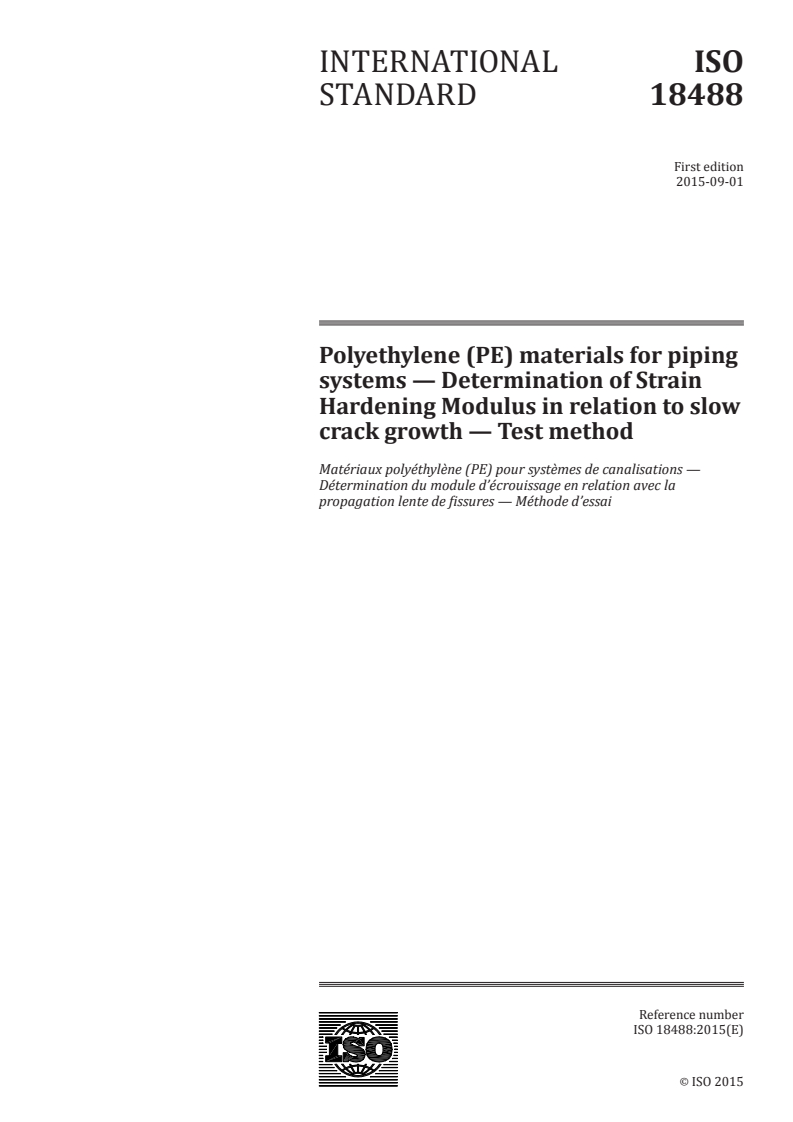
INTERNATIONAL ISO
STANDARD 18488
First edition
2015-09-01
Polyethylene (PE) materials for piping
systems — Determination of Strain
Hardening Modulus in relation to slow
crack growth — Test method
Matériaux polyéthylène (PE) pour systèmes de canalisations —
Détermination du module d’écrouissage en relation avec la
propagation lente de fissures — Méthode d’essai
Reference number
©
ISO 2015
© ISO 2015, Published in Switzerland
All rights reserved. Unless otherwise specified, no part of this publication may be reproduced or utilized otherwise in any form
or by any means, electronic or mechanical, including photocopying, or posting on the internet or an intranet, without prior
written permission. Permission can be requested from either ISO at the address below or ISO’s member body in the country of
the requester.
ISO copyright office
Ch. de Blandonnet 8 • CP 401
CH-1214 Vernier, Geneva, Switzerland
Tel. +41 22 749 01 11
Fax +41 22 749 09 47
copyright@iso.org
www.iso.org
ii © ISO 2015 – All rights reserved
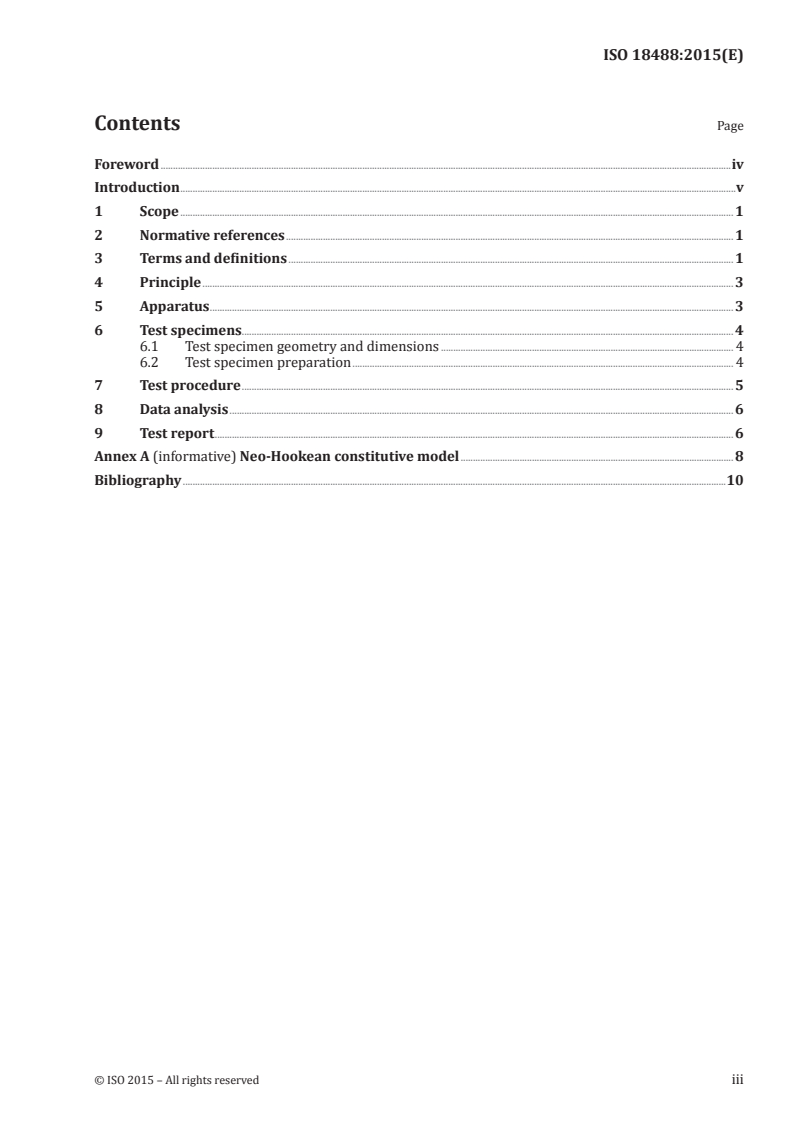
Contents Page
Foreword .iv
Introduction .v
1 Scope . 1
2 Normative references . 1
3 Terms and definitions . 1
4 Principle . 3
5 Apparatus . 3
6 Test specimens. 4
6.1 Test specimen geometry and dimensions . 4
6.2 Test specimen preparation . 4
7 Test procedure . 5
8 Data analysis . 6
9 Test report . 6
Annex A (informative) Neo-Hookean constitutive model . 8
Bibliography .10
Foreword
ISO (the International Organization for Standardization) is a worldwide federation of national standards
bodies (ISO member bodies). The work of preparing International Standards is normally carried out
through ISO technical committees. Each member body interested in a subject for which a technical
committee has been established has the right to be represented on that committee. International
organizations, governmental and non-governmental, in liaison with ISO, also take part in the work.
ISO collaborates closely with the International Electrotechnical Commission (IEC) on all matters of
electrotechnical standardization.
The procedures used to develop this document and those intended for its further maintenance are
described in the ISO/IEC Directives, Part 1. In particular the different approval criteria needed for the
different types of ISO documents should be noted. This document was drafted in accordance with the
editorial rules of the ISO/IEC Directives, Part 2 (see www.iso.org/directives).
Attention is drawn to the possibility that some of the elements of this document may be the subject of
patent rights. ISO shall not be held responsible for identifying any or all such patent rights. Details of
any patent rights identified during the development of the document will be in the Introduction and/or
on the ISO list of patent declarations received (see www.iso.org/patents).
Any trade name used in this document is information given for the convenience of users and does not
constitute an endorsement.
For an explanation on the meaning of ISO specific terms and expressions related to conformity
assessment, as well as information about ISO’s adherence to the WTO principles in the Technical
Barriers to Trade (TBT) see the following URL: Foreword - Supplementary information
The committee responsible for this document is ISO/TC 138, Plastics pipes, fittings and valves for the
transport of fluids, Subcommittee SC 5, General properties of pipes, fittings and valves of plastic materials
and their accessories — Test methods and basic specifications.
iv © ISO 2015 – All rights reserved
Introduction
Resistance to slow crack growth is related in general to the lifetime of polyethylene and thus, the
lifetime of polyethylene products, e.g. pipes and fittings. The slow crack growth behaviour can be
regarded as a combination of yield stress and the capability of disentanglement of tie molecules as
[3] [6] [7]
reported by Kramer and Brown. , , The disentanglement capability of a polymer will determine
its resistance against slow crack growth.
The strain hardening modulus of a polymer is a measure of the disentanglement capability of the tie
molecules of this polymer and is an intrinsic property. The strain hardening modulus of polyethylene
is obtained from a stress-strain curve above the natural draw ratio. The stress-strain curve of a
compression moulded sample is relatively easily obtained using a tensile test apparatus equipped with
an optical extensometer. The test time of the strain hardening modulus is a consequence of the speed
of tensile testing and is therefore constant for all measurements and independent of the slow crack
growth property of the tested material itself.
The strain hardening modulus value allows discrimination between materials. It has been demonstrated
that the strain hardening modulus corresponds very well with several environmental stress cracking
[4] [5] [8]
test methods for high density polyethylene. , ,
INTERNATIONAL STANDARD ISO 18488:2015(E)
Polyethylene (PE) materials for piping systems —
Determination of Strain Hardening Modulus in relation to
slow crack growth — Test method
1 Scope
This International Standard specifies a method for the determination of the strain hardening modulus
which is used as a measure for the resistance to slow crack growth of polyethylene.
The strain hardening modulus is obtained from stress-strain curves on compression moulded samples.
This International Standard describes how such measurement is performed and how the strain
hardening modulus shall be determined from such a curve. Details of the required equipment, precision,
and sample preparation for the generation of meaningful data are given.
This International Standard provides a method that is valid for all types of polyethylene, independent
from the manufacturing technology, comonomer, catalyst type, that are used for pipes and fittings
applications.
NOTE This method could be developed for materials for other applications.
2 Normative references
The following documents, in whole or in part, are normatively referenced in this document and are
indispensable for its application. For dated references, only the edition cited applies. For undated
references, the latest edition of the referenced document (including any amendments) applies.
ISO 527-1, Plastics — Determination of tensile properties — Part 1: General principles
ISO 7500-1, Metallic materials — Verification of static uniaxial testing machines — Part 1:
Tension/compression testing machines — Verification and calibration of the force-measuring system
ISO 9513, Metallic materials — Calibration of extensometer systems used in uniaxial testing
3 Terms and definitions
For the purposes of this document, the following terms and definitions apply.
NOTE The symbols and their terms and definitions, as given below, are in line with ISO 527-1 and/or ISO 16241.
3.1
gauge length
l
initial distance between the gauge marks on the central part of the test specimen
Note 1 to entry: It is expressed in millimetres (mm).
3.2
thickness
h
smaller initial dimension of the rectangular cross-section in the central part of a test specimen
Note 1 to entry: It is expressed in millimetres (mm).
3.3
width
b
larger initial dimension of the rectangular cross-section in the central part of a test specimen
Note 1 to entry: It is expressed in millimetres (mm).
3.4
test speed
v
rate of separation of the gripping jaws
Note 1 to entry: It is expressed in millimetres per minute (mm/min).
3.5
length
l
distance between the gauge marks on the central part of the test specimen at any given moment
Note 1 to entry: It is expressed in millimetres (mm).
3.6
stress
σ
normal force per unit area of the original cross-section within the gauge length (3.1)
Note 1 to entry: It is expressed in megapascals (MPa).
3.7
stress at yield
σ
y
stress at the strain at yield (3.10)
Note 1 to entry: It is expressed in megapascals (MPa).
3.8
true stress
σ
true
draw ratio (3.11) multiplied with the normal force per unit area of the original cross-section within the
gauge length (3.1)
Note 1 to entry: It is expressed in megapascals (MPa).
3.9
strain
ε
increase in length (3.5) per unit original length of the gauge
Note 1 to entry: It is expressed as a dimensionless ratio, or as a percentage (%).
3.10
strain at yield
yield strain
ε
y
first occurrence in a tensile test of strain increase without a stress increase
Note 1 to entry: It is expressed as a dimensionless ratio, or as a percentage (%).
...
INTERNATIONAL ISO
STANDARD 18488
First edition
2015-09-01
Polyethylene (PE) materials for piping
systems — Determination of Strain
Hardening Modulus in relation to slow
crack growth — Test method
Matériaux polyéthylène (PE) pour systèmes de canalisations —
Détermination du module d’écrouissage en relation avec la
propagation lente de fissures — Méthode d’essai
Reference number
©
ISO 2015
© ISO 2015, Published in Switzerland
All rights reserved. Unless otherwise specified, no part of this publication may be reproduced or utilized otherwise in any form
or by any means, electronic or mechanical, including photocopying, or posting on the internet or an intranet, without prior
written permission. Permission can be requested from either ISO at the address below or ISO’s member body in the country of
the requester.
ISO copyright office
Ch. de Blandonnet 8 • CP 401
CH-1214 Vernier, Geneva, Switzerland
Tel. +41 22 749 01 11
Fax +41 22 749 09 47
copyright@iso.org
www.iso.org
ii © ISO 2015 – All rights reserved
Contents Page
Foreword .iv
Introduction .v
1 Scope . 1
2 Normative references . 1
3 Terms and definitions . 1
4 Principle . 3
5 Apparatus . 3
6 Test specimens. 4
6.1 Test specimen geometry and dimensions . 4
6.2 Test specimen preparation . 4
7 Test procedure . 5
8 Data analysis . 6
9 Test report . 6
Annex A (informative) Neo-Hookean constitutive model . 8
Bibliography .10
Foreword
ISO (the International Organization for Standardization) is a worldwide federation of national standards
bodies (ISO member bodies). The work of preparing International Standards is normally carried out
through ISO technical committees. Each member body interested in a subject for which a technical
committee has been established has the right to be represented on that committee. International
organizations, governmental and non-governmental, in liaison with ISO, also take part in the work.
ISO collaborates closely with the International Electrotechnical Commission (IEC) on all matters of
electrotechnical standardization.
The procedures used to develop this document and those intended for its further maintenance are
described in the ISO/IEC Directives, Part 1. In particular the different approval criteria needed for the
different types of ISO documents should be noted. This document was drafted in accordance with the
editorial rules of the ISO/IEC Directives, Part 2 (see www.iso.org/directives).
Attention is drawn to the possibility that some of the elements of this document may be the subject of
patent rights. ISO shall not be held responsible for identifying any or all such patent rights. Details of
any patent rights identified during the development of the document will be in the Introduction and/or
on the ISO list of patent declarations received (see www.iso.org/patents).
Any trade name used in this document is information given for the convenience of users and does not
constitute an endorsement.
For an explanation on the meaning of ISO specific terms and expressions related to conformity
assessment, as well as information about ISO’s adherence to the WTO principles in the Technical
Barriers to Trade (TBT) see the following URL: Foreword - Supplementary information
The committee responsible for this document is ISO/TC 138, Plastics pipes, fittings and valves for the
transport of fluids, Subcommittee SC 5, General properties of pipes, fittings and valves of plastic materials
and their accessories — Test methods and basic specifications.
iv © ISO 2015 – All rights reserved
Introduction
Resistance to slow crack growth is related in general to the lifetime of polyethylene and thus, the
lifetime of polyethylene products, e.g. pipes and fittings. The slow crack growth behaviour can be
regarded as a combination of yield stress and the capability of disentanglement of tie molecules as
[3] [6] [7]
reported by Kramer and Brown. , , The disentanglement capability of a polymer will determine
its resistance against slow crack growth.
The strain hardening modulus of a polymer is a measure of the disentanglement capability of the tie
molecules of this polymer and is an intrinsic property. The strain hardening modulus of polyethylene
is obtained from a stress-strain curve above the natural draw ratio. The stress-strain curve of a
compression moulded sample is relatively easily obtained using a tensile test apparatus equipped with
an optical extensometer. The test time of the strain hardening modulus is a consequence of the speed
of tensile testing and is therefore constant for all measurements and independent of the slow crack
growth property of the tested material itself.
The strain hardening modulus value allows discrimination between materials. It has been demonstrated
that the strain hardening modulus corresponds very well with several environmental stress cracking
[4] [5] [8]
test methods for high density polyethylene. , ,
INTERNATIONAL STANDARD ISO 18488:2015(E)
Polyethylene (PE) materials for piping systems —
Determination of Strain Hardening Modulus in relation to
slow crack growth — Test method
1 Scope
This International Standard specifies a method for the determination of the strain hardening modulus
which is used as a measure for the resistance to slow crack growth of polyethylene.
The strain hardening modulus is obtained from stress-strain curves on compression moulded samples.
This International Standard describes how such measurement is performed and how the strain
hardening modulus shall be determined from such a curve. Details of the required equipment, precision,
and sample preparation for the generation of meaningful data are given.
This International Standard provides a method that is valid for all types of polyethylene, independent
from the manufacturing technology, comonomer, catalyst type, that are used for pipes and fittings
applications.
NOTE This method could be developed for materials for other applications.
2 Normative references
The following documents, in whole or in part, are normatively referenced in this document and are
indispensable for its application. For dated references, only the edition cited applies. For undated
references, the latest edition of the referenced document (including any amendments) applies.
ISO 527-1, Plastics — Determination of tensile properties — Part 1: General principles
ISO 7500-1, Metallic materials — Verification of static uniaxial testing machines — Part 1:
Tension/compression testing machines — Verification and calibration of the force-measuring system
ISO 9513, Metallic materials — Calibration of extensometer systems used in uniaxial testing
3 Terms and definitions
For the purposes of this document, the following terms and definitions apply.
NOTE The symbols and their terms and definitions, as given below, are in line with ISO 527-1 and/or ISO 16241.
3.1
gauge length
l
initial distance between the gauge marks on the central part of the test specimen
Note 1 to entry: It is expressed in millimetres (mm).
3.2
thickness
h
smaller initial dimension of the rectangular cross-section in the central part of a test specimen
Note 1 to entry: It is expressed in millimetres (mm).
3.3
width
b
larger initial dimension of the rectangular cross-section in the central part of a test specimen
Note 1 to entry: It is expressed in millimetres (mm).
3.4
test speed
v
rate of separation of the gripping jaws
Note 1 to entry: It is expressed in millimetres per minute (mm/min).
3.5
length
l
distance between the gauge marks on the central part of the test specimen at any given moment
Note 1 to entry: It is expressed in millimetres (mm).
3.6
stress
σ
normal force per unit area of the original cross-section within the gauge length (3.1)
Note 1 to entry: It is expressed in megapascals (MPa).
3.7
stress at yield
σ
y
stress at the strain at yield (3.10)
Note 1 to entry: It is expressed in megapascals (MPa).
3.8
true stress
σ
true
draw ratio (3.11) multiplied with the normal force per unit area of the original cross-section within the
gauge length (3.1)
Note 1 to entry: It is expressed in megapascals (MPa).
3.9
strain
ε
increase in length (3.5) per unit original length of the gauge
Note 1 to entry: It is expressed as a dimensionless ratio, or as a percentage (%).
3.10
strain at yield
yield strain
ε
y
first occurrence in a tensile test of strain increase without a stress increase
Note 1 to entry: It is expressed as a dimensionless ratio, or as a percentage (%).
...