


ISO/PAS 23678-3:2020
(Main)Service personnel for the maintenance, thorough examination, operational testing, overhaul and repair of lifeboats (including free-fall lifeboats) and rescue boats (including fast rescue boats), launching appliances and release gear — Part 3: Level 1 technician training
Service personnel for the maintenance, thorough examination, operational testing, overhaul and repair of lifeboats (including free-fall lifeboats) and rescue boats (including fast rescue boats), launching appliances and release gear — Part 3: Level 1 technician training
This document establishes a uniform, safe and consistent approach to the technical training of personnel for the maintenance, thorough examination, operational testing, overhaul and repair of lifeboats (including free-fall lifeboats) and rescue boats (including fast rescue boats), launching appliances and release gear. It also provides the necessary information for interested parties to grant authorization, effectively evaluate and audit training, supporting the IMO Requirements, Section 3. It specifies the training requirements for the Level 1 controlled environment education and technical training for personnel certified by a manufacturer or an authorized service provider to carry out maintenance, thorough examination, operational testing, overhaul and repair of lifeboats (including free-fall lifeboats) and rescue boats (including fast rescue boats), launching appliances and release gear. The Level 1 training is split into two Stages, both covered in this document: — Stage 1, Service Technician technical controlled environment education and training, has five modules that consist of classroom-based theory followed by practical sessions. The five modules encompass the scope and range of technical knowledge and skills required to assume type specific design coverage of survival craft, release systems, davits and winches. The modules focus on supporting the requirements in part of the IMO Requirements, paragraphs 8.1, 8.2.1.1-8.2.1.6, 8.2.2, and 8.2.3. — Stage 2, Service Technician technical controlled environment experience and assessment, where candidates undertake a minimum of four supervised scenarios-based practical exercises assessments covering the range of type specific complete systems for which they will be certified. This document is intended to be used in conjunction with ISO/PAS 23678-1, ISO/PAS 23678-2 and ISO/PAS 23678-4. This document is applicable to the following types of lifeboats (including free-fall lifeboats), rescue boats (including fast rescue boats), launching appliances and release gear. Survival craft types: a) single fall totally enclosed lifeboats with sprinkler and air systems; b) twin fall totally enclosed lifeboats with sprinkler and air systems; c) partially enclosed lifeboats; d) tender lifeboats; e) freefall lifeboats; f) open lifeboat; g) inflatable rescue boats; h) rigid rescue boats; i) semi ridged inflatable rescue boats; j) rigid fast rescue boats; k) rigid inflatable fast rescue boats. Survival craft propulsion system types: a) inboard diesel engines; b) outboard engines; c) propeller drives; d) jet drives. Davit types: a) gravity single and twin fall outrigger; b) hydraulic single pivoting/luffing; c) hydraulic multi pivot/luffing; d) telescopic; e) gravity roller track; f) gravity free fall primary; g) free fall hydraulic secondary; h) A-frame hydraulic; i) single arm slewing (manual, electric); j) davits with stored power systems. Winch types: a) twin drum; b) single drum; c) gravity-lowering, electric hoisting; d) gravity-lowering hydraulic hoisting; e) hydraulic hoisting and lowering. Hook release system types: a) on-load/off load (load not over centre); b) on-load/offload (load over centre); c) off load; d) freefall hydraulic; e) automatic.
Personnel de service pour la maintenance, l'examen approfondi, les essais opérationnels, la révision et la réparation des engins de sauvetage (y compris les engins de sauvetage en chute libre) et des canots de secours (y compris les canots de secours rapides), des appareils de mise à l'eau et des dispositifs de largage — Partie 3: Formation de technicien niveau 1
General Information
- Status
- Withdrawn
- Publication Date
- 01-Mar-2020
- Technical Committee
- ISO/TC 8/SC 1 - Maritime safety
- Drafting Committee
- ISO/TC 8/SC 1/WG 1 - Lifesaving appliances and arrangements
- Current Stage
- 9599 - Withdrawal of International Standard
- Start Date
- 11-Aug-2022
- Completion Date
- 14-Feb-2026
Relations
- Effective Date
- 26-Jun-2021
Buy Documents

ISO/PAS 23678-3:2020 - Service personnel for the maintenance, thorough examination, operational testing, overhaul and repair of lifeboats (including free-fall lifeboats) and rescue boats (including fast rescue boats), launching appliances and release gear — Part 3: Level 1 technician training Released:3/2/2020

ISO/PAS 23678-3:2020 - Service personnel for the maintenance, thorough examination, operational testing, overhaul and repair of lifeboats (including free-fall lifeboats) and rescue boats (including fast rescue boats), launching appliances and release gear — Part 3: Level 1 technician training Released:3/2/2020
Get Certified
Connect with accredited certification bodies for this standard

DNV
DNV is an independent assurance and risk management provider.

Lloyd's Register
Lloyd's Register is a global professional services organisation specialising in engineering and technology.

BSI Group
BSI (British Standards Institution) is the business standards company that helps organizations make excellence a habit.
Sponsored listings
Frequently Asked Questions
ISO/PAS 23678-3:2020 is a technical specification published by the International Organization for Standardization (ISO). Its full title is "Service personnel for the maintenance, thorough examination, operational testing, overhaul and repair of lifeboats (including free-fall lifeboats) and rescue boats (including fast rescue boats), launching appliances and release gear — Part 3: Level 1 technician training". This standard covers: This document establishes a uniform, safe and consistent approach to the technical training of personnel for the maintenance, thorough examination, operational testing, overhaul and repair of lifeboats (including free-fall lifeboats) and rescue boats (including fast rescue boats), launching appliances and release gear. It also provides the necessary information for interested parties to grant authorization, effectively evaluate and audit training, supporting the IMO Requirements, Section 3. It specifies the training requirements for the Level 1 controlled environment education and technical training for personnel certified by a manufacturer or an authorized service provider to carry out maintenance, thorough examination, operational testing, overhaul and repair of lifeboats (including free-fall lifeboats) and rescue boats (including fast rescue boats), launching appliances and release gear. The Level 1 training is split into two Stages, both covered in this document: — Stage 1, Service Technician technical controlled environment education and training, has five modules that consist of classroom-based theory followed by practical sessions. The five modules encompass the scope and range of technical knowledge and skills required to assume type specific design coverage of survival craft, release systems, davits and winches. The modules focus on supporting the requirements in part of the IMO Requirements, paragraphs 8.1, 8.2.1.1-8.2.1.6, 8.2.2, and 8.2.3. — Stage 2, Service Technician technical controlled environment experience and assessment, where candidates undertake a minimum of four supervised scenarios-based practical exercises assessments covering the range of type specific complete systems for which they will be certified. This document is intended to be used in conjunction with ISO/PAS 23678-1, ISO/PAS 23678-2 and ISO/PAS 23678-4. This document is applicable to the following types of lifeboats (including free-fall lifeboats), rescue boats (including fast rescue boats), launching appliances and release gear. Survival craft types: a) single fall totally enclosed lifeboats with sprinkler and air systems; b) twin fall totally enclosed lifeboats with sprinkler and air systems; c) partially enclosed lifeboats; d) tender lifeboats; e) freefall lifeboats; f) open lifeboat; g) inflatable rescue boats; h) rigid rescue boats; i) semi ridged inflatable rescue boats; j) rigid fast rescue boats; k) rigid inflatable fast rescue boats. Survival craft propulsion system types: a) inboard diesel engines; b) outboard engines; c) propeller drives; d) jet drives. Davit types: a) gravity single and twin fall outrigger; b) hydraulic single pivoting/luffing; c) hydraulic multi pivot/luffing; d) telescopic; e) gravity roller track; f) gravity free fall primary; g) free fall hydraulic secondary; h) A-frame hydraulic; i) single arm slewing (manual, electric); j) davits with stored power systems. Winch types: a) twin drum; b) single drum; c) gravity-lowering, electric hoisting; d) gravity-lowering hydraulic hoisting; e) hydraulic hoisting and lowering. Hook release system types: a) on-load/off load (load not over centre); b) on-load/offload (load over centre); c) off load; d) freefall hydraulic; e) automatic.
This document establishes a uniform, safe and consistent approach to the technical training of personnel for the maintenance, thorough examination, operational testing, overhaul and repair of lifeboats (including free-fall lifeboats) and rescue boats (including fast rescue boats), launching appliances and release gear. It also provides the necessary information for interested parties to grant authorization, effectively evaluate and audit training, supporting the IMO Requirements, Section 3. It specifies the training requirements for the Level 1 controlled environment education and technical training for personnel certified by a manufacturer or an authorized service provider to carry out maintenance, thorough examination, operational testing, overhaul and repair of lifeboats (including free-fall lifeboats) and rescue boats (including fast rescue boats), launching appliances and release gear. The Level 1 training is split into two Stages, both covered in this document: — Stage 1, Service Technician technical controlled environment education and training, has five modules that consist of classroom-based theory followed by practical sessions. The five modules encompass the scope and range of technical knowledge and skills required to assume type specific design coverage of survival craft, release systems, davits and winches. The modules focus on supporting the requirements in part of the IMO Requirements, paragraphs 8.1, 8.2.1.1-8.2.1.6, 8.2.2, and 8.2.3. — Stage 2, Service Technician technical controlled environment experience and assessment, where candidates undertake a minimum of four supervised scenarios-based practical exercises assessments covering the range of type specific complete systems for which they will be certified. This document is intended to be used in conjunction with ISO/PAS 23678-1, ISO/PAS 23678-2 and ISO/PAS 23678-4. This document is applicable to the following types of lifeboats (including free-fall lifeboats), rescue boats (including fast rescue boats), launching appliances and release gear. Survival craft types: a) single fall totally enclosed lifeboats with sprinkler and air systems; b) twin fall totally enclosed lifeboats with sprinkler and air systems; c) partially enclosed lifeboats; d) tender lifeboats; e) freefall lifeboats; f) open lifeboat; g) inflatable rescue boats; h) rigid rescue boats; i) semi ridged inflatable rescue boats; j) rigid fast rescue boats; k) rigid inflatable fast rescue boats. Survival craft propulsion system types: a) inboard diesel engines; b) outboard engines; c) propeller drives; d) jet drives. Davit types: a) gravity single and twin fall outrigger; b) hydraulic single pivoting/luffing; c) hydraulic multi pivot/luffing; d) telescopic; e) gravity roller track; f) gravity free fall primary; g) free fall hydraulic secondary; h) A-frame hydraulic; i) single arm slewing (manual, electric); j) davits with stored power systems. Winch types: a) twin drum; b) single drum; c) gravity-lowering, electric hoisting; d) gravity-lowering hydraulic hoisting; e) hydraulic hoisting and lowering. Hook release system types: a) on-load/off load (load not over centre); b) on-load/offload (load over centre); c) off load; d) freefall hydraulic; e) automatic.
ISO/PAS 23678-3:2020 is classified under the following ICS (International Classification for Standards) categories: 03.100.30 - Management of human resources; 47.020.01 - General standards related to shipbuilding and marine structures. The ICS classification helps identify the subject area and facilitates finding related standards.
ISO/PAS 23678-3:2020 has the following relationships with other standards: It is inter standard links to ISO 23678-3:2022. Understanding these relationships helps ensure you are using the most current and applicable version of the standard.
ISO/PAS 23678-3:2020 is available in PDF format for immediate download after purchase. The document can be added to your cart and obtained through the secure checkout process. Digital delivery ensures instant access to the complete standard document.
Standards Content (Sample)
PUBLICLY ISO/PAS
AVAILABLE 23678-3
SPECIFICATION
First edition
2020-03
Service personnel for the
maintenance, thorough examination,
operational testing, overhaul and
repair of lifeboats (including free-fall
lifeboats) and rescue boats (including
fast rescue boats), launching
appliances and release gear —
Part 3:
Level 1 technician training
Reference number
©
ISO 2020
© ISO 2020
All rights reserved. Unless otherwise specified, or required in the context of its implementation, no part of this publication may
be reproduced or utilized otherwise in any form or by any means, electronic or mechanical, including photocopying, or posting
on the internet or an intranet, without prior written permission. Permission can be requested from either ISO at the address
below or ISO’s member body in the country of the requester.
ISO copyright office
CP 401 • Ch. de Blandonnet 8
CH-1214 Vernier, Geneva
Phone: +41 22 749 01 11
Fax: +41 22 749 09 47
Email: copyright@iso.org
Website: www.iso.org
Published in Switzerland
ii © ISO 2020 – All rights reserved
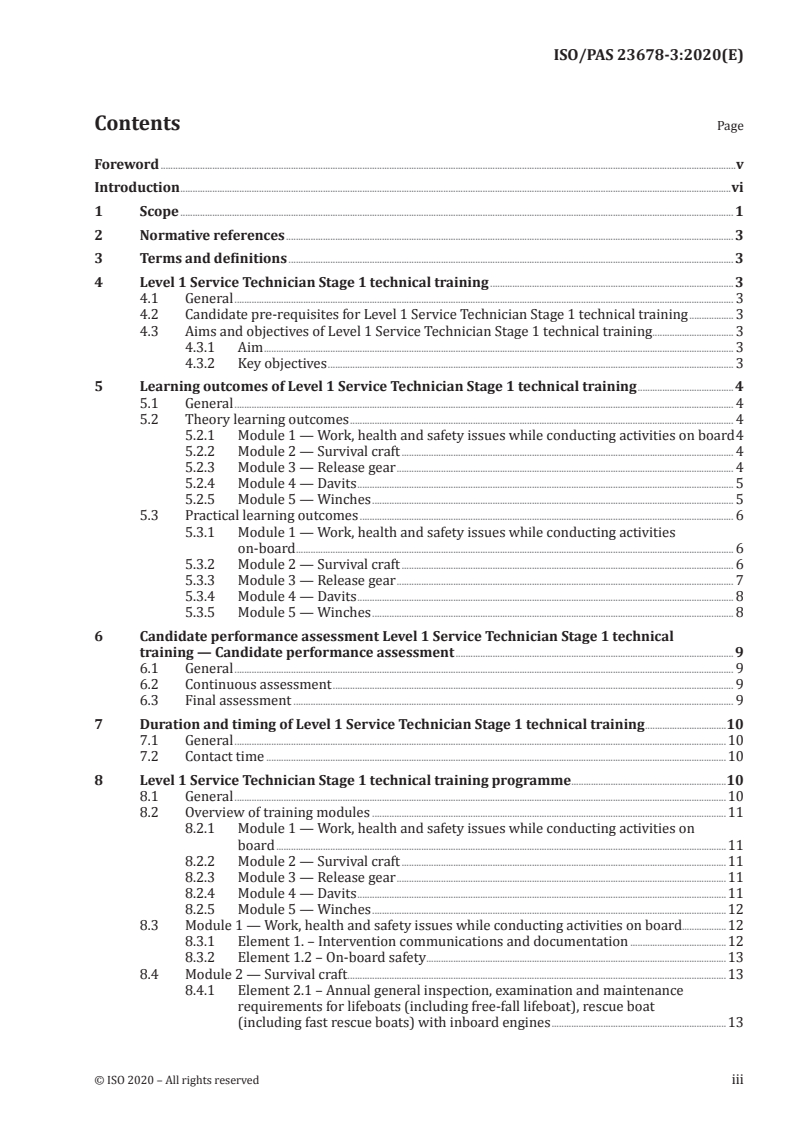
Contents Page
Foreword .v
Introduction .vi
1 Scope . 1
2 Normative references . 3
3 Terms and definitions . 3
4 Level 1 Service Technician Stage 1 technical training . 3
4.1 General . 3
4.2 Candidate pre-requisites for Level 1 Service Technician Stage 1 technical training . 3
4.3 Aims and objectives of Level 1 Service Technician Stage 1 technical training . 3
4.3.1 Aim . 3
4.3.2 Key objectives . 3
5 Learning outcomes of Level 1 Service Technician Stage 1 technical training .4
5.1 General . 4
5.2 Theory learning outcomes . 4
5.2.1 Module 1 — Work, health and safety issues while conducting activities on board 4
5.2.2 Module 2 — Survival craft . 4
5.2.3 Module 3 — Release gear . 4
5.2.4 Module 4 — Davits . 5
5.2.5 Module 5 — Winches . 5
5.3 Practical learning outcomes . 6
5.3.1 Module 1 — Work, health and safety issues while conducting activities
on-board . 6
5.3.2 Module 2 — Survival craft . 6
5.3.3 Module 3 — Release gear . 7
5.3.4 Module 4 — Davits . 8
5.3.5 Module 5 — Winches . 8
6 Candidate performance assessment Level 1 Service Technician Stage 1 technical
training — Candidate performance assessment . 9
6.1 General . 9
6.2 Continuous assessment . 9
6.3 Final assessment . 9
7 Duration and timing of Level 1 Service Technician Stage 1 technical training .10
7.1 General .10
7.2 Contact time .10
8 Level 1 Service Technician Stage 1 technical training programme .10
8.1 General .10
8.2 Overview of training modules .11
8.2.1 Module 1 — Work, health and safety issues while conducting activities on
board .11
8.2.2 Module 2 — Survival craft .11
8.2.3 Module 3 — Release gear .11
8.2.4 Module 4 — Davits .11
8.2.5 Module 5 — Winches .12
8.3 Module 1 — Work, health and safety issues while conducting activities on board.12
8.3.1 Element 1. – Intervention communications and documentation .12
8.3.2 Element 1.2 – On-board safety .13
8.4 Module 2 — Survival craft .13
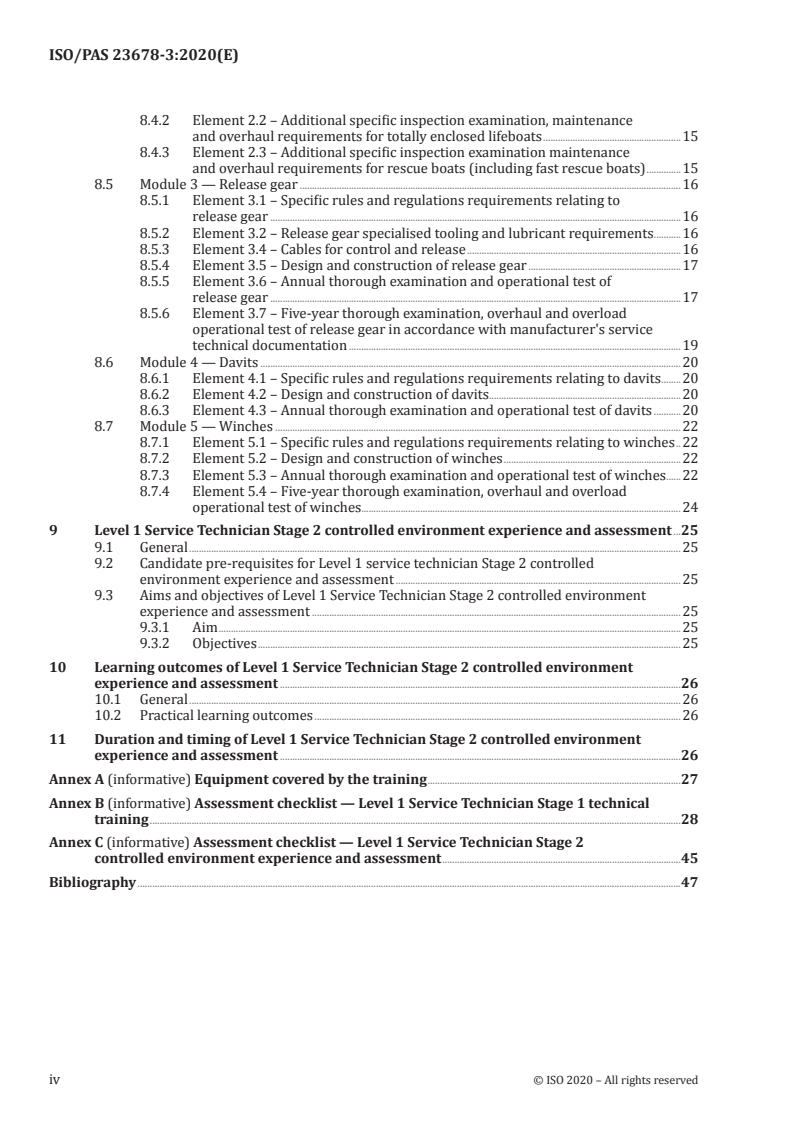
8.4.1 Element 2.1 – Annual general inspection, examination and maintenance
requirements for lifeboats (including free-fall lifeboat), rescue boat
(including fast rescue boats) with inboard engines .13
8.4.2 Element 2.2 – Additional specific inspection examination, maintenance
and overhaul requirements for totally enclosed lifeboats .15
8.4.3 Element 2.3 – Additional specific inspection examination maintenance
and overhaul requirements for rescue boats (including fast rescue boats) .15
8.5 Module 3 — Release gear .16
8.5.1 Element 3.1 – Specific rules and regulations requirements relating to
release gear .16
8.5.2 Element 3.2 – Release gear specialised tooling and lubricant requirements .16
8.5.3 Element 3.4 – Cables for control and release .16
8.5.4 Element 3.5 – Design and construction of release gear .17
8.5.5 Element 3.6 – Annual thorough examination and operational test of
release gear .17
8.5.6 Element 3.7 – Five-year thorough examination, overhaul and overload
operational test of release gear in accordance with manufacturer's service
technical documentation .19
8.6 Module 4 — Davits .20
8.6.1 Element 4.1 – Specific rules and regulations requirements relating to davits .20
8.6.2 Element 4.2 – Design and construction of davits .20
8.6.3 Element 4.3 – Annual thorough examination and operational test of davits .20
8.7 Module 5 — Winches .22
8.7.1 Element 5.1 – Specific rules and regulations requirements relating to winches .22
8.7.2 Element 5.2 – Design and construction of winches .22
8.7.3 Element 5.3 – Annual thorough examination and operational test of winches .22
8.7.4 Element 5.4 – Five-year thorough examination, overhaul and overload
operational test of winches.24
9 Level 1 Service Technician Stage 2 controlled environment experience and assessment .25
9.1 General .25
9.2 Candidate pre-requisites for Level 1 service technician Stage 2 controlled
environment experience and assessment .25
9.3 Aims and objectives of Level 1 Service Technician Stage 2 controlled environment
experience and assessment .25
9.3.1 Aim .25
9.3.2 Objectives .25
10 Learning outcomes of Level 1 Service Technician Stage 2 controlled environment
experience and assessment .26
10.1 General .26
10.2 Practical learning outcomes .26
11 Duration and timing of Level 1 Service Technician Stage 2 controlled environment
experience and assessment .26
Annex A (informative) Equipment covered by the training .27
Annex B (informative) Assessment checklist — Level 1 Service Technician Stage 1 technical
training .28
Annex C (informative) Assessment checklist — Level 1 Service Technician Stage 2
controlled environment experience and assessment .45
Bibliography .47
iv © ISO 2020 – All rights reserved
Foreword
ISO (the International Organization for Standardization) is a worldwide federation of national standards
bodies (ISO member bodies). The work of preparing International Standards is normally carried out
through ISO technical committees. Each member body interested in a subject for which a technical
committee has been established has the right to be represented on that committee. International
organizations, governmental and non-governmental, in liaison with ISO, also take part in the work.
ISO collaborates closely with the International Electrotechnical Commission (IEC) on all matters of
electrotechnical standardization.
The procedures used to develop this document and those intended for its further maintenance are
described in the ISO/IEC Directives, Part 1. In particular, the different approval criteria needed for the
different types of ISO documents should be noted. This document was drafted in accordance with the
editorial rules of the ISO/IEC Directives, Part 2 (see www .iso .org/ directives).
Attention is drawn to the possibility that some of the elements of this document may be the subject of
patent rights. ISO shall not be held responsible for identifying any or all such patent rights. Details of
any patent rights identified during the development of the document will be in the Introduction and/or
on the ISO list of patent declarations received (see www .iso .org/ patents).
Any trade name used in this document is information given for the convenience of users and does not
constitute an endorsement.
For an explanation of the voluntary nature of standards, the meaning of ISO specific terms and
expressions related to conformity assessment, as well as information about ISO's adherence to the
World Trade Organization (WTO) principles in the Technical Barriers to Trade (TBT), see www .iso .org/
iso/ foreword .html.
This document was prepared by Technical Committee ISO/TC 8, Ships and marine technology, SC 1
Maritime safety.
A list of all parts in the ISO/PAS 23678 series can be found on the ISO website.
Any feedback or questions on this document should be directed to the user’s national standards body. A
complete listing of these bodies can be found at www .iso .org/ members .html.
Introduction
The industry recognises that a major objective is to prevent accidents and incidents from occurring. A
global network of competent personnel employed by authorized service providers is vital for lifesaving
appliances to remain fit for purpose, sustaining crew confidence and contributing to the prevention of
incidents and accidents.
It has been recognized from the new requirements in IMO Resolution MSC.402 (96) for maintenance,
thorough examination, operational testing, overhaul and repair of lifeboats (including free-fall
lifeboats) and rescue boats (including fast rescue boats), launching appliances, and release gear
(henceforth referred to as "the IMO Requirements") adopted 19th May 2016 and entering into force
1st January 2020, that it is necessary to develop an International Standard. This necessity is based on
the IMO Requirement in paragraph 7.1.1:
"Employment and documentation of personnel certified in accordance with a recognized national,
international or industry standard as applicable, or a manufacturer's established certification programme.
In either case, the certification programme shall comply with section 8 for each make and type of equipment
for which service is to be provided;"
This document and the associated ISO/PAS 23678-1, ISO/PAS 23678-2 and ISO/PAS 23678-4 have been
developed to achieve three key objectives.
1. The first objective was to develop training documents that would support the IMO Requirements,
section 7, paragraph 7.1.1.
2. The second objective was to develop training documents that would provide a consistent, reliable,
and standardised approach to training and provide a clear auditable trail for interested parties to
grant authorisation supporting the IMO Requirements, section 3, to approved service providers.
3. The third objective was to develop training documents that would enable personnel certified by
authorized service providers to develop and maintain competencies identified by industry experts
to a Level that enables them to competently work unsupervised on equipment covered by this
document.
This document has been developed by identifying common design features in relation to survival craft,
davits, winches and release gear makes and types for which service is to be provided. This has been
achieved by conducting professional discussions with disciplined experts, to obtain the appropriate
information to develop a training programme that is fit for purpose. Successfully completing the service
technician training in ISO/PAS 23678-2, ISO/PAS 23678-3 and ISO/PAS 23678-4 enables personnel
certified by an authorized service provider to meet the IMO Requirements, section 7, paragraph 7.1.1,
and section 8.
The ISO/PAS 23678-series on service technician training consists of:
— Part 1 Guidance to training providers; describes the competence route of the candidate and the
resources that the training provider needs to deliver the training.
— Part 2 Initial training; describes the training programme for initial familiarisation and induction
training that is classroom education. The training programme focuses on introducing individuals
to the complex terminology, rules and regulations, organisations, health and safety which a service
technician needs to understand in order to carry out their role.
— Part 3 Level 1 training; describes the controlled environment education and training delivered
at a training school. The training programme focuses on the technical training for type specific
lifesaving appliances.
— Part 4 Level 2 in-field competence; describes the requirements for initial in-field and ongoing
competence assessments.
vi © ISO 2020 – All rights reserved
NOTE ISO/PAS 23678-1, ISO/PAS 23678-2 and ISO/PAS 23678-3 are referencing typical in-house/training
school training programmes. ISO/PAS 23678-4 is typical in-field performance of the personnel trained and
recording of their competence.
PUBLICLY AVAILABLE SPECIFICATION ISO/PAS 23678-3:2020(E)
Service personnel for the maintenance, thorough
examination, operational testing, overhaul and repair of
lifeboats (including free-fall lifeboats) and rescue boats
(including fast rescue boats), launching appliances and
release gear —
Part 3:
Level 1 technician training
1 Scope
This document establishes a uniform, safe and consistent approach to the technical training of personnel
for the maintenance, thorough examination, operational testing, overhaul and repair of lifeboats
(including free-fall lifeboats) and rescue boats (including fast rescue boats), launching appliances and
release gear.
It also provides the necessary information for interested parties to grant authorization, effectively
evaluate and audit training, supporting the IMO Requirements, Section 3.
It specifies the training requirements for the Level 1 controlled environment education and technical
training for personnel certified by a manufacturer or an authorized service provider to carry out
maintenance, thorough examination, operational testing, overhaul and repair of lifeboats (including
free-fall lifeboats) and rescue boats (including fast rescue boats), launching appliances and release gear.
The Level 1 training is split into two Stages, both covered in this document:
— Stage 1, Service Technician technical controlled environment education and training, has five
modules that consist of classroom-based theory followed by practical sessions. The five modules
encompass the scope and range of technical knowledge and skills required to assume type specific
design coverage of survival craft, release systems, davits and winches. The modules focus on
supporting the requirements in part of the IMO Requirements, paragraphs 8.1, 8.2.1.1-8.2.1.6, 8.2.2,
and 8.2.3.
— Stage 2, Service Technician technical controlled environment experience and assessment,
where candidates undertake a minimum of four supervised scenarios-based practical exercises
assessments covering the range of type specific complete systems for which they will be certified.
This document is intended to be used in conjunction with ISO/PAS 23678-1, ISO/PAS 23678-2 and
ISO/PAS 23678-4.
This document is applicable to the following types of lifeboats (including free-fall lifeboats), rescue
boats (including fast rescue boats), launching appliances and release gear.
Survival craft types:
a) single fall totally enclosed lifeboats with sprinkler and air systems;
b) twin fall totally enclosed lifeboats with sprinkler and air systems;
c) partially enclosed lifeboats;
d) tender lifeboats;
e) freefall lifeboats;
f) open lifeboat;
g) inflatable rescue boats;
h) rigid rescue boats;
i) semi ridged inflatable rescue boats;
j) rigid fast rescue boats;
k) rigid inflatable fast rescue boats.
Survival craft propulsion system types:
a) inboard diesel engines;
b) outboard engines;
c) propeller drives;
d) jet drives.
Davit types:
a) gravity single and twin fall outrigger;
b) hydraulic single pivoting/luffing;
c) hydraulic multi pivot/luffing;
d) telescopic;
e) gravity roller track;
f) gravity free fall primary;
g) free fall hydraulic secondary;
h) A-frame hydraulic;
i) single arm slewing (manual, electric);
j) davits with stored power systems.
Winch types:
a) twin drum;
b) single drum;
c) gravity-lowering, electric hoisting;
d) gravity-lowering hydraulic hoisting;
e) hydraulic hoisting and lowering.
Hook release system types:
a) on-load/off load (load not over centre);
b) on-load/offload (load over centre);
c) off load;
2 © ISO 2020 – All rights reserved
d) freefall hydraulic;
e) automatic.
2 Normative references
There are no normative references in this document.
3 Terms and definitions
For the purposes of this document, the terms, definitions and abbreviated terms given in
ISO/PAS 23678-1 apply.
ISO and IEC maintain terminological databases for use in standardization at the following addresses:
— ISO Online browsing platform: available at https:// www .iso .org/ obp
— IEC Electropedia: available at http:// www .electropedia .org/
4 Level 1 Service Technician Stage 1 technical training
4.1 General
This programme is designed to meet the technical controlled environment training and assessment
requirements for all prospective service technicians. The Level 1 Service Technician training document
explains how competence shall be assessed and certified.
4.2 Candidate pre-requisites for Level 1 Service Technician Stage 1 technical training
a) hold or be working towards a nationally recognised qualification in engineering or mechanics, but
not unduly excluding similar qualifications; and
b) hold a valid Initial Service Technician certificate.
4.3 Aims and objectives of Level 1 Service Technician Stage 1 technical training
4.3.1 Aim
This programme is designed for individuals who have completed the Initial Service Technician
training and need to gain the technical theoretical and practical knowledge to enable them to carry
out maintenance thorough examination, operational testing, repair and overhaul of lifeboats (including
free-fall lifeboats), rescue boats (including fast rescue boats), launching appliances and on-load release
gear under supervision.
4.3.2 Key objectives
The key objectives are:
a) ensure candidates can interpret technical documentation developed by the manufacturers and
apply the information to their role;
b) ensure candidates can identify, interpret and apply to their role key legislation, industry guidelines,
rules, regulations and conventions;
c) ensure candidates have the required technical underpinning knowledge and practical skills to
carry out maintenance thorough examination, operational testing, repair and overhaul of lifeboats
(including free-fall lifeboats), rescue boats (including fast rescue boats), launching appliances and
on-load release gear, as applicable;
d) ensure candidates can write reports and complete associated documentation;
e) ensure candidates can demonstrate in their working environment basic safety and awareness.
5 Learning outcomes of Level 1 Service Technician Stage 1 technical training
5.1 General
The learning outcomes for Level 1 Service Technician training are specified in 5.2 and 5.3. During
the training programme, candidates shall be required to demonstrate they have the skills and
understanding required to be deemed competent in relation to the training outcomes.
5.2 Theory learning outcomes
5.2.1 Module 1 — Work, health and safety issues while conducting activities on board
To successfully complete the Service Technician Level 1 Stage 1 training programme, candidates shall
be able to:
a) explain the people that needs to be informed and the documentation that needs to be checked,
verified and completed before commencing work;
b) explain the safety checks that need to be considered before commencing work on lifeboats
(including free fall lifeboats), rescue boats (including fast rescue boats), launching appliances and
release gear;
c) explain specialised equipment requirements including PPE; and
d) explain the documents that need to be consulted, interpreted, applied and completed to inspect,
maintain, thoroughly examine, operationally test, overhaul and repair lifeboats (including free fall
lifeboats), rescue boats (including fast rescue boats), launching appliances and release gear.
5.2.2 Module 2 — Survival craft
To successfully complete the Level 1 training programme, candidates shall be able to:
a) identify and explain the function of the individual components related to lifeboats (including free
fall lifeboats), rescue boats (including fast rescue boats);
b) identify and explain the specific lubricant requirements for lifeboats (including free fall lifeboats)
and rescue boats (including fast rescue boats); and
c) explain the specific procedures that apply to the inspection, maintenance, thorough examination,
operational testing, overhaul and repair of lifeboats (including free fall lifeboats), rescue boats
(including fast rescue boat), supporting the IMO Requirements, paragraph 6.2.3.
5.2.3 Module 3 — Release gear
To successfully complete the Level 1 training programme, candidates shall be able to:
a) explain the specific design and construction features of distinct various makes and types of
release gears;
b) identify and explain the function of the individual components that make up the distinct designs
associated with specific makes and types of release gears;
4 © ISO 2020 – All rights reserved
c) explain the common faults that can occur and potential solutions to resolve them in relation to the
distinct designs associated with specific makes and types of release gears;
d) identify and explain the generic maintenance and examination criteria in relation to release
gears; and
e) identify and explain the specific procedures to carry out maintenance thorough examination,
operational testing, repair and overhaul, in relation to the distinct designs associated with specific
makes and types of release gears found in lifeboats (including free-fall lifeboats) and rescue boats
(including fast rescue boats).
5.2.4 Module 4 — Davits
To successfully complete the Level 1 training programme, candidates shall be able to:
a) explain the various design and construction features of davits;
b) explain the common faults that can occur and potential solutions to resolve them in relation to the
specific designs of davits;
c) explain how to carry out non-destructive tests on davit components to check for cracks and the
integrity of welds;
d) identify and explain the function of the individual davit components used for launching lifeboats
(including free-fall lifeboats), rescue boats (including fast rescue boats) and davit-launched
liferafts; and
e) identify and explain the specific procedures to carry out maintenance thorough examination,
operational testing, repair and overhaul of specific makes and types of davits used to launch
lifeboats (including free-fall lifeboats) and rescue boats (including fast rescue boats).
5.2.5 Module 5 — Winches
To successfully complete the Level 1 training programme, candidates shall be able to:
a) explain the specific design and construction features of the various specific makes and types of
winches;
b) explain the common faults that can occur and potential solutions to resolve them in relation to the
specific designs of winches;
c) identify and explain the function of specific individual components associated with specific makes
and types of winches used to launch lifeboats (including free-fall lifeboats), rescue boats (including
fast rescue boats) and davit-launched liferafts;
d) identify and explain the specific procedures to carry out maintenance thorough examination,
operational testing, repair and overhaul, in relation to the distinct designs associated with specific
makes and types of winches used to launch lifeboats (including free-fall lifeboats) and rescue boats
(including fast rescue boats);
e) explain the construction of wire ropes; and
f) explain the specific procedures that apply to the inspection, maintenance, thorough examination,
exchange and discard of wire ropes.
5.3 Practical learning outcomes
5.3.1 Module 1 — Work, health and safety issues while conducting activities on-board
To successfully complete the Level 1 training programme, candidates shall be able demonstrate:
a) safety checks that need be completed prior to commencing work on lifeboats (including free fall
lifeboats) rescue boats (including fast rescue boats), launching appliances and release gear;
b) how to interpret and apply the relevant documentation for the maintenance, thorough examination,
operational testing, overhaul and repair of lifeboats (including freefall lifeboats), rescue boats
(including fast rescue boats), launching appliances and release gear;
c) how to complete checklists and compile reports; and
d) how to carry out the required safety checks and attach maintenance/hanging off pendants and
secondary safety devices.
5.3.2 Module 2 — Survival craft
To successfully complete the Level 1 training programme, candidates shall be able demonstrate how
to maintain, thoroughly examine and check for satisfactory condition and operation specific makes
and types of survival craft (see Table A.1), supporting the IMO Requirements, paragraph 6.2.3, and the
manufacturer’s technical documentation. To include:
a) structure of the boat, including fixed and loose equipment;
b) the external boundaries of the internal void spaces as far as practicable;
c) inboard engines and gearbox;
d) outboard engines;
e) engine bed and mounts;
f) primary and secondary start systems;
g) exhaust system;
h) propulsion system, stern tubes, stern glands;
i) lifeboats sprinkler system;
j) lifeboats air supply;
k) maneuvering system;
l) power supply;
m) bailing system;
n) fender and skate arrangements;
o) lifeboat inflatable righting/anti-entrapment equipment;
p) rescue boat (including fast) righting system.
6 © ISO 2020 – All rights reserved
5.3.3 Module 3 — Release gear
5.3.3.1 Operation and tooling
To successfully complete the Level 1 training programme, candidates shall be able to demonstrate:
a) how to correctly operate release gear for lifeboats (including free-fall lifeboats), rescue boats
(including fast rescue boats) and davit-launched liferafts; and
b) the ability to use specialized tooling and apply the correct lubricants to the applicable components.
5.3.3.2 Annual thorough examination and operational test
To successfully complete the Level 1 training programme, candidates shall be able to demonstrate how
to thoroughly examine and check for satisfactory condition and operation specific makes and types of
release systems (see Table A.1), supporting the IMO requirements, paragraphs 6.2.4 to 6.2.8, and the
manufacturer's technical documentation. To include:
a) central release units;
b) hydrostatic interlock systems with diaphragms;
c) hydrostatic interlock systems with floats;
d) cables for control and release;
e) hook assemblies with fastening/locking devices with flat to flat cams;
f) hook assemblies with fastening/locking devices with curve to curve cams;
g) hook assemblies with fastenings/locking devices with curve to flat cams;
h) hook assemblies with fastenings/locking devices with up and down pins;
i) hook assemblies with fastenings/locking devices with amplification arms, intermediary hooks,
arresting levers;
j) free fall hydraulic hook assemblies;
k) automatic hook assemblies;
l) how to check excessive free play and tolerances of release gear against the specifications of the
manufacturer's technical documentation;
m) how to carry out the annual operational tests of davit-launched lifeboats and rescue boats on-load
release function with a simulated load;
n) how to carry out the operational test of the davit-launched liferaft automatic release function.
5.3.3.3 Five-year thorough examination, overhaul and overload operational test
To successfully complete the Level 1 training programme, candidates shall be able to demonstrate how
to overhaul, thoroughly examine and check for satisfactory condition and operation specific makes and
types of release systems (see Table A.1), supporting the IMO Requirements, paragraph 6.3.3, and the
manufacturer's technical documentation. To include:
a) how to dismantle and re-assemble specific makes and types of hook assemblies with fastening/
locking devices with flat to flat cams, curve to curve cams, curve to flat cams, up and down pins,
amplification arms, intermediary hooks and arresting levers;
b) how to dismantle and re-assemble specific makes and types of central release units;
c) how to dismantle and re-assemble specific makes and types of hydrostatic units;
d) how to carry out examinations with regards to tolerances and design requirements of specific
makes and types of release gear as specified by the manufacturer;
e) how to adjust specific makes and types of release gear systems after assembly to operate correctly;
f) how to identify and rectify the faults that can occur related to specific makes and types of
release gear;
g) how to replace service exchange release gear;
h) how to examine vital parts with regards to defects and cracks; and
i) how to carry out the 5-yearly overload operational test of davit-launched lifeboats and rescue boats
using a simulated load.
5.3.4 Module 4 — Davits
To successfully complete the Level 1 training programme, candidates shall be able to demonstrate how
to overhaul, thoroughly examine and check for satisfactory condition and operation specific makes and
types of davits (see Table A.1), supporting the IMO Requirements, paragraphs 6.2.9.1 to 6.2.9.4, and the
manufacturer's technical documentation. To include:
a) how to carry out the necessary safety checks prior to approaching davits;
b) safely operate specific makes and types of davits;
c) davit or other launching structures, with regards to corrosion, misalignments, deformation and
excessive free play;
d) sheaves, rollers, floating blocks for wear, corrosion and excessive free play;
e) fall wires for kinks, damage, corrosion and lubrication;
f) the function of limit switches;
g) mechanical restraints;
h) hydraulic systems;
i) stored power systems; and
j) electrical systems.
5.3.5 Module 5 — Winches
To successfully complete the Level 1 training programme, candidates shall be able to demonstrate how
to overhaul, thoroughly examine and check for satisfactory condition and operation specific makes and
types of winches (see Table A.1), supporting the IMO requirements, paragraphs 6.2.9. and 6.3, and the
manufacturer's technical documentation. To include:
a) winch foundations;
b) remote-control systems, electrical, operating cables, pulleys;
c) power supply systems;
d) lubricants;
e) multiple disc holding/static brake;
f) holding/static brakes with brake bands;
8 © ISO 2020 – All rights reserved
g) holding/static brakes with friction pads;
h) centrifugal brakes with friction pads;
i) lowering brakes with hydraulic pumps;
j) drum, bearings, gearing, pinions, chains;
k) sprag clutches, overrunning clutches;
l) hydraulic systems;
m) wire ropes, corrosion, damage, replacement;
n) how to carry out the annual operational test; and
o) how to carry out the 5-yearly operational test.
6 Candidate performance assessment Level 1 Service Technician Stage 1
technical training — Candidate performance assessment
6.1 General
6.1.1 Candidates attending Level 1 Service Technician Stage 1 technical training shall be given a series
of explanations and demonstrations identifying what they are expected to know and to do. This shall be
followed by practical exercises allowing them to demonstrate their knowledge and understanding of the
course content. Assessment of the candidates’ performance shall be against the stated training outcomes.
Candidates shall have a 100 % course attendance of the recommended contact time (see 7.2).
6.1.2 Assessment of candidates shall be a summation of the following components:
a) continuous assessment;
b) final assessment by an assessor.
6.2 Continuous assessment
6.2.1 The purpose of the continuous assessment is to ensure candidates are acquiring the necessary
skills, knowledge, and understanding of the subject matter being covered. This shall be achieved by
direct observation of practical work and oral/written questioning. Certification bodies shall ensure they
have procedures within their quality management system to deal with absence and demonstration of
competence.
6.2.2 Any candidate failing to meet the expected outcomes as the course progresses can be given
additional training. However, it should be clear that time to do this within the contact time is limited, and
the candidate would have to show, through repeating tests and practice sessions, that they have bridged
the gap in their knowledge and understanding and can demonstrate competence. Certification bodies
shall ensure they have procedures within their quality management system to deal with absence and
demonstration of competence.
6.3 Final assessment
6.3.1 The final assessment shall be conducted by an assessor who may also be involved in the delivery
of the training programme. It shall take the form of direct observation. Documentary evidence for the
continuous assessment shall be provided for the final assessment.
6.3.2 If a candidate is deemed “not yet competent” (NYC), in the opinion of the trainer/assessor after
reasonable tuition, and is unable to meet the learning outcomes of any individual module, only the
training outcomes that the candidate has not been able to achieve competence in needs be repeated.
6.3.3 All candidate assessment forms and test documentation shall be retained for audit purposes. See
Annex B for examples of assessment checklists.
7 Duration and timing of Level 1 Service Technician Stage 1 technical training
7.1 General
7.1.1 The modules can be delivered individually if necessary. If the course modules are delivered
individually, the training programme shall be completed in full within 18 months of commencement of
the first module.
7.1.2 If the modules are not completed within the 18 months period, the training programme shall be
undertaken again.
7.2 Contact time
7.2.1 The optimum recommended 'contact time' for the complete training programme is 160 h. Contact
time includes instruction and assessment activities Contact time does not include course administration,
lunch and refreshment breaks.
7.2.2 The optimum recommended contact time for the individual modules are as follows:
a) mod
...
PUBLICLY ISO/PAS
AVAILABLE 23678-3
SPECIFICATION
First edition
2020-03
Service personnel for the
maintenance, thorough examination,
operational testing, overhaul and
repair of lifeboats (including free-fall
lifeboats) and rescue boats (including
fast rescue boats), launching
appliances and release gear —
Part 3:
Level 1 technician training
Reference number
©
ISO 2020
© ISO 2020
All rights reserved. Unless otherwise specified, or required in the context of its implementation, no part of this publication may
be reproduced or utilized otherwise in any form or by any means, electronic or mechanical, including photocopying, or posting
on the internet or an intranet, without prior written permission. Permission can be requested from either ISO at the address
below or ISO’s member body in the country of the requester.
ISO copyright office
CP 401 • Ch. de Blandonnet 8
CH-1214 Vernier, Geneva
Phone: +41 22 749 01 11
Fax: +41 22 749 09 47
Email: copyright@iso.org
Website: www.iso.org
Published in Switzerland
ii © ISO 2020 – All rights reserved
Contents Page
Foreword .v
Introduction .vi
1 Scope . 1
2 Normative references . 3
3 Terms and definitions . 3
4 Level 1 Service Technician Stage 1 technical training . 3
4.1 General . 3
4.2 Candidate pre-requisites for Level 1 Service Technician Stage 1 technical training . 3
4.3 Aims and objectives of Level 1 Service Technician Stage 1 technical training . 3
4.3.1 Aim . 3
4.3.2 Key objectives . 3
5 Learning outcomes of Level 1 Service Technician Stage 1 technical training .4
5.1 General . 4
5.2 Theory learning outcomes . 4
5.2.1 Module 1 — Work, health and safety issues while conducting activities on board 4
5.2.2 Module 2 — Survival craft . 4
5.2.3 Module 3 — Release gear . 4
5.2.4 Module 4 — Davits . 5
5.2.5 Module 5 — Winches . 5
5.3 Practical learning outcomes . 6
5.3.1 Module 1 — Work, health and safety issues while conducting activities
on-board . 6
5.3.2 Module 2 — Survival craft . 6
5.3.3 Module 3 — Release gear . 7
5.3.4 Module 4 — Davits . 8
5.3.5 Module 5 — Winches . 8
6 Candidate performance assessment Level 1 Service Technician Stage 1 technical
training — Candidate performance assessment . 9
6.1 General . 9
6.2 Continuous assessment . 9
6.3 Final assessment . 9
7 Duration and timing of Level 1 Service Technician Stage 1 technical training .10
7.1 General .10
7.2 Contact time .10
8 Level 1 Service Technician Stage 1 technical training programme .10
8.1 General .10
8.2 Overview of training modules .11
8.2.1 Module 1 — Work, health and safety issues while conducting activities on
board .11
8.2.2 Module 2 — Survival craft .11
8.2.3 Module 3 — Release gear .11
8.2.4 Module 4 — Davits .11
8.2.5 Module 5 — Winches .12
8.3 Module 1 — Work, health and safety issues while conducting activities on board.12
8.3.1 Element 1. – Intervention communications and documentation .12
8.3.2 Element 1.2 – On-board safety .13
8.4 Module 2 — Survival craft .13
8.4.1 Element 2.1 – Annual general inspection, examination and maintenance
requirements for lifeboats (including free-fall lifeboat), rescue boat
(including fast rescue boats) with inboard engines .13
8.4.2 Element 2.2 – Additional specific inspection examination, maintenance
and overhaul requirements for totally enclosed lifeboats .15
8.4.3 Element 2.3 – Additional specific inspection examination maintenance
and overhaul requirements for rescue boats (including fast rescue boats) .15
8.5 Module 3 — Release gear .16
8.5.1 Element 3.1 – Specific rules and regulations requirements relating to
release gear .16
8.5.2 Element 3.2 – Release gear specialised tooling and lubricant requirements .16
8.5.3 Element 3.4 – Cables for control and release .16
8.5.4 Element 3.5 – Design and construction of release gear .17
8.5.5 Element 3.6 – Annual thorough examination and operational test of
release gear .17
8.5.6 Element 3.7 – Five-year thorough examination, overhaul and overload
operational test of release gear in accordance with manufacturer's service
technical documentation .19
8.6 Module 4 — Davits .20
8.6.1 Element 4.1 – Specific rules and regulations requirements relating to davits .20
8.6.2 Element 4.2 – Design and construction of davits .20
8.6.3 Element 4.3 – Annual thorough examination and operational test of davits .20
8.7 Module 5 — Winches .22
8.7.1 Element 5.1 – Specific rules and regulations requirements relating to winches .22
8.7.2 Element 5.2 – Design and construction of winches .22
8.7.3 Element 5.3 – Annual thorough examination and operational test of winches .22
8.7.4 Element 5.4 – Five-year thorough examination, overhaul and overload
operational test of winches.24
9 Level 1 Service Technician Stage 2 controlled environment experience and assessment .25
9.1 General .25
9.2 Candidate pre-requisites for Level 1 service technician Stage 2 controlled
environment experience and assessment .25
9.3 Aims and objectives of Level 1 Service Technician Stage 2 controlled environment
experience and assessment .25
9.3.1 Aim .25
9.3.2 Objectives .25
10 Learning outcomes of Level 1 Service Technician Stage 2 controlled environment
experience and assessment .26
10.1 General .26
10.2 Practical learning outcomes .26
11 Duration and timing of Level 1 Service Technician Stage 2 controlled environment
experience and assessment .26
Annex A (informative) Equipment covered by the training .27
Annex B (informative) Assessment checklist — Level 1 Service Technician Stage 1 technical
training .28
Annex C (informative) Assessment checklist — Level 1 Service Technician Stage 2
controlled environment experience and assessment .45
Bibliography .47
iv © ISO 2020 – All rights reserved
Foreword
ISO (the International Organization for Standardization) is a worldwide federation of national standards
bodies (ISO member bodies). The work of preparing International Standards is normally carried out
through ISO technical committees. Each member body interested in a subject for which a technical
committee has been established has the right to be represented on that committee. International
organizations, governmental and non-governmental, in liaison with ISO, also take part in the work.
ISO collaborates closely with the International Electrotechnical Commission (IEC) on all matters of
electrotechnical standardization.
The procedures used to develop this document and those intended for its further maintenance are
described in the ISO/IEC Directives, Part 1. In particular, the different approval criteria needed for the
different types of ISO documents should be noted. This document was drafted in accordance with the
editorial rules of the ISO/IEC Directives, Part 2 (see www .iso .org/ directives).
Attention is drawn to the possibility that some of the elements of this document may be the subject of
patent rights. ISO shall not be held responsible for identifying any or all such patent rights. Details of
any patent rights identified during the development of the document will be in the Introduction and/or
on the ISO list of patent declarations received (see www .iso .org/ patents).
Any trade name used in this document is information given for the convenience of users and does not
constitute an endorsement.
For an explanation of the voluntary nature of standards, the meaning of ISO specific terms and
expressions related to conformity assessment, as well as information about ISO's adherence to the
World Trade Organization (WTO) principles in the Technical Barriers to Trade (TBT), see www .iso .org/
iso/ foreword .html.
This document was prepared by Technical Committee ISO/TC 8, Ships and marine technology, SC 1
Maritime safety.
A list of all parts in the ISO/PAS 23678 series can be found on the ISO website.
Any feedback or questions on this document should be directed to the user’s national standards body. A
complete listing of these bodies can be found at www .iso .org/ members .html.
Introduction
The industry recognises that a major objective is to prevent accidents and incidents from occurring. A
global network of competent personnel employed by authorized service providers is vital for lifesaving
appliances to remain fit for purpose, sustaining crew confidence and contributing to the prevention of
incidents and accidents.
It has been recognized from the new requirements in IMO Resolution MSC.402 (96) for maintenance,
thorough examination, operational testing, overhaul and repair of lifeboats (including free-fall
lifeboats) and rescue boats (including fast rescue boats), launching appliances, and release gear
(henceforth referred to as "the IMO Requirements") adopted 19th May 2016 and entering into force
1st January 2020, that it is necessary to develop an International Standard. This necessity is based on
the IMO Requirement in paragraph 7.1.1:
"Employment and documentation of personnel certified in accordance with a recognized national,
international or industry standard as applicable, or a manufacturer's established certification programme.
In either case, the certification programme shall comply with section 8 for each make and type of equipment
for which service is to be provided;"
This document and the associated ISO/PAS 23678-1, ISO/PAS 23678-2 and ISO/PAS 23678-4 have been
developed to achieve three key objectives.
1. The first objective was to develop training documents that would support the IMO Requirements,
section 7, paragraph 7.1.1.
2. The second objective was to develop training documents that would provide a consistent, reliable,
and standardised approach to training and provide a clear auditable trail for interested parties to
grant authorisation supporting the IMO Requirements, section 3, to approved service providers.
3. The third objective was to develop training documents that would enable personnel certified by
authorized service providers to develop and maintain competencies identified by industry experts
to a Level that enables them to competently work unsupervised on equipment covered by this
document.
This document has been developed by identifying common design features in relation to survival craft,
davits, winches and release gear makes and types for which service is to be provided. This has been
achieved by conducting professional discussions with disciplined experts, to obtain the appropriate
information to develop a training programme that is fit for purpose. Successfully completing the service
technician training in ISO/PAS 23678-2, ISO/PAS 23678-3 and ISO/PAS 23678-4 enables personnel
certified by an authorized service provider to meet the IMO Requirements, section 7, paragraph 7.1.1,
and section 8.
The ISO/PAS 23678-series on service technician training consists of:
— Part 1 Guidance to training providers; describes the competence route of the candidate and the
resources that the training provider needs to deliver the training.
— Part 2 Initial training; describes the training programme for initial familiarisation and induction
training that is classroom education. The training programme focuses on introducing individuals
to the complex terminology, rules and regulations, organisations, health and safety which a service
technician needs to understand in order to carry out their role.
— Part 3 Level 1 training; describes the controlled environment education and training delivered
at a training school. The training programme focuses on the technical training for type specific
lifesaving appliances.
— Part 4 Level 2 in-field competence; describes the requirements for initial in-field and ongoing
competence assessments.
vi © ISO 2020 – All rights reserved
NOTE ISO/PAS 23678-1, ISO/PAS 23678-2 and ISO/PAS 23678-3 are referencing typical in-house/training
school training programmes. ISO/PAS 23678-4 is typical in-field performance of the personnel trained and
recording of their competence.
PUBLICLY AVAILABLE SPECIFICATION ISO/PAS 23678-3:2020(E)
Service personnel for the maintenance, thorough
examination, operational testing, overhaul and repair of
lifeboats (including free-fall lifeboats) and rescue boats
(including fast rescue boats), launching appliances and
release gear —
Part 3:
Level 1 technician training
1 Scope
This document establishes a uniform, safe and consistent approach to the technical training of personnel
for the maintenance, thorough examination, operational testing, overhaul and repair of lifeboats
(including free-fall lifeboats) and rescue boats (including fast rescue boats), launching appliances and
release gear.
It also provides the necessary information for interested parties to grant authorization, effectively
evaluate and audit training, supporting the IMO Requirements, Section 3.
It specifies the training requirements for the Level 1 controlled environment education and technical
training for personnel certified by a manufacturer or an authorized service provider to carry out
maintenance, thorough examination, operational testing, overhaul and repair of lifeboats (including
free-fall lifeboats) and rescue boats (including fast rescue boats), launching appliances and release gear.
The Level 1 training is split into two Stages, both covered in this document:
— Stage 1, Service Technician technical controlled environment education and training, has five
modules that consist of classroom-based theory followed by practical sessions. The five modules
encompass the scope and range of technical knowledge and skills required to assume type specific
design coverage of survival craft, release systems, davits and winches. The modules focus on
supporting the requirements in part of the IMO Requirements, paragraphs 8.1, 8.2.1.1-8.2.1.6, 8.2.2,
and 8.2.3.
— Stage 2, Service Technician technical controlled environment experience and assessment,
where candidates undertake a minimum of four supervised scenarios-based practical exercises
assessments covering the range of type specific complete systems for which they will be certified.
This document is intended to be used in conjunction with ISO/PAS 23678-1, ISO/PAS 23678-2 and
ISO/PAS 23678-4.
This document is applicable to the following types of lifeboats (including free-fall lifeboats), rescue
boats (including fast rescue boats), launching appliances and release gear.
Survival craft types:
a) single fall totally enclosed lifeboats with sprinkler and air systems;
b) twin fall totally enclosed lifeboats with sprinkler and air systems;
c) partially enclosed lifeboats;
d) tender lifeboats;
e) freefall lifeboats;
f) open lifeboat;
g) inflatable rescue boats;
h) rigid rescue boats;
i) semi ridged inflatable rescue boats;
j) rigid fast rescue boats;
k) rigid inflatable fast rescue boats.
Survival craft propulsion system types:
a) inboard diesel engines;
b) outboard engines;
c) propeller drives;
d) jet drives.
Davit types:
a) gravity single and twin fall outrigger;
b) hydraulic single pivoting/luffing;
c) hydraulic multi pivot/luffing;
d) telescopic;
e) gravity roller track;
f) gravity free fall primary;
g) free fall hydraulic secondary;
h) A-frame hydraulic;
i) single arm slewing (manual, electric);
j) davits with stored power systems.
Winch types:
a) twin drum;
b) single drum;
c) gravity-lowering, electric hoisting;
d) gravity-lowering hydraulic hoisting;
e) hydraulic hoisting and lowering.
Hook release system types:
a) on-load/off load (load not over centre);
b) on-load/offload (load over centre);
c) off load;
2 © ISO 2020 – All rights reserved
d) freefall hydraulic;
e) automatic.
2 Normative references
There are no normative references in this document.
3 Terms and definitions
For the purposes of this document, the terms, definitions and abbreviated terms given in
ISO/PAS 23678-1 apply.
ISO and IEC maintain terminological databases for use in standardization at the following addresses:
— ISO Online browsing platform: available at https:// www .iso .org/ obp
— IEC Electropedia: available at http:// www .electropedia .org/
4 Level 1 Service Technician Stage 1 technical training
4.1 General
This programme is designed to meet the technical controlled environment training and assessment
requirements for all prospective service technicians. The Level 1 Service Technician training document
explains how competence shall be assessed and certified.
4.2 Candidate pre-requisites for Level 1 Service Technician Stage 1 technical training
a) hold or be working towards a nationally recognised qualification in engineering or mechanics, but
not unduly excluding similar qualifications; and
b) hold a valid Initial Service Technician certificate.
4.3 Aims and objectives of Level 1 Service Technician Stage 1 technical training
4.3.1 Aim
This programme is designed for individuals who have completed the Initial Service Technician
training and need to gain the technical theoretical and practical knowledge to enable them to carry
out maintenance thorough examination, operational testing, repair and overhaul of lifeboats (including
free-fall lifeboats), rescue boats (including fast rescue boats), launching appliances and on-load release
gear under supervision.
4.3.2 Key objectives
The key objectives are:
a) ensure candidates can interpret technical documentation developed by the manufacturers and
apply the information to their role;
b) ensure candidates can identify, interpret and apply to their role key legislation, industry guidelines,
rules, regulations and conventions;
c) ensure candidates have the required technical underpinning knowledge and practical skills to
carry out maintenance thorough examination, operational testing, repair and overhaul of lifeboats
(including free-fall lifeboats), rescue boats (including fast rescue boats), launching appliances and
on-load release gear, as applicable;
d) ensure candidates can write reports and complete associated documentation;
e) ensure candidates can demonstrate in their working environment basic safety and awareness.
5 Learning outcomes of Level 1 Service Technician Stage 1 technical training
5.1 General
The learning outcomes for Level 1 Service Technician training are specified in 5.2 and 5.3. During
the training programme, candidates shall be required to demonstrate they have the skills and
understanding required to be deemed competent in relation to the training outcomes.
5.2 Theory learning outcomes
5.2.1 Module 1 — Work, health and safety issues while conducting activities on board
To successfully complete the Service Technician Level 1 Stage 1 training programme, candidates shall
be able to:
a) explain the people that needs to be informed and the documentation that needs to be checked,
verified and completed before commencing work;
b) explain the safety checks that need to be considered before commencing work on lifeboats
(including free fall lifeboats), rescue boats (including fast rescue boats), launching appliances and
release gear;
c) explain specialised equipment requirements including PPE; and
d) explain the documents that need to be consulted, interpreted, applied and completed to inspect,
maintain, thoroughly examine, operationally test, overhaul and repair lifeboats (including free fall
lifeboats), rescue boats (including fast rescue boats), launching appliances and release gear.
5.2.2 Module 2 — Survival craft
To successfully complete the Level 1 training programme, candidates shall be able to:
a) identify and explain the function of the individual components related to lifeboats (including free
fall lifeboats), rescue boats (including fast rescue boats);
b) identify and explain the specific lubricant requirements for lifeboats (including free fall lifeboats)
and rescue boats (including fast rescue boats); and
c) explain the specific procedures that apply to the inspection, maintenance, thorough examination,
operational testing, overhaul and repair of lifeboats (including free fall lifeboats), rescue boats
(including fast rescue boat), supporting the IMO Requirements, paragraph 6.2.3.
5.2.3 Module 3 — Release gear
To successfully complete the Level 1 training programme, candidates shall be able to:
a) explain the specific design and construction features of distinct various makes and types of
release gears;
b) identify and explain the function of the individual components that make up the distinct designs
associated with specific makes and types of release gears;
4 © ISO 2020 – All rights reserved
c) explain the common faults that can occur and potential solutions to resolve them in relation to the
distinct designs associated with specific makes and types of release gears;
d) identify and explain the generic maintenance and examination criteria in relation to release
gears; and
e) identify and explain the specific procedures to carry out maintenance thorough examination,
operational testing, repair and overhaul, in relation to the distinct designs associated with specific
makes and types of release gears found in lifeboats (including free-fall lifeboats) and rescue boats
(including fast rescue boats).
5.2.4 Module 4 — Davits
To successfully complete the Level 1 training programme, candidates shall be able to:
a) explain the various design and construction features of davits;
b) explain the common faults that can occur and potential solutions to resolve them in relation to the
specific designs of davits;
c) explain how to carry out non-destructive tests on davit components to check for cracks and the
integrity of welds;
d) identify and explain the function of the individual davit components used for launching lifeboats
(including free-fall lifeboats), rescue boats (including fast rescue boats) and davit-launched
liferafts; and
e) identify and explain the specific procedures to carry out maintenance thorough examination,
operational testing, repair and overhaul of specific makes and types of davits used to launch
lifeboats (including free-fall lifeboats) and rescue boats (including fast rescue boats).
5.2.5 Module 5 — Winches
To successfully complete the Level 1 training programme, candidates shall be able to:
a) explain the specific design and construction features of the various specific makes and types of
winches;
b) explain the common faults that can occur and potential solutions to resolve them in relation to the
specific designs of winches;
c) identify and explain the function of specific individual components associated with specific makes
and types of winches used to launch lifeboats (including free-fall lifeboats), rescue boats (including
fast rescue boats) and davit-launched liferafts;
d) identify and explain the specific procedures to carry out maintenance thorough examination,
operational testing, repair and overhaul, in relation to the distinct designs associated with specific
makes and types of winches used to launch lifeboats (including free-fall lifeboats) and rescue boats
(including fast rescue boats);
e) explain the construction of wire ropes; and
f) explain the specific procedures that apply to the inspection, maintenance, thorough examination,
exchange and discard of wire ropes.
5.3 Practical learning outcomes
5.3.1 Module 1 — Work, health and safety issues while conducting activities on-board
To successfully complete the Level 1 training programme, candidates shall be able demonstrate:
a) safety checks that need be completed prior to commencing work on lifeboats (including free fall
lifeboats) rescue boats (including fast rescue boats), launching appliances and release gear;
b) how to interpret and apply the relevant documentation for the maintenance, thorough examination,
operational testing, overhaul and repair of lifeboats (including freefall lifeboats), rescue boats
(including fast rescue boats), launching appliances and release gear;
c) how to complete checklists and compile reports; and
d) how to carry out the required safety checks and attach maintenance/hanging off pendants and
secondary safety devices.
5.3.2 Module 2 — Survival craft
To successfully complete the Level 1 training programme, candidates shall be able demonstrate how
to maintain, thoroughly examine and check for satisfactory condition and operation specific makes
and types of survival craft (see Table A.1), supporting the IMO Requirements, paragraph 6.2.3, and the
manufacturer’s technical documentation. To include:
a) structure of the boat, including fixed and loose equipment;
b) the external boundaries of the internal void spaces as far as practicable;
c) inboard engines and gearbox;
d) outboard engines;
e) engine bed and mounts;
f) primary and secondary start systems;
g) exhaust system;
h) propulsion system, stern tubes, stern glands;
i) lifeboats sprinkler system;
j) lifeboats air supply;
k) maneuvering system;
l) power supply;
m) bailing system;
n) fender and skate arrangements;
o) lifeboat inflatable righting/anti-entrapment equipment;
p) rescue boat (including fast) righting system.
6 © ISO 2020 – All rights reserved
5.3.3 Module 3 — Release gear
5.3.3.1 Operation and tooling
To successfully complete the Level 1 training programme, candidates shall be able to demonstrate:
a) how to correctly operate release gear for lifeboats (including free-fall lifeboats), rescue boats
(including fast rescue boats) and davit-launched liferafts; and
b) the ability to use specialized tooling and apply the correct lubricants to the applicable components.
5.3.3.2 Annual thorough examination and operational test
To successfully complete the Level 1 training programme, candidates shall be able to demonstrate how
to thoroughly examine and check for satisfactory condition and operation specific makes and types of
release systems (see Table A.1), supporting the IMO requirements, paragraphs 6.2.4 to 6.2.8, and the
manufacturer's technical documentation. To include:
a) central release units;
b) hydrostatic interlock systems with diaphragms;
c) hydrostatic interlock systems with floats;
d) cables for control and release;
e) hook assemblies with fastening/locking devices with flat to flat cams;
f) hook assemblies with fastening/locking devices with curve to curve cams;
g) hook assemblies with fastenings/locking devices with curve to flat cams;
h) hook assemblies with fastenings/locking devices with up and down pins;
i) hook assemblies with fastenings/locking devices with amplification arms, intermediary hooks,
arresting levers;
j) free fall hydraulic hook assemblies;
k) automatic hook assemblies;
l) how to check excessive free play and tolerances of release gear against the specifications of the
manufacturer's technical documentation;
m) how to carry out the annual operational tests of davit-launched lifeboats and rescue boats on-load
release function with a simulated load;
n) how to carry out the operational test of the davit-launched liferaft automatic release function.
5.3.3.3 Five-year thorough examination, overhaul and overload operational test
To successfully complete the Level 1 training programme, candidates shall be able to demonstrate how
to overhaul, thoroughly examine and check for satisfactory condition and operation specific makes and
types of release systems (see Table A.1), supporting the IMO Requirements, paragraph 6.3.3, and the
manufacturer's technical documentation. To include:
a) how to dismantle and re-assemble specific makes and types of hook assemblies with fastening/
locking devices with flat to flat cams, curve to curve cams, curve to flat cams, up and down pins,
amplification arms, intermediary hooks and arresting levers;
b) how to dismantle and re-assemble specific makes and types of central release units;
c) how to dismantle and re-assemble specific makes and types of hydrostatic units;
d) how to carry out examinations with regards to tolerances and design requirements of specific
makes and types of release gear as specified by the manufacturer;
e) how to adjust specific makes and types of release gear systems after assembly to operate correctly;
f) how to identify and rectify the faults that can occur related to specific makes and types of
release gear;
g) how to replace service exchange release gear;
h) how to examine vital parts with regards to defects and cracks; and
i) how to carry out the 5-yearly overload operational test of davit-launched lifeboats and rescue boats
using a simulated load.
5.3.4 Module 4 — Davits
To successfully complete the Level 1 training programme, candidates shall be able to demonstrate how
to overhaul, thoroughly examine and check for satisfactory condition and operation specific makes and
types of davits (see Table A.1), supporting the IMO Requirements, paragraphs 6.2.9.1 to 6.2.9.4, and the
manufacturer's technical documentation. To include:
a) how to carry out the necessary safety checks prior to approaching davits;
b) safely operate specific makes and types of davits;
c) davit or other launching structures, with regards to corrosion, misalignments, deformation and
excessive free play;
d) sheaves, rollers, floating blocks for wear, corrosion and excessive free play;
e) fall wires for kinks, damage, corrosion and lubrication;
f) the function of limit switches;
g) mechanical restraints;
h) hydraulic systems;
i) stored power systems; and
j) electrical systems.
5.3.5 Module 5 — Winches
To successfully complete the Level 1 training programme, candidates shall be able to demonstrate how
to overhaul, thoroughly examine and check for satisfactory condition and operation specific makes and
types of winches (see Table A.1), supporting the IMO requirements, paragraphs 6.2.9. and 6.3, and the
manufacturer's technical documentation. To include:
a) winch foundations;
b) remote-control systems, electrical, operating cables, pulleys;
c) power supply systems;
d) lubricants;
e) multiple disc holding/static brake;
f) holding/static brakes with brake bands;
8 © ISO 2020 – All rights reserved
g) holding/static brakes with friction pads;
h) centrifugal brakes with friction pads;
i) lowering brakes with hydraulic pumps;
j) drum, bearings, gearing, pinions, chains;
k) sprag clutches, overrunning clutches;
l) hydraulic systems;
m) wire ropes, corrosion, damage, replacement;
n) how to carry out the annual operational test; and
o) how to carry out the 5-yearly operational test.
6 Candidate performance assessment Level 1 Service Technician Stage 1
technical training — Candidate performance assessment
6.1 General
6.1.1 Candidates attending Level 1 Service Technician Stage 1 technical training shall be given a series
of explanations and demonstrations identifying what they are expected to know and to do. This shall be
followed by practical exercises allowing them to demonstrate their knowledge and understanding of the
course content. Assessment of the candidates’ performance shall be against the stated training outcomes.
Candidates shall have a 100 % course attendance of the recommended contact time (see 7.2).
6.1.2 Assessment of candidates shall be a summation of the following components:
a) continuous assessment;
b) final assessment by an assessor.
6.2 Continuous assessment
6.2.1 The purpose of the continuous assessment is to ensure candidates are acquiring the necessary
skills, knowledge, and understanding of the subject matter being covered. This shall be achieved by
direct observation of practical work and oral/written questioning. Certification bodies shall ensure they
have procedures within their quality management system to deal with absence and demonstration of
competence.
6.2.2 Any candidate failing to meet the expected outcomes as the course progresses can be given
additional training. However, it should be clear that time to do this within the contact time is limited, and
the candidate would have to show, through repeating tests and practice sessions, that they have bridged
the gap in their knowledge and understanding and can demonstrate competence. Certification bodies
shall ensure they have procedures within their quality management system to deal with absence and
demonstration of competence.
6.3 Final assessment
6.3.1 The final assessment shall be conducted by an assessor who may also be involved in the delivery
of the training programme. It shall take the form of direct observation. Documentary evidence for the
continuous assessment shall be provided for the final assessment.
6.3.2 If a candidate is deemed “not yet competent” (NYC), in the opinion of the trainer/assessor after
reasonable tuition, and is unable to meet the learning outcomes of any individual module, only the
training outcomes that the candidate has not been able to achieve competence in needs be repeated.
6.3.3 All candidate assessment forms and test documentation shall be retained for audit purposes. See
Annex B for examples of assessment checklists.
7 Duration and timing of Level 1 Service Technician Stage 1 technical training
7.1 General
7.1.1 The modules can be delivered individually if necessary. If the course modules are delivered
individually, the training programme shall be completed in full within 18 months of commencement of
the first module.
7.1.2 If the modules are not completed within the 18 months period, the training programme shall be
undertaken again.
7.2 Contact time
7.2.1 The optimum recommended 'contact time' for the complete training programme is 160 h. Contact
time includes instruction and assessment activities Contact time does not include course administration,
lunch and refreshment breaks.
7.2.2 The optimum recommended contact time for the individual modules are as follows:
a) mod
...
Questions, Comments and Discussion
Ask us and Technical Secretary will try to provide an answer. You can facilitate discussion about the standard in here.
Loading comments...