

ISO 11641:2012
(Main)Leather — Tests for colour fastness — Colour fastness to perspiration
General Information
- Abstract
ISO 11641:2012 specifies a method for determining the colour fastness to perspiration of leather of all kinds at all stages of processing. It applies particularly to gloving, clothing and lining leathers, as well as leather for the uppers of unlined shoes. The method uses an artificial perspiration solution to simulate the action of human perspiration. Since perspiration varies widely from one individual to the next, it is not possible to design a method with universal validity, but the alkaline artificial perspiration solution specified in ISO 11641:2012 will give results corresponding to those with natural perspiration in most cases.
- Status
- Withdrawn
- Publication Date
- 13-Nov-2012
- Technical Committee
- IULTCS - International Union of Leather Technologists and Chemists Societies
- Current Stage
- 9599 - Withdrawal of International Standard
- Start Date
- 03-Nov-2025
- Completion Date
- 29-Aug-2026
Buy Documents
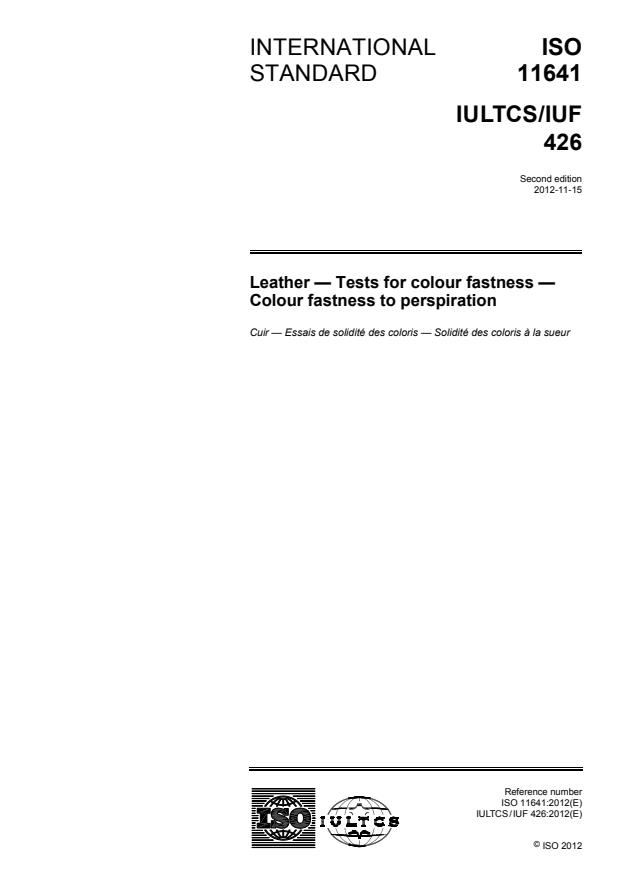
ISO 11641:2012 - Leather — Tests for colour fastness — Colour fastness to perspiration Released:11/14/2012
ISO 11641:2012 - Cuir — Essais de solidité des coloris — Solidité des coloris a la sueur Released:11/14/2012
Overview
ISO 11641:2012 specifies a standardized laboratory method for determining the colour fastness to perspiration of leather at all stages of processing. The method simulates human perspiration using an artificial perspiration solution (primarily alkaline, pH 8.0 ± 0.1) and assesses both change in leather colour and staining of adjacent fabrics. It is particularly relevant for gloving, clothing and lining leathers and for uppers of unlined shoes.
Key topics and technical requirements
- Test principle: Leather and adjacent fabric are soaked in artificial perspiration, assembled as a composite specimen, pressed under constant pressure and heated; after drying, colour change and staining are evaluated.
- Artificial perspiration:
- Alkaline solution (per litre): 5.0 g NaCl, 5.0 g tris(hydroxymethyl)aminomethane (TRIS), 0.5 g urea, 0.5 g nitrilotriacetic acid; adjusted to pH 8.0 ± 0.1 with 2 mol/l HCl.
- Acid solution (if required): composition and pH 5.5 ± 0.2 as specified in ISO 105‑E04; prepared fresh daily.
- Apparatus & conditions:
- Loading weight-piece (approx. 5 kg; cross-section ~115 × 60 mm) applying 12.5 ± 1.0 kPa pressure between inert plates.
- Vacuum step during wetting to ~5 kPa (50 mbar) held for cycles.
- Oven at 37 °C ± 2 °C for 180 min ± 10 min.
- Specimen sizes & preparation:
- Leather specimen ≈ 100 × 40 mm (or 120 × 50 mm for finish-broken preparation).
- Adjacent fabric(s) ≈ 100 × 40 mm (multifibre per ISO 105‑F10 or single-fibre per ISO 105‑F01–F07).
- Option to test finish intact or intentionally “broken” (abrasive treatment) - report must state which.
- Evaluation:
- Visual assessment with grey scales for change in colour (ISO 105‑A02) and staining (ISO 105‑A03), or instrumental assessment per ISO 105‑A04/A05.
- Typical inter-person precision: ±0.5 grey scale units.
- Reporting: Results must reference ISO 11641 and include leather type, finish status, perspiration type, grey scale ratings for staining and colour change, and deviations from procedure.
Applications
- Quality control and acceptance testing in tanneries and leather finishing operations
- Performance specification for leather goods (gloves, clothing, linings, footwear uppers)
- Product development and change control to evaluate dye fixation and resistance to human perspiration
- Third‑party laboratory testing for supply-chain compliance
Who uses this standard
- Leather manufacturers and finishers
- Footwear, glove and apparel product developers
- Independent testing laboratories and certification bodies
- R&D teams working on dyes, finishes and leather treatments
Related standards
- ISO 105‑A01, A02, A03, A04, A05 (colour fastness test principles and assessment)
- ISO 105‑E04 (textile perspiration method)
- ISO 105‑F01…F10 (adjacent fabric specifications)
- ISO 2418 (leather sampling location)
- ISO 3696 (laboratory water quality)
Keywords: ISO 11641:2012, colour fastness to perspiration, leather testing, artificial perspiration solution, grey scale assessment, leather quality control.
Relations
- Effective Date
- 09-Feb-2026
- Effective Date
- 09-Feb-2026
- Consolidates
EN ISO 11641:2012 - Leather - Tests for colour fastness - Colour fastness to perspiration (ISO 11641:2012) - Effective Date
- 12-Feb-2026
- Effective Date
- 06-Jun-2022
- Effective Date
- 27-Apr-2024
- Effective Date
- 16-May-2009
Buy Documents
ISO 11641:2012 - Leather — Tests for colour fastness — Colour fastness to perspiration Released:11/14/2012
ISO 11641:2012 - Cuir — Essais de solidité des coloris — Solidité des coloris a la sueur Released:11/14/2012
Get Certified
Connect with accredited certification bodies for this standard

Control Union Certifications
Global certification for agriculture and sustainability.

Hohenstein Institut
Textile testing and certification.

Bureau Veritas Bangladesh
Bureau Veritas certification services in Bangladesh.
Sponsored listings
Frequently Asked Questions
ISO 11641:2012 is a standard published by the International Organization for Standardization (ISO). Its full title is "Leather — Tests for colour fastness — Colour fastness to perspiration". This standard covers: ISO 11641:2012 specifies a method for determining the colour fastness to perspiration of leather of all kinds at all stages of processing. It applies particularly to gloving, clothing and lining leathers, as well as leather for the uppers of unlined shoes. The method uses an artificial perspiration solution to simulate the action of human perspiration. Since perspiration varies widely from one individual to the next, it is not possible to design a method with universal validity, but the alkaline artificial perspiration solution specified in ISO 11641:2012 will give results corresponding to those with natural perspiration in most cases.
ISO 11641:2012 specifies a method for determining the colour fastness to perspiration of leather of all kinds at all stages of processing. It applies particularly to gloving, clothing and lining leathers, as well as leather for the uppers of unlined shoes. The method uses an artificial perspiration solution to simulate the action of human perspiration. Since perspiration varies widely from one individual to the next, it is not possible to design a method with universal validity, but the alkaline artificial perspiration solution specified in ISO 11641:2012 will give results corresponding to those with natural perspiration in most cases.
ISO 11641:2012 is classified under the following ICS (International Classification for Standards) categories: 59.140.30 - Leather and furs. The ICS classification helps identify the subject area and facilitates finding related standards.
ISO 11641:2012 has the following relationships with other standards: It is inter standard links to EN ISO 11640:2018, EN ISO 14931:2015, EN ISO 11641:2012, ISO 5692-2:2002, ISO 11641:2025, ISO 11641:1993. Understanding these relationships helps ensure you are using the most current and applicable version of the standard.
ISO 11641:2012 is available in PDF format for immediate download after purchase. The document can be added to your cart and obtained through the secure checkout process. Digital delivery ensures instant access to the complete standard document.
Standards Content (Sample)
INTERNATIONAL ISO
STANDARD 11641
IULTCS/IUF
Second edition
2012-11-15
Leather — Tests for colour fastness —
Colour fastness to perspiration
Cuir — Essais de solidité des coloris — Solidité des coloris à la sueur
Reference number
IULTCS/IUF 426:2012(E)
©
ISO 2012
IULTCS/IUF 426:2012(E)
© ISO 2012
All rights reserved. Unless otherwise specified, no part of this publication may be reproduced or utilized in any form or by any means,
electronic or mechanical, including photocopying and microfilm, without permission in writing from either ISO at the address below or
ISO's member body in the country of the requester.
ISO copyright office
Case postale 56 CH-1211 Geneva 20
Tel. + 41 22 749 01 11
Fax + 41 22 749 09 47
E-mail copyright@iso.org
Web www.iso.org
Published in Switzerland
ii © ISO 2012 – All rights reserved
IULTCS/IUF 426:2012(E)
Contents Page
Foreword . iv
1 Scope . 1
2 Normative references . 1
3 Principle . 2
4 Apparatus and materials. 2
5 Test specimens . 4
6 Procedure . 4
7 Evaluation . 5
8 Precision . 5
9 Test report . 5
Annex A (informative) Commercial sources for apparatus and materials . 6
Bibliography . 7
IULTCS/IUF 426:2012(E)
Foreword
ISO (the International Organization for Standardization) is a worldwide federation of national standards bodies
(ISO member bodies). The work of preparing International Standards is normally carried out through ISO
technical committees. Each member body interested in a subject for which a technical committee has been
established has the right to be represented on that committee. International organizations, governmental and
non-governmental, in liaison with ISO, also take part in the work. ISO collaborates closely with the
International Electrotechnical Commission (IEC) on all matters of electrotechnical standardization.
International Standards are drafted in accordance with the rules given in the ISO/IEC Directives, Part 2.
The main task of technical committees is to prepare International Standards. Draft International Standards
adopted by the technical committees are circulated to the member bodies for voting. Publication as an
International Standard requires approval by at least 75 % of the member bodies casting a vote.
Attention is drawn to the possibility that some of the elements of this document may be the subject of patent
rights. ISO shall not be held responsible for identifying any or all such patent rights.
ISO 11641 was prepared by the European Committee for Standardization (CEN) Technical Committee
CEN/TC 289, Leather, in collaboration with the Fastness Tests Commission of the International Union of
Leather Technologists and Chemists Societies (IUF Commission, IULTCS), in accordance with the Agreement
on technical cooperation between ISO and CEN (Vienna Agreement).
The first edition of ISO 11641 was based on IUF 426 published in J. Soc. Leather Tech. Chem., 71, pp. 22-24
(1987), and declared an official method of the IULTCS in October 1989.
This second edition of ISO 11641 cancels and replaces the first edition (ISO 11641:1993). This new version is
an update of the procedures and includes provision for an acidic artificial perspiration solution (4.6), the option
of instrumental grey scale measurement (7.2) and precision information (8).
IULTCS, originally formed in 1897, is a worldwide organization of professional leather societies to further the
advancement of leather science and technology. IULTCS has three Commissions, which are responsible for
establishing international methods for the sampling and testing of leather. ISO recognizes IULTCS as an
international standardizing body for the preparation of test methods for leather.
iv © ISO 2012 – All rights reserved
INTERNATIONAL STANDARD
IULTCS/IUF 426:2012(E)
Leather — Tests for colour fastness — Colour fastness to
perspiration
1 Scope
This International Standard specifies a method for determining the colour fastness to perspiration of leather of
all kinds at all stages of processing. It applies particularly to gloving, clothing and lining leathers, as well as
leather for the uppers of unlined shoes.
The method uses an artificial perspiration solution to simulate the action of human perspiration. Since
perspiration varies widely from one individual to the next, it is not possible to design a method with universal
validity, but the alkaline artificial perspiration solution specified in this International Standard will give results
corresponding to those with natural perspiration in most cases.
NOTE In general, human perspiration is weakly acidic when freshly produced. Micro-organisms then cause it to
change, the pH usually becoming weakly alkaline (pH 7,5 to 8,5). Alkaline perspiration has a considerably greater effect
on the colour of leather than has acid perspiration. Therefore, for coloured leather, an alkaline perspiration solution is used
to simulate the most demanding conditions encountered in practice.
2 Normative references
The following referenced documents are indispensable for the application of this document. For dated
references, only the edition cited applies. For undated references, the latest edition of the referenced
document (including any amendments) applies.
ISO 105-A01, Textiles — Tests for colour fastness — Part A01: General principles of testing
ISO 105-A02, Textiles — Tests for colour fastness — Part A02: Grey scale for assessing change in colour
ISO 105-A03, Textiles — Tests for colour fastness — Part A03: Grey scale for assessing staining
ISO 105-A04, Textiles — Tests for colour fastness — Part A04: Method for the instrumental assessment of
the degree of staining of adjacent fabrics
ISO 105-A05, Textiles — Tests for colour fastness — Part A05: Instrumental assessment of change in colour
for determination of grey scale rating
ISO 105-E04, Textiles — Tests for colour fastness — Part E04: Colour fastness to perspiration
ISO 105-F01, Textiles — Tests for colour fastness — Part F01: Specification for wool adjacent fabric
ISO 105-F02, Textiles — Tests for colour fastness — Part F02: Specification for cotton and viscose adjacent
fabrics
ISO 105-F03, Textiles — Tests for colour fastness — Part F03: Specification for polyamide adjacent fabric
ISO 105-F04, Textiles — Tests for colour fastness — Part F04: Specification for polyester adjacent fabric
IULTCS/IUF 426:2012(E)
ISO 105-F05, Textiles — Tests for colour fastness — Part F05: Specification for acrylic adjacent fabric
ISO 105-F06, Textiles — Tests for colour fastness — Part F06: Specification for silk adjacent fabric
ISO 105-F07, Textiles — Tests for colour fastness — Part F07: Specification for secondary acetate adjacent
fabric
ISO 105-F10, Textiles — Tests for colour fastness — Part F10: Specification for adjacent fabric: Multifibre
ISO 2418, Leather — Chemical, physical and mechanical and fastness tests — Sampling location
ISO 3696:1987, Water for analytical laboratory use — Specification and test methods
3 Principle
A leather specimen is soaked in artificial perspiration solution and a piece of adjacent fabric, also soaked in
artificial perspiration solution, is laid against each side to be tested. The composite specimen is left under
pressure for a specified time in a suitable apparatus. The leather specimen and adjacent fabric are then dried,
and the change in colour of the specimen and the staining of the adjacent fabric assessed with the grey scales.
Leathers with a finish may be tested intact or with the finish broken.
The general colour fastness testing principles shall be in accordance with those described in ISO 105-A01,
taking into account that the substrate is leather.
4 Apparatus and materials
Ordinary laboratory apparatus and
4.1 Test apparatus, consisting of a stainless-steel frame, into which a rectangular weight-piece
approximately 5 kg in mass and approximately 115 mm 60 mm in cross-section fits accurately, so that a
uniform pressure of 12,5 1,0 kPa can be applied on the composite specimen placed between rectangular
plates of an inert material, e.g. glass or acrylic-resin, of the same length and width as the weight-piece and
about 1,5 mm thick.
The test apparatus shall be constructed so that if the weight-piece is removed during the tests, the pressure of
12,5 kPa remains unchanged.
Other devices may be used provided that equivalent results are obtained.
NOTE An example of a suitable apparatus available commercially is given in Annex A.
4.2 Oven, maintained at 37 °C 2 °C.
4.3 Adjacent fabrics (see ISO 105-A01). Either
a) a multifibre adjacent fabric, complying with ISO 105-F10, measuring approximately 100 mm 40 mm, or
b) two single-fibre adjacent fabrics, complying with the relevant specification in ISO 105-F01 to F07.
NOTE Examples of suitable commercial sources are given
...
NORME ISO
INTERNATIONALE 11641
IULTCS/IUF
Deuxième édition
2012-11-15
Cuir — Essais de solidité des coloris —
Solidité des coloris à la sueur
Leather — Tests for colour fastness — Colour fastness to perspiration
Numéro de référence
IULTCS/IUF 426:2012(F)
©
ISO 2012
IULTCS/IUF 426:2012(F)
DOCUMENT PROTÉGÉ PAR COPYRIGHT
© ISO 2012
Droits de reproduction réservés. Sauf prescription différente, aucune partie de cette publication ne peut être reproduite ni utilisée sous
quelque forme que ce soit et par aucun procédé, électronique ou mécanique, y compris la photocopie et les microfilms, sans l'accord écrit
de l'ISO à l'adresse ci-après ou du comité membre de l'ISO dans le pays du demandeur.
ISO copyright office
Case postale 56 CH-1211 Geneva 20
Tel. + 41 22 749 01 11
Fax + 41 22 749 09 47
E-mail copyright@iso.org
Web www.iso.org
Publié en Suisse
ii © ISO 2012 – Tous droits réservés
IULTCS/IUF 426:2012(F)
Sommaire Page
Avant-propos . iv
1 Domaine d'application . 1
2 Références normatives . 1
3 Principe . 2
4 Appareillage et matériaux . 2
5 Éprouvettes . 4
6 Mode opératoire . 5
7 Évaluation . 5
8 Fidélité . 5
9 Rapport d’essai . 5
Annexe A (informative) Appareils et matériaux disponibles dans le commerce . 7
Bibliographie . 8
IULTCS/IUF 426:2012(F)
Avant-propos
L'ISO (Organisation internationale de normalisation) est une fédération mondiale d'organismes nationaux de
normalisation (comités membres de l'ISO). L'élaboration des Normes internationales est en général confiée
aux comités techniques de l'ISO. Chaque comité membre intéressé par une étude a le droit de faire partie du
comité technique créé à cet effet. Les organisations internationales, gouvernementales et non
gouvernementales, en liaison avec l'ISO participent également aux travaux. L'ISO collabore étroitement avec
la Commission électrotechnique internationale (CEI) en ce qui concerne la normalisation électrotechnique.
Les Normes internationales sont rédigées conformément aux règles données dans les Directives ISO/CEI,
Partie 2.
La tâche principale des comités techniques est d'élaborer les Normes internationales. Les projets de Normes
internationales adoptés par les comités techniques sont soumis aux comités membres pour vote. Leur
publication comme Normes internationales requiert l'approbation de 75 % au moins des comités membres
votants.
L'attention est appelée sur le fait que certains des éléments du présent document peuvent faire l'objet de
droits de propriété intellectuelle ou de droits analogues. L'ISO ne saurait être tenue pour responsable de ne
pas avoir identifié de tels droits de propriété et averti de leur existence.
L'ISO 11641 a été élaborée par le comité technique CEN/TC 289, Cuir, du Comité européen de normalisation
(CEN), en collaboration avec la Commission des essais de solidité de l'Union internationale des sociétés de
techniciens et chimistes du cuir (commission IUF, IULTCS), conformément à l'Accord de coopération
technique entre l'ISO et le CEN (Accord de Vienne).
La première édition de l’ISO 11641 était fondée sur l'IUF 426 publiée dans le J. Soc. Leather Tech. Chem., 71,
pp. 22-24 (1987), et déclarée méthode officielle de l'IULTCS en octobre 1989.
Cette deuxième édition de l’ISO 11641 annule et remplace la première édition (ISO 11641:1993). Cette
nouvelle version constitue une mise à jour des modes opératoires et comporte des dispositions relatives à
une solution de sueur acide artificielle (4.6), une possibilité de mesurage par rapport aux échelles de gris au
moyen d’instruments (7.2) et des informations sur la fidélité (Article 8).
L'IULTCS est une organisation mondiale de sociétés professionnelles des industries du cuir fondée en 1897
ayant pour mission de favoriser l'avancement des sciences et technologies du cuir. L'IULTCS a trois
commissions, qui sont responsables de l'établissement des méthodes internationales d'échantillonnage et
d'essai des cuirs. L'ISO reconnaît l'IULTCS en tant qu'organisme international à activités normatives pour
l'élaboration de méthodes d'essai relatives au cuir.
iv © ISO 2012 – Tous droits réservés
NORME INTERNATIONALE
IULTCS/IUF 426:2012(F)
Cuir — Essais de solidité des coloris — Solidité des coloris à la
sueur
1 Domaine d'application
La présente Norme internationale spécifie une méthode permettant de déterminer la solidité des coloris à la
sueur sur les cuirs de toutes catégories, à toutes les phases du traitement. Elle s'applique particulièrement
aux cuirs destinés à la fabrication des gants, des vêtements et des parements, ainsi qu'aux cuirs pour les
tiges de chaussures sans doublure.
La méthode utilise une solution de sueur artificielle afin de simuler l’action de la transpiration humaine.
Attendu que la sueur varie largement d’une personne à une autre, il n’est pas possible de concevoir une
méthode ayant une validité universelle, mais la sueur artificielle alcaline spécifiée dans la présente Norme
internationale donne des résultats correspondant dans la plupart des cas à ceux obtenus avec la sueur
naturelle.
NOTE En général, la sueur humaine est faiblement acide au début de la sudation. Ensuite, les micro-organismes la
modifient, le pH devenant généralement faiblement alcalin (pH compris entre 7,5 et 8,5). La sueur alcaline exerce un effet
beaucoup plus grand sur la couleur du cuir qu'une sueur acide. Par conséquent, pour simuler les conditions les plus
pénalisantes rencontrées dans la pratique, on utilise une solution alcaline pour les cuirs de couleur.
2 Références normatives
Les documents de référence suivants sont indispensables pour l’application du présent document. Pour les
références datées, seule l'édition citée s'applique. Pour les références non datées, la dernière édition du
document de référence s'applique (y compris les éventuels amendements).
ISO 105-A01, Textiles — Essais de solidité des coloris — Partie A01: Principes généraux applicables pour
effectuer les essais
ISO 105-A02, Textiles — Essais de solidité des teintures — Partie A02: Échelle de gris pour l'évaluation des
dégradations
ISO 105-A03, Textiles — Essais de solidité des teintures — Partie A03: Échelle de gris pour l'évaluation des
dégorgements
ISO 105-A04, Textiles — Essais de solidité des teintures — Partie A04: Méthode instrumentale pour
l'évaluation du degré de dégorgement des tissus témoins
ISO 105-A05, Textiles — Essais de solidité des teintures — Partie A05: Évaluation instrumentale du
changement de couleur pour conversion en degrés de l'échelle de gris
ISO 105–E04, Textiles — Essais de solidité des teintures — Partie E04: Solidité des teintures à la sueur
ISO 105-F01, Textiles — Essais de solidité des teintures — Partie F01: Spécifications pour le tissu témoin en
laine
IULTCS/IUF 426:2012(F)
ISO 105-F02, Textiles — Essais de solidité des teintures — Partie F02: Spécifications pour les tissus témoins
en coton et en viscose
ISO 105-F03, Textiles — Essais de solidité des teintures — Partie F03: Spécifications pour le tissu témoin en
polyamide
ISO 105-F04, Textiles — Essais de solidité des teintures — Partie F04: Spécifications pour le tissu témoin en
polyester
ISO 105-F05, Textiles — Essais de solidité des teintures — Partie F05: Spécifications pour le tissu témoin en
acrylique
ISO 105-F06, Textiles — Essais de solidité des teintures — Partie F06: Spécification pour le tissu témoin en
soie
ISO 105-F07, Textiles — Essais de solidité des teintures — Partie F07: Spécifications pour le tissu témoin en
acétate secondaire
ISO 105-F10, Textiles — Essais de solidité des teintures — Partie F10: Spécification pour le tissu témoin:
Multifibre
ISO 2418, Cuir — Essais chimiques, physiques, mécaniques et de solidité — Emplacement de
l'échantillonnage
ISO 3696:1987, Eau pour laboratoire à usage analytique — Spécification et méthodes d'essai
3 Principe
Une éprouvette de cuir est trempée dans une solution de sueur artificielle et un morceau du tissu témoin,
également imbibé de solution de sueur artificielle, est placé contre chaque côté soumis à essai. L'éprouvette
composite est maintenue sous pression pendant un temps spécifié dans un appareil approprié. L'éprouvette
de cuir et le tissu témoin sont ensuite séchés, et le changement de couleur de l'éprouvette et le dégorgement
sur le tissu témoin sont évalués à l'aide des échelles de gris.
Les cuirs comportant un finissage peuvent être soumis à essai en l’état ou avec rupture du finissage.
Les principes généraux des essais de solidité des coloris doivent être conformes à ceux énoncés dans
l’ISO 105-A01, en tenant compte que le substrat est constitué de cuir.
4 Appareillage et matériaux
Appareillage de laboratoire classique et ce qui suit.
4.1 Appareil d’essai, constitué d’un cadre en acier inoxydable, dans lequel s'insère précisément un poids
rectangulaire d‘une masse d’environ 5 kg et d’une section transversale d’environ 115 mm 60 mm, de
manière à pouvoir appliquer une pression uniforme de 12,5 kPa 1,0 kPa à l’éprouvette composite placée
entre les plaques rectangulaires d’une matière inerte, par exemple du verre ou de la résine acrylique, de
même longueur et de même largeur que le poids, et d’une épaisseur d’environ 1,5 mm.
L’appareil d’essai doit être conçu de sorte que la pression de 12,5 kPa soit conservée si le poids est enlevé
lors des essais.
Il est possible d’utiliser d’autres dispositifs du moment que l’on obtient des résultats équivalents.
NOTE Des exemples d’appareil approprié disponible dans le commerce sont donnés dans l’Annexe A.
2 © ISO 2012 – Tous droits réservés
IULTCS/IUF 426:2012(F)
4.2 Étuve, maintenue à 37 °C 2 °C.
4.3 Tissus témoins (voir l’ISO 105-A01):
a) soit un tissu témoin multifibre, conforme à l’ISO 105-F10, mesurant environ 100 mm 40 mm,
b) soit deux tissus témoins monofibres, répondant aux spécifications correspondantes de l'ISO 105-F01 à
l'ISO 105-F07.
NOTE Des exemples de sources d’approvisionnement sont donnés dans l’Annexe A.
4.4 Eau déminéralisée, qualité 3, conformément à l’ISO 3
...