

ISO 15534-2:2000
(Main)Ergonomic design for the safety of machinery — Part 2: Principles for determining the dimensions required for access openings
General Information
- Abstract
This part of ISO 15534 specifies the dimensions of openings for access into machinery as defined in ISO/TR 12100-1. It provides the dimensions to which the values given in ISO 15534-3 are applicable. Values for additional space requirements are given in annex A. This part of ISO 15534 has been prepared primarily for nonmobile machinery; there may be additional specific requirements for mobile machinery. Dimensions for access openings are based on the values for the 95th percentile, whereas reach distances are based on the values for the 5th percentile, in each case the least favourable body dimension of the expected user population being used as a basis. The same considerations apply to the location of access openings. The anthropometric data given in ISO 15534-3 originate from static measurements of nude persons and do not take into account body movements, clothing, equipment, machinery-operating conditions or environmental conditions. This part of ISO 15534 shows how to combine the anthropometric data with suitable allowances to take these factors into account. Situations where people are to be prevented from reaching a hazard are dealt with in ISO 13852.
- Status
- Published
- Publication Date
- 16-Feb-2000
- Technical Committee
- ISO/TC 159/SC 3 - Anthropometry and biomechanics
- Drafting Committee
- ISO/TC 159/SC 3 - Anthropometry and biomechanics
- Current Stage
- 9092 - International Standard to be revised
- Start Date
- 29-Jan-2024
- Completion Date
- 29-Aug-2026
Overview
ISO 15534-2:2000 - "Ergonomic design for the safety of machinery - Part 2: Principles for determining the dimensions required for access openings" provides principles and minimum dimensional criteria for designing access openings in machinery. It specifies how to apply anthropometric data (from ISO 15534-3) and defines when and how to add allowances for clothing, tools, movement and working conditions. The part is intended primarily for non‑mobile machinery and focuses on safety, ergonomics and practical usability of openings used for inspection, maintenance and operation.
Key topics and technical requirements
- Anthropometric basis: Opening dimensions are based on the 95th percentile (largest relevant body dimensions) while reach distances use the 5th percentile (smallest relevant reach), using the least favourable body dimensions of the expected user population.
- Minimum/maximum values: The standard specifies minimum opening sizes (breadth, height, depth) and maximum reach depths to reduce risk and strain; designers are encouraged to increase openings where possible.
- Allowances and adjustments: ISO 15534-2 explains how to combine static anthropometric measures with allowances for clothing, PPE, body movement, tools, and environmental conditions. Annex A gives normative guidance on additional space requirements (for example, a 50 mm clearance allowance is cited as a typical entry clearance).
- Types of access openings: Dimensioning guidance covers many specific access cases (upper body, head, two arms, single arm, fists, flat hand, fingers, foot access, foot‑operated controls), and gives symbols and measurement conventions (see Annex C).
- Positioning guidance: Annex B provides information on ergonomic positioning of access openings relative to operator posture and workspace.
- Safety interfaces: Situations where reaching must be prevented (to avoid hazards) are handled by related standards such as ISO 13852.
Applications and users
Who uses ISO 15534-2:
- Machinery designers and OEMs seeking compliance with ergonomic and safety best practices
- Safety engineers and risk assessors performing ergonomic hazard analysis
- Maintenance planners, human factors specialists and regulatory compliance teams
- Standards writers and certifiers evaluating machine accessibility and servicing
Practical uses:
- Specifying minimum dimensions for inspection and maintenance hatches
- Designing control panels, hand or finger access ports, and foot access for actuators
- Integrating anthropometric allowances into machine layout to improve safety, comfort and efficiency
Related standards
- ISO 15534-3 (Anthropometric data)
- ISO/TR 12100-1 (Basic safety terminology and methodology)
- ISO 13852 (Safety distances to prevent reaching hazards)
- EN 547-2 / EN 614-1 referenced in the standard’s background (ergonomics and machinery directive alignment)
Keywords: ISO 15534-2:2000, ergonomic design, access openings, machinery safety, anthropometric data, access dimensions, reach distances, allowances.
Relations
- Effective Date
- 25-Aug-2026
- Effective Date
- 25-Aug-2026
- Effective Date
- 25-Aug-2026
- Effective Date
- 25-Aug-2026
- Effective Date
- 15-Jul-2026
- Effective Date
- 22-Apr-2026
- Effective Date
- 08-Apr-2026
- Effective Date
- 13-Feb-2026
Get Certified
Connect with accredited certification bodies for this standard

CIS Institut d.o.o.
Personal Protective Equipment (PPE) certification body. Notified Body NB-2890 for EU Regulation 2016/425 PPE.

Kiwa BDA Testing
Building and construction product certification.
Kmetijski inštitut Slovenije
Agricultural Institute of Slovenia. Soil testing, plant health, agricultural product analysis.
Sponsored listings
Frequently Asked Questions
ISO 15534-2:2000 is a standard published by the International Organization for Standardization (ISO). Its full title is "Ergonomic design for the safety of machinery — Part 2: Principles for determining the dimensions required for access openings". This standard covers: This part of ISO 15534 specifies the dimensions of openings for access into machinery as defined in ISO/TR 12100-1. It provides the dimensions to which the values given in ISO 15534-3 are applicable. Values for additional space requirements are given in annex A. This part of ISO 15534 has been prepared primarily for nonmobile machinery; there may be additional specific requirements for mobile machinery. Dimensions for access openings are based on the values for the 95th percentile, whereas reach distances are based on the values for the 5th percentile, in each case the least favourable body dimension of the expected user population being used as a basis. The same considerations apply to the location of access openings. The anthropometric data given in ISO 15534-3 originate from static measurements of nude persons and do not take into account body movements, clothing, equipment, machinery-operating conditions or environmental conditions. This part of ISO 15534 shows how to combine the anthropometric data with suitable allowances to take these factors into account. Situations where people are to be prevented from reaching a hazard are dealt with in ISO 13852.
This part of ISO 15534 specifies the dimensions of openings for access into machinery as defined in ISO/TR 12100-1. It provides the dimensions to which the values given in ISO 15534-3 are applicable. Values for additional space requirements are given in annex A. This part of ISO 15534 has been prepared primarily for nonmobile machinery; there may be additional specific requirements for mobile machinery. Dimensions for access openings are based on the values for the 95th percentile, whereas reach distances are based on the values for the 5th percentile, in each case the least favourable body dimension of the expected user population being used as a basis. The same considerations apply to the location of access openings. The anthropometric data given in ISO 15534-3 originate from static measurements of nude persons and do not take into account body movements, clothing, equipment, machinery-operating conditions or environmental conditions. This part of ISO 15534 shows how to combine the anthropometric data with suitable allowances to take these factors into account. Situations where people are to be prevented from reaching a hazard are dealt with in ISO 13852.
ISO 15534-2:2000 is classified under the following ICS (International Classification for Standards) categories: 13.110 - Safety of machinery; 13.180 - Ergonomics. The ICS classification helps identify the subject area and facilitates finding related standards.
ISO 15534-2:2000 has the following relationships with other standards: It is inter standard links to EN ISO 13482:2014, EN ISO 22734-1:2025, EN ISO 23125:2015, EN ISO 16090-1:2018, EN ISO 16090-1:2022, EN ISO 8528-13:2026, EN ISO 8528-13:2016, EN ISO 10218-2:2025. Understanding these relationships helps ensure you are using the most current and applicable version of the standard.
ISO 15534-2:2000 is available in PDF format for immediate download after purchase. The document can be added to your cart and obtained through the secure checkout process. Digital delivery ensures instant access to the complete standard document.
Standards Content (Sample)
INTERNATIONAL ISO
STANDARD 15534-2
First edition
2000-02-15
Ergonomic design for the safety of
machinery —
Part 2:
Principles for determining the dimensions
required for access openings
Conception ergonomique pour la sécurité des machines —
Partie 2: Principes de détermination des dimensions requises pour les
orifices d'accès
Reference number
©
ISO 2000
PDF disclaimer
This PDF file may contain embedded typefaces. In accordance with Adobe's licensing policy, this file may be printed or viewed but shall not
be edited unless the typefaces which are embedded are licensed to and installed on the computer performing the editing. In downloading this
file, parties accept therein the responsibility of not infringing Adobe's licensing policy. The ISO Central Secretariat accepts no liability in this
area.
Adobe is a trademark of Adobe Systems Incorporated.
Details of the software products used to create this PDF file can be found in the General Info relative to the file; the PDF-creation parameters
were optimized for printing. Every care has been taken to ensure that the file is suitable for use by ISO member bodies. In the unlikely event
that a problem relating to it is found, please inform the Central Secretariat at the address given below.
All rights reserved. Unless otherwise specified, no part of this publication may be reproduced or utilized in any form or by any means, electronic
or mechanical, including photocopying and microfilm, without permission in writing from either ISO at the address below or ISO's member body
in the country of the requester.
ISO copyright office
Case postale 56 � CH-1211 Geneva 20
Tel. + 41 22 749 01 11
Fax + 41 22 734 10 79
E-mail copyright@iso.ch
Web www.iso.ch
Printed in Switzerland
ii © ISO 2000 – All rights reserved
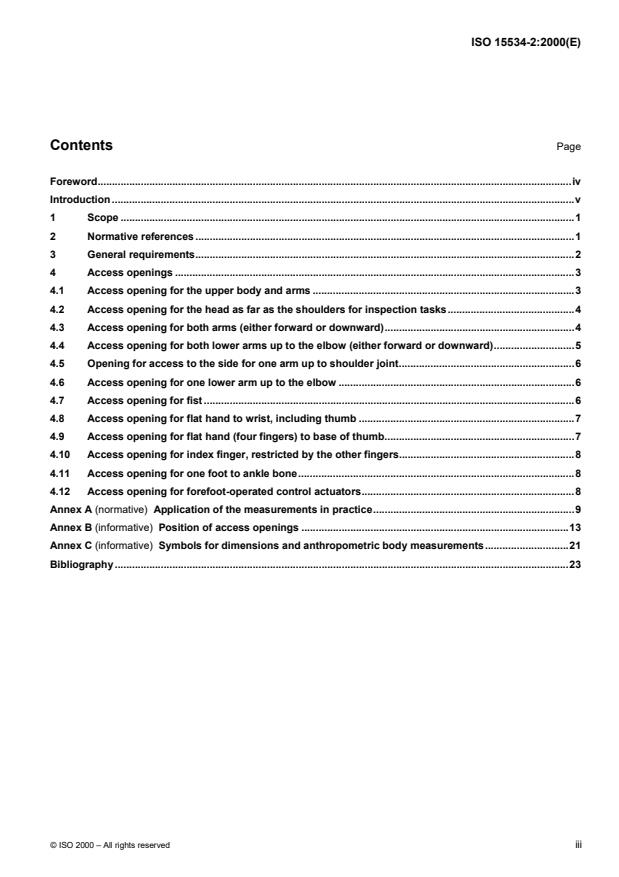
Contents Page
Foreword.iv
Introduction.v
1 Scope .1
2 Normative references .1
3 General requirements.2
4 Access openings .3
4.1 Access opening for the upper body and arms .3
4.2 Access opening for the head as far as the shoulders for inspection tasks.4
4.3 Access opening for both arms (either forward or downward).4
4.4 Access opening for both lower arms up to the elbow (either forward or downward).5
4.5 Opening for access to the side for one arm up to shoulder joint.6
4.6 Access opening for one lower arm up to the elbow .6
4.7 Access opening for fist .6
4.8 Access opening for flat hand to wrist, including thumb .7
4.9 Access opening for flat hand (four fingers) to base of thumb.7
4.10 Access opening for index finger, restricted by the other fingers.8
4.11 Access opening for one foot to ankle bone.8
4.12 Access opening for forefoot-operated control actuators.8
Annex A (normative) Application of the measurements in practice.9
Annex B (informative) Position of access openings .13
Annex C (informative) Symbols for dimensions and anthropometric body measurements.21
Bibliography.23
Foreword
ISO (the International Organization for Standardization) is a worldwide federation of national standards bodies (ISO
member bodies). The work of preparing International Standards is normally carried out through ISO technical
committees. Each member body interested in a subject for which a technical committee has been established has
the right to be represented on that committee. International organizations, governmental and non-governmental, in
liaison with ISO, also take part in the work. ISO collaborates closely with the International Electrotechnical
Commission (IEC) on all matters of electrotechnical standardization.
International Standards are drafted in accordance with the rules given in the ISO/IEC Directives, Part 3.
Draft International Standards adopted by the technical committees are circulated to the member bodies for voting.
Publication as an International Standard requires approval by at least 75 % of the member bodies casting a vote.
Attention is drawn to the possibility that some of the elements of this part of ISO 15534 may be the subject of
patent rights. ISO shall not be held responsible for identifying any or all such patent rights.
International Standard ISO 15534-2 was prepared by Technical Committee ISO/TC 159, Ergonomics,
Subcommittee SC 3, Anthropometry and biomechanics.
ISO 15534 consists of the following parts, under the general title Ergonomic design for the safety of machinery :
� Part 1: Principles for determining the dimensions required for openings for whole-body access into machinery
� Part 2: Principles for determining the dimensions required for access openings
� Part 3: Anthropometric data
Annex A forms a normative part ot this part of ISO 15534. Annexes B and C are for information only.
iv © ISO 2000 – All rights reserved
Introduction
This part of ISO 15534 is one of several ergonomics standards for the safety of machinery.
EN 614-1 ([2] in the Bibliography) describes the principles designers should adopt in order to take account of
ergonomic factors. This part of ISO 15534 describes how these principles should be applied to the design of
access openings.
This part of ISO 15534 is based on EN 547-2:1996 that was prepared as a harmonized standard conforming with
the Machinery Directive and associated European Free Trade Association (EFTA) regulations.
INTERNATIONAL STANDARD ISO 15534-2:2000(E)
Ergonomic design for the safety of machinery —
Part 2:
Principles for determining the dimensions required for access
openings
1 Scope
This part of ISO 15534 specifies the dimensions of openings for access into machinery as defined in
ISO/TR 12100-1. It provides the dimensions to which the values given in ISO 15534-3 are applicable. Values for
additional space requirements are given in annex A. This part of ISO 15534 has been prepared primarily for non-
mobile machinery; there may be additional specific requirements for mobile machinery.
Dimensions for access openings are based on the values for the 95th percentile, whereas reach distances are
based on the values for the 5th percentile, in each case the least favourable body dimension of the expected user
population being used as a basis. The same considerations apply to the location of access openings.
The anthropometric data given in ISO 15534-3 originate from static measurements of nude persons and do not
take into account body movements, clothing, equipment, machinery-operating conditions or environmental
conditions.
This part of ISO 15534 shows how to combine the anthropometric data with suitable allowances to take these
factors into account.
Situations where people are to be prevented from reaching a hazard are dealt with in ISO 13852.
2 Normative references
The following normative documents contain provisions which, through reference in this text, constitute provisions of
this part of ISO 15534. For dated references, subsequent amendments to, or revisions of, any of these publications
do not apply. However, parties to agreements based on this part of ISO 15534 are encouraged to investigate the
possibility of applying the most recent editions of the normative documents indicated below. For undated
references, the latest edition of the normative document referred to applies. Members of ISO and IEC maintain
registers of currently valid International Standards.
ISO/TR 12100-1:1992, Safety of machinery — Basic concepts, general principles for design — Part 1: Basic
terminology, methodology. (EN 292-1:1991)
ISO 13852:1996, Safety of machinery — Safety distances to prevent danger zones being reached by the upper
limbs. (EN 294:1992)
ISO 15534-3:2000, Ergonomic design for the safety of machinery — Part 3: Anthropometric data.
3 General requirements
Operations requiring reach through minimum-access openings are likely to be less efficient, less safe and less
healthy than working with unrestricted access. Therefore, before installing access openings other options should be
considered, e.g. possibility to open machinery, withdrawal of parts for repair. This is particularly important where
the task demands frequent access.
When access openings cannot be avoided, the following criteria are of particular significance:
a) ease of access is influenced by
� the demands of the task, e.g. posture, nature and speed of movement, lines of sight, application of force,
� the location of the access opening relative to the position of the person, e.g. convenient height above
floor, within easy reach, sufficient space outside to allow adoption of a comfortable posture, sufficient
space inside to allow performance of the task,
� frequency and duration of task,
� whether tools are being carried, e.g. for maintenance or repair purposes,
� length of access openings, e.g. through a relatively thin wall (wall of a vessel) or through a channel-type
opening,
� whether additional equipment, such as personal protective equipment (including protective clothing), or
portable lighting, is being carried or worn,
� the type of clothing, e.g. light or heavy clothing, bare hands or thick gloves, bare headed or wearing a
helmet;
b) environmental conditions (e.g. darkness, heat, noise, moisture);
c) level of risk during the task.
Therefore, in addition to the anthropometric data in each case, allowances shall be provided for the respective
opening dimensions and reach distances, taking into account the above criteria.
The applications on how to apply this part of ISO 15534 in practice are contained in annex A, concerning
allowances, and in annex B, concerning the position of access openings.
Annex C gives information on the use of symbols for dimensions and anthropometric measurements.
2 © ISO 2000 – All rights reserved
4 Access openings
An access opening is an opening through which a person can lean forward, reach forward, or extend the upper
body, (head, arm, hand, a finger or several fingers), leg or foot, to be able to carry out measures during work
procedures, such as operating of control actuators, repair duties or monitoring of processes or displays. See
Figures 1 to 12.
This part of ISO 15534 does not specify optimum dimensions, but minimum dimensions for the size of the opening
and maximum dimensions for reach. Wherever possible, the basic dimensions for the openings should be
increased, and the maximum dimensions for reach should be decreased.
Symbol Explanation of measurement
1�
4.1 Access opening for the upper A = a (P95 )+ x
body and arms
A Opening diameter
a Elbow-to-elbow breadth
x Allowance
Figure 1
1) P95: 95th percentile of the expected user population.
Symbol Explanation of measurement
This type of access should be avoided
4.2 Access opening for the head as
wherever possible
far as the shoulders for inspection
tasks
A = c (P95) + x
A Opening diameter
c Head length from tip of nose
x Allowance
Figure 2
4.3 Access opening for both arms A = a (P95) + x
(either forward or downward)
B = d (P95) + y
C = t (P5)
A Opening breadth
B Opening width
C Opening depth
a Elbow-to-elbow breadth
d Upper-arm diameter
t Operating-arm length
x Breadth allowance
y Width allowance
Figure 3
4 © ISO 2000 – All rights reserved
Symbol Explanation of measurement
A =2d (P95) + x
4.4 Access opening for both lower
arms up to the elbow (either forward
B = d (P95) + y
or downward)
C = t (P5)
A Opening breadth
B Opening width
C Opening depth
d Lower-arm diameter
t Forearm reach
x Breadth allowance
y Width allowance
Figure 4
Symbol Explanation of measurement
A = d (P95) + x
4.5 Opening for access to the side
for one arm up to shoulder joint
B = t (P5)
A Opening diameter
B Opening depth
d Upper-arm diameter
t Arm reach to the side
x Allowance
Figure 5
A = a (P95) + x
4.6 Access opening for one lower
arm uptotheelbow
B = t (P5)
A Opening diameter
B Opening depth
a Hand breadth at thumb
t Forearm reach
x Allowance
Figure 6
A = d (P95) + x
4.7 Access opening for fist
A Opening diameter
d Fist diameter
x Allowance
Figure 7
6 © ISO 2000 – All rights reserved
Symbol Explanation of measurement
A = b (P95) + x
4.8 Access opening for flat hand to
wrist, including thumb
B = a (P95) + y
C = t (P5)
A Opening width
B Opening height
C Opening depth
a Hand breadth with thumb
Figure 8 b Hand depth at thumb
t Hand length
x Width allowance
y Height allowance
4.9 Access opening for flat hand A = b (P95) + x
(four fingers) to base of thumb
B = a (P95) + y
C = t (P5)
A Opening width
B Opening height
C Opening depth
a Hand breadth at metacarpals
Figure 9 b Hand depth at palm
t Hand length to thumb
x Width allowance
y Height allowance
Symbol Explanation of measurement
A = a (P95) + x
4.10 Access opening for index finger,
restricted by the other fingers
B = t (P5)
A Opening diameter
B Opening depth
a Index finger breadth, proximal
t Index finger length
Figure 10
x Allowance
4.11 Access opening for one foot to A = a (P95) + x
ankle bone
B = c (P95) + y
A Opening width
B Opening length
a Foot breadth
c Foot length
x Width allowance
y Length allowance
Figure 11
4.12 Access opening for forefoot- A = a (P95) + x
operated control actuators
B = h (P95) + y
cu 0,74 � c (P5)
A Opening width
B Opening height
C Opening length (depth)
h Ankle height
a Foot breadth
c Foot length
Figure 12
x Width allowance
y Height allowance
8 © ISO 2000 – All rights reserved
Annex A
(normative)
Application of the measurements in practice
A.1 Introduction
The purpose of this annex is to explain how to apply the anthropometric measurements given in this part of
ISO 15534 according to ergonomic and safety and health principles.
This part of ISO 15534 describes minimum dimensions for access openings based on anthropometric
measurements, i.e. static measurements of nude persons.
The opening dimensions, including allowances, in this part of ISO 15534 do not always take into consideration, for
example:
� aspects of health and safety arising from contact with the access opening itself;
� whether the body positions and movements that must be used in the access opening mean any risk to the
user’s safety and health, e.g. in relation to how often or how long the person has to use the access opening;
� whether the person has to adopt a certain body position in order to meet the force demands of the task without
becoming overloaded;
� the space required for transportation of equipment and tools through the access opening;
� the space required for using equipment and tools in the access opening in a proper ergonomic way, e.g.
cleaning, repair and maintenance work;
� personal protective equipment the user might wear when reaching through the access opening;
� the speed reduction caused by a space that is too narrow;
� whether the task puts special visual demands on the user;
� any mental load factor, e.g. whether the task must be completed within a specific period of time;
� the space requirements, for entrance to and exit from the access opening.
The design of an access opening that takes ergonomic principles into proper consideration usually leads to more
efficient work, which is also of economic benefit. For example, in most cases the operation time increases as the
size of the opening decreases or if the opening is given an unsuitable position. Information on suitable positions for
access openings is contained in annex B.
A.2 Principles for determining additional space
For each of the openings in this part of ISO 15534, a number of allowances are described in clause A.3 for
conditions that need to be taken into consideration when determining the practical size of a specific access
opening. Where they are applicable, these conditions determine allowances which shall be added to the
anthropometric measurements in order to ensure safety and health while using the access openings. These
allowances are not simply additive; some of the conditions overlap. When designing a specific access opening,
consideration shall be given to each condition given in clause A.3. A decision has to be made as to which ones are
applicable and which ones are the most critical and then an integration of the factors shall be made by an expert,
ending with a definite figure on the total allowance
...