

ISO/IEC 11179-34:2024
(Main)Information technology — Metadata registries (MDR) — Part 34: Metamodel for computable data registration
General Information
- Abstract
This document provides a specification for an extension to a metadata registry (MDR), as specified in ISO/IEC 11179-3, in which metadata that describe computable data can be registered. The specification in this document, together with the relevant clauses of the specification in ISO/IEC 11179-3, provides the ability to record metadata about computable data.
- Status
- Published
- Publication Date
- 14-May-2024
- Technical Committee
- ISO/IEC JTC 1/SC 32 - Data management and interchange
- Drafting Committee
- ISO/IEC JTC 1/SC 32 - Data management and interchange
- Current Stage
- 6060 - International Standard published
- Start Date
- 15-May-2024
- Due Date
- 09-Jun-2024
- Completion Date
- 15-May-2024


Overview
ISO/IEC 11179-34:2024 defines a metamodel extension for Metadata Registries (MDR) to support registration of computable data - metadata that describe executable data pipelines, inputs, outputs, tools and execution environments. As an extension to ISO/IEC 11179-3, this part enables recording machine-actionable manifests for pipelines and computation steps to improve reproducibility, provenance and interoperability of computational workflows across platforms and organizations.
Key topics and technical requirements
- Metamodel extension: Adds the Computable_Data package and classes (e.g., Computable_Data, pipeline, computation step, computation execution environment) to the MDR metamodel.
- Metadata elements: Supports registration of inputs, outputs, parameters, tool versions, environment configuration and relationships between steps to capture full pipeline semantics.
- Representation and specification: Uses UML class diagrams and textual descriptions to specify classes, associations and datatypes; includes normative and informative annexes (class hierarchies, examples).
- Conformance rules: Defines strictly conforming and conforming implementation levels, feature‑level conformance, and requires an Implementation Conformance Statement (ICS).
- Registry profiles and labels: Introduces standard profiles - Computable data Registry and Computable data Registry with mapping - which extend ISO/IEC 11179-3 profiles; conformance labels may be claimed accordingly.
- Interoperability and mapping: Includes a mapping to IEEE 2791-2020 (bioinformatics workflow standard) and references common metadata standards (JSON, ORCID, PAV) to facilitate cross-domain exchange.
- Practical modeling constructs: Specifies datatypes, associations, and package dependencies needed to record computable data in an MDR.
Applications and who should use it
ISO/IEC 11179-34 is intended for organizations and professionals who need standardized, machine-readable metadata for computational workflows:
- Research institutions and data stewards seeking reproducible, verifiable computational experiments.
- Bioinformatics and scientific platforms managing complex pipelines and versioned tools.
- Regulatory agencies and pharmaceutical companies requiring consistent documentation of computational analyses for submission and audit.
- Software vendors and MDR implementers building registries that store computable-data manifests and enable interoperability.
- Data managers and archivists who implement provenance, FAIR data principles, and long-term preservation of computational artifacts.
Related standards
- ISO/IEC 11179-3 - base metamodel for registry common facilities (required companion).
- IEEE 2791-2020 - bioinformatics workflow metadata (mapping provided in Annex A).
- References to JSON, ORCID and PAV for common metadata practices.
This standard enhances metadata registries with a focused metamodel for computable data registration, supporting reproducibility, provenance tracking and interoperable exchange of workflow metadata across domains.
Get Certified
Connect with accredited certification bodies for this standard

BSI Group
BSI (British Standards Institution) is the business standards company that helps organizations make excellence a habit.

NYCE
Mexican standards and certification body.
Sponsored listings
Frequently Asked Questions
ISO/IEC 11179-34:2024 is a standard published by the International Organization for Standardization (ISO). Its full title is "Information technology — Metadata registries (MDR) — Part 34: Metamodel for computable data registration". This standard covers: This document provides a specification for an extension to a metadata registry (MDR), as specified in ISO/IEC 11179-3, in which metadata that describe computable data can be registered. The specification in this document, together with the relevant clauses of the specification in ISO/IEC 11179-3, provides the ability to record metadata about computable data.
This document provides a specification for an extension to a metadata registry (MDR), as specified in ISO/IEC 11179-3, in which metadata that describe computable data can be registered. The specification in this document, together with the relevant clauses of the specification in ISO/IEC 11179-3, provides the ability to record metadata about computable data.
ISO/IEC 11179-34:2024 is classified under the following ICS (International Classification for Standards) categories: 35.040.50 - Automatic identification and data capture techniques. The ICS classification helps identify the subject area and facilitates finding related standards.
ISO/IEC 11179-34:2024 is available in PDF format for immediate download after purchase. The document can be added to your cart and obtained through the secure checkout process. Digital delivery ensures instant access to the complete standard document.
Standards Content (Sample)
International
Standard
ISO/IEC 11179-34
First edition
Information technology — Metadata
2024-05
registries (MDR) —
Part 34:
Metamodel for computable data
registration
Technologies de l'information — Registres de métadonnées (RM) —
Partie 34: Métamodèle pour l'enregistrement des données
calculables
Reference number
© ISO/IEC 2024
All rights reserved. Unless otherwise specified, or required in the context of its implementation, no part of this publication may
be reproduced or utilized otherwise in any form or by any means, electronic or mechanical, including photocopying, or posting on
the internet or an intranet, without prior written permission. Permission can be requested from either ISO at the address below
or ISO’s member body in the country of the requester.
ISO copyright office
CP 401 • Ch. de Blandonnet 8
CH-1214 Vernier, Geneva
Phone: +41 22 749 01 11
Email: copyright@iso.org
Website: www.iso.org
Published in Switzerland
© ISO/IEC 2024 – All rights reserved
ii
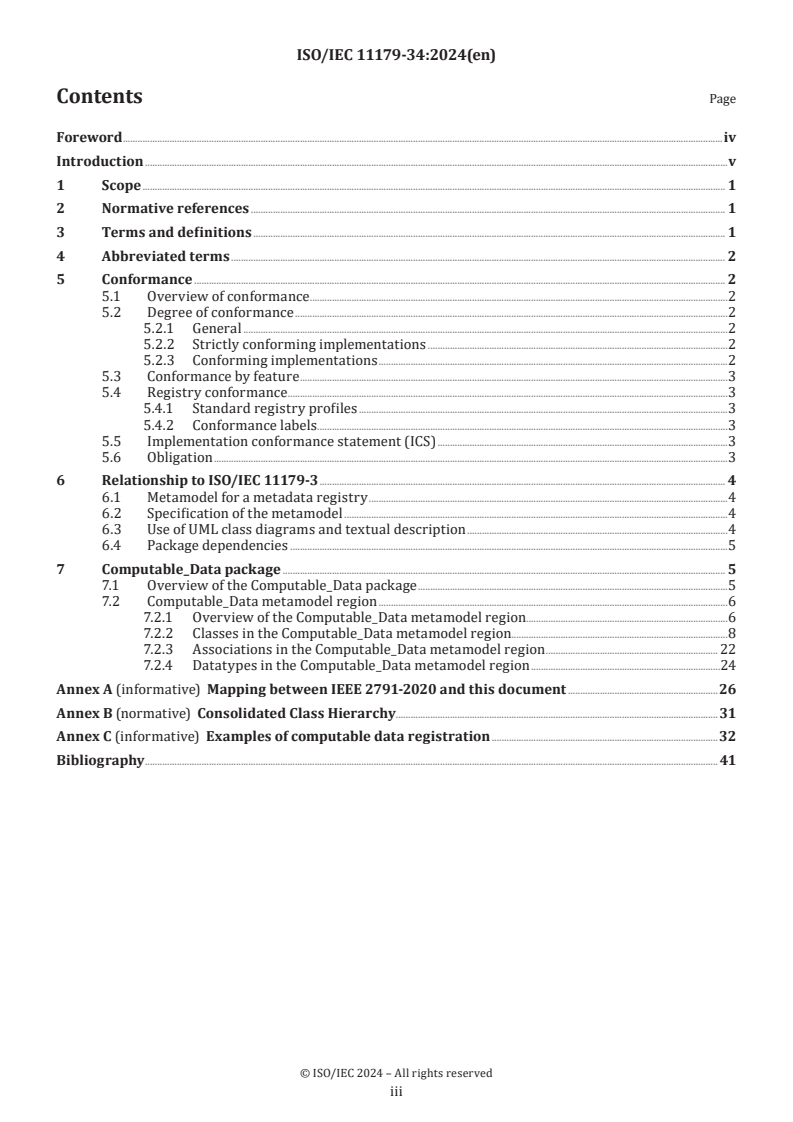
Contents Page
Foreword .iv
Introduction .v
1 Scope . 1
2 Normative references . 1
3 Terms and definitions . 1
4 Abbreviated terms . 2
5 Conformance . 2
5.1 Overview of conformance . .2
5.2 Degree of conformance .2
5.2.1 General .2
5.2.2 Strictly conforming implementations .2
5.2.3 Conforming implementations .2
5.3 Conformance by feature .3
5.4 Registry conformance . .3
5.4.1 Standard registry profiles .3
5.4.2 Conformance labels . .3
5.5 Implementation conformance statement (ICS) .3
5.6 Obligation .3
6 Relationship to ISO/IEC 11179-3 . 4
6.1 Metamodel for a metadata registry .4
6.2 Specification of the metamodel .4
6.3 Use of UML class diagrams and textual description .4
6.4 Package dependencies .5
7 Computable_Data package . 5
7.1 Overview of the Computable_Data package .5
7.2 Computable_Data metamodel region .6
7.2.1 Overview of the Computable_Data metamodel region .6
7.2.2 Classes in the Computable_Data metamodel region.8
7.2.3 Associations in the Computable_Data metamodel region . 22
7.2.4 Datatypes in the Computable_Data metamodel region .24
Annex A (informative) Mapping between IEEE 2791-2020 and this document .26
Annex B (normative) Consolidated Class Hierarchy.31
Annex C (informative) Examples of computable data registration .32
Bibliography . 41
© ISO/IEC 2024 – All rights reserved
iii
Foreword
ISO (the International Organization for Standardization) and IEC (the International Electrotechnical
Commission) form the specialized system for worldwide standardization. National bodies that are
members of ISO or IEC participate in the development of International Standards through technical
committees established by the respective organization to deal with particular fields of technical activity.
ISO and IEC technical committees collaborate in fields of mutual interest. Other international organizations,
governmental and non-governmental, in liaison with ISO and IEC, also take part in the work.
The procedures used to develop this document and those intended for its further maintenance are described
in the ISO/IEC Directives, Part 1. In particular, the different approval criteria needed for the different types
of document should be noted. This document was drafted in accordance with the editorial rules of the ISO/
IEC Directives, Part 2 (see www.iso.org/directives or www.iec.ch/members_experts/refdocs).
ISO and IEC draw attention to the possibility that the implementation of this document may involve the
use of (a) patent(s). ISO and IEC take no position concerning the evidence, validity or applicability of any
claimed patent rights in respect thereof. As of the date of publication of this document, ISO and IEC had not
received notice of (a) patent(s) which may be required to implement this document. However, implementers
are cautioned that this may not represent the latest information, which may be obtained from the patent
database available at www.iso.org/patents and https://patents.iec.ch. ISO and IEC shall not be held
responsible for identifying any or all such patent rights.
Any trade name used in this document is information given for the convenience of users and does not
constitute an endorsement.
For an explanation of the voluntary nature of standards, the meaning of ISO specific terms and expressions
related to conformity assessment, as well as information about ISO's adherence to the World Trade
Organization (WTO) principles in the Technical Barriers to Trade (TBT) see www.iso.org/iso/foreword.html.
In the IEC, see www.iec.ch/understanding-standards.
This document was prepared by Joint Technical Committee ISO/IEC JTC 1, Information technology,
Subcommittee SC 32, Data management and interchange.
This document is part of the fourth modularization of ISO/IEC 11179. This document brings into
ISO/IEC 11179 the ability to register information about computable data.
A list of all parts in the ISO/IEC 11179 series can be found on the ISO and IEC websites.
Any feedback or questions on this document should be directed to the user’s national standards
body. A complete listing of these bodies can be found at www.iso.org/members.html and
www.iec.ch/national-committees.
© ISO/IEC 2024 – All rights reserved
iv
Introduction
Significant scientific discoveries are increasingly achieved through complex and distributed computations
and data analyses. These computations and analyses always involve processing files through a series of
steps and transformations, usually called a pipeline or a workflow.
Data pipelines typically use multiple pieces of software, each of which typically has multiple versions
available, multiple input parameters, multiple outputs, and possibly platform-specific configurations. As
with experimental parameters in a laboratory protocol, small changes in computational parameters can
have a large impact on the scientific validity of the results.
To reproduce and verify scientific discoveries, details of pipelines need to be documented and shared,
including the protocol, procedures, or metadata associated with them. The more analysis steps and the
more complicated a pipeline, the greater the need for a standardized mechanism of communication. A
detailed communication helps ensure responsibility, reproducibility, and the ability to verify protocol, track
provenance information, and promote interoperability.
[1]
This document is inspired by the IEEE 2791-2020 , which aims to improve communication of bioinformatics
protocols and data to facilitate bioinformatics workflow related exchange and communication between
regulatory agencies, pharmaceutical companies, bioinformatics platform providers and researchers.
Although IEEE 2791-2020 has a bioinformatics background and application areas, the concepts and methods
it expressed are applicable to a broader field of scientific research. A mapping table is included in Annex A,
showing the relationship between domains and fields in IEEE 2791-2020 and classes and attributes in this
document.
ISO/IEC 11179-3 specifies the structure of a Metadata Registry (MDR) and provides a metamodel for registry
common facilities. That metamodel is intended to be extended by other parts of ISO/IEC 11179 for specific
purposes.
This document provides a specification of the extensions to the registry metamodel specified in
ISO/IEC 11179-3 to enable the registration of metadata about computable data. Registration of metadata
about computable data are like a manifest describing all details related to input files, output files, and the
pipeline used to process these files. The intent is to facilitate efficient communication and interoperability
among different platforms, industries, scientists, and regulators and to improve reproducibility and
replicability.
In Clauses 6 and 7, this document uses bold font to highlight terms which represent metadata objects
specified by the metamodel.
EXAMPLE Computable_Data (see 7.2.2.1) is a class each instance of which models computable data.
© ISO/IEC 2024 – All rights reserved
v
International Standard ISO/IEC 11179-34:2024(en)
Information technology — Metadata registries (MDR) —
Part 34:
Metamodel for computable data registration
1 Scope
This document provides a specification for an extension to a metadata registry (MDR), as specified in
ISO/IEC 11179-3, in which metadata that describe computable data can be registered.
The specification in this document, together with the relevant clauses of the specification in ISO/IEC 11179-3,
provides the ability to record metadata about computable data.
2 Normative references
The following documents are referred to in the text in such a way that some or all of their content constitutes
requirements of this document. For dated references, only the edition cited applies. For undated references,
the latest edition of the referenced document (including any amendments) applies.
ISO/IEC 11179-3, Information technology — Metadata registries (MDR) — Part 3: Metamodel for registry
common facilities
3 Terms and definitions
For the purposes of this document, the terms and definitions given in ISO/IEC 11179-3 and the following apply.
ISO and IEC maintain terminology databases for use in standardization at the following addresses:
— ISO Online browsing platform: available at https:// www .iso .org/ obp
— IEC Electropedia: available at https:// www .electropedia .org/
3.1
computable data
data that are computed for the purpose of making the data reproducible
3.2
pipeline
full set of logically connected steps needed to transform input data into a result, for which one or more
outputs of one data transformation step can be the input of one or more subsequent steps
3.3
computation step
individual tool (or a well defined and reusable script) used in a pipeline (3.2) that can be executed sequentially
or in parallel with other computation steps
3.4
computation execution environment
information of the environment needed to execute a computation step (3.3) to the extent to which consistent
results are obtained when produced repeatedly, including platform, deployment, software configuration
and running applications, etc.
© ISO/IEC 2024 – All rights reserved
4 Abbreviated terms
JSON JavaScript Object Notation
ORCID Open Researcher and Contributor ID (see Reference [2])
PAV Provenance, Authoring and Versioning (see Reference [3])
UML Unified Modeling Language (see References [4] and [5])
URI Uniform Resource Identifier
URL Uniform Resource Locator
5 Conformance
5.1 Overview of conformance
Conformance rules for a Metadata Registry are specified in ISO/IEC 11179-3:2023, Clause 4. The clause
“Degree of Conformance” is repeated here for convenience. The subsequent subclauses extend the rules
from ISO/IEC 11179-3:2023.
5.2 Degree of conformance
5.2.1 General
The distinction between “strictly conforming” and “conforming” implementations is necessary to address the
simultaneous needs for interoperability and extensions. This document describes specifications that promote
interoperability. Extensions are motivated by needs of users, vendors, institutions, and industries, and:
a) are not directly specified by this document;
b) are specified and agreed to outside this document;
c) may serve as trial usage for future editions of this document.
A strictly conforming implementation can be limited in usefulness but is maximally interoperable with
respect to this document. A conforming implementation can be more useful but can be less interoperable
with respect to this document.
5.2.2 Strictly conforming implementations
A strictly conforming implementation:
a) shall support all mandatory, optional and conditional classes, attributes, datatypes and associations;
b) shall not use, test, access or probe for any extension features nor extensions to classes, attributes,
datatypes, associations or any combination thereof;
c) shall not recognize, nor act on, nor allow the production of classes, attributes, datatypes, associations or
any combination thereof that are dependent on any unspecified, undefined or implementation-defined
behaviour.
NOTE The use of extensions to the metamodel can cause undefined behaviour.
5.2.3 Conforming implementations
A conforming implementation:
a) shall support all mandatory, optional and conditional classes, attributes, datatypes and associations;
© ISO/IEC 2024 – All rights reserved
b) as permitted by the implementation, may use, test, access or probe for extension features or extensions
to classes, attributes, datatypes, associations or any combination thereof;
c) may recognize, act on or allow the production of classes, attributes, datatypes, associations or any
combination thereof that are dependent on implementation-defined behaviour.
NOTE 1 All strictly conforming implementations are also conforming implementations.
NOTE 2 The use of extensions to the metamodel can cause undefined behaviour.
5.3 Conformance by feature
Conformance claims may be made to Clause 7 of this document, or to specific features within that clause.
Clause 7 is also dependent upon one or more clauses of ISO/IEC 11179-3, so conformance to all or part of
Clause 7 shall be understood to imply conformance also to relevant provisions specified in one or more of
the clauses in ISO/IEC 11179-3.
A conformance statement shall specify exactly the features supported and not supported.
5.4 Registry conformance
5.4.1 Standard registry profiles
This document specifies the following standard profiles in addition to those specified in
ISO/IEC 11179-3:2023, 4.4.2.
— Computable data Registry: Implements Clause 7 of this document, in addition to all provisions of the
Basic registry profile of ISO/IEC 11179-3:2023, 4.4.2;
— Computable data Registry with mapping: Implements Clause 7 of this document, in addition to all
provisions of the Basic registry with mapping profile of ISO/IEC 11179-3:2023, 4.4.2.
5.4.2 Conformance labels
Conformance to the profiles specified in 5.4.1 may be claimed using the following labels, respectively:
— ISO/IEC 11179-34:2024 Computable data Registry;
— ISO/IEC 11179-34:2024 Computable data Registry with mapping.
5.5 Implementation conformance statement (ICS)
An implementation claiming conformance to this document shall include an implementation conformance
statement stating:
a) whether it conforms or strictly conforms;
b) which clauses are or are not supported;
c) what extensions, if any, are supported or used.
A standard profile may be referenced, if applicable.
EXAMPLE Product Z strictly conforms to ISO/IEC 11179-34:2024 Computable data Registry.
5.6 Obligation
Properties and relationships specified in this document are one of: Mandatory, Conditional or Optional. The
obligation is not explicitly stated but is to be inferred from the multiplicity of the property or relationship,
and the presence or absence of a condition.
© ISO/IEC 2024 – All rights reserved
For the purpose of conformance:
a) mandatory properties and relationships shall exist and shall conform to the provisions of this document;
b) anything specified as Conditional within this document shall be treated as Mandatory if the associated
condition is satisfied and shall otherwise be not present;
c) optional properties and relationships are not required to exist, but if they do exist, they shall conform to
the provisions of this document.
Such obligation is enforced if and only if the Registration Status of the associated registry items is Recorded
or higher (see ISO/IEC 11179-3:2023, 9.4.4.3 and ISO/IEC 11179-6:2023, 4.3.4).
6 Relationship to ISO/IEC 11179-3
6.1 Metamodel for a metadata registry
A metamodel is a model that describes other models. A metamodel provides a mechanism for understanding
the precise structure and components of the specified models, which are needed for the successful sharing
of the models by users, software facilities or both.
ISO/IEC 11179-3 uses a metamodel to describe the information model of a metadata registry. The registry in
turn will be used to describe and model other data, for example about enterprise, public administration or
business applications. The registry metamodel is specified as a conceptual data model, i.e. one that describes
how relevant information is structured in the natural world. In other words, it is how the human mind is
accustomed to thinking of the information.
6.2 Specification of the metamodel
The conventions used in specifying the metamodel are described in ISO/IEC 11179-3:2023, 5.3. Many of the
classes specified in this document inherit from Item, which is specified in ISO/IEC 11179-3:2023, 6.4.2.1. As
Items, instances of these classes may be identified, registered, administered, named, defined and classified.
6.3 Use of UML class diagrams and textual description
This document uses both text and UML class diagrams to describe the metamodel. Both are normative and
are intended to be complementary. However, if a conflict exists between what is specified in the UML class
diagrams and what is specified in text, the text takes precedence until a correction is made to make them
consistent. Further, if a conflict exists between a formal definition and other normative text, the formal
definition takes precedence until a correction is made to make them consistent.
A consolidated UML class hierarchy is included as Annex B.
While the model diagrams are presented in UML class diagram notation, this document does not assume nor
endorse any specific system environment, database management system, database design paradigm, system
development methodology, data definition language, command language, system interface, user interface,
computing platform, or any technology required for implementation.
© ISO/IEC 2024 – All rights reserved
6.4 Package dependencies
Figure 1 — Package dependencies
Figure 1 illustrates the dependencies among the packages. The Computable_Data package is specified in this
document. All the other packages are specified in ISO/IEC 11179-3 and ISO/IEC 11179-33.
The lines in Figure 1 illustrate dependencies in the direction of the arrow. In order to implement a package
that has dependencies, the packages on which it is dependent shall also be implemented. The dependencies
are of three types:
a) subclassing from classes in another package, e.g. Computable_Data (see 7.2.2.1) in the Computable_
Data package is subclassed from the Item class in the Basic and Core package (ISO/IEC 11179-3:2023,
6.4.2.1);
b) relationship between classes, e.g. Registered_Item in the Registration package
(ISO/IEC 11179-3:2023, 9.4.1) has a relationship with Reference_Document in the Basic and Core
package (ISO/IEC 11179-3:2023, 6.3.8);
c) some attributes use a predefined datatype or a class from another package as a datatype, e.g. the
supporting_document attribute of the Supporting_Document (see 7.2.2.3) class in the Computable_
Data package (see Clause 7) uses the Reference_Document class of the Basic and Core package (see
ISO/IEC 11179-3:2023, 6.3.8) as a datatype.
Conformance options are specified in Clause 5 and standard conformance profiles in 5.4.
7 Computable_Data package
7.1 Overview of the Computable_Data package
The Computable_Data package consists of a single metamodel region, the Computable_Data metamodel region.
© ISO/IEC 2024 – All rights reserved
7.2 Computable_Data metamodel region
7.2.1 Overview of the Computable_Data metamodel region
Figure 2 shows the framework of the metamodel for the registration of metadata about computable data,
Figure 3 and Figure 4 show the detailed information of this metamodel.
Figure 2 — Framework of computable data metamodel region
© ISO/IEC 2024 – All rights reserved
Figure 3 — Computable data metamodel region (1 of 2)
© ISO/IEC 2024 – All rights reserved
Figure 4 — Computable data metamodel region (2 of 2)
Examples of the registration of computable data using this metamodel are included in Annex C.
7.2.2 Classes in the Computable_Data metamodel region
7.2.2.1 Computable_Data class
7.2.2.1.1 Direct superclass
Computable_Data is a subclass of Item (see ISO/IEC 11179-3:2023, 6.4.2.1), allowing instances to be
identified, registered, administered, named, defined and classified.
© ISO/IEC 2024 – All rights reserved
7.2.2.1.2 Description of Computable_Data
Computable_Data is a class each instance of which models computable data, which are data that are
computed for the purpose of making the data reproducible.
7.2.2.1.3 Associations of Computable_Data
As a subclass of Item, Computable_Data inherits Item’s associations (see ISO/IEC 11179-3:2023, 6.4.2.1.2).
Computable_Data has the following additional associations:
— computable_data_pipeline (see 7.2.3.1);
— computable_data_supporting_document (see7.2.3.2);
— computable_data_error (see 7.2.3.3).
— computable_data_contributor (see 7.2.3.4);
— computable_data_review (see 7.2.3.5);
— computable_data_input (see 7.2.3.6);
— computable_data_output (see 7.2.3.7).
7.2.2.1.4 Attributes of Computable_Data
The attributes of the Computable_Data class are specified in Table 1.
Table 1 — Attributes of the Computable_Data class
Attribute name Multiplicity Datatype Description
etag 0.1 String Definition: a string-type, read-only value, pro-
(ISO/IEC 11179- tecting the computable data from internal or
3:2023, 6.2.11) external alterations without proper validation.
[6]
NOTE: See RFC7232 section 2.3 for full de-
scription.
version 1.1 String Definition: a version number which identifies the
(ISO/IEC 11179- state of development of the computable data.
3:2023, 6.2.11)
In computable data versioning, a change affect-
ing the outcome of the computation should be
deposited as a new computable data, not as a
new version.
Changes that cannot affect the results of the
computation can be incorporated into a new
version of the existing computable data.
derived_from 0.1 String Definition: the parent computable data that the
(ISO/IEC 11179- computable data are derived from.
3:2023, 6.2.11)
NOTE: If the computable data are derived from
another, this attribute will specify the parent
computable data, in the form of its identifier.
created_datetime 0.1 Datetime Definition: date and time of the initial creation of
(ISO/IEC 11179- the computable data.
3:2023, 6.2.3)
modified_datetime 0.1 Datetime Definition: date and time the computable data
(ISO/IEC 11179- was last modified.
3:2023, 6.2.3)
obsolete_after_datetime 0.1 Datetime Definition: expiration date and time of the com-
(ISO/IEC 11179- putable data.
3:2023, 6.2.3)
© ISO/IEC 2024 – All rights reserved
TTabablele 1 1 ((ccoonnttiinnueuedd))
Attribute name Multiplicity Datatype Description
embargo_period 0.1 Datetime_Period Definition: period during which the computable
(ISO/IEC 11179- data shall not be made public.
3:2023, 6.3.10)
usability 0.* Text Definition: description of the scientific use case
(ISO/IEC 11179- and function of the computable data.
3:2023, 6.2.12)
licence 1. * Reference_Document Definition: a document that provides licence
(ISO/IEC 11179- information related to the computable data.
3:2023, 6.3.8)
NOTE: A public copyright licence (i.e. Creative
[7]
Commons Attribution 4.0 International )is
used when an author wants to give other people
the right to share, use, and build upon a work
that they (the author) have created.
7.2.2.1.5 Constraint on Computable_Data
Each instance of the Computable_Data class shall only exist if at least one instance of the item_designation
association of the parent Item class shall be instantiated.
7.2.2.2 Pipeline class
7.2.2.2.1 Direct superclass
Pipeline is a subclass of Item (see ISO/IEC 11179-3:2023, 6.4.2.1), allowing instances to be identified,
registered, administered, named, defined and classified.
7.2.2.2.2 Description of Pipeline
Pipeline is a class each instance of which models a pipeline, a full set of logically connected steps needed to
transform input data into a result, for which the output of one data transformation step can be the input of
one or more subsequent steps.
7.2.2.2.3 Associations of Pipeline
As a subclass of Item, Pipeline inherits Item’s associations (see ISO/IEC 11179-3:2023, 6.4.2.1.2). Pipeline
has the following additional associations:
— computable_data_pipeline (see 7.2.3.1);
— pipeline_compostion (see 7.2.3.8).
7.2.2.2.4 Attributes of Pipeline
None.
7.2.2.3 Supporting_Document class
7.2.2.3.1 Direct superclass
Supporting_Document is a subclass of Item (see ISO/IEC 11179-3:2023, 6.4.2.1), allowing instances to be
identified, registered, administered, named, defined and classified.
© ISO/IEC 2024 – All rights reserved
7.2.2.3.2 Description of Supporting_Document
Supporting_Document is a class each instance of which models a supporting document, which might be a
specification document, schema document or other reference document that provides specific information
related to computable data.
7.2.2.3.3 Associations of Supporting_Document
As a subclass of Item, Supporting_Document inherits Item’s associations (see ISO/IEC 11179-3:2023,
6.4.2.1.2). Supporting_Document has the following additional association:
— computable_data_supporting_document (see 7.2.3.2).
7.2.2.3.4 Attributes of Supporting_Document
The attributes of the Supporting_Document class are specified in Table 2.
Table 2 — Attributes of the Supporting_Document class
Attribute name Multiplicity Datatype Description
document_role 0.1 Text Definition: description of the role of the
(ISO/IEC 11179-3:2023, supporting document.
6.2.12)
supporting_document 1.1 Reference_Document Definition: a document that provides
(ISO/IEC 11179-3:2023, specific information related to computable
6.3.8) data.
access_datetime 0.1 Datetime Definition: date and time the document
(ISO/IEC 11179-3:2023, was accessed when it was used as a sup-
6.2.3) porting document during the process the
computable data are produced.
7.2.2.4 Computable_Data_Error class
7.2.2.4.1 Direct superclass
Computable_Data_Error is a subclass of Item (ISO/IEC 11179-3:2023, 6.4.2.1), allowing instances to be
identified, registered, administered, named, defined and classified.
7.2.2.4.2 Description of Computable_Data_Error
Computable_Data_Error is a class each instance of which models an error, which can be an empirical error,
algorithmic error or some other type of error during the process by which computable data are produced by
a pipeline.
The empirical error contains empirically determined values such as limits of detectability, false positives,
false negatives, statistical confidence of outcomes, etc. This can be measured by running the algorithm on
multiple data samples of the usability domain or through the use of carefully designed in-silico data.
The algorithmic error is descriptive of errors that originate by fuzziness of the algorithms, driven by
stochastic processes, in dynamically parallelized multi-threaded executions, or in machine learning
methodologies where the state of the machine can affect the outcome. This can be measured by taking a
random subset of the data and re-running the analysis, or using some rigorous mathematical modeling of
the accumulated errors and providing confidence values.
© ISO/IEC 2024 – All rights reserved
7.2.2.4.3 Associations of Computable_Data_Error
As a subclass of Item, Computable_Data_Error inherits Item’s associations (see ISO/IEC 11179-3:2023,
6.4.2.1.2). Computable_Data_Error has the following additional association:
— computable_data_error (see 7.2.3.3).
7.2.2.4.4 Attributes of Computable_Data_Error
The attributes of the Computable_Data_Error class are specified in Table 3.
Table 3 — Attributes of the Computable_Data_Error class
Attribute Multiplicity Datatype Description
name
type 1.1 String Definition: the type of the computable data error.
(ISO/IEC 11179-
Example: algorithmic error, empirical error, etc.
3:2023, 6.2.11)
detail 1.1 Text Definition: free text of detailed description of the computable
(ISO/IEC 11179- data error.
3:2023, 6.2.12)
7.2.2.5 Contributor class
7.2.2.5.1 Direct superclass
Contributor is a subclass of Item (ISO/IEC 11179-3:2023, 6.4.2.1), allowing instances to be identified,
registered, administered, named, defined and classified.
7.2.2.5.2 Description of Contributor
Contributor is a class each instance of which models a contributor, an entity that contributes to
computable data.
A contributor can be a person, an organization, a software or a location, etc.
7.2.2.5.3 Associations of Contributor
As a subclass of Item, Contributor inherits Item’s associations (see ISO/IEC 11179-3:2023, 6.4.2.1.2).
Contributor has the following additional association:
— computable_data_contributor (see 7.2.3.4).
7.2.2.5.4 Attributes of Contributor
The attributes of the Contributor class are specified in Table 4.
Table 4 — Attributes of the Contributor class
Attribute name Multiplicity Datatype Description
Contribution Definition: description of the type of contribution
contributor_contribution 0.*
[3]
(7.2.4.1) according to PAV ontology .
7.2.2.5.5 Constraint on Contributor
Each instance of the Contributor class shall only exist if at least one instance of the item_designation
association of the parent Item class shall be instantiated.
© ISO/IEC 2024 – All rights reserved
7.2.2.6 Individual_Contributor class
7.2.2.6.1 Direct superclass
Individual_Contributor is a subclass of Contributor (see 7.2.2.5), which in turn is a subclass of Item (see
ISO/IEC 11179-3:2023, 6.4.2.1), allowing instances to be identified, registered, administered, named, defined
and classified.
7.2.2.6.2 Description of Individual_Contributor
Individual_Contributor is a class each instance of which models an individual contributor, a person that
contributes to computable data.
7.2.2.6.3 Associations of Individual_Contributor
As a subclass of Item and Contributor, Individual_Contributor inherits Item’s associations (see
ISO/IEC 11179-3:2023, 6.4.2.1.2) and Contributor’s associations (see 7.2.2.5.3).
7.2.2.6.4 Attributes of Individual_Contributor
The attributes of the Individual_Contributor class are specified in Table 5.
Table 5 — Attributes of the Individual_Contributor class
Attribute name Multiplicity Datatype Description
Organization
Definition: organization the individual contributor
contributor_affiliation 0.* (ISO/IEC 11179-
is affiliated with.
3:2023, 6.3.3)
String
Definition: the email address of the individual
contributor_email 0.1 (ISO/IEC 11179-
contributor.
3:2023, 6.2.11)
String Definition: a persistent digital identifier for a
contributor_orcid 0.1 (ISO/IEC 11179- person (the individual contributor) registered in
3:2023, 6.2.11) ORCID.
7.2.2.7 Organization_Contributor class
7.2.2.7.1 Direct superclass
Organization_Contributor is a subclass of Contributor (see 7.2.2.5), which in turn is a subclass of Item
(see ISO/IEC 11179-3:2023, 6.4.2.1), allowing instances to be identified, registered, administered, named,
defined and classified.
7.2.2.7.2 Description of Organization_Contributor
Organization_Contributor is a class each instance of which models an organization contributor, an
organization that contributes to computable data.
7.2.2.7.3 Associations of Organization_Contributor
As a subclass of Item and Contributor, Organization_Contributor inherits Item’s associations (see
ISO/IEC 11179-3:2023, 6.4.2.1.2) and Contributor’s associations (see 7.2.2.5.3).
7.2.2.7.4 Attributes of Organization_Contributor
The attributes of the Organization_Contributor class are specified in Table 6.
© ISO/IEC 2024 – All rights reserved
Table 6 — Attributes of the Organization_Contributor class
Attribute name Multiplicity Datatype Description
Organization
Definition: organization that contributes to com-
organization 0.1 (ISO/IEC 11179-
putable data.
3:2023, 6.3.3)
7.2.2.8 Review class
7.2.2.8.1 Direct superclass
Review is a subclass of Item (see ISO/IEC 11179-3:2023, 6.4.2.1), allowing instances to be identified,
registered, administered, named, defined and classified.
7.2.2.8.2 Description of Review
Review is a class each instance of which models a review, which associates a reviewer and a description of
the status of computable data in the review process.
7.2.2.8.3 Associations of Review
As a subclass of Item, Review inherits Item’s associations (see ISO/IEC 11179-3:2023, 6.4.2.1.2). Review has
the following additional association:
— computable_data_review (see 7.2.3.5).
7.2.2.8.4 Attributes of Review
The attributes of the Review class are specified in Table 7.
Table 7 — Attributes of the Review class
Attribute name Multiplicity Datatype Description
review_date 0.1 Date Definition: date of the review.
(ISO/IEC 11179-3:2023,
6.2.4)
review_status 1.1 Review_Status (7.2.4.2) Definition: current verification status in the
review process of the computable data.
String
reviewer_name 1 :1 (ISO/IEC 11179-3:2023, Definition: the name of the reviewer.
6.2.11)
Definition: description of the type of contribution
reviewer_contribution 0.* Contribution(7.2.4.1)
[3]
according to PAV ontology .
Organization (ISO/IEC Definition: organization the reviewer is affiliated
reviewer_affiliation 0. *
11179-3:2023, 6.3.3) with.
String
reviewer_email 0.* (ISO/IEC 11179-3:2023, Definition: the email address of the reviewer.
6.2.11)
String
Definition: a persistent digital identifier for a
reviewer_orcid 0.1 (ISO/IEC 11179-3:2023,
person (the reviewer) registered in ORCID.
6.2.11)
reviewer_comment 0.1 Text Definition: optional free text comment by a
(ISO/IEC 11179-3:2023, reviewer.
6.2.12)
© ISO/IEC 2024 – All rights reserved
7.2.2.9 Computation_Step class
7.2.2.9.1 Direct superclass
Computation_Step is a subclass of Item (see ISO/IEC 11179-3:2023, 6.4.2.1), allowing instances to be
identified, registered, administered, named, defined and classified.
7.2.2.9.2 Description of Computation_Step
Computation_Step is a class each instance of which models a computation step, which is an individual tool
(or a well defined and reusable script) used in a pipeline and can be executed sequentially or in parallel with
other computation steps.
7.2.2.9.3 Associations of Computation_Step
As a subclass of Item, Computation_Step inherits Item’s associations (see ISO/IEC 11179-3:2023, 6.4.2.1.2).
Computation_Step has the following additional associations:
— pipeline_compositon (see 7.2.3.8);
— computation_step_input (see 7.2.3.9);
— computation_step_output (see 7.2.3.10);
— computation_execution_environment (see 7.2.3.11);
— computation_step_prerequisite (see 7.2.3.16);
— computation_step_parameter (see 7.2.3.17).
7.2.2.9.4 Attributes of Computation_Step
The attributes of the Computation_Step class are specified in Table 8.
Table 8 — Attributes of the Computation_Step class
Attribute Multiplicity Datatype Description
name
step_number 0.1 Integer Definition: non-negative integer value representing the posi-
(ISO/IEC 11179- tion of the computation step in a one-dimensional representa-
3:2023, 6.2.5) tion of the pipeline.
While this document does not mandate any particular num-
bering schema, it is best practice to pick the most logically
intuitive numbering system, and to keep numbering unique
(i.e. do not repeat step numbers), such that each step has its
own, unique integer. For example, a user may run one step at
the same time as another step or analysis. In a case where each
step pulls output from the same step, the steps may be step #3,
and step #4, instead of number both as #3. The fact that they
pull from the output of the same step (#2) can be detected from
an association to the same instance of Computation_Step_Pre-
requisite class.
Gaps are allowed (e.g. step 20 follows step 10).
version 0.1 String Definition: version of the computation step used.
(ISO/IEC 11179-
3:2023, 6.2.11)
purpose 0.1 Text Definition: description of the specific purpose of the computa-
(ISO/IEC 11179- tion step.
3:2023, 6.2.12)
© ISO/IEC 2024 – All rights reserved
7.2.2.9.5 Constraint on Computation_Step
Each instance of the Computation_Step class shall only exist if at least one instance of the item_designation
association of the parent Item class shall be instantiated.
7.2.2.10 Input_Output_Data class
7.2.2.10.1 Direct superclass
Input_Output_Data is a subclass of Data_Set_Distribution (see ISO/IEC 11179-33:2023, 7.2.2.5), which in
turn is a subclass of Item (see ISO/IEC 11179-3:2023, 6.4.2.1), allowing instances to be identified, registered,
administered, named, defined and classified.
7.2.2.10.2 Description of Input_Output_Data
Input_Output_Data is a class each instance of which models input or output data of a computation step.
7.2.2.10.3 Associations of Input_Output_Data
As a subclass of Item and Data_Set_Distribution, Input_Output_Data inherits Item’s associations (see
ISO/IEC 11179-3:2023, 6.4.2.1.2) and Data_Set_Distribution’s associations (see ISO/IEC 11179-33:2023,
7.2.2.5.3). Input_Output_Data has the following additional associations:
— computable_data_input (see 7.2.3.6);
— computable_data_output (see 7.2.3.7);
— computation_step_input (see 7.2.3.9);
— computation_step_output (see 7.2.3.10).
7.2.2.10.4 Attributes of Input_Output_Data
The attributes of the Input_Output_Data class are specified in Table 9, The filename can be specified using
Designation.sign of the parent Item.
Table 9 — Attributes of the Input_Output_Data class
Attribute name Multiplicity Datatype Description
String
uri 1.1 (ISO/IEC 11179- Definition: URI of the data.
3:2023, 6.2.11)
access_datetime 0.1 Datetime Definition: date and time the data was accessed when it
(ISO/IEC 11179- was used as input to the computation step.
3:2023, 6.2.3)
creation_datetime 0.1 Datetime Definition: date and time the data was created.
(ISO/IEC 11179-
3:2023, 6.2.3)
sha1_checksum 0:1 String Definition: SHA1 checksum of the data.
(ISO/IEC 11179-
3:2023, 6.2.11)
7.2.2.11 Computation_Execution_Environment class
7.2.2.11.1 Direct superclass
Computation_E
...