

ISO 2351-3:2014
(Main)Assembly tools for screws and nuts — Machine-operated screwdriver bits — Part 3: Screwdriver bits for hexagon socket screws
General Information
- Abstract
ISO 2351-3:2014 prescribes the technical specifications for machine-operated screwdriver bits for hexagon socket screws, listed in ISO 1703 under reference number 3 2 03 01 0. It applies to bits with male hexagon drive or with cylindrical flat-end drive as defined in ISO 1173 and to tips for screwdrivers as defined in ISO 2936. It also gives recommended combinations between tips and bits.
- Status
- Published
- Publication Date
- 02-Feb-2014
- Technical Committee
- ISO/TC 29/SC 10 - Assembly tools for screws and nuts, pliers and nippers
- Drafting Committee
- ISO/TC 29/SC 10 - Assembly tools for screws and nuts, pliers and nippers
- Current Stage
- 9093 - International Standard confirmed
- Start Date
- 26-Jun-2025
- Completion Date
- 29-Aug-2026
Buy Documents


ISO 2351-3:2014 - Assembly tools for screws and nuts -- Machine-operated screwdriver bits
ISO 2351-3:2014 - Assembly tools for screws and nuts — Machine-operated screwdriver bits — Part 3: Screwdriver bits for hexagon socket screws/3/2014


ISO 2351-3:2014 - Outils de manoeuvre pour vis et écrous -- Embouts tournevis a machine
ISO 2351-3:2014 - Outils de manoeuvre pour vis et écrous — Embouts tournevis à machine — Partie 3: Embouts tournevis pour vis à six pans creux/3/2014
Overview
ISO 2351-3:2014 specifies the technical requirements for machine-operated screwdriver bits designed for hexagon socket screws. Published by the International Organization for Standardization (ISO), this part of the ISO 2351 series focuses on ensuring interchangeability, performance reliability, and durability of screwdriver bits used in industrial and mechanical assembly settings. It applies specifically to bits with male hexagon drives or cylindrical flat-end drives as defined in ISO 1173, and to screwdriver tips according to ISO 2936. The standard also provides recommended combinations between bit tips and drives, supporting efficient and standardized tooling solutions.
Key Topics
Scope & Application
ISO 2351-3:2014 covers screwdriver bits intended for fasteners with hexagon socket heads, commonly used in machinery, automotive, and precision assembly industries.Dimensions & Forms
Bit dimensions and shapes follow precise criteria to match corresponding screws and drives:- Male hexagon drives or cylindrical flat-end drives per ISO 1173.
- Bits tips conforming to ISO 2936 classifications.
- Recommended combinations of bit ends and drives ensure optimal fit and torque transfer.
Technical Specifications
- Bits must undergo complete heat treatment to maximize strength.
- Compliance with mechanical requirements equivalent to insulated screwdriver ends (ISO 2936).
Torsion Testing
Performance validation involves torsion testing of the driving end using a test socket of minimum 62 HRC hardness. Bits must sustain a minimum torque level without deformation or failure, guaranteeing durable operation under high stress.Marking and Designation
Certified bits must be permanently marked with:- Manufacturer or supplier name.
- Nominal flat-to-flat dimension of the hexagon. Special provisions exist for smaller bits, where marking appears only on packaging.
Identification Format
Example of proper designation:Embout ISO 2351-3 E 11.2 - 6
Where “E 11.2” refers to the nominal drive size and “6” corresponds to the tip’s nominal flat dimension.
Applications
ISO 2351-3:2014 is essential for manufacturers and users of machine-operated screwdriver bits who demand consistency and performance reliability for hexagon socket screws. Typical applications include:
Industrial Manufacturing
Automated assembly lines require bits that deliver repeatable torque and precise fit, minimizing fastener damage and tool wear.Automotive Assembly
Use of hexagon socket screws in engines and chassis exploits these standardized bits to meet stringent quality and safety requirements.Maintenance & Repair
Service personnel depend on bits matching this standard to ensure compatibility with original equipment screws, securing efficient repair operations.Precision Engineering
Sectors involving electronics and instrumentation benefit from the dimensional accuracy and mechanical robustness defined by this standard.
Related Standards
- ISO 1173 – Specifies dimensions and torque testing for bits with various drive profiles including hexagon male and cylindrical flat-ended shafts.
- ISO 2936 – Details tip shapes and dimensions for hexagon socket screwdriver ends.
- ISO 1703 – Provides nomenclature and designation criteria for assembly tools including screwdriver bits.
- ISO 2351 Parts 1 & 2 – Cover screwdriver bits for slotted and cross-recessed (Phillips) screws respectively, complementing Part 3’s focus on hexagon sockets.
Practical Value
By adhering to ISO 2351-3:2014, manufacturers ensure production of high-quality machine-operated hexagon socket screwdriver bits that:
- Provide superior torque transmission.
- Reduce risk of fastener and tool damage.
- Enhance operator safety and productivity.
- Improve interchangeability globally, simplifying tool inventory management.
For industries reliant on high precision and automated assembly, compliance with ISO 2351-3 is a critical factor in tool selection and manufacturing process optimization.
Relations
- Effective Date
- 03-Mar-2012
Buy Documents
ISO 2351-3:2014 - Assembly tools for screws and nuts -- Machine-operated screwdriver bits
ISO 2351-3:2014 - Assembly tools for screws and nuts — Machine-operated screwdriver bits — Part 3: Screwdriver bits for hexagon socket screws/3/2014
ISO 2351-3:2014 - Outils de manoeuvre pour vis et écrous -- Embouts tournevis a machine
ISO 2351-3:2014 - Outils de manoeuvre pour vis et écrous — Embouts tournevis à machine — Partie 3: Embouts tournevis pour vis à six pans creux/3/2014
Get Certified
Connect with accredited certification bodies for this standard

DVS-ZERT GmbH
German welding certification society.
CARES (UK Certification Authority for Reinforcing Steels)
UK certification for reinforcing steels and construction.
EWF/IIW (European/International Welding Federation)
International welding personnel certification.
Sponsored listings
Frequently Asked Questions
ISO 2351-3:2014 is a standard published by the International Organization for Standardization (ISO). Its full title is "Assembly tools for screws and nuts — Machine-operated screwdriver bits — Part 3: Screwdriver bits for hexagon socket screws". This standard covers: ISO 2351-3:2014 prescribes the technical specifications for machine-operated screwdriver bits for hexagon socket screws, listed in ISO 1703 under reference number 3 2 03 01 0. It applies to bits with male hexagon drive or with cylindrical flat-end drive as defined in ISO 1173 and to tips for screwdrivers as defined in ISO 2936. It also gives recommended combinations between tips and bits.
ISO 2351-3:2014 prescribes the technical specifications for machine-operated screwdriver bits for hexagon socket screws, listed in ISO 1703 under reference number 3 2 03 01 0. It applies to bits with male hexagon drive or with cylindrical flat-end drive as defined in ISO 1173 and to tips for screwdrivers as defined in ISO 2936. It also gives recommended combinations between tips and bits.
ISO 2351-3:2014 is classified under the following ICS (International Classification for Standards) categories: 25.140.01 - Hand-held tools in general. The ICS classification helps identify the subject area and facilitates finding related standards.
ISO 2351-3:2014 has the following relationships with other standards: It is inter standard links to ISO 2351-3:2002. Understanding these relationships helps ensure you are using the most current and applicable version of the standard.
ISO 2351-3:2014 is available in PDF format for immediate download after purchase. The document can be added to your cart and obtained through the secure checkout process. Digital delivery ensures instant access to the complete standard document.
Standards Content (Sample)
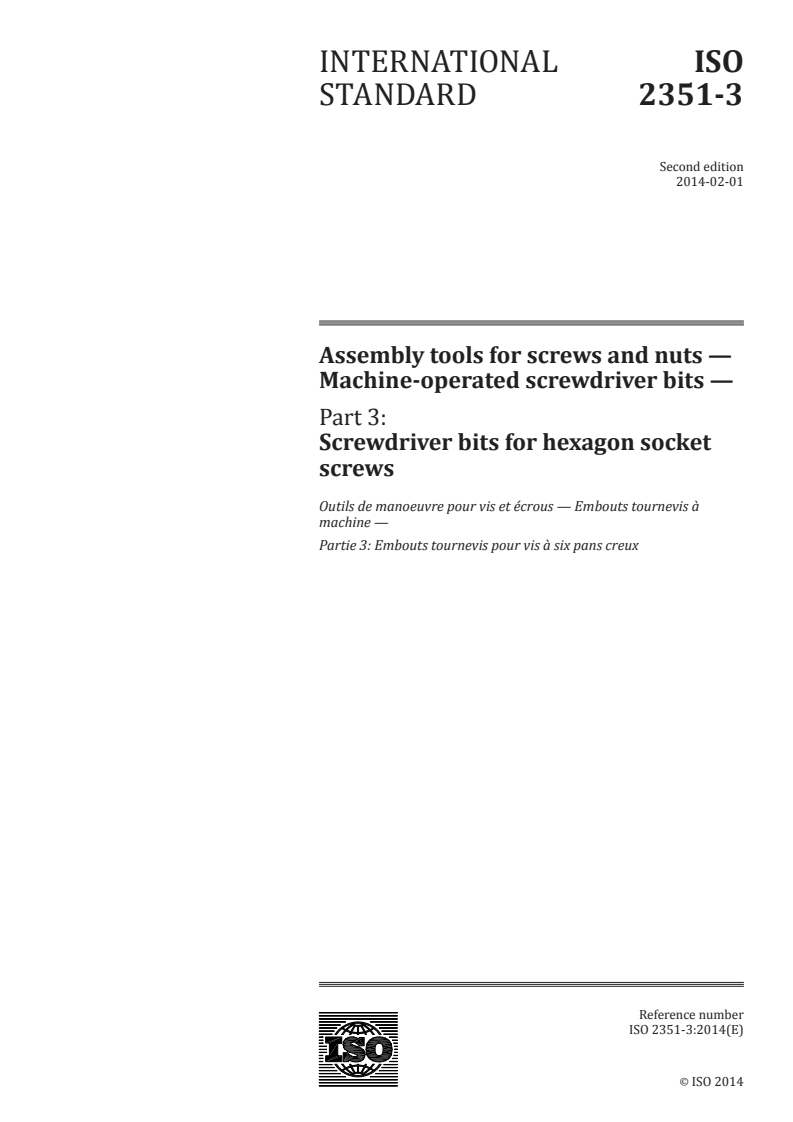
INTERNATIONAL ISO
STANDARD 2351-3
Second edition
2014-02-01
Assembly tools for screws and nuts —
Machine-operated screwdriver bits —
Part 3:
Screwdriver bits for hexagon socket
screws
Outils de manoeuvre pour vis et écrous — Embouts tournevis à
machine —
Partie 3: Embouts tournevis pour vis à six pans creux
Reference number
©
ISO 2014
© ISO 2014
All rights reserved. Unless otherwise specified, no part of this publication may be reproduced or utilized otherwise in any form
or by any means, electronic or mechanical, including photocopying, or posting on the internet or an intranet, without prior
written permission. Permission can be requested from either ISO at the address below or ISO’s member body in the country of
the requester.
ISO copyright office
Case postale 56 • CH-1211 Geneva 20
Tel. + 41 22 749 01 11
Fax + 41 22 749 09 47
E-mail copyright@iso.org
Web www.iso.org
Published in Switzerland
ii © ISO 2014 – All rights reserved
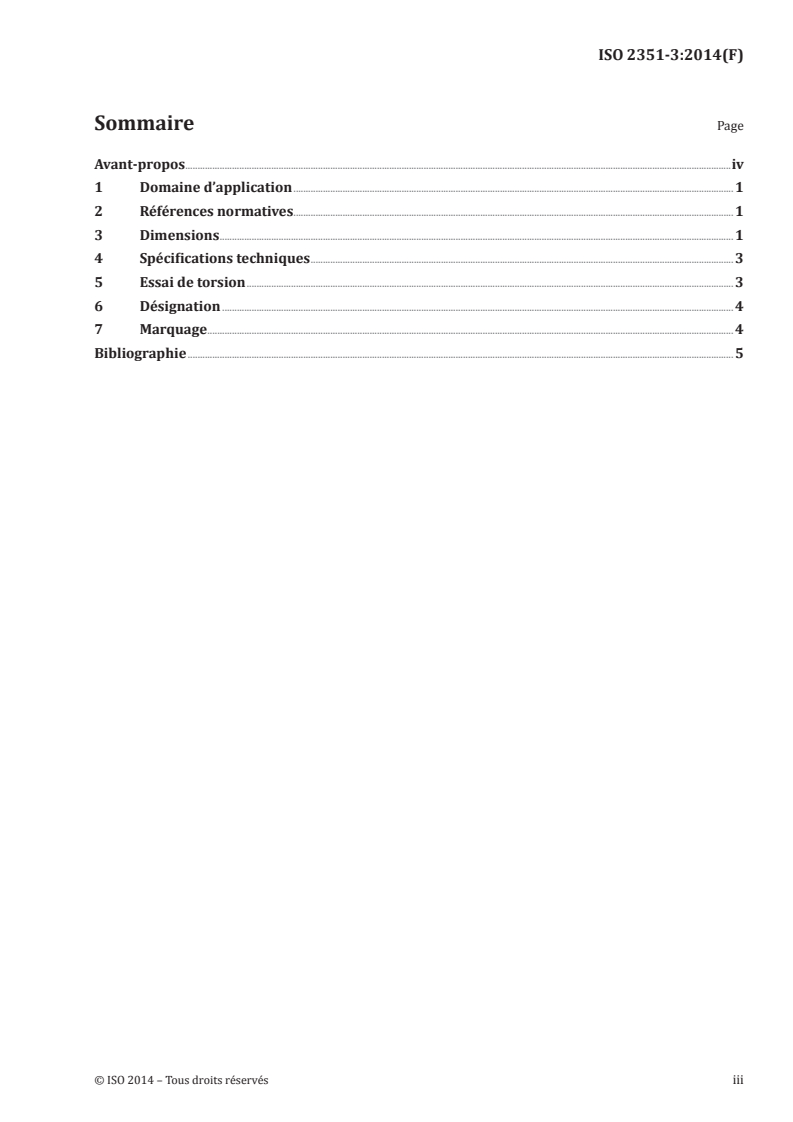
Contents Page
Foreword .iv
1 Scope . 1
2 Normative references . 1
3 Dimensions . 1
4 Technical requirements . 3
5 Torque test . 3
6 Designation . 4
7 Marking . 4
Bibliography . 5
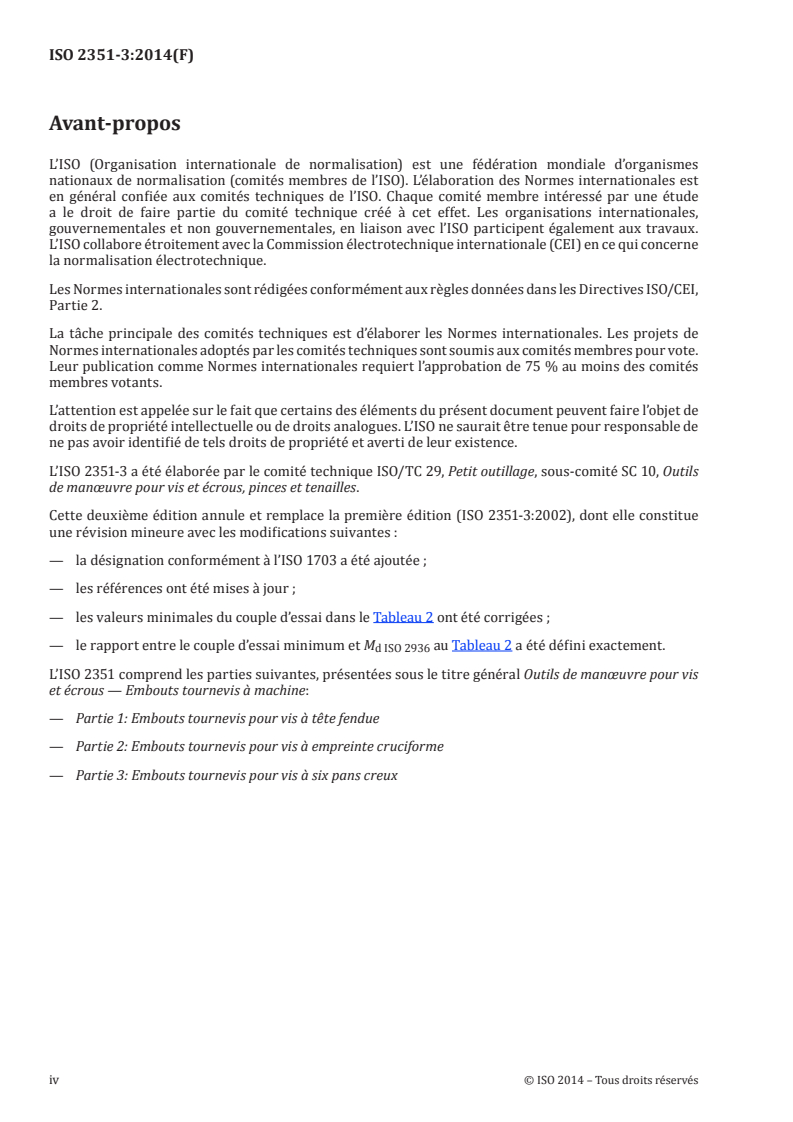
Foreword
ISO (the International Organization for Standardization) is a worldwide federation of national standards
bodies (ISO member bodies). The work of preparing International Standards is normally carried out
through ISO technical committees. Each member body interested in a subject for which a technical
committee has been established has the right to be represented on that committee. International
organizations, governmental and non-governmental, in liaison with ISO, also take part in the work.
ISO collaborates closely with the International Electrotechnical Commission (IEC) on all matters of
electrotechnical standardization.
The procedures used to develop this document and those intended for its further maintenance are
described in the ISO/IEC Directives, Part 1. In particular the different approval criteria needed for the
different types of ISO documents should be noted. This document was drafted in accordance with the
editorial rules of the ISO/IEC Directives, Part 2 (see www.iso.org/directives).
Attention is drawn to the possibility that some of the elements of this document may be the subject of
patent rights. ISO shall not be held responsible for identifying any or all such patent rights. Details of
any patent rights identified during the development of the document will be in the Introduction and/or
on the ISO list of patent declarations received (see www.iso.org/patents).
Any trade name used in this document is information given for the convenience of users and does not
constitute an endorsement.
For an explanation on the meaning of ISO specific terms and expressions related to conformity
assessment, as well as information about ISO’s adherence to the WTO principles in the Technical Barriers
to Trade (TBT) see the following URL: Foreword - Supplementary information
The committee responsible for this document is ISO/TC 29, Small tools, Subcommittee SC 10, Assembly
tools for screws and nuts, pliers and nippers.
This second edition cancels and replaces the first edition (ISO 2351-3:2002), of which it constitutes a
minor r
...
INTERNATIONAL ISO
STANDARD 2351-3
Second edition
2014-02-01
Assembly tools for screws and nuts —
Machine-operated screwdriver bits —
Part 3:
Screwdriver bits for hexagon socket
screws
Outils de manoeuvre pour vis et écrous — Embouts tournevis à
machine —
Partie 3: Embouts tournevis pour vis à six pans creux
Reference number
©
ISO 2014
© ISO 2014
All rights reserved. Unless otherwise specified, no part of this publication may be reproduced or utilized otherwise in any form
or by any means, electronic or mechanical, including photocopying, or posting on the internet or an intranet, without prior
written permission. Permission can be requested from either ISO at the address below or ISO’s member body in the country of
the requester.
ISO copyright office
Case postale 56 • CH-1211 Geneva 20
Tel. + 41 22 749 01 11
Fax + 41 22 749 09 47
E-mail copyright@iso.org
Web www.iso.org
Published in Switzerland
ii © ISO 2014 – All rights reserved
Contents Page
Foreword .iv
1 Scope . 1
2 Normative references . 1
3 Dimensions . 1
4 Technical requirements . 3
5 Torque test . 3
6 Designation . 4
7 Marking . 4
Bibliography . 5
Foreword
ISO (the International Organization for Standardization) is a worldwide federation of national standards
bodies (ISO member bodies). The work of preparing International Standards is normally carried out
through ISO technical committees. Each member body interested in a subject for which a technical
committee has been established has the right to be represented on that committee. International
organizations, governmental and non-governmental, in liaison with ISO, also take part in the work.
ISO collaborates closely with the International Electrotechnical Commission (IEC) on all matters of
electrotechnical standardization.
The procedures used to develop this document and those intended for its further maintenance are
described in the ISO/IEC Directives, Part 1. In particular the different approval criteria needed for the
different types of ISO documents should be noted. This document was drafted in accordance with the
editorial rules of the ISO/IEC Directives, Part 2 (see www.iso.org/directives).
Attention is drawn to the possibility that some of the elements of this document may be the subject of
patent rights. ISO shall not be held responsible for identifying any or all such patent rights. Details of
any patent rights identified during the development of the document will be in the Introduction and/or
on the ISO list of patent declarations received (see www.iso.org/patents).
Any trade name used in this document is information given for the convenience of users and does not
constitute an endorsement.
For an explanation on the meaning of ISO specific terms and expressions related to conformity
assessment, as well as information about ISO’s adherence to the WTO principles in the Technical Barriers
to Trade (TBT) see the following URL: Foreword - Supplementary information
The committee responsible for this document is ISO/TC 29, Small tools, Subcommittee SC 10, Assembly
tools for screws and nuts, pliers and nippers.
This second edition cancels and replaces the first edition (ISO 2351-3:2002), of which it constitutes a
minor r
...
NORME ISO
INTERNATIONALE 2351-3
Deuxième édition
2014-02-01
Outils de manoeuvre pour vis et
écrous — Embouts tournevis à
machine —
Partie 3:
Embouts tournevis pour vis à six pans
creux
Assembly tools for screws and nuts — Machine-operated screwdriver
bits —
Part 3: Screwdriver bits for hexagon socket screws
Numéro de référence
©
ISO 2014
DOCUMENT PROTÉGÉ PAR COPYRIGHT
© ISO 2014
Droits de reproduction réservés. Sauf indication contraire, aucune partie de cette publication ne peut être reproduite ni utilisée
sous quelque forme que ce soit et par aucun procédé, électronique ou mécanique, y compris la photocopie, l’affichage sur
l’internet ou sur un Intranet, sans autorisation écrite préalable. Les demandes d’autorisation peuvent être adressées à l’ISO à
l’adresse ci-après ou au comité membre de l’ISO dans le pays du demandeur.
ISO copyright office
Case postale 56 • CH-1211 Geneva 20
Tel. + 41 22 749 01 11
Fax + 41 22 749 09 47
E-mail copyright@iso.org
Web www.iso.org
Publié en Suisse
ii © ISO 2014 – Tous droits réservés
Sommaire Page
Avant-propos .iv
1 Domaine d’application . 1
2 Références normatives . 1
3 Dimensions . 1
4 Spécifications techniques . 3
5 Essai de torsion . 3
6 Désignation . 4
7 Marquage . 4
Bibliographie . 5
Avant-propos
L’ISO (Organisation internationale de normalisation) est une fédération mondiale d’organismes
nationaux de normalisation (comités membres de l’ISO). L’élaboration des Normes internationales est
en général confiée aux comités techniques de l’ISO. Chaque comité membre intéressé par une étude
a le droit de faire partie du comité technique créé à cet effet. Les organisations internationales,
gouvernementales et non gouvernementales, en liaison avec l’ISO participent également aux travaux.
L’ISO collabore étroitement avec la Commission électrotechnique internationale (CEI) en ce qui concerne
la normalisation électrotechnique.
Les Normes internationales sont rédigées conformément aux règles données dans les Directives ISO/CEI,
Partie 2.
La tâche principale des comités techniques est d’élaborer les Normes internationales. Les projets de
Normes internationales adoptés par les comités techniques sont soumis aux comités membres pour vote.
Leur publication comme Normes internationales requiert l’approbation de 75 % au moins des comités
membres votants.
L’attention est appelée sur le fait que certains des éléments du présent document peuvent faire l’objet de
droits de propriété intellectuelle ou de droits analogues. L’ISO ne saurait être tenue pour responsable de
ne pas avoir identifié de tels droits de propriété et averti de leur existence.
L’ISO 2351-3 a été élaborée par le comité technique ISO/TC 29, Petit outillage, sous-comité SC 10, Outils
de manœuvre pour vis et écrous, pinces et tenailles.
Cette deuxième édition annule et remplace la première édition (ISO 2351-3:2002), dont elle constitue
une révision mineure avec les modifications suivantes :
— la désignation conformément à l’ISO 1703 a été ajoutée ;
— les références ont été mises à jour ;
— les valeurs minimales du couple d’essai dans le Tableau 2 ont été corrigées ;
— le rapport entre le couple d’essai minimum et M au Tableau 2 a été défini exactement.
d ISO 2936
L’ISO 2351 comprend les parties suivantes, présentées sous le titre général Outils de manœuvre pour vis
et écrous — Embouts tournevis à
...
NORME ISO
INTERNATIONALE 2351-3
Deuxième édition
2014-02-01
Outils de manoeuvre pour vis et
écrous — Embouts tournevis à
machine —
Partie 3:
Embouts tournevis pour vis à six pans
creux
Assembly tools for screws and nuts — Machine-operated screwdriver
bits —
Part 3: Screwdriver bits for hexagon socket screws
Numéro de référence
©
ISO 2014
DOCUMENT PROTÉGÉ PAR COPYRIGHT
© ISO 2014
Droits de reproduction réservés. Sauf indication contraire, aucune partie de cette publication ne peut être reproduite ni utilisée
sous quelque forme que ce soit et par aucun procédé, électronique ou mécanique, y compris la photocopie, l’affichage sur
l’internet ou sur un Intranet, sans autorisation écrite préalable. Les demandes d’autorisation peuvent être adressées à l’ISO à
l’adresse ci-après ou au comité membre de l’ISO dans le pays du demandeur.
ISO copyright office
Case postale 56 • CH-1211 Geneva 20
Tel. + 41 22 749 01 11
Fax + 41 22 749 09 47
E-mail copyright@iso.org
Web www.iso.org
Publié en Suisse
ii © ISO 2014 – Tous droits réservés
Sommaire Page
Avant-propos .iv
1 Domaine d’application . 1
2 Références normatives . 1
3 Dimensions . 1
4 Spécifications techniques . 3
5 Essai de torsion . 3
6 Désignation . 4
7 Marquage . 4
Bibliographie . 5
Avant-propos
L’ISO (Organisation internationale de normalisation) est une fédération mondiale d’organismes
nationaux de normalisation (comités membres de l’ISO). L’élaboration des Normes internationales est
en général confiée aux comités techniques de l’ISO. Chaque comité membre intéressé par une étude
a le droit de faire partie du comité technique créé à cet effet. Les organisations internationales,
gouvernementales et non gouvernementales, en liaison avec l’ISO participent également aux travaux.
L’ISO collabore étroitement avec la Commission électrotechnique internationale (CEI) en ce qui concerne
la normalisation électrotechnique.
Les Normes internationales sont rédigées conformément aux règles données dans les Directives ISO/CEI,
Partie 2.
La tâche principale des comités techniques est d’élaborer les Normes internationales. Les projets de
Normes internationales adoptés par les comités techniques sont soumis aux comités membres pour vote.
Leur publication comme Normes internationales requiert l’approbation de 75 % au moins des comités
membres votants.
L’attention est appelée sur le fait que certains des éléments du présent document peuvent faire l’objet de
droits de propriété intellectuelle ou de droits analogues. L’ISO ne saurait être tenue pour responsable de
ne pas avoir identifié de tels droits de propriété et averti de leur existence.
L’ISO 2351-3 a été élaborée par le comité technique ISO/TC 29, Petit outillage, sous-comité SC 10, Outils
de manœuvre pour vis et écrous, pinces et tenailles.
Cette deuxième édition annule et remplace la première édition (ISO 2351-3:2002), dont elle constitue
une révision mineure avec les modifications suivantes :
— la désignation conformément à l’ISO 1703 a été ajoutée ;
— les références ont été mises à jour ;
— les valeurs minimales du couple d’essai dans le Tableau 2 ont été corrigées ;
— le rapport entre le couple d’essai minimum et M au Tableau 2 a été défini exactement.
d ISO 2936
L’ISO 2351 comprend les parties suivantes, présentées sous le titre général Outils de manœuvre pour vis
et écrous — Embouts tournevis à
...