

ISO/TS 17969:2017
(Main)Petroleum, petrochemical and natural gas industries — Guidelines on competency management for well operations personnel
General Information
- Abstract
The purpose of ISO/TS 17969:2017 is to help members of the oil and gas industry develop, implement, maintain and improve their own competency management systems (CMS) for well operations personnel. ISO/TS 17969:2017 supports competency management general principles which can be applied to any operation within the industry. The annexes to ISO/TS 17969:2017 list example competence profiles for personnel responsible for well integrity. Annex A includes an example worksheet which can be used in performing a competency assessment, to help record the assessment results versus expectation, as well as the resulting action plan to address any gaps identified. ISO/TS 17969:2017 is applicable to all operators, service companies and drilling contractors working on wells and well operations.
- Status
- Published
- Publication Date
- 08-Nov-2017
- Current Stage
- 9093 - International Standard confirmed
- Start Date
- 27-Oct-2023
- Completion Date
- 29-Aug-2026
Buy Documents

ISO/TS 17969:2017 - Petroleum, petrochemical and natural gas industries -- Guidelines on competency management for well operations personnel
REDLINE ISO/TS 17969:2017 - Petroleum, petrochemical and natural gas industries — Guidelines on competency management for well operations personnel Released:11/9/2017

ISO/TS 17969:2017 - Petroleum, petrochemical and natural gas industries — Guidelines on competency management for well operations personnel/9/2017
ISO/TS 17969:2017 - Overview
ISO/TS 17969:2017 provides practical guidelines for developing, implementing, maintaining and improving a competency management system (CMS) for well operations personnel in the petroleum, petrochemical and natural gas industries. Applicable to operators, service companies and drilling contractors, the technical specification supports a risk-based, auditable approach to assure competence for safety‑critical tasks and overall well integrity. The document includes example competency profiles and an example competency assessment worksheet (Annex A) to record assessment results and action plans.
Key topics and requirements
- CMS lifecycle: Follows a Plan-Do-Check-Act cycle with five phases (establish requirements, design, implement, maintain/develop competence, verify/audit/review).
- Competency models: Defines a competency catalogue, competency profiles, and proficiency levels to match skills, knowledge and behaviours to role risk.
- Competency assessment: Emphasizes objective, evidence-based assessment using rubrics, independent assessors, and documented appraisal of gaps and development actions.
- Safety-critical focus: Identifies safety-critical competencies and tasks that, if performed incorrectly, can lead to major accidents - ensuring these are subject to stricter assessment and control.
- Team and leadership competence: Covers collective team competence and leadership skills required for effective well operations.
- Contractor management: Provides guidance for assessing and managing competency of non‑staff/contract personnel.
- Documentation and auditability: Recommends a controlled CMS document, system ownership, defined responsibilities, time-bound proficiency validations and storage of competency records for verification.
Practical applications
- Implementing a CMS to reduce operational risk, demonstrate regulatory compliance and provide an audit trail for training and assessment.
- Creating role-based competency profiles (e.g., drilling supervisor, well examiner) using the example annexes to accelerate local implementation.
- Conducting competency assessments using the Annex A worksheet and rubrics to identify gaps and produce targeted development plans.
- Using a risk-based approach to prioritize resources for safety‑critical roles and tasks, improving training ROI and readiness for complex well operations.
Who should use this standard
- Oil & gas operators, drilling contractors, service companies, HSE and competency managers, training organizations, and auditors involved in well integrity and well operations.
Related guidance
- Prepared by ISO/TC 67 (Materials, equipment and offshore structures for petroleum, petrochemical and natural gas industries). For related petroleum industry standards and further references, consult the ISO Online Browsing Platform.
Relations
- Effective Date
- 12-Feb-2026
- Effective Date
- 06-Jun-2022
- Effective Date
- 05-Nov-2015
Buy Documents
ISO/TS 17969:2017 - Petroleum, petrochemical and natural gas industries -- Guidelines on competency management for well operations personnel
REDLINE ISO/TS 17969:2017 - Petroleum, petrochemical and natural gas industries — Guidelines on competency management for well operations personnel Released:11/9/2017
ISO/TS 17969:2017 - Petroleum, petrochemical and natural gas industries — Guidelines on competency management for well operations personnel/9/2017
Get Certified
Connect with accredited certification bodies for this standard

BSI Group
BSI (British Standards Institution) is the business standards company that helps organizations make excellence a habit.

Bureau Veritas
Bureau Veritas is a world leader in laboratory testing, inspection and certification services.

DNV
DNV is an independent assurance and risk management provider.
Sponsored listings
Frequently Asked Questions
ISO/TS 17969:2017 is a technical specification published by the International Organization for Standardization (ISO). Its full title is "Petroleum, petrochemical and natural gas industries — Guidelines on competency management for well operations personnel". This standard covers: The purpose of ISO/TS 17969:2017 is to help members of the oil and gas industry develop, implement, maintain and improve their own competency management systems (CMS) for well operations personnel. ISO/TS 17969:2017 supports competency management general principles which can be applied to any operation within the industry. The annexes to ISO/TS 17969:2017 list example competence profiles for personnel responsible for well integrity. Annex A includes an example worksheet which can be used in performing a competency assessment, to help record the assessment results versus expectation, as well as the resulting action plan to address any gaps identified. ISO/TS 17969:2017 is applicable to all operators, service companies and drilling contractors working on wells and well operations.
The purpose of ISO/TS 17969:2017 is to help members of the oil and gas industry develop, implement, maintain and improve their own competency management systems (CMS) for well operations personnel. ISO/TS 17969:2017 supports competency management general principles which can be applied to any operation within the industry. The annexes to ISO/TS 17969:2017 list example competence profiles for personnel responsible for well integrity. Annex A includes an example worksheet which can be used in performing a competency assessment, to help record the assessment results versus expectation, as well as the resulting action plan to address any gaps identified. ISO/TS 17969:2017 is applicable to all operators, service companies and drilling contractors working on wells and well operations.
ISO/TS 17969:2017 is classified under the following ICS (International Classification for Standards) categories: 03.100.30 - Management of human resources. The ICS classification helps identify the subject area and facilitates finding related standards.
ISO/TS 17969:2017 has the following relationships with other standards: It is inter standard links to CEN ISO/TS 17969:2017, ISO 27588:2012, ISO/TS 17969:2015. Understanding these relationships helps ensure you are using the most current and applicable version of the standard.
ISO/TS 17969:2017 is available in PDF format for immediate download after purchase. The document can be added to your cart and obtained through the secure checkout process. Digital delivery ensures instant access to the complete standard document.
Standards Content (Sample)
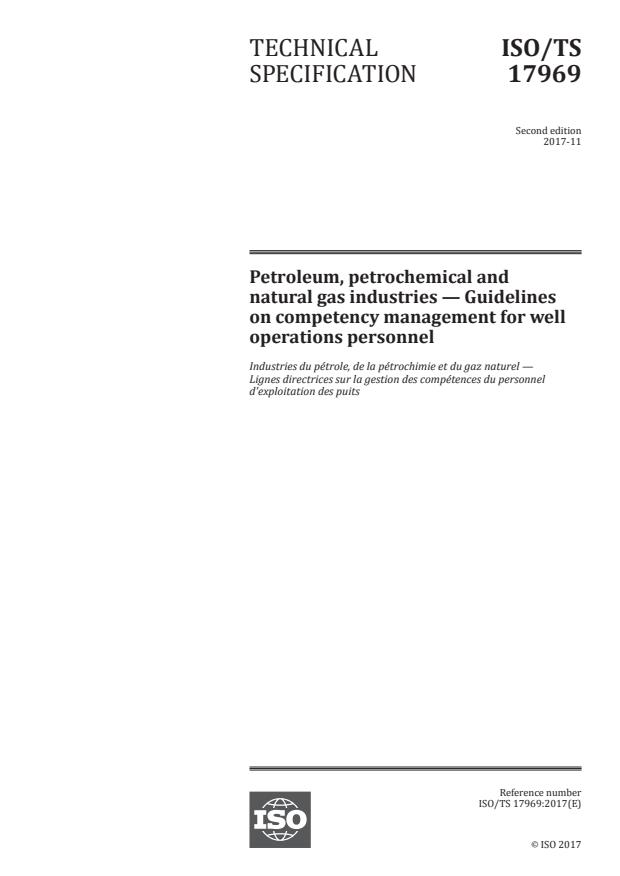
TECHNICAL ISO/TS
SPECIFICATION 17969
Second edition
2017-11
Petroleum, petrochemical and
natural gas industries — Guidelines
on competency management for well
operations personnel
Industries du pétrole, de la pétrochimie et du gaz naturel —
Lignes directrices sur la gestion des compétences du personnel
d'exploitation des puits
Reference number
©
ISO 2017
© ISO 2017, Published in Switzerland
All rights reserved. Unless otherwise specified, no part of this publication may be reproduced or utilized otherwise in any form
or by any means, electronic or mechanical, including photocopying, or posting on the internet or an intranet, without prior
written permission. Permission can be requested from either ISO at the address below or ISO’s member body in the country of
the requester.
ISO copyright office
Ch. de Blandonnet 8 • CP 401
CH-1214 Vernier, Geneva, Switzerland
Tel. +41 22 749 01 11
Fax +41 22 749 09 47
copyright@iso.org
www.iso.org
ii © ISO 2017 – All rights reserved
Contents Page
Foreword .iv
1 Scope . 1
2 Normative references . 1
3 Terms and definitions . 1
4 Competency management system . 3
4.1 General . 3
4.2 Benefits of a CMS . 3
4.3 Comparison of a CMS with an appraisal system . 3
4.4 Development of a CMS . 4
4.4.1 CMS cycle . 4
4.4.2 Phase 1 — Establish requirements for the CMS . 5
4.4.3 Phase 2 — Design the CMS . 6
4.4.4 Phase 3 — Implement the CMS . 7
4.4.5 Phase 4 — Maintain and develop competence . 8
4.4.6 Phase 5 — Verify, audit and review the CMS .10
5 Application of CMS requirements to well operations personnel .11
5.1 General .11
5.2 Recommended risk-based approach for well operations .12
5.3 Competency model .13
5.3.1 Well competency catalogue .13
5.3.2 Proficiency levels .15
5.3.3 Competency profile.16
5.4 Team competence .16
5.5 Leadership skills .16
5.6 Contract personnel .17
5.7 Roadmap to ensure competency .17
6 Examples of competency profiles .19
Annex A (informative) Example competency assessment information .20
Annex B (informative) Example of competency profile for drilling supervisor .24
Annex C (informative) Example of competency profile for senior drilling engineer .25
Annex D (informative) Example of competency profile for well examiner .26
Annex E (informative) Example of competency profile for operations geologist .27
Bibliography .28
Foreword
ISO (the International Organization for Standardization) is a worldwide federation of national standards
bodies (ISO member bodies). The work of preparing International Standards is normally carried out
through ISO technical committees. Each member body interested in a subject for which a technical
committee has been established has the right to be represented on that committee. International
organizations, governmental and non-governmental, in liaison with ISO, also take part in the work.
ISO collaborates closely with the International Electrotechnical Commission (IEC) on all matters of
electrotechnical standardization.
The procedures used to develop this document and those intended for its further maintenance are
described in the ISO/IEC Directives, Part 1. In particular the different approval criteria needed for the
different types of ISO documents should be noted. This document was drafted in accordance with the
editorial rules of the ISO/IEC Directives, Part 2 (see www.iso.org/directives).
Attention is drawn to the possibility that some of the elements of this document may be the subject of
patent rights. ISO shall not be held responsible for identifying any or all such patent rights. Details of
any patent rights identified during the development of the document will be in the Introduction and/or
on the ISO list of patent declarations received (see www.iso.org/patents).
Any trade name used in this document is information given for the convenience of users and does not
constitute an endorsement.
For an explanation on the voluntary nature of standards, the meaning of ISO specific terms and
expressions related to conformity assessment, as well as information about ISO's adherence to the
World Trade Organization (WTO) principles in the Technical Barriers to Trade (TBT) see the following
URL: www.iso.org/iso/foreword.html
This document was prepared by ISO/TC 67, Materials, equipment and offshore structures for petroleum,
petrochemical and natural gas industries.
This second edition cancels and replaces the first edition (ISO/TS 17969:2015), which has been revised
to incorporate the agreed changes that were mistakenly not taken into account in the publication of the
first edition.
iv © ISO 2017 – All rights reserved
TECHNICAL SPECIFICATION ISO/TS 17969:2017(E)
Petroleum, petrochemical and natural gas industries —
Guidelines on competency management for well
operations personnel
1 Scope
The purpose of this document is to help members of the oil and gas industry develop, implement,
maintain and improve their own competency management systems (CMS) for well operations
personnel. This document supports competency management general principles which can be applied
to any operation within the industry.
The annexes to this document list example competence profiles for personnel responsible for well
integrity. Annex A includes an example worksheet which can be used in performing a competency
assessment, to help record the assessment results versus expectation, as well as the resulting action
plan to address any gaps identified.
This document is applicable to all operators, service companies and drilling contractors working on
wells and well operations.
2 Normative references
There are no normative references in this document.
3 Terms and definitions
For the purposes of this document, the following terms and definitions apply.
ISO and IEC maintain terminological databases for use in standardization at the following addresses:
— ISO Online browsing platform: available at https://www.iso.org/obp
— IEC Electropedia: available at http://www.electropedia.org/
3.1
competence
ability to undertake responsibilities and to perform activities to a recognised standard on a regular,
repeatable basis
Note 1 to entry: Competence is a combination of knowledge, practical and thinking skills, and a person’s
behaviour.
Note 2 to entry: Standards may be company specific.
EXAMPLE 1 McCoy’s Law: competency = knowledge × skills × behaviours.
EXAMPLE 2 Bloom’s taxonomy: competency = knowledge × skills × (technical + ability).
3.2
competence assessment
process of judging evidence of an individual’s performance against agreed competence requirements
Note 1 to entry: The result of such an assessment, potentially in combination with other factors such as work
experience, will determine whether that individual has demonstrated competence and to which proficiency level.
3.3
competency catalogue
hierarchical structured list of the competencies required to perform any task
3.4
competency profile
skills and behaviour, each specified at a level of proficiency, required to perform the role or activity in
line with the associated risk
3.5
contractor
non-staff member
3.6
independent assessor
approved assessor that utilizes specified objective evidence of competency to assess an individual’s skills
Note 1 to entry: The independent assessor shall be an approved individual competent in assessing one’s skills
based on predetermined and specified objective evidence of competence. This includes, but is not limited to,
assessment and debrief techniques as well as competence in the skills being assessed.
Note 2 to entry: The independent assessor may not be the line manager or the direct supervisor of the individual.
Note 3 to entry: The independent assessor may or may not be from within the same company.
Note 4 to entry: Independence needs to be demonstrated to ensure that a balanced and fair assessment of a
person’s competency in the subject is completed.
Note 5 to entry: If no one at wellsite can fulfil the role of independent assessor, it is recognized that there may
be challenges to have extra personnel at wellsite. Therefore, companies needs to leverage modern technology,
simulation, remote monitoring, etc. in order to perform independent assessments.
3.7
major accident
significant emission, fire or explosion resulting from uncontrolled events
3.8
proficiency level
level of ability and behaviour attributes within a specific skill
3.9
rubric
set of assessment criteria used to describe and evaluate the important components of a task
Note 1 to entry: A rubric is an effective assessment tool, because it allows different assessors to arrive at similar
conclusions when comparing performance to the guidelines shown on the rubric.
3.10
safety-critical competency
type of competence required of personnel in order to carry out an operation which, if carried out
incorrectly or inadvertently, can lead to a major accident hazard
3.11
safety-critical task
task performed on a safety-critical element which, if performed incorrectly due to lack of technical
skills or knowledge or due to behaviour attributes, can lead to a major accident hazard
2 © ISO 2017 – All rights reserved
4 Competency management system
4.1 General
The purpose of a competency management system (CMS) is to control, in a logical and integrated
manner, a cycle of activities within the organization that systematically and consistently promotes the
development, assurance and maintenance of competent operations personnel, particularly in safety
critical activities. The CMS will enable personnel to be assessed and further developed, contributing
to the goal of competent performance at work. A CMS should be user-friendly, workable, auditable and
practical.
If an organization has no CMS, the recommended first step is to garner support from the very top of the
organization. The system should then be constructed, involving resources from multiple levels of the
organization, to create a sense of ownership.
This document contains a number of examples of competency profiles which can be useful for an
organization if it has to create profiles for its own staff.
4.2 Benefits of a CMS
An effective, appropriate CMS provides the following benefits:
— assists with compliance with regulatory requirements;
— provides a continuous performance improvement tool for the work force;
— provides a more comprehensive picture of the requirements for a job than a job description alone;
— provides an accurate development analysis, enabling targeted and effective development
opportunities;
— provides a measure to calculate the success of training and development interventions;
— provides a framework for ongoing coaching and feedback;
— provides the measurement of proficiency in a specific competency;
— provides a measure of an individual's readiness for a role;
— helps in optimizing training resources and efforts targeting critical skills/competence requirements;
— provides an audit trail of competency assurance.
4.3 Comparison of a CMS with an appraisal system
Performance appraisals generally fall short of the rigour of a competency framework, and therefore are
typically not sufficient in isolation to provide a true measure of competence. However, in more recent
times many organizations have tried to move to a more competency-based appraisal system in order to
provide a more specific measure of performance.
Some key differences between performance appraisals and competence assessment are summarized in
Table 1.
Table 1 — Comparison of performance appraisal and competence assessment
Performance appraisal Competency assessment
Carried out by the line manager or supervisor Carried out by a competent independent assessor
Subjective measure often based on opinion Objective measure based on evidence
Measured against high level work areas often focusing
Measured against defined standards of competence
on soft skills
A measure of attitude and general performance A measure of skills, knowledge and behaviour
Quality of judgements rarely verified Quality of judgements routinely verified
4.4 Development of a CMS
4.4.1 CMS cycle
The main steps or phases by which a CMS can be established, implemented and maintained follow
the traditional quality cycle of ‘Plan-Do-Check-Act’. These are illustrated in Figure 1 and described in
subsequent clauses.
Figure 1 — Competency management system cycle
Establishing a CMS ‘from scratch’ involves starting with Phase 1. However many organizations
can already have some, if not all, elements already in place and so can commence at Phase 5 with a
review/audit of the CMS, incorporating this guidance as reference.
4 © ISO 2017 – All rights reserved
For application to operational activities and personnel, the following key elements of an effective CMS
have been identified within each relevant phase. Within this document, reference is made to specific
guidance in these areas:
a) definition of appropriate competency profiles, skills at specified proficiency levels required for
operational activities;
b) assessment of personnel and their individual competences;
c) assessment of operational teams and their collective competence;
d) assessment of contract personnel;
e) recommendations for management of assessed shortfalls, gaps in competency, and subsequent
development;
f) recommendation for a system for the storage, management and verification of the collected
information in a CMS.
4.4.2 Phase 1 — Establish requirements for the CMS
4.4.2.1 General
Best practice for CMS dictates that the system is tailored to manage the competencies involved with the
organization’s particular work activities, in proportion to the assessed risks. Nevertheless, it is possible
to identify common considerations for a successful CMS.
These best practices are as follows.
a) Description of the CMS in a ‘stand-alone’ controlled document, which forms a part of an
organization’s management system. Through the inclusion in the management system, the intent is
that the CMS is periodically verified through standard processes.
b) A clearly identified system ‘owner’, also with responsibility for the overall management system if
possible, ensures the CMS is maintained.
c) Clear identification of individual accountabilities for implementation and maintenance of the CMS
helps ensure that the system is effective.
d) Time-bound (expiration of) competence proficiency levels ensure that an individual’s competency
is current.
4.4.2.2 Responsibilities
Identification of suitable competence is the responsibility of management. The employer should
ensure that the employee is competent for the tasks which the employer assigns. For this reason, an
organization should ensure that its CMS is integrated into the management system as well as their
operational methods throughout all levels. Personnel have the responsibility to develop, maintain and
demonstrate the required competency for the role they perform.
Employers are required to provide information, instruction and training for their employees and
contractors. This includes defining the format and content of competence profiles and standards to be
met by employees and contractors, in order to competently perform their roles. The employer should
ensure the competence of their personnel, as a part of the CMS, to ensure that the person can perform
their work.
Employers are responsible for keeping records of training, certification, work experience and assessment
of their employees. Personnel shall also take responsibility for developing and demonstrating their
competence.
One critical area of management support is to ensure that personnel are given sufficient time to
fulfil the requirements of the CMS. This means there is no expectation for personnel to complete the
competence development and assessment tasks during their time off. Sufficient time should be allowed
for within their workload.
In accordance with the assessed risk of a task or skill, a period of validity of a specific competence
should be specified by the CMS. Thus, the organization is responsible to clearly document the criteria
for retention/re-validation, in line with the risk associated with the skill.
4.4.2.3 Key success factors
The most successful CMSs exist where competence is at the core of an organization's operating culture,
and the system is a part of the integrated management system. It is important that senior management
endorse and drive the CMS with the usage of the CMS supported and encouraged throughout all
management levels and departments.
One key to success is to clearly distinguish the population and activities covered by the CMS, for
example safety-critical tasks only.
The development of a competence policy, or the inclusion of a commitment to competence assurance
in other high level policies, can also provide a solid backbone for the system. The CMS works best if
tailored to the organization, ensuring adherence to the operating culture as well as the risk and safety
measurement for the tasks being carried out by personnel assessed under the system.
A clear line of sight from policy to the practice of competence management throughout operations is
of the utmost importance to the success of the system. Ownership of the CMS is critical, especially for
those carrying out key tasks within the CMS, such as assessment and verification. Equally important to
success is that the population covered by the CMS embraces and understands the value of the system.
The demonstration of competence should not detract from the task at hand, and should not become a
job in its own right.
4.4.2.4 Risk-based approach
A CMS should address critical competencies commensurate with operational risk, consequence and
complexity. Operators, service companies and rig contractors, including employers, self-employed
persons and installation owners/operators, should assess the risks of their operations and identify
critical tasks and risks. These risk analyses should underpin the eventual CMS, ensuring that at a
minimum safety-critical tasks, those related to asset integrity through the asset life cycle, are covered
by the system.
For organizations operating across a variety of asset types and environments, the CMS should take into
account the full scope and range of the activities when requirements are established. For organizations
operating within a more limited range of asset types and environments, it can be beneficial to define
requirements that are ‘fit-for-purpose’ for specific work programs.
Some roles included in the CMS also carry business, HSE and relationship risks, and the inclusion of
associated competencies can be considered. However, care should be taken to ensure that the CMS
does not become complex and cumbersome; trying to encompass all potential variables will result in a
system burdensome to operate, quickly becoming obsolete.
4.4.3 Phase 2 — Design the CMS
When designing the CMS, an organization should identify their particular activities, the processes
to enable these activities, according to the risk assigned by the organization, and the activities to be
included in the CMS, which is documented in a controlled management system.
Key stakeholders should be involved in the CMS design. Once completed, the CMS and its fundamental
objectives should be clearly communicated across the organization.
6 © ISO 2017 – All rights reserved
A key decision is the extent to which the CMS is to be integrated within any existing human resources
(HR) processes for recruitment, performance appraisals, training and development, etc. Depending on
the nature of a particular organization’s HR and management system, it can be appropriate to establish
a CMS that is managed separately from the HR process, but which makes reference to beneficial and
contributory elements of those systems.
The overall training and development requirements should be described within the CMS.
Critical elements of the CMS design, specifically related to operations, which should be clearly addressed
in this design phase include the following.
a) An identified overall process ‘owner’ for the CMS, to whom comments, observations and requests
for change can be addressed.
b) Assignment of accountabilities for implementing the CMS. This should include specific
accountabilities for the technical authorities, as defined in the organization’s management system
and for line management.
c) The process and responsibilities by which appropriate competency standards for activities are
defined and maintained in the organization. This should be assigned to the technical authorities, as
defined by the organization’s management system.
d) The process and responsibilities for assessment of personnel and their individual competencies.
e) The process and responsibilities for assessment of each operational team and their collective
competence. The CMS should be designed to provide line managers with assurance that the
collective competence of all assigned teams is appropriate to the specific planned activities and
their associated risks.
f) The process and responsibilities for the managing and developing of means to address assessed
shortfalls in competency, for both individuals and teams.
g) The process and responsibilities for the competence management of contractors should be
specifically set out within the CMS.
h) Data protection issues.
The CMS can identify levels of competency (proficiency levels), such that individuals can undertake
the tasks with varying levels of supervision. Individuals can then gain the additional experience,
assessment and training as required by the CMS in order to progress their proficiency level. Individuals
may be mentored by more competent individuals. Recent organization recruits or contractors might be
assigned provisional levels of competency. This status would allow for supervision and/or mentoring,
for a defined probationary period, after which their competency can be reviewed.
4.4.4 Phase 3 — Implement the CMS
A CMS implementation program should be defined and agreed by all parties responsible for its effective
implementation. When developing the implementation schedule, the organization should review the
following factors:
a) the coverage of (and resulting requirement to merge or integrate with) any existing CMS;
b) the operations program;
c) any required synchronization with other management systems;
d) formal management of change (MOC) process for implementation.
Review of these factors can require a staged approach for implementation. In any case, the
implementation program should define milestones and measures, to ensure that the status can
be clearly communicated and understood by all concerned. There is a specific need to elevate the
importance of communication and understanding by all when rolling out a CMS. There is also a need to
develop and execute a well-designed MOC process to explain and gain support.
Once implemented, both employees and contractors should be assessed as soon as practical, per the
risk level involved with each role.
If gaps are identified in an assessment, ensure that there is sufficient provision for competency
development and/or training for individuals.
4.4.5 Phase 4 — Maintain and develop competence
4.4.5.1 General
Maintaining and developing competency are key objectives of a CMS. Competency is verified through
the auditable competency record and validation appropriate to the risk level associated with the skill.
Responsibility should be assigned within the CMS to individuals and their supervisors respectively for
the continual maintenance and monitoring of compe
...
Style Definition: bib_comment
ISO/TC 67 N
Style Definition: bib_deg
Date: 2017‐11
Style Definition: bib_suffix
Style Definition: bib_unpubl
Style Definition: cite_box
ISO/TC 67/WG 2 Style Definition: bib_medline
Deleted: 2016‐12‐09
Secretariat: NEN
Deleted: DTS
Deleted: 2016
Petroleum, petrochemical and natural gas industries — Guidelines on
Deleted: 
competency management for well operations personnelError! AutoText
Warning
entry not defined.
This document is not an ISO
International Standard. It is
distributed for review and
comment. It is subject to change
without notice and may not be
referred to as an International
Standard.
Recipients of this draft are
invited to submit, with their
comments, notification of any
relevant patent rights of which
they are aware and to provide
supporting documentation.
Document type: Technical Specification
Document subtype:
Document stage: (30) Committee
Document language: E
D:\temp\macroserver\DOC2PDFRGB\DOC2PDFRGB.BAZZUCCHI@VBAZZUCCHI_118\C069919e_track
changes.doc STD Version 2.8f
ISO/DTS 17969:2017(E)
Deleted: Copyright notice
This ISO document is a working draft or
committee draft and is copyright‐
protected by ISO. While the reproduction
of working drafts or committee drafts in
any form for use by participants in the ISO
standards development process is
permitted without prior permission from
ISO, neither this document nor any extract
from it may be reproduced, stored or
transmitted in any form for any other
purpose without prior written permission
from ISO.
Requests for permission to reproduce this
document for the purpose of selling it
should be addressed as shown below or to
ISO's member body in the country of the
requester:
[Indicate the full address, telephone
number, fax number, telex number, and
electronic mail address, as appropriate, of
the Copyright Manager of the ISO member
body responsible for the secretariat of the
TC or SC within the framework of which
the working document has been
prepared.]
Reproduction for sales purposes may be
subject to royalty payments or a licensing
agreement.
Violators may be prosecuted.
© ISO 2017 – All rights reserved
ii
ISO/DTS 17969:2017(E)
Contents Page
Foreword . 4
1 Scope . 1
2 Normative references . 1
3 Terms and definitions . 1
4 Competency management system . 3
4.1 General . 3
4.2 Benefits of a CMS . 3
4.3 Comparison of a CMS with an appraisal system . 4
4.4 Development of a CMS . 4
4.4.1 CMS cycle . 4
4.4.2 Phase 1 — Establish requirements for the CMS . 6
4.4.3 Phase 2 — Design the CMS . 7
4.4.4 Phase 3 — Implement the CMS . 8
4.4.5 Phase 4 — Maintain and develop competence . 9
4.4.6 Phase 5 — Verify, audit and review the CMS . 11
5 Application of CMS requirements to well operations personnel . 12
5.1 General . 12
5.2 Recommended risk-based approach for well operations . 13
5.3 Competency model . 14
5.3.1 Well competency catalogue . 14
5.3.2 Proficiency levels . 15
5.3.3 Competency profile . 17
5.4 Team competence . 17
5.5 Leadership skills . 18
5.6 Contract personnel . 18
5.7 Roadmap to ensure competency . 18
6 Examples of competency profiles . 20
Annex A (informative) Example competency assessment information . 21
Annex B (informative) Example of competency profile for drilling supervisor . 25
Annex C (informative) Example of competency profile for senior drilling engineer . 26
Annex D (informative) Example of competency profile for well examiner . 27
Annex E (informative) Example of competency profile for operations geologist . 28
Bibliography . 29
© ISO 2017 – All rights reserved
iii
ISO/DTS 17969:2017(E)
Foreword
ISO (the International Organization for Standardization) is a worldwide federation of national
standards bodies (ISO member bodies). The work of preparing International Standards is normally
carried out through ISO technical committees. Each member body interested in a subject for which a
technical committee has been established has the right to be represented on that committee.
International organizations, governmental and non‐governmental, in liaison with ISO, also take part in
the work. ISO collaborates closely with the International Electrotechnical Commission (IEC) on all
matters of electrotechnical standardization.
The procedures used to develop this document and those intended for its further maintenance are
described in the ISO/IEC Directives, Part 1. In particular the different approval criteria needed for the
different types of ISO documents should be noted. This document was drafted in accordance with the
editorial rules of the ISO/IEC Directives, Part 2 (see www.iso.org/directives).
Attention is drawn to the possibility that some of the elements of this document may be the subject of
patent rights. ISO shall not be held responsible for identifying any or all such patent rights. Details of
any patent rights identified during the development of the document will be in the Introduction and/or
on the ISO list of patent declarations received (see www.iso.org/patents).
Any trade name used in this document is information given for the convenience of users and does not
constitute an endorsement.
For an explanation on the voluntary nature of standards, the meaning of ISO specific terms and
expressions related to conformity assessment, as well as information about ISO's adherence to the Formatted: Not Highlight
World Trade Organization (WTO) principles in the Technical Barriers to Trade (TBT) see the following
Formatted: Not Highlight
URL: www.iso.org/iso/foreword.html
This document was prepared by ISO/TC 67, Materials, equipment and offshore structures for petroleum, Deleted:
petrochemical and natural gas industries.
This second edition cancels and replaces the first edition (ISO/TS 17969:2015), which has been revised
to incorporate the agreed changes that were mistakenly not taken into account in the publication of the
first edition.
© ISO 2017 – All rights reserved
iv
TECHNICAL SPECIFICATION ISO/DTS 17969:2017(E)
Petroleum, petrochemical and natural gas industries —
Guidelines on competency management for well operations
personnel
1 Scope
The purpose of this document is to help members of the oil and gas industry develop, implement,
maintain and improve their own competency management systems (CMS) for well operations
personnel. This document supports competency management general principles which can be applied
to any operation within the industry.
The annexes to this document list example competence profiles for personnel responsible for well
integrity. Annex A includes an example worksheet which can be used in performing a competency
assessment, to help record the assessment results versus expectation, as well as the resulting action Formatted: Not Highlight
plan to address any gaps identified.
Formatted: Not Highlight
This document is applicable to all operators, service companies and drilling contractors working on
wells and well operations.
2 Normative references
There are no normative references in this document.
3 Terms and definitions
For the purposes of this document, the following terms and definitions apply.
ISO and IEC maintain terminological databases for use in standardization at the following addresses:
— ISO Online browsing platform: available at https://www.iso.org/obp
Field Code Changed
Deleted: http
— IEC Electropedia: available at http://www.electropedia.org/
Formatted: English (U.K.)
Formatted: Default Paragraph
3.1
Font, Underline, Font color: Blue,
competence
English (U.K.)
ability to undertake responsibilities and to perform activities to a recognised standard on a regular,
Formatted: Default Paragraph
repeatable basis
Font, English (U.K.)
Note 1 to entry: Competence is a combination of knowledge, practical and thinking skills, and a person’s
behaviour.
Note 2 to entry: Standards may be company specific.
Formatted: Not Highlight
EXAMPLE 1 McCoy’s Law: competency = knowledge × skills × behaviours.
Formatted: Not Highlight
EXAMPLE 2 Bloom’s taxonomy: competency = knowledge × skills × (technical + ability).
3.2
© ISO 2017 – All rights reserved
ISO/DTS 17969:2017(E)
competence assessment
process of judging evidence of an individual’s performance against agreed competence requirements
Note 1 to entry: The result of such an assessment, potentially in combination with other factors such as work
Formatted: Not Highlight
experience, will determine whether that individual has demonstrated competence and to which proficiency level.
3.3
competency catalogue
hierarchical structured list of the competencies required to perform any task
3.4
competency profile
skills and behaviour, each specified at a level of proficiency, required to perform the role or activity in
line with the associated risk
3.5
contractor
non‐staff member
3.6
independent assessor
approved assessor that utilizes specified objective evidence of competency to assess an individual’s
skills
Note 1 to entry: The independent assessor shall be an approved individual competent in assessing one’s skills
Formatted: Not Highlight
based on predetermined and specified objective evidence of competence. This includes, but is not limited to,
Formatted: Not Highlight
assessment and debrief techniques as well as competence in the skills being assessed.
Formatted: Not Highlight
Note 2 to entry: The independent assessor may not be the line manager or the direct supervisor of the
Formatted: Not Highlight
individual.
Formatted: Not Highlight
Note 3 to entry: The independent assessor may or may not be from within the same company.
Formatted: Not Highlight
Formatted: Not Highlight
Note 4 to entry: Independence needs to be demonstrated to ensure that a balanced and fair assessment of a
Formatted: Not Highlight
person’s competency in the subject is completed.
Note 5 to entry: If no one at wellsite can fulfil the role of independent assessor, it is recognized that there may
Formatted: Not Highlight
be challenges to have extra personnel at wellsite. Therefore, companies needs to leverage modern technology,
simulation, remote monitoring, etc. in order to perform independent assessments.
Formatted: Not Highlight
Formatted: Not Highlight
3.7
Formatted: Not Highlight
major accident
significant emission, fire or explosion resulting from uncontrolled events
3.8
proficiency level
level of ability and behaviour attributes within a specific skill
3.9
rubric
set of assessment criteria used to describe and evaluate the important components of a task
Note 1 to entry: A rubric is an effective assessment tool, because it allows different assessors to arrive at similar
Formatted: Not Highlight
conclusions when comparing performance to the guidelines shown on the rubric.
© ISO 2017 – All rights reserved
ISO/DTS 17969:2017(E)
3.10
safety-critical competency
type of competence required of personnel in order to carry out an operation which, if carried out
incorrectly or inadvertently, can lead to a major accident hazard
3.11
safety-critical task
task performed on a safety‐critical element which, if performed incorrectly due to lack of technical skills
or knowledge or due to behaviour attributes, can lead to a major accident hazard
Formatted: Not Highlight
4 Competency management system
4.1 General
The purpose of a competency management system (CMS) is to control, in a logical and integrated
Formatted: Not Highlight
manner, a cycle of activities within the organization that systematically and consistently promotes the
development, assurance and maintenance of competent operations personnel, particularly in safety
critical activities. The CMS will enable personnel to be assessed and further developed, contributing to Formatted: Not Highlight
the goal of competent performance at work. A CMS should be user‐friendly, workable, auditable and
practical.
If an organization has no CMS, the recommended first step is to garner support from the very top of the
organization. The system should then be constructed, involving resources from multiple levels of the
organization, to create a sense of ownership.
This document contains a number of examples of competency profiles which can be useful for an
organization if it has to create profiles for its own staff. Formatted: Not Highlight
4.2 Benefits of a CMS
An effective, appropriate CMS provides the following benefits:
— assists with compliance with regulatory requirements; Formatted: Not Highlight
Formatted: Not Highlight
— provides a continuous performance improvement tool for the work force;
— provides a more comprehensive picture of the requirements for a job than a job description alone;
— provides an accurate development analysis, enabling targeted and effective development
opportunities;
— provides a measure to calculate the success of training and development interventions;
— provides a framework for ongoing coaching and feedback;
— provides the measurement of proficiency in a specific competency;
— provides a measure of an individual's readiness for a role;
— helps in optimizing training resources and efforts targeting critical skills/competence
requirements;
— provides an audit trail of competency assurance.
© ISO 2017 – All rights reserved
ISO/DTS 17969:2017(E)
4.3 Comparison of a CMS with an appraisal system
Performance appraisals generally fall short of the rigour of a competency framework, and therefore are
typically not sufficient in isolation to provide a true measure of competence. However, in more recent
times many organizations have tried to move to a more competency‐based appraisal system in order to
provide a more specific measure of performance.
Some key differences between performance appraisals and competence assessment are summarized in Formatted: Not Highlight
Table 1.
Table 1 — Comparison of performance appraisal and competence assessment
Formatted: Not Highlight
Formatted: Not Highlight
Performance appraisal Competency assessment
Formatted: Centered
Carried out by the line manager or supervisor Carried out by a competent independent assessor
Subjective measure often based on opinion Objective measure based on evidence
Measured against high level work areas often focusing
Measured against defined standards of competence
on soft skills
A measure of attitude and general performance A measure of skills, knowledge and behaviour
Quality of judgements rarely verified Quality of judgements routinely verified
4.4 Development of a CMS
4.4.1 CMS cycle
The main steps or phases by which a CMS can be established, implemented and maintained follow the
traditional quality cycle of ‘Plan‐Do‐Check‐Act’. These are illustrated in Figure 1 and described in
subsequent clauses.
© ISO 2017 – All rights reserved
ISO/DTS 17969:2017(E)
Deleted: 17969_ed2fig1.eps
Formatted: Not Highlight
Figure 1 — Competency management system cycle
Establishing a CMS ‘from scratch’ involves starting with Phase 1. However many organizations can
already have some, if not all, elements already in place and so can commence at Phase 5 with a
review/audit of the CMS, incorporating this guidance as reference. Formatted: Not Highlight
For application to operational activities and personnel, the following key elements of an effective CMS
have been identified within each relevant phase. Within this document, reference is made to specific
guidance in these areas:
a) definition of appropriate competency profiles, skills at specified proficiency levels required for
operational activities;
b) assessment of personnel and their individual competences;
Formatted: Not Highlight
c) assessment of operational teams and their collective competence; Formatted: Not Highlight
d) assessment of contract personnel; Formatted: Not Highlight
e) recommendations for management of assessed shortfalls, gaps in competency, and subsequent Formatted: Not Highlight
development;
f) recommendation for a system for the storage, management and verification of the collected Formatted: Not Highlight
information in a CMS.
© ISO 2017 – All rights reserved
ISO/DTS 17969:2017(E)
4.4.2 Phase 1 — Establish requirements for the CMS
4.4.2.1 General
Best practice for CMS dictates that the system is tailored to manage the competencies involved with the
organization’s particular work activities, in proportion to the assessed risks. Nevertheless, it is possible
Formatted: Not Highlight
to identify common considerations for a successful CMS.
These best practices are as follows.
a) Description of the CMS in a ‘stand‐alone’ controlled document, which forms a part of an
organization’s management system. Through the inclusion in the management system, the intent is Formatted: Not Highlight
that the CMS is periodically verified through standard processes.
Formatted: Not Highlight
b) A clearly identified system ‘owner’, also with responsibility for the overall management system if Formatted: Not Highlight
possible, ensures the CMS is maintained.
c) Clear identification of individual accountabilities for implementation and maintenance of the CMS
helps ensure that the system is effective.
d) Time‐bound (expiration of) competence proficiency levels ensure that an individual’s competency
is current.
4.4.2.2 Responsibilities
Identification of suitable competence is the responsibility of management. The employer should ensure
that the employee is competent for the tasks which the employer assigns. For this reason, an
organization should ensure that its CMS is integrated into the management system as well as their Formatted: Not Highlight
operational methods throughout all levels. Personnel have the responsibility to develop, maintain and
demonstrate the required competency for the role they perform.
Employers are required to provide information, instruction and training for their employees and
contractors. This includes defining the format and content of competence profiles and standards to be
met by employees and contractors, in order to competently perform their roles. The employer should
ensure the competence of their personnel, as a part of the CMS, to ensure that the person can perform
their work.
Employers are responsible for keeping records of training, certification, work experience and Formatted: Not Highlight
assessment of their employees. Personnel shall also take responsibility for developing and
Formatted: Not Highlight
demonstrating their competence.
One critical area of management support is to ensure that personnel are given sufficient time to fulfil
the requirements of the CMS. This means there is no expectation for personnel to complete the
competence development and assessment tasks during their time off. Sufficient time should be allowed Formatted: Not Highlight
for within their workload.
In accordance with the assessed risk of a task or skill, a period of validity of a specific competence Formatted: Not Highlight
should be specified by the CMS. Thus, the organization is responsible to clearly document the criteria
for retention/re‐validation, in line with the risk associated with the skill.
4.4.2.3 Key success factors
The most successful CMSs exist where competence is at the core of an organization's operating culture,
and the system is a part of the integrated management system. It is important that senior management
Formatted: Not Highlight
© ISO 2017 – All rights reserved
ISO/DTS 17969:2017(E)
endorse and drive the CMS with the usage of the CMS supported and encouraged throughout all
management levels and departments.
One key to success is to clearly distinguish the population and activities covered by the CMS, for
example safety‐critical tasks only.
The development of a competence policy, or the inclusion of a commitment to competence assurance in Formatted: Not Highlight
other high level policies, can also provide a solid backbone for the system. The CMS works best if
tailored to the organization, ensuring adherence to the operating culture as well as the risk and safety
measurement for the tasks being carried out by personnel assessed under the system. Formatted: Not Highlight
A clear line of sight from policy to the practice of competence management throughout operations is of
Formatted: Not Highlight
the utmost importance to the success of the system. Ownership of the CMS is critical, especially for
those carrying out key tasks within the CMS, such as assessment and verification. Equally important to Formatted: Not Highlight
success is that the population covered by the CMS embraces and understands the value of the system.
Formatted: Not Highlight
The demonstration of competence should not detract from the task at hand, and should not become a
job in its own right.
4.4.2.4 Risk-based approach
A CMS should address critical competencies commensurate with operational risk, consequence and
complexity. Operators, service companies and rig contractors, including employers, self‐employed
persons and installation owners/operators, should assess the risks of their operations and identify Formatted: Not Highlight
critical tasks and risks. These risk analyses should underpin the eventual CMS, ensuring that at a
minimum safety‐critical tasks, those related to asset integrity through the asset life cycle, are covered
by the system.
For organizations operating across a variety of asset types and environments, the CMS should take into
account the full scope and range of the activities when requirements are established. For organizations
operating within a more limited range of asset types and environments, it can be beneficial to define
requirements that are ‘fit‐for‐purpose’ for specific work programs.
Some roles included in the CMS also carry business, HSE and relationship risks, and the inclusion of
associated competencies can be considered. However, care should be taken to ensure that the CMS does
not become complex and cumbersome; trying to encompass all potential variables will result in a
system burdensome to operate, quickly becoming obsolete.
4.4.3 Phase 2 — Design the CMS
When designing the CMS, an organization should identify their particular activities, the processes to
enable these activities, according to the risk assigned by the organization, and the activities to be
included in the CMS, which is documented in a controlled management system. Formatted: Not Highlight
Key stakeholders should be involved in the CMS design. Once completed, the CMS and its fundamental
objectives should be clearly communicated across the organization. Formatted: Not Highlight
A key decision is the extent to which the CMS is to be integrated within any existing human resources
(HR) processes for recruitment, performance appraisals, training and development, etc. Depending on Formatted: Not Highlight
the nature of a particular organization’s HR and management system, it can be appropriate to establish
Formatted: Not Highlight
a CMS that is managed separately from the HR process, but which makes reference to beneficial and
contributory elements of those systems.
The overall training and development requirements should be described within the CMS.
© ISO 2017 – All rights reserved
ISO/DTS 17969:2017(E)
Critical elements of the CMS design, specifically related to operations, which should be clearly
addressed in this design phase include the following.
a) An identified overall process ‘owner’ for the CMS, to whom comments, observations and requests
for change can be addressed.
b) Assignment of accountabilities for implementing the CMS. This should include specific
accountabilities for the technical authorities, as defined in the organization’s management system Formatted: Not Highlight
and for line management.
c) The process and responsibilities by which appropriate competency standards for activities are
defined and maintained in the organization. This should be assigned to the technical authorities, as
defined by the organization’s management system. Formatted: Not Highlight
d) The process and responsibilities for assessment of personnel and their individual competencies. Formatted: Not Highlight
e) The process and responsibilities for assessment of each operational team and their collective
Formatted: Not Highlight
competence. The CMS should be designed to provide line managers with assurance that the
collective competence of all assigned teams is appropriate to the specific planned activities and
their associated risks.
f) The process and responsibilities for the managing and developing of means to address assessed Formatted: Not Highlight
shortfalls in competency, for both individuals and teams.
g) The process and responsibilities for the competence management of contractors should be
specifically set out within the CMS.
h) Data protection issues.
The CMS can identify levels of competency (proficiency levels), such that individuals can undertake the
tasks with varying levels of supervision. Individuals can then gain the additional experience,
assessment and training as required by the CMS in order to progress their proficiency level. Individuals
Formatted: Not Highlight
may be mentored by more competent individuals. Recent organization recruits or contractors might be
assigned provisional levels of competency. This status would allow for supervision and/or mentoring,
for a defined probationary period, after which their competency can be reviewed.
4.4.4 Phase 3 — Implement the CMS
A CMS implementation program should be defined and agreed by all parties responsible for its effective
implementation. When developing the implementation schedule, the organization should review the Formatted: Not Highlight
following factors:
a) the coverage of (and resulting requirement to merge or integrate with) any existing CMS;
b) the operations program;
c) any required synchronization with other management systems;
d) formal management of change (MOC) process for implementation.
Review of these factors can require a staged approach for implementation. In any case, the
Formatted: Not Highlight
implementation program should define milestones and measures, to ensure that the status can be
clearly communicated and understood by all concerned. There is a specific need to elevate the
© ISO 2017 – All rights reserved
ISO/DTS 17969:2017(E)
importance of communication and understanding by all when rolling out a CMS. There is also a need to
develop and execute a well‐designed MOC process to explain and gain support.
Once implemented, both employees and contractors should be assessed as soon as practical, per the
Formatted: Not Highlight
risk level involved with each role.
If gaps are identified in an assessment, ensure that there is sufficient provision for competency Formatted: Not Highlight
development and/or training for individuals.
4.4.5 Phase 4 — Maintain and develop competence
4.4.5.1 General
Maintaining and developing competency are key objectives of a CMS. Competency is verified through Formatted: Not Highlight
the auditable competency record and validation appropriate to the risk level associated with the skill.
Responsibility should be assigned within the CMS to individuals and their supervisors respectively for
the continual maintenance and monitoring of competency. Formatted: Not Highlight
The CMS should define minimum periods for the conducting of formal competence assessments. Each Formatted: Not Highlight
particular competence should be risk assessed against the knowledge, skills and behaviour associated
Formatted: Not Highlight
with that particular level of proficiency. Formal and auditable records shall be maintained of all
assessments. Formatted: Not Highlight
4.4.5.2 Competency record
The organization should keep auditable competency records, which comprise:
a) degrees and other educational records;
b) training records and certificates; Formatted: Not Highlight
c) present
...
TECHNICAL ISO/TS
SPECIFICATION 17969
Second edition
2017-11
Petroleum, petrochemical and
natural gas industries — Guidelines
on competency management for well
operations personnel
Industries du pétrole, de la pétrochimie et du gaz naturel —
Lignes directrices sur la gestion des compétences du personnel
d'exploitation des puits
Reference number
©
ISO 2017
© ISO 2017, Published in Switzerland
All rights reserved. Unless otherwise specified, no part of this publication may be reproduced or utilized otherwise in any form
or by any means, electronic or mechanical, including photocopying, or posting on the internet or an intranet, without prior
written permission. Permission can be requested from either ISO at the address below or ISO’s member body in the country of
the requester.
ISO copyright office
Ch. de Blandonnet 8 • CP 401
CH-1214 Vernier, Geneva, Switzerland
Tel. +41 22 749 01 11
Fax +41 22 749 09 47
copyright@iso.org
www.iso.org
ii © ISO 2017 – All rights reserved
Contents Page
Foreword .iv
1 Scope . 1
2 Normative references . 1
3 Terms and definitions . 1
4 Competency management system . 3
4.1 General . 3
4.2 Benefits of a CMS . 3
4.3 Comparison of a CMS with an appraisal system . 3
4.4 Development of a CMS . 4
4.4.1 CMS cycle . 4
4.4.2 Phase 1 — Establish requirements for the CMS . 5
4.4.3 Phase 2 — Design the CMS . 6
4.4.4 Phase 3 — Implement the CMS . 7
4.4.5 Phase 4 — Maintain and develop competence . 8
4.4.6 Phase 5 — Verify, audit and review the CMS .10
5 Application of CMS requirements to well operations personnel .11
5.1 General .11
5.2 Recommended risk-based approach for well operations .12
5.3 Competency model .13
5.3.1 Well competency catalogue .13
5.3.2 Proficiency levels .15
5.3.3 Competency profile.16
5.4 Team competence .16
5.5 Leadership skills .16
5.6 Contract personnel .17
5.7 Roadmap to ensure competency .17
6 Examples of competency profiles .19
Annex A (informative) Example competency assessment information .20
Annex B (informative) Example of competency profile for drilling supervisor .24
Annex C (informative) Example of competency profile for senior drilling engineer .25
Annex D (informative) Example of competency profile for well examiner .26
Annex E (informative) Example of competency profile for operations geologist .27
Bibliography .28
Foreword
ISO (the International Organization for Standardization) is a worldwide federation of national standards
bodies (ISO member bodies). The work of preparing International Standards is normally carried out
through ISO technical committees. Each member body interested in a subject for which a technical
committee has been established has the right to be represented on that committee. International
organizations, governmental and non-governmental, in liaison with ISO, also take part in the work.
ISO collaborates closely with the International Electrotechnical Commission (IEC) on all matters of
electrotechnical standardization.
The procedures used to develop this document and those intended for its further maintenance are
described in the ISO/IEC Directives, Part 1. In particular the different approval criteria needed for the
different types of ISO documents should be noted. This document was drafted in accordance with the
editorial rules of the ISO/IEC Directives, Part 2 (see www.iso.org/directives).
Attention is drawn to the possibility that some of the elements of this document may be the subject of
patent rights. ISO shall not be held responsible for identifying any or all such patent rights. Details of
any patent rights identified during the development of the document will be in the Introduction and/or
on the ISO list of patent declarations received (see www.iso.org/patents).
Any trade name used in this document is information given for the convenience of users and does not
constitute an endorsement.
For an explanation on the voluntary nature of standards, the meaning of ISO specific terms and
expressions related to conformity assessment, as well as information about ISO's adherence to the
World Trade Organization (WTO) principles in the Technical Barriers to Trade (TBT) see the following
URL: www.iso.org/iso/foreword.html
This document was prepared by ISO/TC 67, Materials, equipment and offshore structures for petroleum,
petrochemical and natural gas industries.
This second edition cancels and replaces the first edition (ISO/TS 17969:2015), which has been revised
to incorporate the agreed changes that were mistakenly not taken into account in the publication of the
first edition.
iv © ISO 2017 – All rights reserved
TECHNICAL SPECIFICATION ISO/TS 17969:2017(E)
Petroleum, petrochemical and natural gas industries —
Guidelines on competency management for well
operations personnel
1 Scope
The purpose of this document is to help members of the oil and gas industry develop, implement,
maintain and improve their own competency management systems (CMS) for well operations
personnel. This document supports competency management general principles which can be applied
to any operation within the industry.
The annexes to this document list example competence profiles for personnel responsible for well
integrity. Annex A includes an example worksheet which can be used in performing a competency
assessment, to help record the assessment results versus expectation, as well as the resulting action
plan to address any gaps identified.
This document is applicable to all operators, service companies and drilling contractors working on
wells and well operations.
2 Normative references
There are no normative references in this document.
3 Terms and definitions
For the purposes of this document, the following terms and definitions apply.
ISO and IEC maintain terminological databases for use in standardization at the following addresses:
— ISO Online browsing platform: available at https://www.iso.org/obp
— IEC Electropedia: available at http://www.electropedia.org/
3.1
competence
ability to undertake responsibilities and to perform activities to a recognised standard on a regular,
repeatable basis
Note 1 to entry: Competence is a combination of knowledge, practical and thinking skills, and a person’s
behaviour.
Note 2 to entry: Standards may be company specific.
EXAMPLE 1 McCoy’s Law: competency = knowledge × skills × behaviours.
EXAMPLE 2 Bloom’s taxonomy: competency = knowledge × skills × (technical + ability).
3.2
competence assessment
process of judging evidence of an individual’s performance against agreed competence requirements
Note 1 to entry: The result of such an assessment, potentially in combination with other factors such as work
experience, will determine whether that individual has demonstrated competence and to which proficiency level.
3.3
competency catalogue
hierarchical structured list of the competencies required to perform any task
3.4
competency profile
skills and behaviour, each specified at a level of proficiency, required to perform the role or activity in
line with the associated risk
3.5
contractor
non-staff member
3.6
independent assessor
approved assessor that utilizes specified objective evidence of competency to assess an individual’s skills
Note 1 to entry: The independent assessor shall be an approved individual competent in assessing one’s skills
based on predetermined and specified objective evidence of competence. This includes, but is not limited to,
assessment and debrief techniques as well as competence in the skills being assessed.
Note 2 to entry: The independent assessor may not be the line manager or the direct supervisor of the individual.
Note 3 to entry: The independent assessor may or may not be from within the same company.
Note 4 to entry: Independence needs to be demonstrated to ensure that a balanced and fair assessment of a
person’s competency in the subject is completed.
Note 5 to entry: If no one at wellsite can fulfil the role of independent assessor, it is recognized that there may
be challenges to have extra personnel at wellsite. Therefore, companies needs to leverage modern technology,
simulation, remote monitoring, etc. in order to perform independent assessments.
3.7
major accident
significant emission, fire or explosion resulting from uncontrolled events
3.8
proficiency level
level of ability and behaviour attributes within a specific skill
3.9
rubric
set of assessment criteria used to describe and evaluate the important components of a task
Note 1 to entry: A rubric is an effective assessment tool, because it allows different assessors to arrive at similar
conclusions when comparing performance to the guidelines shown on the rubric.
3.10
safety-critical competency
type of competence required of personnel in order to carry out an operation which, if carried out
incorrectly or inadvertently, can lead to a major accident hazard
3.11
safety-critical task
task performed on a safety-critical element which, if performed incorrectly due to lack of technical
skills or knowledge or due to behaviour attributes, can lead to a major accident hazard
2 © ISO 2017 – All rights reserved
4 Competency management system
4.1 General
The purpose of a competency management system (CMS) is to control, in a logical and integrated
manner, a cycle of activities within the organization that systematically and consistently promotes the
development, assurance and maintenance of competent operations personnel, particularly in safety
critical activities. The CMS will enable personnel to be assessed and further developed, contributing
to the goal of competent performance at work. A CMS should be user-friendly, workable, auditable and
practical.
If an organization has no CMS, the recommended first step is to garner support from the very top of the
organization. The system should then be constructed, involving resources from multiple levels of the
organization, to create a sense of ownership.
This document contains a number of examples of competency profiles which can be useful for an
organization if it has to create profiles for its own staff.
4.2 Benefits of a CMS
An effective, appropriate CMS provides the following benefits:
— assists with compliance with regulatory requirements;
— provides a continuous performance improvement tool for the work force;
— provides a more comprehensive picture of the requirements for a job than a job description alone;
— provides an accurate development analysis, enabling targeted and effective development
opportunities;
— provides a measure to calculate the success of training and development interventions;
— provides a framework for ongoing coaching and feedback;
— provides the measurement of proficiency in a specific competency;
— provides a measure of an individual's readiness for a role;
— helps in optimizing training resources and efforts targeting critical skills/competence requirements;
— provides an audit trail of competency assurance.
4.3 Comparison of a CMS with an appraisal system
Performance appraisals generally fall short of the rigour of a competency framework, and therefore are
typically not sufficient in isolation to provide a true measure of competence. However, in more recent
times many organizations have tried to move to a more competency-based appraisal system in order to
provide a more specific measure of performance.
Some key differences between performance appraisals and competence assessment are summarized in
Table 1.
Table 1 — Comparison of performance appraisal and competence assessment
Performance appraisal Competency assessment
Carried out by the line manager or supervisor Carried out by a competent independent assessor
Subjective measure often based on opinion Objective measure based on evidence
Measured against high level work areas often focusing
Measured against defined standards of competence
on soft skills
A measure of attitude and general performance A measure of skills, knowledge and behaviour
Quality of judgements rarely verified Quality of judgements routinely verified
4.4 Development of a CMS
4.4.1 CMS cycle
The main steps or phases by which a CMS can be established, implemented and maintained follow
the traditional quality cycle of ‘Plan-Do-Check-Act’. These are illustrated in Figure 1 and described in
subsequent clauses.
Figure 1 — Competency management system cycle
Establishing a CMS ‘from scratch’ involves starting with Phase 1. However many organizations
can already have some, if not all, elements already in place and so can commence at Phase 5 with a
review/audit of the CMS, incorporating this guidance as reference.
4 © ISO 2017 – All rights reserved
For application to operational activities and personnel, the following key elements of an effective CMS
have been identified within each relevant phase. Within this document, reference is made to specific
guidance in these areas:
a) definition of appropriate competency profiles, skills at specified proficiency levels required for
operational activities;
b) assessment of personnel and their individual competences;
c) assessment of operational teams and their collective competence;
d) assessment of contract personnel;
e) recommendations for management of assessed shortfalls, gaps in competency, and subsequent
development;
f) recommendation for a system for the storage, management and verification of the collected
information in a CMS.
4.4.2 Phase 1 — Establish requirements for the CMS
4.4.2.1 General
Best practice for CMS dictates that the system is tailored to manage the competencies involved with the
organization’s particular work activities, in proportion to the assessed risks. Nevertheless, it is possible
to identify common considerations for a successful CMS.
These best practices are as follows.
a) Description of the CMS in a ‘stand-alone’ controlled document, which forms a part of an
organization’s management system. Through the inclusion in the management system, the intent is
that the CMS is periodically verified through standard processes.
b) A clearly identified system ‘owner’, also with responsibility for the overall management system if
possible, ensures the CMS is maintained.
c) Clear identification of individual accountabilities for implementation and maintenance of the CMS
helps ensure that the system is effective.
d) Time-bound (expiration of) competence proficiency levels ensure that an individual’s competency
is current.
4.4.2.2 Responsibilities
Identification of suitable competence is the responsibility of management. The employer should
ensure that the employee is competent for the tasks which the employer assigns. For this reason, an
organization should ensure that its CMS is integrated into the management system as well as their
operational methods throughout all levels. Personnel have the responsibility to develop, maintain and
demonstrate the required competency for the role they perform.
Employers are required to provide information, instruction and training for their employees and
contractors. This includes defining the format and content of competence profiles and standards to be
met by employees and contractors, in order to competently perform their roles. The employer should
ensure the competence of their personnel, as a part of the CMS, to ensure that the person can perform
their work.
Employers are responsible for keeping records of training, certification, work experience and assessment
of their employees. Personnel shall also take responsibility for developing and demonstrating their
competence.
One critical area of management support is to ensure that personnel are given sufficient time to
fulfil the requirements of the CMS. This means there is no expectation for personnel to complete the
competence development and assessment tasks during their time off. Sufficient time should be allowed
for within their workload.
In accordance with the assessed risk of a task or skill, a period of validity of a specific competence
should be specified by the CMS. Thus, the organization is responsible to clearly document the criteria
for retention/re-validation, in line with the risk associated with the skill.
4.4.2.3 Key success factors
The most successful CMSs exist where competence is at the core of an organization's operating culture,
and the system is a part of the integrated management system. It is important that senior management
endorse and drive the CMS with the usage of the CMS supported and encouraged throughout all
management levels and departments.
One key to success is to clearly distinguish the population and activities covered by the CMS, for
example safety-critical tasks only.
The development of a competence policy, or the inclusion of a commitment to competence assurance
in other high level policies, can also provide a solid backbone for the system. The CMS works best if
tailored to the organization, ensuring adherence to the operating culture as well as the risk and safety
measurement for the tasks being carried out by personnel assessed under the system.
A clear line of sight from policy to the practice of competence management throughout operations is
of the utmost importance to the success of the system. Ownership of the CMS is critical, especially for
those carrying out key tasks within the CMS, such as assessment and verification. Equally important to
success is that the population covered by the CMS embraces and understands the value of the system.
The demonstration of competence should not detract from the task at hand, and should not become a
job in its own right.
4.4.2.4 Risk-based approach
A CMS should address critical competencies commensurate with operational risk, consequence and
complexity. Operators, service companies and rig contractors, including employers, self-employed
persons and installation owners/operators, should assess the risks of their operations and identify
critical tasks and risks. These risk analyses should underpin the eventual CMS, ensuring that at a
minimum safety-critical tasks, those related to asset integrity through the asset life cycle, are covered
by the system.
For organizations operating across a variety of asset types and environments, the CMS should take into
account the full scope and range of the activities when requirements are established. For organizations
operating within a more limited range of asset types and environments, it can be beneficial to define
requirements that are ‘fit-for-purpose’ for specific work programs.
Some roles included in the CMS also carry business, HSE and relationship risks, and the inclusion of
associated competencies can be considered. However, care should be taken to ensure that the CMS
does not become complex and cumbersome; trying to encompass all potential variables will result in a
system burdensome to operate, quickly becoming obsolete.
4.4.3 Phase 2 — Design the CMS
When designing the CMS, an organization should identify their particular activities, the processes
to enable these activities, according to the risk assigned by the organization, and the activities to be
included in the CMS, which is documented in a controlled management system.
Key stakeholders should be involved in the CMS design. Once completed, the CMS and its fundamental
objectives should be clearly communicated across the organization.
6 © ISO 2017 – All rights reserved
A key decision is the extent to which the CMS is to be integrated within any existing human resources
(HR) processes for recruitment, performance appraisals, training and development, etc. Depending on
the nature of a particular organization’s HR and management system, it can be appropriate to establish
a CMS that is managed separately from the HR process, but which makes reference to beneficial and
contributory elements of those systems.
The overall training and development requirements should be described within the CMS.
Critical elements of the CMS design, specifically related to operations, which should be clearly addressed
in this design phase include the following.
a) An identified overall process ‘owner’ for the CMS, to whom comments, observations and requests
for change can be addressed.
b) Assignment of accountabilities for implementing the CMS. This should include specific
accountabilities for the technical authorities, as defined in the organization’s management system
and for line management.
c) The process and responsibilities by which appropriate competency standards for activities are
defined and maintained in the organization. This should be assigned to the technical authorities, as
defined by the organization’s management system.
d) The process and responsibilities for assessment of personnel and their individual competencies.
e) The process and responsibilities for assessment of each operational team and their collective
competence. The CMS should be designed to provide line managers with assurance that the
collective competence of all assigned teams is appropriate to the specific planned activities and
their associated risks.
f) The process and responsibilities for the managing and developing of means to address assessed
shortfalls in competency, for both individuals and teams.
g) The process and responsibilities for the competence management of contractors should be
specifically set out within the CMS.
h) Data protection issues.
The CMS can identify levels of competency (proficiency levels), such that individuals can undertake
the tasks with varying levels of supervision. Individuals can then gain the additional experience,
assessment and training as required by the CMS in order to progress their proficiency level. Individuals
may be mentored by more competent individuals. Recent organization recruits or contractors might be
assigned provisional levels of competency. This status would allow for supervision and/or mentoring,
for a defined probationary period, after which their competency can be reviewed.
4.4.4 Phase 3 — Implement the CMS
A CMS implementation program should be defined and agreed by all parties responsible for its effective
implementation. When developing the implementation schedule, the organization should review the
following factors:
a) the coverage of (and resulting requirement to merge or integrate with) any existing CMS;
b) the operations program;
c) any required synchronization with other management systems;
d) formal management of change (MOC) process for implementation.
Review of these factors can require a staged approach for implementation. In any case, the
implementation program should define milestones and measures, to ensure that the status can
be clearly communicated and understood by all concerned. There is a specific need to elevate the
importance of communication and understanding by all when rolling out a CMS. There is also a need to
develop and execute a well-designed MOC process to explain and gain support.
Once implemented, both employees and contractors should be assessed as soon as practical, per the
risk level involved with each role.
If gaps are identified in an assessment, ensure that there is sufficient provision for competency
development and/or training for individuals.
4.4.5 Phase 4 — Maintain and develop competence
4.4.5.1 General
Maintaining and developing competency are key objectives of a CMS. Competency is verified through
the auditable competency record and validation appropriate to the risk level associated with the skill.
Responsibility should be assigned within the CMS to individuals and their supervisors respectively for
the continual maintenance and monitoring of compe
...