

ISO 12926:2012
(Main)Aluminium fluoride for industrial use — Determination of trace elements — Wavelength dispersive X-ray fluorescence spectrometric method using pressed powder tablets
General Information
- Abstract
ISO 12926: 2012 describes an X-ray fluorescence spectrometric (XRF) method for the determination of aluminium fluoride (AlF3) from the content of fluorine and the content of trace elements in the test specimen. The method does not determine the oxygen content. The calibration reference materials are not specified in this method.
- Status
- Published
- Publication Date
- 11-Dec-2012
- Technical Committee
- ISO/TC 226 - Materials for the production of primary aluminium
- Drafting Committee
- ISO/TC 226/WG 4 - Smelter grade fluorides
- Current Stage
- 9092 - International Standard to be revised
- Start Date
- 06-Oct-2023
- Completion Date
- 29-Aug-2026
Overview
ISO 12926:2012 specifies a wavelength-dispersive X‑ray fluorescence (WDXRF) spectrometric method for the determination of aluminium fluoride (AlF3) from fluorine content and for the measurement of trace elements in industrial-grade aluminium fluoride. The method uses pressed powder tablets prepared from milled samples and does not determine oxygen. Calibration reference materials are not specified in the standard - users must obtain suitable calibration materials.
Key topics and technical requirements
- Analytes and concentration ranges: Applicable to industrial AlF3 where concentrations fall within the ranges listed in the standard (examples include AlF3 86.5–95.75 mass %, Na 0.05–0.25 %, Si 0.001–0.14 %, P 0.001–0.02 %, S 0.01–0.6 %, Ca 0.001–0.10 %, Fe 0.005–0.05 %).
- Sample preparation:
- Two accepted approaches: addition of binder and backing method. Either may be used but preparation must match calibration material handling.
- Typical test portion: 10.0 g (users should maintain same test mass as calibration standards).
- Mill to particle size below 63 µm (typical milling times 1–4 min; shorter times increase variability).
- Use of binders (examples listed) to reduce segregation and aid tablet removal.
- Tablet formation:
- Press powdered sample into tablets using a tablet press (example pressures 20–40 ton, typical 25 ton for 20 s with 40 mm diameter).
- Use Mylar film to protect surfaces; inspect tablets for cracks and surface quality.
- Instrumental measurement:
- Use a wavelength-dispersive XRF spectrometer with vacuum path; Kα lines are preferred.
- Correct for spectral overlaps, background and instrumental drift (monitor samples recommended).
- Suggested measurement lines and settings are provided; users must follow instrument manufacturer guidance.
- Quality considerations:
- Calibration reference materials are user‑supplied; accuracy depends on matched calibration and sample mineralogy.
- Note: fluorine determination can be affected by mineralogical variation - unusual samples should be verified by an absolute method.
- Precision, reporting format and calculation procedures are included in the standard.
Practical applications and users
ISO 12926:2012 is intended for:
- Quality control and incoming inspection of industrial aluminium fluoride (AlF3) used in aluminium smelting and cast‑house processes (electrolyte acidity control, TAC).
- Metallurgical and chemical laboratories performing AlF3 trace element analysis using WDXRF.
- Producers and suppliers of AlF3 requiring routine compositional testing and batch verification.
Benefits include reproducible sample prep procedures (pressed powder tablets), guidance on WDXRF measurement, and structured reporting for regulatory and process control needs.
Related standards
- ISO 1619 - Cryolite, natural and artificial - Preparation and storage of test samples (referenced for sample handling).
- Users should consult instrument manufacturer documentation and available certified reference materials for calibration.
Get Certified
Connect with accredited certification bodies for this standard

ECOCERT
Organic and sustainability certification.

Eurofins Food Testing Global
Global leader in food, environment, and pharmaceutical product testing.

Intertek Bangladesh
Intertek certification and testing services in Bangladesh.
Sponsored listings
Frequently Asked Questions
ISO 12926:2012 is a standard published by the International Organization for Standardization (ISO). Its full title is "Aluminium fluoride for industrial use — Determination of trace elements — Wavelength dispersive X-ray fluorescence spectrometric method using pressed powder tablets". This standard covers: ISO 12926: 2012 describes an X-ray fluorescence spectrometric (XRF) method for the determination of aluminium fluoride (AlF3) from the content of fluorine and the content of trace elements in the test specimen. The method does not determine the oxygen content. The calibration reference materials are not specified in this method.
ISO 12926: 2012 describes an X-ray fluorescence spectrometric (XRF) method for the determination of aluminium fluoride (AlF3) from the content of fluorine and the content of trace elements in the test specimen. The method does not determine the oxygen content. The calibration reference materials are not specified in this method.
ISO 12926:2012 is classified under the following ICS (International Classification for Standards) categories: 71.100.10 - Materials for aluminium production. The ICS classification helps identify the subject area and facilitates finding related standards.
ISO 12926:2012 is available in PDF format for immediate download after purchase. The document can be added to your cart and obtained through the secure checkout process. Digital delivery ensures instant access to the complete standard document.
Standards Content (Sample)
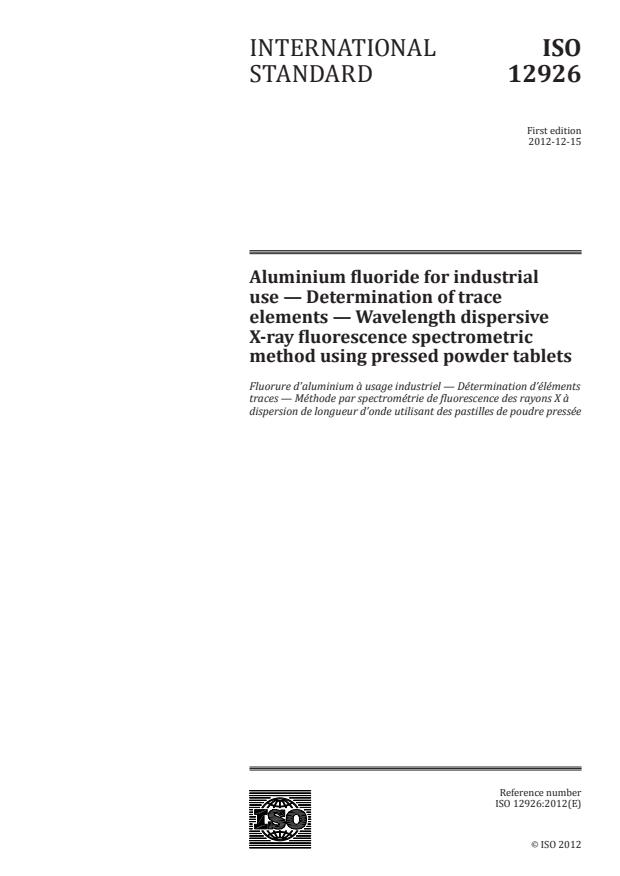
INTERNATIONAL ISO
STANDARD 12926
First edition
2012-12-15
Aluminium fluoride for industrial
use — Determination of trace
elements — Wavelength dispersive
X-ray fluorescence spectrometric
method using pressed powder tablets
Fluorure d’aluminium à usage industriel — Détermination d’éléments
traces — Méthode par spectrométrie de fluorescence des rayons X à
dispersion de longueur d’onde utilisant des pastilles de poudre pressée
Reference number
©
ISO 2012
© ISO 2012
All rights reserved. Unless otherwise specified, no part of this publication may be reproduced or utilized in any form or by any
means, electronic or mechanical, including photocopying and microfilm, without permission in writing from either ISO at the
address below or ISO’s member body in the country of the requester.
ISO copyright office
Case postale 56 • CH-1211 Geneva 20
Tel. + 41 22 749 01 11
Fax + 41 22 749 09 47
E-mail copyright@iso.org
Web www.iso.org
Published in Switzerland
ii © ISO 2012 – All rights reserved
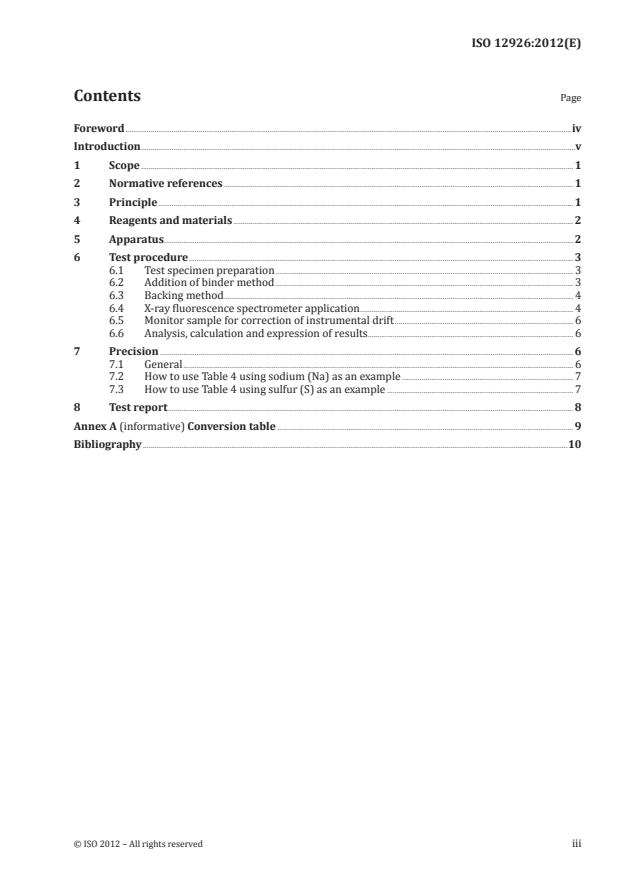
Contents Page
Foreword .iv
Introduction .v
1 Scope . 1
2 Normative references . 1
3 Principle . 1
4 Reagents and materials . 2
5 Apparatus . 2
6 Test procedure . 3
6.1 Test specimen preparation . 3
6.2 Addition of binder method . 3
6.3 Backing method. 4
6.4 X-ray fluorescence spectrometer application . 4
6.5 Monitor sample for correction of instrumental drift . 6
6.6 Analysis, calculation and expression of results . . 6
7 Precision . 6
7.1 General . 6
7.2 How to use Table 4 using sodium (Na) as an example . 7
7.3 How to use Table 4 using sulfur (S) as an example . 7
8 Test report . 8
Annex A (informative) Conversion table . 9
Bibliography .10
Foreword
ISO (the International Organization for Standardization) is a worldwide federation of national standards
bodies (ISO member bodies). The work of preparing International Standards is normally carried out
through ISO technical committees. Each member body interested in a subject for which a technical
committee has been established has the right to be represented on that committee. International
organizations, governmental and non-governmental, in liaison with ISO, also take part in the work.
ISO collaborates closely with the International Electrotechnical Commission (IEC) on all matters of
electrotechnical standardization.
International Standards are drafted in accordance with the rules given in the ISO/IEC Directives, Part 2.
The main task of technical committees is to prepare International Standards. Draft International
Standards adopted by the technical committees are circulated to the member bodies for voting.
Publication as an International Standard requires approval by at least 75 % of the member bodies
casting a vote.
Attention is drawn to the possibility that some of the elements of this document may be the subject of
patent rights. ISO shall not be held responsible for identifying any or all such patent rights.
ISO 12926 was prepared by Technical Committee ISO/TC 226, Materials for the production of primary
aluminium.
iv © ISO 2012 – All rights reserved
Introduction
Aluminium fluoride is used as an electrolyte additive to the aluminium smelting bath to regulate the
acidity, or excess aluminium fluoride, level of the electrolyte. This use is critical in the operation of
all electrolysis cells used for the production of aluminium. Aluminium fluoride is also used in the cast
house as an additive to metal in crucibles in the Treatment of Aluminium in a Crucible process (TAC).
INTERNATIONAL STANDARD ISO 12926:2012(E)
Aluminium fluoride for industrial use — Determination of
trace elements — Wavelength dispersive X-ray fluorescence
spectrometric method using pressed powder tablets
1 Scope
This International Standard describes an X-ray fluorescence spectrometric (XRF) method for the
determination of aluminium fluoride (AlF ) from the content of fluorine and the content of trace elements
in the test specimen. The method does not determine the oxygen content. The calibration reference
materials are not specified in this method.
The method is applicable to industrial-grade aluminium fluoride where the concentration range for
aluminium fluoride and each trace element is within the concentration range given in Table 1. The validity
and precision of test results for concentrations outside these ranges has not been determined (see Note).
Table 1 — Concentration range for aluminium fluoride (from fluorine) and trace elements
Concentration range
Compound or element Symbol
mass %
Aluminium fluoride AlF 86,5 to 95,75
Sodium Na 0,05 to 0,25
Silicon Si 0,001 to 0,14
Phosphorus P 0,001 to 0,02
Sulfur S 0,01 to 0,6
Calcium Ca 0,001 to 0,10
Iron Fe 0,005 to 0,05
NOTE The determination of fluorine has an uncertainty due to mineralogical variation among origins of
aluminium fluoride. Batches from different origins with the same fluorine contents can give different intensities
when determined by this method and pressed tablet preparation does not eliminate this problem. An AlF sample
of unusual mineralogical origin should be tested with an absolute method to verify that, when using this test
method, the fluorine concentration range reported is valid.
2 Normative references
The following referenced documents are indispensable for the application of this document. For dated
references, only the edition cited applies. For undated references, the latest edition of the referenced
document (including any amendments) applies.
ISO 1619, Cryolite, natural and artificial — Preparation and storage of test samples
3 Principle
A representative sample of aluminium fluoride is milled. A test portion is packed and pressed on a
powder tablet press to make the test tablets.
The test tablets are analysed on an X-ray fluorescence spectrometer instrument that has been calibrated
using a series of aluminium fluoride reference materials covering the required concentration range of
the elements to be determined.
4 Reagents and materials
4.1 Lithium tetraborate backing, analytical pure lithium tetraborate.
4.2 Acetone, analytical pure.
4.3 Aluminium tablet dish, of diameter suitable for the tablet press (5.3) and tapered to hold
pressed pellets.
4.4 Mylar film, for keeping the test portion separate from press surfaces.
4.5 Binding agent, suitable for sample preparation. The following are some examples of materials that
have been found satisfactory:
— polyethylene binder, PE-160, PE-190
1)
— mill and press additive, HMPA40 - Herzog mill and press additive
2)
— XRF Multi-Mix RXR-250, Premier Lab Supply
— Retsch - Licowax C micropowder binder (formerly known as Hoechst Wax or Hoechst LICO wax
3)
C Micropowder
4)
— wax, Clairiant Licowax PE-190
5)
— mixture, 9:1 of BASF styrene EMU 120 FD to Hoechst Ceridust 9615A Wax.
6)
4.6 Cleaning agent, if required. Dupont Vertrel XF (MS-782) has been found suitable.
5 Apparatus
5.1 Wavelength dispersive X-ray fluorescence spectrometer, with vacuum path and equipped with
crystals required as shown in Table 3.
1) HMPA40 - Herzog mill and press additive is the trade name of a product supplied by Hertzog Automation
Corporation www.herzogautomation.com This information is given for the convenience of users of this document
and does not constitute an endorsement by ISO of the product named. Equivalent products may be used if they can
be shown to lead to the same results.
2) XRF Multi-Mix RXR-250 is the trade name of a product supplied by Premier Lab Supply. This information is
given for the convenience of users of this document and does not constitute an endorsement by ISO of the product
named. Equivalent products may be used if they can be shown to lead to the same results.
3) Licowax C micropowder (formerly Hoechst wax) is the trade name of a product supplied by Retsch, Socachim,
Spectro. This information is given for the convenience of users of this document and does not constitute an
endorsement by ISO of the product named. Equivalent products may be used if they can be shown to lead to the
same results.
4) Clairiant Licowax PE-190 is the trade name of a product supplied by Clariant Ltd www.clariant.com (formerly
Hoechst). This information is given for the convenience of users of this document and does not constitute an
endorsement by ISO of the product named. Equivalent products may be used if they can be shown to lead to the
same results.
5) BASF styrene EMU 120 FD is the trade name of a product supplied by BASF www.basf.com. This information is
given for the convenience of users of this document and does not constitute an endorsement by ISO of the product
named. Equivalent products may be used if they can be shown to lead to the same results.
6) Dupont Vertrel XF (MS-782)is the trade name of a product supplied by Dupont www2dupont.com/vertrel. This
information is given for the convenience of users of this document and does not constitute an endorsement by ISO
of the product named. Equivalent products may be used if they can be shown to lead to the same results.
2 © ISO 2012 – All rights reserved
5.2 Vibratory disc mill, with tray, ring and puck made of non-contaminating material, tungsten-
carbide and chrome steel have been found to be satisfactory.
5.3 Tablet press, capable of providing a 20 ton or up to 400 kN load for 10 s.
5.4 Mould with Mylar film, for forming tablets in press.
5.5 Desiccator, with a non-contaminating desiccant for storing calibration materials and monitor samples.
5.6 Balance, with precision ± 0,01 g.
5.7 Flat spatula.
6 Test procedure
6.1 Test specimen preparation
Two methods of sample preparation are described: the addition of binder method and the backing
method. Either method may be used.
NOTE The addition of binder method is most used but the preparation of the precision statement showed that
several different methods of sample preparation gave good and sufficient within-laboratory repeatability.
See ISO 1619 for guidance.
6.2 Addition of binder method
6.2.1 Dry the sample to constant mass at (110 to 120) °C.
6.2.2 Take a test portion and weigh it, taking care to always use the same mass as for the calibration
reference material. A typical test portion is 10,0 g.
6.2.3 Mix the test portion with binding agent (see the list of examples in 4.5) before grinding in the disc
mill (5.2), taking care to always use the same mass and proportion of sample and binding agent as for the
calibration reference materials. Some examples of binders in use are given in Table 2.
NOTE The binding agent can decrease the level of segregation in the sample and make it easier to remove the
tablet from the grinding vessel.
Table 2 — Some examples of test portion size and binding agents (4.5) in the addition method
a
Test portion g Binder addition
10,0 8 pills Ho
...