

ISO 21671:2006
(Main)Dentistry — Rotary polishers
General Information
- Abstract
ISO 21671:2006 specifies the dimensions and other requirements for the most commonly used polishers which are used at the working place of the dentist and/or in the dental laboratory. ISO 21671:2006 is applicable to unmounted and mounted polishers.
- Status
- Published
- Publication Date
- 11-Jul-2006
- Technical Committee
- ISO/TC 106/SC 4 - Dental instruments
- Drafting Committee
- ISO/TC 106/SC 4/WG 1 - Rotary instruments
- Current Stage
- 9093 - International Standard confirmed
- Start Date
- 17-Mar-2022
- Completion Date
- 29-Aug-2026

Overview
ISO 21671:2006 - Dentistry - Rotary polishers specifies dimensional, material and performance requirements for the most commonly used rotary polishers in dental practice and dental laboratories. It applies to both unmounted and mounted polishers and provides standardized shapes, sizes and test criteria to ensure interchangeability, safe use and consistent quality of dental polishing instruments.
Key topics and technical requirements
- Scope and applicability: Covers working-part dimensions, shank/mandrel requirements and permissible shapes for polishers used at the dentist’s working place and in dental labs.
- Materials: Working parts are specified to be made of silicon rubber, natural rubber or synthetic rubber, possibly with abrasive additions. Shank/mandrel materials must comply with ISO 1797-1/1797-2 and ISO 13295 where applicable.
- Shapes and dimensions: Standardized shapes include discs, lenses, cylindrical, conical, inverted conical, wheels, spherical, torpedo, bullet, bud and others. Detailed dimension and run-out tables for each shape are provided to guarantee interchangeability.
- Run-out requirements and testing: Maximum run-out limits are specified per shape; testing procedures are defined in Clause 7 to verify rotational accuracy.
- Colour coding for diamond grits: Optional but standardized ring colour codes for diamond-containing abrasives (coarse = green, medium = blue, fine = red, extra fine = yellow, ultra fine = white).
- Quality control and acceptance: Sampling plans and Acceptance Quality Limit (AQL) are addressed (Clause 8) using ISO 2859 procedures for lot inspection.
- Marking, labelling and packaging: Minimum requirements for product identification, grit marking and safe packaging are included to support traceability and correct use.
Applications and practical value
- Ensures interchangeability of polishers between manufacturers and mandrels/shanks.
- Provides manufacturers with clear design and production tolerances to meet regulatory and market expectations.
- Helps dental laboratories and clinicians select appropriate polishers by standardized shape, size and grit identification.
- Supports quality assurance, incoming inspection and supplier acceptance testing.
- Enables procurement teams to specify compliant products and reduces risk of incompatibility or unsafe use.
Who uses this standard
- Dental instrument manufacturers and product designers
- Dental laboratory managers and technicians
- Dental clinicians and hygienists procuring polishers
- Quality and regulatory personnel in dental device companies
- Test labs performing dimensional/run-out verification
Related standards
- ISO 1797-1 / ISO 1797-2 (Shanks)
- ISO 13295 (Mandrels)
- ISO 2157 (nominal diameters preferred)
- ISO 6360 series (number coding for rotary instruments)
- ISO 2859 (sampling/AQL)
Relations
- Effective Date
- 12-Feb-2026
- Effective Date
- 06-Jun-2022
- Effective Date
- 26-Sep-2008
Get Certified
Connect with accredited certification bodies for this standard

BSI Group
BSI (British Standards Institution) is the business standards company that helps organizations make excellence a habit.

TÜV Rheinland
TÜV Rheinland is a leading international provider of technical services.

TÜV SÜD
TÜV SÜD is a trusted partner of choice for safety, security and sustainability solutions.
Sponsored listings
Frequently Asked Questions
ISO 21671:2006 is a standard published by the International Organization for Standardization (ISO). Its full title is "Dentistry — Rotary polishers". This standard covers: ISO 21671:2006 specifies the dimensions and other requirements for the most commonly used polishers which are used at the working place of the dentist and/or in the dental laboratory. ISO 21671:2006 is applicable to unmounted and mounted polishers.
ISO 21671:2006 specifies the dimensions and other requirements for the most commonly used polishers which are used at the working place of the dentist and/or in the dental laboratory. ISO 21671:2006 is applicable to unmounted and mounted polishers.
ISO 21671:2006 is classified under the following ICS (International Classification for Standards) categories: 11.060.20 - Dental equipment. The ICS classification helps identify the subject area and facilitates finding related standards.
ISO 21671:2006 has the following relationships with other standards: It is inter standard links to EN ISO 21671:2006, ISO 21671:2006/Amd 1:2011; is excused to ISO 21671:2006/Amd 1:2011. Understanding these relationships helps ensure you are using the most current and applicable version of the standard.
ISO 21671:2006 is available in PDF format for immediate download after purchase. The document can be added to your cart and obtained through the secure checkout process. Digital delivery ensures instant access to the complete standard document.
Standards Content (Sample)
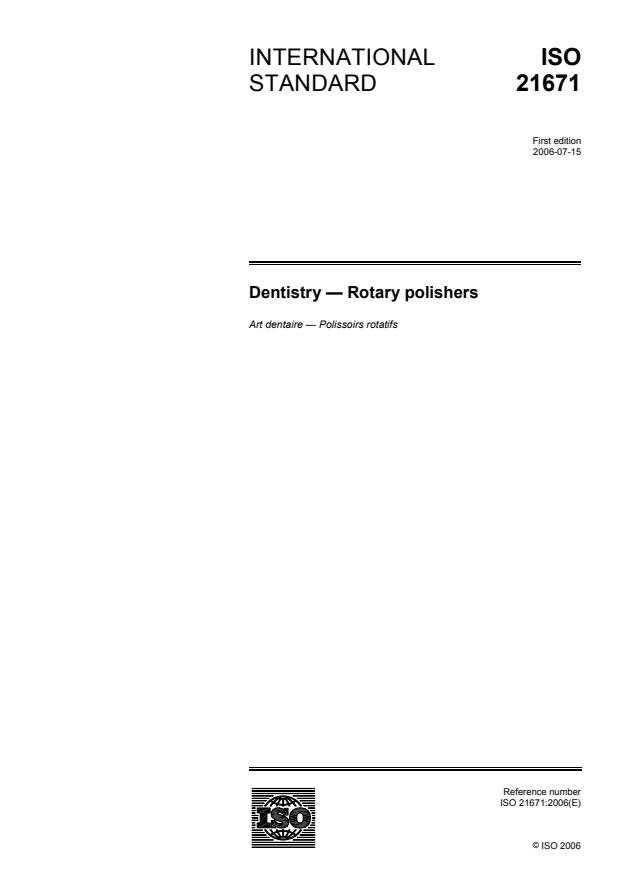
INTERNATIONAL ISO
STANDARD 21671
First edition
2006-07-15
Dentistry — Rotary polishers
Art dentaire — Polissoirs rotatifs
Reference number
©
ISO 2006
PDF disclaimer
This PDF file may contain embedded typefaces. In accordance with Adobe's licensing policy, this file may be printed or viewed but
shall not be edited unless the typefaces which are embedded are licensed to and installed on the computer performing the editing. In
downloading this file, parties accept therein the responsibility of not infringing Adobe's licensing policy. The ISO Central Secretariat
accepts no liability in this area.
Adobe is a trademark of Adobe Systems Incorporated.
Details of the software products used to create this PDF file can be found in the General Info relative to the file; the PDF-creation
parameters were optimized for printing. Every care has been taken to ensure that the file is suitable for use by ISO member bodies. In
the unlikely event that a problem relating to it is found, please inform the Central Secretariat at the address given below.
© ISO 2006
All rights reserved. Unless otherwise specified, no part of this publication may be reproduced or utilized in any form or by any means,
electronic or mechanical, including photocopying and microfilm, without permission in writing from either ISO at the address below or
ISO's member body in the country of the requester.
ISO copyright office
Case postale 56 • CH-1211 Geneva 20
Tel. + 41 22 749 01 11
Fax + 41 22 749 09 47
E-mail copyright@iso.org
Web www.iso.org
Published in Switzerland
ii © ISO 2006 – All rights reserved
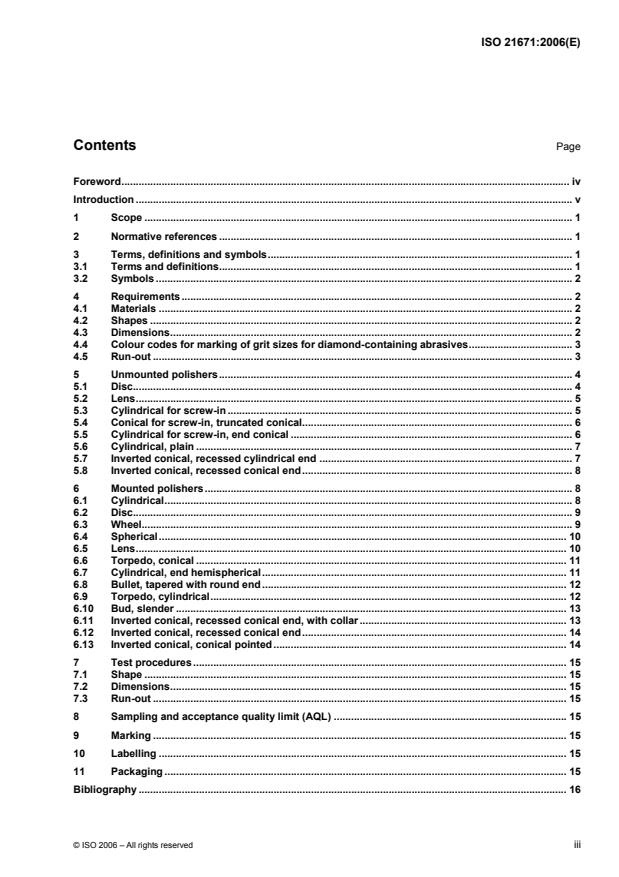
Contents Page
Foreword. iv
Introduction . v
1 Scope . 1
2 Normative references . 1
3 Terms, definitions and symbols. 1
3.1 Terms and definitions. 1
3.2 Symbols . 2
4 Requirements . 2
4.1 Materials . 2
4.2 Shapes . 2
4.3 Dimensions. 2
4.4 Colour codes for marking of grit sizes for diamond-containing abrasives. 3
4.5 Run-out . 3
5 Unmounted polishers. 4
5.1 Disc. 4
5.2 Lens. 5
5.3 Cylindrical for screw-in . 5
5.4 Conical for screw-in, truncated conical. 6
5.5 Cylindrical for screw-in, end conical . 6
5.6 Cylindrical, plain . 7
5.7 Inverted conical, recessed cylindrical end . 7
5.8 Inverted conical, recessed conical end. 8
6 Mounted polishers. 8
6.1 Cylindrical. 8
6.2 Disc. 9
6.3 Wheel. 9
6.4 Spherical. 10
6.5 Lens. 10
6.6 Torpedo, conical . 11
6.7 Cylindrical, end hemispherical. 11
6.8 Bullet, tapered with round end . 12
6.9 Torpedo, cylindrical. 12
6.10 Bud, slender . 13
6.11 Inverted conical, recessed conical end, with collar . 13
6.12 Inverted conical, recessed conical end. 14
6.13 Inverted conical, conical pointed. 14
7 Test procedures . 15
7.1 Shape . 15
7.2 Dimensions. 15
7.3 Run-out . 15
8 Sampling and acceptance quality limit (AQL) . 15
9 Marking . 15
10 Labelling . 15
11 Packaging . 15
Bibliography . 16
Foreword
ISO (the International Organization for Standardization) is a worldwide federation of national standards bodies
(ISO member bodies). The work of preparing International Standards is normally carried out through ISO
technical committees. Each member body interested in a subject for which a technical committee has been
established has the right to be represented on that committee. International organizations, governmental and
non-governmental, in liaison with ISO, also take part in the work. ISO collaborates closely with the
International Electrotechnical Commission (IEC) on all matters of electrotechnical standardization.
International Standards are drafted in accordance with the rules given in the ISO/IEC Directives, Part 2.
The main task of technical committees is to prepare International Standards. Draft International Standards
adopted by the technical committees are circulated to the member bodies for voting. Publication as an
International Standard requires approval by at least 75 % of the member bodies casting a vote.
Attention is drawn to the possibility that some of the elements of this document may be the subject of patent
rights. ISO shall not be held responsible for identifying any or all such patent rights.
ISO 21671 was prepared by Technical Committee ISO/TC 106, Dentistry, Subcommittee SC 4, Dental
instruments.
iv © ISO 2006 – All rights reserved
Introduction
This International Standard is one of a series of standards relating to rotary instruments used in dentistry.
The various dimensional and other requirements specified for polishers are those considered important to
ensure the interchangeability and safe usage of these instruments in the dental laboratory and at the dentist's
working place.
The nominal diameters of the working part listed in Clauses 5 and 6 comply preferably with the diameters
specified in ISO 2157.
Attention is drawn to ISO 6360 which specifies a 15-digit number coding system for the identification of rotary
instruments of all types used in dentistry.
INTERNATIONAL STANDARD ISO 21671:2006(E)
Dentistry — Rotary polishers
1 Scope
This International Standard specifies the dimensions and other requirements for the most commonly used
polishers which are used at the working place of the dentist and/or in the dental laboratory.
This International Standard is applicable to unmounted and mounted polishers.
2 Normative references
The following referenced documents are indispensable for the application of this document. For dated
references, only the edition cited applies. For undated references, the latest edition of the referenced
document (including any amendments) applies.
ISO 1797-1:1992, Dental rotary instruments — Shanks — Part 1: Shanks made of metals
ISO 1797-2, Dental rotary instruments — Shanks — Part 2: Shanks made of plastics
ISO 1942, Dentistry — Vocabulary
ISO 2859-1, Sampling procedures for inspection by attributes — Part 1: Sampling schemes indexed by
acceptance quality limit (AQL) for lot-by-lot inspection
ISO 6360-1, Dentistry — Number coding system for rotary instruments — Part 1: General characteristics
ISO 6360-2, Dentistry — Number coding system for rotary instruments — Part 2: Shapes
ISO 6360-6, Dentistry — Number coding system for rotary instruments — Part 6: Specific characteristics of
abrasive instruments
ISO 8325, Dentistry — Test methods for rotary instruments
ISO 13295, Dentistry — Mandrels for rotary instruments
3 Terms, definitions and symbols
3.1 Terms and definitions
For the purposes of this document, the terms and definitions given in ISO 1942 and the following apply.
3.1.1
polisher
rotary instrument used in dentistry for polishing dental materials or teeth
3.1.2
mounted polish
...
NORME ISO
INTERNATIONALE 21671
Première édition
2006-07-15
Art dentaire — Polissoirs rotatifs
Dentistry — Rotary polishers
Numéro de référence
©
ISO 2006
PDF – Exonération de responsabilité
Le présent fichier PDF peut contenir des polices de caractères intégrées. Conformément aux conditions de licence d'Adobe, ce fichier
peut être imprimé ou visualisé, mais ne doit pas être modifié à moins que l'ordinateur employé à cet effet ne bénéficie d'une licence
autorisant l'utilisation de ces polices et que celles-ci y soient installées. Lors du téléchargement de ce fichier, les parties concernées
acceptent de fait la responsabilité de ne pas enfreindre les conditions de licence d'Adobe. Le Secrétariat central de l'ISO décline toute
responsabilité en la matière.
Adobe est une marque déposée d'Adobe Systems Incorporated.
Les détails relatifs aux produits logiciels utilisés pour la création du présent fichier PDF sont disponibles dans la rubrique General Info
du fichier; les paramètres de création PDF ont été optimisés pour l'impression. Toutes les mesures ont été prises pour garantir
l'exploitation de ce fichier par les comités membres de l'ISO. Dans le cas peu probable où surviendrait un problème d'utilisation,
veuillez en informer le Secrétariat central à l'adresse donnée ci-dessous.
© ISO 2006
Droits de reproduction réservés. Sauf prescription différente, aucune partie de cette publication ne peut être reproduite ni utilisée sous
quelque forme que ce soit et par aucun procédé, électronique ou mécanique, y compris la photocopie et les microfilms, sans l'accord écrit
de l'ISO à l'adresse ci-après ou du comité membre de l'ISO dans le pays du demandeur.
ISO copyright office
Case postale 56 • CH-1211 Geneva 20
Tel. + 41 22 749 01 11
Fax. + 41 22 749 09 47
E-mail copyright@iso.org
Web www.iso.org
Publié en Suisse
ii © ISO 2006 – Tous droits réservés
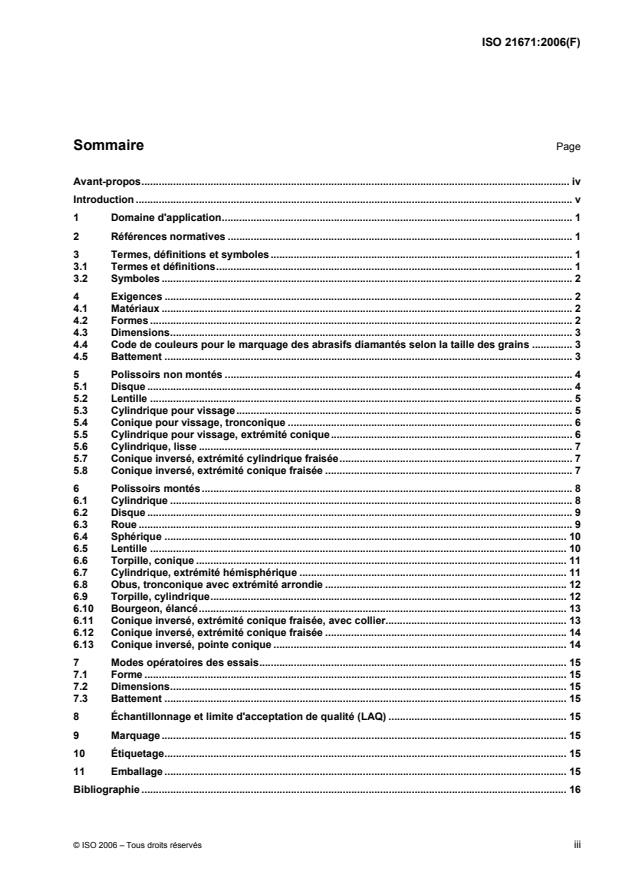
Sommaire Page
Avant-propos. iv
Introduction . v
1 Domaine d'application. 1
2 Références normatives . 1
3 Termes, définitions et symboles. 1
3.1 Termes et définitions. 1
3.2 Symboles . 2
4 Exigences . 2
4.1 Matériaux . 2
4.2 Formes . 2
4.3 Dimensions. 3
4.4 Code de couleurs pour le marquage des abrasifs diamantés selon la taille des grains . 3
4.5 Battement . 3
5 Polissoirs non montés . 4
5.1 Disque . 4
5.2 Lentille . 5
5.3 Cylindrique pour vissage. 5
5.4 Conique pour vissage, tronconique . 6
5.5 Cylindrique pour vissage, extrémité conique. 6
5.6 Cylindrique, lisse . 7
5.7 Conique inversé, extrémité cylindrique fraisée. 7
5.8 Conique inversé, extrémité conique fraisée .7
6 Polissoirs montés. 8
6.1 Cylindrique . 8
6.2 Disque . 9
6.3 Roue . 9
6.4 Sphérique . 10
6.5 Lentille . 10
6.6 Torpille, conique . 11
6.7 Cylindrique, extrémité hémisphérique . 11
6.8 Obus, tronconique avec extrémité arrondie . 12
6.9 Torpille, cylindrique. 12
6.10 Bourgeon, élancé. 13
6.11 Conique inversé, extrémité conique fraisée, avec collier. 13
6.12 Conique inversé, extrémité conique fraisée . 14
6.13 Conique inversé, pointe conique . 14
7 Modes opératoires des essais. 15
7.1 Forme . 15
7.2 Dimensions. 15
7.3 Battement . 15
8 Échantillonnage et limite d'acceptation de qualité (LAQ) . 15
9 Marquage . 15
10 Étiquetage. 15
11 Emballage . 15
Bibliographie . 16
Avant-propos
L'ISO (Organisation internationale de normalisation) est une fédération mondiale d'organismes nationaux de
normalisation (comités membres de l'ISO). L'élaboration des Normes internationales est en général confiée
aux comités techniques de l'ISO. Chaque comité membre intéressé par une étude a le droit de faire partie du
comité technique créé à cet effet. Les organisations internationales, gouvernementales et non
gouvernementales, en liaison avec l'ISO participent également aux travaux. L'ISO collabore étroitement avec
la Commission électrotechnique internationale (CEI) en ce qui concerne la normalisation électrotechnique.
Les Normes internationales sont rédigées conformément aux règles données dans les Directives ISO/CEI,
Partie 2.
La tâche principale des comités techniques est d'élaborer les Normes internationales. Les projets de Normes
internationales adoptés par les comités techniques sont soumis aux comités membres pour vote. Leur
publication comme Normes internationales requiert l'approbation de 75 % au moins des comités membres
votants.
L'attention est appelée sur le fait que certains des éléments du présent document peuvent faire l'objet de
droits de propriété intellectuelle ou de droits analogues. L'ISO ne saurait être tenue pour responsable de ne
pas avoir identifié de tels droits de propriété et averti de leur existence.
L'ISO 21671 a été élaborée par le comité technique ISO/TC 106, Art dentaire, sous-comité SC 4, Instruments
dentaires.
iv © ISO 2006 – Tous droits réservés
Introduction
La présente Norme internationale est l'une d'une série de normes relatives aux instruments rotatifs utilisés en
art dentaire.
Les diverses exigences dimensionnelles et autres exigences spécifiées pour les polissoirs sont celles qui sont
considérées comme étant importantes pour assurer l'interchangeabilité et l'usage en toute sécurité de ces
instruments dans le laboratoire dentaire et au poste de travail du praticien dentiste.
Les diamètres nominaux de la partie active énumérés dans l'Article 5 et dans l'Article 6 sont conformes aux
diamètres spécifiés dans l'ISO 2157.
L'attention est attirée sur l'ISO 6360 qui spécifie un système de codification numérique à 15 chiffres pour
identifier les instruments rotatifs de tous types utilisés en art dentaire.
NORME INTERNATIONALE ISO 21671:2006(F)
Art dentaire — Polissoirs rotatifs
1 Domaine d'application
La présente Norme internationale spécifie les dimensions et les autres exigences pour les polissoirs les plus
communément utilisés au poste de travail du praticien dentiste et/ou dans le laboratoire dentaire.
La présente Norme internationale s'applique à des polissoirs non montés et montés.
2 Références normatives
Les documents de référence suivants sont indispensables pour l'application du présent document. Pour les
références datées, seule l'édition citée s'applique. Pour les références non datées, la dernière édition du
document de référence s'applique (y compris les éventuels amendements).
ISO 1797-1:1992, Instruments rotatifs dentaires — Queues — Partie :1: Queues en matériaux métalliques
ISO 1797-2, Instruments rotatifs dentaires — Queues — Partie :2: Queues en matières plastiques
ISO 1942, Art dentaire — Vocabulaire
ISO 2859-1, Règles d'échantillonnage pour les contrôles par attributs — Partie 1: Procédures
d'échantillonnage pour les contrôles lot par lot, indexés d'après le niveau de qualité acceptable (NQA)
ISO 6360-1, Art dentaire — Système de codification numérique pour instruments rotatifs — Partie 1:
Caractéristiques générales
ISO 6360-2, Art dentaire — Système de codification numérique pour instruments rotatifs — Partie 2: Formes
ISO 6360-6, Art dentaire — Système de codification numérique pour instruments rotatifs — Partie 6:
Caractéristiques spécifiques des instruments abrasifs
ISO 8325, Art dentaire — Méthodes d'essai pour instruments rotatifs
ISO 13295, Art dentaire — Mandrins pour instruments rotatifs
3 Termes, définitions et symboles
3.1 Termes et définitions
Pour les besoins du présent document, les termes et définitions donnés dans l'ISO 1942 ainsi que les
suivants s'appliquent.
3.1.1
polissoir
instrument rotatif utilisé en art dentaire pour polir des produits dentaires ou des dents
3.1.2
polissoir monté
polissoir inamovible qui e
...