


ISO/IEC 24789-2:2011
(Main)Identification cards — Card service life — Part 2: Methods of evaluation
Identification cards — Card service life — Part 2: Methods of evaluation
ISO/IEC 24789-2:2011 specifies methods of evaluation for ID‑1 identification card service life in the applications referred to in ISO/IEC 24789-1. It contains no additional or changed requirements for the ID‑1 card properties defined in other applicable standards.
Cartes d'identification — Durée de vie des cartes — Partie 2: Méthodes d'évaluation
General Information
- Status
- Withdrawn
- Publication Date
- 07-Nov-2011
- Technical Committee
- ISO/IEC JTC 1/SC 17 - Cards and security devices for personal identification
- Current Stage
- 9599 - Withdrawal of International Standard
- Start Date
- 08-Jan-2024
- Completion Date
- 12-Feb-2026
Relations
- Revised
ISO/IEC 24789-2:2024 - Identification cards — Card service life — Part 2: Methods of evaluation - Effective Date
- 06-Jun-2022


Get Certified
Connect with accredited certification bodies for this standard

BSI Group
BSI (British Standards Institution) is the business standards company that helps organizations make excellence a habit.

NYCE
Mexican standards and certification body.
Sponsored listings
Frequently Asked Questions
ISO/IEC 24789-2:2011 is a standard published by the International Organization for Standardization (ISO). Its full title is "Identification cards — Card service life — Part 2: Methods of evaluation". This standard covers: ISO/IEC 24789-2:2011 specifies methods of evaluation for ID‑1 identification card service life in the applications referred to in ISO/IEC 24789-1. It contains no additional or changed requirements for the ID‑1 card properties defined in other applicable standards.
ISO/IEC 24789-2:2011 specifies methods of evaluation for ID‑1 identification card service life in the applications referred to in ISO/IEC 24789-1. It contains no additional or changed requirements for the ID‑1 card properties defined in other applicable standards.
ISO/IEC 24789-2:2011 is classified under the following ICS (International Classification for Standards) categories: 35.240.15 - Identification cards. Chip cards. Biometrics. The ICS classification helps identify the subject area and facilitates finding related standards.
ISO/IEC 24789-2:2011 has the following relationships with other standards: It is inter standard links to ISO/IEC 24789-2:2024. Understanding these relationships helps ensure you are using the most current and applicable version of the standard.
ISO/IEC 24789-2:2011 is available in PDF format for immediate download after purchase. The document can be added to your cart and obtained through the secure checkout process. Digital delivery ensures instant access to the complete standard document.
Standards Content (Sample)
INTERNATIONAL ISO/IEC
STANDARD 24789-2
First edition
2011-11-15
Identification cards — Card service life —
Part 2:
Methods of evaluation
Cartes d'identification — Durée de vie des cartes —
Partie 2: Méthodes d'évaluation
Reference number
©
ISO/IEC 2011
© ISO/IEC 2011
All rights reserved. Unless otherwise specified, no part of this publication may be reproduced or utilized in any form or by any means,
electronic or mechanical, including photocopying and microfilm, without permission in writing from either ISO at the address below or
ISO's member body in the country of the requester.
ISO copyright office
Case postale 56 CH-1211 Geneva 20
Tel. + 41 22 749 01 11
Fax + 41 22 749 09 47
E-mail copyright@iso.org
Web www.iso.org
Published in Switzerland
ii © ISO/IEC 2011 – All rights reserved
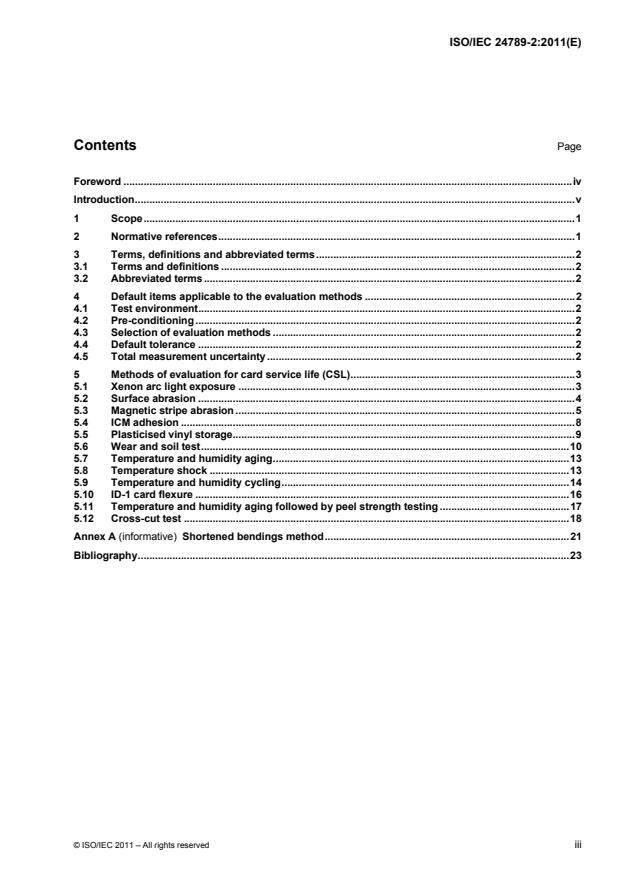
Contents Page
Foreword . iv
Introduction . v
1 Scope . 1
2 Normative references . 1
3 Terms, definitions and abbreviated terms . 2
3.1 Terms and definitions . 2
3.2 Abbreviated terms . 2
4 Default items applicable to the evaluation methods . 2
4.1 Test environment . 2
4.2 Pre-conditioning . 2
4.3 Selection of evaluation methods . 2
4.4 Default tolerance . 2
4.5 Total measurement uncertainty . 2
5 Methods of evaluation for card service life (CSL) . 3
5.1 Xenon arc light exposure . 3
5.2 Surface abrasion . 4
5.3 Magnetic stripe abrasion . 5
5.4 ICM adhesion . 8
5.5 Plasticised vinyl storage. 9
5.6 Wear and soil test . 10
5.7 Temperature and humidity aging . 13
5.8 Temperature shock . 13
5.9 Temperature and humidity cycling . 14
5.10 ID-1 card flexure . 16
5.11 Temperature and humidity aging followed by peel strength testing . 17
5.12 Cross-cut test . 18
Annex A (informative) Shortened bendings method . 21
Bibliography . 23
© ISO/IEC 2011 – All rights reserved iii
Foreword
ISO (the International Organization for Standardization) and IEC (the International Electrotechnical
Commission) form the specialized system for worldwide standardization. National bodies that are members of
ISO or IEC participate in the development of International Standards through technical committees
established by the respective organization to deal with particular fields of technical activity. ISO and IEC
technical committees collaborate in fields of mutual interest. Other international organizations, governmental
and non-governmental, in liaison with ISO and IEC, also take part in the work. In the field of information
technology, ISO and IEC have established a joint technical committee, ISO/IEC JTC 1.
International Standards are drafted in accordance with the rules given in the ISO/IEC Directives, Part 2.
The main task of the joint technical committee is to prepare International Standards. Draft International
Standards adopted by the joint technical committee are circulated to national bodies for voting. Publication as
an International Standard requires approval by at least 75 % of the national bodies casting a vote.
Attention is drawn to the possibility that some of the elements of this document may be the subject of patent
rights. ISO and IEC shall not be held responsible for identifying any or all such patent rights.
ISO/IEC 24789-2 was prepared by Joint Technical Committee ISO/IEC JTC 1, Information technology,
Subcommittee SC 17, Cards and personal identification.
ISO/IEC 24789 consists of the following parts, under the general title Identification cards — Card service life:
Part 1: Application profiles and requirements
Part 2: Methods of evaluation
iv © ISO/IEC 2011 – All rights reserved
Introduction
This part of ISO/IEC 24789 comprises methods of evaluation of identification (ID) card service life.
These methods of evaluation complement the application profiles and requirements defined in
ISO/IEC 24789-1, which are intended to be used by card issuers, card manufacturers and card component
suppliers to represent the comparative rigour of various ID card service life applications. They provide a
means for ranking and comparing the main factors affecting ID card service life in a manner that is amenable
to evaluation using the methods defined or referenced in this part of ISO/IEC 24789.
© ISO/IEC 2011 – All rights reserved v
INTERNATIONAL STANDARD ISO/IEC 24789-2:2011(E)
Identification cards — Card service life —
Part 2:
Methods of evaluation
1 Scope
This part of ISO/IEC 24789 specifies methods of evaluation for ID-1 identification card service life in the
applications referred to in ISO/IEC 24789-1. It contains no additional or changed requirements for the ID-1
card properties defined in other applicable standards.
NOTE 1 At the time of publishing this first edition, there is limited data to show direct equivalence to any measure of
actual field use conditions. It will not be possible to establish any such equivalence until and unless a degree of
quantitative correlation has been established for the ID card construction in question.
NOTE 2 For the convenience of certain users, non-S.I. equivalents are given for some quantity values where these are
in common use in the ID card industry. These equivalents appear in parentheses and are for information only.
2 Normative references
The following referenced documents are indispensible for the application of this document. For dated
references, only the edition cited applies. For undated references, the latest edition of the referenced
document (including any amendments) applies.
ISO/IEC 24789-1, Identification cards — Card service life — Part 1: Application profiles and requirements
ISO/IEC 7810, Identification cards — Physical characteristics
ISO/IEC 7811-2, Identification cards — Recording technique — Part 2: Magnetic stripe — Low coercivity
ISO/IEC 7811-6, Identification cards — Recording technique — Part 6: Magnetic stripe — High coercivity
ISO/IEC 7811-8, Identification cards — Recording technique — Part 8: Magnetic stripe — Coercivity of
51,7 kA/m (650 Oe)
ISO/IEC 10373-1, Identification cards — Test methods — Part 1: General characteristics
ISO/IEC 10373-2, Identification cards — Test methods — Part 2: Cards with magnetic stripes
ISO/IEC 14443-1, Identification cards — Contactless integrated circuit cards — Proximity cards — Part 1:
Physical characteristics
ISO 105-B02, Textiles — Tests for colour fastness — Part B02: Colour fastness to artificial light: Xenon arc
fading lamp test
ISO 3310-1, Test sieves — Technical requirements and testing — Part 1: Test sieves of metal wire cloth
IEC 60068-2-78, Environmental testing — Part 2-78: Tests — Test Cab: Damp heat, steady state
© ISO/IEC 2011 – All rights reserved 1
IEC 60454-2, Pressure-sensitive adhesive tapes for electrical purposes — Part 2: Methods of test
CIE Publication 116-1995, Industrial Colour-Difference Evaluation
3 Terms, definitions and abbreviated terms
3.1 Terms and definitions
For the purposes of this document, the terms, definitions, symbols and abbreviations given in ISO/IEC 7810,
ISO/IEC 10373-1, ISO/IEC 10373-2, ISO/IEC 24789-1 and the following apply.
3.1.1
card fracture
crack or break in a card whose depth is at least one third of the card thickness
3.2 Abbreviated terms
ICM integrated circuit(s) module
ICC integrated circuit(s) card
4 Default items applicable to the evaluation methods
4.1 Test environment
Unless otherwise specified, evaluation shall take place in an environment having a temperature 23C 3C
(73F 5F) and relative humidity of 40 % to 60 %.
4.2 Pre-conditioning
Where pre-conditioning is required by the evaluation method, the identification cards to be evaluated shall be
conditioned to the default test environment for a period of 24 h before evaluation.
4.3 Selection of evaluation methods
Methods of evaluation shall be applied as required by the application profile of the card defined in
ISO/IEC 24789-1.
4.4 Default tolerance
Unless otherwise specified, a default tolerance of 5 % shall be applied to the quantity values given to specify
the characteristics of the equipment (e.g. linear dimensions) and the evaluation procedures (e.g. equipment
adjustments).
4.5 Total measurement uncertainty
The total measurement uncertainty for each quantity determined by these evaluation methods shall be stated
in the test report.
2 © ISO/IEC 2011 – All rights reserved
5 Methods of evaluation for card service life (CSL)
5.1 Xenon arc light exposure
The purpose of this test is two-fold:
a) The procedure can be used as a preconditioning step before, or as a test step in, a sequential test. Cards
will be exposed to Xenon arc to accelerate aging of the plastic materials. This aging typically causes
plastics to lose ductility and become more susceptible to mechanical failures.
b) The test can also be used as a means for determining discoloration of card materials due to UV
degradation. The test will allow for simulation of outdoor exposure (no window glass filter) and indoor
exposure (use of window glass filter).
5.1.1 Apparatus
Xenon Arc Test Chamber conforming to ISO 105-B02 and constructed with:
Xenon arc lamp;
IR (daylight) filter to cut out wavelengths greater than 800 nm;
window glass filter (when applicable);
black body temperature control.
5.1.2 Procedure
Mount the cards in the test chamber with the card surface of interest exposed.
Close the chamber to prevent leakage. Expose the cards to the Xenon arc for 24 h under the following test
conditions:
a) black-standard temperature of 50 °C 5 °C (122 °F 9 °F) as measured with a black-standard
thermometer as defined in ISO 105-B02;
b) illumination intensity:
without window filter – “Outdoor” exposure
2 1)
0,65 w/m using a control point of 420 nm
2 2)
550 w/m using a control point of 290 nm to 800 nm;
with window filter – “Indoor” exposure
0,65 w/m using a control point of 420 nm
550 w/m using a control point of 290 nm to 800 nm.
Allow the cards to cool to room temperature and remove them from the test chamber.
If used as a preconditioning test, continue with the remaining test procedures.
1) Test equipment using a 420 nm control point is made by QSun (models Xe-1 and Xe-3). This information is given for
the convenience of users of this document and does not constitute an endorsement by ISO or IEC of these products.
Other manufacturers using this control point may be used as long as they meet the requirements of ISO 105-B02.
2) Test equipment using a 290 nm to 800 nm control point is made by Atlas (all Suntest models). This information is
given for the convenience of users of this document and does not constitute an endorsement by ISO or IEC of these
products. Other manufacturers using this control point may be used as long as they meet the requirements of
ISO 105-B02.
© ISO/IEC 2011 – All rights reserved 3
5.1.3 Evaluation report
Unless specified otherwise by the base standard:
a) record the number of hours of Xenon arc light exposure, the illumination intensity and any filters used;
b) record any colour change observations and method of evaluation:
visual;
colour difference ∆E* or ∆E* measured using CIE 1994 as defined in CIE Publication 116-1995
Lab Lch
(or later version) L*a*b* or L*C*h* with standard illuminant D65 and 10° observer;
(optionally) reflection density changes (ISO 5-3 and ISO 5-4).
c) record whether or not the cards remain testably functional following application of the procedure and
report the version of the colour difference measurement method used.
5.2 Surface abrasion
The purpose of this method is to provide controlled abrasion of the card surface.
5.2.1 Apparatus
3)
Abraser with vacuum pick up or equivalent ;
2 abrasive Wheels (Taber CS -10F or equivalent);
resurfacing disks (Taber S-11 or equivalent);
dry soft cleaning cloth;
hole punch or equivalent;
500 g total load per wheel (250 g additional - no counter weight wheels).
5.2.2 Procedure
Prepare two sample cards that have all the desired information and features by punching or cutting a notch in
the card as shown in Figure 1.
Resurface the abrasive wheels for 50 cycles before beginning the procedure and then again after every
250 cycles. Clean the cards and turntable thoroughly, using a dry soft cloth, to remove all debris. Avoid direct
finger contact with the test cards and abrasion wheels.
Mount the two cards side by side on the turntable without any compliant pad so that the abrasive wheels pass
over the desired areas. The abrasive wheels must not bounce during the procedure. Place the abrasive
wheels on the card and the vacuum nozzle 6,4 mm (0.25 in) above the cards.
3) The abraser apparatus and abrasive wheels may be obtained from Taber Industries, 455 Bryant Street, North
Tonawanda, New York 14120. This information is given for the convenience of users of this document and does not
constitute an endorsement by ISO or IEC of these products. Equivalent products may be used if they can be shown to
lead to the same results.
4 © ISO/IEC 2011 – All rights reserved
Preset the specified number of cycles and start the abraser and vacuum. Stop the procedure after the
specified number of cycles or until wear through of the card feature is observed. The procedure may be
stopped after 5,000 cycles have occurred without wear through. Stopping the procedure periodically to
observe the point of wear-through is recommended.
Dimensions in millimetres (inches)
not to scale
3,2 ± 0,5
(0.13 ± 0.02)
6,4 ± 0,25
(0.25 ± 0.01)
42,9 ± 0,5
(1.69 ± 0.02)
Figure 1 — Test card notch location
5.2.3 Evaluation report
Unless specified otherwise by the base standard, compare the wear-through of the card to a control card or
the number of cycles to the specified requirement.
5.3 Magnetic stripe abrasion
The purpose of this method is to provide a controlled abrasion of the magnetic stripe surface.
5.3.1 Apparatus
4)
Abraser with vacuum pick up or equivalent
filler card (card of the same thickness as the card to be abraded);
2 abrasive wheels (Taber CS -10F or equivalent);
resurfacing disks (Taber S-11 or equivalent);
500 g total load per wheel (250 g additional - no counter weight wheels);
dry soft cleaning cloth;
4) The abraser apparatus and abrasive wheels may be obtained from Taber Industries, 455 Bryant Street, North
Tonawanda, New York 14120. This information is given for the convenience of users of this document and does not
constitute an endorsement by ISO or IEC of these products. Equivalent products may be used if they can be shown to
lead to the same results.
© ISO/IEC 2011 – All rights reserved 5
hole punch or equivalent;
magnetic stripe read test equipment with the following characteristics:
ISO/IEC 10373-2 compliant;
capable of reporting average signal amplitude (U ) on middle third of Track 2 (see ISO/IEC 7811-2,
A
ISO/IEC 7811-6 or ISO/IEC 7811-8).
5.3.2 Procedure
Prepare the card by encoding on Track 2 with a recording density of 8 ftpmm (200 ftpi), with a relative
tolerance of ± 10 %, at a recording current of I , in accordance with ISO/IEC 7811-2, ISO/IEC 7811-6 or
min
ISO/IEC 7811-8 and ISO/IEC 10373-2).
NOTE 1 If the magnetic stripe material is required to comply with any established standard, the compliance tests must
be conducted and the results acceptable prior to this procedure.
Punch a hole in the card as shown in Figure 2.
Measure the average signal amplitude U in the read area shown in Figure 2.
Ainitial
Resurface the abrasive wheels for 50 cycles before testing begins and after every 100 cycles. Clean the cards
and turntable using a dry soft cloth after the abrasive wheels are resurfaced. Avoid direct finger contact with
the cards and abrasion wheels. Complete the procedure for each card to the stopping point before
recommencing it with another card.
Mount the card on the turntable without any compliant pad. Add a filler card of the same thickness as the card
on the specimen plate so that the abrasive wheels do not bounce when the procedure is in progress. Place
the abrasive wheels (with the additional loads) on the card and the vacuum nozzle 6,4 mm (0.25 in) above the
cards.
Preset the abraser for 50 cycles and start the abraser and vacuum. Ensure that the abrasive wheels do not
bounce during the test.
Remove the card and clean the magnetic stripe thoroughly, using a clean soft cloth, to remove debris.
NOTE 2 Particular care should be taken to ensure that the stripe is completely free from debris in order to avoid
causing damage to the magnetic head used to measure the signal amplitude.
Re-measure average signal amplitude (U ) in the read area shown in Figure 2.
A
Repeat the sequence of 50 abraser cycles followed by measurement of the average signal amplitude (U ) in
A
the read area shown in Figure 2 until a value of U is achieved such that U 0,70 U . The procedure may
A A A initial
be stopped after 5 000 Taber cycles have occurred without achieving U 0,70 U .
A A initial
6 © ISO/IEC 2011 – All rights reserved
Dimensions in millimetres (inches)
not to scale
31,7 ± 0,5
31,7 ± 0,5
(1.25 ± 0.02)
(1.25 ± 0.02)
Read Area
Hole diameter
6,4 (0.25) nominal
8,1 ± 0,5
(0.32 ± 0.02)
42,9 ± 0,5
(1.69 ± 0.02)
Figure 2 — Magnetic stripe read area and hole location
5.3.3 Evaluation report
Unless specified otherwise by the base standard, report the average number of abraser cycles (to the nearest
50 cycles) that was required to produce U 0,70 U .
A A initial
NOTE Graphical results (average signal amplitude vs. abraser cycles) have been shown to be useful in showing
abrasion characteristics.
© ISO/IEC 2011 – All rights reserved 7
5.4 ICM adhesion
The purpose of this method is to establish that sufficient bond strength exists between the card and the ICM of
an IC Card with contacts.
5.4.1 Apparatus
Dimensions in millimetres (inches)
not to scale
location of ICM
A
2A
front of card
R = D/2
back of card
90°
F
D
Before bending After bending
D = 50 (1.97)
A= 2,00 (0.08)
The apparatus comprises a half-cylinder on the rectangular block (not a hemisphere on a cylinder)
Figure 3 — IC-module test apparatus
5.4.2 Procedure
Place the short edge of the ICC nearest the ICM into the jaws of the test apparatus.
Slowly bend the card round the apparatus as shown in Figure 3. The bending time shall be 2 s to 3 s.
Hold the card in this position for 5 s ± 2 s before releasing it to “spring back” freely.
5.4.3 Evaluation report
Perform a visual check of the ICM adhesion and report the result as required by the base standard.
8 © ISO/IEC 2011 – All rights reserved
5.5 Plasticised vinyl storage
This purpose of this method is to evaluate card resistance to the potentially damaging effects of plasticisers.
5.5.1 Apparatus
Two rigid inert sheets having dimensions that exceed the maximum length and width of the cards to be
evaluated. Glass or chrome plated steel are acceptable materials;
batch of 5 cards for evaluation;
5)
soft PVC foils containing 20 % ± 5 % of DOP pla
...
Questions, Comments and Discussion
Ask us and Technical Secretary will try to provide an answer. You can facilitate discussion about the standard in here.
Loading comments...