

ISO 22343-2:2023
(Main)Security and resilience — Vehicle security barriers — Part 2: Application
General Information
- Abstract
This document gives guidance on the selection, installation and use of vehicle security barrier (VSBs) and describes the process of producing operational requirements (ORs). It also gives guidance on a design method for assessing the performance of a VSB. This document is applicable to end users, such as site owners and specifiers, of VSBs, where they are used to protect people in any public or private location from vehicle attacks. This document does not apply to the performance of a VSB or its control apparatus when subjected to: — slow speed encroachment; — slow speed nudging and ramming; — blast explosion; — ballistic impact; — manual attack, with the aid of the vehicle (multiple impacts at slow speed); — manual attack, with the aid of tools (excluding vehicles); — electrical manipulation; — attack on the control systems by any means. NOTE 1 For manual attack, a variety of test methods exist. For assessing intruder resistance of building components, see LPS 1175[53]. NOTE 2 The VSB is designed and tested on the basis of: a) vehicle type, mass and speed of the assessed vehicle-borne threat; b) its geographical application (e.g. climate conditions); c) intended site location (e.g. rigid or non-rigid soil/finished surface (paving, cobblestone, granite, asphalt). It does not apply to guidance on design, the operational suitability of a VSB or other impact test methods.
- Status
- Published
- Publication Date
- 14-Sep-2023
- Technical Committee
- ISO/TC 292 - Security and resilience
- Drafting Committee
- ISO/TC 292 - Security and resilience
- Current Stage
- 6060 - International Standard published
- Start Date
- 15-Sep-2023
- Due Date
- 29-Sep-2023
- Completion Date
- 15-Sep-2023
Overview
ISO 22343-2:2023 - Security and resilience - Vehicle security barriers - Part 2: Application provides practical guidance for the selection, installation and use of vehicle security barriers (VSBs). It explains how to produce Operational Requirements (ORs) for hostile vehicle mitigation and outlines a design method for assessing VSB performance. The standard is aimed at end users (site owners, specifiers and operators) who need to protect people and assets in public or private locations from vehicle-borne threats.
Key topics and technical requirements
- Threat assessment: Guidance on identifying and quantifying vehicle-borne threats by vehicle type, mass and speed, and on considering geographical and site-specific conditions (climate, soil or paved surfaces).
- Selection and siting of VSBs: Criteria for choosing appropriate barrier types (bollards, road blockers, rising arms, sliding/swing gates, street furniture and portable systems) and for integrating them into site layout, traffic flow and aesthetics.
- Design method and performance assessment: A design approach for assessing impact performance, vehicle penetration distance, debris coordinates and stand-off distances. Emphasis on vehicle dynamics, impact angle and legitimate access speed.
- Operational requirements (ORs): Process for producing ORs that define required barrier performance, access control behavior, speed of legitimate access, power and environmental considerations.
- Civil works and foundations: Considerations for ground types, foundations, surface-placed barriers, installation, lifting/placement and repairs.
- Deployment, commissioning and maintenance: Procurement strategy, logistics for deployment/removal, commissioning and handover, availability, ongoing maintenance, staff skills and safety issues.
- Limitations and exclusions: The document does NOT cover performance under slow-speed encroachment/nudging, blast, ballistic impacts, electrical manipulation or attacks on control systems. It notes that VSBs are designed/tested against specific vehicle-borne threat parameters and site conditions.
Practical applications and intended users
Who benefits:
- Site owners & security managers specifying perimeter protection for critical infrastructure, transport hubs, stadia, corporate campuses, embassies and public event zones.
- Architects, civil & security engineers integrating VSBs into site design, foundations and traffic management.
- Specifiers, procurement teams & local authorities responsible for acquiring, approving and permitting VSB deployment. Practical uses:
- Designing vehicle access control points (VACPs)
- Preparing operational requirements and procurement documents
- Planning installation, commissioning and maintenance regimes
- Assessing siting, stand‑off distances and traffic throughput to balance security with access needs
Related standards
- References national and sector guidance where applicable (for example, recognized intruder-resistance standards such as LPS 1175 are noted for manual attack testing). Users should pair ISO 22343-2:2023 with relevant local regulations and infrastructure standards when specifying VSB solutions.
Relations
- Effective Date
- 10-Sep-2022
Get Certified
Connect with accredited certification bodies for this standard

Zavod za gradbeništvo Slovenije (ZAG) - Inšpekcija
ZAG inspection body for construction products, structures, and materials.
Sponsored listings
Frequently Asked Questions
ISO 22343-2:2023 is a standard published by the International Organization for Standardization (ISO). Its full title is "Security and resilience — Vehicle security barriers — Part 2: Application". This standard covers: This document gives guidance on the selection, installation and use of vehicle security barrier (VSBs) and describes the process of producing operational requirements (ORs). It also gives guidance on a design method for assessing the performance of a VSB. This document is applicable to end users, such as site owners and specifiers, of VSBs, where they are used to protect people in any public or private location from vehicle attacks. This document does not apply to the performance of a VSB or its control apparatus when subjected to: — slow speed encroachment; — slow speed nudging and ramming; — blast explosion; — ballistic impact; — manual attack, with the aid of the vehicle (multiple impacts at slow speed); — manual attack, with the aid of tools (excluding vehicles); — electrical manipulation; — attack on the control systems by any means. NOTE 1 For manual attack, a variety of test methods exist. For assessing intruder resistance of building components, see LPS 1175[53]. NOTE 2 The VSB is designed and tested on the basis of: a) vehicle type, mass and speed of the assessed vehicle-borne threat; b) its geographical application (e.g. climate conditions); c) intended site location (e.g. rigid or non-rigid soil/finished surface (paving, cobblestone, granite, asphalt). It does not apply to guidance on design, the operational suitability of a VSB or other impact test methods.
This document gives guidance on the selection, installation and use of vehicle security barrier (VSBs) and describes the process of producing operational requirements (ORs). It also gives guidance on a design method for assessing the performance of a VSB. This document is applicable to end users, such as site owners and specifiers, of VSBs, where they are used to protect people in any public or private location from vehicle attacks. This document does not apply to the performance of a VSB or its control apparatus when subjected to: — slow speed encroachment; — slow speed nudging and ramming; — blast explosion; — ballistic impact; — manual attack, with the aid of the vehicle (multiple impacts at slow speed); — manual attack, with the aid of tools (excluding vehicles); — electrical manipulation; — attack on the control systems by any means. NOTE 1 For manual attack, a variety of test methods exist. For assessing intruder resistance of building components, see LPS 1175[53]. NOTE 2 The VSB is designed and tested on the basis of: a) vehicle type, mass and speed of the assessed vehicle-borne threat; b) its geographical application (e.g. climate conditions); c) intended site location (e.g. rigid or non-rigid soil/finished surface (paving, cobblestone, granite, asphalt). It does not apply to guidance on design, the operational suitability of a VSB or other impact test methods.
ISO 22343-2:2023 is classified under the following ICS (International Classification for Standards) categories: 93.080.30 - Road equipment and installations. The ICS classification helps identify the subject area and facilitates finding related standards.
ISO 22343-2:2023 has the following relationships with other standards: It is inter standard links to IWA 14-2:2013. Understanding these relationships helps ensure you are using the most current and applicable version of the standard.
ISO 22343-2:2023 is available in PDF format for immediate download after purchase. The document can be added to your cart and obtained through the secure checkout process. Digital delivery ensures instant access to the complete standard document.
Standards Content (Sample)
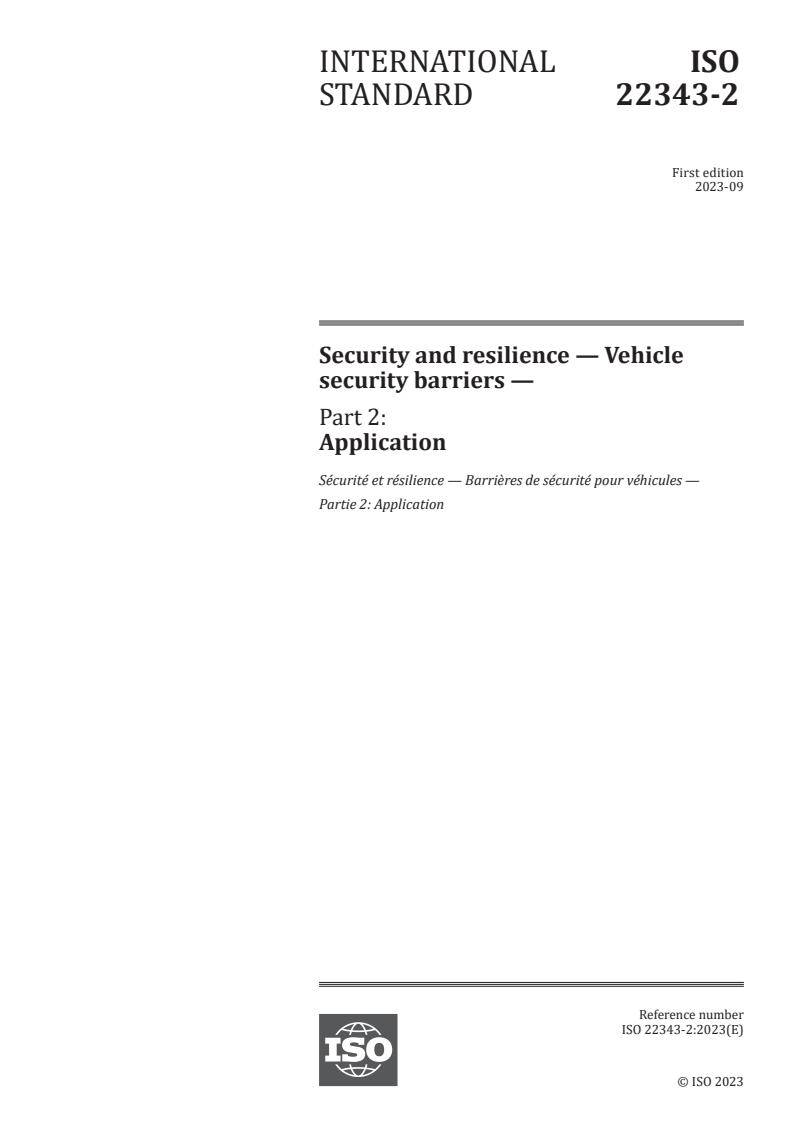
INTERNATIONAL ISO
STANDARD 22343-2
First edition
2023-09
Security and resilience — Vehicle
security barriers —
Part 2:
Application
Sécurité et résilience — Barrières de sécurité pour véhicules —
Partie 2: Application
Reference number
© ISO 2023
All rights reserved. Unless otherwise specified, or required in the context of its implementation, no part of this publication may
be reproduced or utilized otherwise in any form or by any means, electronic or mechanical, including photocopying, or posting on
the internet or an intranet, without prior written permission. Permission can be requested from either ISO at the address below
or ISO’s member body in the country of the requester.
ISO copyright office
CP 401 • Ch. de Blandonnet 8
CH-1214 Vernier, Geneva
Phone: +41 22 749 01 11
Email: copyright@iso.org
Website: www.iso.org
Published in Switzerland
ii
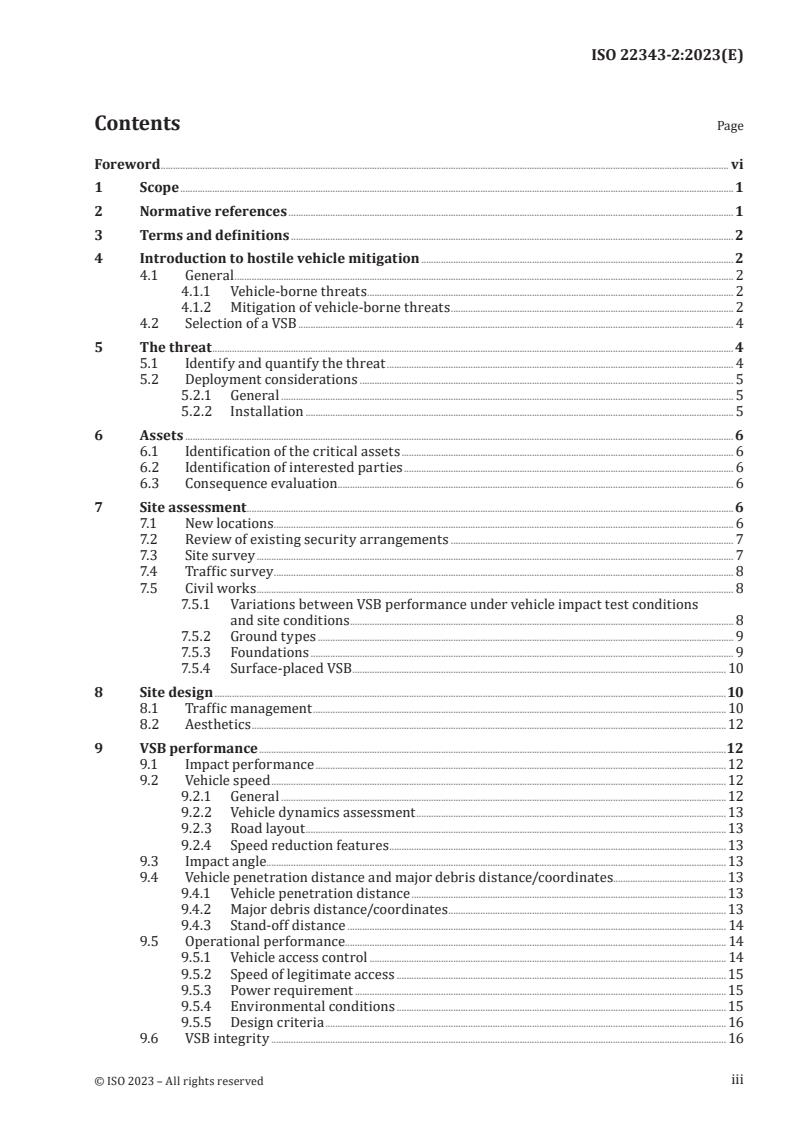
Contents Page
Foreword . vi
1 Scope . 1
2 Normative references . 1
3 Terms and definitions . 2
4 Introduction to hostile vehicle mitigation . 2
4.1 General . 2
4.1.1 Vehicle-borne threats . 2
4.1.2 Mitigation of vehicle-borne threats . 2
4.2 Selection of a VSB . 4
5 The threat . 4
5.1 Identify and quantify the threat . 4
5.2 Deployment considerations . 5
5.2.1 General . 5
5.2.2 Installation . 5
6 Assets . 6
6.1 Identification of the critical assets . 6
6.2 Identification of interested parties . 6
6.3 Consequence evaluation . 6
7 Site assessment .6
7.1 New locations. 6
7.2 Review of existing security arrangements . 7
7.3 Site survey . 7
7.4 Traffic survey . 8
7.5 Civil works . 8
7.5.1 Variations between VSB performance under vehicle impact test conditions
and site conditions . 8
7.5.2 Ground types . 9
7.5.3 Foundations . 9
7.5.4 Surface-placed VSB . 10
8 Site design .10
8.1 Traffic management . 10
8.2 Aesthetics .12
9 VSB performance .12
9.1 Impact performance . 12
9.2 Vehicle speed .12
9.2.1 General .12
9.2.2 Vehicle dynamics assessment . 13
9.2.3 Road layout .13
9.2.4 Speed reduction features . 13
9.3 Impact angle. 13
9.4 Vehicle penetration distance and major debris distance/coordinates.13
9.4.1 Vehicle penetration distance . 13
9.4.2 Major debris distance/coordinates . 13
9.4.3 Stand-off distance . 14
9.5 Operational performance. 14
9.5.1 Vehicle access control . 14
9.5.2 Speed of legitimate access . 15
9.5.3 Power requirement .15
9.5.4 Environmental conditions . 15
9.5.5 Design criteria . 16
9.6 VSB integrity . 16
iii
9.6.1 VSB damage. 16
9.6.2 Remote access to automatic access control system . 16
9.6.3 Repairs . 17
9.6.4 Staff, skills and availability . 17
9.7 Design method . 18
10 Procurement strategy .18
10.1 General . 18
10.2 Availability and maintenance of the VSB . 18
10.3 Quality . 18
10.4 Cost . 18
10.5 Commissioning and handover . 19
11 Deployment and removal . .20
11.1 Highway/local authority approval. 20
11.2 Logistics of deployment . .20
11.3 Installation . 20
11.4 Lifting and placement . 20
11.5 Removal considerations . 21
12 Types of VSB .21
12.1 General . 21
12.2 Passive VSBs . 21
12.3 Active VSBs . 21
12.4 Foundation type . 22
12.5 Foundations and layout.23
12.6 Examples of VSBs — Bollards . 24
12.6.1 General . 24
12.6.2 Fixed bollards . 24
12.6.3 Active bollards . 24
12.7 Examples of VSBs — Road blockers . 25
12.8 Examples of VSBs — Rising arm barriers . 25
12.8.1 General . 25
12.8.2 Layout . 26
12.9 Examples of VSBs — Sliding and swing gates . 26
12.9.1 General . 26
12.9.2 Foundations .26
12.9.3 Layout . 26
12.10 Examples of VSBs — Street furniture . 27
12.10.1 General . 27
12.10.2 Foundations . 27
12.11 Examples of VSBs — Manually deployable (portable) .28
13 Vehicle access control points .28
13.1 General .28
13.2 Layout of active VSBs at VACPs .30
13.2.1 General .30
13.2.2 Single line of VSBs .30
13.2.3 Interlocked VSBs . 31
13.2.4 Final denial VSB. 32
13.2.5 Traffic throughput . 33
13.3 Safety issues.34
13.4 Control system . 35
14 Training .36
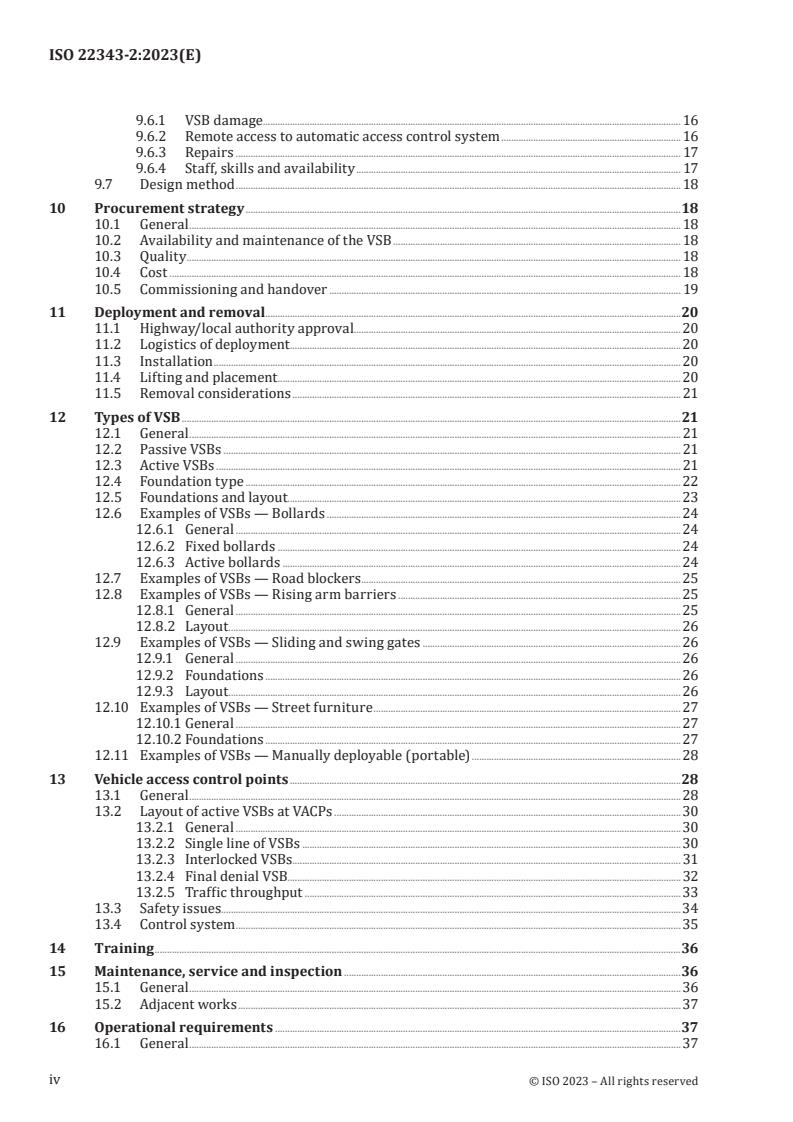
15 Maintenance, service and inspection .36
15.1 General .36
15.2 Adjacent works . 37
16 Operational requirements .37
16.1 General . 37
iv
16.2 Level 1 OR . . . 37
16.3 Level 2 OR . . 37
16.4 Level 2 OR proforma . 39
Annex A (informative) Level 2 operational requirement proforma .40
Annex B (informative) Design method .56
Annex C (informative) Modifications to the VSB .60
Annex D (informative) VSB compliance sign off .61
Bibliography .63
v
Foreword
ISO (the International Organization for Standardization) is a worldwide federation of national standards
bodies (ISO member bodies). The work of preparing International Standards is normally carried out
through ISO technical committees. Each member body interested in a subject for which a technical
committee has been established has the right to be represented on that committee. International
organizations, governmental and non-governmental, in liaison with ISO, also take part in the work.
ISO collaborates closely with the International Electrotechnical Commission (IEC) on all matters of
electrotechnical standardization.
The procedures used to develop this document and those intended for its further maintenance are
described in the ISO/IEC Directives, Part 1. In particular, the different approval criteria needed for the
different types of ISO document should be noted. This document was drafted in accordance with the
editorial rules of the ISO/IEC Directives, Part 2 (see www.iso.org/directives).
ISO draws attention to the possibility that the implementation of this document may involve the use
of (a) patent(s). ISO takes no position concerning the evidence, validity or applicability of any claimed
patent rights in respect thereof. As of the date of publication of this document, ISO had not received
notice of (a) patent(s) which may be required to implement this document. However, implementers are
cautioned that this may not represent the latest information, which may be obtained from the patent
database available at www.iso.org/patents. ISO shall not be held responsible for identifying any or all
such patent rights.
Any trade name used in this document is information given for the convenience of users and does not
constitute an endorsement.
For an explanation of the voluntary nature of standards, the meaning of ISO specific terms and
expressions related to conformity assessment, as well as information about ISO’s adherence to
the World Trade Organization (WTO) principles in the Technical Barriers to Trade (TBT), see
www.iso.org/iso/foreword.html.
This document was prepared by Technical Committee ISO/TC 292, Security and resilience.
This first edition cancels and replaces IWA 14-2:2013, which has been technically revised.
The main changes are as follows:
— alignment with ISO 22343-1;
— updating of the document in light of changing threat and availability of tested vehicle security
barriers (VSBs), i.e. surface-placed and shallow mount systems;
— re-organization of the document for international readability.
A list of all parts in the ISO 22343 series can be found on the ISO website.
Any feedback or questions on this document should be directed to the user’s national standards body. A
complete listing of these bodies can be found at www.iso.org/members.html.
vi
INTERNATIONAL STANDARD ISO 22343-2:2023(E)
Security and resilience — Vehicle security barriers —
Part 2:
Application
1 Scope
This document gives guidance on the selection, installation and use of vehicle security barrier (VSBs)
and describes the process of producing operational requirements (ORs).
It also gives guidance on a design method for assessing the performance of a VSB.
This document is applicable to end users, such as site owners and specifiers, of VSBs, where they are
used to protect people in any public or private location from vehicle attacks.
This document does not apply to the performance of a VSB or its control apparatus when subjected to:
— slow speed encroachment;
— slow speed nudging and ramming;
— blast explosion;
— ballistic impact;
— manual attack, with the aid of the vehicle (multiple impacts at slow speed);
— manual attack, with the aid of tools (excluding vehicles);
— electrical manipulation;
— attack on the control systems by any means.
NOTE 1 For manual attack, a variety of test methods exist. For assessing intruder resistance of building
[53]
components, see LPS 1175 .
NOTE 2 The VSB is designed and tested on the basis of:
a) vehicle type, mass and speed of the assessed vehicle-borne threat;
b) its geographical application (e.g. climate conditions);
c) intended site location (e.g. rigid or non-rigid soil/finished surface (paving, cobblestone, granite, asphalt).
It does not apply to guidance on design, the operational suitability of a VSB or other impact test methods.
2 Normative references
The following documents are referred to in the text in such a way that some or all of their content
constitutes requirements of this document. For dated references, only the edition cited applies. For
undated references, the latest edition of the referenced document (including any amendments) applies.
ISO 22343-1 , Security and resilience — Vehicle security barriers — Part 1: Performance requirement,
vehicle impact test method and performance rating
3 Terms and definitions
For the purposes of this document, the terms and definitions given in ISO 22343-1 apply.
ISO and IEC maintain terminology databases for use in standardization at the following addresses:
— ISO Online browsing platform: available at https:// www .iso .org/ obp
— IEC Electropedia: available at https:// www .electropedia .org/
4 Introduction to hostile vehicle mitigation
4.1 General
4.1.1 Vehicle-borne threats
Vehicle-borne threats can range from the use of a vehicle for vandalism to determined attacks by
adversaries (e.g. criminals and terrorists). The convenience, mobility and payload capacity of a vehicle
offers a tactical means to deliver multiple adversaries and weapons (e.g. an explosive device, firearms
or other hazardous payloads) closer to their target. Vehicles can also be used as a weapon: to drive into
people to cause injury and/or ram into infrastructure to disrupt services.
To conduct such attacks, hostile vehicles can be parked, manoeuvred or rammed into or out of a site, or
adversaries can use a deception or duress methodology.
Attacks on the VSB to enable access by the hostile vehicle without damaging the vehicle or occupants
can include:
a) physical: forcing/tampering with the VSB or the use of an explosive device;
b) electronic: accessing and manipulation of the VSB control system or interfaced platforms (e.g.
access control and building management systems).
A clear definition of the asset(s) (e.g. infrastructure and/or people) to be protected, the threat and how
an attack can be manifested should be the foundation of a risk-based mitigation strategy.
4.1.2 Mitigation of vehicle-borne threats
The mitigation of all forms of vehicle-borne threat can be difficult while satisfying other business
needs. The following should be considered as a minimum:
a) security:
1) the level of residual risk deemed acceptable by the organization/interested parties;
2) the asset(s) to be protected (see Clause 6):
i) hard target (buildings and infrastructure);
ii) soft target (people and crowded places);
3) the attack method to be mitigated;
4) security measures (their performance, deployment, operational and physical limitations);
5) response to increased threat conditions;
6) enforceable stand-off distance to the asset(s);
7) security risks induced by safety concerns or systems;
b) business needs:
1) lifetime cost (training, manning levels, service, maintenance and replacement, procurement
options);
2) traffic management (vehicular and pedestrians);
3) appearance;
4) internal and external interested party requirements;
c) engineering constraints:
1) site topography;
2) architectural;
3) VSB technical and performance constraints;
4) foundations;
5) buried services;
6) land ownership and available space;
7) local authority planning restriction(s) (e.g. height/mass/noise, utilities).
It is important that a security OR (see Clause 16) is developed in conjunction with a user requirement
document (URD) and that all key interested parties are involved from the outset.
The considered elements (i.e. security ORs, user requirements) can adversely influence each other.
Therefore, early consideration of acceptable compromises should be made, particularly with regard to
the security and safety aspects of the VSBs.
Risk assessments should be conducted for safety and security early in the design phase of project
planning, during commissioning and after final installation to ensure the level of residual risk is
identified and owned by the interested parties (e.g. site and or event owner, security and safety
representatives, project manager(s), staff representatives).
These assessments should be shared with or jointly produced by the interested parties and regularly
reviewed. Early engagement with the interested parties can facilitate the development of business
cases and can help identify potential issues, associated costs and constraints.
There is likely to be a need to allow authorized vehicle movement, to allow the safe, secure and timely
transit of legitimate vehicles. Additionally, long-term security issues relating to system reliability and a
change in threat level can also compromise the initial ORs.
A change in threat can result in heightened security response levels and VSBs and procedures that
cannot operate either safely or securely in that new environment.
Often vehicular access has to be provided through the VSB line. The vehicles can be searched or be
of known authenticity before allowing access through the vehicle access control point (VACP). In this
instance, a single or multiple access point may be provided through the active security barriers. Where
the stand-off measure forms the site boundary or security perimeter, the VACP then typically becomes
the first point of challenge for all vehicles.
Regardless of the type of active VSB installed, a secondary access control point should be considered.
This is to ensure that where the VSBs fail or there is an incident at the main VACP, traffic can easily be
diverted to the secondary location. This location should be able to accommodate the traffic volumes
typical to the main VACP while maintaining the same level of operational security.
Where an entrance has more than one VSB (e.g. a separate entry barrier and exit barrier), then each
VSB should have independent drive and control systems. This is to prevent a cascade or nodal failure
as a result of one VSB developing a fault. They may share the same user interface, hydraulic circuits
and electrical systems, but should be designed so that a failure does not disable all VACPs. Provision of
an uninterruptable power supply (UPS) or standby generator should also be considered. An unreliable
VSB is unacceptable and has additional implications that can include costly compensatory measures to
correct the condition.
4.2 Selection of a VSB
The selection of a VSB is dependent on a number of factors, including but not limited to:
a) the threat (see Clause 5);
b) the assets to be protected (see Clause 6);
c) the site (see Clauses 7 and 8);
d) the required performance of the VSB (see Clause 9);
e) the procurement strategy (see Clause 10);
f) deployment and removal of the VSB (see Clause 11);
g) the type of VSB required (see Clauses 12 and 13).
The decision process for the selection of VSBs is illustrated in the flow diagrams in Clause 16, which
covers ORs.
5 The threat
5.1 Identify and quantify the threat
Previous and emerging terrorist, criminal or malicious incidents should be reviewed and their relevance
to the site considered, regarding the target and attack methods used. Threats can evolve or change
with time and it is recommended that periodic reviews of the threat and trends are undertaken, and the
results recorded and documented, by the interested parties.
NOTE The national, regional or local security force can be contacted for threat level updates.
There are seven main methods a vehicle-borne threat (e.g. vehicle as a weapon (VAW) or a vehicle-borne
improvised explosive device (VBIED)) can be deployed with or without the use of suicide operatives, as
follows:
a) Parked vehicles: Unscreened vehicles are parked adjacent to a site, in underground parking facilities
or overlooking a site.
b) Encroachment (exploiting gaps in defences): A hostile vehicle negotiates through/round an
incomplete line of barriers or an incorrectly spaced line of barriers without the need to impact. An
alternative form of encroachment attack is exploitation of an active barrier system at a VACP by a
hostile vehicle “tailgating” a legitimate vehicle.
c) Penetrative attacks: The front or rear of the hostile vehicle is used as a ram, either as a single or a
repetitive impact, against the VSB.
d) Deception techniques: A “Trojan” vehicle (one whose model, livery or registration is familiar to
the site) is used or where hostile occupants negotiate their way through by pretence or by using
stolen (or cloned) access control or ID passes. Alternative scenarios include a driver unknowingly
delivering an improvised explosive device (IED) or weapon(s) surreptitiously planted in their
vehicle by an attacker, or an “insider” bringing an IED/weapon(s) in to their own work site.
Deception techniques prey on human and operational weaknesses.
e) Duress techniques: The driver of a legitimate vehicle is forced to carry an IED/weapon(s) or where
a guard controlling a VACP is forced to allow a vehicle entry. These are perhaps the most difficult
forms of vehicle-borne threat to defend against.
f) Insider: A person with legitimate access willingly facilitates an attack by operating the security
measures locally or remotely, managing or issuing access rights or tampering with the security
measures.
g) Tamper/sabotage: With the intent of leaving no evidence, this attack facilitates hostile vehicle
access at a later time. This can involve altering, weakening or disabling a barrier and/or associated
security systems. This can be a physical or cyber-attack that occurs gradually over time or
immediately before, in order to facilitate a fast-moving attack.
Consideration should be given to addressing the threat of layered attack scenarios using one or more of
the threat types given in this subclause, and how physical and operational security measures should be
introduced to counter that threat. For instance, the use of a first hostile vehicle to create a gap by way of
penetrative attack or blast which then allows a second to encroach through.
5.2 Deployment considerations
5.2.1 General
The period for which security measures are required (design-life) should be defined.
The threat(s) should be assessed and an identification should be made of whether a permanent, semi-
permanent or temporary installation is required as well as the level of protection that the security
measure is required to provide.
5.2.2 Installation
For a new installation, the following types should be considered as part of the risk assessment and
operating plans:
a) permanent installation, which can require significant civil engineering works and is expected to
remain for the life of the asset;
b) semi-permanent installation, which is a hybrid that incorporates some transitory elements that
can be retracted or removed leaving any permanent foundation or anchorage in situ;
c) temporary installation that may be deployed on the basis that it remains in situ for a short period of
time. The extent of the remedial measures required upon removal are kept to a minimum.
It is recommended that interested parties consider the advantages of choosing each of the above options
where regular events are undertaken at the location, and whether there is a cost benefit to choosing
option a) or b) rather than repeated deployment of option c).
It should be decided if, how and from where the system is to be controlled, e.g. controlled locally by
guard, from a central control room or through the use of automatic access control systems (AACS).
An assessment and review should be made at regular intervals as to whether the security measures
need to be adapted to a change in the threat.
6 Assets
6.1 Identification of the critical assets
The assets and their users to be protected should be identified as soft targets (e.g. people, an area,
public event, crowded place) and hard targets (e.g. machinery, infrastructure, equipment, one or more
buildings).
If more than one asset is identified, they should be prioritized.
It should be determined whether there is an existing defensible security perimeter and whether there
is a need to establish a temporary or permanent perimeter security scheme.
The physical VSB strategy may be coordinated with adjacent interested parties.
6.2 Identification of interested parties
Interested parties should be identified and engaged at the start of the project and include both those who
can deliver the solution as well as those affected by the proposed security measures. These include, but
are not limited to, management, staff, security, local authorities, public transport, emergency services,
utility companies, highway authorities, architects, security consultants, neighbours and landlords.
6.3 Consequence evaluation
The consequences of an attack and the likely disruption in terms of loss of life, damage, and business
and financial impact and reputation should be assessed.
Locations or other assets which can suffer short- or long-term disruption to their operations from an
attack should be identified. For example:
a) neighbouring buildings (e.g. government, military, residential, business, emergency services,
schools, religious sites, other assets);
b) people;
c) major communication networks (above and below ground);
d) control rooms;
e) electricity, water and gas lines or storage facilities (above and below ground);
f) underground tunnels, basements and subways;
g) ventilation shafts;
h) bridges;
i) public transport infrastructure and airports.
Threat displacement should be considered and communicated with all interested parties.
7 Site assessment
7.1 New locations
It should be recognized that the majority of measures to be installed will be retro-fitted to an existing
asset, often in an urban environment, with challenges that come with working with existing services
and structures, which can limit scope for innovation. When considering a new (green field) location,
interested parties should introduce measures which can be specified for the site location, as well as the
design of the asset that can incorporate measures from the start of the build. This should minimize any
compromise in security and will typically be more cost effective than installing a subsequent retrofit.
7.2 Review of existing security arrangements
Once the site security plans have been implemented that establish the acceptable level of security risk, a
change control process should be adopted for any proposed site changes (e.g. site infrastructure, safety
related, physical security related, VSB hardware and procedures) to ensure an acceptable level of risk is
maintained. As part of the configuration control process, an analysis should be performed that ensures
that acceptance of the proposed change does not reduce the effectiveness of the previous site security
plans.
The type of vehicles and their frequency of access and egress to the site should be established. The
vehicles should also be assigned authorized and unauthorized pre-notified status and the means of
access control defined for the different visitor types.
7.3 Site survey
All traversable routes along which a hostile vehicle can challenge a VSB or perimeter should be
determined. This includes all carriageways, footways, cycle paths, open spaces and gaps. It should be
recognized that there is likelihood that hostile vehicles can travel against the expected direction of
traffic. The location and usability of drop kerbs and other adaptations in the streetscape should be
considered.
A vehicle dynamics assessment (VDA) should be undertaken as part of the site survey. This provides
a formalized evaluation of the speed that a threat vehicle, as identified in ISO 22343-1, can achieve at
a specific location round the site. This enables the site to identify products including VSBs that have
achieved a performance classification under ISO 22343-1 or an equivalent impact test standard for
vehicle security barriers.
In many locations, it can be necessary to incorporate a vehicle swept path analysis to demonstrate the
ability of the threat vehicle to access specific location or to ensure that authorized vehicles will not be
compromised when accessing the site, by the location of the VSB.
The site survey should incorporate each of the site access locations such that the daily operation of the
site is covered and that peak vehicle and pedestrian flow rates can be accounted for in the operation of
the VA
...