


ISO 1213-1:1993
(Main)Solid mineral fuels — Vocabulary — Part 1: Terms relating to coal preparation
Solid mineral fuels — Vocabulary — Part 1: Terms relating to coal preparation
Defines, in English, 420 terms commonly employed in coal preparation under the following headlines: general terms, sizing, cleaning, separation of solids from water or air, size reduction, expression of results, blending and homogenization, automatic control.
Combustibles minéraux solides — Vocabulaire — Partie 1: Termes relatifs à la préparation du charbon
L'ISO 1213-1:1993 définit des termes communément employés dans la préparation du charbon.
Trdna fosilna goriva - Slovar - 1. del: Strokovni izrazi v tehnologiji premoga
General Information
- Status
- Withdrawn
- Publication Date
- 01-Dec-1993
- Withdrawal Date
- 01-Dec-1993
- Technical Committee
- ISO/TC 27/SC 1 - Coal preparation: Terminology and performance
- Drafting Committee
- ISO/TC 27/SC 1 - Coal preparation: Terminology and performance
- Current Stage
- 9599 - Withdrawal of International Standard
- Start Date
- 24-Sep-2020
- Completion Date
- 12-Feb-2026
Relations
- Effective Date
- 26-May-2018
- Revises
ISO 1213-1:1982 - Solid mineral fuels — Vocabulary — Part 1: Terms relating to coal preparation - Effective Date
- 15-Apr-2008


Get Certified
Connect with accredited certification bodies for this standard

Bureau Veritas Chile
Bureau Veritas certification services in Chile.
Bureau Veritas Peru
Bureau Veritas certification services in Peru.
BVQI Peru
Bureau Veritas certification in Peru.
Sponsored listings
Frequently Asked Questions
ISO 1213-1:1993 is a standard published by the International Organization for Standardization (ISO). Its full title is "Solid mineral fuels — Vocabulary — Part 1: Terms relating to coal preparation". This standard covers: Defines, in English, 420 terms commonly employed in coal preparation under the following headlines: general terms, sizing, cleaning, separation of solids from water or air, size reduction, expression of results, blending and homogenization, automatic control.
Defines, in English, 420 terms commonly employed in coal preparation under the following headlines: general terms, sizing, cleaning, separation of solids from water or air, size reduction, expression of results, blending and homogenization, automatic control.
ISO 1213-1:1993 is classified under the following ICS (International Classification for Standards) categories: 01.040.73 - Mining and minerals (Vocabularies); 73.040 - Coals. The ICS classification helps identify the subject area and facilitates finding related standards.
ISO 1213-1:1993 has the following relationships with other standards: It is inter standard links to ISO 1213-1:2020, ISO 1213-1:1982. Understanding these relationships helps ensure you are using the most current and applicable version of the standard.
ISO 1213-1:1993 is available in PDF format for immediate download after purchase. The document can be added to your cart and obtained through the secure checkout process. Digital delivery ensures instant access to the complete standard document.
Standards Content (Sample)
SLOVENSKI STANDARD
01-februar-1998
Trdna fosilna goriva - Slovar - 1. del: Strokovni izrazi v tehnologiji premoga
Solid mineral fuels -- Vocabulary -- Part 1: Terms relating to coal preparation
Combustibles minéraux solides -- Vocabulaire -- Partie 1: Termes relatifs à la préparation
du charbon
Ta slovenski standard je istoveten z: ISO 1213-1:1993
ICS:
01.040.75 Naftna in sorodna tehnologija Petroleum and related
(Slovarji) technologies (Vocabularies)
73.040 Premogi Coals
75.160.10 Trda goriva Solid fuels
2003-01.Slovenski inštitut za standardizacijo. Razmnoževanje celote ali delov tega standarda ni dovoljeno.
INTERNATIONAL ISO
1213-1
STANDARD
Second edition
1993-12-01
Solid mineral fuels - Vocabulary -
Part 1:
Terms relating to coal preparation
Combustibles minkaux solides - Vocabulaire -
Patiie 7: Termes relatifs 6 Ia pkparation du charbon
Reference number
ISO 1213~1:1993 (E)
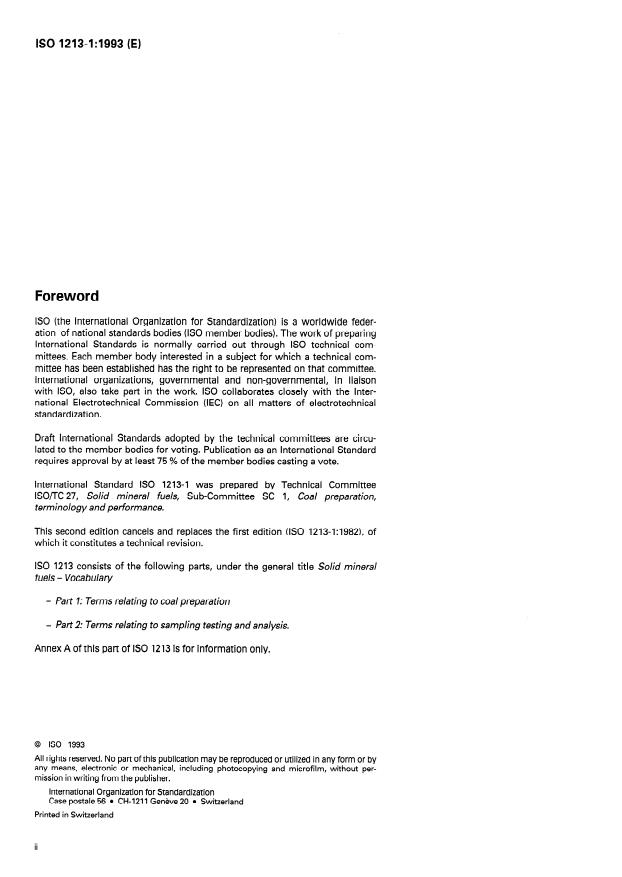
Foreword
ISO (the International Organization for Standardization) is a worldwide feder-
ation of national Standards bodies (ISO member bodies). The work of preparing
International Standards is normally carried out through ISO technical com-
mittees. Esch member body interested in a subject for which a technical com-
mittee has been established has the right to be represented on that committee.
International organizations, governmental and non-governmental, in liaison
with ISO, also take patt in the work. ISO collaborates closely with the Inter-
national Electrotechnical Commission (IEC) on all matters of electrotechnical
standardization.
Draft International Standards adopted by the technical committees are circu-
lated to the member bodies for voting. Publication as an International Standard
requires approval by at least 75 % of the member bodies casting a vote.
International Standard ISO 1213-1 was prepared by Technical Committee
lSO/rC 27, Solid mineral fuels, Sub-Committee SC 1, Coal preparation,
terminology and Performance.
This second edition cancels and replaces the first edition (ISO 1213-1:1982), of
which it constitutes a technical revision.
ISO 1213 consists of the following Parts, under the general title Solid mineral
fuels - Vocabulary
- Part 7; Terms relating to coal preparation
- Part 2: Terms relating to sampling testing and analysis.
Annex A of this patt of ISO 1213 is for information only.
0 ISO 1993
All rights reserved. No part of this publication may be reproduced or utilized in any form or by
any means, electronie or mechanical, including photocopying and microfilm, without per-
mission in writing from the publisher.
International Organization for Standardization
Case postale 56 l CH-1211 Geneve 20 l Switzerland
Printed in Switzerland
ii
ISO 1213~kl993 (E)
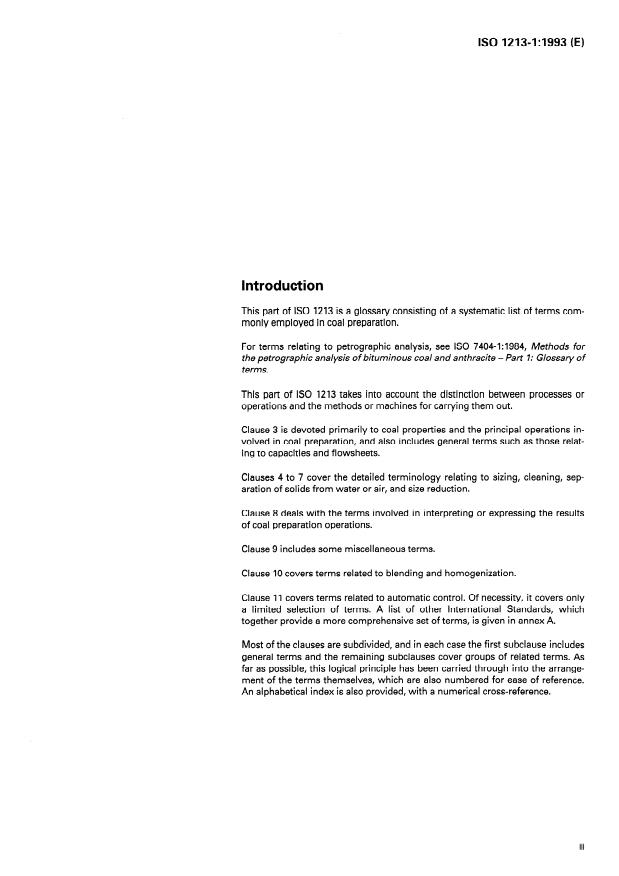
Introduction
This part of ISO 1213 is a glossary consisti ng of a systematic list of terms com-
monly employed in coal preparation.
For terms relating to petrographic analysis, see ISO 7404-1:1984, Methods for
the petrographic analysis of bituminous coal and anthracite - Part 7: Glossary of
terms.
This patt of ISO 1213 takes into account the distinction between processes or
operations and the methods or machines for carrying them out.
Clause 3 is devoted primarily to coal properties and the principal operations in-
volved in coal preparation, and also includes general terms such as those relat-
ing to capacities and flowsheets.
Clauses 4 to 7 cover the detailed terminol ogy relatin g to sizing, cleaning, sep-
aration of sol ids from wa ter or air, and size reduction.
8 deals with the terms involved in interpreti ng or express ing the resu Its
Clause
of coal preparation operations.
Clause 9 includes some miscellaneous terms.
Clause 10 covers terms related to blending and homogenization.
Clause 11 covers terms related to automatic control. Of necessity, it covers only
a limited selection of terms. A list of other International Standards, which
together provide a more comprehensive set of terms, is given in annex A.
Most of the clauses are subdivided, and in each case the first subclause includes
general terms and the remaining subclauses cover groups of related terms. As
far as possible, this logical principle has been carried through into the arrange-
ment of the terms themselves, which are also numbered for ease of reference.
An alphabetical index is also provided, with a numerical Cross-reference.
. . .
Ill
This page intentionally Ieft blank
ISO 1213~1:1993 (E)
INTERNATIONAL STANDARD
Solid mineral fuels - Vocabulary -
Part 1:
Terms relating to coal preparation
3.1.06 cleaned coal; clean coal: Coal produced by a
1 Scope
cleaning process (wet or dry).
This patt of ISO 1213 defines terms commonly employed
3.1.07 middlings: A product of coal preparation that, be-
in coal preparation
Cause of its ash percentage, is intermediate between coal
and discard.
2 Normative reference
NOTE 1 lt follows therefore that the relative density of middlings is
intermediate between those of coal and discard. Middlings may be
The following Standard contains provisions which,
reprocessed.
through reference in this text, constitute provisions of this
part of ISO 1213. At the time of publication, the edition in-
3.1.08 true middlings; bone: Middlings so nearly hom-
dicated was valid. All Standards are subject to revision,
ogeneous that their quality cannot readily be improved by
and Parties to agreements based on this part of ISO 1213
crushing and recleaning.
are encouraged to investigate the possibility of applying
the most recent edition of the Standard indicated below. 3.1.09 false middlings; interbanded middlings: Middlings
Members of IEC and ISO maintain registers of currently in which the particles consist of bands of coal and shale,
valid International Standards.
and from which the coal may be liberated by crushing.
ISO 10753:~11, Coal preparation plant - Assessment of the 3.1.10 reject; refuse: The material extracted from the
Iiability to breakdown in water of materials associated feed during cleaning, for retreatment or discard.
with coal seams.
3.1.11 discard; dirt; stone: The material extracted from
the raw coal and finally discarded.
3 General
3.1.12 recirculation: The Operation in which the whole or
part of a product from a process is returned to the feed to
3.1 General coal preparation terms
a process, e.g. the return of the crushed overflow from a
Screen to the Screen feed for rescreening.
3.1.01 coal preparation: Collectively, physical and me-
chanical processes applied to coal to make it suitable for a
3.1.13 ‘Yoreign coal”: Coal received at a preparation plant
particular use.
from a Source other than that to which the plant is at-
tached.
3.1.02 run of mine; r.o.m. coal: Coal produced by mining
operations, before screening, crushing or preparation.
3.1.14 imported coal: Coal coming from a foreign
country, or other state within the country.
3.1.03 raw coal: Coal that has received no preparation
other than possibly screening or crushing.
3.1.15 low-grade coal: Combustible material that has
only limited uses owing to undesirable characteristics (e.g.
3.1.04 raw coal feed: Raw coal supplied to a plant or
ash percentage or size).
machine, in which it undergoes some form of preparation.
3.1.16 Segregation: Partial Separation of a material into
3.1.05 coal cleaning: The treatment of raw coal to lower its constituents, occurring as a result of differentes in
particle characteristics such as pattitle size or relative
the quantity of undesirable constituents, through the dif-
ference in either density or surface properties
density.
1) To be published.
ISO 1213~1:1993 (E)
3.2 Cleaning characteristics 3.2.11 actual performante curve: A performante curve
showing the results actually obtained from a coal prep-
3.2.01 washability: The amenability of a coal to improve- aration treatment.
ment in quality by cleaning, generally through its relative
density/ash relationship.
3.2.12 expected Performance curve: A Performance
curve showing the expected results of a coal preparation
treatment.
3.2.02 float-and-sink analysis: The division of a Sample
into relative density fractions having defined limits, the
amounts of the fractions being expressed as percentages 3.2.13 M-curve; Mayer curve: A vectorial curve, obtained
of the total Sample, commonly with an indication of the by plotting the cumulative ash percentages against their
ash percentage (and other characteristics, if required) sf cumulative yields, used to express the washability of a
coal, plotted on a vectorial diagram in which the projection
each fraction.
of the vector on the Ordinate (vertical axis) represents the
percentage of the product (coal) and the direction of the
3.2.03 washability curve: Any curve obtained from the
vector represents the percentage of a particular con-
results of a float-and-sink analysis permitting the theoreti-
stituent of the product.
cal yield of floats or sinks to be read off.
3.2.14 ash/relative density curve: The curve obtained
NOTE 2 The following are the five main types of washability curves:
from the float-and-sink analysis by plotting the ash per-
centages of successive fractions against the mean relative
- the characteristic ash curve;
density of the fraction.
- the cumulative floats curve;
- the cumulative sinks curve;
3.3 Capacity and throughput
- the densimetric (relative density) curve;
3.3.01 nominal capacity: A notional figure, expressed in
- the near-density curve.
mass per hour, used in the title of a flowsheet and in the
general description of a plant, applying to the plant as a
3.2.04 characteristic ash curve: The curve obtained from
whole and to the specific product under consideration.
the results of a float-and-sink analysis showing, for any
mass percentage of floats (or sinks) the ash percentage of
3.3.02 operational capacities: Figures given on a flow-
the highest density (or lowest density) fraction passing
sheet to indicate quantities per unit time passing various
into these floats (or sink& the mass percentage being
Points in the plant, taking account of fluctuations in the
plotted on the Ordinate (vettical axis) and the ash percent-
rate of supply and composition (as to size and impurity
age on the abscissa (horizontal axis).
content).
3.2.05 cumulative curve: Any curve expressing the re-
3.3.03 design capacity: The rate of feed at which specific
sults of combining successive relative density fractions or
items of plant must operate continuously and give the
size fractions.
guaranteed results on a particular quality of feed.
3.3.04 peak design capacity: A rate of feed in excess of
3.2.06 cumulative floats curve: The curve obtained from
the design capacity that specific items of plant will accept
the results of a float-and-sink analysis by plotting the
for short periods without necessarily fulfilling the perform-
cumulative mass percentage of floats at each relative
ante guarantees given in respect of them.
density against the cumulative ash of the total floats at
that density.
3.3.05 mechanical maximum capacity: The highest rate
of feed at which specific items of equipment, not subject
3.2.07 cumulative sinks curve: The curve obtained from
to Performance guarantees, will function on the type and
the results of a float-and-sink analysis by plotting the
quality of feed for which they are supplied.
cumulative mass percentage of sinks at each relative
density against the cumulative ash of the total sinks at that
3.3.06 feed: Material for treatment supplied to an ap-
density.
pliance or plant.
3.2.08 densimetric curve; relative density curve: The
3.3.07 basic flowsheet: A schematic diagram represent-
curve obtained from the results of a float-and-sink analysis
ing the various preparation process stages in the treat-
by plotting the cumulative mass percentage of floats or
ment of the raw coal.
sinks against the relative density.
3.3.08 process flowsheet: A basic flowsheet indicating
3.2.09 near-density curve; difficulty curve: The curve ob-
the main operational Steps within the plant, the movement
tained from the results of a float-and-sink analysis, or from
of the various materials between the Steps and the final
the densimetric curve, by plotting the mass percentage
products obtained, and often also the average mass flow
within the limits + 0,l of a given relative density against
at various Points in the plant.
that relative density.
3.3.09 equipment flowsheet: A diagram indicating, by
3.2.10 Performance curve: Any curve used to shovv the Standard Symbols, the units of equipment used in the vari-
relationship between properties of coal and results of a ous operational Steps carried out within a coal preparation
specific treatment. plant.
ISO 1213~1:1993 (E)
3.3.10 materials flowsheet: A flowsheet principally con- 4.2 Screening
cerned with solid materials.
4.2.01 screening: The Separation of solid materials of dif-
3.3.11 liquids flowsheet: A flowsheet to in dicate the flow
ferent sizes, by causing part to remain on a surface pro-
of liqu ids throughout a series of operations.
vided with apertures through which the remainder Passes.
3.3.12 weighted flowsheet; capacity flowsheet: A
4.2.02 Screen:
materials flowheet used in the design sf a plant, including
(1) A device for carrying out the Operation of screening.
Statements of the mass flow per hour at principal Points in
the plant.
A commonly used abbreviation for Screen deck or
(2)
screening surface, e. g. woven-wire Screen.
4 Sizing
4.2.03 amplitude: The maximum displacement from the
mean Position in an oscillating motion.
4.1 General
NOTE 6 In the case of a Screen having a straight line motion or el-
be-
4.1.01 sizing: Division of a material into products
liptical motion, it is half of the total movement or half of the major
tween nominal size limits. axis of the ellipse. In the case of a circular motion, it is the radius of
the circle.
4.1.02 classification: The Separation sf particles accord-
See also stroke (4.2.04).
ing to their size, density and shape by control of their set-
tling rate through a fluid medium.
4.2.04 stroke; throw: The distance between the extreme
positions of an oscillating or vibrating motion, i.e. the
4.1.03 size analysis: The process or the result of the div-
stroke is equal to twice the amplitude.
ision of a Sample into size fractions, each within defined
limits, the mass or number of particles in each fraction
4.2.05 apet-ture sire: The dimension or dimensions defin-
being expressed as percentages of the total Sample.
ing the opening in the screening surface, qualified as to
the shape of aperture, e.g. “round-hole”, “Square-mesh”,
4. 1.04 sieve analysis: Size analysis i n which the division
“long-slot”.
iS carri ed out by the use of test sieves.
4.2.06 dry screening: The sc reening of solid materials of
4.1.05 mean size: The weighted averag e parti cle size of
different sizes without the aid of water.
any Sample, batch or consignment of patt ic ulate ma terial.
4.2.07 wet screening: : The screening of solid materials
NOTE 3 Several bases for calculating mean size have been pro-
of different sizes with the aid of water.
posed, giving results that vary widely for the same size distribution.
The method of calculation should, therefore, always be stated when-
ever results are reported.
4.2.08 probability screening: A method of screening that,
by making extended use of the probability of a particle
4.1.06 nominal size; limiting size: The limit or limits of passing through an aperture, allows sizing at fine sizes to
pattitle size used to describe a product of a sizing oper- be performed with relatively large apertures.
ation.
4.2.09 desliming: The removal of slimes from coal or a
4.1.07 oversize: Material in a product of size greater than
mixture of coal and water, however accomplished.
the upper nominal size limit; may be expressed as a per-
centage of the product.
4.2.10 fines removal: The removal of fine particles from a
feed material, by either wet or dry methods, to facilitate
4.1.08 undersize: Material in a product of size smaller
treatment or utilization of the remainder.
than the lower nominal size limit; may be expressed as a
percentage of the product.
4.2.11 dedusting: Fines removal by dry methods.
4.1.09 dust: Particles of solid material sufficiently fine to
4.2.12 Screen overflow: That pottion of the feed material
allow Suspension in air. (See also 6.4.)
discharged from the Screen deck without having passed
through the apertures.
4.1.10 fines: Coal h aving a maxi mum particle size
usually less th n4mm , and havi ng no lower limit.
4.2. 13 mispl aced undersize: Particles in a Screen
ove rflow that are s maller than a reference size.
NOTE 4 The upper limit may vary widely. To avoid confu
sion, the
term should a Iways be qualified by stating the nominal size.
4.2.14 Screen underflow: That portion of the feed ma-
terial that has passed through the apertures in a Screen
4.1.11 smalls: Coal having a maximum particle size
deck.
usually less tha n 25 mm, and hav ng no lower limit.
4.2.15 misplaced oversize: Particles in
a Screen
NOTE 5 The upper limit may vary widely. To avoid confusion, the
underflow that are larger than a reference size.
term should always be qualified by stating the nominal size.
ISO 1213~1:1993 (E)
4.4.02 primary Screen; raw coal Screen: A Screen used to
4.2.16 misplaced material (screening): Undersize con-
divide coal (usually raw coal) into sizes more suitable for
tained in the Overflow, or oversize contained in the under-
the subsequent cleaning of some or all of them.
flow.
4.2.17 near-mesh material; near-size material: Material
4.4.03 dewatering Screen: A Screen used for the separ-
approximating in size to a reference size, usually within
ation of water from solids.
i 25 % of that reference.
4.4.04 desliming Screen: A Screen used for the removal
4.2.18 nominal area (Screen): The total area of the Screen
of slimes from larger particles, usually with the aid of
deck exposed to the flow of the material feed.
water Sprays.
effective area (Screen); working area (deprecated):
4.2.19
4.4.05 slurry Screen: A Screen used to recover and de-
The nominal area less any area occupied by fixings or sup-
water granular products from circulating water in a coal
ports that obstruct the passage of material over or through
preparation plant.
the Screen deck.
4.4.06 rinsing Screen; Spray Screen: A Screen used for the
4.2.20 open area: The ratio of the total area of the aper-
removal of fine solids by spraying, especially dense me-
tures to the total area of the wire cloth, perforated plate or
dium solids present among or adhering to larger particles.
wedge-wire Panel, expressed as a percentage.
4.4.07 sizing Screen(s); grading Screen(s), classifying
4.2.21 sieve
Screen(s) (deprecated): A Screen or set of screens normally
used for dividing a product (e.g. clean coal) into a range of
(1) Generally, a Screen of relatively small area.
sizes.
(2) Particularly, a Screen used for size analysis.
4.4.08 guard Screen; oversize contra1 Screen: A Screen
used to prevent the entry into a machine of coarse par-
ticles which tan interfere with its Operation.
4.3 Parts of screens
4.4.09 undersize control Screen; breakage Screen
4.3.01 Screen deck; screening surface: A surface pro-
(deprecated): A Screen used for the removal or undersize
vided with apertures of specified size for carrying out the
from a product.
Operation of screening.
4.3.02 Screen plate: A plate provided with apertures of
4.5 Screens according to principle sf construction
specifi ed size and range for use as a Screen deck.
4.5.01 Single-deck Screen: A Screen having one screening
4.3.03 Screen cloth; Screen mesh: A mesh of wires
surface, not necessarily limited to one size or shape of ap-
woven in a consistent manner to form the apertures.
erture.
4.3.04 wedge-wire deck; wedge-wire sieve: A Screen
4.5.02 multi-deck Screen: A Screen having two or more
deck, comprising wires of wedge-shaped Cross-section
superimposed screening surfaces mounted rigidly within a
spaced from each other at a fixed dimension, in which the
common frame.
underflow Passes through an apetture of increasing cross-
section.
4.5.03 jigging Screen; reciprocating Screen; s ha ki ng
Screen (deprecated): A Screen to which a combined hori-
4.3.05 loose-rod deck: A screening surface consisting of
zontal and vertical motion is imparted, normally by a
loosely held parallel rods positioned at right angles to the
crankshaft and connecting rod, the Screen deck being hori-
flow of material over the Screen.
zontal or inclined at a small angle.
NOTE 7 Normally, a loose-rod deck is used only on high-speed vi-
4.5.04 resonance Screen: A Screen having a period of os-
brating screens.
cillation at or very close to the natura1 period of oscillation
of the resilient mounting.
4.3.06 relieving deck: A Screen plate having large aper-
tures mounted over the screening deck to reduce the load
4.5.05 vibrating Screen: A Screen oscillated at high Speed
and wear thereon.
by either mechanical or electrical means.
NOTE 9 The amplitude of movement of the vibrating Screen is
4.4 Screens according to purpose
smaller than that of the jigging Screen, and its frequency of oscil-
lation is higher.
4.4.01 run-of-mine Screen: A Screen used for dividing
run-of-mine coal into two or more sizes for further
4.5.06 rotating probability Screen: A device for prob-
treatment or disposal.
ability screening, consisting of a rotating horizontal deck
having radial spokes, the Separation Point being obtained
NOTE 8 A run-of-mine Screen is usually employed to remove the
by varying the rotational Speed.
largest pieces for crushing and readdition to the run-of-mine coal.
ISO 1213~1:1993 (E)
4.5.07 trommel Screen; revolving Screen: A Screen in 5.1.07 middlings elevator: An elevator that removes mid-
which the screening surface is formed into a cylinder or dlings for further treatment or for disposal as an inferior
frustum of a cone, mounted upon a horizontal or near- product.
horizontal rotating shaft, or on revolving rollers.
5.1.08 head tank: A tank or vessel in the water circuit that
4.5.08 roll Screen: A Screen consisting of a number of
is used to maintain the delivery pressure of the water by
horizontal rotating shafts, fitted with elements arranged to constant level to the washing units.
provide screening apertures.
5.1.09 launder: A trough or channel alon which liquids,
Cl
4.5.09 bar Screen: A stationary inclined Screen, compris-
or a mixture of liquids and solids, flow.
ing longitudinal bars, spaced at intervals, onto which the
material is fed at the upper end.
5.1.10 pump sump: A tank into which the process water
gravitates and from which it is recirculated by means of a
4.5.10 grizzly: A rugged Screen for roug h sizing at com-
50 mm). pump-
paratively large size (e.g. 1
Prise fixed or moving bars, discs, or
NOTE 10 A grizzly tan com
5.1.11 Suspension: A mixture of solid particles and water
shaped tumblers or rollers.
or air in which the solid particles are completely and indi-
vidually supported.
4.5.11 sieve bend: A device for the sizing of fine particles
suspended in water by means of a stationary cutved
5.1.12 teeter (in); fluidized Suspension (in): The condition
Panel, usually of wedge-wire, the apetture of which is at
of a Suspension of solids in an upward-moving current of
right angles to the flow of feed, whereby the finer particles
water or air, whereby the support given to the particles re-
are removed with the bulk of the water in the underflow.
duces the internal friction between them to such an extent
[See also fixed Screen (6.2.02).]
that the Suspension acquires fluid or partially fluid proper-
ties.
4.6 Sizing in a current of air or water
5.1.13 water circuit: The complete System sf pipelines,
4.6.01 air classification: The process of sizing in a current
Pumps, sumps, tanks, launders and accessories used for
of air.
the circulation of water in a washery.
4.6.02 classifier: A device that separates particles, ac-
5.1.14 closed water circuit: A water circuit designed so
cording to their size, shape and density, by physical means
that the only water added is that necessary to replace the
other than screening.
loss on the washery products and that due to atmospheric
evaporation.
4.6.03 cyclone classifier: A device for classification by
centrifugal means of fine particles suspended in a fluid,
whereby the coarser particles are discharged from the
5.1.15 circulating water: The water in the water circuit.
apex of the vessel, and the finer particles are removed
with the bulk of the fluid at the overflow orifice.
5.1.16 make-up water: Water supplied to a plant to re-
place th at lost from the ci rcuit.
5 Cleaning
5.1.17 rinsing water; Spray water: Water used to remove
5.1 General
fine particles from larger sizes.
5.1.01 dry cleaning: The Separation of impurities from
5.1.18 waste water; Surplus water, bleed water
coal by manual or mechanical methods that avoid the use
(deprecated): Excess water allowed to run to waste from
of a liquid.
the water circuit. [See also etfluent (6.1.09 and 6.1.10)].
5.1.02 wet cleaning: The mechanical Separation of im-
5.1.19 pit water; mine water: Water from underground
purities from coal by methods involving the use of a
workings or an open-Cut mine.
liquid.
5.1.03 washery: A coal preparation plant in which a wet
5.1.20 slimes: Extremely fine particles in Suspension or
ng process is carried out.
cleani
ad heri ng to larger particles
reclean; rewash: To re-treat a product
5.1.04 in the same
5.1.21 slurry (coal preparation): Fine particles concen-
or in a
nother plant.
trated in a Portion of the circulating water and water-borne
for treatment or disposal.
5.1.05 washery products: The final products from a
washery.
5.1.22 froth flotation: A process for cleaning fine coal in
5.1.06 reject elevator; refuse elevator (deprecated): An which the coal, with the aid of a reagent or reagents, be-
elevator for removing and draining the reject from a wash- Comes attached to air bubbles in a liquid medium and
ing appliance. floats as a froth.
ISO 1213~kl993 (E)
5.2 Dry cleaning 5.3.09 jig Screen plate; bed plate; grid plate, sieve plate
(deprecated): A perforated plate or grid that supports the
5.2.01 hand cleaning: The removal by hand of impurities
bed of material being treated.
from coal, or coal from impurities.
5.3.10 jig bed: The whole of the material on the jig
Screen plate.
5.3.11 jig cell: One of the individual sections into which
5.2.03 picking belt; picking table: A continuous conveyor the jig below the jig Screen plate is divided by transverse
(e.g. in the form of a rubber belt or of a steel apron, steel
division plates, each being capable of separate control.
plate or link construction) on which raw coal is spread for
hand cleaning and/or hand selection.
5.3.12 jig compat-tments: The sections into which a jig is
divided by transverse division plates that extend above the
5.2.04 picking table, circular: An apparatus used for the
jig Screen plate to form a weir.
same purpose as a picking belt and consisting of a flat
horizontal rotating annular plate.
NOTE 11 Esch compartment usually comprises two or more cells.
5.2.05 pneumatic cleaning: Cleaning by means of an air
current.
5.3.13 hutch: The part of a jig situated below the jig
Screen plate in which the controlled pulsating movement
5.2.06 dry cleaning table: An apparatus in which dry
of the water takes place.
cleaning is achieved by the application of air currents and
agitation to a layer of feed of controlled depth moved
along the surface of the table, usually by a reciprocating
5.3.14 jig feed sill: That part of the jig over which the
action.
feed Passes when it enters the box.
5.2.07 air jig: A machine in which the feed is stratified by
5.3.15 jig centre weir: An adjustable plate situated be-
means of pulsating currents of air and from which the
tween the feed end and the discharge end of a jig and
statified products are separately removed.
serving to regulate the forward movement of material
through the box.
5.3 Jigging
5.3.16 jig discharge sill: That patt of the jig over which
5.3.01 jig; washbox (deprecated): A machine in which the
the cleaned coal Passes out of the box.
feed is stratified in water by means of a vertical pulsating
motion and from which the stratified products are sep-
discharge-end re-
NOTE 12 Usually the disch arge sill is part of the
arately removed.
fuse extraction chamber.
5.3.02 primary jig: In a series of jigs, the first jig, which
5.3.17 air valve: A valve that controls the alternate ad-
receives the feed and from which one product at least is
mission and release of compressed air to each cell of a jig.
given futther treatment.
5.3.18 jig slide valve; jig Piston valve (deprecated): A jig
5.3.03 re-wash jig: A jig to which the product (or a
air valve operated by means of a reciprocating motion.
Portion thereof) of a previous cleaning Operation is fed for
additional treatment.
5.3.19 rotary air A jig air valve that rotates on a
5.3.04 air pulsating jig: A jig in which the pulsating mo-
centra axis.
tion is produced by the intermittent admission of com-
pressed air to the water, either alongside the jig bed, e.g.
5.3.20 jig air cycle: The value-timing cycle determining
Baum, or under the jig bed, e.g. Batac, Tacub.
the periods of air admission and exhaust.
5.3.05 feldspar jig: A jig used to clean coal usually
smaller than 12,5 mm in size, in which the pulsating water 5.3.21 reject extractor: A device used in a jig to remove
is made to pass through a bed of graded feldspar, retained the reject from the compartments of a jig, operated manu-
on a compartmented jig screenplate. ally or automatically.
5.3.06 moving sieve jig: A jig in which the jig Screen
5.3.22 float: On certain types of automatic reject extrac-
plate supporting the bed of material under treatment is
tors, the patt that detects variations in thickness of the
moved up and down in water.
layer of heavy material on the jig Screen plate.
5.3.07 plunger jig; Piston jig: A jig in which the pulsating
5.3.23 bed depth transducer: A device that measures
motion is produced by the reciprocating movement of a
variations in the thickness of heavy material on the jig
plunger or Piston.
Screen plate without the use of a float.
5.3.08 diaphragm jig: A jig in which the pulsating motion
5.3.24 reject extraction chamber: That patt of the jig into
is produced by the reciprocating movement of a dia-
which the reject extractor discharges.
phragm.
ISO 121301:1993 (E)
5.3.25 reject gate; discharge shutter (deprecated): The 5.4.08 make-up medium; make-up medium solids: Me-
mechanism of the reject extractor that may be manually or dium or medium solids added to the circuit to replace
automatically operated to control the rate of removal of re- losses.
ject from the jig.
5.4.09 dense medium recovery; medium solids recovery:
5.3.26 reject rotor; star wheel extractor (deprecated): A The collection, for reuse, of medium solids from dilute me-
reject gate in the form of a rotary (or Star) valve. dium, usually understood to include the removal, in whole
or in patt, of contaminating fine coal and clay.
5.3.27 reject worm: A screw conveyor fitted at the bot-
tom of some jigs to collect the fine reject which has 5.4.10 magnetic separator: A device for the recovery and
passed through the apertures in the jig Screen plate. concentration of medium solids that are magnetic.
5.3.28 reject discharge pipes: Pipes used on some jigs in-
5.4.11 magnetics: The pottion of the dense medium
stead of a reject worm. solids that has a high magnetic susceptibility and is there-
fore readily recovered by magnetic means.
5.3.29 Primat-y reject elevator: An elevator that extracts
the first or more dense reject; usually situated at the feed
5.4.12 non-magnetics: The Portion of the dense medium
end of the jig.
solids that has a low magnetic susceptibility.
5.3.30 secondary reject elevator: An elevator that ex-
NOTE 13 These solids are usually of lower relative density than the
tracts the second or less dense reject; usually situated at magnetics and are therefore classed as contaminants.
the discharge end of the jig.
5.4.13 regenerated dense medium; recovered dense me-
(deprecated ): Water in-
5.3.31 top water; transpoft water dium: Medium obtained from the medium recovery sys-
1 assist the t ransport of
troduced with the raw coal feed to tem and separated (wholly or partly) from contaminants.
material through the jig.
5.4.14 dilute medium: Medium of density less than that
5.3.32 flushing water: Water used to assist the flow of in the dense medium separator, usually occurring as a
materials in a chute or launder.
result of spraying the products with water for the removal
of adhering medium solids.
5.3.33 underscreen water; back water (deprecated):
Water that is fed into the cells of a jig below the level of
5.4.15 over-dense medium: Medium of density greater
the jig Screen plate.
than that in the dense medium separator, usually pro-
duced in the medium recovery System and used to main-
tain the desired density in the separator.
5.4 Dense medium cleaning
5.4.16 dense medium plant: A dense medium process
including all the equipment associated with the recovery,
5.4.01 dense liquid: A liquid or Solution, of density
regeneration and circulation of the medium.
greater than that of water, that tan be used in industry or
in the laboratory to divide coal into two fractions of differ-
ent relative densities. 5.4.17 density control device: An automatic device to
control the density of the medium in, or entering, the
dense medium separator.
5.4.02 dense medium; heavy medium: A fluid, formed by
the Suspension in water of particles of relatively high den-
sity (e.g. magnetite, barytes, shale), that tan be used in
5.4.18 medium draining Screen; depulping Screen
industry or in the laboratory to divide coal into fractions of
(deprecated): A Screen for draining the separating medium
different relative densities. from dense medium separator products.
5.4.03 dense medium process: A process for the cleaning 5.4.19 suspended matter: Particles from the feed, of den-
of coal, in which the desired Separation is effected in a
sity equal or close to that of a separating medium, that are
dense medium.
therefore relatively difficult to remove from the separator,
because they are not readily recovered in either the float
or the sink product.
5.4.04 dense medium separator: A device, employing
gravity or centrifugal forte to effect Separation, for the
cleaning of coal using a dense medium.
5.4.20 medium recovery Screen: A Screen for draining
and spraying the product from a dense medium separator
to remove adhering medium solids.
5.4.05 medium solids: The solid component of a dense
medium.
5.4.21 shower box: A device that produces a continuous
cuttain of water droplets in a band over the full width of a
5.4.06 separating medium; correct medium: Dense me-
Screen; usually used on medium recovery screens.
dium of the density required to achieve a given Separation.
5.4.07 circulating medium: Medium in circulation in or 5.4.22 medium solids preparation: Any grinding or treat-
outside the dense medium separator, at or about the den- ment of the raw dense medium solids to make them suit-
sity of that in the separator. able for use.
ISO 1213~kl993 (E)
5.6.05 depressant: A substance that, when added to a
5.5 Cleaning equipment (miscellaneous)
pulp, prevents a particular mineral or minerals from float-
ing.
5.5.01 trou gh washer; launder washer: A clean ing device
ng the principle of alluviation in troughs.
aPPlYi
5.6.06 pulp: A mixture of solid particles and water. [See
5.5.02 concentrating table; shaking table: A device con-
also slurry (5.1.21).]
sisting of a riffled deck, usually inclined in two directions
to the horizontal, to which a differential reciprocating mo-
5.6.07 selective flotation: A process for the preferential
tion in a substantially horizontal direction is imparted; the
recovery of a particular ingredient of the coal, e.g. a
material to be separated is fed in a stream of water; the
petrological constituent, by froth flotation.
heavy particles collect between the riffles and are there
conveyed in the direction of the reciprocating motion,
whereas the lighter particles are borne by the current of
5.6.08 aeration: The introduction of air into the pulp in a
water over the riffles to be discharged laterally from the
flotation cell to form air bubbles.
table.
5.6.09 conditioning: The preparatory Stage in the flo-
5.5.03 riffles: Longitudinal Strips of varying heights
tation process in which the reagents are brought into
mounted on the deck of a concentrating table to separate
intimate contact with the solids of the pulp.
the more dense particles.
5.6.10 conditioner: An apparatus in which conditioning
Secondary water
5.5.04 dressing water; Cross water:
takes place.
n
used o concentrating tables.
5.5.05 upward current washer: A washer in which sep-
5.6.11 reagent feeder: An apparatus for the feeding and
aration takes place under the influence of an upward cur-
proportioning of one or more reagents.
rent of water or dense medium.
5.6.12 flotation cell: A vessel in which a pulp is subjected
5.5.06 plate cleaner: A device, for cleaning closely-sized
to froth flotation.
raw coal, that uses the differente in the coefficient of re-
silience of friction between clean coal and an inclined
plate, commonly of steel, and that between refuse and the 5.6.13 agitator: A device used to bring about a continu-
plate, to allow the clean coal to jump over a gap while the
ous vigorous disturbance in a pulp, usually used to assist
refuse falls through.
bubble formation.
5.5.07 barrel washer; drum washer: A device for clean-
NOTE 14 In the latter case, the agitator is usually in two Parts: a
ing raw coal, comprising a cylinder rotating slowly about
rotating patt, the impeller, and a stationary patt, the diffuser or hood.
an axis slightly inclined to the horizontal, into which the
raw coal, with a current of water or in Suspension, is fed
near its upper end; the clean coal is carried by the water or
5.6.14 primary cells: A group of flotation cells in which
Suspension to the lower end of the cylinder over a scroll
the raw feed is given a preliminary treatment, either or
that conveys the reject to the upper end of the cylinder.
both of the products being subsequently re-treated.
5.5.08 cyclone: A device in which the principle of cen-
ority
5.6.15 rougher cells: Primary cells in which the maj
trifugal forte is applied to effect a Separation in water or in
of the tailings are removed and discard ed.
a dense medium.
5.5.09 hindered settling cleaner: A wet cleaning device
5.6.16 secondary cells: A group of flotation cells in which
for fine coal, using a teeter bed combined with an upward
primary cells is re-treated.
a prod uct from the
current of water to effect Separation.
5.6.17 cleaner cells; recleaner cells: Secondary cells for
5.6 Froth flotation
the re-treatment of the flotation concentrates from Primat-y
or rougher cells.
5.6.01 activating agent; activator: A substance that,
when added to a pulp, promotes flotation in the presence
of a collecting agent.
5.6.18 scavenger cells: Secondary cells for the re-treat-
ment of tailings.
5.6.02 collecting agent; collector: A reagent added to a
pulp to promote adhesion between coal particles and air
5.6.19 flotation concentrate: The clean product recov-
bubbles.
ered in froth flotation.
5.6.03 frothing agent; frother: A reagent used to control
the size of the air bubbles and the stability of the froth in
5.6.20 flotation tailings: The reject from froth flotation
the flotation process.
cells.
5.6.04 wetting agent: A reagent used to reduce the inter-
5.6.21 flotation middlings: Flotation products that may
facial tension between a solid and a liquid and therefore
be re-treated.
facilitate the spreading of the liquid over the solid surface.
ISO 12130kl993 (E)
5.6.22 contact angle: The angle between the tangent to 6.1.12 dispersion
the fluid-fluid interface and the tangent to the solid surface
at any Point along the line of contact of the interface be-
(1)A Suspension of discrete particles in a fluid
tween two fluids and a solid.
(2) The creation of a dispersion (1) by destroying the
aggregates of particles.
NOTES
15 Where water is involved, the contact angle is usually measured
inside the water Phase.
6.2 Dewatering
16 Maximum and minimum values measured under static con-
ditions, termed advancing and receding contact angles respectively,
6.2.01 dryer: Equipment for the drying of coal with the
are usually qualified by stating the Phase in which the angle is
aid of heat.
measured, e.g. oil-advancing contact angle.
6.2.02 fixed Screen: A stationary inclined flat or curved
5.6.23 froth breaker: A device used to reduce the volume
Panel, commonly of wedge-wire, that is used to remove a
of froth flotation concentrates by de-aeration.
large proportion of water and fines from a Suspension.
5.6.24 release analysis: A procedure, employing staged
6.2.03 basket centrifuge: A device for dewatering in
addition of collector, to determine the best results possible
which wet solids are held by centrifugal forte against a
in cleaning a coal by froth flotation.
perforated containing surface that permits the outward
passage of water (centrate) and retains the solids that are
discharged mechanically.
6 Separation of solids from water or air
6.2.04 solid-bowl centrifuge: A device for dewatering in
which the retaining surface is imperforate, the retained
6.1 General
solid particles are collected by a scroll and discharged
from one end of the machine, and the water (centrate)
6.1.01 dewatering: The removal of water means other
bY
overflows from the opposite end.
than evaporation.
6.2.05 Screen-bowl centrifuge: A dewatering device com-
6.1.02 drying: The removal of moisture, mainly by
bining i n one machin e a bowl and a basket centrifuge.
evaporation.
6.2.06 centrate: The liquid product from a centrifugal de-
6.1.03 draining: The removal of water or medium from a
watering device.
product, mainly by gravity.
6.2.07 filter bowl; filter tank: A tank, containing the pulp
6.1.04 filtration: A process for separating solids from
to be filtered and generally fitted with an agitator to main-
liquids by allowing the liquid to pass through a finely
tain the solids in the pulp in Suspension, in which the
woven cloth or gauze that retains the solids, using vacuum
drum or disc of a rotary vacuum filter is partially im-
or pressure to accelerate the Separation.
mersed.
6.1.05 centrifuging: Dewatering with the aid of centrifu-
6.2.08 filter cloth: A woven or felted fabric used as a me-
gal forte.
dium for filtration.
6.1.06 flocculation: The formation of aggregates from
6.2.09 filter cake: The solid product from the filtration
particles dispersed in a liquid by the use of a flocculating
process.
agent.
6.2.10 filtrate: The liquid product from the filtration
6.1.07 clarification: The removal of solids from circulat-
process
ing water to reduce the sus
...
INTERNATIONAL ISO
1213-1
STANDARD
Second edition
1993-12-01
Solid mineral fuels - Vocabulary -
Part 1:
Terms relating to coal preparation
Combustibles minkaux solides - Vocabulaire -
Patiie 7: Termes relatifs 6 Ia pkparation du charbon
Reference number
ISO 1213~1:1993 (E)
Foreword
ISO (the International Organization for Standardization) is a worldwide feder-
ation of national Standards bodies (ISO member bodies). The work of preparing
International Standards is normally carried out through ISO technical com-
mittees. Esch member body interested in a subject for which a technical com-
mittee has been established has the right to be represented on that committee.
International organizations, governmental and non-governmental, in liaison
with ISO, also take patt in the work. ISO collaborates closely with the Inter-
national Electrotechnical Commission (IEC) on all matters of electrotechnical
standardization.
Draft International Standards adopted by the technical committees are circu-
lated to the member bodies for voting. Publication as an International Standard
requires approval by at least 75 % of the member bodies casting a vote.
International Standard ISO 1213-1 was prepared by Technical Committee
lSO/rC 27, Solid mineral fuels, Sub-Committee SC 1, Coal preparation,
terminology and Performance.
This second edition cancels and replaces the first edition (ISO 1213-1:1982), of
which it constitutes a technical revision.
ISO 1213 consists of the following Parts, under the general title Solid mineral
fuels - Vocabulary
- Part 7; Terms relating to coal preparation
- Part 2: Terms relating to sampling testing and analysis.
Annex A of this patt of ISO 1213 is for information only.
0 ISO 1993
All rights reserved. No part of this publication may be reproduced or utilized in any form or by
any means, electronie or mechanical, including photocopying and microfilm, without per-
mission in writing from the publisher.
International Organization for Standardization
Case postale 56 l CH-1211 Geneve 20 l Switzerland
Printed in Switzerland
ii
ISO 1213~kl993 (E)
Introduction
This part of ISO 1213 is a glossary consisti ng of a systematic list of terms com-
monly employed in coal preparation.
For terms relating to petrographic analysis, see ISO 7404-1:1984, Methods for
the petrographic analysis of bituminous coal and anthracite - Part 7: Glossary of
terms.
This patt of ISO 1213 takes into account the distinction between processes or
operations and the methods or machines for carrying them out.
Clause 3 is devoted primarily to coal properties and the principal operations in-
volved in coal preparation, and also includes general terms such as those relat-
ing to capacities and flowsheets.
Clauses 4 to 7 cover the detailed terminol ogy relatin g to sizing, cleaning, sep-
aration of sol ids from wa ter or air, and size reduction.
8 deals with the terms involved in interpreti ng or express ing the resu Its
Clause
of coal preparation operations.
Clause 9 includes some miscellaneous terms.
Clause 10 covers terms related to blending and homogenization.
Clause 11 covers terms related to automatic control. Of necessity, it covers only
a limited selection of terms. A list of other International Standards, which
together provide a more comprehensive set of terms, is given in annex A.
Most of the clauses are subdivided, and in each case the first subclause includes
general terms and the remaining subclauses cover groups of related terms. As
far as possible, this logical principle has been carried through into the arrange-
ment of the terms themselves, which are also numbered for ease of reference.
An alphabetical index is also provided, with a numerical Cross-reference.
. . .
Ill
This page intentionally Ieft blank
ISO 1213~1:1993 (E)
INTERNATIONAL STANDARD
Solid mineral fuels - Vocabulary -
Part 1:
Terms relating to coal preparation
3.1.06 cleaned coal; clean coal: Coal produced by a
1 Scope
cleaning process (wet or dry).
This patt of ISO 1213 defines terms commonly employed
3.1.07 middlings: A product of coal preparation that, be-
in coal preparation
Cause of its ash percentage, is intermediate between coal
and discard.
2 Normative reference
NOTE 1 lt follows therefore that the relative density of middlings is
intermediate between those of coal and discard. Middlings may be
The following Standard contains provisions which,
reprocessed.
through reference in this text, constitute provisions of this
part of ISO 1213. At the time of publication, the edition in-
3.1.08 true middlings; bone: Middlings so nearly hom-
dicated was valid. All Standards are subject to revision,
ogeneous that their quality cannot readily be improved by
and Parties to agreements based on this part of ISO 1213
crushing and recleaning.
are encouraged to investigate the possibility of applying
the most recent edition of the Standard indicated below. 3.1.09 false middlings; interbanded middlings: Middlings
Members of IEC and ISO maintain registers of currently in which the particles consist of bands of coal and shale,
valid International Standards.
and from which the coal may be liberated by crushing.
ISO 10753:~11, Coal preparation plant - Assessment of the 3.1.10 reject; refuse: The material extracted from the
Iiability to breakdown in water of materials associated feed during cleaning, for retreatment or discard.
with coal seams.
3.1.11 discard; dirt; stone: The material extracted from
the raw coal and finally discarded.
3 General
3.1.12 recirculation: The Operation in which the whole or
part of a product from a process is returned to the feed to
3.1 General coal preparation terms
a process, e.g. the return of the crushed overflow from a
Screen to the Screen feed for rescreening.
3.1.01 coal preparation: Collectively, physical and me-
chanical processes applied to coal to make it suitable for a
3.1.13 ‘Yoreign coal”: Coal received at a preparation plant
particular use.
from a Source other than that to which the plant is at-
tached.
3.1.02 run of mine; r.o.m. coal: Coal produced by mining
operations, before screening, crushing or preparation.
3.1.14 imported coal: Coal coming from a foreign
country, or other state within the country.
3.1.03 raw coal: Coal that has received no preparation
other than possibly screening or crushing.
3.1.15 low-grade coal: Combustible material that has
only limited uses owing to undesirable characteristics (e.g.
3.1.04 raw coal feed: Raw coal supplied to a plant or
ash percentage or size).
machine, in which it undergoes some form of preparation.
3.1.16 Segregation: Partial Separation of a material into
3.1.05 coal cleaning: The treatment of raw coal to lower its constituents, occurring as a result of differentes in
particle characteristics such as pattitle size or relative
the quantity of undesirable constituents, through the dif-
ference in either density or surface properties
density.
1) To be published.
ISO 1213~1:1993 (E)
3.2 Cleaning characteristics 3.2.11 actual performante curve: A performante curve
showing the results actually obtained from a coal prep-
3.2.01 washability: The amenability of a coal to improve- aration treatment.
ment in quality by cleaning, generally through its relative
density/ash relationship.
3.2.12 expected Performance curve: A Performance
curve showing the expected results of a coal preparation
treatment.
3.2.02 float-and-sink analysis: The division of a Sample
into relative density fractions having defined limits, the
amounts of the fractions being expressed as percentages 3.2.13 M-curve; Mayer curve: A vectorial curve, obtained
of the total Sample, commonly with an indication of the by plotting the cumulative ash percentages against their
ash percentage (and other characteristics, if required) sf cumulative yields, used to express the washability of a
coal, plotted on a vectorial diagram in which the projection
each fraction.
of the vector on the Ordinate (vertical axis) represents the
percentage of the product (coal) and the direction of the
3.2.03 washability curve: Any curve obtained from the
vector represents the percentage of a particular con-
results of a float-and-sink analysis permitting the theoreti-
stituent of the product.
cal yield of floats or sinks to be read off.
3.2.14 ash/relative density curve: The curve obtained
NOTE 2 The following are the five main types of washability curves:
from the float-and-sink analysis by plotting the ash per-
centages of successive fractions against the mean relative
- the characteristic ash curve;
density of the fraction.
- the cumulative floats curve;
- the cumulative sinks curve;
3.3 Capacity and throughput
- the densimetric (relative density) curve;
3.3.01 nominal capacity: A notional figure, expressed in
- the near-density curve.
mass per hour, used in the title of a flowsheet and in the
general description of a plant, applying to the plant as a
3.2.04 characteristic ash curve: The curve obtained from
whole and to the specific product under consideration.
the results of a float-and-sink analysis showing, for any
mass percentage of floats (or sinks) the ash percentage of
3.3.02 operational capacities: Figures given on a flow-
the highest density (or lowest density) fraction passing
sheet to indicate quantities per unit time passing various
into these floats (or sink& the mass percentage being
Points in the plant, taking account of fluctuations in the
plotted on the Ordinate (vettical axis) and the ash percent-
rate of supply and composition (as to size and impurity
age on the abscissa (horizontal axis).
content).
3.2.05 cumulative curve: Any curve expressing the re-
3.3.03 design capacity: The rate of feed at which specific
sults of combining successive relative density fractions or
items of plant must operate continuously and give the
size fractions.
guaranteed results on a particular quality of feed.
3.3.04 peak design capacity: A rate of feed in excess of
3.2.06 cumulative floats curve: The curve obtained from
the design capacity that specific items of plant will accept
the results of a float-and-sink analysis by plotting the
for short periods without necessarily fulfilling the perform-
cumulative mass percentage of floats at each relative
ante guarantees given in respect of them.
density against the cumulative ash of the total floats at
that density.
3.3.05 mechanical maximum capacity: The highest rate
of feed at which specific items of equipment, not subject
3.2.07 cumulative sinks curve: The curve obtained from
to Performance guarantees, will function on the type and
the results of a float-and-sink analysis by plotting the
quality of feed for which they are supplied.
cumulative mass percentage of sinks at each relative
density against the cumulative ash of the total sinks at that
3.3.06 feed: Material for treatment supplied to an ap-
density.
pliance or plant.
3.2.08 densimetric curve; relative density curve: The
3.3.07 basic flowsheet: A schematic diagram represent-
curve obtained from the results of a float-and-sink analysis
ing the various preparation process stages in the treat-
by plotting the cumulative mass percentage of floats or
ment of the raw coal.
sinks against the relative density.
3.3.08 process flowsheet: A basic flowsheet indicating
3.2.09 near-density curve; difficulty curve: The curve ob-
the main operational Steps within the plant, the movement
tained from the results of a float-and-sink analysis, or from
of the various materials between the Steps and the final
the densimetric curve, by plotting the mass percentage
products obtained, and often also the average mass flow
within the limits + 0,l of a given relative density against
at various Points in the plant.
that relative density.
3.3.09 equipment flowsheet: A diagram indicating, by
3.2.10 Performance curve: Any curve used to shovv the Standard Symbols, the units of equipment used in the vari-
relationship between properties of coal and results of a ous operational Steps carried out within a coal preparation
specific treatment. plant.
ISO 1213~1:1993 (E)
3.3.10 materials flowsheet: A flowsheet principally con- 4.2 Screening
cerned with solid materials.
4.2.01 screening: The Separation of solid materials of dif-
3.3.11 liquids flowsheet: A flowsheet to in dicate the flow
ferent sizes, by causing part to remain on a surface pro-
of liqu ids throughout a series of operations.
vided with apertures through which the remainder Passes.
3.3.12 weighted flowsheet; capacity flowsheet: A
4.2.02 Screen:
materials flowheet used in the design sf a plant, including
(1) A device for carrying out the Operation of screening.
Statements of the mass flow per hour at principal Points in
the plant.
A commonly used abbreviation for Screen deck or
(2)
screening surface, e. g. woven-wire Screen.
4 Sizing
4.2.03 amplitude: The maximum displacement from the
mean Position in an oscillating motion.
4.1 General
NOTE 6 In the case of a Screen having a straight line motion or el-
be-
4.1.01 sizing: Division of a material into products
liptical motion, it is half of the total movement or half of the major
tween nominal size limits. axis of the ellipse. In the case of a circular motion, it is the radius of
the circle.
4.1.02 classification: The Separation sf particles accord-
See also stroke (4.2.04).
ing to their size, density and shape by control of their set-
tling rate through a fluid medium.
4.2.04 stroke; throw: The distance between the extreme
positions of an oscillating or vibrating motion, i.e. the
4.1.03 size analysis: The process or the result of the div-
stroke is equal to twice the amplitude.
ision of a Sample into size fractions, each within defined
limits, the mass or number of particles in each fraction
4.2.05 apet-ture sire: The dimension or dimensions defin-
being expressed as percentages of the total Sample.
ing the opening in the screening surface, qualified as to
the shape of aperture, e.g. “round-hole”, “Square-mesh”,
4. 1.04 sieve analysis: Size analysis i n which the division
“long-slot”.
iS carri ed out by the use of test sieves.
4.2.06 dry screening: The sc reening of solid materials of
4.1.05 mean size: The weighted averag e parti cle size of
different sizes without the aid of water.
any Sample, batch or consignment of patt ic ulate ma terial.
4.2.07 wet screening: : The screening of solid materials
NOTE 3 Several bases for calculating mean size have been pro-
of different sizes with the aid of water.
posed, giving results that vary widely for the same size distribution.
The method of calculation should, therefore, always be stated when-
ever results are reported.
4.2.08 probability screening: A method of screening that,
by making extended use of the probability of a particle
4.1.06 nominal size; limiting size: The limit or limits of passing through an aperture, allows sizing at fine sizes to
pattitle size used to describe a product of a sizing oper- be performed with relatively large apertures.
ation.
4.2.09 desliming: The removal of slimes from coal or a
4.1.07 oversize: Material in a product of size greater than
mixture of coal and water, however accomplished.
the upper nominal size limit; may be expressed as a per-
centage of the product.
4.2.10 fines removal: The removal of fine particles from a
feed material, by either wet or dry methods, to facilitate
4.1.08 undersize: Material in a product of size smaller
treatment or utilization of the remainder.
than the lower nominal size limit; may be expressed as a
percentage of the product.
4.2.11 dedusting: Fines removal by dry methods.
4.1.09 dust: Particles of solid material sufficiently fine to
4.2.12 Screen overflow: That pottion of the feed material
allow Suspension in air. (See also 6.4.)
discharged from the Screen deck without having passed
through the apertures.
4.1.10 fines: Coal h aving a maxi mum particle size
usually less th n4mm , and havi ng no lower limit.
4.2. 13 mispl aced undersize: Particles in a Screen
ove rflow that are s maller than a reference size.
NOTE 4 The upper limit may vary widely. To avoid confu
sion, the
term should a Iways be qualified by stating the nominal size.
4.2.14 Screen underflow: That portion of the feed ma-
terial that has passed through the apertures in a Screen
4.1.11 smalls: Coal having a maximum particle size
deck.
usually less tha n 25 mm, and hav ng no lower limit.
4.2.15 misplaced oversize: Particles in
a Screen
NOTE 5 The upper limit may vary widely. To avoid confusion, the
underflow that are larger than a reference size.
term should always be qualified by stating the nominal size.
ISO 1213~1:1993 (E)
4.4.02 primary Screen; raw coal Screen: A Screen used to
4.2.16 misplaced material (screening): Undersize con-
divide coal (usually raw coal) into sizes more suitable for
tained in the Overflow, or oversize contained in the under-
the subsequent cleaning of some or all of them.
flow.
4.2.17 near-mesh material; near-size material: Material
4.4.03 dewatering Screen: A Screen used for the separ-
approximating in size to a reference size, usually within
ation of water from solids.
i 25 % of that reference.
4.4.04 desliming Screen: A Screen used for the removal
4.2.18 nominal area (Screen): The total area of the Screen
of slimes from larger particles, usually with the aid of
deck exposed to the flow of the material feed.
water Sprays.
effective area (Screen); working area (deprecated):
4.2.19
4.4.05 slurry Screen: A Screen used to recover and de-
The nominal area less any area occupied by fixings or sup-
water granular products from circulating water in a coal
ports that obstruct the passage of material over or through
preparation plant.
the Screen deck.
4.4.06 rinsing Screen; Spray Screen: A Screen used for the
4.2.20 open area: The ratio of the total area of the aper-
removal of fine solids by spraying, especially dense me-
tures to the total area of the wire cloth, perforated plate or
dium solids present among or adhering to larger particles.
wedge-wire Panel, expressed as a percentage.
4.4.07 sizing Screen(s); grading Screen(s), classifying
4.2.21 sieve
Screen(s) (deprecated): A Screen or set of screens normally
used for dividing a product (e.g. clean coal) into a range of
(1) Generally, a Screen of relatively small area.
sizes.
(2) Particularly, a Screen used for size analysis.
4.4.08 guard Screen; oversize contra1 Screen: A Screen
used to prevent the entry into a machine of coarse par-
ticles which tan interfere with its Operation.
4.3 Parts of screens
4.4.09 undersize control Screen; breakage Screen
4.3.01 Screen deck; screening surface: A surface pro-
(deprecated): A Screen used for the removal or undersize
vided with apertures of specified size for carrying out the
from a product.
Operation of screening.
4.3.02 Screen plate: A plate provided with apertures of
4.5 Screens according to principle sf construction
specifi ed size and range for use as a Screen deck.
4.5.01 Single-deck Screen: A Screen having one screening
4.3.03 Screen cloth; Screen mesh: A mesh of wires
surface, not necessarily limited to one size or shape of ap-
woven in a consistent manner to form the apertures.
erture.
4.3.04 wedge-wire deck; wedge-wire sieve: A Screen
4.5.02 multi-deck Screen: A Screen having two or more
deck, comprising wires of wedge-shaped Cross-section
superimposed screening surfaces mounted rigidly within a
spaced from each other at a fixed dimension, in which the
common frame.
underflow Passes through an apetture of increasing cross-
section.
4.5.03 jigging Screen; reciprocating Screen; s ha ki ng
Screen (deprecated): A Screen to which a combined hori-
4.3.05 loose-rod deck: A screening surface consisting of
zontal and vertical motion is imparted, normally by a
loosely held parallel rods positioned at right angles to the
crankshaft and connecting rod, the Screen deck being hori-
flow of material over the Screen.
zontal or inclined at a small angle.
NOTE 7 Normally, a loose-rod deck is used only on high-speed vi-
4.5.04 resonance Screen: A Screen having a period of os-
brating screens.
cillation at or very close to the natura1 period of oscillation
of the resilient mounting.
4.3.06 relieving deck: A Screen plate having large aper-
tures mounted over the screening deck to reduce the load
4.5.05 vibrating Screen: A Screen oscillated at high Speed
and wear thereon.
by either mechanical or electrical means.
NOTE 9 The amplitude of movement of the vibrating Screen is
4.4 Screens according to purpose
smaller than that of the jigging Screen, and its frequency of oscil-
lation is higher.
4.4.01 run-of-mine Screen: A Screen used for dividing
run-of-mine coal into two or more sizes for further
4.5.06 rotating probability Screen: A device for prob-
treatment or disposal.
ability screening, consisting of a rotating horizontal deck
having radial spokes, the Separation Point being obtained
NOTE 8 A run-of-mine Screen is usually employed to remove the
by varying the rotational Speed.
largest pieces for crushing and readdition to the run-of-mine coal.
ISO 1213~1:1993 (E)
4.5.07 trommel Screen; revolving Screen: A Screen in 5.1.07 middlings elevator: An elevator that removes mid-
which the screening surface is formed into a cylinder or dlings for further treatment or for disposal as an inferior
frustum of a cone, mounted upon a horizontal or near- product.
horizontal rotating shaft, or on revolving rollers.
5.1.08 head tank: A tank or vessel in the water circuit that
4.5.08 roll Screen: A Screen consisting of a number of
is used to maintain the delivery pressure of the water by
horizontal rotating shafts, fitted with elements arranged to constant level to the washing units.
provide screening apertures.
5.1.09 launder: A trough or channel alon which liquids,
Cl
4.5.09 bar Screen: A stationary inclined Screen, compris-
or a mixture of liquids and solids, flow.
ing longitudinal bars, spaced at intervals, onto which the
material is fed at the upper end.
5.1.10 pump sump: A tank into which the process water
gravitates and from which it is recirculated by means of a
4.5.10 grizzly: A rugged Screen for roug h sizing at com-
50 mm). pump-
paratively large size (e.g. 1
Prise fixed or moving bars, discs, or
NOTE 10 A grizzly tan com
5.1.11 Suspension: A mixture of solid particles and water
shaped tumblers or rollers.
or air in which the solid particles are completely and indi-
vidually supported.
4.5.11 sieve bend: A device for the sizing of fine particles
suspended in water by means of a stationary cutved
5.1.12 teeter (in); fluidized Suspension (in): The condition
Panel, usually of wedge-wire, the apetture of which is at
of a Suspension of solids in an upward-moving current of
right angles to the flow of feed, whereby the finer particles
water or air, whereby the support given to the particles re-
are removed with the bulk of the water in the underflow.
duces the internal friction between them to such an extent
[See also fixed Screen (6.2.02).]
that the Suspension acquires fluid or partially fluid proper-
ties.
4.6 Sizing in a current of air or water
5.1.13 water circuit: The complete System sf pipelines,
4.6.01 air classification: The process of sizing in a current
Pumps, sumps, tanks, launders and accessories used for
of air.
the circulation of water in a washery.
4.6.02 classifier: A device that separates particles, ac-
5.1.14 closed water circuit: A water circuit designed so
cording to their size, shape and density, by physical means
that the only water added is that necessary to replace the
other than screening.
loss on the washery products and that due to atmospheric
evaporation.
4.6.03 cyclone classifier: A device for classification by
centrifugal means of fine particles suspended in a fluid,
whereby the coarser particles are discharged from the
5.1.15 circulating water: The water in the water circuit.
apex of the vessel, and the finer particles are removed
with the bulk of the fluid at the overflow orifice.
5.1.16 make-up water: Water supplied to a plant to re-
place th at lost from the ci rcuit.
5 Cleaning
5.1.17 rinsing water; Spray water: Water used to remove
5.1 General
fine particles from larger sizes.
5.1.01 dry cleaning: The Separation of impurities from
5.1.18 waste water; Surplus water, bleed water
coal by manual or mechanical methods that avoid the use
(deprecated): Excess water allowed to run to waste from
of a liquid.
the water circuit. [See also etfluent (6.1.09 and 6.1.10)].
5.1.02 wet cleaning: The mechanical Separation of im-
5.1.19 pit water; mine water: Water from underground
purities from coal by methods involving the use of a
workings or an open-Cut mine.
liquid.
5.1.03 washery: A coal preparation plant in which a wet
5.1.20 slimes: Extremely fine particles in Suspension or
ng process is carried out.
cleani
ad heri ng to larger particles
reclean; rewash: To re-treat a product
5.1.04 in the same
5.1.21 slurry (coal preparation): Fine particles concen-
or in a
nother plant.
trated in a Portion of the circulating water and water-borne
for treatment or disposal.
5.1.05 washery products: The final products from a
washery.
5.1.22 froth flotation: A process for cleaning fine coal in
5.1.06 reject elevator; refuse elevator (deprecated): An which the coal, with the aid of a reagent or reagents, be-
elevator for removing and draining the reject from a wash- Comes attached to air bubbles in a liquid medium and
ing appliance. floats as a froth.
ISO 1213~kl993 (E)
5.2 Dry cleaning 5.3.09 jig Screen plate; bed plate; grid plate, sieve plate
(deprecated): A perforated plate or grid that supports the
5.2.01 hand cleaning: The removal by hand of impurities
bed of material being treated.
from coal, or coal from impurities.
5.3.10 jig bed: The whole of the material on the jig
Screen plate.
5.3.11 jig cell: One of the individual sections into which
5.2.03 picking belt; picking table: A continuous conveyor the jig below the jig Screen plate is divided by transverse
(e.g. in the form of a rubber belt or of a steel apron, steel
division plates, each being capable of separate control.
plate or link construction) on which raw coal is spread for
hand cleaning and/or hand selection.
5.3.12 jig compat-tments: The sections into which a jig is
divided by transverse division plates that extend above the
5.2.04 picking table, circular: An apparatus used for the
jig Screen plate to form a weir.
same purpose as a picking belt and consisting of a flat
horizontal rotating annular plate.
NOTE 11 Esch compartment usually comprises two or more cells.
5.2.05 pneumatic cleaning: Cleaning by means of an air
current.
5.3.13 hutch: The part of a jig situated below the jig
Screen plate in which the controlled pulsating movement
5.2.06 dry cleaning table: An apparatus in which dry
of the water takes place.
cleaning is achieved by the application of air currents and
agitation to a layer of feed of controlled depth moved
along the surface of the table, usually by a reciprocating
5.3.14 jig feed sill: That part of the jig over which the
action.
feed Passes when it enters the box.
5.2.07 air jig: A machine in which the feed is stratified by
5.3.15 jig centre weir: An adjustable plate situated be-
means of pulsating currents of air and from which the
tween the feed end and the discharge end of a jig and
statified products are separately removed.
serving to regulate the forward movement of material
through the box.
5.3 Jigging
5.3.16 jig discharge sill: That patt of the jig over which
5.3.01 jig; washbox (deprecated): A machine in which the
the cleaned coal Passes out of the box.
feed is stratified in water by means of a vertical pulsating
motion and from which the stratified products are sep-
discharge-end re-
NOTE 12 Usually the disch arge sill is part of the
arately removed.
fuse extraction chamber.
5.3.02 primary jig: In a series of jigs, the first jig, which
5.3.17 air valve: A valve that controls the alternate ad-
receives the feed and from which one product at least is
mission and release of compressed air to each cell of a jig.
given futther treatment.
5.3.18 jig slide valve; jig Piston valve (deprecated): A jig
5.3.03 re-wash jig: A jig to which the product (or a
air valve operated by means of a reciprocating motion.
Portion thereof) of a previous cleaning Operation is fed for
additional treatment.
5.3.19 rotary air A jig air valve that rotates on a
5.3.04 air pulsating jig: A jig in which the pulsating mo-
centra axis.
tion is produced by the intermittent admission of com-
pressed air to the water, either alongside the jig bed, e.g.
5.3.20 jig air cycle: The value-timing cycle determining
Baum, or under the jig bed, e.g. Batac, Tacub.
the periods of air admission and exhaust.
5.3.05 feldspar jig: A jig used to clean coal usually
smaller than 12,5 mm in size, in which the pulsating water 5.3.21 reject extractor: A device used in a jig to remove
is made to pass through a bed of graded feldspar, retained the reject from the compartments of a jig, operated manu-
on a compartmented jig screenplate. ally or automatically.
5.3.06 moving sieve jig: A jig in which the jig Screen
5.3.22 float: On certain types of automatic reject extrac-
plate supporting the bed of material under treatment is
tors, the patt that detects variations in thickness of the
moved up and down in water.
layer of heavy material on the jig Screen plate.
5.3.07 plunger jig; Piston jig: A jig in which the pulsating
5.3.23 bed depth transducer: A device that measures
motion is produced by the reciprocating movement of a
variations in the thickness of heavy material on the jig
plunger or Piston.
Screen plate without the use of a float.
5.3.08 diaphragm jig: A jig in which the pulsating motion
5.3.24 reject extraction chamber: That patt of the jig into
is produced by the reciprocating movement of a dia-
which the reject extractor discharges.
phragm.
ISO 121301:1993 (E)
5.3.25 reject gate; discharge shutter (deprecated): The 5.4.08 make-up medium; make-up medium solids: Me-
mechanism of the reject extractor that may be manually or dium or medium solids added to the circuit to replace
automatically operated to control the rate of removal of re- losses.
ject from the jig.
5.4.09 dense medium recovery; medium solids recovery:
5.3.26 reject rotor; star wheel extractor (deprecated): A The collection, for reuse, of medium solids from dilute me-
reject gate in the form of a rotary (or Star) valve. dium, usually understood to include the removal, in whole
or in patt, of contaminating fine coal and clay.
5.3.27 reject worm: A screw conveyor fitted at the bot-
tom of some jigs to collect the fine reject which has 5.4.10 magnetic separator: A device for the recovery and
passed through the apertures in the jig Screen plate. concentration of medium solids that are magnetic.
5.3.28 reject discharge pipes: Pipes used on some jigs in-
5.4.11 magnetics: The pottion of the dense medium
stead of a reject worm. solids that has a high magnetic susceptibility and is there-
fore readily recovered by magnetic means.
5.3.29 Primat-y reject elevator: An elevator that extracts
the first or more dense reject; usually situated at the feed
5.4.12 non-magnetics: The Portion of the dense medium
end of the jig.
solids that has a low magnetic susceptibility.
5.3.30 secondary reject elevator: An elevator that ex-
NOTE 13 These solids are usually of lower relative density than the
tracts the second or less dense reject; usually situated at magnetics and are therefore classed as contaminants.
the discharge end of the jig.
5.4.13 regenerated dense medium; recovered dense me-
(deprecated ): Water in-
5.3.31 top water; transpoft water dium: Medium obtained from the medium recovery sys-
1 assist the t ransport of
troduced with the raw coal feed to tem and separated (wholly or partly) from contaminants.
material through the jig.
5.4.14 dilute medium: Medium of density less than that
5.3.32 flushing water: Water used to assist the flow of in the dense medium separator, usually occurring as a
materials in a chute or launder.
result of spraying the products with water for the removal
of adhering medium solids.
5.3.33 underscreen water; back water (deprecated):
Water that is fed into the cells of a jig below the level of
5.4.15 over-dense medium: Medium of density greater
the jig Screen plate.
than that in the dense medium separator, usually pro-
duced in the medium recovery System and used to main-
tain the desired density in the separator.
5.4 Dense medium cleaning
5.4.16 dense medium plant: A dense medium process
including all the equipment associated with the recovery,
5.4.01 dense liquid: A liquid or Solution, of density
regeneration and circulation of the medium.
greater than that of water, that tan be used in industry or
in the laboratory to divide coal into two fractions of differ-
ent relative densities. 5.4.17 density control device: An automatic device to
control the density of the medium in, or entering, the
dense medium separator.
5.4.02 dense medium; heavy medium: A fluid, formed by
the Suspension in water of particles of relatively high den-
sity (e.g. magnetite, barytes, shale), that tan be used in
5.4.18 medium draining Screen; depulping Screen
industry or in the laboratory to divide coal into fractions of
(deprecated): A Screen for draining the separating medium
different relative densities. from dense medium separator products.
5.4.03 dense medium process: A process for the cleaning 5.4.19 suspended matter: Particles from the feed, of den-
of coal, in which the desired Separation is effected in a
sity equal or close to that of a separating medium, that are
dense medium.
therefore relatively difficult to remove from the separator,
because they are not readily recovered in either the float
or the sink product.
5.4.04 dense medium separator: A device, employing
gravity or centrifugal forte to effect Separation, for the
cleaning of coal using a dense medium.
5.4.20 medium recovery Screen: A Screen for draining
and spraying the product from a dense medium separator
to remove adhering medium solids.
5.4.05 medium solids: The solid component of a dense
medium.
5.4.21 shower box: A device that produces a continuous
cuttain of water droplets in a band over the full width of a
5.4.06 separating medium; correct medium: Dense me-
Screen; usually used on medium recovery screens.
dium of the density required to achieve a given Separation.
5.4.07 circulating medium: Medium in circulation in or 5.4.22 medium solids preparation: Any grinding or treat-
outside the dense medium separator, at or about the den- ment of the raw dense medium solids to make them suit-
sity of that in the separator. able for use.
ISO 1213~kl993 (E)
5.6.05 depressant: A substance that, when added to a
5.5 Cleaning equipment (miscellaneous)
pulp, prevents a particular mineral or minerals from float-
ing.
5.5.01 trou gh washer; launder washer: A clean ing device
ng the principle of alluviation in troughs.
aPPlYi
5.6.06 pulp: A mixture of solid particles and water. [See
5.5.02 concentrating table; shaking table: A device con-
also slurry (5.1.21).]
sisting of a riffled deck, usually inclined in two directions
to the horizontal, to which a differential reciprocating mo-
5.6.07 selective flotation: A process for the preferential
tion in a substantially horizontal direction is imparted; the
recovery of a particular ingredient of the coal, e.g. a
material to be separated is fed in a stream of water; the
petrological constituent, by froth flotation.
heavy particles collect between the riffles and are there
conveyed in the direction of the reciprocating motion,
whereas the lighter particles are borne by the current of
5.6.08 aeration: The introduction of air into the pulp in a
water over the riffles to be discharged laterally from the
flotation cell to form air bubbles.
table.
5.6.09 conditioning: The preparatory Stage in the flo-
5.5.03 riffles: Longitudinal Strips of varying heights
tation process in which the reagents are brought into
mounted on the deck of a concentrating table to separate
intimate contact with the solids of the pulp.
the more dense particles.
5.6.10 conditioner: An apparatus in which conditioning
Secondary water
5.5.04 dressing water; Cross water:
takes place.
n
used o concentrating tables.
5.5.05 upward current washer: A washer in which sep-
5.6.11 reagent feeder: An apparatus for the feeding and
aration takes place under the influence of an upward cur-
proportioning of one or more reagents.
rent of water or dense medium.
5.6.12 flotation cell: A vessel in which a pulp is subjected
5.5.06 plate cleaner: A device, for cleaning closely-sized
to froth flotation.
raw coal, that uses the differente in the coefficient of re-
silience of friction between clean coal and an inclined
plate, commonly of steel, and that between refuse and the 5.6.13 agitator: A device used to bring about a continu-
plate, to allow the clean coal to jump over a gap while the
ous vigorous disturbance in a pulp, usually used to assist
refuse falls through.
bubble formation.
5.5.07 barrel washer; drum washer: A device for clean-
NOTE 14 In the latter case, the agitator is usually in two Parts: a
ing raw coal, comprising a cylinder rotating slowly about
rotating patt, the impeller, and a stationary patt, the diffuser or hood.
an axis slightly inclined to the horizontal, into which the
raw coal, with a current of water or in Suspension, is fed
near its upper end; the clean coal is carried by the water or
5.6.14 primary cells: A group of flotation cells in which
Suspension to the lower end of the cylinder over a scroll
the raw feed is given a preliminary treatment, either or
that conveys the reject to the upper end of the cylinder.
both of the products being subsequently re-treated.
5.5.08 cyclone: A device in which the principle of cen-
ority
5.6.15 rougher cells: Primary cells in which the maj
trifugal forte is applied to effect a Separation in water or in
of the tailings are removed and discard ed.
a dense medium.
5.5.09 hindered settling cleaner: A wet cleaning device
5.6.16 secondary cells: A group of flotation cells in which
for fine coal, using a teeter bed combined with an upward
primary cells is re-treated.
a prod uct from the
current of water to effect Separation.
5.6.17 cleaner cells; recleaner cells: Secondary cells for
5.6 Froth flotation
the re-treatment of the flotation concentrates from Primat-y
or rougher cells.
5.6.01 activating agent; activator: A substance that,
when added to a pulp, promotes flotation in the presence
of a collecting agent.
5.6.18 scavenger cells: Secondary cells for the re-treat-
ment of tailings.
5.6.02 collecting agent; collector: A reagent added to a
pulp to promote adhesion between coal particles and air
5.6.19 flotation concentrate: The clean product recov-
bubbles.
ered in froth flotation.
5.6.03 frothing agent; frother: A reagent used to control
the size of the air bubbles and the stability of the froth in
5.6.20 flotation tailings: The reject from froth flotation
the flotation process.
cells.
5.6.04 wetting agent: A reagent used to reduce the inter-
5.6.21 flotation middlings: Flotation products that may
facial tension between a solid and a liquid and therefore
be re-treated.
facilitate the spreading of the liquid over the solid surface.
ISO 12130kl993 (E)
5.6.22 contact angle: The angle between the tangent to 6.1.12 dispersion
the fluid-fluid interface and the tangent to the solid surface
at any Point along the line of contact of the interface be-
(1)A Suspension of discrete particles in a fluid
tween two fluids and a solid.
(2) The creation of a dispersion (1) by destroying the
aggregates of particles.
NOTES
15 Where water is involved, the contact angle is usually measured
inside the water Phase.
6.2 Dewatering
16 Maximum and minimum values measured under static con-
ditions, termed advancing and receding contact angles respectively,
6.2.01 dryer: Equipment for the drying of coal with the
are usually qualified by stating the Phase in which the angle is
aid of heat.
measured, e.g. oil-advancing contact angle.
6.2.02 fixed Screen: A stationary inclined flat or curved
5.6.23 froth breaker: A device used to reduce the volume
Panel, commonly of wedge-wire, that is used to remove a
of froth flotation concentrates by de-aeration.
large proportion of water and fines from a Suspension.
5.6.24 release analysis: A procedure, employing staged
6.2.03 basket centrifuge: A device for dewatering in
addition of collector, to determine the best results possible
which wet solids are held by centrifugal forte against a
in cleaning a coal by froth flotation.
perforated containing surface that permits the outward
passage of water (centrate) and retains the solids that are
discharged mechanically.
6 Separation of solids from water or air
6.2.04 solid-bowl centrifuge: A device for dewatering in
which the retaining surface is imperforate, the retained
6.1 General
solid particles are collected by a scroll and discharged
from one end of the machine, and the water (centrate)
6.1.01 dewatering: The removal of water means other
bY
overflows from the opposite end.
than evaporation.
6.2.05 Screen-bowl centrifuge: A dewatering device com-
6.1.02 drying: The removal of moisture, mainly by
bining i n one machin e a bowl and a basket centrifuge.
evaporation.
6.2.06 centrate: The liquid product from a centrifugal de-
6.1.03 draining: The removal of water or medium from a
watering device.
product, mainly by gravity.
6.2.07 filter bowl; filter tank: A tank, containing the pulp
6.1.04 filtration: A process for separating solids from
to be filtered and generally fitted with an agitator to main-
liquids by allowing the liquid to pass through a finely
tain the solids in the pulp in Suspension, in which the
woven cloth or gauze that retains the solids, using vacuum
drum or disc of a rotary vacuum filter is partially im-
or pressure to accelerate the Separation.
mersed.
6.1.05 centrifuging: Dewatering with the aid of centrifu-
6.2.08 filter cloth: A woven or felted fabric used as a me-
gal forte.
dium for filtration.
6.1.06 flocculation: The formation of aggregates from
6.2.09 filter cake: The solid product from the filtration
particles dispersed in a liquid by the use of a flocculating
process.
agent.
6.2.10 filtrate: The liquid product from the filtration
6.1.07 clarification: The removal of solids from circulat-
process
ing water to reduce the suspended solids to a minimum.
6.2.11 pressure filter: A filter in which filtration is carried
6.1.08 thickening: The concentration of the solids in a
out as a result of the application of pressure to one side of
Suspension, with a view to recovering a product having a
a filter medium.
higher concentration of solids than that of the original sus-
Pension.
6.2.12 filter press: A form of pressure filter, non-continu-
ous in Operation, used for the removal of water from
6.1.09 effluent: Water discharged from any item of
slurries, tailings and similar products.
equipment after fulfilment of its function or after having
itself been treated (e.g. for clarification).
6.2.13 vacuum filter: A filter in which filtration is carried
out as a result of the application of a vacuum on one side
6.1.10 plant effluent: Water, sometimes containing
of a filter medium.
solids, discharged from a coal preparation plant, usually to
waste.
6.2.14 dredging conveyor: A scraper partially immersed
in a vessel containing liquid and used for removing any
6.1.11 slurry Pond: A natura1 or artificial pon
...
NORME ISO
INTERNATIONALE 1213-1
Deuxième édition
1993-12-01
Combustibles minéraux solides —
Vocabulaire —
Partie 1:
Termes relatifs à la préparation du
charbon
Solid mineral fuels — Vocabulary —
Part 1: Terms relating to coal preparation
Numéro de référence
©
ISO 1993
PDF – Exonération de responsabilité
Le présent fichier PDF peut contenir des polices de caractères intégrées. Conformément aux conditions de licence d'Adobe, ce fichier
peut être imprimé ou visualisé, mais ne doit pas être modifié à moins que l'ordinateur employé à cet effet ne bénéficie d'une licence
autorisant l'utilisation de ces polices et que celles-ci y soient installées. Lors du téléchargement de ce fichier, les parties concernées
acceptent de fait la responsabilité de ne pas enfreindre les conditions de licence d'Adobe. Le Secrétariat central de l'ISO décline toute
responsabilité en la matière.
Adobe est une marque déposée d'Adobe Systems Incorporated.
Les détails relatifs aux produits logiciels utilisés pour la création du présent fichier PDF sont disponibles dans la rubrique General Info
du fichier; les paramètres de création PDF ont été optimisés pour l'impression. Toutes les mesures ont été prises pour garantir
l'exploitation de ce fichier par les comités membres de l'ISO. Dans le cas peu probable où surviendrait un problème d'utilisation,
veuillez en informer le Secrétariat central à l'adresse donnée ci-dessous.
© ISO 1993
La reproduction des termes et des définitions contenus dans la présente Norme internationale est autorisée dans les manuels
d'enseignement, les modes d'emploi, les publications et revues techniques destinés exclusivement à l'enseignement ou à la mise en
application. Les conditions d'une telle reproduction sont les suivantes: aucune modification n'est apportée aux termes et définitions; la
reproduction n'est pas autorisée dans des dictionnaires ou publications similaires destinés à la vente; la présente Norme internationale
est citée comme document source.
À la seule exception mentionnée ci-dessus, aucune partie de cette publication ne peut être reproduite ni utilisée sous quelque forme que
ce soit et par aucun procédé, électronique ou mécanique, y compris la photocopie et les microfilms, sans l'accord écrit de l'ISO à
l'adresse ci-après ou du comité membre de l'ISO dans le pays du demandeur.
ISO copyright office
Case postale 56 • CH-1211 Geneva 20
Tel. + 41 22 749 01 11
Fax + 41 22 749 09 47
E-mail copyright@iso.org
Web www.iso.org
Version française parue en 2003
Publié en Suisse
ii © ISO 1993 — Tous droits réservés
Avant-propos
L'ISO (Organisation internationale de normalisation) est une fédération mondiale d'organismes nationaux de
normalisation (comités membres de l'ISO). L'élaboration des Normes internationales est en général confiée
aux comités techniques de l'ISO. Chaque comité membre intéressé par une étude a le droit de faire partie du
comité technique créé à cet effet. Les organisations internationales, gouvernementales et non
gouvernementales, en liaison avec l'ISO participent également aux travaux. L'ISO collabore étroitement avec
la Commission électrotechnique internationale (CEI) en ce qui concerne la normalisation électrotechnique.
Les Normes internationales sont rédigées conformément aux règles données dans les Directives ISO/CEI,
Partie 3.
Les projets de Normes internationales adoptés par les comités techniques sont soumis aux comités membres
pour vote. Leur publication comme Normes internationales requiert l'approbation de 75 % au moins des
comités membres votants.
La Norme internationale ISO 1213-1 a été élaborée par le comité technique ISO/TC 27, Combustibles
minéraux solides, sous-comité SC 1, Préparation du charbon: Terminologie et rendement.
Cette deuxième édition annule et remplace la première édition (ISO 1213-1:1982), qui a fait l'objet d'une
révision technique.
L'ISO 1213 comprend les parties suivantes, présentées sous le titre général Combustibles minéraux
solides — Vocabulaire:
Partie 1: Termes relatifs à la préparation du charbon
Partie 2: Termes relatifs à l'échantillonnage, l'essai et l'analyse du charbon
L'annexe A de la présente partie de l'ISO 1213 est donnée uniquement à titre d'information.
© ISO 1993 — Tous droits réservés iii
Introduction
La partie 1 de I'ISO 1213 est un glossaire composé d'une liste systématique de termes communément
employés dans la préparation du charbon.
Pour les termes relatifs à l'analyse pétrographique, voir l'ISO 7404-1:1984, Méthodes d'analyse
pétrographique des charbons bitumineux et de l'anthracite — Partie 1: Glossaire de termes.
La présente partie de I'ISO 1213 tient compte des distinctions entre les différents procédés et opérations ainsi
que celles concernant les méthodes et les machines pour les réaliser.
L'article 3 est consacré essentiellement aux propriétés du charbon et aux principales opérations intervenant
dans la préparation du charbon; il inclut aussi les termes généraux tels que ceux qui ont trait aux capacités et
schémas de flottation.
Les articles 4 à 7 couvrent la terminologie détaillée relative au calibrage, au lavage, à la séparation des
solides de l'eau ou de l'air et à la réduction de calibre.
L'article 8 traite des termes utilisés dans l'interprétation et l'expression des résultats des opérations de
préparation du charbon.
L'article 9 inclut les termes divers.
L'article 10 concerne les termes relatifs au mélange et à l'homogénéisation.
L'article 11 concerne les termes relatifs au contrôle automatique. Pour des raisons pratiques, il ne répertorie
qu'un nombre limité de termes. L'annexe A fournit une liste d'autres Normes internationales qui donnent un
ensemble plus complet de termes.
De nombreux articles sont subdivisés et, dans chaque cas, la première subdivision inclut les termes généraux
et les subdivisions restantes traitent des groupes de termes connexes. Autant que possible, ce principe
logique a été suivi dans la disposition des termes qui sont aussi numérotés pour faciliter la référence. Un
index alphabétique est aussi prévu avec référence croisée.
iv © ISO 1993 — Tous droits réservés
NORME INTERNATIONALE ISO 1213-1:1993(F)
Combustibles minéraux solides — Vocabulaire —
Partie 1:
Termes relatifs à la préparation du charbon
1 Domaine d'application
La présente partie de I'ISO 1213 définit des termes communément employés dans la préparation du charbon.
2 Référence normative
La norme suivante contient des dispositions qui, par suite de la référence qui en est faite, constituent des
dispositions valables pour la présente Norme internationale. Au moment de la publication, l’édition indiquée
était en vigueur. Toute norme est sujette à révision et les parties prenantes des accords fondés sur la
présente Norme internationale sont invitées à rechercher la possibilité d'appliquer les éditions les plus
récentes de la norme indiquée ci-après. Les membres de la CEI et de l'ISO possèdent le registre des Normes
internationales en vigueur à un moment donné.
ISO 10753, Ateliers de préparation du charbon — Évaluation de la fiabilité de la fragmentation dans l'eau de
matériaux associés aux gisements de charbon
3 Termes généraux
3.1 Termes généraux de la préparation du charbon
3.1.01
préparation du charbon
ensemble des traitements physiques et mécaniques appliqués au charbon pour le rendre apte à un certain
emploi
3.1.02
tout-venant
charbon produit par exploitations minières, avant criblage, concassage ou préparation
3.1.03
charbon brut
charbon n'ayant pas reçu de préparation sauf dans certains cas un criblage ou un concassage
3.1.04
charbon d'alimentation brut
charbon fourni à un atelier ou à une machine, dans lesquels il est soumis à une certaine forme de préparation
3.1.05
épuration du charbon
traitement du charbon destiné à abaisser la quantité de produits indésirables en utilisant la différence soit de
densité, soit de propriétés superficielles
© ISO 1993 — Tous droits réservés 1
3.1.06
charbon épuré
charbon après traitement d'épuration (par voie humide ou sèche)
3.1.07
mixtes
produit de la préparation du charbon qui, en raison de sa teneur en cendres, se situe entre le charbon et les
rejets
NOTE 1 II s'ensuit par conséquent que la densité relative des mixtes est située entre celle du charbon et celle des
rejets. Les mixtes peuvent être retraités.
3.1.08
mixtes vrais
matières à teneur relativement haute en cendres, suffisamment homogènes pour que leur qualité ne puisse
pas facilement être améliorée par un concassage et une épuration
3.1.09
faux-mixtes
mixtes dans lesquels les morceaux sont constitués de parties de charbon et de schiste à partir desquelles le
charbon peut être obtenu par concassage
3.1.10
rejets
produits retirés de l'alimentation au cours de l'épuration en vue d'un retraitement ou de la mise au terril
3.1.11
déchets
stérile
pierres
produit inerte extrait du charbon brut et finalement mis au terril
3.1.12
recirculation
opération par laquelle la totalité ou une partie d'un produit de traitement est renvoyée à l'alimentation pour le
traitement, par exemple: le retour du flux vers le crible d'alimentation pour un recalibrage
3.1.13
charbon étranger
charbon reçu dans un atelier de préparation et qui provient d'une houillère autre que celle à laquelle l'atelier
de préparation est affecté
3.1.14
charbon importé
charbon provenant d'un pays étranger ou de différentes régions d'un pays
3.1.15
combustible secondaire
produit qui n'a que des emplois limités en raison de ses caractéristiques indésirables (par exemple: teneur en
cendres ou calibre)
3.1.16
ségrégation
séparation partielle d'un produit en constituants, résultant des différences de caractéristiques des particules
telles que leur granulométrie ou leur densité relative
2 © ISO 1993 — Tous droits réservés
3.2 Caractéristiques de l'épuration
3.2.01
lavabilité
possibilité pour un charbon d'améliorer sa qualité par lavage, généralement par le biais de sa relation densité
relative/teneur en cendres
3.2.02
analyse par liqueurs denses
division d'un échantillon en tranches densimétriques comprises entre des limites définies, les proportions des
tranches étant exprimées sous la forme de pourcentages de l'échantillon total, en indiquant habituellement le
pourcentage en cendres (et d'autres caractéristiques si nécessaire) de chaque tranche
3.2.03
courbe de lavabilité
toute courbe obtenue à partir des résultats d'une analyse par liqueurs denses, permettant d'en déduire le
rendement théorique en légers et en lourds
NOTE 2 II y a cinq types principaux de courbes de lavabilité, à savoir:
courbe élémentaire;
courbe des légers;
courbe des lourds;
courbe densimétrique;
courbe des produits de densité voisine de la coupure.
3.2.04
courbe élémentaire
courbe obtenue à partir des résultats d'une analyse par liqueurs denses, montrant pour tout rendement des
légers (lourds) la teneur en cendres de la fraction de la masse volumique la plus élevée passant dans ces
légers (lourds), le pourcentage en masse étant porté en ordonnée (axe vertical) et la teneur en cendres en
abscisse (axe horizontal)
3.2.05
courbe cumulée
toute courbe exprimant les résultats des fractions de densité relative ou granulométrique successives
3.2.06
courbe des légers
courbe obtenue à partir des résultats d'une analyse par liqueurs denses en reportant sur un graphique le
pourcentage en masse cumulé des légers à chaque densité relative en fonction de la teneur en cendres
cumulée de la totalité des légers à cette densité
3.2.07
courbe des lourds
courbe obtenue à partir des résultats d'une analyse par liqueurs denses en reportant sur un graphique le
pourcentage en masse cumulé des lourds à chaque densité relative en fonction de la teneur en cendres
cumulée de la totalité des lourds à cette densité
3.2.08
courbe densimétrique
courbe de densité relative
courbe obtenue à partir des résultats d'une analyse par liqueurs denses en reportant sur un graphique le
pourcentage en masse des légers ou des lourds en fonction de la densité relative
© ISO 1993 — Tous droits réservés 3
3.2.09
courbe des produits de densité voisine de la coupure
courbe de difficulté d'épuration
courbe obtenue à partir des résultats d'une analyse par liqueurs denses ou à partir de la courbe
densimétrique, en reportant le pourcentage en masse cumulé dans les limites comprises entre ± 0,1 d'une
densité relative donnée en fonction de cette densité relative
3.2.10
courbe des résultats
toute courbe employée pour montrer la relation existant entre les propriétés du charbon et les résultats d'un
traitement déterminé
3.2.11
courbe des résultats effectifs
courbe des résultats effectivement obtenus au cours d'un traitement de préparation du charbon
3.2.12
courbe des résultats probables
courbe des résultats prévus d'un traitement de préparation du charbon
3.2.13
courbe M
courbe de Mayer
courbe vectorielle, obtenue en reportant sur un graphique la teneur en cendres cumulée en fonction de son
rendement cumulé, utilisée en premier lieu pour exprimer la lavabilité du charbon, tracée sur un graphique
vectoriel dans lequel la projection du vecteur sur l'axe des ordonnées (axe vertical) représente le pourcentage
du produit (charbon) et le coefficient angulaire du vecteur représente le pourcentage d'un constituant donné
du produit
3.2.14
courbe teneur en cendres/densité relative
courbe obtenue à partir de l'analyse par liqueurs denses, tracée en reportant la teneur en cendres des
tranches densimétriques successives en fonction de la densité relative moyenne de la fraction
3.3 Capacité et débit
3.3.01
capacité nominale
chiffre destiné à donner une notion exprimée en tonnes par heure, utilisé dans le titre du schéma de
traitement et dans les descriptions générales de l'installation, s'appliquant à l'installation dans son ensemble
et au projet en cause
3.3.02
capacités opératoires
valeurs numériques données dans le schéma de traitement, destinées à indiquer les quantités par unité de
temps passant en divers points de l'installation, compte tenu des fluctuations dans le débit d'alimentation et
dans la composition (en ce qui concerne le calibrage et la teneur en impuretés)
3.3.03
capacité du projet
débit d'alimentation auquel des éléments déterminés de l'installation doivent fonctionner continuellement et
donner les résultats garantis sur une qualité définie de l'alimentation
3.3.04
capacité de pointe du projet
débit d'alimentation excédant la capacité du projet qu'absorberont des éléments déterminés de l'installation,
pendant de courtes périodes, sans satisfaire nécessairement aux garanties de résultats fournies en ce qui les
concerne
4 © ISO 1993 — Tous droits réservés
3.3.05
capacité mécanique maximale
débit maximal d'alimentation auquel fonctionneront des éléments déterminés de l'équipement, non soumis à
des garanties de résultats, sur le type et la qualité d'alimentation pour lesquels ils ont été fournis
3.3.06
alimentation
matière destinée à subir un traitement fournie à un appareil ou à un atelier
3.3.07
schéma de traitement
graphique des différentes étapes de traitement du charbon brut
3.3.08
schéma simplifié de traitement
schéma de traitement indiquant les étapes opératoires principales à l'intérieur de l'atelier, le mouvement des
diverses matières entre les étapes et les produits finaux obtenus et souvent aussi le tonnage moyen traité à
différents points de l'atelier
3.3.09
schéma de circulation
graphique indiquant, de préférence par des signes conventionnels, les appareils de I'atelier employés dans
les diverses étapes opératoires parcourues à l'intérieur d'un atelier de charbon
3.3.10
schéma de traitement des matières
schéma de traitement relatif principalement aux matières solides
3.3.11
schéma de circulation des eaux
schéma destiné à indiquer l'écoulement des liquides au cours d'une série d'opérations
3.3.12
schéma de circulation avec bilan pondéral
schéma de traitement utilisé dans la désignation d'un atelier, comprenant une indication de la capacité
maximale en tonnes par heure en divers points de l'atelier
4 Calibrage
4.1 Termes généraux
4.1.01
calibrage
division de la matière considérée en parties comprises entre des limites de calibres nominales
4.1.02
classification
séparation des particules en fonction de leur calibre, leur masse volumique et leur forme, par contrôle de leur
vitesse de sédimentation dans un (milieu) fluide
4.1.03
analyse granulométrique
opération ou résultat de la division d'un échantillon en fractions calibrées dans des limites définies, les
proportions de ces fractions étant exprimées sous la forme de pourcentage de l'échantillon total
4.1.04
analyse par tamisage
analyse granulométrique dans laquelle la division est obtenue par l'utilisation de tamis
© ISO 1993 — Tous droits réservés 5
4.1.05
calibre moyen
moyenne pondérée des calibres des particules de tout échantillon, lot ou livraison d'un matériau particulaire
NOTE 3 Plusieurs méthodes de calcul du calibre moyen ont été proposées, donnant des résultats qui peuvent être très
différents pour la même distribution de calibre. Par conséquent, il convient de toujours préciser la méthode de calcul
chaque fois que ce terme est employé.
4.1.06
calibre nominal
limite de calibre
limite ou limites de calibres de particules utilisées pour décrire le produit d'une opération de calibrage
4.1.07
déclassés supérieurs
matières contenues dans un produit dont le calibre est supérieur à la limite supérieure de calibre fixée; elles
peuvent être exprimées sous la forme d'un pourcentage du produit
4.1.08
déclassés inférieurs
matières contenues dans un produit dont le calibre est inférieur à la limite inférieure de calibre fixée; elles
peuvent être exprimées sous la forme d'un pourcentage du produit
4.1.09
poussier
particules de matières solides suffisamment fines pour rester en suspension dans l'air. (Voir également 6.4.)
4.1.10
fins
charbon contenant un maximum de particules de calibre habituellement inférieur à 4 mm, sans limite
inférieure
NOTE 4 La limite supérieure peut varier de façon considérable. Pour éviter toute confusion, il convient de toujours
définir le terme en établissant les limites de calibre.
4.1.11
petits
charbon contenant un maximum de particules de calibre habituellement inférieur à 25 mm, sans limite
supérieure
NOTE 5 La limite supérieure peut varier de façon considérable. Pour éviter toute confusion, il convient de toujours
définir le terme en établissant les limites de calibre.
4.2 Criblage
4.2.01
criblage
séparation des particules solides de calibres différents, obtenue en retenant une partie des composants du
charbon sur une surface pourvue d'ouvertures à travers lesquelles passe l'autre partie
4.2.02
crible
(1) Dispositif destiné à l'exécution du criblage
(2) Abréviation habituellement utilisée pour le pont du crible ou la surface criblante, par exemple: tissu criblant
6 © ISO 1993 — Tous droits réservés
4.2.03
amplitude
déplacement maximal de la position moyenne dans un mouvement oscillatoire
NOTE 6 Dans le cas d'un crible à mouvement linéaire rectiligne ou elliptique, c'est la moitié du déplacement total ou la
moitié de l'axe principal de l'ellipse. Dans le cas d'un mouvement circulaire, c'est le rayon du cercle.
[Voir aussi course (4.2.04).]
4.2.04
course
distance entre deux positions extrêmes d'un mouvement oscillatoire ou de vibration, par exemple: la course
équivaut à deux fois l'amplitude
4.2.05
ouverture de maille
dimension(s) de l'ouverture dans une surface de criblage habituellement accompagnée d'une indication sur la
forme de l'ouverture, par exemple: «trou rond», «maille carrée», «fente allongée»
4.2.06
criblage par voie sèche
criblage de matières solides de différents calibres sans l'aide de l'eau
4.2.07
criblage par voie humide
criblage de matières solides de différents calibres avec l'aide de l'eau
4.2.08
criblage aléatoire
méthode de calibrage qui, utilisant essentiellement la probabilité de passage d'une particule par une
ouverture, permet le calibrage à de fines granulométries à l'aide d'ouvertures relativement grandes
4.2.09
deslimage
enlèvement des extra-fins du charbon ou d'un mélange de charbon et d'eau, quelle que soit la façon dont cela
est réalisé
4.2.10
enlèvement des fins
enlèvement, par voie humide ou sèche, des produits fins d'une matière constituant une alimentation, afin de
faciliter le traitement ou l'utilisation du reste
4.2.11
dépoussiérage
enlèvement des poussiers par voie sèche
4.2.12
refus d'un crible
partie de la matière constituant l'alimentation déversée de la surface du crible, n'étant pas passée à travers
ses ouvertures
4.2.13
déclassés inférieurs
particules du refus d'un crible qui sont plus petites que les calibres nominaux des ouvertures du crible
4.2.14
passant d'un crible
partie de la matière constituant l'alimentation qui est passée à travers les ouvertures de la surface d'un crible
© ISO 1993 — Tous droits réservés 7
4.2.15
déclassés supérieurs
particules dans le passant qui sont plus grandes que le calibre nominal des ouvertures du crible
4.2.16
déclassés (criblage)
déclassés inférieurs dans le refus ou déclassés supérieurs dans le passant
4.2.17
grain limite
produit de dimension à peu près égale à une maille de référence, habituellement à ± 25 % de cette maille de
référence
4.2.18
surface nominale (d'un crible)
surface totale d'un étage de crible exposée à l'écoulement de la matière formant l'alimentation
4.2.19
surface utile (d'un crible)
surface de travail (déconseillé)
surface nominale sous déduction de toute surface occupée par les attaches ou les supports qui font
obstruction au passage de la matière sur ou à travers l'étage du crible
4.2.20
surface de vide
rapport de la surface totale des ouvertures à la surface totale criblante, tôle perforée ou panneau perforé,
exprimé en pourcentage
4.2.21
tamis
(1) Sens général: Crible de surface relativement faible
(2) Sens particulier: Crible utilisé au laboratoire en vue d'essais
4.3 Parties des cribles
4.3.01
surface criblante
surface pourvue d'ouvertures d'une dimension spécifiée, destinée à exécuter une opération de criblage
4.3.02
tôle perforée
tôle pourvue d'ouvertures d'une dimension spécifiée, destinée à être employée comme surface criblante
4.3.03
toile de criblage
crible à maille serrée
maille en fil tissé de façon à former des ouvertures
4.3.04
grille à fissures
surface criblante comportant des barreaux métalliques à section transversale trapézoïdale, qui sont espacés
d'une distance fixée; le passant traverse ainsi une ouverture de section transversale croissante
4.3.05
étage à baguette d'un crible
surface criblante constituée d'arbres parallèles maintenus sans être serrés et placés à angle droit dans le
courant de matière au-dessus du crible
NOTE 7 Elle est habituellement employée sur les cribles vibrant à grande vitesse.
8 © ISO 1993 — Tous droits réservés
4.3.06
étage de protection d'un crible
tôle perforée à grandes ouvertures montée sur la surface criblante, afin d'en réduire la charge et l'usure
4.4 Cribles suivant leur fonction
4.4.01
crible à tout-venant
crible employé pour diviser le tout-venant en deux calibres au moins, en vue de son traitement ultérieur ou de
son évacuation
NOTE 8 Il est habituellement employé pour enlever les morceaux les plus gros destinés à être concassés et à être
recyclés ensuite dans le tout-venant.
4.4.02
crible de préclassement
crible du brut
crible employé pour diviser le charbon (habituellement le brut) en calibres convenant mieux à l'épuration
ultérieure de certains (ou de la totalité) de ces calibres
4.4.03
crible d'égouttage
crible employé pour la séparation de l'eau des matières solides
4.4.04
crible de deschlammage
crible employé pour la séparation des schlamms fins des particules plus grosses, habituellement à l'aide
d'arrosages
4.4.05
crible à schlamms
crible destiné à récupérer les schlamms grenus dans l'eau de circulation dans un atelier de préparation de
charbon
4.4.06
crible de rinçage
crible employé pour enlever par arrosage les matières solides fines et plus particulièrement les solides du
milieu dense présents parmi eux ou adhérant aux particules plus grosses
4.4.07
crible(s) de reclassement
crible(s)-classeur(s) (déconseillé)
crible (ou jeu de cribles) normalement utilisé pour diviser un produit (par exemple: un charbon lavé) en une
certaine gamme de calibres
4.4.08
crible de protection
crible employé pour empêcher l'entrée dans un appareil de particules grenues surclassées pouvant gêner son
fonctionnement
4.4.09
crible de contrôle des déclassés trop petits
crible employé pour enlever les déclassés inférieurs d'un produit
© ISO 1993 — Tous droits réservés 9
4.5 Cribles suivant le principe de construction
4.5.01
crible à un seul étage
crible ayant une seule surface de criblage qui n'est pas nécessairement limitée à une seule dimension ou à
une seule forme des ouvertures
4.5.02
crible à plusieurs étages
crible ayant au moins deux surfaces de criblage superposées, montées d'une façon rigide dans une seule
caisse
4.5.03
crible à secousses
crible (ou couple de cribles) auquel un mouvement horizontal et vertical combiné est imprimé, normalement
au moyen d'un arbre à excentrique; les étages de criblage sont horizontaux ou inclinés sous un angle faible
4.5.04
crible à résonance
crible à secousses dont la période d'oscillation est égale à la période naturelle d'oscillation de la monture
élastique ou en est très proche
4.5.05
crible vibrant
crible oscillant sous l'effet d'un dispositif mécanique ou magnétique
NOTE 9 L'amplitude du mouvement du crible vibrant est plus faible que celle du crible à secousses et sa vitesse
d'oscillation est plus élevée.
4.5.06
crible rotatif aléatoire
crible pour criblage aléatoire, composé d'un étage horizontal rotatif à rayons radiaux dont le point de
séparation est obtenu en faisant varier la vitesse de rotation
4.5.07
trommel cribleur
crible à tambour
crible dans lequel la surface de criblage est constituée par un cylindre perforé ou par un tronc de cône perforé
monté sur un arbre tournant (horizontal ou presque) ou sur des galets rotatifs
4.5.08
grille à rouleaux
crible consistant en un certain nombre d'arbres horizontaux tournants, pourvus d'éléments disposés de façon
à ménager des ouvertures de criblage
4.5.09
grille fixe
crible incliné, fixe, comportant des barreaux longitudinaux, espacés de certains intervalles, sur lesquels la
matière à cribler est alimentée à l'extrémité supérieure
4.5.10
grille à barreaux
crible rudimentaire destiné à calibrer grossièrement à des calibres relativement élevés (par exemple: 150 mm)
NOTE 10 Il peut comprendre des barreaux fixes ou mobiles, pouvant être des disques, ou bien des cames profilées ou
des rouleaux.
10 © ISO 1993 — Tous droits réservés
4.5.11
tamis courbe
dispositif de calibrage de particules fines en suspension dans l'eau au moyen d'un panneau courbe immobile,
normalement sous la forme d'une grille à fissures, dont l'ouverture est perpendiculaire au flux d'alimentation,
par lequel les particules les plus fines sont éliminées avec la plus grande partie de l'eau dans le courant
dérivé
[Voir aussi grille égoutteuse (6.2.02).]
4.6 Calibrage dans un courant d'air ou d'eau
4.6.01
classification pneumatique
procédé de classification par courant d'air
4.6.02
classificateur
dispositif qui sépare principalement les particules suivant leur calibre, leur forme ou leur densité, à l'aide d'un
moyen technique autre qu'un criblage
4.6.03
hydrocyclone classificateur
dispositif pour calibrer, par voie centrifuge, des particules fines en suspension dans de l'eau. Dans ce cas, les
grains plus gros sont évacués à la pointe du cône du récipient, tandis que les particules plus fines sont
éliminées, avec la plus grande partie de l'eau, par le trop-plein
5 Épuration
5.1 Termes généraux
5.1.01
épuration par voie sèche
séparation d'impuretés du charbon par des méthodes manuelles ou mécaniques ne comportant pas l'emploi
d'un liquide
5.1.02
épuration par voie humide
séparation mécanique d'impuretés du charbon par des méthodes comportant l'emploi d'un liquide
5.1.03
lavoir
atelier de préparation du charbon dans lequel un procédé d'épuration par voie humide est appliqué
5.1.04
relaver
retraiter un produit dans le même appareil de lavage ou un autre
5.1.05
produits d'un lavoir
produits finaux sortant d'un lavoir
5.1.06
noria des rejets
élévateur à godets égoutteurs destiné à évacuer les rejets provenant d'un appareil de lavage
© ISO 1993 — Tous droits réservés 11
5.1.07
noria des mixtes
élévateur à godets qui évacue les mixtes pour un traitement supplémentaire ou pour évacuation en tant que
produit secondaire.
5.1.08
bâche de tête
tout réservoir placé dans le circuit de circulation de l'eau, employé pour assurer une pression donnée de l'eau
d'alimentation des appareils de lavage
5.1.09
goulotte
conduit ou couloir dans lequel s'écoulent des liquides ou un mélange de liquides et de solides
5.1.10
bassin d'aspiration de pompe
réservoir dans lequel l'eau de circulation redescend par gravité et est remise en circulation au moyen d’une
pompe
5.1.11
suspension
mélange de particules solides et d'eau ou d'air dans lequel les particules solides sont supportées
complètement et individuellement
5.1.12
fluidiser
fluidisation
état d'une suspension de matières solides dans un courant ascendant d'eau ou d'air, dans lequel le soutien
fourni aux particules réduit le frottement interne entre elles à un degré tel que la suspension acquiert les
propriétés d'un fluide ou d'un semi-fluide
5.1.13
circuit de l'eau (de lavage)
système complet des tuyauteries, des pompes, des bassins, des réservoirs, des couloirs et des accessoires
utilisés pour la circulation de l'eau dans un lavoir
5.1.14
circuit fermé
circuit de l'eau, prévu de manière qu'il y soit ajouté seulement l'eau nécessaire pour remplacer celle qui est
perdue dans les produits du lavoir, et celle causée par l'évaporation atmosphérique
5.1.15
eau de circulation
eau constituant le circuit de l'eau de lavage
5.1.16
eau d'appoint
eau fournie à un lavoir pour remplacer celle qui est perdue dans le circuit
5.1.17
eau de rinçage
eau employée pour enlever les fines particules des calibres plus gros
5.1.18
ponction d'eau
soutirage d'eau
eau en excédent du circuit de l'eau, que l'on évacue
[Voir aussi eaux résiduaires, effluents (6.1.09 et 6.1.10).]
12 © ISO 1993 — Tous droits réservés
5.1.19
eau d'exhaure
eau provenant des travaux souterrains d'une mine
5.1.20
schlamms fins
particules extrêmement fines en suspension ou adhérant à des particules plus grandes
5.1.21
schlamms
dans la préparation du charbon, particules fines concentrées dans une partie de l'eau de circulation et
transportées hydrauliquement vers l'atelier de traitement ou l'évacuation
5.1.22
flottation
procédé d'épuration du charbon fin dans lequel le charbon, grâce à un réactif ou à des réactifs, s'attache à
des bulles d'air dans un milieu liquide et flotte sous forme d'une mousse
5.2 Épuration par voie sèche
5.2.01
épuration à la main
enlèvement à la main des impuretés du charbon, ou du charbon des impuretés
5.2.02
triage à la main
sélection à la main, d'après I'apparence superficielle, de morceaux de charbon ayant certaines propriétés
particulières
5.2.03
bande de triage
table de triage
transporteur continu (par exemple: à courroie de caoutchouc ou à tablier à écailles métalliques ou à chaîne),
sur lequel le charbon brut est étalé de façon que des parties choisies puissent être retirées à la main
5.2.04
table de triage rotative
appareil employé dans le même but qu'une bande de triage et consistant en un plateau tournant annulaire
horizontal
5.2.05
épuration pneumatique
épuration dans un courant d'air
5.2.06
table d'épuration à sec
appareil dans lequel I'épuration par voie sèche est réalisée grâce à des courants d'air et à l'agitation d'une
couche de produit située sur la surface de la table, et ayant une profondeur réglable
5.2.07
bac d'épuration pneumatique
machine dans laquelle l'alimentation est stratifiée au moyen de pulsations d'air et dont les produits stratifiés
sont enlevés séparément
© ISO 1993 — Tous droits réservés 13
5.3 Pistonnage
5.3.01
bac à piston
boîte de lavage (déconseillé)
appareil dans lequel l'alimentation est stratifiée dans de l'eau au moyen d'un mouvement de pulsation vertical
et à partir duquel les produits stratifiés sont enlevés séparément
5.3.02
bac primaire
premier bac d'une série de bacs à piston qui reçoit l'alimentation, et dont un produit au moins est soumis à un
traitement ultérieur
5.3.03
bac de relavage
bac à piston dans lequel le produit (ou une partie du produit) d'une opération de lavage antérieure est amené
en vue d'un traitement complémentaire
5.3.04
bac à air comprimé
bac dans lequel le mouvement de pulsation est produit par une admission intermittente d'air comprimé sur
l'eau soit le long du piston (par exemple: principe Baum), soit en dessous (par exemple: principe Batac ou
Tacub)
5.3.05
bac à lit filtrant
bac à feldspath
bac destiné à épurer du charbon habituellement inférieur à 12,5 mm, dans lequel l'eau en pulsation est
obligée de passer à travers une couche de matériaux calibrés, par exemple: du feldspath, située sur une table
de lavage
5.3.06
bac à table mobile
bac à piston dans lequel la table de lavage supportant le lit de matière soumise au traitement est déplacée
dans l'eau suivant un mouvement alternatif vertical
5.3.07
bac à piston mécanique
bac dans lequel le mouvement de pulsation est produit par le mouvement alternatif d'un poussoir ou piston
5.3.08
bac à diaphragme
bac dans lequel le mouvement de pulsation est produit par le mouvement alternatif d'un diaphragme
5.3.09
grille de lavage d'un bac
crible de lavage d'un bac (déconseillé)
table de lavage d'un bac supportant le lit de matière traitée
5.3.10
lit de lavage
ensemble des produits situés sur la table de lavage du bac
5.3.11
compartiment de bac à piston
chacun des éléments dans lesquels la partie du bac située sous la table de lavage est divisée par des
cloisons transversales, chacun pouvant être réglé séparément
14 © ISO 1993 — Tous droits réservés
5.3.12
sections de bac à piston
sections divisant un bac à piston, formées par des plaques transversales s'étendant au-dessus de la table de
lavage afin de former un seuil
NOTE 11 Chaque section comprend habituellement deux compartiments au moins.
5.3.13
sous-bac
partie du bac, située au-dessous de la table de lavage et dans laquelle se fait la pulsation de l'eau
5.3.14
seuil d'alimentation du bac
élément d'un bac de lavage sur lequel passe l'alimentation lorsqu'elle entre dans le bac
5.3.15
déversoir central d'un bac de lavage
cloison réglable située entre le côté alimentation et le côté évacuation d'un bac, servant à régler le
mouvement de progression des produits à travers celui-ci
5.3.16
seuil d'évacuation d'un bac de lavage
élément d'un bac au-dessus duquel le charbon lavé sort du bac
NOTE 12 Habituellement ce seuil d'évacuation fait partie de la chambre d'extraction, côté évacuation.
5.3.17
obturateur d'air
obturateur réglant l'admission et l'échappement alternés de l'air comprimé dans chacun des compartiments
d'un bac à air comprimé
5.3.18
tiroir de bac
obturateur d'air d'un bac fonctionnant suivant un mouvement alternatif
5.3.19
vanne rotative d'air
obturateur d'air d'un bac de lavage tournant sur lui-même autour d'un axe central
5.3.20
cycle d'air d'un bac
cycle du mouvement de I'obturateur déterminant les périodes d'admission et d'échappement de l'air
5.3.21
deschisteur
extracteur à rejets
dispositif utilisé dans un bac de lavage pour enlever les rejets des sections de lavage du bac à piston qui
fonctionne à la main ou de façon automatique
5.3.22
flotteur
sur certains types de deschisteurs automatiques, partie qui détecte les variations d'épaisseur de la couche de
matière lourde située sur la table de lavage
5.3.23
transducteur d'épaisseur de couche
dispositif mesurant les variations d'épaisseur de matière lourde sur la grille de lavage d'un bac sans utiliser de
flotteur
© ISO 1993 — Tous droits réservés 15
5.3.24
chambre d'extraction de rejets
partie du bac de lavage dans laquelle le deschisteur se décharge
5.3.25
vanne des rejets
bac à pistonnage (déconseillé)
mécanisme du deschisteur, pouvant fonctionner à la main ou automatiquement, permettant de régler
l'enlèvement des rejets du bac de lavage
5.3.26
deschisteur par roue à alvéoles
vanne rotative des rejets (ou roue à alvéoles)
5.3.27
vis des rejets
convoyeur à vis sans fin monté au fond de quelques bacs de lavage pour recueillir les rejets fins qui ont passé
au travers de la table de lavage
5.3.28
tuyaux sous bac
tuyaux utilisés dans certains bacs de lavage à la place de la vis des rejets
5.3.29
noria primaire à rejets
noria des rejets qui extrait les premiers rejets, c'est-à-dire les plus lourds; elle est habituellement disposée à
l'extrémité «côté de l'alimentation du bac»
5.3.30
noria secondaire à rejets
noria des rejets qui extrait les seconds rejets, c'est-à-dire les plus légers; elle est habituellement disposée à
l'extrémité «côté de l'évacuation du bac»
5.3.31
eau de dessus du bac
eau de transport (déconseillé)
eau introduite simultanément avec l'alimentation en charbon brut, destinée à aider au transport de la matière
à travers le bac de lavage
5.3.32
eau d'entraînement
eau destinée à aider I'écoulement des matières dans des goulottes ou couloirs d'un bac de lavage
5.3.33
eau de sous-bac
eau introduite dans les compartiments d'un bac de lavage au-dessous du niveau de la table de lavage
5.4 Épuration en milieu dense
5.4.01
liquide dense
liquide ou solution d'une masse volumique supérieure à celle de l'eau, pouvant être employé dans l'industrie
ou au laboratoire, pour diviser le charbon en deux tranches de densités relatives différentes
16 © ISO 1993 — Tous droits réservés
5.4.02
milieu dense
médium dense
fluide formé par la suspension dans de l'eau de particules de masse volumique relativement élevée (par
exemple: magnétite, baryte, schistes) qui peut être utilisé dans l'industrie ou au laboratoire, pour diviser le
charbon en fractions de différentes densités relatives
5.4.03
épuration par milieu dense
procédé de lavage du charbon dans lequel la séparation désirée est effectuée dans un milieu dense
5.4.04
séparateur de milieu dense
appareillage utilisant la gravité ou la force centrifuge pour effectuer la séparation, pour le lavage du charbon
en milieu dense
5.4.05
matière alourdissante
élément solide d'un milieu dense
5.4.06
milieu dense de séparation
milieu dense de masse volumique propre à réaliser une séparation donnée
5.4.07
milieu dense de circulation
milieu dense en circulation dans le bac de séparation ou à l'extérieur de celui-ci, ayant exactement ou
approximativement la masse volumique du milieu dense situé dans le séparateur
5.4.08
milieu dense d'appoint
milieu dense ou matière alourdissante ajouté au circuit pour remplacer la perte au cours de l'opération de
séparation
5.4.09
récupération du milieu dense
opération consistant à récupérer la matière alourdissante pour la réutiliser dans le milieu dilué; habituellement
on comprend par là, également, l'enlèvement, en tout ou partie, du charbon fin ou de l'argile qui le
contaminent
5.4.10
séparateur magnétique
dispositif destiné à récupérer les particules solides qui sont magnétiques
5.4.11
magnétiques
parties solides du milieu dense qui sont très magnétiques et sont, en conséquence, entièrement récupérées
par des moyens magnétiques
5.4.12
non-magnétiques
parties solides du milieu dense qui ont une faible susceptibilité magnétique
NOTE 13 Ces solides ont habituellement une densité relative plus faible que les magnétiques et sont, en conséquence,
classés comme contaminants.
5.4.13
milieu dense récupéré
milieu dense obtenu dans l'installation de récupération et débarrassé plus ou moins parfaitement des
contaminants
© ISO 1993 — Tous droits réservés 17
5.4.14
milieu dense dilué
milieu de masse volumique inférieure à celle du milieu dense de séparation, habituellement obtenu à la suite
de l'arrosage des produits traités avec de l'eau pour enlever la matière alourdissante adhérente
5.4.15
milieu dense concentré
milieu de masse volumique supérieure à celle du milieu dense de séparation, habituellement produit dans
l'installation de récupération et utilisé pour maintenir la masse volumique souhaitée dans le séparateur
5.4.16
séparateur par milieu dense
appareil pour I'application d'un procédé par milieu dense, comprenant tout I'équipement relatif à la
récupération, la régénération et la circulation du milieu dense
5.4.17
régulateur de masse volumique
dispositif automatique destiné à contrôler la masse volumique du milieu à l'intérieur du, ou entrant dans le
séparateur de milieu dense
5.4.18
crible d'égouttage du milieu dense
crible destiné à I'égouttage de produits sortant du séparateur par milieu dense
5.4.19
«hésitants»
particules de l'alimentation, d'une masse volumique égale ou proche de celle du milieu de séparation, et qui,
en conséquence, sont relativement difficiles à isoler du milieu de séparation parce qu'elles ne sont pas
entièrement récupérées ni dans le flottant, ni dans le plongeant
5.4.20
crible de récupération de la matière alourdissante
crible destiné à la fois à I'égouttage et au rinçage du produit traité afin d'en enlever la matière alourdissante
adhérente
5.4.21
boîte d'arrosage
dispositif qui produit un rideau continu de gouttelettes sur toute la largeur du crible; il est habituellement
employé sur les cribles de récupération de la matière alourdissante
5.4.22
préparation de la matière alourdissante
tout broyage ou traitement de la matière alourdissante brute, afin de la rendre apte à l'emploi
5.5 Équipement d'épuration (divers)
5.5.01
rhéolaveur
dispositif de nettoyage fonctionnant sur le principe de l'alluvionnement dans les couloirs
5.5.02
table de concentration
dispositif consistant en un plateau porteur de rifles, habituellement incliné dans deux directions par rapport à
l'horizontale. À ce plateau est imprimé un mouvement alternatif différentiel dans une direction sensiblement
horizontale. La matière à séparer est alimentée au sein d'un courant d'eau. Les particules les plus lourdes se
rassemblent entre les rifles et elles y sont transportées dans la direction du mouvement alternatif, tandis que
les particules plus légères sont entraînées en suspension dans le courant d'eau par dessus les rifles, afin
d'être évacuées latéralement de la table
18 © ISO 1993 — Tous droits réservés
5.5.03
rifle
...
Questions, Comments and Discussion
Ask us and Technical Secretary will try to provide an answer. You can facilitate discussion about the standard in here.
Loading comments...