

ISO 13966:1998
(Main)Thermoplastics pipes and fittings — Nominal ring stiffnesses
General Information
- Abstract
- Status
- Published
- Publication Date
- 08-Jul-1998
- Technical Committee
- ISO/TC 138 - Plastics pipes, fittings and valves for the transport of fluids
- Current Stage
- 9093 - International Standard confirmed
- Start Date
- 28-Oct-2024
- Completion Date
- 29-Aug-2026
Buy Documents
ISO 13966:1998 - Thermoplastics pipes and fittings — Nominal ring stiffnesses Released:7/9/1998
ISO 13966:1998 - Tubes et raccords en matieres thermoplastiques — Rigidité annulaire nominale Released:7/9/1998
Overview
ISO 13966:1998 is an international standard developed by the International Organization for Standardization (ISO) that defines nominal ring stiffness classes for thermoplastics pipes and fittings. It applies specifically to components of thermoplastic pipe systems that have a circular cross-section. This standard is essential for manufacturers, engineers, and quality control professionals involved in the design, production, and evaluation of thermoplastic piping systems used in various fluid transport applications.
The standard establishes a clear classification system for the ring stiffness of pipes and fittings, ensuring consistency and reliability across the industry. Ring stiffness is a crucial mechanical property indicating a pipe or fitting’s ability to resist deformation under external loads such as soil pressure or traffic loads when buried.
Key Topics
Nominal Ring Stiffness (SN):
ISO 13966:1998 introduces the concept of a nominal ring stiffness value (SN) which is a rounded numerical designation representing the minimum ring stiffness required for a thermoplastic pipe or fitting. This numeric designation simplifies communication and specification within the industry.Classification and Values:
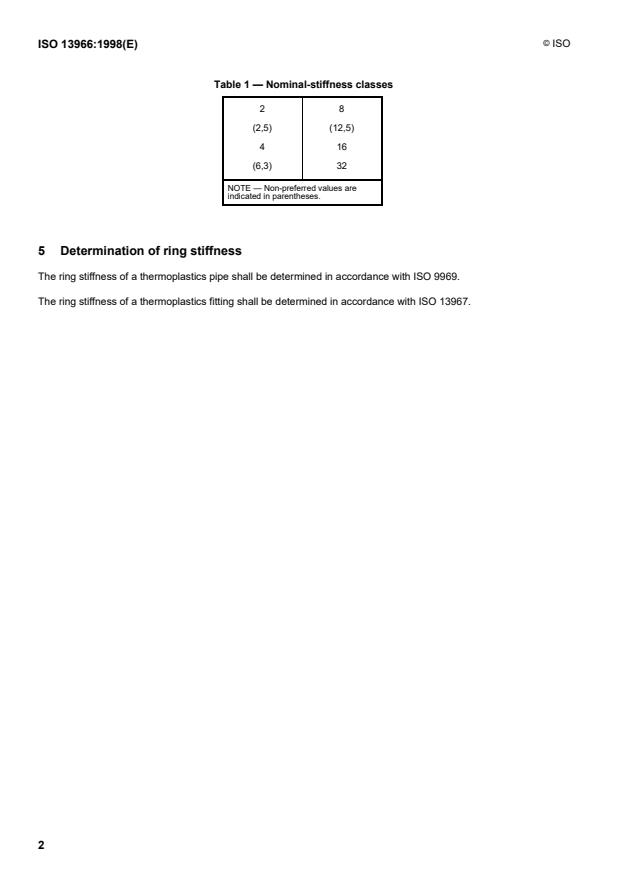
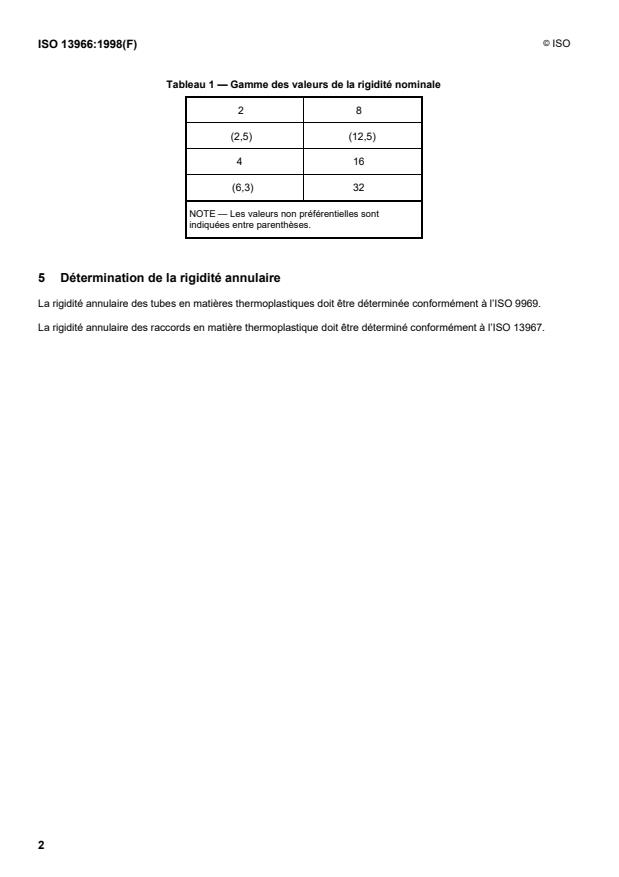
The standard provides a predefined series of nominal ring stiffness classes as per Table 1. These classes cover a range of stiffness levels, with typical values including 2, 4, 8, 16, and 32 (in units of N/m² × 10³), and some non-preferred values indicated in parentheses. For any required stiffness values outside this range, the standard references ISO 3’s R10 series of preferred numbers for proper classification.Testing and Determination Methods:
The actual ring stiffness of pipes and fittings must be determined using standardized methods:- Pipes: ISO 9969 - Thermoplastics pipes - Determination of ring stiffness
- Fittings: ISO 13967 - Thermoplastics fittings - Determination of ring stiffness
Using these methods ensures accuracy and comparability of results to the nominal figures specified.
Applicability:
The standard applies exclusively to thermoplastic pipes and fittings with circular cross-sections, commonly used in water supply, drainage, gas distribution, and other fluid transport systems.
Applications
Pipeline Design and Engineering:
Civil engineers and pipeline designers utilize ISO 13966 to select appropriate thermoplastic pipes and fittings based on required stiffness levels to withstand mechanical loads in buried applications.Manufacturing Quality Control:
Manufacturers use this standard to classify their thermoplastic products for compliance with target stiffness classes and ensure consistent product performance according to international benchmarks.Regulatory Compliance and Specification:
Public utilities, construction companies, and regulatory bodies incorporate ISO 13966 standards in procurement specifications, project tender documents, and quality assurance protocols to guarantee product reliability and safety.Product Development:
Research and development teams leverage the nominal stiffness classifications when innovating new thermoplastic pipe and fitting products to meet evolving market demands and installation conditions.
Related Standards
ISO 9969:1994 - Thermoplastics pipes - Determination of ring stiffness:
Defines the procedure to measure the actual ring stiffness of thermoplastic pipes, directly supporting the classification in ISO 13966.ISO 13967:1998 - Thermoplastics fittings - Determination of ring stiffness:
Establishes the methodology for evaluating the ring stiffness of thermoplastic fittings, complementing the classification system in ISO 13966.ISO 3:1973 - Preferred numbers - Series of preferred numbers:
Provides the basis for selecting standardized numerical values, such as those used for nominal ring stiffness classes in ISO 13966.
Keywords: thermoplastics pipes, nominal ring stiffness, ring stiffness classification, thermoplastics fittings, pipe stiffness, ISO 13966, pipe stiffness testing, thermoplastic pipe standards, fluid transport pipes, plastic pipe fittings, pipe system design, mechanical pipe properties.
Relations
- Effective Date
- 09-Feb-2026
Buy Documents
ISO 13966:1998 - Thermoplastics pipes and fittings — Nominal ring stiffnesses Released:7/9/1998
ISO 13966:1998 - Tubes et raccords en matieres thermoplastiques — Rigidité annulaire nominale Released:7/9/1998
Get Certified
Connect with accredited certification bodies for this standard

Institut za varilstvo d.o.o. (Welding Institute)
Slovenia's leading welding institute since 1952. ISO 3834, EN 1090, pressure equipment certification, NDT personnel, welder qualification. Only IIW Au
Sponsored listings
Frequently Asked Questions
ISO 13966:1998 is a standard published by the International Organization for Standardization (ISO). Its full title is "Thermoplastics pipes and fittings — Nominal ring stiffnesses". This standard covers: Thermoplastics pipes and fittings — Nominal ring stiffnesses
Thermoplastics pipes and fittings — Nominal ring stiffnesses
ISO 13966:1998 is classified under the following ICS (International Classification for Standards) categories: 23.040.20 - Plastics pipes; 23.040.45 - Plastics fittings. The ICS classification helps identify the subject area and facilitates finding related standards.
ISO 13966:1998 has the following relationships with other standards: It is inter standard links to EN 15012:2007. Understanding these relationships helps ensure you are using the most current and applicable version of the standard.
ISO 13966:1998 is available in PDF format for immediate download after purchase. The document can be added to your cart and obtained through the secure checkout process. Digital delivery ensures instant access to the complete standard document.
Standards Content (Sample)
INTERNATIONAL ISO
STANDARD 13966
First edition
1998-07-15
Thermoplastics pipes and fittings —
Nominal ring stiffnesses
Tubes et raccords en matières thermoplastiques — Rigidité annulaire
nominale
A
Reference number
Foreword
ISO (the International Organization for Standardization) is a worldwide
federation of national standards bodies (ISO member bodies). The work of
preparing International Standards is normally carried out through ISO
technical committees. Each member body interested in a subject for which
a technical committee has been established has the right to be represented
on that committee. International organizations, governmental and non-
governmental, in liaison with ISO, also take part in the work. ISO
collaborates closely with the International Electrotechnical Commission
(IEC) on all matters of electrotechnical standardization.
Draft International Standards adopted by the technical committees are
circulated to the member bodies for voting. Publication as an International
Standard requires approval by at least 75 % of the member bodies casting
a vote.
International Standard ISO 13966 was prepared by Technical Committee
ISO/TC 138, Plastics pipes, fittings and valves for the transport of fluids.
© ISO 1998
All rights reserved. Unless otherwise specified, no part of this publication may be reproduced
or utilized in any form or by any means, electronic or mechanical, including photocopying and
microfilm, without permission in writing from the publisher.
International Organization for Standardization
Case postale 56 • CH-1211 Genève 20 • Switzerland
Internet iso@iso.ch
Printed in Switzerland
ii
©
INTERNATIONAL STANDARD ISO ISO 13966:1998(E)
Thermoplastics pipes and fittings — Nominal ring
stiffnesses
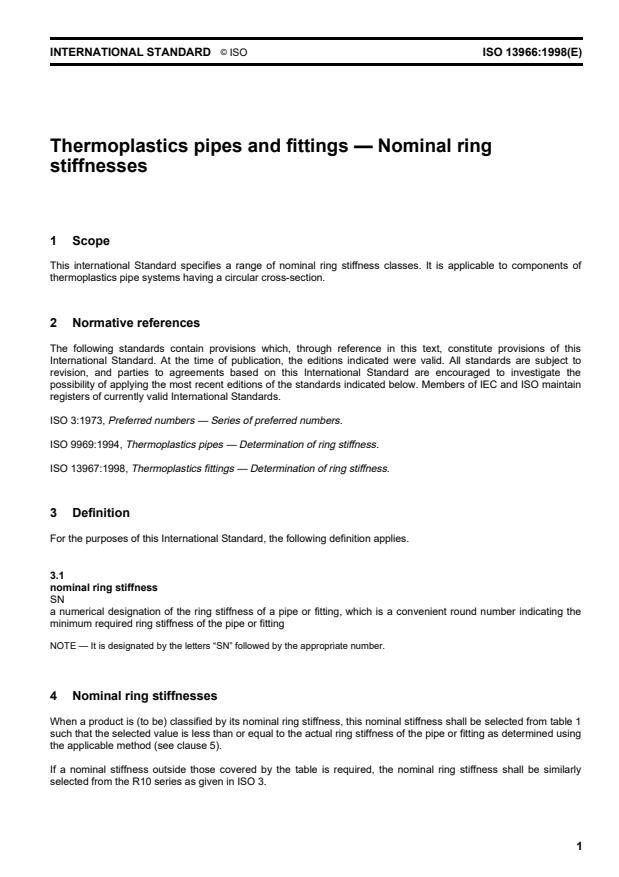
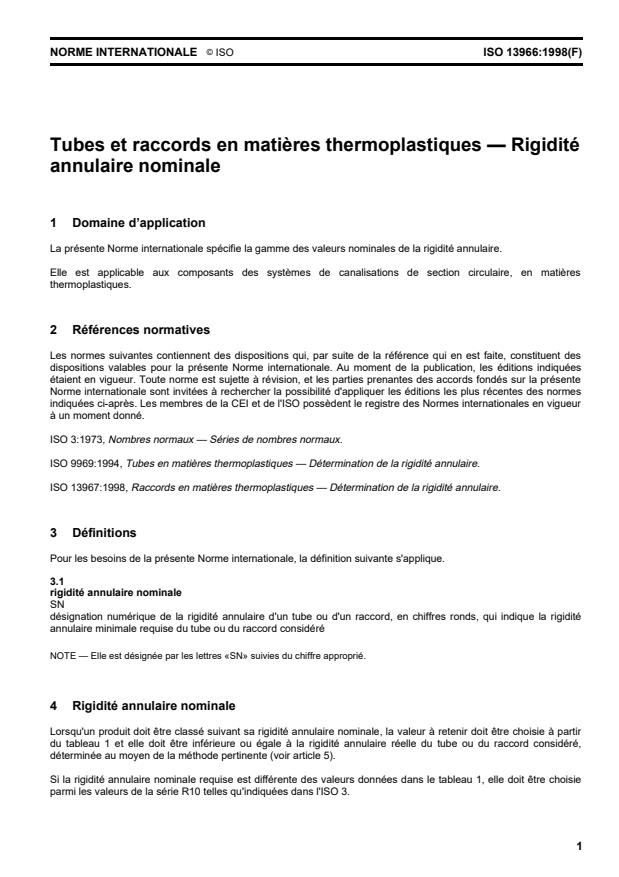
1 Scope
This international Standard specifies a range of nominal ring stiffness classes. It is applicable to components of
thermoplastics pipe systems having a circular cross-section.
2 Normative references
The following standards contain provisions which, through reference in this text, constitute provisions of this
Intern
...
NORME ISO
INTERNATIONALE 13966
Première édition
1998-07-15
Tubes et raccords en matières
thermoplastiques — Rigidité annulaire
nominale
Thermoplastics pipes and fittings — Nominal ring stiffnesses
A
Numéro de référence
Avant-propos
L'ISO (Organisation internationale de normalisation) est une fédération
mondiale d'organismes nationaux de normalisation (comités membres de
l'ISO). L'élaboration des Normes internationales est en général confiée aux
comités techniques de l'ISO. Chaque comité membre intéressé par une
étude a le droit de faire partie du comité technique créé à cet effet. Les
organisations internationales, gouvernementales et non gouvernementales,
en liaison avec l'ISO, participent également aux travaux. L'ISO collabore
étroitement avec la Commission électrotechnique internationale (CEI) en
ce qui concerne la normalisation électrotechnique.
Les projets de Normes internationales adoptés par les comités techniques
sont soumis aux comités membres pour vote. Leur publication comme
Normes internationales requiert l'approbation de 75 % au moins des
comités membres votants.
La Norme internationale ISO 13966 a été élaborée par le comité technique
ISO/TC 138,Tubes, raccords et robinetterie en matières plastiques pour le
transport des fluides.
© ISO 1998
Droits de reproduction réservés. Sauf prescription différente, aucune partie de cette publi-
cation ne peut être reproduite ni utilisée sous quelque forme que ce soit et par aucun pro-
cédé, électronique ou mécanique, y compris la photocopie et les microfilms, sans l'accord
écrit de l'éditeur.
Organisation internationale de normalisation
Case postale 56 • CH-1211 Genève 20 • Suisse
Internet iso@iso.ch
Imprimé en Suisse
ii
©
NORME INTERNATIONALE ISO ISO 13966:1998(F)
Tubes et raccords en matières thermoplastiques — Rigidité
annulaire nominale
1 Domaine d’application
La présente Norme internationale spécifie la gamme des valeurs nominales de la rigidité annulaire.
Elle est applicable aux composants des systèmes de canalisations de section circulaire, en matières
thermoplastiques.
2 Références normatives
Les normes suivantes contiennent des dispositions qui, par suite de la référence qui en est faite, constituent des
dispositions valables pour la présente Norme internationale. Au mome
...