

ISO/IEC 15909-2:2011
(Main)Systems and software engineering — High-level Petri nets — Part 2: Transfer format
General Information
- Abstract
ISO/IEC 15909-2:2011 defines an XML-based transfer format for Petri nets, which are defined conceptually and mathematically in ISO/IEC 15909-1. This transfer format enables the exchange of Petri nets among different Petri net tools and among different parties. Moreover, ISO/IEC 15909-2:2011 defines some concepts and XML-based syntax for defining the detailed graphical appearance of Petri nets. The focus of ISO/IEC 15909-2:2011 is on the transfer format for Place/Transition Nets, High-level Petri Nets and Symmetric Nets. The presentation, however, is structured in such a way that it is open for future extensions, so that other versions of Petri nets can be added later. The exact definition of this extension mechanism, called Petri net type definition, is not defined in ISO/IEC 15909-2:2011; it will be defined in ISO/IEC 15909-3. The transfer format will be used to transfer specifications of systems developed in High-level Petri Nets between tools to facilitate the development of systems in teams. ISO/IEC 15909-2:2011 is written as a reference for developers of Petri net tools. It will also be useful for researchers who define new versions and variants of Petri nets.
- Status
- Published
- Publication Date
- 02-Feb-2011
- Technical Committee
- ISO/IEC JTC 1/SC 7 - Software and systems engineering
- Drafting Committee
- ISO/IEC JTC 1/SC 7/WG 19 - Techniques for Specifying IT Systems
- Current Stage
- 9092 - International Standard to be revised
- Start Date
- 21-Aug-2025
- Completion Date
- 29-Aug-2026
Overview
ISO/IEC 15909-2:2011 specifies an XML-based transfer format for Petri nets - the Petri Net Markup Language (PNML) - enabling interoperable exchange of Petri net models between tools and teams. It focuses on transfer syntax and graphical annotations for Place/Transition Nets, High-level Petri Nets (HLPNs) and Symmetric Nets, building on the conceptual and mathematical definitions in ISO/IEC 15909-1. The standard is structured to support future extensions (Petri net type definitions to be defined in Part 3).
Key technical topics and requirements
- PNML Core Model: Defines the common XML meta-model for Petri net documents, nets, pages, objects, labels, graphical information and tool-specific annotations.
- Transfer formats for net types: Concrete PNML mappings for Place/Transition Nets, HLPNs and Symmetric Nets, including two P/T representations (native P/T and P/T as restricted HLPN).
- Data types and labels: XML-based syntax for labels, built-in sorts (dots, multisets, booleans, enumerations, integer ranges, partitions, etc.) as used by HLPNs.
- Conformance levels:
- Basic conformance to the PNML Core Model.
- Additional conformance levels per net type: textual (looser label syntax) and structural (strict label syntax). Symmetric Nets require structural conformance.
- Mapping to ISO/IEC 15909‑1: Rules for mapping graphical and semantic concepts between Part 1 (concepts/semantics) and Part 2 (transfer format).
- XML syntax and grammars: Exact XML syntax specified via RELAX NG grammars (Annex A for the core model; Annex B for special types and net-specific grammars).
- Implementation guidance: Examples and a PNML framework/API to ease tool implementation and PNML import/export (Annexes C and D).
Practical applications and users
Who benefits:
- Tool developers: Implement PNML import/export to ensure model interoperability between editors, analyzers and simulation tools.
- Systems and software engineers: Exchange HLPN specifications across teams and toolchains to support collaborative design and verification.
- Researchers: Define and prototype new Petri net variants, using PNML as a standard exchange and representation format.
- Modeling teams: Preserve graphical layout and annotations when sharing models for review, analysis or integration.
Typical uses:
- Interoperable model exchange between Petri net CASE tools.
- Archiving and versioning Petri net models in a tool‑neutral XML format.
- Automating toolchains for verification, simulation and code generation that rely on a shared net representation.
Related standards
- ISO/IEC 15909-1 - Concepts, definitions and graphical notation (semantic model for HLPNs).
- ISO/IEC 15909-3 (planned) - Definition of the extension mechanism / Petri net type definition for future net types.
Keywords: ISO/IEC 15909-2, PNML, Petri nets, High-level Petri Nets, Place/Transition Nets, Symmetric Nets, XML transfer format, RELAX NG, interoperability, tool developers.
Get Certified
Connect with accredited certification bodies for this standard

BSI Group
BSI (British Standards Institution) is the business standards company that helps organizations make excellence a habit.

BSCIC Certifications Pvt. Ltd.
Established 2006, accredited by NABCB, JAS-ANZ, EIAC, IAS. CDSCO Notified Body.

Intertek India Pvt. Ltd.
Delivers Assurance, Testing, Inspection & Certification since 1993 with 26 labs and 32 offices.
Sponsored listings
Frequently Asked Questions
ISO/IEC 15909-2:2011 is a standard published by the International Organization for Standardization (ISO). Its full title is "Systems and software engineering — High-level Petri nets — Part 2: Transfer format". This standard covers: ISO/IEC 15909-2:2011 defines an XML-based transfer format for Petri nets, which are defined conceptually and mathematically in ISO/IEC 15909-1. This transfer format enables the exchange of Petri nets among different Petri net tools and among different parties. Moreover, ISO/IEC 15909-2:2011 defines some concepts and XML-based syntax for defining the detailed graphical appearance of Petri nets. The focus of ISO/IEC 15909-2:2011 is on the transfer format for Place/Transition Nets, High-level Petri Nets and Symmetric Nets. The presentation, however, is structured in such a way that it is open for future extensions, so that other versions of Petri nets can be added later. The exact definition of this extension mechanism, called Petri net type definition, is not defined in ISO/IEC 15909-2:2011; it will be defined in ISO/IEC 15909-3. The transfer format will be used to transfer specifications of systems developed in High-level Petri Nets between tools to facilitate the development of systems in teams. ISO/IEC 15909-2:2011 is written as a reference for developers of Petri net tools. It will also be useful for researchers who define new versions and variants of Petri nets.
ISO/IEC 15909-2:2011 defines an XML-based transfer format for Petri nets, which are defined conceptually and mathematically in ISO/IEC 15909-1. This transfer format enables the exchange of Petri nets among different Petri net tools and among different parties. Moreover, ISO/IEC 15909-2:2011 defines some concepts and XML-based syntax for defining the detailed graphical appearance of Petri nets. The focus of ISO/IEC 15909-2:2011 is on the transfer format for Place/Transition Nets, High-level Petri Nets and Symmetric Nets. The presentation, however, is structured in such a way that it is open for future extensions, so that other versions of Petri nets can be added later. The exact definition of this extension mechanism, called Petri net type definition, is not defined in ISO/IEC 15909-2:2011; it will be defined in ISO/IEC 15909-3. The transfer format will be used to transfer specifications of systems developed in High-level Petri Nets between tools to facilitate the development of systems in teams. ISO/IEC 15909-2:2011 is written as a reference for developers of Petri net tools. It will also be useful for researchers who define new versions and variants of Petri nets.
ISO/IEC 15909-2:2011 is classified under the following ICS (International Classification for Standards) categories: 35.080 - Software. The ICS classification helps identify the subject area and facilitates finding related standards.
ISO/IEC 15909-2:2011 is available in PDF format for immediate download after purchase. The document can be added to your cart and obtained through the secure checkout process. Digital delivery ensures instant access to the complete standard document.
Standards Content (Sample)
INTERNATIONAL ISO/IEC
STANDARD 15909-2
First edition
2011-02-15
Systems and software engineering —
High-level Petri nets —
Part 2:
Transfer format
Ingénierie des systèmes et du logiciel — Réseaux de Petri de haut
niveau —
Partie 2: Format de transfert
Reference number
©
ISO/IEC 2011
PDF disclaimer
This PDF file may contain embedded typefaces. In accordance with Adobe's licensing policy, this file may be printed or viewed but
shall not be edited unless the typefaces which are embedded are licensed to and installed on the computer performing the editing. In
downloading this file, parties accept therein the responsibility of not infringing Adobe's licensing policy. The ISO Central Secretariat
accepts no liability in this area.
Adobe is a trademark of Adobe Systems Incorporated.
Details of the software products used to create this PDF file can be found in the General Info relative to the file; the PDF-creation
parameters were optimized for printing. Every care has been taken to ensure that the file is suitable for use by ISO member bodies. In
the unlikely event that a problem relating to it is found, please inform the Central Secretariat at the address given below.
© ISO/IEC 2011
All rights reserved. Unless otherwise specified, no part of this publication may be reproduced or utilized in any form or by any means,
electronic or mechanical, including photocopying and microfilm, without permission in writing from either ISO at the address below or
ISO's member body in the country of the requester.
ISO copyright office
Case postale 56 • CH-1211 Geneva 20
Tel. + 41 22 749 01 11
Fax + 41 22 749 09 47
E-mail copyright@iso.org
Web www.iso.org
Published in Switzerland
ii © ISO/IEC 2011 – All rights reserved
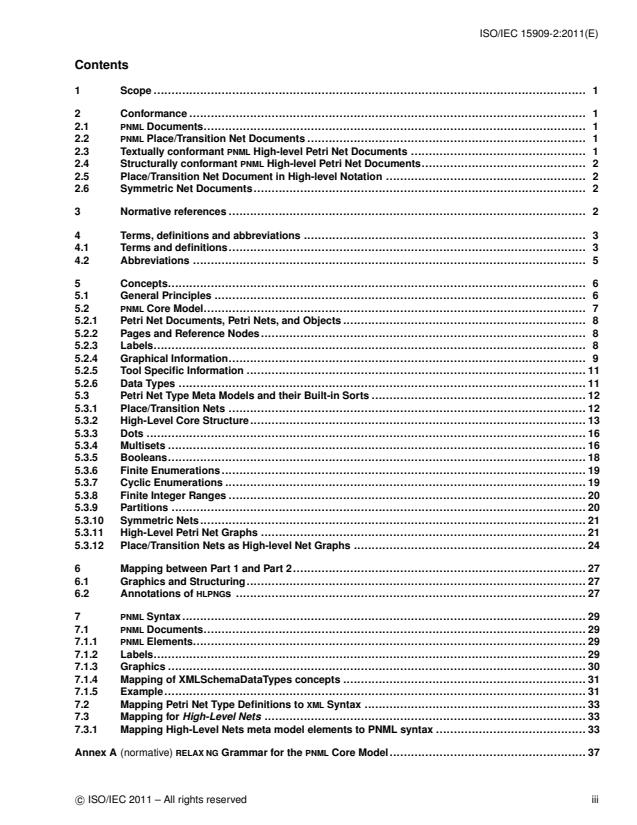
Contents
1 Scope . 1
2 Conformance . 1
2.1 PNML Documents. 1
2.2 PNML Place/Transition Net Documents . 1
2.3 Textually conformant PNML High-level Petri Net Documents . 1
2.4 Structurally conformant PNML High-level Petri Net Documents. 2
2.5 Place/Transition Net Document in High-level Notation . 2
2.6 Symmetric Net Documents . 2
3 Normative references . 2
4 Terms, definitions and abbreviations . 3
4.1 Terms and definitions. 3
4.2 Abbreviations . 5
5 Concepts. 6
5.1 General Principles . 6
5.2 PNML Core Model. 7
5.2.1 Petri Net Documents, Petri Nets, and Objects . 8
5.2.2 Pages and Reference Nodes . 8
5.2.3 Labels. 8
5.2.4 Graphical Information. 9
5.2.5 Tool Specific Information . 11
5.2.6 Data Types . 11
5.3 Petri Net Type Meta Models and their Built-in Sorts . 12
5.3.1 Place/Transition Nets . 12
5.3.2 High-Level Core Structure . 13
5.3.3 Dots . 16
5.3.4 Multisets . 16
5.3.5 Booleans. 18
5.3.6 Finite Enumerations . 19
5.3.7 Cyclic Enumerations . 19
5.3.8 Finite Integer Ranges . 20
5.3.9 Partitions . 20
5.3.10 Symmetric Nets. 21
5.3.11 High-Level Petri Net Graphs . 21
5.3.12 Place/Transition Nets as High-level Net Graphs . 24
6 Mapping between Part 1 and Part 2. 27
6.1 Graphics and Structuring. 27
6.2 Annotations of HLPNGs . 27
7 PNML Syntax . 29
7.1 PNML Documents. 29
7.1.1 PNML Elements. 29
7.1.2 Labels. 29
7.1.3 Graphics . 30
7.1.4 Mapping of XMLSchemaDataTypes concepts . 31
7.1.5 Example. 31
7.2 Mapping Petri Net Type Definitions to XML Syntax . 33
7.3 Mapping forHigh-LevelNets . 33
7.3.1 Mapping High-Level Nets meta model elements to PNML syntax . 33
Annex A (normative) RELAX NG Grammar for the PNML Core Model. 37
c ISO/IEC 2011 – All rights reserved iii
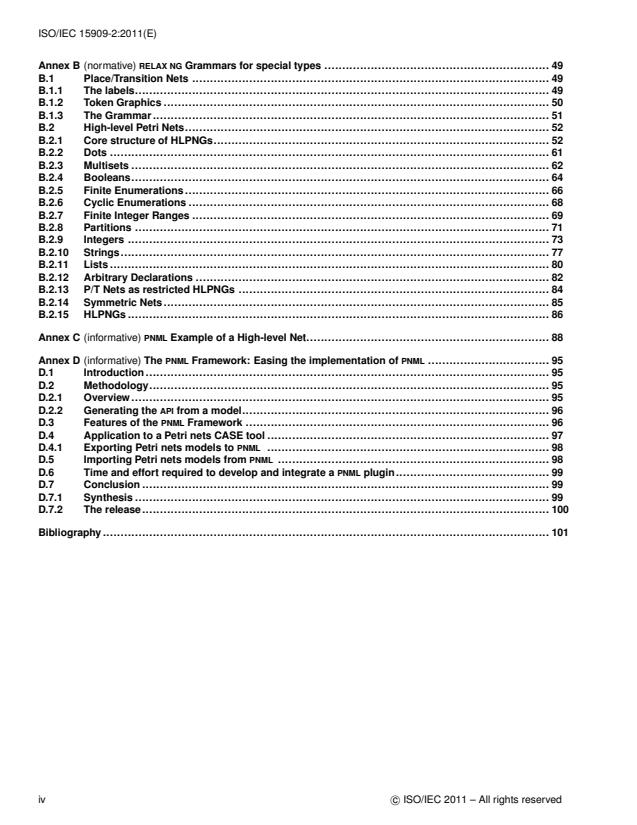
Annex B (normative) RELAX NG Grammars for special types . 49
B.1 Place/Transition Nets . 49
B.1.1 The labels. 49
B.1.2 Token Graphics . 50
B.1.3 The Grammar . 51
B.2 High-level Petri Nets. 52
B.2.1 Core structure of HLPNGs. 52
B.2.2 Dots . 61
B.2.3 Multisets . 62
B.2.4 Booleans. 64
B.2.5 Finite Enumerations . 66
B.2.6 Cyclic Enumerations . 68
B.2.7 Finite Integer Ranges . 69
B.2.8 Partitions . 71
B.2.9 Integers . 73
B.2.10 Strings. 77
B.2.11 Lists . 80
B.2.12 Arbitrary Declarations . 82
B.2.13 P/T Nets as restricted HLPNGs . 84
B.2.14 Symmetric Nets. 85
B.2.15 HLPNGs . 86
Annex C (informative) PNML Example of a High-level Net. 88
Annex D (informative) The PNML Framework: Easing the implementation of PNML . 95
D.1 Introduction . 95
D.2 Methodology. 95
D.2.1 Overview . 95
D.2.2 Generating the API from a model. 96
D.3 Features of the PNML Framework . 96
D.4 Application to a Petri nets CASE tool . 97
D.4.1 Exporting Petri nets models to PNML . 98
D.5 Importing Petri nets models from PNML . 98
D.6 Time and effort required to develop and integrate a PNML plugin. 99
D.7 Conclusion . 99
D.7.1 Synthesis . 99
D.7.2 The release. 100
Bibliography . 101
iv
c ISO/IEC 2011 – All rights reserved
Foreword
ISO (the International Organization for Standardization) and IEC (the International Electrotechnical Commission)
form the specialized system for worldwide standardization. National bodies that are members of ISO or IEC par-
ticipate in the development of International Standards through technical committees established by the respective
organization to deal with particular fields of technical activity. ISO and IEC technical committees collaborate in fields
of mutual interest. Other international organizations, governmental and non-governmental, in liaison with ISO and
IEC, also take part in the work. In the field of information technology, ISO and IEC have established a joint technical
committee, ISO/IEC JTC 1.
International Standards are drafted in accordance with the rules given in the ISO/IEC Directives, Part 2.
The main task of the joint technical committee is to prepare International Standards. Draft International Standards
adopted by the joint technical committee are circulated to national bodies for voting. Publication as an International
Standard requires approval by at least 75% of the national bodies casting a vote.
Attention is drawn to the possibility that some of the elements of this document may be the subject of patent rights.
ISO and IEC shall not be held responsible for identifying any or all such patent rights.
ISO/IEC 15909-2 was prepared by Joint Technical Committe ISO/IEC JTC 1, Information technology, Subcommittee
SC 7, Software and systems engineering.
ISO/IEC 15909 consists of the following parts, under the general title Systems and software engineering – High-level
Petri nets:
— Part 1: Concepts, definitions and graphical notation
— Part 2: Transfer format
“Extensions” will form the subject of a future Part 3.
c ISO/IEC 2011 – All rights reserved v
Introduction
ISO/IEC 15909 is concerned with defining a modelling language and its transfer format, known as High-level Petri
Nets. ISO/IEC 15909-1 provides the mathematical definition of High-level Petri Nets, called the semantic model, the
graphical form of the technique, known as High-level Petri Net Graphs (HLPNGs), and its mapping to the semantic
model. It also introduces some common notational conventions for HLPNGs.
This part of ISO/IEC 15909 defines a transfer format for High-level Petri Nets in order to support the exchange
of High-level Petri Nets among different tools. This format is called the Petri Net Markup Language (PNML). Since
there are many different versions of Petri nets in addition to High-level Petri Nets, this part of ISO/IEC 15909 defines
the core concepts of Petri nets along with an XML syntax, which can be used for exchanging any kind of Petri net.
Based on this PNML Core Model, this part of ISO/IEC 15909 also defines the transfer syntax for the three versions
of Petri nets that are defined in ISO/IEC 15909-1: Place/Transition Nets, Symmetric Nets , and High-level Petri
Nets, where Place/Transition Nets and Symmetric Nets can be considered to be restricted versions of High-level
Petri Nets. For Place/Transition Nets, this part of ISO/IEC 15909 introduces two different transfer formats: one is a
format specifically tuned to Place/Transition Nets, the other is a format that represents Place/Transition Nets as a
restricted version of High-level Petri Nets as defined in ISO/IEC 15909-1.
The basic level of conformance to this part of ISO/IEC 15909 is to the PNML Core Model. The other levels are
according to the particular type of the Petri net; for High-level Petri Nets there are two levels of conformance: textual
conformance ignores the exact syntax and structure of the labels; structural conformance requires that labels are
given in the exact syntax as defined here. Since Symmetric Nets are designed for analysability, textual conformance
does not make any sense for Symmetric Nets; therefore, there is only structural conformance for Symmetric Nets.
Note that this part of ISO/IEC 15909 introduces some concepts that are not defined in ISO/IEC 15909-1. These
concepts are not related to the mathematical concepts of Petri nets and their semantics. They concern the graphical
representation of nets and the structuring of large Petri net models. These concepts need to be defined, along with
a transfer format for Petri nets, in order to ensure that the graphical appearance of a Petri net in different tools is
similar.
This part of ISO/IEC 15909 is structured as follows: Clause 1 describes the scope, the areas of application and the
intended audience of this part of ISO/IEC 15909. Clause 2 defines conformance. Clause 3 gives references that
are essential for the correct interpretation of this International Standard. Clause 4 defines all terms relevant to this
International Standard and includes a list of abbreviations. Clause 5 introduces the concepts of PNML using UML
meta models. Clause 5.2 defines the PNML Core Model, which is the structure common to all versions of Petri nets.
Clause 5.3 defines the particular concepts of the different Petri net types. Clause 6 provides the mapping of the
syntactical concepts defined in this part of ISO/IEC 15909 to the concepts defined in ISO/IEC 15909-1. Clause 7
defines how the concepts of PNML as defined in Clause 5 are mapped to XML syntax.
Annex A defines the exact XML syntax for the PNML Core Model in terms of a RELAX NG grammar. Annex B defines
the exact XML syntax for the different types of Petri nets. Annex C provides a small example for the syntax of
a symmetric net. Annex D discusses a framework for implementing this International Standard and an API for
accessing Petri nets, which is based on the UML models for the PNML meta models.
Symmetric nets were first introduced as well-formed nets and are currently standardized as ISO/IEC 15909-1:2004/Amd. 1:2010.
vi
c ISO/IEC 2011 – All rights reserved
INTERNATIONAL STANDARD ISO/IEC 15909-2:2011(E)
Systems and software engineering – High-level Petri nets –
Part 2: Transfer format
Part 2: Transfer format
1 Scope
This part of ISO/IEC 15909 defines an XML-based transfer format for Petri nets, which are defined conceptually and
mathematically in ISO/IEC 15909-1. This transfer format enables the exchange of Petri nets among different Petri
net tools and among different parties. Moreover, this part of ISO/IEC 15909 defines some concepts and XML-based
syntax for defining the detailed graphical appearance of Petri nets.
The focus of this part of ISO/IEC 15909 is on the transfer format for Place/Transition Nets, High-level Petri Nets and
Symmetric Nets. The presentation, however, is structured in such a way that it is open for future extensions, so that
other versions of Petri nets can be added later. The exact definition of this extension mechanism, called Petri net
type definition, is not defined in this part of ISO/IEC 15909; it will be defined in ISO/IEC 15909-3.
The transfer format will be used to transfer specifications of systems developed in High-level Petri Nets between
tools to facilitate the development of systems in teams.
This part of ISO/IEC 15909 is written as a reference for developers of Petri net tools. Moreover, it will be useful for
researchers who define new versions and variants of Petri nets.
2 Conformance
There are different levels of conformance to this part of ISO/IEC 15909. All conformance levels impose additional
conditions on valid XML documents.
2.1 PNML Documents
An XML document is conformant to the PNML Core Model if it meets the definitions of Clause 5.2 (concepts) and
Clause 7.1 (their mapping to XML syntax) – such a document is called a PNML Document or a Petri Net Document.
A Petri net tool is conformant to the PNML Core Model, if it can import all PNML Documents, and if it can export all
Petri nets to a PNML Document.
The other levels of conformance concern the different Petri Net Types.
2.2 PNML Place/Transition Net Documents
A PNML Document is a conformant Place/Transition Net if it meets the additional restrictions of Clause 5.3.1 (con-
cepts of P/T-nets) and Clause 7.2 (their mapping to XML syntax) – such a document is called a PNML Place/Transition
Net Document. A Petri net tool is conformant to the PNML Place/Transition Net definition if it can import all PNML
Place/Transition Net Documents, and if it can export all Place/Transition Nets to PNML Place/Transition Net Docu-
ments. Note that this transfer format is tuned to Place/Transition Nets. There is another format, which considers
Place/Transition Nets as a restricted form of High-level Petri Nets (see Clause 2.5).
2.3 Textually conformant PNML High-level Petri Net Documents
For High-level Petri Nets, there are two different levels of conformance. The first level requires the existence of
textual labels as defined in Clause 5.3.2 and 5.3.11 (concepts) and Clause 7.3 (mapping to XML syntax). But,
c ISO/IEC 2011 – All rights reserved 1
it does not require the existence of the structural parts of the annotations; it only requires that the textual parts
of the annotations exist, but the text is not required to be in a specific syntax and, therefore, the meaning of it
cannot be transferred to other tools. Such a PNML Document is called a textually conformant PNML High-level Petri
Net Document. A Petri net tool is conformant to the textual PNML High-level Petri Net definition if it can import all
textually conformant PNML High-level Petri Net Documents, and if it can export all High-level Petri Nets to a textually
conformant PNML High-level Petri Net Document.
2.4 Structurally conformant PNML High-level Petri Net Documents
The second level of High-level Petri Net conformance requires that all annotations obey the rules defined in
Clause 5.3.2 and 5.3.11 (concepts) and Clause 7.3 (mapping to XML syntax). Such a PNML Document is called
a structurally conformant PNML High-level Petri Net Document. A Petri net tool is conformant to the structural PNML
High-level Petri Net definition if it can import all structurally conformant PNML High-level Petri Net Documents, and if
it can export all High-level Petri Nets to a structurally conformant PNML High-level Petri Net Document.
2.5 Place/Transition Net Document in High-level Notation
A structurally conformant PNML High-level Petri Net Document that uses only the single sort dot and only the arc
annotations of Place/Transition Nets is a conformant Place/Transition Net Document in High-level Notation.
2.6 Symmetric Net Documents
Finally, there is conformance to Symmetric Nets, which is a restricted version of High-level Petri Nets. A Symmetric
Net Document is a structurally conformant PNML High-level Petri Net Document if it contains only the concepts
defined in Clause 5.3.10. A Petri net tool is conformant to the Symmetric Net definition if it can import all Symmetric
Net Documents, and if it can export all Symmetric Nets to Symmetric Net Documents.
3 Normative references
The following referenced documents are indispensable for the application of this document. For dated references,
only the edition cited applies. For undated references, the latest edition of the referenced document (including any
amendments) applies.
ISO/IEC 15444 (all parts), Information technology – JPEG 2000 image coding system
ISO/IEC 15909-1, Systems and software engineering – High-level Petri nets – Part 1: Concepts, definitions and
graphical notation
ISO/IEC 15948, Information technology – Computer graphics and image processing – Portable Network Graphics
(PNG): Functional specification
ISO/IEC 19757-2:2008, Information technology – Document Schema Definition Language (DSDL) – Part 2: Regular-
grammar-based validation – RELAX NG
CSS, Cascading Style Sheets, level 2 revision 1, CSS 2.1 Specification.; W3C Candidate Recommendation, 25
25 February 2004
OCL 2.0, Object Constraint Language, OMG Available Specification, Version 2.0.Version2.0. OMG formal/06-05-01, May 2006
UML 2.1, OMG Unified Modeling Language (OMG UML): Superstructure, V2.1.2 OMG Available Specification,
November 2007
XML 1.1, Extensible Markup Language (XML) 1.1 (Second Edition); W3C Recommendation, 29 September 2006
XML Schema Datatypes: XML Schema Part 2: Datatypes (Second Edition); W3C Recommendation, 28 October
c ISO/IEC 2011 – All rights reserved
4 Terms, definitions and abbreviations
4.1 Terms and definitions
For the purposes of this document, the terms and definitions given in ISO/IEC 15909-1 and the following apply.
4.1.1
annotation
label (4.1.5) represented as text near to the object (4.1.7) it is associated with
4.1.2
attribute
label (4.1.5) that governs the form or shape of the object (4.1.7) it is associated with, which, in contrast to an
annotation (4.1.1), is typically not shown as text
4.1.3
graphical information
information defining the graphical appearance of objects (4.1.7) and labels (4.1.5) of a net graph, which can be
the position, size, line colour, fill colour, font or line width
4.1.4
global label
label (4.1.5) associated with the net graph itself, rather than with an object (4.1.7) of a net graph
4.1.5
label
information associated with the net graph or one of its object (4.1.7)
4.1.6
meta model
model defining the concepts and their relations for some modelling notation
NOTE The meta models in this part of ISO/IEC 15909 are mainly UML class diagrams.
4.1.7
object (of a net graph)
arc, node, reference node (4.1.14), or page (4.1.8) of a net graph
4.1.8
page
structuring mechanism used to split a large net graph into smaller parts, which are also the units of the net to be
printed
4.1.9
PNML Core Model
meta model (4.1.6) defining the basic concepts and structure of net graph models that are common to all versions
of Petri nets
c ISO/IEC 2011 – All rights reserved 3
4.1.10
PNML Document (Petri Net Document)
XML document that contains one or more net graphs
4.1.11
PNML High-level Net Document
PNML Document (4.1.10) that contains one or more net graphs, where all net graphs conform to High-level Petri
Nets
4.1.12
PNML Place/Transition Net Document
PNML Document (4.1.10) that contains one or more net graphs, where all net graphs conform to Place/Transition
Nets
4.1.13
PNML Symmetric Net Document
PNML Document (4.1.10) that contains one or more net graphs, where all net graphs conform to Symmetric Nets
4.1.14
reference node
node of a Petri net that is a representative of another node, possibly defined on another page (4.1.8) of the net
graph
4.1.15
reference place
reference node (4.1.14) that represents a place and refers to either another reference place (4.1.15) or to a place
4.1.16
reference transition
reference node (4.1.14) that represents a transition and refers to either another reference transition (4.1.16) or
to a transition
4.1.17
source node
node associated with the start of an arc
4.1.18
target node
node associated with the end of an arc
4.1.19
tool specific information
information associated with an object (4.1.7) of a net graph or with the net graph itself that is specific to a particular
tool and is not meant to be used by other tools
c ISO/IEC 2011 – All rights reserved
4.2 Abbreviations
4.2.1
CSS
Cascading Stylesheets
4.2.2
CSS2
Cascading Stylesheets level 2
4.2.3
OCL
Object Constraint Language
4.2.4
P/T Net
Place/Transition Net
4.2.5
PNML
Petri Net Markup Language
4.2.6
RELAX NG
Regular Language description for XML/ New Generation
4.2.7
SN
Symmetric Net
4.2.8
UML
Unified Modeling Language
4.2.9
XML
eXtensible Markup Language
c ISO/IEC 2011 – All rights reserved 5
5 Concepts
A Petri net can be considered to be a labelled graph, where the particular labels depend on the particular type of
Petri net. The concepts for High-level Petri Net Graphs are defined in part 1 of ISO/IEC 15909 and are represented
in terms of a meta model in UML notation in this clause. The mapping of these concepts to XML syntax is defined in
Clause 7.
Some concepts, however, have not been defined in part 1 because the main concern of part 1 was on the semantics
of High-level Petri Nets. Part 2 of ISO/IEC 15909 defines concepts for defining the graphical appearance of Petri
nets in order to enable similar graphical representation in different tools. Moreover, part 2 defines the concept of
pages in order to be able to split the graphical representation of a Petri net into smaller units for printing and viewing
them.
Note that the concepts and definitions presented in part 1 of ISO/IEC 15909 are semantic in nature, whereas part 2
is syntactic in nature. For example, part 1 refers to types, which are sets, but does not mandate any concrete
syntax for transferring such sets. Likewise part 1 uses functions, but does not mandate a syntax for transferring
them. In order to transfer High-level Petri Nets, this part of ISO/IEC 15909 needs to introduce a syntax for types
and functions. To this end, it uses the concepts of sorts and operators. These are syntactic symbols for denoting
types and functions, and are assigned a fixed interpretation, which is defined along with the sorts and operators.
Therefore, this part of ISO/IEC 15909 often refers to sorts and operators, where part 1 refers to their semantical
counterpart, types and functions. By the fixed interpretation of sorts and operators, the respective types and
functions are also defined.
5.1 General Principles
This part of ISO/IEC 15909 defines a transfer format for Place/Transition Nets, High-level Petri Net Graphs, and
Symmetric Nets as defined in part 1 of ISO/IEC 15909. This transfer format has been designed to be extensible
and to be open for future variants of Petri nets and possibly for other use, such as the transfer of results associated
with the analysis of Petri nets, e. g., reachability graphs. In order to obtain this flexibility, the transfer format considers
a Petri net as a labelled directed graph, where all type specific information of the net is represented in labels. A
label may be associated with a node, an arc, a page or the net itself. This basic structure is captured in the PNML
Core Model, which is defined in Clause 5.2.
The PNML Core Model is presented using UML class diagrams. Note that these UML diagrams do not define the
concrete XML syntax for PNML Documents; rather, they define the abstract syntax only. The mapping of the PNML
Core Model elements (i. e., the abstract syntax) to the concrete XML syntax will be defined in Clause 7; Annex A
defines the exact XML syntax in terms of a RELAX NG grammar.
The PNML Core Model imposes no restrictions on labels. Therefore, the PNML Core Model can represent any kind
of Petri net. Due to this generality of the PNML Core Model, there can be PNML Documents that do not correspond to
a Petri net at all. For example, there could be labels from two different and even incompatible versions of Petri nets
within the same PNML Document. For a concrete version of Petri nets, the legal labels are defined by extending the
PNML Core Model with another meta model that exactly defines the legal labels of this type.
Technically, the PNML Core Model is a UML package, and there are additional UML packages for the different Petri net
types that extend the PNML Core Model package. This part of ISO/IEC 15909 defines a package for Place/Transition
Nets, a package for Symmetric Nets, and a package for High-level Petri Net Graphs, where the package for High-
level Petri Net Graphs extends the package for Symmetric Nets. Therefore, every Symmetric Net is also a High-level
Petri Net Graph. The representation of these concepts in XML syntax is defined in Clause 7.2; Annex B defines the
exact XML syntax of the concepts for the different types in terms of RELAX NG grammars.
Figure 1 shows the different packages and how they are related. The package PNML Core Model defines the basic
structure of Petri nets or net graphs; this structure is extended by the package for each type. The PNML Core Model
is defined in Clause 5.2, the package PT-Net is defined in Clause 5.3.1, the package SymmetricNet is defined in
Clause 5.3.10 and the package HLPNG is defined in Clause 5.3.11. Clause 7 shows how the concepts defined in
these packages are represented in concrete XML syntax.
c ISO/IEC 2011 – All rights reserved
<>
PT−Net SymmetricNet HLPNG
<> <>
PNML Core Model
Figure 1: Overview of the UML packages of PNML
5.2 PNML Core Model
Figures 2 and 3 show the PNML Core Model as a UML class diagram. The diagram of Fig. 2 focuses on the conceptual
parts, whereas the diagram of Fig. 3 focuses on the parts concerning the graphical representation. Note that the
data type String is imported from a separate package XMLSchemaDataTypes, which is discussed in Clause 5.2.6.
The concepts defined in the PNML Core Model are discussed in the following clauses.
PNMLCoreModel
PetriNetDoc
net 1.*
ToolInfo
toolspecific
*
tool
PetriNet
toolspecific
*
version
id
toolspecific *
type
label
*
Object
Label
object
label
* *
id
0.1
name
{redefines label}
0.1
Name Annotation Attribute
name
{redefines label}
0.1
graphics
text 1
Graphics
XMLSchemaDataTypes::
graphics
String
0.1
page
1.*
page
1 source
*
Page Node Arc
target
1 *
context Arc inv:
−− source and target must
−− be on the same page
1 1
self.source.page =
PlaceNode TransitionNode
ref ref
self.target.page
* *
Place RefPlace RefTrans Transition
<>
XMLSchemaDataTypes
Figure 2: The PNML Core Model package: concepts
c ISO/IEC 2011 – All rights reserved 7
5.2.1 Petri Net Documents, Petri Nets, and Objects
A document that meets the requirements of the PNML Core Model is called a Petri Net Document (PetriNetDoc)
or a PNML Document. It contains one or more Petri Nets (PetriNet). Each Petri Net has a unique identifier and
a type. The type is a name referring to the package with its definition; an example for such a package name is
http://www.pnml.org/version-2009/grammar/ptnet for the package defining P/T Nets. The URL for the definition
of PNML itself is http://www.pnml.org/version-2009/grammar/pnml.
A Petri net consists of one or more top-level pages that in turn consist of several objects. These objects, basically,
represent the graph structure of the Petri net. Each object within a Petri net document has a unique identifier, which
can be used for referring to this object. Moreover, each object may be equipped with graphical information defining
its position, size, colour, shape and other attributes on its graphical appearance. The precise graphical information
that can be provided for an object depends on the particular type of object (see Clause 5.2.4 and Fig. 3).
The main objects of a Petri net are places, transitions and arcs. For convenience, a place or a transition is general-
ized to a node. For reasons explained in Clause 5.2.2 below, this generalization is via place nodes and via transition
nodes. Nodes of a Petri net can be connected by arcs.
Note that it is legal to have an arc from a place to a place or from a transition to a transition according to the PNML
Core Model. The reason is that there are versions of Petri nets that support such arcs. If a Petri net type does not
support such arcs, this restriction will be defined in the particular package defining this type.
5.2.2 Pages and Reference Nodes
Three other kinds of objects are used for structuring a Petri net: pages, reference places, and reference transitions.
As mentioned above, a page may contain other objects; since a page is an object itself, a page may even contain
other pages, which defines a hierarchy of subpages.
This part of ISO/IEC 15909 requires that an arc must connect nodes on the same page only. The reason for this
requirement is that arcs connecting nodes on different pages cannot be drawn graphically on a single page. In the
PNML Core Model of Fig. 2, this requirement is captured by the OCL expression (OCL 2.0, OMG) next to the class for
arcs.
In order to connect nodes on different pages by an arc, a representative of one of the two nodes is drawn on the
same page as the other node. Then, this representative may be connected with the other node by an arc. This
representative is called a reference node, because it has a reference to the node it represents. Note that a reference
place must refer to a place or a reference place, and a reference transition must refer to a reference transition or
a transition. Moreover, cyclic references among reference nodes are not allowed. Though this requirement cannot
be expressed in UML or OCL notation, this requirement is mandatory.
The concepts of pages and reference nodes are not defined in part 1 of ISO/IEC 15909. The reason for introducing
them in part 2 is that these concepts are needed for graphical and structuring purposes. Semantically, they do not
carry any meaning. The meaning of these concepts is defined by merging each reference node with the node it
ultimately refers to and by simply ignoring the pages. This procedure is called flattening of the page structure.
5.2.3 Labels
In order to assign further meaning to an object, each object may have labels. Typically, a label represents the name
of a node, the initial marking of a place, the transition condition, or some arc annotation. In addition, the Petri net
itself or its pages may have some labels, which are called global labels. For example, the package HLPNG defines
declarations as global labels of a High-level Petri Net, which are used for defining variables, and user-defined sorts
and operators.
This part of ISO/IEC 15909 distinguishes two kinds of labels: annotations and attributes. An annotation comprises
information that is typically displayed as text next to the corresponding object. Examples of annotations are names,
initial markings, arc annotations, transition conditions, and timing or stochastic information.
c ISO/IEC 2011 – All rights reserved
In contrast, an attribute is, typically, not displayed as text next to the corresponding object. Rather, an attribute has
an effect on the shape or colour of the corresponding object. For example, an attribute such as arc type could have
domainf normal, read , inhibitor, resetg. This part of ISO/IEC 15909, however, does not mandate the effect
that an attribute has on the graphical appearance of a net object.
Note that the classes for label, annotation and attribute are abstract in the PNML Core Model, which means that the
PNML Core Model does not define concrete labels, annotations, and attributes. The only concrete label defined in
the PNML Core Model is the name, which is a label that can be used for any object within any Petri net type. Note
that, this way, any object – including nodes, pages, even the net itself as well as arcs – can have a name. The value
of a name is a String, which is imported from the separate package XMLSchemaDataTypes (see Clause 5.2.6 for
more information). The other concrete labels will be defined in the packages for the concrete Petri net types (see
Clause 5.3).
In order to support the exchange of information among tools that have different textual representation for the same
concepts (i. e. if they have different concrete syntax), there are two ways for representing the information within an
annotation: textually in some concrete syntax and structurally as an abstract syntax tree (see Clauses 5.3.11 and
7.1.2 for details).
Note that reference nodes may have labels, but these labels do not have any effect on the semantics of the net
and can be completely ignored semantically. Since the labels of a reference node do not have an effect on the
semantics, it is easy to obtain a semantically equivalent Petri net without pages by merging every reference node
to the node it directly or indirectly refers to. This is called flattening of the Petri net. But, the labels of a reference
node can have an effect on the graphical appearance or can give some additional information to the user.
5.2.4 Graphical Information
In addition to the Petri net concepts, information concerning the graphical appearance can be associated with
each object and each annotation. For a node, this information includes its position; for an arc, it includes a list of
positions that define intermediate points of the arc; for an object’s annotation, it includes its relative position with
respect to the corresponding object; and for an annotation of a page, the position is absolute. There can be further
information concerning the size, colour and shape of nodes or arcs, or concerning the colour, font and font size
of labels. Note that this information can be used for automatically transforming a Petri Net into Scalable Vector
Graphics (SVG) by XSLT transformations (see [8] for more details). This transformation, however, is not defined in
this part of ISO/IEC 15909.
Figure 3 shows the different graphical information that can be attached to the different types of objects and the
different attributes. Note that this still belongs to the PNML Core Model; it is shown in a different figure only for
better understandability. Table 1 gives an overview of the meaning and the domain of the attributes of the different
graphical features. The exact XML syntax is defined in Clause 7.1.3.
A position element defines the absolute position for nodes and pages. For an annotation an offset element defines
its relative position to the object it is attached to – if it is a global annotation, the offset also defines the absolute
position on that page. Each absolute or relative position consists of a pair of Cartesian coordinates (x;y), where
the units are points (pt). As for many graphical tools, the x-axis runs from left to right and the y-axis from top to
bottom. And the reference point for the position of an object is its centre.
For an arc, the (possibly empty) sequence of positions defines its intermediate points (bend points). Note that
the positions of the start point and the end point of an arc are not given explicitly for the arc. These positions
are determined from the position of the source and the target node of the arc and the direction of the respective
segment of the arc. They are defined by the line starting or ending at the reference point of the respective node
in the direction of the arc and the intersection with the border of that node. Altogether, the arc is displayed as a
path from the start point on the border of the source node to the end point on the border of the target node via the
intermediate points. Depending on the value of the attribute shape of element line, the path is displayed as a broken
line (polyline) or as a quadratic Bezier curve. In the case of a Bezier curve the intermediate positions alternately
are the line connectors or Bezier control points. The reference point of an arc is the middle of the arc, which is the
middle of the middle segment of the arc, if there are an odd number of segments; it is the middle point, if there are
an even number of segments.
Sometimes, a read arc is called a test arc.
c ISO/IEC 2011 – All rights reserved 9
PNMLCoreModel
context NodeGraphics inv:
self.object.oclIsKindOf(Node) or
Graphics
self.object.oclIsKindOf(Page)
context ArcGraphics inv:
self.object.oclIsKindOf(Arc)
context AnnotationGraphics inv:
self.object.oclIsKindOf(Annotation)
Annota
...