

ISO 21940-21:2022
(Main)Mechanical vibration — Rotor balancing — Part 21: Description and evaluation of balancing machines
General Information
- Abstract
This document sets out the requirements for evaluating hard and soft bearing balancing machines that support and rotate: a) rotors with rigid behaviour at balancing speed (as described in ISO21940-11); b) rotors with shaft elastic behaviour and balanced in accordance with low speed balancing procedures (as described in ISO21940-12).
- Status
- Published
- Publication Date
- 06-Nov-2022
- Technical Committee
- ISO/TC 108/SC 2 - Measurement and evaluation of mechanical vibration and shock as applied to machines, vehicles and structures
- Drafting Committee
- ISO/TC 108/SC 2/WG 31 - Balancing
- Current Stage
- 6060 - International Standard published
- Start Date
- 07-Nov-2022
- Due Date
- 22-Mar-2022
- Completion Date
- 07-Nov-2022
Overview - ISO 21940-21:2022 (Rotor balancing machines)
ISO 21940-21:2022 specifies requirements for the description and evaluation of balancing machines used in rotor balancing. It applies to both hard-bearing and soft-bearing balancing machines that support and rotate:
- rotors with rigid behaviour at balancing speed (as defined in ISO 21940-11), and
- rotors with shaft elastic behaviour when balanced using low-speed procedures (as defined in ISO 21940-12).
The standard defines how to report machine capacity, performance and testing methods so users can verify machine capability, reproducibility and suitability for production or laboratory balancing tasks.
Key technical topics and requirements
ISO 21940-21 organizes machine evaluation around practical, measurable data and test procedures. Important topics covered include:
- Capacity and performance data: rotor mass and unbalance limitations, rotor dimensions, drive data, torque, brakes, motors and speed regulation.
- Machine features and measuring systems: principle and arrangement of operation, unbalance indicators, plane separation systems (single- and multi-plane), calibration and setting of measuring systems for both hard- and soft-bearing machines.
- Production efficiency: metrics such as time per balance cycle and the unbalance reduction ratio (R).
- Proving rotors and test masses: standardized and user-defined proving rotors, test mass types (U and R), permissible errors and materials.
- Verification tests: procedures to establish minimum achievable residual unbalance (U), R tests, couple moment interference tests, compensator tests and simplified test options.
- Installation and supply requirements: foundations, electrical/air supplies and environmental considerations relevant to accurate balancing machine performance.
Practical applications and users
This standard is intended for professionals who need to specify, verify or operate balancing machines:
- Balancing machine manufacturers - to document machine performance and provide user data sheets.
- Test laboratories and calibration facilities - to perform verification tests and report machine capability.
- Maintenance and reliability engineers - to select appropriate balancing equipment for rotors (fans, motors, turbines, shafts).
- OEMs and production managers - to assess production efficiency and ensure consistent unbalance reduction in manufacturing environments.
- Quality and compliance teams - to demonstrate that balancing equipment meets recognized international criteria.
Adopting ISO 21940-21 supports consistent rotor balancing results, traceable verification procedures and improved reliability of rotating machinery.
Related standards
- ISO 21940-11 - Rotor behaviour: rigid rotors at balancing speed (referenced in scope).
- ISO 21940-12 - Low-speed balancing procedures for rotors with shaft elastic behaviour.
Keywords: ISO 21940-21, rotor balancing, balancing machines, hard-bearing, soft-bearing, unbalance reduction, verification tests, production efficiency.
Relations
- Effective Date
- 23-Apr-2020
Frequently Asked Questions
ISO 21940-21:2022 is a standard published by the International Organization for Standardization (ISO). Its full title is "Mechanical vibration — Rotor balancing — Part 21: Description and evaluation of balancing machines". This standard covers: This document sets out the requirements for evaluating hard and soft bearing balancing machines that support and rotate: a) rotors with rigid behaviour at balancing speed (as described in ISO21940-11); b) rotors with shaft elastic behaviour and balanced in accordance with low speed balancing procedures (as described in ISO21940-12).
This document sets out the requirements for evaluating hard and soft bearing balancing machines that support and rotate: a) rotors with rigid behaviour at balancing speed (as described in ISO21940-11); b) rotors with shaft elastic behaviour and balanced in accordance with low speed balancing procedures (as described in ISO21940-12).
ISO 21940-21:2022 is classified under the following ICS (International Classification for Standards) categories: 21.120.40 - Balancing and balancing machines. The ICS classification helps identify the subject area and facilitates finding related standards.
ISO 21940-21:2022 has the following relationships with other standards: It is inter standard links to ISO 21940-21:2012. Understanding these relationships helps ensure you are using the most current and applicable version of the standard.
ISO 21940-21:2022 is available in PDF format for immediate download after purchase. The document can be added to your cart and obtained through the secure checkout process. Digital delivery ensures instant access to the complete standard document.
Standards Content (Sample)
INTERNATIONAL ISO
STANDARD 21940-21
Second edition
2022-11
Mechanical vibration — Rotor
balancing —
Part 21:
Description and evaluation of
balancing machines
Vibrations mécaniques — Équilibrage des rotors —
Partie 21: Description et évaluation des machines à équilibrer
Reference number
© ISO 2022
All rights reserved. Unless otherwise specified, or required in the context of its implementation, no part of this publication may
be reproduced or utilized otherwise in any form or by any means, electronic or mechanical, including photocopying, or posting on
the internet or an intranet, without prior written permission. Permission can be requested from either ISO at the address below
or ISO’s member body in the country of the requester.
ISO copyright office
CP 401 • Ch. de Blandonnet 8
CH-1214 Vernier, Geneva
Phone: +41 22 749 01 11
Email: copyright@iso.org
Website: www.iso.org
Published in Switzerland
ii
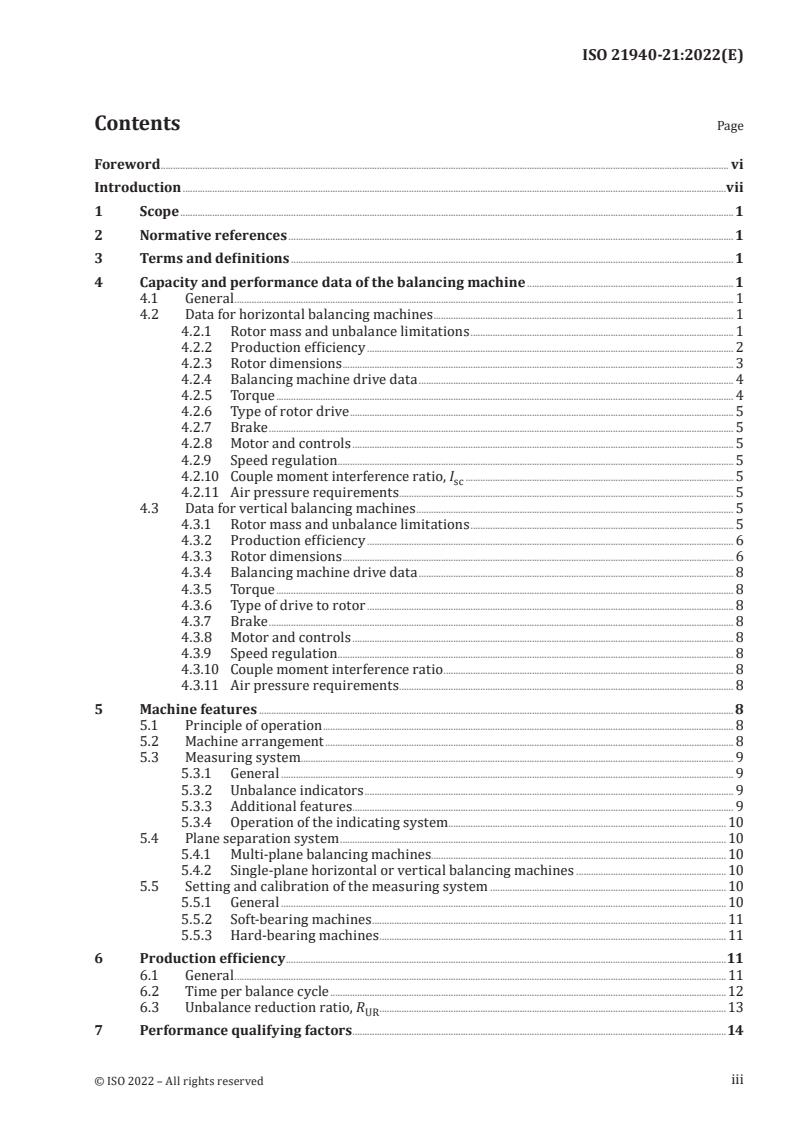
Contents Page
Foreword . vi
Introduction .vii
1 Scope . 1
2 Normative references . 1
3 Terms and definitions . 1
4 Capacity and performance data of the balancing machine . 1
4.1 General . 1
4.2 Data for horizontal balancing machines . 1
4.2.1 Rotor mass and unbalance limitations . 1
4.2.2 Production efficiency . 2
4.2.3 Rotor dimensions . 3
4.2.4 Balancing machine drive data . 4
4.2.5 Torque . 4
4.2.6 Type of rotor drive . 5
4.2.7 Brake . 5
4.2.8 Motor and controls . 5
4.2.9 Speed regulation . . 5
4.2.10 Couple moment interference ratio, I . 5
sc
4.2.11 Air pressure requirements . 5
4.3 Data for vertical balancing machines . 5
4.3.1 Rotor mass and unbalance limitations . 5
4.3.2 Production efficiency . 6
4.3.3 Rotor dimensions . 6
4.3.4 Balancing machine drive data . 8
4.3.5 Torque . 8
4.3.6 Type of drive to rotor . 8
4.3.7 Brake . 8
4.3.8 Motor and controls . 8
4.3.9 Speed regulation . 8
4.3.10 Couple moment interference ratio . 8
4.3.11 Air pressure requirements . 8
5 Machine features . 8
5.1 Principle of operation . 8
5.2 Machine arrangement . 8
5.3 Measuring system . 9
5.3.1 General . 9
5.3.2 Unbalance indicators . 9
5.3.3 Additional features . 9
5.3.4 Operation of the indicating system . . 10
5.4 Plane separation system . 10
5.4.1 Multi-plane balancing machines. 10
5.4.2 Single-plane horizontal or vertical balancing machines . 10
5.5 Setting and calibration of the measuring system . 10
5.5.1 General . 10
5.5.2 Soft-bearing machines . 11
5.5.3 Hard-bearing machines . 11
6 Production efficiency .11
6.1 General . 11
6.2 Time per balance cycle .12
6.3 Unbalance reduction ratio, R . 13
UR
7 Performance qualifying factors . .14
iii
8 Installation requirements .14
8.1 General . 14
8.2 Supply requirements . 14
8.3 Foundation . 15
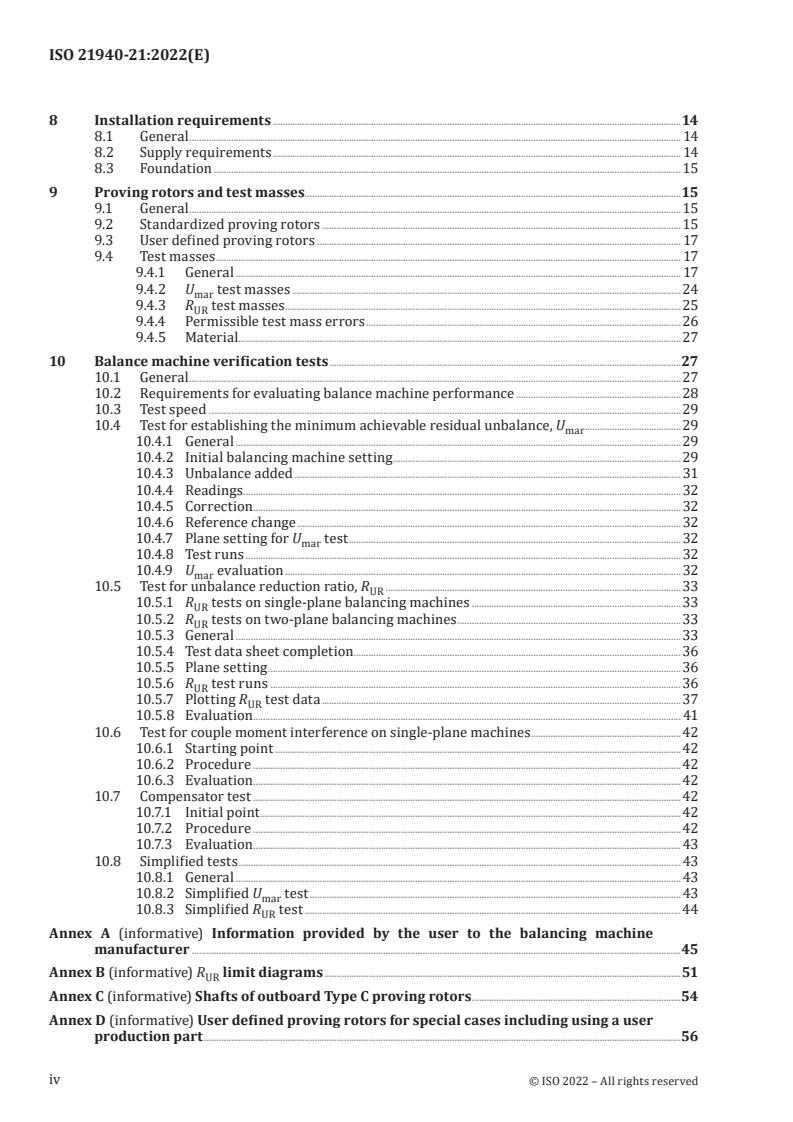
9 Proving rotors and test masses . .15
9.1 General . 15
9.2 Standardized proving rotors . 15
9.3 User defined proving rotors . 17
9.4 Test masses . 17
9.4.1 General . 17
9.4.2 U test masses . 24
mar
9.4.3 R test masses . 25
UR
9.4.4 Permissible test mass errors . 26
9.4.5 Material. 27
10 Balance machine verification tests .27
10.1 General . 27
10.2 Requirements for evaluating balance machine performance .28
10.3 Test speed .29
10.4 Test for establishing the minimum achievable residual unbalance, U .29
mar
10.4.1 General .29
10.4.2 Initial balancing machine setting .29
10.4.3 Unbalance added . 31
10.4.4 Readings . . 32
10.4.5 Correction . 32
10.4.6 Reference change . 32
10.4.7 Plane setting for U test . 32
mar
10.4.8 Test runs . 32
10.4.9 U evaluation . 32
mar
10.5 Test for unbalance reduction ratio, R . 33
UR
10.5.1 R tests on single-plane balancing machines . 33
UR
10.5.2 R tests on two-plane balancing machines . 33
UR
10.5.3 General . 33
10.5.4 Test data sheet completion . 36
10.5.5 Plane setting .36
10.5.6 R test runs . 36
UR
10.5.7 Plotting R test data . 37
UR
10.5.8 Evaluation . 41
10.6 Test for couple moment interference on single-plane machines . 42
10.6.1 Starting point . 42
10.6.2 Procedure . 42
10.6.3 Evaluation . 42
10.7 Compensator test . 42
10.7.1 Initial point . 42
10.7.2 Procedure . 42
10.7.3 Evaluation . 43
10.8 Simplified tests . 43
10.8.1 General . 43
10.8.2 Simplified U test . 43
mar
10.8.3 Simplified R test .44
UR
Annex A (informative) Information provided by the user to the balancing machine
manufacturer .45
Annex B (informative) R limit diagrams .51
UR
Annex C (informative) Shafts of outboard Type C proving rotors .54
Annex D (informative) User defined proving rotors for special cases including using a user
production part .56
iv
Annex E (informative) Modifications to proving rotors prepared in accordance with
ISO 2953 to this document .57
Annex F (informative) Optional repeatability test .59
Annex G (informative) Optional speed range test .61
Bibliography .62
v
Foreword
ISO (the International Organization for Standardization) is a worldwide federation of national standards
bodies (ISO member bodies). The work of preparing International Standards is normally carried out
through ISO technical committees. Each member body interested in a subject for which a technical
committee has been established has the right to be represented on that committee. International
organizations, governmental and non-governmental, in liaison with ISO, also take part in the work.
ISO collaborates closely with the International Electrotechnical Commission (IEC) on all matters of
electrotechnical standardization.
The procedures used to develop this document and those intended for its further maintenance are
described in the ISO/IEC Directives, Part 1. In particular, the different approval criteria needed for the
different types of ISO documents should be noted. This document was drafted in accordance with the
editorial rules of the ISO/IEC Directives, Part 2 (see www.iso.org/directives).
Attention is drawn to the possibility that some of the elements of this document may be the subject of
patent rights. ISO shall not be held responsible for identifying any or all such patent rights. Details of
any patent rights identified during the development of the document will be in the Introduction and/or
on the ISO list of patent declarations received (see www.iso.org/patents).
Any trade name used in this document is information given for the convenience of users and does not
constitute an endorsement.
For an explanation of the voluntary nature of standards, the meaning of ISO specific terms and
expressions related to conformity assessment, as well as information about ISO's adherence to
the World Trade Organization (WTO) principles in the Technical Barriers to Trade (TBT), see
www.iso.org/iso/foreword.html.
ISO 21940-21 was prepared by Technical Committee ISO/TC 108, Mechanical vibration, shock and
condition monitoring, Subcommittee SC 2, Measurement and evaluation of mechanical vibration and shock
as applied to machines, vehicles and structures.
This second edition cancels and replaces the first edition (ISO 21940-21:2012), which has been
technically revised.
The main changes are as follows:
— the introduction of new computer based technology into balance machine indication systems;
— the introduction of additional tests for repeatability and speed range (see Annex F and Annex G);
— the introduction of greater clarification for use with automated and special purpose machines.
A list of all parts in the ISO 21940 series can be found on the ISO website.
Any feedback or questions on this document should be directed to the user’s national standards body. A
complete listing of these bodies can be found at www.iso.org/members.html.
vi
Introduction
The purpose of this document is to provide a common framework for the specification, comparison and
evaluation of balancing machines.
It describes a proforma on which the baseline balancing machine characteristics can be presented by
the manufacturer enabling users to compare products from different manufacturers. Additionally,
guidelines are given on the information by which users provide their data and requirements to a
balancing machine manufacturer.
This document describes the tests to be performed during the acceptance testing of a balancing
machine and later, on a periodic basis, to ensure that the balancing machine is capable of handling the
actual balancing tasks. For periodic tests, simplified procedures are specified.
Methods and requirements for preparing proving rotors (which can be of Type A, Type B or Type C, or
a user defined proving rotor e.g. based on a user supplied part) are specified, allowing a wide range of
applications to be covered.
The accuracy of all balance machines is inherently non-linear over their mass and speed range.
In normal practice, a hard bearing balance machine is calibrated over a particular part of its speed
and mass range, but outside that its accuracy cannot be assumed. As a consequence, a rotor specific
calibration should be performed to establish the machine accuracy at a specific speed and for a rotor of
a particular mass. This is normal practice for soft bearing machines or where the manufacturer states
that rotor specific calibration should be carried out.
vii
INTERNATIONAL STANDARD ISO 21940-21:2022(E)
Mechanical vibration — Rotor balancing —
Part 21:
Description and evaluation of balancing machines
1 Scope
This document sets out the requirements for evaluating hard and soft bearing balancing machines that
support and rotate:
a) rotors with rigid behaviour at balancing speed (as described in ISO 21940-11);
b) rotors with shaft elastic behaviour and balanced in accordance with low speed balancing
procedures (as described in ISO 21940-12).
2 Normative references
The following documents are referred to in the text in such a way that some or all of their content
constitutes requirements of this document. For dated references, only the edition cited applies. For
undated references, the latest edition of the referenced document (including any amendments) applies.
ISO 21940-2, Mechanical vibration — Rotor balancing — Part 2: Vocabulary
3 Terms and definitions
For the purposes of this document, the terms and definitions given in ISO 21940-2 apply.
ISO and IEC maintain terminological databases for use in standardization at the following addresses:
— ISO Online browsing platform: available at https:// www .iso .org/ obp
— IEC Electropedia: available at https:// www .electropedia .org/
4 Capacity and performance data of the balancing machine
4.1 General
The manufacturer shall specify the data listed in 4.2 for horizontal or 4.3 for vertical balancing
machines. Information to be provided by the user to the balancing machine manufacturer is summarized
in Annex A.
4.2 Data for horizontal balancing machines
4.2.1 Rotor mass and unbalance limitations
The maximum rotor mass, m, which can be balanced, shall be stated over the range of balancing speeds
(n , n , .).
1 2
The maximum moment of inertia of a rotor (given by, m r where m is the rotor mass and r the radius of
gyration) with respect to the shaft axis, which the machine can accelerate in a stated acceleration time,
shall be given for the range of balancing speeds (n , n , .) together with the corresponding cycle rate
1 2
(see Table 1, Note 2).
4.2.2 Production efficiency
The production efficiency (further requirements are described in Clause 7) is the total time taken to
carry out the individual steps necessary to perform a balance measuring run.
The individual steps to be measured are:
a) time for mechanical adjustment (s);
b) time for setting indicating system (s);
c) time for preparation of rotor (s);
d) acceleration time for a stated rotor (s);
e) time taken for the balance reading to stabilize and for it to be recorded (s);
f) deceleration time for a stated rotor (s);
g) identifying unbalance readings taken (s);
h) any other times to be taken into account for operations to be carried out but not included in 4.2.2 a)
to 4.2.2 g) (s).
Total time per measuring run is given by adding the individual times measured in steps 4.2.2 a) to
4.2.2 h) (s).
Table 1 — Horizontal balancing machine data
Manufacturer: Model:
Balancing speeds or speed ranges n n n n …
1 2 3 4
maximum, m
max
Rotor mass (kg) (see Note 1)
minimum
Occasional overload force per support (N) (see Note 1)
Maximum negative force per support (N) (see Note 1)
Maximum rotor moment of inertia with respect to the shaft axis (kg m )
Cycle rate per hour (see Note 2)
measurable
Maximum unbalance (g mm/kg or g mm) (see Note 3)
permissible
a) For inboard rotors minimum achiev- maximum mass,
Rotor mass
able residual specific unbalance, e , m
mar max
(kg) (see
(g mm/kg) (see Note 4)
0,2 m
max
Note 1)
minimum mass
b) For outboard rotors minimum achiev- maximum mass,
Rotor mass
able residual specific unbalance, e , m
mar max
(kg) (see
(g mm/kg) (see Note 4)
0,2 m
max
Note 1)
minimum mass
NOTE 1 The occasional overload force is only stated for the lowest balancing speed. It is the maximum force per support
that can be accommodated by the machine without immediate damage. The negative force is the static upward force
resulting from a rotor having its centre of mass outside the bearing support.
NOTE 2 The cycle rate per hour for a given balancing speed is the number of starts and stops, which the machine can
perform per hour without damage to the machine when balancing a rotor of the maximum moment of inertia.
NOTE 3 In general, for rotors with rigid behaviour with two planes, the stated value is distributed proportionally to each
tolerance plane. For disc-shaped rotors with only one tolerance plane, the full stated value holds for one plane.
NOTE 4 This is the machine’s ability to measure the smallest amount of unbalance for a rotor (see 5.5.3).
4.2.3 Rotor dimensions
General arrangement drawings of the pedestals and other obstructions (e.g. belt-drive mechanism,
shroud mounting pads, thrust arms and tie bars) shall be supplied to enable the user to determine the
maximum rotor envelope that can be accommodated and the tooling or adaptors required to support
and or drive the rotor.
A combination of large journal diameter and high balancing speed can result in an excessive journal
peripheral speed. The maximum journal peripheral speed shall be stated.
When belt drive is supplied, balancing speeds shall be stated for both the maximum and minimum
diameters over which the belt can drive the rotor.
The manufacturer shall state if the axial position of the drive can be adjusted.
Rotor envelope limitations shall be stated (see Figure 1).
Key
1 shaft
2 rotor
3 supports
4 bed
d diameter
Figure 1 — Example of a machine support drawing, illustrating rotor envelope limitations
If the left-hand support is not a mirror image of the right-hand support, separate dimensions for each
shall be shown. All maximum rotor swing diameters shall be dimensioned along with the pedestal
widths as indicated in the right hand pedestal.
If applicable, the profile of the belt-drive equipment shall be shown.
In addition, these dimensions shall be recorded:
a) maximum diameter over bed (mm);
b) maximum diameter over which the belt can drive (mm);
c) minimum diameter over which the belt can drive (mm);
d) distance between journal centrelines:
1) maximum (mm);
2) minimum (mm);
3) maximum distance from coupling flange to centreline of farthest bearing (mm);
4) minimum distance from coupling flange to centreline of nearest bearing (mm).
e) journal diameter:
1) maximum (mm);
2) minimum (mm).
-1
f) maximum permissible peripheral journal speed (m s );
g) correction plane limitations (consistent with the requirements of 5.4);
h) correction plane interference ratios (consistent with the requirements of 5.4 and based on the
proving rotor used).
4.2.4 Balancing machine drive data
Balancing machine drive parameters shall be recorded as shown in Table 2.
Table 2 — Balancing machine drive parameters
Balancing speed Rated torque on motor
r/min N m
n
n
n
n
n
n
n
n
or steplessly variable or steplessly variable
from
to
4.2.5 Torque
The balancing machine torque parameters to be recorded are
a) zero-speed torque (% of rated torque on rotor),
b) adjustable run-up torque (from …… % to …… % of rated torque on rotor), and
c) peak torque (% of rated torque on rotor).
In most cases, the maximum torque is required for accelerating a rotor. However, in the case of a rotor
with high windage or friction loss, maximum torque can be required at balancing speed. When there is
axial thrust, it is necessary that provisions are made to take this into account.
4.2.6 Type of rotor drive
The type of rotor drive shall be recorded (e.g. end drive by band, belt drive, magnetic field, driven
bearing rollers, air jet).
In addition, these drive motor parameters shall be recorded:
a) rated power (kW);
b) motor speed (r/min);
c) power supply, voltage (V), frequency (Hz) and phase (single or three phase).
4.2.7 Brake
These brake parameters shall be recorded:
a) type of brake;
b) adjustable braking torque (from …… % to …… % of rated torque on rotor);
c) if the brake can be used as a holding device.
4.2.8 Motor and controls
The standards against which the drive motor and its controls have been manufactured and tested shall
be recorded.
4.2.9 Speed regulation
It shall be recorded whether or not motor speed regulation has been incorporated and if it has, what its
specifications are (range within . % of . r/min, or constant at . r/min).
4.2.10 Couple moment interference ratio, I
sc
The couple moment interference ratio (g mm/(g mm )) shall be recorded.
NOTE This value is only applicable for single-plane balancing machines. It describes the influence of couple
unbalance in the rotor on the indication of a resultant unbalance.
4.2.11 Air pressure requirements
The air pressure requirements for the balancing machine shall be recorded in Pa and volume flow rate
3 -1
in m s .
4.3 Data for vertical balancing machines
4.3.1 Rotor mass and unbalance limitations
The maximum mass of a rotor, m, which can be balanced shall be stated over the range of balancing
speeds (n , n , .) for the machine.
1 2
The maximum moment of inertia of a rotor (given by, m r where, m, is the rotor mass and, r, is the radius
of gyration) with respect to the shaft axis, which the machine can accelerate in a stated acceleration
time, shall be given for the range of balancing speeds (n , n , .) together with the corresponding cycle
1 2
rate (see Table 3).
Table 3 — Vertical balancing machine data
Manufacturer: Model:
Balancing speeds or speed ranges n n n n …
1 2 3 4
maximum, m
max
Rotor mass (kg) (see Note 1)
minimum
Occasional overload force per support (N) (see Note 1)
Maximum rotor moment of inertia with respect to the shaft axis (kg m ) (see
Note 2)
Cycle rate per hour (see Note 2)
measurable
Maximum unbalance (g mm/kg or g mm) (see Note 3)
permissible
NOTE 1 The occasional overload force is only stated for the lowest balancing speed. It is the maximum force per support
that can be accommodated by the machine without immediate damage.
NOTE 2 Cycle rate per hour for a given balancing speed is the number of starts and stops, which the machine can perform
per hour without damage to the machine when balancing a rotor of the maximum moment of inertia.
NOTE 3 In general, for rotors with rigid behaviour with two planes, the stated value is distributed proportionally to each
tolerance plane. For disc-shaped rotors with only one tolerance plane, the full stated value holds for one plane.
NOTE 4 This is the machine’s ability to measure the smallest amount of unbalance for a rotor (see 5.5.3).
4.3.2 Production efficiency
The production efficiency (further requirements are described in Clause 6) is the total time taken to
carry out the individual steps necessary to perform a balance measuring run.
The individual steps to be measured are
a) any mechanical adjustment of the balancing machine needed, including to the drive, tooling or
adaptor,
b) preparation of any other devices and systems needed,
c) setting the indicating system,
d) preparation of the rotor for the measuring run,
e) balance cycle acceleration time,
f) reading time (e.g. the total time between the end of the acceleration run and the start of the
deceleration run),
g) deceleration time,
h) any further operations necessary to relate the readings obtained to the rotor being balanced,
i) loading and unloading times, and
j) time taken for any other relevant operations to be completed (e.g. safety measures).
4.3.3 Rotor dimensions
If the machine has two or more speeds, the rotor dimensions shall be stated for each speed. If the
machine has continuously variable balancing speeds, then the information shall be presented in the
form of a table, formula or graph.
Drawings of the spindle support surface or mounting plate and of any obstructions (e.g. drill heads and
electrical control cabinets) above the mounting plate shall be supplied to enable the user to determine
the maximum rotor envelope that can be accommodated and the tooling or adaptors required.
In addition, these rotor dimensions shall be recorded:
a) maximum diameter (mm);
b) height:
1) maximum overall height (mm);
2) maximum centre of mass height (mm):
i) at 100 % of maximum mass (mm);
ii) at 50 % of maximum mass (mm);
iii) at 25 % of maximum mass (mm).
c) envelope limitations (including machine spindle or mounting plate interface (see Figure 2));
d) correction plane limitations (consistent with the requirements of 5.4).
Key
1 rotor 5 upper correction plane 9 spigot diameter
2 adaptor 6 centre of mass plane 10 maximum height above spindle
3 protractor 7 lower correction plane d diameter
4 spindle 8 mounting holes for
adaptor
Figure 2 — Example of vertical machine mounting interface and rotor envelope
4.3.4 Balancing machine drive data
Balancing machine drive parameters shall be recorded as shown in Table 2.
4.3.5 Torque
See 4.2.5.
4.3.6 Type of drive to rotor
See 4.2.6.
4.3.7 Brake
See 4.2.7.
4.3.8 Motor and controls
See 4.2.8.
4.3.9 Speed regulation
See 4.2.9.
4.3.10 Couple moment interference ratio
See 4.2.10.
4.3.11 Air pressure requirements
See 4.2.11.
5 Machine features
5.1 Principle of operation
A description of the principle of operation of the balancing machine shall be given (e.g. motion
measuring, force measuring).
5.2 Machine arrangement
The manufacturer shall describe the configuration of the balancing machine and its principal design
features (e.g. horizontal or vertical axis of rotation, soft or hard bearing suspension system).
In addition, and as applicable, the manufacturer shall provide details of:
a) components designed to support the rotor, for instance:
1) vee blocks;
2) open rollers;
3) plain half bearings;
4) closed ball, roller or plain bearings;
5) devices to accommodate rotors in their service bearings;
6) devices to accommodate complete units.
b) bearing lubrication requirements;
c) for horizontal machines only, the mechanical adjustment and functioning of the means provided to
take up axial thrust from the rotor;
d) the type(s) of transducer(s) used to sense unbalance effects;
e) the drive method and the means to control it.
5.3 Measuring system
5.3.1 General
A balancing machine shall have the means to determine the amount of unbalance and its angular
location.
The balancing machine manufacturer shall describe the measuring system used in their machine, for
instance:
a) whether it is computer based (to include type and size of visual display used, data entry method,
software architecture and communication and compatible operating system and PC minimum
requirements);
b) whether it is electronically based;
c) the number of unbalance channels included and the phase or encoder inputs included;
d) the type of unbalance pickup used and the signal given.
5.3.2 Unbalance indicators
The manufacturer shall describe the means by which the amount and angle of the unbalance is provided,
for instance by using
a) a display showing vectors in polar coordinates,
b) a numerical digital display with number of decimal places and significant digits,
c) any display showing the position and amount of the balance correction(s) needed (e.g. the position,
depth and shape of the material to be removed or the position and amount of the material to be
added), and
d) a means of displaying any tooling (e.g. a holding device for the rotor under test) compensation
needed.
5.3.3 Additional features
Additional features, which influence the functioning of the balancing machine shall be described.
For information, additional features, which can be included in the machine are, but not limited to
a) whether an arbitrary coordinate system is used (e.g. geometric centring),
b) an indication of the unbalance resolved into components (which can be in more than two correction
planes),
c) any correction devices installed,
d) any device used to show the position and/or amount of the correction to be applied to the rotor,
e) whether a suitable output for connection to a computer, network, printer or other peripheral is
provided, and
f) any error proofing system(s) installed.
5.3.4 Operation of the indicating system
The manufacturer shall describe the procedure by which readings are obtained, taking into account at
least
a) how many runs are required to obtain the unbalance measurements,
b) how the unbalance measurements are displayed,
c) if there are readings retained at the end of the measuring run and if readings from previous runs
can be recalled,
d) if readings can be made and displayed in real time during the measurement run, averaged over
time,
e) if readings can be made and displayed, as an average, after several runs have been completed, and
f) how the addition or subtraction angle of unbalance is selected.
5.4 Plane separation system
5.4.1 Multi-plane balancing machines
The manufacturer shall state whether plane separation is included and if it is, at least these details shall
be provided:
a) how is it operated for single rotors of a type not previously balanced;
b) how is it operated for single rotors, in series, with identical dimensions and masses;
c) the limits of rotor geometry over which plane separation is effective shall be defined with the
effectiveness stated on the basis of the correction plane interference ratio, stating:
1) the ratio of bearing distance to plane distance for which plane separation is eff
...