

ISO 21998:2020
(Main)Interpreting services — Healthcare interpreting — Requirements and recommendations
General Information
- Abstract
This document specifies requirements and recommendations for healthcare interpreting services in spoken and signed communication. It is applicable to all situations requiring healthcare interpreting, where the parties involved need to communicate using spoken or signed language, to treat a health-related issue. It is intended for interpreting service providers and healthcare interpreters.
- Status
- Published
- Publication Date
- 13-Dec-2020
- Technical Committee
- ISO/TC 37/SC 5 - Translation, interpreting and related technology
- Drafting Committee
- ISO/TC 37/SC 5/WG 2 - Interpreting
- Current Stage
- 9092 - International Standard to be revised
- Start Date
- 03-Jun-2026
- Completion Date
- 29-Aug-2026
Buy Documents






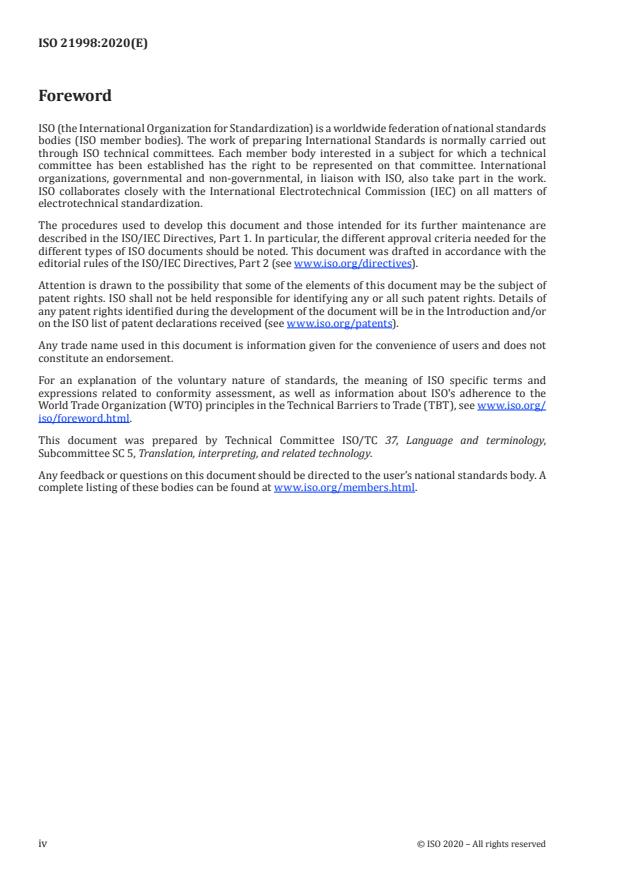
ISO 21998:2020 - Interpreting services -- Healthcare interpreting -- Requirements and recommendations

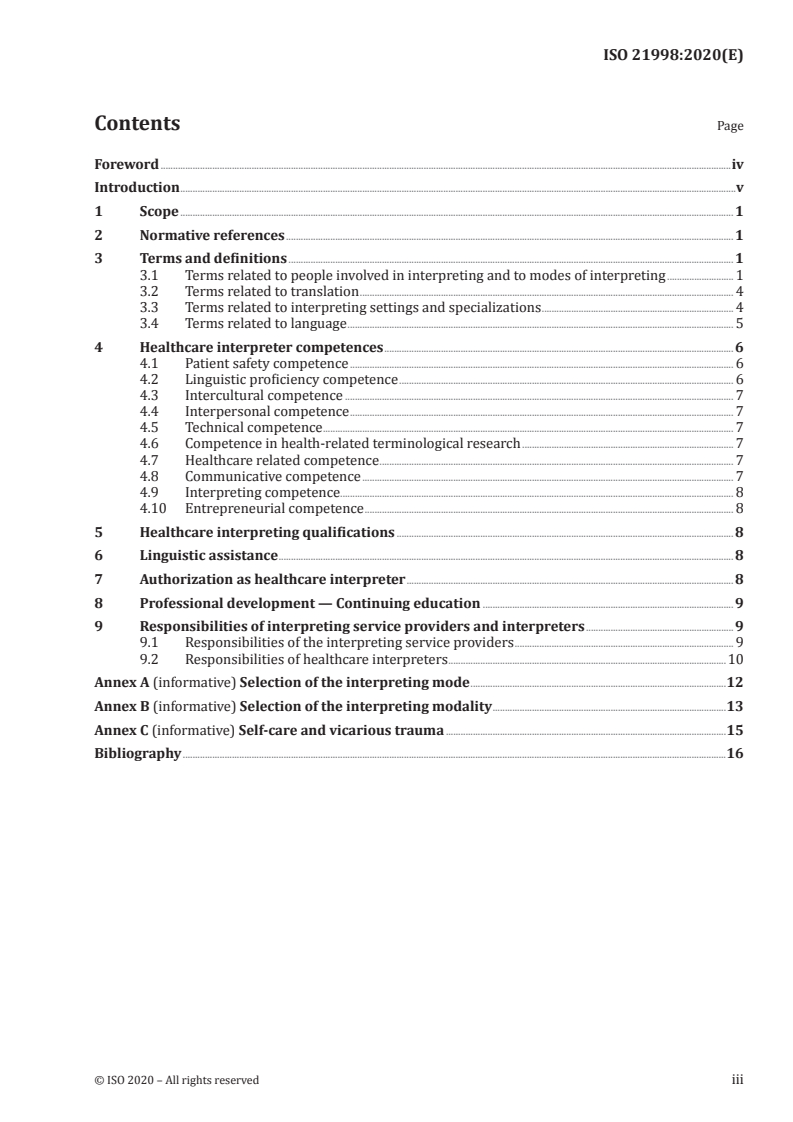
ISO 21998:2020 - Interpreting services — Healthcare interpreting — Requirements and recommendations/14/2020



ISO 21998:2020 - Services d'interprétation -- Interprétation dans le domaine de la santé -- Exigences et recommandations

ISO 21998:2020 - Services d'interprétation — Interprétation dans le domaine de la santé — Exigences et recommandations/14/2020
Overview
ISO 21998:2020 - Interpreting services: Healthcare interpreting - Requirements and recommendations is an international standard that defines requirements and recommendations for healthcare interpreting in both spoken and signed communication. Published in 2020 (first edition) and developed by ISO/TC 37/SC 5, the document is intended for interpreting service providers (ISPs) and healthcare interpreters and aims to promote market transparency, clarify service expectations, and establish professional working conditions for safe, high‑quality healthcare interpreting.
Key topics and requirements
The standard covers terminology, professional competences, service delivery modes and provider responsibilities. Core topics include:
- Scope and terms: Definitions for interpreting, interpreter, healthcare interpreter, ISP, client, end user, distance interpreting, modes and modalities (e.g., consecutive, simultaneous, chuchotage, relay, sight translation).
- Healthcare interpreter competences: Competence areas listed include patient safety, linguistic proficiency, intercultural competence, interpersonal competence, technical competence, terminological research, healthcare knowledge, communicative and interpreting competence, and entrepreneurial competence.
- Qualifications and authorization: Guidance on qualifications, authorization and the role of ISPs and healthcare organizations in verifying competence.
- Service components: Provisions for linguistic assistance, selection of interpreting mode/modality (face‑to‑face and distance interpreting), and sight translation practices.
- Professional development: Continuing education and ongoing professional development expectations.
- Responsibilities: Duties of interpreting service providers and individual healthcare interpreters, including quality assurance and patient safety obligations.
- Wellbeing: Informative annex on self‑care and vicarious trauma for interpreters.
Practical applications
ISO 21998:2020 is directly applicable where accurate spoken or signed language mediation is required to address health‑related issues. Typical uses:
- Hospitals and clinics procuring interpreting services to ensure patient safety and informed consent.
- Interpreting service providers designing service contracts, quality assurance and training programs.
- Healthcare interpreter training programs structuring curricula around defined competences.
- Policy makers and healthcare administrators developing guidelines for linguistically and culturally appropriate care.
- Telehealth and distance interpreting platforms implementing mode and modality best practices.
Who should use this standard
- Healthcare interpreters and interpreter departments
- Interpreting service providers (in‑house or external)
- Healthcare organizations, policy makers and regulators
- Educators, trainers and professional associations
Related standards
- ISO 20539:2019 (source for many interpreting terms and definitions)
Using ISO 21998:2020 helps organizations and professionals deliver safe, consistent and ethically grounded healthcare interpreting services across spoken and signed languages.
Buy Documents
ISO 21998:2020 - Interpreting services -- Healthcare interpreting -- Requirements and recommendations
ISO 21998:2020 - Interpreting services — Healthcare interpreting — Requirements and recommendations/14/2020
ISO 21998:2020 - Services d'interprétation -- Interprétation dans le domaine de la santé -- Exigences et recommandations
ISO 21998:2020 - Services d'interprétation — Interprétation dans le domaine de la santé — Exigences et recommandations/14/2020
Get Certified
Connect with accredited certification bodies for this standard

BSI Group
BSI (British Standards Institution) is the business standards company that helps organizations make excellence a habit.

TÜV Rheinland
TÜV Rheinland is a leading international provider of technical services.

TÜV SÜD
TÜV SÜD is a trusted partner of choice for safety, security and sustainability solutions.
Sponsored listings
Frequently Asked Questions
ISO 21998:2020 is a standard published by the International Organization for Standardization (ISO). Its full title is "Interpreting services — Healthcare interpreting — Requirements and recommendations". This standard covers: This document specifies requirements and recommendations for healthcare interpreting services in spoken and signed communication. It is applicable to all situations requiring healthcare interpreting, where the parties involved need to communicate using spoken or signed language, to treat a health-related issue. It is intended for interpreting service providers and healthcare interpreters.
This document specifies requirements and recommendations for healthcare interpreting services in spoken and signed communication. It is applicable to all situations requiring healthcare interpreting, where the parties involved need to communicate using spoken or signed language, to treat a health-related issue. It is intended for interpreting service providers and healthcare interpreters.
ISO 21998:2020 is classified under the following ICS (International Classification for Standards) categories: 01.020 - Terminology (principles and coordination); 11.020.99 - Other standards related to health care in general. The ICS classification helps identify the subject area and facilitates finding related standards.
ISO 21998:2020 is available in PDF format for immediate download after purchase. The document can be added to your cart and obtained through the secure checkout process. Digital delivery ensures instant access to the complete standard document.
Standards Content (Sample)
SLOVENSKI STANDARD
01-junij-2021
Storitve tolmačenja - Tolmačenje v zdravstvu - Zahteve in priporočila
Interpreting services -- Healthcare interpreting -- Requirements and recommendations
Services d'interprétation -- Interprétation dans le domaine de la santé -- Exigences et
recommandations
Ta slovenski standard je istoveten z: ISO 21998:2020
ICS:
01.020 Terminologija (načela in Terminology (principles and
koordinacija) coordination)
03.080.99 Druge storitve Other services
11.020.99 Drugi standardi v zvezi z Other standards related to
zdravstvom na splošno health care in general
2003-01.Slovenski inštitut za standardizacijo. Razmnoževanje celote ali delov tega standarda ni dovoljeno.
INTERNATIONAL ISO
STANDARD 21998
First edition
2020-12
Interpreting services — Healthcare
interpreting — Requirements and
recommendations
Services d'interprétation — Interprétation dans le domaine de la
santé — Exigences et recommandations
Reference number
©
ISO 2020
© ISO 2020
All rights reserved. Unless otherwise specified, or required in the context of its implementation, no part of this publication may
be reproduced or utilized otherwise in any form or by any means, electronic or mechanical, including photocopying, or posting
on the internet or an intranet, without prior written permission. Permission can be requested from either ISO at the address
below or ISO’s member body in the country of the requester.
ISO copyright office
CP 401 • Ch. de Blandonnet 8
CH-1214 Vernier, Geneva
Phone: +41 22 749 01 11
Email: copyright@iso.org
Website: www.iso.org
Published in Switzerland
ii © ISO 2020 – All rights reserved
Contents Page
Foreword .iv
Introduction .v
1 Scope . 1
2 Normative references . 1
3 Terms and definitions . 1
3.1 Terms related to people involved in interpreting and to modes of interpreting . 1
3.2 Terms related to translation . 4
3.3 Terms related to interpreting settings and specializations . 4
3.4 Terms related to language . 5
4 Healthcare interpreter competences . 6
4.1 Patient safety competence . 6
4.2 Linguistic proficiency competence . 6
4.3 Intercultural competence . 7
4.4 Interpersonal competence . 7
4.5 Technical competence . 7
4.6 Competence in health-related terminological research . 7
4.7 Healthcare related competence . 7
4.8 Communicative competence . 7
4.9 Interpreting competence. 8
4.10 Entrepreneurial competence . 8
5 Healthcare interpreting qualifications . 8
6 Linguistic assistance . 8
7 Authorization as healthcare interpreter . 8
8 Professional development — Continuing education . 9
9 Responsibilities of interpreting service providers and interpreters .9
9.1 Responsibilities of the interpreting service providers . 9
9.2 Responsibilities of healthcare interpreters .10
Annex A (informative) Selection of the interpreting mode .12
Annex B (informative) Selection of the interpreting modality .13
Annex C (informative) Self-care and vicarious trauma .15
Bibliography .16
Foreword
ISO (the International Organization for Standardization) is a worldwide federation of national standards
bodies (ISO member bodies). The work of preparing International Standards is normally carried out
through ISO technical committees. Each member body interested in a subject for which a technical
committee has been established has the right to be represented on that committee. International
organizations, governmental and non-governmental, in liaison with ISO, also take part in the work.
ISO collaborates closely with the International Electrotechnical Commission (IEC) on all matters of
electrotechnical standardization.
The procedures used to develop this document and those intended for its further maintenance are
described in the ISO/IEC Directives, Part 1. In particular, the different approval criteria needed for the
different types of ISO documents should be noted. This document was drafted in accordance with the
editorial rules of the ISO/IEC Directives, Part 2 (see www .iso .org/ directives).
Attention is drawn to the possibility that some of the elements of this document may be the subject of
patent rights. ISO shall not be held responsible for identifying any or all such patent rights. Details of
any patent rights identified during the development of the document will be in the Introduction and/or
on the ISO list of patent declarations received (see www .iso .org/ patents).
Any trade name used in this document is information given for the convenience of users and does not
constitute an endorsement.
For an explanation of the voluntary nature of standards, the meaning of ISO specific terms and
expressions related to conformity assessment, as well as information about ISO's adherence to the
World Trade Organization (WTO) principles in the Technical Barriers to Trade (TBT), see www .iso .org/
iso/ foreword .html.
This document was prepared by Technical Committee ISO/TC 37, Language and terminology,
Subcommittee SC 5, Translation, interpreting, and related technology.
Any feedback or questions on this document should be directed to the user’s national standards body. A
complete listing of these bodies can be found at www .iso .org/ members .html.
iv © ISO 2020 – All rights reserved
Introduction
Healthcare interpreting services:
a) enable safe communication mainly between healthcare providers and patients;
b) provide linguistic access to healthcare services.
This document was developed in response to a worldwide growing demand to accommodate the
interpreting needs of patients deprived of linguistic access to healthcare services and healthcare
professionals, such as physicians, nurses, and healthcare administrative staff, as well as to strive
towards patient safety, wellbeing, and dignity during interactions related to the provision of healthcare-
related services. In those countries that do not have any recognized healthcare interpreting education
in place, this document can serve as a guideline and basis for setting up a suitable legal, administrative
and educational system for all healthcare interpreting stakeholders.
Healthcare interpreting is also referred to as medical interpreting.
The right to health services has been well documented in several international and national documents
(see References [6] to [42]). Several countries have also enacted legislation, regulations, or guidelines
concerning the provision of culturally and linguistically appropriate healthcare services. These require
the provision of qualified interpreting services for linguistically and culturally diverse patients, see
References [43] to [48]. Healthcare interpreting services need to be of a sufficiently high quality to
ensure patient safety.
Healthcare interpreting is distinct from medical or healthcare-related translation. Translation involves
the rendering of various forms of content into another language in written form, requiring a process
and the allocation of a certain period of time for the task. Interpreting involves rendering spoken or
signed messages from one language to another, either face-to-face or via distance interpreting. Some
healthcare interpreters are qualified to provide medical translation while others are not. Likewise, some
medical translators may or may not be qualified to provide healthcare interpreting services, as these
activities require different skill sets. When documents are not translated, healthcare interpreters sight
translate the document into the other language. The provisions herein meet additional requirements
that are specific and unique to healthcare interpreting and the healthcare environment.
Healthcare interpreting takes place between three or more participants:
1) speaker(s) or signer(s) of a language other than the language the healthcare provider speaks or signs;
2) healthcare providers or staff;
3) healthcare interpreter(s).
Healthcare organizations procure interpreting services directly or via an interpreting service
provider (ISP). Healthcare interpreters, who come into a healthcare organization to interpret for a
particular case, whether face-to-face or via distance interpreting (see Annex B), limit themselves to
engaging in the communicative events that require their services. Healthcare interpreters who work
in an interpreter services department within a healthcare organization perform tasks and take on
responsibilities beyond the act of interpreting in communicative events. These tasks can be related to
bridging the cultural and linguistic gaps of the healthcare community, can involve intercultural inquiry,
cultural or linguistic education of other healthcare staff, contacting patients, written translations, or
addressing matters related to the administration and quality assurance of the interpreting department
in question, or comply with patient safety responsibilities as required by their employer. Healthcare
interpreters follow standards of practice (see References [49] to [54]) and relevant code of ethics.
The objectives of this document are:
a) to promote market transparency in the field of healthcare interpreting;
b) to provide information and clarification for users of healthcare interpreting services;
c) to establish professional working conditions for healthcare interpreters.
This document benefits all parties involved in the work of healthcare interpreting. They include:
— healthcare interpreters;
— interpreting service providers;
— patients and accompanying persons;
— interpreter departments in healthcare organizations;
— government agencies;
— non-profit organizations;
— community organizations that provide interpreting services;
— employees that provide interpreting services;
— professional associations;
— healthcare organizations;
— educators and researchers;
— healthcare providers and staff;
— healthcare policy writers.
vi © ISO 2020 – All rights reserved
INTERNATIONAL STANDARD ISO 21998:2020(E)
Interpreting services — Healthcare interpreting —
Requirements and recommendations
1 Scope
This document specifies requirements and recommendations for healthcare interpreting services in
spoken and signed communication. It is applicable to all situations requiring healthcare interpreting,
where the parties involved need to communicate using spoken or signed language, to treat a health-
related issue. It is intended for interpreting service providers and healthcare interpreters.
2 Normative references
There are no normative references in this document.
3 Terms and definitions
For the purposes of this document, the following terms and definitions apply.
ISO and IEC maintain terminological databases for use in standardization at the following addresses:
— ISO Online browsing platform: available at https:// www .iso .org/ obp
— IEC Electropedia: available at http:// www .electropedia .org/
3.1 Terms related to people involved in interpreting and to modes of interpreting
3.1.1
interpret
render spoken or signed information from a source language (3.4.6) to a target language (3.4.7) in
oral or signed form, conveying both the language register (3.4.4) and meaning of the source language
content (3.4.8)
[SOURCE: ISO 20539:2019, 3.1.9]
3.1.2
interpreting
interpretation
rendering spoken or signed information from a source language (3.4.6) to a target language (3.4.7) in
oral or signed form, conveying both the language register (3.4.4) and meaning of the source language
content (3.4.8)
[SOURCE: ISO 20539:2019, 3.1.10]
3.1.3
interpreter
person who interprets (3.1.1)
[SOURCE: ISO 20539:2019, 3.1.12]
3.1.4
healthcare interpreter
medical interpreter
interpreter (3.1.3) who is qualified to provide healthcare interpreting (3.3.3) services
Note 1 to entry: Healthcare interpreters can be required to be authorized.
[SOURCE: ISO 20539:2019, 3.4.24]
3.1.5
interpreting service provider
ISP
interpretation service provider
interpreter (3.1.3) or organization making interpreting (3.1.2) available to a client (3.1.6)
Note 1 to entry: An interpreting service provider can be a for-profit or non-profit organization, an in-house
department, or a healthcare organization, such as a hospital that offers interpreting services.
[SOURCE: ISO 20539:2019, 3.4.28, modified — ‘interpretation service provider’ was added as an
admitted term, and Note 1 to entry was added.]
3.1.6
client
customer
person, or organization, who enters into a formal agreement for the provision of a service
Note 1 to entry: The formal agreement can, for example, take the form of a contract or of an interdepartmental
service agreement between units of an organization.
Note 2 to entry: The client may coincide with the end user (3.1.7), or the requester of services.
[SOURCE: ISO 20539:2019, 3.2.5, modified — In the Note 2 to entry, the wording ‘The client can be the
end user but that does not have to be the case’ was changed to ‘The client may coincide with the end
user or the requester of services’.]
3.1.7
end user
person or group of persons that ultimately uses the service delivered
[SOURCE: ISO 20539:2019, 3.2.6]
3.1.8
speaker
person addressing others using spoken language (3.4.3)
[SOURCE: ISO 20539:2019, 3.4.9]
3.1.9
signer
person addressing others using signed language (3.4.2)
[SOURCE: ISO 20539:2019, 3.4.10]
3.1.10
distance interpreting
remote interpreting
interpreting (3.1.2) of a speaker (3.1.8) or signer (3.1.9) in a different location from that of the interpreter
(3.1.3), enabled by information and communications technology
[SOURCE: ISO 20539:2019, 3.4.15]
2 © ISO 2020 – All rights reserved
3.1.11
mode
established method for the delivery of spoken language (3.4.3) interpreting (3.1.2) and signed language
(3.4.2) interpreting
[SOURCE: ISO 20539:2019, 3.4.11]
3.1.12
consecutive interpreting
mode (3.1.11) of interpreting (3.1.2) performed after the speaker (3.1.8) or signer (3.1.9) pauses
[SOURCE: ISO 20539:2019, 3.4.13, modified — Note 1 to entry was removed.]
3.1.13
simultaneous interpreting
mode (3.1.11) of interpreting (3.1.2) performed while a speaker (3.1.8) or signer (3.1.9) is still speaking
or signing
[SOURCE: ISO 20539:2019, 3.4.12]
3.1.14
sight translation
rendering written source language content (3.4.8) to target language content (3.4.9) in the form of spoken
language (3.4.3) or signed language (3.4.2)
[SOURCE: ISO 20539:2019, 3.4.16]
3.1.15
note-taking
technique in consecutive interpreting (3.1.12) used by interpreters (3.1.3) for remembering,
conceptualizing and summarizing information
Note 1 to entry: Note-taking is highly individual and can involve a mixture of symbols, abbreviations, words and
diagrams.
[SOURCE: ISO 20539:2019, 3.4.29]
3.1.16
chuchotage
whispered interpreting
simultaneous interpreting (3.1.13) where the interpreter (3.1.3) sits or stands in close proximity to the
listeners and uses no interpreting (3.1.2) equipment
Note 1 to entry: Chuchotage is used for interpreting to a very small number of listeners, ideally one or two.
[SOURCE: ISO 20539:2019, 3.4.17, modified — In the definition, ‘speaks very quietly,’ was deleted.]
3.1.17
protocol
rule, official procedure or common practice that guides the conduct of members of a profession
[SOURCE: ISO 20539:2019, 3.4.30]
3.1.18
relay interpreting
interpreting (3.1.2) that occurs when an interpreter’s (3.1.3) input comes from another interpreter’s
rendition and not directly from the speaker (3.1.8) or signer (3.1.9)
[SOURCE: ISO 20539:2019, 3.4.14]
3.2 Terms related to translation
3.2.1
translate
render source language content (3.4.8) into target language content (3.4.9) in written form or signed
language (3.4.2)
[SOURCE: ISO 20539:2019, 3.1.7]
3.2.2
translation
rendering source language content (3.4.8) into target language content (3.4.9) in written form or signed
language (3.4.2)
[SOURCE: ISO 20539:2019, 3.1.8]
3.3 Terms related to interpreting settings and specializations
3.3.1
communicative event
encounter between two or more parties during which information is transmitted
[SOURCE: ISO 20539:2019, 3.4.8]
3.3.2
community interpreting
public service interpreting
interpreting (3.1.2) that enables people to access services available to society as a whole, and which
they would otherwise be unable to access owing to a language (3.4.1) barrier
EXAMPLE Social services, tourist services, disaster victim support services.
[SOURCE: ISO 20539:2019, 3.4.21]
3.3.3
healthcare interpreting
medical interpreting
interpreting (3.1.2) health-related communication between patients, accompanying persons and
treatment providers, or administrators who do not use the same language (3.4.1)
[SOURCE: ISO 20539:2019, 3.4.23]
3.3.4
patient safety
prevention of harm caused by errors of commission and omission
[SOURCE: ISO/TS 18864:2017, 3.23]
3.3.5
portable interpreting system
simultaneous interpreting (3.1.13) equipment, with battery-operated components, which is lightweight
and enables the interpreter (3.1.3) and the participants to move around
[SOURCE: ISO 20539:2019, 3.5.2.14]
4 © ISO 2020 – All rights reserved
3.3.6
pre-conference
pre-session
pre-encounter
briefing
procedure, before the communicative event (3.3.1), during which the interpreter (3.1.3) outlines
information to end users (3.1.7) related to how to work with an interpreter, and requests information
related to the case at hand, as required
3.3.7
post-conference
post-session
post-encounter
debriefing
procedure, after the communicative event (3.3.1), during which the interpreter (3.1.3) outlines
information to end users (3.1.7) related to the case at hand, as required
3.4 Terms related to language
3.4.1
language
systematic use of sounds, characters, symbols or signs by which to communicate
[SOURCE: ISO 20539:2019, 3.1.1]
3.4.2
signed language
language (3.4.1) which uses a combination of hand shapes, orientation and movement of the hands,
arms or body, and facial expressions
[SOURCE: ISO 20539:2019, 3.2.3]
3.4.3
spoken language
language (3.4.1) expressed orally
[SOURCE: ISO 20539:2019, 3.4.4]
3.4.4
language register
language (3.4.1) variety used for a particular purpose or in an event of language use, depending on the
type of situation, especially its degree of formality
Note 1 to entry: Individuals usually have more than one language register in their linguistic repertoire and can
vary their use of language register according to their perception of what is appropriate for different purposes or
domains.
[SOURCE: ISO 20539:2019, 3.2.1]
3.4.5
content
information in any form
EXAMPLE Text, audio, video, messages.
[SOURCE: ISO 20539:2019, 3.1.2, modified — In the EXAMPLE, ‘messages’ was added and ‘etc.’ was
deleted.]
3.4.6
source language
language (3.4.1) from which content (3.4.5) is interpreted (3.1.1) or translated (3.2.1)
[SOURCE: ISO 20539:2019, 3.1.3, modified — ‘translated or interpreted’ was replaced with ‘interpreted
or translated’.]
3.4.7
target language
language (3.4.1) into which content (3.4.5) is interpreted (3.1.1) or translated (3.2.1)
[SOURCE: ISO 20539:2019, 3.1.4, modified — ‘translated or interpreted’ was replaced with ‘interpreted
or translated’.]
3.4.8
source language content
content (3.4.5) to be translated (3.2.1) or interpreted (3.1.1)
[SOURCE: ISO 20539:2019, 3.1.5]
3.4.9
target language content
content (3.4.5) that has been translated (3.2.1) or interpreted (3.1.1)
[SOURCE: ISO 20539:2019, 3.1.6, modified — ‘from a source language’ was removed from the end of the
definition.]
4 Healthcare interpreter competences
4.1 Patient safety competence
Healthcare interpreters shall have the knowledge about patient safety needed in order to facilitate safe
communication between individuals who do not share the same language in the provision of healthcare
services. The right to health services has been well documented in several international documents,
and are included in the Bibliography. All healthcare professionals, including healthcare interpreters,
have such obligations, and are responsible for providing services to patients in a manner that ensures
their safety. Therefore, this competence is required not only to achieve the intended communicative
results, but in doing so, to also ensure patient safety, with respect to their interpreting services to all
parties, within the context of healthcare delivery. The competences set out in 4.2 to 4.10 are required
for healthcare interpreting.
4.2 Linguistic proficiency competence
Healthcare interpreters shall have the documented linguistic proficiency competences required
for interpreting in professional settings. The language proficiency required for spoken healthcare
interpreters shall include speaking, listening comprehension, including the ability to comprehend
various regional accents or dialectal differences, and reading comprehension skills.
These skills shall include the ability to comprehend the language being used, and the respective
reception, and production of messages. Healthcare interpreters shall recognize various registers,
including formal and informal, subject-based vocabulary, idiomatic expressions, colloquialisms, and
slangs. They shall have an ability to interpret both formal and informal spoken or signed language.
In healthcare, due to the highly technical nature of medical communication, a high enough level of
linguistic competence is required for an individual to be able to interpret accurately between two
languages.
Linguistic competence is not the same as interpreting competence. It is recommended that interpreting
service providers, or educators, document linguistic proficiency competence and interpreting
competence separately.
6 © ISO 2020 – All rights reserved
ISO
...
INTERNATIONAL ISO
STANDARD 21998
First edition
2020-12
Interpreting services — Healthcare
interpreting — Requirements and
recommendations
Services d'interprétation — Interprétation dans le domaine de la
santé — Exigences et recommandations
Reference number
©
ISO 2020
© ISO 2020
All rights reserved. Unless otherwise specified, or required in the context of its implementation, no part of this publication may
be reproduced or utilized otherwise in any form or by any means, electronic or mechanical, including photocopying, or posting
on the internet or an intranet, without prior written permission. Permission can be requested from either ISO at the address
below or ISO’s member body in the country of the requester.
ISO copyright office
CP 401 • Ch. de Blandonnet 8
CH-1214 Vernier, Geneva
Phone: +41 22 749 01 11
Email: copyright@iso.org
Website: www.iso.org
Published in Switzerland
ii © ISO 2020 – All rights reserved
Contents Page
Foreword .iv
Introduction .v
1 Scope . 1
2 Normative references . 1
3 Terms and definitions . 1
3.1 Terms related to people involved in interpreting and to modes of interpreting . 1
3.2 Terms related to translation . 4
3.3 Terms related to interpreting settings and specializations . 4
3.4 Terms related to language . 5
4 Healthcare interpreter competences . 6
4.1 Patient safety competence . 6
4.2 Linguistic proficiency competence . 6
4.3 Intercultural competence . 7
4.4 Interpersonal competence . 7
4.5 Technical competence . 7
4.6 Competence in health-related terminological research . 7
4.7 Healthcare related competence . 7
4.8 Communicative competence . 7
4.9 Interpreting competence. 8
4.10 Entrepreneurial competence . 8
5 Healthcare interpreting qualifications . 8
6 Linguistic assistance . 8
7 Authorization as healthcare interpreter . 8
8 Professional development — Continuing education . 9
9 Responsibilities of interpreting service providers and interpreters .9
9.1 Responsibilities of the interpreting service providers . 9
9.2 Responsibilities of healthcare interpreters .10
Annex A (informative) Selection of the interpreting mode .12
Annex B (informative) Selection of the interpreting modality .13
Annex C (informative) Self-care and vicarious trauma .15
Bibliography .16
Foreword
ISO (the International Organization for Standardization) is a worldwide federation of national standards
bodies (ISO member bodies). The work of preparing International Standards is normally carried out
through ISO technical committees. Each member body interested in a subject for which a technical
committee has been established has the right to be represented on that committee. International
organizations, governmental and non-governmental, in liaison with ISO, also take part in the work.
ISO collaborates closely with the International Electrotechnical Commission (IEC) on all matters of
electrotechnical standardization.
The procedures used to develop this document and those intended for its further maintenance are
described in the ISO/IEC Directives, Part 1. In particular, the different approval criteria needed for the
different types of ISO documents should be noted. This document was drafted in accordance with the
editorial rules of the ISO/IEC Directives, Part 2 (see www .iso .org/ directives).
Attention is drawn to the possibility that some of the elements of this document may be the subject of
patent rights. ISO shall not be held responsible for identifying any or all such patent rights. Details of
any patent rights identified during the development of the document will be in the Introduction and/or
on the ISO list of patent declarations received (see www .iso .org/ patents).
Any trade name used in this document is information given for the convenience of users and does not
constitute an endorsement.
For an explanation of the voluntary nature of standards, the meaning of ISO specific terms and
expressions related to conformity assessment, as well as information about ISO's adherence to the
World Trade Organization (WTO) principles in the Technical Barriers to Trade (TBT), see www .iso .org/
iso/ foreword .html.
This document was prepared by Technical Committee ISO/TC 37, Language and terminology,
Subcommittee SC 5, Translation, interpreting, and related technology.
Any feedback or questions on this document should be directed to the user’s national standards body. A
complete listing of these bodies can be found at www .iso .org/ members .html.
iv © ISO 2020 – All rights reserved
Introduction
Healthcare interpreting services:
a) enable safe communication mainly between healthcare providers and patients;
b) provide linguistic access to healthcare services.
This document was developed in response to a worldwide growing demand to accommodate the
interpreting needs of patients deprived of linguistic access to healthcare services and healthcare
professionals, such as physicians, nurses, and healthcare administrative staff, as well as to strive
towards patient safety, wellbeing, and dignity during interactions related to the provision of healthcare-
related services. In those countries that do not have any recognized healthcare interpreting education
in place, this document can serve as a guideline and basis for setting up a suitable legal, administrative
and educational system for all healthcare interpreting stakeholders.
Healthcare interpreting is also referred to as medical interpreting.
The right to health services has been well documented in several international and national documents
(see References [6] to [42]). Several countries have also enacted legislation, regulations, or guidelines
concerning the provision of culturally and linguistically appropriate healthcare services. These require
the provision of qualified interpreting services for linguistically and culturally diverse patients, see
References [43] to [48]. Healthcare interpreting services need to be of a sufficiently high quality to
ensure patient safety.
Healthcare interpreting is distinct from medical or healthcare-related translation. Translation involves
the rendering of various forms of content into another language in written form, requiring a process
and the allocation of a certain period of time for the task. Interpreting involves rendering spoken or
signed messages from one language to another, either face-to-face or via distance interpreting. Some
healthcare interpreters are qualified to provide medical translation while others are not. Likewise, some
medical translators may or may not be qualified to provide healthcare interpreting services, as these
activities require different skill sets. When documents are not translated, healthcare interpreters sight
translate the document into the other language. The provisions herein meet additional requirements
that are specific and unique to healthcare interpreting and the healthcare environment.
Healthcare interpreting takes place between three or more participants:
1) speaker(s) or signer(s) of a language other than the language the healthcare provider speaks or signs;
2) healthcare providers or staff;
3) healthcare interpreter(s).
Healthcare organizations procure interpreting services directly or via an interpreting service
provider (ISP). Healthcare interpreters, who come into a healthcare organization to interpret for a
particular case, whether face-to-face or via distance interpreting (see Annex B), limit themselves to
engaging in the communicative events that require their services. Healthcare interpreters who work
in an interpreter services department within a healthcare organization perform tasks and take on
responsibilities beyond the act of interpreting in communicative events. These tasks can be related to
bridging the cultural and linguistic gaps of the healthcare community, can involve intercultural inquiry,
cultural or linguistic education of other healthcare staff, contacting patients, written translations, or
addressing matters related to the administration and quality assurance of the interpreting department
in question, or comply with patient safety responsibilities as required by their employer. Healthcare
interpreters follow standards of practice (see References [49] to [54]) and relevant code of ethics.
The objectives of this document are:
a) to promote market transparency in the field of healthcare interpreting;
b) to provide information and clarification for users of healthcare interpreting services;
c) to establish professional working conditions for healthcare interpreters.
This document benefits all parties involved in the work of healthcare interpreting. They include:
— healthcare interpreters;
— interpreting service providers;
— patients and accompanying persons;
— interpreter departments in healthcare organizations;
— government agencies;
— non-profit organizations;
— community organizations that provide interpreting services;
— employees that provide interpreting services;
— professional associations;
— healthcare organizations;
— educators and researchers;
— healthcare providers and staff;
— healthcare policy writers.
vi © ISO 2020 – All rights reserved
INTERNATIONAL STANDARD ISO 21998:2020(E)
Interpreting services — Healthcare interpreting —
Requirements and recommendations
1 Scope
This document specifies requirements and recommendations for healthcare interpreting services in
spoken and signed communication. It is applicable to all situations requiring healthcare interpreting,
where the parties involved need to communicate using spoken or signed language, to treat a health-
related issue. It is intended for interpreting service providers and healthcare interpreters.
2 Normative references
There are no normative references in this document.
3 Terms and definitions
For the purposes of this document, the following terms and definitions apply.
ISO and IEC maintain terminological databases for use in standardization at the following addresses:
— ISO Online browsing platform: available at https:// www .iso .org/ obp
— IEC Electropedia: available at http:// www .electropedia .org/
3.1 Terms related to people involved in interpreting and to modes of interpreting
3.1.1
interpret
render spoken or signed information from a source language (3.4.6) to a target language (3.4.7) in
oral or signed form, conveying both the language register (3.4.4) and meaning of the source language
content (3.4.8)
[SOURCE: ISO 20539:2019, 3.1.9]
3.1.2
interpreting
interpretation
rendering spoken or signed information from a source language (3.4.6) to a target language (3.4.7) in
oral or signed form, conveying both the language register (3.4.4) and meaning of the source language
content (3.4.8)
[SOURCE: ISO 20539:2019, 3.1.10]
3.1.3
interpreter
person who interprets (3.1.1)
[SOURCE: ISO 20539:2019, 3.1.12]
3.1.4
healthcare interpreter
medical interpreter
interpreter (3.1.3) who is qualified to provide healthcare interpreting (3.3.3) services
Note 1 to entry: Healthcare interpreters can be required to be authorized.
[SOURCE: ISO 20539:2019, 3.4.24]
3.1.5
interpreting service provider
ISP
interpretation service provider
interpreter (3.1.3) or organization making interpreting (3.1.2) available to a client (3.1.6)
Note 1 to entry: An interpreting service provider can be a for-profit or non-profit organization, an in-house
department, or a healthcare organization, such as a hospital that offers interpreting services.
[SOURCE: ISO 20539:2019, 3.4.28, modified — ‘interpretation service provider’ was added as an
admitted term, and Note 1 to entry was added.]
3.1.6
client
customer
person, or organization, who enters into a formal agreement for the provision of a service
Note 1 to entry: The formal agreement can, for example, take the form of a contract or of an interdepartmental
service agreement between units of an organization.
Note 2 to entry: The client may coincide with the end user (3.1.7), or the requester of services.
[SOURCE: ISO 20539:2019, 3.2.5, modified — In the Note 2 to entry, the wording ‘The client can be the
end user but that does not have to be the case’ was changed to ‘The client may coincide with the end
user or the requester of services’.]
3.1.7
end user
person or group of persons that ultimately uses the service delivered
[SOURCE: ISO 20539:2019, 3.2.6]
3.1.8
speaker
person addressing others using spoken language (3.4.3)
[SOURCE: ISO 20539:2019, 3.4.9]
3.1.9
signer
person addressing others using signed language (3.4.2)
[SOURCE: ISO 20539:2019, 3.4.10]
3.1.10
distance interpreting
remote interpreting
interpreting (3.1.2) of a speaker (3.1.8) or signer (3.1.9) in a different location from that of the interpreter
(3.1.3), enabled by information and communications technology
[SOURCE: ISO 20539:2019, 3.4.15]
2 © ISO 2020 – All rights reserved
3.1.11
mode
established method for the delivery of spoken language (3.4.3) interpreting (3.1.2) and signed language
(3.4.2) interpreting
[SOURCE: ISO 20539:2019, 3.4.11]
3.1.12
consecutive interpreting
mode (3.1.11) of interpreting (3.1.2) performed after the speaker (3.1.8) or signer (3.1.9) pauses
[SOURCE: ISO 20539:2019, 3.4.13, modified — Note 1 to entry was removed.]
3.1.13
simultaneous interpreting
mode (3.1.11) of interpreting (3.1.2) performed while a speaker (3.1.8) or signer (3.1.9) is still speaking
or signing
[SOURCE: ISO 20539:2019, 3.4.12]
3.1.14
sight translation
rendering written source language content (3.4.8) to target language content (3.4.9) in the form of spoken
language (3.4.3) or signed language (3.4.2)
[SOURCE: ISO 20539:2019, 3.4.16]
3.1.15
note-taking
technique in consecutive interpreting (3.1.12) used by interpreters (3.1.3) for remembering,
conceptualizing and summarizing information
Note 1 to entry: Note-taking is highly individual and can involve a mixture of symbols, abbreviations, words and
diagrams.
[SOURCE: ISO 20539:2019, 3.4.29]
3.1.16
chuchotage
whispered interpreting
simultaneous interpreting (3.1.13) where the interpreter (3.1.3) sits or stands in close proximity to the
listeners and uses no interpreting (3.1.2) equipment
Note 1 to entry: Chuchotage is used for interpreting to a very small number of listeners, ideally one or two.
[SOURCE: ISO 20539:2019, 3.4.17, modified — In the definition, ‘speaks very quietly,’ was deleted.]
3.1.17
protocol
rule, official procedure or common practice that guides the conduct of members of a profession
[SOURCE: ISO 20539:2019, 3.4.30]
3.1.18
relay interpreting
interpreting (3.1.2) that occurs when an interpreter’s (3.1.3) input comes from another interpreter’s
rendition and not directly from the speaker (3.1.8) or signer (3.1.9)
[SOURCE: ISO 20539:2019, 3.4.14]
3.2 Terms related to translation
3.2.1
translate
render source language content (3.4.8) into target language content (3.4.9) in written form or signed
language (3.4.2)
[SOURCE: ISO 20539:2019, 3.1.7]
3.2.2
translation
rendering source language content (3.4.8) into target language content (3.4.9) in written form or signed
language (3.4.2)
[SOURCE: ISO 20539:2019, 3.1.8]
3.3 Terms related to interpreting settings and specializations
3.3.1
communicative event
encounter between two or more parties during which information is transmitted
[SOURCE: ISO 20539:2019, 3.4.8]
3.3.2
community interpreting
public service interpreting
interpreting (3.1.2) that enables people to access services available to society as a whole, and which
they would otherwise be unable to access owing to a language (3.4.1) barrier
EXAMPLE Social services, tourist services, disaster victim support services.
[SOURCE: ISO 20539:2019, 3.4.21]
3.3.3
healthcare interpreting
medical interpreting
interpreting (3.1.2) health-related communication between patients, accompanying persons and
treatment providers, or administrators who do not use the same language (3.4.1)
[SOURCE: ISO 20539:2019, 3.4.23]
3.3.4
patient safety
prevention of harm caused by errors of commission and omission
[SOURCE: ISO/TS 18864:2017, 3.23]
3.3.5
portable interpreting system
simultaneous interpreting (3.1.13) equipment, with battery-operated components, which is lightweight
and enables the interpreter (3.1.3) and the participants to move around
[SOURCE: ISO 20539:2019, 3.5.2.14]
4 © ISO 2020 – All rights reserved
3.3.6
pre-conference
pre-session
pre-encounter
briefing
procedure, before the communicative event (3.3.1), during which the interpreter (3.1.3) outlines
information to end users (3.1.7) related to how to work with an interpreter, and requests information
related to the case at hand, as required
3.3.7
post-conference
post-session
post-encounter
debriefing
procedure, after the communicative event (3.3.1), during which the interpreter (3.1.3) outlines
information to end users (3.1.7) related to the case at hand, as required
3.4 Terms related to language
3.4.1
language
systematic use of sounds, characters, symbols or signs by which to communicate
[SOURCE: ISO 20539:2019, 3.1.1]
3.4.2
signed language
language (3.4.1) which uses a combination of hand shapes, orientation and movement of the hands,
arms or body, and facial expressions
[SOURCE: ISO 20539:2019, 3.2.3]
3.4.3
spoken language
language (3.4.1) expressed orally
[SOURCE: ISO 20539:2019, 3.4.4]
3.4.4
language register
language (3.4.1) variety used for a particular purpose or in an event of language use, depending on the
type of situation, especially its degree of formality
Note 1 to entry: Individuals usually have more than one language register in their linguistic repertoire and can
vary their use of language register according to their perception of what is appropriate for different purposes or
domains.
[SOURCE: ISO 20539:2019, 3.2.1]
3.4.5
content
information in any form
EXAMPLE Text, audio, video, messages.
[SOURCE: ISO 20539:2019, 3.1.2, modified — In the EXAMPLE, ‘messages’ was added and ‘etc.’ was
deleted.]
3.4.6
source language
language (3.4.1) from which content (3.4.5) is interpreted (3.1.1) or translated (3.2.1)
[SOURCE: ISO 20539:2019, 3.1.3, modified — ‘translated or interpreted’ was replaced with ‘interpreted
or translated’.]
3.4.7
target language
language (3.4.1) into which content (3.4.5) is interpreted (3.1.1) or translated (3.2.1)
[SOURCE: ISO 20539:2019, 3.1.4, modified — ‘translated or interpreted’ was replaced with ‘interpreted
or translated’.]
3.4.8
source language content
content (3.4.5) to be translated (3.2.1) or interpreted (3.1.1)
[SOURCE: ISO 20539:2019, 3.1.5]
3.4.9
target language content
content (3.4.5) that has been translated (3.2.1) or interpreted (3.1.1)
[SOURCE: ISO 20539:2019, 3.1.6, modified — ‘from a source language’ was removed from the end of the
definition.]
4 Healthcare interpreter competences
4.1 Patient safety competence
Healthcare interpreters shall have the knowledge about patient safety needed in order to facilitate safe
communication between individuals who do not share the same language in the provision of healthcare
services. The right to health services has been well documented in several international documents,
and are included in the Bibliography. All healthcare professionals, including healthcare interpreters,
have such obligations, and are responsible for providing services to patients in a manner that ensures
their safety. Therefore, this competence is required not only to achieve the intended communicative
results, but in doing so, to also ensure patient safety, with respect to their interpreting services to all
parties, within the context of healthcare delivery. The competences set out in 4.2 to 4.10 are required
for healthcare interpreting.
4.2 Linguistic proficiency competence
Healthcare interpreters shall have the documented linguistic proficiency competences required
for interpreting in professional settings. The language proficiency required for spoken healthcare
interpreters shall include speaking, listening comprehension, including the ability to comprehend
various regional accents or dialectal differences, and reading comprehension skills.
These skills shall include the ability to comprehend the language being used, and the respective
reception, and production of messages. Healthcare interpreters shall recognize various registers,
including formal and informal, subject-based vocabulary, idiomatic expressions, colloquialisms, and
slangs. They shall have an ability to interpret both formal and informal spoken or signed language.
In healthcare, due to the highly technical nature of medical communication, a high enough level of
linguistic competence is required for an individual to be able to interpret accurately between two
languages.
Linguistic competence is not the same as interpreting competence. It is recommended that interpreting
service providers, or educators, document linguistic proficiency competence and interpreting
competence separately.
6 © ISO 2020 – All rights reserved
4.3 Intercultural competence
Healthcare interpreters shall use culturally appropriate language and behaviour, and shall be aware
of and able to convey cultural nuances in order to render them in their linguistic output, gestures, and
tone. When necessary, healthcare interpreters shall bridge the cultural and conceptual gaps separating
participants. They shall recognize and address cultural issues, via intercultural inquiry, to ensure
accurate and complete understanding.
4.4 Interpersonal competence
Healthcare inter
...
INTERNATIONAL ISO
STANDARD 21998
First edition
2020-12
Interpreting services — Healthcare
interpreting — Requirements and
recommendations
Services d'interprétation — Interprétation dans le domaine de la
santé — Exigences et recommandations
Reference number
©
ISO 2020
© ISO 2020
All rights reserved. Unless otherwise specified, or required in the context of its implementation, no part of this publication may
be reproduced or utilized otherwise in any form or by any means, electronic or mechanical, including photocopying, or posting
on the internet or an intranet, without prior written permission. Permission can be requested from either ISO at the address
below or ISO’s member body in the country of the requester.
ISO copyright office
CP 401 • Ch. de Blandonnet 8
CH-1214 Vernier, Geneva
Phone: +41 22 749 01 11
Email: copyright@iso.org
Website: www.iso.org
Published in Switzerland
ii © ISO 2020 – All rights reserved
Contents Page
Foreword .iv
Introduction .v
1 Scope . 1
2 Normative references . 1
3 Terms and definitions . 1
3.1 Terms related to people involved in interpreting and to modes of interpreting . 1
3.2 Terms related to translation . 4
3.3 Terms related to interpreting settings and specializations . 4
3.4 Terms related to language . 5
4 Healthcare interpreter competences . 6
4.1 Patient safety competence . 6
4.2 Linguistic proficiency competence . 6
4.3 Intercultural competence . 7
4.4 Interpersonal competence . 7
4.5 Technical competence . 7
4.6 Competence in health-related terminological research . 7
4.7 Healthcare related competence . 7
4.8 Communicative competence . 7
4.9 Interpreting competence. 8
4.10 Entrepreneurial competence . 8
5 Healthcare interpreting qualifications . 8
6 Linguistic assistance . 8
7 Authorization as healthcare interpreter . 8
8 Professional development — Continuing education . 9
9 Responsibilities of interpreting service providers and interpreters .9
9.1 Responsibilities of the interpreting service providers . 9
9.2 Responsibilities of healthcare interpreters .10
Annex A (informative) Selection of the interpreting mode .12
Annex B (informative) Selection of the interpreting modality .13
Annex C (informative) Self-care and vicarious trauma .15
Bibliography .16
Foreword
ISO (the International Organization for Standardization) is a worldwide federation of national standards
bodies (ISO member bodies). The work of preparing International Standards is normally carried out
through ISO technical committees. Each member body interested in a subject for which a technical
committee has been established has the right to be represented on that committee. International
organizations, governmental and non-governmental, in liaison with ISO, also take part in the work.
ISO collaborates closely with the International Electrotechnical Commission (IEC) on all matters of
electrotechnical standardization.
The procedures used to develop this document and those intended for its further maintenance are
described in the ISO/IEC Directives, Part 1. In particular, the different approval criteria needed for the
different types of ISO documents should be noted. This document was drafted in accordance with the
editorial rules of the ISO/IEC Directives, Part 2 (see www .iso .org/ directives).
Attention is drawn to the possibility that some of the elements of this document may be the subject of
patent rights. ISO shall not be held responsible for identifying any or all such patent rights. Details of
any patent rights identified during the development of the document will be in the Introduction and/or
on the ISO list of patent declarations received (see www .iso .org/ patents).
Any trade name used in this document is information given for the convenience of users and does not
constitute an endorsement.
For an explanation of the voluntary nature of standards, the meaning of ISO specific terms and
expressions related to conformity assessment, as well as information about ISO's adherence to the
World Trade Organization (WTO) principles in the Technical Barriers to Trade (TBT), see www .iso .org/
iso/ foreword .html.
This document was prepared by Technical Committee ISO/TC 37, Language and terminology,
Subcommittee SC 5, Translation, interpreting, and related technology.
Any feedback or questions on this document should be directed to the user’s national standards body. A
complete listing of these bodies can be found at www .iso .org/ members .html.
iv © ISO 2020 – All rights reserved
Introduction
Healthcare interpreting services:
a) enable safe communication mainly between healthcare providers and patients;
b) provide linguistic access to healthcare services.
This document was developed in response to a worldwide growing demand to accommodate the
interpreting needs of patients deprived of linguistic access to healthcare services and healthcare
professionals, such as physicians, nurses, and healthcare administrative staff, as well as to strive
towards patient safety, wellbeing, and dignity during interactions related to the provision of healthcare-
related services. In those countries that do not have any recognized healthcare interpreting education
in place, this document can serve as a guideline and basis for setting up a suitable legal, administrative
and educational system for all healthcare interpreting stakeholders.
Healthcare interpreting is also referred to as medical interpreting.
The right to health services has been well documented in several international and national documents
(see References [6] to [42]). Several countries have also enacted legislation, regulations, or guidelines
concerning the provision of culturally and linguistically appropriate healthcare services. These require
the provision of qualified interpreting services for linguistically and culturally diverse patients, see
References [43] to [48]. Healthcare interpreting services need to be of a sufficiently high quality to
ensure patient safety.
Healthcare interpreting is distinct from medical or healthcare-related translation. Translation involves
the rendering of various forms of content into another language in written form, requiring a process
and the allocation of a certain period of time for the task. Interpreting involves rendering spoken or
signed messages from one language to another, either face-to-face or via distance interpreting. Some
healthcare interpreters are qualified to provide medical translation while others are not. Likewise, some
medical translators may or may not be qualified to provide healthcare interpreting services, as these
activities require different skill sets. When documents are not translated, healthcare interpreters sight
translate the document into the other language. The provisions herein meet additional requirements
that are specific and unique to healthcare interpreting and the healthcare environment.
Healthcare interpreting takes place between three or more participants:
1) speaker(s) or signer(s) of a language other than the language the healthcare provider speaks or signs;
2) healthcare providers or staff;
3) healthcare interpreter(s).
Healthcare organizations procure interpreting services directly or via an interpreting service
provider (ISP). Healthcare interpreters, who come into a healthcare organization to interpret for a
particular case, whether face-to-face or via distance interpreting (see Annex B), limit themselves to
engaging in the communicative events that require their services. Healthcare interpreters who work
in an interpreter services department within a healthcare organization perform tasks and take on
responsibilities beyond the act of interpreting in communicative events. These tasks can be related to
bridging the cultural and linguistic gaps of the healthcare community, can involve intercultural inquiry,
cultural or linguistic education of other healthcare staff, contacting patients, written translations, or
addressing matters related to the administration and quality assurance of the interpreting department
in question, or comply with patient safety responsibilities as required by their employer. Healthcare
interpreters follow standards of practice (see References [49] to [54]) and relevant code of ethics.
The objectives of this document are:
a) to promote market transparency in the field of healthcare interpreting;
b) to provide information and clarification for users of healthcare interpreting services;
c) to establish professional working conditions for healthcare interpreters.
This document benefits all parties involved in the work of healthcare interpreting. They include:
— healthcare interpreters;
— interpreting service providers;
— patients and accompanying persons;
— interpreter departments in healthcare organizations;
— government agencies;
— non-profit organizations;
— community organizations that provide interpreting services;
— employees that provide interpreting services;
— professional associations;
— healthcare organizations;
— educators and researchers;
— healthcare providers and staff;
— healthcare policy writers.
vi © ISO 2020 – All rights reserved
INTERNATIONAL STANDARD ISO 21998:2020(E)
Interpreting services — Healthcare interpreting —
Requirements and recommendations
1 Scope
This document specifies requirements and recommendations for healthcare interpreting services in
spoken and signed communication. It is applicable to all situations requiring healthcare interpreting,
where the parties involved need to communicate using spoken or signed language, to treat a health-
related issue. It is intended for interpreting service providers and healthcare interpreters.
2 Normative references
There are no normative references in this document.
3 Terms and definitions
For the purposes of this document, the following terms and definitions apply.
ISO and IEC maintain terminological databases for use in standardization at the following addresses:
— ISO Online browsing platform: available at https:// www .iso .org/ obp
— IEC Electropedia: available at http:// www .electropedia .org/
3.1 Terms related to people involved in interpreting and to modes of interpreting
3.1.1
interpret
render spoken or signed information from a source language (3.4.6) to a target language (3.4.7) in
oral or signed form, conveying both the language register (3.4.4) and meaning of the source language
content (3.4.8)
[SOURCE: ISO 20539:2019, 3.1.9]
3.1.2
interpreting
interpretation
rendering spoken or signed information from a source language (3.4.6) to a target language (3.4.7) in
oral or signed form, conveying both the language register (3.4.4) and meaning of the source language
content (3.4.8)
[SOURCE: ISO 20539:2019, 3.1.10]
3.1.3
interpreter
person who interprets (3.1.1)
[SOURCE: ISO 20539:2019, 3.1.12]
3.1.4
healthcare interpreter
medical interpreter
interpreter (3.1.3) who is qualified to provide healthcare interpreting (3.3.3) services
Note 1 to entry: Healthcare interpreters can be required to be authorized.
[SOURCE: ISO 20539:2019, 3.4.24]
3.1.5
interpreting service provider
ISP
interpretation service provider
interpreter (3.1.3) or organization making interpreting (3.1.2) available to a client (3.1.6)
Note 1 to entry: An interpreting service provider can be a for-profit or non-profit organization, an in-house
department, or a healthcare organization, such as a hospital that offers interpreting services.
[SOURCE: ISO 20539:2019, 3.4.28, modified — ‘interpretation service provider’ was added as an
admitted term, and Note 1 to entry was added.]
3.1.6
client
customer
person, or organization, who enters into a formal agreement for the provision of a service
Note 1 to entry: The formal agreement can, for example, take the form of a contract or of an interdepartmental
service agreement between units of an organization.
Note 2 to entry: The client may coincide with the end user (3.1.7), or the requester of services.
[SOURCE: ISO 20539:2019, 3.2.5, modified — In the Note 2 to entry, the wording ‘The client can be the
end user but that does not have to be the case’ was changed to ‘The client may coincide with the end
user or the requester of services’.]
3.1.7
end user
person or group of persons that ultimately uses the service delivered
[SOURCE: ISO 20539:2019, 3.2.6]
3.1.8
speaker
person addressing others using spoken language (3.4.3)
[SOURCE: ISO 20539:2019, 3.4.9]
3.1.9
signer
person addressing others using signed language (3.4.2)
[SOURCE: ISO 20539:2019, 3.4.10]
3.1.10
distance interpreting
remote interpreting
interpreting (3.1.2) of a speaker (3.1.8) or signer (3.1.9) in a different location from that of the interpreter
(3.1.3), enabled by information and communications technology
[SOURCE: ISO 20539:2019, 3.4.15]
2 © ISO 2020 – All rights reserved
3.1.11
mode
established method for the delivery of spoken language (3.4.3) interpreting (3.1.2) and signed language
(3.4.2) interpreting
[SOURCE: ISO 20539:2019, 3.4.11]
3.1.12
consecutive interpreting
mode (3.1.11) of interpreting (3.1.2) performed after the speaker (3.1.8) or signer (3.1.9) pauses
[SOURCE: ISO 20539:2019, 3.4.13, modified — Note 1 to entry was removed.]
3.1.13
simultaneous interpreting
mode (3.1.11) of interpreting (3.1.2) performed while a speaker (3.1.8) or signer (3.1.9) is still speaking
or signing
[SOURCE: ISO 20539:2019, 3.4.12]
3.1.14
sight translation
rendering written source language content (3.4.8) to target language content (3.4.9) in the form of spoken
language (3.4.3) or signed language (3.4.2)
[SOURCE: ISO 20539:2019, 3.4.16]
3.1.15
note-taking
technique in consecutive interpreting (3.1.12) used by interpreters (3.1.3) for remembering,
conceptualizing and summarizing information
Note 1 to entry: Note-taking is highly individual and can involve a mixture of symbols, abbreviations, words and
diagrams.
[SOURCE: ISO 20539:2019, 3.4.29]
3.1.16
chuchotage
whispered interpreting
simultaneous interpreting (3.1.13) where the interpreter (3.1.3) sits or stands in close proximity to the
listeners and uses no interpreting (3.1.2) equipment
Note 1 to entry: Chuchotage is used for interpreting to a very small number of listeners, ideally one or two.
[SOURCE: ISO 20539:2019, 3.4.17, modified — In the definition, ‘speaks very quietly,’ was deleted.]
3.1.17
protocol
rule, official procedure or common practice that guides the conduct of members of a profession
[SOURCE: ISO 20539:2019, 3.4.30]
3.1.18
relay interpreting
interpreting (3.1.2) that occurs when an interpreter’s (3.1.3) input comes from another interpreter’s
rendition and not directly from the speaker (3.1.8) or signer (3.1.9)
[SOURCE: ISO 20539:2019, 3.4.14]
3.2 Terms related to translation
3.2.1
translate
render source language content (3.4.8) into target language content (3.4.9) in written form or signed
language (3.4.2)
[SOURCE: ISO 20539:2019, 3.1.7]
3.2.2
translation
rendering source language content (3.4.8) into target language content (3.4.9) in written form or signed
language (3.4.2)
[SOURCE: ISO 20539:2019, 3.1.8]
3.3 Terms related to interpreting settings and specializations
3.3.1
communicative event
encounter between two or more parties during which information is transmitted
[SOURCE: ISO 20539:2019, 3.4.8]
3.3.2
community interpreting
public service interpreting
interpreting (3.1.2) that enables people to access services available to society as a whole, and which
they would otherwise be unable to access owing to a language (3.4.1) barrier
EXAMPLE Social services, tourist services, disaster victim support services.
[SOURCE: ISO 20539:2019, 3.4.21]
3.3.3
healthcare interpreting
medical interpreting
interpreting (3.1.2) health-related communication between patients, accompanying persons and
treatment providers, or administrators who do not use the same language (3.4.1)
[SOURCE: ISO 20539:2019, 3.4.23]
3.3.4
patient safety
prevention of harm caused by errors of commission and omission
[SOURCE: ISO/TS 18864:2017, 3.23]
3.3.5
portable interpreting system
simultaneous interpreting (3.1.13) equipment, with battery-operated components, which is lightweight
and enables the interpreter (3.1.3) and the participants to move around
[SOURCE: ISO 20539:2019, 3.5.2.14]
4 © ISO 2020 – All rights reserved
3.3.6
pre-conference
pre-session
pre-encounter
briefing
procedure, before the communicative event (3.3.1), during which the interpreter (3.1.3) outlines
information to end users (3.1.7) related to how to work with an interpreter, and requests information
related to the case at hand, as required
3.3.7
post-conference
post-session
post-encounter
debriefing
procedure, after the communicative event (3.3.1), during which the interpreter (3.1.3) outlines
information to end users (3.1.7) related to the case at hand, as required
3.4 Terms related to language
3.4.1
language
systematic use of sounds, characters, symbols or signs by which to communicate
[SOURCE: ISO 20539:2019, 3.1.1]
3.4.2
signed language
language (3.4.1) which uses a combination of hand shapes, orientation and movement of the hands,
arms or body, and facial expressions
[SOURCE: ISO 20539:2019, 3.2.3]
3.4.3
spoken language
language (3.4.1) expressed orally
[SOURCE: ISO 20539:2019, 3.4.4]
3.4.4
language register
language (3.4.1) variety used for a particular purpose or in an event of language use, depending on the
type of situation, especially its degree of formality
Note 1 to entry: Individuals usually have more than one language register in their linguistic repertoire and can
vary their use of language register according to their perception of what is appropriate for different purposes or
domains.
[SOURCE: ISO 20539:2019, 3.2.1]
3.4.5
content
information in any form
EXAMPLE Text, audio, video, messages.
[SOURCE: ISO 20539:2019, 3.1.2, modified — In the EXAMPLE, ‘messages’ was added and ‘etc.’ was
deleted.]
3.4.6
source language
language (3.4.1) from which content (3.4.5) is interpreted (3.1.1) or translated (3.2.1)
[SOURCE: ISO 20539:2019, 3.1.3, modified — ‘translated or interpreted’ was replaced with ‘interpreted
or translated’.]
3.4.7
target language
language (3.4.1) into which content (3.4.5) is interpreted (3.1.1) or translated (3.2.1)
[SOURCE: ISO 20539:2019, 3.1.4, modified — ‘translated or interpreted’ was replaced with ‘interpreted
or translated’.]
3.4.8
source language content
content (3.4.5) to be translated (3.2.1) or interpreted (3.1.1)
[SOURCE: ISO 20539:2019, 3.1.5]
3.4.9
target language content
content (3.4.5) that has been translated (3.2.1) or interpreted (3.1.1)
[SOURCE: ISO 20539:2019, 3.1.6, modified — ‘from a source language’ was removed from the end of the
definition.]
4 Healthcare interpreter competences
4.1 Patient safety competence
Healthcare interpreters shall have the knowledge about patient safety needed in order to facilitate safe
communication between individuals who do not share the same language in the provision of healthcare
services. The right to health services has been well documented in several international documents,
and are included in the Bibliography. All healthcare professionals, including healthcare interpreters,
have such obligations, and are responsible for providing services to patients in a manner that ensures
their safety. Therefore, this competence is required not only to achieve the intended communicative
results, but in doing so, to also ensure patient safety, with respect to their interpreting services to all
parties, within the context of healthcare delivery. The competences set out in 4.2 to 4.10 are required
for healthcare interpreting.
4.2 Linguistic proficiency competence
Healthcare interpreters shall have the documented linguistic proficiency competences required
for interpreting in professional settings. The language proficiency required for spoken healthcare
interpreters shall include speaking, listening comprehension, including the ability to comprehend
various regional accents or dialectal differences, and reading comprehension skills.
These skills shall include the ability to comprehend the language being used, and the respective
reception, and production of messages. Healthcare interpreters shall recognize various registers,
including formal and informal, subject-based vocabulary, idiomatic expressions, colloquialisms, and
slangs. They shall have an ability to interpret both formal and informal spoken or signed language.
In healthcare, due to the highly technical nature of medical communication, a high enough level of
linguistic competence is required for an individual to be able to interpret accurately between two
languages.
Linguistic competence is not the same as interpreting competence. It is recommended that interpreting
service providers, or educators, document linguistic proficiency competence and interpreting
competence separately.
6 © ISO 2020 – All rights reserved
4.3 Intercultural competence
Healthcare interpreters shall use culturally appropriate language and behaviour, and shall be aware
of and able to convey cultural nuances in order to render them in their linguistic output, gestures, and
tone. When necessary, healthcare interpreters shall bridge the cultural and conceptual gaps separating
participants. They shall recognize and address cultural issues, via intercultural inquiry, to ensure
accurate and complete understanding.
4.4 Interpersonal competence
Healthcare inter
...
NORME ISO
INTERNATIONALE 21998
Première édition
2020-12
Services d'interprétation —
Interprétation dans le domaine
de la santé — Exigences et
recommandations
Interpreting services — Healthcare interpreting — Requirements and
recommendations
Numéro de référence
©
ISO 2020
DOCUMENT PROTÉGÉ PAR COPYRIGHT
© ISO 2020
Tous droits réservés. Sauf prescription différente ou nécessité dans le contexte de sa mise en œuvre, aucune partie de cette
publication ne peut être reproduite ni utilisée sous quelque forme que ce soit et par aucun procédé, électronique ou mécanique,
y compris la photocopie, ou la diffusion sur l’internet ou sur un intranet, sans autorisation écrite préalable. Une autorisation peut
être demandée à l’ISO à l’adresse ci-après ou au comité membre de l’ISO dans le pays du demandeur.
ISO copyright office
Case postale 401 • Ch. de Blandonnet 8
CH-1214 Vernier, Genève
Tél.: +41 22 749 01 11
E-mail: copyright@iso.org
Web: www.iso.org
Publié en Suisse
ii © ISO 2020 – Tous droits réservés
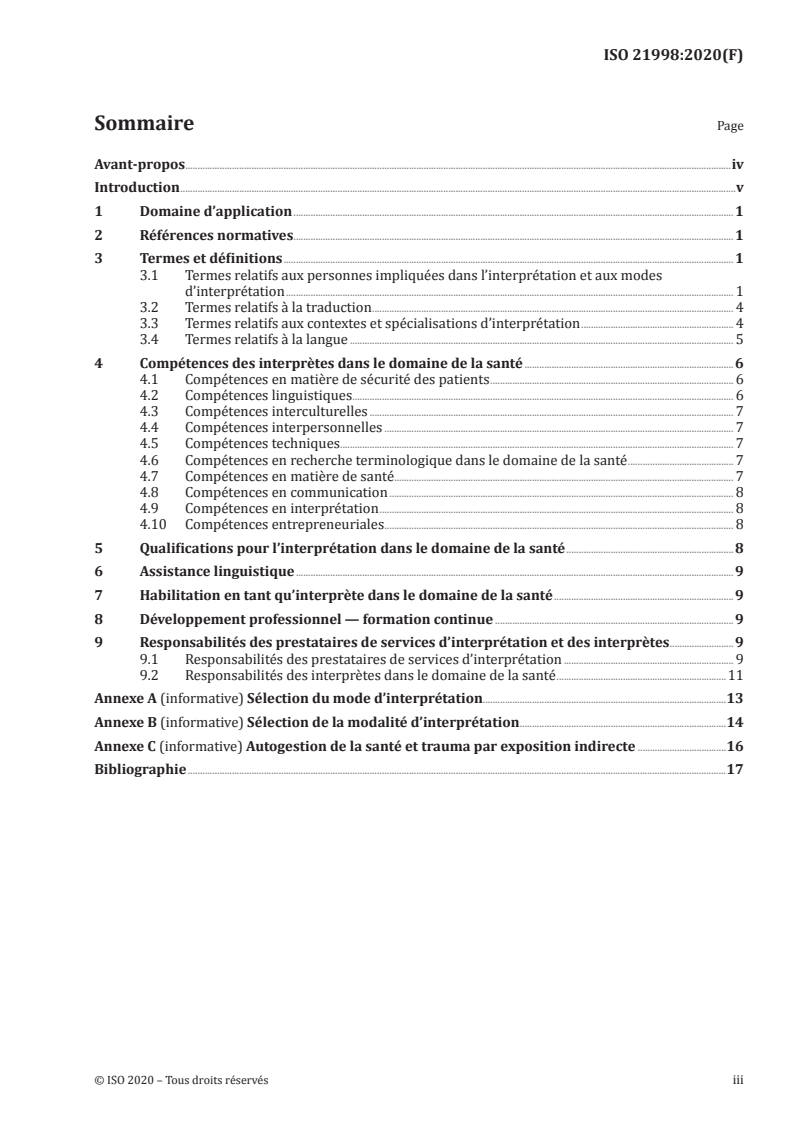
Sommaire Page
Avant-propos .iv
Introduction .v
1 Domaine d’application . 1
2 Références normatives . 1
3 Termes et définitions . 1
3.1 Termes relatifs aux personnes impliquées dans l’interprétation et aux modes
d’interprétation . 1
3.2 Termes relatifs à la traduction . 4
3.3 Termes relatifs aux contextes et spécialisations d’interprétation . 4
3.4 Termes relatifs à la langue . 5
4 Compétences des interprètes dans le domaine de la santé . 6
4.1 Compétences en matière de sécurité des patients . 6
4.2 Compétences linguistiques . 6
4.3 Compétences interculturelles . 7
4.4 Compétences interpersonnelles . 7
4.5 Compétences techniques . 7
4.6 Compétences en recherche terminologique dans le domaine de la santé . 7
4.7 Compétences en matière de santé . 7
4.8 Compétences en communication . 8
4.9 Compétences en interprétation . 8
4.10 Compétences entrepreneuriales . 8
5 Qualifications pour l’interprétation dans le domaine de la santé .8
6 Assistance linguistique . 9
7 Habilitation en tant qu’interprète dans le domaine de la santé . 9
8 Développement professionnel — formation continue . 9
9 Responsabilités des prestataires de services d’interprétation et des interprètes .9
9.1 Responsabilités des prestataires de services d’interprétation . 9
9.2 Responsabilités des interprètes dans le domaine de la santé .11
Annexe A (informative) Sélection du mode d’interprétation.13
Annexe B (informative) Sélection de la modalité d’interprétation .14
Annexe C (informative) Autogestion de la santé et trauma par exposition indirecte .16
Bibliographie .17
Avant-propos
L’ISO (Organisation internationale de normalisation) est une fédération mondiale d’organismes
nationaux de normalisation (comités membres de l’ISO). L’élaboration des Normes internationales est
en général confiée aux comités techniques de l’ISO. Chaque comité membre intéressé par une étude
a le droit de faire partie du comité technique créé à cet effet. Les organisations internationales,
gouvernementales et non gouvernementales, en liaison avec l’ISO participent également aux travaux.
L’ISO collabore étroitement avec la Commission électrotechnique internationale (IEC) en ce qui
concerne la normalisation électrotechnique.
Les procédures utilisées pour élaborer le présent document et celles destinées à sa mise à jour sont
décrites dans les Directives ISO/IEC, Partie 1. Il convient, en particulier, de prendre note des différents
critères d’approbation requis pour les différents types de documents ISO. Le présent document a été
rédigé conformément aux règles de rédaction données dans les Directives ISO/IEC, Partie 2 (voir www
.iso .org/ directives).
L’attention est attirée sur le fait que certains des éléments du présent document peuvent faire l’objet de
droits de propriété intellectuelle ou de droits analogues. L’ISO ne saurait être tenue pour responsable
de ne pas avoir identifié de tels droits de propriété et averti de leur existence. Les détails concernant
les références aux droits de propriété intellectuelle ou autres droits analogues identifiés lors de
l’élaboration du document sont indiqués dans l’Introduction et/ou dans la liste des déclarations de
brevets reçues par l’ISO (voir www .iso .org/ brevets).
Les appellations commerciales éventuellement mentionnées dans le présent document sont données
pour information, par souci de commodité, à l’intention des utilisateurs et ne sauraient constituer un
engagement.
Pour une explication de la nature volontaire des normes, la signification des termes et expressions
spécifiques de l’ISO liés à l’évaluation de la conformité, ou pour toute information au sujet de l’adhésion
de l’ISO aux principes de l’Organisation mondiale du commerce (OMC) concernant les obstacles
techniques au commerce (OTC), voir le lien suivant: www .iso .org/ iso/ fr/ avant-propos .html.
Le présent document a été élaboré par le comité technique ISO/TC 37, Langage et terminologie, sous-
comité, SC 5, Traduction, interprétation et technologies apparentées.
Il convient que l’utilisateur adresse tout retour d’information ou toute question concernant le présent
document à l’organisme national de normalisation de son pays. Une liste exhaustive desdits organismes
se trouve à l’adresse www .iso .org/ fr/ members .html.
iv © ISO 2020 – Tous droits réservés
Introduction
Les services d’interprétation dans le domaine de la santé:
a) permettent une communication sûre principalement entre les prestataires de soins de santé et les
patients;
b) fournissent un accès linguistique aux services de santé.
Le présent document a été élaboré en réponse à une demande croissante à l’échelle mondiale pour
faire face aux besoins d’interprétation des patients privés d’accès linguistique aux services de santé
et des professionnels de santé, tels que les médecins, les infirmiers et le personnel administratif, ainsi
que pour s’efforcer d’assurer la sécurité, le bien-être et la dignité des patients lors des interactions
liées à la prestation des services de santé. Dans les pays ne disposant pas de formation reconnue en
interprétation dans le domaine de la santé, le présent document peut servir de ligne directrice et de
base pour la mise en place d’un système juridique, administratif et éducatif approprié pour toutes les
parties prenantes de l’interprétation dans le domaine de la santé.
L’interprétation dans le domaine de la santé est également appelée interprétation médicale.
Le droit aux services de santé est bien documenté dans un certain nombre de textes nationaux et
internationaux (voir Références [6] à [42]). Plusieurs pays ont également adopté une législation, une
réglementation ou des lignes directrices concernant la prestation de services de santé culturellement
et linguistiquement adaptés. Celles-ci exigent la prestation de services d’interprétation qualifiés
auprès de patients de diverses origines linguistiques et culturelles (voir Références [43] à [48]). Il est
nécessaire que les services d’interprétation dans le domaine de la santé soient d’une qualité suffisante
pour garantir la sécurité des patients.
L’interprétation dans le domaine de la santé se distingue de la traduction médicale ou dans le domaine
de la santé. La traduction implique la restitution de diverses formes de contenu dans une autre langue
par écrit, tâche qui requiert le traitement du document et demande un certain temps. L’interprétation
implique la restitution de messages oraux ou signés dans une autre langue, en face à face ou à distance.
Certains interprètes dans le domaine de la santé sont qualifiés pour fournir des traductions médicales
alors que d’autres ne le sont pas. De même, certains traducteurs médicaux peuvent être qualifiés ou
non pour fournir des services d’interprétation dans le domaine de la santé, ces activités exigeant des
aptitudes différentes. Lorsque des documents ne sont pas traduits, les interprètes dans le domaine de
la santé les traduisent à vue dans l’autre langue. Les présentes dispositions répondent à des exigences
supplémentaires qui sont spécifiques et uniques à l’interprétation dans le domaine de la santé et au
milieu de la santé.
L’interprétation dans le domaine de la santé se déroule entre trois participants ou plus:
1) le ou les orateurs ou signeurs d’une langue autre que la langue que parle ou signe le prestataire de
soins de santé;
2) les prestataires de soins de santé ou le personnel soignant;
3) le ou les interprètes dans le domaine de la santé.
Les organismes de santé fournissent des services d’interprétation directement ou par l’entremise
d’un prestataire de services d’interprétation (PSI). Les interprètes dans le domaine de la santé,
qui interviennent auprès d’un organisme de santé pour des cas particuliers, que ce soit en face à
face ou à distance (voir Annexe B), se limitent à participer aux événements de communication qui
nécessitent leurs services. Les interprètes dans le domaine de la santé qui travaillent dans un service
d’interprétation au sein d’un organisme de santé effectuent des tâches et endossent des responsabilités
qui vont au-delà de l’acte d’interprétation dans les événements de communication. Ces tâches peuvent
être liées à des activités visant à combler les écarts culturels et linguistiques avec la communauté
médicale, peuvent impliquer une recherche interculturelle, la formation culturelle ou linguistique
d’autres membres du personnel soignant, la prise de contact avec les patients, des traductions ou la
prise en compte des aspects liés à la gestion et à l’assurance de la qualité du service d’interprétation en
question, ou consister à se conformer aux responsabilités en matière de sécurité des patients, comme
l’exige leur employeur. Les interprètes dans le domaine de la santé respectent les bonnes pratiques (voir
Références [49] à [54]) et les codes de déontologie applicables.
Les objectifs du présent document sont les suivants:
a) promouvoir la transparence du marché dans le secteur de l’interprétation dans le domaine de
la santé;
b) fournir des informations et des éclaircissements aux utilisateurs de services d’interprétation dans
le domaine de la santé;
c) établir des conditions de travail professionnelles pour les interprètes dans le domaine de la santé.
Le présent document s’adresse à toutes les parties impliquées dans le travail d’interprétation dans le
domaine de la santé. Celles-ci comprennent:
— les interprètes dans le domaine de la santé;
— les prestataires de services d’interprétation;
— les patients et accompagnateurs;
— les services d’interprétation au sein des organismes de santé;
— les organismes publics;
— les organisations à but non lucratif;
— les organismes sociaux offrant des services d’interprétation;
— les employés offrant des services d’interprétation;
— les associations professionnelles;
— les organismes de santé;
— les enseignants et chercheurs;
— les prestataires de soins de santé et le personnel soignant;
— les rédacteurs de politiques de santé.
vi © ISO 2020 – Tous droits réservés
NORME INTERNATIONALE ISO 21998:2020(F)
Services d'interprétation — Interprétation dans le
domaine de la santé — Exigences et recommandations
1 Domaine d’application
Le présent document spécifie des exigences et des recommandations relatives aux services
d’interprétation dans le domaine de la santé en communication orale et signée. Il s’applique à toutes
les situations nécessitant des services d’interprétation dans le domaine de la santé, dans lesquelles les
parties impliquées ont besoin de communiquer oralement ou par la langue des signes pour résoudre
un problème touchant à la santé. Il est destiné aux prestataires de services d’interprétation et aux
interprètes dans le domaine de la santé.
2 Références normatives
Le présent document ne contient aucune référence normative.
3 Termes et définitions
Pour les besoins du présent document, les termes et définitions suivants s’appliquent.
L’ISO et l’IEC tiennent à jour des bases de données terminologiques destinées à être utilisées en
normalisation, consultables aux adresses suivantes:
— ISO Online browsing platform: disponible à l’adresse https:// www .iso .org/ obp;
— IEC Electropedia: disponible à l’adresse http:// www .electropedia .org/ .
3.1 Termes relatifs aux personnes impliquées dans l’interprétation et aux modes
d’interprétation
3.1.1
interpréter
restituer une information parlée ou signée d’une langue source (3.4.6) vers une langue cible (3.4.7) sous
une forme parlée ou signée, en transmettant à la fois le sens et le registre de langue (3.4.4) du contenu en
langue source (3.4.8)
[SOURCE: ISO 20539:2019, 3.1.9]
3.1.2
interprétation
restitution d’une information parlée ou signée d’une langue source (3.4.6) vers une langue cible (3.4.7)
sous une forme parlée ou signée, en transmettant à la fois le sens et le registre de langue (3.4.4) du
contenu en langue source (3.4.8)
[SOURCE: ISO 20539:2019, 3.1.10]
3.1.3
interprète
personne qui interprète (3.1.1)
[SOURCE: ISO 20539:2019, 3.1.12]
3.1.4
interprète dans le domaine de la santé
interprète médical
interprète (3.1.3) qui est qualifié pour fournir des services d’interprétation dans le domaine de la
santé (3.3.3)
Note 1 à l'article: Les interprètes dans le domaine de la santé peuvent être tenus d’être agréés.
[SOURCE: ISO 20539:2019, 3.4.24]
3.1.5
prestataire de services d’interprétation
PSI
prestataire de services d’interprétariat
interprète (3.1.3) ou personne morale assurant l’interprétation (3.1.2) pour un client (3.1.6)
Note 1 à l'article: Un prestataire de services d’interprétation peut être un organisme à but lucratif ou à but non
lucratif, un service interne ou un organisme de santé, comme un hôpital offrant des services d’interprétation.
[SOURCE: ISO 20539:2019, 3.4.28, modifiée — «prestataire de services d’interprétariat» a été ajouté
comme terme admis, et la Note 1 à l'article a été ajoutée.]
3.1.6
client
personne physique ou morale qui sollicite la prestation de services dans le cadre d’un contrat
Note 1 à l'article: Le contrat peut, par exemple, prendre la forme d’un contrat écrit entre deux parties ou d’un
accord entre les services d’un même organisme.
Note 2 à l'article: Le client peut être la même personne que l’utilisateur final (3.1.7) ou le demandeur de services.
[SOURCE: ISO 20539:2019, 3.2.5, modifiée — Dans la Note 2 à l’article, le texte «Le client peut être
l’utilisateur final, sans toutefois que cela soit nécessairement le cas» a été remplacé par «Le client peut
être la même personne que l’utilisateur final ou le demandeur de services».]
3.1.7
utilisateur final
personne ou groupe de personnes qui au final utilise le service fourni
[SOURCE: ISO 20539:2019, 3.2.6]
3.1.8
orateur
personne s’adressant à d’autres personnes en utilisant une langue parlée (3.4.2)
[SOURCE: ISO 20539:2019, 3.4.9]
3.1.9
signeur
personne s’adressant à d’autres personnes en utilisant une langue des signes (3.4.2)
[SOURCE: ISO 20539:2019, 3.4.10]
3.1.10
interprétation à distance
télé-interprétation
avec l’appui des technologies de l’information et de la communication, interprétation (3.1.2) des propos
d’un orateur (3.1.8) ou d’un signeur (3.1.9) se trouvant en un endroit différent de celui où se trouve
l’interprète (3.1.3)
[SOURCE: ISO 20539:2019, 3.4.15]
2 © ISO 2020 – Tous droits réservés
3.1.11
mode
méthode employée pour la prestation de l’interprétation (3.1.2) en langues parlées (3.4.3) et de
l’interprétation en langue des signes (3.4.2)
[SOURCE: ISO 20539:2019, 3.4.11]
3.1.12
interprétation consécutive
mode (3.1.11) d’interprétation (3.1.2) pratiqué en respectant les temps de pauses marqués par l’orateur
(3.1.8) ou le signeur (3.1.9)
[SOURCE: ISO 20539:2019, 3.4.13, modifiée — La Note 1 à l’article a été supprimée.]
3.1.13
interprétation simultanée
mode (3.1.11) d’interprétation (3.1.2) pratiqué en même temps que le discours de l’orateur (3.1.8) ou du
signeur (3.1.9)
[SOURCE: ISO 20539:2019, 3.4.12]
3.1.14
traduction à vue
restitution d’un contenu en langue source (3.4.8) en un contenu en langue cible (3.4.9) sous forme de
langue parlée (3.4.3) ou de langue des signes (3.4.2)
[SOURCE: ISO 20539:2019, 3.4.16]
3.1.15
prise de notes
technique utilisée dans l’interprétation consécutive (3.1.12) par les interprètes (3.1.3) pour se rappeler,
conceptualiser et synthétiser l’information
Note 1 à l'article: La prise de notes est très personnelle et peut comporter un mélange de symboles, d’abréviations,
de mots et de schémas.
[SOURCE: ISO 20539:2019, 3.4.29]
3.1.16
chuchotage
interprétation chuchotée
interprétation simultanée (3.1.13) au cours de laquelle l’interprète (3.1.3) se tient assis ou debout à
proximité physique directe des auditeurs et n’utilise aucun équipement d’interprétation (3.1.2)
Note 1 à l'article: Le chuchotage est employé pour une interprétation destinée à un très petit nombre d’auditeurs,
idéalement un ou deux.
[SOURCE: ISO 20539:2019, 3.4.17, modifiée — Dans la définition, «parle très doucement» a été supprimé.]
3.1.17
protocole
règle, procédure officielle ou pratique courante dictant la conduite des membres d’une profession
[SOURCE: ISO 20539:2019, 3.4.30]
3.1.18
interprétation en relais
interprétation (3.1.2) réalisée par un interprète (3.1.3) à partir du travail d’un autre interprète et non
directement à partir de l’orateur (3.1.8) ou du signeur (3.1.9)
[SOURCE: ISO 20539:2019, 3.4.14]
3.2 Termes relatifs à la traduction
3.2.1
traduire
transposer un contenu en langue source (3.4.8) en un contenu en langue cible (3.4.9) sous forme écrite ou
en langue des signes (3.4.2)
[SOURCE: ISO 20539:2019, 3.1.7]
3.2.2
traduction
restitution d’un contenu en langue source (3.4.8) en un contenu en langue cible (3.4.9) sous forme écrite
ou en langue des signes (3.4.2)
[SOURCE: ISO 20539:2019, 3.1.8]
3.3 Termes relatifs aux contextes et spécialisations d’interprétation
3.3.1
événement de communication
rencontre entre au moins deux parties au cours de laquelle des informations sont transmises
[SOURCE: ISO 20539:2019, 3.4.8]
3.3.2
interprétation en milieu social
interprétation de service public
interprétation (3.1.2) permettant à des personnes d’accéder à des services offerts à la société dans son
ensemble, auxquels elles ne pourraient pas accéder en raison de la barrière linguistique
EXEMPLE Services sociaux, services touristiques, services d’aide aux victimes de catastrophes.
[SOURCE: ISO 20539:2019, 3.4.21]
3.3.3
interprétation dans le domaine de la santé
interprétation médicale
interprétation (3.1.2) de la communication en matière de santé entre les patients, les accompagnants et
le personnel soignant ou le personnel administratif qui n’utilisent pas la même langue (3.4.1)
[SOURCE: ISO 20539:2019, 3.4.23]
3.3.4
sécurité des patients
prévention des dommages causés par des erreurs de commission et d’omission
[SOURCE: ISO/TS 18864:2017, 3.23]
3.3.5
système d’interprétation portable
équipement d’interprétation simultanée (3.1.13) léger, muni de composants fonctionnant sur
accumulateurs et qui permet à l’interprète (3.1.3) et aux participants de se déplacer
[SOURCE: ISO 20539:2019, 3.5.2.14]
4 © ISO 2020 – Tous droits réservés
3.3.6
entretien préalable
entretien avant session
préconsultation
réunion d’information
procédure, avant l’événement de communication (3.3.1), au cours de laquelle l’interprète (3.1.3) donne
aux utilisateurs finaux (3.1.7) des informations sur la façon de travailler avec un interprète et demande
des informations sur le cas en question, en tant que de besoin
3.3.7
entretien de bilan
entretien après session
post-consultation
compte-rendu
procédure, après l’événement de communication (3.3.1), au cours de laquelle l’interprète (3.1.3) donne
aux utilisateurs finaux (3.1.7) des informations sur le cas en question, en tant que de besoin
3.4 Termes relatifs à la langue
3.4.1
langue
utilisation systématique de sons, caractères, symboles ou signes permettant de communiquer
[SOURCE: ISO 20539:2019, 3.1.1]
3.4.2
langue des signes
langue (3.4.1) utilisant une combinaison de positions des mains, de sens et de mouvement des mains,
des bras et du corps ainsi que les expressions faciales
[SOURCE: ISO 20539:2019, 3.2.3]
3.4.3
langue parlée
langue (3.4.1) exprimée oralement
[SOURCE: ISO 20539:2019, 3.4.4]
3.4.4
registre de langue
variété de langue (3.4.1) utilisée pour une finalité particulière ou dans un cas d’utilisation de la langue
spécifique en fonction de la situation, et plus particulièrement de son degré de formalité
Note 1 à l'article: Chaque personne compte généralement plus d’un registre de langue dans son répertoire
linguistique et peut utiliser différents registres de langue en fonction de sa perception du registre le plus
approprié pour divers domaines ou finalités.
[SOURCE: ISO 20539:2019, 3.2.1]
3.4.5
contenu
information sous toutes ses formes
EXEMPLE Texte, audio, vidéo, messages.
[SOURCE: ISO 20539:2019, 3.1.2, modifiée — Dans l’EXEMPLE, «messages» a été ajouté et «etc.» a été
supprimé.]
3.4.6
langue source
langue (3.4.1) à partir de laquelle le contenu (3.4.5) est interprété (3.1.1) ou traduit (3.2.1)
[SOURCE: ISO 20539:2019, 3.1.3, modifiée — «traduit ou interprété» a été remplacé par «interprété ou
traduit».]
3.4.7
langue cible
langue (3.4.1) dans laquelle le contenu (3.4.5) est interprété (3.1.1) ou traduit (3.2.1)
[SOURCE: ISO 20539:2019, 3.1.4, modifiée — «traduit ou interprété» a été remplacé par «interprété ou
traduit».]
3.4.8
contenu en langue source
contenu (3.4.5) à traduire (3.2.1) ou à interpréter (3.1.1)
[SOURCE: ISO 20539:2019, 3.1.5]
3.4.9
contenu en langue cible
contenu (3.4.5) qui a été traduit (3.2.1) ou interprété (3.1.1)
[SOURCE: ISO 20539:2019, 3.1.6, modifiée — «d'une langue source» a été supprimé de la fin de la
définition.]
4 Compétences des interprètes dans le domaine de la santé
4.1 Compétences en matière de sécurité des patients
Les interprètes dans le domaine de la santé doivent posséder les connaissances nécessaires en matière
de sécurité des patients pour faciliter la communication sûre entre des personnes qui ne partagent
pas la même langue, dans le cadre de la prestation de services de santé. Le droit aux services de
santé est bien documenté dans un certain nombre de documents internationaux et est inclus dans la
Bibliographie. Tous les professionnels de santé, y compris les interprètes dans le domaine de la santé,
ont des obligations de cette nature et sont chargés de fournir des services aux patients de manière à
garantir leur sécurité. Par conséquent, ces compétences sont requises non seulement pour atteindre
les résultats escomptés en matière de communication, mais aussi, ce faisant, pour assurer la sécurité
des patients, dans le cadre de l’interprétation, dans le contexte de la prestation de soins de santé. Les
compétences énoncées de 4.2 à 4.10 sont requises pour l’interprétation dans le domaine de la santé.
4.2 Compétences linguistiques
Les interprètes dans le domaine de la santé doivent posséder les compétences linguistiques documentées
requises pour l’interprétation dans un contexte professionnel. Les compétences linguistiques requises
pour les interprètes en langues parlées dans le domaine de la santé doivent comprendre l’expression
orale, la compréhension orale, y compris l’aptitude à comprendre divers accents régionaux ou à
appréhender les différences dialectales, et la compréhension de l’écrit.
Ces aptitudes doivent inclure la capacité à comprendre la langue utilisée, ainsi que la réception et la
production respectives de messages. Les interprètes dans le domaine de la santé doivent reconnaître
des registres variés, y compris les styles formel et informel, le vocabulaire spécifique à une discipline,
les expressions idiomatiques, les expressions familières et l’argot. Ils doivent être capables d’interpréter
le langage parlé ou signé à la fois formel et informel. Dans le domaine de la santé, en raison de la
nature hautement technique de la communication médicale, un niveau de compétence linguistique
suffisamment élevé est requis pour être capable d’interpréter correctement entre deux langues.
6 © ISO 2020 – Tous droits réservés
Les compétences linguistiques sont à distinguer des compétences en interprétation. Il est recommandé
que les prestataires de services d’interprétation ou les enseignants documentent séparément les
compétences linguistiques et les compétences en interprétation.
4.3 Compétences interculturelles
Les interprètes dans le domaine de la santé doivent utiliser un langage et un comportement
culturellement appropriés et doivent connaître et être en mesure de transmettre les nuances
culturelles afin de les restituer dans leur production linguistique, leurs gestes et leur intonation.
Lorsque nécessaire, les interprètes dans le domaine de la santé doivent combler les écarts culturels et
conceptuels qui séparent les participants. Ils doivent repérer et traiter les problématiques culturelles,
par le biais d’une recherche interculturelle, dans le but d’assurer une compréhension exacte et complète.
4.4 Compétences interpersonnelles
Les interprètes dans le domaine de la santé doivent faire preuve de professionnalisme dans leurs
interactions avec autrui. Ils doivent avoir des comportements verbaux et non verbaux appropriés. Ils
doivent être flexibles et patients avec autrui, et être capables de travailler en équipe, avec plusieurs
prestataires de soins de santé ou avec les personnes impliquées dans l’interprétation en relais. Ils
doivent posséder des aptitudes à résoudre les problèmes. Les interprètes dans le domaine de la santé
sont confrontés à des interactions dans des circonstances de vie stressantes et difficiles et dans un
contexte de diversité linguistique et culturelle. Ces situations ne sont pas toujours amicales et requièrent
des aptitudes relationnelles. Les interprètes dans le domaine de la santé doivent être capables d’établir
une relation thérapeutique entre les principaux participants et de faire preuve de maîtrise de soi dans
tous les événements de communication.
4.5 Compétences techniques
L
...
NORME ISO
INTERNATIONALE 21998
Première édition
2020-12
Services d'interprétation —
Interprétation dans le domaine
de la santé — Exigences et
recommandations
Interpreting services — Healthcare interpreting — Requirements and
recommendations
Numéro de référence
©
ISO 2020
DOCUMENT PROTÉGÉ PAR COPYRIGHT
© ISO 2020
Tous droits réservés. Sauf prescription différente ou nécessité dans le contexte de sa mise en œuvre, aucune partie de cette
publication ne peut être reproduite ni utilisée sous quelque forme que ce soit et par aucun procédé, électronique ou mécanique,
y compris la photocopie, ou la diffusion sur l’internet ou sur un intranet, sans autorisation écrite préalable. Une autorisation peut
être demandée à l’ISO à l’adresse ci-après ou au comité membre de l’ISO dans le pays du demandeur.
ISO copyright office
Case postale 401 • Ch. de Blandonnet 8
CH-1214 Vernier, Genève
Tél.: +41 22 749 01 11
E-mail: copyright@iso.org
Web: www.iso.org
Publié en Suisse
ii © ISO 2020 – Tous droits réservés
Sommaire Page
Avant-propos .iv
Introduction .v
1 Domaine d’application . 1
2 Références normatives . 1
3 Termes et définitions . 1
3.1 Termes relatifs aux personnes impliquées dans l’interprétation et aux modes
d’interprétation . 1
3.2 Termes relatifs à la traduction . 4
3.3 Termes relatifs aux contextes et spécialisations d’interprétation . 4
3.4 Termes relatifs à la langue . 5
4 Compétences des interprètes dans le domaine de la santé . 6
4.1 Compétences en matière de sécurité des patients . 6
4.2 Compétences linguistiques . 6
4.3 Compétences interculturelles . 7
4.4 Compétences interpersonnelles . 7
4.5 Compétences techniques . 7
4.6 Compétences en recherche terminologique dans le domaine de la santé . 7
4.7 Compétences en matière de santé . 7
4.8 Compétences en communication . 8
4.9 Compétences en interprétation . 8
4.10 Compétences entrepreneuriales . 8
5 Qualifications pour l’interprétation dans le domaine de la santé .8
6 Assistance linguistique . 9
7 Habilitation en tant qu’interprète dans le domaine de la santé . 9
8 Développement professionnel — formation continue . 9
9 Responsabilités des prestataires de services d’interprétation et des interprètes .9
9.1 Responsabilités des prestataires de services d’interprétation . 9
9.2 Responsabilités des interprètes dans le domaine de la santé .11
Annexe A (informative) Sélection du mode d’interprétation.13
Annexe B (informative) Sélection de la modalité d’interprétation .14
Annexe C (informative) Autogestion de la santé et trauma par exposition indirecte .16
Bibliographie .17
Avant-propos
L’ISO (Organisation internationale de normalisation) est une fédération mondiale d’organismes
nationaux de normalisation (comités membres de l’ISO). L’élaboration des Normes internationales est
en général confiée aux comités techniques de l’ISO. Chaque comité membre intéressé par une étude
a le droit de faire partie du comité technique créé à cet effet. Les organisations internationales,
gouvernementales et non gouvernementales, en liaison avec l’ISO participent également aux travaux.
L’ISO collabore étroitement avec la Commission électrotechnique internationale (IEC) en ce qui
concerne la normalisation électrotechnique.
Les procédures utilisées pour élaborer le présent document et celles destinées à sa mise à jour sont
décrites dans les Directives ISO/IEC, Partie 1. Il convient, en particulier, de prendre note des différents
critères d’approbation requis pour les différents types de documents ISO. Le présent document a été
rédigé conformément aux règles de rédaction données dans les Directives ISO/IEC, Partie 2 (voir www
.iso .org/ directives).
L’attention est attirée sur le fait que certains des éléments du présent document peuvent faire l’objet de
droits de propriété intellectuelle ou de droits analogues. L’ISO ne saurait être tenue pour responsable
de ne pas avoir identifié de tels droits de propriété et averti de leur existence. Les détails concernant
les références aux droits de propriété intellectuelle ou autres droits analogues identifiés lors de
l’élaboration du document sont indiqués dans l’Introduction et/ou dans la liste des déclarations de
brevets reçues par l’ISO (voir www .iso .org/ brevets).
Les appellations commerciales éventuellement mentionnées dans le présent document sont données
pour information, par souci de commodité, à l’intention des utilisateurs et ne sauraient constituer un
engagement.
Pour une explication de la nature volontaire des normes, la signification des termes et expressions
spécifiques de l’ISO liés à l’évaluation de la conformité, ou pour toute information au sujet de l’adhésion
de l’ISO aux principes de l’Organisation mondiale du commerce (OMC) concernant les obstacles
techniques au commerce (OTC), voir le lien suivant: www .iso .org/ iso/ fr/ avant-propos .html.
Le présent document a été élaboré par le comité technique ISO/TC 37, Langage et terminologie, sous-
comité, SC 5, Traduction, interprétation et technologies apparentées.
Il convient que l’utilisateur adresse tout retour d’information ou toute question concernant le présent
document à l’organisme national de normalisation de son pays. Une liste exhaustive desdits organismes
se trouve à l’adresse www .iso .org/ fr/ members .html.
iv © ISO 2020 – Tous droits réservés
Introduction
Les services d’interprétation dans le domaine de la santé:
a) permettent une communication sûre principalement entre les prestataires de soins de santé et les
patients;
b) fournissent un accès linguistique aux services de santé.
Le présent document a été élaboré en réponse à une demande croissante à l’échelle mondiale pour
faire face aux besoins d’interprétation des patients privés d’accès linguistique aux services de santé
et des professionnels de santé, tels que les médecins, les infirmiers et le personnel administratif, ainsi
que pour s’efforcer d’assurer la sécurité, le bien-être et la dignité des patients lors des interactions
liées à la prestation des services de santé. Dans les pays ne disposant pas de formation reconnue en
interprétation dans le domaine de la santé, le présent document peut servir de ligne directrice et de
base pour la mise en place d’un système juridique, administratif et éducatif approprié pour toutes les
parties prenantes de l’interprétation dans le domaine de la santé.
L’interprétation dans le domaine de la santé est également appelée interprétation médicale.
Le droit aux services de santé est bien documenté dans un certain nombre de textes nationaux et
internationaux (voir Références [6] à [42]). Plusieurs pays ont également adopté une législation, une
réglementation ou des lignes directrices concernant la prestation de services de santé culturellement
et linguistiquement adaptés. Celles-ci exigent la prestation de services d’interprétation qualifiés
auprès de patients de diverses origines linguistiques et culturelles (voir Références [43] à [48]). Il est
nécessaire que les services d’interprétation dans le domaine de la santé soient d’une qualité suffisante
pour garantir la sécurité des patients.
L’interprétation dans le domaine de la santé se distingue de la traduction médicale ou dans le domaine
de la santé. La traduction implique la restitution de diverses formes de contenu dans une autre langue
par écrit, tâche qui requiert le traitement du document et demande un certain temps. L’interprétation
implique la restitution de messages oraux ou signés dans une autre langue, en face à face ou à distance.
Certains interprètes dans le domaine de la santé sont qualifiés pour fournir des traductions médicales
alors que d’autres ne le sont pas. De même, certains traducteurs médicaux peuvent être qualifiés ou
non pour fournir des services d’interprétation dans le domaine de la santé, ces activités exigeant des
aptitudes différentes. Lorsque des documents ne sont pas traduits, les interprètes dans le domaine de
la santé les traduisent à vue dans l’autre langue. Les présentes dispositions répondent à des exigences
supplémentaires qui sont spécifiques et uniques à l’interprétation dans le domaine de la santé et au
milieu de la santé.
L’interprétation dans le domaine de la santé se déroule entre trois participants ou plus:
1) le ou les orateurs ou signeurs d’une langue autre que la langue que parle ou signe le prestataire de
soins de santé;
2) les prestataires de soins de santé ou le personnel soignant;
3) le ou les interprètes dans le domaine de la santé.
Les organismes de santé fournissent des services d’interprétation directement ou par l’entremise
d’un prestataire de services d’interprétation (PSI). Les interprètes dans le domaine de la santé,
qui interviennent auprès d’un organisme de santé pour des cas particuliers, que ce soit en face à
face ou à distance (voir Annexe B), se limitent à participer aux événements de communication qui
nécessitent leurs services. Les interprètes dans le domaine de la santé qui travaillent dans un service
d’interprétation au sein d’un organisme de santé effectuent des tâches et endossent des responsabilités
qui vont au-delà de l’acte d’interprétation dans les événements de communication. Ces tâches peuvent
être liées à des activités visant à combler les écarts culturels et linguistiques avec la communauté
médicale, peuvent impliquer une recherche interculturelle, la formation culturelle ou linguistique
d’autres membres du personnel soignant, la prise de contact avec les patients, des traductions ou la
prise en compte des aspects liés à la gestion et à l’assurance de la qualité du service d’interprétation en
question, ou consister à se conformer aux responsabilités en matière de sécurité des patients, comme
l’exige leur employeur. Les interprètes dans le domaine de la santé respectent les bonnes pratiques (voir
Références [49] à [54]) et les codes de déontologie applicables.
Les objectifs du présent document sont les suivants:
a) promouvoir la transparence du marché dans le secteur de l’interprétation dans le domaine de
la santé;
b) fournir des informations et des éclaircissements aux utilisateurs de services d’interprétation dans
le domaine de la santé;
c) établir des conditions de travail professionnelles pour les interprètes dans le domaine de la santé.
Le présent document s’adresse à toutes les parties impliquées dans le travail d’interprétation dans le
domaine de la santé. Celles-ci comprennent:
— les interprètes dans le domaine de la santé;
— les prestataires de services d’interprétation;
— les patients et accompagnateurs;
— les services d’interprétation au sein des organismes de santé;
— les organismes publics;
— les organisations à but non lucratif;
— les organismes sociaux offrant des services d’interprétation;
— les employés offrant des services d’interprétation;
— les associations professionnelles;
— les organismes de santé;
— les enseignants et chercheurs;
— les prestataires de soins de santé et le personnel soignant;
— les rédacteurs de politiques de santé.
vi © ISO 2020 – Tous droits réservés
NORME INTERNATIONALE ISO 21998:2020(F)
Services d'interprétation — Interprétation dans le
domaine de la santé — Exigences et recommandations
1 Domaine d’application
Le présent document spécifie des exigences et des recommandations relatives aux services
d’interprétation dans le domaine de la santé en communication orale et signée. Il s’applique à toutes
les situations nécessitant des services d’interprétation dans le domaine de la santé, dans lesquelles les
parties impliquées ont besoin de communiquer oralement ou par la langue des signes pour résoudre
un problème touchant à la santé. Il est destiné aux prestataires de services d’interprétation et aux
interprètes dans le domaine de la santé.
2 Références normatives
Le présent document ne contient aucune référence normative.
3 Termes et définitions
Pour les besoins du présent document, les termes et définitions suivants s’appliquent.
L’ISO et l’IEC tiennent à jour des bases de données terminologiques destinées à être utilisées en
normalisation, consultables aux adresses suivantes:
— ISO Online browsing platform: disponible à l’adresse https:// www .iso .org/ obp;
— IEC Electropedia: disponible à l’adresse http:// www .electropedia .org/ .
3.1 Termes relatifs aux personnes impliquées dans l’interprétation et aux modes
d’interprétation
3.1.1
interpréter
restituer une information parlée ou signée d’une langue source (3.4.6) vers une langue cible (3.4.7) sous
une forme parlée ou signée, en transmettant à la fois le sens et le registre de langue (3.4.4) du contenu en
langue source (3.4.8)
[SOURCE: ISO 20539:2019, 3.1.9]
3.1.2
interprétation
restitution d’une information parlée ou signée d’une langue source (3.4.6) vers une langue cible (3.4.7)
sous une forme parlée ou signée, en transmettant à la fois le sens et le registre de langue (3.4.4) du
contenu en langue source (3.4.8)
[SOURCE: ISO 20539:2019, 3.1.10]
3.1.3
interprète
personne qui interprète (3.1.1)
[SOURCE: ISO 20539:2019, 3.1.12]
3.1.4
interprète dans le domaine de la santé
interprète médical
interprète (3.1.3) qui est qualifié pour fournir des services d’interprétation dans le domaine de la
santé (3.3.3)
Note 1 à l'article: Les interprètes dans le domaine de la santé peuvent être tenus d’être agréés.
[SOURCE: ISO 20539:2019, 3.4.24]
3.1.5
prestataire de services d’interprétation
PSI
prestataire de services d’interprétariat
interprète (3.1.3) ou personne morale assurant l’interprétation (3.1.2) pour un client (3.1.6)
Note 1 à l'article: Un prestataire de services d’interprétation peut être un organisme à but lucratif ou à but non
lucratif, un service interne ou un organisme de santé, comme un hôpital offrant des services d’interprétation.
[SOURCE: ISO 20539:2019, 3.4.28, modifiée — «prestataire de services d’interprétariat» a été ajouté
comme terme admis, et la Note 1 à l'article a été ajoutée.]
3.1.6
client
personne physique ou morale qui sollicite la prestation de services dans le cadre d’un contrat
Note 1 à l'article: Le contrat peut, par exemple, prendre la forme d’un contrat écrit entre deux parties ou d’un
accord entre les services d’un même organisme.
Note 2 à l'article: Le client peut être la même personne que l’utilisateur final (3.1.7) ou le demandeur de services.
[SOURCE: ISO 20539:2019, 3.2.5, modifiée — Dans la Note 2 à l’article, le texte «Le client peut être
l’utilisateur final, sans toutefois que cela soit nécessairement le cas» a été remplacé par «Le client peut
être la même personne que l’utilisateur final ou le demandeur de services».]
3.1.7
utilisateur final
personne ou groupe de personnes qui au final utilise le service fourni
[SOURCE: ISO 20539:2019, 3.2.6]
3.1.8
orateur
personne s’adressant à d’autres personnes en utilisant une langue parlée (3.4.2)
[SOURCE: ISO 20539:2019, 3.4.9]
3.1.9
signeur
personne s’adressant à d’autres personnes en utilisant une langue des signes (3.4.2)
[SOURCE: ISO 20539:2019, 3.4.10]
3.1.10
interprétation à distance
télé-interprétation
avec l’appui des technologies de l’information et de la communication, interprétation (3.1.2) des propos
d’un orateur (3.1.8) ou d’un signeur (3.1.9) se trouvant en un endroit différent de celui où se trouve
l’interprète (3.1.3)
[SOURCE: ISO 20539:2019, 3.4.15]
2 © ISO 2020 – Tous droits réservés
3.1.11
mode
méthode employée pour la prestation de l’interprétation (3.1.2) en langues parlées (3.4.3) et de
l’interprétation en langue des signes (3.4.2)
[SOURCE: ISO 20539:2019, 3.4.11]
3.1.12
interprétation consécutive
mode (3.1.11) d’interprétation (3.1.2) pratiqué en respectant les temps de pauses marqués par l’orateur
(3.1.8) ou le signeur (3.1.9)
[SOURCE: ISO 20539:2019, 3.4.13, modifiée — La Note 1 à l’article a été supprimée.]
3.1.13
interprétation simultanée
mode (3.1.11) d’interprétation (3.1.2) pratiqué en même temps que le discours de l’orateur (3.1.8) ou du
signeur (3.1.9)
[SOURCE: ISO 20539:2019, 3.4.12]
3.1.14
traduction à vue
restitution d’un contenu en langue source (3.4.8) en un contenu en langue cible (3.4.9) sous forme de
langue parlée (3.4.3) ou de langue des signes (3.4.2)
[SOURCE: ISO 20539:2019, 3.4.16]
3.1.15
prise de notes
technique utilisée dans l’interprétation consécutive (3.1.12) par les interprètes (3.1.3) pour se rappeler,
conceptualiser et synthétiser l’information
Note 1 à l'article: La prise de notes est très personnelle et peut comporter un mélange de symboles, d’abréviations,
de mots et de schémas.
[SOURCE: ISO 20539:2019, 3.4.29]
3.1.16
chuchotage
interprétation chuchotée
interprétation simultanée (3.1.13) au cours de laquelle l’interprète (3.1.3) se tient assis ou debout à
proximité physique directe des auditeurs et n’utilise aucun équipement d’interprétation (3.1.2)
Note 1 à l'article: Le chuchotage est employé pour une interprétation destinée à un très petit nombre d’auditeurs,
idéalement un ou deux.
[SOURCE: ISO 20539:2019, 3.4.17, modifiée — Dans la définition, «parle très doucement» a été supprimé.]
3.1.17
protocole
règle, procédure officielle ou pratique courante dictant la conduite des membres d’une profession
[SOURCE: ISO 20539:2019, 3.4.30]
3.1.18
interprétation en relais
interprétation (3.1.2) réalisée par un interprète (3.1.3) à partir du travail d’un autre interprète et non
directement à partir de l’orateur (3.1.8) ou du signeur (3.1.9)
[SOURCE: ISO 20539:2019, 3.4.14]
3.2 Termes relatifs à la traduction
3.2.1
traduire
transposer un contenu en langue source (3.4.8) en un contenu en langue cible (3.4.9) sous forme écrite ou
en langue des signes (3.4.2)
[SOURCE: ISO 20539:2019, 3.1.7]
3.2.2
traduction
restitution d’un contenu en langue source (3.4.8) en un contenu en langue cible (3.4.9) sous forme écrite
ou en langue des signes (3.4.2)
[SOURCE: ISO 20539:2019, 3.1.8]
3.3 Termes relatifs aux contextes et spécialisations d’interprétation
3.3.1
événement de communication
rencontre entre au moins deux parties au cours de laquelle des informations sont transmises
[SOURCE: ISO 20539:2019, 3.4.8]
3.3.2
interprétation en milieu social
interprétation de service public
interprétation (3.1.2) permettant à des personnes d’accéder à des services offerts à la société dans son
ensemble, auxquels elles ne pourraient pas accéder en raison de la barrière linguistique
EXEMPLE Services sociaux, services touristiques, services d’aide aux victimes de catastrophes.
[SOURCE: ISO 20539:2019, 3.4.21]
3.3.3
interprétation dans le domaine de la santé
interprétation médicale
interprétation (3.1.2) de la communication en matière de santé entre les patients, les accompagnants et
le personnel soignant ou le personnel administratif qui n’utilisent pas la même langue (3.4.1)
[SOURCE: ISO 20539:2019, 3.4.23]
3.3.4
sécurité des patients
prévention des dommages causés par des erreurs de commission et d’omission
[SOURCE: ISO/TS 18864:2017, 3.23]
3.3.5
système d’interprétation portable
équipement d’interprétation simultanée (3.1.13) léger, muni de composants fonctionnant sur
accumulateurs et qui permet à l’interprète (3.1.3) et aux participants de se déplacer
[SOURCE: ISO 20539:2019, 3.5.2.14]
4 © ISO 2020 – Tous droits réservés
3.3.6
entretien préalable
entretien avant session
préconsultation
réunion d’information
procédure, avant l’événement de communication (3.3.1), au cours de laquelle l’interprète (3.1.3) donne
aux utilisateurs finaux (3.1.7) des informations sur la façon de travailler avec un interprète et demande
des informations sur le cas en question, en tant que de besoin
3.3.7
entretien de bilan
entretien après session
post-consultation
compte-rendu
procédure, après l’événement de communication (3.3.1), au cours de laquelle l’interprète (3.1.3) donne
aux utilisateurs finaux (3.1.7) des informations sur le cas en question, en tant que de besoin
3.4 Termes relatifs à la langue
3.4.1
langue
utilisation systématique de sons, caractères, symboles ou signes permettant de communiquer
[SOURCE: ISO 20539:2019, 3.1.1]
3.4.2
langue des signes
langue (3.4.1) utilisant une combinaison de positions des mains, de sens et de mouvement des mains,
des bras et du corps ainsi que les expressions faciales
[SOURCE: ISO 20539:2019, 3.2.3]
3.4.3
langue parlée
langue (3.4.1) exprimée oralement
[SOURCE: ISO 20539:2019, 3.4.4]
3.4.4
registre de langue
variété de langue (3.4.1) utilisée pour une finalité particulière ou dans un cas d’utilisation de la langue
spécifique en fonction de la situation, et plus particulièrement de son degré de formalité
Note 1 à l'article: Chaque personne compte généralement plus d’un registre de langue dans son répertoire
linguistique et peut utiliser différents registres de langue en fonction de sa perception du registre le plus
approprié pour divers domaines ou finalités.
[SOURCE: ISO 20539:2019, 3.2.1]
3.4.5
contenu
information sous toutes ses formes
EXEMPLE Texte, audio, vidéo, messages.
[SOURCE: ISO 20539:2019, 3.1.2, modifiée — Dans l’EXEMPLE, «messages» a été ajouté et «etc.» a été
supprimé.]
3.4.6
langue source
langue (3.4.1) à partir de laquelle le contenu (3.4.5) est interprété (3.1.1) ou traduit (3.2.1)
[SOURCE: ISO 20539:2019, 3.1.3, modifiée — «traduit ou interprété» a été remplacé par «interprété ou
traduit».]
3.4.7
langue cible
langue (3.4.1) dans laquelle le contenu (3.4.5) est interprété (3.1.1) ou traduit (3.2.1)
[SOURCE: ISO 20539:2019, 3.1.4, modifiée — «traduit ou interprété» a été remplacé par «interprété ou
traduit».]
3.4.8
contenu en langue source
contenu (3.4.5) à traduire (3.2.1) ou à interpréter (3.1.1)
[SOURCE: ISO 20539:2019, 3.1.5]
3.4.9
contenu en langue cible
contenu (3.4.5) qui a été traduit (3.2.1) ou interprété (3.1.1)
[SOURCE: ISO 20539:2019, 3.1.6, modifiée — «d'une langue source» a été supprimé de la fin de la
définition.]
4 Compétences des interprètes dans le domaine de la santé
4.1 Compétences en matière de sécurité des patients
Les interprètes dans le domaine de la santé doivent posséder les connaissances nécessaires en matière
de sécurité des patients pour faciliter la communication sûre entre des personnes qui ne partagent
pas la même langue, dans le cadre de la prestation de services de santé. Le droit aux services de
santé est bien documenté dans un certain nombre de documents internationaux et est inclus dans la
Bibliographie. Tous les professionnels de santé, y compris les interprètes dans le domaine de la santé,
ont des obligations de cette nature et sont chargés de fournir des services aux patients de manière à
garantir leur sécurité. Par conséquent, ces compétences sont requises non seulement pour atteindre
les résultats escomptés en matière de communication, mais aussi, ce faisant, pour assurer la sécurité
des patients, dans le cadre de l’interprétation, dans le contexte de la prestation de soins de santé. Les
compétences énoncées de 4.2 à 4.10 sont requises pour l’interprétation dans le domaine de la santé.
4.2 Compétences linguistiques
Les interprètes dans le domaine de la santé doivent posséder les compétences linguistiques documentées
requises pour l’interprétation dans un contexte professionnel. Les compétences linguistiques requises
pour les interprètes en langues parlées dans le domaine de la santé doivent comprendre l’expression
orale, la compréhension orale, y compris l’aptitude à comprendre divers accents régionaux ou à
appréhender les différences dialectales, et la compréhension de l’écrit.
Ces aptitudes doivent inclure la capacité à comprendre la langue utilisée, ainsi que la réception et la
production respectives de messages. Les interprètes dans le domaine de la santé doivent reconnaître
des registres variés, y compris les styles formel et informel, le vocabulaire spécifique à une discipline,
les expressions idiomatiques, les expressions familières et l’argot. Ils doivent être capables d’interpréter
le langage parlé ou signé à la fois formel et informel. Dans le domaine de la santé, en raison de la
nature hautement technique de la communication médicale, un niveau de compétence linguistique
suffisamment élevé est requis pour être capable d’interpréter correctement entre deux langues.
6 © ISO 2020 – Tous droits réservés
Les compétences linguistiques sont à distinguer des compétences en interprétation. Il est recommandé
que les prestataires de services d’interprétation ou les enseignants documentent séparément les
compétences linguistiques et les compétences en interprétation.
4.3 Compétences interculturelles
Les interprètes dans le domaine de la santé doivent utiliser un langage et un comportement
culturellement appropriés et doivent connaître et être en mesure de transmettre les nuances
culturelles afin de les restituer dans leur production linguistique, leurs gestes et leur intonation.
Lorsque nécessaire, les interprètes dans le domaine de la santé doivent combler les écarts culturels et
conceptuels qui séparent les participants. Ils doivent repérer et traiter les problématiques culturelles,
par le biais d’une recherche interculturelle, dans le but d’assurer une compréhension exacte et complète.
4.4 Compétences interpersonnelles
Les interprètes dans le domaine de la santé doivent faire preuve de professionnalisme dans leurs
interactions avec autrui. Ils doivent avoir des comportements verbaux et non verbaux appropriés. Ils
doivent être flexibles et patients avec autrui, et être capables de travailler en équipe, avec plusieurs
prestataires de soins de santé ou avec les personnes impliquées dans l’interprétation en relais. Ils
doivent posséder des aptitudes à résoudre les problèmes. Les interprètes dans le domaine de la santé
sont confrontés à des interactions dans des circonstances de vie stressantes et difficiles et dans un
contexte de diversité linguistique et culturelle. Ces situations ne sont pas toujours amicales et requièrent
des aptitudes relationnelles. Les interprètes dans le domaine de la santé doivent être capables d’établir
une relation thérapeutique entre les principaux participants et de faire preuve de maîtrise de soi dans
tous les événements de communication.
4.5 Compétences techniques
L
...